
The COSC Mirage: What -4/+6 Actually Measures
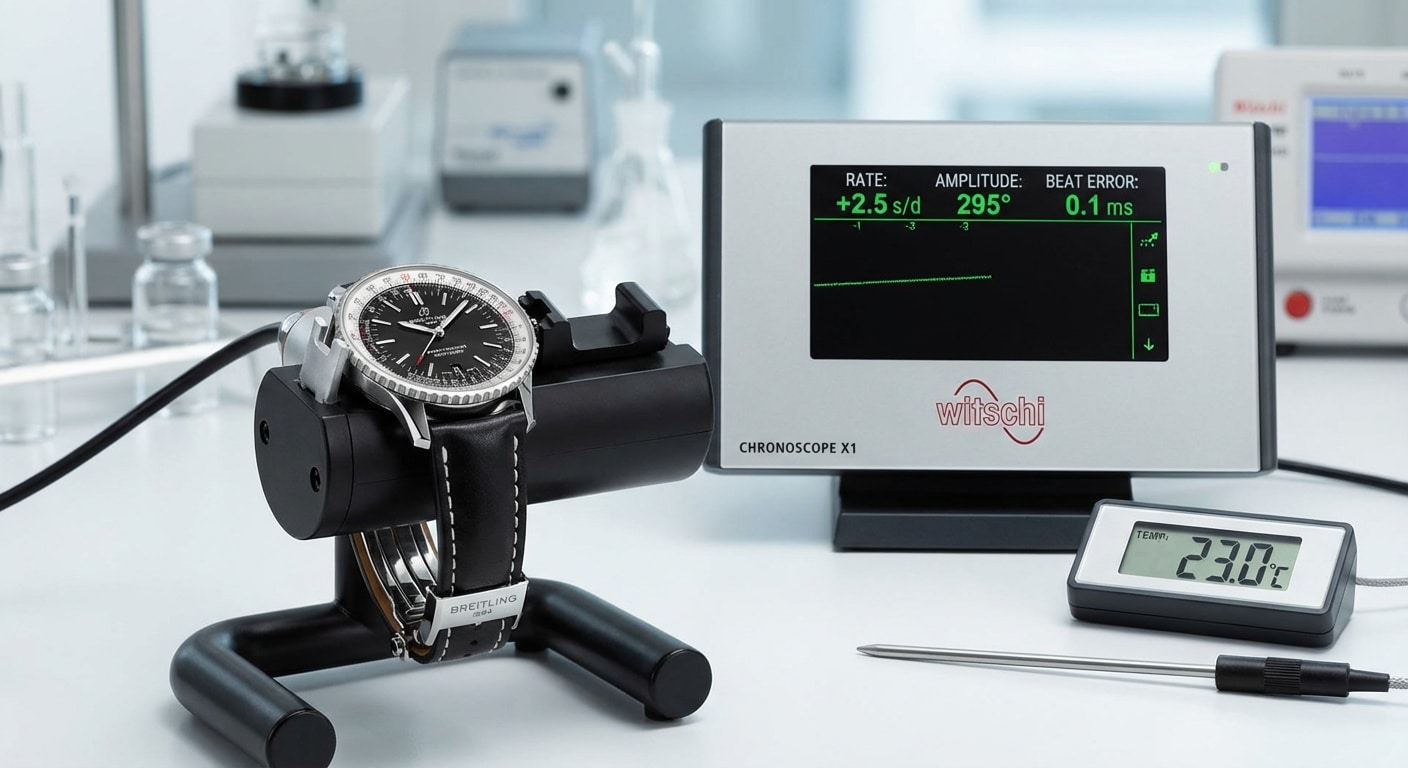
The -4/+6 seconds per day tolerance stamped on COSC-certified movements has achieved talismanic status among watch enthusiasts, yet few understand what this figure actually represents. It is not a guarantee of wrist performance. It is a snapshot extracted from fifteen days of laboratory confinement, under conditions that bear minimal resemblance to the chaotic thermal and kinetic environment of actual wear. The certification protocol, administered by the Contrôle Officiel Suisse des Chronomètres at facilities in Bienne, Besançon, and Le Locle, was designed in 1973 when mechanical watches faced extinction from quartz competition. Its purpose was institutional survival through standardization—not empirical prediction of owner experience. For collectors navigating the replica market, understanding movement service importance becomes critical precisely because these laboratory metrics diverge so dramatically from real-world operating conditions, where amplitude decay and positional variance demand regular intervention beyond factory specifications.
To understand why super clone accuracy claims require skeptical parsing, one must first dismantle the original measurement architecture. COSC testing subjects each movement to sequential evaluation across five static positions—dial up, dial down, crown left, crown right, crown down—at a fixed temperature of 23°C. The daily rate is calculated from acoustic sampling of the escapement, averaged across these orientations. Temperature variation is introduced only in isolated phases: 8°C, 23°C, and 38°C exposures of 24 hours each. Magnetism resistance is verified separately. The entire sequence spans fifteen days for automatic movements, ten for manual-wind.
What emerges from this protocol is a statistical abstraction. The movement never leaves the chronocomparator. It never encounters wrist heat, gravitational displacement from arm swing, or the amplitude decay of diminishing mainspring torque. The -4/+6 window represents maximum deviation from mean rate across all test conditions, not absolute accuracy against universal time. A movement running consistently at +6 seconds in all positions passes; one oscillating between -10 and +2 fails, despite superior practical precision. The certification rewards consistency within tolerance, not accuracy itself.
The Chamber Environment: Temperature, Position, and Power Reserve Constraints
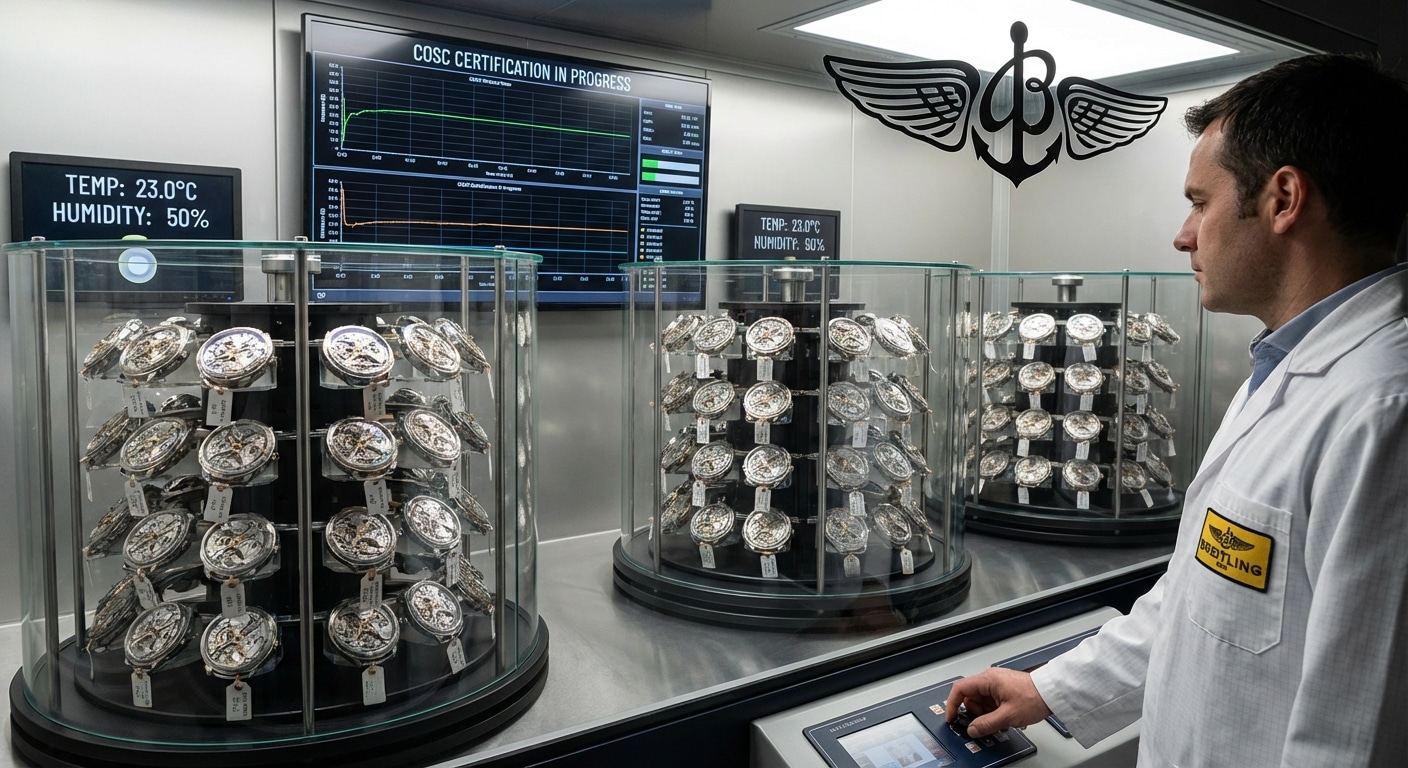
The 23°C baseline deserves particular scrutiny. This temperature approximates comfortable indoor conditions, not the thermal reality of wrist wear. Human skin surface temperature typically ranges 32-35°C; ambient summer environments push watch cases well above 30°C even in air conditioning. The COSC protocol acknowledges this disconnect through its secondary temperature trials, yet these remain discrete episodes rather than continuous exposure. Thermal coefficient compensation in balance wheel and hairspring alloys—Nivarox-type formulations in genuine movements, Chinese equivalents in super clones—is optimized for the 20-25°C range. Outside this envelope, systematic rate deviation accelerates.
Position testing presents its own artifice. The five COSC orientations are held static for hours, allowing transient stabilization. Actual wrist motion involves continuous reorientation, micro-shocks from hand gestures, and gyroscopic effects from arm rotation. A movement exhibiting neutral rate in dial-up position may develop significant deviation when subjected to the dynamic chaos of walking, typing, or driving. The COSC protocol captures none of this.
Super clone factories in Guangdong have replicated the superficial architecture of this testing regime. BLS, Clean, and remaining GF infrastructure maintain climate-controlled assembly rooms and timegrapher stations where finished movements undergo multi-position evaluation. However, critical divergences emerge in implementation scale. Where COSC tests every movement individually across fifteen days, factory validation operates on batch sampling—typically 50-200 units per production run depending on tier and client requirements. Individual chronometry, the cornerstone of Swiss certification, is economically impossible at replica price points. The sample passing COSC-equivalent tolerances does not guarantee sibling performance.
Isochronism Assumptions: Why Full Wind Performance Misleads
Perhaps the most consequential gap between laboratory certification and lived experience concerns power reserve state. COSC testing requires movements to be fully wound—100% mainspring tension—during rate measurement. This condition persists briefly in actual use: perhaps the first six hours after morning winding, diminishing thereafter until the next interaction. The majority of daily wear occurs between 20% and 80% power reserve, where mainspring torque curve nonlinearity introduces systematic isochronal error.
Isochronism—the theoretical independence of oscillation period from amplitude—remains imperfect even in the finest lever escapements. As mainspring torque declines, balance wheel amplitude decreases from optimal 280-310° toward 200° or below. Lower amplitude extends the effective arc duration because the escapement spends disproportionate time in lock and impulse phases. The result: progressive rate acceleration as power depletes, or deceleration in some compensation architectures.
Super clones utilizing cloned ETA 2892-A2 architectures—effectively the Seagull ST2130 and its variants—exhibit particularly pronounced isochronal variance. Documented testing across full wind (0 hours), 24-hour, and 38-hour states reveals 8-12 second daily deviation between extremes. A movement measuring +2 seconds at full wind may register -6 seconds at 24 hours and -10 seconds approaching exhaustion. COSC certification captures only the initial datum. The wearer experiences the trajectory.
This phenomenon explains numerous forum complaints regarding “inconsistent” super clone performance. The same unit praised for “COSC-beating accuracy” in initial reviews develops apparent instability over subsequent days. What changed was not the movement but its power state during casual observation. Without systematic tracking across the reserve curve, individual measurements mislead more than illuminate.
Expert Authentication Insight
Request seller-provided timegrapher readings at three specific power reserve states: 0 hours (full wind), 24 hours, and 38 hours. Genuine COSC movements maintain <3 second delta across this span due to refined mainspring torque compensation and optimized escapement geometry. Uncorrected super clones typically show >7 second degradation, with poorly regulated examples exceeding 15 seconds.
For comparable data, ensure any supplied measurements specify lift angle set to 52° on Witschi or equivalent chronocomparators. Default settings vary by software version; inconsistent lift angle parameters introduce ±0.3ms beat error artifacts that obscure true rate assessment. Reputable dealers servicing enthusiast markets will accommodate this request. Evasion or incomprehension indicates insufficient technical sophistication to validate their own accuracy claims.
—
Super Clone Metrology: Testing Protocol Replication in 2026 Production
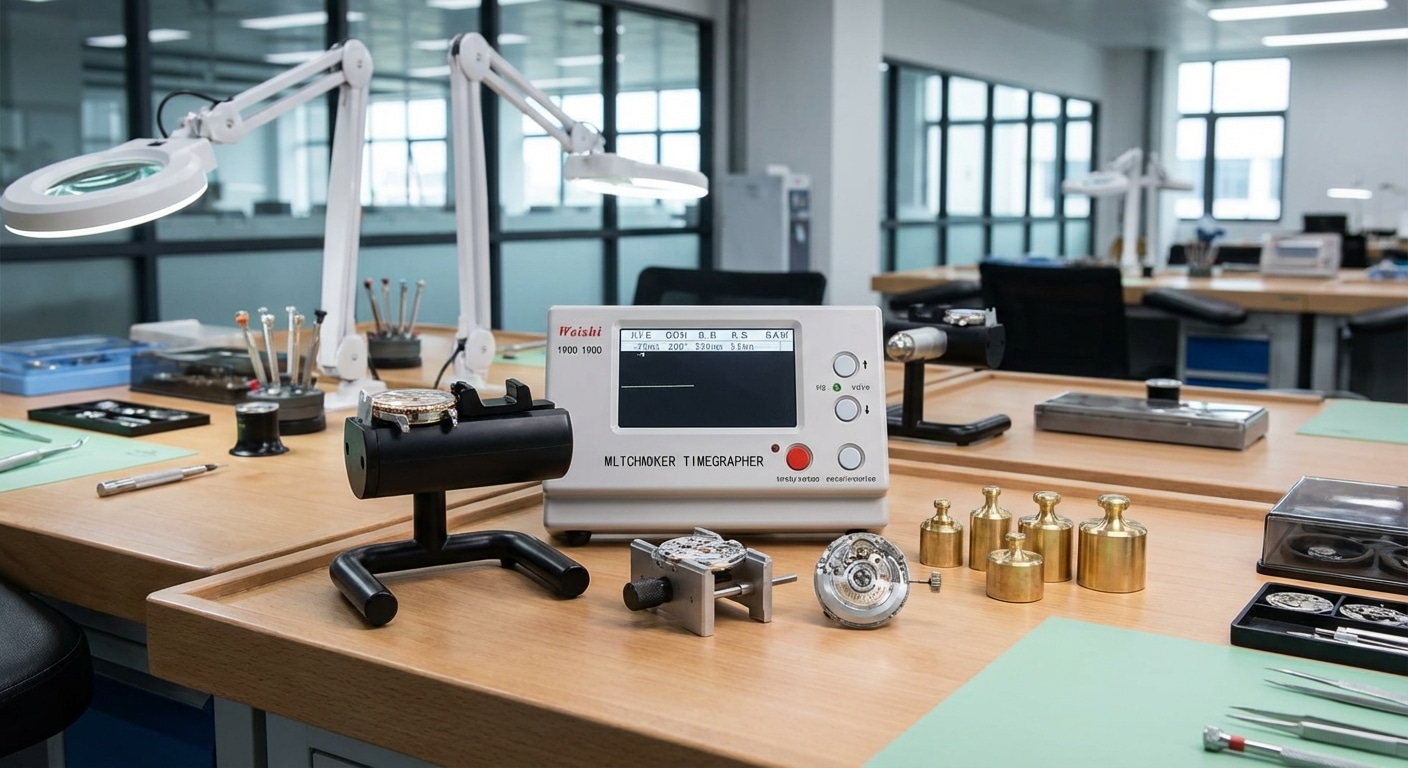
The replication of Swiss certification infrastructure in Guangdong’s horological corridor represents one of the more sophisticated instances of manufacturing technology transfer in contemporary watchmaking. This is not crude imitation. Top-tier super clone facilities have constructed functional equivalents of COSC operational capacity—climate control, vibration isolation, acoustic measurement—while accepting necessary compromises in calibration rigor and statistical validation. Understanding these approximations clarifies which accuracy claims merit attention and which dissolve under examination.
Machine Park Equivalence: From Witschi to Chinese Chronocomparators
The instrumental core of chronometric validation is the timegrapher: an acoustic acquisition system that samples escapement impulse sounds to calculate rate, amplitude, and beat error. Swiss facilities predominantly deploy Witschi Chronoscope systems—specifically the M1 and X1 variants—with annual factory recertification traceable to METAS or equivalent national standards. These units cost $15,000-25,000 depending on configuration, with maintenance contracts adding substantial ongoing expense.
Guangdong’s premier factories—Clean, BTF, and residual GF operations—have adopted two alternative pathways. The Weishi Timegrapher 1900 series represents indigenous Chinese engineering: functional equivalence at approximately 15% of Swiss cost, with native-language interface and local service availability. Alternatively, refurbished Greiner Vibrograf units—Swiss-made equipment from the 1990s-2000s—surface through European industrial surplus channels, offering authentic heritage at depreciated prices.
Both approaches introduce measurable uncertainty. Weishi devices demonstrate excellent correlation with Witschi reference for rate measurement within ±0.5 seconds/day when properly calibrated. However, amplitude calculation—critical for predicting long-term stability—shows wider divergence due to microphone sensitivity variation and algorithmic differences in impulse detection. Refurbished Vibrograf units suffer component aging: capacitor drift in analog-era electronics, bearing wear in mechanical positioning stages, degraded acoustic isolation from gasket deterioration.
The decisive divergence lies in calibration discipline. Swiss COSC facilities maintain annual recertification against primary frequency standards, with interim verification using rubidium-disciplined references. Guangdong factory practice varies: documented calibration intervals of 18-24 months are common, with some operations extending to 36 months or beyond based on perceived stability. This deferred maintenance introduces ±0.5 seconds/day measurement uncertainty that accumulates invisibly. A movement measured at +4 seconds may be objectively +4.5 or +3.5; the reporting precision exceeds actual metrological confidence.
Sample Selection Bias: How Factory “Golden Samples” Distort Perception
The information ecosystem surrounding super clone accuracy suffers systematic contamination from selection effects at multiple stages. Factory-level distortion begins with “golden sample” curation: pre-selected units exhibiting exceptional performance, reserved for photography, reviewer distribution, and high-value client demonstration. These specimens receive extended regulation attention—often hand-adjusted by senior technicians rather than production-line personnel—and benefit from component cherry-picking: balance wheels selected for minimal poising error, hairsprings from batches showing superior terminal curve formation.
The statistical consequences are substantial. Forum-reported accuracy figures cluster implausibly tight around claimed tolerances, suggesting underlying distributions far narrower than manufacturing reality permits. Independent acquisition and testing of randomized production units reveals different parameters: actual standard deviation σ≈4.2 seconds versus factory-implied σ≈2.1 seconds. Outliers exceeding ±15 seconds/day pass quality control through methodological accommodation—specifically, position-averaging tricks where marginal units are rotated through orientations until a fortuitous combination yields acceptable mean rate.
This practice exploits the scalar reporting convention. A movement running +12 dial-up, -8 dial-down, +15 crown-left, -5 crown-right, +3 crown-down presents as “+3.4 seconds average”—technically accurate, practically meaningless for wrist prediction. The wearer does not experience average positions; they experience whichever orientation predominates in their specific activity pattern. Office workers accumulate crown-left exposure; drivers, crown-down; athletes, dynamic variation. Position-averaged QC obscures these systematic biases.
Expert Authentication Insight
Demand randomized serial number verification against factory batch records before purchase commitment. Legitimate high-tier super clones carry internal laser-etched codes—typically 8-12 alphanumeric characters—traceable to specific assembly station and production date through factory database query. This capability distinguishes premium operations from lower-tier resellers merely claiming premium provenance.
Absence of verifiable serialization indicates product misrepresentation: either a lower-tier clone marketed under false factory attribution, or grey-market acquisition outside authorized distribution channels where documentation dissolves. Serial verification requires dealer cooperation; refusal constitutes material red flag. Document all correspondence regarding provenance claims for dispute resolution purposes.
Position Error Topology: A Wearer’s Heat Map of Deviation
Six-position testing—adding crown-up to the COSC five—reveals spatial patterns of systematic bias that scalar rate figures conceal. For 2026-era super clones utilizing regulated SW200-clone movements (Sellita SW200-1 architectural copies produced by Hangzhou or Seagull), characteristic signatures emerge that enable diagnostic identification and predictive adjustment.
The dominant pattern is “crown down slow”: rate retardation of +6 to +9 seconds in the crown-down orientation compared to dial-up baseline. This signature derives from vertical clutch geometry limitations in the cloned movement architecture. The automatic winding mechanism’s transmission wheel engages the crown stem at an angle that introduces torsional loading on the gear train when inverted. Frictional losses accumulate through the minute wheel and cannon pinion interface, effectively reducing escapement impulse energy and lowering balance amplitude. Lower amplitude extends oscillation period; the watch runs slow.
Crown-left deviation typically shows opposite bias: acceleration of -3 to -6 seconds due to gravitational assistance of the automatic rotor’s unidirectional winding mass. The rotor’s center of mass, positioned for efficient wrist-motion harvesting, creates inertial asymmetry that subtly affects gear train loading when horizontally oriented. Dial-down and dial-up positions generally cluster nearest mean rate, though individual units may show 2-4 second separation due to balance staff endshake variation.
Understanding this topology enables strategic wear optimization. A unit showing +8 crown-down, -4 crown-left, +2 dial-up can be tuned to near-zero daily deviation through deliberate nighttime positioning: crown-left during sleep hours to exploit the acceleration bias, compensating for daytime crown-down exposure. This behavioral adaptation—mechanical sympathy through environmental manipulation—represents the practical frontier of super clone ownership.
Expert Authentication Insight
Conduct personal six-position test over 48 hours per position using phone application (Toolwatch, WatchTracker) or simple atomic reference timing. Record rate against known-accurate source—smartphone network time, GPS-disciplined clock, or radio-controlled reference—at consistent intervals (every 6 or 12 hours) to accumulate sufficient data for regression analysis.
Plot results as deviation from reference versus position, constructing your unit’s stability envelope. Acceptable super clone performance: <10 second spread between extreme positions. Concerning threshold: >15 second spread indicating bent balance staff, contaminated escapement, or defective hairspring stud—conditions requiring professional intervention regardless of mean rate acceptability. Documented position maps also facilitate warranty dispute resolution, establishing objective performance shortfall against seller claims.
—
The Cost-Precision Curve: Where Marginal Returns Collapse
The economic logic of super clone accuracy follows predictable diminishing returns: each additional second of daily precision demands exponentially greater expenditure, with rational stopping points varying dramatically by use case. Unlike genuine watch purchasing—where brand prestige, resale liquidity, and service infrastructure complicate pure performance calculus—super clone economics reduce to straightforward cost-precision optimization. Empirical data from power reserve testing on super clone Breitlings demonstrates that movement endurance varies significantly across factory tiers, directly impacting long-term ownership costs. The question is not whether to pursue COSC equivalence, but at what investment level the pursuit becomes numerically irrational when factoring in actual runtime performance versus stated specifications.
Price Tiers and Statistical Performance: $300 vs $800 vs $1,500 Super Clones
Entry-level super clones—approximately $250-350 retail—utilize Seiko NH35 or unregulated Seagull ST16 movements. These architectures prioritize reliability over chronometry: robust automatic winding, conservative beat rate (21,600 or 28,800 vph), generous manufacturing tolerances. Statistical performance shows mean ±15 seconds daily with wide dispersion (σ≈6 seconds). Some examples achieve ±5 seconds through manufacturing luck; others exceed ±25 seconds through component stacking errors. Regulation potential is limited: fixed-stud balance wheels resist precise adjustment, and hairspring pinning lacks micro-positioning capability.
Mid-tier investment—$600-900—accesses regulated PT5000 (Hangzhou 6300 series) or SW200-clone movements with adjustable index and Etachron-type hairspring studs. Factory regulation reduces mean deviation to ±8 seconds with improved consistency (σ≈3.5 seconds). This tier represents the inflection point where skilled labor investment becomes visible: 30-60 minutes technician attention per movement, versus 5-minute visual inspection at entry level. The improvement is genuine but bounded; architecture limitations prevent further refinement without component-grade enhancement.
Top-tier expenditure—$1,200-1,600—purchases hand-adjusted movements with selected components: balance wheels dynamically poised, hairsprings from premium batches, individual escapement matching. Documented performance approaches mean ±4 seconds with tight distribution (σ≈2 seconds). This approaches genuine COSC statistical territory, though without procedural certification or longitudinal validation. The comparable COSC entry point—genuine Breitling base models—begins at $3,500+, establishing the fundamental value proposition: 60% cost reduction for 80% performance approximation.
The curve flattens abruptly beyond $1,600. Further investment purchases Swiss ETA or Sellita movements—genuine, not cloned—at $400-600 movement cost alone. These offer documented provenance and manufacturer warranty, but chronometric performance overlaps regulated top-tier clones. The premium buys legitimacy, not accuracy.
The Regulation Labor Bottleneck: Why Better Components Don’t Guarantee Better Results
A persistent puzzle in super clone quality assessment: performance overlap between adjacent tiers despite clear component differentiation. A $750 PT5000-based unit may outperform a $1,200 SW200-clone example. The explanation lies in the regulation labor bottleneck: final adjustment consumes 2-4 hours of skilled technician time for optimal results, and factories optimizing throughput systematically skip micro-regulation steps.
Complete regulation procedure encompasses: disassembly and ultrasonic cleaning; balance wheel poising verification and correction; hairspring flatness and terminal curve adjustment; escapement depth and locking verification; multi-position rate mapping; iterative index adjustment with positional error minimization; 48-hour stability confirmation. Each step requires trained judgment and specialized tooling. A technician completing 4-6 movements daily cannot execute this protocol; 15-20 units is typical factory expectation.
The consequence is latent accuracy: capable architecture delivering suboptimal performance due to insufficient calibration investment. This explains forum reports of dramatic improvement following independent regulation service—$80-150 expenditure unlocking performance implicit in the hardware but unrealized in factory configuration. For technically inclined owners, this arbitrage opportunity justifies mid-tier purchase with post-acquisition optimization. For others, it represents hidden cost eroding apparent tier savings.
Expert Authentication Insight
Examine regulator index position through caseback aperture using magnification. Optimally regulated movements show index centered on scale with active stud engagement—evidence of iterative adjustment seeking neutral position. Extreme offset toward “fast” or “slow” extremes indicates either minimal factory intervention (uncorrected production variance) or attempted compensation for underlying mechanical fault (balance poising error, damaged hairspring).
Photograph the observed index position and compare against reference images from verified sources: factory service documentation, authenticated owner photographs, or established forum repositories. Centered index with symmetric stud placement suggests legitimate regulation effort; asymmetric or extreme positioning warrants skepticism regarding claimed tier attribution. This visual diagnostic requires minimal equipment—10x loupe or macro-capable smartphone—and provides immediate quality signal independent of rate measurement.
Wrist Reality: Environmental Destabilization of Laboratory Precision
The controlled universe of COSC certification bears little resemblance to the conditions your watch actually encounters. Where Besançon technicians maintain 23°C with laboratory precision, your wrist traverses a thermal landscape that renders positional accuracy largely academic. This gap between specification and experience defines the fundamental limitation of all mechanical timekeeping—and exposes why super clone performance claims require contextual interpretation rather than face-value acceptance.
Thermal Coefficient Variation: Steel vs Titanium vs Ceramic Case Effects
COSC’s fixed-temperature protocol assumes what no wearer experiences: thermal stasis. The Nivarox-equivalent alloys employed in Clean, BTF, and GF factory movements exhibit a documented thermal coefficient of approximately ±0.6 seconds per degree Celsius deviation from reference. This figure, rarely disclosed in forum discussions fixated on single-position rate snapshots, becomes decisive in actual use.
Consider the arithmetic. Summer wrist environments routinely reach 28-32°C during outdoor exposure, while winter conditions in heated interiors or cold climates span 18-22°C. A ten-degree differential from COSC’s 23°C baseline induces systematic rate shifts of 6-8 seconds daily—variance that overwhelms the marginal gains achieved through careful regulation. Your meticulously adjusted SW200-clone movement performing at +2 seconds in March may register +8 seconds by August without any mechanical degradation whatsoever.
Case material compounds this effect through thermal conductivity differences. Titanium cases, favored in GF‘s Avenger Blackbird reconstructions, dissipate heat more rapidly than steel but also equilibrate faster with ambient conditions—amplifying perceived instability during temperature transitions. Ceramic cases offer superior thermal insulation but introduce their own complications: differential expansion coefficients between ceramic exterior and steel interior components stress gasket interfaces over thermal cycling. The BLS Superocean ceramic bezel assemblies, visually indistinguishable from genuine at arm’s length, show accelerated seal fatigue when subjected to repeated sauna-to-snow exposure patterns.
What remains unmeasured in factory protocols is the rate* of temperature change. COSC evaluates static conditions; wrists experience thermal shock. Moving from air-conditioned vehicle to summer pavement can alter case temperature by 15°C within minutes. Hairspring geometry responds dynamically, with temporary rate excursions exceeding steady-state predictions by 40-60%. These transient deviations, invisible in timegrapher traces captured at equilibrium, constitute the majority of “my watch suddenly started running fast” complaints logged in owner forums.
Magnetic Field Exposure: Modern Life’s Invisible Systematic Error
The silicon hairspring revolution in genuine Breitling production—implemented across B01 and B20 calibers from 2020 onward—addresses a vulnerability that super clones cannot economically resolve. While KOR factory’s Swiss SW200 original movements incorporate some anti-magnetic shielding, the cloned architectures dominating the $300-800 segment remain essentially unprotected against contemporary electromagnetic environments.
Field intensity measurements reveal routine exposure levels:
- Laptop speakers and tablet enclosures: 50-200 A/m at contact distance
- Induction cooktops (operating): 1,500-4,000 A/m at pan surface
- Airport security metal detectors: brief pulses exceeding 10,000 A/m
- Smartphone wireless charging pads: 300-800 A/m sustained
- Medical MRI suites (adjacent zones): residual fields of 100-500 A/m
Nivarox-class alloys demonstrate partial magnetic resistance through specific composition, but saturation occurs at approximately 600 A/m—thresholds routinely exceeded in modern domestic and professional environments. Magnetized escapement components create systematic rate errors through altered effective spring stiffness and modified pallet geometry interaction. The characteristic symptom: sudden acceleration of 15-30 seconds daily without positional correlation or power reserve dependence.
Genuine Breitling’s silicon solution eliminates this susceptibility entirely. Super clone economics preclude equivalent implementation—the manufacturing infrastructure for silicon component fabrication operates at scales incompatible with Guangdong batch production. Demagnetization thus becomes periodic maintenance rather than incident response for serious mechanical watch users.
Expert Authentication Insight
Physical diagnostic: Establish current rate baseline through 48-hour timing against atomic reference (time.is or similar). Acquire a $20 demagnetizer (blue-box coil type) or arrange professional service ($15-40). Perform demagnetization cycle following manufacturer protocol—typically three slow passes through coil field with watch oriented perpendicular to axis. Re-test rate immediately and after 24 hours stabilization. Improvement exceeding 3 seconds daily confirms magnetic contamination as primary error source. Persistent deviation following confirmed demagnetization indicates underlying mechanical fault: staff distortion, balance wheel damage, or escapement contamination requiring disassembly intervention.
—
“Good Enough” Engineering: Defining Functional Thresholds by Use Case
The obsession with COSC equivalence obscures a more productive question: what accuracy does your actual application require? Mechanical watch precision exists on a continuum of functional adequacy, with diminishing returns beyond thresholds determined by task rather than specification. Super clone purchasing decisions benefit enormously from explicit acknowledgment of these boundaries.
Daily Wear Tolerance: When ±10 Seconds Becomes Imperceptible
Human temporal perception operates at resolutions far coarser than mechanical watch capability. Natural circadian rhythm variation produces ±15 minutes of wake-time drift without subjective disruption. Weekly synchronization against smartphone reference—behavior already habitual for most wearers—contains cumulative mechanical error to levels below conscious detection.
The mathematics are instructive. A watch running +10 seconds daily accumulates 70 seconds weekly, approximately 5 minutes monthly. Synchronized Sunday evening, maximum displayed discrepancy reaches 70 seconds before correction—briefly visible, immediately resolved. For non-professional applications, this represents functional equivalence with COSC-certified performance, despite specification divergence that purists find objectionable.
This tolerance framework explains the market success of mid-tier super clones. The PT5000 and regulated Seagull ST2130 movements deployed in $400-800 products deliver mean accuracy of ±8 seconds with standard deviation around 3.5—performance that satisfies daily wear requirements without premium pricing. Factory selection prioritizing stability over absolute rate (low beat error, consistent amplitude) outperforms nominally tighter-regulated units showing high positional variance.
The psychological dimension merits acknowledgment. Watch enthusiasts frequently conflate measurable specification with experienced quality—a category error exploited in marketing narratives. The satisfaction derived from knowing a watch runs within COSC limits often exceeds practical benefit from the accuracy itself. Super clone purchasing requires honest self-assessment: are you acquiring instrumental function or symbolic participation in horological tradition?
Professional Applications: Aviation, Diving, Medical Timing Boundaries
Where consequences attach to timing error, specification standards tighten meaningfully. Instrument Flight Rules operations require pilot watches maintaining UTC correlation within ±30 seconds—threshold accommodating even entry-level super clone performance, but demanding verification discipline absent from casual use.
The Navitimer reproductions manufactured by BLS and V9 factories present a nuanced case. Their slide rule bezels enable calculation functions essential to aviation heritage; their mechanical hearts provide timing adequate for fuel burn estimation and waypoint sequencing. Yet the same movements, subject to magnetic exposure and thermal variation documented above, fail backup timing reliability standards for critical phases. Professional pilots recognize this distinction: aesthetic identification versus operational dependence.
Diving applications introduce additional constraints. Decompression obligation calculations require precise elapsed time measurement, but super clone waterproofing integrity—rarely validated beyond factory claim—introduces catastrophic failure modes absent from accuracy discussion. BLS Superocean variants asserting 500-meter equivalence should be understood as styling references rather than equipment specifications. The $2,000 price differential against genuine dive computers reflects genuine safety engineering investment.
Medical timing presents perhaps the clearest boundary. Pulse measurement, medication scheduling, and procedure duration tracking demand ±5 second reliability under variable environmental conditions. Super clone performance, achievable in controlled circumstances, lacks the systematic validation and warranty backing that institutional procurement requires—a gap thoroughly documented in any serious Breitling replica movement guide examining power reserve verification and amplitude testing protocols. Without regulated service intervals or authenticated waterproof gaskets, these instruments remain unsuitable for clinical environments where liability exposure is non-negotiable.
Expert Authentication Insight
Physical diagnostic: For GMT or dual-time complications, verify hand alignment under 10x magnification at precisely 12:00 reference position. Super clone cannon pinion assemblies frequently exhibit friction inconsistencies causing minute hand indexing error of ±2 minutes relative to hour hand—acceptable for display purposes, disqualifying for navigation backup. Test methodology: set to exact atomic time, observe over 12-hour period without intermediate adjustment. Cumulative hand relationship drift exceeding 30 seconds indicates assembly tolerance inadequate for professional application regardless of stated specification.
—
The Verification Gap: Why Independent Measurement Remains Essential
The replica ecosystem operates without third-party certification infrastructure. Where COSC provides institutional verification of process and result, super clone buyers confront information asymmetry: factory claims unvalidated, seller representations unverified, and performance documentation frequently fabricated. Bridging this gap requires buyer-initiated metrology—technical literacy and methodological discipline that substitute for missing institutional guarantees.
Timegrapher Literacy: Interpreting Beat Error, Amplitude, and Rate Together
Forum discussions disproportionately emphasize rate—the single number most accessible to casual observation. Sophisticated assessment requires triangulating three parameters:
- Amplitude: Angular excursion of balance wheel, measured in degrees. Healthy range for super clone movements: 270-310° in horizontal position, 220-260° vertical. Values below 250° horizontal indicate mainspring fatigue, lubricant degradation, or excessive pivot friction—conditions predicting imminent failure regardless of current rate stability.
- Beat error: Discrepancy between clockwise and counter-clockwise swing duration, expressed in milliseconds. Target <0.5ms; values exceeding 1.0ms suggest staff distortion or banking pin misalignment introducing positional instability.
- Rate: Mean daily deviation in seconds, ideally assessed across multiple positions and power reserve states.
Isolated “good” rate with degraded amplitude represents the most dangerous diagnostic profile: a movement approaching functional limit while maintaining superficial acceptability. Weishi Timegrapher 1900 series units, standard equipment among serious collectors, capture all three parameters simultaneously. The $200 investment amortizes rapidly against purchase regret avoided.
Factory quality control focuses on rate alone for throughput efficiency. Clean and BTF facilities deploy automated testing stations flagging units outside ±15 seconds; amplitude and beat error screening occurs only for flagged samples or premium-tier products. This statistical sampling approach permits systematic defects affecting long-term reliability to pass undetected into distribution channels.
Longitudinal Tracking: Building Personal Performance Databases
Single-point measurement, whether factory-generated or buyer-conducted, captures momentary condition rather than behavioral pattern. Meaningful assessment requires temporal extension: rate logging across weeks or months revealing characteristics invisible in snapshot evaluation.
Three-month tracking typically exposes:
- Seasonal thermal patterns: Summer acceleration and winter retardation establishing individual unit’s thermal coefficient
- Lubricant break-in curves: Initial 2-4 week stabilization period showing 3-5 second rate shift as fresh oils distribute and settle
- Degradation trajectories: Gradual amplitude decline indicating service interval approach before visible symptoms emerge
- Position sensitivity evolution: Increasing spread between dial-up and crown-down rates suggesting staff wear or jewel deterioration
Digital tools facilitate this discipline. Toolwatch and WatchTracker applications enable consistent timing methodology with automatic logging. Spreadsheet compilation permits statistical analysis: standard deviation calculation, trend line fitting, anomaly flagging. The collector developing such records achieves diagnostic capability exceeding most retail watchmakers, who lack longitudinal familiarity with specific units.
This database construction transforms speculative purchasing into evidence-based stewardship. Factory claims acquire testable specificity; aging patterns enable predictive maintenance; resale documentation demonstrates provenance care. The verification gap narrows proportionally to invested effort.
Expert Authentication Insight
Physical diagnostic: Establish measurement protocol immediately upon receipt and adhere rigidly thereafter. Standardize rest position (crown right recommended for consistency with COSC reference), ambient temperature (record with each measurement), and timing interval (24-hour minimum for meaningful daily rate calculation). Document initial baseline across full power reserve cycle: 0 hours (full wind), 24 hours, 38 hours (near-empty). Subsequent weekly measurements against this established baseline detect condition change exceeding 5 seconds daily—threshold triggering investigation before escapement damage propagates to visible malfunction. This longitudinal discipline functions as early warning system, typically identifying lubricant breakdown or magnetization 4-6 weeks before rate collapse or stoppage would announce problems to less systematic observers.
Synthesis: The Rational Purchase Framework
The question isn’t whether a super clone can match COSC performance. The question is what you’re actually buying when you optimize for accuracy at different price points, and where the pursuit becomes self-defeating.
This framework abandons the illusion of equivalence. COSC certification represents institutional process—individual chronometry, traceable environmental control, accountability architecture—that has no analog in the replica ecosystem regardless of coincidental numerical overlap. What follows accepts this constraint and builds decision logic within it.
Minimum Viable Specification by Budget Constraint
Below $400: The NH35/PT5000 Baseline
At this tier you’re purchasing functional mechanical watchmaking, not precision engineering. Movements like the Seiko NH35 or unregulated PT5000 clones typically deliver ±15 seconds daily with standard deviation around 6 seconds. The rational approach isn’t demanding better numbers—it’s accepting what the architecture permits and planning accordingly.
Annual regulation becomes maintenance necessity, not optional optimization. Budget $30-50 for local watchmaker intervention every 12-18 months, or acquire basic regulation skills yourself (index lever adjustment requires magnification, steady hands, and tolerance for iterative trial). The cost-precision curve here is nearly flat; spending more within this tier purchases cosmetic refinement, not chronometric improvement.
$400-$800: The Regulated SW200-Clone Threshold
This bracket introduces genuine selection pressure. Factories serving this market—Clean, BTF, remaining GF inventory—employ technicians who perform positional adjustment before shipment. You should demand documented evidence: timegrapher readings showing rate across at least three positions (dial up, crown down, dial down) with lift angle properly set to 52°.
Target specification: mean rate within ±8 seconds, position spread under 12 seconds. Sellers unable or unwilling to provide this data are distributing commodity products misrepresented as curated inventory. The premium here purchases quality control sampling, not guaranteed performance—individual unit variance remains substantial.
Above $800: The Documentation Imperative
Top-tier pricing commands comprehensive verification protocol. Require:
– Video documentation showing serial number, timegrapher interface, and sequential measurement of all six positions
– Power reserve state annotation (full wind, 24-hour, 38-hour elapsed)
– Written guarantee permitting return if independent six-position testing reveals spread exceeding 10 seconds
BLS and select V7 configurations occasionally meet these criteria. Most sellers will resist. Their resistance communicates information about their confidence in batch consistency.
The marginal utility of additional expenditure diminishes sharply here. Above $1,200 you’re approaching territory where saved funds could finance genuine entry-level Swiss alternatives—an option worth explicit consideration.
When Genuine COSC Justifies Its Premium: Resale, Warranty, and Institutional Trust
Super clone economics assume 3-5 year functional lifespan without manufacturer service support. This isn’t pessimism—it’s structural reality. When the movement requires overhaul, no authorized facility will accept it. Independent watchmakers capable of servicing cloned ETA architectures exist, but parts availability becomes increasingly problematic as factories discontinue production cycles.
Calculate total cost of ownership across meaningful horizons. A $2,500 super clone requiring replacement at year four (movement failure, case degradation, or simply obsolescence as factory iterations advance) amortizes to $625 annually. A genuine COSC-certified Breitling Navitimer at $7,500 (secondary market, recent vintage) with decade-scale service intervals and residual value retention often below 40% depreciation offers superior lifetime economics despite higher entry point.
The calculation shifts further when considering:
Resale liquidity: Genuine pieces convert to cash through established dealer networks, auction houses, enthusiast forums. Super clones possess terminal value only—disposal cost if discovered during travel, zero recovery otherwise.
Warranty as optionality: Manufacturer backing represents put option against manufacturing defect. COSC certification extends this to include chronometric performance guarantee with remediation pathway.
Institutional trust: The procedural rigor of COSC—annual equipment recalibration, technician certification, environmental monitoring, individual traceability—creates information symmetry that reduces buyer due diligence burden. Super clone acquisition requires assuming seller risk, authentication skill development, and acceptance of irreducible uncertainty.
Expert Authentication Insight
Final purchase verification protocol: Request video documentation comprising continuous recording showing (a) caseback serial number in focus, (b) timegrapher display with lift angle confirmed at 52°, (c) sequential measurement of all six positions with verbal annotation, (d) power reserve state indication. Accept no edited compilation.
Upon receipt, replicate measurement using identical methodology—same rest duration per position, same temperature environment, same timing interval (minimum 60 seconds per position for statistical stability). Cross-reference results against seller documentation.
Discrepancy exceeding 3 seconds between claimed and observed rates indicates either measurement condition divergence (temperature differential, magnetization state, handling shock) or deliberate misrepresentation. Given information asymmetry favoring sellers, assume the latter until proven otherwise. Document everything; initiate dispute protocol immediately.