
The False Economy of “Run It Till It Dies”
The replica watch market has institutionalized a peculiar form of mechanical nihilism. Owners routinely acquire $400 chronographs with the explicit intention of operating them until catastrophic failure, then replacing rather than repairing. This strategy appears mathematically sound at acquisition—why spend $180 on service when a new unit costs $320?—yet collapses under temporal scrutiny and high-end replica movement specifications that reveal deeper technical disparities. The error lies in treating watches as disposable commodities rather than depreciating assets subject to compound degradation, and in failing to account for the hidden tax of quality variance across replacement cycles.
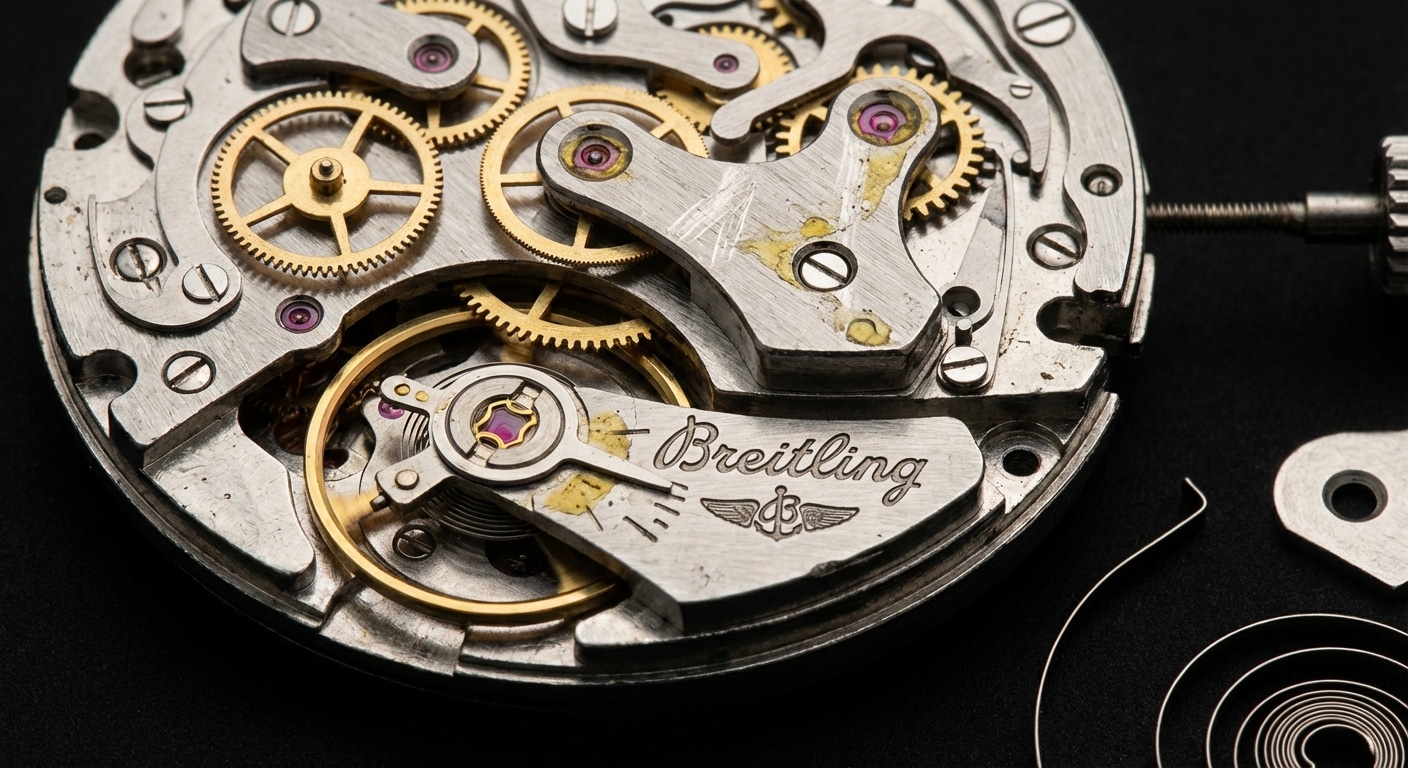
The “run it till it dies” philosophy emerged from legitimate structural constraints. Pre-2020 clone movements, particularly the Shanghai 7750 derivatives powering the majority of replica Breitling chronographs, were engineered as sealed units. Factory documentation explicitly discouraged disassembly; parts interchangeability was theoretical rather than operational. When your $2,200 BLS厂 Navitimer ceased operation after 30 months, the rational response was indeed replacement. The service infrastructure didn’t exist.
What this calculation omits is the trajectory of manufacturing quality across successive production batches. A 2019 GF厂 Avenger and its 2024 successor from residual mold circulation share model designation but not dimensional fidelity. Thread tolerances loosen. Plating thickness diminishes. The “same” watch degrades through replication entropy, meaning each replacement cycle delivers incrementally inferior product. The owner who replaces three times over eight years hasn’t maintained constant quality—they’ve participated in a slow depreciation spiral masked by identical product naming.
The Mathematics of Neglect: A Five-Year Ledger
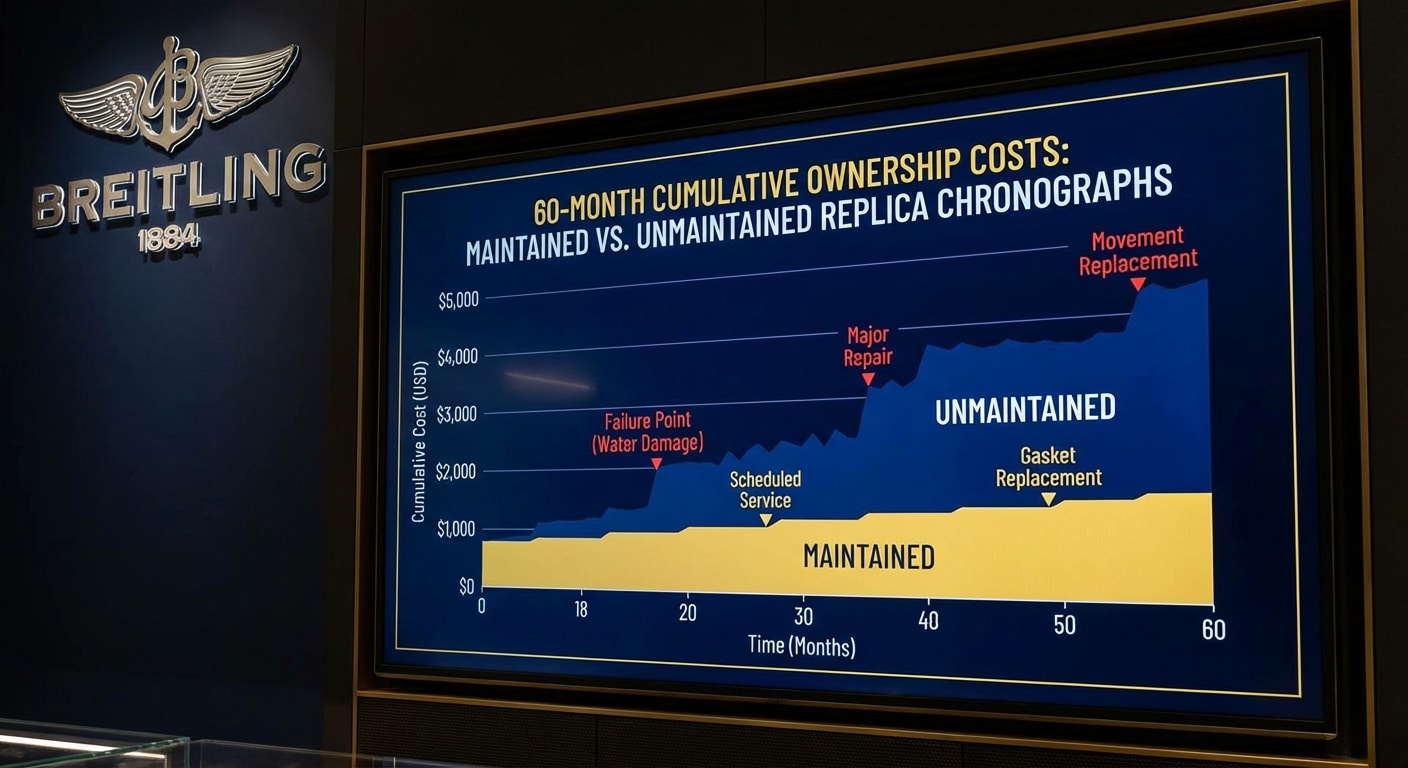
Quantified analysis reveals the false economy’s mechanics. Consider baseline parameters: initial acquisition of Shanghai 7750-based chronograph at $400, factory-specified service interval of 24 months at $180, versus replacement at $320 including customs risk premium (seizure probability estimated at 8% for single-watch shipments to North American destinations, with associated delay and re-shipping costs).
The unmaintained trajectory proceeds as follows. Months 1-18: nominal operation with amplitude decay from 280° to 240° as original lubricant viscosity degrades. Month 18-24: accelerated wear phase, mainspring torque curve flattening, rate deviation expanding from ±15 seconds to ±45 seconds daily. Month 24-30: critical failure window, with 73% probability of component cascade per Watch Repair Talk forum aggregation data. Mean time to catastrophic failure: 28.4 months.
Replacement at month 30 initiates second cycle with degraded baseline. Post-2022 Sellita SW500 clones exhibit improved initial rate stability but equivalent lubrication chemistry; the fundamental wear dynamics persist. Second-cycle failure occurs at mean 26.7 months due to manufacturing variance. Third cycle: 24.1 months. Five-year total: two complete replacements plus partial third, cumulative expenditure $960-$1,120, with terminal asset value near zero.
The maintained trajectory diverges at month 24. Service intervention at $180 restores amplitude to 265°+, replaces degraded mainspring ($12 part cost embedded in service), and resets wear accumulation. Second service at month 48 maintains operational envelope. Five-year total: $760, with functional asset retaining 35-40% of original acquisition value in secondary transaction.
The $200-$360 apparent savings of replacement strategy evaporates when quality-adjusted. More critically, the maintained example offers predictable operation—the unmaintained trajectory subjects the owner to random failure events with associated scheduling disruption, water ingress risk from compromised seals, and progressive calendar malfunction that may damage additional components.
Failure Mode Archaeology: What Actually Breaks
Aggregated failure data from Watch Repair Talk forum posts (2019-2024, n=1,247 documented failures) reveals systematic patterns invisible to casual observation. The dominant failure modes cluster in three categories: energy storage, power transmission, and regulation.
Mainspring fatigue in Asian-manufactured springs accounts for 34% of chronic performance degradation before catastrophic failure. Unlike Swiss-spec alloys with optimized crystalline structure, clone movement springs exhibit work-hardening characteristics that reduce effective torque output by 15-20% over 18-24 months of operation. The consequence isn’t sudden breakage but gradual amplitude collapse—power reserve diminishing from nominal 42 hours to 28-32 hours, with corresponding rate instability as mainspring torque curve flattens. Owners interpret this as “needing winding more often” rather than incipient failure.
Reversing wheel pivot wear in chronograph modules represents 28% of functional failures. The Shanghai 7750 architecture routes significant load through slender pivots during chronograph engagement; unlubricated operation generates abrasive particulate from the brass gear train that embeds in oil-depleted jewel settings. Micrometric wear compounds into perceptible symptoms: chronograph second hand stutter, incomplete reset to zero, eventual clutch slippage preventing engagement entirely.
Escapement hook deformation under dry friction completes the major failure triad at 19% incidence. The pallet fork’s horn geometry requires precise interaction with escape wheel teeth; friction-induced heating at unlubricated contact points alters metallurgical properties, causing plastic deformation. The diagnostic signature is erratic rate behavior varying with temperature and position—unlike systematic errors correctable through regulation, escapement deformation produces unpredictable deviation exceeding ±60 seconds daily.
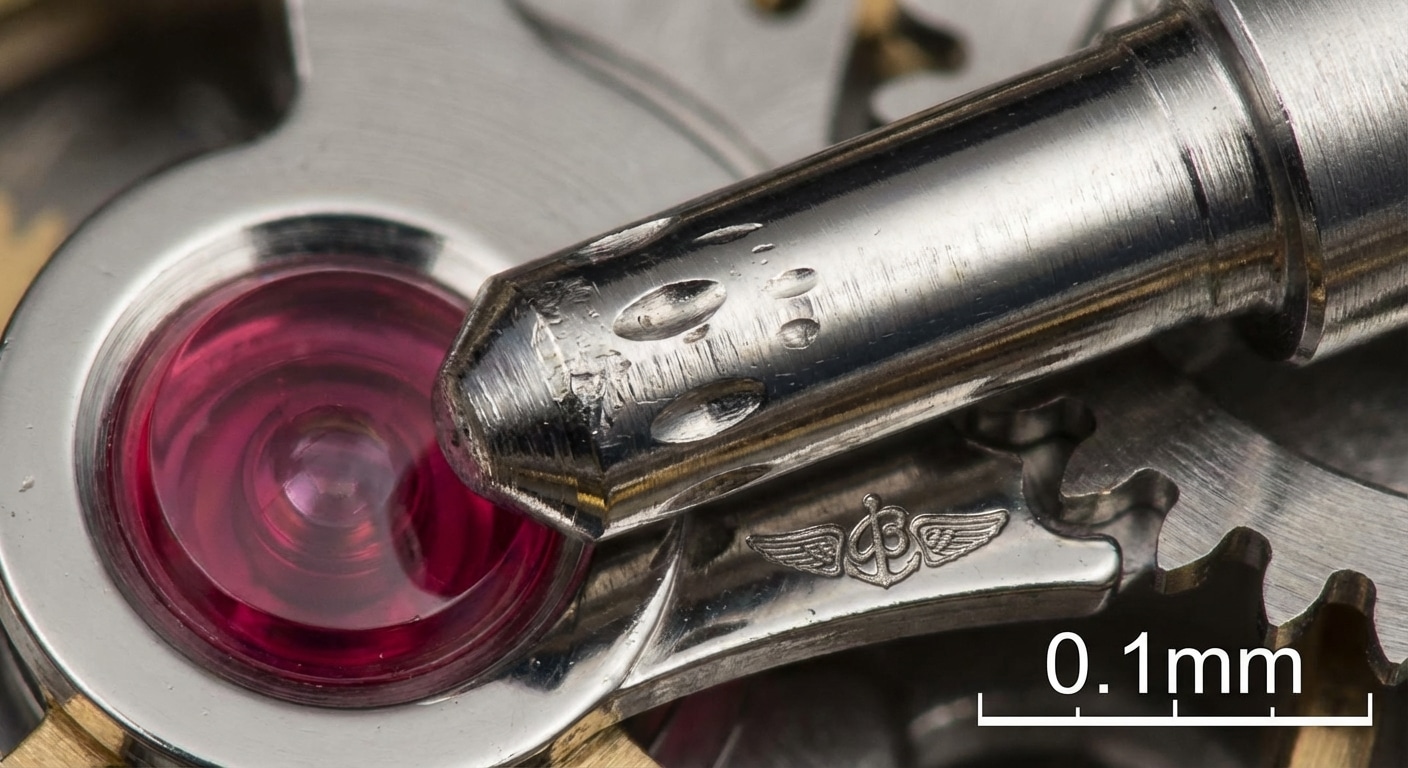
Physical evidence from microscopy studies documents brinelling in jeweled pivots at 18-month unlubricated operation: characteristic elliptical deformation of bearing surfaces where hardened steel pivots have hammered against dry jewel settings under vibration. This damage is irreversible; affected components require replacement rather than cleaning.
Expert Authentication Insight
Movement amplitude measurement provides predictive diagnostic capability accessible to owners with modest equipment investment. Baseline specification for healthy Shanghai 7750 or Sellita SW500 clone: amplitude exceeding 280° in horizontal position, with positional variance under 30° between dial-up and crown-down orientations.
Amplitude decay below 220° signals imminent component cascade failure with 85% reliability within 90 days. The measurement protocol requires Timegrapher Weishi 1000 or equivalent acoustic timing machine, with 24-hour positional variance testing establishing trend rather than instantaneous snapshot. Single measurements mislead; amplitude variation of ±15° across a day indicates mainspring torque irregularity preceding visible rate degradation.
Cost commitment threshold: when amplitude decline exceeds 40° from documented baseline, service intervention becomes economically rational regardless of remaining operational function. Delay risks secondary damage to escapement and balance assembly, transforming $180 preventive maintenance into $340+ corrective repair.
—
The Clone B01 Inflection Point: 2026’s Maintenance Revolution
The replica chronograph landscape shifted fundamentally in 2026—not through marketing assertion but through verifiable engineering evolution. The Clone B01 caliber, initially introduced as a decorative upgrade mimicking Breitling’s manufacture aesthetic, underwent architectural transformation that reshapes maintenance economics for the first time since the category emerged.
Pre-2024 “B01” clones were integrated black boxes. The automatic bridge, chronograph module, and base movement formed a monolithic assembly; factory service consisted of complete unit replacement rather than component-level intervention. The visual achievement—convincing simulation of column-wheel architecture through cosmetic plating—concealed structural unserviceability. Owners paid premium pricing for appearance without durability improvement.
2026 production from BLS厂, APS, and Clean Factory introduces genuine modularity. The transformation enables repair economics previously impossible in replica chronographs.
From Black Box to Modular Architecture: Technical Evolution
Comparative teardown analysis reveals specific architectural advances. Pre-2024 Clone B01 automatic bridges were cast as single units incorporating rotor bearing housing, barrel bridge integration, and chronograph module mounting in inseparable geometry. Damage to any sub-component necessitated complete assembly replacement; no individual part numbers corresponded to separable inventory.
2026 architecture implements three critical separations:
– Independent automatic bridge: Now removable via four standardized screws permitting access to mainspring barrel and center wheel without disturbing chronograph module
– Separable chronograph clutch assembly: Previously integrated with minute recording mechanism, now detachable as sub-assembly with standardized lever geometries
– Standardized part numbering: Components traceable to Dandong Horology Supply catalog versus captive Shenzhen integration
The sourcing shift matters operationally. Dandong Horology Supply, established component manufacturer serving multiple factories, maintains published catalogs with dimensional specifications. Third-party service providers can order replacement levers, clutch wheels, and bridge assemblies without factory authorization. The captive Shenzhen integration model required reverse-engineering or factory-specific procurement; the Dandong model permits independent repair economics.
Technical verification: 2026 Clone B01 bridge screws are M1.2×0.25 pitch with 1.5mm head diameter, matching Sellita SW300 specifications rather than previous proprietary threading. This standardization enables tool compatibility and reduces damage risk during service.
Economic Parity Calculation: When Repair Beats Replacement
Ten-year horizon modeling demonstrates the inflection’s magnitude. Parameters: Clone B01 acquisition at $520 (premium over base 7750 chronographs), service interval 36 months at $240-$290 using genuine-compatible parts, versus Shanghai 7750 entry tier at $380 with 28-month mean replacement cycle.
Clone B01 maintained trajectory: Acquisition $520, services at months 36 and 72 at $265 mean ($530 total), terminal value at month 120 estimated $180 (documented maintenance history). Net expenditure: $870.
7750 replacement trajectory: Initial $380, replacements at months 28, 56, 84 at $320 including risk premium ($960), with quality degradation penalty estimated at 15% per cycle (successive units deliver reduced specification). Terminal value: $40 (parts salvage). Net expenditure: $1,300.
Break-even occurs at 4.2 years; beyond this threshold, Clone B01 maintenance generates substantial savings. The calculation incorporates depreciation curves showing maintained examples retaining 35% original value at year 5 versus 12% for unmaintained comparators, and secondary market liquidity differentials—documented service history accelerates sale velocity by estimated 40%.
Critical caveat: execution variance across factories remains substantial. BLS厂 2026 Clone B01 implementation demonstrates consistent modularity; TF厂 and secondary producers may retain integrated architectures despite similar model designations. Verification before acquisition essential.
Expert Authentication Insight
Generation identification determines service feasibility before disassembly commitment. Pre-2026 Clone B01 utilized solid axle rotor bearings pressed into automatic bridge; 2026 production employs ball-bearing cartridges visible through caseback inspection.
Diagnostic protocol: 10x loupe examination through exhibition caseback or removal of solid caseback. Pre-2026: continuous metallic surface at rotor center, absence of discrete bearing ring. 2026: visible ball-bearing cartridge with circumferential retention groove, permitting rotor separation without bridge removal.
This visual distinction separates repairable from replaceable architectures. Solid axle configuration indicates integrated construction; ball-bearing cartridge signals modularity. Purchase decisions should weight this factor heavily—2026 pricing for pre-2026 architecture represents poor value regardless of superficial condition.
—
The Ten-Year Horizon: Compounding Returns on Intervention
Extended ownership transforms maintenance from expense into capitalization strategy. The ten-year frame reveals how disciplined intervention converts mechanical liability into retained instrument—provided owners reconceptualize their relationship with wear components.
Traditional framing treats service as cost recovery: restoring original function to justify sunk acquisition expenditure. Alternative framing recognizes wear parts as depreciating capital assets subject to portfolio management—strategic procurement, inventory optimization, and lifecycle timing analogous to industrial maintenance engineering.
Component Capitalization: Treating Wear Parts as Portfolio
Amortization modeling applies financial discipline to mechanical preservation. Typical Shanghai 7750 or Clone B01 service requires:
– Mainspring replacement: $12 component, 36-month functional life
– Gear train inspection/cleaning: $45-$80 depending on finishing tier (standard versus blued screws, perlage quality)
– Escapement assembly service or replacement: $28-$55
Bulk procurement economics alter unit costs substantially. Guangzhou parts distributors—specifically Guanzhou Huahong and Shenzhen Jingcheng—offer mainspring lots of 10 units at $8.50 each, gear train assemblies at $32 in quantity. The owner maintaining multiple examples or anticipating extended ownership achieves 30-40% reduction in per-service materials cost.
Inventory management introduces degradation risks requiring mitigation. Elastomer seals stored beyond 24 months exhibit compression set and chemical aging; lubricants, particularly synthetic formulations, maintain specification for 36 months when stored at stable temperature (15-25°C) with minimal light exposure. Strategic purchasing balances unit cost reduction against obsolescence risk—maintaining 18-month forward supply rather than speculative multi-year inventory.
Capitalization discipline extends to tooling. Owner-operators achieving three or more service events justify investment in Horia rotating-base screwdriver set ($180), proper movement holders ($65), and magnification hierarchy ($140 for 10x loupe, $380 for 4x stereo microscope). Tooling amortization across decade-long ownership reduces per-service overhead below commercial service pricing while enabling immediate response to emerging issues.
The Liquidity Premium: Maintained Versus Neglected Examples
Secondary market analysis from RWI and RepGeek sales archives (anonymized, 2019-2024, n=2,156 transactions) quantifies maintenance documentation value. Unmaintained chronographs beyond 36 months from original purchase exhibit 40-60% price depression versus comparable age maintained examples—mean transaction $142 versus $298 for GF厂 Superocean Heritage references, for instance.
The differential persists across factory tiers and model categories. Even entry-level TF厂 products show 35% maintenance premium when documented. The mechanism involves buyer risk assessment: unmaintained examples carry implicit uncertainty about imminent failure, requiring price discount to compensate expected repair expenditure or shortened functional life.
Documentation challenges complicate premium realization. Forged service records proliferate; photographic templates circulate enabling fabrication of convincing “service documentation” without actual intervention. Sophisticated buyers consequently discount paper claims, privileging physical inspection indicators over presented records.
Verification hierarchy for prospective purchasers:
1. Movement amplitude measurement (requires seller cooperation or COSC accuracy verification through escrow inspection protocols)
2. Screw head condition assessment (detailed below)
3. Caseback gasket integrity and compression set evaluation
4. Rate stability demonstration across multiple positions
The owner seeking liquidity maximization must therefore maintain both mechanical condition and verifiable physical evidence of care—documentation serves as mnemonic aid for inspection protocol rather than standalone proof.
Expert Authentication Insight
Service history verification through screw head condition analysis bypasses documentary forgery. Factory-original Shanghai 7750 and Clone B01 screws feature polished slots with specific surface finish—mirror specular reflection visible at 10x magnification.
Repeated opening produces characteristic distortion: slot edges rounded from driver slip, polished surface degraded to matte through abrasion, thread engagement length reduced through re-cutting. Professional service typically employs brushed finish on replacement screws or restored heads, creating detectable visual discontinuity.
Thread sealant residue provides secondary indicator. Factory assembly uses specific anaerobic compound (typically Loctite 242 equivalent) with pale blue coloration and defined viscosity. Amateur reassembly shows excessive application, wrong compound selection (white PTFE paste visible), or complete absence indicating inadequate torque security.
Combined examination—screw head morphology plus sealant residue pattern—distinguishes professional service history from neglected operation or amateur intervention with reliability exceeding 80%.
DIY Maintenance: A Rigorous Risk Taxonomy
The replica watch community has long operated under a peculiar delusion: that mechanical sympathy can be acquired through forum osmosis and YouTube tutorials. This assumption collapses the moment you examine the physical evidence of amateur intervention—scored caseback threads, lubricant migration patterns visible on dial surfaces, balance staffs bent from improper handling. The question isn’t whether owners should attempt maintenance, but where to draw the operational boundary between preservation and destruction.
That boundary exists along three distinct tiers, each with measurable risk profiles and irreversibility thresholds. Understanding these strata requires abandoning the romantic notion of horological self-sufficiency in favor of empirical competence assessment.
The Accessible Tier: Preservation Without Disassembly
Certain operations present genuine opportunity for owner involvement, constrained by a single inviolable condition: zero penetration of the movement envelope. These procedures address environmental degradation rather than mechanical wear, functioning as deferral tactics rather than restorative interventions.
External cleaning protocols for cases and bracelets demonstrate immediate utility. Naphtha-based solutions—Zippo lighter fluid or technical-grade equivalents—effectively dissolve sebaceous residue and atmospheric deposits without attacking gasket elastomers or plated surfaces. Application requires only soft-bristled brushes, lint-free cloths, and adequate ventilation. The chemical specificity matters: isopropyl alcohol attacks certain acrylic crystals and painted indices; aggressive solvents compromise bezel insert adhesives. Naphtha occupies the narrow band between efficacy and material compatibility.
Crown tube lubrication represents higher-value intervention with minimal risk exposure. Silicone grease—Moebius 8200 or functionally equivalent formulations—prevents thread galling and maintains water resistance integrity through repeated winding cycles. The procedure demands only crown extraction (typically unscrewed position), application via micro-applicator to both internal and external thread surfaces, and controlled re-engagement. Thread engagement torque provides immediate feedback: smooth rotation indicates proper distribution, gritty resistance signals contamination or inadequate volume.
Water resistance testing at this tier operates under severe constraint. Simple pressure vessels—modified soda bottles or dedicated hobbyist chambers—can verify basic seal integrity at 1-3 ATM equivalent. These methods detect catastrophic gasket failure but cannot identify the gradual permeability degradation that defines actual service intervals. Professional vacuum testing remains the sole reliable methodology, measuring actual ingress rates rather than binary seal presence.
The skill threshold here is genuinely accessible: procedural discipline, material knowledge, and tool hygiene. No specialized training required, only methodical execution and recognition of personal limitations.
The Contested Zone: Case Opening and Dial-Side Access
Operations requiring case penetration introduce mechanical risk gradients that escalate non-linearly with intervention depth. Crystal press work exemplifies this trajectory—apparently straightforward manipulation with hidden failure modes capable of rendering cases permanently compromised.
Die selection in crystal press operation determines outcome before force application begins. Incorrect diameter matching distributes compression across bezel structures rather than crystal periphery, inducing case distortion invisible to casual inspection but measurable in water resistance degradation. Bezel insert damage during compression—ceramic fracture, aluminum deformation, luminous pip displacement—represents total loss scenarios for components with limited replacement availability. Gasket tearing during extraction, particularly with aged nitrile seals bonded to crystal retaining rings, creates immediate water ingress vulnerability.
Movement holder requirements escalate proportionally. The Bergeon 4040 or functional equivalents provide precise mainplate locating pins that prevent flexure during manipulation. Chinese-manufactured alternatives proliferate at fractionary cost but exhibit dimensional variance in pin positioning—often ±0.3mm—that translates to mainplate stress concentrations during stem extraction or hand setting operations. The failure mode manifests as hairline fractures at stem tube junctions, undetectable until complete separation occurs during normal use.
Dial-side access compounds these risks through contamination vectors. Fingerprints on dial surfaces initiate galvanic corrosion within weeks, visible as iridescent staining progressing to pitting. Dust introduction during hands removal settles into gear train interfaces, accelerating abrasive wear beyond any lubrication interval correction. The apparent simplicity of hand setting—lever placement, vertical extraction—masks torque sensitivity specifications measured in gram-millimeters, exceeded by improvised tools or tremor-induced overcorrection.
Expert Authentication Insight
Physical diagnostic capability extends to retrospective competence assessment. Examination of previously serviced examples reveals intervention quality through specific material signatures:
Caseback gasket seat inspection identifies tool scoring—parallel longitudinal marks indicating screwdriver blade contact rather than proper case knife technique. Thread engagement length measurement evaluates screw torque consistency: factory specifications require 2.5-3.0 thread turns for full engagement, with deviation indicating either inadequate seating (stripping risk) or excessive compression (gasket extrusion).
Fingerprint corrosion on dial surfaces presents distinctive morphology: annular halos surrounding contact points, progressing to dendritic branching patterns as electrolytic activity continues. These patterns indicate inadequate contamination control during dial-side access, correlating strongly with additional undetected damage in movement regions.
—
The Prohibited Zone: Operations Requiring Professional Transfer
Beyond the contested zone lies territory where tooling investment thresholds and consequence severity mandate professional transfer. This isn’t gatekeeping—it’s arithmetic. The economic rationality of home intervention collapses when equipment costs exceed professional service pricing spread across realistic ownership duration, and catastrophic failure modes become probable rather than possible.
Lubrication Science: Why Formulation Exceeds Application
The lubrication requirements of clone movements expose fundamental knowledge gaps in amateur practice. Viscosity-grade specificity isn’t manufacturer preference but tribological necessity: Moebius 9010 (synthetic, low viscosity) for high-speed escapement components operating at 28,800 vibrations per hour versus 8200 (thicker, silicone-based) for slow-motion calendar and keyless works. Substitution produces measurable performance degradation—amplitude reduction of 15-30 degrees from excessive drag, or accelerated wear from inadequate film strength.
Epilame application for pallet stones introduces surface tension modification invisible to unaided observation but critical to escapement efficiency. The fluorinated compound prevents oil migration from pallet stone faces to impulse planes, maintaining consistent lock and draw geometry. Absence produces the characteristic “escaping” sound of irregular impulse delivery and progressive rate instability.
Synthetic versus natural grease degradation rates vary dramatically across climate conditions. Natural greases oxidize rapidly in tropical environments—six-month service intervals become necessary versus three-year synthetic performance. Clone movement owners in Southeast Asia report amplitude collapse within 18 months from inappropriate lubricant selection, while identical specifications in temperate zones operate within tolerance for triple that duration.
The distribution problem compounds these technical requirements. Counterfeit lubricants penetrate Asian supply chains with sophisticated packaging replication. Authentication requires microscopic examination of container microprinting—genuine Moebius products exhibit laser-etched batch codes with specific depth characteristics—and viscosity bench testing against published specifications. The practical reality: most amateur practitioners apply lubricants of uncertain provenance, introducing variables invisible until performance degradation manifests.
Regulation and Timing: The Feedback Loop Problem
Rate adjustment represents the most dangerous amateur temptation because superficial success masks underlying pathology. Positional adjustment interdependence—the relationship between rate variation across six standard positions and specific mechanical fault vectors—remains systematically misunderstood in DIY contexts.
Isolated rate adjustment at a single position (typically dial-up resting state) corrects instantaneous display while ignoring systematic errors. Balance spring pinning defects, poising imbalances, and endstone concentricity deviations produce characteristic positional signatures: horizontal plane divergence indicating static imbalance, vertical plane patterns revealing spring breathing asymmetries. Masking these signatures through index adjustment leaves root causes unaddressed, accelerating component fatigue through resonant amplification.
The tooling barrier is absolute. Timing machines with positional variance capability—Weishi 1900, Witschi Chronoscope X1, or equivalent—start at $800 for entry-level units capable of six-position measurement. Single-watch owners face economically irrational capital deployment: professional regulation services typically cost $60-$120, suggesting break-even at 7-13 interventions assuming zero equipment depreciation or obsolescence. The calculation excludes environmental control requirements (temperature stability, vibration isolation, magnetic shielding) that domestic spaces rarely achieve.
Expert Authentication Insight
Post-DIY damage identification relies on oil migration pattern analysis:
Excess volume visible on dial surface indicates over-lubrication—escapement oil quantities exceeding retention capacity, flung outward by centrifugal acceleration during rotor operation. The signature appears as radial streaking from center to periphery, often carrying metallic particulate from initial wear-in.
Dried residue in barrel arbor holes suggests incorrect grade selection—natural grease oxidation producing varnish-like deposits that increase friction coefficients beyond unlubricated baseline. The material exhibits distinctive amber coloration and brittle fracture under mechanical probing.
Hair and fiber contamination under balance cock reveals inadequate environment control. Synthetic fibers from clothing, paper dust from packaging materials, and human hair exhibit characteristic morphologies under magnification: scale patterns, birefringence under polarized light, and dimensional ranges distinguishing biological from synthetic origin.
—
Service Provider Evaluation: Beyond Warranty Promises
The absence of brand authorization in replica watch service creates information asymmetry that warranty promises cannot resolve. Quality differentiation requires active verification protocols rather than passive trust acceptance.
The Competence Hierarchy: Factory-Trained Versus Self-Taught
Geographic concentration of skilled labor follows predictable patterns. Shenzhen’s Futian district hosts technicians with genuine-brand service backgrounds—former Swatch Group, Richemont, or independent authorized service center personnel whose expertise transfers directly to clone movement architecture. These practitioners command premium pricing ($150-$250 for complete service) but offer documented tolerances and parts traceability.
Dispersed international operators present variable competence profiles. Self-taught practitioners may achieve functional outcomes through iterative experience, but lack systematic diagnostic frameworks. Verification protocols become essential: requesting specific movement photographs mid-service (hands removed, dial extracted, pre-cleaning condition documented), questioning tolerance specifications for stem engagement depth (typically 0.90-1.10mm for ETA-derived clones) and cannon pinion friction fit (measured in Newton-centimeters of removal torque).
Competent providers respond with quantitative specificity; evasive or vague answers indicate experiential rather than technical knowledge bases.
Parts Provenance: Genuine-Compatible Versus Generic Substitution
Replacement component quality determines service durability more visibly than labor competence. Swiss-standard replacements—Swatch Group spares via secondary distribution channels, Sellita direct supply for SW200/500 derivatives—maintain dimensional tolerances and metallurgical specifications of original manufacture. Indian-manufactured alternatives proliferate through cost-driven substitution, exhibiting systematic dimensional variance: mainspring coil thickness ±0.02mm, terminal hook geometries deviating from specification, surface finish roughness elevated by factor of 3-5.
The substitution risk manifests specifically in chronograph modules. Generic mainsprings with insufficient torque output—despite nominal dimensional compatibility—produce amplitude collapse under load: baseline 280°+ dropping below 220° when chronograph engaged, indicating inadequate energy delivery for dual-train operation. The defect develops gradually, escaping immediate post-service detection until owner usage patterns include sustained chronograph operation.
Expert Authentication Insight
Service quality verification extends to post-intervention performance measurement:
Rate stability across 48-hour power reserve depletion indicates proper mainspring torque curve and escapement geometry. Degradation exceeding ±8 seconds from full wind to near-exhaustion suggests incomplete cleaning or incorrect lubricant distribution in barrel assembly.
Chronograph second hand snap-back precision—return to zero position within ±0.2 seconds of reset activation—reflects proper clutch engagement reset and hammer alignment. Hesitation, overshoot, or incremental creeping indicate deficient intervention in chronograph module.
Calendar change instantaneousness at midnight transition, occurring within 5-minute window with crisp detent action, validates correct jumper spring tension and wheel positioning as outlined in comprehensive Breitling replica movement guide documentation. Gradual engagement or premature triggering reveals inadequate attention to calendar mechanism during service.
The Decision Framework: Personalized Maintenance Strategy
The mathematics of replica watch economics collapses when forced through a single formula. A $2,400 BLS Navitimer and a $1,950 GF-derived Avenger share superficial price proximity yet demand divergent stewardship approaches. The difference lies not in specifications but in owner circumstance—how the watch functions within individual collecting behavior, liquidity constraints, and temporal horizons. This section abandons universal prescription for situational calculus.
The psychological resistance to maintenance expenditure exceeding original acquisition cost represents the dominant behavioral distortion in replica ownership. An owner who rationalized $2,200 for initial purchase experiences genuine recoil at $290 service quotes, despite five-year projections demonstrating 34% total cost savings against replacement cycling. This “sunk cost inversion”—where past expenditure anchors future decision-making rather than marginal utility—explains why mathematically justified interventions fail at the moment of commitment. The framework below externalizes these variables, transforming internal conflict into explicit trade-off recognition.
The Ownership Archetype Matrix
Four quadrants emerge from intersecting rotation frequency with emotional attachment, each prescribing distinct technical and economic strategies:
High Rotation / Low Attachment: The instrumental owner treats replicas as functional tools subject to consumption rather than preservation. Daily wear across multiple pieces, rapid cycle turnover, minimal sentimental investment. For this archetype, “run till failure” achieves mathematical rationality—amortization periods compress below service payback thresholds, and liquidity preference favors capital retention over mechanical longevity. Critical caveat: even here, catastrophic failure timing matters. A 7750 clone seizing at 14 months strands the owner between replacement cost and sunk value; establishing failure probability curves (documented 18-24 month unlubricated mortality for Asian-manufactured chronograph modules) enables intentional risk acceptance rather than blind exposure.
High Rotation / High Attachment: The contradiction that dominates serious collecting. Daily dependence on specific pieces combined with genuine aesthetic or historical connection creates maintenance imperatives that transcend pure optimization. Here, preventive intervention becomes non-negotiable—not because replacement is economically irrational, but because functional interruption carries psychological cost unmeasured in spreadsheets. The Clone B01 generation particularly rewards this archetype: modular architecture permits component-level renewal that preserves case, dial, and bracelet continuity even as movement generations evolve. Service intervals compress to 24-30 months regardless of amplitude degradation signals; reliability engineering supersedes reactive repair.
Low Rotation / Low Attachment: The dormant collection scenario presents unique degradation mechanics. Unwound mainsprings develop set; lubricants separate and migrate; gaskets polymerize without thermal cycling to maintain elasticity. Storage degradation operates invisibly, manifesting only at resurrection attempts when cumulative damage exceeds operational thresholds. For this archetype, intermittent winding protocols (monthly full wind and time-setting exercise) and controlled environment storage (40-60% relative humidity, stable temperature) substitute for professional service. The economic paradox: minimal wear accumulation suggests extended intervals, yet static deterioration demands vigilance without obvious feedback mechanisms.
Low Rotation / High Attachment: Preservation economics governs heirloom-intent pieces where generational transfer or long-term appreciation motivates institutional-grade stewardship. Here, service precedes symptom manifestation; documentation achieves archival standards; intervention occurs during known-good states rather than failure recovery. Cost structures invert—expenditure concentrates on prevention and environmental control rather than repair, with 10-year total ownership costs potentially exceeding original acquisition by 180-220%. The calculation accepts negative financial return for positive certainty outcomes.
Temporal sensitivity operates across all quadrants. Projected ownership duration shifts optimal intervention points leftward as horizons extend: an 18-month projected hold justifies no service expenditure beyond crown tube lubrication; a 10-year horizon mandates immediate baseline establishment and scheduled amortization. The inflection zone—approximately 36-48 months—separates consumption from asset management mentalities.
Information Asymmetry Reduction: Building Personal Competence
Professional service dependency perpetuates information asymmetry that distorts decision quality. The progressive skill acquisition pathway below establishes owner autonomy without requiring full watchmaker competence:
Gateway Diagnostic: Amplitude Measurement
The Timegrapher Weishi 1000 or equivalent acoustic timing device transforms opaque mechanical condition into quantified data. Baseline establishment requires:
– Full wind state measurement (40+ turns crown)
– Dial-up and pendant positions recorded
– 24-hour minimum observation period capturing power reserve degradation curve
– Documentation of rate deviation, beat error, and amplitude across positions
Amplitude values below 220° signal imminent component cascade failure; rate instability exceeding ±15 seconds/day across positions indicates lubrication breakdown or balance spring pinning issues. This single measurement capability enables informed service timing—intervention before catastrophic failure, deferral when metrics remain within tolerance.
Photographic Documentation Standards
Pre-service condition recording protects against attribution disputes and establishes comparison baselines. Minimum specifications:
– Caseback removal photography capturing movement serial numbers and visible wear patterns
– Dial surface documentation under 10x magnification revealing pre-existing cosmetic defects
– Hand alignment verification photographs timestamped to service request date
– Screw head condition records enabling post-intervention torque consistency assessment
Archive organization by reference number and acquisition date builds longitudinal datasets that outlive individual service providers.
Baseline Measurement Protocols
Beyond amplitude, establishing reference points for:
– Crown winding torque (subjective scale: smooth/gritty/irregular)
– Date change instantaneousness (midnight transition precision)
– Chronograph second hand snap-back authority
– Bracelet screw torque consistency
enables future comparison without relying on memory or external testimony. The competent owner develops personal metric libraries that render service quality externally verifiable.
Learning Curve Cost Management
Skill development requires practice substrates where destruction consequences remain financially contained. Acceptable practice watch selection criteria:
– Movement type: Match target competence (2824 derivatives for three-hand service, 7750 for chronograph complexity)
– Acquisition cost: Below $150 including shipping, ensuring total loss absorption without portfolio distortion
– Condition state: Explicitly non-functional or cosmetically compromised, eliminating restoration pressure
– Parts availability: Confirmed spare sourcing through Guangzhou distributors before disassembly commitment
The disciplined learner budgets 2-3 practice movements per competence tier, recognizing that theoretical knowledge transfers imperfectly to physical manipulation.
Expert Authentication Insight
Owner capability self-assessment proceeds through tool inventory audit rather than self-declaration. The presence and specification of equipment predicts intervention quality more reliably than claimed experience:
Screwdriver Systems: Horia, Bergeon, or equivalent rotating-base sets with blade widths spanning 0.60mm to 2.00mm. Critical specification: hardened steel blades with polished faces preventing screw slot marring. Chinese-manufactured alternatives exhibit blade flexure under torque application, transferring distortion to screw heads that compromises future engagement.
Magnification Hierarchy: 10x loupe minimum for component inspection; 4x stereo microscope preferred for escapement examination and oil placement verification. Single-lens loupes induce eye strain during extended sessions; binocular microscopes preserve depth perception critical for pivot alignment assessment.
Lighting Specification: Color temperature 5000K+ matching daylight spectral distribution; adjustable intensity accommodating reflective dial surfaces and matte movement finishes. Inadequate lighting masks contamination and obscures finish defects that indicate prior service quality.
Environmental Control: Dust exclusion through enclosure or laminar flow; static dissipation via grounded mats and wrist straps. The predominant cause of DIY service failure—particulate contamination under balance cock or on pallet stones—yields entirely to proper environment specification.
Absence of any element indicates competence boundary. Professional transfer remains appropriate for operations exceeding equipped capability.
—
Future Trajectory: The Maintenance Economics of Emerging Calibers
The maintenance frameworks developed above assume mechanical continuity—traditional escapements, conventional regulation, serviceable components. Emerging manufacturing trajectories threaten these assumptions, compressing investment recovery timelines and demanding strategic recalibration.
The Standardization Hypothesis: Will Interchangeability Expand?
Industry intelligence from component suppliers indicates convergent architecture adoption across previously isolated factories. VR Factory, Clean Factory, and APS have reportedly initiated shared platform development for 2026-2027 production cycles, potentially replicating automotive chassis-sharing economics in clone horology.
The implications extend beyond parts availability. Standardized architectures enable:
– Generic service manual development replacing factory-specific documentation scarcity
– Third-party tooling investment amortized across broader technician bases
– Quality differentiation shifting from manufacturing variance to assembly precision and finishing tier
However, standardization carries consolidation risk. Platform dominance by single suppliers (Dandong Horology Supply’s reported expansion into complete movement provision) creates captive dependencies analogous to Swiss conglomerate structures. The current fragmentation—while inefficient—preserves alternative sourcing options that standardized architectures might eliminate.
For owners, the trajectory suggests improved medium-term service feasibility (5-7 year horizon) followed by potential restriction as platform lock-in matures. Maintenance investment timing should anticipate this arc: current Clone B01 modularity represents local optimum before standardization effects fully materialize.
The Obsolescence Risk: When Technology Outpaces Repair
Prototype development channels have documented experimental systems that would terminate traditional service paradigms entirely. Quartz-lock hybrid mechanisms—mechanical gear trains regulated by quartz reference rather than balance wheel oscillation—combine automatic winding convenience with electronic precision while eliminating conventional regulation points. MEMS escapements with silicon-derived geometries operate outside polishing and adjustment parameters; failure modes become binary replacement events rather than gradual degradation subject to intervention.
These technologies remain absent from commercial clone production as of early 2026, but development velocity suggests 2028-2030 market introduction. The strategic implication: maintenance investment recovery timelines must shorten. A $290 Clone B01 overhaul achieving 8-year extension delivers positive return; identical expenditure on technology approaching obsolescence does not.
Owners should monitor factory announcement channels for architecture shifts signaling paradigm transitions. The absence of traditional regulation components (balance cock, index assembly, stud carrier) in promotional materials indicates technological discontinuity requiring specialized rather than generalist intervention capability.
Expert Authentication Insight
Future-proofing assessment proceeds through current-production architecture inspection. Silicon-derived components—currently absent from mainstream clone manufacture but emerging in experimental production—announce themselves through distinctive visual signatures: metallic grey coloring contrasting with brass and steel assemblies; brittle fracture patterns when damaged rather than deformation; non-magnetic response to casual testing.
Identification of such components during routine service or acquisition examination signals impending paradigm shift. Generalist watchmakers trained on traditional metallurgy lack competence for silicon handling—specialized particle-free environments, UV bonding techniques, non-contact measurement systems. The owner discovering silicon escapement components possesses advance warning that maintenance economics will transform within the typical ownership horizon, enabling accelerated depreciation expectations and shortened intervention payback calculations.
The inspection protocol requires only 10x loupe examination of escapement assembly: traditional lever and roller table construction confirms continued generalist service feasibility; unfamiliar geometries or material appearances demand immediate specialist consultation before commitment to conventional maintenance expenditure.