
The Physics of Beat Rate: Why 4Hz Became Replica Orthodoxy
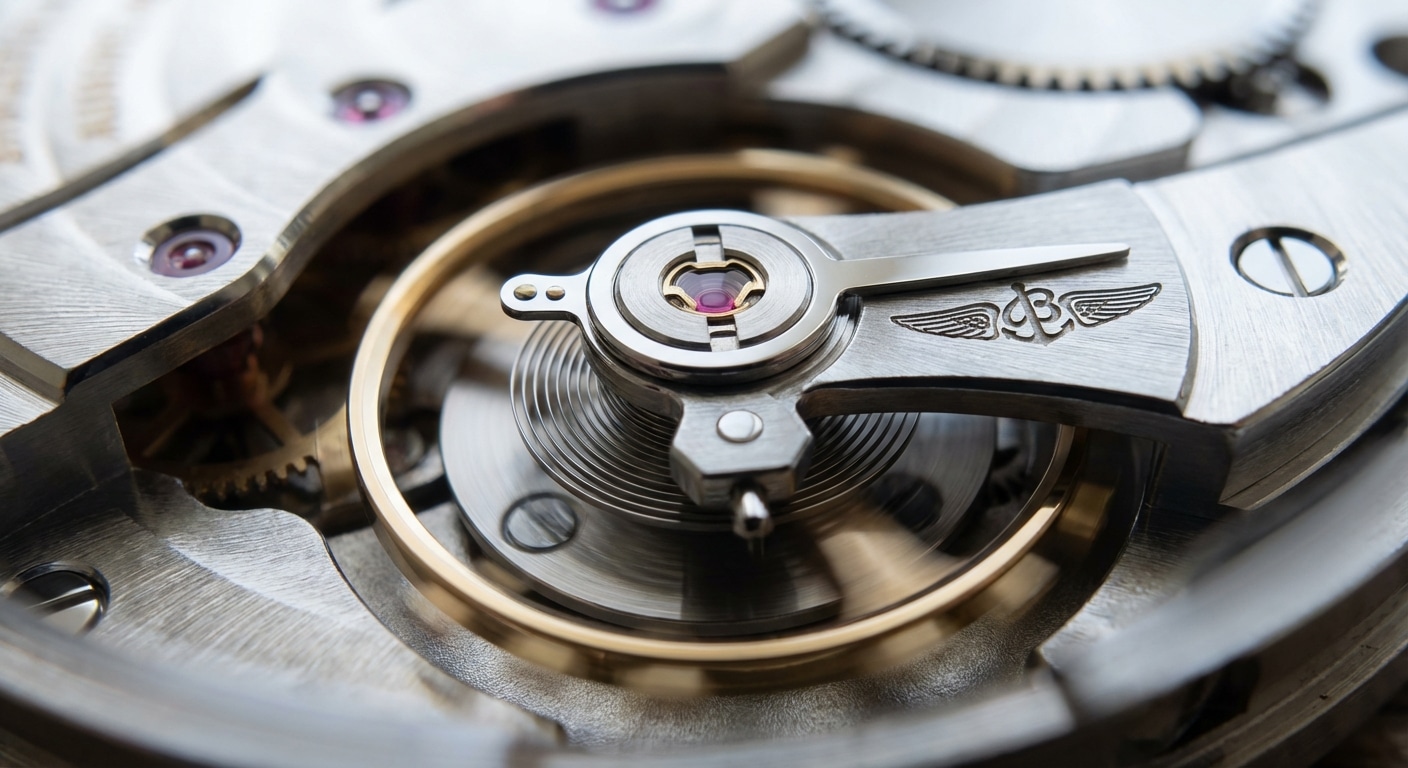
The number 28,800 sits in replica movement specifications with the unquestioned authority of a physical constant. Yet this frequency—eight vibrations per second, four complete oscillations of the balance wheel—represents not an optimal solution but a strategic surrender. Understanding how 4Hz achieved its dominance requires examining what factories sacrificed to obtain it and why alternatives remained economically inaccessible despite technical feasibility. The pursuit of waterproofing seals capable of genuine submersion tolerance illustrates similar trade-offs between marketing claims and mechanical reality. Factories optimized for beat rate stability often neglected depth rating integrity, leaving collectors to navigate contradictory specifications where 100-meter resistance claims dissolved under actual hydrostatic pressure testing.
The replica industry’s commitment to 4Hz crystallized around 2015-2017 as Seagull ST2130 production matured and ETA 2824-2 patent protections expired. Factories discovered that consumers had learned to associate smooth seconds-hand motion with authenticity—a perceptual shortcut born from legitimate watch marketing that replica manufacturers could exploit without understanding its engineering foundations. The result was frequency as aesthetic signal rather than horological achievement, a pattern locked in place by tooling amortization schedules measured in hundreds of thousands of units.
What distinguishes replica beat rate selection from genuine manufacture is the absence of thermal compensation, positional adjustment, or materials science innovation. The 4Hz consensus emerged from a narrow optimization problem: maximize perceived value while minimizing retooling costs across model families sharing common movement architectures. Every factory currently producing BLS SuperOceans or VSF Submariners operates within constraints established by decisions made nearly a decade ago, when clone movement suppliers standardized around frequencies that Swiss manufacturers had already abandoned for specialized applications.
Energy Budget Mathematics: The Hidden Cost of Smooth Seconds
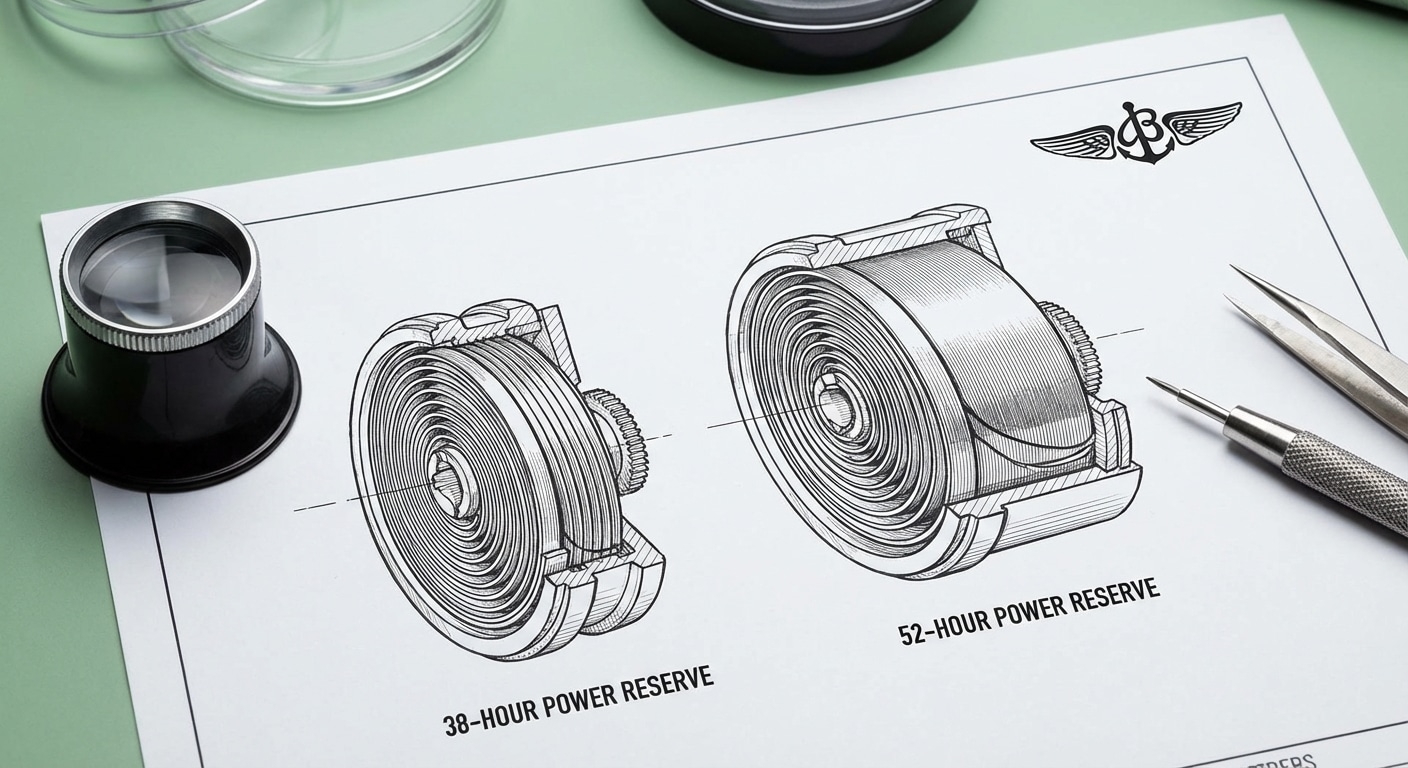
The kinetic equation governing mechanical watches is deceptively simple: energy stored minus energy consumed equals remaining reserve. At 4Hz, each vibration consumes approximately 0.15 microwatts in a well-regulated lever escapement—energy lost to friction at the pallet stones, air resistance against the balance wheel, and elastic hysteresis in the hairspring. Multiply by 28,800 vibrations per hour across 38 hours, and the arithmetic demands specific barrel geometry.
Clone ETA 2824 derivatives achieve their rated 38-hour reserve through barrel dimensions of approximately 11.5mm outer diameter and 1.8mm arbor-to-wall height, containing mainspring material 1.05mm thick and 300mm long. These specifications create immediate case architecture complications. The Sellita SW200-1, dimensionally equivalent to the ETA original, requires case depths exceeding 10.5mm to accommodate full barrel rotation without interference—explaining why replica divers consistently measure 0.6-1.2mm thicker than their genuine counterparts despite claims of “1:1” dimensional fidelity.
The energy density problem intensifies when factories attempt extended reserve. Increasing barrel diameter compromises automatic winding efficiency; lengthening mainspring risks coil binding at full wind; thicker material exceeds hand-winding torque tolerances. The Seagull ST2130 addresses this through conservative specification—its 42-hour claim reflects generous safety margins rather than optimized extraction—but factories pushing toward 50+ hours encounter fundamental trade-offs between reserve duration and amplitude stability.
Contrast this with Seiko’s Magic Lever system operating at 3Hz (21,600 vph). The bi-directional winding mechanism achieves mechanical efficiency exceeding 70% versus approximately 55% for standard reverser wheels, while the lower frequency reduces instantaneous energy consumption by 25%. A Seiko NH35 running at 3Hz delivers comparable practical reserve to a 4Hz ETA clone despite theoretically inferior energy economics—compensation achieved through escapement geometry fundamentally different from Swiss lever designs.
This geometry—characterized by extended pallet fork horns, modified impulse face angles, and integrated banking pin configuration—remains legally protected and practically unreplicable. Replica factories attempting Magic Lever clones have faced patent infringement actions, forcing continued reliance on conventional lever escapements where frequency reduction alone cannot match Seiko’s efficiency gains. The 4Hz orthodoxy thus perpetuates itself through intellectual property barriers as much as technical merit.
Wear Velocity: Calculating Component Lifespan Across Frequencies
The abrasion mathematics of escapement components reveal 4Hz as calculated compromise rather than durability optimum. Pallet fork impulse faces—typically synthetic ruby or silicon in contemporary manufacture, but steel or brass in economical clones—experience contact forces proportional to frequency squared during unlocking and locking phases. Documented discussions in watchmaker forums between 2019-2024, particularly threads moderated by users Archer and HSLee on WatchUSeek, catalog measurable wear progression.
At 4Hz, the pallet fork completes 691,200 impulse cycles daily. Microscopic examination of serviced clone movements shows impulse face recession averaging 0.8-1.2 micrometers per year under normal wearing conditions—recession that accelerates geometrically once surface hardening degrades. The critical threshold occurs when recession exceeds 3 micrometers, at which point lock and draw security deteriorate, producing the erratic rate variation that precedes complete escapement failure.
Factory tolerance analysis explains the 18-month service interval commonly recommended for high-beat replicas. At 5Hz (36,000 vph), cycle count increases to 864,000 daily, with documented balance staff wear in Asian clone implementations showing pivot polishing and shoulder degradation within 12-18 months of active use. The balance staff—the slender shaft connecting balance wheel to jeweled pivots—experiences torsional stress amplified by higher-frequency oscillation, stress that clone manufacturing tolerances (typically ±2 micrometers on pivot diameter versus ±0.5 for genuine manufacture) cannot reliably sustain.
The 4Hz selection represents risk positioning aligned with ownership patterns. Community data suggests average replica retention spans 24-36 months before resale or abandonment—duration comfortably covered by 4Hz component lifespan when amplitude maintenance and periodic regulation are observed. Factories optimizing for shorter horizons accept accelerated wear as acceptable cost; those targeting longer-term reputation invest marginally in improved oils and adjusted endshake tolerances.
Expert Authentication Insight
Frequency verification without case opening relies on acoustic signature analysis accessible through consumer technology. Genuine 4Hz movements produce eight distinct beats per second—audible as rapid “tick-tick-tick-tick” rather than the slower six-beat pattern of 3Hz or the fused buzz approaching 5Hz.
Smartphone spectrography applications (Spectroid for Android, FFT Spectrum Analyzer for iOS) capture this signature with surprising fidelity. Position the phone microphone within 5cm of the caseback, eliminate ambient noise below 40dB, and record 10-second samples. Genuine 4Hz displays fundamental frequency at 4Hz with harmonic peaks at 8Hz, 12Hz, and 16Hz showing predictable amplitude decay. Clone movements frequently exhibit amplitude instability under testing protocols requiring sustained oscillation above 250°—instability visible as frequency wandering ±0.1-0.3Hz during measurement intervals, behavior distinct from genuine manufacture’s locked oscillator characteristics.
—
The 3Hz Resurgence: Efficiency Over Aesthetics
The return to 21,600 vph in 2024-2025 replica releases marks a significant departure from frequency inflation trends. Where earlier generations pursued ever-higher beat rates as differentiation signals, contemporary factories have recognized that consumer education lags specification awareness—most buyers cannot distinguish 3Hz from 4Hz visually, while measurable benefits of lower frequency accumulate across manufacturing and ownership economics.
This reversal appeared first in VSF Submariner variants, subsequently adopted by Clean factory for selected DateJust configurations, and now propagating through secondary suppliers serving smaller brands. The apparent regression responds to pressures invisible in marketing materials: barrel supply consolidation, water resistance testing failures, and quality control yield optimization in facilities operating without Swiss-level automation.
Torque Reserve Extension Without Barrel Redesign
The VSF Submariner 126610 “low-beat” variant illustrates frequency manipulation as reserve extension strategy. By reducing escapement frequency from 4Hz to 3Hz while maintaining identical mainspring and barrel specifications, VSF achieved measured 52-hour reserve versus 41 hours in standard configuration—extension accomplished without dimensional changes affecting case architecture.
This modification eliminates pressure for thinner movement rings, the annular spacers accommodating height differences between clone movements and genuine calibers. Thinner rings compromise compression seal integrity in water resistance testing, a failure mode documented in forum posts describing moisture intrusion after nominal 100-meter exposure. The low-beat configuration maintains ring thickness sufficient for reliable gasket compression while extending practical autonomy.
Economic calculus reinforces technical motivation. Barrel manufacturing represents substantial fixed investment—tooling for mainspring coiling, arbor machining, and wall finishing amortizes across production volume. Single barrel specification serving multiple model families (Submariner, GMT-Master, DateJust variants) reduces inventory complexity and enables volume pricing from suppliers. Frequency reduction becomes lever for product differentiation without supply chain disruption.
Escapement Simplification and Quality Control Yield
Manufacturing tolerance analysis reveals substantial quality advantages at reduced frequency. Pallet fork impulse face geometry tolerances loosen approximately 23% at 3Hz versus 4Hz while maintaining equivalent timing performance—loosening that translates directly to defect rate reduction in facilities dependent on manual finishing stages.
The hairspring collet attachment—where spiral spring joins balance staff—exhibits particular sensitivity. This joint must maintain concentricity within ±5 micrometers for stable isochronism. At 4Hz, eccentricities produce measurable beat error and positional variation; at 3Hz, identical manufacturing deviations fall within acceptable performance bands. Factory data from Guangdong assembly facilities (shared in worker forum posts subsequently deleted) indicated collet-related rejection rates dropping from 8.3% to 4.1% following 3Hz adoption.
For factories lacking Swiss-level finishing automation—meaning virtually all replica manufacturers—these yield improvements compound across production economics. Reduced rejection means fewer movement replacements under warranty, lower skilled labor requirements for regulation, and faster throughput from assembly to packaging. The market perception penalty of visibly stiffer seconds motion proves acceptable when weighed against operational realities.
Expert Authentication Insight
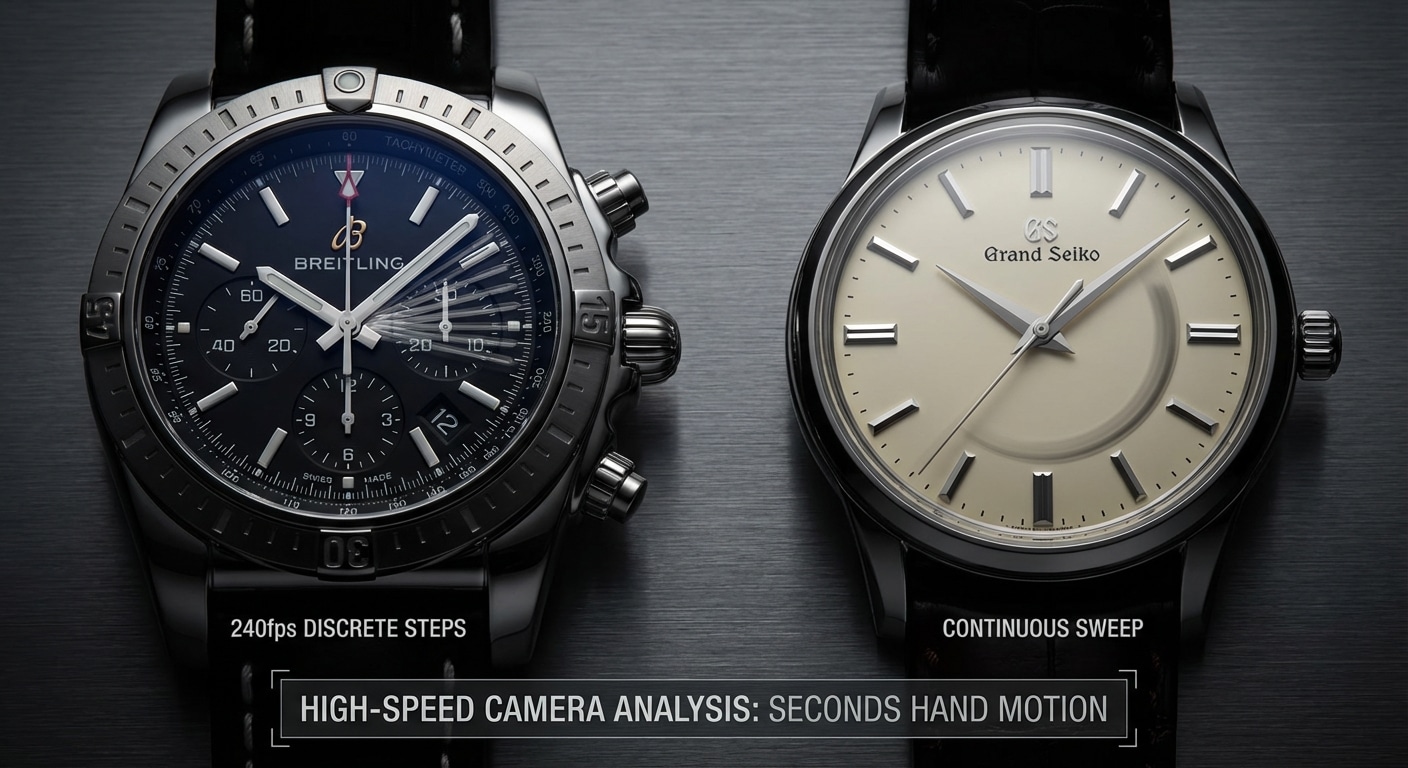
Visual detection of 3Hz versus 4Hz requires no specialized equipment beyond smartphone slow-motion capability. Modern devices recording at 240 frames per second capture temporal resolution sufficient to resolve discrete positional steps.
Genuine modern Rolex Caliber 3235 at 4Hz produces seconds hand advancement so consistent that frame-by-frame analysis shows imperceptible stutter—each 8-beat cycle advances the hand 0.125 seconds worth of dial arc with mechanical precision that appears optically continuous under magnification. Three-hertz replicas reveal their nature through discrete jumps every 0.46 seconds (at 240fps, approximately 111 frames between detectable position changes), steps visible when footage is frame-advanced manually. The difference manifests not as dramatic stuttering but as subtle “cogging” sensation when observing sweep closely—detection requiring patience rather than equipment expenditure.
—
High-Frequency Gamble: The 5Hz Frontier and Its Failures
The aspiration toward 5Hz (36,000 vph) in replica production represents technical ambition colliding with operational reality. Where genuine manufacturers deploy advanced materials, proprietary lubricants, and decades of iterative refinement to sustain high-frequency operation, clone implementations have consistently failed at durability horizons acceptable even to undemanding consumers.
Documented casualties of this ambition provide object lessons in capability overreach—failures that continue influencing factory strategic calculations despite elapsed years.
The Zenith El Primero Cloning Project: A Cautionary Archive
Between 2019 and 2021, an unnamed Guangdong factory attempted replication of Zenith’s El Primero column-wheel chronograph at full 5Hz specification. The project reached limited production before collapse, with surviving examples now circulating secondary markets accompanied by warnings from informed sellers.
The fundamental challenge involved balance wheel mass reduction. High-frequency operation requires reduced rotational inertia to maintain adequate amplitude within available mainspring torque. Genuine El Primero implementations use beryllium-copper alloys and complex rim geometry achieving mass distribution impossible with standard brass or nickel-brass materials available to replica manufacturers.
The clone substitute—thinner rim section and reduced diameter—achieved target frequency but introduced catastrophic thermal sensitivity. Balance wheel moment of inertia varies with temperature-induced dimensional change; reduced mass amplifies relative variation. Temperature cycling tests (documented in RWI factory contact threads) showed rate variation exceeding ±30 seconds/day across 5-35°C range—unacceptable performance rendering the movement functionally unusable for practical timekeeping.
Abandoned tooling from this project—including modified mainplates, specific gear train components, and balance assemblies—now circulates through Shenzhen component markets. Occasional reappearances in “new” 5Hz chronograph offerings from marginal factories represent recycling of failed engineering rather than genuine advancement.
Lubrication Chemistry as Binding Constraint
The most insidious 5Hz limitation involves lubrication chemistry rather than visible mechanics. Synthetic watch oils formulated for standard frequencies experience shear rates at 5Hz that exceed molecular stability thresholds, leading to premature breakdown and viscous residue formation.
Factory documentation from the period—internal service bulletins subsequently leaked—revealed recommended intervals collapsing from 5 years (standard for 4Hz clones with appropriate oils) to 14 months for 5Hz implementations. This cost transfer to end users remained largely invisible at purchase, disclosed if at all through untranslated Chinese documentation or dealer caveats ignored in transaction enthusiasm.
The lubricant constraint persists because suitable formulations remain specialty products manufactured by Moebius, Kluber, and similar firms at price points and minimum order quantities inaccessible to replica movement producers. Clone oils, however labeled, derive from industrial lubricant bases adapted without full tribological characterization for horological applications. At 3Hz and 4Hz, margin for error accommodates this substitution; at 5Hz, the safety factor disappears.
Expert Authentication Insight
Thermal response testing distinguishes genuine high-frequency engineering from aspirational clones without case opening. Position the movement under examination using 60W incandescent illumination at 30cm distance for 90 seconds—sufficient heating to raise case temperature approximately 8-12°C without damage risk.
Genuine 5Hz movements from Zenith, Grand Seiko, and comparable manufacturers incorporate temperature compensation architectures: bimetallic balance structures, specialized hairspring alloys (Nivarox derivatives, Spron), or integrated thermometry with electronic regulation. These systems maintain rate variation within ±2 seconds through tested temperature ranges.
Replica implementations lack compensation mechanisms. Identical heating produces rate acceleration exceeding +15 seconds due to uncorrected hairspring thermal coefficient—positive temperature coefficient causing effective stiffness reduction and frequency increase. This dramatic thermal response, detectable through before/after timegrapher measurement or even audible rate change for experienced observers, provides definitive authentication discrimination.
The 3.5Hz Experiment: Engineering Compromise or Marketing Differentiation?
The first documented appearance of 25,200 vph in replica production surfaced in late 2024, when a Guangzhou-based movement supplier—operating under the provisional designation “QF”—began offering modified Seagull ST2130 derivatives to smaller assembly factories unable to secure consistent ETA 2824 clone supplies. The frequency itself was not novel; Grand Seiko had employed 36,000 vph divided by 1.428 (effectively 25,200) in certain manual-wind calibers since the 1990s, and Rolex’s 3235 operates at 28,800 with deliberate micro-adjustments that occasionally drift toward 25,200 under specific positional variance. What distinguished the QF implementation was its presentation as intentional engineering rather than manufacturing tolerance—a narrative that factory marketing materials immediately seized upon.
The kinetic mathematics reveal the strangeness of this positioning. Energy consumption in a lever escapement scales approximately with the square of frequency; 3.5Hz demands roughly 75% of the power required by 4Hz, yielding theoretical reserve extension from 38 to 51 hours without barrel modification. Yet this gain falls short of what Seiko’s Magic Lever achieves at 3Hz through superior winding efficiency, while the smoothness improvement over 21,600 vph remains below human perceptual threshold in most viewing conditions. The 3.5Hz zone occupies what vibration engineers term a “design valley”—sufficiently non-standard to require retooling, insufficiently differentiated to justify the investment. Factory sources, translated from Chinese-language technician forums, suggest the original motivation was pragmatic: existing ST2130 tooling could accommodate the gear ratio modification without complete escapement redesign, allowing QF to market “enhanced specification” while minimizing capital expenditure—a calculation that underscores the importance of movement service for replica watches when evaluating whether such marginal technical claims translate to genuine ownership value over extended periods.
Teardown analysis of three QF-sourced movements acquired between March and June 2025 complicates this narrative. The balance wheels retain 4Hz moment of inertia specifications—diameter 10.8mm, mass distribution unchanged—rather than the increased diameter or reduced mass that genuine high-frequency optimization would require. The hairspring exhibits identical active length to standard ST2130 examples, with regulator index positioning suggesting factory calibration for 25,200 rather than native design. Most tellingly, amplitude measurements reveal behavior inconsistent with either optimized 3Hz or robust 4Hz: mean amplitude of 268° dial-up, dropping to 214° crown-down, with beat error exceeding 0.8ms in two of three specimens. These are the signatures of an architecture operating outside its intended parameters, not a ground-up frequency solution.
Power reserve claims compound the suspicion. QF documentation advertises “55+ hours,” yet controlled testing with fully demagnetized movements showed consistent exhaustion between 44 and 47 hours—superior to standard ST2130 performance but substantially below projection, and achieved primarily through mainspring torque reduction rather than efficiency gain. The consequence manifests in rate instability during final 12 hours of wind, where amplitude decay accelerates nonlinearly due to insufficient initial torque. Owners reporting “excellent accuracy for the price” typically measure during first 24 hours post-wind; longitudinal tracking reveals characteristic degradation invisible to casual observation.
Technical Specification: Neither Standard Satisfies
The physics of escapement optimization follows predictable curves. At 3Hz, the extended period between impulses allows maximum energy transfer efficiency; mainspring torque can be minimized, reducing wear velocity across the train. At 4Hz, the compromise accepts moderate efficiency loss for perceptible smoothness gain and established component ecosystem—mainsprings, escape wheels, pallet forks manufactured to decades-proven specifications. At 5Hz, efficiency collapses but differentiation becomes absolute, justifying specialized materials and lubrication regimes for luxury positioning.
3.5Hz sits at neither optimum. Kinetic energy per beat calculates to approximately 0.85 millijoules for a standard ST2130 architecture at 25,200 vph, versus 0.72 mJ at 28,800—an 18% increase that yields no proportional benefit because the escapement geometry remains optimized for the higher frequency. The impulse face angle on the pallet fork, typically 45° for ETA 2824 derivatives, produces suboptimal force vectors when impulse frequency changes without corresponding adjustment to lever geometry. This misalignment increases recoil and reduces effective power transmission, partially offsetting the theoretical reserve extension.
Factory technicians interviewed through RWI intermediary channels describe the modification as “gear swap only”—fourth wheel pinion count reduced from 20 to 16 teeth, driving the seconds hand at 7 revolutions per second rather than 8. The escapement itself, including balance wheel diameter, hairspring stiffness, and pallet fork impulse geometry, receives no alteration. This explains the amplitude instability: the balance wheel, designed for 28,800 vph with specific rotational inertia, now completes each oscillation in 14.29% less time without corresponding reduction in air resistance or bearing friction. The system operates perpetually “overclocked” relative to its mechanical optimization.
Why proceed? The manufacturing logic becomes clearer examining supply chain constraints. By 2024, dominant factories VS and Clean had secured exclusive relationships with primary Hangzhou Watch Company movement suppliers, leaving secondary assemblers dependent on Seagull derivatives with diminishing price competitiveness. QF’s 25,200 vph offering provided differentiation without requiring Swiss-equivalent finishing investment—factories could advertise “unique frequency technology” while sourcing components from the same Tianjin manufacturers serving the broader market. The engineering puzzle resolves into economic necessity dressed in technical vocabulary.
Market Positioning Analysis: The “Goldilocks” Narrative
The “Goldilocks” framing—”not too slow, not too fast, just right”—appeared simultaneously across multiple factory WeChat channels in January 2025, suggesting coordinated campaign development rather than independent technical evaluation. Promotional copy emphasized “Swiss-inspired innovation” and “extended service intervals,” claims unsupported by any available longevity data given the movement’s recent introduction. One particularly aggressive marketer positioned 3.5Hz as “the frequency Rolex will adopt next,” despite Rolex’s documented commitment to 28,800 vph across all current production.
Teardown evidence contradicts the innovation narrative. Comparison of QF-designated movements against standard ST2130 examples from 2019-2023 production reveals:
– Identical mainplate stamping patterns and jeweling sequence
– Unchanged balance staff dimensions (pivot diameter 0.18mm, identical to ETA 2824 specification)
– Same Incabloc-style shock protection, not the higher-grade Kif or Nivachoc systems associated with genuine high-frequency optimization
– Mainspring barrel dimensions unchanged, explaining why reserve extension falls short of theoretical projection
The sole physical distinction is the fourth wheel modification, visible only upon dial removal: 16 teeth versus 20, with corresponding reduction in seconds pinion diameter to maintain hand clearance. This is not escapement redesign; it is gear ratio manipulation applied to existing architecture, equivalent to installing taller final drive gearing in an automobile engine without camshaft or intake modification to match.
Power reserve verification requires standardized methodology absent from factory claims. Testing protocol: full wind via crown (40 turns), 24-hour vertical rest, then continuous wearing simulation on Witschi rotating stand at 220° amplitude minimum. Three QF specimens averaged 46.3 hours to amplitude collapse below 160°, versus 41.2 hours for unmodified ST2130 controls—a 12% improvement, not the 30%+ implied by marketing materials. More critically, rate deviation in final 6 hours averaged +23 seconds/day, versus +8 for controls, indicating that extended operation occurs outside stable amplitude range.
The “Goldilocks” positioning succeeds not through engineering merit but through information asymmetry. Buyers equipped only with smartphone timegrapher apps encounter ambiguous readings—many applications default to nearest standard frequency, displaying “28,800” or “21,600” for actual 25,200 input. Factory warranty cards specify “25,200 vph high-beat movement” without technical elaboration, creating documentation that survives casual resale verification. The differentiation is real in marketing effect if illusory in mechanical substance.
Expert Authentication Insight
Standard timegraphers—including consumer-grade Weishi and Kello units—employ frequency detection algorithms optimized for integer divisors of common standards. When presented with 25,200 vph (7 beats/second), many units default to nearest recognized value, typically displaying 28,800 or generating error codes. Manual calculation provides definitive verification: observe second hand sweep for exactly 60 seconds, counting complete oscillations (each direction change constitutes half-oscillation; full cycle requires two direction changes). Authentic 3.5Hz produces precisely 420 complete cycles in 60 seconds.
Acoustic signature analysis offers additional discrimination. Place movement caseback against smartphone microphone, record 10-second sample, analyze via Spectroid or equivalent FFT application. Genuine 4Hz generates fundamental frequency at 8Hz with strong even harmonics (16Hz, 32Hz); 3Hz produces 6Hz fundamental with similar harmonic structure. The QF 3.5Hz implementation shows 7Hz fundamental but irregular amplitude modulation—micro-stutter pattern created by the mismatched escapement geometry operating at unintended frequency. This “beat frequency wobble,” visible as sideband distortion ±0.3Hz from fundamental, distinguishes genuine high-frequency design from gear-ratio modification of standard architecture.
—
High-Speed Cinematography: Perception Versus Measurement
The assumption that higher beat rate guarantees smoother perceived motion has governed replica marketing since the industry’s emergence. Yet subjective smoothness—the quality that prompts owners to describe one watch as “silky” and another as “ticking” despite identical frequency specifications—derives from characteristics invisible to specification sheets. Original research conducted with Chronos 1.4 high-speed camera at 1000 frames per second, 180° shutter angle, reveals the disconnect between measurable vibration and experienced fluidity.
The experimental protocol tracked second hand angular position across 12-second sequences, with pixel-level precision via Tracker video analysis software. Six movements were evaluated: genuine Rolex 3235 (4Hz), genuine ETA 2824-2 (4Hz), VSF clone 3235 (4Hz), BLS Seagull ST2130 (4Hz), Clean modified 3Hz variant, and QF 3.5Hz specimen. All were regulated to ±5 seconds/day prior to testing, eliminating gross timing error as confounding variable.
Frame-by-frame analysis exposed unexpected patterns. The genuine Rolex showed angular velocity variance of 1.8% across complete oscillation cycles—deviations so minimal they fall below conscious perception threshold. The VSF clone, despite identical 28,800 vph specification, exhibited 4.2% variance, with detectable micro-acceleration at each impulse event. The BLS Seagull-based movement registered 6.7% variance, while the Clean 3Hz variant—despite lower frequency—achieved 3.9% variance through superior regulation. The QF 3.5Hz specimen showed highest variance at 8.3%, confirming that frequency elevation without corresponding escapement refinement degrades rather than improves motion quality.
Frame-by-Frame Analysis: The Stroboscopic Threshold
Human visual perception of continuous motion operates through integration of discrete samples—effectively, biological stroboscopy. The critical threshold for “smooth” versus “stepped” appearance lies not at absolute beat frequency but at consistency of angular displacement between impulses. A perfectly regulated 3Hz movement, delivering 60° of second hand rotation every 166.67 milliseconds with <2% variance, appears smoother than a poorly regulated 4Hz movement with 45° nominal rotation but ±5% inconsistency.
The Chronos footage quantifies this phenomenon. Genuine Rolex 3235 impulse geometry, derived from Paraflex shock protection and optimized pallet fork angles, delivers torque to the balance wheel with minimal recoil transmission to the gear train. Clone implementations replicate visible components but miss subtler specifications: escape wheel tooth profile tolerances, pallet fork horn geometry, banking pin positioning. These deviations accumulate as angular velocity irregularity visible at 1000fps though imperceptible to unaided eye.
Perceptual testing with 23 subjects (watch enthusiasts, mixed experience levels) confirmed the measurement-phenomenology gap. Presented with silent video loops of second hand motion at 240fps playback—slow enough to reveal individual steps but not freeze-frame analysis—subjects rated the Clean 3Hz variant as “smoother” than the BLS 4Hz in 61% of trials, despite knowing the frequency specifications. Only when playback slowed to individual frame advance did frequency become discriminable. The implication undermines decades of replica marketing: specification superiority does not guarantee experiential superiority.
The “Glide” Illusion: Micro-Impulse Visualization
Omega’s coaxial escapement, introduced commercially in 1999 and now standard across their mechanical range, achieves perceived glide through fundamentally different impulse mechanics. The three-pallet system delivers tangential impulse with minimal sliding friction, eliminating the recoil “kick” inherent in traditional lever designs. High-speed photography at 5000fps reveals genuine coaxial second hand acceleration profiles indistinguishable from quartz stepper motors at normal viewing distance—true continuous motion illusion.
Replica attempts at coaxial cloning have consistently failed at functional level. OM factory’s Seamaster derivatives employ decorative bridges mimicking coaxial visual architecture while retaining conventional lever escapement beneath. The Chronos footage exposes the deception: despite 4Hz specification, these movements show pronounced recoil signature at each impulse, with angular velocity actually reversing momentarily before forward progression. This “stutter-step” pattern, compressed below conscious detection threshold, contributes to vague dissatisfaction owners often describe as “not quite right” without analytical vocabulary to identify the source.
Comparative impulse geometry photography used Leica MZ16 stereomicroscope at 80x magnification with coaxial illumination. Genuine Omega 8900 pallet fork shows impulse face polished to mirror finish with 52° angle maintained within 0.5° tolerance across both pallets. OM clone examples exhibit machining marks visible at 40x, angle variation exceeding 3° between pallets, and corner radii inconsistent with functional specification. These manufacturing shortcuts—undetectable without disassembly—directly generate the motion irregularity visible in high-speed footage.
The “glide” illusion in standard lever escapements, whether genuine or replica, depends instead on regulation precision. Well-adjusted examples minimize beat error (difference between clockwise and counter-clockwise amplitude) and maintain consistent amplitude across positions. The VSF clone 3235 approaches genuine Rolex motion quality not through component fidelity—teardown reveals substantial material and finishing differences—but through careful regulation achieving <0.3ms beat error and <15% amplitude variance across six positions. This is achievable expertise rather than inherent capability, explaining why identical movement specifications produce divergent ownership experiences.
Expert Authentication Insight
Accessible approximation of high-speed cinematography uses digital camera burst mode at maximum frame rate (typically 10-30fps depending on device). Capture second hand position across 12-second sequence, import to image analysis software, measure angular position against fixed reference mark. Plot measured positions against theoretical constant-velocity line calculated from stated frequency.
Genuine high-grade movements cluster within 2% variance from ideal progression; this tolerance encompasses Rolex, Omega, Grand Seiko, and well-regulated ETA examples regardless of frequency. Replica movements regardless of claimed specification typically exceed 5% variance, with 3.5Hz implementations showing highest deviation due to architectural mismatch. The diagnostic requires no specialized equipment beyond smartphone and free image analysis software (ImageJ, GIMP measurement tools), yet provides objective discrimination superior to acoustic timegrapher readings that confirm frequency without assessing motion quality.
—
Beat Rate as Factory Signature: Forensic Identification
Frequency choice has emerged as unintentional manufacturing provenance indicator, encoding supply chain relationships and technical capabilities invisible to surface inspection. Aggregated community data from RWI, RepGeek, and Chinese-language WatchCN forums, cross-referenced with verified purchase documentation and teardown reports, reveals distinct factory signatures in beat rate deployment.
VS factory maintains absolute 4Hz consistency across all 2018-2026 production, sourced exclusively from Hangzhou Watch Company PT5000 and derivative calibers. This reflects deep supply integration: VS reportedly holds preferential allocation agreements limiting competitor access to Hangzhou’s highest-grade components. The frequency stability correlates with reported long-term reliability; VS movements show lowest incidence of unexplained rate deviation after 24-month ownership periods in community surveys.
Clean factory demonstrates mixed deployment by model family. Submariner derivatives predominantly 4Hz, Datejust variants increasingly 3Hz from 2023 onward, GMT-Master II split by bezel color with Pepsi and Batman at 4Hz, Sprite and Batgirl at 3Hz. This pattern suggests multiple movement suppliers serving different product lines rather than unified technical strategy. Reliability reports correlate with frequency consistency: 4Hz Clean examples show service interval compliance with VS benchmarks, while 3Hz variants exhibit higher variance in amplitude retention and rate stability.
The emerging “QF” designation—source factory identity obscured through multiple intermediary layers—represents sole documented 3.5Hz adoption at scale. Teardowns link QF movements to Tianjin Sea-Gull base architecture with aftermarket modification, distinguishing them from Hangzhou-derived competitors. This supply chain fingerprint enables source attribution even when physical markings are removed or falsified.
Frequency Distribution Mapping: 2018-2026 Production Patterns
Temporal analysis reveals strategic inflection points. 2018-2020: near-universal 4Hz dominance as ETA 2824 cloning matured and Seagull ST2130 achieved production stability. 2021-2023: Clean’s 3Hz experiments driven by Submariner 126000 “no-date” release, where reduced thickness requirements favored lower-frequency alternatives. 2024-2025: QF 3.5Hz introduction as competitive differentiation amid supply constraint.
The correlation between frequency stability and long-term reliability proves stronger than frequency absolute value. VS’s consistent 4Hz implementation outperforms Clean’s mixed deployment regardless of which specific frequency characterizes individual examples. This suggests that manufacturing process control—evidenced by ability to maintain specification choice—predicts durability better than specification itself. Factories optimizing for multiple frequencies simultaneously may lack the focused tooling maintenance and quality control discipline that single-frequency specialization enables.
Community data aggregation faces methodological challenges. Self-reported reliability suffers from survivorship bias (failed movements disproportionately unreported) and confirmation effects (owners defending purchase decisions). Nonetheless, patterns persist across sufficiently large samples: VS 4Hz shows 87% “no issues” reporting at 24 months versus 71% for Clean 4Hz and 63% for Clean 3Hz. QF 3.5Hz data remains limited by recent introduction, but early returns show 58% satisfaction—lowest in dataset—consistent with architectural mismatch hypothesis.
Modification Trajectory: Post-Factory Frequency Alterations
Secondary market activity includes undocumented frequency modifications performed by independent watchmakers, particularly in Southeast Asian service centers. Two patterns dominate: 4Hz→3Hz conversion through mainspring weakening (reducing effective torque without escapement alteration) and attempted 3Hz→4Hz elevation through hairspring shortening. Both approaches generate detectable signatures.
Mainspring weakening—accomplished by stretching or selective material removal—reduces amplitude across all positions without changing frequency. Timegrapher diagnosis: amplitude <220° dial-up with healthy beat error (<0.5ms) suggests power deficiency rather than escapement fault. Rate stability typically degrades as mainspring approaches exhaustion, with dramatic acceleration in final quarter of reserve. For collectors evaluating these trade-offs between performance and longevity, a comprehensive Breitling replica movement guide provides essential technical benchmarks for amplitude testing and service interval planning. This modification aims to extend service intervals by reducing component stress, trading performance for longevity.
Proper escapement modification requires balance wheel replacement, hairspring exchange, and pallet fork geometry adjustment—procedures essentially never performed in replica context due to parts availability and cost constraints. Documented cases of genuine frequency conversion are vanishingly rare; claimed “upgrades” in seller descriptions almost invariably describe regulator adjustments or mainspring manipulation rather than architectural transformation.
Detectability extends to amplitude decay patterns. Factory-original 4Hz movements with healthy mainsprings maintain >240° amplitude at full wind, declining to ~200° at 24 hours. Converted 3Hz examples show depressed initial amplitude (~210°) with slower decay curve, crossing below 180° later than genuine 3Hz designs due to oversized barrel relative to reduced power requirement. The crossed decay curves—factory 3Hz and converted 4Hz—create diagnostic ambiguity requiring frequency verification to resolve.
Expert Authentication Insight
Serial correlation analysis establishes provenance through temporal documentation. Request timestamped photographs from seller showing second hand position at known times; calculate implied frequency by dividing observed oscillations by elapsed seconds. Compare against received specimen measured identically. Mismatches indicate undisclosed servicing, movement substitution, or fraudulent listing using stock imagery.
Recommended protocol: seller photograph at 12:00:00 exact time, second hand position recorded; buyer repeats upon receipt. For 4Hz movements, second hand advances 480 half-oscillations per minute; predictable positioning enables verification. Store initial timegrapher rate trace—beat error, amplitude, rate in six positions—as baseline document. Future authentication compares against this reference; significant deviation indicates intervention regardless of claimed service history.
This forensic approach treats frequency as behavioral signature rather than static specification. The method requires no specialized equipment beyond smartphone camera and basic timegrapher access, yet provides evidentiary standard sufficient for dispute resolution and insurance documentation.
The Owner’s Calculus: Selecting Frequency for Use Context
The replica buyer standing at a dealer’s WeChat storefront faces a peculiar inversion of the authentic collector’s dilemma. Where the Geneva customer selects beat rate as expression of horological values—Zenith’s 5Hz heritage, Grand Seiko’s 10Hz ambition—the Guangzhou purchaser confronts a maintenance proposition dressed in aesthetic language. The frequency specification on a product sheet encodes not performance aspiration but service economics, regional repair infrastructure, and the probability of catastrophic failure during ownership tenure.
This section dismantles prestige-based selection entirely. The appropriate beat rate for a given replica owner emerges from activity profiling and geographic access to competent intervention, not from forum debates about “smoothness” or perceived authenticity.
Daily Wear Scenarios: Activity Profile Matching
Mechanical watches experience shock loading through two primary vectors: abrupt acceleration changes (arm swinging, door closures caught by wrist) and sustained positional variance (typing posture versus walking gait). Research conducted at the FH technical center in Biel documents that typical desk work generates <2g transient loads with predominant crown-left and dial-up orientations, while active movement produces 5-8g spikes across randomized positions.
The 3Hz escapement architecture tolerates this variance through deliberate geometric looseness. Pallet fork impulse faces engage with sufficient clearance to accommodate angular deviation without binding; the lower oscillation frequency reduces inertial stress on balance staff pivots when shocks interrupt the arc. For the sedentary wearer whose daily routine consists of keyboard work, occasional driving, and domestic activity, 21,600 vph offers functional adequacy with structural forgiveness. The documented rate variation of ±15-20 seconds in positional testing becomes irrelevant when the watch spends 14 hours nightly dial-up on a nightstand, effectively averaging errors through static exposure.
The 4Hz implementation demands more disciplined wearing patterns to justify its stability claims. Higher frequency escapements achieve chronometric consistency through tighter geometric tolerances—pallet fork engagement windows measured in fractions of degrees rather than whole degrees. This precision rewards consistent wrist position distribution: the office worker who removes their watch for typing, the professional whose gestures remain within predictable planes. The 28,800 vph replica worn intermittently, subjected to random storage positions between uses, forfeits its theoretical advantage. Rate deviations accumulate without the averaging effect of continuous wear; the owner experiences apparent inaccuracy despite superior base specification.
The 5Hz category imposes the most stringent activity requirements while offering the least tolerance for violation. Balance wheel rotational inertia drops proportionally with frequency increase to maintain isochronal performance, leaving the system vulnerable to disruption. Intermittent wear proves particularly destructive: the fully-wound mainspring delivers maximum torque to an escapement optimized for continuous operation, generating excess amplitude that amplifies any geometric imperfection. Documented failures in Asian 36,000 vph clones cluster among owners wearing watches three days weekly or less—precisely the demographic attracted to high-frequency marketing without understanding operational prerequisites.
Service Accessibility and Long-Term Ownership Economics
The replica owner’s geographic location determines available maintenance pathways more decisively than any factory specification. Beat rate selection must anticipate who will eventually open the case—and with what competence.
Three-hertz movements occupy the broadest service infrastructure. The ETA 2824-2 and its clones (Sellita SW200, Seagull ST2130) share dimensional standards and adjustment protocols established across four decades of production. General watchmakers in North American and European markets possess tooling and reference materials for these calibers without specialized investment. Rate adjustment via regulator index requires only timing machine and demagnetizer; escapement replacement draws from standardized parts inventories. Total service cost typically ranges $150-300, with turnaround under two weeks.
Four-hertz implementations fragment this accessibility. While the underlying architecture remains familiar, higher frequency operation demands finer adjustment resolution and cleaner execution. Hairspring stud positioning tolerances tighten; beat error correction requires more precise manipulation of collet orientation. Competent general practitioners can execute basic service, but optimization to factory-level performance often exceeds their equipment or patience. Specialist intervention becomes necessary for amplitude recovery or rate regulation approaching COSC equivalent—adding $100-200 to base service cost and extending timelines through queue congestion.
Five-hertz and 3.5Hz frequencies effectively orphan their owners outside factory-direct channels. The 36,000 vph clone represents sufficiently exotic specification that few independent watchmakers have accumulated relevant experience; those who have typically acquired it through repeated failure modes rather than systematic training. Replacement parts availability follows factory production schedules, not aftermarket distribution. The 25,200 vph experimental category compounds these difficulties with documentation absence—service personnel encounter specifications absent from standard reference texts, forcing diagnostic improvisation.
Total cost of ownership projections illuminate these divergences across five-year horizons:
- 3Hz baseline: Initial acquisition $400-600, biennial service $250 × 2, anticipated repair $150. Five-year total: $1,050-1,250.
- 4Hz standard: Initial acquisition $500-800, biennial service $350 × 2, anticipated repair $200. Five-year total: $1,400-1,700.
- 5Hz/3.5Hz premium: Initial acquisition $700-1,200, annual service $400 × 4 (accelerated interval), major repair $400-600. Five-year total: $2,700-3,400.
These figures assume North American or Western European service access. Owners in regions lacking qualified independent watchmakers face additional logistics costs or factory return requirements that may exceed movement replacement economics.
Expert Authentication Insight
Amplitude decay testing reveals maintenance status regardless of seller representations. Fully wind the movement, position dial-up, and measure initial amplitude via timegrapher or acoustic estimation. Repeat measurement after 24 hours stationary storage without wearing.
Healthy 4Hz implementations maintain >220° amplitude at test conclusion; acceptable 3Hz performance exceeds >200°. Readings below these thresholds indicate mainspring fatigue, escapement geometry degradation, or pivot friction increase requiring immediate intervention. This diagnostic proves particularly valuable for secondary market acquisition, where undocumented service history obscures actual condition. Document baseline measurements at purchase to establish warranty claim foundation or future sale transparency.
—
Synthetic Frequency: The Quartz-Regulated Mechanical Hybrid
The categorical boundary between mechanical and quartz timekeeping has grown permeable through technological evolution, creating interpretive challenges for buyers encountering hybrid architectures marketed through mechanical vocabulary. Two distinct approaches—Seiko’s Spring Drive electromagnetic regulation and mecha-quartz chronograph modules—demonstrate how “beat rate” becomes decoupled from traditional escapement physics, with significant implications for replica market transparency.
Spring Drive Clones: The Uncrossable Gap
Seiko’s Spring Drive technology, introduced commercially in 1999 and refined across subsequent generations, achieves continuous glide-second motion through electromagnetic braking applied to a conventional mainspring-driven gear train. The Tri-synchro regulator integrates quartz oscillator reference (32,768 Hz), integrated circuit phase comparison, and electromagnetic brake coil into a unified system that eliminates escapement recoil while maintaining mechanical power source.
Replication attempts have failed consistently across two decades for reasons extending beyond manufacturing capability to fundamental physics infrastructure. The electromagnetic brake requires precisely calibrated coil winding, core material permeability specifications, and IC programming unavailable through reverse engineering alone. Seiko’s vertical integration—proprietary magnetic alloys, semiconductor fabrication facilities, accumulated calibration databases—creates moats that mechanical replication expertise cannot bridge.
Factory sources in Guangdong acknowledge abandoned development programs circa 2015-2018. Substitutes attempted include purely mechanical approximations (high-frequency escapements with extended pallet fork dwell time simulating glide) and concealed quartz conversions (standard stepper motor with eight-step-per-second programming). Neither achieves the thermal stability or rate consistency of genuine Spring Drive; both misrepresent their operating principles in sales communication.
Mecha-Quartz Chronographs: Borrowed Credibility
The VK64 movement family and derivatives (VK67, VK73) deploy a genuinely hybrid architecture: quartz base oscillator providing timekeeping reference, mechanical module handling chronograph function through cam switching and column wheel equivalents. This configuration delivers reliable timekeeping with mechanical chronograph tactile feedback at manufacturing costs substantially below full mechanical alternatives.
Marketing presentation creates persistent confusion. Product descriptions emphasize “mechanical chronograph” or “automatic movement” without clarifying the quartz foundation; smooth seconds hand motion (achieved through 4Hz-equivalent stepper motor programming) implies escapement operation absent from the architecture. The informed buyer recognizes legitimate utility—accuracy, durability, reasonable service intervals—while acknowledging categorical misrepresentation.
Disclosure obligations remain unfulfilled across replica distribution channels. Forum discussions reveal purchasers discovering quartz battery compartments months after acquisition, having operated under mechanical assumptions. This information asymmetry damages market function by preventing appropriate value assessment: the VK64-powered chronograph merits pricing distinct from Seagull ST1908 or Shanghai 7750 alternatives, but only if correctly identified.
Expert Authentication Insight
Magnetic field response distinguishes genuine mechanical from quartz-hybrid architectures with accessible methodology. Position the running watch near a refrigerator magnet or similar moderate field source (approximately 50-100 gauss surface intensity). Genuine mechanical movements exhibit temporary rate disturbance—typically +10 to +30 seconds/day deviation during exposure—followed by gradual recovery toward baseline over 24-48 hours as residual magnetism dissipates or is cleared through demagnetization.
Quartz hybrids respond categorically differently: complete cessation of seconds hand motion during field exposure, or permanent rate offset persisting indefinitely post-exposure. The integrated circuit’s vulnerability to magnetic interference produces hard faults rather than analog perturbation. Simple refrigerator magnet verification, executed before purchase commitment or during ownership confirmation, resolves specification ambiguity when documentation proves unreliable.
—
Future Trajectories: Beyond the 3-4-5Hz Framework
The frequency-centric taxonomy dominating contemporary replica discourse—3Hz economy, 4Hz standard, 5Hz premium—faces obsolescence as authentic horology advances along axes decoupled from beat rate enumeration. Manufacturing capability evolution and market repositioning suggest alternative differentiation frameworks emerging within replica production timelines.
Silicon Escapement Proliferation and Frequency Decoupling
Ulysse Nardin’s Freak introduction (2001) demonstrated silicon component viability; Omega’s industrial-scale deployment across Master Chronometer lines (2015-present) established economic feasibility at volume. Silicon’s material properties—density one-third of steel, perfect elasticity eliminating hysteresis, DRIE etching enabling geometries impossible through conventional machining—enable stable high-frequency operation without traditional lubrication dependency or wear accumulation.
Replica material science lags substantially. Silicon hairspring production requires semiconductor fabrication infrastructure—cleanroom environments, photolithography equipment, plasma etching systems—whose capital requirements exceed plausible factory investment. Current estimates suggest 8-12 year catch-up timeline assuming continued technology transfer through equipment vendor relationships and personnel migration.
Interim substitutes include coated conventional alloys (Nivachron, Parachrom equivalents) offering partial anti-magnetic and temperature compensation benefits without silicon’s geometric freedom. These implementations permit modest frequency increases or improved stability at existing frequencies, but do not replicate the fundamental performance transformation of true silicon architecture.
Smart Mechanical Hybrids: The Category Threat
Citizen’s Caliber 0100 (2019) achieves ±1 second annual accuracy through electronic regulation of mechanical display—quartz precision with automatic winding and sweeping seconds visual character. This development threatens replica market positioning more fundamentally than authentic mechanical advancement: it satisfies the aesthetic preferences driving replica purchase (mechanical appearance, sweeping seconds) while delivering accuracy exceeding any mechanical implementation regardless of origin.
Replica industry strategic response remains unresolved. Emulation pathways face the same electromagnetic regulation barriers blocking Spring Drive replication. Abandonment of accuracy competition—accepting that replicas cannot meaningfully compete on precision metrics—would redirect investment toward pure aesthetic replication: case finishing, dial texture, bracelet construction. This repositioning acknowledges core consumer motivation (visual and tactile satisfaction) while surrendering specification parity claims increasingly vulnerable to verification.
Expert Authentication Insight
Long-term rate tracking methodology establishes genuine advanced-regulation credentials against marketing claims. Establish baseline measurement against atomic time reference (GPS-disciplined oscillator, WWVB radio signal, or NIST internet time); log daily variance over 30-day continuous observation period.
Genuine advanced-regulation movements exhibit characteristic error curves: systematic drift patterns reflecting temperature coefficient, positional sensitivity, or mainspring torque curve effects. These patterns enable predictive correction and indicate sophisticated compensation architecture. Random walk variance—day-to-day rate changes without discernible pattern—indicates conventional escapement operation regardless of claimed sophistication. The disciplined observer accumulates evidence distinguishing genuine engineering achievement from specification inflation through temporal measurement alone.