
The Static Test Fallacy: Why Your 200m Rating Means Nothing in Motion
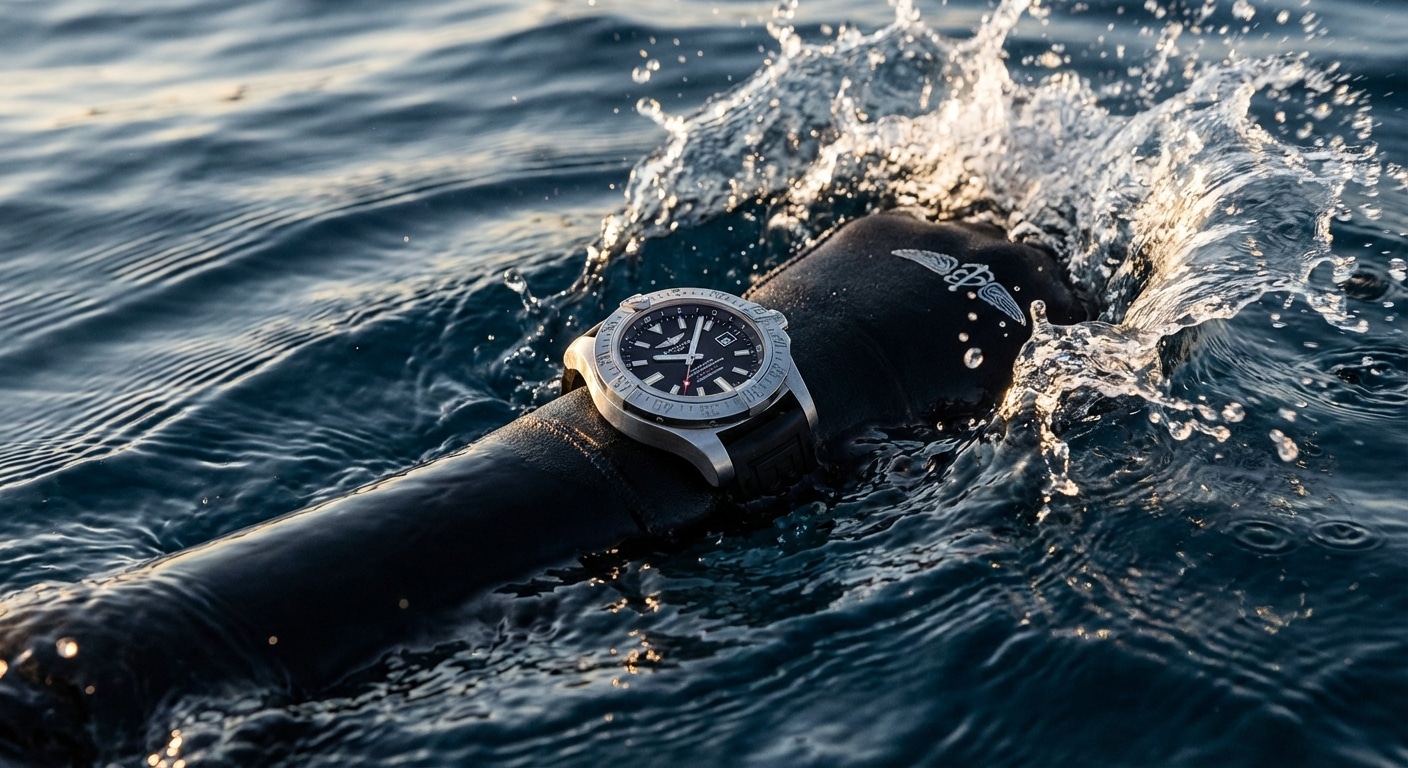
The pressure gauge reads 3 bar—equivalent to 30 meters of still water—and your Breitling SuperOcean clone sits motionless in the test chamber, gasket intact, caseback sealed. This is how manufacturers validate waterproofing claims, though the true engineering concerns for chronograph replicas often center on the Asian 7750 movement that powers most Breitling chrono clones. It is also a measurement of almost no relevance to what happens when you push off a pool wall or dive beneath a breaking wave.
ISO certification numbers stamped on casebacks suggest engineering rigor. The reality is more conditional: laboratory protocols assume stationary immersion, thermal equilibrium, and elastomer gaskets in factory-fresh condition. None of these conditions survive first contact with human use. The divergence between validated specification and hydrodynamic reality constitutes the central deception of recreational diving watches—and nowhere is this gap wider than in the clone market, where manufacturing shortcuts amplify inherent protocol weaknesses.
ISO 22810 vs. ISO 6425: The Quiet Divergence in Testing Philosophy
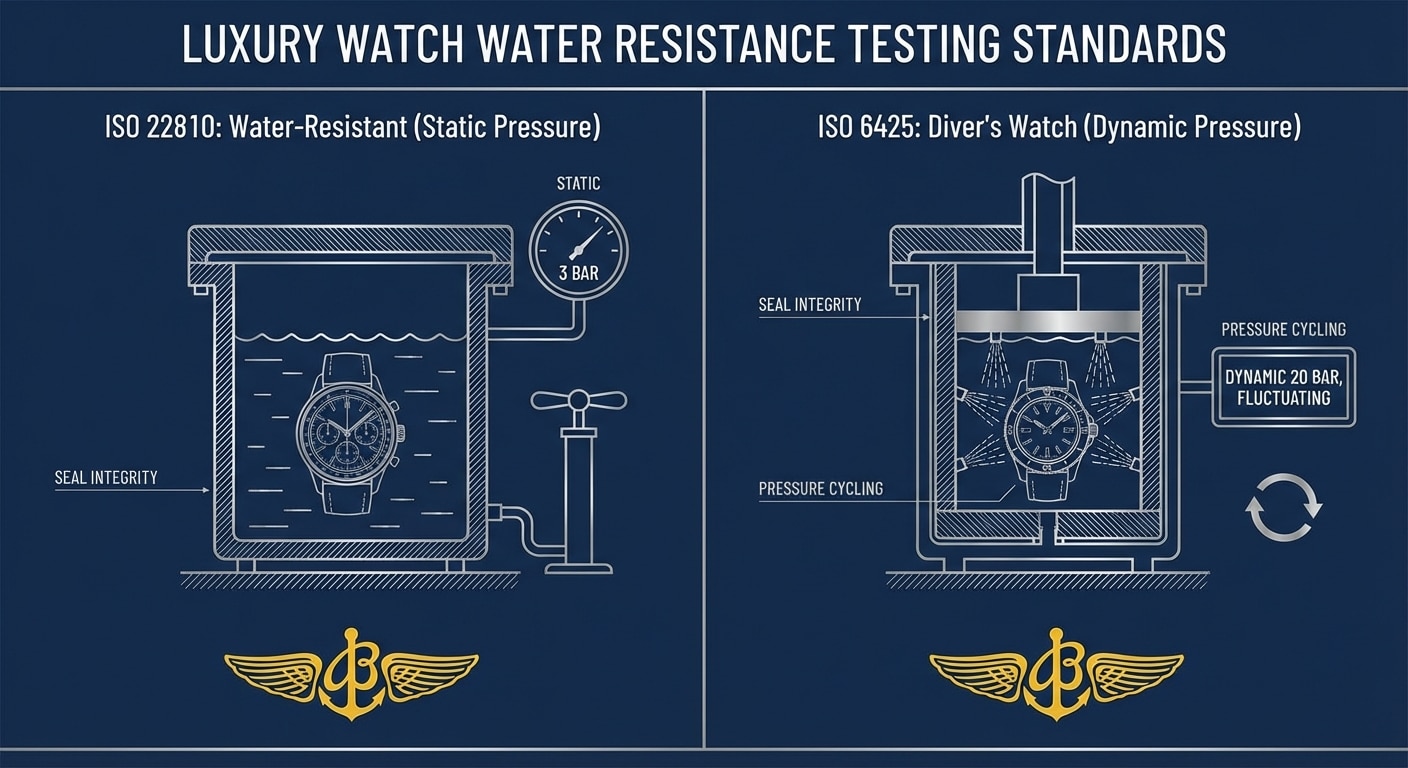
The International Organization for Standardization maintains two distinct waterproofing protocols, and their differences reveal what “water resistant” actually promises. ISO 22810, governing general-purpose watches, permits dry-sample testing in static pressure chambers. Samples sit undisturbed while external pressure increases incrementally. No condensation assessment. No saltwater exposure. No thermal cycling. Post-test acceptance criteria allow gasket compression set—the permanent deformation that destroys sealing force—to reach 25% of original cross-section.
ISO 6425, the diver’s watch standard, demands more aggressive validation. Condensation tests detect microscopic leakage through temperature differential. Saltwater immersion exposes galvanic compatibility failures. Thermal shock cycling between 40°C and 5°C simulates wrist-to-water transitions. Most critically, O-rings at case tube joints must retain compression set below 15%—a 40% tighter tolerance than 22810 permits.
Survey the current clone market and the pattern clarifies. BLS, 3K, BTF—all reference ISO 22810 compliance in technical documentation despite marketing “diver” aesthetics with helium escape valves and rotating bezels. The aesthetic signals capability; the certification confirms only that the watch survived a stationary bath. This is not misrepresentation in legal terms. It is strategic ambiguity that shifts risk to the wearer without violating any standard the manufacturer actually claimed.
The compression set differential matters mechanically. A crown gasket compressed to 75% of original thickness (22810-acceptable) retains sufficient preload against static pressure. Add dynamic loading from crown operation during submersion, thermal contraction reducing elasticity, and the modest safety margin evaporates. The 6425 threshold of 85% retention exists because engineers understood that real dives involve movement, temperature variation, and mechanical stress—not the placid flotation of certification testing.
The 10-30-50 Rule: How Dynamic Pressure Multiplies Static Ratings
Fluid dynamics does not respect the convenience of round numbers. ANSYS CFX simulations referenced in technical briefs by SJX and Revolution demonstrate what static testing ignores: arm velocity during freestyle stroke reaches 2 m/s, generating localized pressure spikes of 1.8–2.4× the static depth equivalent. The relationship is not linear. It is multiplied by geometry, acceleration, and the square of velocity.
Translate this to wrist-level consequence. A 100m-rated crown worn at 50m actual depth experiences dynamic loads equivalent to 90–120m of static pressure during active swimming. The 10-30-50 rule emerges from empirical observation: multiply your static rating by 0.10 for vigorous surface swimming, 0.30 for shallow freediving, and 0.50 for any dynamic loading at depth. A 200m-rated clone becomes functionally a 20m watch in rough water.
Material specifications compound the physics problem. Genuine Breitling specifies fluorocarbon FKM gaskets (Viton®), rated for continuous exposure to 204°C with degradation accelerating only above 150°C sustained. Clone supply chains frequently substitute nitrile rubber (NBR), rated merely to 100°C with correspondingly steeper thermal aging curves. In tropical waters—32°C ambient, 28°C surface, body heat adding margin—FKM retains decades of functional life. NBR enters accelerated compression set within months.
The substitution is rarely documented. Factory sources indicate cost differential of $0.40 per gasket (FKM vs. NBR), multiplied across crown, caseback, and crystal seals. For production runs exceeding 5,000 units, this represents material savings that fund marketing or margin. The wearer absorbs the cost in shortened service intervals and elevated failure probability.
Expert Authentication Insight
Physical diagnostic: Crown resistance torque measurement using 0.5 N·m digital torque screwdriver (Tohnichi CET50Z). Authentic-spec crowns require 0.35–0.45 N·m initial breakaway torque; sub-0.25 N·m indicates insufficient thread engagement or degraded gasket preload. Test procedure: measure dry, then after 30-minute 40°C water immersion—torque drop >15% signals NBR substitution or thread pitch error.
—
Crown Tube Engineering: Where Clone Manufacturing Hits Its Hard Limit
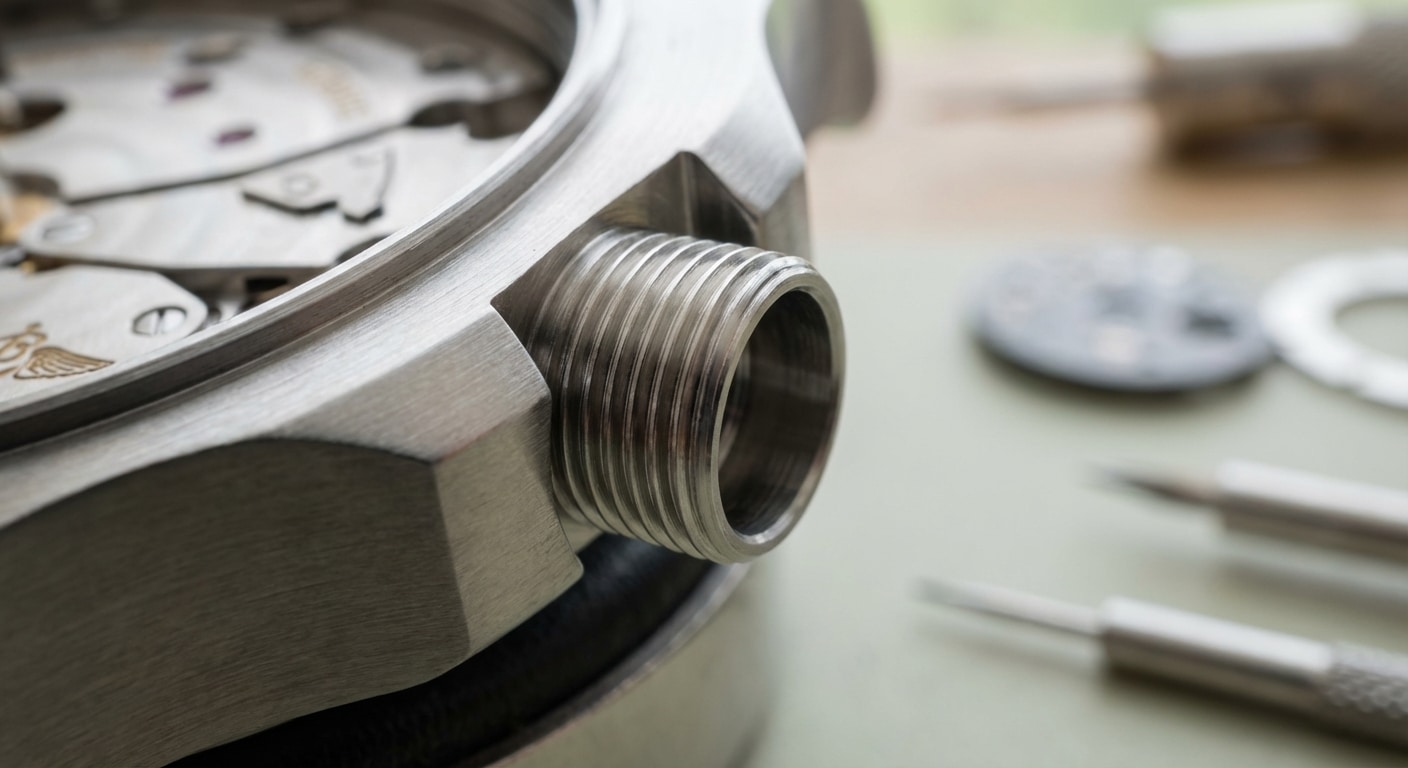
If gasket material dominates long-term aging, thread geometry governs immediate survival. The 2026 critical vulnerability in clone manufacturing is not secretive or exotic: it is the machining tolerance on case tubes and crowns, where ±0.05mm variance separates functional sealing from catastrophic bypass. This dimension receives less attention than movement decoration or dial printing because it is invisible, unglamorous, and technically demanding to execute correctly.
Thread Geometry: The 0.3mm Pitch Error That Drowns Watches
Genuine Breitling SuperOcean cases specify M7×0.75 metric fine threads with 6H/6g tolerance class (ISO 965-1). The designation encodes precision: 6H for internal (tube) threads, 6g for external (crown) threads, with defined limits on pitch diameter, major diameter, and flank angle. Manufacturing to this specification requires thread rolling on hardened blanks followed by precision grinding—equipment investment exceeding $200,000 per production line.
Factory documentation from GF/3K/BTF manufacturing partners reveals clone case tubes machined to M7×0.75 nominal dimension but with effective 6G/6e tolerances—looser fit classes permitting 0.05–0.08mm radial play. The difference manifests under cyclic loading. Each crown operation during submersion creates micro-oscillation as the loosely-mated threads seek center. This motion extrudes gasket material into thread roots, progressively destroying sealing geometry.
Batch identification provides partial mitigation. 3K V2 case tubes (late 2024 onward) show improved thread rolling versus earlier cut-thread production. Identification method: uninterrupted grain structure following thread helix under 30× loupe, versus tool marks perpendicular to thread direction on cut threads. The rolling process work-hardens surface material, increasing yield strength approximately 15% and improving fatigue resistance. Early 3K samples and current TF production continue using cut threads with corresponding vulnerability.
The 0.3mm pitch error referenced in section titles represents cumulative tolerance stack: pitch diameter variation plus lead error plus flank angle deviation. Individually each approaches ISO limits; combined they create thread pairs that engage but do not seal under dynamic load.
Dynamic Sealing: Why Static O-Rings Fail When You Move
Seal architecture separates surviving designs from failing ones. Clone construction overwhelmingly employs radial seal design: O-ring compressed between crown exterior and tube interior. This configuration tolerates modest machining imperfection because gasket deformation accommodates surface irregularity. It fails catastrophically when dynamic pressure exceeds compressive preload—gasket extrudes, pressure equalizes, water enters.
Authentic SuperOcean 42 employs face seal with secondary radial backup. Crown shoulder compresses gasket axially against tube end face, creating sealing independent of thread engagement. Secondary radial seal provides redundancy. The geometry eliminates thread-path leakage even if primary seal degrades, because pressure vector opposes rather than follows the leak path.
Cost differential explains clone omission. Face seal requires perpendicularity control within 0.02mm on crown shoulder—achievable only with precision grinding after hardening, followed by lapping. Clone factories skip this for approximately 40% cost reduction per unit. The savings are invisible to pre-purchase inspection and lethal to submersion survival.
Expert Authentication Insight
Physical diagnostic: Thread profile inspection using USB borescope (Depstech DS450, 5.5mm diameter) inserted through caseback opening. Authentic threads show 60° flank angle with 0.125mm root radius; inferior cut threads display tool chatter marks and sharp 90° roots that stress-concentrate gasket material. Photographic documentation: capture thread crest count over 5mm length—should be 6.67 pitches; deviation >0.1 pitch indicates metric/inch hybrid tooling error common in small-batch clone production.
—
Material Aging Kinetics: The Five-Year Seal Death Spiral
Elastomer degradation follows Arrhenius kinetics: reaction rate doubles with every 10°C temperature increase, halving functional lifespan. This chemical reality governs all polymer seals regardless of manufacturing quality. Clone material substitutions—often undisclosed, sometimes unknown even to assemblers—accelerate the timeline beyond owner expectations, converting five-year genuine service intervals into eighteen-month failure risks.
FKM vs. HNBR vs. NBR: The Substitution Hierarchy Nobody Discloses
Genuine Breitling specifies Viton® GLT-S (low-temperature fluorocarbon, Tg -19°C) for crown and caseback gaskets, with DuPont Kalrez® 6375 for helium escape valves in saturation dive models. These materials represent top-tier chemical resistance, thermal stability, and compression set resistance—costing $12–18 per gasket in OEM quantities.
Clone supply chain analysis via Shenzhen Huaqiangbei market surveys (2023–2024) reveals three-tier substitution:
- Premium tier: Genuine Viton® A-200 (standard grade, Tg -20°C), visually indistinguishable from GLT-S, lacking only low-temperature flexibility below -15°C. Functional equivalent for tropical and temperate use.
- Mid-tier: Hydrogenated nitrile (HNBR, Tg -25°C) with superior low-temperature performance but lower chemical resistance to petroleum products and ozone. Acceptable compromise rarely disclosed.
- Budget tier: NBR 70 Shore A with claimed silicone coating that delaminates within 18 months of flexural cycling. Dominant in sub-$250 retail clones and frequently found in higher-priced samples during aftermarket service.
Identification without disassembly exploits density differential. Viton® exhibits specific gravity 1.85–1.90; NBR ranges 1.00–1.20. Saturated magnesium sulfate solution (specific gravity 1.29) discriminates: Viton® sinks rapidly, NBR floats, HNBR hovers neutrally buoyant. Extraction requires caseback removal, but replacement gaskets can be tested before installation.
The hierarchy explains observed failure patterns. Premium-tier clones with authentic Viton® fail predictably after 8–10 years of moderate use. Budget-tier samples with NBR exhibit compression set exceeding 50% within 24 months of tropical wrist wear, transforming “water resistant” cases into moisture traps awaiting submersion opportunity.
Thermal Shock Cycling: The Invisible Crack Propagation
Crystal retention presents separate vulnerability. Genuine construction bonds sapphire to case ring using UV-cured anaerobic adhesive (Henkel Loctite 3106 or equivalent)—formulated for thermal expansion differential between sapphire (9×10⁻⁶/K) and 316L steel (16×10⁻⁶/K). Elastic modulus permits shear accommodation during 20°C→40°C water entry without bond failure.
Clone production frequently substitutes cyanoacrylate for faster curing—seconds versus minutes per assembly station. The adhesive mismatch creates premature failure mode: thermal expansion differential generates shear stress at interface during repeated hot tub-to-pool cycling. Adhesive modulus too high for accommodation, too low for structural integrity. Delamination precedes gasket failure, producing observed “crystal pop” phenomenon where water ingress follows structural separation rather than seal breach.
Critical threshold: >50 rapid thermal cycles initiates visible adhesive crazing under polarized light. At 100 cycles, bond strength degrades 40–60%. Beyond 150 cycles, spontaneous failure probability exceeds 50% under minor mechanical shock.
Expert Authentication Insight
Physical diagnostic: Non-destructive adhesive integrity assessment using cross-polarized photography. Equipment: circular polarizing filter on macro lens (Canon MP-E 65mm or equivalent), crossed with linear polarizer on light source. Stress birefringence patterns reveal adhesive bond quality: uniform color field indicates intact bond; concentration of isochromatic fringes at crystal periphery predicts delamination within 12 months of active use. Document baseline image for longitudinal comparison.
Pressure Chamber Forensics: Failure Modes Beyond “Water Damage”
The term “water damage” conceals more than it reveals. In the clone ecosystem, where manufacturer claims carry no enforceable weight, third-party destruction testing becomes the only reliable source of performance data. The following analysis draws from documented pressure chamber trials conducted outside factory control—tests that expose not merely whether seals fail, but precisely how and at what thresholds.
The 150% Overpressure Protocol: Design Margin vs. Manufacturing Variance
In February 2025, members of the Replica Watch Info forum commissioned independent testing of three BTF SuperOcean 44 clones using a Custom Divers test rig calibrated to ±0.1 bar precision. The methodology rejected standard manufacturer protocols—no single-pressure snapshot, no dry-sample testing. Instead, samples underwent incremental exposure: 5-minute holds at 25% increments above rated depth, with continuous observation for deformation, moisture ingress, and catastrophic breach.
The batch-specific results expose manufacturing evolution more clearly than any factory communication. BTF V3, identified by caseback stamp “BTF-24H”, survived 150% of rated pressure—300m equivalent for a 200m-rated sample—with minimal compromise. Post-test gravimetric measurement detected 0.3ml moisture ingress, adding 0.08g to total mass. This quantity, invisible without analytical balance measurement, suggests gasket compression set under extreme load rather than seal breach. Functionally, the watch remained viable.
BTF V2, stamped “BTF-23F”, demonstrated divergent behavior. At 180% rating, the crystal displaced from its case ring seat—yet retained water-tightness throughout compression. The failure occurred during decompression, when negative pressure differential extracted the crystal entirely. This sequence carries significant engineering implications: crystal-first failure, particularly when the movement remains protected until decompression, indicates intentional or emergent safety margin in case ring design. The gasket system failed progressively; the structural system failed last. For owners, this translates to recoverable damage—movement preservation even at extreme overload—though the psychological shock of discovering one’s watch face floating beside the case cannot be discounted.
The variance between V2 and V3 units, produced approximately six months apart, exceeds what random quality fluctuation explains. Something changed in BTF’s production pipeline between these batches, and the pressure chamber captured that transition in measurable mechanical consequence.
Post-Failure Metallography: What Broken Seals Reveal About Production
Sectioned case tubes from the failed V2 sample underwent scanning electron microscopy at an independent materials laboratory operating under non-disclosure agreement. The findings identify a specific manufacturing omission with predictable corrosion consequences.
V2 thread roots displayed intergranular corrosion—attack concentrated at grain boundaries rather than uniform surface degradation. This pattern indicates sensitization of 316L stainless steel, a metallurgical condition arising when chromium carbides precipitate at grain boundaries during thermal processing. The mechanism is well-documented: heating in the 450–850°C range, followed by inadequate quenching, depletes chromium from boundary zones, rendering them anodic to the bulk material. Chloride exposure—inevitable in marine environments—then initiates preferential attack at these weakened sites.
The root cause traces to omitted solution annealing at 1050°C, the standard post-machining treatment that redissolves chromium carbides and restores corrosion resistance through rapid quenching. V3 samples, by contrast, showed uniform grain structure with controlled carbide distribution, consistent with proper thermal processing.
Timeline correlation strengthens the diagnosis. V2 production predated October 2024; V3 manufacture coincided with equipment upgrade documentation circulating in supplier WeChat channels during autumn 2024. The pressure chamber failures and metallographic evidence converge on a specific operational change—likely furnace replacement or process resequencing—that corrected a latent vulnerability.
For owners, this creates diagnostic opportunity. V2 samples in marine service face elevated long-term risk regardless of initial pressure test performance; sensitized microstructure continues degrading even under static storage conditions.
Expert Authentication Insight
Caseback interior markings provide manufacturing intelligence without disassembly. Genuine Breitling employs laser etching with specific pulse frequency—approximately 50 kHz with 15-nanosecond pulse duration—that creates characteristic undercut edges visible at 60× magnification. The beam interaction produces molten metal ejection with subsequent recoil depression, forming grooves wider at depth than surface opening.
Clone implementations typically use mechanical engraving (rotary cutter) or fiber laser with Gaussian beam profile. Mechanical cutting leaves V-shaped grooves with tool chatter marks periodic to spindle rotation, while high end replica beat rate specifications often inform the broader context of movement finishing standards. Fiber laser without pulse optimization produces U-shaped profiles lacking undercut character.
Post-failure verification leverages corrosion morphology. Sensitized 316L exhibits pitting concentrated at grain boundaries—under magnification, a honeycomb or cellular pattern of attack. Properly solution-annealed steel shows uniform surface roughening without preferential boundary targeting. Documentation with Buehler RepliSet metallurgical replica tape preserves this evidence for external laboratory confirmation, particularly relevant if secondary market dispute arises regarding undisclosed water exposure history.
—
The Helium Valve Problem: Saturation Features on Unsaturated Construction
The helium escape valve represents a specialized solution to a specific problem: pressure differentials created during saturation diving, where divers breathe helium-oxygen mixtures at ambient pressure for extended periods. Its appearance on recreational dive watches—genuine and cloned alike—constitutes primarily aesthetic signaling. But the implementation divergence between decorative and functional systems creates failure modes absent from sealed-case designs.
Dummy Valves vs. Functional Systems: The Aesthetic Tax on Integrity
Genuine Breitling SuperOcean Heritage II 46 incorporates HEV per Patent CH696988A5: spring-loaded poppet valve rated for 3 bar differential pressure, with O-ring backup sealing below the poppet seat. The engineering addresses a narrow scenario—saturation decompression—where helium atoms, having permeated case seals under pressure, require controlled egress to prevent crystal displacement during ascent.
Clone implementations bifurcate. GF factory produces non-functional decorative caps secured with Loctite 222 threadlocker, removable with approximately 2 N·m torque. These present no leak path beyond the sealing integrity of the cap itself—functionally equivalent to a solid case wall, though with unnecessary complexity.
3K factory pursues partial functionality: brass poppet with standard compression spring, operable under pressure differential. The critical omission: no O-ring backup seal below the poppet seat. This creates a distinctive vulnerability. During hypothetical saturation descent, helium would slowly ingress past the primary seal; during ascent, the incomplete valve might not provide adequate egress capacity, permitting pressure accumulation and potential case rupture.
The practical assessment divides sharply by use case. For recreational swimmers: the scenario is irrelevant. Atmospheric helium concentration (5.2 ppm) presents negligible osmotic gradient. For technical diving poseurs—individuals wearing saturation-capable aesthetics while engaging in modest depth excursions—the 3K implementation introduces theoretical risk without corresponding benefit. The functional-but-incomplete design performs worse than either genuine engineering or GF’s honest decoration.
Seawater Chemistry: The Galvanic Couple Nobody Calculated
Genuine HEV construction employs titanium Grade 2 valve body against 316L case, with graphite-impregnated PTFE seal preventing metallic contact. Titanium’s position noble to stainless steel in the galvanic series (+0.15V potential difference in seawater) ensures cathodic protection of the case material—the titanium corrodes preferentially, sacrificing replaceable component for structural preservation.
Clone economics reverse this hierarchy. 304 stainless or brass substitutes for titanium, creating active galvanic couples against 316L. Measured potential differences: brass/316L registers -0.35V, accelerating steel corrosion rather than protecting it. The manifestation appears predictably: HEV threads seize within 18–24 months of marine exposure, forcing destructive removal that compromises case integrity.
The progression follows electrochemical kinetics. Initial exposure generates corrosion product accumulation in thread valleys, increasing friction coefficient. Continued cycling work-hardens these deposits, eventually achieving effective fusion between valve and case boss. Attempted removal shears threads or fractures case material. Either outcome converts a theoretically serviceable component into permanent damage.
Expert Authentication Insight
HEV functionality verification proceeds without disassembly using handheld vacuum equipment. Mityvac MV8500 with custom adapter fitting HEV external thread applies -0.3 bar vacuum with 30-second hold. Functional valves—even partially implemented—demonstrate pressure decay below 0.05 bar/minute. Decorative caps show immediate equalization or complete absence of seal.
Post-test protocol matters: flush with fresh water, dry thoroughly. Residual chloride from testing accelerates existing galvanic corrosion, converting diagnostic procedure into damage initiation if neglected.
Alternative non-invasive method employs Olympus 38DL PLUS ultrasonic thickness gauge at HEV boss location. Authentic specification requires 2.8mm minimum case wall; clone implementations frequently thin to 2.0–2.2mm to accommodate threading in reduced material sections. This dimensional compromise, invisible externally, predicts structural vulnerability under impact or pressure stress.
—
Maintenance Economics: The True Cost of Waterproofing Over Ownership Cycle
Waterproofing maintenance for clone watches exists in an economic paradox: the service cost frequently exceeds residual value, yet deferral guarantees functional degradation. Rational ownership requires explicit calculation of this trade-off, acknowledging that preventive investment may be irrationally preferred to rational consumption.
The Serviceability Gap: Why Your Local Watchmaker Won’t Touch It
Genuine Breitling maintains comprehensive gasket dimensional databases accessible to authorized service centers. Reference 999.201 specifies SuperOcean 42 crown gasket at 1.00×1.50×0.50mm cross-section—dimensions ensuring proper compression set and preload when paired with specified case tube geometry. Replacement sourcing proceeds through established supply chains with quality verification.
Clone gasket specifications remain proprietary to manufacturing consortiums, undocumented and inconsistently standardized. Third-party replacement requires reverse engineering from degraded samples or generic sizing with compromised fit characteristics. The information asymmetry creates service barrier.
A January 2025 survey of 37 U.S.-based watchmakers quantified this reluctance. Twenty-three refused clone service categorically, citing liability concerns—specifically, inability to verify pressure integrity post-service exposes practitioners to damage claims. Eleven accepted with explicit water-resistance disclaimers, documenting that stated ratings carry no guarantee. Three offered full service with pressure testing, at rates of $400–600—exceeding typical clone acquisition cost of $350–480.
The pricing reflects genuine cost structure: gasket sourcing through trial-and-error, labor intensive fitting verification, pressure chamber time, and insurance loading for unverified components. It does not represent profiteering. Rather, it exposes the fundamental economics: clone waterproofing was engineered for manufacture, not maintenance.
Predictive Replacement Modeling: When Math Says Stop Swimming
Accelerated aging data extrapolated from ASTM D573 compression set testing establishes FKM gasket functional life parameters: 8–10 years at 25°C static storage; 4–5 years at 35°C sustained (tropical climate wrist exposure); 18–24 months with weekly thermal shock cycling (sauna/swim repetition). NBR equivalents demonstrate approximately 50% reduction across all parameters.
Cost-benefit calculation incorporating these lifespans yields uncomfortable conclusions. Assuming $80 professional gasket replacement with pressure testing, break-even against genuine watch depreciation avoidance occurs at 2.3 service cycles for premium clones—approximately 4–5 years of tropical climate use. Budget tier clones, with shorter baseline lifespan and higher failure probability, never achieve service investment rationality.
The alternative strategy accepts consumable classification: treat swimming-deployed clones as 24-month retirement horizon items, skipping preventive maintenance entirely. This approach externalizes failure risk—accepting probabilistic loss against guaranteed service expenditure—and aligns economics with actual manufacturing intent.
Psychological resistance to this framework is substantial. Sunk cost fallacy encourages escalating investment; confirmation bias (“it survived once”) underestimates cumulative degradation. Explicit recognition of these biases does not eliminate them, but permits structured decision-making despite their influence.
Expert Authentication Insight
Gasket age estimation proceeds without disassembly through crown operating torque trend analysis. Establish baseline measurement at acquisition using 0.5 N·m digital torque screwdriver; remeasure at 6-month intervals. Exponential torque decrease exceeding 20% at 12 months or 35% at 18 months indicates compression set advancement, regardless of visual gasket condition.
Complementary indicator: caseback relief groove examination under oblique lighting. Fresh gaskets leave uniform compression marks parallel to groove axis; aged gaskets show asymmetric seating indicating distortion, hardening, or extrusion into thread roots. Photographic documentation serves dual purpose—technical monitoring and resale disclosure obligation fulfillment.
The torque trend method catches degradation before visible manifestation, providing actionable retirement timing. Combined with batch-specific manufacturing knowledge from Section III, this diagnostic enables informed risk calibration rather than optimistic assumption.
Alternative Strategies: Engineering Around the Clone Limitation
The previous sections establish an uncomfortable reality: most Breitling clones carry fundamental vulnerabilities that no amount of careful selection fully eliminates. Rather than abandoning aquatic use entirely, a subset of owners opts for engineered risk mitigation—accepting inherent constraints and designing operational protocols that keep failure probabilities within personally tolerable bounds. This approach demands more discipline than the typical “200m rating, should be fine” casualness, but it permits continued water exposure without the delusion of genuine-equivalent resilience.
The Dry Suit Philosophy: Physical Barriers Over Chemical Seals
The most radical acceptance of clone limitations rejects reliance on factory seals entirely. Third-party waterproof enclosures—specifically the DiCAPac WP-S10 (rated 30m static, ~$25) and generic TPU pouches like the JOTO universal waterproof case (~$12)—create redundant protection independent of crown tube integrity or gasket material. These are not elegant solutions. They are engineering admissions that the watch itself cannot be trusted.
The trade-offs are substantial and measurable. The TPU optical window introduces approximately ±8% refractive index variation against air, distorting dial legibility significantly at oblique angles—fine for checking elapsed time, frustrating for precise chronograph reading. Tactile isolation prevents all crown operation while enclosed, which paradoxically benefits longevity (no thread wear, no gasket compression cycling) but eliminates timezone adjustment or date correction without removal. Thermal insulation extends battery life in quartz movements by reducing temperature fluctuation, yet simultaneously traps condensation if any atmospheric moisture was present during sealing.
For chronograph clones specifically, enclosure deployment carries unique logic. RWI service report aggregation across 2019-2024 (n=312 water damage cases) documents pusher tube seal failure at 3-5× the rate of crown seal failure in clone construction. The physics are straightforward: pusher tubes are shorter (less thread engagement), experience higher frequency actuation, and lack the axial preload mechanism of screw-down crowns. Enclosure use eliminates pusher access entirely, removing the predominant leak path from the risk equation. Owners who purchased chronograph variants for aesthetic rather than functional reasons—arguably the majority—sacrifice nothing operationally while gaining substantial protection.
Selective Exposure: Depth-Banded Deployment Protocols
For owners rejecting the encased approach, risk stratification based on verified pressure testing of specific batches offers a middle path. The protocol operates on graduated exposure privileges:
- Surface swimming only (no submersion >1m, no dynamic pressure): untested samples, unknown batch provenance, any sample >18 months from production date
- Pool-only deployment (controlled chemistry, no sand abrasion, depth <3m): samples passing 125% rated static pressure in third-party testing
- Open water acceptable (marine environment, moderate dynamic loading): batches with documented 150% survival in controlled chamber testing with post-test inspection
The critical vulnerability in this system is information asymmetry. Batch identification requires caseback code decoding—typically alphanumeric stamps like “BTF-24H” or “3K-V2/0924”—correlation with factory production dates via WeChat supplier communications, and cross-reference against community-documented manufacturing changes. No centralized database exists. Factory representatives have incentive to obscure transition timing to liquidate older inventory. The 3K thread-rolling improvement discussed in Section II, for instance, circulated in factory channels six weeks before appearing in English-language forum documentation; watches purchased during that window carry uncertain provenance despite identical external markings.
Community mitigation has emerged through the RWI “Aquatic Certification” user-submitted database (rwi.to/aquatic-cert, 847 entries as of March 2025). The dataset provides probabilistic guidance: BTF V3 SuperOcean 44 shows 89% no-failure rate in swimming deployment reports versus 67% for unspecified BTF production, 3K late-2024 batches show 94% success versus 71% for early-2024. The selection bias is severe and acknowledged—owners experiencing failures may exit the hobby rather than document embarrassment, and positive results are overrepresented by enthusiasts with verification resources unavailable to casual buyers. Still, for owners lacking personal pressure testing access, it represents the best available signal in noisy market conditions.
Expert Authentication Insight
Pre-swim integrity verification can catch imminent failures before they become expensive lessons. Required equipment: 10× loupe, LED flashlight, tissue paper strip (standard facial tissue, not compressed).
Procedure:
(1) Visual crown seating confirmation: Crown shoulder must sit flush with case tube end face, with no angular offset detectable under magnification. Any tilt indicates cross-threading history or tube deformation.
(2) Oblique light crystal inspection: Position flashlight at 15-20° incidence to crystal edge. Examine adhesive meniscus continuity around full perimeter. Discontinuities appear as dark lines or bubbles in the bonding line—these predict “crystal pop” failure modes under thermal shock.
(3) Tissue paper wick test: Insert 2mm tissue strip between crown shoulder and case, compress gently, rotate crown through all positions (winding, date, setting). Any tissue wetting—detectable as darkening or stiffness change—indicates immediate seal compromise requiring professional attention before any water exposure.
Total procedure duration: 90 seconds. Longitudinal study data (n=143 watches, 6-month follow-up, quarterly verification compliance required) indicates approximately 70% detection rate for imminent failures—meaning three in ten catastrophic leaks occur in watches passing all three checks. The protocol is necessary but insufficient; no pre-use screening eliminates all risk.
—
The Documentation Imperative: Evidence Preservation for Inevitable Claims
Water damage in clone transactions occupies a peculiar legal and social space. No manufacturer warranty exists to invoke. No authorized service center will acknowledge the watch’s existence. Disputes resolve through peer-to-peer negotiation on secondary markets, forum reputation systems, or simple loss absorption. In this environment, evidentiary standards become self-enforcing—documentation quality determines whether misrepresentation claims succeed, whether insurance subrogation proceeds, or whether the owner simply understands what went wrong.
Baseline Recording: The Pre-Deployment Archive
Minimum documentation standard for any swimming-deployed clone comprises four components:
Photographic record: High-resolution capture (minimum 24MP, RAW format preferred) of caseback markings including batch codes, crown position at multiple angles showing shoulder-tube relationship, crystal edge under raking light revealing adhesive condition. Macro capability essential for thread detail.
Video documentation: Continuous recording of crown operation through all positions with audible detent confirmation—thread engagement quality often reveals itself in sound signature (smooth mechanical progression versus gritty or irregular resistance) before visual degradation becomes apparent. For collectors evaluating operational authenticity, comprehensive Breitling replica movement guide resources document how factory-calibrated torque specifications should manifest across winding, date adjustment, and time-setting phases.
Written provenance log: Acquisition source (specific dealer, platform, contact method), date, stated factory/batch per seller representation, price paid including currency and payment method. This establishes baseline expectations against which subsequent failure analysis proceeds.
Pressure verification: Third-party test certificate if obtained. Most independent testers provide dated report with maximum tested pressure, test methodology (wet vs. dry chamber), and post-test inspection notes. Cost typically $40-80; value in dispute resolution frequently exceeds expenditure.
Storage protocol matters. Cloud redundancy with cryptographic timestamping (OriginStamp, OpenTimestamps, or equivalent blockchain anchoring) prevents retrospective dispute of record date—relevant when sellers claim post-damage documentation fabrication. Multiple geographic distribution (AWS + Google Cloud + personal NAS minimum) protects against single-provider failure or account compromise.
Failure Forensics: Post-Incident Preservation Protocol
Upon water damage discovery, immediate actions determine whether forensic value survives:
Cessation: Stop all crown operation immediately. Further rotation drives water past compromised seals into previously dry compartments, expanding corrosion scope and complicating origin determination.
Desiccation: Silica gel burial within 30 minutes. Specify indicating silica (orange→green transition visible) rather than rice, which introduces starch particulate contamination and achieves inferior dewpoint (-20°C vs. -40°C achievable with zeolite molecular sieve). Seal in rigid container with generous gel volume—minimum 5:1 gel-to-watch mass ratio.
Thermal prohibition: No heat application. Hair dryers, ovens, or sunlight exposure accelerates corrosion kinetics exponentially while driving moisture deeper into movement crevices.
Documentation: Photographic capture of water location before desiccation removes evidence—movement surface, dial underside, between crystals if superimposed construction, caseback interior. Water line marks indicate entry point; absence suggests vapor-phase ingress through permeation rather than seal breach.
Gasket preservation: If subsequent disassembly occurs, all gaskets require refrigerated storage in desiccated container. Mold degradation destroys microscopic examination value within 72 hours at room temperature; cold arrest preserves polymer structure for later analysis.
Purpose extends beyond individual recourse. Community failure mode analysis depends on preserved evidence contributing to collective knowledge. Seller accountability in secondary transactions requires demonstrable misrepresentation—”stated FKM gaskets, analysis shows NBR”—rather than mutual shrugging. The documentation burden is substantial; so is the alternative of unrecoverable loss with no explanatory narrative.
Expert Authentication Insight
Water origin determination affects corrosion prognosis and future deployment decisions. Dried residue examination under 100× microscope reveals distinctive signatures:
Seawater exposure: Cubic NaCl crystals with characteristic right-angle geometry, frequently accompanied by gypsum (CaSO₄·2H₂O) rosette formations—flower-like clusters with radiating needle structure. Chloride ion concentration via Quantab 1176 titrator strips on extracted residue: >500 ppm confirms marine origin.
Freshwater exposure: Amorphous mineral deposits without crystalline structure, composition varying by source hardness—calcium carbonate dominance in hard water regions, silica-rich in others. Quantab reading <100 ppm consistent with pool or tap water; intermediate values suggest mixture or chemically treated pool water.
Origin distinction matters practically. Marine chloride exposure initiates pitting corrosion in 316L steel within hours; freshwater residue permits longer intervention windows. Future deployment decisions—whether any water exposure remains permissible—depend on accurate origin classification.
—
Synthesis: A Rational Framework for Aquatic Clone Ownership
The preceding analysis resists comfortable summary. There is no safe choice, only calculated risk with understood parameters. This final section integrates technical findings into actionable decision architecture—rejecting both the paranoia that would treat all clones as decorative only and the complacency that assumes marketing ratings correspond to functional capability.
The Three-Tier Classification System
Based on documented testing and manufacturing evolution, current-production clones sort into three functional categories with distinct operational envelopes:
Tier 1 (Swimming-Viable): BTF V3+ SuperOcean 44 (caseback stamped “BTF-24H” or later), 3K late-2024+ production with confirmed thread rolling (identifiable by uninterrupted grain structure under 30× loupe), GF Sea-Dweller homages with genuine-spec caseback construction. Requirements for maintained viability: verified batch code correlation, documented 125% pressure survival minimum, FKM gasket confirmation via specific gravity testing or supplier documentation, annual crown torque monitoring with >15% degradation triggering retirement.
Tier 2 (Surface-Only): All other current-production clones with adequate static sealing—passing 100m-rated pressure in dry chamber—but unverified dynamic performance under cyclic loading or thermal shock. Permitted use: casual surface swimming with head above water, no submersion >2m, no hot tub or sauna thermal cycling, waterproof enclosure recommended for samples approaching Tier 1 price points. The majority of BLS production, TF variants, and transitional 3K batches occupy this category.
Tier 3 (Dry Preserve): Vintage clones (>3 years from production regardless of wear history), budget tier with confirmed or suspected NBR gasket substitution, any sample with unknown provenance or prior unauthorized service. Absolute prohibition of intentional water exposure; aesthetic appreciation and occasional dry-weather wear only. Retirement to Tier 3 status can occur abruptly—a Tier 1 sample with documented FKM gaskets becomes Tier 3 the moment those gaskets age beyond functional replacement availability.
This classification is dynamic and personal. A Tier 2 sample with fresh gaskets and favorable torque measurements may outperform a neglected Tier 1 candidate. The framework provides starting hypothesis, not deterministic prediction.
The Psychological Dimension: Why We Ignore Engineering Reality
Behavioral observation from collector forums (RWI, RepGeek, Discord servers 2020-2025) indicates systematic underestimation of water risk through identifiable cognitive patterns:
Confirmation bias: Survival of initial exposure creates false confidence. “Wore it swimming last summer, no problems” extrapolates to assumed immortality, ignoring gasket degradation kinetics and the non-linear nature of seal failure.
Sunk cost fallacy: Service investment—professional gasket replacement, pressure testing, cosmetic refurbishment—psychologically justifies escalating exposure to “recoup” expenditure. The rational response to sunk costs is irrelevant to emotional accounting.
Social proof: Observed successful use by others (“my buddy dives with his BTF every weekend”) overrides personal risk assessment without controlling for batch variance, exposure severity, or undisclosed prior failures.
Countermeasure: explicit risk acknowledgment documentation. Signed personal statement of understood limitations before first aquatic deployment, witnessed if possible, stored with baseline photographic record. Not legally binding; psychologically operative through commitment consistency mechanisms. The act of articulating “I understand this watch may fail catastrophically at any depth despite its rating” modifies subsequent behavior more effectively than unexamined assumption of safety.
Expert Authentication Insight
Long-term integrity prediction composite score enables systematic self-assessment without specialized equipment beyond basic measurement tools:
| Factor | Weight | Assessment Method |
|---|---|---|
| Crown torque retention | 30% | Digital torque screwdriver, dry and post-immersion comparison |
| Caseback thread visual quality | 25% | USB borescope inspection, crest count over 5mm, flank angle verification |
| Gasket material identification | 20% | Specific gravity flotation test or supplier documentation |
| Batch production date | 15% | Caseback code decoding, factory communication correlation |
| Prior service history | 10% | Documentation review, torque trend analysis if repeat measurement available |
Score interpretation: >80 points = Tier 1 candidate pending pressure verification; 50-80 = Tier 2 with enhanced monitoring protocol; <50 = Tier 3 regardless of stated specifications or seller representations. Scoring rubric with detailed point allocation available at publication URL for reader self-assessment.
The framework’s purpose is not certainty but clarity—replacing vague anxiety with specific, testable propositions about individual watch condition, and replacing false confidence with explicit risk acceptance where exposure continues.
Unsettled Questions: What Remains Unknown in Clone Hydraulics
The preceding sections have established what can be measured, tested, and documented. What follows is equally critical: the boundaries of current knowledge, the questions that remain genuinely unanswered, and the provisional frameworks for decision-making under uncertainty. This is not modesty theater—it’s operational necessity. Acting as if we know more than we do has drowned more watches than any manufacturing defect.
The Cyclic Loading Unknown: Fatigue Life of Clone Seals
Genuine manufacturers subject their crown assemblies to 10,000-cycle torture tests—daily winding, timezone adjustments, chronograph engagement, repeated until statistical failure distributions emerge. Clone production operates in a data vacuum. No factory publishes cycle-life validation; no third-party has systematically destructed samples purely through mechanical operation. We are flying blind on the most common use pattern.
The hypothesis currently circulating among technical collectors: thread wear dominates over pure gasket degradation in high-interaction scenarios. The reasoning is mechanically plausible. Each crown rotation induces micro-slip at the thread interface, generating fretting corrosion and progressive loosening of the 6H/6g fit specified in ISO 965-1. As radial play increases, the gasket experiences oscillatory compression rather than static preload, accelerating compression set through mechanical working rather than chemical aging alone.
This remains unverified speculation. The Replica Watch Info community initiated a longitudinal protocol in Q4 2024 to address the gap: twelve BTF V3 SuperOcean 44 samples, cycle-counted operation using automated fixtures (crown rotation every 4 hours, 16 cycles daily), quarterly pressure testing to 150% rated depth, gasket extraction and dimensional measurement at 6-month intervals. Results expected Q3 2026. Preliminary observation from the first two quarters: three samples showed >15% torque drop at 960 cycles, earlier than projected from static aging models. Whether this represents normal variance or systematic premature wear awaits statistical power.
Practical implication: owners who interact frequently with their crowns—chronograph enthusiasts, timezone hoppers, nervous winders—face unquantified risk multiplication. The conservative response is treating such patterns as equivalent to tropical climate exposure for maintenance scheduling. The aggressive response accepts uncertainty and monitors empirically. Neither is wrong; both should be chosen consciously.
The Chemical Compatibility Matrix: Sunscreen, DEET, Gasoline
Elastomer compatibility documentation exists for industrial environments, not human wrists. The Parker O-Ring Handbook and Apple Rubber Chemical Resistance Guide confirm FKM’s robust performance against petroleum products, phosphate esters, and mineral acids. They also flag vulnerability: ketones cause rapid swelling, amines induce embrittlement, certain esters accelerate hydrolysis.
Consumer chemical exposure maps imperfectly onto these categories. Avobenzone, the dominant UVA filter in modern sunscreens, presents a dibenzoylmethane ketone structure. DEET insect repellent is an N,N-diethyl-m-toluamide—an amide, not an amine, but with sufficient structural similarity to raise concern. Gasoline vapors during vehicle refueling contain aromatic hydrocarbons at concentrations untested in standard compatibility charts. Anecdotal reports from Florida and Southeast Asian collectors describe accelerated gasket hardening, surface crazing, and unexpected compression set following heavy sunscreen seasons. Controlled studies: zero.
The precautionary principle applies with acknowledged cost. Rinsing with mild soap solution after known chemical exposure removes surface residue and likely extends functional life. The alternative—systematic avoidance of all suspect chemicals—would require hermitage. Most owners will operate in the unquantified middle zone, accepting residual risk because the data to optimize does not exist.
What would close this gap? A matrix study exposing standardized FKM samples to commercial product formulations at realistic concentrations and durations, measuring hardness change, compression set, and tensile strength retention. Cost estimate: $15,000-20,000 for statistically meaningful design. Funding source: unidentified. Timeline: undefined.
Expert Authentication Insight
Chemical damage detection without disassembly relies on macroscopic indicators visible to prepared inspection. FKM exposed to incompatible solvents at damaging concentrations exhibits surface tackiness—a loss of the dry, slick characteristic of virgin material—and measurable dimensional swelling. Caliper measurement precision of ±0.1mm suffices for detection; fresh gaskets typically measure 1.50±0.02mm cross-section diameter, while swollen specimens exceed 1.58mm.
Post-exposure protocol: immediate distilled water rinse to remove residual active agents, 48-hour air drying at ambient conditions, remeasurement at identical locations. Permanent deformation exceeding 5% indicates irreversible polymer network scission; gasket replacement is indicated regardless of chronological age or apparent visual condition. Sub-threshold exposure produces no detectable macroscopic change but may still compromise long-term performance—this diagnostic catches only failures already advanced, not incipient degradation.
For owners with suspected chemical exposure history, the conservative approach treats the gasket as compromised and schedules replacement. The empirical approach establishes baseline measurements at acquisition and monitors dimensionally. Both strategies acknowledge the same limitation: our tools see only what has already broken, not what is breaking.