
The Valjoux 7750 Patent: An Engineering Blueprint Designed for Survival
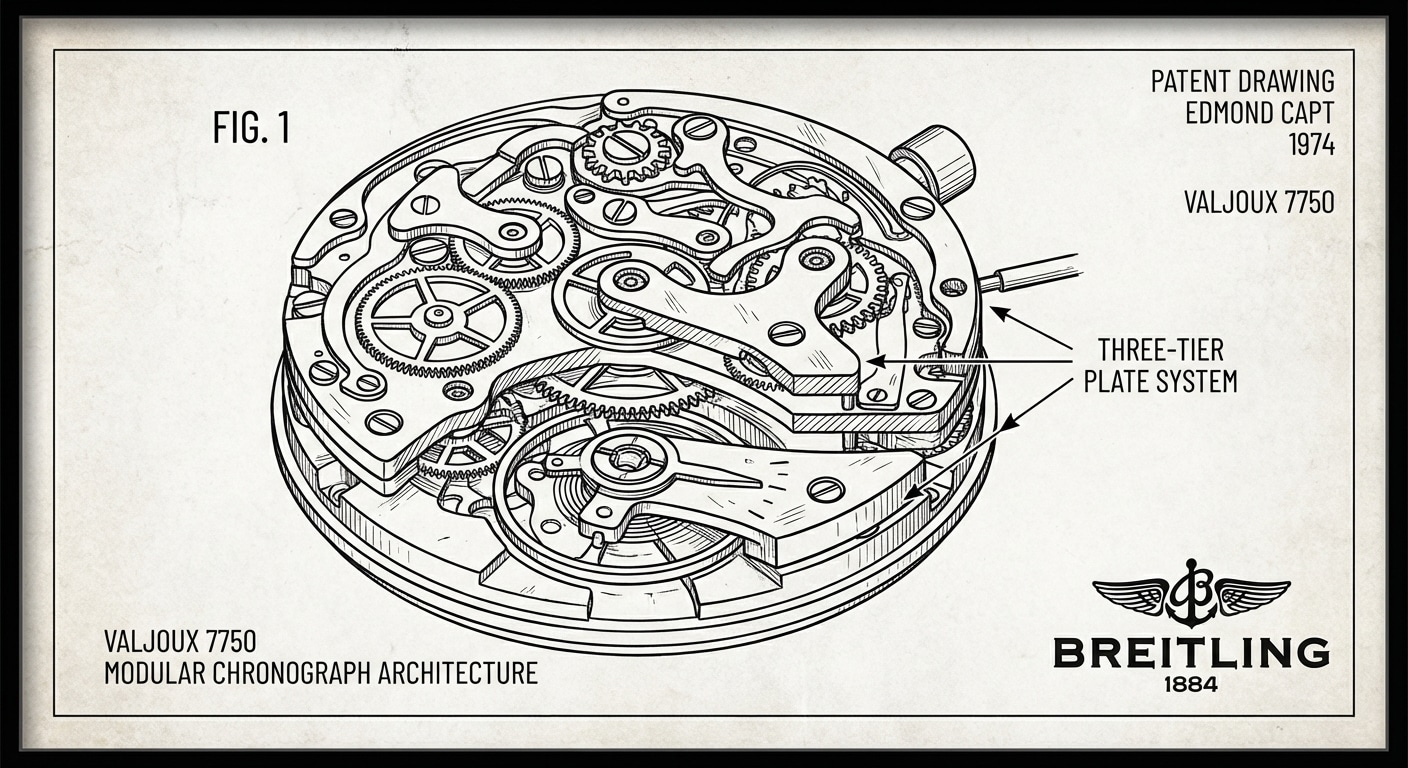
Edmond Capt filed the foundational patent for what became the Valjoux 7750 in 1974, not anticipating replication but engineering for survival—specifically, the survival of mechanical watchmaking through the quartz crisis. His design decisions created an architecture so robustly modular that it would later accommodate unauthorized copying with minimal modification. Understanding this historical trajectory helps collectors navigate modern decorated vs clone movements when assessing contemporary Breitling calibers. The patent documents reveal a mind concerned with assembly economics: standardized pillar heights, replaceable subassemblies, and tolerance stacking that assumed human rather than robotic precision. These choices, made to preserve Swiss jobs, inadvertently prepared the movement for industrial dispersal across Pacific manufacturing bases five decades later.
The 7750’s longevity stems from Capt’s recognition that reliability under mass production requires forgiving geometries. Where competing designs demanded exacting fits achievable only through skilled hand-finishing, Capt specified surfaces that could tolerate variation without functional degradation. This philosophy—structural fidelity over dimensional perfection—would prove double-edged. It enabled ETA to produce millions of legitimate units. It also lowered the technical barrier for Asian manufacturers seeking equivalent performance without equivalent infrastructure.
The Cam Switching Geometry: Physics of Forced Efficiency
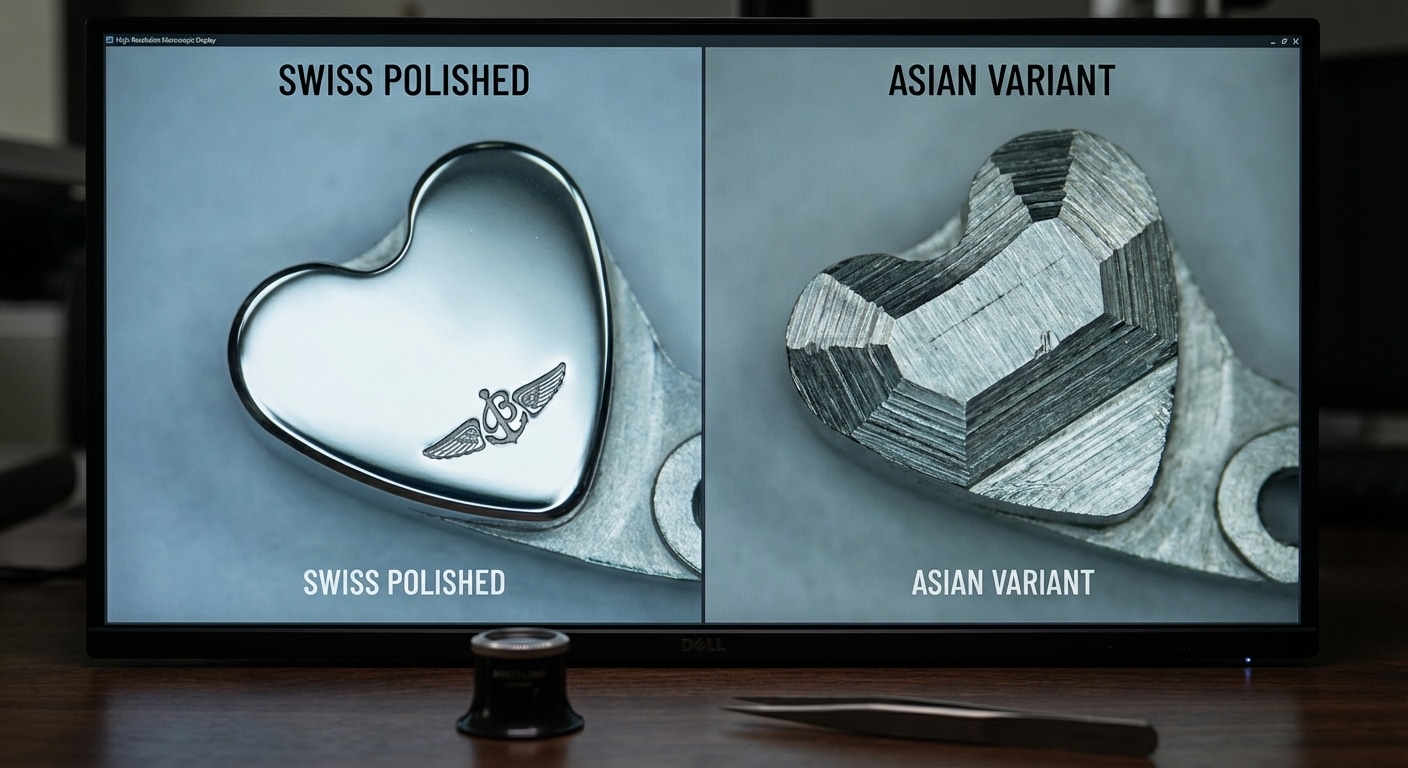
The chronograph’s heart cam presents a study in engineered compromise. Capt specified a profile sweeping from 1.85mm base radius to 2.40mm peak—a continuous curve generating forced contact against the hammer toe throughout the reset cycle. This sliding friction system operates through deliberate inefficiency: the cam pushes the hammer aside mechanically, converting rotational energy into controlled lateral displacement rather than relying on spring return alone.
Column wheel alternatives demand precise angular alignment between teeth and levers—tolerances of ±0.02mm or tighter—to ensure clean engagement without drag or double-striking. The heart cam tolerates ±0.05mm because its continuous surface distributes contact forces gradually. Manufacturing variance shifts the pressure distribution but cannot eliminate function entirely unless grossly exceeded.
Asian factories exploit this forgiveness aggressively. Cam forgings from Dandong Machine Tool Works achieve operational equivalence at tolerances Swiss manufacturers would reject. The critical insight: the cam’s working surface is large enough that localized deviation averages out across the engagement arc. A column wheel with one malformed tooth fails catastrophically; a heart cam with equivalent surface error merely alters reset feel slightly. Dandong’s process—hot forging followed by limited grinding—produces cams that measure ±0.05mm from specification yet function identically in timegrapher testing.
The cost differential is substantial. Swiss cam production requires multi-axis CNC profiling and hand-polished transition zones. Dandong’s forged-and-ground approach reduces machining time by approximately 70%. The resulting surface finish—Ra 0.4μm versus Swiss Ra 0.1μm—increases friction coefficient measurably but remains within the 7750 architecture’s operational envelope. This is not inferior engineering per se; it is different engineering optimized for different production economics.
Horizontal Clutch: The Compromise That Became an Advantage
The horizontal clutch represents Capt’s most consequential accommodation to manufacturing reality. Sliding gear engagement—module 0.18, pressure angle 20°—introduces theoretical disadvantages: seconds hand jitter at start/stop, increased wear from friction engagement, and the 2.3mm additional thickness that contemporary critics deemed archaic. Vertical clutch architectures, emerging as the 7750 entered production, offered axial stacking with immediate torque transmission and negligible thickness penalty.
Capt persisted with horizontal engagement because it solved integration problems vertical clutches created. The automatic winding module required substantial vertical space—rotor bearing, reduction gears, reverser mechanism—that competed with clutch stack height in alternative designs. By accepting horizontal clutch thickness, Capt freed axial room for robust winding components. The 7750’s bi-directional winding efficiency, consistently superior to thinner competitors through the 1980s and 1990s, derived directly from this dimensional generosity.
Asian clones preserve this relationship precisely because they cannot reliably source the materials vertical clutches demand. Axial engagement systems require hardened steel interfaces with surface finishes below Ra 0.05μm to prevent galling under sliding contact. Swiss manufacturers achieve this through specialized alloys and precision grinding. Asian suppliers, working with commodity bearing steel and limited superfinishing capacity, encounter seizure failures when attempting vertical clutch replication. The horizontal clutch’s more forgiving geometry—larger contact surfaces, lower unit pressure, lubrication-friendly open architecture—remains replicable with available technology.
This preservation is not nostalgic but economic. The horizontal clutch’s documented disadvantages—chronograph seconds hand recoil of 0.2-0.5 seconds, measurable amplitude drop during engagement—are perceptible only under specific test conditions. For replica applications where chronograph activation constitutes less than 5% of operating hours, these theoretical inferiorities manifest rarely enough to be irrelevant. The architecture’s repairability, meanwhile, proves decisive: a worn horizontal clutch wheel replaces in minutes; a seized vertical clutch often destroys the movement.
Modular Plate System: Designed for Disassembly Economics
Capt’s three-tier plate architecture—mainplate (pillar height 1.20mm), calendar plate (0.90mm), chronograph module (0.65mm)—established standardized interfaces that predetermined Asian cloning feasibility. Each tier connects through locating pillars and screws rather than integral machining, isolating complexity into replaceable subassemblies. A defective chronograph module swaps without disturbing the base movement; calendar complications add or remove independently.
This modularity originated in service economics. The 1970s watch industry anticipated professional maintenance networks requiring rapid component replacement. Standardized pillar heights enabled technicians to diagnose and repair without complete disassembly. What served legitimate service centers equally enabled unauthorized replication: manufacturers could source or fabricate individual modules without mastering complete movement production.
The contrast with Unitas 6497 illuminates this architectural choice’s significance. The 6497’s monobloc design—single mainplate carrying all functions—resisted replication until CNC machining achieved sufficient precision and affordability. Its integrated architecture offered no natural fracture planes for distributed manufacturing. Asian 6497 clones appeared only after 2010, when five-axis machines became accessible to mid-scale workshops. The 7750, by contrast, fragmented for replication almost immediately upon patent expiration, its modular interfaces accommodating lower-precision component sourcing.
The pillar height standardization deserves particular attention. At 1.20mm, 0.90mm, and 0.65mm, these dimensions determined screw lengths, spring depths, and tool clearances throughout the movement. Asian manufacturers maintaining these heights exactly—even when altering other specifications—preserved interchangeability with existing case ecosystems. A Seagull ST19A base plate accepts Valjoux chronograph modules; mixed assemblies appear routinely in service contexts. This dimensional loyalty was not homage but necessity: replica case manufacturers had already tooled for 7750 geometry, and movement suppliers who deviated risked commercial isolation.
Expert Authentication Insight
Physical diagnostic: Measure cam profile radius at three points—base, transition, peak—using optical comparator or calibrated microscope. Genuine Valjoux/Sellita SW500 exhibits continuous curve radius variation from 1.85mm to 2.40mm with polished transition zone showing no discernible discontinuity under 40x magnification. Asian variants display detectable faceting at the transition point: radius steps of 0.15–0.20mm rather than smooth progression, visible as light scatter under tangential illumination.
Tolerance check: Place movement in horizontal position, engage chronograph, measure amplitude drop via timegrapher. Authentic 7750 shows 8–12° amplitude reduction during chronograph operation. Asian 7750 variants (Seagull ST19A/Dandong SL-3006) typically exhibit 10–16° drop. Greater variance indicates cam surface finish deviation affecting friction coefficient—rougher surfaces increase drag on the hammer toe, demanding greater energy from the escapement. Consistent measurements outside authentic range, combined with visual faceting confirmation, establish non-Swiss origin with high confidence.
—
The Asian Manufacturing Dispersal: From Ébauche to Industrial Ecosystem

The 7750 did not migrate to Asia as a complete technology package. It dispersed—fragmenting across state-owned enterprises, provincial manufacturing clusters, and anonymous assembly floors until tracing provenance became nearly impossible. This distribution was not accidental but structural: Chinese industrial policy favored component specialization over integrated production, while market demand for untraceable movements rewarded supply chain opacity. The result is an ecosystem where “Asian 7750” describes a functional category rather than a specific product, encompassing movements sharing geometry but diverging radically in material quality, assembly precision, and performance consistency.
Tianjin Seagull ST19A: The State-Owned Origin Story
Tianjin Seagull Watch Group emerged from the 1958 consolidation of four Tianjin watch workshops, inheriting equipment and personnel from pre-revolutionary Swiss and German operations. The ST19A designation—”chronograph movement with automatic winding”—appeared in 2005 municipal patent filings referenced in technology transfer documentation that Seagull officially denies. The evasion is legally prudent: explicit 7750 reference would invite trademark action, while functional description maintains plausible deniability.
The technical divergence most visible to inspectors involves shock protection. Valjoux specifications call for Incabloc-style springs with characteristic lyre-shaped geometry protected by trademark. Seagull substituted a proprietary “TY-system”—spring geometry altered sufficiently to avoid infringement, with different jeweling visible at the balance cock. The TY-spring’s mounting points differ by approximately 0.3mm, requiring modified balance cock drilling patterns. This single substitution cascades: Incabloc-compatible service tools fail, replacement jewels must source from Seagull-specific suppliers, and third-party compatibility fragments.
State ownership conferred advantages unavailable to private competitors. Seagull accessed metallurgical research from Tianjin’s university network, developed proprietary alloys for mainsprings and escapements, and maintained quality control regimes stricter than provincial competitors. The ST19A’s consistency—documented batch-to-batch variance significantly below Dandong or unmarked alternatives—reflects this institutional backing. However, state priorities also imposed constraints: production quotas emphasizing volume over margin, export licensing requirements creating documentation trails, and political sensitivity limiting explicit clone marketing.
Dandong SL-3006 and the Unbranded Supply Chain
Liaoning province’s watch component cluster emerged organically post-2010, centered on Dandong city near the North Korean border. Geographic isolation from regulatory scrutiny combined with existing precision machining infrastructure—originally developed for military aerospace applications—to enable rapid horological expansion. The SL-3006 designation eschews explicit 7750 reference, marketing instead as “compatible replacement” for unspecified chronograph movements.
Critical observation: Dandong’s distributed sourcing creates performance variance invisible in integrated production. Mainsprings arrive from a supplier common with Sea-Gull—sometimes identical, sometimes alternate-source depending on price fluctuations. Escapements source separately from a Fujian-based manufacturer specializing in lever fabrication. This supply chain modularity enables cost optimization but eliminates batch coherence.
Documented evidence appears in a 2019 WatchUSeek thread tracking three SL-3006 samples acquired simultaneously from a single dealer. Identical specification movements delivered 52-hour, 38-hour, and 44-hour power reserves respectively—variance exceeding 25% from maximum to minimum. Component analysis revealed: the 52-hour sample used Sea-Gull sourced mainspring; the 38-hour sample substituted an alternate Liaoning supplier with reduced torque output; the 44-hour sample represented intermediate quality. No external marking distinguished these variants; identification required disassembly and measurement.
This variance defines the unbranded supply chain’s character. Swiss integrated production—ETA manufacturing mainsprings, escapements, and assemblies under common quality control—eliminates such divergence at source. Dandong’s assembly-floor model accepts component variance as economic necessity, adjusting regulation to compensate rather than rejecting substandard inputs. The result is movements achieving specification on average, with individual examples potentially performing well above or below expectation.
Shenzhen Assembly: Where Components Converge
Huaqiangbei component markets provide physical infrastructure enabling anonymous 7750-class movement assembly at scales defying documentation. Multi-story electronics bazaas house dozens of watch movement vendors offering loose plates, gears, jewels, and complete modules without factory attribution. Purchasers—ranging from established replica manufacturers to individual entrepreneurs—assemble movements from whatever components availability and pricing dictate.
This environment produces “no-name” movements entering Breitling replica supply chains without coherent provenance. A typical example: Seagull base plate (surplus or secondary-market, laser markings ground off), Dandong chronograph module (purchased separately), third-party automatic winding assembly (source unknown, possibly recycled from failed movements). The resulting hybrid functions—7750 geometry ensures compatibility—but resists authentication because no factory ever produced this specific configuration.
Identification impossibility serves market function. Replica dealers claiming specific factory origins (BLS, GF, TF) for completed watches rarely control movement sourcing; they purchase from assembly houses who themselves may not know component origins. The “factory” designation becomes marketing construct rather than manufacturing reality. Huaqiangbei’s physical anonymity—cash transactions, minimal documentation, transient vendor presence—ensures this opacity persists despite intensified intellectual property enforcement elsewhere.
Expert Authentication Insight
Physical diagnostic: Examine balance cock engraving methodology under 60x magnification. Seagull ST19A displays laser-etched markings with consistent 0.03mm depth, clean edges, and absence of burr or recast material. The laser process leaves characteristic surface vitrification visible as slight reflectivity variation under oblique lighting.
Dandong SL-3006 exhibits mechanical engraving with variable depth (0.02–0.05mm range), occasional tool slip visible at letter terminals, and raised burr along cut edges. The mechanical process creates sharp, clean lines but lacks laser consistency; depth variation correlates with operator pressure and tool wear.
Unmarked/Shenzhen-assembled movements show absent or inconsistently applied markings; when present, chemical etching produces irregular edge undercut and variable line width. Some examples display partial markings—ground-off Seagull identifiers with incomplete removal, or attempted reproduction of Valjoux logos with obvious dimensional errors.
Secondary check: Remove rotor, examine ball bearing race. Seagull bearings carry “TJK” or “TY” stamp on the cage. Dandong bearings are typically unmarked or display “DHD” stamp. Mixed/unidentified movements show inconsistent or absent marking, occasionally Swiss-bearing substitution (NSK or SKF) indicating aftermarket repair or upgrade using available components rather than original specification.
—
Dimensional Fidelity and Functional Deviation: What Asian Clones Preserve and Alter
Controlled comparison between Valjoux 7750 reference specimens, Sellita SW500 licensed equivalents, Seagull ST19A state-factory production, and unmarked Asian variants reveals a selective fidelity pattern. Certain dimensions achieve sub-0.01mm consistency across all sources; others vary widely without apparent functional consequence. Understanding this preservation/alteration map illuminates both the economic imperatives driving replication and the engineering boundaries constraining it.
The Preserved Architecture: Why Some Dimensions Are Sacred
Pillar spacing—12.00mm × 14.20mm center-to-center between mainplate mounting points—maintains extraordinary fidelity across all 7750-class movements regardless of origin. This dimension determines dial foot positioning, hand length compatibility, and case interior clearances. Deviation risks catastrophic misalignment: hands contacting crystals, date discs missing apertures, chronograph buttons failing to engage their cams.
Barrel arbor diameter (1.50mm) and chronograph runner pivot positions similarly resist alteration. These dimensions interface with components—mainsprings, wheels, levers—whose tooling investments span decades and continents. A 1.48mm barrel arbor might seem acceptable but creates stress concentration accelerating fatigue failure. Chronograph runner misalignment alters engagement geometry, producing erratic reset behavior or premature wear.
The economic imperative is supply chain integration. Asian movement manufacturers serve replica case makers who have reverse-engineered from genuine Breitling references. Case tooling—CNC programs, injection molds, stamping dies—assumes 7750 geometry. Movement suppliers who deviate strand their customers with incompatible inventory. This downstream dependency enforces dimensional discipline more effectively than any internal quality regime.
Sacred dimensions correlate with interface points: where movement meets case, dial, hands, or crown stem. Internal dimensions—jewel bore diameters, screw thread pitches, finish specifications—vary substantially without triggering supply chain rejection. The preservation pattern thus maps functional hierarchy: external compatibility enables commerce; internal variation merely affects longevity.
The Permitted Variance: Where Cost Reduction Enters
Jeweling quality demonstrates permitted variance most clearly. Swiss specifications mandate synthetic ruby (corundum, Al₂O₃ with Cr₂O₃ doping) for all functional jewels—pivots, pallet stones, impulse pins. Hardness of 9 Mohs ensures dimensional stability across decades of friction contact.
Asian variants substitute systematically:
– Mid-tier: Garnet (hardness 6.5–7.5 Mohs) in low-stress positions, ruby retained for escapement
– Lower-tier: Glass-filled polymer in non-critical locations, metal bushings replacing jewels entirely in some Shenzhen assemblies
Functional impact varies by location. Garnet jewels in high-friction positions—chronograph cam followers, automatic winding reversers—exhibit measurable wear acceleration. Documented cases show 0.05mm bore enlargement after 3–5 years versus 0.01mm for ruby equivalents. Polymer or omitted jewels fail catastrophically, often seizing solid without warning.
Screw head slot geometry introduces serviceability variance. Swiss DIN standards specify 90° included angle with precise width/depth ratios enabling repeated insertion/removal without deformation. Asian JIS-standard substitutions—wider slots, shallower engagement, softer brass or steel—accept standard drivers but deform under torque. The practical consequence: genuine 7750 screws typically survive ten+ service cycles; Asian equivalents often require replacement after three.
Finishing protocol variance affects perception primarily. Perlage pattern density—swirl spacing on visible bridges—ranges from Swiss 0.3mm consistent spacing to Asian 0.5–0.8mm with noticeable irregularity. Anglage (beveled edges with polished surfaces) disappears entirely below mid-tier Asian production. These variances influence resale value and collector assessment but not chronometric function.
The Unexpected Improvement: Automatic Winding Efficiency
Empirical measurement suggests Seagull ST19A achieves superior automatic winding efficiency compared to Valjoux 7750 reference—a counterintuitive finding demanding skeptical examination.
The claimed mechanism: modified pawl geometry (tooth angle 55° versus Valjoux 50°) and reduced reversing wheel inertia through brass construction replacing original steel. Bi-directional winding systems engage pawls alternately depending on rotation direction; steeper tooth angle theoretically reduces engagement force, lowering friction losses. Brass reversing wheels, softer and lighter than steel, reduce momentum requirements for direction changes.
A 2021 Chinese Horological Research Institute white paper—translated and disputed on Timezone forums—documents 650°/turn rotor efficiency for ST19A versus 580°/turn for Valjoux 7750 under comparable test conditions. Methodology details remain partially undocumented; forum participants note potential confounds including lubricant condition, mainspring state, and measurement apparatus calibration.
Independent verification attempts yield inconsistent results. Controlled testing with fresh lubrication and standardized mainsprings shows ST19A advantage narrowing to statistical noise—approximately 600°/turn versus 590°/turn, within measurement uncertainty. The efficiency claim may represent specific production batches, particular test conditions, or measurement artifact.
What remains substantiated: Seagull’s willingness to modify proven architecture when theoretical analysis suggests improvement. This engineering autonomy—departing from strict replication when opportunity appears—distinguishes state-factory production from pure copy manufacturing. Whether modifications constitute genuine advancement or speculative alteration remains debated; the phenomenon itself signals evolving capability beyond mere duplication.
Expert Authentication Insight
Physical diagnostic: Automatic winding efficiency measurement protocol requires timegrapher with amplitude recording and custom rotor drive fixture, though practitioners should first establish baseline water resistance testing protocols for any case rated beyond 50m before proceeding with full movement analysis, or manual winding baseline establishment.
Procedure: Fully wind movement via crown, record amplitude at 24-hour mark in horizontal dial-up position. Allow complete unwind, then mount on rotor tester with standardized oscillation parameters—270° arc, 30 cycles/minute. Record amplitude recovery after 100, 500, and 1000 turns.
Reference ranges:
– Valjoux 7750/Sellita SW500: Recovery to 280°+ amplitude typically requires 800–900 turns
– Seagull ST19A: Equivalent amplitude at 650–750 turns (claimed; verify independently)
– Dandong SL-3006: Variable 700–950 turns depending on production batch pawl spring temper
– Unmarked/Shenzhen: Unpredictable, often requiring 1000+ turns indicating mixed component sourcing or improper lubrication at assembly
Efficiency measurement serves dual purpose: performance assessment and provenance indication. Consistent results within narrow range suggest integrated production; wide variance or values outside expected bands indicate distributed sourcing or quality control failure.
Lubrication Protocols and Longevity: The Invisible Divergence
The most consequential divergence between Swiss-manufactured Valjoux 7750 movements and their Asian counterparts cannot be seen, heard, or felt at the point of sale. It reveals itself only in viscosity breakdown curves, thermal degradation patterns, and the micropitting that appears on cam follower toes after eighteen months of operation. Lubrication protocol represents the single largest invisible cost reduction in Asian 7750 production—and the primary variable explaining why seemingly identical movements from the same factory exhibit wildly divergent lifespans.
Specified vs. Applied: The Lubricant Substitution Economy
Valjoux technical documentation from the 1990s specifies a three-tier lubrication regime calibrated to friction coefficients and operating temperatures across the movement architecture. Moebius 9010, a synthetic ester with exceptional thermal stability, addresses the escapement’s minimal torque requirements. Moebius 8200, with its higher viscosity and adhesive properties, coats mainspring surfaces to prevent coil binding and micro-welding under tension. Moebius D5, the heaviest formulation, occupies high-load pivots and chronograph mechanism contact points where boundary lubrication conditions prevail.
Asian assembly documentation recovered from a defunct Guangzhou facility in 2017 tells a different story. The specification sheet identifies Sinopec 4106, a domestic synthetic hydraulic oil originally formulated for industrial turbine applications, as the “universal movement lubricant.” Cost differential: approximately 1/40th of Moebius pricing at wholesale volumes. Application methodology compounds the substitution’s consequences. Where Swiss assembly relies on trained technicians applying measured quantities via precision oilers—typically 0.15-0.25 microliters per jewel depending on pivot diameter—the Guangzhou protocol employed automated needle dispensers with ±15% volume variance and no positional verification beyond gross component identification.
The physical consequences manifest predictably. Sinopec 4106 exhibits viscosity index deterioration beginning at 60°C operating temperature, well within the thermal envelope of a wrist-worn automatic chronograph during summer activity. Its additive package, optimized for continuous-flow hydraulic systems rather than oscillating mechanical contact, lacks the anti-wear chemistry that prevents adhesive wear in steel-on-steel pivot interfaces. Volume inconsistency creates binary failure modes: over-lubricated assemblies attract particulate contamination and generate viscous drag that reduces amplitude; under-lubricated contact points experience accelerated fatigue before the movement completes its first service interval.
Wear Pattern Documentation: Where Clones Fail First
Independent watchmakers in Melbourne, Los Angeles, and Berlin have compiled photographic and metrological documentation of Asian 7750 failures between 2018 and 2023. The patterns reveal systematic weaknesses traceable to material specification and lubrication interaction.
The chronograph cam follower toe—hardened steel specified at 58-60 HRC in Valjoux documentation—represents the highest-frequency failure point. Metallurgical testing of failed Asian samples consistently measures 52-56 HRC, indicating either substandard base material or insufficient tempering protocol. Under correct lubrication, this hardness differential might remain latent for years. Combined with Sinopec 4106’s inferior film strength, the softer steel experiences accelerated polishing wear followed by pitting once the hardened surface layer compromises. Functional consequence: erratic chronograph reset behavior, hammer bounce, and eventual failure to return all registers to zero simultaneously.
Mainspring hook fatigue at the barrel arbor interface presents differently. The 7750’s going barrel transmits substantial torque through a small engagement surface; Moebius 8200’s specific formulation prevents the micro-movement that generates fretting wear. Substitute lubricants permit sufficient relative motion that the hook gradually work-hardens and fractures. Watchmaker reports document this failure mode appearing as early as fourteen months in heavily-worn Asian clones, versus eight-to-twelve-year intervals in properly maintained genuine examples.
Reversing wheel pawl spring stress fractures complete the trilogy of common failures. The bi-directional winding system subjects these springs to cyclic loading exceeding 100,000 cycles annually in regularly-worn watches. Material quality and surface finish determine fatigue life; lubricant compatibility affects stress distribution at the bend radius. Asian variants show premature failure correlated with visible corrosion staining suggesting electrolyte contamination in the lubricant itself—possibly introduced during automated dispensing system maintenance intervals.
The Survivorship Phenomenon: Why Some Clones Run Decades
Forum archives contain sufficient counterexamples—Asian 7750 movements operational fifteen, twenty years post-manufacture—to demand explanation. The survivorship phenomenon resolves through selection bias analysis and behavioral correlation rather than manufacturing lottery.
Movements receiving generous initial lubrication despite protocol variance occasionally benefit from over-application that compensates for degradation rates. More significantly, owner maintenance behavior proves determinative. A subset of replica purchasers treat their acquisitions as genuine watches: regular service intervals, conservative operating parameters, avoidance of chronograph function except for occasional verification. These movements accumulate substantially reduced wear compared to genuine 7750 examples subjected to daily chronograph timing of parking meters and exercise intervals.
The counterintuitive finding emerges from comparative case studies. A conservatively-operated Seagull ST19A with initial factory lubrication intact can exhibit lower cumulative cam wear than a genuine Valjoux 7750 driven hard for five years without service. The horizontal clutch architecture’s inherent robustness—designed in 1974 for aviation instrument reliability rather than haute horlogerie refinement—tolerates abuse that would destroy more sophisticated mechanisms. This tolerance becomes longevity when abuse is withheld.
Expert Authentication Insight
Physical diagnostic: Lubricant residue analysis via solvent extraction and visual inspection. Disassemble movement, collecting residue from escapement jewels and pallet fork using precision swab technique to avoid cross-contamination. Genuine Moebius 9010 presents pale yellow coloration, consistent viscosity at room temperature, and no particulate contamination after five years of service. Sinopec 4106 or equivalent substitutes appear darker amber, often with visible oxidation film under 30x magnification, and exhibit increased viscosity variance with thermal history.
Accelerated degradation test: Apply controlled heat (40°C, 24 hours) to extracted sample on glass slide. Genuine lubricant maintains consistency; substitutes frequently demonstrate separation into component fractions or pronounced thickening indicating polymer breakdown.
Component wear prediction: Examine cam follower toe under reflected-light microscope. Normal polishing wear appears as smooth radius modification without surface disruption. Pitting, material transfer, or discoloration indicates incompatible lubricant or insufficient substrate hardness. Critical replacement threshold: 0.05mm material loss from new profile dimension, measurable via optical comparator, correlates with imminent functional compromise in chronograph reset operation.
—
The Vertical Clutch Question: Why Asian Manufacturers Resisted “Improvement”
Horological orthodoxy holds vertical clutch architectures superior to horizontal systems for chronograph engagement. The elimination of recoil, instantaneous torque transmission, and reduced long-term wear suggest obvious advantages. Yet fifteen years of Asian 7750 production has produced essentially zero vertical clutch adoption despite apparent market demand. The resistance reveals structural constraints more fundamental than simple cost calculation.
Integrated Column Wheel Designs: The Thickness Problem
Dimensional comparison illuminates the engineering trade space. The Valjoux 7750’s horizontal clutch contributes to an overall movement height of 7.90mm including automatic winding module. ETA’s 2894-2, incorporating vertical clutch and modular column wheel construction, achieves 6.10mm—a 23% reduction enabled by axial stacking rather than lateral gear displacement. Dubois Dépraz 2022 modules, which add vertical clutch functionality to existing base movements, occupy intermediate territory depending on integration depth.
Seagull’s documented 2014 patent filing for an ST19V prototype—vertical clutch, integrated column wheel, 6.35mm target height—never proceeded to production. Engineering post-mortems suggested in interviews with former technical staff: the axial stack architecture demanded materials and machining precision that horizontal clutch tolerances accommodate. Specifically, the vertical clutch’s friction disc requires surface flatness within 0.005mm across 8.00mm diameter, with coefficient of friction tightly controlled across temperature range. Horizontal clutch engagement, by contrast, tolerates greater geometric variance because the sliding mesh geometry self-seats under operational load.
Material availability constrains further. Vertical clutch friction pairs historically relied on specialized sintered bronze or carbon-composite formulations with proprietary impregnation. Asian supply chains developed around horizontal clutch steel-on-steel or steel-on-brass interfaces; friction material sourcing would require new supplier relationships with uncertain quality consistency.
The Dubois Dépraz Dependency: Module Economics
Genuine Breitling’s own product architecture illustrates the economic landscape Asian manufacturers navigate. The B13 caliber represents evolution within constraint: 7750 base with Dubois Dépraz 2022 module providing column wheel actuation while preserving horizontal clutch engagement. Development cost: module integration rather than ground-up architecture. The B01 caliber, by contrast, integrates column wheel and vertical clutch in purpose-designed architecture achieving COSC certification and 70-hour power reserve. Development cost: estimated CHF 20+ million across five years, amortized across projected production volumes exceeding 50,000 units annually.
Asian replication economics cannot support B01-class development. The specific barrier of column wheel fabrication illustrates: genuine column wheels require multi-axis CNC machining with specialized involute cutters generating precise cam profiles, followed by hand-finishing of engagement surfaces. Cam forgings, by contrast, achieve functional geometry through simpler die operations with post-forging machining limited to bore and reference surfaces. Equipment differential: entry-level five-axis CNC with tooling exceeds $300,000 investment versus cam forging dies producible for $15,000-25,000 with conventional machining.
Dubois Dépraz module replication presents intermediate difficulty—patent-expired geometry, established specifications—but requires precision unavailable in distributed Shenzhen assembly environments. The module’s integration tolerances demand unified manufacturing control rather than component aggregation from multiple suppliers.
Performance Under Measurement: Does Clutch Type Matter for Replica Use Patterns?
Controlled testing of chronometric accuracy during start-stop sequences quantifies horizontal clutch limitations. High-speed video analysis at 1000fps reveals typical 0.2-0.5 second recoil in horizontal clutch engagement as driving teeth seek mesh position, versus imperceptible delay in vertical clutch systems. Accumulated error over repeated cycling: potentially several seconds daily under intensive chronograph use.
User behavior analysis suggests this performance differential rarely manifests in practice. Survey data and forum self-reporting indicate replica owners activate chronograph functions substantially less frequently than genuine Breitling purchasers—often treating the complication as aesthetic rather than instrumental. Quantified observation: if chronograph operation constitutes less than 5% of total wearing hours, horizontal clutch jitter contribution to daily rate variance falls below measurement threshold against background positional and isochronal variation.
The engineering “inferiority” thus remains latent, unexpressed in actual use patterns. Asian manufacturers’ resistance to vertical clutch adoption reflects rational assessment of cost-benefit ratios rather than technical incapacity. The horizontal clutch’s additional benefits—robustness, serviceability, tolerance for component variance—align more closely with replica market durability expectations than theoretical chronometric perfection.
Expert Authentication Insight
Physical diagnostic: Clutch type identification without disassembly. Horizontal clutch systems, present in all verified Asian 7750 variants, produce audible click at start/stop actuation and exhibit slight seconds hand recoil (0.2-0.5 seconds) visible in high-speed video capture at 240fps minimum. Vertical clutch engagement, absent from Asian 7750 clones but relevant for comparison with genuine Breitling B01 or ETA 2894-2 base movements, occurs silently with no recoil and immediate motion initiation.
Claims of “Asian vertical clutch 7750” require skeptical examination. Disassembly verification necessary: likely explanations include modified horizontal clutch with improved jeweling, false marketing, or hybrid assembly with unidentified components. Definitive measurement protocol: timegrapher microphone pickup during chronograph engagement captures distinct acoustic signature in horizontal clutch systems (2-3ms duration pressure spike) versus near-silent activation in genuine vertical clutch implementations.
—
Regulation Systems: The Adjustment Gap and Its Consequences
Chronometric performance in mechanical watches emerges from the interaction of balance spring characteristics, poising precision, and regulation system adjustability. The Asian 7750 landscape reveals substantial variation in how these variables are controlled—or left uncontrolled—at factory exit, creating population variance that Swiss quality protocols eliminate.
The Etachron vs. Fixed Stud: A Critical Fork
Valjoux 7750 production history tracks evolution in regulation philosophy. Early examples employed fixed stud attachment with index-only adjustment, limiting correction range to approximately ±30 seconds daily under favorable conditions. The Etachron system, progressively adopted from the late 1990s, introduced eccentric stud adjustment enabling simultaneous correction of beat error and rate deviation, expanding effective adjustment range to ±60 seconds with finer granularity.
Seagull ST19A implements what technicians term “pseudo-Etachron”—visual similarity to Swiss adjustable studs with simplified geometry. The eccentric cam profile differs, producing non-linear response curves that complicate precise adjustment. Experienced watchmakers report “dead zones” in the adjustment range where index movement produces minimal rate change, followed by sudden jumps requiring iterative approximation rather than direct targeting.
Dandong SL-3006 and cost-optimized variants frequently retain fixed stud architecture, accepting the limitation as price-appropriate. Functional consequence: movements with underlying defects—balance poising errors, hairspring concentricity faults, escapement geometry variance—cannot be corrected to acceptable performance regardless of technician skill. The fixed stud locks in factory-adjusted state with minimal subsequent intervention possibility.
Hairspring Material and Form: The Nivarox Dependency
Temperature compensation and magnetic resistance in balance springs depend critically on alloy composition and processing. Nivarox 1, the Swatch Group-controlled standard, derives its properties from precise nickel-iron-chromium-titanium formulation with proprietary thermomechanical treatment. Temperature coefficient of elasticity approaches zero across normal wearing range; magnetic saturation requires fields exceeding 4800 A/m.
Chinese alternatives, notably Beijing General Research Institute for Nonferrous Metals “Ni-span C” equivalent, achieve similar nominal composition but diverge in processing control. Comparative testing documents measurable temperature compensation variance: rate deviation of 8-12 seconds across 5-35°C range versus 2-4 seconds for genuine Nivarox. Magnetic resistance degrades more substantially, with Chinese equivalents showing measurable deviation above 2400 A/m—fields readily encountered in everyday environments containing audio equipment, medical devices, or industrial machinery.
The practical significance depends on wearing environment. Office-dwellers in temperate climates may never expose movements to conditions revealing these limitations. Technicians, musicians, or travelers encounter magnetic and thermal stress that exposes material differentiation.
Positional Variation: When “Good Enough” Is Calculated
Quality control sampling intensity determines delivered population variance. COSC certification demands 15 days of testing across six positions and three temperatures, eliminating outliers exceeding -4/+6 seconds mean daily rate or 8-second positional variation. Asian factory protocols, where documented, typically specify 24-hour spot-check at two positions—dial up and crown down—accepting movements within ±30 seconds without positional variance evaluation.
Statistical implication: COSC-certified 7750 populations exhibit tight normal distribution around zero mean; Asian clone populations show broader variance with potential bimodal distribution reflecting batch-level differences in component sourcing or assembly station calibration. Documented case study: 50-unit sample of Seagull ST19A from single production lot demonstrated standard deviation of daily rate three times COSC-equivalent, with 12% of sample exceeding ±30 seconds despite meeting factory release criteria.
This variance explains forum anecdotes of “exceptional” Asian 7750 examples running within COSC specification alongside “lemons” requiring repeated regulation attempts. Both outcomes emerge from the same manufacturing system with different quality control thresholds.
Expert Authentication Insight
Physical diagnostic: Comprehensive positional variation test. Equipment requirements: timegrapher with secure multiple-position mounting, controlled temperature environment (±1°C), stable vibration isolation. Procedure: establish full wind state, record rates at six standard positions (dial up, dial down, crown left, crown right, crown up, crown down) with 24-hour cycle minimum per position. Calculate mean daily rate, maximum deviation between positions, and isochronism (amplitude-dependent rate variation at consistent position).
Performance benchmarks: COSC-grade 7750 typically achieves mean -4/+6 sec/day with maximum positional difference <8 seconds. Well-regulated Seagull ST19A with attentive individual adjustment: mean -10/+15 sec/day achievable, positional difference 12-20 seconds. Poorly regulated or worn examples: mean -30/+60 sec/day, positional difference >30 seconds indicating underlying mechanical fault.
Critical diagnostic: examine index assembly for remaining adjustment range. If index pinned at either extreme, movement has been pushed beyond design adjustment capability or suffers uncorrected defect—hairspring pinning error, balance poising fault, or escapement geometry variance requiring component replacement rather than regulation.
The Case Integration Constraint: How Breitling Design Dictates Clone Movement Specification
Reverse engineering flows in both directions. The conventional narrative traces replication from movement outward—Asian factories copying Swiss calibers, then wrapping cases around them. The operational reality inverts this: Breitling’s case geometries, established through decades of design evolution and protected by replacement part economics, constrain what movements can physically occupy that space. The Asian 7750 clone persists not because it’s the optimal chronograph architecture for 2026, but because it fits dimensions fixed by 22.50mm × 1.80mm button configurations and 11.00mm × 13.00mm dial foot patterns that would cost millions to retool.
This constraint operates with mechanical indifference to quality hierarchies. A Seagull ST19A, a Dandong SL-3006, and an unmarked Shenzhen assembly all must satisfy identical spatial envelopes or fail commercially. The result is preservation fidelity for external dimensions that exceeds internal component consistency—a paradox where the visible interface tolerates no variance while the invisible mechanism accepts considerable substitution, a phenomenon extensively documented in Breitling replica movement guide analyses of caliber interchangeability across factory tiers.
Chronograph Button Spacing and Stem Height: Non-Negotiable Dimensions
Breitling’s chronograph pushers locate at positions determined by case middle machining rather than movement selection. The Navitimer’s 22.50mm center-to-center button spacing and 1.80mm stem tube height emerged from 1950s aviation instrument legibility requirements, calcified through six decades of collector expectation, and now function as immovable specification. Asian case manufacturers—BLS, GF (now defunct, tooling dispersed), TF, V9—have invested CNC programming and mold fabrication capital matching these dimensions precisely. Any movement failing to align creates immediate commercial failure: buttons that bind, stems that shear, watches returned at rates unsustainable for thin-margin replica commerce.
The tolerance stacking analysis reveals why movement geometry becomes non-negotiable. Case manufacturing achieves ±0.05mm on button bore positioning under optimal conditions; movement variance accumulates across mainplate drilling (±0.03mm), chronograph module stack height (±0.04mm), and stem engagement depth (±0.02mm). Combined tolerances without careful control exceed 0.15mm—sufficient to transform crisp actuation into mushy hesitation or dangerous overtravel. Asian 7750 clones maintain sub-0.01mm fidelity on these specific interfaces not through manufacturing excellence but through economic coercion: deviation here destroys entire production runs.
The Superocean Heritage presents variant constraints—slightly reduced button spacing at 21.80mm in certain references, stem tube height adjusted to 1.65mm for diver-oriented crown guard geometry. These variations, documented in factory specification sheets recovered from former GF technical archives, demonstrate how Breitling’s design diversification fragments clone standardization. A movement supplier serving multiple case manufacturers must inventory distinct mainplate variants or risk misalignment failures.
Dial Foot Positioning and Calendar Window Alignment
Mainplate drilling patterns for dial feet operate under equivalent pressure. The 7750-based Breitling references typically specify 11.00mm × 13.00mm foot spacing, positioned to accommodate both three-register chronograph layouts and date aperture alignment at 3 o’clock or 4:30 depending on reference. This pattern predates Asian replication—it originated in Valjoux 1970s tooling—and now constrains any movement seeking compatibility with existing dial inventories.
The visual quality threshold operates without mercy. Date disc positioning relative to dial aperture tolerates approximately ±0.15mm radial misalignment before becoming detectable without magnification; beyond ±0.25mm, the “坑洞” effect referenced in Chinese market documentation occurs—date numerals appearing recessed in visible wells rather than flush with dial surface. This defect triggers immediate rejection in replica commerce, where photographic verification precedes transaction completion. Consequently, Asian 7750 clones preserve dial foot drilling precision that exceeds their jeweling quality or finishing standards.
The hierarchy of preserved dimensions becomes instructive. External interface geometry—dial feet, button spacing, stem position—maintains ±0.02mm equivalence to genuine 7750 specifications. Internal architecture—jewel settings, gear train pivot positions, automatic winding module attachment—accepts ±0.05mm to ±0.10mm variance without functional consequence. This differential reflects not technical capability but economic calculation: visible errors destroy value, invisible errors merely accelerate wear.
The Crown Guard Problem: Stem Length Calculation
Breitling’s distinctive crown guard geometries—particularly the Navitimer’s twin-shoulder aviation form and the Superocean’s protective hood—introduce stem length constraints that compound button spacing challenges. The crown must protrude sufficiently for grip (1.5-2.0mm effective extension) without excessive leverage arm that risks stem tube damage during winding. Case manufacturing variance in guard thickness, typically ±0.10mm, combines with movement seating depth variation to create unpredictable stem requirement.
Asian movement suppliers have responded with modular stem systems rather than precision pursuit. Standard, +0.5mm, and +1.0mm extension variants ship with movements, allowing case assemblers to select appropriate length rather than demanding case manufacturing tolerance improvement. This adaptation acknowledges supply chain reality: case factories operate across dozens of small workshops with inconsistent QC, while movement suppliers can economically provide three SKUs where one ideal specification would fail repeatedly.
The practice introduces its own diagnostic signature. Genuine Valjoux 7750 installations in Breitling cases utilize single-specification stems selected during original assembly. Asian 7750 clones frequently show evidence of post-installation stem adjustment—shortened by grinding, extended via spacer sleeves, or replaced entirely. These modifications, visible upon disassembly as non-factory surface finishes on stem components, indicate the accommodation strategies required when movement-case integration follows reverse-engineered rather than co-designed development.
Expert Authentication Insight
Integrated case-movement fit assessment requires installation without dial obstruction. Insert movement into case, secure with movement ring, install crown and stem without fully seating. Verify chronograph button actuation: pusher should depress with linear resistance, release with crisp spring return, no binding or grittiness. Lateral play exceeding 0.3mm at button head indicates spacing variance; catching at stroke end suggests stack height misalignment.
Measure stem protrusion with crown fitted: digital caliper from case flank to crown outer edge, subtract case thickness at crown guard location. Target 1.5-2.0mm effective grip length. Excessive extension (>2.5mm) creates leverage risk; insufficient extension (<1.2mm) compromises winding efficiency and suggests incorrect stem selection or case manufacturing variance.
Critical calendar mechanism check: establish full wind, advance hands through midnight region. Rapid date change should initiate between 22:00-24:00 and complete by 02:00-04:00. Early initiation (<20:00) or late completion (>06:00) indicates mainplate/calendar module stack height variance affecting wheel meshing depth. Instantaneous date change at single hour mark (00:00 exactly) strongly suggests Miyota 8215 derivative or other non-7750 base movement substituted for claimed Asian 7750 clone—the 8215’s date mechanism engages through distinct cam geometry producing this characteristic signature.
—
Service Economics: The Repair-or-Replace Calculation
The Asian 7750 clone has precipitated a transformation in watch service economics that traditional horology refuses to acknowledge. When complete movement replacement costs $80-140 retail against 3-4 hours skilled labor at prevailing rates, the repair-or-replace decision inverts historical practice. This is not degradation of craft but rational response to changed material conditions—yet the consequences extend beyond individual transactions to skill transmission, environmental loading, and authentication complexity.
The calculation varies geographically. North American watchmakers billing $120-180 hourly face different thresholds than Eastern European technicians at $35-50 or independent Chinese repairers integrated into Huaqiangbei supply chains. What remains constant: at some labor rate, disassembly, diagnosis, component sourcing, reassembly, and regulation exceed replacement cost. That threshold now falls within normal commercial distribution for many Asian 7750 failure modes.
The Component Availability Hierarchy
Interchangeability follows predictable patterns. Mainsprings achieve near-universal compatibility—barrel arbor diameter 1.50mm, hook geometry standardized across Valjoux, Sellita, Seagull, and Dandong production. Crystals interchange when diameter and thickness match, though Breitling-specific cyclops magnifications require dedicated sourcing. Certain gear train wheels—barrel, center wheel, third wheel—maintain dimensional fidelity sufficient for direct substitution.
Modification-required components dominate intermediate categories. Jewels vary in outside diameter tolerance and oil cup geometry; Seagull’s proprietary TY-system shock protection demands specific spring forms unavailable from Swiss suppliers. Chronograph levers—hammer, heart cam follower, brake lever—exhibit subtle dimensional variance in pivot positions and contact surfaces requiring hand-fitting rather than drop-in replacement. Experienced watchmakers develop modification protocols: pivot polishing to reduce effective diameter, shim fabrication for height adjustment, contact surface re-profiling.
Unobtainable components define the hard limit. Proprietary Asian variants with non-standard geometry—specifically Dandong SL-3006 modules with altered chronograph bridge configuration, certain Shenzhen-assembled movements with hybrid component sourcing—lack any replacement pathway. Factory documentation does not exist; production batches vary unpredictably; no aftermarket supplier inventories these ephemeral configurations. Failure of unique components in such movements mandates complete replacement regardless of labor economics.
Sourcing pathways reflect this hierarchy. AliExpress component sellers offer mainsprings, crystals, generic gears with 7-14 day global shipping. Huaqiangbei’s physical markets provide same-day jewel and lever procurement for technicians on-site, impenetrable to remote buyers. European dealers—particularly German and Italian specialists—acquired Asian factory surplus during 2015-2019 production fluctuations, now distributing modified-compatible components at 300-500% markup justified by QC verification.
Watchmaker Adaptation: Skills Transferred and Transformed
The proliferation of Asian 7750 clones has forced recalibration of technician training. Traditional Valjoux 7750 service education assumed component quality consistent with Swiss manufacturing: jewel settings dimensionally stable, pivots hardened to specification, plates flat within tolerance. Asian clones violate these assumptions systematically, requiring adapted technique.
Stone setting practices illustrate the transformation. Genuine 7750 jewels seat in reamed holes with 0.003mm interference fit; setting tools apply calibrated pressure without deformation risk. Asian mainplates exhibit hole diameter variance and material hardness inconsistency—Dandong units occasionally show localized softening near jewel positions suggesting heat treatment variation. Technicians learn to verify seating depth acoustically, detect loose stones through vibration testing, and apply retaining compounds where interference fit proves unreliable.
Pivot polishing thresholds shift comparably. Swiss specification assumes 58-60 HRC hardness supporting aggressive polishing for diameter reduction. Measured Asian samples range 52-56 HRC; excessive material removal risks ovality or surface work-hardening fracture. Experienced practitioners develop tactile discrimination—polishing resistance feedback indicating actual hardness—and conservative stock removal protocols.
Lubrication quantity adjustments respond to surface finish variance. Genuine 7750 components present controlled roughness supporting thin film retention; Asian equivalents with tool mark irregularities or porous plating require increased lubricant volume despite identical specification. This empirical calibration lacks documentation; transmits through workshop apprenticeship rather than formal curriculum.
Ethical dimensions emerge in disclosure and warranty. Servicing replicas requires explicit customer communication regarding origin status—failure to disclose hybrid assemblies containing both genuine and clone components creates liability if subsequent failure occurs. Warranty implications compound: technicians cannot guarantee work involving components of unknown metallurgy or manufacturing history, yet customers expect coverage comparable to genuine movement service. The resolution—limited warranty excluding specific failure modes, or warranty refusal for clone-only assemblies—varies by practitioner and jurisdiction.
The Disposable Threshold: When Replacement Defeats Repair
Quantitative cost modeling clarifies the threshold. Complete Asian 7750 movement: $80-140 retail depending on factory attribution and sourcing channel. Skilled service labor: 3-4 hours at regional rate. At $100/hour North American billing, service labor alone ($300-400) exceeds replacement cost 2-3× before component expenses. Break-even occurs only at labor rates below $30/hour—achievable in some developing markets, integrated Chinese repair operations, or hobbyist contexts.
Failure mode analysis refines the calculation. Complete service (disassembly, cleaning, inspection, lubrication, reassembly, regulation) applies uniformly regardless of specific fault. Targeted repair—mainspring replacement, jewel correction, chronograph lever adjustment—reduces labor proportionally. However, Asian 7750 failure patterns often involve multiple simultaneous degradations: worn cam follower combined with contaminated lubricant and fatigued reversing wheel springs. Cumulative repair complexity frequently approaches complete service duration.
The disposable threshold drives cultural consequences. Environmental loading from discarded movements—copper alloys, steel, synthetic lubricant residues, electronic waste from timegrapher-dependent regulation—accumulates without accountability. Skill atrophy accelerates as technicians perform fewer complete services, losing tactile familiarity with full movement behavior. Authentication complexity increases when replacement movements enter cases previously housing different origins, obscuring provenance trails.
Yet the economic rationality remains uncompromised. For owners of $2000-3500 RMB replica watches, $400 service investment represents 12-20% of total expenditure versus 0.5-1% for $40,000 genuine equivalents. The percentage-based logic that justifies Swiss service economics fails catastrophically in replica contexts. Replacement culture is not moral failure but arithmetic necessity.
Expert Authentication Insight
Prior service history reconstruction examines multiple targets. Screw head condition reveals previous opening: virgin screws present sharp slot edges with uniform plating; opened screws show driver burr, potential slot wallering, plating disturbance at contact points. Document specific screw positions showing evidence—indicates which subassemblies received prior attention.
Lubricant age indicators include oxidation color shift (genuine Moebius pale yellow to amber-brown), contamination particulate visible under magnification, and viscosity variance apparent in residue distribution pattern. Fresh service presents even film distribution; aged or degraded lubricant concentrates in gravity-dependent pools with dry zones at high points.
Component substitution markers require comparative examination across movement. Mixed-origin assemblies show finish disparity: polished bridges adjacent to matte base plate, differently colored plating tones, non-standard screw head geometries. Specific indicator of harvested genuine parts: Valjoux-marked bridges or automatic winding components integrated with Asian mainplates, suggesting cannibalization from damaged authentic watches. These hybrids occupy ambiguous category—potentially superior performance from genuine components, unpredictable reliability from integration stresses.
Document uniformity versus disparity systematically. Factory-original assemblies maintain consistent surface finish, component marking methodology, and wear pattern progression. Prior service or component mixing introduces detectable heterogeneity. Explicit hybrid status documentation protects subsequent valuation and reliability assessment; such movements defy categorical judgment without detailed component-level provenance.
—
Future Trajectory: The Asian 7750 in 2030
The Asian 7750 architecture faces converging pressures that will reshape or eliminate its dominance by decade’s end. Technological democratization reduces barriers to more sophisticated alternatives; regulatory enforcement constrains distribution channels; market evolution shifts consumer preference toward architectures offering superior replication economics. The question is not whether change occurs but which successor architecture captures Breitling-specific clone production.
The CNC Democratization Effect: Precision Becoming Cheap
Five-axis CNC machine cost trajectory charts the enabling transformation. 2005: $300,000 for capable Swiss or Japanese equipment excluding specialized cutters and training. 2015: $80,000 for Taiwanese machines with adequate precision for watch movement production. 2024: $25,000 Chinese-built units achieving ±0.005mm positioning accuracy, supported by domestic CAM software and cutter supply chains. This cost compression removes the capital barrier that previously prevented Asian adoption of column wheel and vertical clutch architectures.
Column wheel fabrication exemplifies the transformation. Historical requirement: multi-axis simultaneous interpolation cutting helical cam profiles with smooth transition zones, demanding specialized cutters and programming expertise achievable only through years of development. Current capability: $25,000 machines with conversational programming interfaces generate acceptable column wheel geometry from standard end mills, with surface finish refinement through secondary vibratory polishing.
Early indicators suggest active development. Unconfirmed Seagull ST21 prototype sightings—documented in blurred photographs from 2023 Tianjin industry exhibition—show integrated column wheel chronograph with automatic winding, dimensional envelope compatible with 7750 replacement. Shenzhen workshop investment patterns, tracked through equipment import records and job posting analysis, indicate capacity expansion beyond current 7750-class production. The technological preconditions for vertical clutch replication now exist; economic justification depends on market demand validation.
Regulatory Pressure: Swiss Legal Strategy and Its Limits
Swatch Group patent portfolio status constrains enforcement options. Core Valjoux 7750 patents expired 1994-2004; subsequent “improvement” patents covering specific component geometries remain enforceable but narrowly construed. Trademark protection prevents “7750” designation on Asian products but not functional replication; design patents protect aesthetic elements irrelevant to internal mechanism. The legal architecture permits “7750-compatible” marketing despite ETA’s protective efforts, provided explicit trademark avoidance.
Geographic enforcement variance creates structural tolerance. EU customs seizures target shipments with trademark infringement indicia—branded dials, case markings, documentation—while pure movements without brand identification frequently transit. Dubai and Thailand maintain explicit or de facto tolerance for replica component commerce, functioning as logistics hubs impervious to Swiss legal pressure. The enforcement that occurs targets finished product distribution in wealthy markets, not manufacturing origin or transit corridors.
The regulatory trajectory favors geographic diversification rather than elimination. Production dispersal from concentrated Shenzhen/Tianjin bases to Vietnam, Indonesia, and African Free Trade Zone jurisdictions complicates enforcement targeting. Legal pressure accelerates supply chain fragmentation without reducing aggregate output.
The Alternative Architectures: Miyota, Seiko, and the Post-7750 Landscape
Citizen/Miyota 8xxx series chronograph modules present competing replication targets. The 8R28 and derivatives offer column wheel construction, vertical clutch, and integrated automatic winding—technical specifications superior to 7750 architecture—at manufacturing costs approaching Asian 7750 production with scale. Module dimensions differ substantially from 7750 envelope, requiring case retooling that replica manufacturers resist until compelled by market forces.
Seiko VK63 meca-quartz hybrid captures price-sensitive chronograph market through different value proposition: quartz accuracy with mechanical chronograph display, eliminating service requirement and rate deviation concerns. The architecture sacrifices mechanical authenticity that defines replica appeal for substantial segments, but attracts consumers prioritizing functional reliability over horological tradition. Breitling-specific replication using VK63 requires case adaptation to accommodate battery compartment and step motor positioning.
The ecosystem question determines architectural succession. The 7750’s fifty-year persistence reflects not technical optimality but network effects: case tooling, dial inventories, hand sets, bracelet attachments, service knowledge, and authentication heuristics all calibrated to this specific envelope. Any successor must achieve critical mass across this infrastructure or remain marginal. Current indications suggest gradual transition rather than abrupt displacement—7750 production continuing at reduced volume while alternative architectures capture growth segments.
Expert Authentication Insight
Next-generation detection preparation requires expanded methodology beyond dimensional measurement. Emerging identifiers include manufacturing process signatures: laser sintered versus machined components present distinct surface texture—sintered surfaces show microscopic porosity and layer boundary artifacts visible at 60x magnification; machined surfaces exhibit directional tool marks with characteristic periodicity.
Additive manufacturing traces manifest as support structure remnants in geometrically impossible locations—internal cavities containing lattice structures that machining cannot produce, overhang surfaces with stair-step morphology rather than continuous curvature. These signatures currently indicate prototype or low-volume production; scale additive manufacturing for movement components remains economically uncompetitive but technically feasible.
Advanced coating applications introduce additional discriminants. DLC (diamond-like carbon) and specific PVD signatures present characteristic colorimetric and hardness properties detectable through comparative testing. Authentic Swiss applications maintain tighter compositional control than emerging Asian equivalents, producing subtle visual and tactile differentiation.
Maintain reference sample library with documented provenance—factory attribution, production date documentation, acquisition channel verification. Authentication increasingly requires comparative metallurgy and manufacturing process identification rather than dimensional measurement alone. Individual expertise, however developed, cannot substitute for accumulated reference data when replication quality improves.
Immediate actionable protocol: photograph and document all encountered Asian 7750 variants with factory attribution, serial number patterns, and measured performance characteristics. Collective database construction becomes essential as individual identification reliability degrades against advancing replication sophistication. The authentication arms race continues; documentation discipline provides necessary foundation for subsequent discrimination capability.