
Choosing an APF Royal Oak Offshore is not the same decision as choosing a classic Royal Oak replica, because the slimmer three-hand category often uses the VS Factory AP 15500 guide as a benchmark for case finishing, bracelet feel, and dial execution. This guide focuses on why Offshore chronographs need a different judgment path: thicker cases, visible pushers, rubber strap fit, busier dials, and more movement-related compromise all matter more than the slim bracelet refinement that defines many three-hand Royal Oak comparisons.
The key question is whether the buyer actually wants the Offshore ownership experience, not simply whether APF is a known factory name. A convincing Offshore chronograph depends on case-side balance, pusher alignment, date centering, subdial layout, strap curvature, and realistic expectations for chronograph use. The article helps separate acceptable tradeoffs from warning signs, so buyers can decide whether an APF Offshore fits their wrist, usage, and risk tolerance.
| Decision Point | What To Check | Practical Judgment |
|---|---|---|
| Watch family first | Offshore chronograph vs classic three-hand Royal Oak | APF is more relevant for Offshore-style models than slim bracelet-focused Royal Oaks. |
| Chronograph movement | Reset behavior, winding feel, rotor noise, service risk | Moderate chronograph use is more realistic than frequent timing. |
| Case profile | Side thickness, bezel seating, caseback height | Thickness is acceptable only when the case still looks balanced. |
| Pusher execution | Alignment, tactile feel, sticking, crooked placement | Uneven or poorly resetting pushers are serious warning signs. |
| Dial layout | Subdial spacing, date centering, printing, hand alignment | Wrong geometry matters more than tiny printing variation. |
| Rubber strap system | Strap curve, lug fit, buckle quality, wrist comfort | Poor strap flare can make the whole watch feel clumsy. |
Quick Questions Before You Read
Q: Is APF the right choice for every Royal Oak replica?
No. The article treats APF mainly as an Offshore chronograph option, not a universal choice for slim Royal Oak models.
Q: What should be checked first in QC photos?
Start with side-profile shots, crown-side pusher alignment, date centering, subdial balance, and strap fit.
Q: Is case thickness always a problem on an Offshore?
Not always. Offshore models are naturally bold, but slab sides, raised casebacks, or poor bezel seating can make thickness look awkward.
Q: Who should avoid an APF Offshore chronograph?
Buyers who want a thin case, cleaner dial, refined bracelet feel, and lower movement risk may be better served by a simpler Royal Oak style.
Editorial Perspective: For an APF Royal Oak Offshore, the useful question is not whether APF is “better” than another AP factory in general. The more practical comparison is whether the exact Offshore version being offered has a movement route, case profile, pusher setup, strap fit, and dial layout that match the buyer’s intended use. Factory labels, seller descriptions, and QC photos are useful signals, but they should be treated as starting evidence rather than final proof, especially on complicated chronograph replicas where visual appeal and daily reliability do not always move together.
Evidence Boundaries for This APF Offshore Guide
This article discusses imitation watches and factory labels used in the replica-watch market. It does not imply authorization, affiliation, endorsement, or genuine-product status from Audemars Piguet or any trademark owner. The USPTO describes counterfeit goods as items involving unauthorized use of another party’s trademark in a way that can confuse buyers about source or authenticity, so replica-watch language should stay clear about non-authorized status.[1]
Official Audemars Piguet information is useful for understanding the authentic Royal Oak family, but it cannot prove the quality, materials, water resistance, movement, or finishing of an APF replica. For example, Audemars Piguet lists the Royal Oak 15510ST as a 41 mm Royal Oak with a Grande Tapisserie dial and 50 m water-resistance specification; that information helps define the authentic model context, not the performance of any replica watch.[2]
Movement and certification claims also need restraint. Official movement documents can explain what a named caliber is designed to do, but they do not prove that a specific replica contains that caliber unless the watch is independently inspected. Likewise, official chronometer certification information explains what certified testing means for eligible genuine movements or watches, but it should not be used to suggest that a replica chronograph has the same tested accuracy or certification status.[3]
Legal and customs issues should be treated cautiously rather than reduced to simple yes-or-no advice. U.S. Customs and Border Protection identifies intellectual property rights as a trade enforcement priority, which is relevant when discussing counterfeit or infringing goods crossing borders; that does not predict the outcome of any particular shipment or buyer situation.[4]
Brand names are used here to identify the genuine reference design being discussed. Replica watches are not genuine products from the original luxury brands and should not be represented, resold, or used as authentic watches.
Factory names in the replica watch market are useful buyer-facing references, but they should not be treated as official luxury-brand affiliations, audited production sources, or automatic guarantees of quality across every model. A factory comparison is most useful when it is tied to the specific reference, version, movement configuration, case shape, dial execution, strap construction, and available QC evidence.
Why APF Should Not Be Judged Like a Classic Royal Oak Factory
The first mistake in an AP replica factory comparison is asking for the “best Royal Oak factory” before deciding which Royal Oak family is being discussed. A classic three-hand Royal Oak and a Royal Oak Offshore replica do not test the same factory skills. APSF Royal Oak and ZF Royal Oak discussions often revolve around thin case profiles, integrated bracelet finishing, tapisserie dial texture, and simple automatic movement architecture. An APF Royal Oak Offshore lives in a different problem set: thicker chronograph cases, rubber strap integration, large pushers, subdial placement, date position, and a movement route with more mechanical compromise.
This is why APF should not be dismissed just because APSF or ZF are more commonly mentioned in classic Royal Oak conversations. The Offshore chronograph is not a slim bracelet watch with two or three hands. It is a larger sport chronograph where the case side, pusher geometry, strap fit, and dial balance matter as much as the front-facing dial impression. A factory that looks weaker in a thin Royal Oak comparison may still be more relevant when the target is a 26470-style or 26420-style Offshore chronograph.
The stronger judgment is this: APF should be evaluated by Offshore-specific execution, not by the standards used for a three-hand Royal Oak. That does not mean APF is automatically better than APSF or ZF across Audemars Piguet replicas. It means the comparison only becomes useful after the buyer separates model families. Asking “APF vs APSF Royal Oak” or “APF vs ZF AP replica” without naming the watch type creates a misleading answer.
The Category Mistake Buyers Make With AP Factories
Many buyers carry over factory rankings from the classic Royal Oak market and apply them directly to Offshore chronographs. That is the category mistake. A three-hand Royal Oak rewards factories that can keep the case thin, make the bracelet drape correctly, and avoid obvious dial or movement-position problems. The Offshore rewards a different set of choices: whether the larger case looks balanced, whether the chronograph pushers sit cleanly, whether the strap exits the case naturally, and whether the subdial layout makes visual sense.
This is also why forum shorthand can be dangerous. A recommendation like “ZF is strong for AP” or “APSF is better for Royal Oak” may be useful for a 15400, 15500, or similar three-hand model, but it does not automatically answer whether APF is better for Offshore. The Offshore chronograph has more exterior hardware and more movement-driven layout pressure. The visible quality is spread across more parts of the watch, not concentrated only in the dial and bracelet.
At Clean VS Factory, we usually treat factory reputation as model-specific, not brand-wide. A factory name is useful only after the watch architecture is clear. For Offshore chronographs, that means judging APF by case thickness control, pusher alignment, rubber strap fit, dial layout, and realistic movement expectations rather than by whether it wins a slim Royal Oak bracelet comparison.
Why “Best Factory” Claims Need a Reference Number
A broad “best AP factory” claim can hide more than it explains. One factory may perform well on a thin 15500-style Royal Oak because it controls bracelet shape and case thickness, while another may be more convincing on a rubber-strap Offshore because it handles the pusher block, thicker case, and chronograph dial more naturally. Those are different engineering and finishing problems, so the factory name should be narrowed to a reference family before it becomes useful.
For APF Offshore buyers, the reference number also affects risk. A 26470-style watch may be more forgiving because the muscular case and busier dial can absorb minor finishing limits, while a cleaner 26420-style layout may expose subdial spacing, date placement, and strap integration more clearly. That does not make one automatically better; it means the same factory label can produce different buyer outcomes depending on the model, batch, movement route, and the buyer’s tolerance for case thickness or chronograph compromise.
A factory comparison is most useful when it is tied to the specific reference, version, movement configuration, and visible execution details rather than treated as a universal ranking. In practical APF Offshore shopping, that means recording the reference style, dial color, case material look, strap type, pusher format, and movement route before comparing comments from different sellers or older forum posts.
The Short Answer for Offshore Buyers
If the buyer wants a thin, elegant, three-hand Royal Oak replica, APF is usually not the first name to study. APSF and ZF are more relevant in that conversation because the classic Royal Oak depends heavily on bracelet finishing, case slimness, and simple movement layout. If the buyer wants a Royal Oak Offshore chronograph replica, APF becomes much more relevant because the Offshore requires a factory that understands larger chronograph casework and sport-watch proportions.
The practical decision rule is simple: choose the watch family first, then compare factories. For a classic Royal Oak, start with classic Royal Oak criteria. For an Offshore chronograph, start with Offshore criteria. APF belongs in the second conversation. Buyers who miss that distinction often end up comparing the wrong strengths and overlooking the risks that will actually affect daily wear.
Factory Name Clarification: Factory names in the replica watch market are buyer-facing reference labels, not official brand affiliations or audited manufacturer guarantees. APF, APSF, ZF, and similar names should be judged model by model, because the same label can perform differently across Offshore chronographs, classic Royal Oak three-hand models, batches, movement routes, and strap configurations.
The Royal Oak Offshore Design Language Changes the Factory Challenge
The Royal Oak Offshore design changes the replica challenge because it is not trying to be the same object as a classic Royal Oak. The Offshore is larger, thicker, more aggressive, and more tactile. Its identity comes from the case mass, bezel presence, chronograph pushers, rubber strap, and layered dial. That gives factories more physical room to work with, but it also creates more ways for the watch to feel wrong on the wrist.
A classic Royal Oak often fails through subtle issues: bracelet sharpness, case thickness, tapisserie texture, or the way the first links articulate from the case. An Offshore chronograph replica can hide some small finishing differences because the design is visually louder. But it exposes larger construction mistakes immediately. If the case side is too slab-like, the pushers sit at an awkward height, the strap flares away from the wrist, or the bezel stack looks too tall, the watch feels off even before the buyer studies macro photos.
This is why the Offshore should not be judged only by a clean front dial photo. The Royal Oak Offshore design is a full case-and-strap object. A strong dial can still be attached to a watch that wears poorly. For this model family, daily-wear credibility depends on whether the mass is controlled, whether the rubber strap follows the wrist, and whether the chronograph hardware looks integrated rather than attached as an afterthought.
Larger Case, More Visual Mass, More Tolerance Pressure
The larger case profile of an Offshore chronograph gives a replica factory some forgiveness, but not as much as buyers assume. A thicker case is expected on an Offshore, so thickness alone is not automatically a flaw. The problem is uncontrolled thickness. If the mid-case is too vertical, the caseback protrudes too much, or the bezel sits like a separate block on top of the case, the watch becomes bulky rather than powerful.
The lug-to-strap transition is especially important. On many Offshore references, the strap is part of the case architecture. If the rubber strap exits the case at the wrong angle, the watch can hover above the wrist instead of wrapping around it. This matters more in real use than a tiny printing difference on the dial. A buyer will feel poor case balance every time the watch is worn.
Bezel height also changes the impression. The Offshore bezel is supposed to look substantial, but it still needs to sit cleanly within the case stack. Too much vertical height can make the watch look top-heavy. Too little definition can make the front lose the strong Offshore character. This is where factory execution becomes less about copying a dimension and more about making the object visually stable.
Chronograph Layout as a Design Feature, Not Just a Function
On an Offshore chronograph replica, the subdials are not just functional counters. They define the face of the watch. Subdial spacing, hand length, date position, tachymeter printing, and pusher alignment all work together. If one element shifts too far, the whole dial can feel crowded, stretched, or mechanically unrelated to the case.
This is one reason Offshore replicas are harder than they look. A simple three-hand dial can survive small differences in marker shape or text weight. A chronograph dial has more reference points. The eye naturally compares the subdials against the bezel, date window, center hands, logo, and pushers. If the pusher position on the case side does not visually correspond with the chronograph layout on the dial, the watch loses some of its coherence.
The common buyer mistake is treating the chronograph as a bonus feature. On the Offshore, it is part of the design language. Even buyers who rarely use the chronograph still live with the layout every time they look at the watch. That makes subdial balance and date placement more important than many first-time buyers expect.
Rubber Strap Wearing Experience
For many Offshore references, rubber strap quality matters more than bracelet discussion. The strap controls how the case sits, how the watch wears, and whether the size feels intentional or clumsy. A good Offshore chronograph replica should have a strap that curves naturally from the case and does not force the watch to sit like a flat plate on the wrist.
Strap stiffness is a real ownership issue. A strap that looks acceptable in photos can feel awkward if it resists wrist curvature. The buckle also matters because the Offshore is already a substantial watch; a rough, bulky, or poorly finished buckle adds weight and discomfort in the wrong place. Buyers should not judge this model family using the same bracelet-first standards they would use for a 15400 or 15500-style Royal Oak.
The most convincing Offshore wearing experience comes when the case, strap, and buckle feel like one system. If the strap connection is wrong, the watch may look large in an unattractive way rather than sporty in the intended Offshore style. That difference is not a minor comfort detail. It changes whether the watch feels wearable at all.
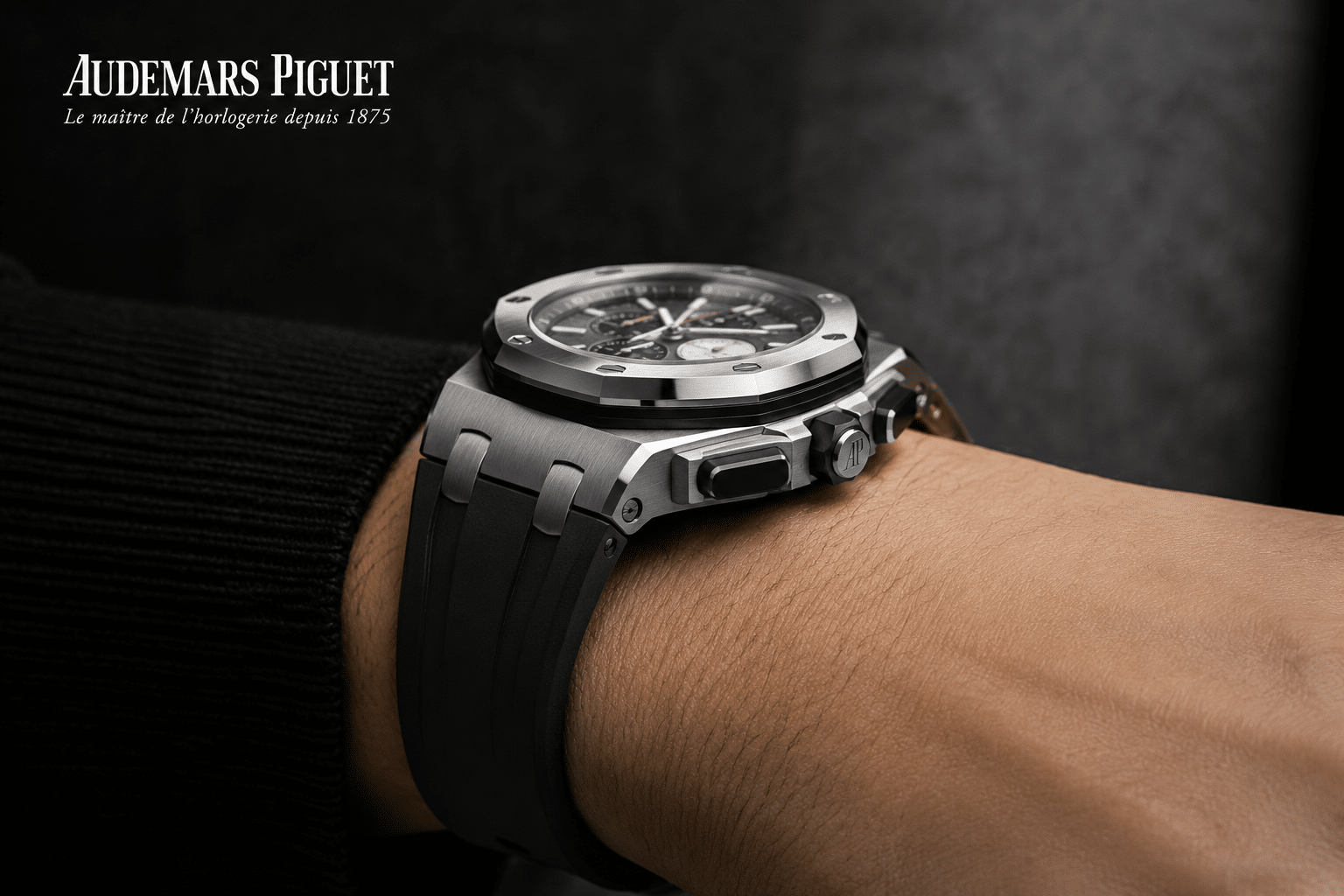
Where APF Fits in the 26470, 26400, and 26420 Offshore Space
APF is most relevant when the buyer is looking at Royal Oak Offshore chronograph families rather than classic Royal Oak three-hand watches. The names that usually matter in this discussion are 26470-style, 26400-style, and 26420-style Offshore replicas. These references are not interchangeable. They differ in case presence, dial layout, bezel character, strap format, and the movement compromise behind the chronograph display.
This is where APF’s reputation should be understood carefully. The factory is not simply “an AP factory” in the broad sense. Its relevance is tied to Offshore chronograph execution. An APF 26470 discussion is not the same as a ZF 15500 discussion. An APF 26420-style watch should not be judged by the same buyer checklist as a thin integrated-bracelet Royal Oak. The case architecture and chronograph system put the factory under different pressure.
Buyers should also be cautious with old reference claims. Offshore replicas can change by batch, dial color, strap type, and movement route. A post from two years ago may describe a version that is no longer the same as the one currently being offered. The safer approach is to use the reference family as a starting point, then confirm the current version details before making a decision.
Traceability in this section means matching the factory label to the exact watch being discussed. An APF label alone does not answer whether the watch has the current dial execution, the expected pusher layout, the right strap curvature, or the movement configuration a buyer believes they are choosing. When comparing two APF Offshore listings, the more reliable comparison is model-to-model and version-to-version, not listing title to listing title.
26470-Style Offshore Chronographs
The 26470-style Offshore chronograph is often the most approachable APF entry point because it represents the familiar modern Offshore formula: substantial case, rubber strap, visible pushers, and a balanced sport-chronograph dial. For buyers asking which APF Offshore model makes sense first, this family is usually easier to understand than more extreme Offshore variations.
The key is not whether the watch is small or thin. It is not supposed to be. The key is whether the size looks controlled. A good 26470-style replica needs a case that feels intentionally thick rather than swollen, pushers that line up cleanly, a dial layout that does not look compressed, and a strap that helps the watch sit securely. If those elements work together, the Offshore character comes through. If they do not, the watch can look like a large case built around a movement compromise.
For this family, APF should be judged on broad execution rather than one isolated detail. A slightly imperfect print weight may matter less than a poor side profile or strap angle. Buyers who focus only on the dial photo may miss the parts of the watch that define the Offshore experience.
26400-Style Offshore Chronographs
26400-style Offshore chronographs tend to push the larger and more aggressive side of the Offshore personality. That can make them visually exciting, but it also raises the risk of poor wrist balance. On a large AP chronograph replica, extra thickness, a stiff strap, or an oversized caseback can quickly turn bold design into uncomfortable daily wear.
This is where the buyer should be honest about wrist tolerance. A larger Offshore replica may look impressive in a close-up photo but feel excessive after a full day of wear. The question is not only whether the factory copied the general look. The question is whether the case mass, bezel height, strap curve, and buckle weight make sense together.
APF can be relevant in this space because Offshore chronographs reward case-side execution and strap integration. But the larger the design, the less forgiving the watch becomes. A strong-looking 26400 replica still needs to be checked as a physical object, not only as a dial image.
26420-Style Offshore Chronographs
26420-style Offshore chronographs bring a more updated Offshore look, and that makes the visual relationships more demanding. Newer-generation styling often places more attention on cleaner dial organization, sharper case geometry, and more integrated strap design. For an APF 26420-style replica, the buyer should pay close attention to whether the updated design language is actually supported by the case and dial execution.
The risk with newer-style Offshore replicas is that small layout issues can become more visible because the design is cleaner. Subdial spacing, date placement, pusher geometry, and strap connection need to feel coordinated. If the dial looks modern but the case side or strap fit feels older or rougher, the watch can lose the intended generation-specific character.
This is also where “APF 26420” should be treated as a version question, not just a model label. Different batches or source descriptions may vary in details that matter. A buyer comparing 26470 vs 26420 replica options should not assume that newer styling automatically means a safer watch. Sometimes the older Offshore language is more forgiving because the design itself is busier and more muscular.
Version Details to Confirm
Before judging an APF Offshore reference, confirm the exact reference style, approximate case size, dial color, strap type, bezel material or finish, and movement route being offered, using a ZF Factory AP comparison as context for factory-dependent construction differences. Do not rely only on a factory name or an old forum photo. Offshore chronographs are too dependent on case construction and layout details for that shortcut to be reliable.
The most useful information is current and specific: front dial photos, crown-side case photos, strap connection views, case thickness impressions, and a clear description of the movement configuration. None of this guarantees long-term reliability or genuine-level execution, but it reduces the chance of buying the wrong version for the wrong reason. For APF Offshore buyers, the smartest comparison starts with the exact model family and current batch, not with a broad factory ranking.
Chronograph Movements Create the Biggest Offshore Tradeoff
The Offshore chronograph movement is the point where buyers need to stop thinking like classic Royal Oak buyers. A three-hand Royal Oak replica is mainly judged by case thickness, bracelet execution, dial texture, and whether the movement supports the correct proportions. An Offshore chronograph adds another layer: the movement has to drive extra hands, support start-stop-reset behavior, place the subdials in a believable layout, carry the date in the right visual zone, and still fit inside a case that does not become awkward on the wrist.
This is why an APF chronograph movement should be judged as an ownership tradeoff, not just a spec line. A good-looking Offshore chronograph replica can still become frustrating if the winding feels rough, the rotor is loud, the chronograph reset is inconsistent, or the case has been made thicker simply to accommodate the movement route. The buyer’s question should not only be “does the dial look close?” It should be “does this movement choice make the whole watch livable?”
Why Chronograph Function Adds Risk
A chronograph is not just a decorative complication. Even in an automatic chronograph replica, the start, stop, and reset actions involve more mechanical interaction than a simple three-hand movement. The subdial hands must move correctly, the central chronograph hand must reset cleanly, and the date system still has to behave without being disturbed by the extra load of the chronograph mechanism.
This does not mean every Offshore chronograph replica is fragile, but it does mean the risk profile is different. Buyers who ask “is the chronograph reliable?” usually want a simple yes or no. The more useful answer is that chronograph use should be moderate and expectations should be realistic. If you plan to time workouts, meetings, or daily tasks constantly, a Royal Oak Offshore chronograph replica is a less sensible choice than a simpler AP-style three-hand model. If you mainly want the Offshore look and only test the chronograph occasionally, the compromise is easier to accept.
Date behavior is another practical point buyers often ignore. On some chronograph layouts, the date position is partly dictated by the movement architecture. If the date sits slightly high, low, or too close to a subdial, that is not always a simple printing issue; it may come from the movement route underneath. This is where visual accuracy and mechanical compromise meet.
How Movement Route Can Affect Case Thickness
The movement route can change the Offshore’s entire side profile. A movement that requires extra height, spacer work, or stacked components may force the case to sit taller than expected. Offshore watches are naturally thick and sporty, so thickness alone is not automatically a flaw. The problem is uncontrolled thickness: a slab-like midcase, a tall caseback, or a watch that feels top-heavy once mounted on a rubber strap.
This is one reason APF should be evaluated differently from factories known mainly for slim Royal Oak three-hand models. In a three-hand Royal Oak, the movement’s job is to help preserve thinness and bracelet flow. In an Offshore chronograph, the movement’s job is also to support a more complicated dial and pusher system without making the case feel mechanically forced. That is a different factory game.
Rotor noise and winding feel also matter more than many photo-based comparisons suggest. A loud rotor does not ruin the appearance of the watch, but it can make the ownership experience feel cheaper every time the watch moves on the wrist. A gritty crown feel or inconsistent winding resistance is not visible in QC photos, yet it tells the buyer something about how refined the movement installation may be.
Movement trust in the replica market depends on understanding what the movement claim actually describes: architecture, decoration, layout, reliability, or simply a market name used by sellers. For an APF Offshore chronograph, the most practical question is whether the selected movement route supports the correct subdial geometry, acceptable case height, clean reset behavior, and realistic service expectations for the specific version.
Visual Similarity Is Not the Same as Ownership Confidence
Chronograph movements can create a mismatch between what looks good in a listing and what feels sensible to own. A decorated rotor, attractive caseback view, or seller description may suggest a more premium movement route, but the buyer still has to ask practical questions: does the chronograph reset cleanly, does the watch wind smoothly, does the case become too thick, and is the movement likely to be serviceable if something goes wrong?
This distinction matters because some Offshore buyers mainly want a convincing wrist presence, while others expect frequent chronograph use. The first buyer may accept a movement compromise if the dial layout, case shape, and strap fit are strong. The second buyer may be disappointed if the pushers feel stiff, the reset is inconsistent, or local service is difficult. On complicated replicas, “best” depends heavily on whether the buyer values visual accuracy, mechanical usability, or lower long-term risk.
Movement Claims Should Be Checked, Not Assumed
Seller movement descriptions are useful only when they match the watch being offered and can be supported by clear photos or credible inspection. A phrase such as “Swiss movement,” “clone movement,” or “decorated movement” should not be treated as proof of origin, durability, service compatibility, or genuine-equivalent architecture. Official technical sheets can explain a movement family in general, but they do not verify what is inside a specific APF Offshore unit.
For example, Sellita’s official SW200-1 technical document is relevant if a buyer wants to understand a named automatic movement platform at a specification level, but it would not prove that a replica watch actually contains a Sellita SW200-1.[5] The same caution applies to other named movement families: the practical QC question is whether the exact watch winds, sets, runs, and resets as expected, not whether a listing uses an impressive movement label.
Movement Transparency Note: Movement references in this article describe replica-market movement types, layouts, or seller-facing configurations, not official Audemars Piguet calibers or verified Swiss-manufactured movements unless watch-specific evidence supports that claim. Buyers should judge the exact unit by winding feel, date operation, chronograph start-stop-reset behavior, rotor noise, case thickness, and service risk rather than relying on a movement label alone.
Serviceability and Daily-Wear Expectations
The safest way to own an Offshore chronograph replica is to treat the chronograph as a feature you respect, not a tool you abuse. Repeated heavy use of the pushers increases stress on a movement that is already more complex than a simple automatic. If the chronograph hand resets properly and the subdials behave normally, that is a good sign, but it is not a guarantee of long-term durability.
Serviceability is also less straightforward. Many local watchmakers are more comfortable with basic automatic movements than complicated replica chronographs, especially when movement decoration, modified layouts, or tight case construction are involved. Parts availability can vary, and a movement that looks impressive through a caseback may still be harder to repair than replace. This is why buyers should not overpay for movement claims without understanding the practical aftereffect.
At Clean VS Factory, we usually separate visual strength from ownership confidence on complicated replicas. An APF Royal Oak Offshore can make sense if the buyer accepts that the Offshore chronograph movement is part of the risk. It is not the same decision as choosing a cleaner, simpler three-hand Royal Oak replica for daily wear.
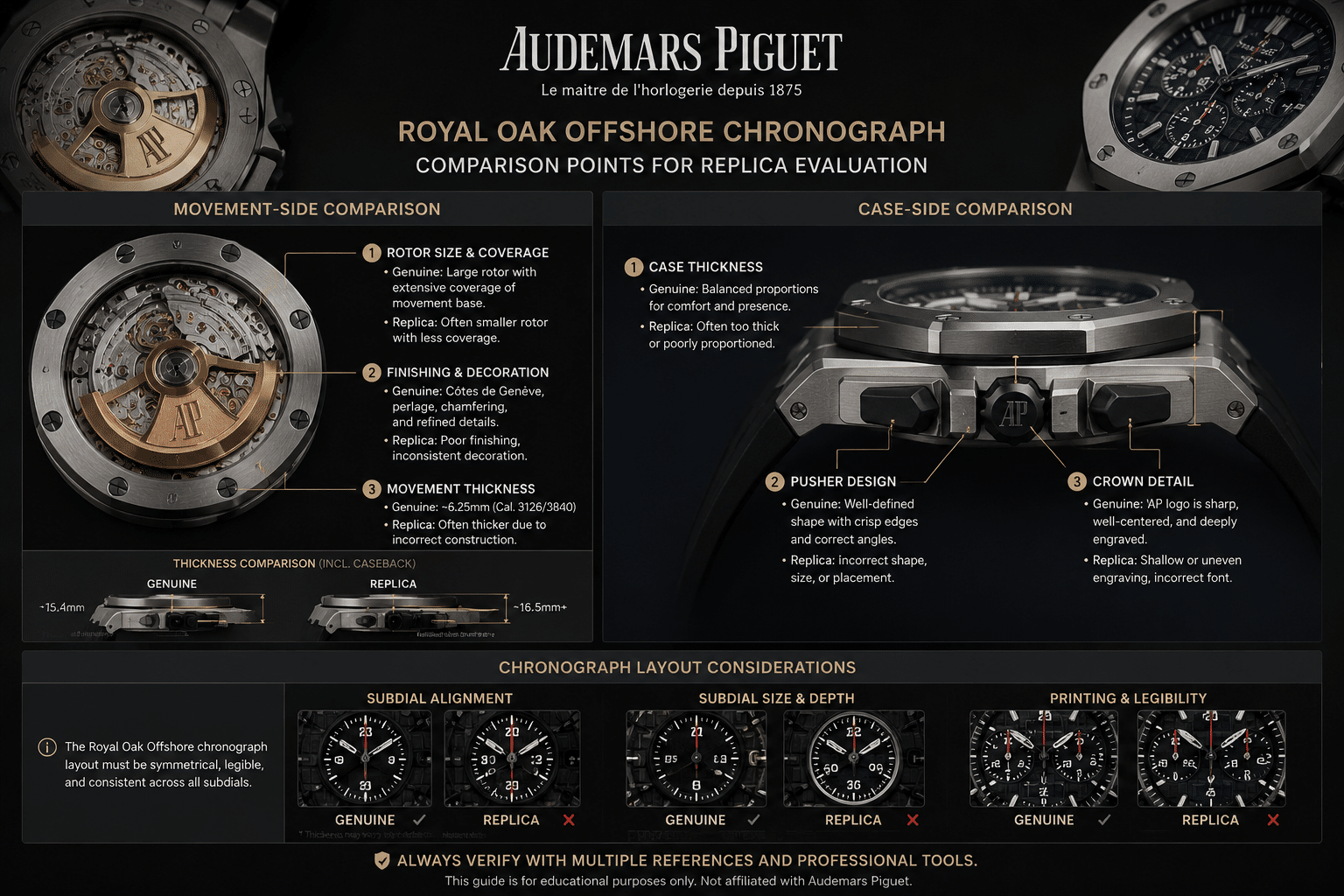
Pusher Alignment and Feel Are Offshore-Specific Quality Signals
The pushers on a Royal Oak Offshore chronograph are not small hidden controls. They are part of the watch’s face from the side. On many Offshore references, the crown guards, rubber-clad or metal pushers, and case flank form a large visual block. If that block looks uneven, the whole watch looks less convincing before anyone studies the dial.
This is where APF pusher alignment becomes a real evaluation point. A buyer should not only check whether the chronograph starts and stops. The better question is whether the pushers sit evenly, follow the case geometry, and feel like they belong to the case rather than being added around the movement as an afterthought. On an Offshore, weak pusher execution is more obvious than a slightly imperfect line of dial printing.
Visual Pusher Placement
Side photos tell you things front photos cannot. The upper and lower Offshore chronograph pushers should look balanced against the crown and crown guards. If one pusher appears tilted, sunken, protruding too far, or positioned at a noticeably different angle from the other, that is not a harmless macro flaw. It changes the case-side symmetry, which is a major part of Offshore wrist presence.
Pusher spacing is especially important because the Offshore case is visually heavy. A small mismatch can look larger once the watch is worn, because the side profile is thick and exposed. The buyer should also look at whether the crown sits centered between the pushers and whether the crown guards frame it cleanly. A strong front dial does not compensate for a sloppy crown-side case profile.
There is a useful distinction here: visual pusher alignment and mechanical chronograph reliability are related, but they are not the same issue. A watch can have straight-looking pushers and still have a questionable reset feel. It can also have a working chronograph with pushers that look poorly fitted. Both matter, but they should be judged separately.
Tactile Feel and Reset Behavior
Pusher feel is one of the quickest ways a chronograph replica reveals its limits. A good pusher action should have a clear press, controlled resistance, and a reset that feels definite rather than vague. It will not feel like a genuine high-end chronograph, but it should not feel crunchy, sticky, overly stiff, or uneven between the upper and lower buttons.
The reset action deserves special attention. If the central chronograph hand does not return cleanly to zero, or if the subdial hands behave unpredictably, the issue is more serious than cosmetic alignment. This affects confidence in the movement and makes the watch less enjoyable even if you rarely use the chronograph. For an Offshore chronograph replica, a clean reset is a more meaningful ownership signal than a tiny difference in engraving depth.
Buyers should also be cautious about repeatedly testing the chronograph just because it is there. A short function check is reasonable. Constant cycling is not. Offshore replicas are best approached with the understanding that the chronograph adds character and visual identity, but it also adds mechanical exposure.
QC Photos to Request
The most useful views are simple: a straight front dial shot, a clean crown-side case photo, a side profile showing both pushers, and a close-up where the crown, crown guards, and pusher spacing can be seen together. If available, a short confirmation that the chronograph starts, stops, and resets properly can help, but it should not be treated as proof of long-term reliability.
Lighting and lens angle can distort the case side, so one bad-looking photo does not always mean the watch is defective. The red flags are repeated: uneven pusher height across multiple angles, a crown that appears visibly off-center, a pusher that looks crooked against the case line, or reset behavior that does not return cleanly. Those are worth taking seriously before deciding.
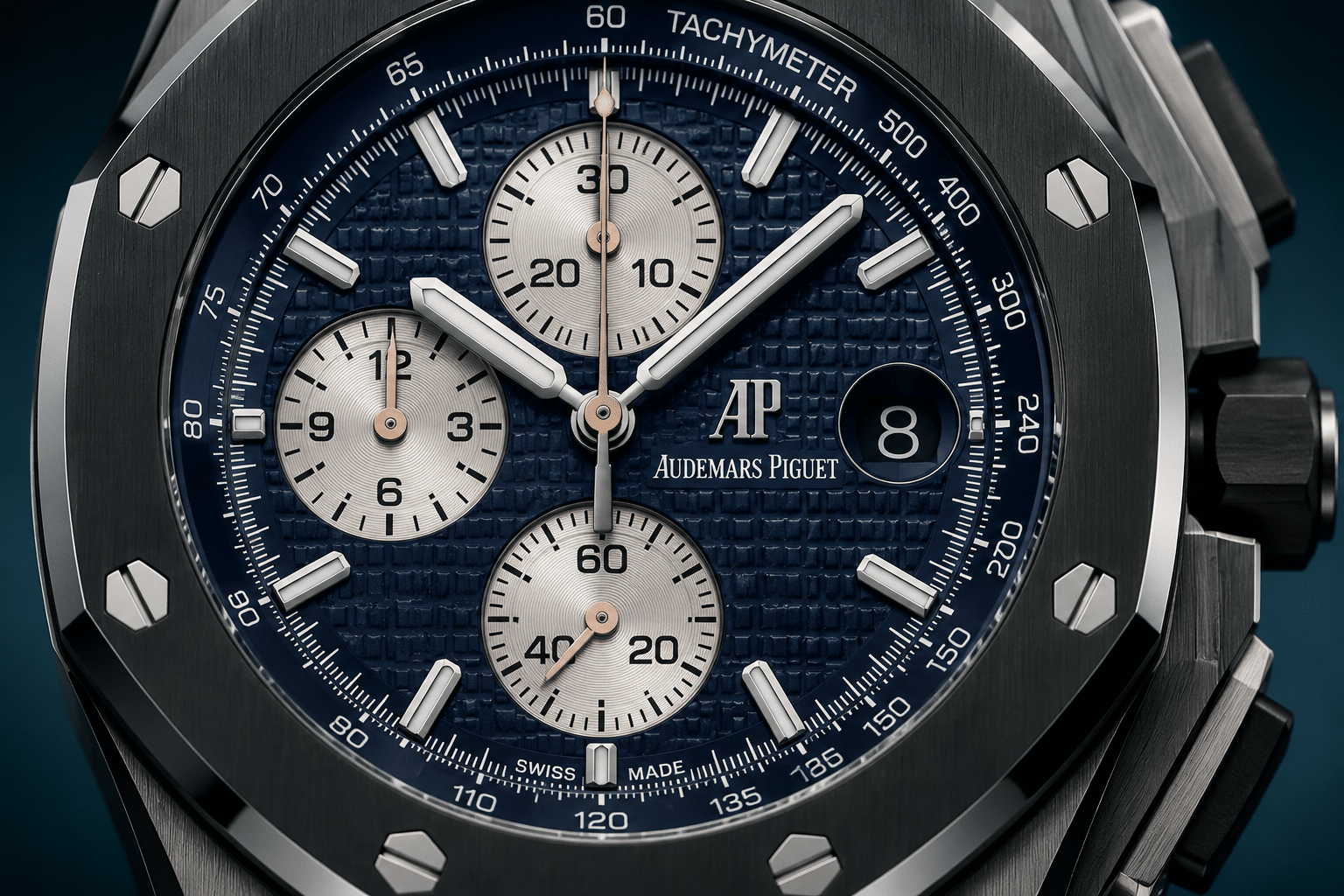
Subdial Layout and Date Placement Decide Visual Credibility
A Royal Oak Offshore dial is not judged like a simple Royal Oak dial. On a three-hand model, the eye mostly reads the tapisserie texture, markers, logo, hands, and date. On an Offshore chronograph, the dial has more moving parts visually: subdials, scales, date window, tachymeter or minute track, larger hands, and often stronger color contrast. If one element is off, it can disturb the whole layout.
The most common mistake is treating the Offshore subdial layout as a small detail. It is not. The subdials define the dial’s balance. If they sit too close together, too far apart, too high, or too low, the watch can look wrong even when the printing is sharp. This is why the Royal Oak Offshore dial should be judged as a system rather than a collection of individual parts.
Subdial Spacing and Chronograph Balance
Subdial spacing is one of the strongest visual credibility points on an Offshore chronograph replica. The position of the counters controls how the dial breathes. If the spacing is compressed, the center of the dial looks crowded. If the subdials sit too far out, they may fight the hour markers, tachymeter scale, or date window. Either way, the watch loses the strong, organized look that makes the Offshore design work.
Movement architecture can influence this. Factories may choose a movement route that works mechanically but creates compromises in subdial position. Buyers should not assume that a better-looking decorated movement automatically means a better-looking dial. For an Offshore chronograph, the dial-side result matters more than the movement story if the buyer’s main concern is daily-wear appearance.
Reference family also matters. A 26470-style layout, a larger 26400-style design, and a newer 26420-style Offshore do not create the same dial impression. The buyer should compare the replica against the specific reference style, not against a generic idea of what an AP chronograph should look like.
Date Window, Printing, and Hand Alignment
The date window is a small feature that can create a large distraction. A date that sits too high, too low, or too close to the edge of its frame will be noticed more often than a slightly imperfect caseback engraving. Date font weight also matters, but centering usually matters more in daily wear. A slightly different font is tolerable; a visibly misaligned date is not.
Dial printing should be judged by consistency rather than perfection. The tachymeter scale, minute track, subdial numerals, and logo should look clean and evenly weighted. Printing that is slightly heavier than the genuine reference may be acceptable for many buyers, but uneven print thickness or tilted scale elements can make the dial feel cheap quickly.
Hand alignment is another practical check. The central hands should sit cleanly, the chronograph hand should point to zero when reset, and the subdial hands should not look randomly placed. Lume plots and applied markers should be straight enough that the dial does not pull the eye toward one crooked area. On an Offshore, there is already a lot happening visually; poor alignment makes that busyness feel uncontrolled.
Acceptable Flaws Versus Red Flags
Not every difference deserves the same reaction. Slight variation in print weight, small lume color differences, or a dial texture that looks a little too sharp under macro photography may be acceptable if the overall layout is balanced. Many of these differences are less obvious on the wrist than in enlarged photos.
Red flags are different. Badly placed subdials, a date window that looks visibly wrong, a chronograph hand that fails to reset to zero, crooked applied markers, or a dial scale that appears shifted are harder to ignore. These flaws affect the watch every time you look at it, not just when you inspect it under strong light.
The practical judgment is simple: accept minor finishing limits if the Offshore chronograph layout is coherent, but be cautious when the dial geometry itself looks wrong. A Royal Oak Offshore replica can survive small cosmetic imperfections. It cannot easily survive a subdial position problem that makes the entire dial feel misplaced.
Case Thickness, Bezel Fit, and Strap Integration Matter More Than Bracelet Talk
The classic Royal Oak conversation often turns into a bracelet discussion, and for good reason. On a three-hand Royal Oak replica, bracelet articulation, taper, brushing, and first-link fit can decide whether the watch feels convincing. The Royal Oak Offshore chronograph is a different wearing object. For an APF Royal Oak Offshore, the more useful question is not “how good is the bracelet?” but “does the case-and-strap system sit correctly on the wrist?”
This is where many Offshore buyers misjudge the watch from photos. A dial can look strong from the front, but the watch can still feel wrong if the case profile is too slab-sided, the rubber strap flares outward, the bezel does not sit cleanly, or the buckle feels light and unfinished. Offshore case thickness is not a side issue. It directly affects comfort, wrist balance, and whether the watch has the dense, purposeful presence buyers expect from this model family.
Why Thickness Is Not Automatically a Problem
A Royal Oak Offshore chronograph is supposed to have more mass than a classic Royal Oak. Buyers who expect a thin, elegant 15400-style wearing experience are already looking at the wrong model category. The Offshore design accepts a thicker case, taller bezel, larger pushers, and a more aggressive side profile. That extra volume is part of the watch’s identity.
The problem is not thickness by itself. The problem is uncontrolled thickness. A well-executed Offshore replica should have a case that looks thick but shaped, heavy but balanced. If the mid-case looks like a straight metal block, the caseback sits too proud, or the bezel stack appears disconnected from the case body, the watch may wear larger than its stated size suggests. On the wrist, that kind of shape feels top-heavy rather than sporty.
For APF Offshore models, buyers should inspect the side profile before obsessing over tiny dial printing differences. A slightly imperfect printed scale is usually less disruptive than a case that sits like a puck. The stronger Offshore replicas use their thickness with better contour: the bezel, mid-case, caseback, pushers, and strap line should appear like one engineered shape rather than separate parts stacked together.
Rubber Strap Fit and Wrist Shape
The Royal Oak Offshore rubber strap is not just an accessory. It controls how the case lands on the wrist. A good rubber strap should curve naturally from the case, keep the lugs visually connected to the wrist, and prevent the heavy chronograph head from floating above the arm. Poor strap integration creates one of the fastest daily-wear disappointments: the watch may look impressive in a box but feel awkward after ten minutes on the wrist.
The first thing to check is the lug transition. If the strap leaves the case too stiffly, it can create a gap on smaller or flatter wrists. If it bends too sharply, the watch can look pinched and uncomfortable. The best Royal Oak Offshore rubber strap fit is not always the softest strap; it is the one with the correct curvature for the case weight. Too soft can feel cheap, while too rigid can make the case stand up instead of wrapping down.
Buckle fit matters more than many buyers expect. A heavy Offshore head needs a buckle or deployant that feels secure and proportional. Thin metal, weak engraving, rough edges, or a loose keeper can make the whole watch feel lower grade even if the dial is attractive. For daily wear, buckle comfort is not a luxury detail. It decides whether the watch feels stable enough to wear regularly.
Bezel Seating and Case-Side Cleanliness
The Offshore bezel is visually dominant. If it is not seated cleanly, the flaw affects the entire watch. Buyers should look for even spacing between bezel and case, consistent gasket visibility, and screws that sit level rather than appearing sunken or proud. Perfect screw alignment should not be expected on a replica watch, but uneven seating or visibly inconsistent screw depth is more serious than a tiny difference in screw slot direction.
Case-side cleanliness also matters because the Offshore exposes more side architecture than a slim Royal Oak. The pushers, crown guards, brushed surfaces, polished bevels, and side screws all live in the same visual zone. If the finishing is rough here, the watch loses the engineered look that makes the Offshore convincing. In normal wear, people see the case side more often than macro shots suggest: when the wrist turns, when the strap flexes, and when light catches the bezel edge.
The practical judgment is simple: do not evaluate an APF Offshore chronograph like a bracelet-first Royal Oak. Evaluate it as a thick chronograph case connected to a rubber strap. If that system works, the watch can feel coherent even with minor cosmetic compromises. If that system fails, a good dial will not save the ownership experience.
APF Versus APSF and ZF: The Comparison Only Works by Model Type
The APF vs APSF or APF vs ZF question becomes misleading when buyers treat all Audemars Piguet replica watches as one category. A Royal Oak three-hand replica and a Royal Oak Offshore chronograph do not ask the factory to solve the same problems. One is mainly about slim proportions, integrated bracelet finishing, tapisserie execution, and a stable three-hand movement route. The other is about a larger chronograph case, pusher integration, rubber strap fit, subdial balance, and more complicated ownership expectations.
This is why a universal “best AP factory” answer is not useful. APSF and ZF may be stronger names in many classic Royal Oak discussions, especially when the buyer is comparing 15400, 15500, or similar three-hand models, and broader Audemars Piguet replica factories evaluations only become meaningful when they separate factory reputation from specific model architecture. APF becomes more relevant when the buyer is specifically studying Offshore chronograph factory execution. The better comparison is not factory name against factory name. It is factory skill set against model architecture.
When APSF or ZF Comparisons Make Sense
APSF and ZF comparisons make sense when the target is a Royal Oak three-hand replica. In that category, the priorities are different: case thinness, bracelet drape, end-link behavior, dial texture, date placement, clasp feel, and the movement route behind a relatively clean dial. A buyer comparing classic Royal Oak replicas is usually trying to avoid a watch that looks too thick, has a stiff bracelet, or uses an older movement architecture that compromises the caseback or balance position.
That is not the same problem as an Offshore chronograph. If someone asks whether APF or ZF is better without naming the model family, the answer is incomplete. ZF can be a serious option in one Royal Oak lane while APF can be the more relevant name in another. Factory reputation does not travel equally across every reference.
At Clean VS Factory, we usually separate the factory question from the watch-family question first. If the buyer actually wants the slimmer Royal Oak look, APSF or ZF-style comparisons are more useful. If the buyer wants a bold Offshore chronograph, those same comparison habits can point them toward the wrong checklist.
When APF Becomes the More Relevant Name
APF becomes more relevant when the target watch is an Offshore chronograph, especially in the 26470, 26400, or 26420-style space. Here, buyers are not mainly judging a thin integrated bracelet watch. They are judging whether a factory can manage thick case construction, chronograph pushers, rubber strap integration, case-side finishing, bezel seating, and a dial layout that does not feel visually compressed or off-center.
This does not mean APF should be treated as automatically superior in every AP replica discussion. That would be the same mistake in reverse. APF’s strength should be judged inside the Offshore chronograph category, where the factory’s relevance is tied to the model’s physical demands. A buyer looking for a classic Royal Oak three-hand model should not choose APF simply because APF is discussed favorably for Offshore chronographs.
The APF vs ZF AP replica question is therefore only meaningful after the model type is fixed. For Offshore buyers, APF belongs in the conversation because the Offshore rewards chronograph-specific casework and strap execution. For classic Royal Oak buyers, the factory conversation often shifts back toward APSF, ZF, and their specific versions.
The Model-Type Decision Rule
Choose the watch family first, then choose the factory comparison. If the target is a Royal Oak three-hand replica, judge factories by thinness, bracelet quality, dial texture, and simple movement execution. If the target is a Royal Oak Offshore chronograph, judge factories by case mass, pusher layout, subdial balance, rubber strap fit, bezel seating, and realistic chronograph expectations.
This rule prevents the most common buying error: using the right factory reputation for the wrong model. The best factory for one AP design language may not be the safest choice for another.
QC Priorities for an APF Royal Oak Offshore Chronograph
APF Offshore QC should focus on flaws that affect the watch as a large chronograph, not on generic replica watch perfection checks. Royal Oak Offshore QC photos can help you judge front dial alignment, case profile, pusher placement, bezel seating, strap fit, and buckle quality. They cannot prove long-term movement reliability, water resistance, or genuine-level durability.
The goal is not to reject every small imperfection. The goal is to catch the problems that will bother you every time you wear the watch. On an APF Royal Oak Offshore chronograph, the most important QC issues are usually structural and layout-related: whether the dial is balanced, whether the case side looks clean, whether the pushers sit evenly, whether the bezel is seated properly, and whether the strap allows the case to sit naturally.
Before making a decision, buyers should review real QC photos where available, including dial printing, hand alignment, bezel position, datewheel centering, bracelet or strap fit, clasp engraving, case thickness, pusher alignment, and overall finishing. Factory labels and stock photos alone are not enough for a reliable judgment.
QC photos can reduce uncertainty, but they do not guarantee perfection, authenticity, movement origin, pressure-test results, or long-term reliability. Buyers should use them as practical visual evidence for the exact watch being supplied, while also confirming seller terms directly before ordering.
Front Dial Checks
Start with the whole dial before zooming into one detail. On an Offshore chronograph, the subdials, date window, hands, markers, logo, and printed scales must work together. A single slightly heavy printed mark is usually not the main concern. A visibly crooked subdial, uneven subdial spacing, off-center date, or misaligned hand is more likely to damage the watch’s overall credibility.
Check whether the subdials appear level and evenly placed within the dial design. Then look at the date window. Date centering matters because the window is small and easy to notice when the numeral sits too high, too low, or too far to one side. If QC photos show only one date number, remember that alignment can vary across the datewheel; one acceptable number does not guarantee every date will be centered equally.
Marker alignment should be judged with some caution because camera angle can distort the octagonal bezel and dial edge. Still, obvious tilted markers, uneven lume plots, or a logo that sits visibly off-axis should be treated seriously. For APF Offshore QC, the practical standard is not macro perfection. It is whether the front view looks balanced without needing excuses.
Side Profile and Pusher Checks
The side profile is where many Offshore replicas reveal their real quality level. Ask whether the case thickness looks controlled, whether the bezel transitions cleanly into the mid-case, and whether the caseback appears excessively raised. A thick Offshore can be acceptable; a poorly shaped Offshore feels clumsy.
Pusher alignment deserves special attention. The pushers should look parallel, evenly spaced, and properly integrated with the crown-side case architecture. If one pusher appears angled, recessed, proud, or visibly different from the other, that is not just a cosmetic issue. It may suggest inconsistent case machining or imperfect movement-to-case alignment.
Also check the bezel-to-case transition from the side. A gasket line that looks uneven, a bezel corner that appears lifted, or a side screw that sits poorly can make the watch look assembled rather than engineered. Lighting can exaggerate small shadows, so compare multiple angles before judging. But if the same unevenness appears in every photo, treat it as a real warning sign.
Strap, Buckle, and Wearing Fit Checks
The strap should leave the case with a natural curve. If the rubber strap flares outward too much, the watch may wear larger and less securely than expected. If it drops too sharply, it may look forced or uncomfortable. This matters especially for buyers with smaller wrists because the Offshore case already has strong visual mass.
Buckle finishing is another practical APF Offshore QC point. Look for clean brushing, tidy edges, secure keeper fit, and a clasp or tang buckle that visually matches the size of the watch head. A weak buckle can make the entire watch feel cheaper in hand, even if the dial and case look good in photos.
QC photos cannot fully answer whether the watch will be comfortable on your wrist, but they can reveal obvious strap problems. If the strap does not sit flush at the case connection, if one side appears twisted, or if the buckle hardware looks poorly finished, those are not microscopic flaws. They affect daily wear.
How to Read Seller Photos Without Over-Trusting Them
Seller photos are useful, but they are not neutral measurements. Strong lighting can hide rough brushing, a slightly angled front shot can make subdials look more centered than they are, and a tight crop can avoid showing case height or strap flare. For an APF Offshore, a beautiful dial photo is only one part of the evidence; the buyer still needs side, crown-side, strap, and buckle views to understand how the watch is built as a full object.
Factory labels and listing descriptions should also be checked against what the photos actually show. If a listing emphasizes “latest version” or “best edition” but does not show pusher alignment, case thickness, or chronograph reset position, the claim is incomplete. A careful buyer should not need dramatic promises; they need enough visual information to judge whether the movement route, case construction, and strap system make sense for the exact Offshore reference being offered.
QC photos reduce uncertainty, but they do not remove every risk. They help buyers judge visible execution before shipment, especially when factory names, stock images, or repeated catalog photos do not show the exact watch being supplied. Buyers should also confirm return, repair, shipping, and after-sales terms before ordering, because those terms can vary by seller and are not proven by a factory label.
Red Flags Before You Decide
The most serious APF QC red flags are the ones that change the watch’s overall shape or balance: visibly crooked subdials, poor date centering, badly misaligned pushers, uneven bezel seating, rough case-side finishing, and rubber strap fit that makes the case sit awkwardly. These are more important than tiny printing variations that only appear under heavy zoom.
Be careful with QC decisions based on one dramatic photo. Wide-angle lens distortion, harsh lighting, and tilted camera positioning can make a good watch look worse than it is. But do not use that as an excuse for every flaw. If the same issue appears from the front, side, and angled views, it is probably not just photography.
The safest APF Offshore decision is based on the full package: dial balance, case profile, pusher symmetry, bezel fit, strap curvature, and realistic expectations for a chronograph replica. If several of those areas look weak at once, passing on that unit is usually more rational than hoping the watch will feel better in person.
Water Resistance, Certifications, and Genuine-Spec Claims
Water resistance should not be assumed on an APF Royal Oak Offshore chronograph unless the individual watch has been pressure-tested after purchase. Authentic brand specifications, seller descriptions, and caseback markings do not prove that a replica case has the same gasket quality, assembly tolerance, crown sealing, pusher sealing, or pressure-test result. This is especially important for chronograph cases because pushers add more possible sealing points than a simple three-hand case.
Buyers should also separate genuine-watch certifications from replica ownership expectations. COSC describes chronometer certification as a formal testing process for eligible movements under defined standards; that type of official certification should not be treated as evidence that a replica watch has comparable tested accuracy.[3] The same principle applies to any “Master Chronometer,” “chronometer,” or “factory tested” wording in a replica listing unless the exact watch has credible, watch-specific documentation.
The safer practical rule is simple: avoid swimming, showering, diving, or heavy water exposure unless the watch has been tested by someone competent after delivery. Even then, a pressure test is a snapshot of one watch at one time, not a lifetime guarantee. For APF Offshore ownership, treat water resistance as a service and inspection issue, not a factory-name promise.
Price, Seller Claims, and Misrepresentation Boundaries
Price comparisons for APF Offshore chronographs should be handled carefully because replica watch prices can vary by factory label, version, movement configuration, finishing quality, seller channel, availability, and after-sales support. A lower price is not automatically better value, and a higher price does not prove a better version. Buyers should compare like-for-like details before treating one listing as the stronger option.
Be cautious with seller language that sounds absolute, such as claims that a watch is “perfect,” “same as genuine,” “inspection safe,” “factory guaranteed,” or “waterproof.” Those phrases may be marketing shorthand rather than verifiable evidence. The safer use of factory and movement information is to avoid overpaying or misunderstanding quality, not to represent a replica watch as genuine or to assume it can pass professional authentication.
CleanVSFactory’s buyer-facing approach is to make replica watch comparison clearer by connecting factory names, movement claims, visible QC details, version differences, and realistic ownership limits. That approach does not make CleanVSFactory an authorized brand representative, certification body, authentication authority, or guarantee provider; it is an editorial framework for reading the replica-market information more carefully.
Who APF Offshore Chronographs Make Sense For
An APF Offshore buyer guide should end with a simple correction: APF makes the most sense when the buyer actually wants a Royal Oak Offshore chronograph, not when the buyer is trying to find the safest all-around AP replica factory name. That distinction matters because the Offshore is not a cleaner, larger version of the classic Royal Oak. It is a heavier, thicker, more mechanical-looking watch where the chronograph layout, pushers, rubber strap, and case presence are part of the appeal.
The clearest APF Royal Oak Offshore conclusion is this: choose APF only if the Offshore identity is the reason you are buying the watch. If your real attraction is the thin case, integrated bracelet, and cleaner dial of a 15400 or 15500-style Royal Oak replica, APF is probably the wrong conversation. You would be comparing the wrong factory skill set.
Best Fit: Buyers Who Want Offshore Presence
APF Offshore chronographs make the most sense for buyers who like the 26470 or 26420-style personality: larger case, visible chronograph hardware, rubber strap comfort, sportier wrist presence, and a dial that looks busy by design. This buyer is not trying to hide the size of the watch. They want the Offshore to feel bold, technical, and more casual than a classic Royal Oak.
The best-fit buyer also understands the tradeoff. A Royal Oak Offshore replica is not only a visual purchase; it carries more ownership risk than a simple three-hand model. The chronograph movement route, pusher behavior, date placement, and case thickness all matter. If you are comfortable treating the chronograph as a feature to use lightly rather than a timing tool to operate constantly, the watch becomes a more realistic daily-wear choice.
This is where APF’s relevance is strongest. It is not because APF should be treated as a universal AP solution, but because Offshore chronographs reward the areas APF is usually discussed for: case-and-strap execution, chronograph layout, pusher integration, and bold wrist presence. For the right buyer, those priorities matter more than the bracelet refinement arguments that dominate classic Royal Oak factory comparisons.
Poor Fit: Buyers Who Actually Want Classic Royal Oak Simplicity
APF is a poor fit for buyers who say they want an Offshore but are actually looking for classic Royal Oak simplicity. If your priorities are thinness, bracelet drape, lower mechanical risk, and a clean three-hand dial, an Offshore chronograph will likely feel like too much watch. The case is supposed to be thick. The dial is supposed to be busier. The pushers and strap are not side details; they define the model.
This is the mistake many buyers make when asking “APF or classic Royal Oak replica?” as if the answer is only a factory ranking. A buyer comparing APF to APSF or ZF without first choosing the model family is skipping the most important step. A 15400-style or 15500-style Royal Oak replica asks for thin-case discipline, bracelet finishing, and three-hand movement stability. A Royal Oak Offshore chronograph asks for different strengths and accepts different weaknesses.
If you are movement-sensitive, dislike thick watches, or expect a chronograph replica to feel as carefree as a simple automatic, APF Offshore may not be the most rational choice. The safer path is usually a simpler Royal Oak-style model with fewer mechanical and layout variables. That is not a downgrade in taste; it is a better match between expectation and watch architecture.
The Final Decision Framework
The practical decision rule is: pick the watch family first, then judge the factory by the skills that family requires. For an Offshore chronograph buyer, the key question is not simply “which AP factory is better?” It is “which factory handles Offshore case mass, pusher geometry, subdial balance, strap integration, and chronograph movement compromise most convincingly for the reference I want?”
If the answer is that you want a sportier, thicker, rubber-strap AP chronograph with strong wrist presence, APF belongs in the discussion. If the answer is that you want a slim integrated-bracelet Royal Oak with a cleaner dial and less movement complexity, then the APF Offshore path is probably solving the wrong problem.
At Clean VS Factory, we usually treat this as a model-specific decision, not a factory-name decision. APF is most useful when the buyer’s expectations match the Offshore chronograph format. It becomes less useful when the buyer is chasing a general “best AP factory” answer without separating Offshore chronographs from classic Royal Oak three-hand replicas.
For Clean VS Factory, the goal is to make replica watch comparison easier to understand by connecting factory names, movement claims, visible QC details, and realistic ownership limits. That approach is especially important with APF Offshore chronographs because the purchase decision depends on several linked factors: the exact reference style, the current version, the movement route, the case-side execution, and the buyer’s tolerance for chronograph complexity.
So, should you choose APF Offshore? Yes, if you want the Offshore look badly enough to accept the extra checks around case thickness, pusher alignment, subdial layout, strap fit, and chronograph movement expectations. No, if what you really want is a slimmer, simpler, lower-risk Royal Oak replica. The better purchase is not the factory with the loudest reputation; it is the watch whose compromises you already understand before it reaches your wrist.
References
[1] USPTO, “USPTO Counterfeit Goods Basics,” official guidance on counterfeit goods and trademark boundaries, available at USPTO Counterfeit Goods Basics.
[2] Audemars Piguet, “Royal Oak 15510ST Official Specifications,” official brand information for the Royal Oak 15510ST including size, dial description, and water-resistance specification, available at Audemars Piguet Royal Oak 15510ST Official Specifications.
[3] COSC, “Chronometer Certified,” official description of chronometer certification and testing context, available at COSC Chronometer Official Certification Explanation.
[4] U.S. Customs and Border Protection, “Intellectual Property Rights,” official CBP trade enforcement resource on IPR and counterfeit goods concerns, available at U.S. CBP Intellectual Property Rights.
[5] Sellita, “SW200-1 Official Technical Document,” official technical documentation for the Sellita SW200-1 movement family, available at Sellita SW200-1 Official Technical Documentation.
Disclosure: This article is for general educational and comparison purposes only. Replica watches are not genuine products from the original luxury brands, and brand names are used only to identify reference designs or comparison topics. Factory names, movement descriptions, prices, availability, QC details, seller policies, and version information can change, so readers should verify important details with the seller before making a purchase decision. Replica watches should not be represented, resold, or used as genuine watches.