
The real question with the VS Factory AP 15500 is not whether VS has a strong name in other replica categories, but whether its current Royal Oak execution can stand beside APS and ZF on the details that expose flaws quickly, especially when an AP 15500 dial texture comparison brings the tapisserie depth and bracelet finishing into sharper focus. The 15500 is a difficult model to judge because the flat case surfaces, bezel shape, integrated bracelet, tapisserie dial, and slim profile leave little room for careless finishing or uneven batch quality.
This guide helps buyers avoid choosing by factory reputation alone. VS may be a serious challenger if the present batch shows convincing dial texture, case geometry, bracelet finishing, and DD4302-style movement execution. APS remains attractive for buyers who prefer a more documented movement route, while ZF can still be competitive when its case and bracelet finishing look stronger in current QC. The practical decision comes down to recent photos, movement evidence, and whether the price difference reflects visible or mechanical improvement.
Brand names are used here to identify the genuine reference design being discussed. Replica watches and super clone watches are not genuine Audemars Piguet products, are not authorized by Audemars Piguet, and should not be represented, resold, or used as authentic luxury watches.
| Decision Point | What To Check | Buyer Takeaway |
|---|---|---|
| VS Factory choice | Current batch dial, case side view, movement photos | Promising, but should be judged sample by sample |
| APS comparison | SH4302-style route, date action, owner feedback | Often lower risk for movement maturity and history |
| ZF comparison | Case profile, bracelet flow, visual coherence | Can still win when finishing looks stronger in QC |
| Dial judgment | Tapisserie depth, logo placement, marker alignment | Neutral-light QC matters more than polished front photos |
| Bracelet and clasp | Link taper, articulation, brushing, clasp security | Daily-wear feel may expose weak execution quickly |
| Price difference | Visible finishing gains or stronger movement evidence | Pay more only when improvements are specific and verifiable |
Quick Questions Before You Read
Q: Is VS automatically better because of its reputation?
No. Its Omega reputation does not prove Royal Oak execution, so AP 15500 QC needs separate judgment.
Q: Is APS still the safer AP 15500 option?
For many buyers, yes, mainly because its movement route and batch behavior are more documented.
Q: What should be checked first in QC photos?
Start with dial texture, side-case thickness, bezel screws, bracelet flow, clasp finishing, and movement images.
Q: When is paying more for VS justified?
Only when the specific sample shows clearer finishing, better geometry, or stronger movement evidence than APS or ZF.
Editorial Perspective: For this AP 15500 comparison, cleanvsfactory.com treats the factory name as a starting signal, not a final answer. VS has earned attention in other replica categories, but a Royal Oak asks different questions: whether the tapisserie dial has real depth, whether the case profile stays controlled, whether the integrated bracelet feels coherent on the wrist, and whether the 4302-style movement route is supported by current evidence. A stronger buying judgment comes from matching the specific sample to the buyer’s use case, not from assuming that the most discussed factory is automatically the safest choice.
Evidence Boundaries for This AP 15500 Comparison
Official Audemars Piguet information is useful for understanding why Royal Oak details matter, but it should not be used to prove that any replica is accurate, authorized, or mechanically equivalent. For example, Audemars Piguet lists the current Royal Oak 15510ST as a 41 mm stainless steel model with a Grande Tapisserie dial and 50 m water-resistance rating; that helps explain the authentic design vocabulary buyers are trying to evaluate, but it does not prove that a VS, APS, or ZF example matches those specifications.[1]
The same restraint applies to the broader Royal Oak family. Audemars Piguet’s Royal Oak Jumbo 16202ST page documents a 39 mm Royal Oak with Petite Tapisserie and an ultra-thin profile, which reinforces how central dial texture, case thinness, and bracelet architecture are to the Royal Oak identity.[2] Those official references can clarify the authentic watch context, but this article still judges replicas through current QC photos, movement evidence, and buyer-visible execution rather than assuming equivalence.
Replica watches also sit in a different legal and disclosure category from authorized watches. The USPTO describes counterfeit goods in trademark terms, and U.S. Customs and Border Protection identifies intellectual property rights enforcement as an import priority; those sources support cautious language around trademark, customs, import, resale, and disclosure risk, not any broad claim that a specific purchase is safe or unsafe in every jurisdiction.[3][4]
How to Keep This Comparison Fair and Useful
A fair VS, APS, and ZF comparison should not treat factory labels as proof of authorization, authenticity, or uniform quality. In the replica watch market, factory names are useful buyer-facing references, but they do not guarantee that every AP 15500 sample from the same label will have the same dial, movement presentation, bracelet tolerance, or case finishing.
The purpose of this guide is buyer education and risk awareness. It can help readers understand what to inspect, what claims to question, and why Royal Oak replication is difficult, but it should not be used to imply that a replica AP 15500 is legally, commercially, or mechanically equivalent to an authentic Audemars Piguet watch.
Readers should also separate visual comparison from authentication. A strong super clone may look convincing in normal wear, but close inspection can still reveal differences in finishing, movement architecture, case proportions, bracelet feel, dial texture, service compatibility, or documentation. The practical goal is to avoid misunderstanding quality, not to represent a replica watch as genuine.
Why VS Factory Entering the AP 15500 Market Got Attention
VS Factory’s AP 15500 release got attention because it changed the conversation from “which factory is strongest in its own lane” to “can a factory known for other brands actually pressure APS and ZF on Royal Oak territory.” That matters. It does not automatically make VS the safest choice, but it does make the comparison more serious than a routine new-release discussion.
The reason buyers reacted so quickly is simple: VS already has a reputation in other replica categories for solid execution, cleaner movement presentation, and a generally disciplined product feel. That reputation gives the AP 15500 instant credibility in the market, even before the watch has fully earned it on its own terms. For a lot of buyers, that is enough to move VS Factory AP 15500 from “ignore it” to “worth a closer look.”
The caution is that AP is not just another brand family. A Royal Oak replica is judged on case geometry, bracelet integration, dial texture, and how the whole watch sits on the wrist. A factory can be very good at one type of replica and still need time to prove itself on AP. That is why the right question is not whether VS is a respected factory in general, but whether this specific AP 15500 is strong enough to compete with APS Factory and ZF Factory on this model.
That distinction matters because replica buyers often overextend factory reputation. A strong Omega track record does not automatically translate into a strong Royal Oak result. The AP 15500 is a different test, and the market is treating it that way. Buyers are not asking whether VS is “good” in the abstract; they are asking whether VS is good enough on this specific reference to justify considering it alongside the established AP options.
The Reputation Effect Behind VS Factory
VS Factory has earned attention in part because buyers associate the name with controlled assembly, reliable-looking movement execution, and a product style that tends to feel more mature than random new entries. That is especially true for people who have already handled VS in other brand families and have come to expect a certain baseline of cleanliness in finishing and presentation.
That kind of reputation is useful, but only up to a point. In the replica market, a factory name can open the door; it cannot finish the evaluation for you. The strongest mistake a buyer can make is assuming that a factory’s success in one line automatically proves its AP 15500. It only proves that the factory deserves inspection, not trust by default.
Factory Name Clarification: Factory names such as VS Factory, APS Factory, and ZF Factory are buyer-facing replica-market labels. They can help organize comparisons, but they are not official brand affiliations, audited manufacturer identities, or guarantees of identical quality across every AP 15500 sample.
Why Royal Oak Replication Is a Different Test
The AP 15500 asks for a different kind of accuracy. An Omega-style replica can survive with more conventional case architecture and less visually exposed finishing. A Royal Oak cannot. The integrated bracelet, the visible brushing, the octagonal bezel, and the way the case flows into the bracelet all make the watch feel either convincing or off, very quickly.
That is why the AP 15500 is so easy to underestimate from photos and so hard to get right in person. A buyer can look at a front shot and think the watch is close, then notice the case shape, bracelet line, or dial depth and realize the difference is more structural than cosmetic. On this model, small mistakes are not small for long.
For that reason, VS entering the AP 15500 market creates competition but also new uncertainty. APS and ZF are not suddenly outdated because a stronger-known factory joined the field. They are established reference points, and VS has to prove itself against that standard rather than against its own reputation elsewhere.
The AP 15500 Is Harder to Clone Than It Looks
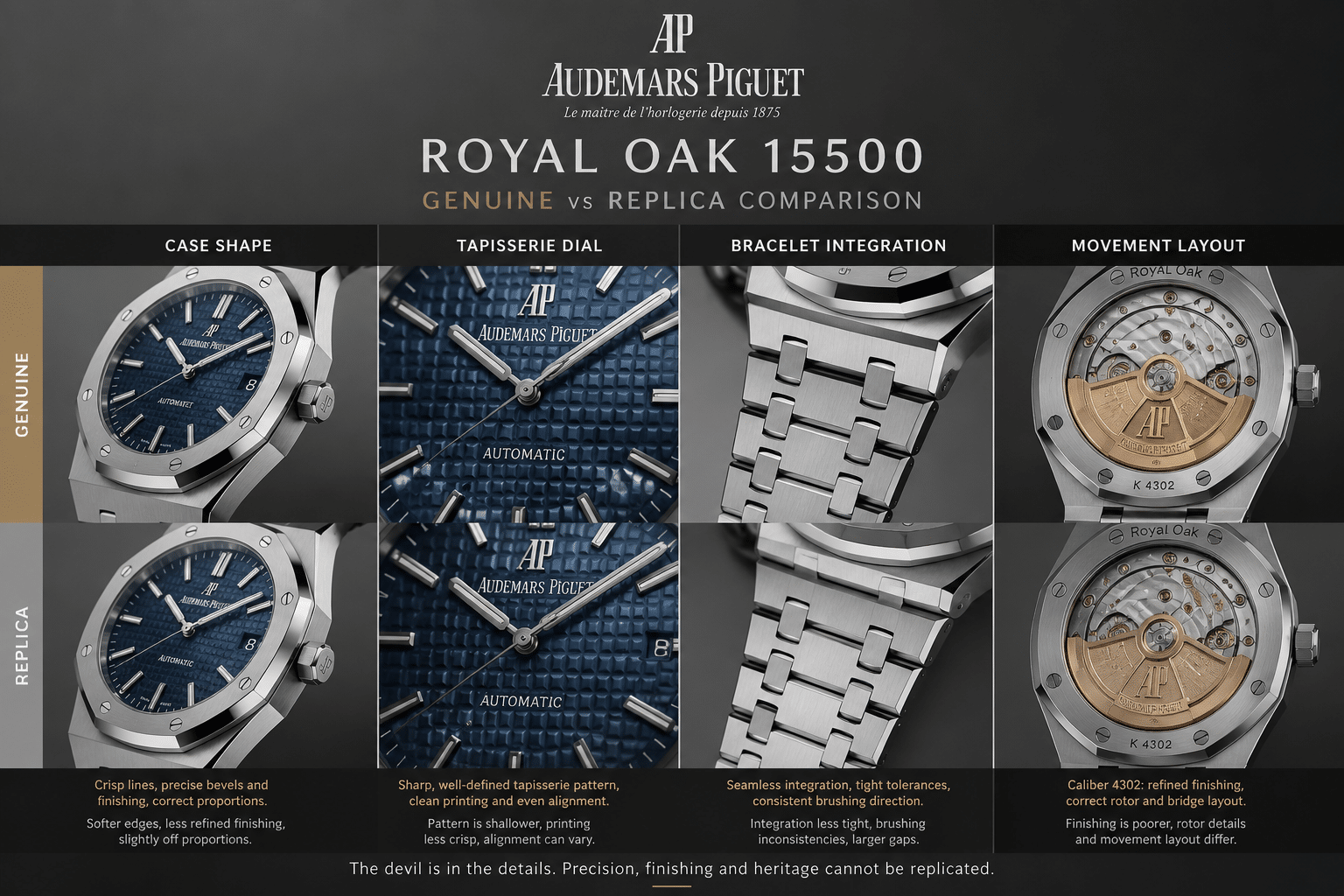
The AP Royal Oak 15500 looks simple at a glance, which is exactly why buyers sometimes misjudge it. It does not have a complicated bezel, a crowded dial, or a dramatic case shape. But that simplicity is deceptive. The design leaves very little room to hide errors, and that makes the AP Royal Oak 15500 replica a demanding project even for serious factories.
What makes this model difficult is not one single flaw. It is the way several details stack together. The octagonal bezel has to sit with the right presence. The case needs the right thickness and shoulder shape. The integrated bracelet must flow naturally from the case rather than look attached. And the dial has to deliver texture that feels dimensional, not merely printed. If one of those areas is weak, the whole watch loses credibility.
This is why a factory with a good reputation in Rolex-style or Seamaster-style replicas can still look less convincing on a Royal Oak. Those watches do not expose finishing in the same way. The 15500 does. Its surfaces are flat, its transitions are sharp, and its bracelet is part of the identity, not an accessory. That combination is brutal on weak execution.
Flat Surfaces Make Finishing Mistakes Easier to See
On a Royal Oak-style case, brushing direction, bevel brightness, and edge sharpness do more than create visual polish. They determine whether the watch feels crisp or soft. A slightly rounded edge on another sports watch may be acceptable. On the AP 15500, it can change the whole impression.
That is why macro photos matter here, but wrist view matters just as much. Some flaws disappear at a distance, while others become more obvious because the watch depends on light play across large flat surfaces. The model rewards precision and punishes anything that looks generic.
The Integrated Bracelet Is Part of the Watch, Not an Accessory
The bracelet is central to the AP 15500. Buyers who treat it like a normal bracelet are usually evaluating the watch too casually. Link shape, taper, articulation, and the way the bracelet meets the case all affect whether the watch looks like a Royal Oak or just a watch with a bracelet bolted on.
A bracelet can feel acceptable in hand and still fail visually because the flow is wrong. It can also look sharp in photos but wear stiff. On this model, those are not minor differences. They decide whether the watch has the right presence on the wrist.
The Dial Texture Must Look Dimensional, Not Printed
The tapisserie dial is one of the most important reasons buyers keep comparing factories. It is not just a pattern; it is the face of the watch. If the texture looks flat, too shiny, or too uniform, the whole dial loses depth. If the square pattern spacing feels off, the eye catches it immediately.
Logo placement, marker alignment, and the way the dial changes under different lighting matter for the same reason. The strongest AP 15500 replicas are the ones that look alive under normal light, not only under close-up photos. That is the real test.
Movement Route: VS DD4302-Style Discussion vs APS SH4302-Style Maturity
The movement question is the center of the VS AP 15500 discussion because it affects more than technical bragging rights. It affects confidence. Buyers want to know whether the newer DD4302-style route is a genuine advantage, a possible risk, or simply too new to trust without evidence. That is the right way to look at it.
APS has the benefit of being associated with a more established SH4302-style route in AP 15500 discussions. That does not make it flawless, but it does give buyers more to work with: more feedback, more batch history, and more practical expectations around what the movement tends to do in real use. In replica buying, that kind of maturity matters a lot.
VS, by contrast, enters with attention but less accumulated proof. A new movement route can look exciting on paper or in movement shots, yet still leave questions about winding feel, rotor behavior, date action, and how consistently it is being delivered across batches. Those are the details that separate “interesting new option” from “safer daily-wear choice.”
The display back makes this comparison more sensitive. Buyers are not just thinking about whether the movement runs; they are thinking about whether it looks believable through the caseback and whether it feels dependable on the wrist. If a movement appears impressive but introduces uncertainty in daily ownership, the visual gain may not be worth much.
One thing buyers should keep in mind is that movement names in the replica market are often used loosely. A seller can repeat a route name long before the market has enough teardown evidence or owner feedback to judge it properly. That is why this section should be read as a confidence discussion, not a declaration of victory.
Movement decoration and movement ownership should also be separated. A movement can look closer through the caseback while still being less proven in daily use, and a more familiar route can be less visually exciting while giving the buyer clearer expectations about winding resistance, rotor sound, date setting, and service access. For the AP 15500, this tradeoff matters because the movement is visible, but the watch still has to be worn, adjusted, and maintained like a mechanical object rather than admired only in photos.
Movement Transparency Note: Movement references such as DD4302-style or SH4302-style describe replica-market movement routes and configurations, not an official Audemars Piguet caliber unless supported by verifiable evidence. Buyers should check movement photos, rotor presentation, date behavior, and service expectations rather than relying on a movement label alone.
Why the 4302-Style Movement Matters on the 15500
The AP 15500 uses a display-back layout, so the movement is part of the visual evaluation rather than a hidden mechanism. That makes rotor appearance, engraving presentation, and overall movement layout more relevant than they would be on a closed-back watch.
It also means case thickness and ownership feel matter. A movement route that supports the right profile is not just a technical detail; it affects whether the watch sits like a proper Royal Oak or feels compromised. Buyers notice that even when they do not measure it.
What APS’s More Established Route May Offer
APS’s advantage is not mystical. It is familiarity. A more established route usually comes with clearer expectations around common issues, better reading of QC photos, and more owner feedback to draw from. That makes it easier for cautious buyers to know what they are getting into.
In a market where uncertainty can be more expensive than a small price gap, that familiarity has value. A watch does not need to be the newest thing to be the safer thing.
Why VS’s Newer Route Needs Evidence
VS’s route needs evidence because the factory reputation alone is not enough on this model. Buyers should want to see current batch proof: how the movement is presented, whether the rotor looks correct, whether the date action is consistent, and whether the watch is being delivered in a repeatable way.
That is the practical standard here. A new AP 15500 entry from a known factory is worth attention, but it should still be judged as a current sample, not as a promise.
Movement Route to Verify
Buyers should ask for movement photos, rotor engraving appearance, date-change behavior if available, and any batch-specific evidence that supports the movement claim. The key is not to assume the label tells the whole story. On a new VS AP 15500, verification is part of the value.
How to Read Movement Claims Without Overreaching
Official movement documents can help buyers understand what a documented caliber specification looks like, but they do not verify what is inside a specific replica. For instance, Sellita’s SW200-1 technical document and Miyota’s 9015 specification page show the kind of manufacturer-level information that can support narrow claims about those official calibers; they should not be treated as proof that any AP 15500 replica contains a particular movement unless the specific watch is supported by credible photos, inspection, or seller documentation.[5][6]
That boundary is important for DD4302-style and SH4302-style language. These labels are useful for discussion, but they are not the same as an official Audemars Piguet caliber claim. Buyers should separate architecture, decoration, hand position, date behavior, rotor appearance, winding feel, and serviceability instead of assuming that a movement name alone proves quality or equivalence.
Dial and Tapisserie Accuracy: Where AP Replicas Often Win or Fail
The AP 15500 dial is where a replica either starts to feel credible or falls apart fast. On this model, the tapisserie dial replica is not just decoration; it changes how deep the face looks, how the light breaks across the pattern, and whether the watch reads like a Royal Oak from normal wrist distance. That is why VS, APS, and ZF, much like APF Royal Oak Offshore chronographs in a different factory segment, should not be judged by a single “good or bad dial” label. The better question is which factory gets the texture, spacing, and visual balance most consistently in the current version.
For buyers, the common mistake is focusing only on front-facing clarity. A dial can look sharp in a seller photo and still feel flat in real life if the pattern depth is weak or the printing is too bright. On the AP 15500, that difference matters more than people expect because the design gives you very few distractions. If the tapisserie is off, the whole watch feels cheaper.
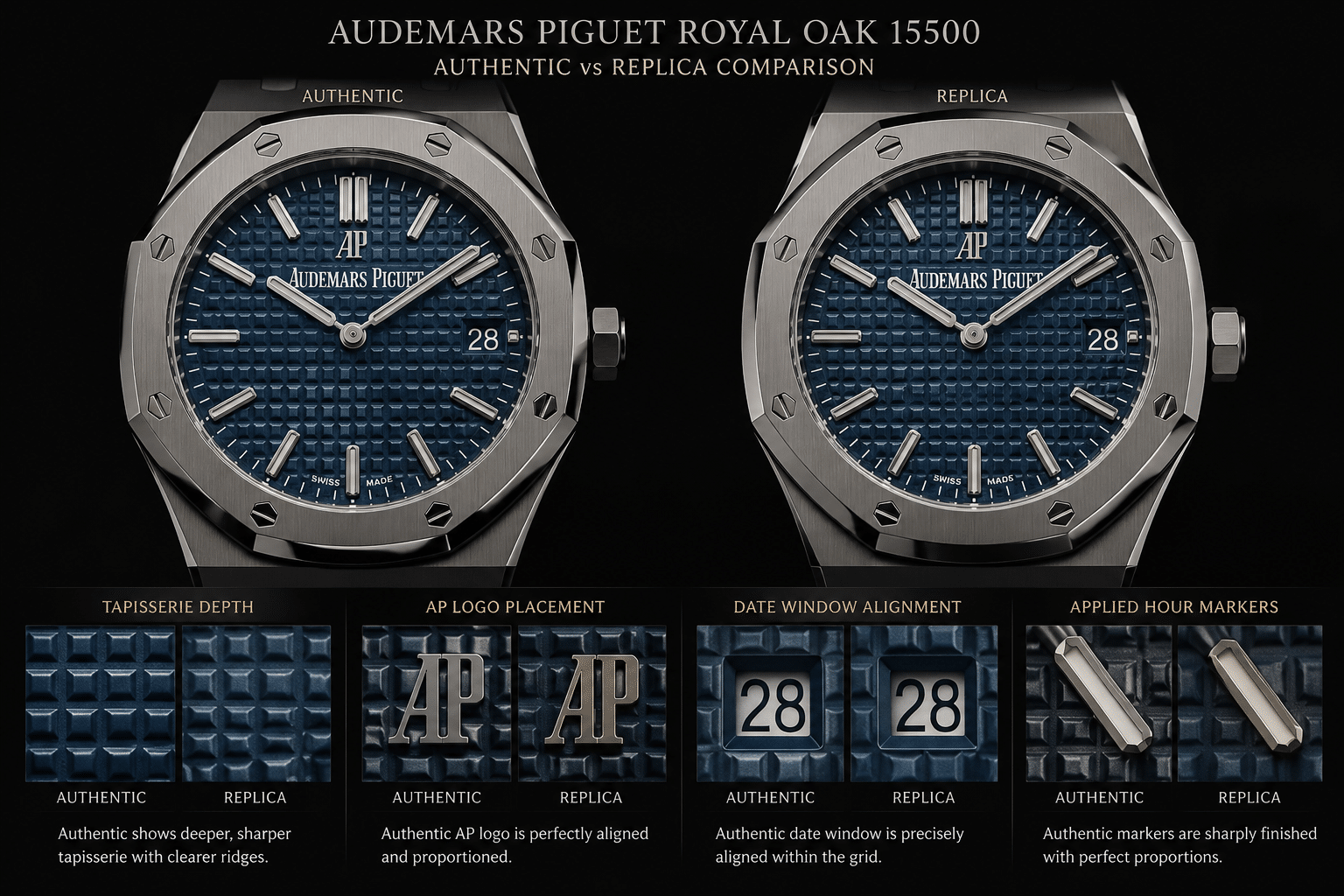
VS entering this space matters because it creates a genuine comparison point, not because it automatically resets the hierarchy. APS and ZF already have a market reputation on the Royal Oak, so VS has to prove itself on dial-side execution rather than borrowing credibility from other brands. That is especially true here, where the dial sits directly in the line of sight and immediately exposes weak pattern depth, awkward print weight, or inconsistent marker placement.
Tapisserie Depth and Pattern Consistency
The first thing to judge is whether the dial looks dimensional or merely stamped. A convincing Royal Oak dial should have a pattern that catches light in layers, with enough depth to avoid the “printed grid” look that cheaper replicas often show. Flat or overly glossy tapisserie tends to reflect light too evenly, which makes the face look thin and artificial instead of textured.
Spacing matters just as much as depth. If the squares look too wide, too shallow, or too uniform in a mechanical way, the dial loses the subtle irregularity that gives the genuine watch character. This is one reason buyers should compare current examples rather than relying on old forum memory. A factory can improve one batch and regress in the next, especially on a watch where small changes are easy to see.
In practical terms, APS and ZF are usually discussed because they have already shown more mature Royal Oak dial execution in the market. VS may still compete, but buyers should look for evidence of proper pattern relief rather than assuming the newer version is automatically sharper.
Logo, Text, Markers, and Date Window
The AP logo should sit cleanly, not float awkwardly over the dial texture. If the logo feels too tall, too bold, or slightly misplaced, it throws off the whole face. The same is true for printed text. On the AP 15500, overly thick printing is easy to spot because the dial design is otherwise restrained. There is nowhere for sloppy text to hide.
Applied markers should line up cleanly with the minute track, and the lume fill should sit evenly inside each marker. When alignment is off, the watch can still look fine in a loose photo but starts to feel careless once you examine it closely. The date window is another place where buyers over-trust glossy images. What matters is not only whether the date is readable, but whether the window is centered correctly and framed in a way that matches the dial’s geometry.
For the AP 15500, date consistency is a better practical check than people admit. A slightly off datewheel or a window that sits too high or too low can make the whole dial feel less refined, even if the rest of the watch is strong. That is why a strong AP 15500 dial comparison is never only about the tapisserie pattern; it is also about how all the small printed and applied elements work together.
Dial Color Under Real Lighting
Blue, gray, black, and white dials can all photograph differently depending on lighting, camera balance, and background. This is where buyers get misled most often. A bright showroom image can make a dial look richer or more uniform than it really is, while a dull indoor photo can make a decent dial look lifeless.
The better method is to compare neutral-light photos and look for how the dial behaves when light moves across it. A good AP 15500 dial should keep its texture without looking washed out. If the color shifts too aggressively or the pattern disappears in normal light, that is a sign the dial is relying more on photography than real presence.
One useful rule: do not generalize from a single color. A factory can look stronger on black or gray while showing weaknesses on blue, or vice versa. That is why “strongest AP 15500 dial” only makes sense if it is tied to a specific color, batch, and QC sample.
Visual accuracy should be judged through specific details rather than broad claims. For the AP 15500, the useful checks are tapisserie depth, dial color stability, logo height, marker alignment, datewheel centering, bezel tone, case thickness, lug-to-bracelet transition, and clasp finishing. A watch may look convincing in a single front photo while still showing differences under side light, wrist movement, or close inspection.
Case Geometry and Bezel Shape: The Royal Oak Test VS Cannot Skip
The AP 15500 case profile is one of the hardest parts of the watch to fake convincingly because the Royal Oak design exposes its geometry from every angle. A front photo can flatter almost any decent replica, but the side profile, bezel height, and transition from case to bracelet are what tell you whether the watch actually feels like a Royal Oak on the wrist.
That is the real issue for VS. A factory can arrive with a strong reputation and still miss the Royal Oak’s specific architecture. The shape is unforgiving: if the bezel looks too thick, the mid-case too soft, or the profile too tall, the watch stops reading as refined even when the dial looks acceptable.
Front View Is Not Enough
Many buyers overvalue straight-on photos because they are easy to compare, but they hide the most important case differences. The AP 15500 is a watch that needs side-profile and angled images. Those views show whether the bezel sits too high, whether the case looks slab-like, and whether the watch has the right visual tension between flat surfaces and sharp transitions.
In real wear, these proportions matter more than a perfectly centered front shot. A replica can look close in a head-on image and still feel wrong because the case lacks the crispness that defines the Royal Oak silhouette. That is why an AP 15500 case shape check should always include angled photos, not just dial shots.
Bezel Thickness, Screw Seating, and Edge Definition
The octagonal bezel is not just a shape; it is a proportion test. If the bezel is too bulky, too soft at the edges, or visually heavy, the watch starts to lose the sharpness that makes the design recognizable. The edge definition should feel deliberate rather than rounded off.
Screw seating is another detail buyers should not ignore. The screws should look cleanly integrated, not awkwardly oversized or unevenly buried in the bezel. In replica watches, screw alignment is one of those details that seems minor until you compare it side by side. Then it becomes obvious how much the bezel relies on precision to look believable.
Brushing and polished bevels also affect whether the bezel feels right. If the transition between surfaces looks soft or rushed, the bezel can appear cheap even when the case dimensions are close. For AP replica bezel alignment, the key is not perfect symmetry under macro alone; it is whether the bezel still feels sharp and architectural in normal light.
Caseback and Thickness Expectations
Thickness is not just a number on a spec sheet. It changes wrist presence, silhouette, and how naturally the watch sits under a cuff. On the AP 15500, even small profile differences are visible because the watch is so architecture-driven. A watch that is fractionally too tall or too flat can feel noticeably different once worn.
Movement route and display-back construction can both affect this profile, so buyers should avoid treating thickness as an isolated detail. What matters is whether the finished watch preserves the clean, layered look of the Royal Oak without making the case seem bloated. If the caseback fit looks awkward or the side profile stacks too abruptly, the watch loses credibility quickly.
Case and Bezel Checks
For a serious AP 15500 case comparison, the most useful checks are the side-profile photo, bezel screw alignment, visible case thickness, caseback fit, and how sharply the brushing transitions into polished edges. Those details tell you more than a front photo ever will.
Bracelet and Clasp Finishing: The Area That Often Decides the Watch
The integrated bracelet is where a Royal Oak either feels complete or disappoints. On the AP 15500, the bracelet is not an accessory attached to the case; it is part of the design language itself. That means bracelet quality carries more weight here than on many other replica watches. A decent case with a weak bracelet still feels wrong.
This is also where VS has the hardest proof to make. Reputation from other model families does not automatically translate to the Royal Oak bracelet, because this design depends on link shape, edge treatment, and articulation in a way that many watches do not. Buyers should judge the bracelet and clasp as a separate quality category, not as a minor finishing detail.
Link Shape, Taper, and Wrist Drape
A good AP 15500 bracelet should flow naturally out of the case and taper in a way that feels intentional, not abrupt. The visual transition from case to first link is one of the most important parts of the Royal Oak design. If that transition feels stiff or awkward, the watch loses part of its identity.
Comfort matters here too. A bracelet can look accurate in photos and still wear poorly if the articulation is stiff. On the wrist, that stiffness changes how the watch drapes and how balanced it feels during movement. Buyers often underestimate this because they focus on appearance first, but with the Royal Oak, the bracelet’s movement is part of the experience.
Brushing, Bevels, and Light Play
The Royal Oak bracelet works because it alternates brushed and polished surfaces in a way that creates controlled contrast. If brushing is uneven, if bevels are dull, or if polishing looks too wide, the bracelet starts to lose its crisp character. That effect is visible even without macro photography.
This is why bracelet finishing is not the same thing as bracelet weight. A heavy bracelet can still feel clumsy, and a lighter one can still look refined if the link geometry is right. For an AP 15500 bracelet, the real test is how the surfaces catch light as the wrist moves, not how dense the watch feels in the hand.
Clasp Feel and Practical Wear
Clasp quality is one of the easiest things to overlook and one of the easiest things to feel in daily use. The clasp should open and close with a controlled action, not feel loose or overly sharp. Interior finishing also matters because rough edges inside the clasp are often the first place where a watch feels less polished than it looked in photos.
For AP replica clasp check purposes, buyers should pay attention to security, finishing, and how the bracelet behaves during wear. A clasp that looks fine but feels cheap will remind you of the compromise every time you put the watch on. That is why bracelet and clasp finishing often decide whether the AP 15500 feels like a serious daily watch or just a good-looking sample.
VS vs APS vs ZF: The Comparison That Actually Matters
The useful AP 15500 factory comparison is not “VS is famous, so VS wins” or “APS has been around longer, so APS wins.” The better question is narrower: which current AP 15500 version gives the strongest mix of movement confidence, dial accuracy, case geometry, bracelet finishing, and QC consistency for the buyer’s tolerance? On this model, factory reputation helps you decide what deserves attention, but it does not replace evidence from the actual watch.
For the VS vs APS AP 15500 discussion, VS is the interesting new pressure point. It has enough credibility from other replica watch categories to make buyers take the release seriously. But the Royal Oak is not an Omega Seamaster-style project. A factory can be excellent with round sports watches and still need time to prove that it can control tapisserie texture, integrated bracelet finishing, bezel shape, and a convincing 4302-style movement package.
APS remains the safer reference point for many buyers because its AP 15500 route has more accumulated feedback. That does not mean every APS sample is automatically superior. It means buyers have a clearer idea of what to expect, what flaws to look for, and how the movement route behaves over time. In a market where batch variation matters, known weaknesses can sometimes be easier to live with than unknown strengths.
ZF still belongs in the conversation because AP replicas are not judged by movement route alone. A Royal Oak can lose credibility through a soft case edge, stiff bracelet, weak brushing transition, or dial that looks flat under normal light. If a current ZF batch shows stronger case and bracelet execution than a competing version, it may remain the more convincing daily-wear AP 15500 replica for a buyer who prioritizes external feel over movement novelty.
Buyer Type Matters More Than a Universal Winner
A first-time AP buyer, a photo-focused buyer, and a daily-wear buyer may not need the same version. Someone who mainly wants the watch to look strong in wrist shots may care most about dial color, bezel shape, and bracelet flow in clean lighting. Someone who plans to wear it several days a week should give more weight to winding feel, clasp comfort, bracelet articulation, rotor behavior, and whether the movement route has enough owner feedback. A buyer who wants the lowest uncertainty may reasonably choose the more documented option even if a newer VS sample looks more exciting in launch photos.
This is where “best factory” language becomes too blunt. VS may be the more interesting challenger, APS may be the steadier movement-confidence choice, and ZF may still be competitive when external finishing is strong in the specific batch. The useful decision is not which factory sounds strongest in general; it is which compromise fits the buyer’s intended use and tolerance for early-batch uncertainty.
Where VS Could Become Competitive Quickly
VS could become a serious AP 15500 competitor if its current batches show three things at the same time: a stable DD4302-style movement route, a dial that does not look printed or overly flat, and bracelet finishing that feels natural on the wrist. The opportunity is real because VS has historically been strong at packaging a watch as a complete product rather than treating movement, case, and dial as separate parts.
The risk is that buyers may over-transfer VS Factory’s reputation. A strong VS Omega does not prove a strong VS Royal Oak. On the AP 15500, the movement presentation matters through the display back, but the watch is won or lost just as much through bracelet drape, case-edge discipline, and tapisserie depth. If VS controls those areas consistently, it can challenge APS and ZF quickly. If it only offers a new movement name with average Royal Oak finishing, the release is more interesting than decisive.
At Clean VS Factory, we usually treat this kind of release as a version comparison, not a factory coronation. VS deserves attention because its track record raises the ceiling of expectation, but the AP 15500 still needs to be judged sample by sample until the market has enough consistent feedback.
Where APS Still Has a Confidence Advantage
APS’s advantage is not only that it is familiar. It is that buyers have had more time to understand its AP 15500 behavior. Movement maturity is not a marketing phrase; it means more examples in circulation, more reports on date behavior, winding feel, rotor noise, power reserve, servicing familiarity, and common QC patterns. That history lowers uncertainty, even if it does not eliminate flaws.
For a cautious buyer asking which AP 15500 factory is better as a lower-risk choice, APS may still make more sense if the priority is movement-route confidence and predictable ownership. A newer VS version may look exciting, but “newer” is not the same as “safer.” The safer AP 15500 replica is usually the one with fewer unanswered questions, not necessarily the one with the strongest launch discussion.
APS also benefits from being measured against its own previous versions. If a current APS sample improves dial texture, case profile, or bracelet finishing compared with older batches, the buyer can evaluate that progress against an existing baseline. With VS, the baseline is still forming. That difference matters when the buyer is not trying to be an early adopter.
Where ZF Still Belongs in the Conversation
ZF should not be dismissed just because the movement discussion often centers on APS and VS. Many buyers judge the AP 15500 first by what they feel and see on the wrist: case shape, brushing, bevel definition, bracelet comfort, and dial presence. If ZF delivers a cleaner external package in a specific batch, it can still be the more satisfying choice for buyers who care less about having the newest movement route.
The VS vs ZF AP 15500 comparison is especially dependent on side-by-side photos. ZF’s relevance usually comes from visual execution and wearing feel, not from being the newest talking point. A Royal Oak with better bracelet articulation and cleaner case transitions may feel more convincing than a technically interesting watch with a stiff bracelet or bulky side profile.
The key is to avoid treating ZF as yesterday’s answer. AP factory performance has always been model-specific and batch-sensitive. A factory can be behind in one category and still competitive in another. For the AP 15500 factory comparison, ZF remains relevant wherever current examples show strong dial-side appearance, case finishing, and bracelet integration.
How to Compare Without Being Misled
The cleanest comparison method is to separate reputation from evidence. Start with current QC photos and recent owner feedback, not old rankings. Confirm the movement route being claimed, then compare dial texture, date alignment, bezel screw seating, side profile, bracelet fit, and clasp finishing from the same batch period if possible.
| Buyer Priority | Factory Logic | What to Verify |
|---|---|---|
| Lowest uncertainty | APS may feel safer because the route is more established | Movement behavior, date change, dial texture, and current batch QC consistency |
| New technical challenger | VS may be attractive if the DD4302-style route and finishing are proven | Movement photos, case thickness, bracelet finishing, and repeatable owner feedback |
| External visual package | ZF may still compete strongly if case and bracelet execution are clean | Side profile, bevels, brushing transitions, dial color, and bracelet drape |
The mistake is asking for a permanent winner. The better question is which factory version is strongest right now for your use case. If you want the most conservative path, movement maturity and predictable QC matter more. If you are comfortable evaluating a newer release, VS may be worth considering. If wrist presence and bracelet feel matter most, ZF cannot be removed from the shortlist without current evidence.
Before making a decision, buyers should review real QC photos where available, including dial printing, hand alignment, bezel position, datewheel centering, bracelet fit, clasp engraving, case thickness, caseback view, and overall finishing. Factory labels and stock photos alone are not enough for a reliable AP 15500 judgment.
QC Consistency and Batch Risk: The Biggest Unknown for New VS AP Versions
QC consistency is where a new VS Factory AP version has the most to prove. One strong sample can make a release look impressive, but a serious AP 15500 QC judgment needs repetition. The Royal Oak design is unforgiving because the dial, bezel, case, and bracelet are all exposed. A small error that might disappear on a round sports watch can sit in plain sight on a Royal Oak.
For a newer VS AP 15500, the buyer should look for repeatable execution rather than a single polished photo set. Are the date windows consistently centered? Are the bezel screws seated evenly? Does the side profile look controlled across multiple examples? In any serious top Audemars Piguet factories comparison, the bracelet fit should be tight without looking rigid, and the movement photo must match the claimed route. These are better questions than whether the factory name is currently popular.
Batch variation matters more at the beginning of a factory’s run. Early batches may show small adjustments in dial printing, caseback fit, movement decoration, clasp finishing, or bracelet tolerance. Some changes are improvements. Some create new problems. The safest approach is to judge the actual watch in front of you, not the strongest sample circulating in a discussion thread.
Front Dial Photos: Alignment, Date, and Texture
A proper front dial photo should show whether the AP logo sits cleanly, whether the hour markers line up with the minute track, and whether the date sits centered inside the window. On the AP 15500, date alignment is not a minor detail because the dial is open and geometric. A low or high date immediately interrupts the balance of the face.
The tapisserie texture also needs neutral lighting. Bright showroom-style lighting can make a weak dial look more dramatic than it is, while low-quality compression can hide pattern inconsistency. The buyer should look for dimensional texture, even square spacing, clean printed text, and a dial color that does not shift strangely from one photo to another. Blue and gray dials are especially lighting-sensitive, so one flattering image is not enough.
Acceptable variance includes tiny differences in light reflection or very slight date position variation that is only visible under magnification. Red flags include visibly crooked markers, a logo that looks too high or too low, a date that hugs one edge of the window, or a tapisserie pattern that looks flat, glossy, or stamped without depth.
Side and Angled Photos: Thickness and Case Flow
Side and angled photos are essential because the AP 15500 can look convincing from the front while still feeling wrong on the wrist. The side profile reveals bezel height, mid-case thickness, caseback protrusion, and how naturally the first bracelet link leaves the case. These are not abstract details; they determine whether the watch has the flat, architectural Royal Oak presence or a heavier, more generic replica-watch feel.
For VS Factory AP QC, the side view should also help confirm whether the movement route and display-back construction are affecting thickness. A visually interesting movement is less useful if the case becomes too bulky or the caseback sits awkwardly. A Royal Oak should feel integrated, not like a thin-looking front attached to a thick rear section.
Angled photos can reveal problems that front shots hide: uneven bezel brushing, soft polished bevels, screw heads sitting too proud, or gaps where the bracelet meets the case. If every QC image is straight-on and flattering, the buyer does not yet have enough evidence.
Bracelet and Clasp Photos: Fit and Finish
The bracelet deserves its own QC attention because it is part of the Royal Oak’s identity. Look for consistent gaps between links, clean taper, smooth articulation, and brushing that runs in the correct direction. A bracelet can look acceptable in a still photo but wear stiffly if the links do not articulate well.
Clasp photos matter because rough finishing often appears there first. Check the AP-style engraving, inner clasp surfaces, edges, and closing fit. The clasp does not need to feel like a genuine AP clasp to be acceptable, but it should not look crude, loose, sharp, or unfinished. A weak clasp can turn a visually strong AP 15500 replica into a frustrating daily watch.
Visible roughness, uneven bevels, inconsistent link gaps, or a bracelet that does not sit cleanly against the case should be treated more seriously than tiny macro-only dial imperfections. The bracelet is constantly felt, not just seen.
Seller Descriptions and QC Photos Are Signals, Not Proof
Seller descriptions can be useful when they identify the factory, claimed movement route, version, and recent batch, but they should not be treated as proof by themselves. Phrases such as “latest version,” “best edition,” or “upgraded movement” only become meaningful when the photos support them. For the AP 15500, the buyer should be able to connect each claim to something visible or testable: a movement image, side profile, date alignment, bracelet finishing, clasp detail, or repeated feedback from current examples.
QC photos also have limits. They can show alignment, finishing, and broad geometry, but they may not reveal rotor noise, winding feel, bracelet stiffness, clasp sharpness, or how the dial color behaves outside the seller’s lighting. This does not make QC photos useless; it means they should be read as evidence with boundaries. The safest buyer decision combines photo review with an understanding of what those photos cannot confirm.
What QC Photos Cannot Promise
QC photos can reduce uncertainty, but they do not guarantee perfection, long-term reliability, water resistance, official inspection acceptance, or service compatibility. They are most useful for checking visible details such as dial printing, hand alignment, bezel position, datewheel centering, bracelet fit, clasp finishing, case thickness, and movement presentation. Buyers should still confirm seller policies, inspection options, and after-sales expectations directly before ordering.
QC Photos to Request
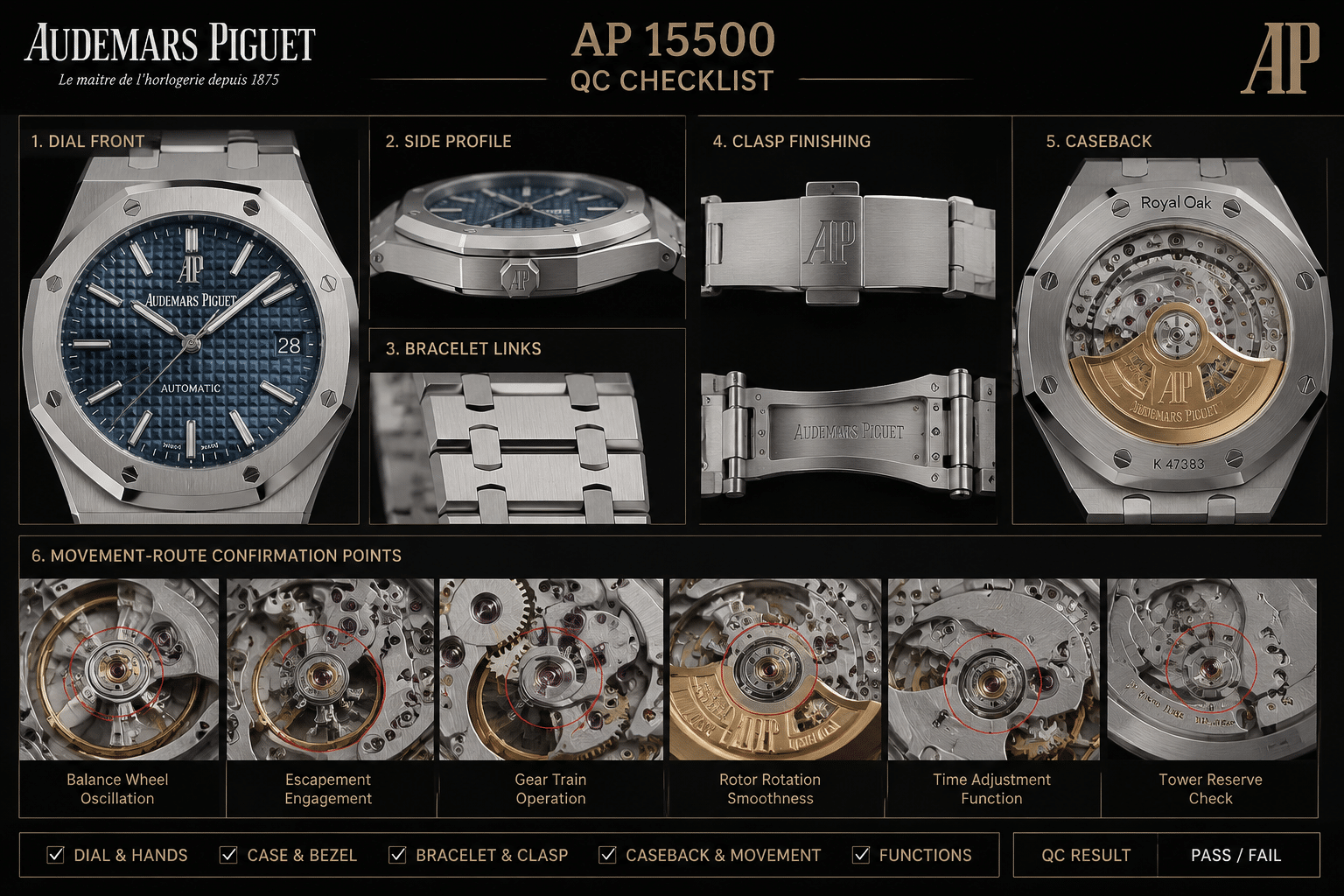
A useful AP 15500 QC checklist should include a straight front dial photo, a side profile, an angled case photo, close-ups of the bezel screws, bracelet link shots, clasp exterior and interior photos, a caseback image, and a movement photo that supports the claimed movement route. If the watch is being compared as VS versus APS or ZF, the photo angles should be similar enough to judge the same details fairly.
The strongest QC set is not the prettiest one. It is the one that makes flaws visible. Neutral lighting, straight alignment, and honest side angles help the buyer understand what the watch will actually look like in use. If a seller or source only provides dramatic front photos, the most important AP-specific risks remain hidden.
Price and Value Logic: When a New VS Version May or May Not Be Worth More
The AP 15500 replica price should be judged as a risk-and-value question, not a simple factory ranking. A newer VS version may be positioned higher because it is new, because the movement route sounds attractive, or because the factory name carries weight from other categories. None of those factors automatically makes it the better value.
The right AP 15500 value comparison asks what the buyer is actually paying for. If the premium brings stronger movement confidence, better dial execution, cleaner case geometry, more refined bracelet finishing, and more consistent QC, then paying more can be rational. If the premium is mostly attached to launch excitement or a familiar factory name, an established APS or ZF version may be the smarter choice.
Higher price often pays for reduced uncertainty, not perfection. That distinction matters. A strong AP 15500 replica can still have dial, screw, movement finishing, or bracelet limitations under close inspection. The buyer should not expect a higher price to erase the fundamental difficulty of replicating the Royal Oak.
What Can Justify a Higher Price
A higher price is easier to justify when the improvement is visible or practical. Movement-route confidence matters if the watch winds smoothly, changes date cleanly, runs consistently, and supports the correct case profile. Dial execution matters if the tapisserie has real depth and the date, markers, logo, and printing are controlled. Bracelet finishing matters because it affects both comfort and perceived quality every time the watch is worn.
QC consistency can also justify paying more. If a factory version shows fewer rejected samples, better alignment control, cleaner brushing, and more predictable movement presentation, the buyer is not only paying for the object. They are paying for a lower chance of receiving a compromised example. For many buyers, that is more valuable than a single headline specification.
A VS AP 15500 may be worth a premium if current evidence shows that it combines movement presentation with Royal Oak-specific finishing. The key word is “combines.” A new movement route without strong bracelet and case execution does not solve the AP 15500 problem.
When a Cheaper Established Version May Be Smarter
A cheaper established version can be the more rational buy when its flaws are known and acceptable. APS may make sense for buyers who want a more mature AP 15500 route and clearer expectations around movement behavior. ZF may make sense where the buyer values external finishing, case feel, or bracelet execution and the current batch supports that choice.
This is especially true for cautious beginners. Paying more for a new release can be rewarding if the buyer knows how to evaluate QC photos, movement claims, and batch feedback. But if the buyer simply wants the safer AP 15500 replica for daily wear, predictable flaws are often easier to manage than unknown early-batch issues.
Lower price should not be confused with better value either. A cheaper AP 15500 that has a poor bracelet, weak dial texture, or questionable movement route may cost less upfront but disappoint faster. The smarter value is the version whose compromises match the buyer’s priorities.
Why New-Release Hype Can Distort Value
New-release hype changes how buyers interpret price. A factory with a strong reputation enters a new model category, early photos circulate, and the market starts treating attention as proof. That is exactly where AP buyers need to slow down. The Royal Oak rewards factories that can repeat difficult finishing and geometry, not just factories that can produce an impressive first sample.
VS Factory’s reputation should make buyers interested, not careless. If the current VS AP 15500 proves strong across multiple batches, a higher price may become easier to defend. Until then, premium pricing should be tested against evidence: movement photos, side profile, dial texture, bracelet finishing, clasp quality, and recent owner feedback.
The practical rule is simple: pay more only when the reason is visible, mechanical, or consistency-related. Do not pay more only because the release is new. On the AP 15500, value belongs to the version that reduces the buyer’s biggest risk, whether that version comes from VS, APS, or ZF.
Buyers should also be careful with language that sounds too absolute. Claims such as “perfect,” “same as genuine,” or “guaranteed to pass inspection” are not useful ways to compare VS, APS, and ZF. A more traceable value judgment looks at the exact version, the claimed movement configuration, the visible finishing, the QC photo set, and whether the seller’s description can be matched to the watch being shown.
Water Resistance, Daily Wear, and Authentic-Spec Confusion
Buyers should not borrow official Royal Oak water-resistance figures and apply them to a replica. Even when an authentic reference lists a water-resistance rating, that rating belongs to the authorized watch as manufactured and tested by the brand, not to a replica sample from VS, APS, ZF, or any other factory.[1] For replica watches, water resistance should be treated as unverified unless the individual watch has been pressure-tested after purchase by someone competent to inspect the crown, gasket, crystal, and caseback seal.
This matters because “daily wear” can mean different things. Wearing an AP 15500 replica at a desk, in dry weather, and with careful handling is different from exposing it to swimming, showering, heavy rain, sweat, or sudden temperature changes. A watch may look visually strong and still have inconsistent sealing, imperfect gasket compression, or a caseback fit that should not be trusted around water. The safer buyer habit is to separate appearance from durability instead of assuming that a premium factory version is automatically ready for wet use.
A replica AP 15500 should be evaluated with realistic ownership expectations. Even a strong super clone can have limits in water resistance, long-term movement stability, servicing convenience, bracelet adjustment quality, and close-inspection finishing compared with a genuine reference. Buyers should confirm return, repair, shipping, and after-sales terms before ordering, because those terms can vary by seller and should not be assumed from the factory name alone.
Final Judgment: VS Is a Serious Challenger, Not an Automatic Winner
The VS Factory AP 15500 verdict is straightforward: VS is a serious challenger, but not the automatic answer for the most suitable AP 15500 replica factory. Its entry matters because VS has enough factory discipline and movement reputation to pressure APS and ZF, but the Royal Oak 15500 is not a model where reputation can substitute for proof. The safer judgment is evidence-based: if a current VS batch shows strong movement execution, convincing tapisserie depth, clean bracelet finishing, correct case flow, and repeatable QC, it deserves to be compared directly with APS and ZF. If those points are inconsistent, APS and ZF remain easier to justify.
The biggest mistake would be transferring VS’s Omega reputation directly onto an AP Royal Oak. Omega-style cases and bracelets do not test the same skills as a Royal Oak. The 15500 exposes tiny weaknesses in surface finishing, bezel geometry, bracelet articulation, dial texture, and display-back movement presentation. A factory can be excellent elsewhere and still need time to prove itself here. That is why this AP 15500 factory decision should not be reduced to “VS is good, so VS wins.”
Who Should Consider VS
VS makes the most sense for buyers who are comfortable evaluating a newer version through current QC evidence rather than waiting for years of market feedback. If the sample in front of you shows clean dial alignment, a believable tapisserie effect, controlled case thickness, good bracelet fit, and credible movement-route confirmation, the VS Factory AP 15500 can be a rational choice. This is especially true for buyers who enjoy following factory updates and understand that early versions may improve or shift across batches.
The VS buyer should not be someone who wants the lowest-risk AP 15500 replica with the least research. VS is more interesting if you are willing to compare fresh QC photos, ask for movement-side images, study side-profile shots, and accept that feedback history is still developing. In practice, VS is better suited to the informed early adopter than the cautious first-time Royal Oak buyer.
Who May Prefer APS or ZF
APS may still be the safer AP 15500 option for buyers who value movement maturity, known behavior, and a longer record of owner feedback. In an APS vs VS decision, the practical advantage is not that APS is automatically perfect; it is that buyers generally have more reference points for what to expect, what to inspect, and which flaws are common enough to tolerate or reject. For a daily wearer, that predictability can matter more than the excitement of a newer release.
ZF also should not be dismissed just because VS entered the category. In a ZF vs VS comparison, ZF can remain relevant when a specific batch shows strong dial-side appearance, case finishing, and bracelet execution. Royal Oak finishing is a package issue. A watch with a slightly less exciting movement story can still be the more satisfying choice if the case, bezel, bracelet, and dial look more coherent on the wrist.
For cautious buyers asking “should I choose VS AP 15500,” the answer depends on tolerance. If you want the newest competitor and are willing to verify the details, VS is worth considering. If you want the safer AP 15500 option with fewer unknowns, APS may still be easier to defend. If your priority is visual execution in the specific sample available, ZF can still belong in the final comparison.
The Practical Rule for This Model
The AP 15500 should be judged by current sample evidence, not factory reputation borrowed from another brand category. That means QC evidence carries more weight than slogans, old rankings, or a factory name on its own. The right question is not simply “which factory is best,” but “which current version has the strongest combination of movement confidence, Royal Oak finishing, dial texture, bracelet feel, case geometry, and buyer risk for my expectations?”
For CleanVSFactory, the goal is to make replica watch comparison more traceable by connecting factory names, movement claims, visible QC details, version differences, and realistic ownership limits. That approach is especially important with the VS AP 15500 because the model is new enough to create excitement but demanding enough that every claim still needs to be checked against the actual watch.
For this model, the hierarchy is clear. First, confirm the movement route and case profile. Second, judge the dial texture and date alignment. Third, look closely at bracelet finishing and integration. Finally, compare factory reputation only after those visible and ownership-related points are satisfied. A strong VS sample can challenge APS and ZF. A weak VS sample should not be excused just because VS has performed well in other categories.
The final recommendation is restrained but clear: VS has earned attention in the AP 15500 market, not immunity from inspection. APS remains compelling where movement maturity and track record matter. ZF remains relevant where visual execution and finishing are competitive. The most suitable AP 15500 replica factory for a given buyer is the one with the strongest current evidence, not the loudest reputation.
References
[1] Audemars Piguet, “Royal Oak 15510ST official specifications,” official brand reference for authentic Royal Oak 15510ST case size, dial description, and water-resistance listing, available at Audemars Piguet Royal Oak 15510ST Official Specifications.
[2] Audemars Piguet, “Royal Oak Jumbo 16202ST official specifications,” official brand reference for authentic Royal Oak Jumbo 39 mm design, Petite Tapisserie dial description, and ultra-thin Royal Oak context, available at Audemars Piguet Royal Oak Jumbo 16202ST Official Specifications.
[3] United States Patent and Trademark Office, “Counterfeit Goods Basics,” official educational resource on counterfeit goods and trademark-related basics, available at USPTO Counterfeit Goods Basics.
[4] U.S. Customs and Border Protection, “Intellectual Property Rights,” official customs resource on IPR enforcement and import-related intellectual property priorities, available at U.S. CBP Intellectual Property Rights.
[5] Sellita, “SW200-1 official technical document,” manufacturer technical document for the Sellita SW200-1 movement family, available at Sellita SW200-1 Official Technical Document.
[6] Miyota, “Caliber 9015 official movement specifications,” manufacturer specification page for the Miyota 9015 automatic movement, available at Miyota 9015 Official Movement Specifications.
Disclosure: This article is for general educational and comparison purposes only. Replica watches are not genuine products from the original luxury brands, and brand names are used only to identify reference designs or comparison topics. Factory names, movement descriptions, prices, availability, QC details, seller policies, and version information can change, so readers should verify important details with the seller before making a purchase decision. Replica watches should not be represented, resold, or used as genuine watches.