
Choosing between APS and ZF for the AP 15500 is not just a question of which factory has the stronger name. The real decision is whether you will notice dial realism more, or whether bracelet feel and case finishing will affect your ownership experience more, especially when an AP 15400 factory comparison sets a useful baseline for judging similar Royal Oak details. The Royal Oak design makes this difficult because the watch is defined by many exposed details: tapisserie depth, dial color behavior, bezel screws, case brushing, polished bevels, bracelet articulation, and clasp confidence all matter.
This article looks at the choice through practical buyer judgment rather than hype. APS generally makes more sense for buyers who care most about dial texture, blue dial behavior, date presentation, and movement-route confidence. ZF may be the better direction for those who plan to wear the watch often and care more about bracelet comfort, clasp feel, case geometry, and finishing consistency. The key is to approve the specific watch in QC, not the factory name alone.
| Buyer Priority | APS Direction | ZF Direction |
|---|---|---|
| Dial realism | Stronger appeal for tapisserie depth and blue dial behavior | May be less convincing if dial texture looks flatter |
| Daily comfort | Check bracelet sharpness, link movement, and clasp feel carefully | Often favored for bracelet drape and wearing comfort |
| Case and finishing | Needs close QC on bevels, brushing, and integration | Usually chosen for case shape and finishing coherence |
| Movement confidence | Often preferred by buyers focused on clone 4302 route clarity | Still requires seller clarity and functional checks |
| Price judgment | Premium makes sense only if dial and movement concerns matter most | Premium makes sense only if wear feel and finishing reduce your main risk |
| QC focus | Dial alignment, date position, color behavior, movement description | Bracelet edges, clasp closure, bezel screws, case profile |
Quick Questions Before You Read
Q: Is APS automatically better because of the dial?
No. APS may suit dial-focused buyers, but bracelet feel, case finishing, and QC still decide whether a specific unit is worth approving.
Q: Is ZF the safer choice for daily wear?
It can be the more practical direction if comfort, clasp feel, and bracelet finishing matter more than small dial differences.
Q: Should the blue dial be judged from one QC photo?
No. Blue dial behavior should be checked across multiple lighting angles because one dramatic photo can be misleading.
Q: When is paying more justified?
Only when the higher price reduces the flaw you care about most, such as dial texture, movement-route clarity, or bracelet comfort.
Why the AP 15500 Makes the APS vs ZF Decision Harder Than It Looks
The AP 15500 replica is not a simple “APS is better” or “ZF is better” decision. The better answer depends on which flaw you will notice first and which flaw you can live with. On this model, APS Factory and ZF Factory are both credible choices, but they do not win in the same areas. That is exactly why the APS vs ZF 15500 comparison becomes frustrating for buyers who want one clean recommendation.
The Royal Oak 15500 replica looks straightforward from a distance: time, date, three hands, integrated bracelet, octagonal bezel. In practice, it is one of the less forgiving modern Royal Oak references because almost every visible surface is part of the design language. The dial is not just a color plate. The bracelet is not just a strap. The case is not just a steel container. A weak tapisserie dial, soft bevel, stiff bracelet, poor brushing transition, or vague movement claim can change how convincing the watch feels very quickly.
Official Audemars Piguet information for the Royal Oak 15510ST helps explain why buyers focus on these details: the authentic model is described with a 41 mm stainless steel case, Grande Tapisserie dial, octagonal bezel, integrated bracelet, and 50 m water-resistance specification for the genuine watch.[1] That official specification is useful for understanding the design target, but it should not be used as proof that any APS or ZF replica has the same construction, finishing, movement performance, or water resistance.
This is why a super clone AP needs to be judged differently from many round sports replicas. A Rolex-style diver can hide small finishing inconsistencies behind a rotating bezel, curved case, and conventional bracelet structure. The Audemars Piguet Royal Oak exposes them. The flat bezel catches light directly. The polished chamfers create high-contrast lines. The bracelet flows straight out of the case. The dial grid gives your eye a fixed pattern to inspect. If one element looks lazy, it does not stay isolated.
The 15500 Is Not Forgiving of Small Finishing Errors
The 15500 is difficult because its design is built from straight lines, hard planes, and repeated geometry. The octagonal bezel has to sit cleanly. The screws have to appear evenly placed. The brushing needs to run with discipline across broad flat surfaces. The polished bevels need enough definition to create contrast without looking rounded or over-polished. On a Royal Oak 15500 replica, these are not minor collector details. They are the watch.
The dial creates a different kind of pressure. The Grande Tapisserie pattern gives the front of the watch its depth, but it also gives buyers an easy way to spot flatness. If the square pattern looks too printed, too uniform, or too shallow, the entire front view loses life. A plain sunburst dial on another watch may still look acceptable with small compromises. A Royal Oak dial with weak tapisserie can feel wrong even if the color is attractive.
The bracelet adds another layer because it is both visual and tactile. A buyer may not notice a slightly soft bevel in a seller’s front-facing photo, but they will notice a bracelet that feels sharp, blocky, loose, or stiff. This is where the 15500 becomes more demanding than it first appears. It must look right in photos and feel coherent on the wrist. Many replica watch buyers focus heavily on the dial during selection, but the Royal Oak punishes that narrow approach more than most models.
Why Factory Reputation Alone Is Not Enough
APS Factory and ZF Factory both have real arguments on the AP 15500, but a factory name by itself does not answer the buying question. APS is often discussed because of dial texture, tapisserie depth, blue dial behavior, and buyer confidence around the clone 4302 route. ZF is often respected because of case shape, bracelet finishing, bevel consistency, and the overall external feel of the watch. Those are different strengths, not the same strength measured on a single scale.
This is the mistake buyers make when they ask, “Which AP 15500 factory is better?” without defining better. Better for close-up dial inspection is not always better for daily wrist comfort. Better movement-route confidence is not the same as better bracelet articulation. Better case finishing does not automatically mean the dial will satisfy someone who is sensitive to tapisserie texture. A factory comparison only becomes useful when it is tied to the specific version, batch, and buyer expectation.
Factory names in the replica market are buyer-community labels rather than official brand affiliations. They can be useful shorthand, but they should not be treated as manufacturer certification, movement verification, or authorization from Audemars Piguet. The USPTO explains counterfeit goods in relation to unauthorized use of trademarks, which is why replica-watch language should remain clear about imitation status and should not imply authorized origin.[2]
At Clean VS Factory, we usually treat this type of comparison as a flaw-tolerance decision rather than a factory loyalty debate. A strong factory reputation narrows risk, but it does not remove the need to ask what you personally value most: front-facing dial realism, external finishing, movement confidence, or daily handling feel.
Factory Name Clarification: Factory names such as APS and ZF are practical replica-market references, not official brand affiliations, audited manufacturer identities, or guarantees of identical quality across every AP 15500 unit. Buyers should judge the specific version, batch, QC photos, bracelet finishing, dial execution, and movement description rather than relying on the factory label alone.
Editorial Perspective: For the AP 15500, the useful comparison is not whether APS or ZF has the louder reputation, but whether the specific unit matches the buyer’s real use case. A dial-focused buyer should care about tapisserie depth, color control, date placement, and movement-route clarity. A daily wearer should give more weight to bracelet articulation, clasp action, case profile, and edge comfort. Factory labels, seller descriptions, and QC photos are helpful signals, but they are not final proof until the actual watch is checked against those priorities.
Evidence Boundaries for This Comparison
Official brand sources can clarify what the authentic Royal Oak family is designed to be, but they cannot verify APS or ZF execution. Seller photos can show dial alignment, finishing, and broad movement appearance, but they cannot prove water resistance, long-term durability, lubrication quality, or serviceability. For that reason, this article treats factory claims as buyer-discussion signals and QC priorities rather than as independently verified production facts.
The same restraint applies to movement and material language. A “clone 4302” description may be relevant to caseback appearance and buyer confidence, but it should not be read as proof of genuine AP performance, parts compatibility, or official certification. A steel bracelet, polished bevel, or display back can be evaluated visually and tactically, yet those observations remain different from confirmed factory specifications or laboratory testing.
Brand, Factory, and Movement Boundaries
Brand names in this article are used to identify the genuine reference design being discussed and to explain what replica-market buyers are comparing. APS and ZF Royal Oak 15500 replicas are not genuine Audemars Piguet watches, are not produced or approved by Audemars Piguet, and should not be represented as authentic Royal Oak watches in resale, service, insurance, or authentication contexts.
Factory names are useful market references, but they do not guarantee identical quality across every model or version. A factory may be stronger in one reference, dial color, or movement route and less convincing in another, so the most defensible comparison is always tied to the specific watch being offered, the current version, the visible QC evidence, and the buyer’s own tolerance for dial, case, bracelet, and movement compromises.
Movement descriptions in the replica market should also be read carefully. Terms such as “clone 4302” may describe layout, decoration, architecture, or seller terminology rather than an official Audemars Piguet-manufactured caliber. The purpose of discussing movement route is to help buyers understand appearance, function, and ownership risk, not to suggest genuine-brand equivalence or inspection passability.
How This Comparison Stays Traceable
A traceable APS vs ZF decision should move from broad label to specific evidence. Start with the factory name only as a sorting tool, then check the exact reference style, dial color, batch or version description, movement route, case profile, bracelet construction, and QC photo set. This order matters because a factory reputation may describe a general tendency, while the watch being offered may still show unit-level variation.
For the AP 15500, the most useful evidence is visible and model-specific: tapisserie depth, logo placement, marker alignment, date centering, bezel screw seating, brushing direction, bevel consistency, bracelet drape, clasp closure, and side thickness impression. Movement information adds context, but it should be matched against actual movement photos and basic functional checks rather than treated as a standalone promise.
CleanVSFactory’s editorial approach is to make replica watch decisions more traceable by connecting factory claims to visible details, movement behavior, version differences, and practical QC checks. That approach does not make APS or ZF official sources, and it does not remove normal replica-watch limits. It simply helps buyers avoid choosing from slogans when the real decision depends on the exact watch, the exact version, and the flaws they are most likely to notice.
The Real Question: Which Flaw Will Bother You More?
The practical question is not whether APS or ZF can produce a convincing Royal Oak 15500 replica. Both can, depending on the watch and the buyer. The better question is which imperfection will irritate you after the excitement of receiving the watch fades. If you keep looking at the dial and judging the depth of the tapisserie, APS will naturally draw more attention. If you judge the watch by how the bracelet wraps, how the clasp closes, and how the case catches light on the wrist, ZF becomes harder to dismiss.
Dial flaws usually bother buyers during close inspection, comparison photos, and direct front-facing wrist shots. Bracelet and case flaws tend to bother buyers during ownership: sizing the bracelet, closing the clasp, feeling the link edges, watching the case profile from the side, and noticing whether the bracelet flows naturally from the case. Neither type of flaw is harmless. They simply show up in different moments.
That is the core buyer tradeoff behind the APS vs ZF 15500 debate. If the watch will mostly be judged by photos, dial texture and color behavior may carry more weight. If it will be worn often, handled daily, and expected to feel like a coherent integrated-bracelet watch, bracelet finishing and case geometry may matter more. The right choice starts with admitting which flaw you are least willing to accept.
A Model-Specific Lens Helps Avoid the Wrong Shortcut
The Royal Oak 15500 is a good example of why factory reputation should not be applied too broadly. A factory that performs well on one AP reference, one dial color, or one movement route may not automatically be the right answer for every Royal Oak buyer. The 15500 puts unusual pressure on the dial grid, the thin visual line of the case, and the bracelet transition, so the best choice has to be model-specific rather than brand-specific.
This also means the buyer should separate “best for photos” from “best for wearing.” A front-facing APS dial may look more convincing in a comparison post, but that does not prove it will feel better after sizing the bracelet and wearing it for a full day. A ZF case and bracelet may feel more coherent on the wrist, but that does not prove the dial will satisfy someone who bought the blue 15500 mainly for the Grande Tapisserie effect.
The safer buying habit is to decide which evidence matters for the intended use. For photo comparison, dial depth, date centering, marker alignment, and controlled blue tone deserve extra attention. For daily wear, bracelet drape, clasp feel, case-to-bracelet integration, rotor behavior, and crown action may matter more. The same factory name can lead to different decisions depending on which of those checks carries the most weight.
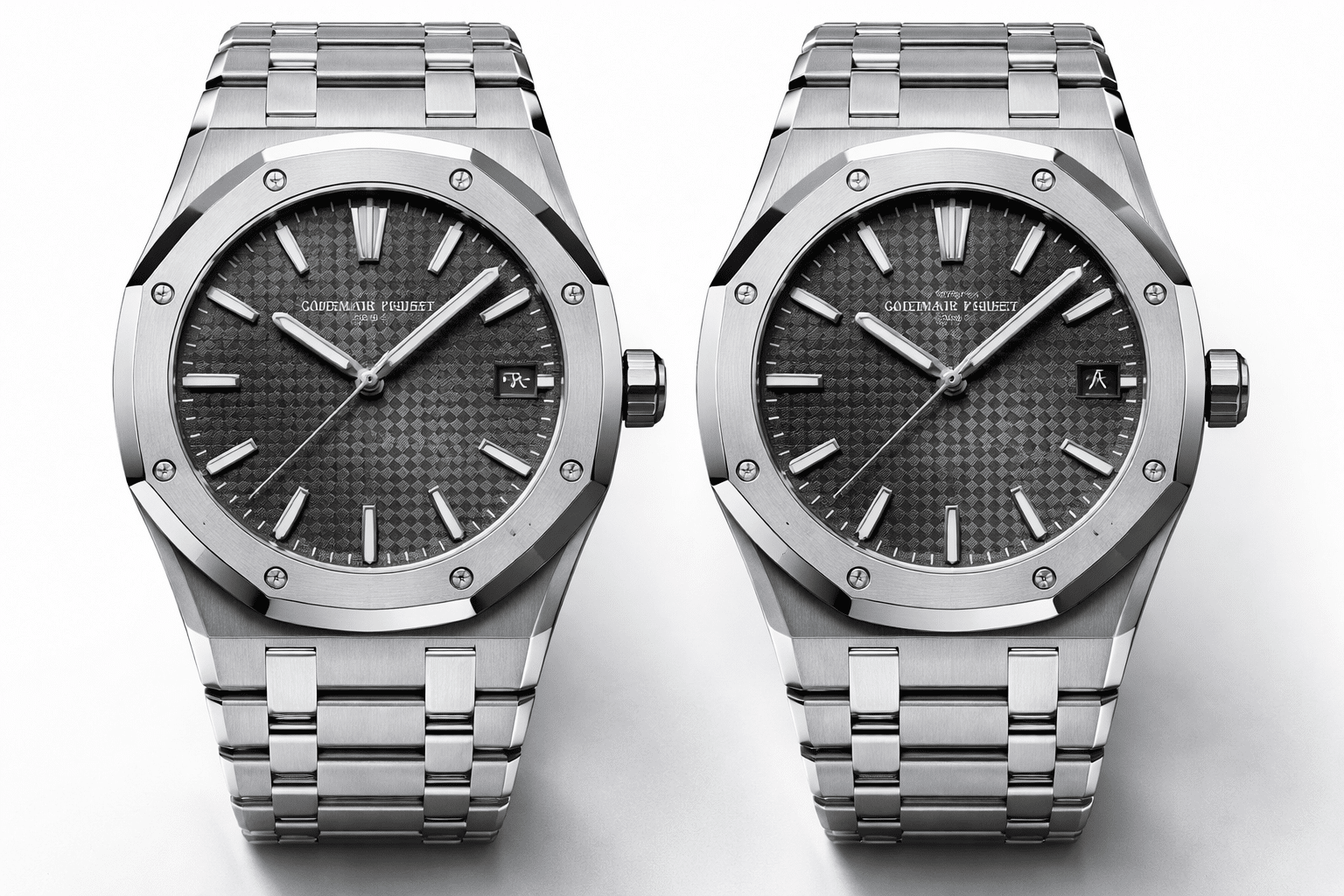
APS Strengths on the 15500: Dial Texture, Tapisserie Depth, and Clone 4302 Confidence
The main reason buyers lean toward the APS AP 15500 is the front-facing impression. APS Factory 15500 versions are often discussed favorably because the dial has more convincing texture, stronger tapisserie presence, and better light behavior than many earlier Royal Oak replicas. For a buyer who stares at the dial before anything else, that matters more than a small improvement in an area they rarely notice.
The strongest argument for APS is not that it makes the entire watch perfect. It does not. The argument is that the Royal Oak’s identity is heavily concentrated in the dial, and APS tends to address that part of the watch in a way that feels more satisfying to dial-sensitive buyers. The AP 15500 dial texture has to create depth without looking like a flat stamped pattern. When the square grid has enough relief and catches light with some variation, the watch looks more alive from the front.
APS also benefits from the confidence buyers associate with the clone 4302 movement route. That does not mean guaranteed long-term durability, and it should not be treated as a promise of genuine-level performance. It does mean the movement discussion feels more complete than vague “decorated automatic” claims. For buyers who care about the display caseback, movement layout, and ownership confidence, that can be part of the APS appeal.
Why Tapisserie Texture Carries So Much Weight
The tapisserie dial is the first place many AP 15500 replica comparisons are won or lost. A weak dial does not merely look slightly inaccurate; it changes the character of the watch. The authentic Royal Oak 15510ST is officially described with a Grande Tapisserie dial, which helps explain why the dial grid remains such a central visual reference when buyers evaluate 15500-style replicas.[1] On a replica, the question is whether the grid has enough depth, spacing discipline, and surface variation to avoid appearing flat.
APS is attractive to many buyers because its tapisserie execution often gives a stronger impression of depth. The individual squares should not look like identical plastic blocks, and the grooves between them should not disappear under normal lighting. The dial needs contrast, but not cartoonish contrast. If the pattern is too aggressive, it can look artificially sharp. If it is too soft, it loses the Royal Oak identity. The useful middle ground is a dial that keeps visible structure without looking over-etched.
This is why APS dial accuracy matters most for buyers who evaluate the watch straight-on. If your first reaction to a Royal Oak is always the dial, choosing a version with weaker tapisserie just because another factory has a nicer bracelet may not satisfy you. The dial sits at the center of every wrist check. If it looks flat to you, you will keep seeing that flaw.
Blue Dial Performance Under Different Lighting
The blue dial is where APS gets the most attention, but it is also where buyers can misjudge the watch most easily. Royal Oak blue is sensitive to light, camera exposure, and white balance. A dial that looks rich and controlled in one photo can look too bright in another. A dial that looks dark indoors may open up under angled light. This is why a single seller photo is a weak basis for judging the APS blue dial.
A good AP 15500 blue dial replica needs more than the right shade. It needs the sunburst effect and tapisserie texture to work together. If the blue is attractive but the grid looks flat, the dial still feels incomplete. If the texture is strong but the blue is over-saturated, the watch can look more dramatic than realistic. APS is often chosen because it tends to give dial-focused buyers a better balance of texture and light movement, but the exact result still depends on the individual unit and photo conditions.
Buyers should be cautious with overly bright comparison images. Strong lighting can make a dial look more dynamic than it will appear in normal wear. It can also hide unevenness, date-window issues, or marker alignment problems. Neutral light is less flattering but more useful. If the dial still has visible depth under neutral light, that is a better sign than a dramatic sunburst shot taken at the perfect angle.
Where the Clone 4302 Route Matters
The clone 4302 route matters because the 15500 is a display-back watch with a modern movement identity. Buyers are not only looking at the dial; many also care whether the movement layout, rotor presentation, and general architecture feel appropriate for the model. APS benefits because its 15500 is commonly associated with a more confident clone 4302 approach rather than a simple base movement hidden under decorative plates.
The practical value is reduced uncertainty, not guaranteed reliability. Movement photos can help confirm broad layout and decoration, but they cannot prove that a specific movement is clean, properly lubricated, well-regulated, or free from future issues. Winding feel, rotor behavior, date change, and timekeeping still need realistic expectations. A clone 4302 movement can make the watch feel more complete, but it does not remove the need for QC or sensible ownership habits.
For some buyers, this movement confidence is enough to tilt the decision toward APS, especially if the dial is already the main priority. For others, movement route is secondary to how the case and bracelet feel in hand. Neither position is wrong. The mistake is treating the movement label as a magic answer while ignoring the rest of the watch.
Dial Details to Confirm
Before choosing an APS Factory 15500, buyers should still inspect the actual watch rather than relying only on the factory name. Check whether the tapisserie has visible depth under neutral light, whether the AP logo sits cleanly, whether the hour markers are straight, and whether the minute track feels evenly placed around the dial. The date window deserves special attention because a strong dial can still be weakened by a poorly centered date.
The most useful QC review is not an extreme macro hunt for every tiny imperfection. It is a practical front-facing check: does the dial look alive or flat, are the markers aligned, is the date sitting acceptably, and does the blue color behave naturally across more than one lighting angle? If those points satisfy you, APS becomes a sensible direction for a buyer who values dial realism and movement-route confidence more than the last degree of bracelet refinement.
ZF Strengths on the 15500: Case Shape, Bracelet Finishing, and Wrist Feel
The strongest argument for the ZF AP 15500 is not the dial. It is the external wearing experience. ZF Factory 15500 versions remain respected because the Royal Oak is an integrated-bracelet watch, and ZF has built much of its reputation around case shape, bracelet finishing, bevel work, and the way the watch feels as a complete object on the wrist.
This matters because the bracelet on a Royal Oak is not an accessory. It is part of the architecture. A buyer who treats the bracelet as secondary is misunderstanding the model. The case, first links, taper, brushing, polished chamfers, and clasp all work together to create the Royal Oak feel. If that system feels rough, stiff, or visually disjointed, even a good dial cannot fully rescue the ownership experience.
ZF becomes especially appealing for buyers who handle their watches often and notice tactile details. A slightly better dial may impress in a photo, but a cleaner bracelet edge, smoother link articulation, and more convincing case profile can matter every time the watch is worn. For daily wear, that repeated physical contact is hard to ignore.
Case Geometry and Bevel Consistency
The Royal Oak case is a geometry test. The flat surfaces need discipline, the brushing must look intentional, and the polished bevels have to form clean lines between planes. ZF’s appeal on the 15500 comes from this external coherence. The watch can look more convincing as a shaped steel object, not merely as a dial inside a case.
Case brushing is easy to underestimate until it is wrong. Uneven grain, cloudy transitions, or soft edges can make the watch feel cheaper even if the front view seems acceptable. The polished chamfers are just as important because they create the sharp contrast that makes the Royal Oak case recognizable. If the bevels are too rounded, too wide, or inconsistent from one side to the other, the watch loses that crisp architectural feel.
This is where ZF often makes sense for buyers who care about the side profile and the way the case meets the bracelet. A front photo can hide a lot. Wrist angle, side view, and case-to-bracelet transition reveal more about whether the 15500 feels properly constructed. If your eye goes first to case lines and finishing rather than dial texture, ZF deserves serious consideration.
Bracelet Drape Is a Core Royal Oak Feature
The Royal Oak bracelet needs to drape, not just attach. A good bracelet should curve naturally around the wrist, with links that articulate smoothly and do not feel like a rigid steel strip. This is one of the biggest reasons ZF remains competitive against APS on the 15500. Bracelet quality affects comfort, visual flow, and perceived finishing at the same time.
Link flexibility matters more on a Royal Oak than on many conventional sports watches because the bracelet begins visually at the case itself. If the first links sit awkwardly or the bracelet feels blocky, the whole watch looks less integrated. If the edges are too sharp, the watch becomes less pleasant to wear. If the brushing and polished chamfers across the bracelet look uneven, the eye catches those breaks as the wrist moves.
For buyers who plan to wear the watch often, ZF bracelet quality may matter more than a small dial advantage elsewhere. This is the non-obvious part of the APS vs ZF debate: the better watch in photos may not be the better watch for daily handling. A dial is inspected in moments. A bracelet is experienced for hours.
Clasp Feel and Daily Handling
The clasp is another area where tactile quality shapes ownership. A convincing clasp should close with confidence, feel reasonably solid, and avoid rough finishing around the contact points, especially when judged against a VS Factory AP 15500 comparison that considers bracelet refinement alongside case and movement execution. It does not need to feel identical to the genuine watch to be satisfying, but it should not feel hollow, loose, gritty, or uncertain. On an AP 15500 replica, weak clasp action can make the whole bracelet feel less refined.
ZF’s strength is that these external details often feel more cohesive. The case, bracelet, and clasp are judged together every time the buyer puts the watch on. A small dial flaw may be noticed during inspection, but a poor clasp or sharp bracelet edge becomes part of the routine. That is why ZF is often the more rational choice for a buyer who values wearing feel over close-up dial study.
This does not make ZF universally better. It means ZF’s advantage is concentrated in the parts of the watch that affect touch, comfort, and external finishing. If those are your priorities, choosing ZF over APS can be a practical decision rather than a contrarian one. The buyer simply needs to accept that dial-focused collectors may still prefer the APS direction.
Dial Texture vs Bracelet Finishing: Which Flaw Is More Noticeable in Real Use?
The honest answer in the AP 15500 dial vs bracelet debate is that the flaw you notice first is not always the flaw you will live with longest. Dial flatness shows up quickly in close-up photos, direct wrist checks, and side-by-side comparisons. Bracelet roughness shows up more slowly, but it follows you every time the watch is worn, sized, clasped, or adjusted on the wrist.
This is the real APS vs ZF tradeoff. A buyer who studies macro photos may care more about tapisserie depth, dial texture, and whether the dial looks too printed under neutral light. A buyer who wears the watch several days a week may become more sensitive to bracelet drape, edge comfort, link stiffness, and how cleanly the case flows into the integrated bracelet. Neither concern is cosmetic trivia on a Royal Oak. The model depends on both the dial and the bracelet to feel convincing.
For a daily wear AP replica, bracelet finishing usually has the stronger long-term effect because it becomes part of the handling experience. A slightly weaker dial may bother you when you stare at the watch. A rough bracelet bothers you when you put it on, when it catches hair, when it feels rigid, or when the clasp feels less secure than the rest of the watch suggests. That is why the better choice is not simply “choose APS or ZF.” The better question is which weakness you are least willing to notice repeatedly.
When Dial Flatness Becomes the Bigger Problem
Dial flaws become serious when the buyer cares about the Royal Oak’s front-facing identity. The 15500 is not a plain dial watch where a minor texture issue disappears. The tapisserie grid is the visual center of the model. If the squares look shallow, overly stamped, too uniform, or lifeless under neutral light, the watch can lose much of its Royal Oak character even if the case and bracelet are respectable.
This matters most for buyers who take close-up wrist photos, compare QC images carefully, or choose the blue dial because they want that changing light effect. A flat dial is not only a macro-photo flaw. On the 15500, weak tapisserie depth can make the dial look more like a patterned surface than a layered, light-reactive dial. The watch may still look attractive, but it feels less convincing to someone who bought the model specifically for the dial architecture.
The non-obvious point is that dial accuracy creates early confidence. When a buyer opens QC photos, the dial is usually the first thing judged. Logo position, marker alignment, date centering, color tone, and tapisserie texture all create the first yes-or-no reaction. If that first impression is wrong, a better bracelet may not rescue the watch for a dial-sensitive buyer.
When Bracelet Roughness Becomes the Bigger Problem
Bracelet flaws become more important when the watch is actually worn instead of only photographed. The Royal Oak bracelet is not a detachable afterthought. It is part of the case design, the wrist presence, and the perceived quality of the watch. If the links feel stiff, the edges feel sharp, the brushing looks uneven, or the clasp action feels weak, the whole watch starts to feel less refined.
This is where some buyers misjudge the APS vs ZF tradeoff. Dial texture is easier to discuss online because photos make it visible. Bracelet quality is harder to judge from a front-facing seller image, but it can matter more in ownership. A bracelet with poor drape may make the watch sit blocky on the wrist. Rough chamfers may make the watch feel cheaper than it looks. A clasp that lacks confidence may become annoying even if the dial photographs well.
For buyers planning regular wear, bracelet roughness is usually the more dangerous compromise. You can avoid staring at the dial under harsh light every day, but you cannot avoid feeling the bracelet. The integrated bracelet is one of the reasons people choose a Royal Oak replica in the first place, so a weak bracelet undermines the model at a more basic level.
The Practical Rule for Most Buyers
The practical rule is simple: choose based on the flaw you will notice in your normal use, not the flaw other people argue about most loudly. If you are photo-focused, dial-sensitive, and attracted to the 15500 because of the tapisserie pattern, prioritize dial realism. If you are a daily wearer who cares about comfort, case flow, and handling quality, prioritize bracelet and case finishing.
At Clean VS Factory, we usually encourage buyers to separate visual accuracy from ownership experience. A watch can look stronger in dial photos but feel less satisfying on the wrist. Another watch can have a slightly less exciting dial but feel more coherent because the case, bracelet, and clasp work better together. That distinction matters more on the Royal Oak than on many round sports watches.
For most buyers, the safer decision is to accept the flaw that will appear least often in their actual routine. A collector who inspects dials under bright light should not tolerate a flat tapisserie pattern. A wearer who wants the 15500 as a frequent wrist piece should not ignore bracelet sharpness or stiff articulation just because the dial looks good in QC photos.
Blue Dial Comparison: Color, Sunburst, and Tapisserie Under Real Lighting
The AP 15500 blue dial replica is difficult because blue is both the most desirable and the least forgiving choice. Grey, black, and white dials can hide some texture and saturation issues more easily. The Royal Oak 15500 blue dial exposes everything: color tone, sunburst strength, tapisserie depth, reflection behavior, and camera distortion.
A good blue dial is not just “dark enough” or “bright enough.” It needs controlled color shift. It should not look electric blue in every photo, but it also should not die into a flat navy patch indoors. The sunburst dial effect and the tapisserie grid have to work together. If the color is attractive but the grid looks shallow, the dial can look decorative rather than architectural. If the grid has depth but the blue is over-saturated, the watch can feel too loud for the 15500’s design.
This is why buyers should be careful with APS blue dial vs ZF blue dial comparisons based on one image. A bright dealer photo can make a dial look richer than it is. A poorly exposed QC image can make a good dial look dull. The correct question is not whether one photo looks better. The better question is whether the dial keeps enough depth, texture, and controlled color shift across different lighting angles.
Why Blue Dial Photos Can Mislead Buyers
Blue dial photos are unusually sensitive to camera exposure, white balance, and reflection. A phone camera can push the dial toward a brighter royal blue, a darker navy, or a washed-out steel blue depending on the lighting. Artificial light can exaggerate the sunburst. Direct light can make the tapisserie grid pop more than it will in normal indoor wear. Shadow can make the same dial appear flatter than it really is.
This creates a common buyer mistake: choosing the dial that looks most dramatic in one photo. A highly brightened image may look impressive on a screen but may not represent daily wear. The opposite is also true. A neutral QC photo can look less exciting but may be more honest. For blue dial quality, consistency across photos matters more than the single most attractive shot.
The strongest blue dial for a replica watch buyer is usually the one that does not collapse under normal lighting. It should show texture straight on, catch light at an angle, and avoid looking painted or overly glossy. If the dial only looks good under one perfect light angle, that is a warning sign rather than a strength.
Tapisserie Depth and Sunburst Need to Work Together
On the 15500, color alone cannot save a weak dial. The tapisserie grid gives the dial structure, while the sunburst effect gives it movement. If the grid is too shallow, the sunburst may dominate and make the dial look smoother than it should. If the sunburst is weak, the grid may look static and overly stamped. Good execution requires both elements to support each other.
This is why “blue dial too bright” and “dial looks flat” are often connected complaints. Over-saturation can hide the small texture differences within the tapisserie pattern. Poor lighting can do the same. A dial that looks like a single blue surface with square outlines is less convincing than one where the squares, grooves, and light direction create visible depth.
Batch variation also matters. It is safer to judge the exact watch offered than to rely on old comparison photos. Blue dials can shift by version, lighting, and camera setup, so a buyer should avoid treating one factory reputation as a permanent guarantee for every current unit.
QC Photos to Request
For a blue AP 15500, one straight-on dial photo is not enough. Ask for a clean front view to check logo placement, marker alignment, date centering, and whether the tapisserie looks flat. Then look for an angled light shot that shows whether the sunburst reacts naturally and whether the grid still has depth when the dial catches reflection.
A date window close-up is useful because blue dial attention often distracts buyers from date alignment. The date should appear reasonably centered and not visually crowded against the window. If available, a neutral-light image is more valuable than a dramatic showroom-style photo because it better represents normal wear. These photos are for personal buying judgment and expectation-setting, not for misrepresenting the watch as genuine.
Before making a decision, buyers should review real QC photos where available, including dial printing, hand alignment, bezel position, datewheel centering, bracelet fit, clasp engraving, case thickness, and overall finishing. Factory labels and stock photos alone are not enough for a reliable judgment, and QC photos reduce uncertainty rather than guaranteeing a flawless watch.
Case Brushing, Polished Bevels, and the Royal Oak Shape Test
AP 15500 case finishing is not only about whether the case looks shiny or clean. The Royal Oak case shape is a geometry test. Large brushed planes, polished bevels, an octagonal bezel, visible bezel screws, and a sharp case-to-bracelet transition all have to agree with each other. If one area is soft or uneven, the whole watch can look less precise.
This is one reason the APS vs ZF comparison cannot be reduced to dial texture alone. A strong dial helps the first impression, but the case head frames everything. If the brushed bezel looks cloudy, the bevels are inconsistent, or the side profile looks awkward, the watch loses the crisp architectural feel that makes the 15500 recognizable.
The most useful case shape comparison is not a single front photo. Front views can hide thickness, mid-case shape, and how the first bracelet link meets the case. A side profile check often reveals more: whether the case looks too slab-like, whether the bezel sits cleanly, and whether the bracelet integration looks natural rather than attached as a separate part.
Brushing Direction and Surface Cleanliness
The Royal Oak has broad exposed surfaces, so brushing quality is easy to notice in normal use. The grain should look directional and controlled, not cloudy, patchy, or randomly scratched. On the bezel, uneven brushing can make the octagonal shape look less sharp even if the dimensions are acceptable.
Surface cleanliness also affects perceived quality. A case can have the right general shape but still feel weak if the brushing transitions are messy. The problem is not only cosmetic. Blurry brushing reduces the contrast between the satin planes and polished bevels, which is one of the main visual signatures of the Royal Oak.
Buyers should be cautious with photos taken under harsh reflection. Bright light can hide poor brushing by washing out the grain, while low light can exaggerate marks that are not serious. The best evaluation comes from several angles where the brushing direction remains consistent.
Polished Bevels and Edge Definition
Polished bevels are where the Royal Oak gets much of its tension. The watch is supposed to move between brushed flat planes and bright polished edges with clean separation. If the bevels are too rounded, too wide, too narrow, or inconsistent from one side to another, the case loses that crisp high-contrast character.
Bevel quality is also more noticeable on the wrist than buyers expect. As the watch moves, polished edges catch light along the bezel, lugs, and case sides. A weak bevel does not always jump out in a static photo, but it can make the watch feel less sharp in motion. This is why case finishing matters even for buyers who think they mostly care about the dial.
The key is consistency. A small difference in bevel width may be acceptable if the case still looks balanced. Uneven polishing, cloudy transitions, or a bevel that disappears near the bracelet connection should be treated more seriously because it affects the Royal Oak’s overall shape language.
Bezel Screws and Front-Face Symmetry
The octagonal bezel makes small asymmetries easy to spot. Bezel screws should sit evenly, appear flush, and maintain clean visual spacing around the bezel. On replicas, screw size, seating, and orientation can vary, and even a minor issue becomes more visible because the Royal Oak front face is so structured.
Buyers should not obsess over microscopic screw details while ignoring larger problems, but obvious uneven seating or a screw that looks tilted should not be dismissed. The bezel is the frame around the dial. If the screws look careless, the watch can feel less refined before the bracelet or movement is even considered.
A useful QC sequence is to check bezel symmetry first, then screw seating, then brushing around the screw positions. If the bezel looks balanced from a normal viewing distance, small macro-level imperfections may be tolerable. If the front face already looks off without magnification, that is a stronger reason to reject the unit.
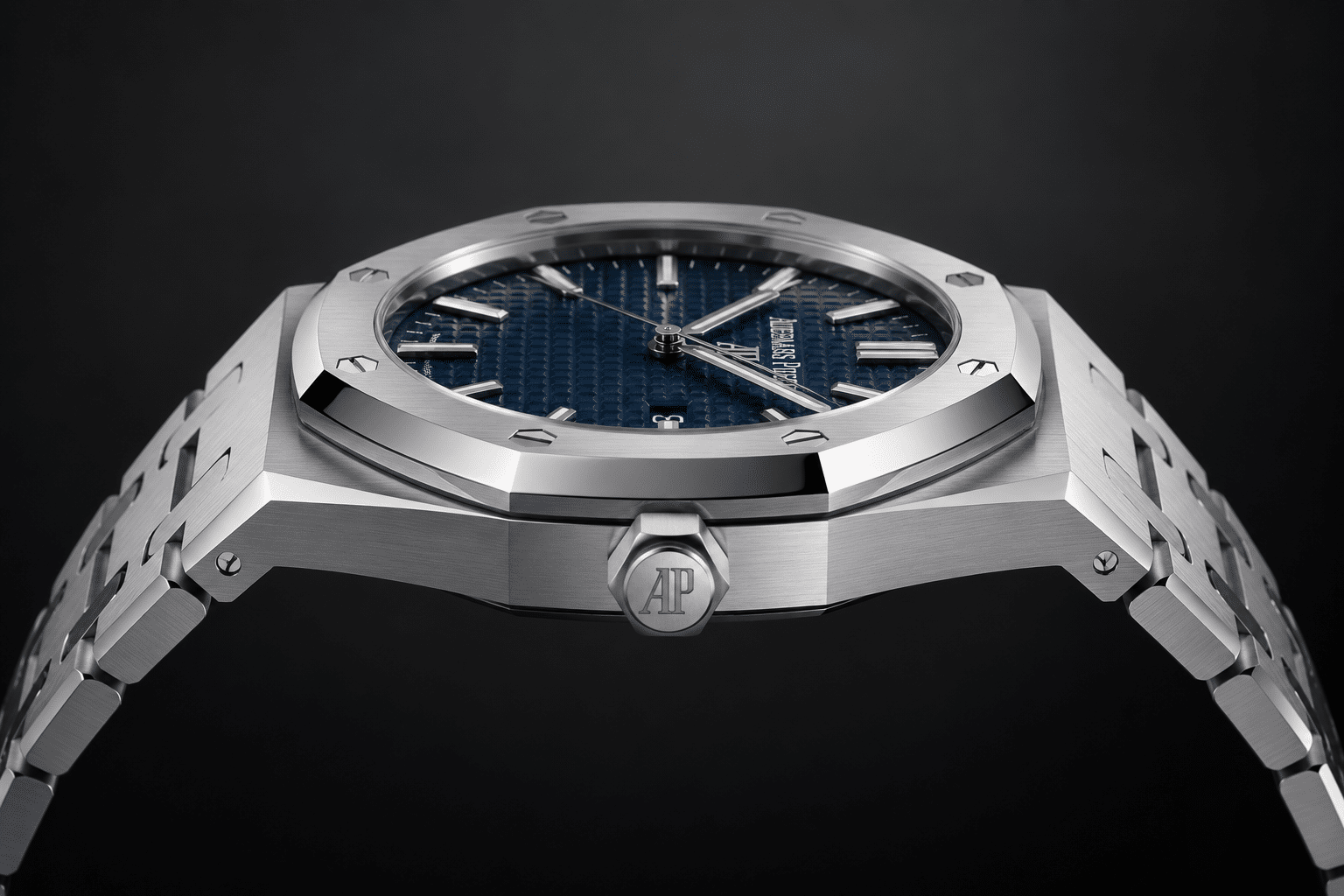
Bracelet and Clasp Feel: The Detail That Can Decide Daily Wear
The AP 15500 bracelet is not a secondary part of the watch. On a Royal Oak 15500 replica, the bracelet is part of the case architecture, part of the visual identity, and the part the buyer physically deals with every time the watch is worn. This is why the ZF bracelet vs APS bracelet question matters more than many buyers expect. A dial can impress in a photo, but a stiff bracelet, sharp edge, weak clasp, or poor first-link fit becomes noticeable within minutes on the wrist.
The practical judgment is simple: if this is a daily-wear AP 15500 replica, Royal Oak bracelet finishing may matter more than a tiny dial advantage. Not because the dial is unimportant, but because bracelet comfort and handling are repeated experiences. A slightly better tapisserie pattern is appreciated when you look at the watch. A rough bracelet is felt every time you put it on, size it, adjust your wrist, or close the clasp.
Link Articulation and Drape on the Wrist
A well-executed Royal Oak bracelet should curve naturally around the wrist rather than behave like a row of rigid metal blocks. Link articulation is one of the fastest ways to separate a convincing AP 15500 bracelet from one that only looks acceptable in a flat product photo. The links should move with enough freedom to follow the wrist, but not so loosely that the bracelet feels sloppy or poorly assembled.
This is where ZF has often been respected in the AP 15500 comparison. Buyers who prioritize daily wear feel usually pay attention to bracelet drape, first-link movement, and how the bracelet transitions from the case. APS has improved in this area, but a buyer choosing APS mainly for dial texture should still check whether the bracelet feels too stiff or whether the first links sit awkwardly from the case. The Royal Oak does not forgive poor bracelet flow because the integrated bracelet is the design, not an add-on strap.
Seller photos can hide this problem. A straight front shot may make both bracelets look similar, while a side angle or wrist curve shows whether the links actually articulate. If the bracelet looks flat, blocky, or reluctant to bend in QC photos, do not assume it will “break in” perfectly. Some stiffness may soften with use, but poor link geometry or rough finishing is not something a buyer should expect to disappear.
Edge Comfort and Polished Chamfers
Comfort on an AP 15500 bracelet depends heavily on the treatment of the edges. The brushed links need clean satin grain, but the polished chamfers must also be smooth enough not to feel sharp against the wrist. A bracelet can look bright and impressive in photos while still feeling unpleasant if the edges are too crisp, uneven, or poorly softened.
The common mistake is judging Royal Oak bracelet finishing only by how shiny the bevels look. Shine is not the same as quality. What matters is whether the polished chamfers are consistent from link to link, whether the brushing runs cleanly across the flat surfaces, and whether the transition between brushed and polished areas looks controlled. Over-polished edges can make the bracelet look rounded and soft; under-finished edges can feel scratchy or cheap. Both problems reduce the sense of quality.
For buyers comparing ZF and APS, the bracelet comfort question should be treated separately from the dial question. If you are sensitive to sharp edges, hair pulling, or rigid link movement, the better dial will not fully compensate for a bracelet you dislike wearing. This is one of the few areas where the flaw is not only visual. It becomes tactile, and tactile flaws tend to age badly in ownership.
Clasp Action and Handling Confidence
The clasp is a small part of the watch, but it controls the daily handling experience. A good AP 15500 clasp should close with a confident snap, sit evenly, and feel secure without requiring force. A weak clasp can make the entire watch feel less refined even if the dial and case look strong. This is especially true on a Royal Oak replica because the bracelet and clasp are handled more often than the movement is seen.
Clasp feel is also one of the details that is hard to judge from a single QC photo. A photo can show engraving, brushing, and alignment, but it cannot fully show closure tension, click quality, or whether the clasp feels thin and hollow in use. If a seller can provide a short handling note or video, it is more useful for the clasp than for many other parts of the watch.
Buyers should not expect genuine-level clasp refinement from either APS or ZF, but obvious weakness should still matter. A clasp that sits unevenly, looks poorly finished inside, or does not appear to close cleanly deserves more concern than a microscopic engraving difference. For daily wear, clasp quality is less glamorous than dial accuracy, but it has a larger effect on whether the watch feels satisfying after the first week.
Case and Bracelet Checks
Before deciding on a specific AP 15500 bracelet, ask for angles that show the bracelet as a three-dimensional object, not only a front-facing watch. Check the first-link fit where the bracelet leaves the case, the alignment of the bracelet down both sides, and whether the bracelet appears to curve naturally rather than hang straight and stiff. A side view is especially useful because it can reveal link thickness, gaps, and awkward case-to-bracelet transition.
- First-link fit: Look for uneven gaps, poor seating, or links that sit too rigidly from the case.
- Bracelet alignment: The bracelet should track straight from the case without visible twisting or uneven spacing.
- Edge finishing: Avoid units where link edges look jagged, overly sharp, or inconsistently polished.
- Clasp closure: Confirm that the clasp sits flush and appears to close cleanly, not loosely or off-center.
- Side profile: Use side photos to judge bracelet drape and whether the watch looks blocky on the wrist.
The best practical rule is to treat bracelet flaws more seriously if you plan to wear the watch often. A dial-focused collector may tolerate a bracelet that is merely acceptable. A daily wearer usually should not.
Movement Route, Rotor Behavior, and What Buyers Should Realistically Expect
The Royal Oak 15500 movement discussion is important, but it is also easy to overstate. The AP 15500 clone 4302 route gives buyers more confidence than vague “decorated automatic” claims because it suggests a movement architecture built around the 15500 rather than a generic base movement hidden under plates. That matters for layout, case proportion, display-back appearance, and buyer trust. It does not make the watch risk-free.
APS is often discussed with more clone 4302 confidence, while ZF’s position depends on the specific version and movement supply behind that version. The buyer mistake is treating the movement label as a guarantee of long-term reliability. A Royal Oak 15500 movement should be evaluated in practical ownership terms: winding feel, rotor noise, power reserve behavior, date change, timekeeping information, and whether the movement claim matches the watch being offered.
Why Clone 4302 Confidence Matters to Some Buyers
Clone 4302 confidence matters because the 15500-style watch is visually connected to AP’s modern 4302 movement story, not just an older thin movement or a generic automatic with decorative plates. A movement route that better matches the model can support the right case thickness, a more convincing caseback view, and a cleaner sense that the replica was engineered for this reference rather than adapted around whatever movement was available.
For APS, this is one reason many buyers take the APS AP 15500 seriously. The movement route gives the watch a more complete package, especially for buyers who care about the display caseback and dislike unclear movement descriptions. Still, the phrase “clone 4302” should not be read as “same performance as genuine.” It is a useful reduction of uncertainty, not a promise of perfect durability, full parts interchangeability, or guaranteed service outcomes.
At Clean VS Factory, we usually treat movement choice as part of the ownership decision rather than a trophy specification. A watch can look convincing from the front but still become annoying if the rotor is loud, the crown feels rough, or the date change is inconsistent. For the AP 15500, the better movement route is valuable because it reduces some obvious compromises, but QC and realistic expectations still matter.
Rotor Noise and Winding Feel in Real Ownership
Rotor behavior is one of the first movement-related details buyers notice after delivery. Some rotor sound is normal in mechanical watches, but a loud spinning, scraping, or rattling sensation can make a super clone AP feel less refined. The problem is not only noise; it is the feeling that the movement is loose, dry, or poorly regulated, even when the watch is technically running.
Winding feel also matters because the Royal Oak crown is handled directly and regularly. A smooth, controlled wind gives more confidence. A gritty, overly tight, or uneven wind does not automatically mean the movement will fail, but it does reduce the quality of the ownership experience. This is why movement confidence should include tactile behavior, not only a decorated movement photo.
Date behavior is another practical check. Buyers comparing top Audemars Piguet factories should confirm that the date advances cleanly and that the crown positions feel distinct. If possible, ask whether the date change has been tested around midnight and whether the watch has basic timegrapher data. Timegrapher numbers are not a full health certificate, but they are more useful than a movement glamour shot when judging whether a specific unit is functioning acceptably before shipment.
What Movement Photos Can and Cannot Prove
Movement photos can confirm broad appearance, decoration style, rotor design, and whether the watch appears to follow the claimed Royal Oak 15500 movement route. They can also reveal obvious problems such as incorrect engravings, visibly poor assembly, or a movement that does not match the seller’s description. For buyers comparing APS movement vs ZF movement, this helps reduce obvious misrepresentation.
What movement photos cannot prove is long-term reliability. They do not show whether the movement is properly lubricated, whether the rotor bearing will stay quiet, whether the power reserve will perform consistently, or whether the date mechanism will remain trouble-free after months of use. A clean-looking movement can still have practical issues, and a slightly imperfect decoration does not always mean poor running.
The better approach is to combine movement photos with function checks. Ask for confirmation of winding, setting, date change, and timekeeping data where available. If a seller cannot clearly explain the movement route, or if the movement claim changes depending on the conversation, treat that as a real warning sign. On the AP 15500, movement uncertainty should not be ignored simply because the front of the watch looks good.
Movement Transparency Note: Movement references in this article describe replica-market movement routes or configurations, not an official Audemars Piguet-manufactured caliber unless explicitly supported by verifiable evidence. Buyers should check the specific movement photo, winding feel, date behavior, rotor noise, and seller description because a movement label alone does not prove reliability, serviceability, or genuine-brand equivalence.
Movement Claims Need Version-Level Reading
Movement trust in the replica market depends on understanding what the movement claim actually describes: architecture, decoration, layout, reliability expectation, or simply a market name used by sellers. A clone route may look more appropriate through a display back, while a decorated or modified base movement may be easier to recognize from certain plates, rotor shapes, bridge layouts, or setting behavior. Those differences matter, but they should not be confused with an official AP caliber.
For an APS or ZF 15500, buyers should compare the movement description with the exact version being offered. If the listing claims a clone 4302, the movement photo should broadly support that layout and the seller should be able to describe basic operation consistently. If the description is vague, changes during conversation, or relies only on broad phrases like “top movement,” the safer response is to ask for clearer photos and function confirmation instead of assuming the factory name proves the configuration.
Serviceability is a separate issue from appearance. A movement can look visually suitable for the 15500 and still be harder to service locally than a simpler movement. Buyers should think about how much they value caseback realism compared with practical concerns such as winding smoothness, rotor sound, date action, timekeeping stability, and the likelihood that future service will be convenient.
Serviceability and Ownership Risk Are Part of the Movement Decision
A movement choice affects ownership beyond the first QC approval. A more visually appropriate movement route may make the display back more satisfying, but the buyer should also think about future service access, parts familiarity, and how the movement behaves after regular use. A replica movement that looks closer to the intended architecture is not automatically easier to maintain, and a seller’s movement name does not prove that a local watchmaker will be comfortable servicing it.
This matters more on the 15500 than on simpler closed-back watches because the movement is part of the model’s appeal. Buyers may be tempted to pay extra for a movement label, but the practical value depends on whether it improves the parts of ownership they will actually notice: smoother winding, acceptable rotor sound, stable timekeeping, clean date change, and a caseback view that matches expectations. Decoration alone is less useful if the movement feels rough or behaves inconsistently.
For first-time buyers, this is a reason to avoid treating complicated specifications as automatic upgrades. The 15500 is not a chronograph or perpetual calendar, but it is still a display-back integrated-bracelet watch with a movement story attached to it. If movement uncertainty makes you uncomfortable, it is better to verify the route, ask for basic function checks, and accept that long-term performance cannot be guaranteed by factory name, price, or a polished rotor photo.
QC Variation: The Same Factory Name Can Still Produce Different Outcomes
The APS vs ZF decision narrows the field, but AP 15500 QC decides the actual watch. This is the point many buyers miss. Factory reputation tells you the general direction of the product, not the condition of the individual unit in front of you. One APS 15500 can have a stronger dial than another. One ZF 15500 can have better bracelet fit than another. Batch variation, assembly tolerance, lighting, and seller photo quality all affect what the buyer is actually approving.
The most useful APS ZF QC comparison is not a fan ranking. It is a review sequence. Check the dial first because misalignment and date issues are front-facing. Check the bezel and screws second because the octagonal layout makes asymmetry obvious. Check the side profile third because it reveals case and bracelet integration better than a straight photo. Check the bracelet and clasp fourth because those flaws affect daily handling. Review movement and timing information last, not because it is unimportant, but because photos alone cannot prove long-term movement behavior.
Front Dial and Date Window Checks
Start with the dial because this is where many buyers form their first impression of an AP 15500 replica. Look at the logo placement, the alignment of the applied markers, the consistency of the tapisserie grid, and whether the dial looks flat or uneven under neutral light. A slightly different color tone may be tolerable depending on the dial, but a crooked marker or poorly centered logo will bother most buyers once noticed.
The date window deserves special attention. Date centering should be judged from a straight-on photo, not an angled one. A date that sits slightly high, low, or off to one side may not ruin the watch for every buyer, but obvious miscentering is a practical red flag because it is visible during normal use. Also check whether the date font looks clean and whether the window edge appears neat rather than rough or shadowed.
Lighting can distort dial judgment. Bright seller lighting can make texture look deeper and color richer than it appears in normal indoor wear. Harsh angles can also exaggerate marker reflections and make alignment look worse than it is. A buyer should not reject a unit based on one dramatic photo, but should not approve one based only on flattering light either.
Bezel, Screws, and Case Profile Checks
The Royal Oak bezel makes alignment problems easy to see because the front face is geometric and symmetrical. Check whether the bezel sits evenly, whether the screws are seated consistently, and whether any screw appears sunken, proud, or obviously rotated out of pattern. Tiny screw differences may be acceptable, but uneven seating is more serious because it changes the quality impression of the whole front face.
Brushing transitions should look clean around the bezel and upper case. Cloudy brushing, inconsistent grain direction, or messy polished edges can make even a well-aligned watch feel lower grade. A front photo can show obvious problems, but the side profile is usually more revealing. It shows case thickness impression, mid-case shape, bracelet exit angle, and whether the first link integrates naturally with the case.
For both APS and ZF, do not judge the case only from a perfectly centered dial photo. The Royal Oak is a flat-plane watch, and side angles expose details that straight photos hide. If the seller provides only one front shot, the QC set is incomplete for this model.
Bracelet, Clasp, and Handling Checks
Bracelet QC should focus on alignment, first-link fit, visible gaps, clasp seating, and edge finishing. The bracelet should leave the case evenly on both sides, and the first links should not look twisted, jammed, or separated by uneven gaps. On a Royal Oak, poor bracelet fit is not a small accessory flaw; it breaks the integrated design.
Check the clasp from both the outside and, if available, the inside. The clasp should sit flush and close cleanly. Rough clasp finishing, off-center closure, or weak-looking engagement should matter more to a daily wearer than a tiny macro-level dial printing issue. Clasp quality affects confidence every time the watch is put on.
Handling information is useful when available. A short note or video showing bracelet movement and clasp closure can reveal stiffness, rattling, or poor snap that photos may not show. If the bracelet looks sharp at the edges or the links appear unevenly finished, assume you may feel that on the wrist.
How to Treat Seller Claims and QC Photos
Seller descriptions should be treated as starting information, not as proof. A listing that says “APS,” “ZF,” “latest version,” or “clone 4302” can help narrow the shortlist, but those words still need to match the watch shown in the photos. The buyer should look for consistency between the claimed factory, the dial execution, the movement view, the case profile, and the bracelet finishing rather than relying on one label.
QC photos are also not neutral evidence by default. They can show alignment, date position, broad finishing, and obvious defects, but they can also hide bracelet stiffness, clasp feel, rotor behavior, and edge comfort. Lighting can make a blue dial look richer, a bevel look cleaner, or brushing look smoother than it will appear in normal wear. This does not make QC photos useless; it means they should be read carefully and supplemented with side angles, neutral lighting, and function checks where possible.
A useful buyer question is: “What would this photo fail to show?” For the AP 15500, a perfect front view may still hide a blocky bracelet, thick-looking side profile, or uncertain clasp action. A clean movement photo may still hide rotor noise or rough winding. A dramatic blue dial shot may still hide date centering. The strongest decision comes from combining seller information with buyer-verifiable details instead of letting marketing language decide the purchase.
Red Flags Before You Decide
Not every flaw should cause an automatic rejection. Some small differences are part of buying any replica watch, especially a model as unforgiving as the Royal Oak 15500. The key is separating tolerable imperfections from flaws that will be visible, felt, or irritating in normal use.
- Severe dial misalignment: Crooked logo placement, visibly tilted markers, or an uneven tapisserie presentation should be taken seriously.
- Poor date centering: A date that is obviously too high, low, or sideways will be noticed often.
- Uneven bezel screw seating: Screws that sit at different depths or break the bezel symmetry weaken the entire front view.
- Rough bracelet finishing: Sharp edges, stiff articulation, or uneven first-link fit can make the watch unpleasant for daily wear.
- Unclear movement-route claims: If the seller cannot explain the movement consistently, the risk is higher than the factory name suggests.
The final QC rule is to approve the watch, not the factory label. APS and ZF each have strengths, but the unit in the photos is what the buyer will actually wear. A strong factory choice with weak QC is still a weak purchase.
Price and Value: When Paying More Does or Does Not Reduce Risk
The AP 15500 replica price should not be read as a simple quality score. In the APS vs ZF value discussion, a higher number can mean several different things: a newer batch, a more desirable dial color, a movement-route premium, better bracelet finishing, tighter QC supply, or simply stronger demand from buyers who have heard one factory name repeated more often. Those are not equal reasons to pay more.
The useful question is not “is APS worth more?” or “is ZF worth more?” in the abstract. The useful question is whether the price difference reduces the specific risk that would bother you most. If you are buying the 15500 because the Grande Tapisserie dial is the whole attraction, paying more for the version with the stronger dial may be rational. If you plan to wear the watch frequently and care more about bracelet feel, clasp action, and case finishing, a premium for stronger external execution may make more sense.
Exact pricing changes by seller, stock condition, version, dial color, and market timing, so fixed numbers become stale quickly. What does not change is the value logic: compare the actual version, batch, movement claim, and QC photos before deciding whether the price difference is meaningful. A slightly cheaper watch with a clean dial, centered date, acceptable bracelet, and clear movement route can be a better buy than a more expensive one with a famous factory label but weak QC.
Why Similar 15500 Replicas Can Be Priced Differently
Two AP 15500 replicas can look similar in a listing but carry different prices because they are not always the same product underneath. Factory name is only the first layer. Version premium, batch update, movement route, bracelet finishing, dial color demand, and availability all affect pricing. Blue dial versions often attract more attention, so the market may price them differently even when the underlying case and bracelet execution are similar.
Movement claims also influence price. A seller may price one version higher because it is associated with a clone 4302 route rather than a vague or older movement description. That premium can be reasonable if the buyer values movement confidence, caseback appearance, crown feel, and date behavior. But movement wording should still be checked carefully. A higher price does not prove the movement is better, cleaner, better regulated, or more reliable over time.
Seller channel can also create a price difference that has little to do with the watch itself. Some pricing reflects supply pressure, return friction, exchange risk, communication quality, or simply how confidently the seller positions the factory. For a buyer, that means price should be interpreted as a clue, not a verdict. The watch still has to earn the premium in QC.
When a Premium May Be Justified
Paying more makes sense when the premium protects the part of the AP 15500 you are least willing to compromise. For a dial-focused buyer, that may mean stronger tapisserie depth, better sunburst behavior, cleaner logo placement, and a date window that does not immediately pull the eye. In that case, an APS premium can be rational if the actual QC photos support the dial advantage.
For a daily-wear buyer, the premium may be justified in a different direction. Bracelet roughness, stiff link articulation, weak clasp feel, uneven brushing, or poor case-to-bracelet transition can become more annoying than a small dial imperfection. If a ZF Factory 15500 costs more because the bracelet and case finishing are stronger on that specific unit, the added cost is not just for cosmetics. It is buying a better wearing experience.
The most defensible premium is the one that reduces a visible or tactile risk, not the one attached to the loudest factory reputation. At Clean VS Factory, we usually treat price as part of expectation management: if the extra cost does not improve the flaw you actually care about, it is not automatically better value.
When the Cheaper Option May Still Be Smarter
The cheaper option can be the smarter AP 15500 replica if its weakness is outside your priority zone. A buyer who mostly wants the watch for occasional wear and wrist presence may not need to pay extra for the last bit of dial texture. A buyer who photographs the watch often may accept a bracelet that is not the most fluid if the front-facing dial presentation is stronger.
This is where many buyers overpay. They hear that one factory is “better,” then pay the premium without asking better for what. If the extra money is attached to bracelet finishing but you mainly care about dial realism, the value may be poor for you. If the premium is attached to movement confidence but you are most sensitive to case shape and bracelet comfort, the same problem applies.
A lower price is not a bargain if the watch has the exact flaw you hate. But it can be good value if the compromise is one you will rarely notice. The rational move is to define your tolerance first, then judge whether the price difference actually buys a lower-risk version of the watch you want.
Policy Questions Before Ordering
Price comparisons should also include the practical terms around the purchase, not only the factory label. Before ordering, buyers should confirm return terms, exchange options, repair support, water-resistance testing, shipping expectations, and after-sales communication directly with the seller. Unless those terms are clearly stated by the seller, they should not be assumed from the words “APS,” “ZF,” “latest version,” or “premium batch.”
This matters because a slightly higher price may or may not reduce real risk. If the premium comes with clearer QC communication, better pre-shipment photos, and a seller who explains the exact movement route consistently, it may be easier to justify. If the premium is supported only by broad language such as “best version,” “factory direct,” or “perfect 1:1,” the buyer should ask for specific evidence rather than treating the claim as proof.
Legal, Disclosure, and Water-Resistance Cautions
Replica watches should be understood as imitation products, not authorized goods from Audemars Piguet or any other trademark owner. That distinction matters for buyer expectations, resale language, customs exposure, and disclosure. U.S. Customs and Border Protection identifies intellectual property rights enforcement as a trade priority, including enforcement involving counterfeit and pirated goods, so buyers should avoid broad assumptions that replica-watch shipments are risk-free in every jurisdiction.[3]
Water resistance should also be treated carefully. The genuine Royal Oak 15510ST has an official 50 m water-resistance specification, but that specification belongs to the authentic AP watch and does not transfer to APS, ZF, or any other replica.[1] Unless the individual replica has been pressure-tested after purchase by a competent watchmaker, it is safer to avoid swimming, showering, or heavy water exposure.
Disclosure is part of responsible ownership. A replica should not be represented as genuine in resale, trade, social proof, insurance, authentication, or service contexts. This article compares buyer-facing execution differences between APS and ZF versions; it does not imply authorization, equivalence, trademark permission, or genuine-brand service compatibility.
The Buyer Rule: Choose the Flaw You Are Least Willing to Accept
The cleanest way to choose APS or ZF 15500 is to stop asking for a universal winner. The better question is which flaw would bother you more after the excitement of receiving the watch fades. Dial flatness, bracelet roughness, movement uncertainty, and case-finishing compromise do not affect every buyer equally.
If you are trying to find the best AP 15500 replica for you, match the factory direction to your personal flaw tolerance. APS makes more sense if your attention goes straight to dial accuracy, tapisserie texture, blue dial behavior, date presentation, and clone 4302 confidence. ZF makes more sense if you judge the watch by case shape, bracelet finishing, clasp feel, edge comfort, and daily handling.
This is not a permanent factory ranking. It is a buyer filter. A strong APS unit can still have bracelet or finishing issues that need review. A strong ZF unit can still disappoint a buyer who is highly sensitive to dial depth or blue dial behavior. The factory choice narrows the likely tradeoff, but the individual QC decides whether the specific watch is acceptable.
Choose APS If Dial Realism Is Your Main Priority
Choose APS if the Royal Oak dial is the reason you want the 15500 in the first place. The tapisserie pattern, square depth, sunburst behavior, logo position, marker alignment, and date presentation dominate the straight-on view. If those details feel flat or artificial to you, the watch may never feel convincing no matter how good the bracelet is.
APS is the more sensible direction for a dial-focused buyer who studies photos, cares about blue dial behavior, and wants movement-route confidence to support the overall package. The compromise is that you should still inspect the external finishing carefully. A better dial does not automatically mean perfect bracelet drape, flawless bevels, or ideal clasp feel.
Choose ZF If Wearing Feel Matters More
Choose ZF if you expect to wear the watch often and care about how the case and bracelet feel in real use. On the Royal Oak, the bracelet is not a detachable afterthought. It is part of the design identity. Link articulation, edge softness, brushing quality, case-to-bracelet transition, and clasp action can decide whether the watch feels satisfying after the first week.
ZF is the more sensible direction for a bracelet-focused buyer who values external finishing and daily handling over close-up dial inspection. The compromise is that you should not ignore dial QC. If the tapisserie looks flat, the blue tone looks too bright, or the date placement pulls attention, stronger bracelet feel may not rescue the watch for a visually sensitive buyer.
Avoid Both If Your Expectations Require Perfection
Neither APS nor ZF should be treated as flawless, officially authorized, or guaranteed to match every detail of the genuine Audemars Piguet Royal Oak 15500. The authentic Royal Oak design language depends on precise case geometry, Grande Tapisserie dial execution, integrated-bracelet architecture, and refined finishing, but those official model details do not prove replica equivalence.[1] A high-end replica can be convincing in casual daily-wear appearance, but it still has limits under careful inspection and long-term ownership.
If you cannot tolerate any visible dial difference, any bracelet edge issue, any movement uncertainty, or any case-finishing compromise, the safer decision is not to force the purchase. The AP 15500 is a demanding design, and that makes it less forgiving than many simpler sports watch replicas. Expecting perfection from either factory is the fastest way to be disappointed.
Final Decision Filter
Use this filter before choosing: if dial flatness would ruin the watch for you, lean APS and inspect the dial under neutral and angled light. If bracelet roughness or stiff handling would bother you more, lean ZF and inspect the bracelet, clasp, bevels, and side profile. If movement uncertainty is your main concern, verify the movement route and basic function claims instead of relying on price alone. If case-finishing compromise is the deal breaker, prioritize side-profile shots, brushing transitions, bevel consistency, and bezel symmetry.
The practical rule is simple: pick the factory whose weaker area you can live with, then judge the individual watch by QC rather than factory name alone. That approach will not make the AP 15500 replica perfect, but it will reduce the chance of buying the wrong version for the way you actually notice watches.
References
[1] Audemars Piguet, “Royal Oak Selfwinding 15510ST official specifications,” official brand specification page for the authentic Royal Oak 15510ST, available at Audemars Piguet Royal Oak 15510ST official specifications.
[2] United States Patent and Trademark Office, “Counterfeit Goods Basics,” official USPTO resource explaining counterfeit goods and trademark-related basics, available at USPTO Counterfeit Goods Basics.
[3] U.S. Customs and Border Protection, “Intellectual Property Rights,” official CBP trade priority page on intellectual property rights enforcement, available at U.S. CBP Intellectual Property Rights.
Disclosure: This article is for general educational and comparison purposes only. Replica watches are not genuine products from the original luxury brands, and brand names are used only to identify reference designs or comparison topics. Factory names, movement descriptions, prices, availability, QC details, seller policies, and version information can change, so readers should verify important details with the seller before making a purchase decision. Replica watches should not be represented, resold, or used as genuine watches.