
Chinese AP super clones have improved in areas that matter to real buyers: slimmer case profiles, better integrated bracelets, sharper brushing, deeper dial texture, and movement layouts that can support more convincing proportions, especially when viewed through a China supply chain breakdown that separates factory sourcing from marketing labels. The problem is that prices have also climbed, and a higher price does not automatically mean the watch is meaningfully better. Labels such as “latest version,” “V2,” “V3,” or “clone movement” only matter when they point to a specific correction you can verify on the exact watch.
This article helps separate genuine progress from pricing noise. The practical question is not whether newer AP replicas are always worth more, but whether a specific Royal Oak or Offshore version fixes the weaknesses that affected earlier models. For most buyers, the safest judgment comes from checking case thickness, dial alignment, bracelet articulation, finishing transitions, caseback layout, movement route, and QC photos before paying a premium.
| Buyer Checkpoint | When a Higher Price May Make Sense | Warning Sign |
|---|---|---|
| Case profile | Noticeably slimmer side view and better Royal Oak proportions | Same thick case with only a new version label |
| Dial execution | Cleaner tapisserie texture, date position, markers, and printing | Listing claims improvement without clear dial QC photos |
| Bracelet and clasp | More natural articulation, sharper brushing, cleaner bevel transitions | Stiff bracelet or uneven finishing still visible |
| Movement route | Architecture helps thickness, layout, or display-back appearance | More complex movement with unclear serviceability |
| Model choice | Time-and-date Royal Oak with verified improvements | Offshore chronograph premium without movement and pusher checks |
| Version claims | V2 or V3 corrects a named flaw from the previous batch | “Latest” used as a price excuse without comparison |
Quick Questions Before You Read
Q: Are newer AP super clones always better than older ones?
No. Some newer versions solve real proportion or finishing issues, while others mainly carry higher prices and stronger marketing.
Q: Is a clone movement worth paying more for?
Only if it improves case thickness, layout, or display-back accuracy in a way you can verify. It may also bring higher service risk.
Q: Which AP replica type is safer for beginners?
Simple time-and-date Royal Oak models are usually safer than Offshore chronographs because they involve fewer mechanical and proportion challenges.
Q: What should be checked before paying a premium?
Look at QC photos for the side profile, dial, date alignment, bracelet, clasp, caseback, and confirmed movement details.
Factory labels in the AP replica market are useful starting points, but they do not verify case thickness, dial quality, bracelet finish, or movement execution on their own. Buyers should compare the exact version being offered, then check real QC photos when available.
In practice, the safest premium is the one that can be traced back to a visible change. If the newer batch only sounds better in the listing, the buyer has not gained much certainty. If the newer batch corrects proportion, finishing, or movement-route problems that can be seen in photos, the price increase is easier to justify.
Editorial Perspective: The most reliable way to judge an AP replica is not by factory name alone, but by whether that specific model has a better case profile, a more appropriate movement route, and cleaner bracelet and dial execution than the alternatives in the same price range. On cleanvsfactory.com, this kind of comparison is treated as a model-specific buying question rather than a simple factory ranking. A factory can be strong on one Royal Oak reference and less convincing on another, so version labels, QC photos, and seller descriptions should be read as useful signals, not final proof. For many buyers, the better watch is the one that solves the model’s known weaknesses without adding unnecessary movement risk or overpaying for marketing language.
Evidence Boundary for This Guide: This article discusses imitation watches and buyer evaluation logic, not authorized Audemars Piguet products. Factory names, version labels, movement nicknames, and seller descriptions in the replica market are often informal and difficult to verify independently. For that reason, this guide treats claims such as “best factory,” “latest movement,” “V3 update,” or “same as genuine” as statements that must be checked against the actual watch, not as facts that should be accepted at face value.
Official brand information can help explain the authentic model family, design language, and why details such as case profile, bracelet integration, dial texture, and movement layout matter. It cannot prove that a replica has the same specifications, materials, water resistance, finishing quality, warranty support, or long-term durability as the genuine watch. When no reliable source or direct inspection is available, the safer approach is to narrow the claim: the watch may look more convincing, may use a more suitable movement route, or may show better finishing in QC photos, but it should not be described as identical, authorized, or guaranteed equivalent.
Factory Name Clarification: Factory names in the replica watch market are buyer-facing shorthand, not official brand affiliations or guarantees of identical quality. They are most useful when paired with model-specific QC photos, movement details, and visible build checks rather than treated as proof by themselves.
What Buyers Should Verify When a Factory Seems Strong
Even when a factory has a solid reputation, the buyer still needs to verify the exact watch in front of them. AP replicas can vary by batch, assembly standard, and version label, so the watch should be judged by what can be seen: side profile, dial symmetry, bracelet articulation, clasp fit, and movement route. A respected factory name can reduce uncertainty, but it does not replace inspection.
This matters because two watches from the same factory can still wear differently. One may have cleaner brushing, a better date position, and a tighter bracelet, while another may have a better dial but a thicker case or rougher clasp. The safest comparison is watch-to-watch, not label-to-label. If the listing only emphasizes the factory and avoids clear photos of the exact piece, the buyer has too little evidence to support a premium.
Version labels should also be read carefully. A “new batch” can mean a meaningful correction, but it can also mean a small batch adjustment that has little effect on daily wear. When the seller cannot explain the actual change, the buyer should assume the label is descriptive rather than decisive.
The Short Answer: Some AP Super Clones Are Better, but Price Has Also Outrun Progress
Modern AP super clones are better than many older Chinese AP replicas, but not evenly and not always by the same margin as the price increase suggests. The real improvement is concentrated in specific areas: thinner and more accurate case profiles, better bracelet feel, more convincing tapisserie dial texture, cleaner brushing and bevel transitions, and movement layouts that fit the watch architecture more naturally. Those are real upgrades, especially on Royal Oak-style models where proportion and bracelet execution are not minor details.
The problem is that the market now prices almost every “latest version” as if it contains a major engineering leap. Sometimes it does. Sometimes the buyer is mostly paying for demand, factory scarcity, seller positioning, or a new version label attached to a small batch adjustment. This is the core mistake to avoid: higher replica watch pricing can be a signal that production is more advanced, but it is not proof that the exact watch in front of you is meaningfully better.
For a buyer asking whether AP super clones are worth more now, the answer depends on the model family and the reason for the price jump. A Royal Oak replica that moves from an older decorated movement route to a better-integrated clone movement may justify a premium if it improves thickness, caseback layout, date behavior, and overall proportions. A Royal Oak Offshore replica with a chronograph complication has a different risk profile; a higher price may reflect more ambitious construction, but also more things that can go wrong. A simple “newer equals safer” rule does not work with AP.
How to Read Factory Reputation Without Overrating It
Factory reputation is useful, but with AP replicas it is only a starting point. A strong factory name can narrow the shortlist, but it does not automatically prove the specific reference is the best choice. One factory may be excellent on a Royal Oak time-and-date model and less compelling on an Offshore chronograph, while another factory may be the opposite. The buyer decision should begin with the exact model, the expected movement route, and the visible strengths or weaknesses that matter on that reference.
This is where many AP buyers make their first costly mistake. They treat a factory label like a final quality verdict, then ignore whether the watch in front of them has the right thickness, dial texture, bracelet movement, or date placement. A better approach is to ask what the factory is known to do well on this model specifically. If the answer is mostly “good reputation,” the comparison is too vague to justify a premium.
Factory reputation also changes over time as batches, assembly quality, and component sourcing shift. A factory that was the clear leader on one version can lose its advantage if another factory solves a key issue like case thickness or bracelet finish. That is why cleanvsfactory.com-style comparisons work best when they stay model-specific rather than turning into a generic top-factory ranking. For AP, the watch should always come before the badge on the listing.
How to Treat Factory Claims: Factory claims in the AP replica market should be read as buyer-community shorthand, not as official manufacturing documentation. Names such as APS, ZF, APF, JF, XF, or other commonly discussed factories can be useful for organizing comparisons, but they do not prove the movement origin, steel grade, dial supplier, water resistance, or exact production method of a specific watch. Even when a factory has a strong reputation, the individual watch still needs to pass reference-specific checks.
A more defensible comparison is narrow and visible: one version may have a slimmer side profile, a cleaner bracelet transition, a better-centered date, or a more convincing caseback layout than another. A weaker comparison is broad and absolute: one factory is “the best,” “identical,” or “always better.” Because batch variation and seller descriptions can change quickly, factory reputation should support the shortlist, while QC photos and movement-route clarity should decide the purchase.
What Seller Photos Can Show, and What They Usually Hide
Seller photos are useful, but they are not neutral evidence. They can confirm dial layout, case shape, bracelet style, and overall finishing quality, but they can also hide thickness, poor articulation, uneven screw alignment, and clasp issues. On AP replicas, the most flattering angles are often the least useful ones because the Royal Oak design rewards front-facing symmetry while hiding structural compromises in the side profile.
Close-up macro shots can be especially misleading. They may make brushing look sharper, tapisserie texture look deeper, or bevels look cleaner than they feel in hand. That does not mean the photos are fake; it means they are incomplete. A buyer should ask whether the photo set shows the watch from enough angles to judge the case middle, bracelet flexibility, date window placement, and whether the movement route matches the claim in the description.
The most practical rule is to compare what the seller emphasizes with what the watch needs to prove. If the listing highlights “newest version” but avoids side photos, movement confirmation, or bracelet underside images, the buyer is being asked to trust a description more than the actual watch. That is the point where a premium becomes hard to defend. Good seller photos support a decision; they should not replace one.
What “Better” Actually Means for an AP Replica
With AP, “better” should not mean a louder sales description or a more aggressive “super clone” label. It should mean the watch solves a specific weakness that buyers could see, feel, or live with. On a Royal Oak, case thickness matters because the flat case, octagonal bezel, and integrated bracelet leave little room to hide extra height. A slightly bulky case can make the watch feel heavier and less elegant even if the dial photo looks impressive.
Dial texture is another real divider. The tapisserie pattern is central to the Royal Oak identity, and modern versions can show better square definition, cleaner printing, and more balanced date window placement than older pieces. But even here, the buyer should be careful. A dial can look dramatic under seller lighting and still look too sharp, too flat, or slightly wrong in natural light. The improvement is real, but it is not the same as genuine AP guilloché work.
Bracelet feel may be the most underrated upgrade. Older AP replicas could look acceptable from the front but feel stiff, sharp, or uneven on the wrist. A better bracelet has smoother articulation, cleaner edge finishing, tighter clasp construction, and more natural flow from the case to the first link. For daily wear, this can matter more than a tiny dial-printing correction that only appears in macro photos.
Movement improvement also needs a practical definition. A clone movement is valuable when it helps the watch achieve the right case thickness, dial layout, hand position, date behavior, or display-back appearance. It is less valuable if the only benefit is a more impressive description while reliability, serviceability, or batch consistency remains uncertain. Visual movement accuracy and ownership comfort are related, but they are not the same thing.
Where Price Can Mislead Buyers
AP replica prices have risen partly because some watches genuinely cost more to develop and assemble. Better case machining, improved bracelets, more complex dial work, and integrated clone movement projects are not free. The higher price of a strong modern AP super clone is not automatically artificial.
But price can also be inflated by non-technical pressure. Genuine AP scarcity has made the Royal Oak and Royal Oak Offshore more desirable, and that demand flows directly into the replica market. Fewer strong factory options can reduce buyer leverage. Sellers also know that buyers often associate expensive with safer, so a “latest factory version” can be positioned at a premium even when the actual upgrade is only a dial shade, a minor clasp revision, or a batch-level correction.
The most dangerous pricing trap is paying for a label instead of a change. “V2,” “V3,” “latest batch,” and “upgraded movement” only matter if the seller can explain what changed and the watch itself shows the improvement. If the case is still thick, the bracelet still feels crude, the date sits poorly, or the movement route is vague, the premium is not doing the buyer much good.
The Buyer Rule for This Article
Judge the exact model, factory version, movement route, and visible execution together. Do not buy an AP replica only because it is newer, more expensive, or attached to a respected factory name. A factory can be strong on one Royal Oak reference and less convincing on another. A clone movement can be a real upgrade on one model and a risky selling point on a more complicated one.
The practical rule is simple: pay more only when the added cost reduces a real weakness. If the premium gives you a thinner case, better bracelet articulation, improved dial texture, cleaner finishing, a more suitable movement architecture, or stronger batch consistency, it may be justified. If the premium is mostly wording, scarcity, or version-number marketing, a cheaper or older option may be the more rational purchase.
Before 2021: Why JF, XF, and Miyota-Based AP Clones Set the Old Baseline
To understand whether today’s AP super clones are genuinely better, it helps to know what they are being compared against. Before the current movement-focused era, many of the strongest AP replicas were judged mainly by external appearance: case shape, bezel geometry, dial texture, bracelet finishing, and wrist presence. JF AP replica models and XF AP replica models became important because they showed that a Chinese AP replica could look convincing enough for normal wear, even if the internal architecture was still compromised.
That older market should not be dismissed as primitive. Some pre-2021 AP clones had strong visual balance for their time, and certain discontinued versions are still discussed because they got a specific reference or proportion surprisingly close. The important point is that the old baseline was built around a tradeoff: good external presentation paired with movement routes that often forced compromises in thickness, rotor behavior, crown feel, or display-back accuracy.
This is why older AP clone versus new version comparisons can be misleading if the buyer only looks at front-facing photos. A good older Royal Oak 15400 replica might still have an attractive dial and bracelet from above. The gap becomes clearer in side profile, movement layout, bracelet comfort, date action, and the way the watch feels during winding or daily wear. Modern AP pricing is partly a response to factories trying to solve those older structural limits.
Why JF Became the Old Royal Oak Reference Point
JF became the old reference point because it helped define what buyers expected from a serious Royal Oak replica. The case had to carry the sharp, flat personality of the Royal Oak. The bezel needed the right octagonal stance. The bracelet had to look integrated rather than attached as an afterthought. The dial needed enough tapisserie depth and print control to avoid the cheap, flat look of low-tier copies.
JF’s strength was not that every detail was technically correct. Its importance was that it gave buyers a recognizable standard. A JF-style Royal Oak could look balanced on the wrist, and for many buyers at the time, that was the main achievement. It made AP replicas feel like a real category rather than a rough approximation.
The limitation is also clear in hindsight. Many older JF-era pieces relied on practical base movement solutions with decorative plates rather than more integrated AP-style architecture. That approach kept pricing and reliability within a more manageable range, but it created structural limits. Case thickness, balance position, rotor behavior, and display-back credibility could only be improved so far when the movement underneath was not designed around the AP case from the start.
Where XF Was Strongest in the Older Market
XF’s strongest reputation came from models where thinness and proportion mattered more than complication. In certain Royal Oak-style references, especially the thinner side of the AP family, XF showed why case architecture could be more important than a long list of marketing features. A watch that sits closer to the expected profile can feel more convincing than one with a louder movement description but a bulky case.
This is the useful lesson from XF rather than a reason to romanticize every older XF AP replica. The best older versions were not perfect, and their strengths were model-specific. But XF helped buyers understand that AP is unforgiving in a way many round sports watches are not. The Royal Oak’s flat bezel, thin mid-case, and integrated bracelet expose thickness errors immediately from the side.
For today’s buyer, XF is still relevant as a comparison point. If a modern watch costs significantly more but does not improve the profile, bracelet integration, or dial execution, the price increase deserves skepticism. A newer factory version should not get credit just for being newer; it has to outperform the old baseline in the areas AP actually exposes.
The Miyota-Based Limitation Buyers Learned to Accept
Miyota-based AP replicas were not automatically bad. In fact, the Miyota route had real advantages: it was affordable, widely understood, relatively durable when properly assembled, and easier to live with than many fragile experimental movements. For buyers who wanted a decent-looking AP-style replica without chasing the highest technical accuracy, that route made sense.
The compromise was architecture. A Miyota movement with a decorated movement plate can imitate the appearance of an AP caliber from a distance, but it does not become the same structural solution. The base movement dimensions, rotor design, balance location, and plate construction can affect case thickness and caseback appearance. Rotor noise was also a common complaint, especially when the watch was worn actively. A buyer might accept the look, then notice the sound and feel later.
This older tradeoff explains why newer clone movement claims gained so much attention. Buyers were not just asking for prettier bridges. They wanted watches that could be thinner, better proportioned, and less obviously built around a generic movement. The mistake is assuming every modern clone movement fully solves the problem. The better judgment is to ask whether the movement route actually improves the specific model, or whether it simply raises the price while adding new service and reliability questions.
At Clean VS Factory, we usually treat older Miyota-based AP clones as a baseline rather than a joke. They show what was already visually possible, and they also reveal exactly where modern versions need to prove their value: profile, bracelet feel, movement fit, and consistency on the actual watch.
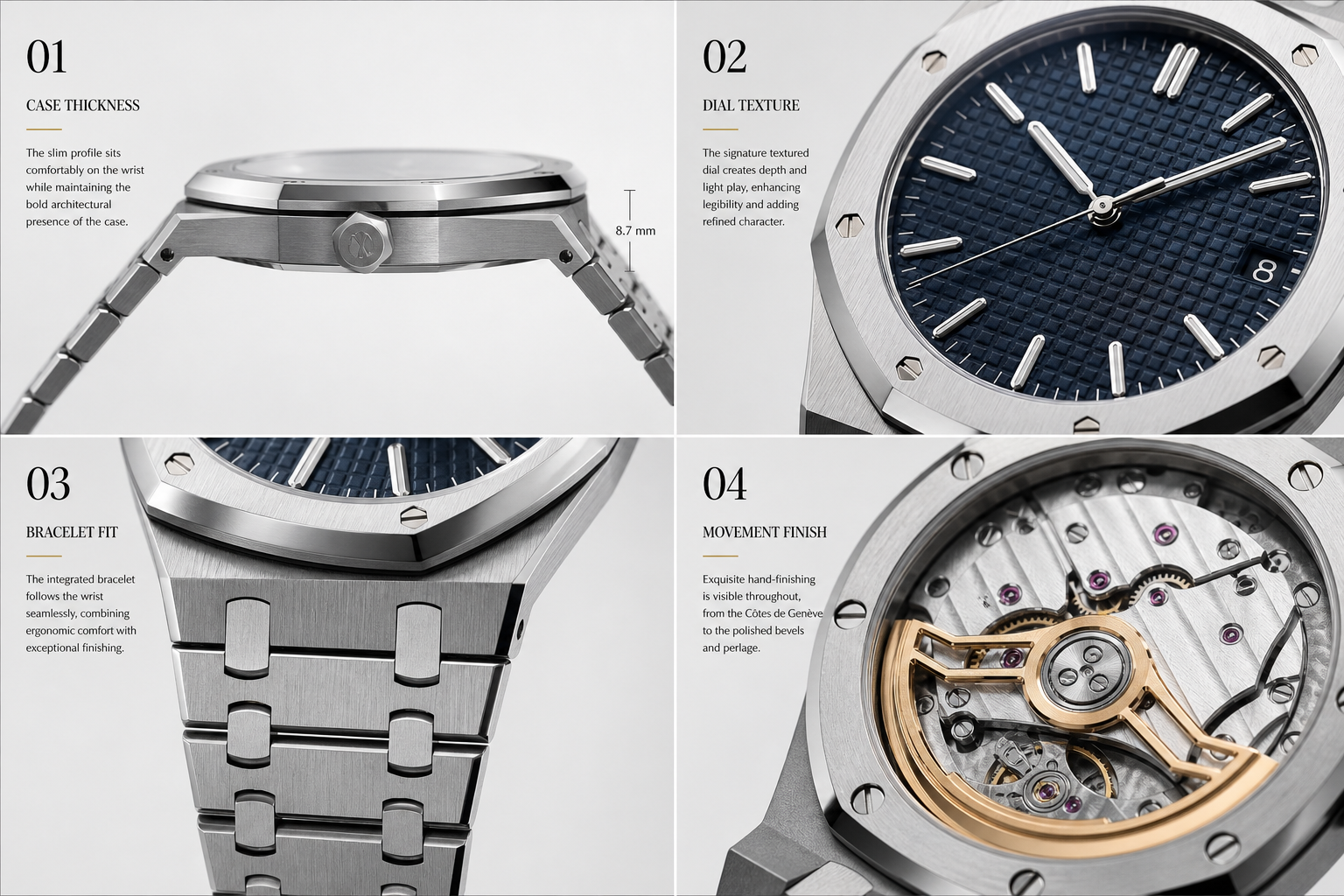
Post-2021 Changes: APS Clone Movements, ZF Finishing, and APF Offshore Development
After the old JF and XF-dominated period, the AP replica market changed in a way that directly affected pricing. The strongest newer AP super clones were no longer competing only on front-facing appearance. They started competing on movement architecture, case thickness, display-back layout, bracelet refinement, and more reference-specific development. That shift is one reason some modern AP replicas cost more than older versions.
The important distinction is that the market did not simply become “better” across the board. It became more specialized. APS-style development pushed the conversation toward integrated clone movements. ZF remained important because many buyers still judge the watch by finishing, case presence, dial execution, and bracelet feel. APF became more relevant in the Offshore chronograph space, where the problems are different from a simple time-and-date Royal Oak. These are not interchangeable strengths.
This is also where factory consolidation matters. When fewer production networks control the strongest options, prices can rise even if the technical improvement from one batch to the next is modest. A buyer may be paying partly for real development and partly for reduced competition. That does not make every premium unfair, but it does mean the premium needs to be tested against the watch itself.
Why Clone Movement Development Changed the Pricing Conversation
Clone movement development changed AP replica pricing because it addresses a structural problem, not just a cosmetic one. A movement that better matches the intended architecture can help the case sit closer to the correct thickness, place visible components more convincingly under a display back, and reduce the need for awkward decorative plates. On a Royal Oak, where the side profile is part of the design, that can be a meaningful upgrade.
This is the strongest argument for paying more on certain modern AP factory versions. If a newer watch uses a more suitable clone 3120 or clone 4302-style route and the result is a thinner, better-proportioned case with a more credible rear view, the buyer is not only paying for marketing. The movement is helping the entire watch shape make more sense.
The risk is that “clone movement” is often used loosely. Some listings use the term to describe a decorated base movement, some use it for a more integrated architecture, and some leave the details vague. A closer-looking movement can also be harder to service than a basic, familiar movement. More technical ambition is not automatically lower ownership risk. It is a better value only when the movement improves the watch and the buyer accepts the maintenance uncertainty that may come with it.
Movement Evidence Boundary: Movement names in replica listings should be treated as claims to verify, not specifications to assume. A seller may use phrases such as “3120 clone,” “4302 clone,” “4401-style,” “decorated movement,” or “AP movement,” but those labels do not by themselves confirm the architecture, parts quality, serviceability, beat rate, power reserve, or long-term reliability of the individual watch. The most defensible evidence is the combination of movement photos, case thickness, hand and date behavior, display-back layout, and consistency with the seller’s description.
It is also important to separate movement appearance from movement equivalence. A decorated rotor, bridge layout, or engraved plate can make a caseback look more convincing, but decoration is not proof that the movement functions like the authentic caliber or can be serviced in the same way. If a higher price is based on a movement claim, the buyer should ask what the movement actually improves: slimmer profile, better hand position, cleaner date placement, more credible display-back appearance, or smoother daily operation. If the improvement cannot be connected to the watch’s structure or ownership experience, the movement claim should carry limited weight.
Why ZF’s Finishing Reputation Still Matters
ZF’s relevance in modern AP replicas is less about one simple movement claim and more about overall presentation. Buyers often notice ZF-style strengths in the way the case is brushed, how the polished bevels catch light, how the bracelet feels, and whether the dial and case look balanced as a complete object. For AP, this matters because the Royal Oak is not forgiving. Rounded brushing, soft bevels, uneven bracelet gaps, or a stiff first link can make an expensive replica feel cheaper than its price.
ZF should not be treated as a universal answer, though. A strong ZF AP replica in one reference does not guarantee the same result across every AP model. The buyer still has to ask which movement route is being used, whether the model is a time-and-date piece or a chronograph, and whether the current batch actually shows the finishing people are praising. Factory reputation is useful, but it can become lazy shorthand if it replaces checking the specific watch.
The non-obvious point is that finishing can justify price even when the movement is not the headline. A Royal Oak with cleaner brushing, better bracelet articulation, and sharper case transitions may deliver more daily satisfaction than a technically ambitious version with mediocre exterior execution. AP is worn on the wrist, not studied only through a caseback photo.
APF and the Offshore Chronograph Segment
APF’s role is most useful to discuss in the Offshore and chronograph segment because those watches create a different buying problem. A Royal Oak Offshore replica is not judged only by tapisserie texture and bracelet finishing. Thickness, pusher alignment, subdial spacing, date placement, rubber strap or bracelet integration, and chronograph behavior all become part of the decision.
This is where higher pricing can be more understandable and more dangerous at the same time. Offshore chronographs are harder to build convincingly, so a factory that improves the movement layout, pusher feel, and case construction may deserve a premium. But the added complexity also increases ownership risk. Chronograph modules, thicker movement bases, and more crowded dials leave less room for error.
A buyer moving from a simple Royal Oak replica to an Offshore chronograph should not assume that a higher price buys the same kind of safety. In a time-and-date Royal Oak, the premium may buy proportion and bracelet refinement. In an Offshore chronograph, the premium may buy a more ambitious construction, but also a movement route that needs more caution. This is why the Offshore segment is better suited to buyers who understand the tradeoff rather than buyers who only want the most expensive-looking AP replica.
Movement Route to Verify
Before treating any post-2021 AP clone as a technical upgrade, confirm the advertised movement route for the exact model and version. Ask whether the watch uses a decorated base movement, a closer clone 3120-style movement, a clone 4302-style movement, or a chronograph movement route with additional functional risk. The wording matters because “clone movement” can mean different things depending on the seller and listing.
The practical check is not only what movement name appears in the description. The buyer should look for whether that movement supports the claimed case thickness, whether the display-back layout matches the claim, whether the date and hand layout make sense, and whether the factory version is known for consistent execution in that reference. A movement upgrade is worth paying for when it improves the whole watch. If it only improves the advertisement, the price has outrun progress.
Where Modern AP Super Clones Have Made Real Technical Progress
The strongest AP super clone improvements are not the loudest claims in the listing. They are the things that change how the watch sits, moves, and reads in normal wear: case thickness, dial texture, bracelet articulation, bevel definition, clasp feel, and whether the movement architecture allows the case to stay closer to the intended proportions. These are the areas where newer AP replicas can justify a higher price, especially on Royal Oak models where the design leaves very little room to hide mistakes.
The important judgment is this: a better AP replica version should solve a visible or structural problem, not merely add a newer label. If the newer watch is thinner, the bracelet drapes more naturally, the tapisserie dial has better depth, and the date window looks less crowded, the premium may be rational. If the only difference is a fresh batch name with similar photos, the improvement is probably smaller than the price jump suggests.
Case Thickness and Profile Are No Longer Minor Details
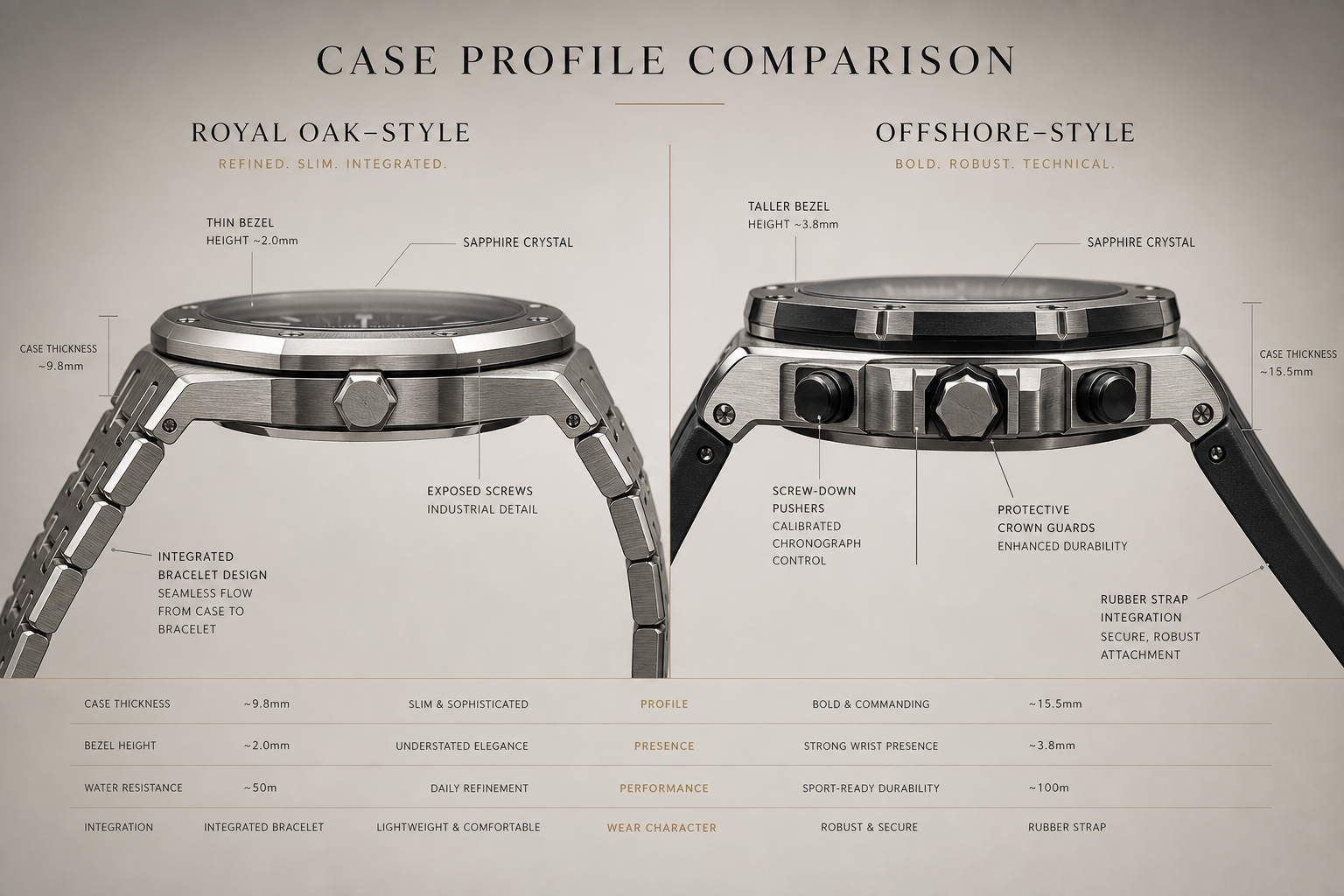
On many round sports watches, a slightly thick case can disappear because the bezel, mid-case, and caseback are curved into the wrist. The Royal Oak is not that forgiving. Its flat bezel, sharp mid-case, integrated bracelet, and broad side profile make excess thickness obvious. A Royal Oak replica that is even modestly too slab-sided can lose the low, architectural feel that defines the watch.
This is one of the clearest areas of real AP super clone improvements. Better movement architecture and more careful case construction have allowed some modern Royal Oak super clone quality to move closer to the correct wrist profile. The benefit is not just a number on a spec sheet. A thinner, better-shaped case changes the whole watch: the bezel looks less stacked, the bracelet starts at a more natural angle, and the watch does not feel like a thick block attached to an elegant bracelet.
Offshore models need a different reading. They are supposed to be thicker and more aggressive, so raw thickness is not automatically a flaw. The problem is proportion. A Royal Oak Offshore replica can tolerate more height, but it still needs the bezel, caseband, pushers, crown guards, and strap integration to look intentional. If the case gains thickness because the movement route is crude, the watch often looks inflated rather than muscular.
Tapisserie Dial Texture Has Become a Major Quality Divider
The tapisserie dial is where many buyers overestimate photos and underestimate real-world texture. A flat image can make almost any square pattern look acceptable, but on the wrist the dial has to catch light correctly. The better modern dials show more convincing square depth, cleaner channels between the blocks, sharper minute track printing, and better balance between the logo, hour markers, and date window.
This matters because the Royal Oak dial is not decorative background. It is the center of the design. If the square pattern looks too shallow, too stamped, too glossy, or too sharp-edged in the wrong way, the watch loses depth. A stronger dial does not need to be perfect under macro inspection to be a worthwhile upgrade, but it should avoid the dead, printed look that older or cheaper AP replicas often had.
Date window execution is also part of dial quality, not a separate minor detail. A newer AP replica version can look meaningfully better if the date sits centered, the font weight is not too heavy, and the window does not crowd the tapisserie pattern. On AP designs, a poorly placed date is easy to notice because the dial grid gives your eye a built-in alignment reference.
Bracelet Articulation Is One of the Biggest Wearability Upgrades
The bracelet is where a modern AP super clone can feel more expensive even before you inspect the dial. Older Royal Oak replicas often looked acceptable from the top but felt stiff, sharp, or poorly integrated once worn. The first links could sit awkwardly, the bracelet could resist the wrist curve, and rough edges could turn an impressive-looking watch into a poor daily wearer.
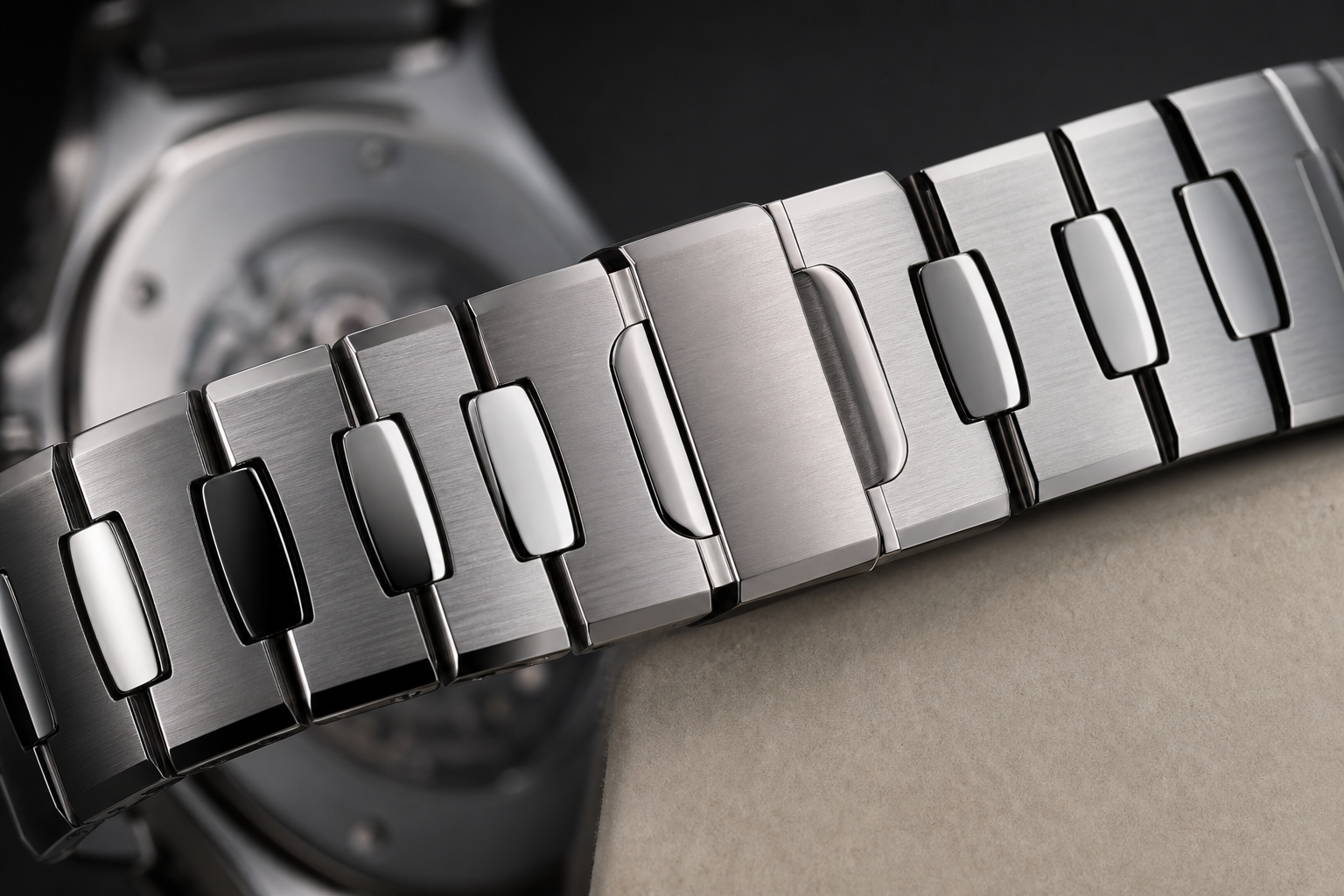
Current higher-tier versions have improved noticeably in link shaping, edge finishing, clasp construction, and flexibility. The best progress is not only smoother brushing or shinier bevels. It is the way the bracelet leaves the case and wraps around the wrist. A Royal Oak bracelet should feel solid but not rigid. If the head links do not articulate properly, the watch can wear larger, flatter, and less comfortable than the case diameter suggests.
This is also why bracelet quality deserves more weight than many buyers give it. A slightly imperfect caseback engraving will rarely bother you during daily wear. A stiff bracelet, uneven clasp, sharp link edge, or visible gap at the case will bother you every time you put the watch on. For buyers comparing what improved on newer AP replicas, bracelet behavior is one of the most practical upgrade signs.
At Clean VS Factory, we tend to treat bracelet feel as part of the value calculation, not just a finishing detail, because AP factory batch quality can influence how articulation, clasp tolerance, and endlink fit translate into daily wear. A watch with a visually strong dial but poor bracelet articulation may photograph well and still disappoint as a daily-wear object.
Finishing Improvements Are Real but Easy to Overstate
Modern AP replicas have improved in brushing direction, polished bevels, cleaner transitions, and more consistent case-to-bracelet finishing. This is important because AP design depends heavily on contrast: flat brushed planes against bright polished chamfers. If those transitions are soft, uneven, or rounded, the watch looks less architectural.
The improvement is real, but buyers should be careful with studio photos. Strong lighting can make bevel polishing look sharper than it feels in hand. A polished edge can flash beautifully in one photo while still being uneven along the case flank or bracelet link. The more useful question is whether the brushing lines are straight, whether the bevel width remains consistent, and whether the polished transitions continue cleanly from the case into the bracelet.
Finishing is also where the gap between “better than before” and “same as genuine” needs to stay clear. Newer factories can produce a more convincing daily-wear appearance, but AP’s genuine hand-finished transitions still have a refinement that replicas struggle to duplicate under close inspection. A higher price is justified when finishing is cleaner across the whole watch, not when one macro angle shows a bright chamfer.
The buyer rule is simple: look for improvement across connected surfaces. Case brushing, bezel edges, bracelet bevels, clasp fit, and link articulation should tell the same story. If only one area looks upgraded while the rest feels average, the watch may be benefiting more from photography than from real technical progress.
Where Higher Prices Are Driven by Market Inflation Instead of Better Watches
Not every increase in AP replica prices comes from a better watch. Some of it is real production cost: more ambitious movements, better bracelets, more careful finishing, and smaller tolerances can raise the cost of making a convincing super clone watch. But buyers get into trouble when they assume every higher Audemars Piguet super clone price reflects a major technical upgrade.
The AP market has become expensive partly because demand has concentrated around a few desirable model families and a few trusted production routes. That creates pressure. When buyers all want the same Royal Oak or Offshore style, and only a limited number of factories are considered acceptable, prices can rise even if the latest batch is only modestly improved.
Genuine AP Scarcity Increased Demand for Lookalike Alternatives
The genuine Royal Oak and Royal Oak Offshore occupy a rare position in the luxury sports watch market. They are recognizable, heavily desired, and difficult for many buyers to access at retail. That scarcity has pushed more attention toward Chinese AP replicas, especially from buyers who want the design language without entering the genuine AP market.
This demand can raise AP replica prices even when the underlying watch has not changed dramatically. A blue-dial Royal Oak-style model, for example, may command more attention because the genuine version is culturally and commercially desirable. That does not automatically mean the replica dial color, movement route, or bracelet finishing is better than a less hyped option.
This point is important because scarcity in the genuine market should not be treated as proof of quality in the replica market. It explains demand. It does not verify execution. A replica should still be judged as a replica watch: by its case, dial, movement route, bracelet, finishing, and QC photos, not by the status of the genuine reference it imitates.
Factory Consolidation Can Reduce Buyer Leverage
When fewer factories produce credible AP super clones, buyers have less leverage. If one or two production routes become the default choice for a certain Royal Oak or Offshore model, the market can price the “best available” version higher even if the improvement over the previous version is incremental. This is not unique to AP, but AP feels it more because the design is hard to clone and buyers are quick to reject weak versions.
Factory consolidation also changes how comparisons work. In a more competitive market, a factory has to show a clear reason for a higher price: a better movement, thinner case, cleaner dial, stronger bracelet, or more consistent finishing. In a tighter market, the premium may reflect availability and reputation as much as actual progress.
This is why factory name alone is a weak pricing tool. A strong factory can make a convincing version of one AP reference and a less impressive version of another. A price increase is more believable when it is tied to a specific change in the watch, not just to the fact that the model comes from a currently fashionable production source.
Material and Labor Costs Matter, but They Do Not Explain Everything
Better bracelets cost more to produce. Cleaner case finishing takes more time. More advanced movement routes require more development and tighter assembly. These are legitimate reasons why a modern AP super clone may cost more than an older Miyota-based or lower-tier version. A buyer should not expect real improvements in case profile, bracelet construction, and dial execution to appear with no price change.
Still, production cost is only part of the story. Seller markup, limited batches, demand spikes, and premium positioning can all stretch the final price beyond the actual quality gap. This is where many buyers overpay: they see a higher price and assume they are receiving better finishing, a newer movement, and cleaner QC all at once. Those things may be true, but they must be verified separately.
The more expensive watch is sometimes the smarter buy, especially if it fixes a known weakness in thickness, bracelet comfort, or dial layout. But a cheaper version can be more rational if the premium only buys a small cosmetic revision or a less proven movement route. Higher price should make the buyer ask harder questions, not fewer.
Price Claim to Treat Carefully
The most dangerous price claim is the vague premium: “latest,” “top,” “best,” or “upgraded” with no specific explanation of what changed. A premium price does not automatically mean a newer movement, better finishing, cleaner date alignment, or stronger QC. It may simply mean the seller knows the model is in demand.
Before accepting a higher AP replica price, the buyer should ask what the premium is attached to. Is the case thinner? Is the bracelet revised? Is the dial texture improved? Is the movement route different? Are there clear QC photos showing better execution on the actual watch? If the answer is mostly branding language, the price is acting more like market inflation than technical progress.
Version-Number Marketing: When “V2,” “V3,” and “Latest Batch” Actually Matter
Version numbers can be useful, but they are not proof by themselves. In the AP replica market, a V2 or V3 label may represent a real correction, such as a dial revision, case profile adjustment, bracelet update, date window improvement, or movement change. It can also be a loose selling term applied to a small batch difference that does not change the ownership experience.
The practical question is not “is the latest version better?” The better question is “what weakness did this version fix?” If that question cannot be answered clearly, the version label has limited value.
Meaningful Version Updates Usually Fix a Specific Weakness
A meaningful AP replica version update normally has a target. It corrects something buyers could identify in the previous batch. On a Royal Oak, that might mean a thinner case, better tapisserie depth, more accurate logo position, improved datewheel centering, or a bracelet that articulates more naturally from the case. On an Offshore chronograph, it might mean better subdial spacing, improved pusher alignment, a cleaner strap fit, or a movement route that supports more believable case proportions.
The best updates are easy to explain because they solve a known problem. “The dial texture is deeper and less flat” is useful. “The case profile is closer and the mid-case is less bulky” is useful. “The bracelet end link now moves more naturally” is useful. These are real upgrade signs because they affect how the watch looks or feels, not just how it is described.
A movement upgrade can also matter, but it needs context. A closer clone movement may improve display-back appearance or allow better thickness, yet it may also introduce serviceability or batch-stability questions. A version update is stronger when the movement change improves the whole watch architecture, not just the marketing photo of the caseback.
Weak Version Claims Rely on Vague Language
Weak version claims usually avoid specifics. Phrases like “newest,” “ultimate,” “best edition,” “fully upgraded,” or “1:1” are not useful unless they are tied to visible or mechanical changes. A buyer should be especially cautious when a listing uses strong language but shows no side-by-side comparison, no movement clarification, and no clear explanation of the previous flaw.
This matters because version-number marketing can make small changes feel larger than they are. A slightly different dial tone, a new batch of bracelets, or a minor clasp engraving change may be worth knowing, but it does not always justify a major premium. The price should match the importance of the correction.
A simple test works well: if the seller removed the version label, would the watch still look or perform better based on the evidence? If the answer is no, the label is doing most of the work.
Batch Variation Can Matter More Than the Version Label
Even within the same stated AP replica version, individual watches can vary. One piece may have cleaner dial alignment, better date centering, tighter bracelet fit, and more even brushing than another watch from the same batch. This is why QC photos matter even after choosing the factory and version.
AP designs make batch variation more visible because the geometry is exposed. The tapisserie grid reveals crooked markers. The octagonal bezel reveals uneven screw placement. The integrated bracelet reveals gaps and poor articulation. The flat case sides reveal thickness and finishing mistakes. A correct version label does not erase those individual risks.
This is one reason experienced buyers do not treat “latest AP clone batch” as the final answer. It is a starting point. The actual watch still has to prove itself through photos and, where possible, movement-route confirmation. Paying more for a newer label while accepting weak QC is one of the easiest ways to lose the benefit of a better factory version.
Version Details to Confirm
Before paying extra for a V2, V3, or latest-batch AP super clone, confirm the specific claimed change. The most useful details are the movement route, case thickness claim, dial revision, bracelet revision, date window improvement, and whether the QC photos show the actual watch being supplied.
The safest approach is to treat version information as evidence to verify, not a guarantee. A real update should be visible in the watch or relevant to ownership. If the version claim cannot be connected to case profile, dial quality, bracelet feel, finishing consistency, or movement architecture, it should not carry much weight in the buying decision.
Royal Oak Versus Offshore: Price Increases Do Not Mean the Same Thing Across AP Models
A price increase on a Royal Oak replica is not the same kind of signal as a price increase on a Royal Oak Offshore replica. The Royal Oak is a proportion watch first. The Offshore is a proportion watch plus a complication watch. That difference changes what the buyer should be paying for.
On a time-and-date Royal Oak, the premium is usually easier to judge: thinner case, better integrated bracelet, cleaner tapisserie dial, sharper bevel transitions, more believable date window, and a movement route that supports the case profile. On an Offshore chronograph, the extra money may be going toward a more complicated movement solution, a thicker case construction, pusher alignment, subdial placement, or simply the factory’s higher risk of producing a more difficult watch.
This is where many buyers misread the AP replica market. They see two watches from the same brand family and assume the more expensive one must be the “better clone.” Not necessarily. A clean time-only Royal Oak with strong proportions can be a more convincing daily watch than a more expensive AP chronograph replica with awkward thickness, noisy pushers, or questionable movement behavior.
Time-and-Date Royal Oak Models Reward Proportion Accuracy
The simple Royal Oak is not easy to clone, but its problems are easier for a buyer to understand. The case must sit flat, the bezel cannot look too tall, the dial cannot sit too deep, and the integrated bracelet has to flow from the case instead of hanging off it like an attachment. If those elements are right, the watch usually looks coherent on the wrist even if small macro-level flaws remain.
This is why case thickness matters more on a Royal Oak replica than on many round sports watches. The Royal Oak has a wide, flat case, a hard bezel line, and an integrated bracelet that visually extends the case shape. Extra thickness does not hide under a curved caseback or tall bezel. It creates a slab-sided look that changes the character of the watch. A buyer paying more for a newer version should see a real benefit here, not just a new version label.
Dial placement is another practical divider. On a strong Royal Oak super clone, the tapisserie pattern, applied markers, AP logo, minute track, and date window should feel centered and calm. A slightly off datewheel or heavy logo may not ruin a watch in isolation, but the Royal Oak dial is grid-based. The squares make misalignment easier to notice. This is less forgiving than a textured or open dial where the eye has more distractions.
The bracelet is the other half of the watch. A Royal Oak replica with a good dial but stiff bracelet still feels wrong in daily wear. The link taper, first-link articulation, brushing direction, polished bevels, and clasp closure all affect whether the watch feels premium or merely looks acceptable in photos. For a buyer asking which AP clone is safer, a well-executed time-and-date Royal Oak is usually the more rational starting point than a complicated chronograph, provided the case thickness and bracelet fit are genuinely improved.
Offshore Chronographs Carry More Mechanical and Visual Risk
The Royal Oak Offshore replica has a different problem: it is allowed to be larger and bolder, but that does not mean thickness stops mattering. Offshore cases are already muscular. If the replica adds extra height because of the movement route, the watch can cross from aggressive to clumsy. This is especially noticeable from the side, where the case middle, bezel height, caseback, pushers, and strap integration all appear in one view.
Chronograph layout creates another trap. Subdial spacing, date placement, hand length, pusher position, and dial depth must work together. A watch can look impressive in a front-facing seller photo but still feel off because the subdials sit too close together, the date is squeezed into the wrong visual zone, or the pushers do not line up naturally with the case profile. These are not small cosmetic issues; they change the entire architecture of the watch.
Pusher feel also matters more than buyers expect. On an AP chronograph replica, loose, gritty, overly stiff, or uneven pusher action is a warning sign. Even if the chronograph works during a short test, frequent use can add stress to a movement that may already be less forgiving than a simple automatic. For daily wear, many experienced buyers treat the chronograph function as something to verify carefully but not abuse casually.
Rubber strap and bracelet integration should be judged separately. Offshore models often use rubber straps, plots, endlinks, or larger bracelet systems that must sit flush against a thick case. Poor integration creates gaps, twisting, or a top-heavy feel. A higher price is more defensible when the watch wears balanced and the strap or bracelet connects cleanly. It is less defensible when the seller is mainly charging for the Offshore name and a busier dial.
Newer 4401-Style Chronograph Claims Need Extra Scrutiny
Newer 4401-style chronograph claims are one of the few areas where a higher AP super clone price may reflect a meaningful technical attempt. If the movement architecture allows a more accurate case thickness, better subdial layout, and a more convincing display-back appearance, that is a real upgrade over older thick chronograph solutions. The buyer should still separate “more ambitious” from “automatically safer.”
A clone chronograph movement has more to prove than a time-and-date clone movement. The calendar behavior, reset action, pusher feel, minute counter, running seconds, winding feel, rotor sound, and long-term parts availability all matter. A movement can look closer through a caseback and still be less familiar to service than a simpler base movement. The ownership risk rises with the complication.
The sensible approach is to ask what the newer chronograph route actually fixes. If it corrects case thickness, improves subdial spacing, and avoids the bulky profile that made older AP chronograph replicas easy to criticize, the premium may be justified for a buyer who understands the mechanical risk. If the watch is only advertised as “latest 4401” without clear photos, function confirmation, or believable side-profile improvement, the price increase deserves skepticism.
For most buyers, the safer AP replica path is still the one where the upgrade is visible, measurable, and tied to the model’s main weakness. On a Royal Oak, that usually means proportion and bracelet quality. On an Offshore chronograph, it means movement route, thickness control, pusher execution, and layout accuracy all at once. That is a much harder test.
Movement Development: The Real Upgrade and The Real Risk
Movement development is the strongest technical reason modern AP super clones cost more than older versions. It is also the area where buyers can most easily overpay. A closer-looking Audemars Piguet replica movement can improve case thickness, hand position, date behavior, and display-back credibility, but it does not automatically make the watch more reliable or easier to own.
The key distinction is simple: a decorated base movement is usually a known movement dressed to look like something else, while a more integrated AP clone movement is designed to match the original architecture more closely. The first route can be practical and serviceable, but it often forces compromises in thickness, rotor position, and visual layout. The second route can make the whole watch more convincing, but it may introduce serviceability and batch consistency questions.
At Clean VS Factory, we usually treat movement choice as part of the ownership decision, not just a specification line. For AP replicas especially, the movement is not hidden deep inside the watch. It affects the case profile, the display back, the way the crown feels, and sometimes how comfortable the watch is to wear.
How to Read Movement Labels in Replica Listings
Movement names in AP replica listings should be read as configuration labels, not as official caliber claims. A listing may say “clone 3120,” “clone 4302,” “decorated movement,” or “AP movement,” but the buyer should still ask what the label actually refers to: architecture, decoration, base caliber, or a loose market nickname. In replica-watch buying, the same phrase can describe very different internal setups.
The most useful check is whether the movement claim lines up with the rest of the watch. If the movement is said to be closer to the authentic architecture, the case thickness, date behavior, and caseback layout should support that claim. If the movement description sounds impressive but the watch still looks thick or awkward in side profile, the claim may be more promotional than technical.
Movement transparency also helps buyers compare two watches that look similar from the front. One version may rely on an older decorated route with easier servicing but less accurate proportions, while another may use a more integrated route that improves the shape of the watch but may be harder to maintain. Neither route is automatically wrong. What matters is knowing which tradeoff you are accepting.
Why Decorated Base Movements Held Back Some Older AP Clones
Older AP clones often relied on a Miyota base or similar automatic movement with decorative plates. That route was not foolish. It gave factories a relatively affordable, available, and familiar movement foundation. For many buyers, it also meant acceptable daily reliability if the movement was clean, regulated, and not overstressed.
The problem is that AP case design leaves little room for mechanical shortcuts. If the base movement does not match the architecture of the original caliber, the factory has to compensate with extra plates, altered caseback depth, different rotor behavior, or a thicker case. On a Royal Oak, that extra thickness is immediately more visible because the case is flat and angular. On a display-back model, the wrong bridge layout or balance position becomes part of the visual compromise.
Rotor noise is another common complaint with some Miyota-based AP replicas. The watch may be visually strong from the front, but the free-spinning rotor can create a whirring sound that feels out of character for a watch trying to imitate a high-end integrated sports design. This does not always mean the movement is failing, but it does affect the ownership experience. A buyer who wants quiet wrist presence may find this more annoying than a minor dial-printing flaw.
Decorated base movements also create a trust problem in listings. A seller may describe the watch as having an “AP-style movement” or “decorated clone movement,” which sounds more advanced than it is. The practical question is whether the movement is mainly dressed up visually or whether its dimensions and layout actually help the case and dial become more accurate.
Why Integrated Clone Movements Can Justify Higher Pricing
An integrated clone movement route can justify a higher price when it solves structural problems, not just when it looks attractive through the caseback. For Royal Oak references, a closer clone 3120 or clone 4302-style route may allow a thinner case, better balance-wheel placement, more believable rotor layout, and improved overall proportions. Those improvements are not just for collectors staring at movement photos. They can change how the watch wears.
This is the most legitimate argument for paying more in the current AP replica market. If the movement architecture supports the correct case profile, the watch can avoid the top-heavy or slab-sided feel that affected many older versions. A more accurate movement layout can also make the display back less distracting, especially on AP models where the back is part of the ownership appeal.
There is also a tactile side. Better movement integration can improve crown feel, winding resistance, date action, and sometimes rotor behavior. These details do not show up clearly in seller photos, but they affect whether the watch feels like a coherent object or a good-looking case built around a compromise. For buyers who wear the watch regularly, this difference can matter more than a tiny dial font correction.
The important limit is reliability. A closer AP clone movement may be more technically impressive, but it is still not the same as owning the original caliber, and it may not be as easy for every watchmaker to service. Parts availability, batch variation, lubrication quality, and assembly cleanliness can vary. A buyer paying extra for an AP clone movement should be paying for better architecture and proportions, not assuming risk-free long-term performance.
Why More Complex Movements Can Be Less Forgiving
The risk rises sharply with chronographs. A simple automatic movement has fewer things to go wrong. A chronograph adds pushers, reset mechanisms, counters, extra gearing, and more opportunities for misadjustment. This is why an AP chronograph replica can look like a major technical leap and still be a less forgiving daily watch than a time-and-date Royal Oak.
Clone 4401-style chronograph claims deserve attention because they may represent real development in layout and thickness control. But the buyer should not judge the movement only by whether the caseback looks closer. The more useful questions are whether the chronograph starts, stops, and resets cleanly; whether the hands return properly; whether the date changes as expected; whether the power reserve is realistic; and whether the case had to become too thick to house the mechanism.
Serviceability is the hidden cost. A common base movement may be less elegant, but more watchmakers understand it. A newer integrated clone movement may be more convincing, but if it develops a calendar issue, winding fault, or chronograph reset problem, repair options may be narrower. That does not make clone movements a bad choice. It means the buyer should understand that technical ambition and ownership simplicity move in opposite directions.
Batch consistency is also part of the risk. One batch may have cleaner assembly, better lubrication, quieter winding, or fewer date issues than another. This is why movement claims should be tied to the exact watch and version being considered. “Clone movement” is not a single quality level. It is a category with good and bad executions.
Movement Route to Verify
Before paying a premium, verify the advertised movement route for the exact model. Ask whether the watch uses a decorated base movement, a closer clone 3120 or clone 4302-style architecture, or a newer clone 4401-style chronograph route. The distinction matters because each route changes thickness, display-back appearance, service risk, and long-term expectations.
- Check the stated movement: vague descriptions such as “AP movement” or “upgraded movement” are not enough.
- Look for movement photos when available: bridge layout, rotor shape, balance position, and engraving quality can help confirm whether the claim matches the watch.
- Confirm date behavior: date alignment and date-change behavior often reveal whether the movement is well integrated or merely adapted.
- Treat chronograph claims carefully: verify start, stop, reset, hand return, and whether the case profile still makes sense.
- Separate appearance from reliability: a better-looking movement can still be harder to service or more sensitive to batch quality.
Verification Note: When possible, buyers should review real watch photos, dial details, clasp finishing, caseback structure, date alignment, and movement information before making a decision. Stock images and factory labels alone are not enough for a reliable judgment.
A Practical QC Reading Order
When a listing looks promising, the safest approach is to read the QC set in a fixed order: first the case profile, then the dial, then the bracelet, and only then the movement or caseback. That order helps prevent one attractive feature from hiding a more important weakness. A beautiful dial does not compensate for a thick case, and a convincing caseback does not fix a poor bracelet.
If the watch still looks balanced after those checks, the next question is whether the claimed version change is visible on the actual piece. If the answer is yes, the premium is easier to defend. If the answer is no, the buyer should not let the listing language do the work that the QC photos failed to do.
QC Photos Reveal Whether the Higher Price Is Showing Up on the Actual Watch
Factory name, version label, and price all become secondary once QC photos arrive. The actual watch in front of you is what matters. AP replica QC is especially unforgiving because the design is geometric: octagonal bezel, exposed screws, straight brushing, square tapisserie, applied markers, integrated bracelet, and flat case planes. Small errors have fewer places to hide.
A higher-priced AP super clone should show cleaner execution in the areas that define the model. If the dial is crooked, the date sits high, the bezel screws look uneven, or the bracelet has obvious gaps, the premium is not showing up where it should. The buyer should not accept weaker QC simply because the watch is described as a “latest batch.”
Camera angle matters. A front photo taken slightly above or below the watch can make markers look misaligned when they are acceptable, or hide a real datewheel issue. Strong lighting can make brushing look sharper than it feels in hand. A single flattering photo is not enough for an AP replica QC decision. You need angles that reveal symmetry, thickness, and bracelet construction.
Front Dial Photos Should Confirm Symmetry, Not Just Beauty
The front dial photo should be judged for structure, not just dial color. On a Royal Oak QC photo, the tapisserie grid creates a built-in alignment tool. The applied markers should sit squarely against the pattern, the logo should not appear tilted or too heavy, and the minute track should follow the dial edge evenly. If the watch has a date window, the date should sit centered enough that it does not pull the eye immediately.
Bezel screw appearance deserves attention, but buyers should keep perspective. Perfect genuine-style screw geometry is not realistic on most replicas, and tiny differences in screw shape are often macro-photo issues. What matters more for daily wear is whether one screw is visibly rotated, raised, damaged, or inconsistent enough to disturb the bezel symmetry. A single bad screw can make the whole watch look careless.
Hand alignment is another overlooked point. The hour and minute hands should look properly seated and not drag visually against the markers or dial texture. On chronograph models, the central chronograph hand and subdial hands should reset neatly. A beautiful dial photo means less if the hands are misaligned or the counters are not returning correctly.
Dial color should be judged cautiously. AP blue, grey, and black dials can shift heavily under lighting. A QC photo may not show the same tone you will see in daylight. Instead of obsessing over one photo’s color temperature, focus on consistency: clean printing, even tapisserie texture, centered logo, balanced date, and no obvious dust or marker defects.
Side-Profile Photos Show Whether Thickness Claims Are Believable
The side profile is where many expensive AP replicas either justify their price or expose the compromise. A Royal Oak can look excellent from the front and still feel wrong if the case middle is too thick, the bezel sits too tall, or the caseback adds a visible bulge. The flat AP case design makes this more obvious than on watches with rounded cases or thicker bezels by design.
For a time-and-date Royal Oak replica, the side photo should show a case that feels slim and controlled, since case finishing standards associated with high-end Audemars Piguet replica factories often influence how naturally the bracelet leaves the case. If the first link drops awkwardly or the watch looks like a thick block sitting on top of the bracelet, the proportions are fighting the design.
For an Offshore or AP chronograph replica, the side view should include the pushers and crown guards. Look for pusher alignment, case thickness, bezel height, and how the strap or bracelet meets the case. Offshore models can tolerate more mass, but they should still look engineered rather than swollen. Extra thickness is more acceptable when the original model is already large, but it becomes a problem when it changes the watch’s balance on the wrist.
Side photos are also useful for checking whether movement development actually helped. If a listing claims a newer clone movement but the watch still has an obviously bulky case, the buyer should question whether the premium is meaningful. The most expensive claim in the description should appear somewhere in the geometry of the watch.
Bracelet and Clasp Photos Matter More Than Many Buyers Expect
The Royal Oak bracelet is not a minor accessory. It is part of the case design. QC photos should show whether the first links articulate cleanly, whether the gaps are even, and whether the bracelet drapes naturally instead of appearing rigid. A stiff bracelet can make even a visually strong AP replica feel cheap on the wrist.
Look closely at edge finishing. Rough bevels, sharp link edges, inconsistent brushing, or visible machining marks can affect comfort immediately. Hair pulling is not exclusive to replicas, but poor link finishing can make it worse. If the bracelet looks uneven in QC photos, it rarely improves in hand.
Clasp photos help reveal the factory’s finishing consistency. The clasp should close cleanly, sit flush, and show engraving that is not overly thick, shallow, or messy. Interior clasp finishing will not be visible to others during wear, but the owner sees and feels it every time the watch is put on. For a high-priced AP super clone, sloppy clasp finishing is a weak place to save money.
Bracelet underside photos are especially useful because sellers naturally prefer to show the most attractive front angles. The underside can reveal screw quality, rough edges, uneven brushing, link gaps, and whether the bracelet has the kind of articulation expected from a higher-tier AP replica.
QC Photos to Request
For AP replica QC, the goal is not to hunt for microscopic flaws that no one will notice. The goal is to confirm that the higher price is visible on the actual watch. A strong QC set should show the watch from enough angles to judge symmetry, thickness, bracelet integration, and movement-route claims.
- Front dial photo: check logo position, index alignment, date centering, hand alignment, bezel screw consistency, and tapisserie texture.
- Angled dial photo: helps reveal applied marker height, dial depth, crystal distortion, and whether the tapisserie catches light evenly.
- Side-profile photo: essential for judging case thickness, bezel height, caseback shape, pusher placement, and bracelet or strap integration.
- Bracelet underside photo: useful for link gaps, screw quality, edge finishing, and overall articulation.
- Clasp photo: check closure fit, engraving, interior finishing, and whether the clasp sits flush.
- Caseback photo: confirm engraving quality, display-back presentation, and whether the movement appearance matches the advertised route.
- Movement confirmation photo where appropriate: especially important when paying extra for a clone movement or newer chronograph architecture.
The clear judgment is this: do not pay a premium for a story that QC photos do not support. A strong factory version can still produce an average individual watch, and an expensive AP replica can still fail in alignment, thickness, bracelet fit, or finishing. The safer decision is to judge the specific watch, not the reputation around it.
How to Decide Whether a More Expensive AP Super Clone Is Worth It
The cleanest way to answer “should I pay more for an AP clone?” is to ignore the price for a moment and ask what problem the higher-priced version actually solves. A premium AP super clone is worth considering when the extra cost buys a thinner case, a better-matched movement route, a more convincing tapisserie dial, stronger bracelet articulation, or more consistent QC execution. If the premium only buys a newer label, a louder listing description, or a vague “latest version” claim, the value case is weak.
This matters more with AP than with many Rolex-style replicas because the Royal Oak design exposes small compromises quickly. A slightly slabby case, stiff bracelet, shallow dial texture, or awkward date window does not hide well behind the overall design. The best value AP replica is not always the cheapest one, but it is also not automatically the most expensive one. It is the version where the price increase is connected to a visible or ownership-relevant improvement.
Pay More When the Upgrade Fixes a Known Weakness
A higher price is easiest to justify when the older version had a specific weakness and the newer version corrects it in a way the buyer can actually experience. Case thickness is the obvious example. On a Royal Oak-style watch, the side profile is part of the identity of the model. If an older Miyota-based version sits too tall and the newer clone-movement version brings the case closer to the intended proportion, that is not just a technical brag. It changes how the watch looks from the side, how it wears under a cuff, and how balanced the integrated bracelet feels on the wrist.
Bracelet improvement can be just as important. Many buyers focus on the dial because it is easier to judge in photos, but the bracelet is where an AP replica either feels convincing or cheap in daily wear. Better link articulation, cleaner edge finishing, tighter clasp construction, and more natural first-link movement are all upgrades worth paying for if they are visible in the actual watch. A Royal Oak with a strong dial but a stiff, sharp, or gap-heavy bracelet will usually disappoint faster than one with a slightly imperfect dial color but better wrist feel.
Consider a buyer comparing an older Royal Oak replica with a newer clone-movement version. If the older watch is less expensive but has a thicker case, noisier rotor, less accurate display-back layout, and a bracelet that does not drape well, the cheaper price may not be the better deal. The premium version makes sense if the thinner case, improved movement architecture, and better bracelet solve the exact issues that would bother the buyer every time the watch is worn. If the watch will mostly be worn casually and the buyer is not sensitive to profile or movement appearance, the older version may still be rational.
At Clean VS Factory, we usually treat this as a price-versus-weakness question rather than a price-versus-factory question. Paying more is sensible when the upgrade removes a flaw that matters on that model. Paying more just because the listing sounds newer is not the same thing.
Be Cautious When the Premium Is Only a Label
The weakest premium is the one attached to language instead of evidence. Terms like “V3,” “latest batch,” “upgraded,” or “super 1:1” mean very little unless the seller can show what changed. A meaningful version update should be tied to a real correction: thinner case profile, revised dial texture, improved date window placement, better bracelet fit, corrected logo position, or a clearly different movement route. Without that, the version number is often just a pricing tool.
This is where many AP replica buyers overpay. They assume the newest label must be safer than the older one. Sometimes it is. Sometimes the new batch has only a small dial color adjustment or a minor engraving change that does not affect daily wear. In some cases, the older version from a stable production run may have more predictable QC than a freshly promoted version with limited owner feedback.
A useful rule: if the seller cannot explain the difference between the cheaper and more expensive version in one or two concrete details, the premium deserves skepticism. “Better finishing” is not enough by itself. Better where? Bezel brushing? Bracelet chamfers? Clasp engraving? Caseback decoration? If the answer stays vague, the buyer is probably paying for positioning rather than progress.
This does not mean version labels are useless. They can help identify real production changes. But the label should start the question, not end it. For AP super clones, price versus version only becomes meaningful when it is supported by comparison photos, movement confirmation, case measurements, or consistent QC examples.
Beginner Buyers Should Prioritize Forgiving Models and Cleaner QC
First-time AP buyers often get pulled toward the most dramatic option: chronographs, skeleton dials, ceramic Offshore models, or complicated-looking references with aggressive marketing. Those watches can be impressive, but they are not always the smartest first AP replica. More functions mean more places for the watch to go wrong: subdial spacing, pusher feel, case thickness, date placement, chronograph reliability, and movement serviceability.
A simpler Royal Oak-style time-and-date model with cleaner QC is usually the safer starting point. It still demands good case shape, dial texture, bracelet finishing, and alignment, but it avoids some of the mechanical risks that come with complicated chronographs. If the buyer wants a daily-wear replica watch rather than a display piece, fewer complications often create fewer surprises.
There is also nothing wrong with choosing a mid-tier or older version if the expectations are honest. If the buyer values affordability, basic automatic reliability, and casual wrist presence more than maximum movement accuracy, a cheaper version can be enough. The mistake is not buying the cheaper watch. The mistake is buying the cheaper watch while expecting the refinement of a current premium AP super clone.
For daily wear, the most sensible choice is often the version with the least conflict between appearance, movement risk, comfort, and price. A complex Offshore with excellent photos but uncertain chronograph reliability may be less satisfying than a simpler Royal Oak with modest claims and clean execution. The better watch is the one that fits the buyer’s tolerance, not the one with the most impressive description.
What to Check Before You Decide
- Model family: A time-and-date Royal Oak, an Offshore chronograph, and a newer integrated chronograph do not carry the same risk. Judge them separately.
- Factory strength for that model: A factory name is useful, but it does not guarantee every AP reference from that factory is equally strong.
- Movement route: Confirm whether the watch uses a decorated base movement or a closer clone architecture, and understand what that means for thickness, display-back appearance, rotor behavior, and service risk.
- Version change: Ask what the newer version actually improves. If the answer is only “latest” or “best,” treat the premium carefully.
- QC photos: Look at the specific watch, not just sample photos. Check dial alignment, date centering, bezel screw position, side profile, bracelet gaps, clasp fit, and caseback execution.
- Case thickness: AP cases are not forgiving. A small thickness difference can change the whole wrist presence.
- Bracelet fit: The integrated bracelet is a core part of the Royal Oak experience. Stiff links, sharp edges, or uneven gaps reduce value quickly.
- Ownership expectations: A visually strong AP replica is still not a genuine AP watch. Treat reliability, waterproofing, and serviceability with realistic caution.
If a more expensive AP super clone performs better in several of these areas, the premium may be justified. If it only wins on branding, version language, or seller confidence, a cheaper or older version may be the more disciplined choice.
Water Resistance, Durability, and Legal Caution: Buyers should treat water resistance as unverified unless the individual watch has been pressure-tested after purchase. A replica that imitates the look of a Royal Oak or Offshore should not be assumed safe for swimming, showering, diving, or sports use merely because the authentic model has a stated water-resistance rating. Gaskets, crown construction, caseback sealing, crystal fit, pusher sealing, and assembly quality can vary from watch to watch, so water exposure is a practical risk unless the specific piece has been checked.
Replica watches can also raise trademark, customs, import, resale, and disclosure issues depending on jurisdiction. This article is not legal advice, and it should not be read as a claim that replica watches are risk-free to buy, import, or resell. Buyers should confirm seller policies, local rules, and any relevant handling or ownership concerns before ordering. The safest use of factory and movement information is to understand quality differences and avoid overpaying, not to misrepresent a replica watch as genuine.
Common Red Flags in AP Replica Listings
Many AP replica problems can be spotted before purchase if the buyer knows what to look for. The strongest warning signs are not usually hidden in technical jargon. They are found in the way the listing is written, the photo set is presented, and the seller answers questions. A buyer who learns to read those clues can avoid paying a premium for a watch that does not match the description.
One red flag is overconfident language without specifics. Another is a listing that spends more time on factory reputation than on the exact watch’s thickness, dial layout, or bracelet construction. A third is selective imagery: plenty of glamorous front shots but no side profile, no clasp interior, and no movement view. If the seller wants a higher price, the watch should be asked to support that price visibly.
There are also practical red flags in how the watch is described. Words like “perfect,” “same as genuine,” or “can pass every check” should be treated carefully because they imply certainty that the replica market cannot honestly guarantee. A better listing will explain the watch’s strengths and limits in direct language. It may not sound as dramatic, but it gives the buyer a more realistic basis for comparison.
Listing Language That Should Make You Pause
Pay close attention to vague superlatives. “Best batch,” “ultimate version,” “fully upgraded,” and “the same as original” are not useful unless the seller can show the exact basis for the claim. In the AP market, where case geometry and movement route matter so much, broad praise is a weak substitute for details.
Be careful when a seller claims a version upgrade but gives no explanation of the prior flaw. A legitimate update should answer a question buyers already had. If no flaw is named, the version label may be doing the work of a real comparison.
Also watch for claims that drift into genuine-watch language. If a replica listing starts describing the watch as “authentic,” “original,” or “official,” the wording is no longer just imprecise. It is creating avoidable confusion. The buyer should want a seller who can describe a replica clearly as a replica, with the actual movement and version information left in proper context.
Photo Patterns That Often Hide Problems
Some photo sets are useful because they reveal symmetry. Others are designed to flatter the watch. The more a listing relies on front-facing beauty shots and close-ups with heavy lighting, the more likely it is hiding something in thickness, bracelet articulation, or side profile. AP designs are especially sensitive to this because they look good in the right angle even when the underlying structure is off.
Another pattern to watch is inconsistent color rendering. If the dial color appears dramatically different from one image to the next, the listing may be using lighting to exaggerate the watch’s appeal. That does not necessarily mean the piece is poor, but it does mean the buyer should be cautious about judging the dial by image alone.
For chronographs, look carefully at subdial spacing and hand placement. A well-photographed Offshore can still have awkward functional layout, and a close-up of the dial does not show whether the pusher action feels correct. If the seller avoids functional photos, the buyer should assume that the chronograph claim has not been fully demonstrated.
Questions Worth Asking the Seller
Questions should be simple and direct. Ask what version is being supplied, what movement route it uses, and whether the QC photos are of the exact watch or a sample example. Ask whether the bracelet is fully articulated, whether the clasp engraving matches the current batch, and whether the case profile is the revised version or an older one. If the seller gives clear answers, that is helpful. If the replies stay vague, the buyer has learned something important too.
It can also help to ask for side-profile photos and clasp underside images before paying a premium. Those are not unreasonable requests when the listing is being marketed as a higher-tier AP super clone. If the seller is unwilling to show the parts of the watch that determine comfort and proportion, the price should be treated cautiously.
For buyers who want to stay disciplined, the safest question is still the simplest one: what exactly is better on this watch than on the cheaper alternative? If the seller cannot answer that in one sentence with visible proof, the premium is not yet earned.
How to Compare Two AP Super Clones Without Getting Lost in Brand Noise
The easiest way to compare two AP super clones is to compare them by visible structure rather than by factory prestige. That means looking at case thickness, side profile, dial alignment, bracelet finish, clasp feel, and movement route before thinking about the label. Two watches may come from different factories, but if one has the better profile and the better bracelet, it may be the more rational choice for daily wear.
Brand noise can be distracting because Audemars Piguet has strong design recognition. Buyers may focus on the logo, the octagonal bezel, or the model name and forget to inspect the actual execution. That is exactly where replica pricing becomes less reliable. A watch can sound impressive and still wear awkwardly.
A disciplined comparison also helps avoid overfitting one feature. Some buyers fall in love with dial texture and ignore a thick case. Others focus on movement labels and ignore bracelet comfort. The strongest AP replica comparison brings all of those details together and ranks them by how much they affect the ownership experience.
Comparison by Wearing Experience
If a buyer plans to wear the watch often, comfort and profile should outrank caseback novelty. A watch that sits properly on the wrist, hides its thickness well, and moves naturally with the bracelet will usually be more satisfying than a technically more ambitious piece that feels clumsy in daily use. AP is a brand where the feel of the watch matters almost as much as the look.
That does not mean caseback detail is irrelevant. It matters more when a buyer is specifically paying for a movement route that claims to improve architecture. But the final judgment should still ask whether the watch feels coherent from every angle, not whether one photo of the back looked attractive.
Wearability also includes the sound and behavior of the movement. A noisy rotor, rough winding, or stiff crown can change the entire impression of an AP replica. If a watch is meant to be worn in quiet settings, those details become part of the value equation. Two watches with similar photos can feel very different once on the wrist.
Comparison by Model Intent
Each AP family has a different purpose. A simple Royal Oak is about balance and refinement. An Offshore is about boldness with structure. A chronograph is about complexity and function. A buyer should not compare a watch outside its intended role. A time-and-date Royal Oak that is slim and clean should not be judged by the same criteria as an aggressive Offshore with pushers and a more muscular case.
The better comparison question is whether the watch fulfills the model’s intent convincingly. If it does, the premium has a stronger case. If the watch looks like it is trying to be something else, or if the movement route compromises the model’s character, the price is harder to support.
That approach also keeps the buyer from overvaluing a technical detail that has little effect on actual enjoyment. For many AP replica buyers, the right answer is not the watch with the most complicated description. It is the watch that most faithfully delivers the design language they want without crossing into unnecessary complication risk.
What to Expect After Purchase
Even a well-chosen AP super clone should be treated as a replica-market watch with realistic limits. That means inspecting the watch carefully on arrival, checking the clasp, setting the time, verifying the date change, and looking for obvious fit or finish issues. It does not mean assuming the watch is mechanically perfect because it came from a respected factory label or had strong QC photos.
A careful first inspection is not about hunting for microscopic flaws. It is about confirming that the actual watch matches the QC set and the seller description. If there is a visible mismatch, the buyer can raise the issue promptly while the order is still fresh. If everything looks correct, the watch can be worn with a more realistic understanding of what it is and is not.
Routine ownership should also remain practical. Replica watches can be sensitive to knocks, moisture, and inconsistent servicing. The more complex the movement, the more cautious the owner should be with setting, winding, and repeated chronograph use. A buyer who treats the watch as a decorative precision object rather than a rough utility watch is usually better served.
Initial Checks on Arrival
Check the case finish under normal light first, not only under macro photography conditions. Confirm that the bezel sits evenly, the screws are consistent enough to be visually balanced, and the dial does not show dust or obvious printing issues. Then examine the bracelet articulation and clasp closure. If something feels rough or uneven immediately, that is useful information before the watch has been worn extensively.
It is also worth checking the movement behavior in basic use. Make sure the time-setting action feels normal for the claimed movement route. Confirm that the date changes as expected. If the watch is a chronograph, test the start, stop, and reset functions gently and only if the seller’s guidance allows it. These simple checks tell you much more than a list of marketing claims.
If the watch does have any issues, the safest response is to document them clearly and communicate directly with the seller using the same watch that was delivered. That keeps the discussion grounded in the actual piece rather than in general market language or factory reputation.
Long-Term Ownership Expectations
Long-term ownership of an AP replica should be framed around uncertainty, not guarantees. Movement performance can vary, assemblies can loosen, and bracelet wear can become more noticeable over time. That does not mean the watch cannot be enjoyed. It simply means the buyer should not expect the same maintenance structure or support environment that accompanies a genuine brand-manufactured watch.
If the movement is a more complex clone architecture, the owner should be extra careful about service planning and handling. If the movement is a decorated base movement, the owner should expect simpler servicing possibilities but also a less authentic architecture. In both cases, the key is understanding what was purchased in the first place.
That is why the best long-term decision is usually the one made with clear expectations. A buyer who chooses a simpler Royal Oak replica because it looks good and feels comfortable is often better served than a buyer who chases every technical claim and ends up with a watch that is harder to live with.
Where Clean VS Factory Fits Into the Comparison
Clean VS Factory can be useful as a buyer education perspective when it stays focused on the actual watch in front of you. Its value is in model-specific comparison, QC awareness, and clear explanation of what a version claim or movement label might actually mean. That is more helpful than broad factory hype because AP replicas are highly reference-dependent.
The most responsible way to use a comparison resource like this is to treat it as a filter, not a verdict. It can help narrow down the likely strengths and weaknesses of a factory or version, but it should not replace direct photos, seller communication, and a realistic understanding of replica-market limits.
That approach also protects buyers from assuming that one factory name solves every question. It does not. A reference may look excellent in one batch and ordinary in another. What matters is whether the version being offered can be checked against the known weak points of that particular model.
Why Model-Specific Reading Matters More Than Factory Hype
AP buyers often want a shortcut, but the market rarely offers one. A factory that is praised for one Royal Oak version may be less convincing on a different dial, case size, or complication. The same movement route may also behave differently depending on assembly and final finish. That is why the safest reading method is model-specific.
Model-specific reading means asking what is different about this version, not just what factory made it. It means checking whether the dial texture, case shape, bracelet feel, and movement route all point in the same direction. When those details agree, the watch is easier to trust as a piece of buyer-facing product information. When they do not, the listing should be treated cautiously.
This is also where good comparison writing can help without overclaiming. It can show why one AP replica feels more proportionate, why another is more complicated, and why a certain premium may be worthwhile for one buyer and unnecessary for another. That is a better use of replica-market knowledge than trying to declare a universal winner.
Why Straightforward QC Language Helps Buyers
Clear QC language matters because AP design is so visual. Buyers do not need exaggerated promises. They need a practical description of how the watch looks and what it may still lack. A watch can be described as “strong in profile, acceptable in bracelet articulation, and worth checking for final dial alignment” without pretending it is perfect or identical to the genuine reference.
That kind of language helps buyers make better choices. It keeps the discussion focused on visible evidence rather than emotional sales language. It also reduces the chance of misunderstanding what a factory label, movement route, or version number actually means.
For readers comparing options, that is the most useful outcome. The goal is not to make a replica watch sound like a genuine one. The goal is to understand where the replica is strong, where it remains limited, and where the premium actually goes.
Common Buying Scenarios and How to Think Through Them
Different buyers need different answers, and AP replicas are especially sensitive to that fact. A collector-style buyer who wants visual accuracy may prioritize case profile and movement route. A casual wearer may care more about comfort and the bracelet. A first-time buyer may want fewer risks and simpler operation. None of those priorities is wrong, but they do lead to different value judgments.
Thinking in scenarios makes the comparison clearer. Instead of asking whether an AP super clone is “worth it” in the abstract, ask whether it is worth it for your actual use. That is the most reliable way to avoid overpaying for features that do not matter to you, or underpaying for features that you will notice every day.
If You Want the Most Convincing Daily-Wear Look
Focus on case thickness, dial texture, and bracelet articulation. These are the features most likely to shape how the watch is perceived on the wrist in ordinary settings. A balanced Royal Oak with a good bracelet and a convincing dial usually delivers more satisfaction than a complicated watch with impressive marketing and awkward proportions.
For that buyer, a stable version with clear QC may be better than the newest version on paper. If the newer batch has more technical ambition but less consistent execution, the older one may be more predictable and therefore more enjoyable to own.
If You Care Most About Movement Architecture
Focus on whether the movement route actually improves the case and display back, and whether it introduces service complexity you are willing to accept. A closer clone architecture may be more satisfying if the goal is structural coherence. It may be less attractive if the buyer wants easier maintenance and fewer complications.
This is where the movement question becomes more than a label. It becomes a balance between visual accuracy, mechanical practicality, and service expectations. The right answer depends on which of those matters most to you.
If You Are Comparing a Royal Oak and an Offshore
Do not compare them by price alone. Compare them by the problems they are trying to solve. A Royal Oak should feel slimmer and more refined. An Offshore should feel bolder but still engineered. If the watch fails its own category’s standards, the price is too high regardless of how expensive it looks in the listing.
That frame keeps the buyer from assuming the more expensive watch is automatically superior. In AP replica buying, the right model for the right use case can be more important than the watch with the higher price tag.
Closing Buyer Logic
The most useful way to think about AP super clones is simple: pay more only when the extra money fixes a real issue on the specific watch you are buying. If the newer version improves case profile, bracelet articulation, dial texture, or movement architecture in a visible and relevant way, the premium may be reasonable. If the price rise is mainly driven by labels, scarcity, or hype, the buyer should pause.
That logic is especially important in a market where factory names can be used too broadly and version numbers can sound more meaningful than they are. The watch itself remains the final evidence. Good QC, clear movement information, and proportionally sound design should matter more than the reputation attached to the listing.
For most buyers, the safest AP replica is not the most expensive one. It is the one that most honestly balances appearance, comfort, technical route, and risk. That may be a newer super clone, or it may be a better-executed older version. The right answer is model-specific, version-specific, and watch-specific.
Disclosure: This article is for general educational and comparison purposes only. Replica watches are not genuine products from the original luxury brands, and brand names are used only to identify reference designs or comparison topics. Factory names, movement descriptions, prices, availability, QC details, seller policies, and version information can change, so readers should verify important details with the seller before making a purchase decision. Replica watches should not be represented, resold, or used as genuine watches.