
Audemars Piguet Royal Oak Replica Models – Technical & Factory Comparison Table
| Model | Case Size | Typical Replica Thickness | Movement Architecture | Main Factories | Strengths in Replica Form | Inherent Limitations | Best Use Profile |
|---|---|---|---|---|---|---|---|
| Royal Oak 15400 | 41mm | ~10.8–11.0mm | Cal. 3120 style (modified base with decorative bridges) | VS / ZF | Mature tooling, stable wear, forgiving dial layout, strong bracelet articulation | Older generation design, less modern dial language, visible movement compromise under scrutiny | First AP replica, value-focused daily wear |
| Royal Oak 15500 | 41mm | ~11.0mm | Cal. 4302 style (updated bridge layout, display back) | APS / VS | Best overall balance, modern proportions, clean dial, wide factory support | Thickness still perceptible on wrist, demands decent finishing to look convincing | One-watch Royal Oak, business & casual |
| Royal Oak 15510 | 41mm | ~11.0mm | Cal. 4302 style (refined dial & logo layout) | APS (dominant) | Most current generation, calmer dial, strong visual authenticity when executed well | Narrow factory selection, less forgiving of dial or finishing errors | Enthusiasts wanting latest generation |
| Royal Oak 16202 Jumbo | 39mm | ~8.8–9.2mm (replica) | Jumbo ultra-thin style (structural compromise unavoidable) | Limited / niche | Elegant proportions, historic appeal, closer case dimensions than earlier attempts | Thickness gap vs gen, movement architecture mismatch, high sensitivity to flaws | Experienced collectors only |

Movement & Factory Behavior Summary (Practical Perspective)
| Factory | Movement Philosophy | Visual Priority | Wear Stability | Best Matching Models |
|---|---|---|---|---|
| VS Factory | Conservative, stability-first modified movements | Moderate | High | 15400 / 15500 |
| APS Factory | Structural ambition, closer visual architecture | High | Medium–High | 15500 / 15510 |
| ZF Factory | Dial & case finishing focus | Medium–High | Medium | 15400 (select versions) |
Audemars Piguet Royal Oak Overview (Short History & Design DNA)
The Royal Oak is not difficult to recognize, but it is difficult to reproduce with credibility. Designed by Gérald Genta in 1972, it broke every rule of luxury watchmaking at the time: exposed screws, an industrial steel case priced like gold, and an integrated bracelet that refused to hide its mechanics. What looks simple today was radical then, and that radical simplicity is exactly what makes the Royal Oak one of the hardest steel watches to replicate convincingly.
The challenge is not any single feature. It is the way all the parts depend on each other. The octagonal bezel is not decorative; its geometry controls how light hits the case. The screws are not aligned randomly; their orientation is fixed and unforgiving. The integrated bracelet does not taper gently like a Submariner’s—it spreads across the wrist, amplifying both presence and flaws. Any inconsistency in brushing, bevel depth, or link articulation becomes immediately visible once the watch is worn.
This is why Royal Oak replicas expose factory capability more clearly than most sports watches. A Submariner can survive with acceptable casework and a solid dial. A Royal Oak cannot. The moment the bracelet feels stiff, the bezel edges look soft, or the Tapisserie pattern lacks depth, the illusion collapses. In practice, Royal Oak replicas are less about copying a design and more about reproducing manufacturing discipline across multiple surfaces that interact under real-world wear.
Key Differences Between Royal Oak Replica Models (How to Compare)
Comparing Royal Oak replica models by reference number alone leads to shallow conclusions. The differences that matter are structural, generational, and experiential. Case size, thickness behavior on the wrist, movement architecture, and dial execution all interact differently depending on the model. Once these dimensions are understood, the choice between 15400, 15500, 15510, and 16202 becomes less confusing and far more practical.
All models discussed below should be evaluated using the same lenses. Not because they are equal, but because consistency in comparison reveals where compromises are acceptable and where they are not.
Case Size & Wrist Presence (39mm vs 41mm)
On paper, the difference between 39mm and 41mm seems minor. On the wrist, it is not. The Royal Oak’s integrated bracelet creates what many collectors describe as a “width amplification effect.” The first links extend the visual footprint of the case, making the watch wear larger than its nominal diameter.
In practice, a 41mm Royal Oak does not wear like a conventional 41mm sports watch. It wears flatter, wider, and more assertive. On most Asian wrists, especially below 17cm, the 41mm case can dominate quickly if the bracelet articulation is not perfectly executed. This is where replica quality matters: a stiff bracelet exaggerates size, while a well-tuned one allows the watch to settle and visually shrink.
The 39mm Jumbo, by contrast, trades presence for proportion. It feels more balanced on slimmer wrists, but only when thickness and case finishing are correct. When those elements are even slightly off, the Jumbo loses its elegance and starts to look like a compromised downsizing rather than a deliberate design choice.
Thickness & Wearing Comfort
Thickness numbers are often quoted, but they rarely tell the full story. Two Royal Oak replicas can share the same stated thickness and wear completely differently. Caseback curvature, mid-case profile, and bracelet drop all influence comfort far more than a single measurement.
In real use, thicker Royal Oak replicas tend to sit higher because the integrated bracelet resists downward flex. This creates a subtle “platform” effect on the wrist, which some wearers tolerate and others immediately reject. Thinner models, even when only marginally thinner, feel more natural because the bracelet can articulate closer to the wrist bone.
This is why “same thickness” does not mean “same wearing experience.” The Royal Oak magnifies small dimensional differences, especially over long wear sessions.
Movement Generation & Display Caseback
The transition from the AP Cal. 3120 to the Cal. 4302 was not cosmetic. It changed the visual language of the caseback and raised expectations for replica movements. The 3120 generation is compact, traditional, and easier to disguise with decorative bridges. The 4302 is larger, more open, and far less forgiving when replicated with layered plates.
Most Royal Oak replicas rely on modified base movements with added architecture. This approach can work, but it introduces compromises: false gear trains, simplified balance assemblies, and visual shortcuts that experienced eyes notice immediately. The newer the movement generation, the harder these compromises are to hide.
Caseback transparency amplifies these differences. Owners who rarely turn the watch over may not care. Collectors who do will immediately distinguish between a functional approximation and a cosmetic one.
Dial Details & Tapisserie Pattern
The Tapisserie dial is the Royal Oak’s quiet signature, and it is where many replicas fail without appearing obviously wrong at first glance. Depth matters more than sharpness. The grid must catch light unevenly, not uniformly. Too shallow and the dial looks flat. Too deep and it becomes aggressive, losing refinement.
Hour markers introduce another layer of scrutiny. Their proportions, polishing, and alignment relative to the grid reveal the maturity of the tooling. Lume application, while secondary on a Royal Oak, still exposes inconsistencies when overfilled or unevenly recessed.
Across different models, dial execution often matters more than movement choice for daily satisfaction. A technically ambitious replica with a mediocre dial rarely ages well on the wrist.
Royal Oak 15500 Replica Review (41mm, Cal. 4302)
15500 Key Specifications
The Royal Oak 15500 represents the point where the Royal Oak stopped being nostalgic and fully embraced modern proportions. At 41mm with the Cal. 4302 generation layout, it sits squarely in the contemporary Royal Oak lineage. The dial is cleaner than the 15400, the markers feel more deliberate, and the overall presentation shifts from transitional to settled.
What makes the 15500 the mainstream choice is not that it is perfect, but that it absorbs compromise better than any other Royal Oak reference. The slightly larger case tolerates small finishing deviations more gracefully. The updated dial layout reduces visual clutter, which helps replicas look composed even when examined closely. In daily wear, this model feels intentional rather than historical, and that matters when the watch is worn frequently rather than collected abstractly.
The Cal. 4302 display caseback also signals modernity. Even when the movement underneath is a structured approximation, the visual language matches what buyers expect from a current Royal Oak, not a legacy piece.
Best Factories for Royal Oak 15500
Two factories dominate serious discussion around the 15500 replica: APS and VS, and they represent different philosophies rather than a simple quality hierarchy.
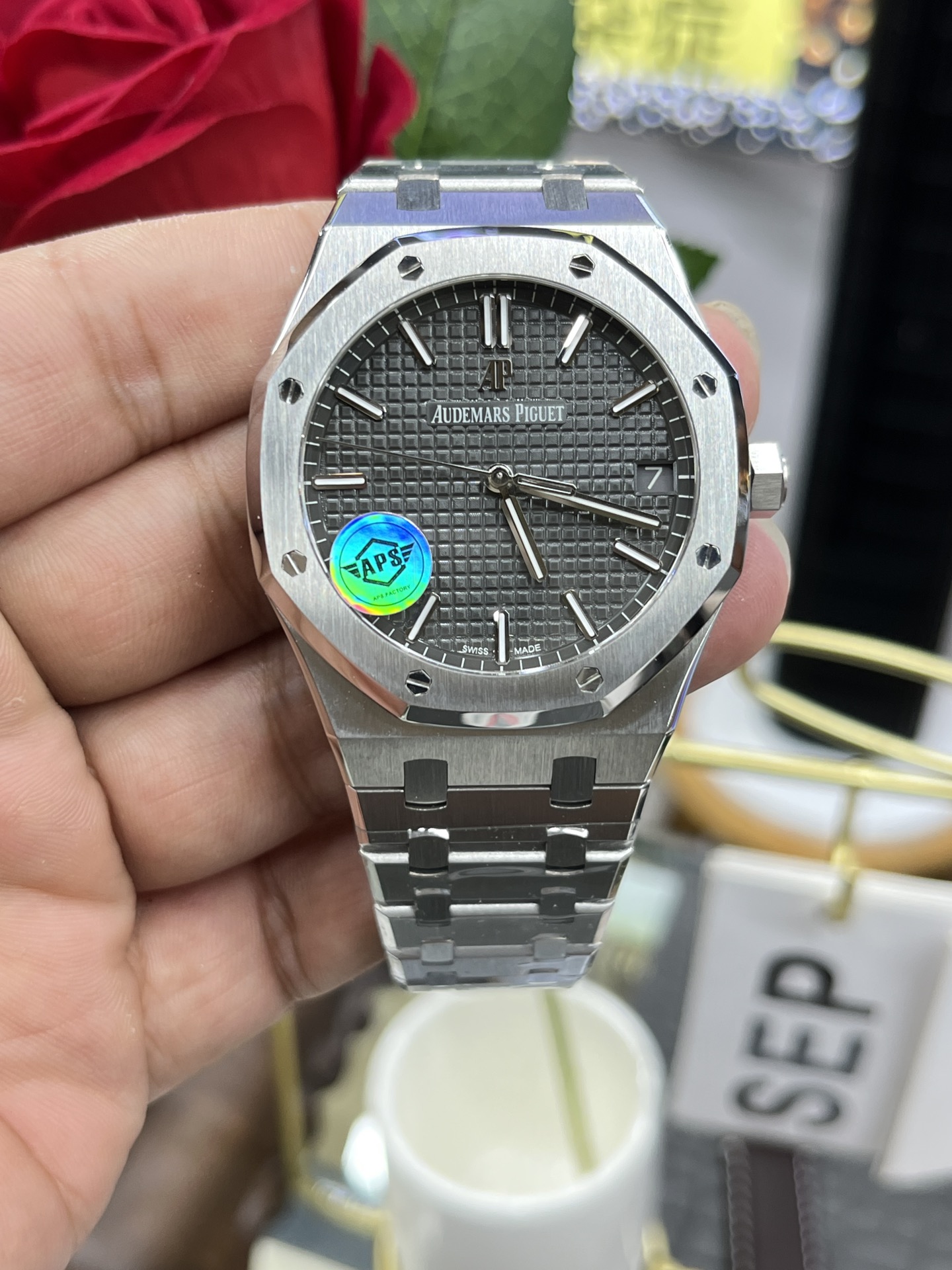
APS prioritizes structural ambition. Their approach leans into visual completeness, especially around the caseback architecture and dial execution. The finishing is sharp, the proportions are aggressive, and the watch presents strongly under scrutiny. The trade-off is that this ambition demands tighter tolerances, and long-term consistency depends heavily on assembly discipline.
VS takes the opposite path. The finishing is slightly more conservative, but the stability is proven. Bracelet articulation tends to feel more forgiving, and the watch settles naturally on the wrist over time. The movement solution is less visually assertive, but operational reliability is rarely questioned.
Choosing between APS and VS is less about which is “better” and more about which compromise aligns with how the watch will be used. One emphasizes appearance under inspection, the other favors behavior over months of wear.
Pros & Cons of the 15500 Replica
The greatest strength of the 15500 replica is balance. Size, design language, and wearability align well enough that no single flaw dominates the experience. It looks modern without feeling oversized, and it carries presence without demanding attention.
Its weakness remains thickness. Even well-executed replicas struggle to fully disappear on the wrist, especially during long wear. This is not always obvious in photos but becomes apparent over time. The second limitation is that the cleaner design raises expectations. Small dial or finishing imperfections stand out more clearly than they would on busier models.
Who Should Choose 15500?
The 15500 is the safest entry point into the Royal Oak world. It works as a first AP because it does not require historical context to appreciate, and it adapts well to daily wear. In business settings it feels current and composed. In casual environments it avoids feeling dated or experimental.
For buyers who want one Royal Oak replica that can handle most situations without constant second-guessing, the 15500 remains the most forgiving and the most versatile choice.
Royal Oak 15510 Replica Review (Updated 41mm)
What’s New in 15510 Compared to 15500
The 15510 is not a redesign; it is a refinement. On paper, it replaces the 15500. In practice, it tightens details that only become visible after extended exposure to the Royal Oak line. The most obvious change is the dial signature. The applied “AP” logo replaces the printed text at twelve, subtly shifting visual balance upward and giving the dial a calmer center of gravity.
Hands and typography also evolve. The hands feel slightly more restrained, and the dial fonts appear cleaner, with less visual weight. These are not changes that transform wrist presence, but they do influence how the watch feels over time. The 15510 reads quieter, more deliberate, and less transitional than the 15500.
For replicas, these refinements matter because they reduce tolerance for error. Cleaner dials amplify mistakes. When executed well, the 15510 looks unmistakably current. When executed poorly, it feels unfinished rather than imperfect.
Best Factories for Royal Oak 15510
APS holds a clear advantage in the 15510 segment. The factory’s strength lies in dial execution and structural alignment, both of which are critical for this reference. The applied logo, marker proportions, and dial surface texture require tighter control than earlier generations, and APS handles this with fewer visible compromises.
VS coverage is more limited for the 15510, not due to capability gaps but because the model demands retooling without the same margin for error. The result is fewer consistent releases and less market depth. Where VS excels in long-term stability, the 15510 demands visual precision first, and that shifts the balance toward APS.
15510 Pros & Cons
The primary advantage of the 15510 replica is its modern restraint. It feels like the most current expression of the Royal Oak without introducing experimental proportions. The dial changes reduce visual noise, and when done correctly, the watch feels more refined than the 15500.
The drawback is choice limitation. Fewer strong factory options mean less room to maneuver. Buyers must accept a narrower decision window and be more selective about execution quality. This is not a forgiving model.
Who Should Choose 15510?
The 15510 suits buyers who value being current over being flexible. It appeals to those who prefer the latest generation and are comfortable making a more deliberate selection. If the goal is ownership of a modern Royal Oak replica that feels intentionally updated rather than historically transitional, the 15510 delivers that experience.
Royal Oak 15400 Replica Review (Older Generation)
15400 Positioning & Market Reality
The 15400 occupies a unique position in the Royal Oak ecosystem. Officially discontinued, it sits between eras rather than at an endpoint. That status works in its favor. The design language is familiar, the proportions are well understood, and expectations are realistic.
In replica terms, maturity matters. The 15400 benefits from years of tooling refinement, repeated production cycles, and accumulated feedback. It may not represent the latest Royal Oak philosophy, but it represents one that factories have learned how to reproduce with confidence.
This is why the 15400 remains relevant. Not because it competes with newer models on novelty, but because it avoids their growing pains.
Best Factories for Royal Oak 15400
VS remains the most stable choice for the 15400. The factory’s advantage is not innovation but consistency. Bracelet articulation, case finishing, and movement behavior have reached a predictable equilibrium. Problems are rare, and when they occur, they are familiar rather than surprising.
Older tooling works in the 15400’s favor. Revisions have smoothed out earlier errors, and tolerances are better understood. While newer factories may chase visual breakthroughs, VS delivers a version that behaves well over time.
15400 Pros & Cons
The 15400’s strength lies in reliability. It wears comfortably, looks coherent, and does not demand constant scrutiny to justify itself. The design is slightly busier than later models, which helps mask minor imperfections.
Its weakness is generational. It does not feel as current as the 15500 or 15510, and for buyers focused on owning the latest expression of the Royal Oak, that matters.
Who Should Choose 15400?
The 15400 is ideal for buyers who value value itself. It suits those who want a Royal Oak replica that performs predictably, wears comfortably, and avoids the risks associated with newer releases. Accepting that it is not the latest generation is the trade-off—and for many, it is an easy one to make.
Royal Oak 16202 Jumbo Replica (39mm Extra-Thin)
Why Jumbo Is the Hardest Royal Oak to Replicate
The Jumbo is not difficult because it is rare. It is difficult because it leaves no room to hide. At 39mm with an ultra-thin profile, the 16202 depends entirely on proportion, restraint, and mechanical honesty. Any excess thickness, any visual imbalance, immediately breaks the watch’s identity.
The core problem is structural. The Jumbo was never designed to accommodate compromise movements. Its slim mid-case, flat caseback, and wide bracelet geometry assume a thin, purpose-built caliber. Replicas cannot fully replicate this without accepting trade-offs: layered movements, simplified architecture, or altered case profiles. Each solution solves one problem while creating another.
Unlike thicker Royal Oak references, the Jumbo magnifies error. A fraction of a millimeter matters. A slightly stiff bracelet feels wrong. A dial that is too deep or too flat destroys the calm visual rhythm that defines the model. This is why even high-effort replicas struggle to feel “right” over long-term wear.
Current Replica Status of 16202
Current 16202 replicas can look convincing at a distance and even in hand under casual inspection. Case proportions are closer than earlier attempts. Dial colors and Tapisserie patterns have improved. Bracelet finishing, while not perfect, is serviceable on better executions.
What has not been solved is the total experience. Thickness remains the primary limitation. Even when measurements appear close, the watch often sits higher on the wrist than it should, altering how the bracelet flows. Movement architecture under the display back is another unavoidable gap. It may resemble the original layout, but it does not behave or age like it.
This is not a failure of effort. It is a limitation of the format. The Jumbo demands mechanical minimalism that replicas cannot yet deliver without significant compromise. Pretending otherwise only creates disappointment.
Who Should (and Should NOT) Choose 16202 Replica
The 16202 replica is best suited for experienced Royal Oak owners who already understand what they are giving up. For collectors who value the idea of the Jumbo more than perfect execution, it can still be rewarding as a rotation piece.
It is not suitable as a first Royal Oak replica. New buyers often expect the Jumbo to feel smaller, thinner, and more elegant than its 41mm counterparts. In replica form, those expectations are rarely met consistently. For newcomers, the risk of mismatch between expectation and reality is high.
Royal Oak Replica Models Comparison Table
| Model | Case Size | Wearing Feel | Movement Generation | Replica Difficulty | Recommended Profile |
|---|---|---|---|---|---|
| 15400 | 41mm | Stable, forgiving | Cal. 3120 style | Moderate | Value-focused, daily wear |
| 15500 | 41mm | Balanced, modern | Cal. 4302 style | Moderate–High | First AP, all-round use |
| 15510 | 41mm | Refined, precise | Cal. 4302 style | High | Latest generation preference |
| 16202 | 39mm | Sensitive, demanding | Ultra-thin Jumbo style | Very High | Experienced collectors only |
This comparison makes one pattern clear: the more restrained and thin the Royal Oak becomes, the less forgiving the replica experience is. Larger, modern references absorb compromise more gracefully. The Jumbo does not.
Each model serves a different type of buyer. Understanding which compromises you are willing to live with matters more than chasing the most iconic reference.
Best Royal Oak Replica Model for Different Buyers
Best for Beginners
For first-time Royal Oak buyers, the safest entry points remain the 15400 and the 15500. The reason is not price alone, but tolerance. Both models absorb small replica imperfections without constantly reminding the wearer that compromises were made. Bracelet behavior, case presence, and dial legibility tend to align with expectations quickly.
The 15400 offers familiarity and maturity. The 15500 offers modernity without demanding expertise. Either allows a newcomer to understand the Royal Oak experience before developing stronger preferences.
Best for Daily Wear
The 15500 stands out as the most wearable Royal Oak replica over extended periods. Its proportions feel intentional rather than historic, and it transitions naturally between business and casual settings. The dial is clean without being sterile, and the bracelet presence feels confident without becoming intrusive.
For daily wear, consistency matters more than theoretical perfection. The 15500 delivers that consistency better than any other Royal Oak reference currently available in replica form.
Best for Collectors / Enthusiasts
Collectors tend to value intent over convenience. The 15510 appeals to those who want the latest generation and appreciate subtle refinements that only reveal themselves after long exposure. It rewards attention but punishes casual selection.
The 16202 Jumbo belongs in the same category, but with clearer risk. It suits experienced owners who understand its limitations and accept them as part of the ownership experience. For enthusiasts, these models offer intellectual satisfaction rather than effortless enjoyment.
Common Mistakes When Choosing Royal Oak Replica Models
The most common mistake is chasing novelty without context. Newer references are not automatically better replicas. In some cases, they are simply harder to execute well.
Another frequent error is ignoring wrist size. The Royal Oak’s integrated bracelet amplifies fit issues, and choosing based on diameter alone often leads to disappointment.
Finally, many buyers overlook factory alignment. A strong model paired with the wrong execution undermines the entire experience. Model choice and factory capability must be considered together, not separately.
Final Verdict: Which Royal Oak Replica Model Is Worth Buying?
There is no single correct choice, but for most buyers seeking a reliable, convincing, and wearable Royal Oak replica, the 15500 remains the most balanced and defensible decision.