
The Four-Pillar Framework: Why “Entry-Level” RM Replicas Need a Deeper Analysis
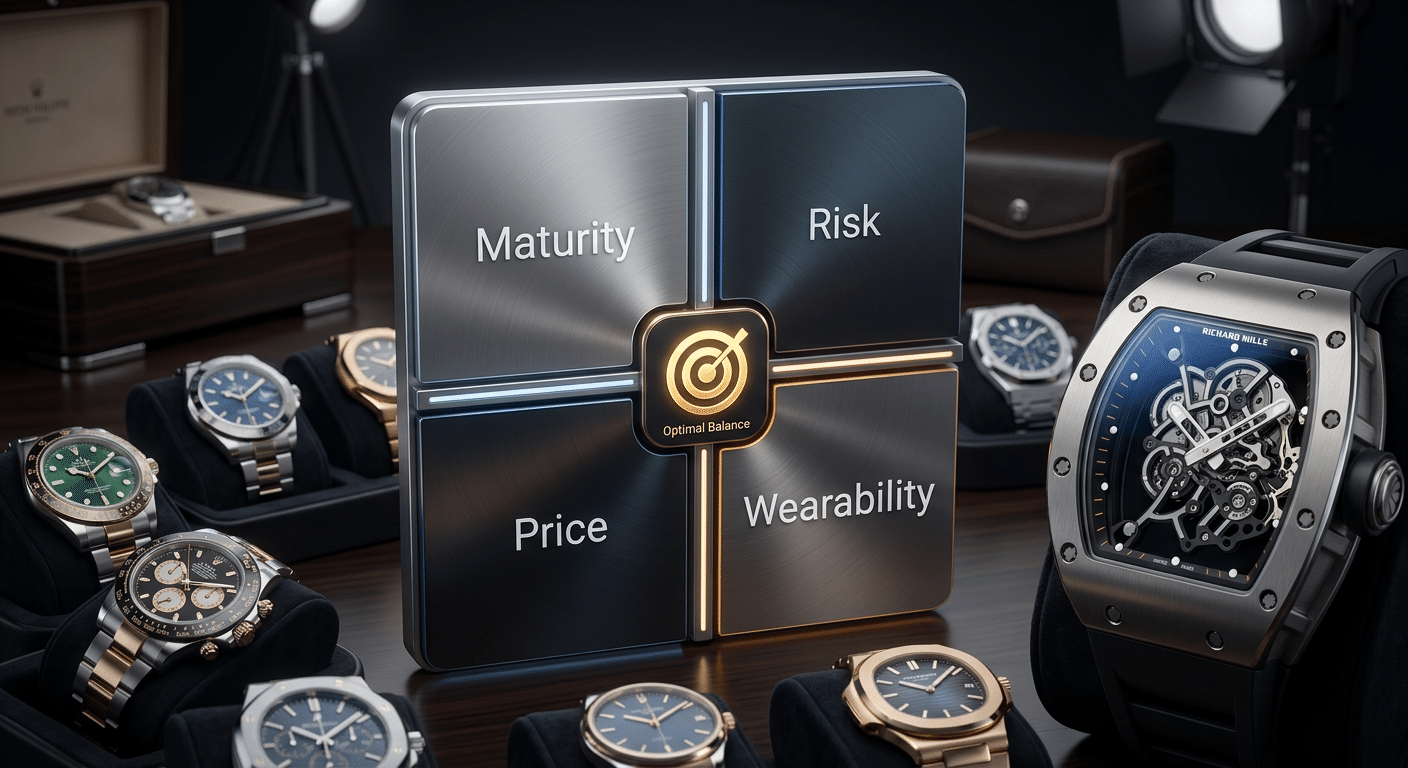
Walk into any replica watch forum and you’ll find the same question repeated a hundred times: “What’s the best first Richard Mille to buy?” The instinct is simple: find the most popular model, buy from the most recommended factory, and hope for the best. This is the beginner’s fatal mistake—treating a complex purchase as a popularity contest. The result is predictable: a watch that looks great in a seller’s studio photos but becomes a source of anxiety the moment you put it on your wrist. The reality is that choosing an entry-level Richard Mille super clone isn’t about finding a single “best” model; it’s about finding the model with the optimal balance across four critical, interconnected dimensions—a standard embodied by most wearable super clone models—and pulling on one lever, like prioritizing a visually stunning, low-maturity model, will tighten the others, increasing risk or sacrificing comfort.
Think of it like buying a used performance car. You wouldn’t choose based solely on horsepower (the “wow” factor). You’d weigh mileage (maturity), accident history (risk), total cost of ownership (price exposure), and daily drivability (wearability). A car with 800 horsepower but a rebuilt transmission and terrible ride quality is a terrible choice for most people. The same logic applies here. Your goal is to build a protective decision matrix that filters out hype and aligns a watch’s technical and physical realities with your personal tolerance for risk, budget, and daily use.
Pillar 1: Factory Maturity – The Hidden Technical Baseline
Maturity measures how many generations of refinement a specific replica model has undergone. It’s not about the factory’s overall reputation; it’s about the iteration count of the exact model you’re considering. A first-version RM 67-02 from a top factory will have glaring flaws, while a fourth-generation RM 011 from a mid-tier factory might be surprisingly polished. Maturity directly dictates movement refinement, case finishing consistency, and the likelihood of undiscovered flaws. A mature model has had its weak points exposed and corrected by hundreds of previous buyers. It may lack the “latest” hype, but it offers dramatically lower buyer’s remorse.
Pillar 2: Risk Control – From “Looks Real” to “Feels Right”
Risk is the probability of the watch being identified as a replica, either by an expert or by your own nagging doubt. This exists on a spectrum. Tier 1 (Photographic) realism means the watch looks real in edited images—a low bar most “super clones” clear. Tier 2 (Physical) realism means the weight, surface texture, balance, and mechanical action (crown, pushers) feel correct in hand. This is where 99% of failures occur. A watch can photograph perfectly but feel cheap, light, or gritty. Tier 3 (Psychological) realism means the watch holds up to casual, prolonged observation by a knowledgeable non-expert. Risk control means deliberately targeting models where the replica has mastered the difficult, tactile details that separate a convincing object from a convincing experience.
Pillar 3: Price Exposure – When Cost Becomes a Tell
Price isn’t just a budget constraint—it’s an active diagnostic. Paying far below the market norm ($400 for a watch that typically sells for $700) is a massive red flag. It signals movement swaps, material fraud, and zero after-sales support. Conversely, paying a huge premium for “special” versions often just feeds seller hype without tangible quality gains. “Price exposure” refers to how your purchase price relative to the established market creates a cognitive gap for an observer. A genuine RM 35-02 costs $300,000+. A replica costing $450 feels implausibly cheap, making its own fakeness more obvious. The “sweet spot” is the market-established price for a mature model from a reputable source—high enough to signal decent materials and labor, low enough that the loss wouldn’t be catastrophic.
Pillar 4: Wearability – The Daily Reality Check
Wearability is the non-negotiable physical reality. A Richard Mille’s “racing machine on the wrist” ethos often means substantial size and weight. The RM 035 (titanium, ~12mm thick) may be comfortable for all-day wear, while the RM 88 (wildly thick and angular) is a desk-only showpiece. Wearability encompasses case dimensions, material fatigue (ceramic shatters, carbon can delaminate), and bracelet vs. strap integration. A model with poor ergonomics will end up in a drawer, making even a perfect replica a waste. The most mature replicas often mirror the genuine’s proven wearability, as years of owner feedback influence case design tweaks in later factory versions.
Expert Authentication Insight: The Telltale Signs of a Superficial vs. Substantive Guide
The fastest way to spot a shallow buyer’s guide is a simple word count test. A substantive, framework-based guide will dedicate at least 30% of its content to the buyer’s own situation—wrist size, budget ceiling, risk appetite, daily environment. It forces self-assessment before model research. A superficial guide is a product list in disguise; it spends 90% of its words describing models, factories, and specs, assuming a one-size-fits-all recommendation. If the guide doesn’t help you ask “What do I need?” first, it’s not a framework—it’s a catalog with an opinion.
Factory Maturity: Which RM Models Have Stood the Test of Time?
Chasing the “best factory” is a fool’s errand. The critical question is: “How many rounds of corrections has this specific model undergone?” A top-tier factory can release a clunky, problematic first version of a new model (e.g., an early RM 67-02), while a factory considered “mid-tier” might have a perfected 4th-generation version of an older model (e.g., a BP RM 011). The single most important maturity metric is iteration count—the number of major version updates (V1, V2, V3…) the model has seen from a given factory. Each iteration addresses flaws discovered by the previous batch of buyers.
The judgment is clear: Always choose a model that is at least on its 3rd major factory version. Earlier versions are essentially beta tests. You are paying to be an unpaid quality control agent. Maturity correlates directly with movement refinement (smoother operation, better accuracy), case finishing (cleaner lines, consistent gaps), and the resolution of model-specific quirks. A V5 ZF RM 035 is a fundamentally different, more reliable object than a V2.
Mapping the Factory Landscape: Who Excels at What?
Factories develop specialties based on investment and technical focus. ZF (and its “U mi” sub-brand) is historically strongest with skeletonized models like the RM 035 and RM 052, where movement aesthetics are paramount. BP (often confused with BBR) built its reputation on the integrated case-and-bracelet construction of the RM 011 chronograph, solving linkage issues over four versions. APS has emerged as the leader for free-sprung balance movements in the RM 35-02 and RM 055 NTPT. EUR is the undisputed specialist for true tourbillon replicas (RM 052, RM 027). AVS has carved a niche with the ultra-thin RM 67-02, where thickness is the ultimate challenge. Do not assume a factory that excels in one category will deliver in another.
Model Iteration Count: The Single Most Important Maturity Metric
When researching a model, your first question to any seller must be: “What is the current factory version number?” If they cannot give a specific V-number (e.g., “ZF V6,” “APSF V2”), you are almost certainly dealing with an early, unrefined version or a scammer. Then, verify that version. A simple rule: If you cannot find clear, unedited video evidence of that exact model version from at least three independent sources (different dealers, forum reviewers), assume it is an early-run model with high risk. The community consensus on models like the ZF RM 035 V5 or BP RM011 V4 exists because thousands of units have been sold and scrutinized. That collective feedback is the maturity signal.
Community Feedback Loops: How to Read Forum History for Red Flags
Forums like RWI and RepTime are not just for hype; they are error logs. Search for the exact model and factory version. Look for patterns in complaints. Do multiple reviewers over six months mention the same issue—e.g., “crown wobbly on V2,” “carbon pattern too bright on early ZF,” “chronograph hands not lining up”? These are unresolved flaws. If the last major review of a version is older than 12-18 months and a new version is rumored, the current version may be obsolete. A mature model has a quiet, problem-free forum presence. A problematic one has a thread full of users asking “Has this been fixed yet?”
Expert Authentication Insight: Spotting a First-Run Factory Model vs. a Mature One
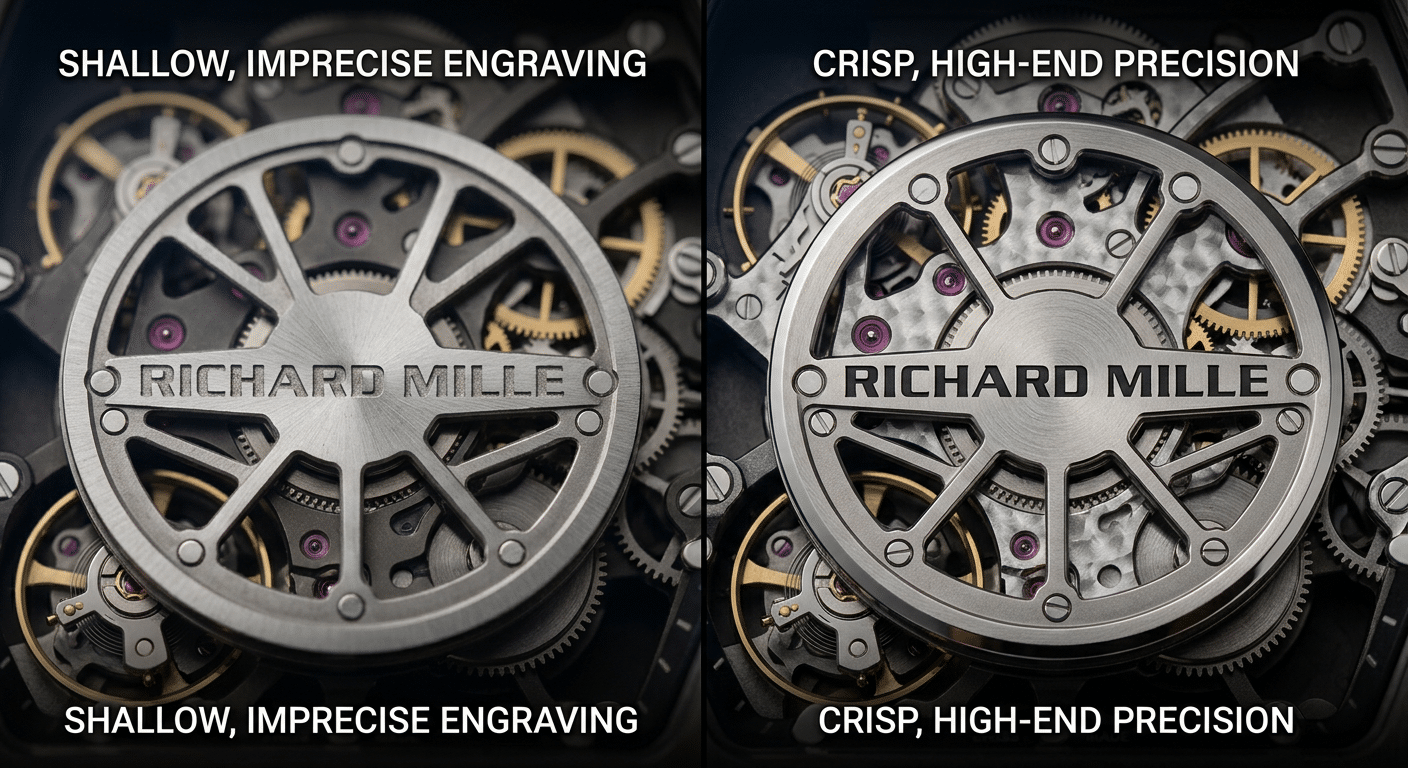
The fastest physical diagnostic is a macro-photography check of the movement’s rotor engraving and functional jewel placement. Request a close-up video (60mm macro lens equivalent) from the seller. Compare it side-by-side with high-resolution images of the genuine movement. A first-run model will often have: (1) shallow, blurry, or incorrectly fonted text on the rotor, (2) an incorrect total count of jewels (even if they’re glass), or (3) jewels placed in non-functional locations just to mimic the genuine’s visual density. A mature model will have precise, deeply engraved rotor text and accurate jewel counts/placement that match the genuine’s functional diagram. Inconsistencies here are a near-certain sign of an early, unrefined movement package that likely has other hidden flaws.
Risk Control: How to Gauge Realism Beyond “Looks Good in Photos”
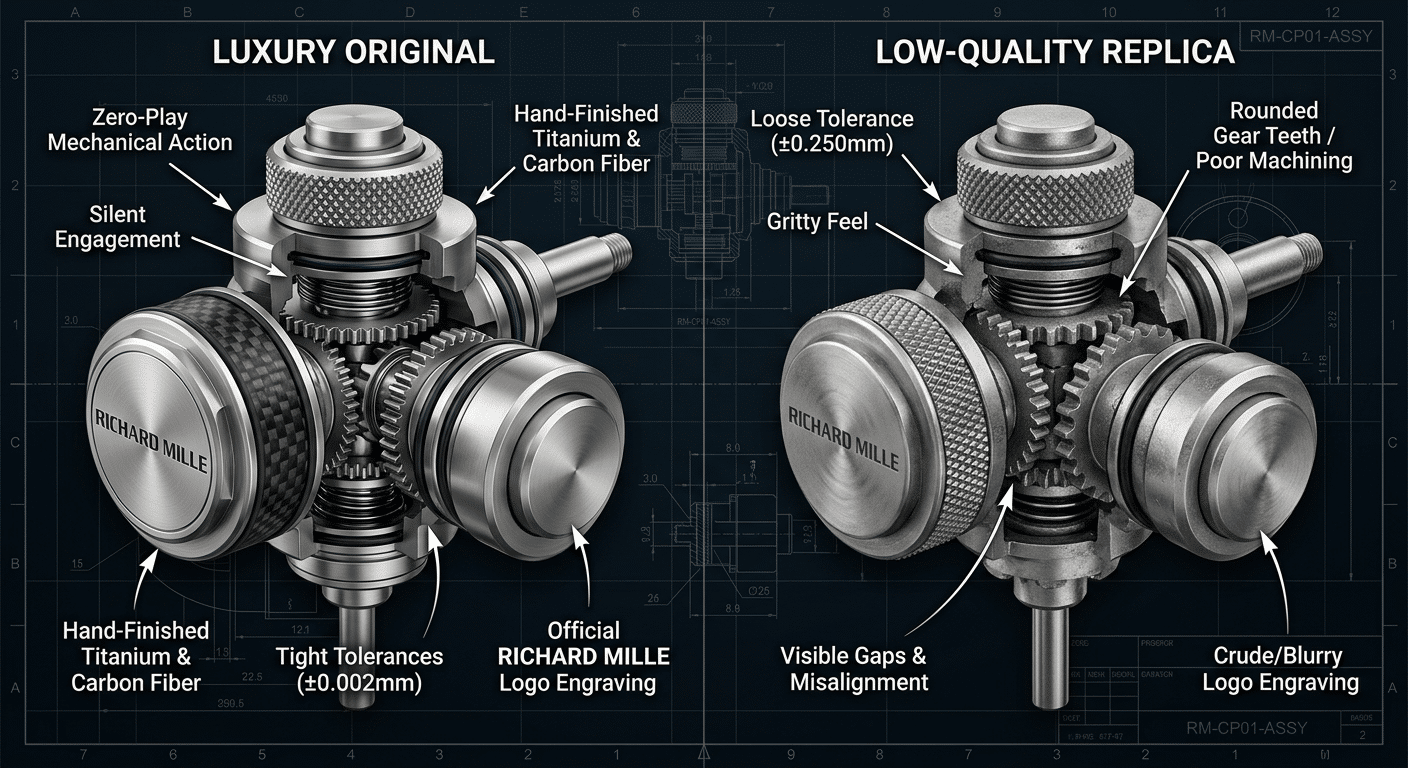
Studio photos are a fiction. The only valid proof is natural-light, handheld video. Risk control is the process of systematically lowering the probability that your watch will be called out, moving it from “looks real in a picture” (Tier 1) to “feels correct in hand” (Tier 2) to “holds up to casual, prolonged observation” (Tier 3). The vast majority of buyer failure happens in the gap between seeing a photo and holding the watch. The weight is wrong. The crown action is gritty. The case transitions feel rough. This is where the replica’s compromises become physically obvious.
Richard Mille’s design is a minefield of difficult-to-replicate details: the complex, skeletonized case geometry; the specific brush-polish transition on the bezel; the precise tactile feel of machined titanium versus poured ceramic; the silent, firm click of the crown and pushers. Risk is not binary. You can lower it by targeting models where the factory has demonstrably mastered these high-risk details through multiple iterations. A model with a history of “crown wobble” complaints is a high-risk choice, regardless of how good the dial looks.
The Three Tiers of Replica Realism: Where Most Buyers Get Stuck
- Tier 1: Photographic. The watch looks real in edited, well-lit images. This is the entry threshold for a “super clone.” It is also almost meaningless. Lighting, angles, and photo editing can hide a multitude of sins.
- Tier 2: Physical. The watch feels correct in hand: weight matches expectations, surfaces are smooth and crisp, mechanical actions (crown, pushers, bezel) are firm and silent, and the overall balance on the wrist is natural. This is the critical make-or-break level. If the watch fails here, you will know it the moment you pick it up. It will feel like a toy.
- Tier 3: Psychological. The watch holds up to casual, prolonged observation by a knowledgeable non-expert (e.g., a watch enthusiast who knows RMs but isn’t an authenticator). This is the highest level, where the replica survives the “glance test” in normal social settings. Achieving this consistently across all details is exceptionally rare.
Your goal as a first-time buyer is to secure at least Tier 2 realism reliably. That means choosing models with proven physical execution.
High-Risk Details: The RM-Specific Tells That Kill Confidence
Some details are disproportionately difficult for replicas to get right. These are your high-risk areas:
- Crown & Pusher Action: Should be firm, precise, and silent. Any grit, looseness, or lateral play is an instant fail. This tests the quality of the internal tube and the machining of the crown stem.
- Case Transitions: The junctions between the bezel, caseband, and case back should be seamless, with consistent, sharp lines. A rounded, soft, or uneven transition is a major tell.
- Material Feel: Machined titanium has a distinct, cool, slightly “grippy” metallic feel. Cheap ceramic can feel waxy or plastic. Carbon fiber should feel light and solid, not hollow.
- Skeleton Dial Gearing: On models with visible gears through the front, the gears should rotate freely and smoothly when the crown is wound. Stiff, gritty, or non-moving gears are a dead giveaway of a decorative, non-functional layer.
- Bezel-to-Crystal Seam: The bezel should meet the crystal with a perfectly even, gapless ring. Any variation indicates poor machining or assembly.
Seller Vetting: Extracting Truth from Product Photos and Videos
You must train sellers to provide proof, not marketing. Your script:
- For photos: “Please provide unedited, natural-light photos. No studio lighting. Show the watch on a wrist, then on a plain surface. Include a ruler or coin for scale.”
- For video: “Please pan slowly across all case sides under direct light. Then, show a close-up of the crown being depressed and rotated, and the pushers being pressed. Finally, tilt the watch to show the movement from the back. Do not use slow motion or filters.”
- The killer question: “Can you show me a video of this exact model version (e.g., ZF V6 RM035) from a different customer’s purchase?” A legitimate dealer with high volume will have this. One who dithers or shows you a different model’s video is hiding something.
Studio photos are for initial screening only. The buying decision is made on the basis of raw, handheld video.
Expert Authentication Insight: The 30-Second Physical Check That Reveals 80% of Fakes
You do not need tools. You need tactile sensitivity. The “Crown Test” is your single most powerful filter. On any watch with a crown (and on chronographs, the pushers as well):
- Gently depress the crown. It should have a smooth, firm, and silent action with zero lateral wobble.
- Rotate the crown (in non-winding position). It should turn smoothly, with a precise, high-quality feel—not gritty or loose.
- On a chronograph, press the pushers. They should have a crisp, definitive click with no sponginess or excess travel.
A cheap or early-run clone will have a gritty, loose, or noisy feel. The crown may wobble side-to-side. This single test instantly separates units with decent internal engineering from those with cheap, outsourced movements and poor machining. It is the ultimate test of physical realism. If a seller refuses to provide a clear video of this action, do not buy.
Price Exposure: When Your Watch’s Cost Becomes a Giveaway
The moment you start researching Richard Mille super clones, you’ll encounter a chaotic price landscape. One seller lists an RM 035 for $400; another asks $900 for what looks like the same model. The instinct is to treat price as a simple budget filter: find the lowest cost that still looks good. This is a critical error. In the replica world, price is not just a number—it’s an active signal of risk, quality, and seller legitimacy. Your goal is not to find the cheapest “steal,” but to identify the “sweet spot” where the price itself supports the watch’s credibility and your peace of mind.
The Realistic Price Spectrum for Mature Entry-Level Models
Forget the $200 listings on generic forums. Those are entry points into a world of disappointment. The market for genuinely mature, super-clone tier Richard Mille replicas—those from APS, ZF, BBR, EUR, and similar—operates within clear, defensible bands as of 2025. These prices reflect the cost of refined clone movements, genuine or high-grade composite materials, and the overhead of reputable dealer networks.
- RM 035 (NTPT Carbon/Titanium Skeleton): The benchmark model. A solid version from ZF (V6/V7) or APSF (V2) starts at $650 and can reach $900–$1,000+ for the latest iterations with free-sprung balance movements. Anything consistently below $550 from a non-clearinghouse source should be treated as a major red flag.
- RM 055 (Ceramic or NTPT): The second most refined. Expect to pay $600–$800 for a BBR ceramic or ZF/APSN NTPT version. The ceramic models trend slightly lower; the NTPT versions command a premium due to material cost.
- RM 011 Chronograph: This is the cautionary tale. Because it relies on a modified Shanghai 7750 (a bulky movement), even the best versions (from KU) are fundamentally compromised in thickness. The mature price band here is $350–$500. Paying more than $550 for an RM 011 replica is almost certainly overpaying, as the technical ceiling is lower by design.
- RM 052 Skull Tourbillon: Here, price separates reality from fantasy. A non-tourbillon “simulation” from ZF is $550–$650. A real, functioning tourbillon from EUR Factory starts at $970 and can exceed $1,100. Any “tourbillon” RM 052 priced under $800 is, with near certainty, a fake tourbillon (a moving balance wheel illusion).
These bands exist because the underlying component costs are relatively fixed. A Dandong RMUL2 movement, a block of forged carbon, a sapphire crystal with AR coating—these have market prices. A listing far outside these bands means one of two things: the materials are fraudulent, or the seller’s business model is predatory.
Hidden Cost Traps: What Your Low Price Is Really Paying For
A $400 RM 035 is not a bargain. It is a loan with a mandatory future repayment plan. That low price is the down payment on a series of inevitable costs that will ultimately exceed the “savings.”
The movement swap is the most common hidden fee. A cheap replica uses a low-grade, unrefined Chinese movement (often a base Shanghai 7750 or a poorly decorated automatic). These movements are noisy, inaccurate (±30–50 seconds/day), and have a short lifespan. Within 12–24 months, a service is required. For a skeletonized watch like the RM 035, this almost always means a full movement replacement, costing $150–$300 in parts and labor. Your $400 watch just became a $550–$700 project.
Material fraud is the silent killer. That “carbon fiber” case for $400? It’s almost certainly a painted resin or a cheap, brittle composite that will chip, fade, or warp. Replacing it means sourcing a new case—a complex, model-specific part that can cost $200+ if you can even find one. You are not buying a watch; you are buying a disposable cosmetic object.
Zero after-sales is the final trap. Sellers operating at the bottom of the price scale have no margin for support. A stuck crown, a broken bracelet clasp, a loose bezel—these are problems you solve entirely at your own expense. The $400 price tag implicitly includes a 100% markup on future risk and hassle. You are not saving money; you are deferring and magnifying it.
Negotiation Leverage: Using Market Knowledge to Pressure Sellers
Once you know the realistic bands, your entire negotiating posture changes. You are no longer a grateful buyer happy to find any price under $500; instead, you evaluate bracelet sourcing, clasp engineering, and case finishing. For the RM52 skull, design complexity introduces significant risks in dial manufacturing and case construction, making the RM52 skull complexity guide an essential technical reference. You are an informed buyer assessing value within a tight corridor, now integrating movement authenticity, lume analysis, and overall finishing standards into your evaluation.
When a seller quotes a price, your first question should be: “What is the exact factory and version number?” An answer like “ZF version” is garbage. You need “ZF V6 RM 035-02” or “APSF V2 RM 055 NTPT.” With that specificity, you can immediately check if the price aligns with community standards. A ZF V6 RM 035 listed at $750 is in the zone. The same watch listed at $900 needs to justify the premium with evidence of recent QC improvements or included accessories.
Use the price bands as a bludgeon against vague hype. If a seller says, “This is the best quality, you have to pay for quality,” your response is: “The market for that specific factory version is $650–$750. I’m prepared to pay $700 if you can provide a recent, unedited video of that exact version from another client.” This forces the conversation from abstract claims to concrete evidence. A legitimate dealer will engage. A scam artist will deflect, insult, or suddenly have a “special price” for you—which is usually the same price they were going to charge anyway, now framed as a favor.
The sweet spot is not the absolute lowest price. It is the lowest price at which the seller can still provide verifiable evidence of a mature product and a documented after-sales policy. That price, for an entry-level RM super clone in 2025, almost never dips below $550 for the simplest models and starts around $650 for the most refined.
Expert Authentication Insight: Calculating the True Cost of a “Bargain” RM Replica
The purchase price is a lie. It’s a marketing number. The true cost is the total financial commitment you will make over 24 months. Here is the diagnostic calculation:
True Cost = Purchase Price + (Expected Service/Repair Cost within 2 Years) + (Opportunity Cost of Funds)
Let’s compare two RM 011 scenarios:
- The “$400 Bargain”: Purchase Price: $400. Expected Service: The Shanghai 7750-based movement will likely need a timing adjustment within 6 months ($80) and a full movement swap within 18–24 months ($250). Total Expected Service: $330. Opportunity Cost: If you had instead invested that $400 + $330 = $730 into a more reliable watch, that capital would be preserved. Here, we’ll assign a nominal 5% cost for simplicity ($36). True 2-Year Cost: $400 + $330 + $36 = $766.
- The “$650 Premium” from a Known Source: Purchase Price: $650. Expected Service: The refined movement (e.g., a higher-grade Chinese clone or Japanese auto) should require no service for 3+ years. We’ll budget $50 for a simple regulation check. Opportunity Cost on tied-up funds: $22. True 2-Year Cost: $650 + $50 + $22 = $722.
The “bargain” is $34 more expensive over two years and comes with the immense hassle of finding a watchmaker, shipping, and waiting. More importantly, it carries a 70%+ probability of a complete movement failure within that period, leaving you with a $400 paperweight. The “premium” purchase buys predictability, a working warranty, and a seller who will likely handle the $50 check for you. The $250 price difference is not for the watch; it is for the option value of not having to think about the watch for years. This is the tangible meaning of price exposure.
Wearability: The Daily Driver Reality Check
You can have the most visually convincing, movement-refined Richard Mille replica in the world. If it feels like a brick on your wrist after 30 minutes, you have not bought a watch. You have bought a frustrating object that will live in a drawer. Richard Mille’s design philosophy—a “racing machine on the wrist”—inherently conflicts with all-day comfort. The tonneau shape, substantial lugs, and integrated bracelets are engineering statements first, ergonomic considerations second. Your job is to find the model where the compromise is least severe for your wrist.
Size & Weight: The Non-Negotiable Wrist-Fit Calculation
Do not guess. Get a ruler or caliper. Richard Mille’s dimensions are not just case diameter; the lug-to-lug length and thickness are the true determinants of comfort.
The Wrist-to-Watch Ratio is your primary filter. Measure your wrist circumference.
- Under 6.5″ (165mm): Avoid any model with a lug-to-lug length over 50mm or a thickness over 12mm. The RM 035 (~50mm lug-to-lug, ~12mm thick) is your upper limit. Models like the RM 011 (~52mm+ lug-to-lug, ~18mm+ thick on replicas) will overhang and feel top-heavy.
- 6.5″–7.5″ (165mm–190mm): You have the most options. The RM 035, RM 055, and the slimmer variants of the RM 67-02 (if you can find a truly thin version) are viable. The RM 011 becomes manageable but will still be a presence.
- Over 7.5″ (190mm): You can handle the larger dimensions, but pay close attention to bracelet/strap length. Many replica bracelets are non-adjustable or have limited links, creating a poor fit on larger wrists.
Thickness is the universal enemy. Due to movement stack height, replicas are almost always thicker than their genuine counterparts. The RM 011 genuine is 16.15mm; a replica is 18–19mm. That 2–3mm difference is the line between a solid presence and a clumsy tool. An 18mm+ watch will catch on sleeves, feel unbalanced, and be uncomfortable in a car or at a desk. Always research the replica’s specific thickness for your chosen factory version, not the genuine spec.
Material Fatigue: How Different Replica Materials Age on Your Wrist
The material isn’t just about looks; it’s about long-term feel and durability.
- Carbon Fiber/NTPT-Style: The best replicas use forged carbon or imported carbon composites. They are very light (often 60–80g total weight), which is a huge comfort advantage. However, forged carbon can delaminate or develop hairline cracks if impacted. The surface can also feel slightly “spongy” compared to metal. It’s the best for all-day lightness but has a finite lifespan under stress.
- Ceramic: Extremely scratch-resistant and feels cool and solid. But it is brittle. A knock against a doorframe or a fall onto a tile floor can shatter it. There is no repair. It also has no “give,” so on a tight wrist, it can feel like a rigid band. The weight is moderate (~90–110g).
- Titanium: The genuine article is lightweight and hypoallergenic. Replica titanium is often a lower-grade alloy that can feel slightly “colder” and may show skin oils or scratches more readily. It’s a good middle ground but lacks the premium feel of genuine Grade 5.
- Stainless Steel (Budget Tier): Avoid. It is ~60% denser than titanium, making the watch feel unnecessarily heavy and clumsy. A stainless steel RM replica will feel like a toy compared to a genuine, and the weight will be immediately suspicious.
The key insight: material choice directly dictates your anxiety level. With carbon, you worry about cracks. With ceramic, you worry about shatters. With titanium, you worry about scratches. There is no perfect material, only a trade-off you are willing to accept.
Bracelet vs. Strap: The Hidden Impact on All-Day Comfort
This is the most overlooked and highest-impact comfort factor. The integrated bracelet is where most replica RMs fail.
Integrated Bracelets (RM 011, RM 055, RM 67-02, etc.): These are complex, multi-link constructions with a deployant clasp. On a genuine RM, the articulation is smooth and the clasp is a precise mechanism. On a replica, it is almost always the weakest link. The links can have stiff, uneven articulation. The clasp may be flimsy, insecure, or pinch the wrist. The micro-adjustment mechanism (if present) is often crude. If the bracelet is not comfortable, you will not wear the watch. Period. Demand close-up, functioning videos of the bracelet being flexed and the clasp opening/closing. Listen for gritty sounds and watch for uneven gaps between links.
Rubber/Fluoroelastomer Straps (RM 035, RM 055): Generally more forgiving. The strap is a single piece with a deployant or tang buckle. The main issues are strap length (many are short, limiting on larger wrists) and strap quality. Cheap rubber will feel sticky, tear easily, and develop an odor. The best replicas use a decent quality rubber, but it will never match the proprietary, long-lasting elastomer of a genuine RM. Aftermarket strap replacements from specialists like Horatech (RWI) are a common and recommended upgrade.
Nylon/Textile Straps (RM 27, some tourbillon models): These are usually comfortable and adjustable. The risk is lower quality weave or buckle hardware. They are the least problematic from a comfort standpoint but may lack the premium feel.
The Universal Rule: If the bracelet or strap feels stiff, cheap, or poorly finished in a video, it will feel 10x worse on your wrist after an hour. This component is non-negotiable for daily wear.
Expert Authentication Insight: The 15-Minute Wear Test You Must Simulate
You cannot judge comfort from photos or a 30-second video. You must simulate the experience. Here is the only reliable pre-purchase test:
- Identify the exact case dimensions (diameter, thickness, lug-to-lug) of your target replica model from the factory’s specs or community measurements.
- Find a loaner watch in your collection or from a friend that matches those dimensions as closely as possible. It doesn’t need to be the same shape; the size is what matters. A 42mm, 12mm thick Seiko will give you a 90% accurate feel for a 42mm, 12mm thick RM 035.
- Wear it for 15 minutes while performing mundane tasks: typing on a keyboard, reaching into a cabinet, driving (if safe), adjusting your collar. Do not just sit there.
- Note the failure points: Does the case dig into the back of your hand? Does the top edge catch on your sleeve? Does it feel balanced, or does it want to rotate on your wrist? Is the weight noticeable after 10 minutes, or does it disappear?
If you cannot find a loaner, create a cardboard cutout of the case shape. Hold it against your wrist with a strap. Move your wrist. You will instantly feel if the lugs are too long, if the case is too thick, or if the shape will be problematic. This physical simulation eliminates 70% of models that seem perfect on paper. Replicas are made to genuine specs, so this test is a perfect proxy. If the size feels wrong in this test, it will be a daily irritant in reality.
Matching Models to Buyer Profiles: A Decision Matrix
The four-pillar framework is useless without a translation into action. This section synthesizes Factory Maturity, Risk Control, Price Exposure, and Wearability into concrete recommendations for four distinct buyer archetypes. There is no “best” first Richard Mille replica. There is only the best for you, given your non-negotiable constraints. The following matrix forces that match. Be brutally honest about which profile fits you. The trade-offs listed are not failures; they are the conscious price of your priority.
Profile A: The Cautious First-Timer – Minimal Regret, Maximum Confidence
Dominant Pillars: Factory Maturity & Risk Control.
Primary Goal: Own a replica that is mechanically sound, visually credible at conversational distance, and carries the absolute lowest probability of buyer’s remorse or early failure.
Acceptable Trade-offs: Higher initial price, less “wow” factor from exotic materials or complications, potentially less aggressive styling.
Recommended Model: ZF Factory RM 035-02 V6 or V7 (or APSF RM 035-02 V2 if budget allows).
Why: This is the most iterated, most reviewed, and most refined replica in the entire RM lineup. The movement (Dandong RMUL2) is proven. The carbon case is good. The skeleton dial, while not perfect under magnification, is consistent. The design is classic RM. The community knowledge base is massive, meaning you can find endless QC videos and service reports. You are buying a known quantity.
Biggest Remaining Risk: The skeleton dial printing and hand finishing will never match a genuine under 10x magnification. You are buying “conversational realism,” not forensic perfection. Also, the rubber strap, while decent, is a common upgrade point.
Price Target: $650–$850.
Profile B: The Budget-Conscious Enthusiast – Best Value Under $600
Dominant Pillars: Price Exposure & Wearability.
Primary Goal: Get the most credible visual experience for the lowest possible outlay, accepting higher long-term maintenance risk.
Acceptable Trade-offs: Older factory version, potentially less refined movement finishing, higher probability of needing a service within 2 years, simpler complications (no tourbillon).
Recommended Model: BBR Factory RM 055 Ceramic (V3 or later) or ZF Factory RM 055 (earlier V3/V4 version).
Why: These hit the sub-$600 price point while still offering a genuine ceramic case, a working chronograph function (on the RM 055), and a recognizable RM shape. They are not the absolute pinnacle of refinement (BBR’s ceramic color is slightly off, ZF’s older versions have less detailed movement finishing), but they deliver 85% of the visual impact for 70% of the price of a top-tier RM 035. The ceramic is durable and scratch-resistant.
Biggest Remaining Risk: Movement reliability. These use earlier iterations of the RMUL2 clone. They are more likely to need a timing adjustment and have a shorter reliable lifespan than the latest APS/ZF movements. The bracelet articulation on the RM 055 is also a known weak point.
Price Target: $450–$580.
Profile C: The Daily Statement-Wearer – Presence Over Perfection
Dominant Pillars: Wearability & Visual Impact.
Primary Goal: Own the most distinctive, conversation-starting RM shape that is still reasonably comfortable for daily wear. Willing to accept higher detection risk for a more exotic look.
Acceptable Trade-offs: Lower maturity (newer, less-iterated models), higher potential for being called out by a knowledgeable enthusiast, potentially less reliable movement.
Recommended Model: AVS Factory RM 67-02 (V7 or latest) or ZF/U mi RM 61-01 Yohan Blake.
Why: The RM 67-02 is Richard Mille’s ultra-thin sports model. Its radical, asymmetric shape and incredible thinness (when replicated correctly) make it a jaw-dropping statement piece. The AVS version achieves near-genuine thickness (~7.8mm), which is a massive comfort and wearability win. The RM 61-01 has an even more unique, irregular case shape that turns heads. Both are light and sit low on the wrist. You are buying for the design shock, not for anonymous realism.
Biggest Remaining Risk: These are newer, less-iterated models. The RM 67-02’s automatic winding mechanism can be noisy. Strap sizing on the RM 67-02 is notoriously tight for larger wrists. The RM 61-01’s unusual shape can be polarizing and is harder to wear discreetly. The replication maturity is behind the RM 035/055, so closer inspection will reveal more gaps.
Price Target: $550–$750 for AVS RM 67-02; $600–$800 for ZF RM 61-01.
Profile D: The Strategic Buyer – Thinking About a Future Exit
Dominant Pillars: Factory Maturity & Price Exposure.
Primary Goal: Purchase a model that holds its value in the replica secondary market and is easiest to sell or trade later. Prioritizes liquidity and brand recognition within the replica community.
Acceptable Trade-offs: May pay a slight premium for the “gold standard” model, might choose a more common colorway over a personal favorite.
Recommended Model: ZF Factory RM 035-02 (any recent V5-V7) or KU Factory RM 011 (if you must have a chronograph).
Why: The RM 035 is the most replicated, most discussed, and most liquid asset in the entire RM replica market. It is the “Rolex Submariner” of this niche. You will always find a buyer, and the price will be stable. The RM 011, while technically inferior (thick), is the second most iconic RM model due to its racing heritage and complex dial. Its sheer recognizability gives it residual resale value. You are buying the equivalent of a blue-chip stock.
Biggest Remaining Risk: For the RM 035, the market is saturated, so you are not buying a rarity. For the RM 011, you are accepting a fundamentally thicker, less refined watch as your “asset.” Its value is based purely on name recognition, not technical quality. A future buyer will also be a budget-conscious enthusiast, not a quality seeker.
Price Target: $600–$800 for ZF RM 035; $350–$450 for KU RM 011.
Expert Authentication Insight: How to Vet a Seller’s “Perfect Match” Recommendation
When you tell a seller your profile (e.g., “I’m a cautious first-timer with a 6.25″ wrist”), they will inevitably recommend a model. This is a critical test. The recommendation itself is less important than how they justify it.
Ask this single, devastating question: “What is the current factory version number for this model, and can you show me a video of that exact version from a different buyer, in natural light, showing all case sides and the movement?”
A legitimate, mature operation’s response: They will immediately state the version (e.g., “APSF V2 RM 055 NTPT”). They will then either pull up a saved video or quickly message you a link to a recent, unedited QC post from a forum (RWI, RepTime) or a trusted dealer’s listing that shows the exact watch. They understand that version specificity is the currency of their business.
A scammer or low-tier seller’s response: They will dodge. They might say, “All versions are the same,” or “We only carry the latest.” They might show you a stock video from the factory that is clearly a promotional clip, not a real buyer’s watch. They might show you a video of a different model (“Here’s a video of our RM 035 quality, it’s the same as the RM 055”). They will become evasive or aggressive. This one question filters out 80% of bad actors because it requires them to have tangible, version-specific proof in their possession. If they cannot produce it on the spot, they do not have the product they claim to sell. Walk away.
Common Pitfalls and How to Avoid Them
The beginner’s journey with Richard Mille replicas is rarely derailed by a single bad fact. It’s sunk by a series of small, seductive errors in judgment—each one feeling reasonable at the time, each one compounding the next. These aren’t tales of bad luck; they’re patterns of avoidable mistakes. Recognizing them is the first step toward building a replica experience that lasts, rather than one that collapses into frustration after the first month.
Pitfall 1: Chasing the “Hottest” Model Instead of the Right Model
The forum buzz is intoxicating. The RM 35-02 with its spinning gears, the RM 052 skull tourbillon, the RM 67-02 ultra-thin—these are the headline grabbers. The mistake is treating popularity as a proxy for suitability. The “hottest” model is often the one with the most dramatic visual gimmick, not the one with the most mature engineering or wearable proportions. This leads to buying a watch that impresses in photos but becomes a drawer queen because it’s too thick, too heavy, or requires constant adjustment. The pursuit of “wow” overrides the need for “fit.”
Avoidance Strategy: Impose a mandatory two-week research deadline. Your goal in that period is not to find “the best,” but to identify the three models that physically fit your wrist (using the 15-minute wear test from the previous section) and align with your primary buyer profile (Cautious, Budget-Conscious, etc.). Once those three are identified, you stop reading reviews and start hunting for the most mature factory version of one of them. The hunt ends when you find verified evidence of that version. Analysis paralysis is the friend of no one.
Pitfall 2: Overlooking the Bracelet and Clasp – The Weakest Link
Every beginner fixates on the case and skeleton dial. The bracelet is an afterthought, assumed to be a functional detail. This is where joy goes to die. The integrated tonneau bracelet is Richard Mille’s most complex ergonomic challenge, and it’s also the area where replicas show their cheapest compromises. The clasp mechanism is often flimsy, the micro-adjustment range is non-existent or crude, and the link articulation can be stiff or produce audible rattles. You will notice this every single day. A stunning case paired with a painful, suspicious-feeling bracelet creates a cognitive dissonance that makes the entire watch feel fake, not just in look but in spirit.
Avoidance Strategy: Demand unedited, natural-light video of the clasp being opened, closed, and adjusted. Listen for sounds. Watch for smoothness. Require a close-up shot of the inner clasp mechanism. If the seller cannot provide this or describes it as “fine,” assume the worst. Budget an additional $100–$200 for a high-quality aftermarket strap from a reputable source (like Horatech in the RWI community) as a likely necessity. Factor this cost into your “price exposure” calculation.
Pitfall 3: Believing Factory Loyalty Over Model-Specific Evidence
“ZF is the best.” “APSF is king.” This is the replica buyer’s biggest cognitive bias. Factories are not monolithic quality engines. They are collections of engineers and tooling focused on specific model lines. ZF may make the definitive RM 35-02 but a mediocre RM 011. APSF may lead in movement refinement but have a less comfortable strap than BBR’s older version. Loyalty to a factory name blinds you to the critical fact: you are buying a specific model version, not a brand. The question is not “Is ZF good?” but “Is the ZF V6 RM 35-02 better than the APSF V2 for my needs?”
Avoidance Strategy: Start every model search with the question: “What is the current, consensus best factory for *this specific model*?” Ignore any recommendation that doesn’t specify the factory *and* the version number (e.g., V5, V7, V2). Then, seek out side-by-side comparison videos of *that exact version* against the genuine, not just stock photos. Judge the model, not the badge.
Pitfall 4: Skipping the Psychological Reality Check
You tell yourself you’re buying a “design object” or an “engineering homage.” You’re comfortable with the transaction. Then, six months in, you see a genuine Richard Mille in the wild—on a stranger’s wrist, in a magazine, on a celebrity. That pang of “mine is not that” is the impostor syndrome, and it’s a far more common cause of buyer’s remorse than any QC flaw. Assuming you have zero psychological friction is a profound misreading of your own relationship to luxury objects. The replica exists in a mental category that is inherently unstable for many people.
Avoidance Strategy: Before buying, perform the “Museum Test.” Imagine your replica in a glass case in a modern art museum, with no brand name, no context. Would you still want to look at it? Would you appreciate its form, its skeletonization, its material texture? If the answer is “no,” your enjoyment is tied to the brand signal, and the replica will eventually feel like a failed substitute. If the answer is “yes,” you are buying a watch you love for itself, and the psychological ground is solid.
Expert Authentication Insight: The Pre-Purchase Checklist That Catches 90% of Bad Deals
The transaction point is where most buyers are most vulnerable. Sellers know this. Your defense is a non-negotiable checklist. Before a single dollar leaves your account, you must have:
- Exact-Unit Video: A clear, handheld, natural-light video of the *specific watch you will receive* (not a stock clip). It must show all four case sides, the movement via the display back, and the clasp opening/closing. No blur, no rushed pans.
- Written Specification: A written confirmation (email, chat log) stating the exact factory name, model version number (e.g., “ZF V6”), and movement type (e.g., “Dandong RMUL2 V1”). Vague terms like “latest version” or “good movement” are unacceptable.
- Return Policy in Writing: A documented, no-hassle return policy with a specific time window (minimum 24 hours after receipt, 48+ is standard). The process for initiating a return must be clear. Verbal promises are worthless.
- Seller’s History: You must be able to view a history of the seller’s listings for the *same model*. This is not about the shop’s general reputation; it’s about their specific experience with this product. A seller with 50 posts showing different RM models is a drop-shipper or aggregator, not a specialist.
Missing any one of these four pillars means the deal is structurally unsound. Walk away. The time spent finding a seller who meets these criteria is the most valuable investment you make.
Long-Term Ownership: Maintenance, Resale, and Psychological Readiness
The purchase is the beginning of the story, not the end. The first flush of excitement fades, and the watch enters the phase of daily reality. This is where the decision’s true quality is tested. A smart entry choice isn’t just one that looks good on day one; it’s one that remains a source of satisfaction months later, without unexpected costs, mechanical failures, or creeping regret. This requires understanding three post-purchase realities: maintenance, liquidity, and mindset.
Maintenance Realities: The Inevitable Movement Swap
Forget everything you know about servicing a Swiss watch. Replica movements, even the best Dandong RMUL2 clones, are not designed for the genuine service cycle. They are not built to be disassembled, cleaned, and reassembled by a watchmaker. Parts are not standardized or interchangeable. The “service” for a failing replica movement is almost always a full movement swap. You do not fix it; you replace the entire unit.
This has a direct cost and timeline implication. Budget $150–$300 for a movement swap within the first 2–3 years of ownership, depending on the movement’s complexity. This is not an “if” but a “when” for most units. The critical preparatory step is to identify, *before you buy*, a local watchmaker who is openly “replica-aware” and offers competitive movement swap pricing. Do not assume your local Authorized Dealer or even a general independent watchmaker will touch it. Having this relationship in place turns a potential crisis into a scheduled, predictable maintenance event.
Resale Liquidity: Which Models Actually Have a Secondary Market?
The fantasy of easily flipping your replica for near-cost is just that—a fantasy. The replica secondary market is thin, illiquid, and driven entirely by model maturity and factory reputation. The only models with consistent, if modest, resale demand are the undisputed champions: the ZF or APSF RM 35-02 and, to a lesser extent, the APSF RM 055 NTPT. These are the benchmark watches that every new buyer researches, creating a constant trickle of demand.
Everything else is a hard sell. Exotic models (tourbillons, ultra-thins, rare colors), very new releases, or models from defunct or low-tier factories (BBR’s final runs, anything from KV/KU) can sit for months with no buyer. You will likely sell at a significant loss, if you sell at all. Resale value is not a primary consideration for a first-time buyer; it’s a fringe benefit for choosing the most common, mature models. Treat your replica as a consumable enjoyment item, not an asset.
Psychological Adjustment: Owning Your Choice Without Regret
The most subtle and persistent challenge is mental. The “impostor syndrome” can surface when you see a genuine article, read an authentication guide, or encounter a watch snob. The key is to decouple your enjoyment from the brand’s prestige hierarchy. This replica is not a “fake Richard Mille.” It is a Richard Mille-inspired design object that you own. Its value is in the craftsmanship of its replication (the case finish, the movement animation), the pleasure of its form on your wrist, and the intellectual satisfaction of understanding its mechanical mimicry.
Reframe it. You are a student of design and engineering, studying a masterpiece through a high-fidelity model. You appreciate the aesthetic without needing the proprietary material science or the Swiss manufacturing markup. The ultimate test is the “museum test” from the pitfalls section. If you can value it in a vacuum, the brand’s aura becomes irrelevant. Your peace is not predicated on fooling others; it’s predicated on your own honest appreciation of the object itself.
Expert Authentication Insight: The 6-Month Ownership Review – What Changes?
The honeymoon period is over. At the six-month mark, perform this triage. The results will tell you everything about the long-term viability of your specific piece and the quality of the factory version you bought.
- Timegrapher Test: A mature replica movement, even after six months of wear, should still hold accuracy within -10 to +20 seconds per day and exhibit a low beat error (under 2 milliseconds). A watch that has drifted to ±40+ seconds per day or shows a rising beat error is on a trajectory toward imminent failure. This indicates a low-quality base movement or poor initial regulation.
- 10x Loupe Dial Inspection: Examine the hands and hour markers under magnification. Look for any lifting of the lume application, any misalignment between the lume and the marker edge, or any fading/chalking of the luminous material. These are signs of poor initial assembly or material degradation that will worsen. The dial-side is the most visible part of the watch; these flaws become glaring over time.
- Bracelet/Clasp Stress Test: Flex the bracelet through its full range of motion. Listen for new rattles, clicks, or play in the links or clasp mechanism that weren’t there before. Gently wiggle the clasp. Any developing looseness is a sign of wear on cheaply manufactured pins or bushings. This is the mechanical component most likely to degrade into annoyance.
Passing all three tests suggests you have a well-assembled unit from a decent production batch. Failing one, especially the timegrapher, is a major red flag that the movement was not properly sorted at the factory and will likely require a full swap sooner rather than later.
The Final Decision Filter: A Repeatable Process
First, measure your wrist and set your absolute maximum case thickness (13mm for under 6.5″, 14mm for 6.5″-7″, 15mm+ for larger wrists). This is non-negotiable. Second, set your maximum budget including a 30% buffer for potential service. If you have $600, your target purchase price is $450. Third, choose your primary goal from the four buyer profiles (Cautious, Budget-Conscious, Statement, Strategic). Fourth, eliminate any model that fails your wrist-size test or budget test. The remaining 1-2 models are your true candidates. Research only those, focusing with laser intensity on finding the most mature factory version (highest V-number, most forum comparisons) within your adjusted budget. If you cannot find clear, video-based evidence of a mature version for your candidate model, restart at step one with a different model. This process converts anxiety into a systematic hunt. The goal is not to find a perfect watch—it doesn’t exist—but to find the optimal, evidence-based compromise for your specific situation.