
Why Richard Mille Replica Wearability Is a Separate Problem from Visual Accuracy
When evaluating a Richard Mille replica, the most common—and most dangerous—mistake is to equate visual accuracy with overall quality. A watch that passes the “glance test” from a meter away can still be a miserable failure on the wrist. For Richard Mille, wearability isn’t a secondary concern; it’s a primary filter that often invalidates even the most visually convincing replica, as hardest RM super clone models demonstrate significant structural risks that affect daily wear. This separation exists because Richard Mille’s design philosophy is fundamentally at odds with traditional ergonomic priorities, and replica factories frequently exacerbate the inherent challenges.
The Tonneau Paradox: Iconic Shape vs. Wrist Conformity
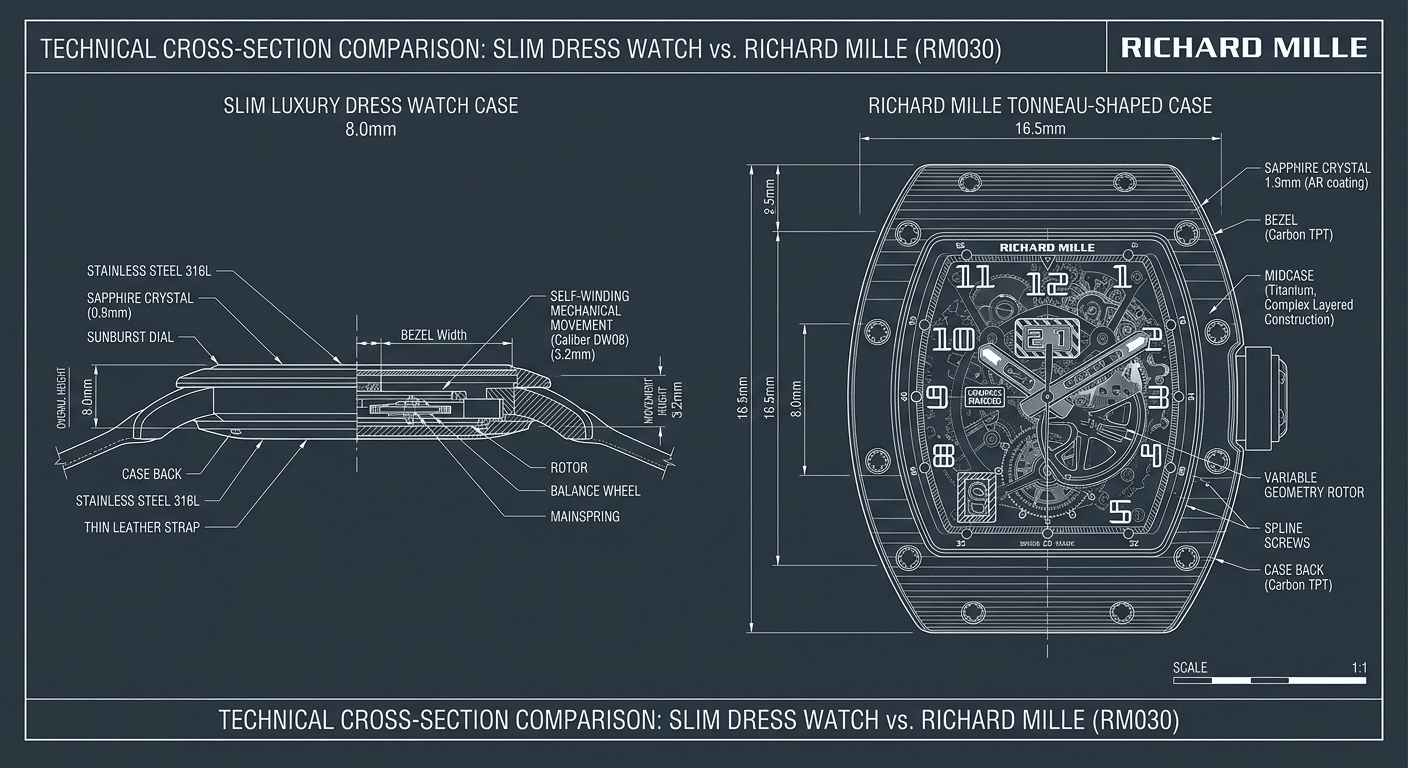
Traditional watchmaking often prioritizes a case that sits flush and conforms to the wrist’s natural curve. Richard Mille, from its inception, prioritized structural expression and movement visibility. The iconic tonneau (barrel) shape is a statement of architectural boldness, not a slave to ergonomic comfort. Its curved sides and angular lugs create a complex geometry that, while stunning, does not naturally “hug” the wrist. Instead of distributing pressure across a broad surface, the design often concentrates it at the lug tips and caseback edges. This is a deliberate trade-off: the shape is the signature, and comfort is secondary. A classic round watch from Patek or Vacheron can achieve a lower profile and more even contact; the Richard Mille tonneau is a sculptural object first, a wrist instrument second.
How Movement Architecture Forces Case Thickness
The staggering thickness of many Richard Mille models is not a stylistic choice but a mechanical necessity. To achieve the skeletonized, three-dimensional look, the movement must be mounted on a substantial chassis, often with multiple layers of bridges and plates visible from both sides. Take the RM 011 chronograph as a case study. Its height—over 16mm in genuine form—is driven by the stack of the manual winding mechanism, the chronograph module from Dubois-Dépraz, and the calendar complications. There is simply no way to house that functional complexity in a slim package. Replica factories, even when copying the design accurately, must still accommodate these spatial requirements. The result is that models like the RM 011, RM 50-03, and RM 055 are inherently thick watches, and their replicas inherit this fundamental dimension.
Replica Factory Compromises: Where Cost-Cutting Hurts Comfort
If the genuine design presents an ergonomic challenge, the replica often doubles it. Factories face three main pressures that directly degrade wearability:
- Movement Clearance: Clone movements, while visually closer, are rarely exact dimensional copies. To ensure the movement fits without binding, factories often mill the case interior with extra clearance, adding 0.5mm to 1.5mm to the final thickness. The Shanghai 7750-based RM 011 replicas are notorious for this, ballooning to 18mm or more.
- Material Density: Genuine Richard Mille uses aerospace-grade titanium and proprietary carbon composites. Replicas substitute lower-grade titanium, stainless steel, or forged carbon—all denser. A movement that should weigh 4.3 grams in genuine titanium can weigh 15-20 grams in brass/steel. That extra 10-16 grams, multiplied across the entire watch, translates to a noticeable heft on the wrist that feels disproportionate to the watch’s size.
- Simplified Curvature: The precise, multi-radius curvature of a genuine RM case is difficult and expensive to machine. Some replica factories simplify the curve, using a single, larger radius or even a slightly flatter back. This reduces manufacturing time but creates a case that contacts the wrist in fewer spots, increasing point pressure and reducing stability.
The “double penalty” is real: the design is already challenging, and the replica’s execution often makes it worse.
Expert Authentication Insight: Measuring Wrist Diameter vs. Case Length to Predict Overhang
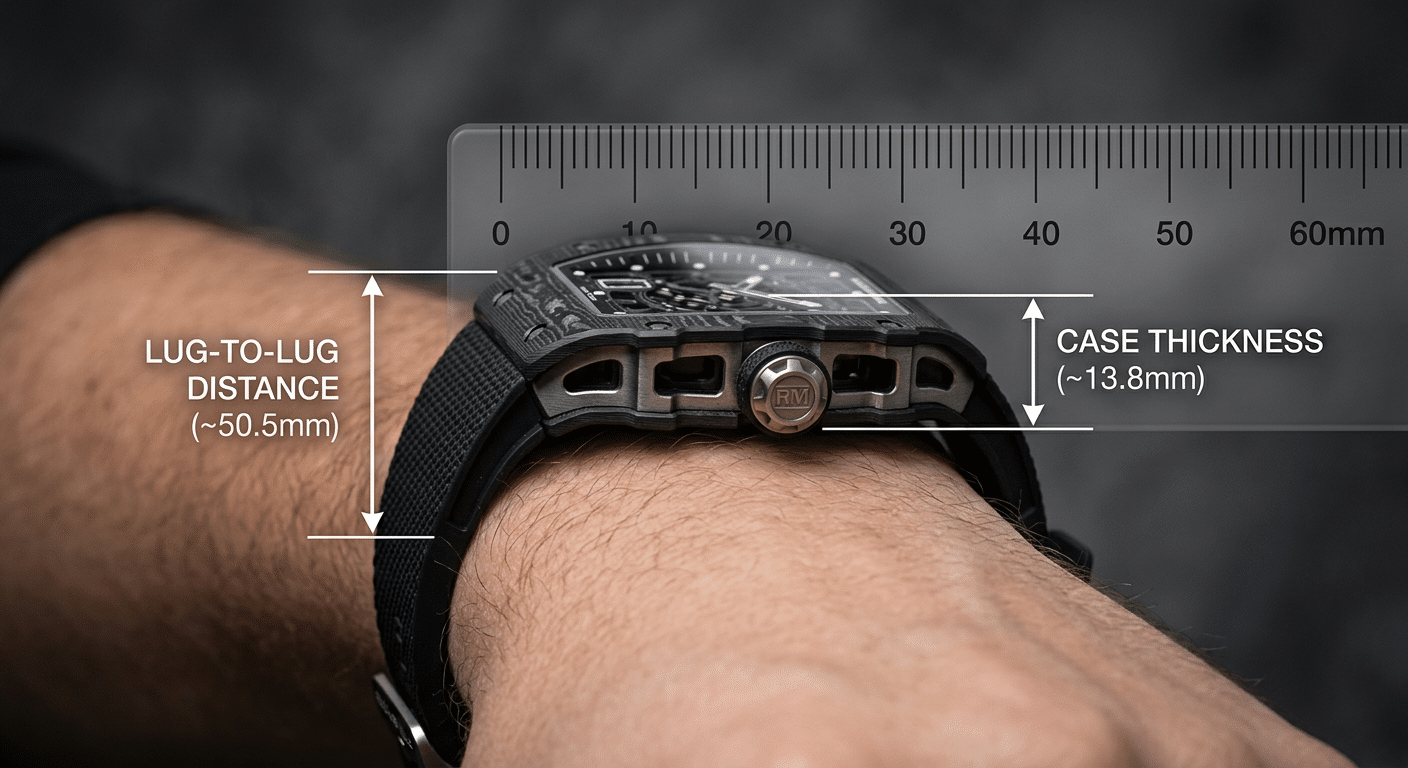
One of the most reliable predictors of discomfort is case overhang. While many buyers focus on the 42mm or 49.9mm diameter, the critical measurement is lug-to-lug. This is the horizontal span of the case, including the lugs. To predict overhang, measure your wrist circumference and convert it to an approximate diameter (circumference ÷ π). A 6.5-inch wrist has a diameter of about 52mm. For comfort, the lug-to-lug measurement should be at least 4-6mm less than your wrist diameter to allow the case to sit securely without extending past the bone structure. An RM 011 with its 50.5mm lug-to-lug on a 6.3-inch wrist (≈51mm diameter) will overhang significantly, creating a constant feeling of instability and snagging on sleeves. This simple calculation—wrist diameter minus desired clearance—should be your first filter before even considering a model’s aesthetics.
The Four Pillars of RM Case Wearability: Length, Curvature, Thickness, and Strap Integration
To move from vague feelings of discomfort to a systematic evaluation, we must deconstruct wearability into four measurable, interacting pillars. A watch that scores well on three but fails on one can still be unwearable. This framework allows for objective comparison between models and, crucially, between different factory versions of the same model.
Case Length and Width: The Wrist Footprint Equation
“Case length” here means lug-to-lug measurement. This is the single most important metric for predicting whether a watch will fit your wrist. A 49mm diameter watch with short, tucked-in lugs can wear smaller than a 42mm watch with long, projecting lugs. The wrist footprint is the area of your wrist covered by the case and lugs. Overhang occurs when this footprint extends beyond the bony sides of your wrist, causing the watch to rock, catch on objects, and feel insecure. For a 6.5-inch wrist, a safe target is a lug-to-lug under 48mm. For a 7-inch wrist, you can tolerate up to 52mm. Always check the specific model’s lug-to-lug measurement—official specs often list case diameter but hide the more critical lug width.
Curvature Match: How the Tonneau Arch Interacts with Your Radius
The tonneau shape is not a simple arc; it’s a complex, multi-radius curve. Your wrist also has a radius—the degree to which it rounds from the top to the sides. A perfect match means the caseback’s curvature mirrors your wrist’s radius, creating broad, even contact. A mismatch—a case that is too “flat” or has a radius that’s too tight—results in point pressure. The watch will only touch your wrist at the very edges of the caseback, leading to sore spots after an hour. Think of it like a chair: a well-designed seat distributes your weight over a broad area; a narrow plank concentrates it. Genuine RM cases are meticulously shaped for this contact. Replicas, due to simplified CNC programming or cost-cutting on finishing, often have a less optimal curve, making them feel “edgy” even if the thickness is acceptable.
Thickness Perception: Not Just Millimeters, But Edge Beveling and Weight Distribution
A 14mm-thick watch can feel incredibly slim, and a 12mm watch can feel like a brick. Thickness perception is a function of three things:
- Edge Treatment: A case with wide, gentle bevels from the crystal down to the caseback creates a visual and tactile slimming effect. Sharp, 90-degree edges make the watch feel thicker and catch on cuffs.
- Center of Gravity: Where the weight is concentrated matters. A watch with most of its mass in the movement (center) will feel balanced on the wrist. A watch where heavy materials are used in the caseback or lugs will feel top-heavy and pull downward, increasing the sensation of bulk.
- Top vs. Side Illusion: A very tall, but narrow, case can look thinner from above than a shorter, wider case. The RM 67-02, at just 7.8mm, feels disappearingly thin because its height is minimal and its width is spread out.
When evaluating a replica, don’t just note the thickness spec. Look at photos of the case profile: are the edges nicely chamfered, or are they sharp and blocky? That detail dictates whether the thickness is perceptible or negligible.
Strap Integration: The Hidden Impact of Lugs, Spring Bars, and Material Choice
The strap is not an afterthought; it’s the final link in the wearability chain. Richard Mille’s lug designs are often proprietary and integrated, meaning the strap is part of the case’s structural language. This creates two problems for replicas:
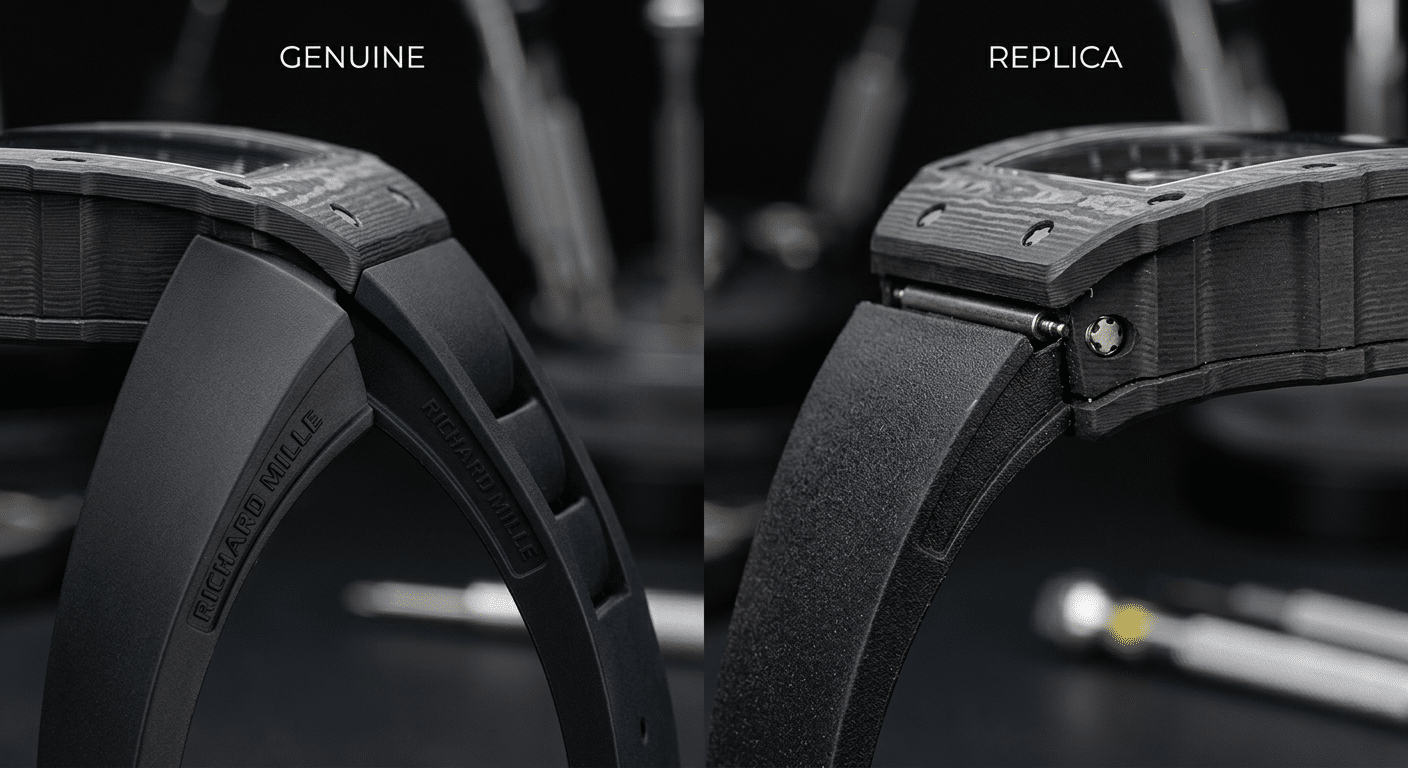
- Lug Geometry: The shape and angle of the lugs determine how the strap sits on the wrist. If the lugs are cast or milled with even slight inaccuracies, the strap may not lie flat, creating a twisting force that pulls the watch off-center. Poorly aligned spring bar holes can cause the strap to sit crooked, concentrating pressure on one side.
- Strap Material Stiffness: OEM fluoroelastomer straps are soft and flexible. Replica straps, even when visually identical, often use cheaper rubber that is stiffer out of the box and can develop memory bends. A stiff strap does not conform to the wrist, negating any comfort gained from a well-shaped case. Aftermarket straps, while sometimes higher quality, may not match the exact lug shape and can create gaps or pressure points.
True integration means the strap and case behave as a single system. A replica with a perfect case but a poor strap will still be uncomfortable.
Expert Authentication Insight: The “Paper Test” for Strap Flexibility and Lug Pressure Points
Here’s a simple, at-home test to gauge a replica’s strap integration and potential pressure points. Place a standard sheet of printer paper between the caseback and your wrist, then fasten the strap to a normal tightness. Now, twist your wrist slowly and flex your hand. If the paper crumples or tears easily, the strap is too stiff or the caseback pressure is too high in spots—a sign of poor curvature or a rigid strap. If the paper remains mostly flat and slides slightly, the combination of case curvature and strap flexibility is allowing the watch to move with your wrist. This test simulates the micro-movements that, over hours, cause soreness. It’s a quick way to identify a replica where the strap or caseback will likely cause irritation.
Wrist Size and Shape: How to Match Your Anatomy to the Right RM Replica
When evaluating a Richard Mille replica, the single most critical question is not “Does it look authentic?” but “Will it actually fit my wrist?” The brand’s iconic tonneau shape is an exercise in sculptural expression, not ergonomic universalism. A watch that looks like a masterpiece on a 7.5-inch wrist can become an overhanging, top-heavy burden on a 6.3-inch wrist. Your wrist anatomy is the ultimate filter that determines whether a replica becomes a daily-wear “grail” or a permanent “drawer queen.” This guide translates the abstract concept of “wearability” into a precise, personal sizing protocol.
Small Wrists (<6.5″): The Narrow Case Hunt and the Dangers of Overhang
If your wrist circumference measures less than 6.5 inches (approximately 165mm), you are in the most challenging territory for Richard Mille replicas. The brand’s design language is inherently expansive, and even its “smaller” models can dominate a petite frame. Your primary enemy is lug-to-lug overhang. A case that extends significantly beyond the edges of your wrist bones will not only look disproportionate but will also catch on sleeves, create pressure points, and feel unstable.
Your target is a lug-to-lug measurement of 48mm or less. This is a hard rule derived from simple geometry: for a 6.3″ wrist, subtracting 10-12mm for comfort and strap clearance leaves a maximum case footprint of about 46-48mm. Models like the RM 035 (typically ~47mm lug-to-lug) and the RM 67-01 (~46mm) become your prime candidates. Conversely, the legendary RM 011 replica, with its ~50.5mm length, is almost always a non-starter—it will overhang and feel like a brick strapped to your arm.
The secondary challenge is thickness perception. On a small wrist, every millimeter of thickness adds visual and physical heft. Prioritize models where the movement architecture allows for a slimmer case, like the automatic skeleton RM 67-01 (often ~8mm in the best replicas). Avoid chronograph replicas (RM 011, RM 65-01) and tourbillon models (RM 052), which add unavoidable bulk. The goal is to find a model where the case sits within your wrist’s width, not on top of it.
Medium Wrists (6.5″-7.5″): The Sweet Spot for Most RM Models
This is the golden zone. With a wrist between 6.5 and 7.5 inches, you can comfortably wear the majority of Richard Mille’s portfolio without extreme overhang or top-heaviness. Your target lug-to-lug range expands to 48mm to 52mm. This opens up the “balanced workhorse” category: the RM 035, RM 039, and RM 029 all fall comfortably within this footprint on a medium wrist.
However, “sweet spot” does not mean “no compromises.” Thickness remains a variable. A 7.5″ wrist with a slender, bony profile will still feel the difference between a 10mm and a 14mm case. You must still respect the four pillars. The advantage here is choice: you can prioritize aesthetics (a skeleton dial) or complexity (a chronograph) without automatically sacrificing basic comfort. For example, the RM 011‘s 50.5mm length is acceptable on a 7.3″+ wrist, but its 18mm+ thickness on many replicas will still be a daily presence. Your task is to balance your desire for a specific model against its tangible physical cost.
Large Wrists (>7.5″): Where the Tonneau Shines and Where It Still Fails
If your wrist exceeds 7.5 inches, the standard Richard Mille sizing paradox flips. The very models that overhang on smaller wrists now look appropriately proportioned, even elegant. The tonneau’s long, sweeping curves can fill a larger wrist beautifully. Your primary concern shifts from overhang to visual balance and thickness management.
You can venture into larger cases like the RM 011 or RM 052 without them looking like a “small watch on a big wrist.” However, the fundamental RM design—movement-driven thickness—remains. A 14mm+ thick case on a large wrist still creates a high center of gravity and a constant physical awareness. Furthermore, some of the “featherweight” models (like the RM 67-01 at ~42g) can actually look lost or too delicate on a substantial wrist. Your sweet spot lies in models that combine a larger footprint with reasonable mass, such as the titanium RM 035 or the ceramic RM 055, which distribute weight well.
Wrist Shape Matters: The Flat vs. Rounded Wrist Curve Challenge
Wrist circumference is only half the equation. The radial profile of your wrist—whether it’s flat, average, or prominently rounded—dictates how the case back interacts with your skin. This is the “curvature match” pillar in action.
A flat wrist (little vertical rise from the sides to the top) is the toughest test for a Richard Mille tonneau. The case’s pronounced arch is designed to sit on a curved surface. On a flat wrist, the center of the case back bears almost all the pressure, creating a single, concentrated point of contact. This leads to discomfort, redness, and a feeling of the watch “sinking in” after a few hours. You must actively seek models with the most aggressive, continuous back curvature. Some replicas, in cost-cutting, flatten the caseback; these are absolute avoidances for flat-wristed individuals.
A rounded wrist is the natural partner for the tonneau shape. The case arch can distribute its weight across a broader surface area, matching the wrist’s own curve. This maximizes comfort and stability. If you have a rounded wrist, you have more flexibility in the models you can tolerate, even those with slightly less pronounced caseback curvature.
Expert Authentication Insight: The String Method: Accurately Measuring Your Wrist for Case Fit Prediction
Before you even look at a model list, get your baseline numbers. Forget the “feel” of a leather strap; you need hard data and precise metrics. According to any entry-level Richard Mille super clone guide, accurate wrist measurement is the first step in evaluating wearability and risk. Use a flexible tailor’s tape measure or a thin string and a ruler to obtain those critical dimensions.
- Circumference: Wrap the tape or string snugly around the bony protrusions of your wrist (the ulna and radius). Mark or note the measurement in both inches and millimeters. This is your total wrist size.
- The “Comfort Subtraction”: A watch does not occupy the entire circumference. The case sits on the top of the wrist, and the strap occupies the sides and bottom. A reliable rule is to subtract 10-12mm from your total wrist circumference to estimate your maximum comfortable lug-to-lug measurement. Example: A 6.5″ (165mm) wrist → target case length ≤ 153-155mm (~48mm).
- Shape Assessment: Look at your wrist from the side. Can you easily slide a finger between the top of your wrist and the bottom? If it’s a tight, flat plane, you are flat-wristed. If there’s a noticeable curve, you are rounded.
This simple test eliminates guesswork. A model with a 50mm lug-to-lug may be listed as “42mm diameter” and seem small, but on a 6.2″ wrist, that 50mm will be a dealbreaker. Measure first, shop second.
Lifestyle Scenarios: Which RM Replica Is Best for Commuting, Office, Travel, and Weekend Wear?
Wearability isn’t an abstract score; it’s the sum of your daily friction points. A watch that feels fine on the couch can become a nuisance on a crowded train or under a shirt cuff. The Richard Mille’s architectural drama—its exposed screws, sculpted lugs, and skeletonized depth—creates unique interactions with real life. Let’s map the four pillars of comfort (Length, Curvature, Thickness, Strap Integration) onto your actual routine.
The Daily Commuter: Lightweight, Low-Profile, and No-Snag Design
The commute is a series of micro-interactions: twisting your arm to grab a backpack strap, leaning against a train window, checking your phone while holding a coffee. Your RM replica must be an invisible participant, not a snagging hazard.
Prioritize: Low weight (under 60g with strap) and smooth, flowing lines. Sharp lug edges or prominent crown guards will catch on bag straps, jacket seams, and seatbelts. A rubber or fluoroelastomer strap is ideal—it’s flexible, quiet, and won’t flop around like a leather strap might. The RM 67-01 and RM 035 are top choices here, especially in carbon or titanium, weighing in the 40-60g range. Their relatively low profiles and integrated lug designs minimize protrusions.
Avoid: Any model with a long, angular lug design or a massive crown. The RM 011 replica, with its 50.5mm length and prominent pushers, is a commuter’s nightmare—it will hook on everything. Also, beware of cheap aftermarket metal bracelets; they can be heavy and have sharp edges where the links connect.
The Office Professional: Subtle Presence and All-Day Comfort Under a Cuff
The office test is two-fold: physical comfort during eight hours of typing and ergonomic compatibility with formal wear. The watch must disappear under a dress shirt cuff but still be legible when you need it.
Prioritize: Thin profile (case thickness under 11mm from top to bottom) and short lugs. A thick watch will bulge a shirt cuff, creating an unsightly “tent” effect and making the sleeve feel tight. The RM 016 (genuinely one of RM’s thinnest offerings, replicas ~9.6mm) and the RM 029 are excellent. A brushed or matte finish (vs. high-polish) is also more appropriate and shows fewer desk scratches. Crucially, the strap must be slim and flexible to allow the watch to slide easily under a tight cuff—test this with the “Cuff Test” below.
Avoid: Skeleton dials can be too busy and “flashy” for conservative offices, but the bigger issue is physical bulk. Any model over 12mm thick will fight with your cuff all day. Also, avoid bright, polished bezels that reflect light distractingly under fluorescent lighting.
Expert Authentication Insight: The “Cuff Test”: How to Check if a Replica Will Fit Under Dress Shirt Cuffs
This is a non-negotiable physical test you can perform at home. Put on a standard dress shirt with French cuffs (or any tight cuff). Try to slide the watch with its intended strap under the cuff opening.
- Pass: The watch slides through with minimal resistance, and the cuff closes comfortably without pulling at the watch or creating a visible bulge on the outside of the fabric.
- Fail: You have to force it, the cuff strains, or the watch gets “stuck” halfway. This means the combination of case thickness, lug width, and strap thickness is too much for standard formal wear. You will be constantly adjusting it and will likely avoid wearing it with shirts.
Remember: a strap swap can fix a bad fit. If the watch case passes but the stock strap is too thick, a thinner aftermarket strap (like a 2mm rubber) can solve the problem. But if the case itself is too thick, no strap will help.
The Travel Companion: Durability, Time Zone Clarity, and Airport-Friendly Security
Travel subjects a watch to jostling, time zone changes, and security scans. The ideal travel RM is a “set it and forget it” piece that is legible, durable, and hassle-free.
Prioritize: Material durability and legibility. A titanium or ceramic case (from ZF, APS, or BBR) will resist bumps and scratches better than carbon fiber, which can chip. For legibility, avoid skeleton models with busy dials; a clean dial with luminous hands and clear hour markers (like the RM 035 or RM 029) is far easier to read at a glance in a dark car or on a dim flight. GMT or dual-time functionality is a bonus, but few RMs have it.
Security Note: Richard Mille movements are not magnetic, so they are safe for metal detectors. The real risk is accidental impact. A protruding crown or pusher (like on an RM 011 chronograph) is a vulnerability. A recessed crown is better. Also, ensure your strap clasp is secure; a flimsy deployment clasp that pops open in a crowded terminal is a major risk.
Avoid: Ultra-thin models (RM 67-01) can be more delicate due to their thin crystals and complex case shapes. While beautiful, they are more susceptible to case back flex under pressure. Also, avoid models with exotic, easily damaged straps (like the perforated rubber on some RM 27 models) that can snag on luggage.
The Weekend Warrior: When (and Why) to Avoid RM for Active Use
Let’s be blunt: the Richard Mille, even a replica, is a terrible “sports watch” in the traditional sense. Its design ethos is for the golf course or tennis court—controlled, precise athleticism—not for hiking, swimming, or gym work.
The Fundamental Mismatch: RMs are built for shock resistance in a specific direction (through the movement’s axis) via Incabloc-type systems, but their tonneau case is not sealed for water resistance. No RM replica is truly water-resistant. The complex case shape with multiple screws and gaskets makes a reliable seal nearly impossible to achieve in the replica world. The universal community warning is: “Do not go near water.” Washing hands is a calculated risk; swimming is a death sentence.
Physical Vulnerability: Sharp case edges, protruding crowns, and exposed screws are snag magnets. A fall onto concrete can easily chip a carbon fiber case or dent a titanium one. The lugs can dig into your wrist during repetitive motion (cycling, weightlifting).
Recommendation: Designate your RM replica as a “dry land” watch. For active weekends, have a dedicated beater—a Seiko, G-Shock, or even a cheap digital. If you must wear your RM for light weekend activities (brunch, casual outings), choose the most robust-seeming model: a titanium RM 035 or a ceramic RM 055 with a solid, integrated strap. But for anything involving sweat, water, or impact, leave it at home. The “Weekend Warrior” for an RM is a contradiction in terms.
Factory-Specific Comfort Differences: Why Not All Super Clones Feel the Same on Wrist
The prevailing narrative focuses on factory battles over movement accuracy and carbon fiber patterns. But the more insidious, experience-shaping difference lies in ergonomic execution. Two RM 35-02 replicas from different top factories can have identical dials and moving gears, yet one will feel like a natural extension of your arm while the other feels like a poorly fitted prosthesis. This is because comfort is determined by micron-level tolerances, material density, and finishing quality—areas where factories diverge significantly.
Case Thickness Tolerance: How Factories Squeeze Movements and Add Bulge
The #1 comfort killer is thickness, and it’s where factory variation is most pronounced. The root cause is the movement. A clone movement that is 0.3mm taller than the genuine spec forces the caseback to sit higher. But factories also make independent choices: some use a thicker sapphire crystal mount, some add extra gasket material, some machine the caseback cavity less deeply.
Example: The genuine RM 67-01 is a marvel of thinness at 7.80mm. The AVS Factory version has achieved a remarkable 7.8mm replica thickness by meticulously optimizing every internal cavity. However, other factories’ versions of the same model can measure 8.4mm or more—a 0.6mm difference you can feel on the wrist. For a model like the RM 011, where the genuine is 16.15mm, the replica baseline from KV/KU is a monstrous 18mm+. But even among “super clone” factories, an RM 011 from a hypothetical “better” miller might hit 17.2mm, while a less precise one is 18.5mm. That 1.3mm is the difference between “noticeably thick” and “unwearable.”
The Takeaway: When researching a model, you must ask not just “which factory?” but “which version/iteration from that factory?” The V6 of a model might shave 0.2mm off the caseback compared to the V5. This is why community reviews that mention “feels thinner than expected” are gold.
Beveling and Edge Finishing: The Unseen Comfort Factor
Thickness is a number; edge finishing is a sensation. A case with perfectly beveled, polished edges (where the side of the case meets the lugs) will glide over skin and clothing. A case with sharp, 90-degree CNC edges—even if the same thickness—will dig into the wrist bone and catch on everything.
This is a major differentiator between Tier 1 and Tier 2 factories. Top factories (APSF, ZF, BBR) invest in hand-beveling and final polishing passes on case edges. Lower-tier factories often skip this step, leaving a “machined” feel. The difference is palpable when you run a finger along the lugs. For a watch you wear daily, this is a make-or-break detail. A sharp lug edge on an otherwise beautiful watch will force you to take it off after a few hours.
Strap Quality: OEM vs. Aftermarket and the Impact on Flexibility
The strap is half the wearing experience. A stiff, poorly molded rubber strap can make a perfectly ergonomic case feel rigid and unyielding, especially when evaluating Richard Mille super clone watches. Factory OEM straps vary wildly, as detailed in the Richard Mille Super Clone Models Guide, affecting everything from immediate comfort to long-term durability.
APSF’s rubber straps for the RM 35-02 are frequently praised for their softness and flexibility, matching the genuine’s fluoroelastomer feel. ZF’s straps have been criticized in some versions for being harder and less pliable. BBR’s straps are often described as having a “cheap silicone” texture. This isn’t just about luxury; a stiff strap does not conform to the wrist, creating pressure points at the lugs and the clasp. It also makes the “Cuff Test” much harder to pass.
Solution: Budget for an aftermarket strap from a reputable maker (like Horatech in the RWI community). A $50-$100 high-quality rubber or canvas strap can transform the comfort of a $800 watch. But the best-case scenario is an OEM strap that is soft from the factory. Ask your dealer for close-up photos and, if possible, a video of the strap being flexed.
Weight Distribution: Heft vs. Balance in Different Factories’ Versions
Total weight is one thing; balance is another. A watch that is 80g but has its mass centered and low on the wrist will feel more comfortable than a 70g watch where the weight is all in the lugs or the crown side.
This comes down to material density and internal construction. A movement with brass bridges (heavier) vs. aluminum (lighter) changes the center of gravity. A case with a steel inner frame vs. a titanium one changes overall density. Carbon fiber cases (from APSF, ZF, BBR) are inherently lighter than ceramic or titanium, which can make a big difference on a smaller wrist. However, if a carbon case uses a heavier metal core or has poorly balanced weight distribution, it can still feel “tippy.”
Practical Check: When you receive QC photos, look for the watch on the dealer’s wrist (if provided). Does it sit flat, or does it seem to rotate or pull to one side? This is a subtle but important sign of balance. A well-balanced watch “disappears”; a poorly balanced one constantly reminds you of its presence.
Expert Authentication Insight: The Scale Test: Comparing Weights of the Same Model from Different Factories
This is the most objective, data-driven way to compare comfort potential. A digital gram scale is a $20 tool that provides invaluable insight. Community members who conduct “weight tests” are providing a major service.
How to use this data:
- Find a trusted review (on RWI, RepTime, or a respected YouTube channel) that lists the complete watch weight (case + strap) for the exact factory and model version you’re considering.
- Compare that number to the genuine weight (often published by Richard Mille). A gap of 15-40g is typical for replicas due to brass movements and denser case materials.
- More importantly, compare across factories for the SAME model. If Factory A’s RM 35-02 weighs 68g and Factory B’s weighs 75g, that 7g difference is meaningful for comfort, especially on smaller wrists. That weight usually comes from a thicker case, denser materials, or heavier movement components.
Caveat: Weight alone doesn’t tell the whole story—balance matters too. But all else being equal, the lighter, more carefully milled version will be more comfortable. Make weight specs a mandatory part of your pre-purchase research checklist.
The Long-Term Reality: How Wearability Affects Ownership Satisfaction and Resale
The initial thrill of unboxing a Richard Mille replica—the heft, the visual drama, the skeletal machinery on full display—can fade alarmingly fast if the watch fights your wrist. This is the “drawer queen” phenomenon: a piece of stunning horological art that spends more time in a case than on your arm because it’s simply too uncomfortable to wear. The true cost isn’t just the $500–$1,000 you spent; it’s the amortized cost per wear. A $3,000 replica worn 50 times costs $60 per outing. If you wear it only five times before abandoning it, that figure skyrockets to $600 per wear. You haven’t bought a watch; you’ve bought expensive frustration.
This disconnect between visual desire and physical reality is driven by two powerful psychological traps. First, the sunk cost fallacy makes us cling to an uncomfortable watch because we’ve already invested in it, convincing ourselves we’ll “get used to it.” Second, hedonic adaptation—our brain’s ability to tune out minor irritations—simply doesn’t apply to Richard Mille’s pronounced bulk. A watch that digs into your wrist bone or extends a centimeter past your ulna doesn’t fade into the background; it announces itself with every movement. The result is a watch that is actively avoided, gathering dust while a comfortable beater gets all the wrist time.
The “Drawer Queen” Phenomenon: When Gorgeous Watches Go Unworn
Community forums are filled with these stories. One user on RWI detailed selling their “perfect” RM 011 replica after just two months, stating bluntly it “felt like a brick” and was a “one-glance fake” because no one with a genuine would tolerate that weight and thickness. The watch was visually convincing in photos, but on the wrist, it was a deal-breaker. This isn’t about authenticity detection by others; it’s about self-sabotage. You, the owner, become the most harsh critic because you have to live with the thing. The “drawer queen” is ultimately a failure of the wearability filter, not the visual one.
Comfort as a Resale Factor: Why Wearable Models Hold Value Better
The second-hand market for replicas is not just about condition; it’s about demonstrated utility. A watch that has been worn regularly shows patina—fine scratches on the case, perhaps a slightly stretched strap—but this is a positive signal. It proves the watch is wearable. A potential buyer sees a well-worn RM 67-01 and thinks, “This must be comfortable enough for daily use.” Conversely, a pristine, unworn RM 011 raises a red flag. Savvy buyers will ask, “Why wasn’t this worn?” and the answer almost always points to ergonomic failure. Models with a reputation for poor comfort (the RM 011 chronograph being the prime example) have a smaller, more hesitant buyer pool. Even in excellent cosmetic condition, they can be harder to move because the next owner inherits the same discomfort. Your future resale value is directly tied to your present willingness to wear the watch.
Adaptation vs. Tolerance: Can You Get Used to an Uncomfortable RM?
There’s a crucial distinction here. Adaptation is your nervous system tuning out a stimulus. Tolerance is your body enduring pain or pressure. For most Richard Mille replicas, you are building tolerance, not adapting. The human body does not adapt to sustained point pressure from a sharp lug edge or the constant pendulum weight of a 19mm-thick chronograph. You may *tolerate* it for a special occasion, but for daily wear, the discomfort becomes a persistent cognitive load. The only true adaptation is to your own behavior: you adapt by reaching for a different watch. The RM’s design philosophy—structural expression over ergonomics—means the most iconic models (like the RM 011) are fundamentally at odds with all-day comfort. You can’t think your way out of poor geometry.
The True Cost of Discomfort: Missed Wear Time and Opportunity Cost
Let’s quantify the loss. If you own five watches, and one is an uncomfortable RM replica that you wear only 5% of the time, you’ve effectively paid for a watch that provides 95% less utility than your others. The “opportunity cost” is the enjoyment and utility you *could* have derived from spending that same $800 on a truly comfortable, versatile watch you’d actually wear. This isn’t just about money; it’s about the psychological value of ownership. A watch you love wearing becomes a positive feedback loop. A watch you dread putting on becomes a source of minor daily regret. The long-term reality is that wearability determines whether your replica becomes a cherished part of your collection or a static trophy that serves only to validate a past purchase decision.
Expert Authentication Insight: The 30-Day Wear Log: A Simple Method to Objectively Judge Comfort
Before finalizing any purchase, institute a mandatory 30-day trial period if your dealer allows it (most reputable TDs will accept a return within a week or two for quality issues, but a 30-day *wear* log is your personal protocol). For one month, wear the watch as your primary timepiece. Don’t just note “it was fine.” Record specifics: “Day 3: Lug edge pressed into radial bone after 4 hours.” “Day 10: Had to take it off during 2-hour meeting due to weight shift.” “Day 25: Reached for Seiko instead.” This log transforms subjective feeling into data. If you find yourself consciously or unconsciously avoiding the watch more than three times a week, it fails the test. The goal isn’t to prove you can endure it; it’s to discover if your life and wrist naturally accommodate it. If the answer is no, the watch—no matter how perfect visually—is the wrong one for you.
Final Verdict: The Top 5 Most Wearable Richard Mille Replica Models and Who They’re For
Synthesizing the four-pillar framework (Length, Curvature, Thickness, Strap Integration) with real-world factory outputs and community wear reports, here is a definitive, comfort-first ranking. These models represent the best chance of achieving the RM aesthetic without sacrificing daily usability. The scores are weighted toward thickness control and lug-to-lug measurement, as these are the most common failure points.
#1: RM 67-01 (Extra-Flat Skeleton) – The Ultralight Champion for Small to Medium Wrists
Comfort Score: 9.5/10
Key Attribute: Extreme thinness and low weight. The CRMA6 automatic movement is designed for slimness.
Why It’s Comfortable: This is the rare RM where the replica approach genuinely matches the genuine’s ergonomic goal. Top factories (AVS, APSF) achieve ~7.8–8.4mm thickness and weights as low as 36–42g. The lug-to-lug is compact for a 44.5mm case, and the pronounced tonneau curvature distributes pressure beautifully.
Ideal Wrist/Scenario: Wrists 6.0″–6.8″. Perfect for all-day office wear, travel, and as a lightweight statement piece. The skeleton dial is less “loud” than a chronograph.
Recommended Factory: AVS Factory for the thinnest, lightest version with a working rotor. APSF also makes a competent version.
Caveat: The automatic rotor can be audible in a quiet room. Strap sizing on some versions can be restrictive for larger wrists (>7.5″).
#2: RM 035 (Manual Skeleton) – The Balanced All-Rounder for Daily Use
Comfort Score: 8.5/10
Key Attribute: Proven ergonomics from a sports-luxury platform. Short, integrated lugs.
Why It’s Comfortable: The RM 35-02’s case dimensions (approx. 50mm lug-to-lug) are well-managed for its 42mm diameter. The integrated lugs and rubber strap create a seamless, flexible interface. While thicker than the RM 67-01 (~14mm), the weight distribution is excellent, and the curvature is effective.
Ideal Wrist/Scenario: Wrists 6.3″–7.2″. The quintessential “daily driver” RM. Suitable for commuting, casual outings, and even light travel. Avoid for very formal cuffs.
Recommended Factory: ZF (V7) for the most refined finishing and visible moving gears. APSF for a slightly thinner case and superior rubber strap.
Caveat: At ~14mm, it’s still a thick watch. Those with very slender wrists (<6.2″) will feel the bulk. The chronograph-style pushers add visual weight.
#3: RM 71-01 “Talisman” – The Elegant Thin Option with Unique Appeal
Comfort Score: 8.0/10
Key Attribute: Ultra-thin manual-winding profile with a distinctive crown placement.
Why It’s Comfortable: With a genuine thickness of ~8.1mm (replicas from APSF and ZF are within 0.5mm), this is among the thinnest RMs ever made. The smaller 40mm case and elegant, flowing lines make it surprisingly low-profile. The crown at 12 o’clock avoids the common 3 o’clock bulge issue.
Ideal Wrist/Scenario: Wrists 6.0″–6.8″. Ideal for dressier occasions, office environments, and those who want an RM that slides under a cuff. Its unique aesthetic is a conversation starter without the heft.
Recommended Factory: APSF leads on this model with excellent case finishing. ZF’s version is also very good.
Caveat: The manual winding requires daily attention. The crown position takes a day to get used to. Less “sporty” than other RMs, so it targets a different aesthetic.
#4: RM 029 (Automatic with Date) – The Underrated Medium-Size Workhorse
Comfort Score: 7.5/10
Key Attribute: Forgotten gem with sensible proportions. A classic three-hand automatic that doesn’t over-engineer the case.
Why It’s Comfortable: The RM 029 maintains a relatively modest profile for an RM. Case thickness is around 11.5–12.5mm in replicas (ZF is the main maker), and the lug-to-lug is shorter than the 035/011 family. It lacks the complex architecture that forces bulk in chronographs or tourbillons, resulting in a more “traditional” wearing experience while retaining the tonneau identity.
Ideal Wrist/Scenario: Wrists 6.5″–7.5″. A perfect everyday watch for those who want an RM without the skeleton drama or chronograph thickness. Excellent for commuting and general wear.
Recommended Factory: ZF Factory is the sole major producer. Their execution is solid and reliable.
Caveat: Less visually complex than skeleton models. The date function can be a minor alignment point to check on replicas. Not as widely available as the 035 or 055.
#5: RM 11-03 (McLaren) – The Compromise Statement Piece (With Major Caveats)
Comfort Score: 6.0/10
Key Attribute: The iconic McLaren design in a slightly more manageable form than the RM 011.
Why It’s (Conditionally) Comfortable: The RM 11-03 uses a different case construction than the older RM 011. Replicas from ZF and APSF are thinner (~13.5–14.5mm vs. 18mm for RM 011) and have refined lug shapes. It’s still a large, heavy watch, but it’s the *least bad* of the large, complex RM statements.
Ideal Wrist/Scenario: Wrists >7.0″ only. For the enthusiast who *must* have a McLaren RM and accepts a significant presence on the wrist. Best for weekend wear, not all-day office use.
Recommended Factory: APSF for the latest movement and best case finish. ZF is also a strong contender.
Caveat: This is a statement watch first, a comfort watch tenth. It will dominate the wrist. The push-pull chronograph layout is not ideal for daily wear. Only rank this #5 because the alternatives (#6 and below) are objectively worse for comfort.
Models to Approach with Caution: The RM 011, RM 50-03, and Other Thick Monsters
These are the “drawer queen” candidates. They look spectacular in a display case but are ergonomic liabilities on a living wrist.
- RM 011 / RM 11-02 (Felipe Massa Flyback): The undisputed king of discomfort. The modified Shanghai 7750 movement forces a case thickness of 17–19mm in replicas (genuine is 16.15mm). Lug-to-lug exceeds 52mm. It’s a chronograph with a long, heavy case that dominates any wrist under 7.5″. Even the best KV/KU version is a brick. Verdict: Avoid for daily wear. A “special occasion only” watch at best.
- RM 50-03 McLaren Split-Seconds: The Graph TPT case is visually stunning, but the movement complexity demands extreme thickness. Replicas (primarily from BBR, now defunct, and others) push 16mm+. The split-second mechanism adds bulk. This is a museum piece, not a wristwatch. Verdict: Aesthetic marvel, ergonomic disaster.
- RM 052 Skull (Tourbillon): EUR Factory’s titanium version weighs ~116g. The skull design creates sharp edges and poor strap integration. It’s a sculpture you mount on your arm, not a tool you wear. Verdict: For collectors who prioritize the “wow” factor over all else.
- RM 61-01 Yohan Blake: The irregular case shape (thicker on crown side) is a novelty that becomes a nuisance. At ~101g and 16mm+ on one side, it’s unbalanced and heavy. Verdict: A conversation piece that fails as a daily wearer.
Expert Authentication Insight: The “Dealbreaker Checklist”: Three Non-Negotiable Comfort Tests Before Buying Any RM Replica
Before you even consider factory reputation or movement clone accuracy, run this brutal filter. If a model fails two or more, walk away—no matter how beautiful it is.
- Lug-to-Lug vs. Wrist Circumference: Measure your wrist. Subtract 10–12mm for comfort clearance. Your target maximum lug-to-lug is that number. If the watch’s lug-to-lug exceeds your wrist circumference by more than 5mm, it will overhang and catch on sleeves. This is the #1 cause of buyer’s remorse.
- Case Thickness: Any replica over 13mm thick (measured at the center) is a serious comfort risk for wrists under 7.0″. Over 15mm is almost universally uncomfortable for daily wear. Remember: genuine RMs are already 12–16mm; replicas often add 1–3mm.
- Strap Flexibility & Integration: Does it come with a stiff, generic leather strap that won’t bend? Are the lugs designed for a specific, proprietary strap shape that limits aftermarket options? If the stock strap is rigid or the lug design creates pressure points, you cannot fix this with a $20 strap swap. The integration must be sound from the factory.
The final verdict is not about finding the “best” Richard Mille replica. It’s about finding the most wearable Richard Mille replica for you. The market’s technical prowess is impressive, but it means nothing if the watch sits in a drawer.
Your Decision Hierarchy:
- Start with your wrist. Measure it honestly. This is non-negotiable biology, not opinion.
- Define your primary use case. Commute? Office? Weekend? This dictates your tolerance for thickness, weight, and cuff-friendliness.
- Apply the Dealbreaker Checklist. Eliminate any model that fails the three basic comfort tests. This is your primary filter.
- From the survivors, choose by aesthetics and factory reputation. Now, and only now, can you safely prioritize visual accuracy, movement clone quality, and dial details. You are choosing from a pool of watches that will actually get worn.
In the world of Richard Mille replicas, wearability is the ultimate luxury. A watch that fights you is a failed object, no matter how many hours were spent replicating its carbon fiber weave. The goal is not to own an RM. The goal is to enjoy an RM. Measure your wrist tonight. Then revisit this guide. Your future self—the one who actually wears the watch—will thank you.