
Most Richard Mille replica buyers are drawn to the visual drama of a tourbillon or chronograph, but these complex movements often fail under the shock, dust, and constant motion of daily wear. The central decision isn’t which movement looks most impressive in a display case—it’s which one will still be running accurately after six months of regular use. This article cuts through the visual appeal to rank replica RM movements by real-world reliability, and Richard Mille replica movement serviceability is a key consideration in this analysis, helping you choose between fragile spectacle and practical stability for a watch you plan to wear often.
| Movement Type | Daily Wear Verdict | Key Weakness to Know |
|---|---|---|
| Simple automatic (Miyota 9015, Seiko NH35) | Best choice for daily use | Less visually exciting; may need rotor silencing mod |
| Hand-wound skeleton | Strong compromise; good visual drama | Fragile internal components can snap under heavy winding |
| Automatic skeleton | Decent but more failure points than simple automatic | Open gear train collects dust faster |
| Chronograph (modular) | Not recommended for daily wear | Stiff pushers, misaligned subdials, adds thickness and unreliability even when unused |
| Tourbillon | Highest risk; avoid for everyday use | Fragile, often inaccurate, difficult to service or replace |
Quick Questions Before You Read
Q: I want the most reliable RM replica I can actually wear to work. Which movement should I look for?
Stick with a simple automatic movement—ideally a Miyota 9015 or Seiko NH35. They self-wind, hold 40+ hours of reserve, and any local watchmaker can service them. The trade-off is a less skeletonized dial.
Q: Is a hand-wound skeleton movement safe for daily wear, or will it break quickly?
It is the safest visually impressive option, but winding strength matters. Overly forceful winding can snap delicate gear-train pivots. If you choose this route, wind gently and stop at resistance.
Q: Are all tourbillon replica movements unreliable, or are some factories better than others?
Even the best factory tourbillons are fragile for daily wear. They are more sensitive to shock, less accurate than simple automatics, and difficult to repair when they break. Most buyers who wear a tourbillon daily report failure within months.
Q: Before buying, what quick test can I do to check movement health?
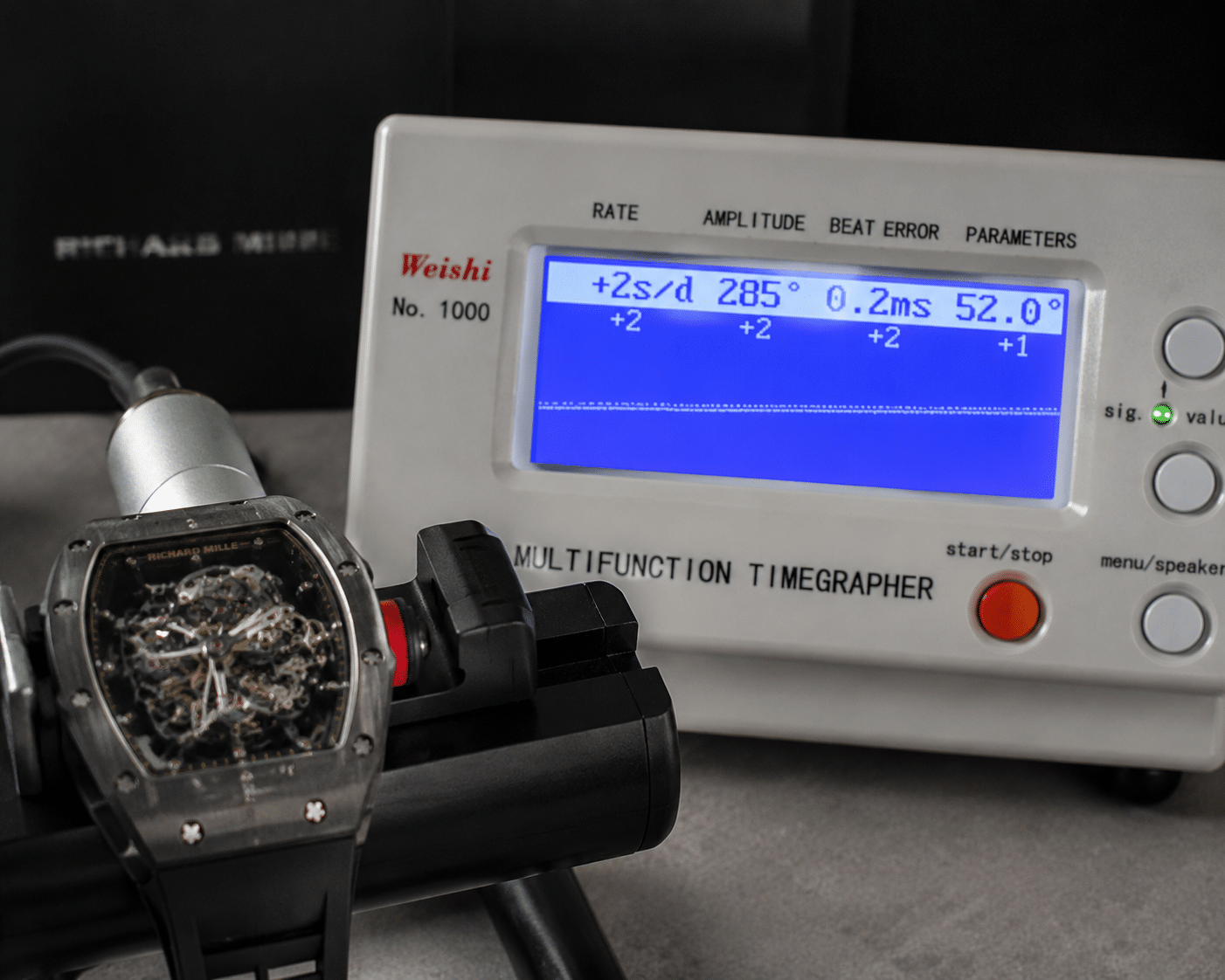
Ask the seller for a timing test result. Look for rate within ±15–25 seconds per day, amplitude above 250°, and beat error under 1.0 ms. Also listen for rotor noise and feel the winding action—grinding or sticking are red flags.
Why Most Richard Mille Replica Buyers Choose the Wrong Movement for Daily Wear
The most impressive-looking movement inside a Richard Mille replica is rarely the best choice for daily wear. This is the single most important distinction a buyer can understand, yet it is the one most commonly ignored.
Richard Mille replicas attract buyers through visual spectacle. The skeletonized architecture, exposed gears, visible balance wheels, and exotic tonneau case shapes create a wrist presence that round-case watches simply cannot match. When a buyer first browses photos of an open-worked RM replica with a tourbillon spinning at six o’clock or a chronograph with layered subdials, the reaction is immediate: that is what I want. The decision is made on impact. The movement is judged by how dramatic it looks through the dial, not by how it will behave after a month of regular use.
That gap between first impression and long-term experience is where most buyers go wrong. A tourbillon cage that looks mesmerizing in a promotional video may stop running smoothly after a few weeks of wrist movement. A chronograph with beautifully aligned pushers on arrival may develop subdial stutter or reset failure within months. The same visual complexity that makes the watch exciting in photos also creates more mechanical stress, more friction, more opportunities for dust ingress, and a much higher service burden. The tonneau case shape, which gives RM watches their distinctive silhouette, also makes movement replacement and servicing more complicated than it is for a standard round watch.
Buyers often ask which movement is safer for a daily driver RM replica, but they are really asking two different questions. One is about visual desire. The other is about mechanical survivability. These two questions do not lead to the same answer. A simple automatic movement with minimal decoration will never look as dramatic as a full skeleton tourbillon under macro photography. But it will wind itself during the day, require fewer winding cycles, produce less noise, and survive more real-world handling. The buyer who chooses the tourbillon because it looks like a million-dollar watch may end up with a watch that runs poorly after a year.
Over the next sections, we will compare the main movement routes found in Richard Mille replicas — simple automatic, hand-wound skeleton, chronograph, and tourbillon — from the perspective of daily wear. The goal is not to dismiss visually impressive movements but to help the buyer decide whether the tradeoff between spectacle and stability is one they are actually prepared to accept.
Editorial Perspective: The difficulty with RM replica movement choices is that factory reputation and movement spectacle are often conflated. A buyer might assume that a tourbillon from a well-known factory is inherently superior to a simple automatic from a lesser-known factory. The reality is that a tourbillon from any factory still carries the mechanical risk of a rotating cage, exposed gear train, and fragile balance staff, whereas a simple automatic from even a mid-tier factory, based on a widely produced platform like the Miyota 9015, is far more likely to withstand daily shocks and dust. The factory name helps narrow the search, but the movement architecture ultimately determines the daily-wear outcome. At cleanvsfactory.com, this kind of comparison is treated as a buyer-first judgment — the right question is not “which factory makes the best tourbillon,” but “does a tourbillon make sense for how I intend to wear this watch?”
What “Daily Wear” Actually Means for a Richard Mille Replica Movement
Before comparing movement types, it helps to define what daily wear actually involves for a replica watch. The term sounds straightforward, but buyers often underestimate the stresses that regular use places on a movement, especially inside a tonneau-shaped skeleton case.
Daily wear means the watch goes on the wrist in the morning and stays there through the workday: typing at a desk, walking through a parking lot, opening a car door, setting a bag down on a table. It means the watch is worn on weekends for casual errands, not for heavy labor, sports, or swimming. It is removed at night and stored on a bedside table or in a watch box. The next morning, it is put back on. This cycle repeats every day, not once a week for photos.
This routine creates specific stresses that a display-case watch never experiences. Every wrist movement winds or shakes the rotor. Every desk bump transmits shock through the case to the movement. Every opening and closing of the crown wears the winding mechanism a little more. Every day of wear exposes the movement to dust, humidity, and temperature changes that a watch stored in a box avoids. For a skeleton replica, where the movement is partially visible through the dial and caseback, dust paths are shorter and more direct.
Rotor noise becomes a real annoyance in daily wear. A loud grinding rotor on a simple automatic movement is distracting during a quiet meeting. A chronograph pusher that feels spongy on day one will not improve after a hundred presses. A hand-wound movement with a stiff crown will make the morning winding ritual frustrating rather than satisfying. These are not theoretical concerns. They are the small failures that turn a visually exciting watch into a watch that sits unworn in a drawer.
Power reserve consistency also matters more in daily use. A movement that runs for 40 hours and can be rewound the next morning is practical. A movement that stops unpredictably after 18 hours, or that loses significant time overnight, becomes a nuisance. The buyer should expect to wind or wear the watch regularly. But the watch should not demand constant attention just to stay running.
The case shape matters here too. Richard Mille replicas use a tonneau (barrel-shaped) profile with layered construction held together by multiple screws. This design is visually distinctive, but it makes servicing access more labor-intensive than a standard round caseback. If a movement fails or needs regulation, the watch may not be serviceable by a local watchmaker. The buyer may need to return it to a specialist, which adds time and cost. The more complex the movement, the more likely it is to need that return.
None of this means a Richard Mille replica cannot be worn regularly. But it does mean the buyer should choose a movement that matches their tolerance for noise, winding, and potential downtime. A movement chosen for daily wear should be selected for reliability first, visual drama second.
Simple Automatic Movements: The Underrated Daily Driver
The least dramatic movement option in a Richard Mille replica is often the most sensible for daily wear. Simple automatic movements — typically derived from Miyota or Seiko base calibers with minimal skeleton decoration — lack the open architecture and visible gear trains that make RM watches visually famous. But they offer something more important for regular use: reliability, convenience, and lower maintenance.
A simple automatic movement winds itself during wrist movement. The rotor spins as the wearer moves through the day, transferring energy to the mainspring. The watch does not need to be manually wound every morning unless it has been sitting for over 24 hours. This self-winding behavior is the most practical feature for daily wear because it removes one more thing the wearer has to think about. The watch stays running as long as it is worn regularly.
Power reserve on these movements is typically in the 40–45 hour range. That is enough to take the watch off on Friday evening and have it still running on Monday morning if worn through the weekend. It is not a week-long reserve, but it covers normal rotation without stress. For comparison, most tourbillon replicas offer shorter power reserves, sometimes under 30 hours, which means the watch will stop overnight more frequently.
Rotor noise varies by quality tier. A cheap automatic movement based on a Miyota 8215 has a rotor that sounds like a small marble rolling across a ceramic plate. It is audible in quiet rooms and can be distracting. Higher-grade movements, such as a Miyota 9015 or a well-decorated Seiko NH35, are noticeably quieter. The rotor spin is smoother, the winding is less aggressive, and the noise level drops to something most wearers find acceptable. If rotor noise is a concern — and it should be for daily wear — the buyer should confirm the movement grade before purchasing. A $300 replica with a budget automatic will sound different from a $700 version with a decorated higher-grade base.
The tradeoff for this reliability is visual simplicity. A simple automatic RM replica will not have a fully skeletonized dial with exposed bridges and gears. The movement may be partially visible through the caseback, but the front view will be more closed. Some buyers worry this makes the watch look less like a real Richard Mille. The reality depends on the model. Some RM references, such as the RM 011 and certain RM 055 variants, have dial layouts that do not rely on full skeletonization. In those cases, a simple automatic movement works naturally. For buyers who want the RM silhouette and case shape without the mechanical risk of a tourbillon or chronograph, this is a sensible compromise.
Another practical advantage is serviceability. Simple automatic movements are widely understood by watchmakers. Parts are available. If the movement fails, it can be replaced entirely at reasonable cost. This is not true for skeleton movements or tourbillons, where replacement parts are scarce and servicing requires specialist knowledge. For a buyer who wants to wear the watch daily for years, not months, a simple automatic movement is the safest mechanical foundation.
Most mid-tier RM replicas from budget factories use a specific movement route because it works reliably for daily wear. In the context of RM replica assessment, when evaluating replica accuracy, factors such as movement thickness effects are critical, as they directly influence whether the replica looks wrong. Although these replicas may not win any prizes for visual drama, the tradeoff in terms of functionality and affordability often makes them a worthwhile choice.
Understanding the Movement Base: Official specifications from Miyota show that the Miyota 9015 operates at 28,800 vibrations per hour (4Hz), with a power reserve of approximately 42 hours and 24 jewels.[1] For the Seiko NH35, official technical documents list a beat rate of 21,600 vph (3Hz), a power reserve of 41 hours, and 24 jewels.[2] These specifications help explain the mechanical baseline. However, the exact power reserve and accuracy on a specific replica watch depends on how the movement was decorated, regulated, and installed — not just on the manufacturer’s listed specifications. A movement that is poorly lubricated or has a damaged rotor will not deliver the performance the official specs suggest.
This distinction matters because some sellers may claim a replica uses a “Miyota 9015” when the actual caliber inside is a lower-grade clone. The official movements from Miyota Prestige Inc. are designed for reliability across many applications, but a replica can use an unmarked clone that shares dimensions rather than quality. The official spec sheets are a reference for the original movement, not a guarantee of what is inside any specific watch. Buyers should ask for clear movement photos to verify the caliber before assuming the listed movement is genuine.
Quality Control Note: For replica and super clone watches, buyer confidence depends on visible quality-control details such as case finishing, dial printing, bezel alignment, bracelet fit, clasp engraving, datewheel position, and movement configuration. These details should be checked model by model rather than assumed from a factory name alone.
Hand-Wound Skeleton Movements: The Balanced Choice
If the simple automatic movement is the practical commuter car of the RM replica world, the hand-wound skeleton movement is the well-tuned sports sedan. It offers more visual drama than a closed-dial automatic, but it stops well short of the mechanical gamble that comes with a chronograph or tourbillon. For most buyers who want a Richard Mille replica that looks impressive on the wrist and can still be worn regularly without constant worry, this movement type is the most sensible middle ground.
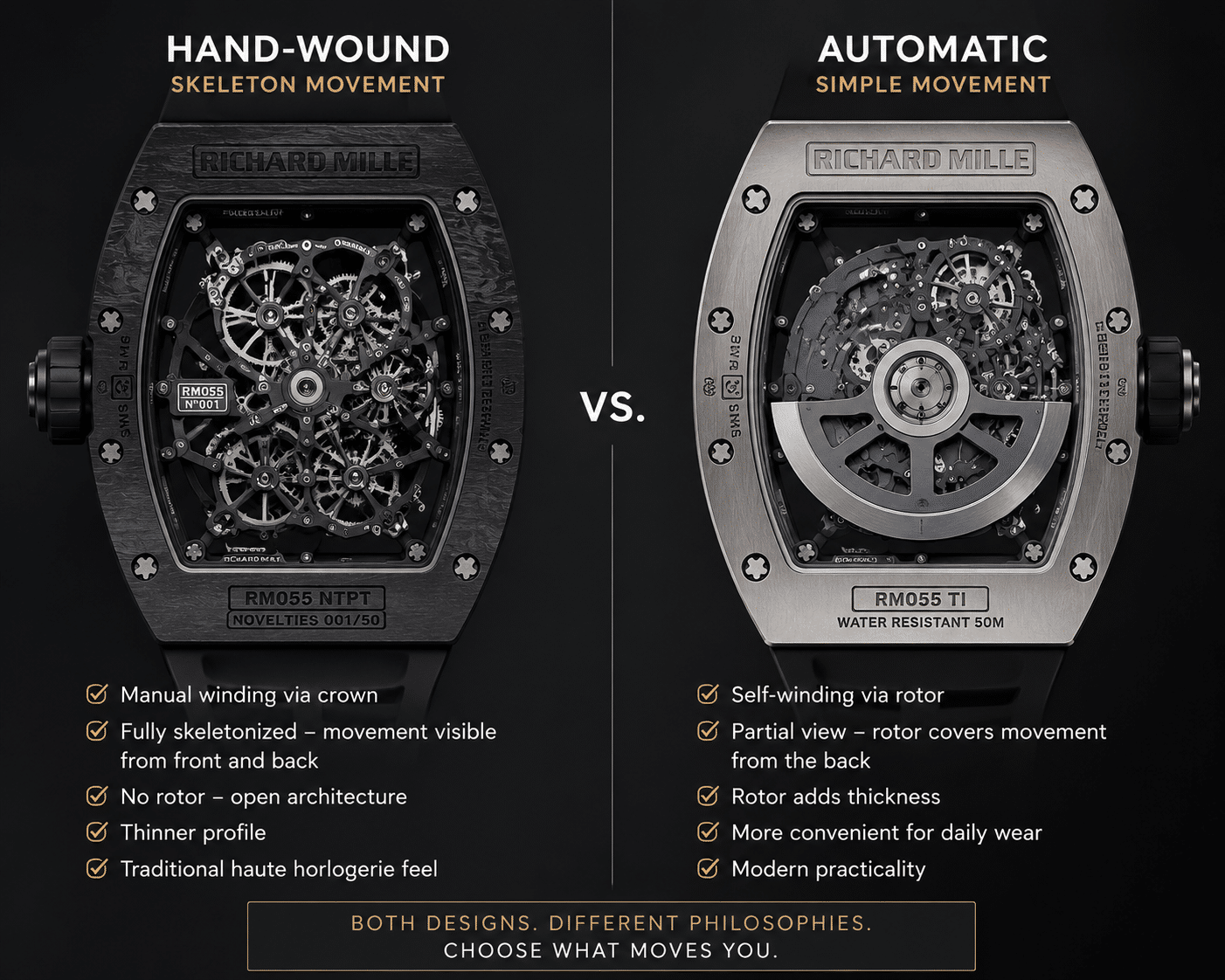
The hand-wound skeleton is the most common “super clone” movement route in the RM market. Factories like APS, ZF, and BBR have invested heavily in skeletonized bridges and plates that mimic the genuine RM architecture — the open gear train, the visible barrel, the angular layout of the movement through the dial. Visually, these watches deliver. The skeletonization gives the watch depth and mechanical character that a simple automatic with a closed dial simply cannot match. For many buyers, that visual appeal is the entire point of choosing a Richard Mille replica.
The mechanical tradeoff, however, is worth understanding. Because there is no rotor, the hand-wound skeleton has fewer moving parts than an automatic. Fewer parts generally means fewer things that can fail. That sounds reassuring, and in principle it is. But the real-world experience depends heavily on execution. The winding feel — how smooth the crown turns, how much resistance it offers, whether it winds evenly — varies enormously by factory and even by batch. Some hand-wound RM replicas have a beautifully crisp, satisfying winding action. Others feel gritty, stiff, or uneven from the first day. That variation is not visible in photos, and it is one of the reasons this movement type rewards careful QC checking before purchase.
Another hidden risk: some skeleton movements are beautifully decorated on top but use fragile winding gear underneath. The decoration may look correct, but the keyless works (the mechanism that connects the crown to the movement) can be poorly finished. Over time, aggressive or impatient winding can strip a gear or misalign the crown stem. The buyer who winds gently and deliberately will have a much better experience than the buyer who forces the crown through resistance.
The upside, and it is a real one for daily wear, is the absence of rotor noise. A loud rotor is one of the most common frustrations with automatic replica watches — the audible wobble or scrape every time the wrist moves. A hand-wound movement is silent. That silence matters more in daily use than many buyers expect. It makes the watch feel tighter, more deliberate, and less like a budget mechanism rattling around inside a showy case.
Comparing Skeleton vs. Non-Skeleton Hand-Winds
Not all hand-wound RM replicas are fully skeletonized. Some use a closed dial or only partial skeletonization with solid bridges covering part of the movement. This distinction matters more than most buyers realize.
Full skeletonization gives you the dramatic visual — the gears visible through the front, the open architecture that defines the RM look. But it also exposes the movement to more dust, moisture, and accidental impact. A bump that would barely affect a closed movement can knock a thin skeleton bridge out of alignment. The skeleton bridges themselves are often thinner and more fragile than their closed counterparts, simply because material has been removed for visual effect.
Partial skeleton or closed-dial hand-wound movements are less visually exciting, but they protect the movement better. The mechanical core is the same — manual wind, visible gear train — but the movement is not fully exposed on all sides. For a buyer who wants the hand-wound simplicity but does not need every gear visible through the front, this route is mechanically safer. The visual depth is reduced, but the movement is better shielded from the everyday hazards of dust, moisture, and knocks.
Our team usually considers the hand-wound skeleton the smartest entry point for anyone who wants an RM replica that looks serious but does not carry the service burden of a chronograph or tourbillon. It is not the most visually spectacular option. But it is the option most likely to survive regular use without requiring a trip to a specialist for repair.
Chronograph Movements: The Burden of Extra Complexity
On paper, a Richard Mille chronograph replica sounds like the full package: a skeletonized automatic watch with stopwatch functionality, subdials, and pushers. In photos, it looks busy and impressive. In practice, the chronograph movement route is where the gap between visual show and daily-wear reliability widens dramatically. For regular use, the chronograph RM replica is the option that demands the most caution.
The root cause is mechanical layering. Most RM replica chronographs are not built with a purpose-made integrated chronograph movement. Instead, they use a modified automatic base movement — typically a Miyota 9015 or an Asian clone of the ETA 2892 — with an added chronograph module stacked on top. That module handles the stopwatch functions, the subdial hands, and the reset mechanism. The problem is that this layering increases the movement’s thickness, adds dozens of small components, and introduces multiple new failure points that a simple automatic or hand-wound movement simply does not have.
Thickness is the first visible casualty. The genuine RM 011 and RM 11-03 chronographs are already substantial watches, but the replica versions are measurably thicker. The added chronograph module pushes the case height past the genuine’s profile. On the wrist, that extra thickness changes the proportions. The watch sits higher, catches on cuffs more easily, and loses some of the sleek tonneau presence the originals are known for. For a buyer who values a convincing silhouette, this is not a small detail.
The daily-wear risks go beyond appearance. Subdial hands on RM replica chronographs are notorious for misalignment. The central chronograph hand might reset slightly to the left or right of 12. The minute and hour subdials may not line up perfectly at zero. These are common QC issues, and while some are correctable, they often drift again after use. The pushers on the case side — used to start, stop, and reset the chronograph — tend to feel stiff or spongy compared to the genuine. A stiff pusher is not just an annoyance; it puts extra stress on the chronograph module inside.
The real problem for daily wear, however, is that the chronograph function is rarely used in everyday life. Most buyers activate it a few times out of curiosity, then leave it running or unused. Meanwhile, the movement is carrying the weight and mechanical drag of the chronograph module at all times — whether the stopwatch is running or not. That means more wear on the automatic winding system, more components that can fail, and a higher likelihood that the watch will need service sooner than a simpler movement.
This is not to say an RM chronograph replica is unusable. It is to say that the buyer should go into it with realistic expectations. If the chronograph is the only model that scratches the itch, and the buyer accepts that it is unlikely to match the reliability of a simple automatic or hand-wound version, then the choice is personal. But for anyone who wants a watch they can grab and wear without thinking about it, the chronograph route is the wrong answer. Use it sparingly, do not leave the chronograph running all day, and be prepared for the possibility that it will need service sooner than expected.
Tourbillon Movements: Spectacle That Demands Caution
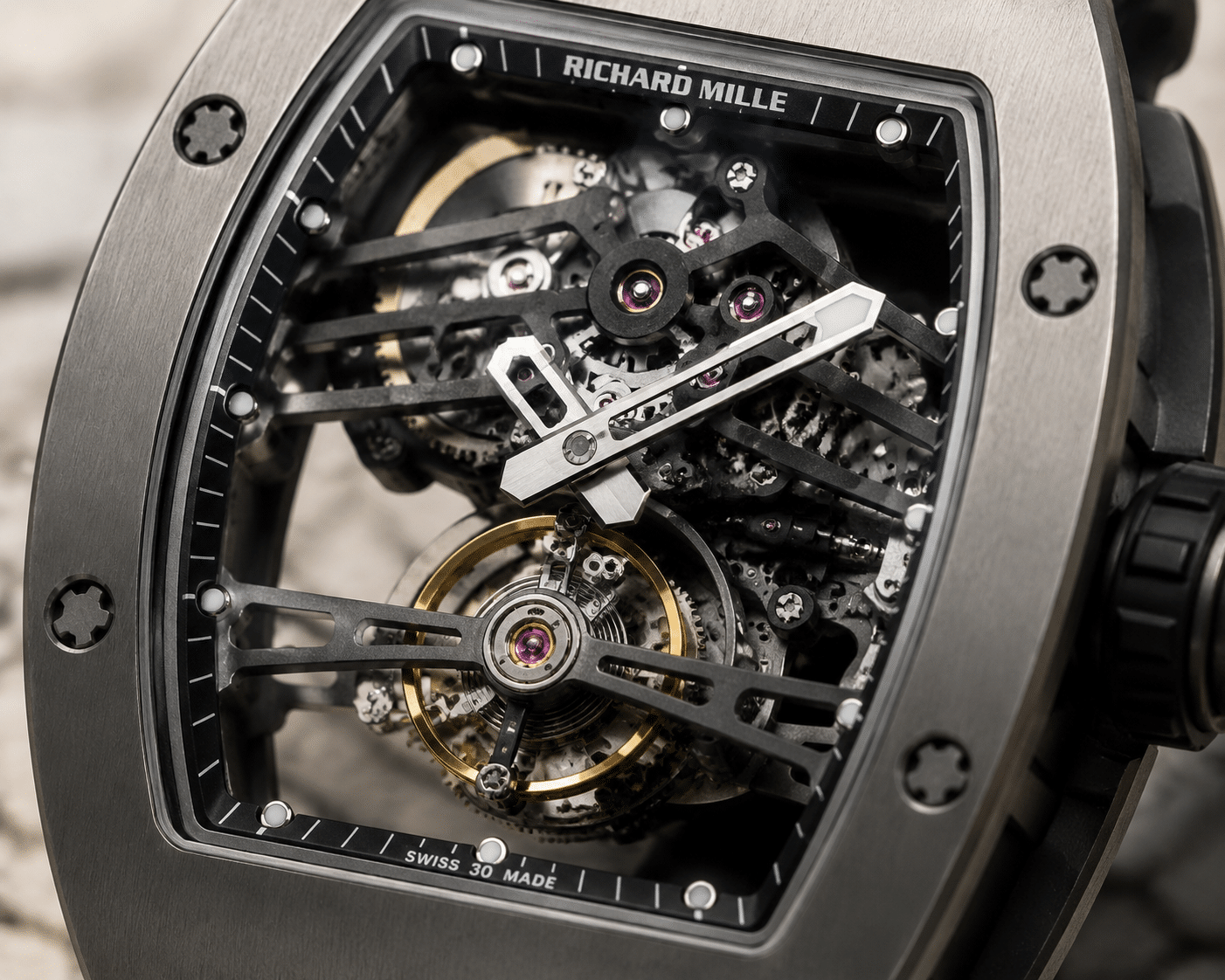
The tourbillon is the crown jewel of Richard Mille’s design language — a rotating cage of balance wheel and escapement, fully exposed through the skeleton dial, spinning in plain sight. On a genuine RM, the tourbillon represents the highest level of watchmaking art and a six-figure price tag. On the replica side, it represents the highest level of visual impact and, by a wide margin, the highest level of daily-wear risk.
Let us be direct: the tourbillon movement in a replica RM is not a sign of superior engineering. It is a sign of added mechanical complexity in an already challenging case architecture. The tourbillon cage itself is a precision assembly of dozens of tiny components — balance spring, balance wheel, escape wheel, pallet fork, cage bridge, and bearings — all rotating continuously. In a replica movement, these parts are not made from the same materials or to the same tolerances as a genuine Swiss or Asian high-end tourbillon. They are functional, but they are fragile.
The fragility shows up in several ways. First, the tourbillon cage is more exposed than any other part of the movement. A knock to the side of the case, even a mild one, can bend a balance staff or knock a jewel out of alignment. The skeleton architecture offers no protection. Second, winding a tourbillon replica requires more care. The gear train that transfers power from the crown to the barrel also drives the cage. Forcing the crown when it meets resistance — a common mistake with less experienced owners — can damage the delicate gear teeth inside the tourbillon module. Third, many replica tourbillons are more decorative than functional in terms of timekeeping. The cage rotates and looks impressive, but the rate may be inconsistent from crown-up to dial-up position, or the watch may stop entirely after a few hours of wear. A tourbillon does not automatically mean better accuracy. In a replica, it often means the opposite.
Serviceability is the other hard reality. A local watchmaker who can service a Miyota or a clone ETA is not necessarily equipped to service a tourbillon. The specialized tools, the knowledge of the cage geometry, and the availability of replacement parts are all major barriers. A broken tourbillon replica often becomes a permanent desk ornament. There are specialists who can handle these repairs, but they are not common, and the cost can approach or exceed the price of the watch itself.
When a Tourbillon Makes Sense in a Daily Wear Rotation
Despite all of the above, there are buyers who understand the risks and still want the tourbillon experience. That is a legitimate choice, provided the expectations are managed. For those buyers, the least risky approach is to treat the tourbillon RM as part of a rotation, not as a single daily driver. Wear it for an evening, a special occasion, or a day when the watch will not face much physical activity. Wind it gently and deliberately. Avoid bumps, handshakes with force, and any situation where the watch might take a hard knock. Accept that the accuracy may be looser than a simple movement and that the watch may eventually need a specialist’s attention.
For the buyer who cannot accept those limitations, the tourbillon route is best admired from a distance. The visual spectacle is real. The daily-wear practicality is not.
How to Check Movement Stability Before Buying
The decision between movement types is important, but it only matters if the specific watch you receive actually runs well. A simple automatic movement that arrives with poor regulation or a damaged rotor will be more frustrating than a well-sorted tourbillon. The goal is to identify problems before the watch ships, not after you have paid and waited weeks for delivery. Most dealers expect these requests. If a seller hesitates to show the movement running, that is a signal worth taking seriously.
The most useful single piece of evidence is a timing test. Ask the dealer to put the watch on a timegrapher and send you a photo of the result. You are looking for three numbers: the rate (how many seconds per day the watch gains or loses), the amplitude (how far the balance wheel rotates), and the beat error (how evenly the watch ticks). A reasonable rate for a replica RM movement is within ±15 to ±25 seconds per day. Amplitude should be above 250 degrees in the fully wound position. Beat error should ideally be under 1.0 milliseconds. Numbers outside these ranges suggest poor regulation, a damaged movement, or a movement that was assembled without proper lubrication. If the dealer cannot provide a timing test photo, ask why.
Rotor noise is the next most common issue, especially for automatic movements. A smooth automatic rotor should produce a faint, continuous sound when the watch is moved. A loud grinding, scraping, or clicking noise means the rotor bearing is dry, poorly fitted, or already damaged. For hand-wound movements, the question is winding feel. The crown should turn with even resistance. If it feels gritty, catches intermittently, or requires noticeably different effort at different points in the winding cycle, the winding gear or mainspring barrel may have an issue. Dealers rarely advertise these problems, but they will often answer honestly if you ask directly: “How does the crown feel when winding? Any rough spots?”
Power reserve is worth checking, but do not expect Richard Mille replica movements to match genuine specifications. A hand-wound clone movement that stops after 20 hours rather than the stated 40 hours indicates a problem. A movement that runs 35 hours is within normal variation. The easiest way to verify is to wind the watch fully, set it aside, and check whether it is still running the next day. If the dealer can provide a video of the watch running on day two, that is stronger evidence than any advertisement.
For chronograph models, test the pusher action. Press the start/stop pusher and watch the chronograph seconds hand. It should begin moving immediately without hesitation. Press the reset pusher. The hand should snap back to zero cleanly, not drift past 12 or stop a few degrees off. Misaligned subdials are common in replica chronographs, but a misalignment that appears in QC photos will not improve with use. If the subdial hands are not centered in their registers when reset, that watch should be rejected.
For tourbillon models, the key check is whether the cage rotates smoothly and continuously. A video is essential here. The tourbillon cage should rotate at a steady speed, typically one full rotation per minute. If the cage stutters, stops, or changes speed unevenly, the movement has a problem that will not resolve itself. Also check whether the balance wheel inside the cage is visibly oscillating. Some low-end replica tourbillons have a stationary cage and a fake balance wheel — essentially a decorative piece that does not keep time. A genuine-function tourbillon cage should move consistently and the watch should continue running in multiple positions.
One final check that costs nothing: ask the dealer whether the movement has been serviced or lubricated before shipping. Most replica movements arrive with minimal lubrication from the factory. A dealer who offers to regulate or oil the movement before shipping is adding real value. A dealer who says “no need, it is fine” is probably shipping the watch as-is. Neither answer is a dealbreaker, but knowing which one you are getting helps set expectations.
QC Photos to Request for Movement Verification
When requesting QC photos from your dealer, be specific about what you need to evaluate the movement. A standard set of dealer photos often emphasizes the case and dial, but you need angles that reveal mechanical behavior.
Start with a clear, well-lit dial shot straight on. This lets you check subdial hand alignment at rest. For a chronograph, the subdial hands should point exactly to their zero positions. For a tourbillon, this shot should show the cage centered within its opening and the balance wheel clearly visible. Next, request a case-back shot that shows the movement finishing. If the movement is automatic, you want to see the rotor shape and whether it sits flat. Look for visible debris, uneven screw heads, or loose wire loops. For hand-wound movements, check whether the bridges are cleanly finished and whether any decorative plates appear misaligned.
A side profile shot is useful for one reason only: case thickness. If the dealer listing claims a certain thickness, the photo confirms whether it matches. This is less a movement check and more a geometry check, but thickness problems often trace back to the movement — a 7750-based chronograph will always be thicker than a simple hand-wind, and the photo should make that evident.
The most revealing format is a video. Ask for a short clip showing the crown being wound and the second hand sweeping. For hand-wound watches, the video should show approximately 10–15 seconds of winding so you can hear the sound and feel of the crown. For automatic watches, the video should include a gentle shake to demonstrate rotor movement. For tourbillons, the video should be at least 30 seconds long, showing the cage completing at least one full rotation. If the dealer sends a video that cuts off after a few seconds, ask for a longer one. The movement either runs cleanly or it does not, and a few extra seconds of video will reveal the difference.
The Hidden Variable: Movement Origin and Batch Consistency
One factor that buyers often overlook is that the same movement type can vary significantly depending on the factory batch and the specific clone caliber used. A hand-wound skeleton from Factory A may use a decorated Seagull ST3601 manual movement, while the same type from Factory B may use a less well-known Shanghai-based clone with different gear ratios and lower finishing standards. The movement type label — “hand-wound skeleton” — does not guarantee the same internal components or the same long-term behavior. This is not a reason to distrust every listing, but it is a reason to ask the dealer what specific movement base is inside the watch before buying.
The same logic applies to automatic movements. A Miyota 9015 is a reliable platform, but its replica decoration can vary. Some factories apply decorative bridges that look attractive but impede access to the regulator arm. Others leave the movement undecorated, which is less visually impressive but easier to adjust or service later. A buyer who prefers serviceability should ask whether the movement can be regulated without removing decorative plates. This is a simple question that reveals whether the factory prioritized appearance or practicality.
Batch consistency is another challenge. A factory may produce excellent movements for three months, then switch to a lower-grade batch of parts from a different supplier. The movement type remains the same in the listing, but the actual experience changes. The only reliable defense is to insist on seeing the specific movement that will be shipped — not a stock photo, not a reference image from a previous customer, but a photo of the actual watch. This is standard practice for most serious dealers, and if a seller resists, the risk of receiving a poorly assembled movement increases sharply.
Understanding the Distinction: Replica Movements vs. Genuine Luxury Calibers
Throughout this article, movement names and specifications from manufacturers like Miyota, Seiko, or ETA are used to help describe the mechanical baseline of certain replica watch calibers. It is important to clarify that these references are made for comparison and educational purposes only. A replica watch is not a genuine product from Richard Mille, and any movement inside a replica watch does not originate from or carry the guarantee of the original luxury brand.
When a seller describes a movement as a “Miyota 9015” or a “Seiko NH35,” the claim should be treated as a configuration reference, not as a verified guarantee. The actual caliber inside the watch could be a genuine movement from the manufacturer, an unmarked clone with shared dimensions and lower finishing tolerances, or a decorated variation that behaves differently from the original specification. The official technical documents cited earlier in this article describe the performance of the original manufacturer’s caliber under controlled conditions, not the performance of every clone or decorated version found in the replica market.
Brand names such as Richard Mille, Audemars Piguet, and Rolex are used in this article solely to identify the reference design or comparison topic being discussed. Their inclusion does not imply authorization, endorsement, partnership, or affiliation with the original luxury watch brands. Replica watches are not genuine products from these brands and should not be represented, resold, or used as authentic watches.
Factory names in the replica market — such as ZF, APS, BBR, and others — are useful buyer-facing references for version identification and comparison. However, these factory labels should not be treated as official luxury-brand affiliations or as automatic proof of identical quality across every model or batch. The most reliable assessment of a specific replica watch comes from examining visible QC details for that individual piece, not from assuming that a factory name guarantees perfection.
Movement descriptions in the replica market should be read carefully. Terms like “skeleton,” “automatic,” or “clone movement” describe layout, decoration, or architecture, but they do not mean the watch uses an official brand-manufactured caliber. A strong replica movement may look convincing in normal wear, but close inspection can reveal differences in finishing, material quality, component tolerances, and long-term durability compared to a genuine luxury watch movement. Buyers should use this article’s guidance to understand mechanical risk and reliability differences, not to misrepresent a replica watch as genuine.
Final Comparison: Which Movement Should You Wear Daily?
After walking through the strengths and weaknesses of each movement route, the ranking for daily wear is reasonably clear. The order does not reward spectacle. It rewards stability, serviceability, and low frustration over time.
First: Simple Automatic Movements. These are the least dramatic option, and they are also the most practical. An automatic movement winds itself during wear, requires minimal attention, and has fewer decorative elements that could come loose or break. The rotor noise on good examples is acceptable. The power reserve is sufficient for daily rotation. If something goes wrong, these movements are the easiest to repair or replace because they are based on widely available platforms like Miyota or Seiko. For buyers who want to wear their RM replica regularly without thinking about it, this is the smartest choice.
Second: Hand-Wound Skeleton Movements. This is the middle ground — more visually engaging than a plain automatic, but mechanically simpler than a tourbillon or chronograph. The absence of a rotor means no rotor noise, which is a real benefit for daily wear. The skeleton architecture shows the movement clearly, satisfying the buyer who wants to see the mechanics. The tradeoff is daily winding, which is acceptable if the crown action is smooth. Problematic examples have stiff or gritty winding, but a well-finished hand-wound movement is completely livable. This is the right choice for buyers who want visual interest without the risk profile of a complication.
Third: Automatic Skeleton Movements. These combine the convenience of self-winding with some skeletonization, but they sit lower in the ranking because the skeleton architecture often exposes more moving parts to dust and impact while the rotor adds noise. They are not a bad choice — simply less optimized than the two options above. A buyer who wants both skeleton visibility and automatic winding should look carefully at the specific factory execution rather than assuming all automatic skeletons are equal.
Fourth: Chronograph Movements. The chronograph ranks lower not because it looks bad, but because the added complexity creates more failure points in daily use. The modified base movements and modular chronograph assemblies used in most RM replica chronographs introduce thickness, pusher stiffness, and subdial alignment risks. A chronograph can still be a daily wearer, but the buyer should use the chronograph function sparingly and accept that servicing will be more difficult. If you do not actually need the chronograph, the simpler movement is the wiser purchase.
Fifth: Tourbillon Movements. The tourbillon sits at the bottom of the daily-wear ranking. It is the most fragile, the most difficult to service, and the most sensitive to shock and positional changes. The visual appeal is undeniable — a rotating cage through a skeleton dial is the most dramatic thing a replica RM can show. But that appeal comes with real ownership costs. The cage can stop if the watch is bumped. Balance staffs break. Local watchmakers rarely touch replica tourbillons. If you understand these risks and accept them, a tourbillon can still be enjoyed as a rotation piece. As a daily wearer, it is the least sensible option.
Buyer Expectation Note: No replica watch should be judged by factory reputation alone. A better decision usually depends on the specific model, movement version, case thickness, dial accuracy, bracelet quality, service risk, and how closely the watch will be inspected in real use.
Final Considerations for the Buyer: The above comparison has practical roots in what official movement data and community experience can teach us. Movement manufacturers like Miyota and Seiko publish specifications that explain performance baselines — power reserve, beat rate, and jewel count — which can help a buyer understand what a well-functioning watch should deliver.[1][2] However, these specifications describe the original movement, not the decorated or modified version inside a replica. A replica movement may have different lubrication, lower finishing tolerances, or a different grade of parts, all of which affect real-world performance. The official page for the Seiko NH35, for example, confirms that it is a high-quality mechanical movement designed for reliability under normal use, but the same page does not and cannot confirm that a specific replica watch uses an authentic NH35.[2] The same principle applies to any movement listed in the replica context: the specification sheet is a reference, not a receipt. The buyer’s best tool remains careful QC verification and honest seller communication.
Before making a final decision, buyers should review real QC photos where available, including dial printing, hand alignment, bezel position, datewheel centering, bracelet fit, clasp engraving, case thickness, and overall finishing. Factory labels and stock photos alone are not enough for a reliable judgment. Movement descriptions should be read as configuration references, not as official brand-caliber claims, unless there is clear, verifiable evidence. Buyers should also confirm return, repair, shipping, and after-sales terms before ordering, as these policies can vary significantly by seller.
The final decision is yours, but the logic is consistent: choose stability before spectacle for a watch you plan to wear often. A simple automatic movement worn daily is a better experience than a tourbillon that sits in a drawer waiting for the right moment. An RM replica should feel comfortable on your wrist, run reliably day to day, and not make you worry about every bump or winding session. If a movement adds anxiety instead of enjoyment, it is not a daily wearer — it is a display piece. Wear the watch. Do not let the watch wear you.
[1] Miyota Precision Inc., “Miyota Caliber 9015 Specification Sheet,” official movement technical document. Available at: Miyota Movement Official Site
[2] Seiko Watch Corporation, “Technical Guide: NH35A Automatic Movement,” official specification document. Available at: Seiko Watches Official Site
Disclosure: This article is for general educational and comparison purposes only. Replica watches are not genuine products from the original luxury brands, and brand names such as Richard Mille, Audemars Piguet, and Rolex are used only to identify reference designs or comparison topics. Factory names, movement descriptions, prices, availability, QC details, seller policies, and version information can change, so readers should verify important details with the seller before making a purchase decision. Replica watches should not be represented, resold, or used as genuine watches. The movement specifications cited from official manufacturer documents describe the original calibers, not every decorated or modified version found in the replica market.