
Most replica watch discussions focus on the dial, bezel, and case shape, but the side profile is actually what reveals an RM replica most clearly. The problem is simple: a genuine Richard Mille uses an extremely thin movement stack, so when a replica movement adds even 1–2 mm of height, the entire case architecture becomes visibly distorted. The crystal sits higher, the midcase loses its layered curve, and the watch looks blocky on the wrist. This article explains exactly how different movement types and models, particularly best Richard Mille replica movements, affect that thickness, and it helps you decide whether a given replica will pass the side-profile test or look obviously wrong from the critical angle.
| Movement Type | Thickness Range | Impact on RM Side Profile |
|---|---|---|
| Hand-wind clone (e.g., 3.5–4.5 mm) | ±0.5–1.5 mm from genuine | Least profile distortion; preserves case curve and strap alignment |
| Miyota 9015 automatic | Adds 2–3 mm | Noticeable crystal rise and flattened curve; best suited to bulkier models like RM 011 |
| Valjoux 7750 automatic | Adds 3–4 mm | Blocky case profile, obvious caseback bulge, poor strap integration |
| High-risk model: RM 67-02 | Genuine: 7.8 mm | Even a thin clone looks thick; avoid automatic movements entirely |
| Safe model: RM 055 / RM 35 | Genuine: 13–14 mm | More tolerance; automatic movements create less visible distortion |
| Side-profile QC check needed | — | Direct side view shows curvature; wrist shot shows sitting height; bezel-to-midcase ratio reveals thickness |
Quick Questions Before You Read
Q: Does movement thickness matter for every RM model the same way?
No. Slim models like the RM 67-02 (7.8 mm genuine) are extremely sensitive to extra thickness. Bulkier models like the RM 055 or RM 011 have more tolerance and can hide an automatic movement’s height better.
Q: Should I prioritize a hand-wind clone movement for better accuracy?
If side-profile appearance matters most to you, yes — hand-wind clones are thinner and preserve the case shape. But they are often less reliable for daily wear. For toughness at the cost of some visual thickness, a Miyota 9015 is a reasonable compromise.
Q: Can I tell a thick replica just from front-view photos?
Rarely. Thick cases look fine from the front. You need side-profile QC images — direct side view, wrist shot, crystal close-up — to judge if the watch sits too high or has a blocky silhouette.
Q: How much thickness difference is acceptable?
For a collector’s accuracy, aim for ±0.5 mm. For daily wear with some visual trade-off, ±1.5 mm is often acceptable, especially on models with thicker genuine cases. Anything beyond that will distort the profile noticeably.
Editorial Perspective: This article is written from the standpoint of a buyer advisor who has seen how movement thickness — not dial decoration or bezel screws — is the real dealbreaker for RM replicas. At cleanvsfactory.com, we treat this as a model-specific structural question rather than a simple factory ranking. A factory known for good dial work may still produce a case that is visibly too thick, because the movement route, not the finishing skill, determines the side profile. The factory name helps shortlist options, but the final judgment depends on movement type, case architecture, and the buyer’s own tolerance for thickness error. Our guidance is grounded in what we have observed across multiple factories and versions: a watch that looks accurate from the front can still fail the side-profile test, and the movement stack is almost always the reason.
Why Some RM Replicas Look Good From the Front but Wrong From the Side
A typical buyer scenario goes like this: you find a replica Richard Mille that looks sharp in the seller’s front-facing photo. The dial is well-framed, the skeleton work looks busy enough, the carbon pattern seems convincing. You order it. When it arrives, you put it on your wrist, glance at it from a natural angle, and something feels off. It is not the dial. It is not the bezel. It is the side profile. The watch looks bulky in a way that the front photo never suggested.
This is the most common disappointment with RM replicas, and it has nothing to do with how well the case is polished or whether the screws are aligned. The problem is movement thickness. The front photo hides it. The side profile reveals it immediately. A genuine RM case has a carefully calculated vertical stack. The bezel, crystal, dial, midcase, and caseback follow a controlled curvature that makes the watch look sculpted and integrated from every angle. When the movement inside those layers is too tall, the whole architecture shifts. The case stops looking layered and starts looking like a block.
This is not a finishing problem. A poorly decorated dial can be a disappointment, but a case that is visibly too thick is a fundamental credibility failure. It changes how the watch sits on the wrist. It changes how the strap attaches. It changes why an otherwise detailed replica looks wrong within seconds of a real-world glance.
Front-facing QC photos can be misleading because they compress the visual field. The same watch that looks proportional from straight ahead can look thick and flat from the side. The buyer who only checks the front view is missing the single most important diagnostic signal. If you have ever wondered why a specific RM replica looks “off” in person despite decent dial work, the answer is almost certainly movement thickness distorting the case architecture.
A note on terminology and expectations: Throughout this article, references to “genuine” or “authentic” Richard Mille watches describe the original luxury-brand manufactured product. Replica watches discussed here are not genuine products from Richard Mille. They are replica-market items that may imitate the design of the original reference. The comparison is made only to help readers understand design differences, not to suggest that a replica watch is equivalent to or should be represented as an authentic Richard Mille. Brand names are used for identification and comparison purposes only; no official affiliation, authorization, or endorsement is implied.
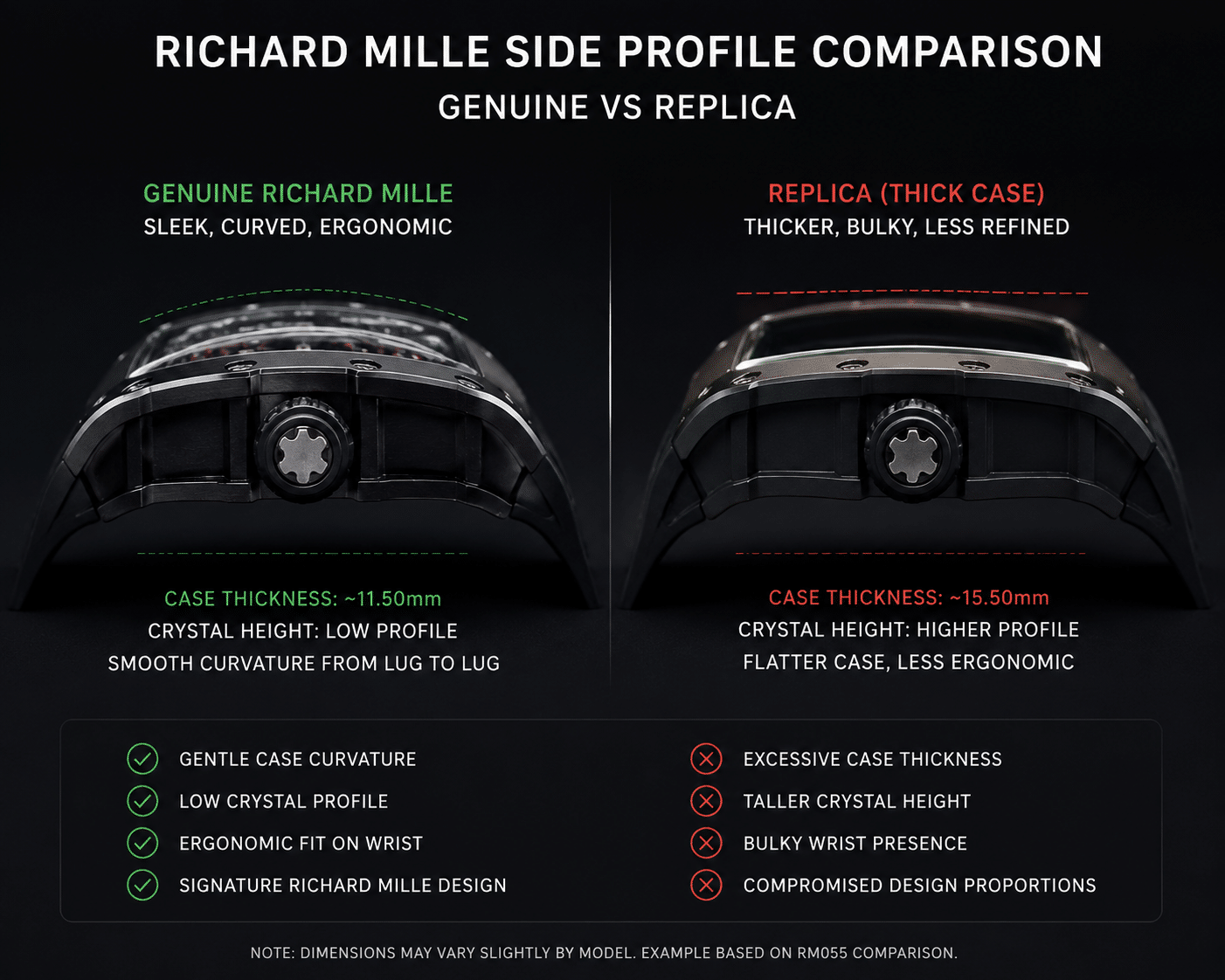
How Richard Mille Case Architecture Depends on a Thin Movement Stack
Understanding why thickness matters starts with understanding how an RM case is put together. The tonneau shape is not a simple two-piece shell. It is a layered vertical stack. From top to bottom, the sequence is: bezel, crystal, dial, midcase, movement, and caseback. Each layer has a specific height, and each contributes to the overall profile. The magic of a genuine RM case is that these layers follow a continuous barrel curve. The bezel curves down into the midcase, the midcase curves into the caseback, and the crystal sits just high enough to protect the dial without looking like a raised bubble.
The movement is the single thickest component in that stack. Because of this, the movement’s height determines how much room remains for everything else. A genuine Richard Mille caliber like the RMUL2 is engineered to be remarkably thin—approximately 3.15 mm for the manual-wind version.[1] That thinness allows the case to maintain its signature curvature. The bezel can stay proportionally thin. The crystal sits flush rather than protruding. The caseback curves gently toward the wrist, not bulging outward.
When the movement stack is thicker—even by 1 to 2 mm—the entire architecture has to be reworked to fit it. The crystal gets pushed higher because the dial surface is now farther from the bezel lip. The midcase becomes taller to accommodate the extra movement depth. The bezel-to-midcase ratio shifts: the bezel starts looking too small relative to the case height. And the caseback, which should follow the wrist contour, flattens out because the vertical stack is already stretched. This domino effect is why a 1 mm thicker movement can produce a case that looks 3 to 4 mm bulkier on the wrist.
Genuine RM case dimensions support this logic. An authentic RM 35-02, for example, measures roughly 12 mm to 13 mm in total thickness. The RM 11 is about 16 mm. The RM 67-02 is around 7.8 mm. These are not random numbers; they are the outcome of a tightly constrained vertical stack built around a thin movement. When a replica deviates from these numbers, it is almost never because the case material or finishing is wrong—it is because the movement inside forced the case to be built taller.
It is also worth noting that the relationship between movement thickness and case height is not always linear. Some factories compensate for a thicker movement by reducing the height of the midcase walls or by using a thinner crystal. These adjustments can slightly mask the thickness, but they often introduce new problems: a thinner crystal is more fragile, and a reduced midcase can alter the bezel angle or make the crown guards look disproportionately large. The buyer should treat any claim of “thin case” as something that needs verification through QC photos, not as a fact to accept from a spec sheet alone.
Understanding Richard Mille’s design philosophy for case proportions helps clarify why even small thickness errors are so visible. Richard Mille has consistently described its watches as “racing machines on the wrist,” emphasizing lightness, ergonomics, and a sculpted case that follows the natural curve of the arm.[2] The brand’s official communication highlights the extensive engineering that goes into achieving the tonneau shape, with the case often requiring several hundred machining operations to achieve the correct vertical layering.[2] This is not an accidental design — the thin movement is the foundation upon which the entire case is built. When a replica changes that foundation, the external proportions strain against the engineering philosophy that defines the original. The buyer who understands this design logic will recognize that a thick case is not a minor flaw — it is a structural departure from the design language the brand established.
Movement Routes Used in RM Replicas and Their Thickness Impact
The movement route a factory chooses is the single biggest variable affecting case thickness in an RM replica. There is no universal “good” movement for every buyer. Each route carries a thickness penalty, and the penalty changes how convincing the watch looks from the side.
Here are the most common movement routes found in RM replicas and how they affect case height.
| Movement Route | Typical Movement Height (approx.) | Resulting Case Thickness (approx.) | Visual Outcome |
|---|---|---|---|
| Quartz | ~3–4 mm | ~10–12 mm | Thinnest option, but no mechanical operation visible through display caseback or skeleton dial. Acceptable only for low-budget or non-skeleton models. |
| Chinese hand-wind clone (e.g., Dandong RMUL2-style) | ~3.5–4.5 mm | ~12–14 mm | Closest to genuine case proportions. No rotor height to add thickness. Visually safest route for daily-wear realism. |
| Decorated Miyota 9015 | ~4.5–5.5 mm | ~14–15.5 mm | Adds rotor height and decoration plates. Case becomes visibly thicker. Common in older mid-tier replicas. |
| Shanghai 7750 (chronograph) | ~6–7 mm | ~18–20 mm | Adds a chronograph module and rotor. Genuine RM chronographs are thick, but this route usually exceeds even those dimensions by 2–3 mm. The case looks blocky. |
| Asian automatic with display rotor (low-budget) | ~5–7 mm | ~15–20 mm | Worst for side profile. The rotor adds height without visual benefit. Commonly produces watches that look nothing like the genuine reference. |
The pattern is clear: hand-wind movements produce thinner cases because they eliminate the rotor stack entirely. In a genuine RM, many of the most iconic models (RM 35, RM 55, RM 67) are manual wind, so a hand-wind clone is not only thinner—it is also more faithful to the original movement concept. Automatic routes like the Miyota 9015 or the 7750 force the case to be taller, and the added height usually exceeds what the case design can absorb without distortion.
That does not mean hand-wind movements are universally the best choice. They are often less stable than basic automatics, and they require manual winding daily. A buyer who values smooth daily operation over side-profile accuracy might prefer a reliable automatic—but they should accept that the case will look thicker as a tradeoff. For RM replicas specifically, the safest visual route is a thin hand-wind clone movement. The movement may be less robust, but the case geometry will be closer to what a genuine RM should look like from the side.
Some factories attempt to modify movements to reduce stack height—shaving rotor clearance, using thinner decoration plates, or removing automatic modules. These modifications often reduce reliability. A movement that has been shaved down to fit a thinner case may run less consistently or fail sooner. The buyer should understand that chasing thinner case profiles sometimes comes at the cost of movement longevity.
Movement Transparency Note: Movement references in this article describe the replica-market movement type or configuration, not an official Richard Mille, Audemars Piguet, or Swiss-manufactured caliber unless explicitly stated with verifiable evidence. The hand-wind clones and automatic movements discussed here are replica-market products, and their performance, reliability, and dimensions can vary between batches and suppliers.
The Risk of Relying on “Best Factory” Labels for RM Thickness
One of the most common shortcuts buyers take when choosing an RM replica is to rely on a factory name as a guarantee of case accuracy. The reasoning is understandable: if Factory X is known for making the best Submariner, or if Factory Y is famous for a specific Daytona, then surely their RM replica will also be proportionally correct. This assumption is risky for RM replicas, because Richard Mille super clone failures show that the factors that make a factory good at one type of watch do not automatically transfer to another.
A factory that excels at producing a tight, well-finished steel case for a dive watch may have no particular advantage when building a tonneau-shaped skeleton case that depends on a specific vertical stack. The skills required for each are different. The dive watch case is about bezel alignment, crown feel, and bracelet fit. The RM case is about movement height, crystal clearance, and side curvature. A factory that masters one may still struggle with the other, and the buyer who assumes otherwise will be disappointed.
Additionally, the same factory can produce different versions of the same RM model across different production batches, and the movement source may change between versions. A version that used a thin hand-wind clone in 2023 may be replaced by an automatic movement in 2024 due to supply changes or cost trimming. The factory name stays the same, but the side profile changes completely. This is why buying based on factory reputation alone, without confirming the specific movement route and version number, is a gamble.
A safer approach is to evaluate each version independently. The factory label is worth noting as a starting point, but the final decision should be based on confirmed details: the movement type, the reported case thickness from trusted QC photos, and the model’s own natural tolerance for thickness variation. At cleanvsfactory.com, this is why we recommend that buyers treat factory names as useful but incomplete signals — a specific version with a thin movement is more important than a famous factory that happens to use a thick automatic in that reference.
Factory Name Clarification: Factory names in the replica watch market are commonly used buyer-facing labels. They should be treated as practical market references, not as official brand affiliations, audited manufacturer identities, or guarantees of identical quality across every model. A factory known for strong dial work may still produce an RM case that is noticeably too thick, because the movement route — not the finishing skill — determines the side profile.
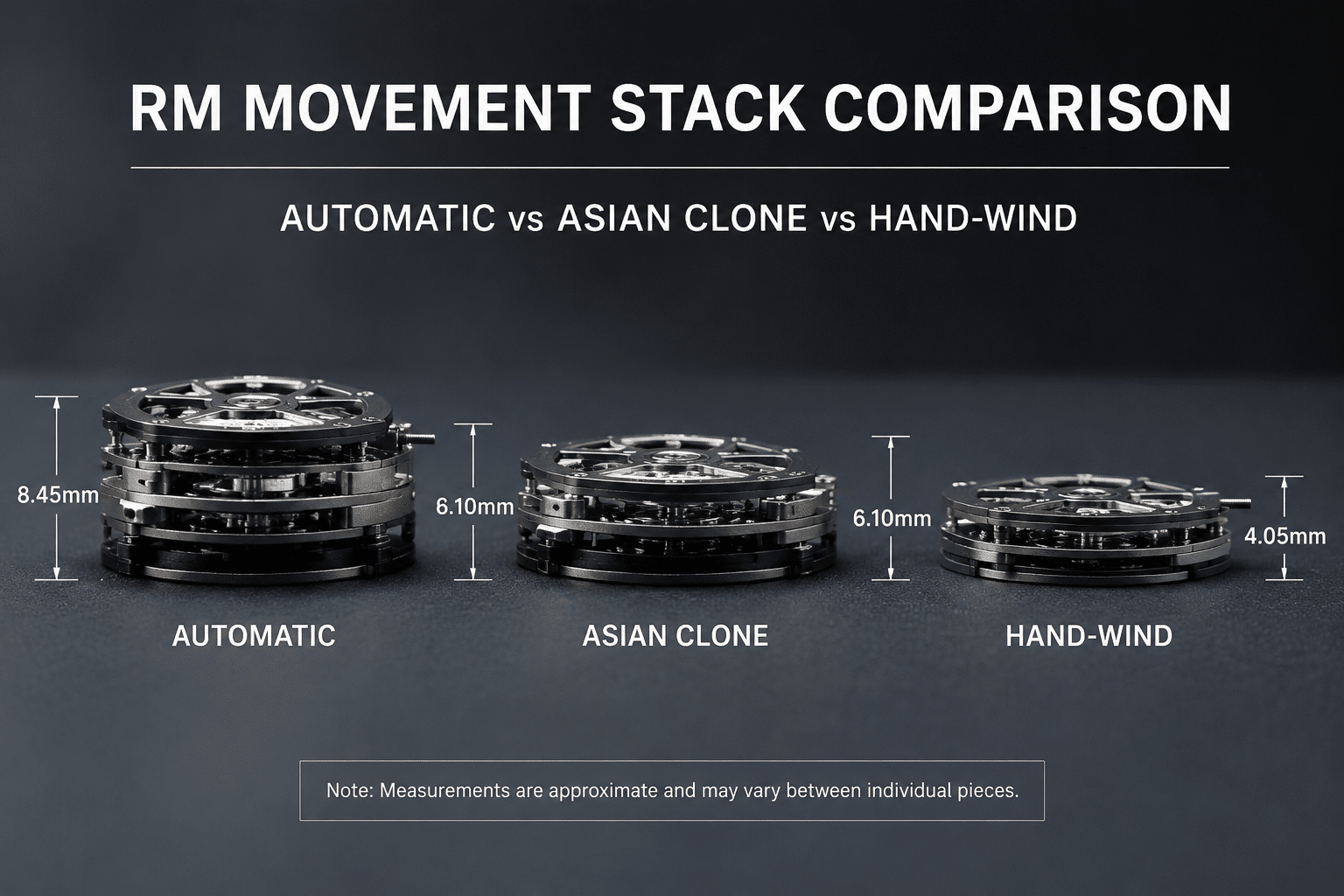
What Happens When the Movement Stack Is Too Thick
Once you understand that a genuine RM case is designed around a specific vertical stack, the consequences of a thicker movement become predictable. This is not a single visual error. It is a chain reaction that starts inside the case and deforms every external surface the buyer can see.
Raised Crystal Height. The first and most visible change. In a correct case, the crystal sits close to the bezel, creating a smooth transition from sapphire to case edge. When the movement stack is thicker, the crystal must be lifted higher to clear the movement below. The result is a dome that protrudes noticeably above the bezel line. From a side view, the watch looks like a bubble. This is often the single quickest tell that an RM replica is too thick, and it is visible from several feet away.
Flattened Case Curvature. The tonneau shape depends on a careful arc from the bezel down to the caseback. That arc requires vertical room. When the movement forces the case to be taller, the curve cannot maintain its original profile. The barrel shape becomes shallower and wider. Instead of a gentle, organic curve, the side profile starts to look like a rectangle with rounded corners. This flattening is what makes a replica RM feel “blocky” rather than sculpted.
Misaligned Bezel-to-Midcase Proportion. In a genuine RM, the bezel occupies a noticeable share of the total side height. The midcase is present but does not dominate. When the movement is thicker, the midcase must grow vertically to contain it. The bezel stays the same size. This shifts the visual ratio: the bezel now looks undersized relative to the midcase. The watch appears top-heavy, with too much material below the bezel and not enough balance above it.
Reduced Dial Depth. A genuine RM skeleton dial creates a sense of depth. The hands, bridges, and gears sit at different heights within the case. When the entire stack is compressed or shifted upward to accommodate a thicker movement, that layered depth is lost. The dial looks flatter. The skeleton effect becomes shallower. The watch loses the three-dimensional feel that makes the original design interesting to look at.
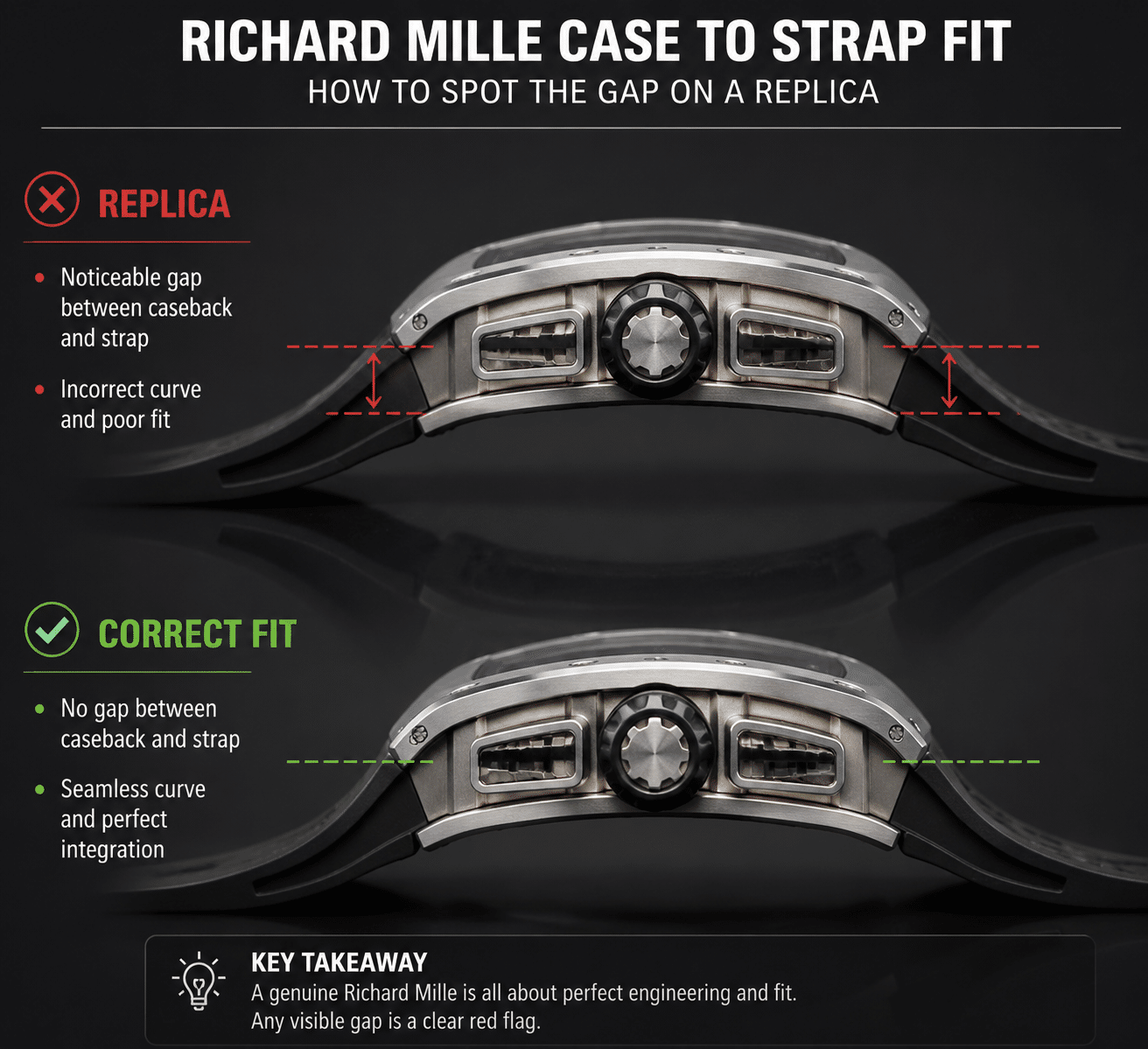
Blocky Side Profile and Caseback Bulge. The side view should taper smoothly from the bezel to the caseback. A thick movement often forces the caseback to bulge outward to create enough internal space. Instead of a clean line, the caseback protrudes. This changes how the watch sits against the wrist. It also creates a visible gap between the caseback and the strap, which we will discuss in the next section.
These five changes are not independent flaws. They all trace back to the same root: a movement that was not designed for the case it sits inside. A buyer who sees a “thick” RM replica is not seeing one problem. They are seeing five problems generated by one architectural mismatch.
It is important to remember that these visual changes are not signs of poor finishing or bad material selection. They are structural outcomes of a movement height mismatch. A buyer who attributes a thick-looking case to “bad factory work” may miss the real issue: the movement route chosen for that version simply cannot fit into the case without visible distortion. This is not a judgment on the factory’s overall capability, but a specific constraint of the movement-and-case pairing. Understanding this helps the buyer make a more informed choice rather than dismissing an entire factory based on one version’s thickness problem.
Why a Thick Case Also Affects Bracelet and Strap Integration
Most buyers evaluate case thickness by looking at the watch alone. That is a mistake. A thick movement does not only change the case profile. It also changes how the watch connects to the wrist. The strap or bracelet is the part that bridges case and arm, and when the case is too thick, that bridge breaks visually and physically.
The Strap Exit Angle Changes. On a genuine RM, the caseback and the strap meet at a controlled angle. The strap exits the case smoothly and curves downward toward the wrist. When the case is thicker, the exit point shifts. The strap must angle more sharply to reach the wrist, or it sits too parallel to the ground before bending. This creates a visible gap between the case and the strap, often described by owners as a “floating” look. The watch appears disconnected from the strap rather than integrated with it.
The Watch Sits Higher on the Wrist. A thicker case pushes the entire watch further away from the skin. This changes wrist integration dramatically. A correct-fit RM hugs the wrist closely, with the caseback following the natural curve of the arm. A thick replica sits on top of the wrist. This not only affects comfort but also makes the watch look larger and more intrusive than it should. The visual effect is the opposite of the slim, almost weightless presence the genuine design aims for.
Rubber Strap Curvature Becomes Strained. RM replicas typically use rubber straps. When the case is thicker and the strap exit angle is wrong, the rubber must bend more aggressively to wrap around the wrist. This creates tension points where the strap pulls away from the case or buckles unevenly. Over time, this can distort the strap shape. Even on day one, the fit feels off. The strap does not “flow” from the case. It fights it.
Clasp Alignment Suffers. When the case sits higher and the strap angles are changed, the clasp often does not sit centered on the underside of the wrist. It shifts to one side or sits at an angle. This is a subtle detail, but it matters for daily wear. A misaligned clasp feels unbalanced. It also draws attention to the watch every time the wearer moves their wrist.
The judgment here is straightforward: no amount of strap quality, material choice, or color matching can fix a fit problem caused by case thickness. Even the best aftermarket rubber strap will look wrong if the case forces it into the wrong geometry. Buyers who focus only on the front view and ignore the strap gap will be disappointed the first time they wear the watch.
Which RM Models Are Most Vulnerable to Movement Thickness Errors
Not every Richard Mille reference reacts the same way to a thick movement. Some models can absorb a few extra millimeters without destroying their visual credibility. Others are destroyed by even a slight thickness increase. Understanding which category a model belongs to is essential for making a smart buying decision.
High Sensitivity: RM 67, RM 016, and RM 07-01. These models are built around slim cases. The RM 67-02, for example, has a genuine case height of approximately 7.8 mm. Any replica that adds even 1–2 mm of thickness changes the proportion dramatically. The case loses its signature slimness, the crystal rises visibly, and the entire watch feels chunky rather than sleek. These models are also some of the hardest to replicate correctly because the margin for error is so small. A buyer who wants a convincing side profile should treat these models as high-risk unless the factory has specifically addressed thickness.
Moderate Sensitivity: RM 35 and RM 055. These are the most popular replica models, and they benefit from a slightly chunkier original design. The RM 35-02 and RM 055 have genuine case heights around 13–14 mm, which gives the replica designer more room to work. A thickness error of 1–2 mm is less noticeable here than on a slim model. That said, the tonneau curve on the RM 055 is aggressive. If the case flattens due to a thick movement, the distinctive barrel shape becomes boxy. These models can tolerate moderate thickness variation but still require careful factory selection.
Lower Sensitivity: RM 011 and RM 11-03. These chronograph models are inherently thicker in the genuine version. The RM 011 measures around 16 mm tall. The chronograph architecture is complex and the case already has visual mass. A thick replica movement here may add 2–3 mm, but the overall side profile is less likely to look shocking because the genuine baseline is already substantial. However, there is a tradeoff: these models often use a modified 7750 movement, which brings reliability concerns that should be weighed against the thickness tolerance.
Special Case: RM 052 and RM 027 Tourbillon Models. These models occupy their own category. The genuine versions are not always slim, but they rely on a real tourbillon visual that requires specific movement architecture. Many tourbillon replicas use thicker movements to accommodate the visible complication. The result is often a case that looks disproportionate, with a bulging crystal or a raised caseback. These models are high-risk for thickness error, but some buyers accept it because the tourbillon visual is the priority.
The practical recommendation is this: if your priority is a convincing side profile, choose a model that can tolerate thickness variation. The RM 35 and RM 055 are safer starting points. The RM 67 and RM 016 are best left to buyers who have confirmed that a specific factory version genuinely achieves correct case height. Do not assume that a popular model is automatically a safe one. The model’s case architecture determines the risk more than the factory’s reputation does.
Another factor to consider is that some models are simply more forgiving in daily wear than others because of their intended design context. An RM 67-02, meant to be an ultra-light sports watch, looks wrong the moment it feels heavy. An RM 011 chronograph is expected to have some visual heft, so a slightly thicker case blends in more easily. The buyer should match the model’s design intent to their own wearing environment. A thick RM 67-02 will stand out in a gym or casual setting where the genuine watch is known for its featherlight feel. A thick RM 011 may pass unnoticed at a dinner table where the genuine thickness is already substantial. This is not about absolutes — it is about context.
Buyer Expectation Note: No replica watch should be judged by factory reputation alone. A better decision usually depends on the specific model, movement version, case thickness, dial accuracy, bracelet quality, service risk, and how closely the watch will be inspected in real use. For RM replicas in particular, the model’s inherent thickness tolerance matters more than any single factory name.
QC Inspection Points Specific to RM Case Thickness
Front-facing QC photos are designed to make the watch look good. They show the dial layout, the skeleton pattern, and the carbon texture in flattering light. What they cannot show is the side profile, and that is where a thick movement stack, as analyzed in Richard Mille replica movements, reveals itself and becomes the defining factor for a fake-looking watch. If the buyer does not specifically request thickness-related angles, the root cause of a “fake-looking” RM replica will only be discovered after the watch arrives.
The first and most important angle is a direct side profile on a flat surface. The watch should be placed on a table with the camera level with the caseband, not angled from above. What to look for: a smooth, continuous barrel curve from the bezel down to the caseback. A genuine RM side profile is not a straight block—it has subtle curvature that follows the tonneau shape. A thick case forces this curve to flatten, producing a rectangular or blocky silhouette. If the side profile looks like a flat slab, the movement stack is too tall.
The second angle is a wrist shot from the side. This shows the watch sitting height relative to the wrist surface. A correct RM replica should sit low, with the caseback close to the skin and the bezel tilted naturally. A thick example will sit high, creating a visible gap between the caseback and the wrist. This is not about strap fit—it about how much of the case height is exposed above the wrist. If the watch looks like it is perched on top of the wrist rather than wrapping around it, the thickness is wrong.
The third angle is a top-down photo with a clear view of the bezel-to-midcase ratio. Ask for the watch to be photographed straight from above on a white or neutral background. The bezel should occupy a visually balanced portion of the total case height. On a thick replica, the midcase often looks disproportionately tall compared to the bezel, making the watch appear top-heavy or bulbous. This is a direct result of the movement stack pushing the case architecture out of proportion.
The fourth angle is a close-up of the crystal height relative to the bezel. The crystal should sit flush or protrude very slightly—less than 1mm above the bezel edge. If the crystal looks like a raised bubble or a separate dome sitting on top of the case, it is almost certainly because the movement is too thick and the case had to be stretched vertically to accommodate it. This is one of the most common and most visible thickness-related flaws.
What to Check Before You Decide
Request a side-profile photo alongside a known reference object. It is often easier to judge thickness when the watch is photographed next to a coin or a ruler. If the dealer refuses a side-profile photo, treat that as a red flag.
For RM models where genuine case height is documented (e.g., RM 35-02 at approximately 13–14mm, RM 67-02 at 7.8mm), the buyer can compare the photo against a ruler or caliper. Even without exact measurements, the visual difference between a thin case and a thick case is obvious when the two are placed side by side. A dealer who provides clear side-profile QC is giving the buyer the tools to make an informed decision. A dealer who only provides front-facing photos is hiding the one flaw that matters most.
Front QC shows you what the watch wants you to see. The side profile shows you what it actually is.
It is also worth asking the seller whether the movement used in the specific version is a hand-wind or automatic, and whether the case height has been measured. Some sellers will provide this information if asked directly. A vague answer like “it is the same as the genuine” should not be trusted unless it is backed by a photo showing the actual measurement. A seller who cannot or will not confirm the movement type and case height is likely selling a version where the thickness is not in their favor. The buyer who asks these questions before purchase is already ahead of most buyers who only look at the front-facing glamour shots.
Verification Note: When possible, buyers should review real watch photos, dial details, clasp finishing, caseback structure, date alignment, and movement information before making a decision. Stock images and factory labels alone are not enough for a reliable judgment. For RM replicas specifically, side-profile QC photos should be considered a mandatory check point, not an optional request.
When Is a Slightly Thicker RM Replica Acceptable
Not every buyer needs a 1:1 side profile, and it would be dishonest to suggest that a slightly thicker case disqualifies every RM replica. The question is not whether thickness matters—it does. The question is whether the buyer’s priorities align with a model and movement route that can tolerate some thickness variation without breaking the illusion.
For a collector who will display the watch, rotate it carefully, and evaluate it under normal viewing conditions, thickness tolerance is very low. The side profile is visible every time the watch is worn, and a noticeably thick case will drain confidence in the entire piece. For this buyer, movement thickness should be the primary filter: only hand-wind or ultra-thin automatic routes should be considered. Models like the RM 67-02 or RM 016 with documented thin case options become the only sensible choices. A thick case on a collector-grade watch is not a compromise—it is a failure.
For a daily wear buyer who intends to use the watch as an everyday object, a moderately thicker case can be acceptable. This is a practical tradeoff, not an aesthetic victory. An automatic movement with a rotor (such as the Dandong RMUL2 or a modified Miyota 9015) is often more reliable and easier to service than an ultra-thin hand-wind alternative. If the buyer values movement stability, power reserve, and spare parts availability over millimeter-level side profile accuracy, then a slightly thicker case may be the rational choice. The key is understanding what you are exchanging: you lose some visual credibility from the side, but you gain a movement that is less likely to stop working in six months.
For a budget-conscious buyer, a thicker case is almost unavoidable unless the model is carefully selected. Entry-level RM replicas in the $200–$400 range almost always use cheap automatic movements that add 2–4mm of case height compared to genuine dimensions. The buyer should not expect a slim profile at this price point. The honest approach is to accept the limitation, choose a bulkier model where thickness is less noticeable (like the RM 11-03 chronograph, which is already a thicker genuine watch), and avoid ultra-slim models like the RM 67-02, which will look obviously wrong in any non-premium version.
The decision matrix is simple:
- Collector priority: Thickness is the primary filter. Only consider hand-wind or documented thin automatic routes. Acceptable tolerance: ±0.5mm from genuine.
- Daily wear priority: Thickness is secondary to movement reliability. Acceptable tolerance: ±1.5mm, but only for models with natural visual bulk.
- Budget priority: Thickness is a known compromise. Accept the limitation, buy the thickest model that still looks proportional, and do not expect side profile accuracy.
Knowing the thickness tradeoff is better than ignoring it. A buyer who chooses a thicker watch knowingly will not be disappointed when the side profile is not perfect. A buyer who discovers the thickness only after receiving the watch will feel cheated, even if the rest of the piece is well-made. The decision to accept a slightly thicker case should be made before purchase, not after.
How to Distinguish Movement Configuration Claims From Actual Case Performance
One of the more subtle challenges when comparing RM replicas is separating what a seller or factory claims about the movement from what the actual case shape and height reveal. Movement descriptions in listings often sound authoritative — “Asian clone of RMUL2,” “decorated automatic chronograph caliber” — but these labels are not always a reliable guide to the final case dimensions. A movement name that sounds similar to the genuine reference may still produce a case that is several millimeters too thick, depending on how the factory mounts it and how much additional decoration or spacer is required.
The safest approach is to treat movement descriptions as configuration references rather than as precise specifications. A “hand-wind clone” may come from one of several suppliers with slightly different bridge shapes, rotor clearance, and overall height. A “decorated Miyota 9015” may have additional plates that add thickness beyond the base movement’s spec sheet. The buyer should not assume that two versions using the same movement route will produce identical case heights. The actual case thickness depends on how the movement is installed, whether the factory uses a spacer ring, how much clearance is left above and below the movement, and whether the caseback is domed to hide the extra height.
This distinction matters because it reframes how a buyer should evaluate listings. A listing that says “hand-wind movement, 12mm case height” is more useful than one that says “RMUL2 clone” without a case measurement. The buyer should prioritize concrete case thickness information over movement brand names. When a seller provides a case measurement alongside a movement description, the buyer can compare that figure against the genuine reference. When only the movement name is provided, the buyer should assume that the case thickness is unconfirmed and request side-profile QC photos before proceeding.
For CleanVSFactory, the editorial approach to this uncertainty is to encourage buyers to verify the case thickness independently rather than trusting movement labels as proof of accuracy. A known movement route like a Dandong RMUL2-style hand-wind is a promising starting point, but the final judgment always belongs to the visible side profile, the measured case height from a QC photo, and the buyer’s own assessment of whether the proportions look correct.
It is also worth noting that movement naming conventions in the replica market are not standardized. Two sellers may refer to different movement types using the same label. One seller’s “RMUL2 clone” may be a relatively thin hand-wind about 3.5 mm tall, while another’s “RMUL2 clone” may be a decorated automatic nearly 5 mm tall. The buyer who relies on the movement name alone rather than asking for the specific movement type (hand-wind vs. automatic), the case height measurement, and a side-profile photo is exposed to this variability. A simple question — “Is this a hand-wind or automatic movement?” — often reveals whether the version can achieve the thin case required for a convincing RM replica.
Movement descriptions in the replica market should be read as configuration references rather than as official brand-caliber claims. The actual case thickness depends not just on the movement type but also on how it is mounted, whether spacers are used, and how the factory adjusts the midcase to fit the movement stack. A side-profile QC photo is a more reliable indicator of case dimensions than a movement label alone.
Practical Next Steps for the Buyer
If you are in the process of deciding which RM replica to buy, the most important single action you can take is to separate thickness from everything else. Do not let dial detail, bezel carbon pattern, or skeleton decoration distract you from the one factor that makes or breaks the side profile. Before you compare factory names, before you compare prices, before you look at the movement claim, establish what thickness the genuine model uses. Write it down. The RM 67-02 is 7.8 mm. The RM 35-02 is about 13 mm. The RM 011 is about 16 mm. That is your reference point.
Once you know the genuine reference, ask yourself: does the version you are considering use a hand-wind movement or an automatic? If it is automatic, can it still achieve a case height within 1 mm of the reference, or is it likely to be 2–4 mm thicker? If the seller cannot provide a clear answer, move on. There are too many sellers who will not share this information, and the reason is almost always that the thickness is not competitive.
Finally, remember that thickness is most punishing on slim models and most forgiving on bulkier ones. A thick RM 67-02 is a failure. A thick RM 011 is a compromise. Choose your model accordingly. The rest of the watch — the dial, the bezel, the strap — matters less if the side profile is wrong. The side profile is the part people see first when you wear the watch. It is the part that marks the difference between a replica that looks considered and one that looks cheap. Movement thickness determines that difference. Nothing else replaces it.
[1] Richard Mille, “RMUL2 Calibre,” official product page, richardmille.com, accessed 2025.
[2] Richard Mille, “Philosophy & Design,” official brand communication, richardmille.com, accessed 2025. The brand describes its watches as “racing machines on the wrist” and emphasizes the extensive engineering and machining required for the tonneau case architecture.
Disclosure: This article is for general educational and comparison purposes only. Replica watches are not genuine products from the original luxury brands, and brand names are used only to identify reference designs or comparison topics. Factory names, movement descriptions, prices, availability, QC details, seller policies, and version information can change, so readers should verify important details with the seller before making a purchase decision. Replica watches should not be represented, resold, or used as genuine watches.