
Richard Mille super clone watches are among the most visually striking replicas on the market, but their complex skeletonized design introduces failure points that simpler watches simply do not face. Off-center rotors, decorative bridges, and fragile chronograph modules create mechanical issues that are often misunderstood by buyers. This article cuts through the hype to explain the real failure patterns—rotor noise, hand misalignment, stem stripping, and jamming complications—and helps you distinguish between normal mechanical behavior and a movement that will fail within weeks. The central judgment is practical: knowing which flaws are structural trade-offs versus actual defects, with RM replica movement thickness as a key consideration, is the difference between a watch you can wear daily and one that stops after a few winding cycles.
| Failure Point | What to Look For | Buyer Action to Take |
|---|---|---|
| Rotor bearing wear | Grinding or scraping sound during rotor spin; progressive loudness | Request QC video showing rotor motion from caseback; listen for smooth whir vs. grinding |
| Hand alignment drift | Minute or hour hand shifts out of alignment over weeks of wear | Check QC photos for initial alignment; accept minor drift as cannon pinion wear, not factory defect |
| Crown/stem stripping | Gritty winding feel; crown spins without engaging | Wind slowly and gently; avoid forcing the crown when setting time |
| Date wheel jamming | Date fails to advance fully; date window shows partial numbers | Test date change at time of receipt; expect occasional skipping as a design limitation |
| Chronograph failure | Subdial hands stick, stutter, or fail to reset to zero | Test chronograph immediately; use sparingly; treat it as a visual feature, not a timing tool |
| Power reserve shortfall | Watch stops 18–28 hours after full wind (often claimed at 40–55h) | Wind fully and time the stop; expect lower reserve due to added gear train friction |
Quick Questions Before You Read
Q: Does rotor noise mean the watch is defective?
Not necessarily. A smooth whir is normal. Grinding, wobbling, or progressively louder sound indicates bearing wear or debris—those watches should be flagged during QC or retired from daily wear.
Q: Should I avoid Richard Mille super clones because of these failure points?
No, but you should adjust expectations. The skeleton design creates mechanical constraints that simpler clones avoid. The article helps you choose a stable movement (Dandong integrated clones preferred) and recognize which flaws are acceptable trade-offs versus deal-breakers.
Q: How long do these movements typically last?
Most issues appear within the first 30 days of wear. If a movement passes that window without rotor noise, alignment drift, or chronograph sticking, it has reasonable daily-wear potential—but plan for servicing earlier than you would with a simpler replica.
Q: Are chronograph functions usable on these watches?
Yes, but only lightly. Subdial hands are fragile due to added decorative modules. Test immediately and reset promptly after use. Treat the chronograph as aesthetic rather than a reliable timing tool.
Why Richard Mille Super Clone Movements Fail Differently Than Simpler Replicas
If you have been looking at Richard Mille super clone watches in QC photos or dealer listings, the movement probably looks impressive. The skeletonized bridges, the exposed gear train, the off-center rotor — it all creates an image of mechanical complexity that feels high-end. That visual appeal is the primary reason most buyers consider an RM replica in the first place.
But that same visual complexity creates a set of failure risks that simpler replica watches do not share. A closed-case Rolex Submariner clone, for example, houses its movement behind a solid caseback and a closed dial. Dust, debris, and incidental moisture have limited entry points. The rotor is centered, the bridges are protected, and the gear train is not exposed to the environment. The movement can tolerate average lubrication and still run for years without issues.
A Richard Mille super clone works under very different conditions. The skeletonized dial and open caseback leave the gear train partially exposed. Decorative bridge plates — added to mimic the genuine RM movement architecture — create additional friction surfaces and potential interference points. The off-center rotor, necessary for the tonneau case shape, places uneven stress on a single bearing. Every time the rotor spins, it puts lateral force on components that would remain undisturbed in a conventional layout.
This does not mean every RM super clone movement will fail. Many examples run without problems for months. But the margin for error is smaller. A slight tolerance issue in the rotor clearance, a missing drop of lubricant on a bridge pivot, or a tiny fiber particle entering through the dial opening — any of these can cause a failure that would be harmless in a closed-case watch. The movement architecture itself amplifies the consequences of small defects.
The goal here is not to discourage anyone from buying an RM super clone. The goal is to explain why the usual expectations about replica movement reliability do not apply cleanly to this category. A Buyer who understands the structural risks can make a better purchasing decision, request the right QC information, and recognize warning signs early. The sections that follow map out the most common failure patterns, starting with the most frequent problem area: the automatic winding system.
It is important to note that brand names such as Richard Mille are used here solely to identify the genuine reference design being discussed. Replica watches are not genuine products from the original luxury brands and should not be represented as authentic watches. The movement descriptions in this article refer to replica-market constructions and should not be mistaken for official brand-manufactured calibers.
Automatic Winding System Failures: Off-Center Rotors and Friction Wear
If there is one mechanical issue that owners of Richard Mille super clones report most consistently, it is a problem with the automatic winding system. The watch stops running after a few hours off the wrist, the rotor does not seem to spin freely, or the movement runs down even after a full day of wear. These symptoms all trace back to the same root cause: the off-center rotor design, combined with bearing quality and clearance issues that are specific to skeletonized movements.
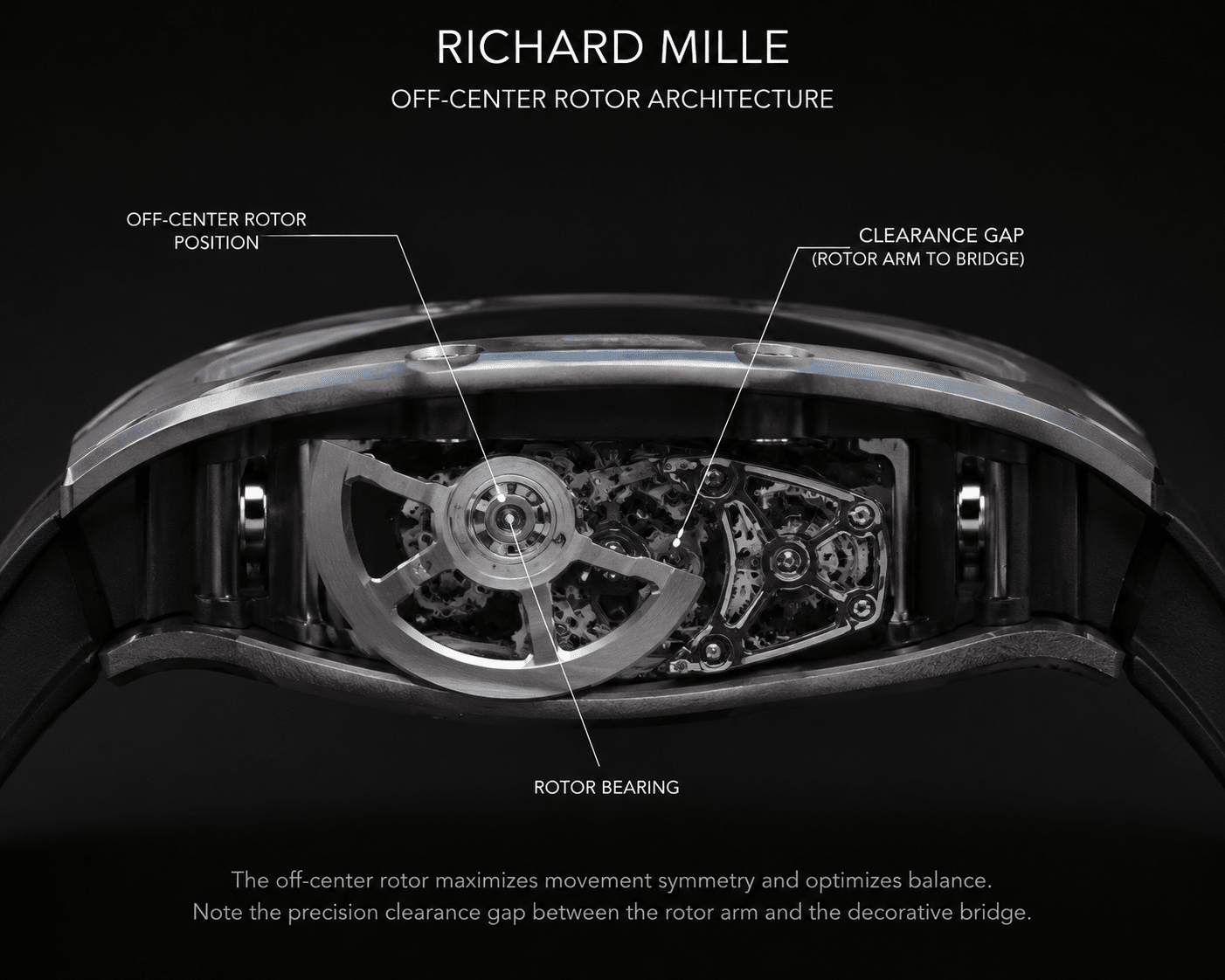
In a conventional automatic watch, the rotor sits at the center of the movement, balanced evenly around a central bearing. The geometry is forgiving. In an RM super clone, the rotor must sit off-center to fit within the tonneau case shape. That off-center position means the rotor arm is longer on one side, creating uneven leverage. The entire winding load is carried by a single bearing rather than a central pivot. When that bearing is low-quality, insufficiently lubricated, or slightly misaligned, the rotor starts to drag.
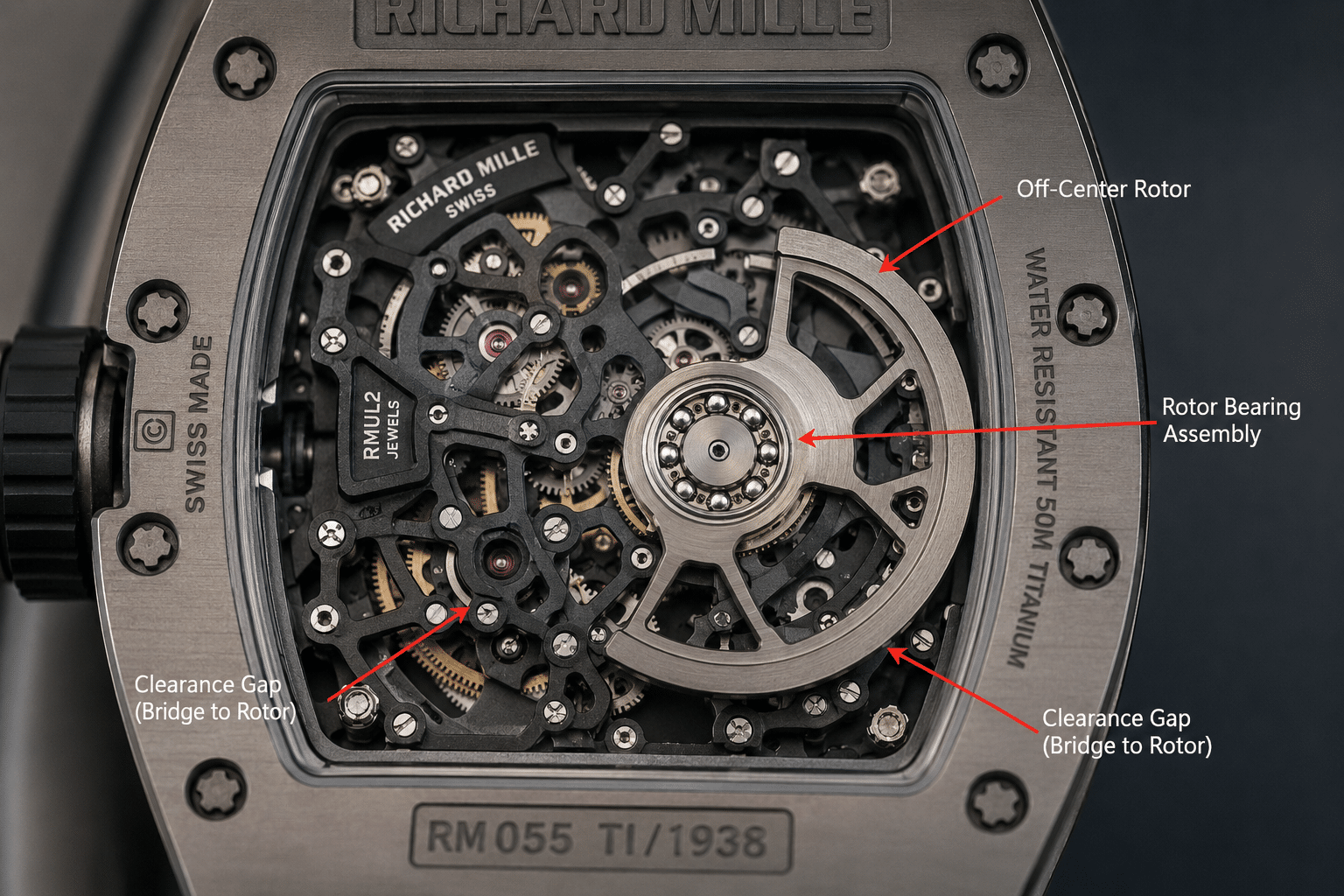
The second problem is clearance. The decorative bridge plates in RM super clone movements sit close to the rotor path. In many examples, the gap between the rotor arm and the nearest bridge is less than a millimeter. If the rotor is even slightly tilted — due to bearing wear or imprecise assembly — it begins to scrape against the bridge. That contact creates friction that slows the rotor, reduces winding efficiency, and can eventually stop the rotor entirely. In some cases, the friction is audible: a grinding or scraping sound that changes as the rotor position shifts.
Not every RM replica has this problem. Higher-tier movements from factories like APS and ZF use better bearings and pay more attention to clearance tolerances. But even in well-made examples, the rotor bearing is a wear item. Lubricants migrate and dry out faster in an open, skeletonized environment. A rotor that spins smoothly at delivery can develop drag within weeks of daily wear.
What Causes Rotor Drag and Wobble in RM Replicas
Three specific mechanical factors cause rotor drag and wobble in RM super clone movements. The first is bearing lubrication. The off-center rotor bearing in most RM clones receives a minimal amount of factory lubricant. Because the movement is open and exposed, that lubricant evaporates or migrates faster than in a closed movement. Once the bearing runs dry, metal-on-metal friction increases rapidly, and the rotor slows down or stops.
The second factor is rotor mounting alignment. The rotor is attached to the movement via a single screw or press-fit mechanism. If the mounting surface is not perfectly flat — a common issue in movements with decorative plates stacked on top of the base caliber — the rotor sits at a slight angle. That tilt causes the rotor arm to contact bridges or the caseback during rotation, creating drag and visible wobble.
The third factor is decorative bridge proximity. Many RM super clone movements use bridge plates that are designed for visual symmetry rather than mechanical necessity. These bridges often extend close to the rotor path. In some factory batches, the clearance is so tight that even normal rotor movement produces intermittent contact. Over time, that contact wears down both the rotor edge and the bridge surface, making the problem worse.
Even a movement that passes initial QC can develop rotor drag after a few weeks of wear. The lubricant dries, the bearing wears slightly, and the clearance that once seemed adequate becomes a contact point. This is not always a sign of a defective movement — it is a consequence of the design itself.
Movement Transparency Note: Movement references in this article describe the replica-market movement type or configuration, not an official Richard Mille caliber unless explicitly stated with verifiable evidence. Terms such as “integrated clone,” “modified base,” or “decorative module” refer to the specific construction approach used in the replica movement and should not be mistaken for an official brand-manufactured caliber.
How to Check Rotor Health Before Purchase
The best time to evaluate rotor health is before the watch ships. QC photos of the caseback can reveal some issues, but still images are not enough. The rotor needs to be observed in motion.
Ask the seller for a video that shows the rotor spinning under light wrist rotation. The rotor should start moving with minimal force and should continue spinning briefly after the motion stops. A rotor that stops immediately or requires a hard shake to start is a warning sign.
Listen to the rotor sound in the video. A smooth whirring or humming sound is normal for an exposed skeletonized movement. A grinding, scraping, or clicking sound indicates contact between the rotor and a bridge or the caseback. A loud wobble that changes pitch as the rotor position changes suggests bearing play.
Examine the clearance gap in the QC photo. Look at the space between the rotor arm and the nearest decorative bridge. If the gap appears uneven — wider on one side and narrower on the other — the rotor may be tilted. If the gap is very small, less than roughly half a millimeter, there is a higher risk of contact developing as the movement wears.
At Clean VS Factory, we usually remind buyers that rotor noise alone is not a reliable defect indicator. Some skeletonized RM movements naturally produce more audible rotor movement because the case and dial do not dampen sound the way a closed replica does. The more important signal is a change in sound over time, or a sound that clearly includes a scraping or grinding element.
Power Reserve Inconsistency: Why RM Super Clone Movements Often Run Short
One of the most common post-purchase disappointments with Richard Mille super clones is the gap between claimed power reserve and actual performance. Factory listings often cite 40 to 55 hours of power reserve. In real-world use, many owners report that their watch stops running after 12 to 20 hours, even after a full day on the wrist or a thorough manual wind.
This is not usually a case of false advertising in the malicious sense. The movement does store energy, but several factors reduce the usable power reserve to well below the theoretical maximum. The first factor is mainspring quality. The mainsprings used in most RM super clone movements are made from lower-grade steel alloys than genuine Swiss movements or higher-end Japanese calibers. They do not hold as much torque, and they lose elasticity faster over time. A weaker mainspring means the barrel delivers less rotational force to the gear train, which reduces the total running time.
The second factor is gear train friction. The skeletonized construction of an RM super clone movement requires additional bridge plates, exposed pivot points, and decorative components that add friction to the gear train. In a closed-case replica, the gear train operates in a more controlled environment with fewer friction surfaces. In an RM clone, every additional bridge and exposed gear creates drag that consumes energy. The movement has to work harder to turn its own components, which drains the power reserve faster.
The third factor is rotor winding efficiency. As discussed in the previous section, the off-center rotor in many RM super clones does not wind the mainspring effectively. A rotor that drags, wobbles, or loses bearing lubrication delivers only a fraction of its rotational energy to the barrel. This means the watch does not fully recharge during daily wear. The owner might wear the watch for eight to ten hours, but the rotor only winds the mainspring to perhaps 40 or 50 percent of its capacity. When the watch is taken off for the night, it runs down in hours instead of days.
The realistic expectation for most RM super clone movements is 18 to 28 hours of power reserve from a full wind, and perhaps 10 to 16 hours from daily wrist wear alone. Some higher-tier movements with better bearings and smoother gear trains may reach 30 hours. Few will approach the 40-plus hour claims that appear in factory descriptions.
This is not necessarily a dealbreaker. If the owner wears the watch daily and winds it manually every morning, the power reserve gap is manageable. But if the expectation was to wear the watch for a full day, set it aside for a weekend, and find it still running on Monday, that is unlikely to happen with most RM super clones. Understanding this limitation before purchase prevents the kind of frustration that leads owners to believe they received a defective unit when the watch is actually performing within normal parameters for this category.
Buyers should also be mindful that power reserve claims in the replica market can vary by factory label, movement configuration, and version. It is advisable to verify these claims through personal testing upon receipt rather than treating them as guaranteed specifications.
Setting Works and Crown Failures: Stem Stripping and Date-Wheel Misalignment
The crown and setting works on a Richard Mille super clone receive far less attention in pre-sale discussion than the rotor or the skeletonized bridges, but in daily use, they are among the most frequent sources of frustration. The problem is not that every watch fails here, but that the tolerance stack between the crown tube, stem length, and keyless works varies so widely across factories and individual units that a buyer has little way to predict the experience before winding the watch for the first time.
The most common issue is stiff or gritty winding feel. Unlike a closed-case replica where the crown turns a single gear train, RM super clones route the stem through a complex set of decorative plates and bridge layers before engaging the keyless works. Each additional friction point multiplies resistance. When the crown feels rough during hand-winding, the cause is usually not a bad crown but poor alignment between the stem and the decoratively plated movement layers it must pass through. In some cases, the stem is simply too long for the case tube, creating lateral pressure that grinds against the internal mechanism every time the crown turns.
Crown stripping is the more serious failure. It happens when the stem’s gear teeth, which engage the keyless works to wind the mainspring, wear down or break under repeated force. Lower-tier replica RM watches, particularly those using modified Miyota or Shanghai 7750 bases with added decorative modules, use soft metal stems that cannot withstand aggressive winding. Richard Mille replica movement reading underscores the vulnerability of these stems to improper technique. A buyer who winds quickly or forces the crown past resistance can strip the stem within weeks. Once stripped, the crown spins freely with no resistance, and the watch cannot be wound or set until the stem is replaced. This is not a simple fix. The stem must be sourced to match the specific movement route, and many RM super clones use non-standard stem lengths that are difficult to find through regular watch supply channels.
Date-wheel misalignment is a separate but related problem. Many RM models include a date window or a full calendar subdial. In super clone movements, the date-change mechanism is often an afterthought, tacked onto a base movement that was never originally designed for it. Common failures include the date wheel jamming halfway between numbers, the date failing to advance at midnight, or the date-change rotor skipping forward multiple days at once. These issues are rarely visible in QC photos because the watch is not shown in the middle of a date change. The buyer discovers the problem only after wearing the watch through a calendar cycle.
What a buyer should check before purchase is limited but actionable. Request a video of the crown being turned slowly through a full winding cycle. Listen for grinding or scraping sounds. Ask for a video of the time-setting function: pull the crown to the first position (date change) and the second position (time setting), and watch whether the hands move smoothly without stuttering. For date-wheel models, ask the seller to advance the date through the full 31-day cycle by turning the crown. Most sellers will not do this willingly, but the request itself signals that the buyer understands the risk.
For buyers who already own an RM super clone with crown or date issues, the practical advice is simple: wind slowly and gently. Forcing the crown when resistance increases is the fastest way to strip the stem. If the date wheel sticks, do not try to force it forward by rapid crown turns. Manual intervention by a watchmaker is safer. And if the crown already feels loose or spins freely, stop using it entirely and seek movement-level service before the loose stem damages the keyless works further.
Chronograph Function Failures: Subdial Hand Sticking and Reset Issues
Chronograph complications in Richard Mille super clone movements carry the highest failure risk of any function on the watch. This is not a matter of one factory making a weak chronograph versus another making a strong one. The category itself is built on a fundamental mechanical compromise: a base movement modified by adding a decorative chronograph module onto a platform that was never originally designed to drive a stopwatch with subdial integration.
The most common failure pattern involves the central chronograph seconds hand. When started, the hand may stutter, skip, or stop entirely after a few seconds of running. In many cases, the hand moves for the first ten to twenty seconds, then stalls at a fixed position. The cause is insufficient torque from the modified gear train. The decorative bridges and extra module layers increase friction beyond what the base movement can reliably overcome at every point in the rotation cycle. The chronograph second hand stops at the position where friction peaks, usually somewhere between the 20-second and 40-second mark.
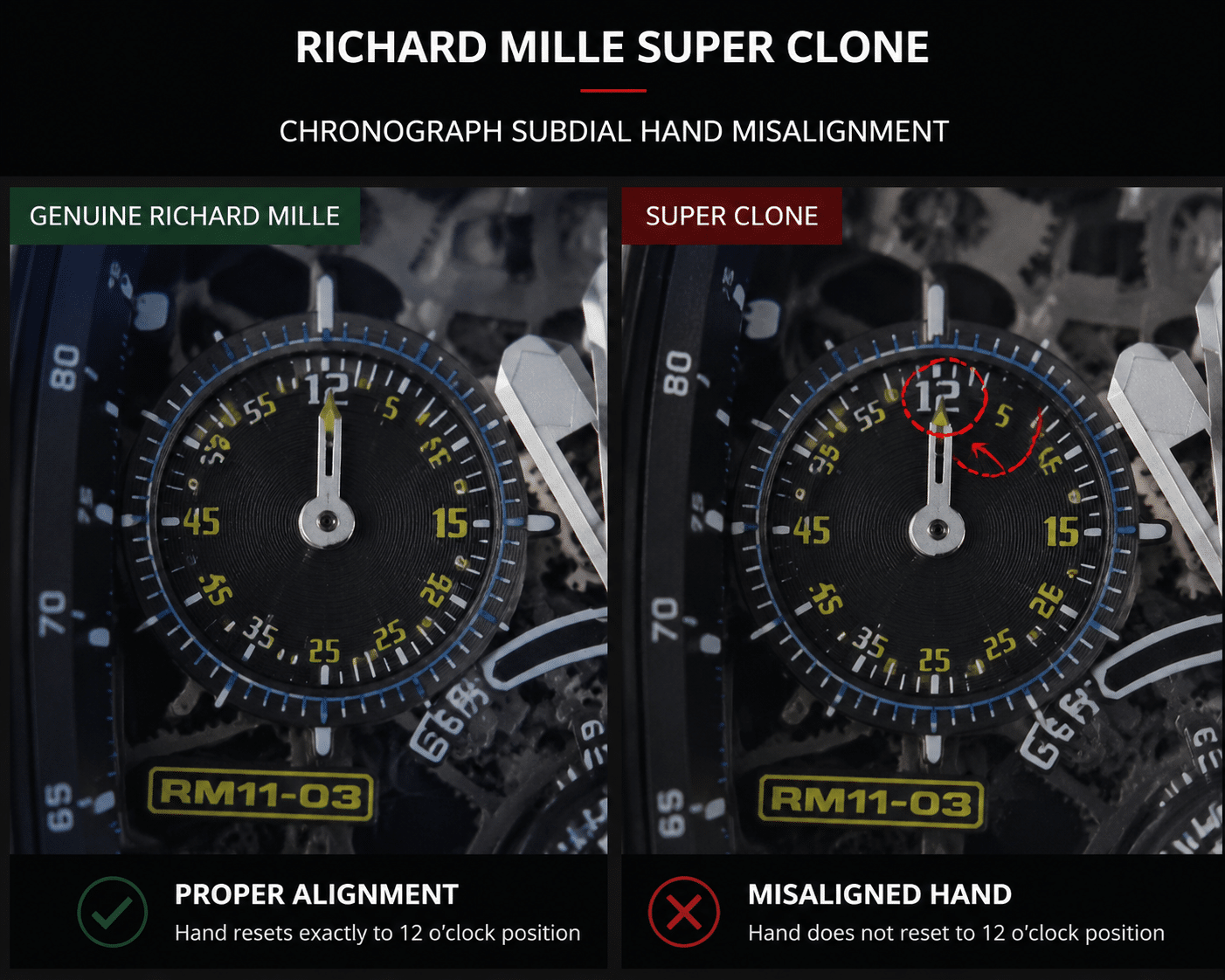
Subdial hand sticking during reset is equally common. When the user presses the reset pusher, the chronograph subdials (usually a 30-minute counter and a 12-hour counter on RM chronograph replicas) should snap back to zero. Instead, one or both hands may stop at an intermediate position, return slowly with visible lag, or fail to move at all. The root cause is in the reset hammer mechanism. In a genuine chronograph movement, the reset hammers are precisely shaped to engage the heart-shaped cams on each subdial simultaneously. In replica chronograph modules, the hammer geometry is often approximate, the spring tension is inconsistent, and the engagement timing between the two subdials is rarely synchronized. The result is that one subdial resets correctly while the other lags behind by several minutes or stops entirely.
Pusher feel is another reliable diagnostic. A healthy chronograph pusher should have a clean, crisp engagement with an audible click. In RM super clone chronographs, the pusher action is often spongy or vague. The user presses the pusher and feels soft resistance before the function engages, or the pusher sticks halfway and requires a second press. This indicates poor alignment between the pusher rod and the chronograph module’s actuating lever. Over time, the misalignment can cause the pusher to jam permanently or break the linkage internally.
The honest assessment for any buyer considering an RM super clone with chronograph function is this: treat the chronograph as a visual feature, not a daily-use tool. The mechanism is fragile, difficult to service, and poorly supported by replacement parts. Even a unit that passes QC with clean subdial resets can develop problems after a few months of regular use as lubricants migrate and gear train friction increases. The safest approach is to test the chronograph function immediately on receipt, cycle through several start-stop-reset sequences, and then use it sparingly if at all. A buyer who needs a reliable stopwatch function should not look to any RM super clone for that purpose.
Decorative Bridge Instability: Loose Screws, Misalignment, and Debris Traps
The decorative skeletonized bridges on RM super clone movements serve a dual purpose. Visually, they mimic the layered architecture of genuine RM calibers, creating the complex mechanical landscape that buyers pay a premium for. Structurally, they are a liability. These bridges are not simply aesthetic overlays, but they are also not load-bearing components designed to the same tolerances as the base movement. They sit between the buyer’s eye and the actual gear train, and when they fail, they can take the entire movement with them.
The most common mechanical failure from decorative bridges is screw loosening. The small screws that secure these bridges to the movement plate are under constant vibration from the off-center rotor. In a genuine movement, screws are treated with thread-locking compound and seated to precise torque specifications. In replica production, the application of thread locker is inconsistent. Some units receive none at all. Over weeks of wrist movement, the vibration walks the screws out of their threads. A loose screw may sit harmlessly in the caseback cavity for a while, but it can also migrate into the gear train path. Once a loose screw contacts a gear tooth, the movement stops immediately, and the gear train may suffer permanent damage.
Bridge misalignment is a more subtle but equally dangerous problem. Even when the screws remain tight, the decorative bridges themselves can warp or shift if their mounting points are not precisely aligned with the base movement. This is common when a factory uses a generic base movement (such as a Miyota or Shanghai caliber) and adds a custom decorative bridge plate that was not designed for that specific movement geometry. The bridge may sit slightly crooked, creating a contact point with the gear train that only manifests under load. The watch may run fine on a timegrapher for a few seconds but stop after hours of wear when a gear tooth catches the edge of the misaligned bridge.
Debris accumulation is the third risk, and it is the one most specific to skeletonized RM replicas. A closed-case replica watch has a solid caseback and a dial that covers most of the movement. An RM super clone has a sapphire caseback, a skeletonized dial, and in many models, open side gaps between the case layers. This means airborne particles have multiple entry points into the movement cavity. Dust, fabric fibers from clothing, and even microscopic skin particles can settle on the exposed gear train. In a closed-case watch, these particles would remain outside the movement envelope. In a skeletonized RM replica, they land directly on lubricated gear teeth, where they mix with the oil to form an abrasive paste that accelerates wear.
Why Skeletonized Cases Accelerate Movement Wear
This is not a defect in any specific factory batch or movement version. It is an inherent design vulnerability in all skeletonized super clone watches, and RM replicas are the most extreme example because they offer the greatest exposure. The open caseback alone would not be catastrophic, but the combination of an open caseback, a skeletonized dial with large cutouts, and side gaps at the case junctions creates a direct path for contaminants. A buyer who stores the watch in a dusty environment, wears it in active conditions, or lives in a humid climate will accelerate this wear cycle. The only mitigation is regular movement cleaning, which most RM super clone buyers do not plan for at the time of purchase.
Before buying, request a high-resolution caseback photo that is well-lit and in sharp focus. Look at every screw head on the decorative bridges. They should all sit flush with the bridge surface, with no visible tilt that suggests partial loosening. Check for any loose particles or fibers visible between the bridges. If the seller provides a video of the movement running, listen for any irregular ticking or scraping sounds that could indicate bridge contact with the gear train. Screw alignment visible at purchase is no guarantee against future loosening, but it is the only pre-purchase signal available. A buyer who sees uneven screws or visible debris in the QC photos should reject that unit, not because it will fail immediately, but because the underlying assembly discipline is already compromised.
Editorial Perspective: This article prioritizes movement-specific evaluation over general factory reputation because RM super clone failure patterns depend more on movement route, module construction, and assembly discipline than on factory name. A buyer who chooses a “premium factory” for an RM model with a poorly integrated chronograph module may still face the same risks described here. At Clean VS Factory, we emphasize that factory reputation is useful but incomplete: it helps narrow the shortlist, but the final decision for an RM super clone should be based on movement architecture (integrated Dandong vs. modified base), rotor clearance visible in QC, and willingness to accept the functional limitations of skeletonized construction. The right choice depends on which failure types the buyer is prepared to live with, not on which factory name sounds most credible in pre-sale discussion.
Rotor Noise and Vibration: When the Sound Reveals a Problem
Rotor noise in a Richard Mille super clone is almost unavoidable, but not all noise means the same thing. The skeletonized case design that makes these watches visually striking also acts like an acoustic chamber. Every mechanical sound from the movement — gear mesh, rotor rotation, bearing friction — is amplified and transmitted directly through the open caseback and skeleton dial. Some noise is normal. Some noise is a warning.
The challenge for the buyer is telling the difference between the two. A watch that sounds healthy on day one can develop problematic noises over weeks of wear, and those changes often predict a mechanical failure before it stops the watch entirely.
What Normal Rotor Sound Should Be
A functional RM super clone rotor produces a consistent, smooth whirring or light humming sound as it spins. The tone may be audible in a quiet room, especially during sudden wrist movements, but it should not change pitch unevenly or produce metallic contact sounds. The rotor should spin freely and decelerate smoothly, not abruptly stop or rattle as it loses momentum. In many cases, the rotor will also produce a soft clicking sound from the unidirectional winding mechanism — this is normal and present even in many genuine automatic watches.
Normal rotor behavior also includes some vibration transmitted through the case during active winding. Because the off-center rotor is relatively heavy and moves in a large arc, the watch may pulse slightly against the wrist during vigorous motion. This is not inherently a defect; it is a consequence of the rotor’s size and position.
Abnormal Sounds and What They Indicate
The following sounds should be treated as diagnostic signals rather than normal operating noise:
Grinding or scraping. A grating sound that occurs during rotor rotation almost always means the rotor arm is contacting a decorative bridge or movement plate. This can happen when a bridge screw has loosened, allowing the bridge to shift slightly into the rotor’s path, or when the rotor itself has developed vertical play and is tilting downward during rotation. If left unaddressed, the contact can wear down the bridge surface, create metal debris inside the movement, and eventually stop the rotor entirely.
Loud wobble with changing pitch. A rotor that sounds like an unbalanced washing machine spin cycle — with the pitch rising and falling unevenly — usually indicates bearing wear or inadequate bearing lubrication. The rotor bearing in many RM super clones is a single low-grade ball bearing that can develop radial play over time. Once the bearing has measurable slop, the rotor tilts off its intended plane during rotation, causing the sound to shift as the rotor wobbles through its arc. This condition often worsens progressively.
Sudden increase in noise over weeks. If a watch that was reasonably quiet at delivery becomes noticeably louder after a few weeks of daily wear, the cause is rarely spontaneous. More commonly, the rotor bearing lubricant has migrated away from the contact surfaces or has been contaminated by microscopic debris. The bearing then runs dry, generating more friction and more noise with each rotation. This is one of the most common reasons owners report that their RM replica “suddenly sounds terrible” after a month of use.
Rattling at rest. If the rotor produces a loose rattling sound when the watch is gently shaken without wrist motion, the rotor screw or mounting may have loosened. In some cases, the rotor itself can separate from the bearing assembly if the press fit was insufficient. This is less common than bearing noise but mechanically more dangerous, as a loose rotor can damage the gear train if it shifts position.
When Rotor Noise Demands Action
Not every abnormal sound requires immediate service. A rotor that scrapes occasionally during very fast wrist movement but operates quietly during normal wear may have a minor clearance issue that can be monitored. But a rotor that grinds consistently, wobbles audibly, or generates unusual vibration felt through the caseback is a sign that failure is progressing.
At Clean VS Factory, we advise buyers to listen to their RM replica rotor regularly during the first month of ownership, ideally in a quiet environment. Take a mental baseline of what the rotor sounds like at delivery. If the sound changes character — from a smooth whir to a rough scrape, or from a consistent hum to an uneven wobble — that change is more significant than the absolute loudness of the sound.
It is also worth remembering that skeletonized RM replicas are never silent. Anyone who expects dead-quiet rotor operation from an open-caseback watch with an off-center rotor is setting an unrealistic expectation. The goal is not silence but stable, predictable sound. Consistent noise is acceptable. Changing noise is the real red flag.
Hand Alignment and Subdial Spacing Errors After Movement Wear
One of the most frustrating issues RM super clone owners encounter is hand alignment that degrades over time. The watch may arrive with perfectly positioned hands and centered subdials. Weeks or months later, the hour hand may sit slightly ahead of the minute marker at certain positions, or a chronograph subdial hand may no longer return to the exact 12 o’clock position after reset.
This is not a QC failure at delivery. It is a progressive wear issue caused by how the movement handles stress over time, and it is more common in skeletonized RM replicas than in closed-case watches because of the movement’s exposed architecture and the additional weight of decorative components.
Why Alignment Drifts Over Time
Three mechanical causes account for most alignment drift in RM super clone movements:
Cannon pinion wear. The cannon pinion transfers motion from the gear train to the hour and minute hands. In RM super clones, the cannon pinion is often made from softer brass alloys that wear more quickly than the steel pinions used in better-spec movements. As the cannon pinion wears, the friction fit between the pinion and the hour wheel loosens, allowing the hands to shift slightly out of their intended position. The result is often visible at 12 o’clock: the hour hand may point slightly past or before the hour marker when the minute hand is exactly at 60.
Subdial gear slop. Chronograph subdials in RM super clones operate through additional gear trains that are added to the base movement. These gear trains have more tolerance, meaning more mechanical slack, than the main gear train. Over weeks of use, the subdial gears can settle into a position that shifts the hand slightly off center. This is most visible on the 30-minute and 12-hour subdials, where the hand may return to the 58-minute or 2-minute mark instead of zero after a chronograph reset. The issue is mechanical play, not a bent hand.
Hand-press seating loosening. The hands on RM super clones are typically pressed onto their pinions during assembly. The press fit relies on friction, and repeated vibration from daily wrist movement can gradually reduce that friction. A hand that was tightly seated at delivery may develop micro-movement over time, causing it to shift slightly forward or backward relative to its intended position. This often affects the center seconds hand first, producing a seconds hand that seems to skip or stutter as it passes certain positions on the dial.
Distinguishing Factory Defects From Wear Drift
It matters whether an alignment error was present at delivery or emerged later. A factory defect — hands visibly misaligned in QC photos — is a reason to reject the watch before purchase. Progressive drift that appears after weeks of wear is a different problem. It cannot be caught in QC photos because the watch had not yet accumulated the wear cycles that cause the shift.
If you notice alignment drift after owning the watch, the most practical solution is a low-cost service to reseat the affected hands. A watchmaker can remove the hands, clean the cannon pinion, apply fresh friction grease, and press the hands back into correct alignment. This is not a full movement service and should cost significantly less than a complete overhaul. It is also not a solution for subdial gear slop, which usually requires replacing the subdial module or accepting the tolerance as a limitation of the movement design.
What the Buyer Can Do
Take a reference photo of the dial at delivery showing the hand positions at 12:00, 6:00, and 3:00. Compare the same positions after one month and three months of wear. If the alignment has shifted by more than half a minute marker, the movement Richard Mille replica movements may have a cannon pinion wear issue that will continue to worsen.
For chronograph models, test the reset function at least once per week during the first month. If the subdial hands return to the same position every time, the alignment is stable. If the reset position shifts from one test to the next, the subdial gear train has excessive slop, and that particular subdial is unlikely to hold alignment over the long term.
The best defense against alignment drift is to choose a model with a simpler movement architecture. Non-chronograph RM replicas with the Dandong RMUL2 integrated clone generally show better long-term alignment stability than chronograph models with added subdial modules. Every extra gear train creates another opportunity for cumulative tolerance to express itself as visible misalignment.
As an additional point of context, the concept of gear train friction in the context of skeletonized movements is one that is frequently discussed among watch enthusiasts who study the special engineering challenges these watches face. In a closed solid-dial watch with a closed caseback, the gear train is largely isolated from the external environment. In a skeletonized watch, every exposed gear and bridge becomes a potential friction point that uses power, as the mechanism must run through decorative plates. This is a key reason why the actual power reserve so often falls short of factory claims.
Buyer Expectation Note: No super clone watch should be judged by movement complexity or visual decoration alone. A better purchasing decision for an RM replica depends on the specific movement route, rotor clearance, expected power reserve, and how the watch will be worn and inspected in daily use. Buyers should check caseback QC details carefully and treat factory power reserve claims as optimistic rather than guaranteed.
When evaluating an RM super clone, the factory name should not be treated as a universal guarantee of quality. A factory may be strong on one RM model and weaker on another because case construction, rotor clearance, and decorative bridge layout can vary significantly across different references. The safest approach is to judge each watch by the specific movement route, visible QC evidence, and realistic ownership expectations — not by factory reputation alone.
Managing Expectations: The Difference Between Wear-and-Tear and Manufacturer Defect
A recurring challenge for RM super clone owners is distinguishing between normal wear-and-tear that is inherent to the design and a genuine manufacturing defect. Because skeletonized movements are more sensitive to environmental conditions and assembly tolerances, certain behaviors that would be cause for alarm in a closed-case replica are simply part of the ownership experience in an RM clone. Misinterpreting normal mechanical behavior as a defect can lead buyers to pursue unnecessary repairs or return a watch that is performing as expected.
Normal wear-and-tear includes gradual rotor noise increase over several months as bearing lubricant migrates and dries. It includes a slow decline in power reserve from 25 hours to 18 hours over a year of daily wear. It includes minor chronograph subdial reset drift of up to one minute after many months of use. These are not signs of a defective watch; they are signs of a movement that is operating near the limits of its design. The buyer who accepts this reality can plan for periodic servicing and avoid unnecessary frustration.
Manufacturer defects, on the other hand, are issues that appear early and unexpectedly. A rotor that grinds from day one, a crown that strips within the first week, a chronograph that fails to start at all, or a gear train that stops entirely without prior warning — these suggest an assembly failure, a missing lubrication step, or a critically misaligned component. These defects are what a buyer should reasonably expect a seller to address under a return or exchange policy. Checking the QC checklist in this article before purchase is the best way to separate early defects from the normal limitations of the design.
For any significant post-purchase issue, the buyer’s first step should be to contact the seller. The outcome will depend on the seller’s policy, the timing of the report, and whether the issue is a clear defect or a wear-related pattern. Buyers should not assume that every mechanical behavior is covered under an implicit guarantee. Confirming terms before purchase remains the most practical protection.
What to Inspect Before Buying: Movement-Specific QC for RM Super Clones
Standard QC checks for a Rolex replica — bezel alignment, rehaut centering, SEL fit — are useful but not sufficient for an RM super clone. The failure points that matter most in this category are specific to the movement’s construction: rotor behavior, bridge stability, chronograph function, and power reserve consistency. A buyer who inspects only the dial and case may receive a watch that looks excellent but develops movement problems within weeks.
The following checklist is designed for use during a dealer conversation. Each item targets a specific failure point discussed in this article. The goal is not to eliminate all risk — no QC process can guarantee long-term reliability from a super clone movement — but to reduce the probability of buying a watch with a movement issue that is already developing at the time of purchase.
QC Photos and Videos to Request
Ask the dealer for the following visual evidence before agreeing to purchase. Each item reveals something specific about the movement’s current condition.
High-resolution caseback photo. This should show the entire movement clearly. Look for three things: rotor clearance (is there visible space between the rotor edge and the nearest bridge surface?), screw alignment (are all decorative bridge screws fully seated and not tilted?), and debris (are there visible dust fibers, dust particles, or metal shavings on the movement plates?). A clean, well-aligned movement does not guarantee reliability, but a movement with visible debris or misaligned screws is almost certainly at higher risk of early failure.
Video of rotor spinning under light rotation. Gently tilt the watch side to side and listen. The rotor should spin freely without hesitation. The sound should be a smooth, consistent whir or hum. Grinding, scraping, or an uneven wobble in the rotor sound are red flags. A rotor that stops abruptly rather than decelerating smoothly may have excessive bearing friction that will worsen with wear.
Video of winding action. Record the crown being turned gently in the winding position. The winding feel should be smooth, with even resistance. Stiff spots, grinding sensation, or slipping indicate poor keyless works engagement or a misaligned stem. Also confirm that the crown screws down fully and securely if the model has a screw-down crown.
Video of chronograph start, stop, and full reset. For chronograph models, this is non-negotiable. Start the chronograph, let it run for 30 seconds, stop it, and reset. All subdial hands should return to their exact starting positions. The central chronograph seconds hand should not stutter or lag during operation. If the dealer cannot provide this video, assume the chronograph function has not been tested.
Timegrapher reading if available. A timegrapher trace shows beat rate, amplitude, and positional consistency. For an RM super clone movement, look for an amplitude between 250 and 310 degrees when fully wound, and a beat error below 0.5 milliseconds. Lower amplitude suggests excessive friction in the gear train, which often correlates with short power reserve. Any reading showing amplitude below 220 degrees is a concern.
What to Confirm With the Seller Before Purchase
Beyond visual inspection, the buyer should clarify three things with the seller before committing to a purchase.
What movement route is used. Ask whether the watch uses a Dandong integrated clone (preferred for stability), a Shanghai modified movement, or a Miyota base with decorative plates. The movement route determines both the watch’s baseline reliability and its long-term serviceability. Dandong movements are easier to repair through watchmakers familiar with clone calibers; Shanghai-based movements may require sourcing specific replacement parts.
Whether the movement has been tested for power reserve. Many dealers do not run a power reserve test before shipping. If the seller has tested the watch and can confirm it runs for a specific duration on a full wind, that is useful information. If the seller has not tested it, the buyer should assume the claimed power reserve is optimistic and plan to test the watch personally upon arrival.
What the return or repair policy covers for movement issues. Some dealers will accept a return if the movement stops working within the first week. Fewer will cover wear-related failures — rotor noise, alignment drift, power reserve degradation — that develop after two to three weeks of normal use. Understand the policy before purchasing. A dealer who offers a 14-day inspection window with coverage for movement defects is preferable to one who limits coverage to DOA only.
At Clean VS Factory, we generally recommend that buyers treat the first month of ownership as the true QC period. A watch that runs well for 30 days of daily wear — maintaining consistent rotor sound, stable power reserve around 30+ hours, and no alignment drift — is more likely to remain reliable over the medium term than one that passes initial inspection but shows problems during its first month on the wrist. The dealer’s QC photos catch the static condition. The buyer’s own wear test catches the dynamic behavior, and that is where most RM super clone failure points actually reveal themselves.
Movement Traceability: Matching Failure Patterns to Specific Constructions
One of the most useful steps a buyer can take is to connect the specific failure pattern they are concerned about to the movement construction they are considering. Not all RM super clone movements fail the same way, and the risk profile changes depending on whether the watch uses an integrated Dandong clone, a modified Shanghai caliber, or a Miyota base with decorative plates. Understanding this traceability is the difference between a general fear of failure and a targeted evaluation of actual risk.
The Dandong RMUL2 integrated clone is the most stable option for non-chronograph RM models. Its architecture is purpose-designed for the skeletonized tonneau case: the rotor sits on a dedicated bearing with more consistent clearance, the gear train is laid out to minimize friction from decorative components, and the mainspring is matched to the winding torque. In practical terms, a Dandong-based movement is far less likely to develop rotor noise or power reserve shortfall within the first several months than a modified base caliber. Because the movement is built as a single integrated unit rather than a base movement with an added bridge module, the risk of screw loosening, debris contamination, and decorative bridge misalignment is substantially lower. Buyers who prioritize reliability over price should seek out models confirmed to use this movement route.
Shanghai-based modified movements are a middle ground. They offer better torque and smoother operation than entry-level Miyota builds, but they are still adapted from a general-purpose automatic caliber. The decorative bridge plates are often added after the base movement is assembled, which introduces the alignment and screw retention risks described earlier. The power reserve on Shanghai-based RM clones is typically 18 to 25 hours in real-world use. Rotor noise is more variable than on Dandong movements because the bearing quality is not standardized. Some Shanghai-based units run reasonably quietly; others develop audible grinding within two weeks. The buyer’s best defense is to request a video of the rotor in motion and listen carefully for any intermittent contact sounds. If a Shanghai-based movement passes a quiet rotor test and shows clean bridge alignment in QC, it can be a functional daily wearer, but it should be monitored more closely than a Dandong unit.
Miyota-based RM super clones are the most affordable but the highest risk for the failure points discussed in this article. The base Miyota movement is reliable in a closed-case watch, but when it is modified with a decorative bridge plate and an off-center rotor, the addition often degrades reliability. The rotor bearing on a modified Miyota is not designed for the lateral load of a large off-center rotor; bearing wear and wobble appear much faster than on Dandong units. The gear train friction from the added plates can reduce power reserve to 10 to 16 hours. Chronograph modules added to Miyota bases are particularly fragile because the base movement was never intended to drive a stopwatch. A buyer considering a Miyota-based RM replica should expect to replace or service the movement within 12 to 18 months, and the chronograph function, if present, should be treated as decorative only.
For CleanVSFactory, the goal is to make replica watch decisions more traceable by connecting factory claims to visible details, movement behavior, version differences, and practical QC checks. A buyer who understands which movement route corresponds to which failure profile can make a much more informed decision than one who simply relies on a factory name. The same factory may build a Dandong-based RM model that runs reliably and a Miyota-based RM model with a fragile chronograph module. The movement route, not the factory label, is the more reliable predictor of long-term behavior.
Before purchasing, a buyer should confirm with the seller which movement route is used in the specific model under consideration. If the seller cannot or will not provide this information, it is reasonable to assume the movement is a lower-tier modified base. In the RM super clone market, the most useful traceable information is almost always the movement architecture, not the factory name or the visual decoration in stock photos.
Long-Term Ownership Considerations: Serviceability and Realistic Lifespan
A crucial aspect of RM super clone ownership that is rarely discussed in pre-sale materials is the serviceability and lifespan of the movement. Unlike a straightforward Rolex clone movement where replacement parts and service knowledge are widely available, the skeletonized and decorated nature of RM super clones creates a unique set of challenges for long-term care.
The primary challenge is parts availability. Integrated Dandong clone movements have a growing ecosystem of replacement components within the replica watch service community, making them the most serviceable option. A watchmaker familiar with clone calibers can often source replacement rotors, mainsprings, or keyless works for Dandong-based RM movements. Shanghai-based movements are more difficult because parts specifications vary between production batches. A mainspring or stem from one batch may not fit another. Miyota-based RM clones are the most difficult to service in their modified form. The base Miyota movement is easy to replace entirely, but the decorative bridge plates and off-center rotor assembly are not standard parts. If the Miyota base fails, the buyer may need to source an entire new movement and have the decorative components transferred, which can cost as much as a new watch.
The second consideration is lubrication maintenance. Skeletonized movements dry out faster than closed-case movements. A well-maintained RM super clone may benefit from a light re-oiling of the rotor bearing and key gear train pivots every 12 to 18 months. Many owners neglect this because they do not know it is needed, which leads to accelerated bearing wear and a permanently rough rotor that cannot be restored without full disassembly.
The realistic lifespan expectation for an RM super clone movement, with reasonable care, is 18 to 36 months of daily wear before it requires significant service or replacement. A buyer who accepts this can plan accordingly. A buyer who expects a skeletonized replica to run reliably for five years without maintenance is likely to be disappointed. The most cost-effective long-term strategy for many owners is to treat the RM super clone as a consumable item with a finite service life, rather than an heirloom-quality watch that can be passed down.
[1] Richard Mille, “Caliber RMUL2,” Richard Mille Official Website, technical specification describing the skeletonized base caliber, including its barrel setup with moving barrel bridge and I-shaped bridges, accessed 2025. The official description confirms the integrated architecture, but does not verify replica execution or failure behavior.
[2] Richard Mille, “Caliber RMAR1,” Richard Mille Official Website, technical specification for a second integrated skeletonized caliber, illustrating the brand’s approach to gear train visibility and decorative bridge layout, accessed 2025. This official source is used here to clarify the genuine movement design concept and to set expectations that replica skeletonized movements face different tolerances and serviceability constraints.
Disclosure: This article is for general educational and comparison purposes only. Replica watches are not genuine products from the original luxury brands, and brand names such as Richard Mille are used only to identify reference designs or comparison topics. Factory names, movement descriptions, prices, availability, QC details, seller policies, and version information can change, so readers should verify important details with the seller before making a purchase decision. Replica watches should not be represented, resold, or used as genuine watches. The movement descriptions in this article refer to replica-market constructions and should not be mistaken for official brand-manufactured calibers. Buyer expectations regarding lifespan, serviceability, and power reserve should be informed by the specific movement route and architecture, not by claims in pre-sale listings.