
Most Richard Mille replica reviews focus on the case or dial, but the movement is where the real differences between a high-tier super clone and a budget replica become visible — even without opening the caseback. Many buyers rely on “looks real enough” and end up with a watch that wears thicker, winds poorly, or has a decorative plate pretending to be a working skeleton movement. This article shows you how to decode the movement failure points through the crystal, the rotor sound, the crown feel, and the behavior of chronograph or GMT functions. By the end, you will know exactly which visual and mechanical clues separate a proper clone build from a decorative base movement, and how to confirm what is inside before you buy.
| Checkpoint | High-Tier Clone (e.g., Asia Clone) | Lower-Tier Base (Miyota / Seiko / Quartz) |
|---|---|---|
| Balance wheel appearance | Smooth blur from 28,800 bph; positioned near 12 o’clock | Visible swings from 21,600 bph or lower; might be a stationary fake wheel |
| Bridge architecture | Beveled edges, functional screws, visible turning gears under multi-level bridges | Flat cosmetic plates with painted detail, shallow screws, stationary surfaces |
| Rotor sound (when shaking) | Smooth, consistent sweep | Scratchy (Miyota), clicking (Seiko), or silent (quartz) |
| Crown winding feel | Firm, crisp position changes; requires deliberate turns | Lighter, looser, or sloppy feel; positions may feel vague |
| Case thickness vs. genuine | Within 0.5 mm of genuine dimensions | 1.5–2 mm thicker (Miyota) or thinner (quartz) |
| Chronograph / GMT function | Smooth sweep, crisp start/stop/reset, independent GMT tracking | Non-functional pushers, drifting hands, or no real timekeeping logic |
Quick Questions Before You Read
Q: Can you really tell the movement tier just by looking at the dial side?
Yes — the balance wheel position and oscillation speed, combined with bridge depth and screw quality, reveal whether you’re looking at a functional clone movement or a decorative plate.
Q: Does the rotor sound alone confirm a high-tier build?
No, but it’s a strong first filter. A smooth sweep points to an Asian clone, while scratchy, clicking, or silent rotor sounds indicate Miyota, Seiko, or quartz bases respectively.
Q: Which single test should a beginner trust most if they can’t open the case?
The crown winding feel. A firm, crisp winding action with clear position stops is hard for lower-tier builds to fake. Combined with a side-profile thickness check, this catches most disguised builds.
Why Richard Mille Replica Movements Are Harder to Judge From the Outside
If you have ever inspected a Rolex replica, you already know the basic rule: look at the balance wheel through the caseback. On a Submariner or Datejust, the balance is hidden behind a solid steel caseback, so you rely on other tells — bezel feel, crown action, datewheel font. But on a Richard Mille, the dial is wide open. You can see gears, bridges, and the balance wheel through the front crystal. It is tempting to assume that an open dial simplifies movement evaluation. It does not. In many ways, it makes the job harder.
The reason is structural. A Richard Mille replica dial is not a transparent window into a neatly laid-out movement. It is a layered composition of skeletonized bridges, decorative plates, and functional components arranged for visual impact first and mechanical logic second. What you see is not always what works. The balance wheel may be visible, but the pallet fork — the component that actually controls energy transfer — is almost always hidden behind a bridge or under the dial. You can watch the balance oscillate, but you cannot see whether it is connected to a real escapement or merely spinning freely. The mainspring barrel is often visible, but on lower-tier builds it may be a stationary decorative disc rather than a functional power source.
The real challenge is visual noise. A genuine Richard Mille movement is built on a grade 5 titanium baseplate with transparent bridges and exposed gear trains. A replica must simulate this architecture using whatever movement it has inside. On a clone movement — such as the Dandong-based automatic — the bridges are functional and the gear train is mostly visible. On a decorated Miyota or Seiko base, the manufacturer adds cosmetic plates, false bridges, and painted details to fill the gap between the small round movement and the large tonneau case. These decorative components are fixed in place. They do not move, they do not connect to gears, and they do not serve any horological function. But they look convincing in a QC photo.
This is why dial-side movement evaluation requires a different method than what works on a closed-dial watch. On a Rolex replica, the movement is hidden, so every clue comes from external behavior — rotor noise, crown feel, bezel action. On a Richard Mille replica, the movement is visible, but much of what you see may be theater. The buyer must learn to separate functional components from decorative ones. A visible balance wheel does not guarantee a true automatic escapement. A visible gear does not guarantee a connected train. A visible barrel does not guarantee a wound mainspring.
The practical takeaway is simple: do not trust the visual impression. Trust what the component actually does. A bridge that does not hold a moving gear is decoration. A wheel that does not turn when the crown is wound is a fake. A balance that oscillates without a visible pallet fork may still be real — but you cannot confirm it from the dial alone. The open architecture of a Richard Mille replica gives you more to look at, but it also gives you more to misinterpret. The sections that follow will teach you what to look for and, just as importantly, what to ignore.
It is important to note that Richard Mille is a registered trademark of Richard Mille SA. Brand names are used in this article only to identify the genuine reference design being discussed. Replica watches discussed here are not genuine products from Richard Mille or any other luxury brand and should not be represented as authentic watches.
Quality Control Note: For replica and super clone watches, buyer confidence depends on visible quality-control details such as case finishing, dial printing, bezel alignment, bracelet fit, clasp engraving, datewheel position, and movement configuration. These details should be checked model by model rather than assumed from a factory name alone.
Balance Wheel Position and Behavior – The Single Most Reliable Dial-Side Clue
Of all the visible movement components on a Richard Mille replica, the balance wheel is the most useful indicator of movement quality. It is almost always visible through the skeleton dial, it moves continuously while the watch is running, and its behavior directly reflects the movement type and construction tier. If you learn to read just one external clue, this is the one to master.
The first thing to check is position. On most Richard Mille replica movements, the balance wheel sits at either 12 o’clock or 6 o’clock, depending on the movement route. Clone movements — such as the Dandong RMUL2 or the Shanghai-based integrated calibers — usually place the balance at 12 o’clock, matching the genuine layout. Decorated Miyota 9015 builds often move the balance to 6 o’clock or offset it to one side. Quartz-based builds may place a fake balance wheel anywhere for visual effect, or omit it entirely. If the balance wheel is not where a real Richard Mille movement would place it, that is an immediate tell.
The second clue is oscillation speed. A genuine Richard Mille caliber runs at 28,800 vibrations per hour (4 Hz), producing a very fast, smooth sweep that appears as a continuous blur to the naked eye. A replica clone movement that also runs at 28,800 bph will show the same blur — you cannot count individual oscillations, and the wheel looks almost frozen in motion under good light. A low-beat movement at 21,600 bph (3 Hz) produces a noticeably slower oscillation. The wheel moves in visible back-and-forth sweeps, and with practice you can estimate the beat rate just by watching for a few seconds. If the balance wheel ticks once per second or does not move at all, the watch is either quartz or a dummy build with a non-functional decorative wheel.
To test this in practice, hold the watch face-up under direct lighting — a desk lamp works well. Watch the balance wheel for five seconds. If the wheel appears as a shimmering disc with no visible individual swings, the movement is almost certainly high-beat (28,800 bph). If you can clearly see the wheel swing left and right, it is low-beat (21,600 bph). If the wheel sits still or moves only when you tilt the watch, the movement is not a true automatic. In QC photos, the same logic applies: a sharp photo of a balance wheel with visible spokes indicates low-beat or a stopped movement. A photo where the balance wheel is a blurred circle indicates a watch that is running at high speed.
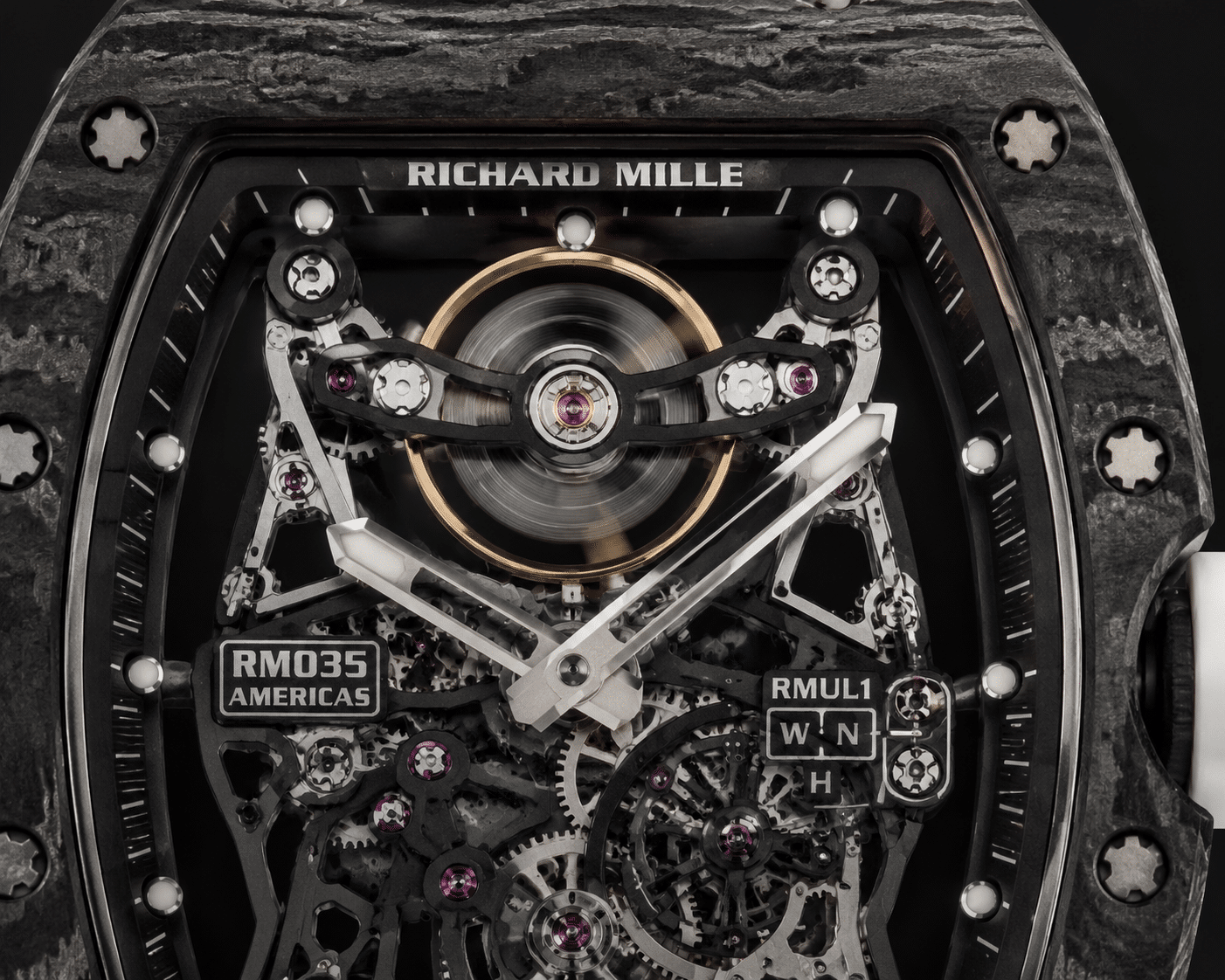
There is an important caveat. Some higher-tier Richard Mille replicas use a decorated balance bridge — a shaped metal cover that sits over the true balance wheel. This bridge is usually engraved or skeletonized, and it can partially obscure the oscillation. If you see a bridge covering the balance area, look for the actual wheel underneath. If only the bridge is visible and no moving wheel appears beneath it, the watch may be using a decorative plate to simulate a balance that does not exist. Push the crown lightly to start the movement and watch again. A real balance wheel will begin oscillating within a second or two. A decorative plate will remain still.
The balance wheel test is reliable enough to eliminate entire tiers of replica Richard Mille watches. A quartz build fails immediately because there is no oscillation. A low-beat build signals a cheaper movement route — usually a Seiko NH-series or a decorated Miyota 8215. A high-beat build at the correct position suggests a clone movement and warrants closer inspection of the other external clues. This is the single most useful dial-side diagnostic available without opening the case.
When evaluating a balance wheel position claim, it is worth remembering that a movement description in the replica market is a configuration reference, not an official caliber specification. A balance wheel placed at 12 o’clock is a strong visual match for the genuine layout, but it should be confirmed through actual QC photos rather than assumed from the factory name alone.
Visible Bridge Architecture – What the Skeleton Dial Actually Shows
Once you have confirmed the balance wheel is real and correctly positioned, the next step is to read the bridge layout visible through the dial. The bridges — the shaped metal bars that hold the gear train in place — are the most visually prominent components on any Richard Mille replica. They are also the most commonly faked. Knowing how to distinguish a functional bridge from a decorative plate is the difference between identifying a clone movement and being fooled by a dressed-up base caliber.
Start by identifying the main visible zones through the open dial. On a typical Richard Mille replica, you can see the barrel at either 12 o’clock or 6 o’clock (depending on the movement). The gear train bridges radiate outward from the barrel toward the balance area. The balance bridge sits near the balance wheel. On a genuine clone movement, these bridges form a logical mechanical path. The barrel connects to the gear train, the gear train connects to the escapement, and each bridge holds a visible wheel or pinion that turns when the watch runs. If you look closely, you should see gear teeth interlocking, screw heads that align with visible threaded holes, and slight shadows between bridge layers that indicate real depth.
On a higher-tier clone movement — such as the Dandong RMUL2 or the Shanghai 4801 — the bridges are functional. They are machined metal components with beveled edges, functional screws, and openings that expose the gear train. The bridges are not flat. They have different levels, drilled slots, and in some cases visible jewels. When the watch is running, you can see gears turning beneath the bridges. This is the baseline for a convincing Richard Mille replica movement.
On a lower-tier build using a Miyota 9015 or Seiko NH35 base, the dial-side architecture is mostly cosmetic. These base movements are round and small — about 25mm to 30mm in diameter — while the Richard Mille case interior is much larger. To fill the space, manufacturers add decorative bridge plates that are screwed or glued over the base movement. These plates mimic the shape of genuine Richard Mille bridges, but they are flat, laser-engraved, and lack functional depth. The gear train is hidden underneath. No visible wheels turn between the bridges. The only moving part you can see is the balance wheel, which belongs to the base movement underneath.
How Decorative Plates Mask the Real Movement
The most common deception in Richard Mille replicas is the decorative plate. The manufacturer takes a standard Miyota 9015, removes the rotor, and places a skeletonized metal cover over the entire movement. This cover is shaped like a genuine RM bridge set, with engraved lines, painted screws, and cutouts that reveal the balance wheel and part of the barrel. In a QC photo, it looks convincing. In person, the tell is immediately visible: the bridges have no real depth, the cutouts reveal stationary surfaces rather than moving gears, and the screws are printed as dark points rather than actual threaded fasteners.
To detect this, look for three things. First, examine the visible openings in the bridges. If the openings show a flat metal surface with no gear teeth, the bridge is cosmetic. Second, check for screw alignment. Functional screws sit flush in countersunk holes and have a visible slot or cross. Cosmetic screws are shallow, painted, or mismatched in size and shape. Third, look for visual depth. Functional bridges have different levels — the barrel bridge sits higher than the gear train bridge, and the balance bridge has its own raised profile. A decorative plate is usually at a single depth with painted shading to simulate layers.
Factory names are used here as market references to identify commonly discussed movement configurations. They do not guarantee that every replica bearing that factory label will match the described level of bridge finishing or functional depth. Buyers should verify these details through actual QC photos rather than assuming a factory name automatically ensures a particular bridge architecture.
The practical application is straightforward. In QC photos, ask for a dial-side close-up under side lighting. This creates shadows that reveal depth. If the bridges appear uniformly flat, the movement is likely a decorated base. If the bridges show distinct levels, functional screws, and visible gear openings, the movement is likely a clone. This visual test does not require opening the case. It can be performed on any Richard Mille replica with a skeleton dial, which is virtually all of them. Learning to read bridge architecture is the second most reliable external clue after the balance wheel, and for many models it is the most telling clue about the movement route.
Rotor Sound and Behavior – What the Winding System Tells You
Of all the external clues available without opening the case, the rotor is probably the most honest. It does not hide well. Even in a quiet room, a few seconds of wrist movement will tell you more about the movement route than most dial-side inspection can. The rotor sound is not just a comfort issue; true tourbillon vs display tourbillon is a key factor, and it is a direct signal of what is inside the case.
There are three common rotor sounds in Richard Mille replicas, and each points to a different movement family.
The first is a smooth, near-silent sweep. When you rotate the watch gently in your hand, the rotor spins freely with almost no audible friction. This is characteristic of a well-built Asian clone movement, usually the Dandong RMUL2 or a similar integrated automatic module. The winding system is bidirectional, the rotor is properly weighted and lubricated, and the whole assembly sits in a movement frame that was designed for this case. If you hear nothing more than a soft mechanical whisper, you are likely holding a higher-tier super clone build.
The second sound is a scratchy or grating noise, often described as sandpaper rubbing against metal. This is the classic signature of a Miyota 9015 base movement that has been fitted with a skeletonized decorative rotor. Miyota rotors are unidirectional. They wind in one direction and spin freely in the other, but in a Richard Mille case, the rotor often sits too close to the movement plate or the decorative bridge. The result is a scraping sound that becomes more obvious when the watch is shaken side to side. This does not mean the movement is broken. It means the build is a decorated base movement, not an integrated clone. Many mid-tier replicas sound exactly like this.
The third sound is a single-direction chunk or click. This is typical of Seiko-based NH-series movements, where the rotor winds only in one direction and the reversal mechanism creates an audible ratcheting click. The rotor may also feel heavier and less balanced on the wrist. If the sound is not continuous but punctuated, the movement is almost certainly a Seiko or similar budget automatic base. These builds are rarer in Richard Mille replicas now, but they still appear in lower-priced models that use a small round movement inside a skeletonized case.
There is also a fourth category: no sound at all. A completely silent rotor that does not move when the watch is shaken typically indicates a quartz movement. In these builds, the rotor is a decorative piece that may spin freely but does not engage any winding mechanism. The watch runs on battery power, and the rotor is there only for visual effect. If the seller claims the watch is automatic but the rotor is silent and motionless, the movement route is almost certainly quartz.
A practical test is simple. Hold the watch to your ear and shake it gently in a side-to-side motion. A smooth sweep with minimal noise suggests an Asian clone. A scratchy or scraping sound suggests a Miyota base. A clicking sound suggests a Seiko base. Silence suggests quartz. None of these alone confirms the entire movement quality, but combined with the other clues in this guide, rotor behavior gives you a fast, reliable read on what you are actually buying.
One additional note: lubrication matters. Higher-tier clone movements usually have well-lubricated rotors that stay quiet even after months of use. Mid-tier builds often arrive dry, and the rotor noise gets worse over time. If you are evaluating a watch that is already in hand and the rotor sounds rough, you are likely dealing with a decorated base movement that was assembled with minimal attention to the winding system.
Movement Transparency Note: Movement references in this article describe the replica-market movement type or configuration, not an official Richard Mille, Rolex, Cartier, or Swiss-manufactured caliber unless explicitly stated with verifiable evidence.
Hand-Setting Feel, Crown Action, and Date-Set Behavior
If the rotor reveals what the movement is, the crown tells you how well it was built. The tactile experience of winding, pulling, and setting a Richard Mille replica varies so sharply between movement routes that a buyer who knows what to feel can often identify the movement type without ever seeing the balance wheel or the caseback.
Start with the winding feel. Wind the crown slowly for about ten turns in the neutral position. An Asian clone movement, such as the Dandong RMUL2 or the Shanghai 4801, will show immediate and consistent resistance. The winding is smooth but firm, with a mechanical consistency that feels deliberate. You can feel the mainspring loading with each turn. A Miyota 9015 base feels noticeably lighter. The crown turns with less resistance, and there is often a slight catch or roughness in the crown tube, especially if the crown stem was not cut to the exact length for the RM case. A quartz movement has almost no winding resistance at all. The crown spins freely with a hollow feel, and no amount of winding will generate the mechanical feedback of a real automatic movement.
Next, test the crown pull. A clone movement usually has a two-position crown: the first position for date adjustment, the second for time setting. The pull should feel crisp, with a clear detent at each position. A Miyota-based build often has a softer pull, and the crown may wobble slightly in the winding position because the movement sits inside a spacer ring rather than being integrated into the case design. A quartz movement typically has a single-stage pull straight to time setting, with no intermediate date position. If the crown pulls out with no resistance gradient, you are likely holding quartz.
The hand-setting feel is equally revealing. On a clone movement, turning the crown in time-setting mode moves the hands with a smooth, consistent drag. The gears engage tightly, and there is no dead zone in the crown rotation. On a Miyota base, the hand-setting feel may be lighter, and the minute hand can sometimes show a slight backlash when you reverse the crown direction. This is not a defect, it is a characteristic of a movement that was not originally designed for this case geometry. On quartz builds, the hands may jump in discrete steps rather than sweeping, and the crown may feel loose with no mechanical connection.
For models with a date function, the behavior of the date change is a strong clue. A true clone movement should change the date instantly at midnight, with the date disc snapping into place within a one to two minute window. A Miyota or Seiko-based build typically uses a slow crawl date, where the date number gradually shifts over a period of one to three hours before settling into the correct position. If you advance the time past midnight and the date is still half-positioned at 1:00 AM, you are looking at a base movement, not an integrated clone.
For chronograph models, pusher feel matters. A real clone chronograph movement should have crisp, positive pusher action with a clear click at the start, stop, and reset positions. The reset button should snap the chronograph seconds hand back to zero without hesitation. A Miyota or Seiko base with a decorative chronograph module often has spongy pusher feel, and the reset may be slow or incomplete. Quartz chronographs usually have a light, shallow pusher feel with no mechanical depth.
From our perspective, the crown test is one of the most underused evaluation methods among replica buyers. Most people focus on photos and visual details, but a thirty-second crown test in hand reveals whether the movement was built as an integrated system or assembled from a generic base. If you are evaluating a watch from seller videos, ask for a close-up video of the crown being wound, pulled to each position, and used to set the hands. The sound and feel are visible enough in a well-filmed clip to tell you which movement route you are getting.
Caseback Visibility – Reading the Movement Through an Exhibition Caseback
Not every Richard Mille replica has a transparent caseback, but when one is present, it provides the single best window into the movement route without unscrewing anything. The caseback view reveals what the dial side can hide: the true construction of the main plate, the rotor finishing, and the bridge logic. Most sellers include a caseback photo in QC, and knowing what to look for can immediately separate a clone movement from a decorated base.
Start with the main plate. A true clone movement, such as the Dandong RMUL2, has a layered, skeletonized main plate with visible gear train elements. You can see separate metal planes, functional screws holding real bridges, and openings where gear teeth are visible. The plate has depth. It is not a single flat surface. A decorated Miyota or Seiko base, by contrast, uses a round movement that is smaller than the case interior. To fill the visual gap, the manufacturer adds a flat decorative plate over the base movement. This plate may be engraved, laser-etched, or painted to look like skeleton bridges, but it is a single layer. There is no depth. The screws on these decorative plates are often cosmetic, serving no structural function. If the caseback view shows a flat, uniform surface with no visible gear train underneath, you are looking at a decorated base movement.
The rotor is the second checkpoint. A clone movement rotor is typically larger, curved to match the tonneau case shape, and engraved with fine detailing. The rotor weight may have brand markings or decorative perlage that looks machined, not stamped. A Miyota or Seiko rotor is smaller, rounder, and often has simpler finishing. In many RM replicas, the Miyota rotor is partially hidden under a decorative plate, so you may see only a portion of it through the caseback. If the visible rotor looks cheap, stamped, or too small for the case opening, the movement is almost certainly a base movement with cosmetic coverings.
Bridge alignment is a quality indicator that is easy to spot once you know what to look for. On a true clone, the bridges fit cleanly against the main plate with no gaps. The screw heads are evenly seated and aligned. On a decorated base movement, the bridges are decorative plates screwed onto a spacer ring. Gaps are common. Screws may sit at uneven angles. If you see a visible gap between the edge of a bridge and the caseback opening, or if screws appear misaligned, the build quality is lower.
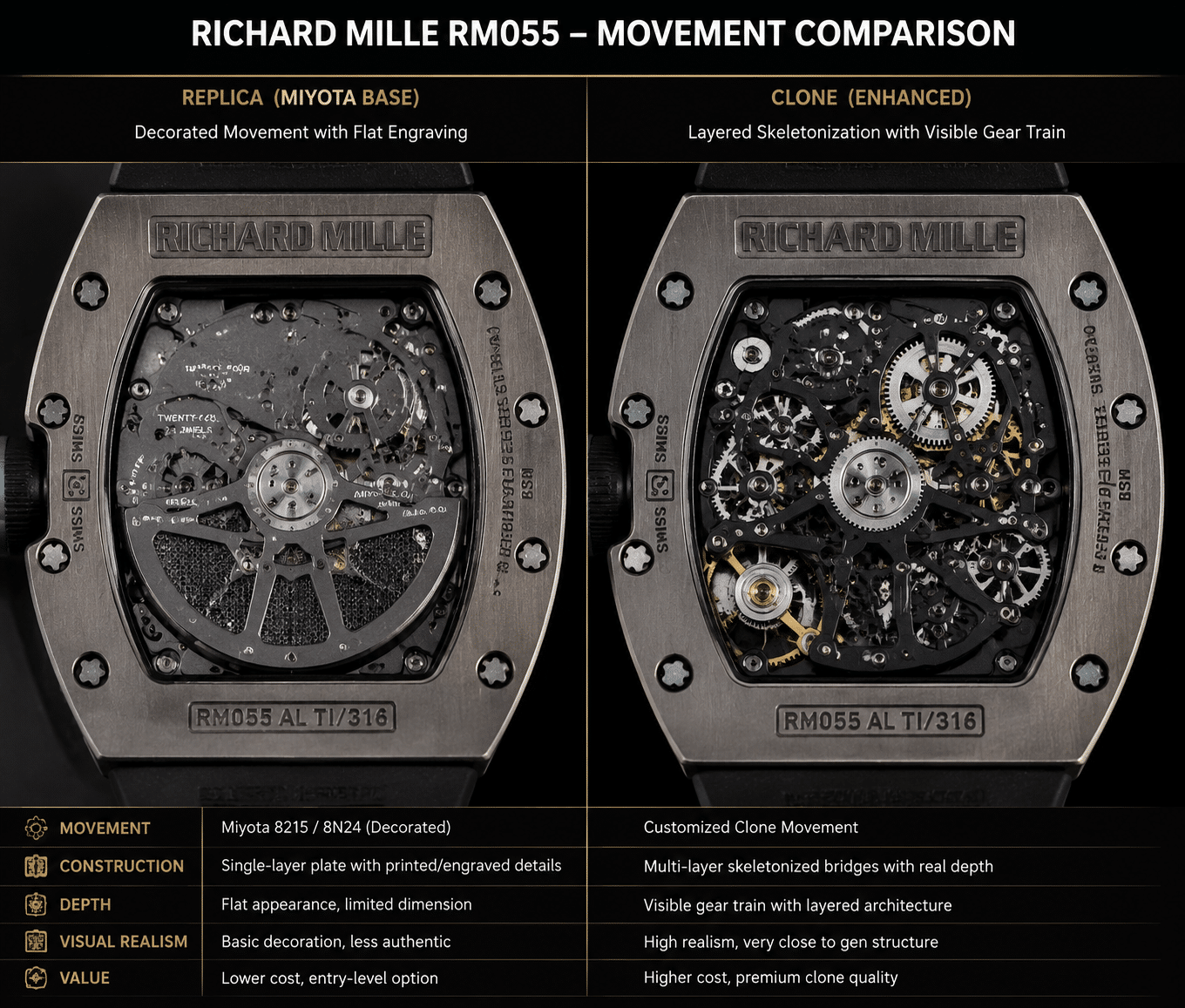
Engraving depth matters more than most buyers realize. Some replicas use laser engraving to simulate bridge architecture on a flat plate. In photos, this can look convincing. In person, laser engraving is shallow. There is no bevel, no edge break, no tactile separation between layers. A true clone has machined bridges with visible beveling and polished edges. If you can run your fingernail across the plate and feel no change in surface height, the engraving is likely cosmetic.
There is one important limitation to acknowledge: solid metal casebacks. Many Richard Mille replicas, especially carbon and ceramic models, use a closed caseback that reveals nothing. In these cases, the buyer must rely entirely on dial-side clues, rotor sound, crown feel, and functional testing. A seller who refuses to provide a caseback photo for a model that should have a transparent back, or who only offers blurry images, is raising a red flag. When the caseback is closed, the movement route becomes a question of trust and external verification rather than direct inspection.
For models with exhibition casebacks, the visual check is straightforward. If you see layered skeletonization, visible gear train elements, a large curved rotor, and no flat decorative plates covering the movement, you are likely looking at a clone movement build. If you see a flat engraved plate, a small round rotor, or visible gaps between bridges and the case opening, you are looking at a decorated base movement. The difference is clear once you know what to look for. This single caseback inspection, combined with the dial-side and rotor clues, gives you a complete external movement evaluation without touching a single screw.
Functional Synchronization – What Chronograph, Subdial, and GMT Hands Tell You
A Richard Mille replica’s dial is packed with visible hands, subdials, and pointers. But the biggest trap is assuming they all do what they appear to do. Many buyers look at a skeleton dial with three subdials and a power reserve indicator and assume the movement is mechanically sophisticated. In reality, the behavior of those hands — not their presence — tells you which movement route you are dealing with. And the difference between a true clone function and a decorative simulation is immediately testable.
The most common complication on Richard Mille replicas is the chronograph, found on models like the RM 011 and RM 11-03. When you test it, there are three possible outcomes. The first is true clone function: pressing the start pusher begins a central chronograph seconds hand that sweeps continuously, and pressing stop freezes it. The reset pusher snaps it back to zero cleanly. Subdial positions match the genuine layout — running seconds at 6 o’clock, 30-minute counter at 3 o’clock, and 12-hour counter at 9 o’clock. This behavior signals a modified Asian chronograph movement, usually based on the Shanghai 7750, that provides real stopwatch function. The second outcome is modified lower-tier behavior: the subdials run off the base movement, but their hands move independently and cannot be reset. The chronograph seconds hand may start and stop, but does not fully return to zero when reset — it drifts slightly or lands off-center. This is common with Miyota-based builds where the chronograph visual is faked using decorative plates. The third outcome is quartz simulation: the subdial hands do not move at all, or they move only with the main hands. Pressing the pushers does nothing. This is the clearest sign of a quartz movement route where the complications are purely cosmetic.
A simple test sequence helps identify which category you are looking at. First, inspect the subdial hands while the watch is running normally. On a true clone, the running seconds hand at 6 o’clock should move continuously. On a Seiko VK mecha-quartz mechanism, the chronograph seconds hand jumps in discrete 1-second intervals. On a cheap quartz build, the subdial hands may be completely stationary. Second, operate the chronograph pushers. Press the start button gently first, then fully. Some higher-tier replicas use a two-lever pusher mechanism that requires a deliberate press — a spongy or loose press with no change in the hands suggests the pushers are cosmetic.
For GMT models, the test is different but equally revealing. A true clone movement uses an independent GMT hand that moves separately when you adjust the crown. On a Seiko-based route, the GMT hand is actually an independently adjustable 24-hour hand — it works, but the movement architecture is different from the genuine. On quartz builds, the GMT hand is often fixed and does not move independently at all. The same logic applies to power reserve indicators: most Richard Mille replicas use a decorative pointer that is linked to the mainspring barrel visually but does not actually reflect the winding state. At typical replica price points, a functional power reserve indicator is extremely rare, and most buyers should treat it as a visual simulation rather than a real complication.
The practical takeaway is this: if you can test the chronograph or GMT function and the hands behave correctly — smooth continuous sweep, crisp start/stop/reset, independent GMT tracking — you are likely looking at a true clone movement. If the subdials are non-functional or the hands do not reset properly, you are dealing with a lower-tier build or a quartz base. Do not assume that every visible hand is a real function. Test it.
Case Thickness and Side Profile – When the Movement Route Is Visible in the Silhouette
The easiest movement clue to miss is the one you see before you even look at the dial: the side profile of the watch. A Richard Mille replica’s case thickness, crown position, and overall silhouette are directly determined by the movement inside. A genuine Richard Mille uses ultra-thin calibers that allow for remarkably slim case profiles — typically between 12mm and 14mm for automatic models, and even thinner for manual-wind references. Replica movements do not all match that thickness. The difference is often visible as a 1-2mm height gap that changes how the watch looks on the wrist and how it sits on a table.
Clone movements built specifically for Richard Mille replicas — such as the Dandong RMUL2, the 4801, or the 7804 — are designed to mimic the genuine movement’s dimensions. These builds typically stay within 0.5mm of the genuine case height. When you look at the side profile, the caseback is relatively flush with the bezel, and the crown sits at the correct height relative to the bezel edge. The overall taper of the tonneau case looks balanced, without any unexpected bulging at the back or the front.
Miyota 9015-based builds tell a different story. The Miyota 9015 is a standard round movement that was not designed for tonneau cases. To fit it inside a Richard Mille case, manufacturers use a spacer ring and a taller caseback. This typically adds 1.5-2mm of total case height. The side profile looks thicker, the crown sits lower on the case relative to the bezel, and the caseback protrudes more noticeably. If you place the watch on a flat surface, the caseback lifts it higher off the table compared to Richard Mille replica movement guide versions, which typically result in a significantly lower profile when worn.
Quartz builds often go in the opposite direction. A quartz movement is thinner than any automatic caliber, so a quartz Richard Mille replica may be noticeably slimmer than the genuine. On models like the RM 35-02 or RM 055, a quartz case height that is visibly less than 12mm is a red flag — the genuine sits thicker, and a quartz build lacks the mechanical depth needed to match it.
The best way to use this clue is to request a side-profile QC photo showing the watch on a flat surface. Compare the bezel-to-caseback height. If the seller provides measurements, compare the replica’s claimed thickness against the known genuine thickness for that model. A difference of less than 0.5mm is excellent; 1mm is acceptable for most mid-tier builds; anything over 1.5mm is a clear sign of a Miyota or budget movement route. On tonneau models, also look at the taper: clone builds usually maintain a smooth curve from bezel to caseback, while Miyota builds often have a thicker, slab-sided appearance near the caseback.
Case thickness alone does not confirm the movement route — a well-made clone build can still be slightly thicker than genuine, and some Miyota builds come close on certain models. But when combined with balance wheel behavior, bridge architecture, and rotor sound, the side profile becomes one of the most reliable external clues. It costs nothing to check and requires no technical skill. Just look at the watch from the side.
What QC Photos Should Show for Movement Verification
You cannot verify a Richard Mille replica’s movement route from product photos on a dealer website. Those images are usually marketing shots of the best available example, often with optimal lighting and angles that hide the details you actually need to see. To assess the movement without opening the case, you must request specific QC photos and a short video. Most trusted dealers will provide these if you ask directly — and a seller who refuses or provides blurry, poorly lit images is likely hiding a lower-tier movement.
Four angles matter most. First, a close-up dial-side photo under direct lighting. This should show the balance wheel clearly enough to see whether it oscillates smoothly (high-beat clone) or slowly (low-beat Miyota), and whether the bridge structure has real depth or looks like a flat decorative plate. The lighting should be neutral white LED or natural daylight — warm or dim lighting can obscure bridge finishing and make decorative plates look more convincing than they are. Second, a side-profile photo on a flat surface with a known reference object — a coin, a ruler, or even the seller’s own measurement calipers. This lets you assess case height and compare it against the genuine specification for that model. Third, a caseback photo showing the rotor engraving, main plate finishing, and any visible bridge alignment. Look for fine engraving, curved rotor edges, and visible gear teeth through the skeleton openings. If the caseback shows a flat, unengraved rotor or a single-plate movement with no depth, it is likely a decorated base movement. Fourth, a short video — 10 to 15 seconds — showing the seller winding the crown, shaking the watch to show rotor sweep, and activating any chronograph pushers. The video should include audio so you can hear the rotor sound and the pusher click.
When requesting these photos, be direct and specific. You can say something like: “Can you provide a close-up of the dial under bright light showing the balance wheel and bridge depth, a side view with a ruler to check case height, a caseback photo, and a short video of the crown winding and rotor movement?” A reputable dealer will understand the request. A dealer who sends blurry photos, refuses video, or claims the movement is “too delicate to photograph” is giving you a reason to walk away.
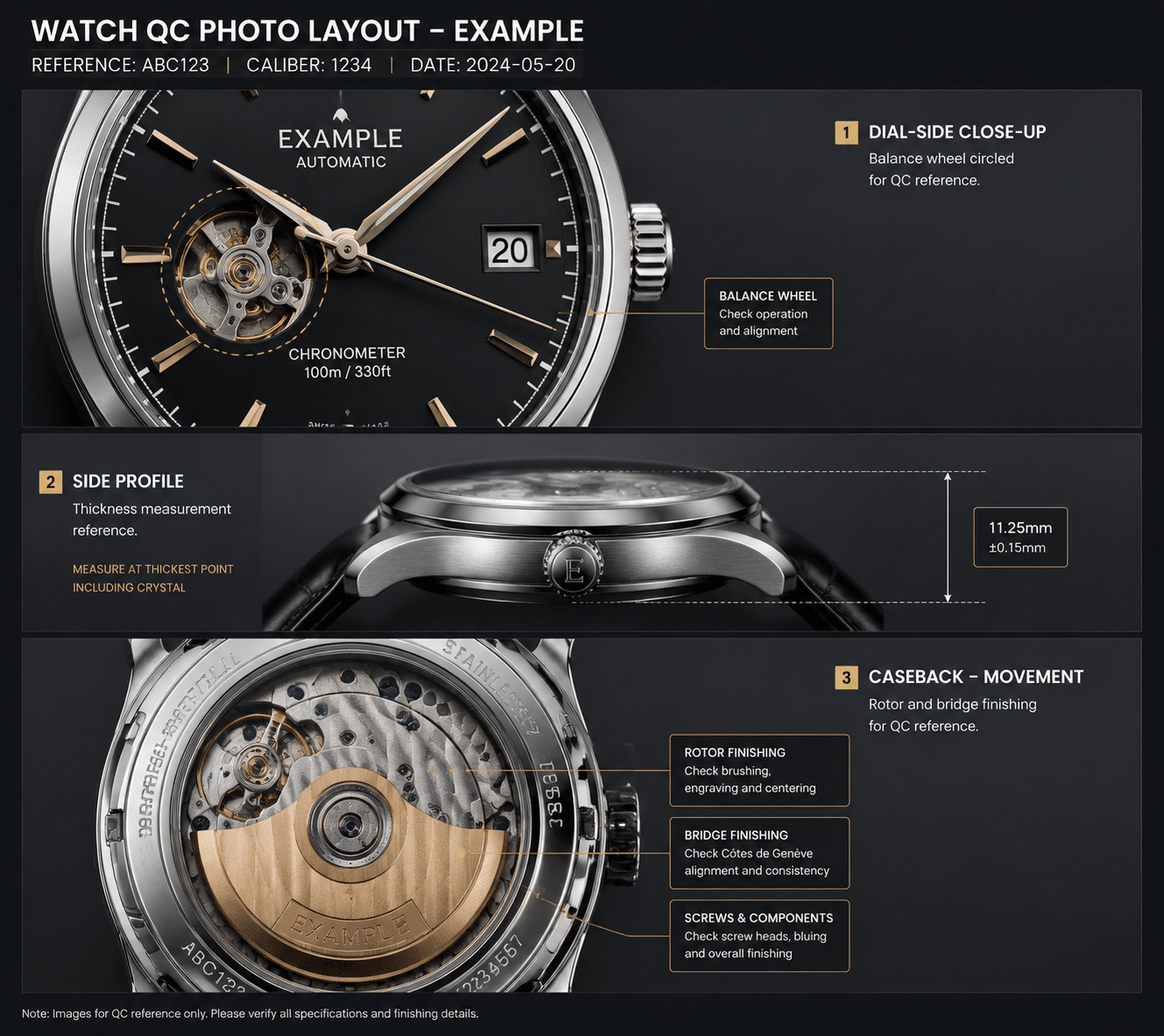
One caution: some sellers edit QC photos to improve contrast or hide flaws. Bright filters can make decorative engraving look deeper than it is, and dark backgrounds can hide rotor texture. Request photos against a neutral light background — white or light gray — so the finishing quality is visible. If the seller provides only heavily edited or dark images, ask for unedited shots. And remember: four clear QC angles and a solid video are not a guarantee of movement quality, but they are the best screening tool you have when you cannot open the case. If the seller delivers convincing photos, you move forward with more confidence. If the photos raise questions, you have saved yourself a costly mistake.
Verification Note: When possible, buyers should review real watch photos, dial details, clasp finishing, caseback structure, date alignment, and movement information before making a decision. Stock images and factory labels alone are not enough for a reliable judgment.
The Limits of Dial-Side and Caseback Inspection
While the techniques described in this guide cover the most reliable external methods for evaluating a Richard Mille replica movement, it is important to acknowledge what these methods cannot confirm. No amount of visual inspection through the crystal or caseback can verify that a movement is properly lubricated, that its gear train is free from binding, or that its rate of timekeeping falls within a normal range. A movement that looks convincing may still perform poorly in practice.
This gap exists because the external clues are structural, not functional. The balance wheel position and oscillation speed tell you that the movement is running at a certain beat rate, but they cannot tell you whether the amplitude is healthy or whether the escape wheel is engaging correctly. The rotor sound reveals the movement family, but it does not indicate whether the winding efficiency is adequate for daily wear. The crown feel can separate a clone from a base movement, but it cannot identify a worn setting lever or a loose yoke spring.
For this reason, the external evaluation framework should be treated as a screening step, not a final verdict. If a watch passes all the visual and tactile tests described in this guide, it qualifies for closer consideration. But the only way to confirm a movement’s true condition is with a timegrapher test for beat rate, amplitude, and beat error, or with a caseback removal and direct inspection by an experienced watchmaker. Sellers of high-tier replicas are increasingly willing to provide a timegrapher reading as part of QC, and this additional data point is far more reliable than any dial-side visual clue for assessing movement health.
Buyers should also understand that a decorated base movement can sometimes look surprisingly close to a clone in certain lighting conditions, especially in low-resolution QC photos or seller videos filmed at a distance. The techniques in this guide are most effective when applied to high-resolution images and clear video footage. If the seller’s material is low quality, the probability of misidentification increases. The safest approach is to insist on both a timegrapher reading and the four specific QC angles described in the previous section. A seller who provides all of this data is demonstrating transparency. A seller who cannot or will not provide it is asking the buyer to trust an unsupported claim about the movement route.
Why Movement Route Matters More for Richard Mille Replicas Than Most Other Models
The difference between a clone movement and a decorated base is not just a technical detail — it changes the entire ownership experience. On a Rolex Submariner replica, a Miyota 9015 base can be perfectly acceptable if the case, dial, and bezel are well-executed. The movement is hidden, the rotor sound is muffled by the caseback, and the crown feel is less noticeable because the crown is small and protected by crown guards. But on a Richard Mille replica, the movement is the dial. It is the most visually dominant element, and its flaws are visible every time you look at the watch. A decorative plate that looks convincing in a QC photo may feel disappointing in person because the lack of depth and functional gear movement becomes obvious once the watch is in hand and running.
This is why choosing a Richard Mille replica based on the factory name or the case material alone is often misleading. The same factory can produce the same model with different movement routes for different price points. The factory label helps narrow the options, but the movement route determines how the watch will look, feel, and perform over time. A buyer should confirm the movement first, then check the factory’s track record for that specific model.
The movement route also affects long-term serviceability. A Dandong RMUL2 clone movement shares enough architecture with genuine Swiss calibers that a skilled independent watchmaker can service it. The parts are machined to tolerances that allow oiling, adjustment, and replacement of worn components. A decorated Miyota base, by contrast, is cheaper to replace than to repair. If the movement fails, most buyers find it more practical to buy a new watch than to pay a watchmaker to work through a round movement that was never intended to fit inside a tonneau case. This cost-of-ownership difference is rarely discussed in factory comparisons, but it directly affects what the buyer will spend after the first year.
For a buyer considering a Richard Mille replica as a daily-wear piece, the practical advice is to prioritize a clone movement build — even if it costs more upfront — because the visual accuracy, winding feel, and long-term reliability are substantially better. For a buyer who wants the look for occasional wear and does not mind a heavier, thicker watch, a decorated Miyota base can be acceptable if the price is low enough and the buyer understands the tradeoff. The wrong choice is paying a mid-tier price for a build that is marketed as a high-tier clone but actually uses a decorated base movement, because the buyer gets the worst of both worlds: a higher cost without the corresponding quality.
The evaluation framework for Richard Mille replicas should always start with the movement route — not the case material, not the factory name, and not the seller’s description. The buyer should ask three questions before considering any other detail: Is the movement a true integrated clone or a decorated base? Is the balance wheel in the correct position and running at high beat? Does the crown winding feel match a clone movement? If the answer to any of these is uncertain, the buyer should request the QC angles and videos described in this guide. A few minutes of inspection confirms what a seller’s description often leaves vague.
Editorial Perspective: This guide intentionally avoids the claim that one factory or movement type is perfect for every buyer. The choice between a Dandong clone, a Miyota base, or a quartz movement depends on the buyer’s priorities: visual accuracy, daily reliability, serviceability, cost tolerance, and intended wearing frequency. A higher price alone does not guarantee a better daily experience, and a lower price does not automatically mean a bad buy — but only if the buyer knows exactly what they are paying for. The most honest QC photo or seller description is incomplete without a clear understanding of which movement route it represents. The evaluation framework in this article gives the buyer the tools to verify that information without relying on marketing language or the factory name alone.
Practical Next-Step Guidance for Buyers Using This Framework
The evaluation framework described in this article gives the buyer a structured way to judge a Richard Mille replica movement without opening the case, using only QC photos, seller videos, and a few simple in-hand tests. But knowing what to look for is not the same as knowing how to apply it during an actual purchase. A practical next-step process helps turn these clues into a reliable buying decision.
Start by deciding which movement tier fits your budget and wearing expectations before you contact any seller. If you want the closest visual match and a better long-term service outlook, a clone movement build should be your target. If your budget is lower or the watch will only be worn occasionally, a Miyota-based build can be acceptable if you understand the tradeoffs. Knowing this in advance prevents you from being persuaded by vague descriptions like “high-quality automatic movement” that could apply to either route.
When you find a specific listing, begin your evaluation with the visual clues that are easiest to confirm from photos: balance wheel position and beat rate, bridge depth and screw quality, and caseback plate structure. If the seller provides clear, well-lit images that show these details, you can proceed with more confidence. If the photos are blurry, poorly lit, or cropped to hide the movement area, treat that as a caution signal. A seller who cannot provide a clear dial-side shot of a skeleton watch is either hiding a lower-tier movement or not taking the QC process seriously.
Next, move to the functional tests that require a video: rotor sound, crown winding feel, pusher action, and date change behavior. A short video with audio is the most useful single piece of evidence for confirming the movement route. If the seller provides this, watch it carefully. Compare the sound and feel against the descriptions in this guide. If the seller does not offer a video, request one. A refusal or a claim that “the movement is the same as in the photos” should reduce your confidence in the listing.
Finally, consider requesting a timegrapher reading. This is not always available, especially from smaller sellers, but when it is, it provides a functional check that no visual clue can replace. A timegrapher reading shows beat rate, amplitude, and beat error — three numbers that together confirm whether the movement is running correctly or showing signs of a problem. A healthy clone movement should show an amplitude between 270° and 310° and a beat error below 0.5 ms. A Miyota base movement at the same beat rate may show a lower amplitude or higher beat error, but it should still run within acceptable parameters. A reading that is far outside these ranges suggests a movement that is poorly assembled or already worn.
This step-by-step process — budget decision, visual QC review, functional video check, and optional timegrapher reading — turns the external evaluation clues into a practical buying framework. It does not replace direct movement inspection, but it gives the buyer a much more reliable picture of what is inside the case than relying on a factory name or a seller’s description alone.
A final important note about how movement information should be used: the purpose of identifying a clone movement versus a decorated base is to help the buyer understand quality and realistic performance expectations — not to represent the replica watch as a genuine Richard Mille or to pass it off as authentic during inspection, resale, or any other context. Replica watches remain replica-market products, and no amount of visual similarity changes that distinction.
[1] Rolex, “Rolex Movements — Perpetual Caliber Specifications,” Rolex SA, official reference. Information on balance wheel operation and beat rate standards. Does not apply directly to replica quality or movement identification, but supports general understanding of high-beat movement behavior.
[2] Citizen Miyota Co., Ltd., “Miyota 9015 — Automatic Movement Specifications,” official technical sheet. Miyota Movement 9015. Supports description of rotor sound characteristics, unidirectional winding behavior, and general dimensions of this base movement.
[3] Seiko Instruments Inc., “Caliber NH35A — Automatic Movement Specifications,” official technical documentation. Supports description of rotor clicking sound and date-crawl behavior common in this movement family.
Disclosure: This article is for general educational and comparison purposes only. Replica watches are not genuine products from the original luxury brands, and brand names — including Richard Mille — are used only to identify reference designs or comparison topics. Factory names, movement descriptions, prices, availability, QC details, seller policies, and version information can change, so readers should verify important details with the seller before making a purchase decision. Replica watches should not be represented, resold, or used as genuine watches.