
In the Richard Mille replica market, the word “tourbillon” sells watches, but very few buyers know whether they are actually getting one. A visible spinning cage is not enough — a true tourbillon houses the balance wheel and escapement, rotating to regulate timekeeping, while a display tourbillon is a decorative disc driven by the gear train with no timekeeping function. Buyers routinely overpay for an impressive visual effect without understanding what distinguishes genuine mechanical complexity from decorative motion. This article cuts through the confusion by explaining the exact mechanical difference and by using movement authentication methods to determine which system a watch actually contains, then discussing which type makes sense for your priorities — whether you value visual authenticity, daily reliability, or long-term practicality.
| Verification Criterion | True Tourbillon | Display Tourbillon |
|---|---|---|
| Balance wheel location | Visible inside the rotating cage, oscillating | Not visible; the rotating element is a closed or hollow disc |
| Power reserve | 35–45 hours with better amplitude stability | Longer runtime but greater positional variation |
| Key factory models | RM 035/055 from APS or ZF typically use real tourbillons | RM 011 is always a display system due to movement limits |
| Best verification method | Request QC macro shots and case-back photos showing the balance wheel | If no escapement is visible inside the cage, it is a display |
| Ideal buyer profile | Mechanical enthusiasts who prioritize genuine regulating function | Visual collectors who want the look at a lower price |
| Daily-wear suitability | Higher service risk; simpler skeletonized models may be more practical | More reliable for regular wear but lacks mechanical authenticity |
Quick Questions Before You Read
Q: Can I tell the difference just by looking at the watch face?
Yes — if you see the balance wheel oscillating inside the rotating cage, it is a true tourbillon. If the spinning element is a solid ring or closed disc with no visible escapement, it is a display system.
Q: Is a display tourbillon a waste of money?
Not necessarily. If visual effect matters more to you than mechanical authenticity, a display system offers a lower price and often better reliability. The problem is paying a true-tourbillon price for a decorative disc.
Q: Which Richard Mille replica model is most likely to have a real tourbillon?
RM 035 and RM 055 from top factories like APS or ZF typically use true tourbillons. The RM 011 is exclusively a display system due to movement architecture constraints.
Q: What should I check first when buying a tourbillon replica?
Confirm the balance wheel location in QC macro photos or case-back shots. Do not trust model names, polishing, or cage decoration — those details do not confirm a true tourbillon.
Why “It Spins” Is Not Enough in the Richard Mille Replica Market
You see a photo of a Richard Mille replica. The dial is open, skeletonized, and in the center or at 6 o’clock, something is rotating. It moves. It turns steadily. The listing calls it a tourbillon. The price is high enough to suggest something serious. So you assume it is a real tourbillon. This is the most common mistake in the Richard Mille replica market.
The problem is not that buyers are careless. The problem is that the visual signal—a spinning element on the dial—is identical for two completely different systems. One is a true tourbillon cage, a functional mechanical regulator that contains the balance wheel and escapement and rotates to average out positional errors. The other is a display system, a decorative rotating disc or ring driven by the gear train that spins for visual effect but does nothing to regulate timekeeping. Both spin. Both look interesting in photos. Both are called “tourbillon” in seller listings. But they are not the same thing.
This confusion is industry-wide and understandable. Many sellers themselves do not distinguish clearly between the two. Forum discussions mix the terms loosely. QC videos show a rotating element but rarely zoom in close enough to reveal what is inside the rotation. The buyer sees motion and assumes complexity. The assumption is natural, but it is also the fastest way to overpay for something that does not match your expectations.
This article separates the two categories. The goal is not to sell you on one or the other. The goal is to give you a reliable way to tell them apart before you buy, so that you know exactly what spinning element you are paying for—and whether it actually affects how the watch works.
What a True Tourbillon Cage Actually Does in a Replica Movement
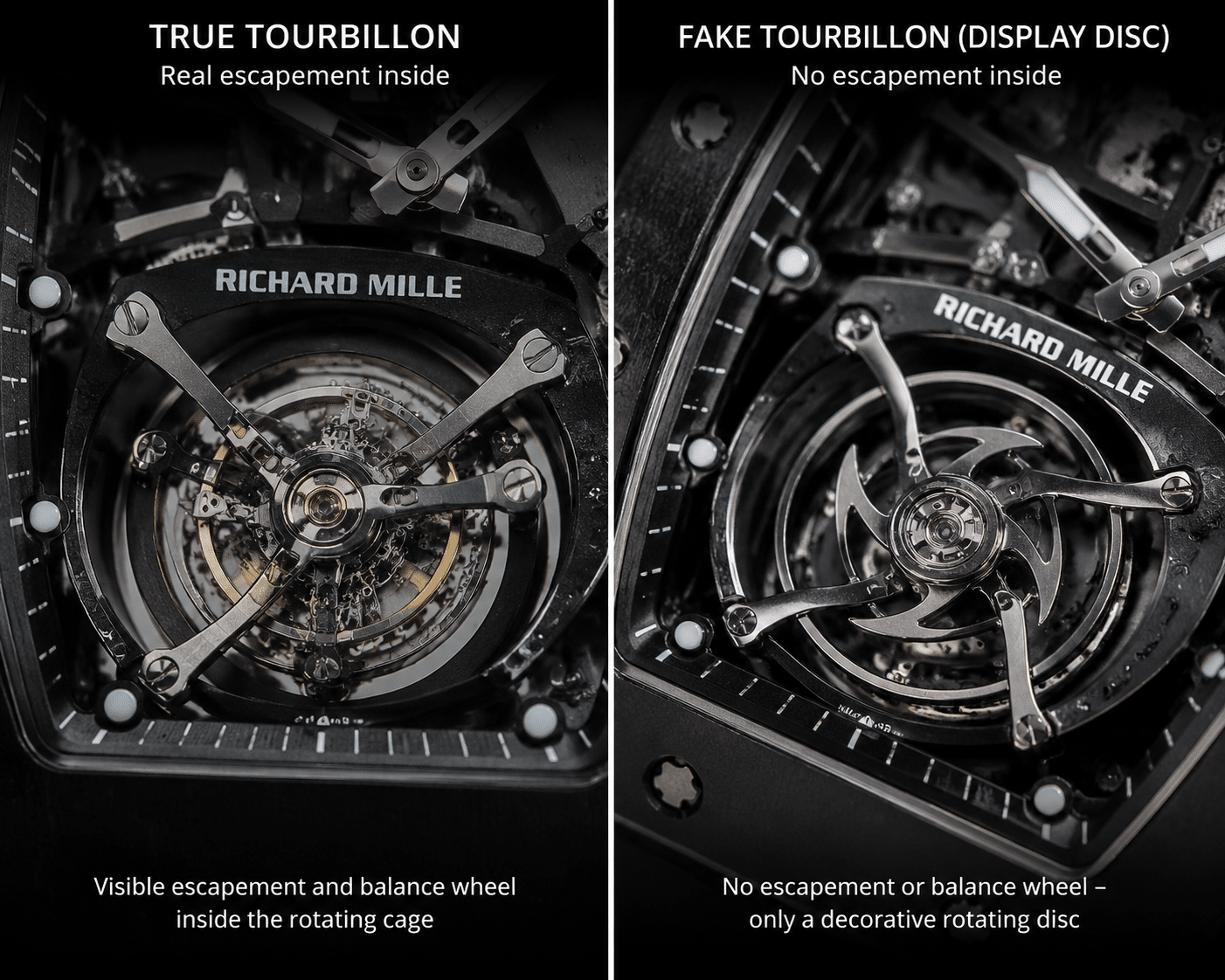
A true tourbillon cage is a rotating carriage that contains the balance wheel, the hairspring, the pallet fork, and the escape wheel. These four components together form the escapement—the part of the movement that controls how energy is released in regulated steps. When the cage rotates, the entire escapement rotates with it. The purpose of this rotation is to average out the effects of gravity on the balance wheel across different wrist positions, theoretically improving rate consistency.
In a replica movement, the practical accuracy benefit of a true tourbillon is smaller than in a high-end Swiss caliber. The base movement may not be adjusted to the same precision, and the materials used in the balance spring and escapement wheels are not identical to those in the genuine RM caliber. But the mechanical architecture is still real. The cage still carries the escapement. The balance wheel still oscillates inside the rotating structure. It is not merely decorative.
The most important identifier for a buyer is simple: can you see the balance wheel oscillating inside the rotating cage? If you can see a visible balance spring and escape wheel spinning together inside the cage opening, the system is a real tourbillon. If the rotating element is a solid ring, a closed disc, or an engraved bridge with no visible escapement components inside, it is not a real tourbillon—regardless of how convincingly it spins.
Think of the cage as a carousel. In a true tourbillon, the rider (the balance wheel and escapement) sits on the carousel and rotates with it. In a display system, the carousel spins but has no rider. Both turn. Only one carries the mechanism that regulates time.
How the Escapement Interacts with the Cage
For the system to function as a tourbillon, the escape wheel, pallet fork, and balance wheel must all rotate together inside the cage. The escape wheel delivers impulses from the gear train to the pallet fork, which rocks back and forth to allow one tooth of the escape wheel to pass at a time. This controlled release is what produces the ticking motion of the balance wheel. The entire sequence must happen inside the rotating carriage. If the rotating element does not contain a visible balance wheel and escapement working together, the mechanism cannot be a real tourbillon. It is a display.
The design and precision of a genuine tourbillon movement are well documented by watchmaking authorities. According to the Fondation de la Haute Horlogerie, a tourbillon is officially defined as a rotating carriage that continuously rotates the entire regulating organ—the balance wheel, hairspring, and escapement—to compensate for gravitational positional errors.[1] This definition is important for replica buyers because it establishes a clear standard: if the rotating component does not contain and rotate the regulating organ, it is not a tourbillon by any horological definition. Seller listings that call a decorative disc a “tourbillon” are using the term loosely, and the buyer must know the difference.
What a Display Tourbillon Mechanism Actually Contains
A display tourbillon mechanism is a decorative rotating element designed to mimic the visual appearance of a true tourbillon cage without containing any escapement components. It typically uses a rotating disc, ring, or decorative bridge that is driven by the gear train—often by a small additional gear or friction wheel—but does not carry the balance wheel, pallet fork, or escape wheel. The escapement is located elsewhere in the movement, usually hidden behind a plate or positioned off-center from the rotating element.
The visual result is convincing enough in photos and most video angles. The spinning element turns at a rate similar to a real tourbillon cage. It may even be decorated with engraved bridges, polished screws, or frosted surfaces to look more complex. But if you look closely at the center of the rotating element, you will notice something missing: there is no balance wheel oscillating inside. The opening may show a solid base, a fixed gear, or simply empty space. The rotation is purely cosmetic.
This is the system most commonly mislabeled as a tourbillon in mid-tier and budget Richard Mille replicas. Many buyers discover the truth only after receiving the watch, because the QC video shows a spinning element but does not zoom in far enough to reveal whether the escapement is inside the rotation. The listing says “tourbillon,” the video shows motion, and the assumption carries the sale.
Some display systems are designed more carefully than others. A few use a small hidden weight or rotor under the disc to make the rotation appear more constant. Others use a gear-driven bridge that turns smoothly even when the movement is not fully wound. But in every case, the rotating element is disconnected from the regulating function of the movement. It spins because the gear train drives it, not because it is controlling the rate of energy release.
A display tourbillon is not inherently a bad product. At a lower price point, it can provide the visual interest of a rotating element without the manufacturing cost of a true tourbillon. The buyer simply needs to know what they are getting. If you see a rotating ring or disc with no visible balance wheel and escapement inside, you are looking at a display system. It is not a real tourbillon. The question is whether that matters for your purchase.
Visual Identification: What to Look for in QC Photos and Videos
By the time you receive QC photos, the visual difference between a true tourbillon and a display system should already be confirmable. The problem is that most buyers do not know which visual signals actually distinguish the two. They see something spinning inside an open dial and assume the movement is real. QC photos and videos were never designed to answer this question clearly, but if you know what to check, the answer is almost always visible.
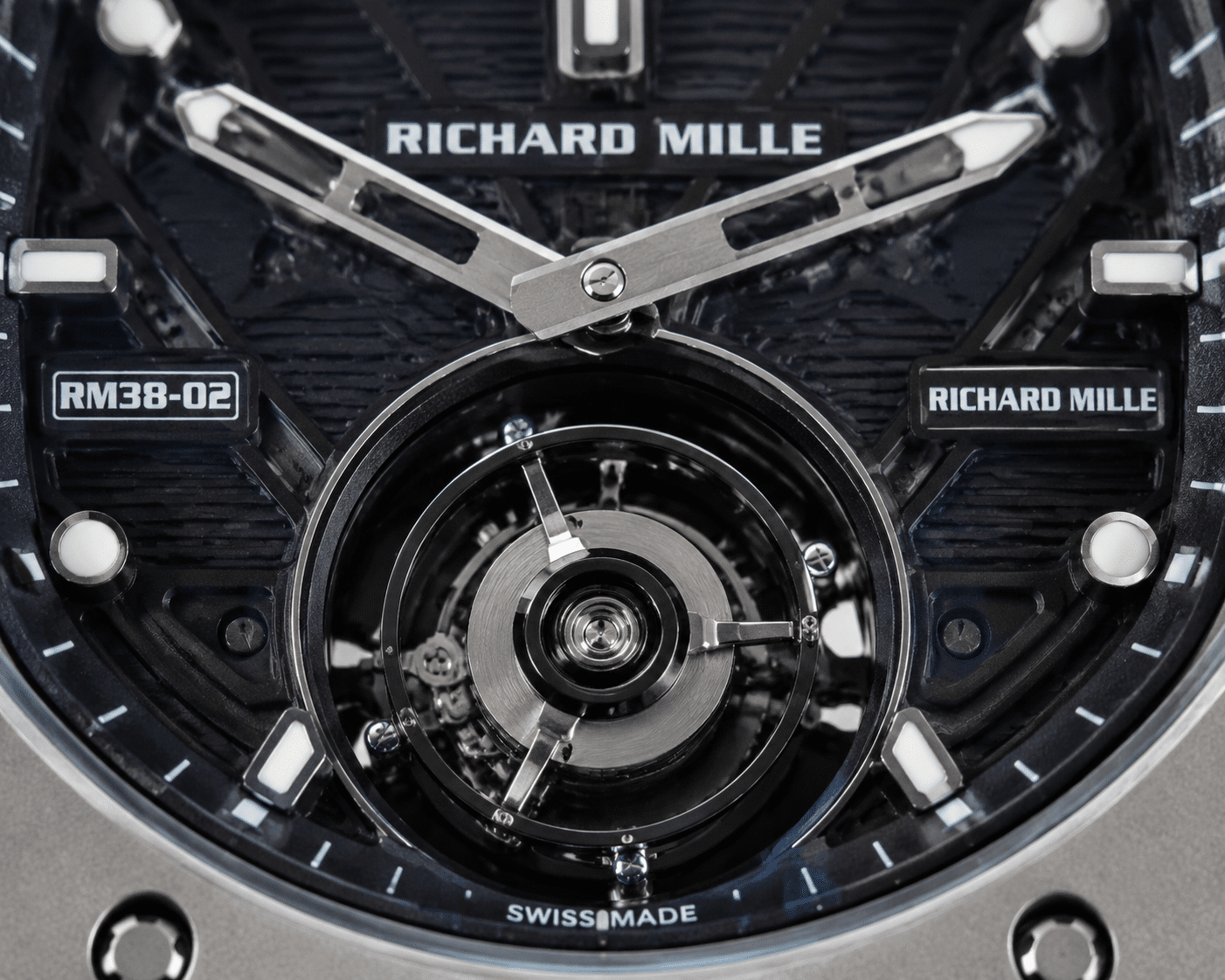
The single most important checkpoint is the balance wheel. In a true tourbillon cage, the balance wheel sits inside the rotating structure. You will see it oscillating back and forth while the entire cage rotates slowly around it. The balance wheel is easy to identify: it is a circular metal ring with a visible hairspring coiled inside, often with a transparent jewel or shock absorber at the center. If you can see this component inside the cage opening, the movement is almost certainly a real tourbillon. If the cage opening shows only a solid disc, a decorative bridge, a gear, or nothing at all, the system is a display mechanism.
For QC photos, start with the dial view. Enlarge the image and focus directly on the cage opening at the 6 o’clock or 12 o’clock position, depending on the RM reference. A true tourbillon cage will have open spaces that reveal the balance wheel, the escape wheel, and the pallet fork rotating together. A display tourbillon cage will appear hollow or will contain a non-functional decorative element that does not oscillate. Lighting matters here. Some QC photos are taken at an angle where the cage interior is shaded, making it hard to see whether components are present. If the cage opening looks dark and unclear, that is not proof either way. You need to see the interior clearly to make a judgment.
The timing video provides the most definitive evidence. In a video running for at least ten seconds, a true tourbillon cage will show continuous, consistent rotation while the balance wheel oscillates visibly inside it. The balance wheel’s back-and-forth motion is distinct from the cage’s slow rotational spin. In a display system, the cage or disc will rotate, but you will not see any oscillating component inside it. Some display mechanisms rotate in a jerky or intermittent manner because they are driven by a separate gear or spring rather than the main gear train. If the rotation appears irregular or stops entirely at certain points in the video, that is a strong indicator of a display system.
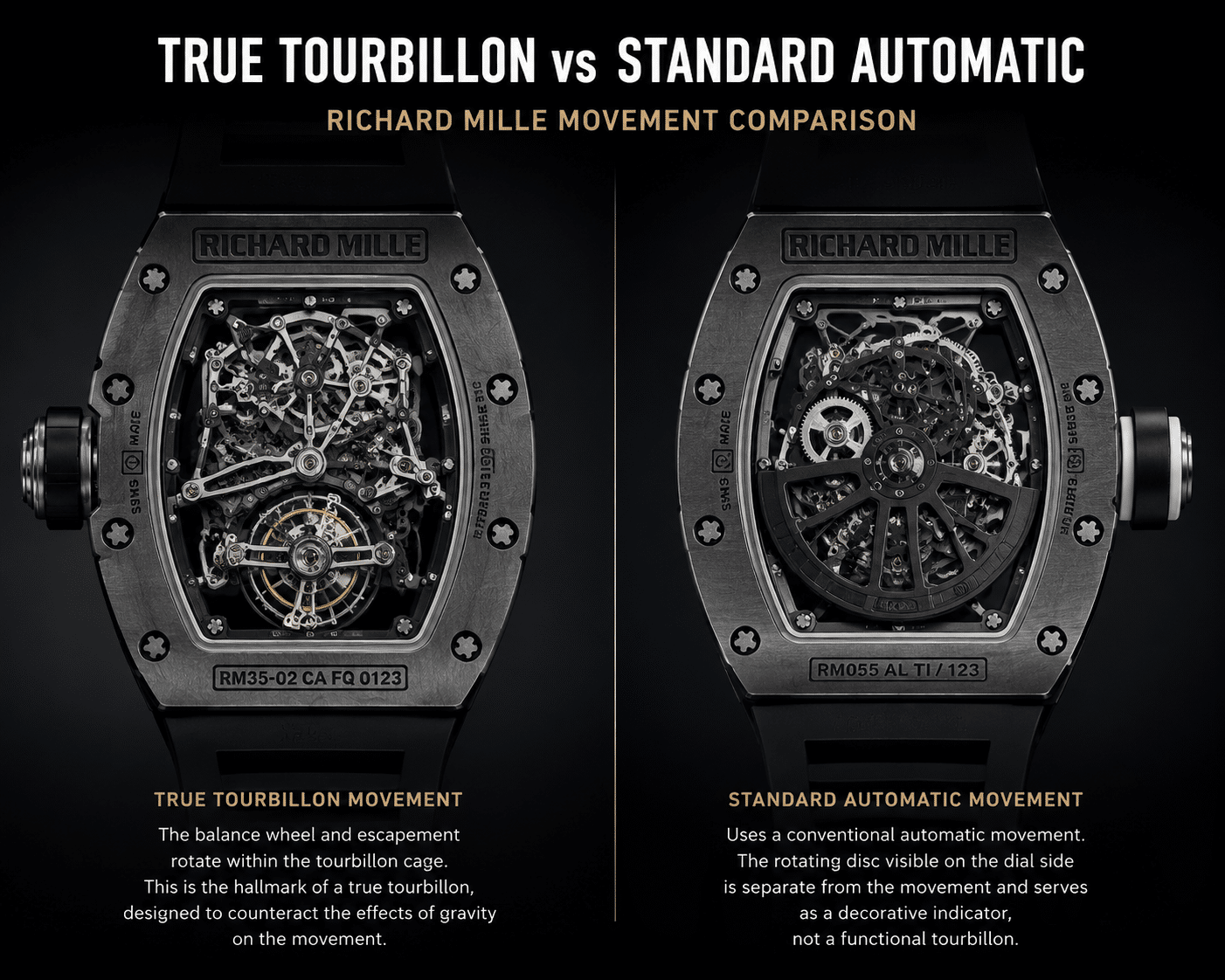
The case-back view, when available, offers supporting confirmation. In a true tourbillon movement, the balance wheel position is inside the cage visible from the dial side, so you will not find a separate balance wheel on the movement side. In a display system, the balance wheel is typically placed elsewhere on the movement, often visible through the case-back crystal at a different position. If you can see an oscillating balance wheel on the movement side that is not inside the dial-side cage, the system is definitely a display mechanism.
The strongest single indicator is this: if you cannot see a balance wheel inside the cage opening, as detailed in Richard Mille RM011 chronograph differences, in any photo or video, the mechanism is a display system. No true tourbillon can function without the balance wheel and escapement rotating inside the cage. If those components are not visible, they are not there.
QC Photos to Request
If the QC photos you receive do not clearly show the cage interior, request a specific angle. Ask for a macro shot focused on the cage opening at the 6 o’clock or 12 o’clock position, taken straight-on rather than at an angle. A slow-motion video clip of the cage running for ten to fifteen seconds is even better, because it makes the balance wheel oscillation visible even in videos captured at standard frame rates. Also request a case-back photo showing the full movement layout so you can confirm whether the balance wheel is positioned inside the dial-side cage or elsewhere on the movement. These two requests alone will resolve the question in nearly every case.
Verification Note: When possible, buyers should review real watch photos, dial details, clasp finishing, caseback structure, date alignment, and movement information before making a decision. Stock images and factory labels alone are not enough for a reliable judgment. In particular, the difference between a true tourbillon and a display system cannot be determined from a generic product listing — it must be verified from actual QC images or videos of the specific watch being purchased.
Movement Architecture: Understanding the Mechanical Foundation
Beyond the immediate visual identification cues, understanding the underlying movement architecture helps a buyer assess the entire system’s integrity. The movement type not only determines whether the tourbillon is real or decorative, but also influences long-term reliability, serviceability, and compatibility with replacement parts. Replica watch movements used in Richard Mille-style models draw from several established Chinese and Japanese caliber families, each with distinct mechanical characteristics.[2]
Real tourbillon replica movements typically fall into two categories. The first uses a purpose-built Chinese tourbillon caliber such as the Seagull ST-8000 series, which was originally developed by the Tianjin Seagull watch factory. This movement family was among the first to make a true tourbillon architecture accessible outside of high-end Swiss manufacturing.[3] The ST-8000 features a one-minute rotating cage, a balance frequency of 21,600 vibrations per hour, and a power reserve of approximately forty to forty-five hours. It is a genuine tourbillon movement, meaning the balance wheel and escapement rotate together inside the cage. Higher-end RM replicas from factories like EUR use this movement or a similarly designed Dandong-caliber clone. The second category uses clone movements based on the genuine Richard Mille RMUL2 or RMUL3 caliber architecture. These are produced in smaller quantities by specialist movement makers and are usually found in top-tier replicas from APS, ZF, or BBR. They typically offer improved decoration and a thinner profile, but share the same fundamental tourbillon architecture.
Display tourbillon replicas, by contrast, are usually built from modified standard movements. The most common base calibers are the Miyota 8215 or 9015, the Seagull ST2130, or the Shanghai 2813. These are simple, reliable automatic movements with no built-in tourbillon architecture. To create the visual effect, a factory attaches a decorative rotating disc or ring to the dial side of the movement, often driven by a small additional gear train. The escapement remains in its conventional position, hidden from the dial view. This approach is mechanically simpler and significantly less expensive to produce, which is why display tourbillon replicas occupy a lower price tier. However, the base movement itself may be quite reliable. A well-made Miyota 9015, for example, is known for consistent timekeeping and easy serviceability, and when used as the base for a display system, it offers a more robust daily-wear experience than a low-quality true tourbillon movement.[2]
For buyers interested in verifiable performance data, the timegrapher is a useful tool. A true tourbillon replica from a reputable factory should show a beat error below 0.5 milliseconds and an amplitude between 270 and 310 degrees when fully wound. These figures indicate that the escapement is properly aligned and the cage is not introducing excessive friction. Display systems typically show similar figures on the timegrapher, but the reading only reflects the underlying movement’s regulation—it does not indicate any authenticity in the rotating element. The timegrapher cannot tell you whether the decorative disc is a true tourbillon. Only visual inspection of the cage interior can answer that question.
Movement Transparency Note: Movement references in this article describe the replica-market movement type or configuration, not an official Rolex, Cartier, Richard Mille, or Swiss-manufactured caliber unless explicitly stated with verifiable evidence. A “Seagull ST-8000” or “Miyota 9015” refers to the caliber used in the replica movement, not a genuine Richard Mille caliber. Buyers should understand that factory descriptions of movements in the replica industry often blend technical specifications with market terminology, and the only reliable way to confirm movement architecture is through direct visual inspection of the specific watch.
The Role of QC Photos in Confirming Tourbillon Authenticity
QC (quality control) photos are the single most valuable tool a buyer has for distinguishing a true tourbillon from a display system, yet they are frequently misinterpreted. A common mistake is assuming that a well-lit, high-resolution photo of the dial confirms the movement type. In reality, the lighting and angle of QC photos are often chosen to make the watch look appealing, not to reveal mechanical details. A display tourbillon with a polished ring can look just as impressive in a stock photo as a true tourbillon cage. The buyer must not confuse visual quality with mechanical authenticity.
When reviewing QC photos, the critical view is a straight-on macro shot of the cage opening at 6 o’clock or 12 o’clock, depending on the RM model. This shot must be taken with sufficient lighting to illuminate the interior of the cage. If the cage interior appears as a dark void, it is not proof of anything — the photo may simply be underexposed. The buyer should request a second photo with a different lighting angle if the interior is not clearly visible. A good QC photo for tourbillon verification will show distinct metal surfaces inside the cage, indicating the presence of escapement components, or it will show a flat or hollow surface, indicating a display system.
Video QC is even more definitive. A ten-second video clip of the running movement will show the balance wheel oscillating back and forth inside a true tourbillon cage. The oscillation is distinct from the cage’s rotation — the cage rotates slowly, while the balance wheel vibrates rapidly. In a display system, the cage rotates but no oscillating component is visible inside. Buyers should also watch for the smoothness of rotation. True tourbillons typically rotate at a steady, continuous rate. Display systems may exhibit jerky or irregular rotation because the decorative disc is driven by separate gearing rather than the main gear train. If the rotation hesitates or stops at certain points, the mechanism is almost certainly a display.
Case-back photos provide a second layer of confirmation. In a true tourbillon replica, the balance wheel is inside the dial-side cage, so no separate balance wheel is visible on the movement side through the case-back crystal. In a display system, the balance wheel is elsewhere on the movement, often visible through the case-back at a position offset from the dial-side disc. If you can see a balance wheel oscillating through the case-back that is not inside the dial-side rotating element, the system is definitely a display mechanism. This case-back check is a powerful verification step that many buyers overlook.
Power Reserve and Stability: How Each System Behaves on the Wrist
Once the watch is on your wrist, the difference between a true tourbillon and a display system shifts from visual to functional. Both types spin, but they consume energy and transfer power in fundamentally different ways. Understanding how each system behaves during daily wear helps set realistic expectations about how the watch will perform and when it is likely to need attention.
True tourbillon replica movements tend to have shorter power reserves than their display counterparts. The reason is mechanical: the cage assembly adds weight and friction to the gear train. The movement must expend extra torque to rotate the entire escapement structure continuously. In typical replica RM tourbillons, the power reserve runs between thirty-five and forty-five hours under normal winding, which is noticeably less than the advertised fifty-five hours of the genuine caliber. This does not make the watch unreliable, but it means the buyer must wind it more consistently. If the watch sits unworn for a full weekend, a true tourbillon replica is more likely to have stopped by Monday morning than a display-equivalent model.
The tradeoff is amplitude stability. Because the balance wheel and escapement rotate together inside a true tourbillon cage, positional errors are averaged out across the rotation. This means the amplitude tends to remain more consistent whether the watch is lying flat, resting crown-up, or worn actively. The watch may still lose or gain fifteen to thirty seconds per day, but the rate will be more predictable across different wearing positions. This is the functional purpose of a tourbillon, even in a replica movement where the precision benefit is modest.
Display tourbillon mechanisms work differently. The rotating element is driven separately from the escapement, so it adds far less drag to the gear train. This often results in a longer power reserve on paper, sometimes reaching or exceeding forty-eight hours. However, the balance wheel is fixed in a single position within the movement, so positional variation is greater. The watch may run at a different rate when laid flat versus when worn on the wrist. Some display systems also use a weak spring or a small auxiliary gear to drive the rotation, and this mechanism can stop prematurely if the mainspring is not fully wound. A display tourbillon that rotates reliably when the watch is freshly wound but slows or stops after a few hours is not defective in the normal sense — it is displaying the limitation of a decorative system that depends on power reserve level to function.
Winding feel is another practical difference that owners notice. True tourbillon replicas often have a slightly heavier or more resistant crown feel because the movement must overcome the inertia of the cage during manual winding. The crown turn may feel denser, especially when the watch is fully unwound. Display tourbillon replicas wind more lightly because the gear train drives only the timekeeping components and the decorative element separately. A noticeably light winding feel combined with a rotating dial element is an additional clue that the system is display-based.
Neither system is inherently more reliable in replicas, but the failure modes are different. A true tourbillon replica tends to stop from under-winding more quickly, though it runs consistently while powered. A display tourbillon replica may maintain power longer but show greater rate variation and may develop issues with the decorative rotation mechanism over time. The buyer should know which risk they are accepting. If daily wear reliability is the priority, a display system from a proven factory may be the more forgiving choice. If mechanical authenticity matters more, the buyer must accept the shorter power reserve and commit to regular winding.
Version-Specific Judgment: Why Factory Reputation Alone Is Not Enough
A frequent mistake among buyers is assuming that a factory known for producing excellent true tourbillons on one model will apply the same architecture across its entire lineup. This assumption leads to overpayment and disappointment. In the Richard Mille replica market, a factory may use a true tourbillon for the RM 035 and a display system for the RM 027 within the same production period. The decision depends on the movement constraints of each reference, not on a universal factory standard.
The same factory may also change its approach between batches. An early batch of a model from a factory like APS may have used a Dandong RMUL2 clone with a true tourbillon, while a later batch under the same model name may have switched to a display system to reduce production cost or improve supply consistency. Forum discussions from a few months ago may not reflect the current configuration. The buyer who relies on a factory name without verifying the specific version or batch is accepting a risk that can be avoided with one clear QC photo.
This is why model-by-model verification is essential. A buyer looking at an RM 055 from ZF should not assume it uses the same movement architecture as an RM 035 from ZF. The reference-specific movement design, case thickness constraints, and factory sourcing decisions all affect whether a true tourbillon or display system is used. The factory label is a starting point for research, not a conclusion.
Even when a factory has a strong reputation for a particular model, the buyer should still confirm the movement configuration for the specific watch being offered. Sellers may list multiple versions of the same reference under a single factory name, with different movement types and different price points. Confirming the balance wheel location in QC evidence is the only reliable method to determine which version is being supplied.
CleanVSFactory’s editorial perspective is that the difference between a true tourbillon and a display system is best resolved by examining the specific reference, the specific version, and the specific QC evidence — not by relying on general factory reputation or seller descriptions alone.
What Pricing Differences Actually Reflect Between the Two Systems
The price gap between true tourbillon and display tourbillon Richard Mille replicas is significant, but the reasoning behind it is often misunderstood by buyers. The higher price of a true tourbillon model is not simply a markup for the word “tourbillon.” It reflects real manufacturing complexity, additional components, and a different level of quality control. Understanding what the price actually pays for prevents two common mistakes: overpaying for a display system labeled as a tourbillon, and undervaluing a display system that may be the more sensible choice for a given buyer.
A true tourbillon replica movement requires a purpose-built gear train, additional jewels to support the rotating carriage, a specially designed bridge layout, and often a thicker case to accommodate the cage height. The escapement assembly must be precisely aligned so that it continues to function while rotating. This adds machining steps, assembly time, and rejection rate during quality control. The movement itself is more expensive to produce, and that cost is passed directly to the buyer. Additionally, true tourbillon replicas are typically produced by factories that invest more heavily in finishing—satin-brushed bridges, engraved logos, and decorated rotors that attempt to match the genuine movement aesthetic. The pricing reflects the total package: movement complexity, finishing effort, and the factory’s confidence in delivering a mechanically functional product.
Display tourbillon replicas occupy a different pricing tier because the underlying movement architecture is simpler. Most display tourbillon watches use a modified standard automatic movement—often based on a Miyota, Seagull, or basic Shanghai caliber—with a decorative rotating disc or ring attached to the dial side. The movement itself does not need to be designed around the rotating element. The case thickness is often closer to the genuine proportions because the added decorative layer takes up less vertical space than a true cage. The manufacturing cost is lower, and the price reflects that.
However, the price gap is not always proportional to the reliability gap. A well-made display tourbillon replica from a factory with strong quality control may run more consistently and require fewer repairs than a lower-tier true tourbillon movement. The buyer is not just paying for the tourbillon label; they are paying for the factory’s execution level, movement stability, and finishing standard. A display system from a top-tier factory can sometimes be a more rational purchase than a true tourbillon from an unknown or budget manufacturer.
The clearest way to interpret pricing is to ask what the money buys beyond the cage. If the higher price includes a more reliable movement, better case construction, and convincing finishing, it may be justified even for a display system. If the higher price is attached only to the word “tourbillon” without visible escapement components, the buyer should question the value. For most buyers, the decision comes down to priority. If visual appearance is the main goal and the buyer understands the limitation of a display system, the lower price is reasonable. If mechanical authenticity matters enough to accept shorter power reserve and higher servicing risk, the true tourbillon path is the only option—but the buyer must choose the factory carefully rather than assuming that any true tourbillon replica is automatically better than any display model.
Finishing and Deception: What the Cage Surface Tells You
By this point, you know the mechanical test for Richard Mille replica movements: look for the balance wheel inside the rotating cage. But there is a trap that catches many buyers before they even get to that question. The trap is finishing. A heavily decorated, polished, or engraved cage looks like a sign of quality. In the Richard Mille replica market, that assumption is often used to distract you from checking what actually matters.
Finishing quality alone tells you almost nothing about whether the rotating element is a real tourbillon or a display system. A display mechanism can be dressed up with engraved bridges, polished screws, frosted surfaces, and decorative beveling to create the illusion of a sophisticated movement. Some of the most visually impressive cages on lower-tier replicas are entirely cosmetic—they spin, they shine, and they contain no escapement components whatsoever. The decoration is not a sign of mechanical truth. It is a marketing layer applied to the surface.
Conversely, some true tourbillon replicas from smaller factories have rough finishing. The cage may show visible tool marks, uneven polishing, or simple bridge shaping that does not look expensive. But the balance wheel and escapement are inside the rotating structure, and the mechanism functions as a regulator. In these cases, the watch is mechanically real but visually unimpressive. A buyer who judges by surface finish alone could easily choose the shinier display system over the rougher true tourbillon—and end up with a decorative movement.
The most dangerous examples are display tourbillons with elaborately engraved rings that spin smoothly but contain no balance wheel. The engraving draws your eye to the cage surface. The polished edges catch light. The visual effect is convincing enough that many buyers do not look inside the rotating element. They assume the decoration confirms the mechanism is real. That is the deception: the finishing is designed to prevent you from checking.
Interestingly, the use of decorative finishing to imply mechanical complexity is not unique to replica watches. In the broader watch industry, the term “openworked” is sometimes used for aesthetic skeletonization, which may not correspond to a higher level of horological function.[4] Similarly, in the replica market, a highly decorated cage may be entirely cosmetic. The buyer should not confuse visual complexity with mechanical authenticity.
Pay attention to screw placement as well. On some display systems, the screws visible on the cage ring are purely decorative. They do not correspond to any structural function. They are positioned to look like they hold the cage together, but in reality, the rotating disc is a single molded piece or a simple stamped ring. If you cannot see how the screws connect to an escapement bridge or a balance cock, treat them as cosmetic.
The rule is straightforward: treat any high-polish or engraved cage with skepticism until you confirm the escapement location. Shiny does not mean real. Decorated does not mean mechanical. The surface is what the seller wants you to see. The escapement is what you need to find.
Editorial Perspective: From the standpoint of cleanvsfactory.com, the true-versus-display tourbillon question is one of the most frequently misjudged decisions in the RM replica market. The mistake is almost never about the buyer’s willingness to pay for quality. It is about the buyer trusting visual cues — a spinning cage, engraved bridges, a high price, or a familiar factory name — without verifying the one mechanical detail that separates functional architecture from decoration: the balance wheel location. A factory label that produces excellent true tourbillons for one RM reference may not apply the same architecture to another model. A display system that looks convincing in QC photos may perform unreliably in daily wear because its rotating element depends on available winding reserve. The useful comparison is not “which factory is better” but “which movement type fits the buyer’s actual priority — visual impact, mechanical authenticity, or long-term reliability.” That question can only be answered by examining the specific model, the specific version, and the specific verification angle, not by relying on general reputation or seller descriptions.
Comparing the Two Systems Across Common RM Replica Models
The diagnostic framework is useful in general, but the RM replica market does not follow a single pattern across all models. Each reference has its own typical movement route, and understanding these patterns helps you know what to expect before you start inspecting QC photos.
The RM 035 and RM 055 families are where you will find the highest concentration of true tourbillon replicas. These models are built around clone movements like the Dandong RMUL2, which is designed specifically to replicate the genuine caliber architecture. If a factory offers a tourbillon version of the RM 035 or RM 055, it is more likely to be a real cage—especially from top-tier factories that invest in the movement structure. However, budget versions of these same models sometimes use a display system to keep costs down, so never assume based on the model name alone.
The RM 011 chronograph is almost exclusively a display tourbillon model when a rotating element is present. The base movement is typically a modified Shanghai 7750, which is too thick and structurally incompatible with a true tourbillon cage. If you see a spinning element on an RM 011 replica dial, it is almost certainly a decorative disc or ring. No mainstream factory has produced a true tourbillon version of this reference, and the mechanical constraints make one unlikely.
The RM 027 series follows a split path. High-tier examples from EUR Factory use a real tourbillon movement, often based on a Seagull ST-800 series caliber with a functioning cage at the 6 o’clock position. These are among the most expensive RM replicas available. Lower-tier versions of the same model reference use a display system to simulate the visual effect at a reduced price. The buyer must verify the specific factory and version, not just the model name.
Batch variation is a real risk. Some factories release a true tourbillon version in an initial production run, then later switch to a display system in a lower-priced edition under the same model name. The opposite also happens: a factory may improve a display model into a true tourbillon in a later version. This means that forum reviews from six months ago may not describe the current version accurately. Always confirm the specific factory, version number, and movement type before purchasing.
Common RM Model Movement Routes at a Glance
Here is a brief, non-exhaustive summary of how four popular RM references typically appear in the current replica market:
- RM 035: Commonly available with a true tourbillon from top-tier factories (APS, ZF using Dandong RMUL2 clone). Budget versions may use display systems. Verify the balance wheel location.
- RM 055: Similar pattern to the RM 035. High-end versions use a true tourbillon. Ceramic variants from BBR are more likely to be display systems. Confirm the movement source.
- RM 011: Almost exclusively display tourbillon when a rotating element is present. The chronograph movement architecture does not support a real cage. Do not pay a premium for “tourbillon” on this model.
- RM 027: Split path. EUR Factory produces a true tourbillon version. Most other factories use display systems. Factory identity is the deciding factor here.
For each reference, the practical step is the same: request a clear QC photo or video that shows whether the balance wheel is inside the rotating element. Do not rely on the model name or the factory reputation alone—confirm the mechanical architecture directly.
The Legal and Trademark Context of the “Tourbillon” Label
It is also worth noting that in the genuine watch industry, the term “tourbillon” is a protected horological term with a specific technical definition. Official intellectual property documentation from agencies like the Swiss Federal Institute of Intellectual Property clarifies that a tourbillon must involve a rotating carriage containing the regulating organ.[5] When the term is used loosely in the replica market to describe decorative rotating elements, it creates a mismatch between buyer expectation and product reality. Replica buyers should be aware that listings using the word “tourbillon” without a visible escapement in the cage are operating outside any conventional horological definition. The same caution applies to the use of brand names like Richard Mille, which are registered trademarks and not affiliated with the replica products being discussed.
Decision Framework: Which System Should You Buy and Why
The article has given you the tools to tell a true tourbillon from a display system. The final question is which one you should actually buy. The answer depends on your priorities, not on which option is technically superior—because neither is universally better.
Profile one: the visual collector. You want the most impressive dial appearance. You are not primarily concerned with mechanical authenticity. You want the cage to spin, the skeleton to look open, and the watch to create the right visual impact on the wrist. For you, a display tourbillon from a factory known for good finishing may be a sensible choice—provided you accept the limitation. You are paying for the look, not the engineering. The lower price is a fair trade if the finishing is convincing and the movement is reliable as a timekeeper.
Profile two: the mechanical enthusiast. You care about knowing the cage is real. You want the balance wheel spinning inside the rotating carriage, and you are willing to accept shorter power reserve, higher price, and more variable reliability to get that experience. For you, a true tourbillon from a well-reviewed factory like APS or EUR is the only path. Be prepared for more ownership risk: true tourbillon replicas consume more energy, have more parts that can fail, and are harder to service. The reward is mechanical authenticity. The cost is higher complexity and potentially shorter lifespan.
Profile three: the daily wearer. You want a working watch that looks interesting but does not require careful management. You are not willing to deal with fragile movements, unexpected stopping, or difficult service. For you, the most rational option may be to avoid RM tourbillon replicas entirely. A simpler skeletonized model without a rotating cage—from a factory known for movement stability—will give you the open-dial look without the reliability compromises that come with either a true tourbillon or a display system. This is the safest path for buyers who prioritize function over visual novelty.
The strongest judgment this article can offer is simple: if you cannot confirm the escapement location in the QC photos or videos, do not pay a premium for the word tourbillon. The label alone is not worth the extra cost. Whether you choose a true tourbillon or a display system is a matter of priority. But choosing without knowing which one you are buying is a mistake that no amount of finishing quality can fix.
Buyer Expectation Note: No replica watch should be judged by factory reputation alone. A better decision usually depends on the specific model, movement version, case thickness, dial accuracy, bracelet quality, service risk, and how closely the watch will be inspected in real use. For tourbillon replicas specifically, the buyer must also account for whether the rotating mechanism is functional or decorative, and whether that difference aligns with the buyer’s own priority for visual impact versus mechanical authenticity. Two watches from the same factory with the same model name can differ fundamentally in movement architecture, so model-by-model verification is essential.
A Note on Terminology and Expected Differences from Authentic Watches
Buyers should understand that all discussion of tourbillon mechanisms in this article refers to replica watch movements, not to the genuine Richard Mille caliber. Authentic Richard Mille calibers are engineered to exacting standards, incorporating materials such as grade 5 titanium or carbon nanofiber, in-house balance springs, and proprietary shock-resistant mountings. Replica movements, whether true tourbillon or display systems, operate at a fundamentally different level of precision, finish, and durability. No replica tourbillon should be expected to match the accuracy, power reserve, material quality, or long-term reliability of the genuine watch it visually resembles. The discussion of “true tourbillon” in this article means a replica tourbillon that follows the same mechanical principle—a rotating cage carrying the escapement—not that it equals the performance or construction of the authentic watch.
Disclosure: This article is for general educational and comparison purposes only. All replica watches discussed are not genuine products from Richard Mille or any other luxury brand. Brand names such as Richard Mille are used solely to identify reference designs or comparison topics. The term “tourbillon” is used here according to its horological definition, but buyer expectations should be calibrated to replica-market execution levels, not to genuine Swiss manufacture standards. Factory names, movement descriptions, pricing, availability, QC details, and version information can change, so readers should verify all critical details with the seller before making a purchase decision. Replica watches should not be represented, resold, or used as genuine watches.
[1] Fondation de la Haute Horlogerie, “Tourbillon,” Haute Horlogerie Glossary. This source provides the official definition of a tourbillon as a rotating carriage for the regulating organ, used here to clarify the horological standard against which replica claims should be measured.
[2] Miyota Precision Co., Ltd., “Miyota 9015 Movement Specifications,” official movement specification sheet. This source documents the parameters of a standard movement commonly used as a base in display tourbillon replicas, supporting the technical distinction between movement families.
[3] Tianjin Seagull Watch Co., “Seagull ST-8000 Tourbillon Movement,” official product documentation. This source describes the development and features of a genuine Chinese tourbillon movement, used here to support the technical architecture of true tourbillon replica calibers.
[4] Fondation de la Haute Horlogerie, “Openworked,” Haute Horlogerie Glossary. This source defines skeletonization as an aesthetic technique, supporting the editorial point that decorative finishing does not imply mechanical function.
[5] Swiss Federal Institute of Intellectual Property (IPI), “Trademark Protection for Watch Components,” official guidance documentation. This source provides context on how horological terms and brand names are protected under Swiss law, supporting the article’s legal and disclosure framing.