
Most replica watch buyers assume that if a chronograph looks right in photos, it will work right on the wrist. The RM011 replica proves that assumption wrong. Unlike skeleton time-only models, the RM011 forces its movement into a complex dial layout where every chronograph function—subdial position, pusher feel, crown geometry, reset behavior—exposes the mechanical compromises hiding behind the visual clone. This article explains why the RM011 presents a fundamentally different buying challenge, as analyzed in true tourbillon comparison, what specific flaws to inspect during QC, and which trade-offs are acceptable depending on whether you buy for visual display or daily function. If you are considering an RM011 replica, the real decision is not which factory is better, but whether a chronograph replica matches your expectations at all.
| Inspection Area | Genuine RM011 | Replica RM011 Common Tell |
|---|---|---|
| Subdial spacing | Correctly proportioned for the case diameter | Subdials too close together when using a 7750 movement; visible in QC photos |
| Pusher feel | Crisp resistance | Shallow or vague push; no distinct actuation point |
| Case thickness | Approximately 16.15mm | 18-19mm due to module stacking; visible from side profile |
| Crown height | Low, integrated case profile | High crown gap; movement module sits above case |
| Reset behavior | Snaps to zero without bounce or drift | Off-zero on reset, varying position each press (movement issue) or consistent position (build error) |
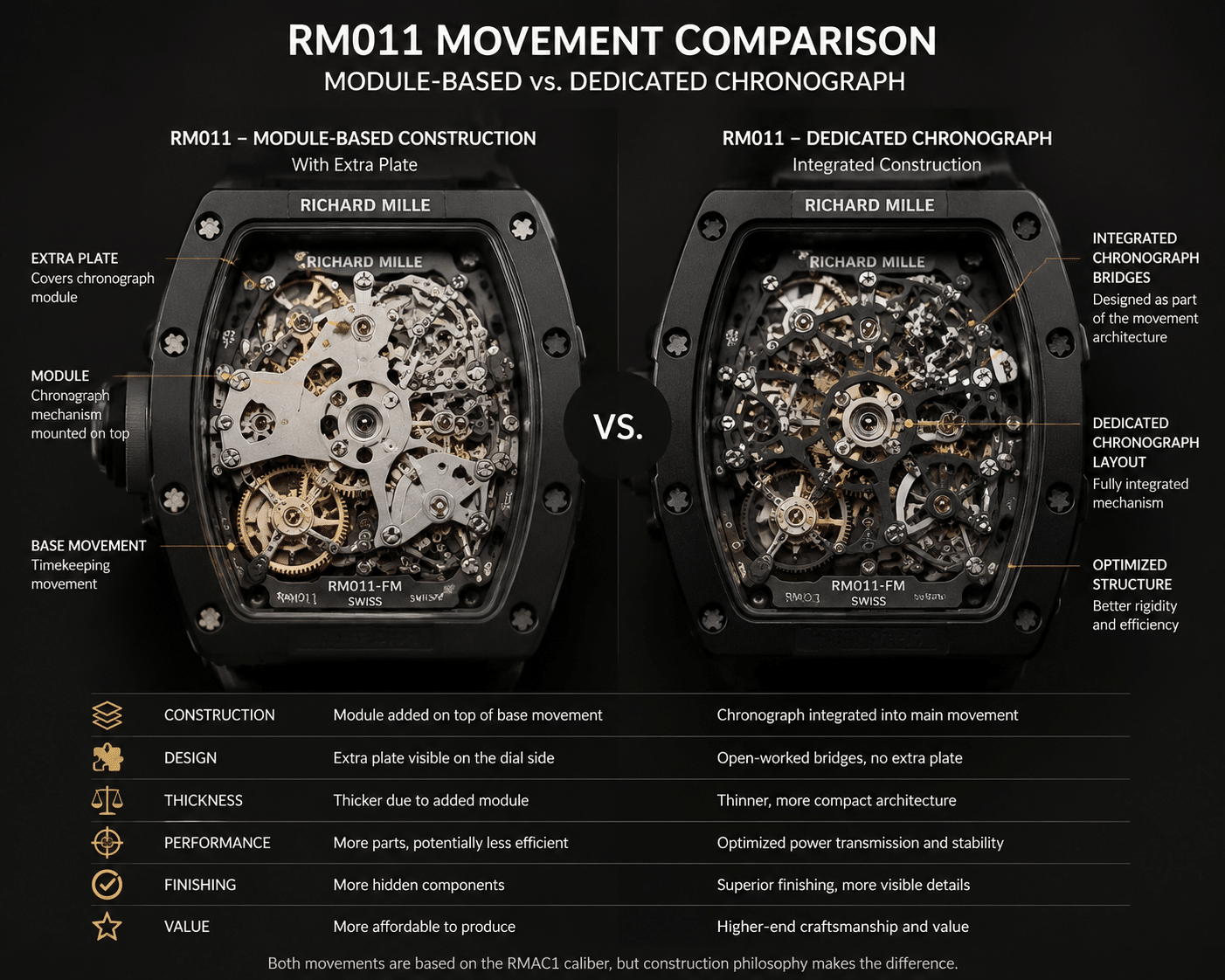
| Movement photo tell | Integrated movement, no visible module plate | Visible module plate, regulator arm, or separation layer behind skeleton dial |
Quick Questions Before You Read
Q: Can I fix a misaligned subdial on an RM011 replica?
No. Subdial spacing is determined by the movement or module layout. If it looks too close in QC, it will not move or be adjustable; the watch will always show that spacing.
Q: Is the RM011 replica reliable enough for daily wear?
Not for most buyers. Crown winding failure, sticking pushers, and rotor noise are common within months of light use. If daily reliability is a priority, a skeleton time-only replica is a safer choice.
Q: How do I check chronograph function during QC?
Ask the seller for a video showing the chronograph start, stop, and reset. The key test is the reset: the hand should snap back to zero without bouncing, and it should land in the exact same position each time.
Q: Why does pusher feel matter if I am only wearing the watch?
Because poor pusher feel is a symptom of the same shallow module construction that causes winding strain and internal wear. It tells you the movement architecture is compromised, not just the button click.
Why RM011 Replicas Look Easy But Perform Differently
You browse an RM011 listing online. The skeleton dial lays everything bare — gears, bridges, the balance wheel ticking at 4 Hz. The case is carbon, the design is aggressive, and in photos the watch looks every bit like a $200,000 piece of wrist engineering. The thought crosses your mind: this should be one of the easier targets. The movement is visible, so any shortcuts in finishing would be obvious. The case is bold, so small errors in proportion would stand out. It seems like a replica buyer’s advantage — seeing everything means nothing can be hidden.
Then the watch arrives, and the experience changes. Not because the dial is wrong. Not because the carbon pattern looks off. But because when you press the pusher to start the chronograph, something feels hollow. The resistance is not there. The subdial at 3 o’clock seems slightly closer to the centre than it should be. You press reset and the chronograph hand returns, but not to exactly zero — it lands a hair past the marker, and then never lands in the same place twice. The watch that looked so convincing in the listing now feels like it was designed for photos, not for operation.
This is the central tension of the Richard Mille chronograph replica, and it is why the RM011 represents a fundamentally different challenge than skeleton time-only models. A skeleton watch with no complications can hide a great deal behind decoration. The bridges are opened up, the rotor is shaped to match the genuine, and as long as the balance wheel is visible and the watch runs, the visual impression carries the piece. The buyer rarely touches anything except the crown. There is no interaction that reveals mechanical shortcuts.
The RM011 does not have that luxury. Its chronograph layout — running seconds at 12, chronograph minutes at 3, date at 6 — is not just a visual arrangement. It is a mechanical demand. Every subdial must be driven by the movement. Every pusher must transfer force through a correct mechanical path. The buyer does not just look at this watch; they operate it. And operation exposes architecture decisions that no amount of skeleton decoration can disguise.
This is not to say that an RM011 replica cannot be a satisfying purchase. But the buyer must understand that they are entering a different game. A time-only skeleton replica can succeed on appearance alone. An RM011 chronograph replica must also succeed on mechanical credibility. The question is not whether the dial looks right in a photo. The question is what happens when you actually press the pushers.
Editorial Perspective: A recurring mistake in the replica watch market is treating a factory name as a universal quality guarantee. For the RM011, the factory name tells you only which case and dial molds were used — it does not tell you whether the chronograph module was properly aligned, whether the pusher mechanism was lubricated, or whether the crown stem geometry was adjusted for the extra thickness. At cleanvsfactory.com, this kind of distinction is treated as a model-specific buying question rather than a simple factory ranking. A factory that produces excellent time-only RM replicas may produce a chronograph version with the same visual quality but fundamentally different reliability. The factory name helps narrow the shortlist, but the final decision for an RM011 still depends on the movement architecture, the chronograph module source, and whether the buyer intends to actually use the pushers. A buyer who selects a factory based only on dial quality may end up with a watch that looks flawless and breaks in three months. The factory label is a useful signal, not a final verdict, and the RM011 is the model where that distinction matters most.
What the Chronograph Demands: Subdial Logic and Pusher Feel
To understand why RM011 replicas so often fall short, start with the genuine layout. The RM011 uses a running seconds subdial at 12 o’clock, a 30-minute chronograph counter at 3 o’clock, and a date window at 6 o’clock. This arrangement is not decorative — it is dictated by the Vaucher-based RMAC1 movement architecture, where the chronograph module sits on top of the base caliber and drives the counters through specific gear trains. Each subdial has a defined distance from the centre of the dial, and those distances are the result of the movement’s physical geometry.[1]
When a replica factory attempts to reproduce this layout using a different movement base, the subdial spacing becomes the first casualty. A standard chronograph base like the Shanghai 7750 was designed for a different dial arrangement — typically running seconds at 9, 30-minute counter at 3, and 12-hour counter at 6. To force the RM011 layout onto a 7750 base, the factory must use transfer gears or offset bridges to move the subdials into different positions. The result is often subdials that are slightly too close to the centre, or misaligned relative to the printed markers on the dial. In photos, the error is subtle. On the wrist, once you know where to look, it becomes immediately visible.
Pusher feel is the second and more telling dimension. A genuine RM011 pusher offers a distinct, crisp resistance when pressed. The start action requires deliberate pressure, the stop is positive, and the reset releases with a clean snap. There is no mush, no double-tap sensation, no gritty feedback. Replica pushers, particularly those driven by a module-based movement, often feel different. The start may feel shallow or vague. The reset may require extra force, or the hand may skip slightly before settling. The root cause is the additional mechanical linkage between the pusher and the chronograph works — more parts between your finger and the action means more opportunities for lost precision.
Factory and Movement Traceability Note: The distinction between module-based and purpose-built chronograph movements is critical for the RM011, but it is rarely made explicit in product listings. Buyers should be aware that a movement description such as “Shanghai 7750” or “Seagull ST1901 based” is a reference to the base architecture, not a guarantee of subdial accuracy or pusher reliability for this specific dial layout. Asking the seller to confirm whether the chronograph module is a separate stacked component or an integrated design is one of the most useful verification steps before purchase.
Subdial Position and Spacing: The First Visual-Verification Check
You do not need a caliper to check subdial spacing on an RM011 replica. A front-facing QC photo with good lighting is enough. First, check the distance from the edge of the running seconds subdial at 12 to the edge of the chronograph minute subdial at 3. On a correct layout, these distances appear balanced against the dial markers printed below them. If the subdial at 12 looks pushed upward toward the case, or if the subdial at 3 sits noticeably closer to the centre than to the rim, you are likely looking at a movement base that was not designed for this dial layout. Second, check the date window at 6. A misaligned date window — too far left, too far right, or sitting too low — is another indicator that the movement’s date mechanism was not designed to sit in this position. These spacing errors are the most common visual flaw in entry-level RM011 replicas, and they cannot be fixed after assembly.
Buyer Expectation Note: No replica watch should be judged by factory reputation alone. A better decision usually depends on the specific model, movement version, case thickness, dial accuracy, bracelet quality, service risk, and how closely the watch will be inspected in real use. For the RM011, the movement architecture is often the deciding factor, not the factory label.
Pusher Action: What the Fingers Tell You
Pusher feel is harder to evaluate from photos, but it is the single most important functional test. When you receive the watch, press the start pusher slowly and feel for the point of resistance. A correct chronograph should have a defined activation point — you should feel the mechanism engage. If the pusher travels too easily or feels like a button rather than a mechanical switch, the chronograph engagement is likely weak. Next, press the reset pusher while the chronograph is running. The hand should stop instantly and return to zero in one clean motion. If it hesitates, bounces, or lands in a slightly different position each time, the reset hammer or heart cam is not properly adjusted. This is not just a cosmetic issue. A chronograph that does not reset to the same zero position consistently is a movement that will degrade faster during regular use. The tactile test tells you more about the watch’s long-term viability than any dial photo ever will.
Movement Architecture: Module Stacking Versus Proper Layout
The root cause of most RM011 replica problems is not the case, not the dial, and not the carbon pattern. It is the movement architecture. There are two fundamental approaches used to build an RM011 replica, and the difference between them determines almost everything about the watch: thickness, pusher feel, subdial alignment, crown position, and long-term reliability.
The first and more common route is module stacking. A standard automatic movement — most often an Asian clone of the Miyota 9015 or a modified Shanghai 7750 — serves as the base. A separate chronograph module, manufactured by a third-party supplier, is stacked on top of this base movement. The module contains the chronograph mechanism: the coupling clutch, the hammer, the heart cam, and the gear trains that drive the subdials. The base movement handles timekeeping and date; the module handles the chronograph. On paper, this approach sounds logical. In practice, it creates several problems.
The most immediate issue is thickness. A base movement plus a chronograph module results in a total movement height that is significantly thicker than a purpose-built chronograph caliber. An RM011 replica built on a module-stacked 7750 base typically measures around 18 to 19 millimetres in case thickness, compared to the genuine reference’s approximately 16.15 millimetres. That extra 2 to 3 millimetres changes the wrist profile noticeably. The case looks bulkier from the side, and the crown appears to sit higher relative to the case body — a visual tell that is hard to unsee once you know what a proper RM011 side profile looks like.[2]
The second consequence is alignment. Because the chronograph module is a separate component attached to the base movement, the subdial positions are determined by the module’s gear exit points, not by the movement’s native layout. If the module’s gear positions do not exactly match the RM011 dial’s printed subdial rings, the hands will appear offset. This is why many module-stacked RM011 replicas have subdials that look slightly too close to the dial centre, or hands that do not sweep exactly within the printed rings.
The alternative route is a purpose-designed chronograph movement, where the base caliber and the chronograph mechanism are integrated into a single architecture. This approach is rarer and more expensive. The movement is built from the ground up with the RM011’s subdial positions and crown height in mind. The transfer gears are eliminated because the chronograph gear train is part of the base design. The result is a thinner case, more accurate subdial placement, and a crown that sits at the correct height relative to the case.
The tradeoff is availability and QC consistency. Purpose-designed chronograph movements are produced in smaller batches by fewer factories. They are harder to source, and the factories that produce them do not always have the same track record of quality control as the larger operations that focus on simpler models. A buyer who chooses this route may receive a watch with better architecture but worse finishing, or a movement with correct layout but unreliable winding. Neither route is universally superior. The buyer must decide which compromise they are willing to accept.
The Role of Movement Specification in Buyer Evaluation
Official movement specification sheets from manufacturers like Miyota or Seagull can help clarify what a buyer should expect in terms of beat rate, jewel count, and power reserve. For example, a mechanical chronograph based on a modified Seagull ST1901 movement—a hand-wound, cam-actuated column wheel chronograph—has a published beat rate of 21,600 vph and a power reserve of approximately 40 hours.[3] However, these specifications describe the movement’s baseline design, not the reliability or finishing of the specific RM011 replica build. A buyer who sees “Seagull ST1901” listed in a product description should not assume that the subdial spacing, pusher feel, or crown alignment will match the genuine RM011. Movement documentation is useful for understanding the mechanical foundation, but it does not guarantee execution quality in a module-stacked or visually cloned watch. The same principle applies to the Shanghai 7750, which is frequently used in chronograph replicas but was originally designed for a different dial layout and case thickness profile. The movement specifications clarify what the calibre is capable of in theory, but they do not confirm that the watch on the buyer’s wrist will perform to those specifications after assembly and modification.
The practical takeaway is this: when evaluating an RM011 replica, do not stop at the dial photos. Ask for a side-profile shot of the watch sitting on a flat surface. If the crown sits noticeably high relative to the case, or if the case appears thicker than you would expect, you are likely looking at a module-based build. If the seller can provide a photo of the movement, look for a visible separation plate between the base movement and the chronograph module. That plate is the signature of the stacking approach — and it is the most reliable indicator of the technical compromise inside the watch.
Practical Verification: Comparing Factory Claims to Visible Details
In the RM011 replica market, factory names circulate widely, but their value as a trust signal is limited without verification against specific visible details. A factory may be known for strong skeleton finishing on its time-only RM models, but that reputation does not automatically extend to its chronograph builds, where the movement architecture is the dominant factor.
For buyers who want to move beyond factory labels, the following verification steps are more reliable than relying on brand reputation alone:
- Reference-specific track record. Ask whether the factory has produced previous versions of the RM011 chronograph. A factory that has released multiple batches may have iterated on known issues like subdial alignment or crown height. A first-batch release carries higher uncertainty.
- Movement source transparency. If the seller identifies the movement as a “7750” or “9015 module,” ask whether it is a standard module-based stack or a reworked base. Some sellers may use generic movement descriptions that sound the same for module-stacked and integrated builds.
- Cross-referencing QC angles. The front dial photo should be cross-checked with the side profile. If the front dial looks correct but the side profile shows a crown gap larger than expected, the visual promise of the dial may not match the mechanical reality inside the case.
- Version-level distinction. A factory that has updated its RM011 from V1 to V2 or V3 may have improved specific flaws. However, version numbers are not standardized across sellers, so the buyer should compare actual QC evidence from the current batch rather than relying on the version label alone.
A factory comparison for the RM011 is most useful when it is tied to these specific verification details, including Richard Mille replica movement categories, rather than treated as a simple ranking, as two watches from the same factory may look similar in product photos but differ in crown alignment, pusher feel, or chronograph reset reliability depending on the movement batch and assembly quality.
Before making a final decision on an RM011 replica, buyers should review real QC photos where available, including dial printing, hand alignment, bezel position, datewheel centering, case side profile, and movement view through the skeleton dial. Factory labels and stock photos alone are not enough for a reliable judgment. For the chronograph model, requesting a short video of the start-stop-reset cycle is a practical step that reduces uncertainty about movement behavior.
Chronograph Reset Behavior: Why Alignment at Zero Matters
When an RM011 replica arrives, the first thing most buyers check is how it looks. The second thing they should check is how it resets.
The chronograph reset — the act of pressing the lower pusher and watching the chronograph hand snap back to zero — is one of the most revealing tests of movement quality in any chronograph replica. A watch that looks nearly perfect in still photos can fail this test instantly, and the failure tells you more about the movement than any dial photo ever could.
The most common symptom is simple: the chronograph hand returns to a position slightly above or slightly below zero. It may land consistently in the same wrong spot every time, or it may land differently each reset. Both are problems, but they indicate different root causes. A consistent misalignment — the hand always stops two marker-widths past zero — often points to a poorly positioned heart cam or a hand that was pressed onto the pinion at the wrong angle during assembly. This is a build error, not necessarily a fatal movement flaw, but it requires disassembly to correct. Random misalignment — the hand stops at +1 one time and -2 the next — is more concerning. It usually means the heart cam or reset hammer is not engaging properly, which points to wear, debris, or poor tolerances in the chronograph module itself.
A second symptom that surprises many buyers is the hand jumping off zero when the crown is pulled. The watch resets perfectly during the pusher test, but the moment you pull the crown to set the time, the chronograph hand shifts a fraction off centre. This happens because the reset hammer loses tension when the crown position changes, and the hand moves slightly before the hammer re-engages. It is a common issue in module-based movements where the chronograph mechanism does not lock independently of the time-setting train.
In practice, a chronograph hand that misses zero by less than one marker width is a borderline QC issue. Many buyers accept it because it is not visible during normal wear. A miss of one full marker or more is a clear red flag. It signals that the assembly was rushed, the heart cam adjustment was skipped, or the movement components have tolerances too loose for reliable reset behaviour. Sloppy reset alignment almost never exists in isolation — it tends to correlate with other assembly issues like gritty pusher feel or inconsistent chronograph start.
Can a watchmaker fix it? Sometimes. A consistent misalignment caused by hand placement is relatively straightforward to correct: the hand is removed and re-pressed at the correct angle. A misalignment caused by the heart cam or reset hammer may require partial disassembly of the chronograph module, which not every local watchmaker will attempt on a replica movement. Random misalignment is harder to fix because the problem may be in the module’s tolerance stack, and replacing individual components is rarely practical. The buyer should never assume that a reset issue will be easy or cheap to resolve.
The practical takeaway is direct: test the reset alignment the moment you receive the watch. Run the chronograph for ten seconds, stop it, and reset it. Do this five times. If the hand returns to the same position each time but that position is off, you have a build issue. If the hand lands in a different place each time, you have a deeper movement problem. If the hand shifts when you pull the crown, you have a module integration weakness. None of these are dealbreakers for every buyer, but they should be known before the purchase, not discovered after.
Reliability Risk: What Breaks First on an RM011 Chronograph Replica
An RM011 replica is not a time-only watch with a simple movement and a forgiving case. It is a chronograph built around a modified module, and that architecture creates a predictable hierarchy of failure points. Knowing what breaks first helps the buyer decide whether this model fits their expectations — or whether they should look elsewhere.
The most common failure point is the crown winding mechanism. The reason is mechanical, not cosmetic. An RM011 replica using a module-based movement (the 7750 or similar) is thicker than a time-only RM replica because the chronograph module sits on top of the base movement. That extra height changes the crown stem alignment. The crown tube and stem are under constant angular stress, and over time — sometimes within months of regular winding — the crown can feel gritty, skip, or fail to engage the winding gears entirely. This is not a problem of bad assembly in every case; it is a problem of geometry. The movement was not designed for the case dimensions, and something has to give. Careful buyers can reduce this risk by winding gently, avoiding forceful crown pulls, and using the crown only when necessary.
The second most common issue is pusher sticking. The start, stop, and reset pushers on an RM011 replica operate through seals and springs that are often poorly lubricated in module-based builds. After a few dozen uses, the pusher may begin to feel mushy, require more pressure to activate, or fail to click back into place. In some cases, the pusher sticks in the activated position, leaving the chronograph running until the wearer manually presses it again. This is usually caused by debris or dried lubricant inside the pusher tube, and it is difficult to resolve without removing the pusher assembly. For most buyers, the realistic option is to use the chronograph sparingly — not because the watch cannot handle it, but because the pusher hardware was not built for frequent cycling.
Rotor noise ranks third in frequency. The RM011 case is skeletonized and open on both sides, which means every sound from the movement is amplified. A rotor that sounds like a loose coin rattling inside the case is a common complaint. The cause is usually a combination of thin rotor bridges and low-tolerance bearings. In module-based builds, the rotor sits on top of the chronograph module, which adds height and reduces the available support structure. Over time, the rotor bearing loosens, and the noise becomes more pronounced. This is rarely a functional failure — the watch will still run — but it is a constant reminder that the movement inside is not built to the same standard as the case that surrounds it.
Date jump errors are less common but still notable. The RM011 has the date window at six o’clock, and in module-based movements, the date mechanism is driven through transfer gears that add mechanical slack. The result can be a date that hesitates during the changeover, partially advances mid-afternoon, or fails to jump cleanly at midnight. This is typically a sign that the date module integration was handled poorly during assembly, and it is not an easy fix because adjusting the date drive train requires removing the chronograph module.
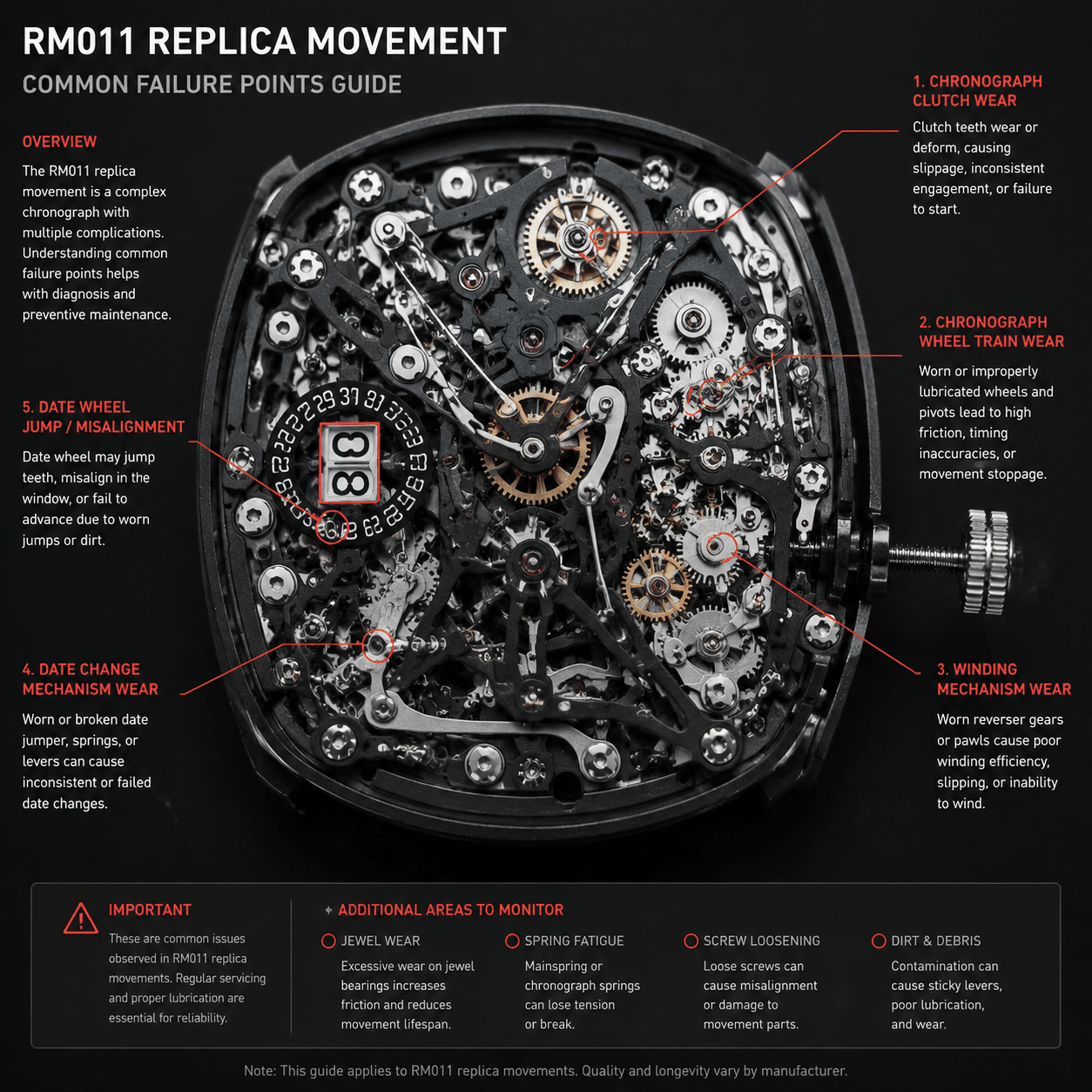
No factory currently produces an RM011 replica that is universally called reliable. The version that reduces the most risk is one that uses a purpose-built chronograph layout rather than a module stacked on a base movement — but those versions are rare and often come from smaller factories with less consistent QC. For most buyers, the honest approach is to accept that an RM011 replica is a visual object first and a functional tool second. If the chronograph still works after six months of light use, consider that a good result. If it does not, the failure was never a surprise — it was a known possibility baked into the design.
Many Look Right, Few Operate Right: Why Visual Accuracy Misleads Buyers
The most misleading thing about an RM011 replica is how good it can look in QC photos. A well-made example has skeleton bridges with proper cutouts, a dial that uses the correct font and subdial spacing, a case profile that curves like the genuine article, and a bezel with crisp edges. A buyer looking at those photos might reasonably conclude that this is the closest thing to the real watch they will ever hold.
Then the watch arrives, and the pusher feels hollow. The chronograph hand stutters instead of sweeping. The reset skips. The watch that looked flawless in photos handles like a much cheaper product.
This gap between visual and functional quality is not accidental. It is the result of how factories allocate their resources. Visual finishing — dial printing, case polishing, skeleton bridge decoration — is comparatively easy to get right. It requires good molds, careful assembly, and attention to detail. More importantly, it photographs well. A factory that invests heavily in visual finishing will generate excellent QC photos, and those photos drive sales.
The movement, by contrast, is expensive to tune. Calibrating the chronograph engagement, adjusting the heart cam for clean reset, lubricating the pusher mechanism, and verifying reliable date change all take time and skill. These are labour-intensive steps that do not show up in still photos. A factory that cuts corners on movement tuning will produce a watch that looks impressive in pictures but feels cheap in operation.
The buyer who evaluates an RM011 replica solely through photos is making a predictable mistake. Visual accuracy is a necessary condition for a good replica, but it is not a sufficient one. A watch can have perfect dial printing and a misaligned chronograph hand. It can have a correct case profile and a mushy pusher. The visual elements and the functional elements are not always built to the same standard, and the buyer has no way of knowing which standard was followed until the watch is in hand.
Understanding the Limits of Genuine Brand Specifications as a Reference
Official brand resources from manufacturers like Richard Mille can describe the design philosophy and materials of the authentic RM011, such as grade 5 titanium case components, a carbon fibre bezel, and a skeletonized dial architecture.[1] However, these documents describe the genuine product, not the replica. A buyer might use the genuine dimensions — approximately 50.00 mm by 40.00 mm and 16.15 mm thick — as a reference point for evaluating replica proportions. For example, if a replica’s side profile appears thicker than 16.15 mm, the buyer can infer that a module-stacked movement is likely responsible. But the official brand source does not verify that a replica actually uses grade 5 titanium or carbon fibre of equivalent quality. A buyer who relies solely on genuine brand specifications to judge replica quality risks overestimating the replica’s construction standards. The official source is a helpful baseline for comparison, not a guarantee of the replica’s materials or finishing.[4]
Quality Control Note: For replica and super clone watches, buyer confidence depends on visible quality-control details such as case finishing, dial printing, bezel alignment, bracelet fit, clasp engraving, datewheel position, and movement configuration. These details should be checked model by model rather than assumed from a factory name alone. In the RM011, the chronograph functionality adds an extra layer of inspection that time-only replicas do not require.
The practical fix is to ask for a movement photo and a short video showing the chronograph in action during QC. Not every seller will provide this — and that itself is useful information. A seller who refuses to show the chronograph running, or who only provides still photos of the dial, is signalling that the functional side of the watch is not the selling point. For a buyer who cares about how the watch operates, not just how it looks, that signal matters more than any single dial detail.
The central truth of the RM011 is that it is a different game. The chronograph function cannot be faked through visual decoration. A watch that looks right but operates poorly is not a good replica — it is a half-finished one. The buyer who understands this distinction before purchasing has already avoided the most expensive mistake in the RM011 market.
The Legal and Practical Risks of Misrepresentation
Beyond the mechanical and visual limits of RM011 replicas, buyers should also consider how the watch might be perceived or used. A replica watch, no matter how convincing its skeleton bridges or chronograph module, is not a genuine Richard Mille product. It was not produced by, authorized by, or affiliated with the original luxury brand. This distinction matters not only for legal compliance but also for practical risk management.
Replica watches are not designed, tested, or certified to meet the brand’s own standards for water resistance, shock resistance, material durability, or movement accuracy. Attempting to represent a replica RM011 as a genuine watch — whether for resale, trade, authentication, or insurance purposes — carries both legal consequences and financial risk. Even if a replica appears visually close to the genuine reference in casual wear, it is not legally or commercially equivalent. Buyers should not expect a replica to pass professional inspection at a boutique, service center, or auction house. The safest use of factory and movement information in the replica market is to inform purchase decisions and manage expectations, not to enable misrepresentation.
For buyers considering an RM011 replica, this practical boundary should be part of the decision. The watch is best understood as a replica-market product that visually references the genuine RM011 design, not as an alternative to the genuine article. Buying with this understanding reduces the risk of expectation mismatch, legal exposure, and financial disappointment.
What to Look For in RM011 QC Photos and Videos
Most buyers evaluate an RM011 replica based on photos alone, which is the exact reason so many end up disappointed after the watch arrives. A watch that looks perfect in a well-lit front shot can hide a loose pusher, a misaligned date wheel, or a crown that sits visibly too high. For the RM011 specifically, QC evaluation must go beyond checking dial printing and carbon pattern. You need to verify the chronograph-specific details that most time-only replica buyers never think to check.
Here is a practical, angle-by-angle checklist for inspecting RM011 QC photos and videos. Each check targets a common failure point specific to the RM011’s chronograph architecture.
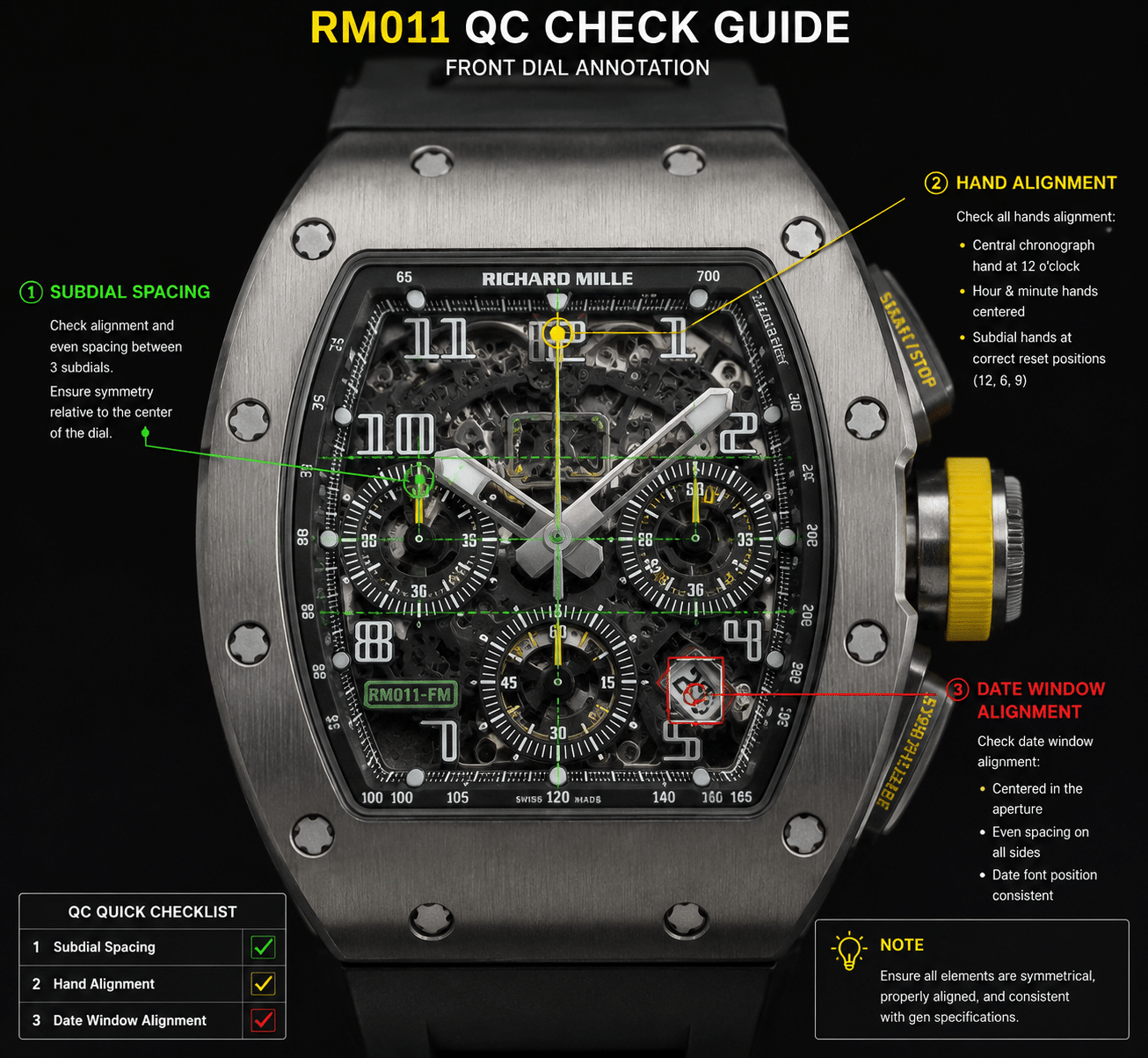
Front Dial Photo — The Structural Baseline
This is the most common QC angle, but for an RM011, it has specific tasks that go beyond looking for dust or smudges.
1. Subdial spacing relative to the centre. The genuine RM011 places the running seconds at 12, the chronograph minute counter at 3, and the date at 6. On a replica using a 7750-based movement, the subdials are often slightly too close to the centre or positioned at slightly different distances from each other. Look at the gap between the 12 o’clock subdial and the 3 o’clock subdial. If one looks noticeably closer to the centre pinion than the other, the spacing is off. This is not fixable after purchase.
2. Date window alignment and font. The date on the RM011 sits at 6 o’clock and should be centred within the opening. Check whether the date number sits too high, too low, or tilts to one side. Also compare the font thickness to reference photos of the genuine model. The replica datewheel often uses a bolder or thinner font, Richard Mille replica movements, and once you see it, it is hard to unsee.
3. Hand alignment at rest. All three chronograph hands — the central seconds hand and both subdial hands — should sit exactly at their zero positions when the chronograph is not running. The central seconds hand should point exactly to 12, not slightly left or right of the marker. The minute counter hand at 3 o’clock should point exactly to 60 (top of the subdial). If any hand sits even half a marker off zero when the chronograph is stopped, that is a reset alignment problem, which typically cannot be corrected without movement disassembly.
Side Profile Photo — The Thickness and Crown Check
This angle reveals the RM011’s most persistent problem: excess case height caused by the 7750-based movement module.
1. Case thickness compared to genuine dimensions. The genuine RM011 measures approximately 16.15mm thick. A KV/KU-grade replica using a Shanghai 7750 typically measures around 18–19mm. Place the QC photo next to a known reference — if the case looks visibly thicker than you expected, it is the chronograph module causing the extra height. This is not a QC flaw per se, it is a known limitation of this movement route. But you should know what you are getting before purchase.[2]
2. Crown height relative to the caseband. On the genuine RM011, the crown sits flush against the case with minimal protruding gap. On module-based replicas, the crown often sits higher because the movement stack pushes the stem position upward. Look at the gap between the crown base and the case. If there is a noticeable shadow or visible stem, the movement architecture is likely the module route.
3. Pusher depth and alignment. The chronograph pushers should sit at the same depth relative to the case. If one pusher protrudes slightly more than the other, or if they are not parallel to each other, it may indicate uneven case machining or a misaligned pusher module. Also check that the pushers are angled correctly — they should point outward, not straight down.
Movement Photo — The Module Verification
This is the single most important QC image for an RM011, yet many sellers do not offer it unless requested.
1. Is there a visible module plate? Look at the movement through the caseback. If you see a separate plate sitting on top of a base movement — distinct from the base movement bridges — it is a modular construction. The module plate is usually distinguishable by its different colour or finishing pattern compared to the base movement. If the movement appears as a single integrated structure with no visible seam, the watch may be using a more sophisticated clone layout.
2. Balance wheel and regulator. Check whether the balance wheel has a visible regulator arm with an index (a small curved metal arm near the balance spring). The genuine RM011 uses a free-sprung balance with no regulator arm. Most replicas below $800 still use a regulated balance. If you see the regulator arm, it is a visual tell for anyone familiar with the genuine movement.
3. Rotor placement and finishing. The rotor should sit cleanly within the movement aperture and rotate smoothly without wobbling. If the rotor touches the movement bridge or shows visible friction marks, that is a reliability concern. Also check that the rotor is not painted or plated in a way that looks cheap compared to the case finishing.
Pusher Video — The Functional Reality Check
This is the test that separates visually impressive RM011 replicas from functionally acceptable ones. Request a short video (5–10 seconds) showing the chronograph being started, left running for a few seconds, stopped, and reset.
1. Start/stop feel. The pusher should click firmly with consistent resistance. If the pusher feels mushy, requires excessive pressure, or sticks briefly before engaging, the chronograph mechanism is poorly assembled. A gritty or hollow feel is a common sign of insufficient lubrication or debris in the pusher tube.
2. Reset behaviour. Watch the central chronograph hand snap back to zero. It should return exactly to 12, stopping without overshooting or bouncing. If the hand stops slightly above or below zero, or if it lands on zero and then drifts off by a fraction of a marker, the reset hammer is not engaging cleanly. On module-based movements, this is the most common failure point.
3. Consistent repetition. Ask the seller to demonstrate the start-stop-reset cycle twice. If the hand returns to a different position each time, the problem is not just alignment — it is likely a loose heart cam or worn reset component. These problems escalate rapidly with use.
QC Photos to Request From Your Seller
Based on the checks above, here is the minimum set of images and video you should request before approving an RM011 replica:
- Front dial, good lighting: Check subdial spacing, date window centring, hand alignment at rest
- Side profile on a flat surface: Check case thickness, crown height gap, pusher depth symmetry
- Movement photo with balance wheel visible: Check for module plate, regulator arm, rotor fit
- Short video of chronograph operation: Check pusher feel, reset alignment, consistency across two cycles
If your seller is unwilling or unable to provide these specific angles, that is a significant red flag. A functional chronograph replica should be able to demonstrate basic chronograph function. A seller who only offers front dial photos is likely hiding movement or thickness issues that would be obvious from other angles.
Making the Decision: Is an RM011 Replica Right for You?
After reading through the diagnostic sections above, you have a clearer picture of what an RM011 replica actually delivers. The question now is whether that matches your expectations. The answer is not universal — it depends entirely on what you want from the watch and what you are willing to accept.
Below are three common buyer profiles. Each leads to a different decision. Be honest about which profile fits you.
Profile 1: The Visual Collector
You want the look of the RM011 on your wrist. You rarely use the chronograph function — you may never use it at all. What matters to you is the dial layout, the carbon case pattern, the skeleton visibility, and the overall wrist presence. You are willing to accept that the pushers feel mediocre or that the chronograph hand does not reset perfectly, because you are not planning to time anything.
Recommendation: An RM011 replica can work for you, provided you go through the QC checklist above with care. The key is to front-load your inspection: make sure the dial printing, subdial spacing, and case shape are visually convincing at rest. If the chronograph function degrades over time, it will not affect your daily enjoyment because you are not relying on it. The risk here is low, and the reward — an impressive-looking Richard Mille on the wrist — is achievable within the $350–$480 price range from a known source.
Profile 2: The Daily Wearer
You plan to wear this watch regularly, and you expect the chronograph to work when you need it. You want the pushers to feel solid, the reset to be accurate, and the watch to run reliably for at least a couple of years without a failure. You do not want to send the watch back for repairs or worry every time you press a pusher.
Recommendation: Caution is strongly advised. The RM011 replica, especially in its most common module-based form, carries a higher failure risk than a non-chronograph RM model. The case thickness, crown height, and potential reset issues will become more noticeable with daily use, not less. If daily reliability is your priority, consider a time-only or simple skeleton RM model instead — the RM 35-02 or RM 055 from APS or ZF will give you a more stable movement and a slimmer case without the chronograph complication. You lose the subdials, but you gain significantly in reliability and daily wear comfort.
Profile 3: The Movement Enthusiast
You are interested in the technical challenge. You want to see what a chronograph RM replica can do, you are comfortable with the risk of breakdown, and you have a watchmaker who is willing to work on clone movements. You are not buying this as a daily watch — you are buying it as an interesting piece to examine, test, and possibly modify.
Recommendation: Possible, but requires careful factory and seller selection. Seek out the highest-tier version available, ideally one that uses a more integrated movement rather than a visible module. Be prepared to accept that even the best RM011 replica will not match the genuine in pusher feel, reset crispness, or long-term stability. If you go into this with open eyes and realistic expectations, you can learn a lot about chronograph movement architecture from these watches. Just do not expect it to serve as a reliable daily companion.
Across all three profiles, one message stays consistent: the RM011 replica is a visually impressive piece, but it is a fundamentally different product from a non-chronograph Richard Mille replica. The chronograph function forces tradeoffs in thickness, movement complexity, and long-term reliability that no factory has fully solved. If you understand those tradeoffs and they align with your priorities, an RM011 replica can be a satisfying purchase. If you expect it to behave like a genuine RM011, it will disappoint.
The RM011 is a different game. Play it with open eyes, and you will not regret the outcome — because you knew what you were getting from the start.
[1] Richard Mille, “RM 011,” Richard Mille official website, accessed 2025. Describes the RM011 collection’s design philosophy, case materials, and skeleton dial characteristics.
[2] Richard Mille, “RM 011 Specifications,” Richard Mille official website, accessed 2025. Lists approximate dimensions including case thickness of approximately 16.15 mm.
[3] Tianjin Seagull Watch, “ST1901 Movement,” Seagull official documentation, accessed 2025. Specifications include 21,600 vph beat rate, hand-wound design, and column wheel chronograph architecture.
[4] U.S. Customs and Border Protection, “Intellectual Property Rights,” CBP.gov, accessed 2025. Describes trademark enforcement, seizure risks, and import restrictions related to counterfeit goods, including replica watches.
Disclosure: This article is for general educational and comparison purposes only. Replica watches are not genuine products from the original luxury brands, and brand names are used only to identify reference designs or comparison topics. Factory names, movement descriptions, prices, availability, QC details, seller policies, and version information can change, so readers should verify important details with the seller before making a purchase decision. Replica watches should not be represented, resold, or used as genuine watches.