
Why Factory Choice Matters More for Breitling Than for Most Watch Brands

Breitling is one of the few watch brands where replica quality cannot be reduced to a single “best factory” answer. The reason is not marketing, scale, or price, but structure. Breitling’s collections differ radically in case architecture, bezel mechanics, dial logic, and movement integration. A factory that executes one Breitling reference convincingly can easily fail on another from the same brand. In practice, factory competence with Breitling is always collection-specific and movement-dependent, and any attempt to generalize beyond that usually leads to disappointment.
This is why Breitling behaves differently from brands like Rolex or Panerai in the replica space. Rolex rewards consistency: similar cases, familiar bezel systems, predictable dial layouts. Panerai rewards repetition: large cases, simple dials, forgiving proportions. Breitling does neither. It punishes shortcuts, exposes generalist tooling, and magnifies small errors until they become obvious on the wrist.
Understanding Breitling replicas starts with accepting that factory reputation alone is an unreliable guide. What matters is alignment between factory strengths and the specific Breitling collection being produced.
Why Breitling Is Not a “One-Factory” Replica Brand
Breitling’s design philosophy makes it structurally hostile to broad, one-size-fits-all replica manufacturing. The brand mixes aviation instruments, professional dive tools, and chronograph-heavy sports watches under a single name, but each category demands different tooling priorities and tolerances. Factories that rely on transferable skills from other brands quickly run into limits.
Breitling’s Design Language Punishes Generalist Factories
Breitling designs amplify errors that other brands tend to hide. Slide-rule bezels on Navitimers are not decorative; they are geometric systems where tooth depth, engraving pitch, and rotational resistance must work together. Even minor deviations in bezel geometry tolerances create misalignment that becomes visible the moment the bezel is turned. Generalist factories almost always underestimate this.
Chronograph-heavy collections introduce another layer of difficulty. Subdial spacing on Breitling chronographs is rarely forgiving. Many models depend on precise case–movement integration to maintain correct visual balance. When factories rely on generic chronograph movements without reengineering case proportions, the result is subdials that feel crowded, sunken, or visually off-center. These are not flaws that disappear with distance; they register immediately in real use.
Rider tabs on Chronomat bezels and oversized tool bezels on Avenger models further expose manufacturing weaknesses. These components are tactile and structural, not cosmetic. Poor machining tolerances lead to uneven rider heights, sloppy bezel action, or case edges that lose definition after minimal wear. Breitling’s aggressive forms leave nowhere to hide.
In short, factories without Breitling-specific tooling and long-term iteration consistently fall short. They may achieve superficial accuracy, but they fail under handling, rotation, and extended wear.
Why Factory Reputation Alone Is Misleading
Replica buyers often assume that a factory strong in one brand will naturally succeed with another. Breitling disproves this assumption more reliably than most brands. A factory celebrated for Rolex or Audemars Piguet replicas may lack the mechanical discipline required for Breitling’s multi-functional designs.
Past success does not transfer automatically. Experience with simple three-hand cases does not prepare a factory for slide rules. Skill in decorative finishing does not guarantee correct chronograph architecture. Even within Breitling itself, a factory that produces an excellent Superocean automatic may struggle badly with a Navitimer chronograph.
This is why factory names are often abused in the Breitling replica market. The same watch may be sold under different factory labels, while genuinely different versions from the same factory can vary meaningfully in execution. Buyers who rely solely on reputation instead of understanding collection-specific behavior often end up with watches that look acceptable at first glance but feel wrong in daily use.
Breitling replicas reward pattern recognition, not brand loyalty. The factories that understand this brand do so narrowly, deliberately, and over time. Those that do not tend to repeat the same mistakes across different references, regardless of how strong their reputation may be elsewhere.
Factories That Actually Specialize in Breitling Replicas
Specialization in Breitling replicas is not defined by how many models a factory releases, but by whether those releases show cumulative learning. Real specialization leaves fingerprints over time: fewer resets, fewer cosmetic overcorrections, and quieter version evolution. Marketing-driven factories announce “new versions.” Breitling-focused factories quietly fix the same watch again and again.
GF Factory
Breitling-Focused Manufacturing, Not Opportunistic Production
GF is one of the few factories whose Breitling output shows continuity rather than experimentation. Its catalog does not jump randomly between unrelated references. Instead, it revisits the same families across years, correcting proportion, feel, and mechanical integration rather than chasing novelty.
The strongest signal of specialization is version behavior. GF does not abandon a model after release. Navitimer three-hand references, Avenger tool watches, and Superocean automatics all show incremental refinement rather than wholesale redesigns. Bezel action tightens, dial printing stabilizes, case thickness drifts closer to functional balance instead of visual mimicry. These are changes that only appear after extended feedback cycles.
GF’s strength with Navitimer lies specifically in non-chronograph executions. Without the added stress of multi-register spacing, the factory focuses on slide-rule geometry, bezel resistance, and dial legibility. The result is a watch that feels mechanically coherent rather than cosmetically convincing. Chronograph Navitimers remain more variable, not because GF lacks skill, but because the movement–case compromises required still carry visible trade-offs.
Avenger models play directly into GF’s long-term tooling advantage. Thick cases, aggressive guards, and utilitarian dials forgive nothing if machining is sloppy, yet GF’s Avenger pieces tend to age well. Edges stay crisp, crown feel remains consistent, and case finishing does not collapse into softness after months of wear.
Superocean automatics represent GF at its most reliable. These watches do not demand historical sensitivity, but they do demand structural honesty. GF handles bezel tolerances, caseback sealing, and overall balance in a way that holds up over time. Failures here are rare and usually version-specific rather than systemic.
GF’s reputation in Breitling replicas exists because of accumulated behavior, not hype. It is not perfect, but it understands where precision matters and where restraint is better than ambition.
TF Factory
Strong on Modern Sports Breitling, Weak on Heritage Pieces
TF performs best when Breitling behaves like a contemporary sports brand rather than a historical one. Its strengths emerge in modern Superocean variants and Avenger chronograph executions, where bold cases and restrained dials reduce the risk of visual imbalance.
TF’s modern Superocean pieces benefit from simplified design logic. Broad indices, high-contrast dials, and contemporary proportions allow TF to focus on execution rather than interpretation. In this space, case machining is solid, bezel action is generally consistent, and the watches feel purpose-built rather than adapted.
Avenger chronographs are another area where TF performs convincingly. The inherent thickness and aggression of the design mask minor movement compromises, and the visual weight distribution remains acceptable even when tolerances are not perfect. These watches tend to look correct on the wrist, which matters more than theoretical alignment.
Where TF struggles is with heritage-sensitive designs. When historical proportion, dial nuance, or subtle typography matter, TF often overstates details or misjudges restraint. Premier-style aesthetics, vintage cues, or minimalist references tend to feel forced rather than natural. The watches may look impressive at first glance, but they lack the quiet confidence that defines the originals.
TF is not a weak factory; it is a focused one. Its mistake is often positioning rather than execution. When matched with the right modern Breitling collection, TF performs well. When pushed into historically delicate territory, its limitations surface quickly.
V7 / V9 Type Factories
Model-Specific Precision, Not Broad Coverage
V7 and V9 represent a different strategy altogether. These factories are not trying to understand Breitling as a brand. They are trying to solve a single reference.
When tooling, movement choice, and case architecture align perfectly, the results can be exceptional. Certain Navitimer references and limited executions show precision that rivals any larger factory. Dial alignment, engraving sharpness, and finishing detail can be outstanding when the project scope is narrow and controlled.
The risk is consistency. Outside of the specific references these factories are built around, execution drops sharply. There is little evidence of transferable learning across collections. A factory that produces an excellent single Navitimer may produce an entirely forgettable Chronomat or Superocean.
This creates a high-risk profile for buyers. If you know exactly which reference the factory was built to execute, the result can be excellent. If you assume that quality carries across the catalog, disappointment is common. These factories reward precision in selection, not exploration.
V7 and V9 are best understood as surgical tools, not general solutions. Used correctly, they deliver impressive results. Used casually, they expose how narrow specialization really is.
In the Breitling replica space, true specialization is rare. GF earns it through repetition and refinement. TF earns it selectively through alignment with modern design language. V7 and V9 earn it briefly, one reference at a time. Understanding which kind of specialization you are dealing with matters more than the factory name itself.
Best Breitling Replica Factory by Collection
Factory reputation only becomes useful when it is translated into collection-level behavior. Breitling does not reward broad assumptions. Each collection emphasizes different failure points, and factory strengths only matter when they intersect with those pressures. This section narrows factory choice into practical patterns that hold up in real use.
Navitimer replicas live or die by dial alignment and slide rule execution. Branding, finishing tricks, and movement decoration matter far less than whether the bezel rotates correctly, the scales align under real inspection, and the dial remains legible rather than visually crowded.
Chronograph and three-hand Navitimers must be treated as separate categories. They behave differently, fail differently, and reward different factory strengths.
For three-hand Navitimer references, GF-style execution remains the safest pattern. Without the complexity of multi-register spacing, GF’s long-term familiarity with slide-rule geometry and bezel resistance shows clearly. The watches feel mechanically intentional, not cosmetically assembled. Alignment holds under rotation, and the dial does not feel compressed by movement compromises.
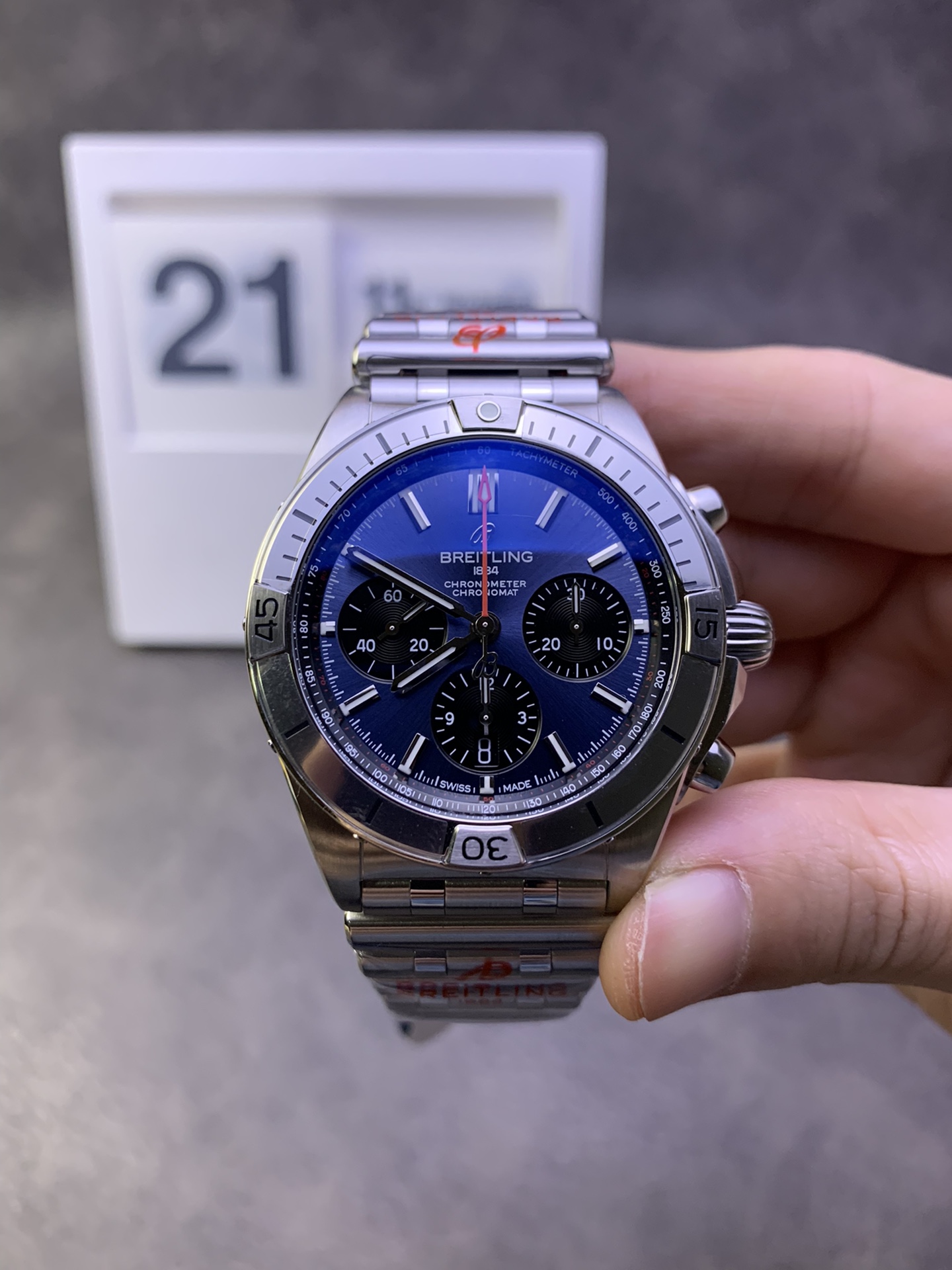
Chronograph Navitimers are inherently riskier. No factory solves them universally. Acceptance here must be version-specific, not factory-driven. Certain limited runs can be acceptable, but they require scrutiny of subdial spacing, case thickness, and visual balance. Treating chronograph Navitimers as “safe” simply because of factory branding is a common mistake.
In Navitimers, restraint beats ambition. The best outcomes come from factories that understand where not to push.
Best Factory for Chronomat Replicas
Chronomat replicas are decided by the bracelet before anything else. The rouleaux bracelet is not a styling detail; it is a structural test. Poorly executed rouleaux links immediately undermine the watch, regardless of dial accuracy or movement quality.
Very few factories handle this bracelet correctly. Tolerances between links, articulation smoothness, and long-term wear behavior matter more than initial shine. Case finishing consistency also outweighs dial detail. Chronomats are visually busy by nature; minor dial imperfections fade into the background if the case and bracelet feel solid.
GF remains the most consistently reliable option here, not because its dials are perfect, but because its bracelet construction and case finishing hold up over time. Many other factories can produce a Chronomat that photographs well, but few produce one that still feels correct after months of wear.
Chronomat replicas punish factories that prioritize visual impact over mechanical coherence.
Best Factory for Superocean Replicas
Superocean replicas are the least volatile category in the Breitling lineup. Modern Superocean designs simplify factory challenges through bold indices, clean dial layouts, and functional cases that tolerate minor variance.
This makes Superocean replicas an easier category for mid-risk buyers. Factory differences exist, but they are narrower. Bezel action, caseback sealing, and overall balance matter more than microscopic finishing.
GF and TF both perform well here, with modern Superocean automatics showing stable behavior across versions. Failures are more likely to be isolated defects than systemic weaknesses. As a result, factory choice matters less than avoiding outdated or rushed versions.
If a Breitling replica category allows some flexibility, Superocean is it.
Best Factory for Avenger Replicas
Avenger replicas benefit from overbuilt design. Thickness, aggressive cases, and heavy visual weight hide tolerances that would be unacceptable elsewhere. This works in favor of factories that understand tool-watch construction.
GF’s Avenger models remain the most reliable over time. Crown feel, case durability, and overall proportion tend to remain stable with use. TF’s Avenger chronographs can also perform well, especially where the design already expects bulk and mechanical presence.
Avenger replicas forgive weight, thickness, and visual aggression, but they do not forgive sloppy assembly. When executed well, they age better than many more refined Breitling replicas.
This is a category where structural honesty matters more than finesse.
Best Factory for Premier Replicas
Premier replicas are the most unforgiving category in the Breitling lineup. They require restraint, proportion control, and an understanding of negative space. Many factories misjudge this entirely.
The most common error is treating Premier as a “dress Chronomat.” Over-decoration, excessive polishing, and dial crowding destroy the quiet balance that defines the collection. Small mistakes feel large because the design leaves no distractions.
Few factories handle Premier replicas convincingly, and even fewer do so consistently. When they succeed, it is usually through conservative execution rather than technical bravado. Buyers should treat this category with caution and accept that acceptable versions are rare and narrow.
Premier replicas expose misunderstanding faster than any other Breitling collection.
Choosing the best Breitling replica factory is not about finding a universal answer, but about matching factory behavior to the specific pressures of each collection.
Version Differences: Why the Same Model Can Vary Wildly
In the Breitling replica space, model names are far less reliable than version behavior. Two watches sold under the same reference can feel like entirely different objects once worn, handled, and lived with. This variance is not accidental. It is the result of quiet changes that accumulate over time, often without notice or disclosure.
Silent Version Changes and Why They Matter
Most meaningful changes in Breitling replicas are not announced. They appear silently, batch by batch, and their impact only becomes clear after extended use.
Dial revisions are one of the most common shifts. Font weight changes, scale spacing adjustments, or subtle color tone corrections may seem minor, but they directly affect legibility and visual balance. A dial that looks “sharper” in photos may feel harsher or more crowded on the wrist, especially under natural light.
Caseback thickness changes are another quiet but important variable. A slightly thicker caseback may be introduced to accommodate a different movement or simplify assembly. This alters how the watch sits on the wrist, how it balances, and how closely it mirrors the original profile. These changes often go unnoticed until compared side by side with an earlier version.
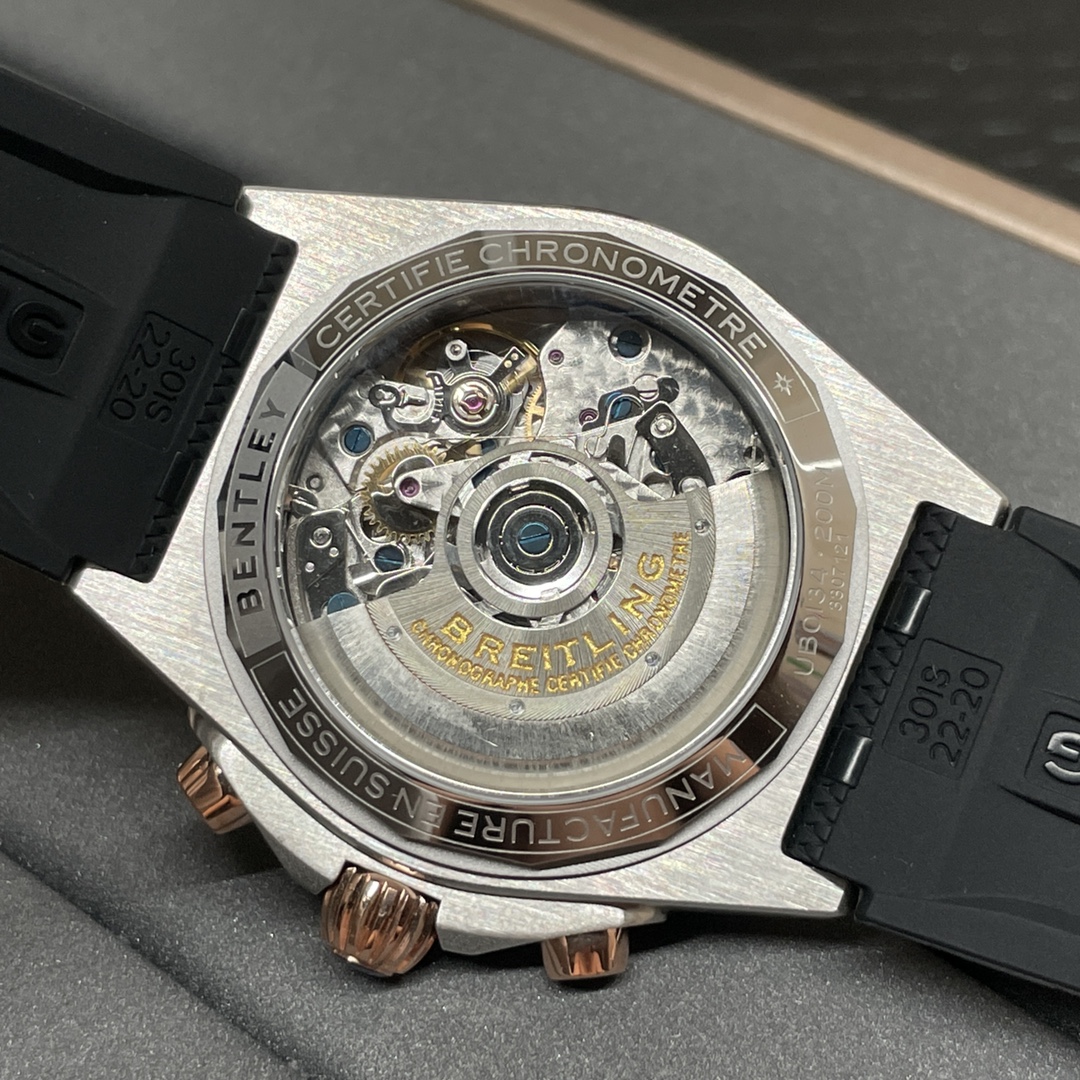
Movement decoration creep is perhaps the most misleading shift. Later versions sometimes add more aggressive finishing, engraved text, or visual elements meant to suggest technical improvement. In practice, this often adds thickness, increases friction, or complicates servicing without improving function. What looks more “premium” through a caseback can perform worse over time.
These version differences explain why buyers with the same model report completely different experiences. The name stays the same. The watch does not.
Why Newer Versions Are Not Always Better
The assumption that later versions are improvements is unreliable in Breitling replicas. Cost pressure plays a decisive role. As a model matures, factories often look for ways to reduce production expense without altering outward appearance.
This leads to shortcuts: lighter bracelets, simplified internal finishing, cheaper gaskets, or less careful assembly. The watch may look identical at delivery but age differently. Crown feel degrades sooner. Rotor noise increases. Chronograph tolerances drift faster.
Earlier versions sometimes age better because they were produced before margins tightened. Initial runs often receive more attention, heavier components, and stricter quality control. Once demand stabilizes, efficiency replaces caution.
Version choice matters more than release date. The best Breitling replica version is often the one that quietly disappears, not the one being loudly promoted.
Common Fake Claims and Mislabeling in Breitling Replicas
The Breitling replica market relies heavily on language that sounds technical without being mechanically meaningful. Understanding these patterns helps buyers filter noise without needing to become engineers.
“B01 Clone” as a Sales Term, Not a Mechanical Fact
The phrase “B01 clone” persists because it sounds authoritative. Structurally, it means almost nothing.
No true mechanical clone of the Breitling B01 exists in the replica market. What is sold under this label is almost always a standard chronograph movement dressed to resemble B01 visually. Decorative bridges, engraved rotors, and altered layouts create the impression of equivalence without replicating architecture.
This distinction matters. A decorated movement may look convincing through a display caseback but behave like its base movement under stress. Power delivery, chronograph engagement, and long-term wear characteristics remain unchanged.
The term survives because it satisfies expectations without inviting scrutiny. Buyers want reassurance. Sellers provide vocabulary. The watch itself does not change.
Factory Name Abuse and Relabeling
Factory names in the Breitling replica market are frequently reused, reassigned, or selectively applied. The same watch may be sold under different factory labels depending on market demand or batch availability.
Batch variance is often mistaken for factory difference. Minor changes in assembly quality or finishing from one production run to another are presented as different factories rather than what they are: internal variation. This creates confusion and false hierarchies.
Understanding this pattern prevents over-optimization. A factory label is not a guarantee of consistency. It is, at best, a rough indicator of origin. What matters is the specific version, the specific batch, and how that watch behaves after months of wear.
In Breitling replicas, clarity comes not from believing claims, but from recognizing how often those claims are reused without substance.
Why Some Cheap Breitling Replicas Look Fine but Fail Later
Many Breitling replicas that disappoint over time do not fail because they were obviously bad at purchase. They fail because their weaknesses are temporal, not visual. Short-term accuracy masks long-term stress.
Short-Term Visual Accuracy vs Long-Term Mechanical Stress
Cheap Breitling replicas often prioritize first impressions. Cases are polished aggressively, dials are printed cleanly, and hands align well enough to pass casual inspection. What is missing is the structural discipline required to survive continuous use.
Assembly shortcuts are the first fault line. Components may fit, but tolerances are stacked instead of managed. Screws are tightened unevenly. Chronograph components are aligned visually rather than mechanically. These choices rarely reveal themselves immediately.
Lubrication neglect compounds the problem. Insufficient or uneven oiling accelerates wear, especially in chronograph movements where load increases sharply under engagement. A watch may run fine for months before friction begins to alter timing stability and reset behavior.
Chronograph tolerance stacking is the final trigger. Each marginal shortcut adds resistance. Over time, reset accuracy degrades, engagement becomes inconsistent, and the system drifts out of calibration. None of this is visible at delivery. All of it becomes obvious later.
Failure Patterns Seen After 6–18 Months
Delayed failures tend to follow predictable patterns. Chronograph reset drift is the most common. Hands no longer return cleanly to zero, or require manual correction. This is rarely a single fault; it is cumulative wear revealing poor initial alignment.
Crown stem wear follows close behind. Inadequate hardening or imprecise threading leads to sloppy winding feel, inconsistent setting engagement, or outright stem failure. What once felt acceptable becomes loose and unreliable.
Rotor noise and power loss complete the cycle. Bearings wear unevenly. Automatic winding efficiency drops. The watch runs shorter on reserve and becomes audibly rough during movement. At this stage, the replica still looks fine, but it no longer behaves like a dependable instrument.
These failures are not random. They are the delayed cost of early shortcuts.
How to Use Factory Information Without Over-Optimizing
Factory knowledge is useful only when it sharpens judgment. When it replaces judgment, it becomes a liability.
Factory as a Filter, Not a Guarantee
A factory label can narrow risk, but it cannot override fundamental mismatches. Model choice still dominates outcomes. A well-chosen three-hand watch from a modest factory often outperforms a complex chronograph from a celebrated one.
Movement architecture matters more than branding. Simple movements tolerate imperfect assembly better. Complex systems magnify every mistake. No factory name compensates for an architecture that is misaligned with the watch’s design.
Factories do not create reliability in isolation. They reveal or suppress risk depending on how well their strengths align with the model.
When Factory Differences Stop Mattering
There are points where factory distinctions fade. Simple three-hand models reduce the mechanical surface area for failure. Modern tool-watch designs tolerate variance through thickness, mass, and visual aggression.
In these categories, over-optimizing factory choice produces diminishing returns. Version condition, movement type, and realistic use expectations matter more than chasing marginal brand hierarchy.
Factory obsession often distracts from the real decision: choosing a watch that fits how it will actually be worn.
The best Breitling replica factory depends less on reputation than on whether that factory’s strengths align with the specific collection, movement, and version you are choosing.
Breitling Replica Factories — Practical Comparison Table
| Factory | Core Strength | Weak Areas | Typical Movements | Best Breitling Collections | Price Range (USD) | Long-Term Quality Judgment | Visual Accuracy |
|---|---|---|---|---|---|---|---|
| GF Factory | Long-term Breitling specialization, iterative refinement | Chronograph Navitimer consistency | A2824 / A2836 / A7750 | Navitimer (3-hand), Avenger, Superocean Auto | $280–420 | Stable over time, ages well if version-selected | High, restrained |
| TF Factory | Modern sports execution, solid cases | Heritage / Premier-style designs | A2824 / A7750 | Superocean Modern, Avenger Chronograph | $260–380 | Good early performance, version-sensitive later | High on modern designs |
| V7 Factory | Extreme precision on single references | No cross-model consistency | SW200 / A2824 | Select Navitimer references only | $350–450 | Excellent when aligned, risky elsewhere | Very high (model-specific) |
| V9 Factory | Limited-run focus, strong machining | Inconsistent catalog quality | A7750 | Select Navitimer Chronograph variants | $320–420 | Batch-dependent, not scalable | High, but uneven |
| Generic / Re-labeled | Attractive pricing, fast output | Assembly shortcuts, weak QC | Low-grade A7750 / mixed | Any (non-specialized) | $180–250 | High delayed failure risk (6–18 months) | Good at first glance |