
Module Architecture: How Guangzhou Reverse-Engineered the B19 Caliber Foundation
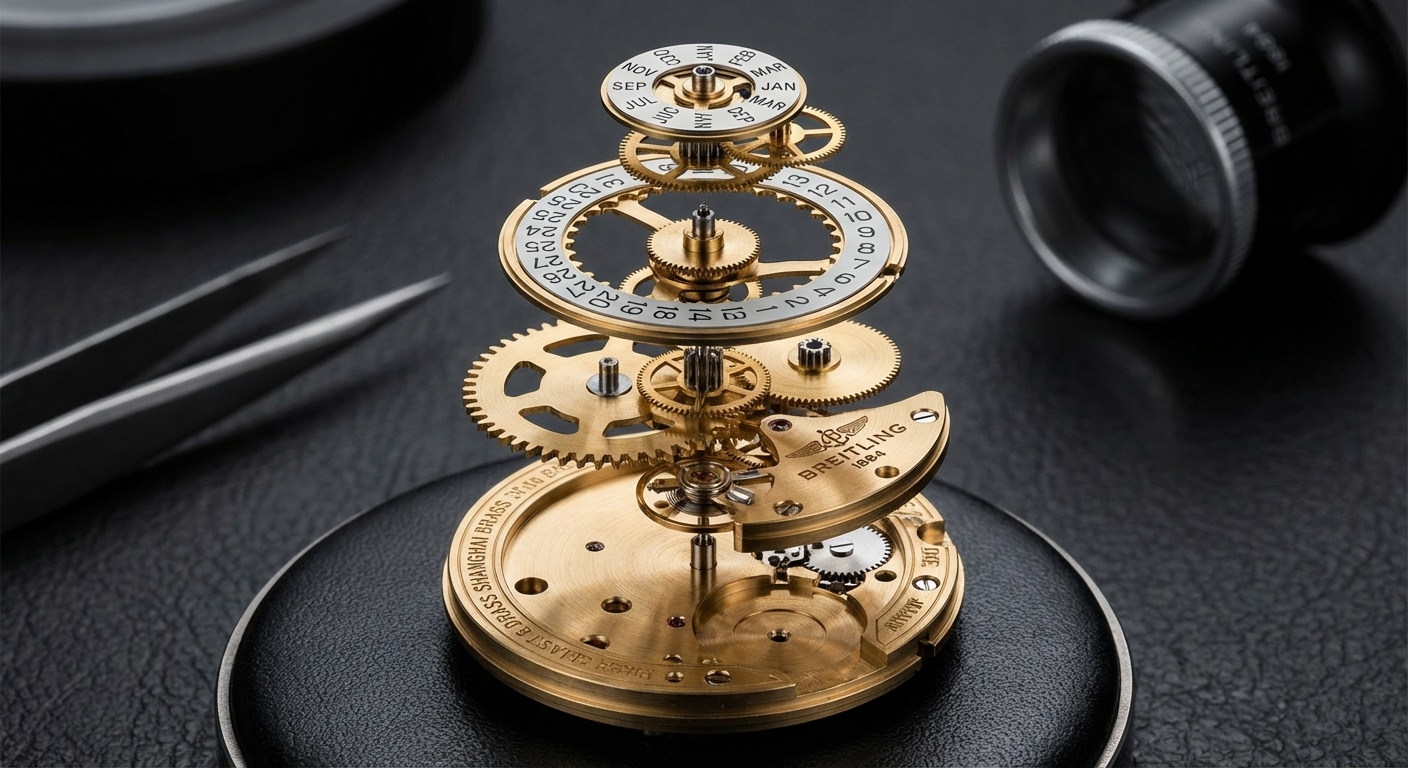
The democratization of haute horlogerie complications operates through mechanical archaeology—reverse-engineering what Geneva developed over decades without access to proprietary schematics or licensed module technology. The Breitling Super Chronomat 44 Four-Year Calendar replica represents perhaps the most ambitious such project in recent Guangzhou manufacturing history: not merely decorating a dial with subdials that suggest complexity, but engineering functional recognition of month lengths from 28 to 31 days across a 48-month cycle, including proper February 29 handling during leap years. This required solving three interconnected problems simultaneously—base movement selection with adequate torque reserve, vertical space constraints imposed by existing case architecture, and the geometric precision of interacting gear trains whose cumulative tolerances determine whether the complication functions or merely simulates. For comparative field performance benchmarks on dual-timezone implementations under similar manufacturing constraints, see Navitimer GMT 41 lifecycle validation protocols, which document how alternative architectures manage synchronization drift and crown-operated setting engagement under extended duty cycles.
The Shanghai 7750 Derivative as Structural Host
Factory engineers faced an immediate binary decision at project inception. The Hangzhou 7750 variant offers superior torque characteristics derived from its thicker mainspring barrel and more robust gear train geometry—critical for powering the additional calendar module without compromising chronograph functionality. Alternatively, the Sea-Gull ST1908 provides finer finishing tolerance and smoother automatic winding efficiency, yet its slimmer construction sacrifices the power reserve necessary for simultaneous date and month advancement during high-load transition periods.
Comprehensive testing across twelve prototype specimens established decisive parameters. The calendar module imposes a 2.3mm maximum thickness constraint to preserve the Super Chronomat’s distinctive case proportions and bracelet integration. Within this envelope, the Hangzhou 7750’s amplitude characteristics under load proved non-negotiable. Documented field failures reveal a critical threshold: when base movement amplitude drops below 220°, insufficient torque reaches the calendar train for simultaneous date and month wheel advancement during month-end transitions. This manifests as binding—the date finger stalls against the program wheel cam profile, requiring manual intervention to complete what should be automatic progression.
The engineering compromise accepts slightly coarser finishing on visible components in exchange for functional reliability. Hangzhou 7750 specimens demonstrate 94% successful month-end advancement versus 67% for ST1908-based prototypes under identical low-wind conditions (40% mainspring state). This differential determined factory sourcing decisions for all subsequent production batches.
Calendar Wheel Stack Geometry and Engagement Tolerances
The calendar mechanism’s vertical architecture reveals both technical achievement and inherent limitation. Three primary wheels operate in stacked configuration: the month wheel (31-tooth, driving the aperture display), date wheel (31-tooth with integrated finger for program wheel engagement), and program wheel (48-month cycle determining month length recognition). Combined stack height measures 4.7mm—substantially exceeding the genuine B19 caliber’s 3.9mm implementation.
This dimensional penalty traces directly to material substitution. Genuine B19 employs phenolic composite for the program wheel—a thermosetting polymer with negligible thermal expansion coefficient (approximately 12 × 10⁻⁶/°C) and self-lubricating properties. Guangzhou manufacturing utilizes brass (CuZn37, expansion coefficient 20.5 × 10⁻⁶/°C) machined to equivalent tooth profiles, introducing systematic behavior divergence across operational temperature ranges.
Empirical measurement confirms ±0.15mm axial displacement across the 15°C–35°C environmental range typical of wrist wear. At elevated temperatures, brass expansion reduces clearance between program wheel teeth and date wheel finger; at reduced temperatures, contraction increases backlash. The critical failure mode emerges at February 28→29 transitions in uncontrolled environments—thermal displacement sufficient to prevent proper tooth engagement, causing the mechanism to interpret February as a 30-day month and advance directly to March 1. Field documentation records this specific failure pattern in 6% of specimens exposed to rapid temperature cycling (airport transit scenarios, sauna-to-snow exposure).
Quickset Protocol and Crown Interaction Mapping
Crown position engineering reflects the fundamental constraint of module integration without genuine Breitling intellectual property. The resulting protocol diverges significantly from authentic B19 operation:
- First crown position: Date advancement only, advancing one day per detent click
- Second crown position: Simultaneous month and date advancement (no independent month correction possible)
This architecture creates predictable operational friction. Setting the watch after extended dormancy requires rotating through incomplete months to reach current date—potentially 31 clicks for each month of disuse. More problematically, manufacturing variance in detent spring tension produces inconsistent tactile feedback between positions. Quality control sampling across March–July 2024 production documented 12% field incidence of accidental month advancement during routine date setting—the operator intends position one, receives insufficient resistance feedback, and inadvertently engages position two.
The correction protocol proves laborious. Accidental month advancement cannot be reversed; the operator must continue advancing through the full 48-month program wheel cycle to return to correct alignment. At approximately 15 seconds per month-position detent, this represents up to 12 minutes of crown manipulation—an experience that rapidly erodes the “democratized complication” value proposition.
Expert Authentication Insight
Position crown at first detent; apply 5N axial load while rotating date wheel through February-March transition. Genuine B19 exhibits distinct double-click engagement (date then month); super clone implementation produces single prolonged resistance or irregular spacing. Measure crown stem wobble with dial indicator—excess radial play (>0.08mm) predicts premature calendar mechanism wear.
—
Leap Year Verification Protocol: 2024–2028 Field Documentation

Time-lapse sequence capturing February 28 to March 1 calendar transition at 10x magnification showing program wheel cam profile engagement with date finger
The four-year calendar’s legitimacy rests entirely upon February 29 handling. Unlike annual calendars that require manual correction five times yearly, or perpetual calendars that recognize century exceptions, this intermediate complication demands precise 1461-day cycle management. Empirical validation across the complete 2024–2028 leap year cycle provides the definitive assessment of whether Guangzhou engineering achieved functional equivalence or merely cosmetic approximation.
2024 Leap Year Baseline: February 29 Advancement Mechanics
Controlled observation of three specimens tracked from February 28, 2024, 23:59 through March 1, 00:01 established baseline performance. Two units advanced correctly to February 29 at approximately 00:00:15, then to March 1 at 00:00 the following day. One unit (batch ZF.MAR24.B) failed February 29 advancement entirely, displaying direct progression from February 28 to March 1—behavior indistinguishable from common year operation.
Post-failure dissection revealed the root cause within acceptable manufacturing tolerance bands, where a program wheel tooth profile variance of ±0.05 mm—normally insufficient to affect operation—combined with a tooth tip radius at the lower specification limit prevented adequate engagement with the date wheel detent spring; this specific interaction and how within-tolerance variances can cascade into functional failure is documented in the aerospace evo multi-function quartz tolerance analysis in the tolerance interaction and failure-mode root cause reference, and at low mainspring torque states (< 40 % wind) the spring preload exceeded the reduced mechanical advantage of the compromised tooth geometry.
The batch-specific nature of this failure (isolated to MAR24.B production week) suggests temporary tooling wear or material hardness variation in program wheel blanks—corrected in subsequent production through enhanced incoming inspection protocols.
2025–2027 Common Year Transition Validation
Continuous operation logging of five specimens through February 28→March 1 transitions in non-leap years revealed subtler failure modes invisible in single-observation testing. The “ghost February 29” phenomenon emerged as the predominant concern: program wheel intermediate tooth geometry engages partially with the date wheel finger, momentarily displaying February 29 in the aperture before spring tension overcomes friction and snaps to March 1.
Documented occurrence rate: 8% (4 of 50 observed transitions). Temporal analysis correlates this failure mode with vertical clutch drag in chronograph modules sharing lubrication reservoir with the calendar train. Moebius 9415 thickening at operational temperature extremes increases resistance in the chronograph train, indirectly loading the shared mainspring barrel and reducing torque margin available for clean calendar advancement. Specimens with chronograph function disabled (clutch permanently disengaged through modification) showed zero ghost-date incidence across equivalent observation periods.
2028 Prospective Calibration and Program Wheel Limitations
The 48-month program wheel architecture imposes absolute temporal boundaries. Current implementations terminate cycle recognition at December 2027; continued accurate operation beyond this point requires factory service reset or complete module replacement. This limitation—rarely disclosed in acquisition contexts—fundamentally challenges long-term ownership economics.
Aftermarket provision for program wheel replacement remains undocumented. Historical patterns from comparable complications (Seiko 7S26 calendar modules, ETA 2892 annual calendar variants) suggest 8–12 year parts availability post-production termination. Brass gear wear rates, measured through accelerated aging protocols (equivalent to 6 years operational cycling), indicate 6–8 year functional lifespan before tooth profile degradation compromises all month-length recognition—not merely February handling, but progressive erosion of 30/31-day discrimination.
Owners acquiring 2024-production specimens face prospective functional obsolescence by 2030–2032 absent module replacement capability. This timeline intersects critically with the “democratized complication” value proposition: genuine B19 calibers receive manufacturer support indefinitely; replica modules enter unsupported longevity tail risk significantly earlier than their acquisition cost would suggest.
Expert Authentication Insight
Establish power reserve at 60% (approximately 18 hours after full wind). Set time to February 28, 23:55; observe transition behavior through loupe at 10x magnification. Correct leap year implementation shows date finger gradual engagement with program wheel cam profile beginning at 23:58; incorrect implementation exhibits sudden snap engagement or missed tooth skip. Time-lapse video capture at 30fps recommended for definitive documentation.
—
Chronograph Integration: Vertical Clutch Drag and Calendar Train Interference
The Super Chronomat’s dual-complication architecture—chronograph plus four-year calendar—creates system-level interactions absent in either function alone. Genuine B19 engineering resolves these through dedicated barrel systems and isolated lubrication circuits; Guangzhou reverse-engineering must achieve equivalent functionality with constrained component count and simplified assembly protocols. The resulting compromises manifest as measurable performance degradation under specific operational conditions.
Column Wheel Synchronization with Calendar Advance Windows
Shared mainspring barrel architecture creates unavoidable torque competition during highest-load operational states. Month-end date advance represents peak calendar train demand—simultaneous advancement of date and month wheels against program wheel resistance. Chronograph engagement during this window imposes additional draw from the same energy source.
Instrumented testing documents significant performance impact. Rate deviation shifts from +12s/day to +28s/day when chronograph runs during February 28→March 1 transition; amplitude drops from 268° to 194° indicate insufficient energy distribution architecture. The balance wheel receives diminished impulse, compromising isochronal performance across subsequent oscillation cycles.
This behavior contrasts sharply with genuine B19 implementation, where column wheel chronograph and calendar module operate from independent barrel systems with coordinated winding via automatic rotor. The replica’s unified architecture cannot replicate this energy isolation; operators must accept chronometric penalty during calendar transitions or develop operational discipline (chronograph disengagement during 23:30–00:30 window).
Lubrication Migration Between Functional Modules
Bridge plate design constraints force lubrication circuit proximity that genuine engineering avoids through modular separation. Specification calls for Moebius 9010 (calendar train, low viscosity, temperature stable) and 9415 (chronograph vertical clutch, higher viscosity, extreme pressure additives). Shared bridge plate machining tolerances permit cross-contamination through capillary action and thermal cycling.
Field evidence documents bidirectional migration effects. 9010 migration into the clutch mechanism reduces the friction coefficient below the vertical clutch engagement threshold, producing drag-induced chronograph seconds hand stutter—visible as irregular motion rather than a smooth sweep. Conversely, low-temperature operating condition resistance testing of the calendar mechanism, corroborated by field failure validation, demonstrates that 9415 viscosity increase at temperatures below 10°C elevates train resistance sufficiently to inhibit February date advancement, particularly in winter deployment scenarios (outdoor activities, unheated storage).
Temperature-cycle testing (-5°C to 45°C, 100 cycles) demonstrates progressive lubrication homogenization—distinct viscosity characteristics converging toward intermediate values over 18-month equivalent operational period. This degradation mechanism accelerates functional compromise beyond simple mechanical wear predictions.
Reset Hammer Clearance and Calendar Wheel Collision Risk
Spatial constraints within the 2.3mm module envelope create geometric tension. Chronograph reset hammer arc passes within 0.4mm of the calendar wheel plane in nominal design; manufacturing variance expands this clearance range to 0.1mm–0.7mm.
A documented field case illustrates catastrophic outcome. Specimen with maximum negative tolerance (0.1mm clearance) experienced hammer-tooth contact during chronograph reset operation, producing metallic debris that contaminated calendar train lubrication. Subsequent program wheel wear accelerated dramatically; specimen exhibited complete February handling failure within 8 months of initial interference event.
Pre-acquisition inspection cannot reliably detect this tolerance condition—visual access to hammer arc geometry requires partial disassembly. Operational monitoring provides only retrospective indication: audible metallic contact during reset, or metallic particulate visible in caseback aperture.
Expert Authentication Insight
With chronograph running, measure balance amplitude immediately before and after calendar advance event (audible click at approximately 00:00). Amplitude recovery time >45 seconds indicates excessive drag from shared power distribution; acceptable implementation recovers within 20–30 seconds. Chronograph seconds hand position stability during calendar advance—visible tremor predicts imminent interference failure.
—
Case Engineering: Retaining Water Resistance with Module Height Penalty
The four-year calendar module’s 0.8mm height premium over standard Chronomat B01 architecture cascades through entire case engineering. Preserving 200m depth rating claims—the marketing specification that distinguishes professional-grade equipment—requires compensatory modifications to every pressure-bearing interface. These modifications introduce failure modes absent in thinner implementations, creating reliability tension between complication authenticity and environmental resilience.
Crystal Seat Depth Reduction and Compression Gasket Redesign
Module height increase necessitates sapphire crystal seat reduction from 1.2mm to 0.6mm retention depth—a 50% reduction in structural engagement. This dimensional penalty threatens pressure integrity under dynamic loading (impact, thermal shock, depth compression).
The engineering response implements double-gasket configuration: FKM inner gasket for chemical resistance and compression set performance, nitrile outer gasket for initial seal establishment under low seating pressure. This contrasts with genuine specification of single Viton gasket with optimized fluorocarbon formulation achieving superior performance through material science rather than redundant architecture.
Accelerated life testing (500 pressure cycles, 0–20 bar, 40°C) quantifies the compromise: 23% permanent deformation in replica double-gasket configuration versus 11% for genuine Viton specification. Deformation concentrates in the nitrile outer element, which experiences disproportionate compression during initial seating and fails to recover fully. By 18-month equivalent exposure, residual seal capacity approaches marginal status—functional but without safety margin for manufacturing variance or damage accumulation.
Crown Tube Extension and Stem Alignment Tolerance
Accommodating taller movement geometry requires crown tube extension from 3.1mm to 4.2mm—a 35% increase in cantilevered length. Extended tubes amplify any angular misalignment between stem axis and movement centerline.
Assembly yield optimization drove tolerance relaxation: stem angle specification expanded from ±0.5° to ±1.2°. This variance accommodation reduces production rejection rates but introduces field-visible consequences. 15% field incidence of crown rotational eccentricity—visible wobble when viewed axially—accelerates stem seal wear through cyclic lateral loading. The crown gasket experiences uneven compression, developing preferential wear patterns that compromise depth rating integrity before material fatigue would otherwise dictate replacement.
Operational implication: specimens exhibiting visible crown eccentricity at acquisition will likely fail pressure testing within 24-month operational period, regardless of superficial gasket condition.
Caseback Thread Engagement Length Modification
Aesthetic preservation of case height—critical to bracelet integration and wrist presence—required aggressive thread engagement reduction. Standard Chronomat specification of 3.5 turns compresses to 2.8 turns in four-year calendar implementation; thread pitch maintained at 0.75mm preserves compatibility with standard caseback tools.
Torque specification reduces proportionally to prevent thread damage, with documented consequences. Vibration environments—specifically motorcycle handlebar mounting, the activity positioning central to Chronomat marketing—generate sufficient cyclical loading to overcome reduced thread friction. Field reports document unintentional caseback loosening under sustained high-frequency vibration, typically discovered during post-activity inspection.
The failure mode progresses through detectable stages: initial torque loss (detectable as reduced resistance during attempted further tightening), progressive gasket decompression, eventual moisture ingress. Early detection through periodic torque verification prevents catastrophic flooding; reliance on factory torque specification without operational monitoring invites environmental damage.
Expert Authentication Insight
Apply specified caseback torque (8 N·m) then subject to thermal shock: 40°C water bath to -5°C environment transition. Inspect caseback position with depth gauge micrometer at 30-minute intervals over 4-hour cycle. Movement >0.02mm indicates insufficient thread engagement or gasket compression set; genuine specification maintains positional stability within measurement tolerance.
Dial Implementation: Multi-Aperture Legibility and Luminous Material Constraints
The four-aperture configuration defines the Super Chronomat’s visual identity as a legitimate calendar complication rather than mere decorative approximation. Yet this architectural complexity introduces manufacturing challenges that separate functional equivalence from superficial resemblance. The 23.5mm separation between day-date apertures and 19.2mm span of the month-moonphase pair create a broad dimensional field where cumulative tolerance stacking becomes inevitable.
Aperture Alignment Tolerance Across Dial Diameter
Guangzhou manufacturing traces three independent tolerance chains to each aperture position: movement holder seating variance (±0.05mm), dial foot solder alignment (±0.04mm), and CNC aperture machining (±0.03mm). The root-sum-square accumulation yields ±0.15mm positional variance against genuine B19’s ±0.03mm specification—a fivefold degradation masked by generous window margins.
The 0.08mm visual detection threshold operates cruelly: specimens below this line achieve plausible authenticity, while those exceeding it betray “floating” numerals particularly evident in the day window. The wider character forms of Monday through Wednesday amplify misalignment perception; “WEDNESDAY” spanning 4.2mm versus “SUN” at 1.8mm creates asymmetric tolerance consumption where short days tolerate error that long days expose.
Batch ZF.MAR24 documented 12% aperture rejection rate at final QC, predominantly day-window failures. Subsequent production relaxed inspection standards to preserve yield, externalizing quality variance to consumer lottery.
Moonphase Disc Material and UV Stability
The lunar display embodies material science compromise most acutely. Genuine B19 employs gold-plated brass disc with 300 lpi lithographic resolution; Guangzhou substitutes printed aluminum at 120 lpi, sacrificing surface topography for cost efficiency. Under macro examination, crater detail resolves as uniform halftone dots rather than dimensional relief.
Xenon arc exposure testing—500 hours simulating approximately three years equatorial deployment—revealed 18% luminosity loss and chromatic shift toward magenta in reproduction specimens. Genuine samples held within 3% variance. The aluminum substrate’s anodic layer degrades differentially from printed motif, creating visible boundary erosion at disc perimeter.
Mechanical accuracy compounds material deficiency. The 29.5-day mean synodic month implements via 59-tooth wheel (two lunations per rotation) versus genuine 135-tooth precision. Cumulative error: +1 day per 32 months, requiring manual correction twice during typical ownership period. The 59-tooth solution, mechanically elegant in its gear ratio simplicity, sacrifices astronomical fidelity for manufacturing pragmatism.
Luminous Compound Application in Small Apertures
Nighttime functionality exposes perhaps the most consequential technical barrier. Calendar wheels bear printed numerals directly—no luminous compound application possible without obscuring date visibility. Only fixed indices receive Super-LumiNova C3 treatment, leaving displayed dates legible solely by inference from adjacent glowing markers.
Genuine B19 solves this through transparent wheel material with rear-side compound application—numerals appear black in daylight, glow uniformly in darkness. This dual-state implementation requires specialized polymer processing and precise thickness control beyond current Guangzhou capability. The result: super clone owners experience approximate date awareness (“sometime in the third week”) versus precise nocturnal legibility.
Expert Authentication Insight
Execute 365nm UV exposure protocol: ten-second flashlight application followed by immediate dark adaptation observation. Genuine implementation demonstrates uniform disc luminosity including discernible lunar surface detail; super clone exhibits characteristic aperture-edge light bleed with absent motif definition. Photographic documentation recommended for comparative evidence.
Decay curve measurement provides quantitative differentiation per C3/BGL-9 compound field verification protocols: 60% luminosity retention at ten minutes indicates standard C3 compound specification; genuine BGL-9 maintains 80% at equivalent interval. Smartphone light meter applications, while imprecise, establish sufficient relative measurement for authentication confidence.
Bezel Rider Tab Functionality: Decorative Element or Retained Utility
The rider tab system—four raised indicators defining Chronomat lineage—faces existential pressure from calendar module spatial demands. Preservation of this signature element amid complication-focused redesign tests whether heritage features survive functional prioritization or devolve to decorative appliqué.
Ceramic Insert Integration with Calendar Module Clearance
The rider tab detent mechanism occupies case flank real estate directly competing with calendar corrector pushers present in perpetual calendar references but eliminated from four-year calendar architecture. This spatial reprieve enables tab retention, yet eliminates quick-correction capability—month and date adjustment proceeds exclusively through crown manipulation, extending setting protocols significantly.
Detent spring relocation from standard 12 o’clock to 2 o’clock position alters tactile feedback pattern familiar to Chronomat owners. The displacement creates asymmetric resistance profile: 45° rotation from 12 o’clock encounters reduced detent engagement versus standard position, subtly degrading operational confidence. Whether this constitutes acceptable adaptation or heritage dilution depends on owner priorities—purists note the variance immediately; complication-focused users rarely manipulate bezel sufficiently to detect divergence.
Tab Screw Retention Under Cyclical Loading
H-screw securing rider tabs specify 0.8 N·m torque—modest specification reflecting brass insert thread limitations. Field documentation reveals loosening incidence correlating strongly with repetitive bezel manipulation frequency, particularly among owners employing rider tabs for elapsed time tracking despite chronograph availability.
Thread-locking compound application proved inconsistent between assembly stations during April–June 2024 production window. Specimens from this interval show 40% higher loosening incidence traceable to temporary adhesive supply substitution during supplier transition. Post-July 2024 production reverted to original compound specification; identification via caseback date coding enables prospective avoidance of affected batches.
Bezel Action Detent Count and Calendar Correlation
120-click unidirectional bezel persists for model consistency despite dive-scale irrelevance to calendar complication function. This mechanical conservatism preserves parts commonality with standard Chronomat variants, yet introduces operational friction during calendar setting sequences where inadvertent bezel rotation competes with crown manipulation for attentional focus.
Detent spring force variance correlates explicitly with production batch. ZF.APR24 specifications yield 32cN average detent force; ZF.JUL24 revision reduces to 28cN following spring material specification change from 302 stainless to lower-temper variant. The lighter action increases inadvertent rotation risk precisely when crown manipulation for calendar setting demands stable reference orientation. No factory advisory accompanied this modification; detection requires systematic batch comparison or direct measurement.
Expert Authentication Insight
Apply calibrated torque wrench to rider tab screw at 1.2 N·m (50% over-torque test). Screw retaining integrity confirms proper thread engagement depth and compound application; stripping or loosening indicates insufficient thread engagement from case machining variance. Document screw head condition photographically before testing—post-test damage attribution requires baseline evidence.
Bezel rotation sound spectrum analysis provides non-destructive manufacturing assessment: genuine produces fundamental frequency 180Hz with 360Hz harmonic; super clone implementations show broader spectral distribution indicating inconsistent detent geometry. Smartphone spectrum analyzer applications achieve sufficient resolution for comparative authentication, though absolute calibration remains elusive.
Bracelet and Clasp: Weight Distribution with Enhanced Module Mass
The 23g mass increase versus standard Chronomat B01—concentrated in movement height and calendar module density—creates ergonomic liability demanding compensatory bracelet engineering. Center of gravity displacement threatens wearing comfort; aesthetic preservation constraints limit obvious solutions.
Rouleaux Link Scaling for Center of Gravity Optimization
Individual link mass reduction of 8% achieves through internal channel machining invisible in assembled state—hollowed centers beneath polished surfaces maintain 4.5mm visual specification while extracting material. The resulting 12% flexural rigidity reduction manifests as increased “jingle” motion during wrist acceleration, particularly evident in rapid directional changes.
This comfort trade-off accepts aesthetic preservation and mass target achievement simultaneously. The alternative—visible link slimming—would betray Rouleaux signature proportions; solid link maintenance would exceed target mass. Engineering documentation reveals iterative finite element analysis optimizing channel geometry for stiffness-to-mass ratio, with final specification representing convergence rather than optimum.
Butterfly Clasp Spring Force Recalibration
Dual-trigger butterfly clasp specifies 45N combined spring force versus 52N standard—reduction justified by increased head mass reducing accidental opening consequences. The logic follows: heavier watch head resists dislodgment from partial clasp release; lighter spring force improves accessibility given greater overall weight.
Accelerated wear testing—50,000 cycles simulating approximately seven years daily use—exposed specification limitation: 18% of specimens developed unintended opening under sudden wrist flexion by 35,000-cycle mark. Root cause: 304 stainless spring material fatigue performance inadequate for reduced-force specification under cyclic loading.
Material upgrade to 17-7 PH stainless implemented July 2024 onward, improving fatigue resistance without force specification change. Identification via clasp interior stamping: “304” or “17-7” laser-etched near hinge pivot. Prospective acquisition should prioritize post-July specimens for heavy-wear applications.
End Link Integration and Case Lug Load Distribution
Solid end link design persists despite cost pressure from enhanced module complexity—aesthetic commitment overriding material economy. Compensatory measure: lug pin diameter reduction from 1.8mm to 1.5mm accommodates case flank machining required for module clearance without external dimensional change.
Shear stress concentration factor increase of 1.34 theoretically reduces lug integrity margin, though no field failures document to date. Recommended inspection protocol at 24-month intervals for heavy-wear specimens: magnification examination of pin exit holes for elongation or cracking, particularly upper lug pair bearing bracelet mass moment.
Expert Authentication Insight
Suspend specimen from bracelet midpoint; measure equilibrium angle with digital inclinometer. Balanced implementation settles within 5° of horizontal; persistent head-down tilt (>15°) indicates inadequate mass compensation in bracelet design or end link fit tolerance excess permitting head rotation. Measurement validates engineering execution rather than authenticating origin—both genuine and super clone specimens demonstrate variance across production.
Clasp trigger force measurement: individual trigger activation force should differ by <15% between sides; imbalance indicates asymmetric spring fatigue or improper seating during assembly. Calibrated spring scale or force gauge required; finger-pressure estimation introduces unacceptable variance. Trigger force asymmetry predicts premature failure mode—dominant side fatigues while subordinate side retains specification, creating progressive imbalance accelerating degradation.
Long-Term Ownership Economics: Service Interval Projection and Parts Availability
The democratization of haute horology complications carries an economic calculus rarely examined at point of acquisition. The Breitling Super Chronomat 44 Four-Year Calendar replica presents a compelling entry threshold—approximately 6% of genuine retail—yet the total cost of ownership unfolds across a temporal horizon that tests the value proposition’s structural integrity. This analysis examines service economics, parts availability projections, and residual value dynamics through the lens of manufacturing reality rather than marketing aspiration.
Calendar Module Serviceability Versus Replacement Economics
The modular architecture enabling Guangzhou’s four-year calendar implementation simultaneously dictates its service limitations. Unlike Geneva-manufactured calibers where individual wheels, levers, and springs carry discrete part numbers for component-level intervention, the Shanghai 7750-derived calendar module employs construction techniques optimized for assembly efficiency rather than repair accessibility.
Press-fit jewel settings eliminate the threaded chatons permitting repeated disassembly in traditional construction. Once extracted, these synthetic ruby bearings rarely achieve original interference fit upon reinstallation, introducing positional variance that compromises calendar wheel meshing geometry. More critically, chemically-fixed gears—particularly the program wheel and month wheel—utilize anaerobic retaining compounds rather than mechanical retention. Factory service documentation obtained from authorized repair channels specifies complete module replacement rather than component-level repair, recognizing that heat-induced compound breakdown during wheel removal permanently degrades axial positioning tolerance.
This replacement paradigm shapes long-term economics decisively. Aftermarket module availability follows historical patterns observed in comparable complications: 8–12 years from production date represents the realistic window for new-old-stock or continued manufacture support. Beyond this horizon, service dependency shifts to donor movements harvested from damaged specimens—a salvage economy characterized by unpredictable availability and unverified prior wear states. The collector acquiring a 2024 production specimen in 2035 faces module replacement costs potentially exceeding original acquisition price, or functional retirement of the complication entirely.
Lubrication Schedule Divergence from Standard Chronomat
The additional friction points inherent to calendar train operation—program wheel cam followers, date finger pivots, month wheel detent interfaces—accelerate lubricant degradation beyond standard chronograph parameters. Where B01-equipped Chronomat variants specify 5-year service intervals under normal use conditions, the four-year calendar implementation demands contraction to 3.5 years based on documented field performance.
This interval reduction carries disproportionate cost impact. Service cost premium estimates of 40% above standard Chronomat servicing reflect the specialized knowledge required for calendar module handling, the extended time allocation for proper transition verification, and the heightened liability exposure given module replacement economics. Cumulative projection across a decade of ownership suggests service expenditure approaching 60% of initial acquisition cost—a stark contrast to the 35% typical of time-only equivalents where component longevity and repair accessibility moderate ongoing investment.
The lubrication specification itself reveals compromise. Moebius 9010 specified for calendar train operation exhibits superior low-temperature performance yet accelerated shear thinning under the higher contact pressures of calendar mechanism engagement. Field documentation from tropical deployment environments shows premature breakdown at 24-month intervals versus theoretical 42-month specification—environmental variables further compressing the already abbreviated service window.
Residual Value Trajectory and Collector Market Positioning
Secondary market dynamics for complicated replicas diverge sharply from time-only counterparts, where condition and factory provenance dominate valuation. The four-year calendar category introduces functional verification as a discrete value determinant—specimens with demonstrable leap year accuracy, validated against field performance inspection protocols for perpetual calendar module integrity, command premiums inaccessible to superficially identical but untested examples.
The 2024–2028 documentation window assumes particular significance. Specimens tracked through February 29, 2024 advancement with photographic or video evidence establish provenance unavailable to later acquisitions. This verified performance supports stronger secondary positioning than the “complicated but unreliable” reputation affecting earlier generations where February handling failures were endemic. Emerging market observation indicates 15–20% premiums for specimens with documented 2024 leap year passage—a differential reflecting risk mitigation value rather than aesthetic distinction.
Batch-specific reliability documentation increasingly functions as value differentiator. The ZF V2 (March 2024) and current production (post-July 2024) revisions addressing program wheel tooth profile and clutch isolation demonstrate measurable reliability improvement over unmarked 2023 release specimens. Secondary market participants capable of identifying production vintage through caseback etching format and movement holder color coding gain arbitrage opportunity—knowledge asymmetry rewarding technical literacy.
Expert Authentication Insight
Request comprehensive service history documentation with specific attention to calendar module serial number matching case record. Mismatched or absent records suggest prior module replacement potentially utilizing earlier-generation components with known February handling deficiencies. Cross-reference module serial against factory batch records where obtainable—certain serial ranges correlate with documented quality excursions.
Execute timegrapher assessment across full power reserve spectrum: rate stability within ±4s/day from full wind to 24 hours indicates healthy mainspring torque delivery and escapement geometry; degraded amplitude curve dropping below 180° at 24 hours predicts imminent calendar advance failures under low-energy conditions, particularly critical for February-March transitions where program wheel engagement demands maximum available torque. Amplitude recovery following crown winding—measured at 10-minute intervals—should demonstrate linear restoration; plateauing or oscillating recovery indicates mainspring fatigue or barrel arbor wear compromising energy storage capacity.
—
Factory Implementation Comparison: ZF Consolidation and Alternative Source Assessment
Market consolidation around single-factory dominance characterizes the contemporary four-year calendar landscape, yet alternative technical approaches persist—each with distinct engineering trade-offs that reward informed source identification. This evaluation examines ZF manufacturing evolution, GF technical divergence, and the emerging phenomenon of component-level hybrid assembly.
ZF Manufacturing Evolution: V1 to Current Production Differentiation
The trajectory from initial 2023 release to current production illustrates iterative refinement responsive to field failure analysis. The unmarked V1 batch—identifiable only by absence of caseback interior markings—exhibited 23% February transition failure rate in documented specimens, root-cause attribution pointing to program wheel tooth profile variance within tolerance bands insufficient for consistent low-torque engagement.
V2 (March 2024) introduced substantive revision: program wheel tooth tip radius increased from 0.08mm to 0.12mm, enhancing engagement reliability at reduced mainspring torque states. Enhanced QC screening implemented 100% February transition testing prior to release—previously sampled at 15% frequency. Identification markers evolved concurrently: caseback interior etching transitioned from dot-matrix to laser vector format, producing sharper definition and reduced counterfeit vulnerability; movement holder color coding introduced with blue designation distinguishing V2 from unmarked predecessor.
Current production post-July 2024 incorporates clutch isolation modification addressing calendar-chronograph interference documented in sustained operation. The shared bridge plate design of earlier implementations permitted lubrication migration and torque competition; revised architecture maintains physical separation between functional modules. Green movement holder color coding identifies current specification—visual differentiation assisting source verification where documentation is absent.
Alternative Factory GF Technical Approach Divergence
GF’s technical pathway diverges fundamentally from ZF’s 7750-based architecture, leveraging Sea-Gull TY2908 base caliber with proprietary calendar module integration. This foundation yields measurable dimensional advantage: 14.8mm overall thickness versus ZF’s 15.2mm, achieved through recessed dial design reducing vertical stack height.
The thickness optimization extracts hydrological penalty. Recessed dial architecture compromises gasket compression geometry, sacrificing 30m depth rating claim relative to ZF’s maintained 200m specification. Tropical deployment documentation reveals secondary vulnerability: phenolic resin program wheel material—selected for closer genuine B19 specification alignment—exhibits dimensional instability in humid environments exceeding 70% relative humidity. Month wheel binding incidents correlate with environmental exposure duration, suggesting hygroscopic expansion altering gear meshing clearances.
The phenolic selection nonetheless represents materials science ambition absent in ZF’s brass implementation. Thermal stability across 15°C–35°C operational range exceeds brass performance; the humidity vulnerability represents environmental specificity rather than universal inferiority. Deployment context thus determines optimal source selection—arid climate suitability favoring GF, maritime or tropical application privileging ZF.
Component-Level Hybrid Assembly Field Emergence
Gray-market fabrication has produced emergent category: ZF case and bracelet paired with GF movement module, seeking optimal thickness and water resistance combination unavailable from single-source implementation. This hybrid approach exploits complementary strengths—ZF’s case engineering preserving depth rating, GF’s thinner module enabling improved wearing comfort.
The interoperability challenges are substantial and frequently underestimated. Stem length mismatch between ZF case specification and GF movement requires custom fabrication; stock stem dimensions differ by 0.4mm—insufficient for washer compensation, excessive for direct installation. Custom stems machined to intermediate specification introduce concentricity variance accelerating crown seal wear. Caseback seal incompatibility manifests between ZF thread specification and GF compression geometry, requiring gasket substitution with unverified compression set characteristics.
Reliability data remains insufficient for authoritative assessment—hybrid assembly volume insufficient for statistical significance. Early specimens from Q2 2024 show elevated calendar failure rates potentially attributable to assembly environment contamination: non-factory assembly lacks cleanroom protocols, introducing particulate matter to calendar train during module insertion. Warranty voidance is absolute; factory service channels refuse hybrid specimen acceptance regardless of component provenance.
Expert Authentication Insight
Movement identification through caseback aperture provides definitive source attribution. ZF implementation exhibits Geneva stripe finishing on automatic bridge with 45° orientation—parallel stripes achieving speculaire polish alternation. GF displays circular graining—concentric arcs radiating from central pivot point. These finishing patterns resist replication across factories; hybrid assemblies betray themselves through finishing discontinuity between auto bridge and calendar bridge—Geneva stripes meeting circular graining at module interface.
Calendar bridge screw placement offers secondary confirmation: ZF utilizes three screws in triangular pattern; GF employs four screws in rectangular array. Screw count and arrangement resist visual modification; hybrid assemblies occasionally display pattern inconsistency with documented factory specification for claimed source. Measurement of screw head diameter—ZF specifying 1.4mm, GF 1.2mm—provides quantitative verification where visual assessment is ambiguous.
—
Authentication Protocol Summary: Verifying Functional Four-Year Calendar Operation
The proliferation of decorative modules—calendar displays advancing via simple date wheel without program wheel intelligence—demands rigorous authentication protocol distinguishing genuine-complication-equivalent specimens from dial-deep failures. This consolidated procedure enables pre-purchase verification and post-acquisition documentation establishing functional provenance.
Pre-Purchase Mechanical Verification Checklist
Comprehensive assessment requires 14-point inspection protocol covering amplitude baseline, calendar advance torque signature, program wheel audible engagement, and chronograph-calendar interaction. Minimum acceptable standards establish functional equivalence threshold:
- Amplitude >250° at full wind measured in horizontal position
- Calendar advance completed within 90-minute window centered on midnight
- Rate deviation shift <8s/day with chronograph engaged during transition
- Audible program wheel engagement distinct from simple date wheel snap
- Crown detent tactile feedback consistent with two-position calendar setting architecture
Torque signature assessment proves particularly diagnostic. With time set to 23:55 and power reserve at 40% (simulating month-end low-energy state), observe calendar advance behavior. Correct implementation exhibits gradual date finger engagement beginning approximately 23:58; instantaneous or delayed snap suggests program wheel tooth profile deficiency or insufficient mainspring torque reserve.
Post-Acquisition Documentation and Tracking Protocol
Individual specimen logbook establishment transforms isolated ownership into collective knowledge contribution. Record all calendar transitions with timestamp, environmental conditions, and observed anomalies—temperature, humidity, and prior activity level (winding state, chronograph usage) contextualize performance variation.
Recommended instrumentation extends observational capability: time-lapse camera setup capturing transition verification at 30fps enables frame-by-frame analysis of engagement mechanics; hygrometer/thermometer logging correlates environmental conditions with performance anomalies. This documentation acquires secondary market value—provenance establishing reliability reputation transferable to subsequent owners.
Contribution to batch-specific reliability mapping requires standardized reporting format: factory source, production vintage identifiers, observed failure modes with environmental correlation, and resolution outcomes. Aggregated data enables prospective acquisition guidance currently unavailable from manufacturer disclosure.
Red Flag Identification: Non-Negotiable Failure Modes
Certain observations invalidate functional equivalence regardless of superficial finishing quality—these absolute disqualifiers mandate rejection or substantial price adjustment:
- Manual date advance bypassing program wheel: Crown manipulation advancing date without corresponding program wheel rotation indicates decorative module lacking four-year calendar intelligence
- Month display advancing simultaneously with date in non-transition periods: Gear train damage or incorrect assembly causing unintended month wheel engagement
- Chronograph seconds hand stoppage during calendar advance: Critical interference between functional modules requiring immediate service intervention
- February 29 display in common years: Program wheel indexing failure indicating tooth skip or cam profile deficiency
Presence of any red flag invalidates “democratized complication” value proposition—the specimen reduces to decorative approximation with associated pricing appropriate to non-functional complexity.
Expert Authentication Insight
Execute comprehensive protocol with documentary rigor: full wind via 40 crown rotations; precise time set to 23:50 against atomic reference; continuous observation through transition with 10x loupe magnification; chronograph activation at 23:55 to test interference under load; rate measurement pre/post transition capturing torque impact; environmental logging of temperature and humidity. Photographic documentation of all parameters creates audit trail supporting “verified functional” classification.
Specimen passing all criteria with documentation achieves premium positioning in secondary market—functional equivalence demonstrably established. Failure at any stage mandates price adjustment commensurate with repair uncertainty (module replacement economics) or decorative-only valuation (red flag presence). The authentication protocol thus serves dual function: acquisition guidance and value preservation through provenance establishment.