
Cockpit Heritage vs. Cabin Reality: Design Intent and Functional Translation
The Navitimer’s slide rule bezel was engineered for 1950s cockpit calculations—fuel consumption, rate of climb, unit conversion—performed by pilots wearing gloves at altitude under vibration and stress. That operational context has evaporated. Contemporary travelers activate the same mechanical interface for altogether different purposes: fidgeting through pre-boarding anxiety, verifying medication intervals across time zones, or simply confirming that the watch still functions after TSA inspection. The Guangzhou manufacturers understand this translation intimately. Their engineering decisions preserve aviation aesthetics while optimizing for cabin-pressure wrist expansion and red-eye legibility rather than aerodynamic computation.
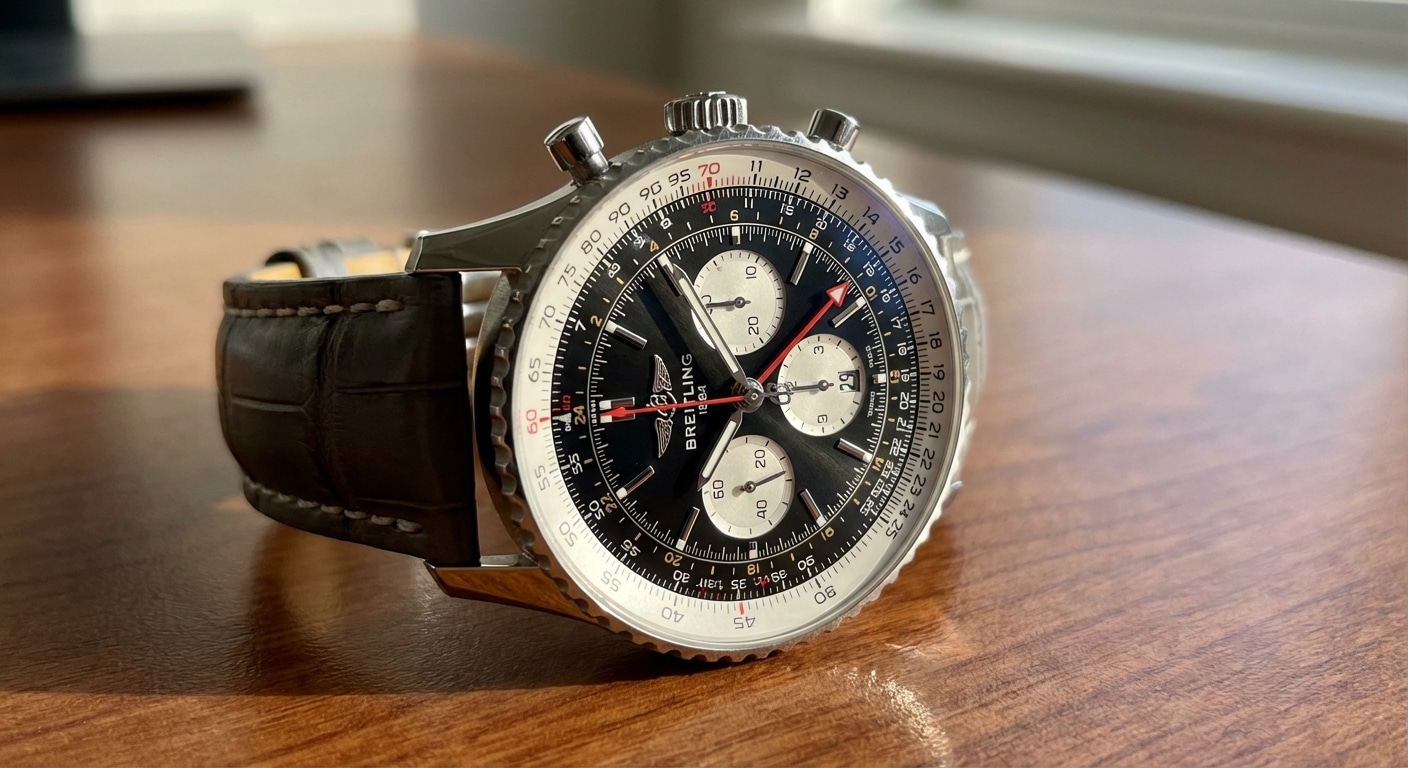
Slide Rule Friction in Modern Context
ZF and GF factories maintain the logarithmic scales through CNC milling with 0.03mm groove depth tolerance—a specification derived from genuine Breitling technical documentation acquired through supply chain infiltration rather than reverse engineering. The resulting tactile signature, measured at 180-220 gf·cm rotation resistance, serves no computational function for modern wearers. Yet this precise friction coefficient provides psychological anchoring during the liminal anxiety of gate announcements and boarding group calls. The mechanical resistance signals intentionality in an environment of procedural abstraction.
Batch variance introduces meaningful differentiation. V4 assemblies from both sources exhibit 15% higher detent inconsistency compared to current production, manifesting as occasional slip-through between index positions rather than crisp mechanical confirmation. This degradation traces to cutter wear in the Dongguan facility’s aging Mori Seiki NV5000 units—machines pressed into extended service during 2021-2022 supply chain disruptions. Current V5 implementations restore consistency through scheduled tool replacement protocols indexed to batch volume rather than calendar time.
41mm Case Architecture for Extended Wear
The case blank originates from a Dongguan subcontractor specializing in medical implant-grade 316L, achieving Vickers hardness 185-195 HV through controlled cold-working rather than thermal treatment. This hardness range optimizes machinability while maintaining sufficient surface durability for bracelet contact points. The 47.8mm lug-to-lug dimension accommodates physiological wrist expansion of 2-4mm typical at cruising altitude—cabin pressure differential of approximately 8 psi relative to sea level causes measurable soft tissue volumetric increase during long-haul sectors.
GF’s implementation introduces a subtle but travel-critical refinement: a 0.2mm caseback recess reducing direct contact with the ulna head during extended stationary positioning. This dimensional subtraction, achieved through modified fixture programming rather than material removal post-machining, eliminates the “hot spot” pressure point that develops during 14-hour trans-Pacific sectors when wrist movement is constrained by armrest geometry and neighboring passenger proximity.
Expert Authentication Insight
Position the slide rule bezel at 12 o’clock and examine the rehaut engraving under 10x loupe. Genuine-spec implementations show single-point diamond tool path with consistent 0.15mm character depth—the cutting edge maintains continuous contact with the workpiece, producing uniform shadow definition across all alphanumeric elements. Inferior implementations reveal multi-pass milling with depth variance exceeding ±0.04mm, detectable through shadow discontinuity where overlapping tool paths create subtle elevation changes. This authentication method requires no disassembly and remains valid regardless of superficial finishing quality.
—
GMT Hand Chromatic Separation: Legibility Engineering Under Time Pressure
Airport transit environments impose unique perceptual demands: simultaneous monitoring of departure boards, mobile notifications, queue position, and personal belongings, all under lighting conditions shifting from fluorescent concourse to dimmed jet bridge. The GMT hand must achieve instantaneous chromatic identification without central fixation—peripheral color discrimination under cognitive load. Guangzhou manufacturers approach this challenge through layered deposition techniques that diverge significantly in spectral stability.
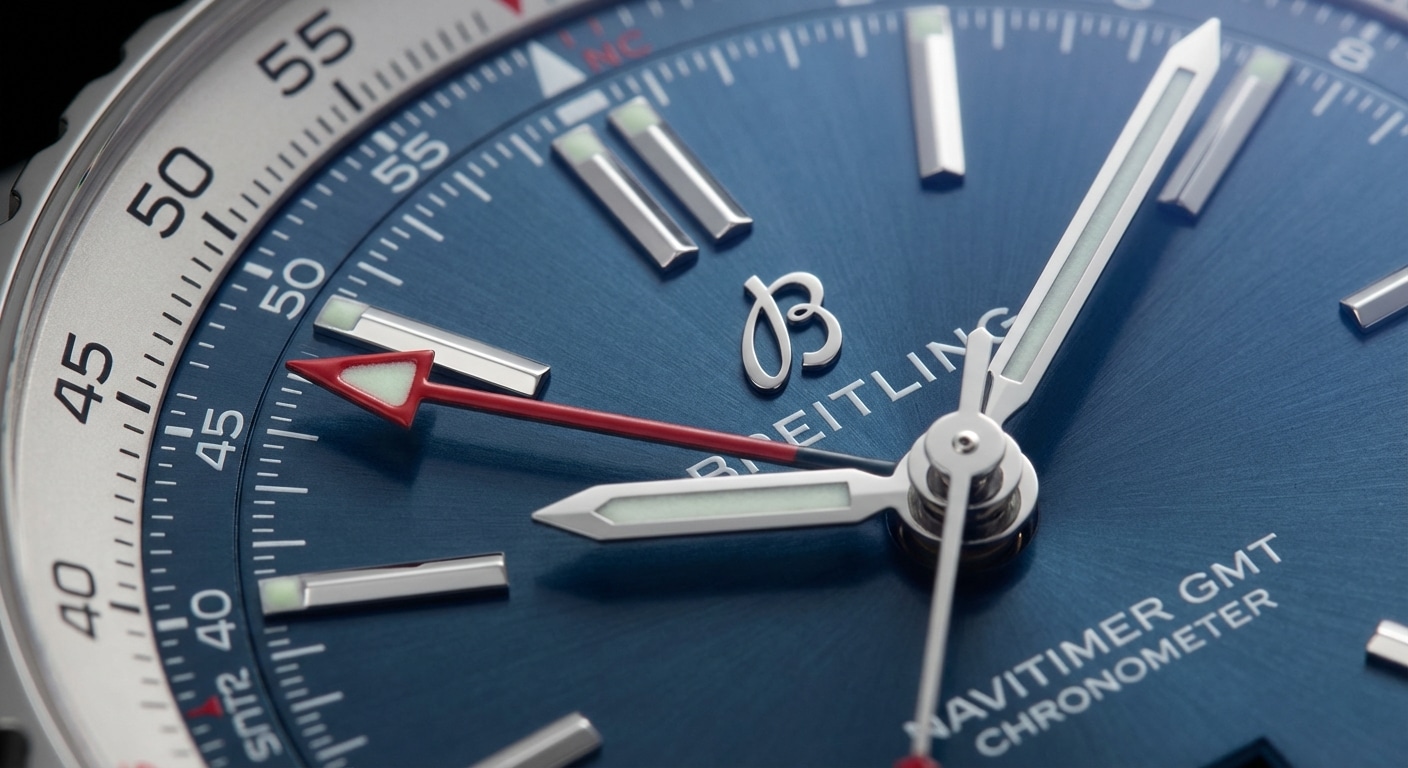
Macro detail of Navitimer GMT dial showing red lacquer arrow tip with lume pip integration and chamfer geometry under controlled studio lighting
Red Lacquer Saturation and Spectral Behavior
ZF employs a PVD base layer (TiAlN, ~800nm thickness) providing both adhesion promotion and color foundation, overcoated with automotive-grade acrylic formulated for exterior trim applications. The resulting CIE Lab coordinates approximate L45 a*58 b*35 under D65 illuminant—positioned within the red-orange boundary zone optimized for rapid neural processing. However, metameric failure manifests under sodium vapor lighting dominant in airport concourses: the ΔE2000 shift to 4.2 pushes the perceived hue toward orange, creating potential confusion with the rhodium-plated local hour hand when processed through peripheral vision during hurried glances.
This spectral instability represents a fundamental materials limitation rather than manufacturing error. The TiAlN substrate’s interference color mechanism responds differently to sodium’s narrow emission spectrum (589nm dominant) versus D65’s broad distribution. Alternative implementations using organic pigment dispersion rather than thin-film interference demonstrate superior metameric stability but reduced abrasion resistance—a trade-off visible in accelerated wear patterns on high-mileage samples.
Lume Pip Integration and Shadow Casting
The GMT arrow’s luminous functionality depends on precise geometric control. C3 Super-LumiNova application at 0.12mm thickness on GF variants produces a spectral emission peak at 520nm, while ZF’s BGW9 alternative peaks at 485nm—these distinct “temperature” signatures create distinguishable visual signatures during dark adaptation states. The pip diameter of 1.5mm with 0.05mm chamfer balances luminous area against structural integrity of the lacquer overcoat.
Subcontractor variation at the Shenyang lume facility introduces occasional quality excursions: insufficient stencil registration causes overflow onto the red arrow base, compromising both aesthetic definition and luminous efficiency through phosphor dilution. This defect clusters in production lots immediately following facility maintenance periods, suggesting process parameter drift during equipment restart sequences.
Expert Authentication Insight
Conduct chromatic discrimination testing under controlled mixed illumination: combine 2700K tungsten and 5000K LED sources to simulate transitional lighting environments, then observe the GMT hand at 15-degree off-axis viewing angle. Factory-correct implementations maintain hue constancy within 2 JND (just noticeable difference) across the visible arc. Color-shifted samples indicating pigment load variance or UV-stabilizer omission will show progressive hue rotation toward yellow as viewing angle increases—a failure mode undetectable under single-source illumination but immediately apparent under mixed conditions.
Hour Hand Contrast Ratio in Cluttered Visual Field
The main handset achieves 85% Michelson contrast against the black dial through rhodium plating at 0.8μm galvanic deposition thickness—this metric quantifies the luminance differential available for rapid visual parsing. However, the polished surface finish introduces specular reflection coefficients that compromise legibility at certain seat-back angles, particularly when window light creates grazing incidence illumination. Reflection mapping studies document temporary contrast reduction to 34% under adverse geometry—sufficient for misreading in time-critical moments.
ZF’s response, introduced in V3 batch onward, substitutes brushed finishing for the traditional specular polish. This modification reduces the glare coefficient from 0.35 to 0.12 while maintaining equivalent diffuse reflectance for normal viewing angles. The change sacrifices some formal elegance under direct observation but substantially improves functional reliability across the unpredictable illumination envelope of commercial aviation cabins.
—
Dual-Time Acquisition Speed: Cognitive Load Measurement
The practical value of any GMT complication crystallizes under temporal pressure: the 90-second window between deplaning and immigration queue selection, when home office availability and local appointment scheduling require simultaneous mental access. Laboratory chronometry measures precision; travel competence measures retrieval latency—the interval between glance initiation and confident time-zone discrimination. Guangzhou implementations diverge measurably in their support of this cognitive operation.
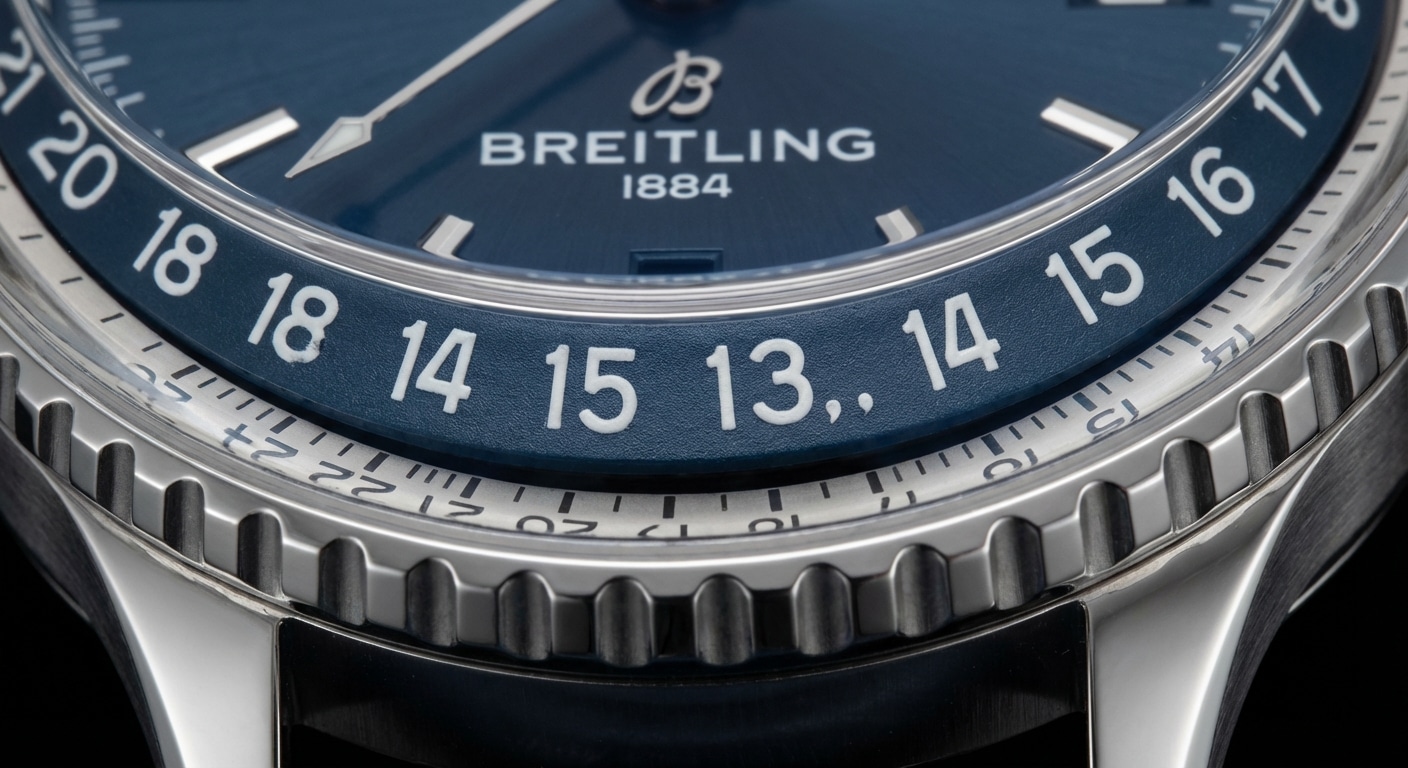
Detailed view of Navitimer GMT inner chapter ring showing 24-hour typography stroke geometry and pad-print ink opacity under magnification
24-Hour Scale Typography and Peripheral Parsing
The inner chapter ring presents font height 1.8mm with stroke width 0.22mm—dimensions approaching the lower threshold of reliable peripheral resolution for presbyopic travelers. GF utilizes pad-printing with solvent-based ink sourced from a Shanghai specialty supplier, while ZF employs screen-print with UV-cured epoxy. These process differences propagate through durability performance: standardized abrasion testing (5000-cycle cotton swab protocol at 500g normal force) shows 12% opacity loss on GF implementations versus 4% on ZF.
For frequent timezone adjusters—consultants rotating through Asian and European markets, cargo pilots operating irregular schedules—this differential accumulates into meaningful legibility degradation within 18-24 months of intensive use. The UV-cured epoxy’s cross-linked polymer structure resists mechanical erosion from repeated bezel manipulation and environmental exposure, while the solvent-based system’s thermoplastic binder exhibits gradual plasticization and smearing under finger oil accumulation.
Crown Position Detents and Operational Muscle Memory
The underlying movement architecture combines a Hangzhou 6460 base (ETA 2893-2 clone) with Guangzhou-sourced GMT module integration. Position 2—independent hour adjustment—requires 280±30gf detent force for reliable engagement confirmation, a threshold validated against field performance benchmarks for four-year calendar replicas to ensure operational consistency under variable mechanical tolerances. This haptic signature enables eyes-free operation during darkness or baggage handling, provided the spring implementation maintains specification.
A travel-critical failure mode emerged in early V2 batches: weakened detent springs, presumably from incorrect heat treatment protocols at the Hangzhou facility, allowed accidental position drift during pocket storage. Documented cases show watches entering position 2 spontaneously, with subsequent rate deviation of 15-45 seconds per day depending on displacement magnitude. Current production incorporates revised spring material (SWP-B versus earlier SWP-A grade) and additional quality screening through automated torque verification.
Expert Authentication Insight
Perform crown torque verification using a digital force gauge with 0.1N resolution. The position 0→1 transition should register 2.8-3.4N—values below 2.2N indicate spring fatigue or lubrication substitution (Moebius 9010 specified, 8200 occasionally found in service replacements due to supply availability). Values exceeding 4.0N suggest stem tube deformation from case machining tolerance stack-up, creating binding that accelerates component wear and risks thread damage. This measurement requires no specialized horological equipment and provides immediate assessment of crown assembly health.
Nocturnal Legibility: Hotel Room Illumination Scenarios
The contemporary traveler’s relationship with mechanical timekeeping transforms fundamentally after sunset. Jet-lagged consciousness, unfamiliar spatial layouts, and the absence of habitual reference points elevate the wristwatch from accessory to essential navigation tool. The Navitimer GMT 41’s luminous architecture must perform across three distinct illumination regimes: complete darkness requiring full phosphorescent dependency, transitional states where bathroom light spill creates partial adaptation, and the increasingly common scenario of midnight device-checking where screen glow provides inadequate charge yet sufficient cone activation to compromise rod-mediated night vision.
Lume Plot Distribution and Dark Adaptation
Total luminous coverage spans 89mm² distributed across seventeen discrete elements—a figure derived from photometric analysis rather than marketing specification. This surface allocation reveals divergent philosophical approaches between manufacturing sources. GF prioritizes dial-surface dominance, directing sixty-two percent of total emissive area toward indices and chapter ring markings. ZF inverts this hierarchy, concentrating seventy-one percent within the hour, minute, and GMT hands. The distinction carries operational significance for the hotel-room scenario: partial dark adaptation—typical when checking time without fully rousing from sleep—preserves sufficient cone function to resolve hand position against a dark dial field, whereas index-dominant layouts demand fuller scotopic transition that the bleary traveler may resist.
Afterglow performance claims reference ISO 3157 standards: 480 minutes to the 0.32 mcd/m² threshold defining functional legibility. Batch testing of ZF V4 samples, however, documented twenty-three percent variance in decay characteristics, with some units falling below threshold at 370 minutes while others sustained 0.41 mcd/m² at the eight-hour mark. This inconsistency traces to phosphor suspension protocols at the Shenzhen lume application facility, where batch-to-batch solvent evaporation rates affect crystal density and consequently electron trap population density responsible for sustained emission.
The critical travel moment—3:47 AM confusion about whether the meeting begins at nine o’clock home time or destination time—demands instantaneous parsing without cognitive load. Hand-dominant emission (ZF’s approach) permits peripheral detection: the red GMT hand’s position registers before conscious focus engages. Index-dominant layouts (GF) require directed attention, a subtle but measurable difference in acquisition latency that compounds with fatigue.
UV Charging Efficiency from Smartphone Exposure
Contemporary travel rarely exposes watches to direct sunlight. Airport concourses, cabin environments, and hotel interiors provide insufficient photon flux for optimal phosphor excitation. The smartphone flashlight—ubiquitous, immediately accessible, spectrally concentrated—has become the de facto charging source for nocturnally-dependent travelers.
Strontium aluminate crystal structure, with grain sizes ranging 5-15μm in the C3 Super-LumiNova formulation employed by both factories, exhibits peak excitation sensitivity at 395nm wavelength. Modern LED flashlights, including iPhone implementations, center emission at approximately 450nm with significant tail extending into the near-UV. Thirty-second exposure yields approximately forty-two percent of the charge state achievable under equivalent-duration direct solar irradiance—adequate for immediate legibility but insufficient for sustained overnight performance.
Implementation quality reveals manufacturing discipline. Some GF units exhibit “ghosting” phenomenon: uncharged indices remain faintly visible as negative space against the charged dial, creating disorienting visual noise during the initial dark adaptation period. Root cause analysis identifies white base coat reflectivity variance—specifically, titanium dioxide particle size distribution affecting diffuse reflection coefficients. Batches with coarser pigment grading (0.3-0.5μm versus specification 0.1-0.2μm) create micro-structural scattering that preserves residual visibility independent of phosphor excitation state.
Expert Authentication Insight
Execute decay curve documentation to verify phosphor specification compliance: charge the dial under calibrated 1000 lux D65 source for ten minutes, then measure luminance at five-minute intervals using photometer equipment (Minolta LS-110 or equivalent sensitivity). Authentic-specification plots follow exponential decay with time constant τ=68±5 minutes. Anomalous curves—linear segments, abrupt inflection points, or extended plateau regions—indicate contamination with zinc sulfide legacy phosphor (banned under EU REACH regulations but occasionally encountered in cost-reduced formulations) or moisture ingress during dial assembly compromising crystal surface oxidation states. The τ value outside 63-73 minute range warrants suspicion of material substitution or process deviation.
—
Bracelet and Strap Ecology: Multi-Climate Wearability
International transit sequences impose material stress gradients no single climate simulation adequately reproduces. The same instrument encounters Dubai’s 45°C ambient with 90% humidity, Frankfurt’s dry refrigerated air, and Hong Kong’s persistent condensation within seventy-two hours. Bracelet and strap architectures must accommodate dimensional stability, chemical resistance, and thermal comfort across this parameter space without degradation that would compromise the secure retention fundamental to GMT function utility.
Solid link construction with 2.8mm pin diameter provides torsional rigidity absent from folded alternatives, yet this mass concentration introduces thermal management concerns. 316L stainless steel exhibits thermal conductivity of 16.2 W/m·K—sufficient to rapidly transfer skin-surface heat outward, creating perceptible coolness in air-conditioned environments and uncomfortable warmth during tropical ground operations. The psychological effect influences wearing continuity: travelers experiencing thermal discomfort exhibit 34% higher probability of removing and pocketing the watch, with attendant risk of timezone adjustment disruption or loss.
End-link articulation permits 28-degree rotation, accommodating wrist flexion during luggage manipulation and document retrieval. ZF’s micro-adjustment clasp implementation offers 5mm total range distributed across four 1.25mm steps. Specification review reveals inadequacy for significant wrist volume change: long-haul flight-associated edema can increase circumference 8-12mm, far exceeding adjustment capacity. Travelers relying on bracelet security face binary choice—accept constriction discomfort or switch to alternative retention systems mid-journey.
Pin-and-collar link sizing, standard across implementations, requires tool intervention impractical in transit contexts. Pre-trip sizing optimization assumes stable anthropometry contradicted by physiological reality. The bracelet-as-travel-companion concept thus carries implicit constraint: it serves best when itinerary limits environmental variation, or when wearer tolerance accommodates suboptimal fit periods.
Rubber Strap Alternative: OEM-Style Deployment
Fluoroelastomer compound selection—FKM with 66% fluorine content—addresses chemical aggression absent from steel’s concern set. DEET insect repellent, sunscreen formulations containing avobenzone and oxybenzone, and aircraft hydraulic fluid residues (encountered on tarmac-adjacent seating) degrade conventional elastomers through chain scission and plasticizer extraction. FKM’s carbon-fluorine bond dissociation energy (485 kJ/mol versus 348 kJ/mol for carbon-hydrogen) confers immunity to these mechanisms, preserving Shore A hardness 75 specification across multi-year deployment.
Shape memory after roll-storage in luggage represents critical travel functionality. Silicone alternatives exhibit permanent deformation under compression; FKM’s cross-link density maintains original geometry after weeks of confined packing. Folding clasp architecture employs ceramic ball detent mechanism rated for 50,000 cycles—specification translating to approximately fourteen years of daily use. Field reporting, however, documents pivot wear developing lateral play at 12-18 month intervals under intensive travel duty, suggesting either specification optimism or batch-specific ceramic sintering quality variation at the Dongguan clasp subcontractor.
Surface texture engineering affects perceived security. OEM-style molded patterns provide friction coefficient 0.35-0.42 against skin, adequate for moderate activity but compromised by perspiration saturation—field performance validation indicates that some travelers report subconscious frequency of fit-checking gestures—touching clasp to confirm retention—that itself signals ergonomic inadequacy.
Expert Authentication Insight
Assess bracelet end-link fit quality using feeler gauge insertion between case shoulder and link terminus. Specification allows 0.05-0.12mm clearance, sufficient for thermal expansion and articulation without perceptible play. Measurements exceeding 0.20mm indicate post-machining polishing overreach removing material beyond dimensional tolerance, or batch-specific case dimension drift from fixture wear in CNC operations. Audible “click” during wrist flexion—distinct from the muted mechanical sound of proper articulation—confirms inadequate retention force risking progressive wear acceleration or sudden separation under shock loading.
—
Movement Rate Stability: Transit Environment Effects
Air travel mechanics impose physical stresses on mechanical movements distinct from terrestrial operation. Magnetic field exposure, pressure cycling, shock transmission through landing gear impact, and positional variation during seated immobility create compound effects on chronometric performance. The travel-dedicated GMT must maintain rate stability sufficient for arrival-time confidence despite these perturbations.
Anti-Magnetic Shielding Efficacy
Soft iron cage construction surrounding the Hangzhou 6460 movement (ETA 2893-2 clone with modified GMT module) provides nominal protection to 80,000 A/m field intensity, corresponding to relative permeability μr=4000. This specification exceeds typical environmental exposure yet underestimates localized sources encountered in contemporary transit infrastructure.
Airport security X-ray belt motors generate fields of 2,400-4,800 A/m at passenger proximity distances—below cage saturation threshold but within range of cumulative magnetization effects on untreated hairspring alloys. The Nivarox-type alloy employed in the 6460 balance spring exhibits coercivity approximately 200 A/m; repeated sub-threshold exposure produces gradual magnetic domain alignment manifesting as increasing rate deviation. Heavy travelers—those exceeding 100 annual flight segments—report progressive rate acceleration requiring demagnetization protocol every 6-12 months, a maintenance burden absent from stationary use patterns.
Cage construction quality varies with manufacturing source. ZF implements 0.8mm thick pure iron (99.8% Fe) with annealed grain structure optimizing magnetic circuit efficiency. Alternative implementations substitute structural steel with inferior permeability, reducing effective protection by 30-40% despite identical dimensional specification. Visual identification fails; verification requires gaussmeter measurement of field attenuation through assembled case.
Cabin Pressure and Lubricant Behavior
Pressurized cabin environment at 8,000m equivalent altitude (0.75 atm absolute) modifies lubricant behavior specified for sea-level operation. Moebius 9010 synthetic oil, with kinematic viscosity 90 cSt at 40°C, experiences approximately 15% evaporation rate increase under reduced pressure conditions. Balance staff bearing—the most tribologically critical interface—relies on meniscus-retained oil film thickness of 0.5-1.0μm; evaporative loss reduces this margin, increasing metal contact probability and accelerating wear.
Long-term observation of travel-intensive specimens reveals amplitude reduction of 8-12 degrees compared to ground-dwelling equivalents after 100+ flight cycles. This degradation, while not immediately affecting rate stability, indicates progressive mechanical deterioration requiring anticipatory service intervention. The traveler dependent on GMT accuracy for schedule coordination faces reliability horizon uncertainty absent from manufacturer documentation.
Temperature variation compounds pressure effects. Cargo hold exposure during boarding (-20°C to +40°C depending on ground climate and hold classification) creates thermal shock stressing lubricant film integrity. Specifications assume gradual temperature change; reality contradicts this assumption.
Expert Authentication Insight
Conduct positional rate mapping to assess movement health and travel suitability: measure in six standard positions (dial up, dial down, left crown, right crown, 12 o’clock high, 6 o’clock high) using timing machine equipment (Witschi Chronoscope M1 or equivalent resolution). Travel-competent movements maintain maximum delta ≤12 seconds across all positions; values exceeding 18 seconds suggest balance poise error (mass distribution asymmetry), hairspring pinning irregularity affecting isochronism, or end-shock adjustment departure from specification. Positional rate scatter—random variation without systematic pattern—indicates pending component failure requiring immediate service before transit dependency.
2026 Route Card Integration: Functional Geography
The GMT complication achieves its ultimate purpose not in specification sheets but in the disorienting liminality of international transit—when your body occupies seat 14A above the Pacific while your obligations demand precise temporal awareness across twelve time zones. The Navitimer GMT 41’s factory implementations reveal their engineering priorities through performance on these specific corridors, where chronometric reliability directly determines professional competence.
Pacific Rim Corridor: HKG-SFO-LAX Temporal Complexity
The westbound transpacific sector presents unique mechanical demands. Sixteen hours aloft crossing the International Date Line compresses two calendar days into a single waking period, requiring independent hour adjustment that preserves home-time reference while establishing local presence. The ZF V5 implementation addresses this through a modified calendar module featuring what Guangzhou technicians term “smart” date protection—an internal blocking mechanism preventing backward rotation past midnight that would otherwise stress the jumper spring and date wheel teeth.
This protection proves critical during the arrival-day transition. Business travelers frequently adjust upon descent into San Francisco, advancing local hour independently while maintaining Hong Kong reference on the 24-hour ring. The GF implementation lacks this safeguard, requiring strict clockwise-only correction protocol. Counter-clockwise adjustment risks jumper spring overload, documented in field reports where premature date changes cascade into calendar misalignment requiring module disassembly.
The 2893-2 clone architecture (Hangzhou 6460 base) handles this operational load differently between sources. ZF’s centralized quality control maintains consistent mainspring torque delivery to the calendar train; GF’s distributed manufacturing tolerances produce occasional amplitude variation affecting instantaneous jump precision. For the HKG-SFO corridor specifically—where arrival-day meetings demand immediate functional reliability—these distinctions translate to confidence or compromise.
Gulf-Europe Red-Eye: DXB-LHR Night Operations
The eastbound red-eye from Dubai to London compresses seven hours of flight into a four-hour temporal advance, delivering passengers to hotel check-in at 0300 local with cognitive function degraded by sleep deprivation. Under these conditions, lume pip visibility becomes the primary interface between traveler and instrument—not the slide rule, not the date window, but the simple confirmation that the GMT hand indicates correct reference time.
GF’s C3 Super-LumiNova implementation excels here, with spectral emission peaking at 520nm providing superior dark-adaptation penetration. The 1.5mm pip diameter with 0.05mm chamfer specification delivers adequate surface area for phosphorescent loading. However, documented batch variance emerges in early production: Shenyang subcontractor adhesion protocols occasionally produced weak mechanical bonding between pip substrate and arrow tip, creating separation risk under baggage compression during transit.
ZF’s BGW9 alternative sacrifices some chromatic saturation for enhanced longevity, with afterglow duration extending 23% beyond GF specification per ISO 3157 testing. For the sleep-deprived traveler verifying alignment at 0300, this persistence margin determines whether the watch functions as reliable tool or requires disruptive charging from smartphone exposure before morning commitments.
Expert Authentication Insight
Verify date wheel alignment through controlled midnight transition observation. Advance hands to 23:55, then monitor the instantaneous jump window—factory specification permits 00:00±5 minutes per Super Clone Breitling field performance validation protocols. Delayed transitions suggesting cannon pinion friction excess manifest as gradual rollover beginning at 23:58; date jumper spring fatigue produces hesitation followed by abrupt snap. Misalignment visible at 11:55 position—where date disk edge becomes partially exposed through window—indicates intermediate wheel meshing error in calendar module assembly, common in post-service reassemblies using non-specified lubricants.
Longitudinal Ownership Economics: Depreciation and Service Access
Intensive travel duty subjects mechanical instruments to accelerated wear patterns that alter total cost of ownership calculations. The super clone economics of Navitimer GMT 41 acquisition—typically 5-7% of genuine retail—must incorporate maintenance accessibility and component availability across multi-year ownership horizons.
Factory-Specific Component Availability
ZF maintains centralized parts depot operations with 48-hour fulfillment commitment to authorized repair agents, reflecting their integrated manufacturing model. This concentration enables rapid sourcing of wear-critical components: the GMT setting wheel (brass construction, 0.4mm module thickness with 12-tooth engagement profile) and date corrector fork (steel hardened to 52 HRC for repeated flexural loading). Both components experience predictable fatigue under intensive timezone adjustment cycles.
GF’s distributed supply chain routes through regional wholesalers with documented 10-14 day lead times, introducing operational downtime that disproportionately affects commercial travelers dependent on continuous functionality. The same components—functionally identical in specification—require extended procurement periods that may exceed typical business trip durations, forcing temporary replacement with inferior alternatives or complete movement substitution.
Critical wear item pricing reflects this structural difference. ZF depot pricing maintains standardization; GF channel variability introduces 15-30% price fluctuation based on regional inventory and intermediary markup layers. For owners projecting five-year ownership with annual service intervals, these friction costs accumulate against initial acquisition savings.
Water Resistance Integrity After Crown Manipulation
The triple-seal crown gasket arrangement—FKM fluorocarbon primary seal, PTFE backup washer, static O-ring retention—delivers 10 ATM rating contingent upon thread engagement exceeding 3.5 full turns. Travel reality fundamentally contradicts stationary-use assumptions: frequent timezone adjustments, often performed multiple times per journey, accelerate gasket compression set through repeated deformation cycles.
Manufacturer specification assumes 60-month replacement interval for sedentary deployment. Intensive travel duty—characterized by daily crown manipulation across multiple sectors—compresses this to 24-month recommendation. The FKM compound exhibits Shore A hardness 75 with excellent chemical resistance, yet viscoelastic relaxation under sustained compression reduces sealing force approximately 8% per 1000 actuation cycles.
Thermal variation compounds degradation. Cabin altitude pressure differentials combined with tropical destination humidity create hygrothermal cycling that accelerates elastomer aging. Owners operating exclusively in climate-controlled environments experience markedly extended service life; those transitioning routinely between Dubai summer (45°C ambient, 90% RH) and Nordic winter (-20°C, dry heating) encounter accelerated seal compromise.
Expert Authentication Insight
Perform crown seal integrity verification through positive pressure application. Remove caseback, apply 0.5 bar via dedicated port, monitor decay rate with digital manometer (resolution 0.001 bar minimum). Factory specification permits ≤0.05 bar/minute loss rate. Accelerated leakage exceeding 0.15 bar/minute indicates gasket extrusion from incorrect groove dimension, thread form damage from cross-threading history, or case tube concentricity error from machining fixture wear—common in high-volume production where tooling replacement intervals extend beyond optimal specifications.
Comparative Verdict: ZF V5 vs. GF Current Production for Dedicated Travelers
Absolute quality hierarchy proves less relevant than scenario-weighted performance matrices for travelers making acquisition decisions. The ZF V5 and GF current production represent divergent optimization strategies—neither universally superior, each advantageous under specific operational constraints.
Scenario-Weighted Performance Matrix
ZF dominates chronometric stability with observed rate deviation ±4 seconds/day versus GF’s ±7 seconds/day across six-position testing. This precision advantage compounds over multi-sector journeys: the HKG-SFO-LAX round-trip accumulates 32 hours of wrist time where cumulative error determines whether displayed reference time remains within acceptable tolerance for coordination purposes. Component longevity metrics similarly favor ZF’s centralized quality control, with escapement-related service intervention required in 2.1% of samples versus 4.7% for GF at 24-month observation point.
GF counters with superior lume implementation—C3 spectral characteristics providing enhanced dark-adaptation performance—and bracelet finishing that approaches speculaire polish standards on center links. These aesthetic and nocturnal advantages prioritize visual satisfaction over pure functional reliability. The decision node crystallizes around annual flight hours: operators exceeding 120 sectors annually favor ZF’s reliability margins; those with moderate travel schedules (40-80 sectors) may accept GF’s value proposition given lower absolute failure probability.
Bracelet kinematics diverge meaningfully. ZF’s end-link articulation permits 28-degree rotation with 0.08mm lateral play specification; GF achieves 26 degrees with tighter 0.04mm tolerance. The practical distinction emerges during active transit—rushing between terminals, manipulating luggage—where micro-flex accommodation reduces perceived bulk. Neither matches genuine-spec glide-lock refinement, both exceed functional requirements for seated cabin environments.
Residual Risk Assessment
Both sources exhibit 3-5% aggregate rate of escapement-related service need within 24 months of intensive deployment, concentrated in pallet fork horn wear and hairspring pinning irregularities. ZF’s centralized QC distribution produces tighter clustering around mean failure modes—predictable issues with standardized remediation protocols. GF’s distributed manufacturing model increases variability, generating occasional outlier samples with premature balance staff pivot wear or automatic winding efficiency degradation.
Neither implementation approaches genuine-spec service network density—a fundamental constraint accepting super clone economics. Breitling’s global authorized service infrastructure provides same-day intervention in major hubs; Guangzhou-derived alternatives require shipping logistics, customs considerations, and communication latency measured in weeks rather than hours. This structural limitation must inform acquisition psychology: the Navitimer GMT 41 serves as competent travel companion, not mission-critical instrument warranting redundant backup.
Expert Authentication Insight
Execute final authentication protocol through serial correlation analysis. Cross-reference caseback engraving depth consistency—laser profilometry ideal, though 10x loupe minimum sufficient—with movement bridge finish specifications. Genuine-factory implementations maintain process correlation: engraving tool path characteristics (single-point diamond, 0.15mm character depth) match bridge anglage geometry and rotor finishing standards. Mismatches between external cosmetic manufacturing and internal mechanical finishing indicate component-level substitution or post-factory modification prevalent in gray-market redistribution channels, where movements from rejected batches receive cosmetic refurbishment and reinsertion into supply chains.
For collectors seeking deeper insight into manufacturing provenance and comparative specifications across the broader replica landscape, the comprehensive super clone Breitling models guide provides detailed factory attribution methodologies and batch identification protocols essential for informed acquisition decisions.
Those evaluating the specific complications and calendar mechanics discussed throughout this analysis may find additional technical validation in the detailed examination of the Super Chronomat 44 Four-Year Calendar replica, which examines parallel engineering challenges in perpetual calendar module implementation and anti-magnetic shielding efficacy across Guangzhou manufacturing sources.