
The Illusion of Savings: Why Used Super Clones Carry Unique Risks
The allure of a cheaper price tag on a used Panerai super clone is undeniable. On the surface, it seems like a smart way to get a high-quality replica without paying new-stock prices. However, the secondary market for super clones is far from straightforward. Unlike buying a new watch directly from a reputable Trusted Dealer (TD) with a known provenance and often a warranty, a used super clone comes with a history you rarely fully understand. This lack of transparency introduces unique risks and potential hidden costs, especially concerning Panerai replica upgrades, that can quickly erode any perceived savings, turning a supposed bargain into a financial headache. It’s not just about the initial price; it’s about the true cost of ownership once hidden defects and future service needs are factored in.
The “Super Clone” Label: What it Doesn’t Guarantee Used
When a new replica is branded a “super clone,” it signifies that it originated from a top-tier factory like VS Factory or XF Factory, aiming for near-perfect fidelity to the genuine article in terms of materials, movement, and finish. This designation applies to the watch as it leaves the factory*. However, once it enters the used market, the “super clone” label becomes a historical claim, not a guarantee of its current state. A used piece may have undergone modifications, repairs, or part replacements that downgrade its original factory specifications.
The reality is that owners might swap movements for cheaper alternatives if the original fails, replace a damaged crystal with an aftermarket piece, or even relume a dial incorrectly. For instance, a common downgrade might involve replacing a high-quality VS P.9000 clone movement (which alone costs $180-$280 new) with a generic Asian 2824 or an inferior P.9000 clone after a failure. Similarly, a superior sapphire crystal with correct anti-reflective (AR) coating could be swapped for a cheaper mineral glass or a sapphire with an incorrect AR tint. Even subtle details like the lume color can betray a non-original dial or hands; VS/XF typically use BGW9 lume that glows blue-white, but a swapped dial might have cheaper green-glowing lume. Therefore, a used “super clone” demands a component-by-component verification, not just an acceptance of its initial factory claim.
The Hidden Costs of Deferred Maintenance
Even the best replica movements, such as the VS P.9000 or XF P.3000 clones, are mechanical machines that require periodic servicing to maintain accuracy and longevity. This means cleaning, lubricating, and potentially replacing worn parts every 3-5 years, similar to a genuine watch. However, unlike genuine watches, replicas almost never come with verifiable service records. When buying used, you’re inheriting an unknown history of wear and tear, and critically, an unknown service schedule.
Neglecting movement service leads to increased friction, accelerated wear of critical components like pivots and gears, and eventual failure. This translates directly into future service costs that can quickly negate any initial savings. For example, a full service for a VS P.9000 clone movement from an independent watchmaker might range from $150 to $250. This cost needs to be weighed against the typical price difference between a new VS Factory Panerai (e.g., a PAM005 from VS Factory might be $450-$550 new) and a used one in supposedly good condition (which might sell for $300-$400). If you save $100-$150 on the purchase but immediately face a $200 service bill, your “bargain” is already costing you more than a new, warrantied piece. Always assume a used replica requires immediate service unless the seller provides compelling, verifiable evidence to the contrary, and factor that expense into your budget.
The Seller’s Advantage: Information Asymmetry and Market Noise
The used replica market is rife with information asymmetry. The seller possesses crucial knowledge about the watch’s actual history, usage, and any underlying issues—information often withheld or obscured from the buyer. This creates an uneven playing field where buyers are often at a disadvantage.
Sellers can employ various tactics to mask problems. A common phrase like “runs fine” might hide erratic timekeeping, low amplitude, or a high beat error that indicates imminent movement failure. Claims of “water resistant” are frequently made without any actual pressure testing, potentially concealing past water damage or compromised seals. Strategic photography can also play a role, carefully avoiding angles that show scratches, dings, or misaligned components. For instance, a seller might use soft lighting to downplay a stripped caseback screw or avoid close-ups of the crown guard if it has excessive play. Statements like “minor scratch” can often hide deeper case damage or evidence of clumsy opening. Approach all used replica listings with a deep sense of skepticism. Demand clear, high-resolution photos, detailed descriptions, and be prepared to ask pointed questions about the watch’s history, service, and any known issues.
Expert Authentication Insight
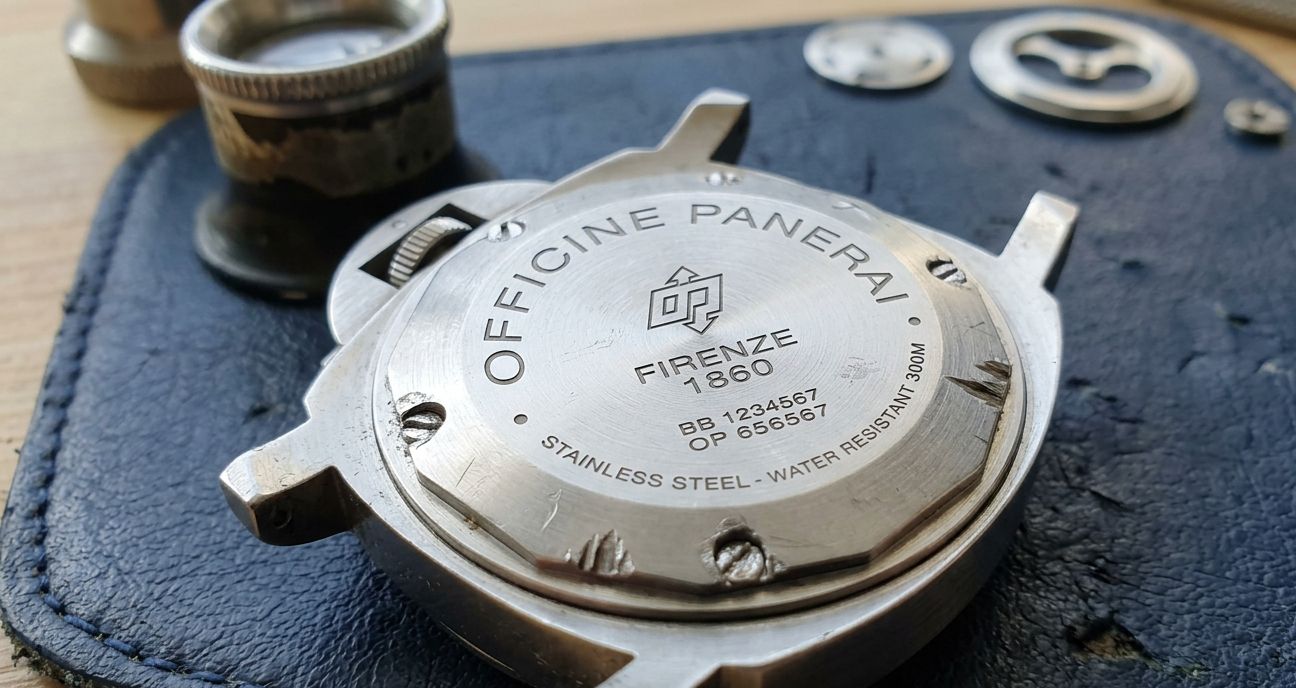
A critical first step when evaluating any used super clone Panerai is a thorough visual inspection under magnification. Arm yourself with at least a 10x loupe. Look for tell-tale signs of external neglect or amateur repair: stripped screw heads on the caseback or movement (indicating clumsy access), pry marks around the case opening points, or uneven gaps in the case construction that suggest poor reassembly. Inspect lug holes for tool marks or non-flush screws. These details often reveal a history of careless handling or repairs that could impact the watch’s integrity and value.
Movement Integrity: Diagnosing Wear and Hidden Issues in Used Panerai Replicas
The movement is the heart of any watch, and in a used replica, it’s often the most vulnerable component. Assessing its health is paramount, as a failing movement can quickly turn a perceived bargain into an expensive paperweight. This section focuses on objective indicators and visual cues that betray wear, damage, or neglect within the replica’s engine.
The Unseen Grind: Amplitude, Beat Error, and Timegrapher Readings
Replica movements, whether they’re workhorse Asian 2824/2836 clones or sophisticated VS P.9000/P.3000 clones, are susceptible to wear over time. Pivots can dry out, mainsprings can lose elasticity, and escapement components can become fouled. These issues directly impact the movement’s performance metrics, which are best measured with a timegrapher.
A healthy, well-serviced replica movement should exhibit:
- Amplitude: Typically 270-310 degrees (dial up), indicating a strong balance wheel swing.
- Beat Error: Ideally below 0.2ms, certainly no higher than 0.5ms, showing good balance wheel poise.
- Rate Deviation: Within +/- 10 seconds per day across multiple positions, indicating consistent timekeeping.
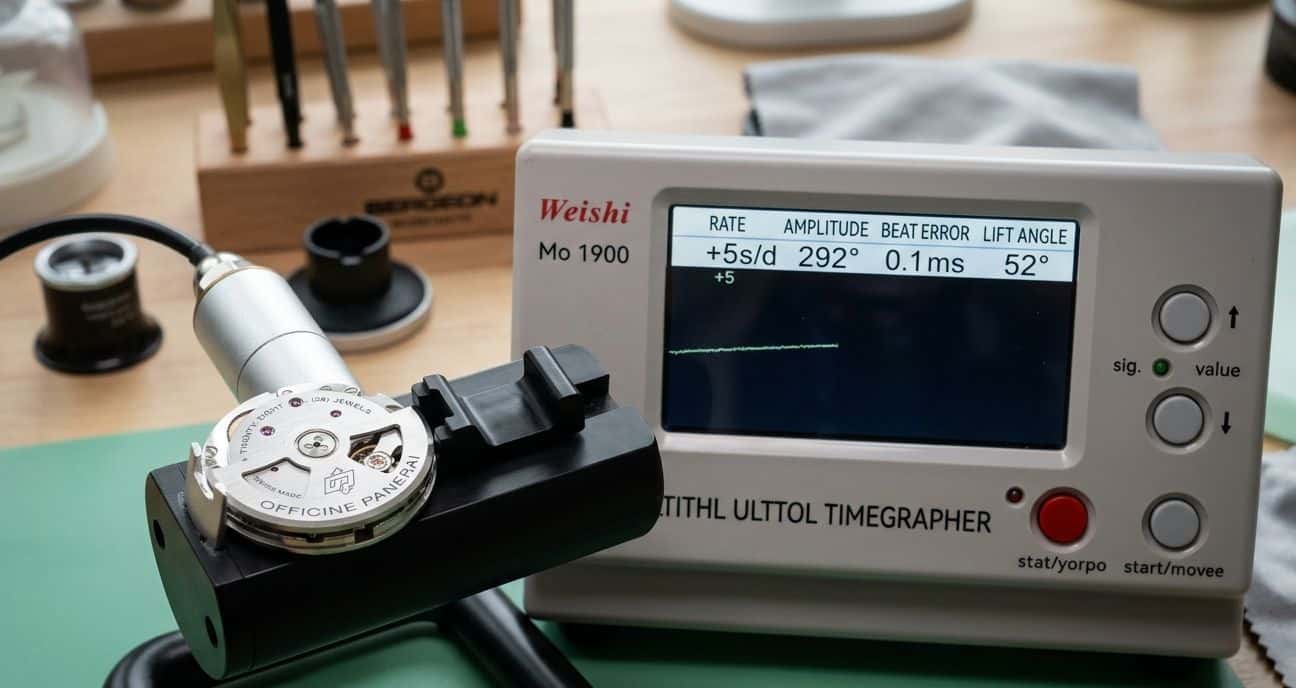
These values degrade significantly with wear or lack of lubrication. For instance, low amplitude (<250 degrees dial up) suggests friction, a weak mainspring, or congealed lubricants. A high beat error (>0.5ms) points to a poorly poised balance wheel, often due to impact or a bent balance staff. Wildly unstable rates across positions indicate general wear, contamination, or a need for regulation. These poor metrics are not just numbers; they are direct predictors of future failure and a strong indication that a service or repair is imminent.
Service History & Lubrication: A Critical Blind Spot
Unlike genuine watches that might come with service papers, verifiable service records for replica watches are virtually non-existent. This creates a critical blind spot for buyers of used pieces. Proper lubrication is vital for the longevity of any mechanical movement. Clone movements, often assembled in less controlled environments than genuine counterparts, are particularly sensitive to over-lubrication, under-lubrication, or contamination during assembly or subsequent repairs.
Improper lubrication leads to premature wear. Over-lubrication can cause lubricants to spread to areas where they shouldn’t be, gumming up the escapement. Under-lubrication or dried-up oil starves critical friction points, leading to metal-on-metal wear. Visually inspect the movement (if visible through a display caseback) for signs of old, congealed oil (which often looks like dark, sticky residue) or excessive lubricant seepage from pivots (indicating over-application). These are strong indicators of a neglected or poorly serviced movement that will require immediate attention to prevent accelerated wear and potential component failure.
Rotor & Gearing: Signs of Impact or Poor Assembly
The automatic winding system, particularly the rotor, is a high-stress component and a common point of failure or issue in replica movements. It’s susceptible to impact damage or improper seating during assembly, which can lead to friction, noise, and inefficient winding. Misaligned or worn gears within the automatic winding bridge can also cause problems.
Listen carefully for unusual noises when gently shaking the watch or manually winding it. A loose or scraping rotor will often produce a distinct grinding or rattling sound. Observe the rotor for excessive wobble or play, which can indicate a problem with the rotor axle or its bearing. If you can, visually inspect the gear teeth for any burrs, chips, or excessive play between them. Any grinding, significant wobble, or unusual resistance in the automatic winding system points to internal issues that will require professional intervention. These are not minor cosmetic flaws but functional problems that directly affect the watch’s ability to self-wind and keep time accurately.
Expert Authentication Insight
The most effective way to assess a replica movement’s health is with a timegrapher. Measure the amplitude (in degrees), beat error (in milliseconds), and rate deviation (in seconds per day) across multiple positions: dial up, dial down, and crown up. A healthy movement will show consistent, strong readings across these positions. Significant drops in amplitude (e.g., from 280° dial up to 200° crown up) or large variances in beat error (e.g., 0.1ms dial up, 0.8ms crown up) are clear indicators of wear, poor lubrication, or damage requiring immediate service.
Water Damage & Case Integrity: The Silent Killer of Replica Longevity
Water resistance is a frequent point of compromise in replica watches, and water damage is arguably the “silent killer” of a replica’s longevity. Unlike mechanical wear that often gives warning signs, water ingress can rapidly cause catastrophic and irreversible damage. This section provides critical inspection points to detect current or past water damage and assess the overall integrity of a used Panerai super clone.
The Corrosion Conundrum: Spotting Internal Rust and Patina
Even minor water ingress can have devastating effects. Steel components, such as movement screws or plates, are highly susceptible to rust. Brass or copper parts, commonly found in replica movements, will oxidize, often turning green or blue. This corrosion degrades movement function, affects lubrication, and is visually unappealing.
Carefully inspect the movement (if visible through a display caseback), the inside of the solid caseback, and around the dial feet for any signs of water marks, rust spots, or greenish/bluish oxidation. Rust on screw heads is a dead giveaway. Even subtle discoloration or clouding on the inside of the crystal can indicate past moisture exposure. The progression of water damage starts subtly but quickly becomes destructive, affecting the long-term viability of the movement. Any sign of internal moisture or corrosion is a deal-breaker, as it unequivocally indicates compromised water resistance and likely irreversible damage to the movement and case components.
Caseback Compromises: Stripped Threads and Gasket Condition
The caseback is a critical barrier against water ingress. Replica casebacks are often opened and closed more frequently than genuine ones, either for movement regulation, part swaps, or repairs. If not handled correctly, this can lead to stripped threads or damage to the sealing gasket.
Visually inspect the caseback threads for any signs of wear, cross-threading, or metal shavings. Stripped threads prevent the caseback from screwing down securely, creating a weak point for water entry. Next, examine the caseback gasket. It should appear supple and uniformly seated. Look for any cracks, dryness, flattening, or signs of being pinched or improperly installed. A degraded or improperly seated gasket is a primary pathway for water to enter the watch. Stripped caseback threads are a significant repair that often requires case replacement, and a compromised gasket guarantees future water resistance issues, rendering the watch unsuitable for any practical wear, especially near water.
Crown & Tube: The First Line of Defense
The crown and its tube represent the most dynamic and frequently manipulated point of entry for water. It’s also one of the most common weaknesses in replica watches. Misaligned, worn, or poorly sealed crowns are a high-risk factor.
Test the crown’s screw-down action thoroughly. It should screw down smoothly and securely against the case, without feeling gritty or loose. Check for any excessive play or wobble when the crown is pulled out to set the time. If accessible, visually inspect the crown gasket for any signs of wear, cracking, or deterioration. The critical role of the crown gasket and tube cannot be overstated; any damage or wear here directly compromises the watch’s water resistance. A crown that doesn’t screw down securely, feels gritty, or exhibits excessive wobble is a major red flag, indicating a high risk of water damage and requiring immediate professional attention.
Expert Authentication Insight
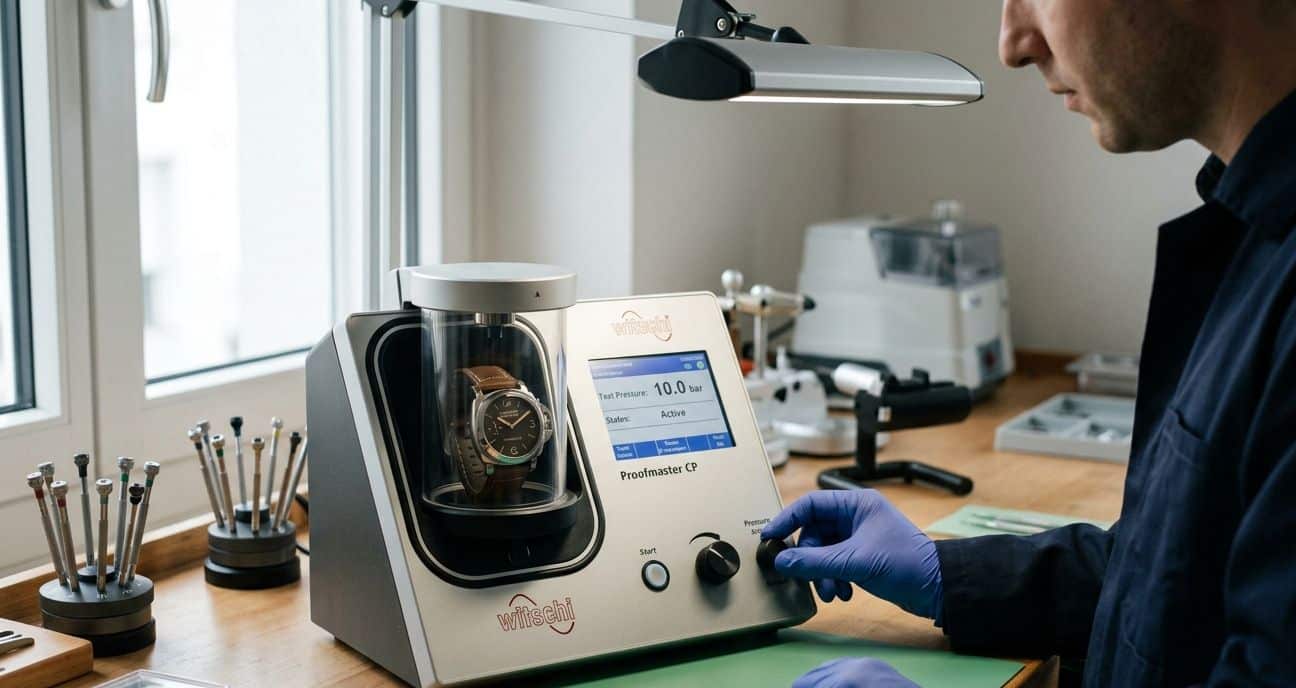
To definitively assess water resistance, a professional watch pressure test is indispensable. Start with a dry test to confirm the case integrity without exposing the watch to water. If it passes, proceed to a wet test, submerging the watch in water while under pressure (at least 3 ATM or 30 meters). Observe for any bubble formation during the wet test, which indicates a leak, or a pressure drop during the dry test. This is the only reliable way to verify the watch’s current water resistance, far beyond any seller’s claim.
The “Franken” Phenomenon: Unmasking Modified & Mismatched Panerai Replica Parts
The allure of a used Panerai super clone often comes with a hidden risk: the “Franken” build. This term refers to a watch assembled from parts originating from different replica factories, aftermarket sources, or even lower-tier components, which are crucial for understanding Panerai replica pricing, often to repair damage, cut costs, or deceptively “upgrade” a watch. For the buyer, identifying these mismatched components is crucial, as they can significantly impact the watch’s quality, longevity, and perceived value.
Dial & Hand Swaps: Identifying Non-VSF/XF Components
Dials and hands are frequently swapped in used replicas. This might happen to repair a damaged dial, to “upgrade” a lower-tier replica with a more accurate dial from another factory, or even to create a unique, non-factory configuration. The challenge for buyers is that even a swapped high-tier replica dial might not be original to the claimed factory (e.g., an XF dial in a VS Factory case), which can still affect consistency and value.
To detect non-original dials or hand sets, pay close attention to subtle details. Compare the font style, thickness, and sharpness of all text on the dial (e.g., “Luminor Panerai,” model designation, depth rating) against high-resolution reference images of known, authentic VS or XF models. Look for inconsistencies in lume color and application. While VS and XF are generally excellent, slight variations in the creamy-white or green hue of the Super-LumiNova can betray a non-matching component. Under UV light, the lume glow should be consistent in color and intensity across all markers and hands. Any significant difference in glow, or a visibly different shade, is a red flag. The finishing on the hands—their brushing, polishing, and precise length relative to the markers—should also match known factory standards. A poor finish or misaligned hands are clear indicators of a replacement.
Judgment: A mismatched dial or hand set indicates a non-original build. This can reduce the watch’s value and suggests a past repair or modification, the quality of which is unknown. It immediately undermines the claim of an untouched “super clone” from a single factory.
Crown Guards & Bezel Inserts: Aftermarket & Mismatched Parts
Panerai’s iconic crown guard (CG) and, for models like the Submersible, its bezel insert, are defining features. These components are often targets for aftermarket replacements or lower-tier parts, which can drastically alter the watch’s aesthetic and functional quality. A poorly executed CG or bezel can be an immediate visual tell.
For the crown guard, inspect the lever action: it should operate smoothly with a satisfying, firm click, and the pin holding it in place should be flush with the case, without excessive play or wobble. VS and XF crown guards are known for their precise machining, exhibiting sharp, clean edges and correct proportions. Aftermarket or inferior replacements often have softer edges, visible machining marks, or an ill-fitting pin. For models with a rotating bezel, such as the Submersible, check the bezel insert’s alignment with the dial markers and the quality of its lume pip. The click action should be firm and precise, not loose or mushy. Any excessive play in the CG lever, a non-flush pin, or a poorly aligned, loose, or low-quality bezel insert strongly suggests a non-original or low-quality replacement. This significantly diminishes the watch’s claim to “super clone” status.
Judgment: A loose crown guard, a non-flush pin, or a poorly aligned bezel insert points to a non-original or low-quality replacement. This directly detracts from the “super clone” claim and affects both aesthetics and potential water resistance.
Case, Mid-Case, and Lug Integration: Signs of Disassembly/Reassembly
The precise fit and finish of a Panerai case—including the mid-case, bezel, caseback, and lugs—are hallmarks of top-tier replica factories like VS and XF. These components are designed to integrate seamlessly. However, a watch that has been extensively disassembled and reassembled, especially with mismatched components or by an inexperienced hand, will often show tell-tale signs of stress, tool marks, or uneven fit.
Carefully run your finger along the seams where the caseback meets the mid-case, and where the bezel meets the mid-case. You should feel a smooth, consistent transition. Any unevenness, sharp edges, or noticeable gaps indicate a poor fit or careless reassembly. Inspect the lug holes for signs of tool marks or damage from strap changes, and ensure the screws (if applicable) are flush and not stripped. Look for any pry marks around the caseback opening, which suggest amateur attempts to open the watch. Visible gaps, misalignments, or heavy tool marks are strong indicators of a “Franken” build or simply careless handling. Such issues not only affect the watch’s appearance but can also compromise its water resistance and overall durability.
Judgment: Visible gaps, misalignments, or heavy tool marks strongly indicate a “Franken” build or careless assembly. These issues can compromise the watch’s water resistance and long-term durability, turning a perceived bargain into a liability.
Expert Authentication Insight
For a definitive assessment of “Franken” components, employ a high-magnification loupe (at least 10x). Meticulously compare the font, depth, and sharpness of all printed or engraved markings on the dial, case, and movement bridges against high-resolution reference images of known, authentic VS/XF models. Pay attention to the subtle nuances of finishing, such as brushing patterns on the case, polishing on the hands, and the consistency of lume application. Any deviation from documented factory standards, even slight, is critical evidence.
Authenticating the Replica: Verifying Factory Origin and Build Quality
When buying a used Panerai super clone, the seller’s claim of its factory origin (e.g., VS Factory, XF Factory) is a primary driver of its perceived value. However, without direct provenance, verifying this claim requires a forensic approach. This section guides you through scrutinizing specific characteristics that distinguish top-tier replicas and confirm their purported factory origin, separating genuine quality from misrepresentation.
Case Markings & Serial Numbers: Deciphering Factory Codes
Top-tier replica factories, particularly VS and XF, often incorporate subtle yet specific identifiers into their cases. These can include unique serial number formats, specific reference numbers, or distinct subtle markings that are characteristic of their production batches. These are not always obvious but can be critical in confirming a watch’s true origin.
To verify, meticulously compare the engraved text on the caseback (e.g., “OFFICINE PANERAI,” “SWISS MADE,” water resistance depth) and any serial numbers against high-resolution images of known authentic VS or XF examples of that specific model. Look for consistency in font style, depth of engraving, and the overall crispness. VS Factory, for instance, has specific font characteristics for its serial numbers that differ from XF or other factories. Inconsistencies—such as a different font, shallower engraving, or a serial number format that doesn’t match known factory patterns—can reveal that the watch is not from the claimed factory, or that its case has been swapped, potentially from a lower-tier replica. This is a strong indicator of misrepresentation.
Judgment: Discrepancies in case markings or serial numbers are strong indicators that the watch is not from the claimed factory or has had its case swapped. This significantly impacts its value and authenticity claim.
Movement Decoration & Bridges: VS/XF Signatures
For Panerai replicas with display casebacks, the movement itself provides the most compelling evidence of its factory origin and quality. VS Factory, in particular, is renowned for its highly accurate clone movements (e.g., VS P.9000, VS P.3000, VS P.4000 clones), which feature specific bridge layouts, engraving styles, and rotor decorations designed to mimic genuine Panerai calibers.
Carefully examine the movement through the display caseback, or if possible, with the solid caseback removed. Focus on the architecture of the bridges: their shape, the arrangement of screws, and the quality of the finish (e.g., perlage, Geneva stripes, brushing). Pay close attention to any text engraving on the movement bridges or rotor—the font, depth, and clarity should match documented VS/XF movement images. The balance wheel configuration, including the shock protection system (Incabloc for many clones), also offers clues. Any significant deviation in these aesthetic details from known VS/XF standards means the movement is either a clone from a different factory, an inferior replacement, or has been tampered with. The VS P.9000 clone, for example, is distinct from the XF P.9000 clone in several visual aspects, despite both being high quality.
Judgment: Any significant deviation in movement aesthetics from known VS/XF standards means the movement is either a different factory’s clone or an inferior replacement, directly impacting the watch’s quality and value.
Crystal & AR Coating: Quality Differentiators
The sapphire crystal and its anti-reflective (AR) coating are often overlooked but serve as critical quality differentiators among replicas. Top-tier factories like VS and XF invest in superior crystals that offer excellent clarity and effective AR coatings, closely mimicking the genuine article. Lesser replicas, or those with replacement crystals, often fall short here, creating an immediate visual tell.
Assess the crystal’s clarity: it should be highly transparent with minimal distortion, especially when viewed at an angle. Examine the edges for any milkiness or haziness, which can indicate lower-quality sapphire or even mineral glass. The AR coating, typically applied to the interior surface of genuine Panerai crystals, should effectively reduce glare. On many Panerai models, this interior AR coating can produce a subtle blue hue when viewed at certain angles. Look for this characteristic. A crystal that appears overly reflective, shows rainbow reflections under direct light, or lacks the characteristic blue tint (if applicable to the model) suggests a lower-tier replica or a replacement crystal not up to VS/XF standards. Double-sided AR coatings (which are sometimes found on older replica batches) tend to be too effective and don’t match the subtle reflections of genuine Panerai.
Judgment: A cloudy crystal, noticeable distortion, or a poor/absent AR coating suggests a lower-tier replica or a replacement crystal not up to VS/XF standards, indicating a compromise in overall build quality.
Expert Authentication Insight
Perform a detailed inspection of the movement through the display caseback (or after removing a solid caseback). Focus intently on the specific engraving styles, bridge layouts, and overall finish quality. These are the characteristic identifiers of VS Factory or XF clone movements. Have high-resolution reference photos of genuine VS/XF movements ready for direct comparison. Pay attention to the texture of the bridges, the sharpness of the engraving, and the precise placement of components. Even subtle differences can reveal a watch’s true manufacturing origin.
Pricing the Past: Valuing Used Super Clones Against New VS/XF Offerings
The primary motivation for buying a used Panerai super clone is almost always perceived savings. However, without a clear framework for valuation, what appears to be a bargain can quickly become an expensive mistake. This section provides a practical approach to determining a fair market price for a used super clone, critically comparing its value proposition against the known quantity and warranty of a brand-new equivalent from top-tier factories like VS or XF.
Depreciation Curves: What to Expect for High-End Replicas
Unlike genuine luxury watches, which can sometimes appreciate or hold value, replicas undergo rapid depreciation. The moment a super clone is purchased and leaves the Trusted Dealer (TD), it loses a significant portion of its initial value. This depreciation continues with wear, lack of maintenance, and the introduction of newer, more accurate versions by factories.
Expect a well-maintained, used super clone in excellent condition to depreciate by 20-40% off its original new price. For a watch with visible wear, unknown history, or identified flaws, this depreciation can be even steeper, potentially reaching 50% or more. Factors like the specific model’s desirability (e.g., a popular PAM005 vs. a niche model), the general market demand for that replica, and any verifiable provenance (though rare for replicas) can influence its resale value. However, the fundamental rule remains: a used replica is inherently worth substantially less than its new counterpart.
Judgment: Always expect significant depreciation. A used super clone should be priced substantially lower than a new one, even if it appears to be in excellent condition. When consulting a Panerai replica buying guide, remember to factor this depreciation into your offer from the outset.
The Cost of “New”: Benchmarking Against Current TD Prices
The most straightforward way to establish a baseline for a used super clone’s value is to benchmark it against the price of a brand-new, equivalent model from a reputable Trusted Dealer (TD). A new watch from a TD comes with the assurance of being untouched, tested (often), and sometimes carries a limited warranty or return policy, representing a known quantity and maximum value.
To do this, research current prices for the exact Panerai model you’re considering (e.g., VS Factory PAM005) from several established TDs online. Look for the “all-in” price, which includes shipping. As of 2026, a new VS Factory Panerai might range from $420-$680 USD, depending on the model and complexity. This figure represents the absolute ceiling you should consider paying for a used version. Your goal should be to secure a significant discount from this new price, reflecting the watch’s used status, lack of warranty, and unknown history.
Judgment: Never pay more for a used replica than what a new, warrantied one costs from a Trusted Dealer. Aim for a significant discount from the new price to account for risk and depreciation.
Factoring in Service & Repair: Quantifying Potential Overheads
Perhaps the most critical, yet often overlooked, aspect of pricing a used replica is the inevitable cost of potential service and repair. Given the unknown history of most used replicas, it’s prudent to assume that a full movement service, water resistance overhaul, or replacement of common “Franken” parts will be necessary. These costs can quickly erode any initial savings, turning a perceived bargain into an expensive endeavor.
Estimate the cost of a full movement service for a replica (e.g., an Asian 2824 clone or a VS P.9000 clone). This typically includes cleaning, lubrication, and minor adjustments, and can range from $120-$280 USD from an independent watchmaker specializing in replicas. Factor in the cost of a water resistance test ($30-$50) and any necessary gasket replacements ($20-$50). If you suspect “Franken” parts, research the potential cost of replacing a crystal ($80-$150), crown guard ($50-$100), or hands ($30-$80). For example, if a new VS PAM005 costs $550, and you estimate a $200 service is needed, your effective “new” cost is $750. A used one must be priced significantly below this.
Judgment: Subtract the estimated cost of necessary repairs and servicing from the maximum acceptable purchase price. This will help you arrive at a true “walk-away” offer, ensuring you don’t overpay for hidden problems.
Expert Authentication Insight
Conduct a direct, side-by-side comparison of the seller’s asking price for the used replica against the lowest current online price for a new* equivalent model from a reputable Trusted Dealer (TD). Calculate the exact price difference and the percentage saving. For example, if a new VS PAM005 is $550 and the used one is $350, that’s a $200 (36%) saving. Then, mentally (or physically) subtract your estimated service/repair costs from that $350. If the watch needs a $200 service, your *actual* cost becomes $550, meaning no savings at all. This exercise quickly reveals whether a “bargain” is truly a bargain.
The Used Panerai Replica Buyer’s Checklist & Decision Framework
This final section consolidates all the inspection points and valuation strategies into an actionable checklist, providing a clear methodology for buyers to make an informed decision and avoid costly mistakes.
Pre-Purchase Inquiry: Essential Questions for Sellers
Proactive questioning can reveal critical information about the watch’s history, modifications, and any known issues before a physical inspection. A comprehensive list of questions allows buyers to probe beyond vague descriptions and identify potential red flags early.
When engaging with a seller, ask direct questions about the watch’s history. These should cover:
- Service History: “Has the watch ever been serviced? If so, when and by whom? Do you have any records?”
- Water Resistance: “Has it ever been pressure tested? What depth rating was achieved? Has it ever been exposed to water beyond splashes?”
- Modifications/Repairs: “Has any part of the watch been replaced or modified (e.g., dial, hands, crystal, movement parts)? Was it ever opened for any reason?”
- Movement Performance: “What are the timegrapher readings (amplitude, beat error, rate) if you have them? How long does the power reserve last?”
- Reason for Selling: “Why are you selling the watch?” (This can sometimes reveal underlying issues, though it might also be a genuine reason like upgrading).
Examples of red-flag answers include: “don’t know,” “never opened” (for a watch several years old, this suggests deferred maintenance), “ran great until…” (implying recent issues), or vague assertions like “water resistant” without any testing proof. If a seller is evasive, deflects questions, or is unable to provide clear, specific answers to these essential inquiries, it’s a strong indicator to proceed with extreme caution or walk away. Information asymmetry heavily favors the seller in the used replica market, and transparency is paramount.
The Physical Inspection Protocol: Your Hands-On Guide
A systematic, step-by-step physical inspection is the most crucial step in identifying hidden flaws, franken parts, and movement issues. This hands-on guide draws on the detailed insights from previous sections, helping you spot discrepancies that aren’t apparent in photos.
Here’s a detailed, sequential checklist for inspecting the watch:
- External Condition (Initial Scan): Check for major dings, scratches, or signs of impact. Look for pry marks on the caseback or case edges, which indicate careless opening. Ensure the brushed and polished finishes are consistent with the factory’s standards.
- Crown & Bezel Function: Test the crown’s screw-down action for smoothness and security. It should screw down completely without grittiness or excessive play. If it’s a rotating bezel, check the click action – it should be crisp and precise, not loose or mushy.
- Time Setting & Winding: Pull the crown to set the time; hands should move smoothly without stuttering or excessive resistance. Wind the movement manually if applicable; it should feel consistent, not gritty or unusually tight. For automatics, gently shake the watch and listen for any unusual rotor noises or scraping.
- Caseback Integrity: Inspect the caseback threads for any signs of stripping or cross-threading. Check the caseback gasket for dryness, cracking, or signs of being pinched, which indicates a compromised seal.
- Crystal Clarity & AR Coating: Examine the sapphire crystal for milkiness, distortion, or scratches. Check the anti-reflective (AR) coating for effectiveness and color (e.g., the blue hue on some Panerai models). Poor AR or a cloudy crystal points to a lower-tier component or damage.
- Dial & Hands: Use a 10x loupe to inspect the dial printing (fonts, sharpness, bleeding), lume plots (evenness, alignment, bleeding), and hand finishing. Compare these details against high-resolution reference images of known VS/XF models. Check lume glow consistency under UV light if possible.
- Crown Guard (CG): For Luminor models, inspect the CG lever for play and ensure the pin is flush. Any looseness or non-flush pin suggests a non-original or low-quality replacement.
- Movement (if visible): Through a display caseback, check for specific VS/XF bridge layouts, engraving styles, and the balance wheel configuration. Look for any signs of rust, oxidation, or congealed lubricant, which indicate water damage or neglected service.
- Lugs & Strap Fit: Inspect lug holes for tool marks or non-flush screws. Ensure the strap fits snugly against the case without large gaps.
Any significant deviation from the ideal state on this checklist, especially issues like stripped threads, water damage, or obvious franken parts, should be a point of negotiation or a reason to reject the purchase entirely.
Setting Your “Walk-Away” Price: Quantifying Risk
Establishing a maximum acceptable price based on condition, estimated repair costs, and new market value prevents emotional overspending. The perceived bargain of a used super clone can quickly evaporate once necessary repairs are factored in.
To calculate your “walk-away” price, you need a clear framework. Start by researching the current price of a new* equivalent model from a reputable Trusted Dealer (TD). Let’s call this New TD Price. For a VS Factory Luminor Marina PAM005, this might be around $500-$550.
Next, consider the typical depreciation for a super clone. Even in excellent condition, expect a 20-40% discount off the new price. For a watch with visible wear or questionable history, this discount should be much higher. Let’s assume a 30% discount for a well-maintained used piece.
So, Initial Used Value Estimate = New TD Price * (1 – Depreciation Percentage).
For our PAM005 example: $550 * (1 – 0.30) = $385.
Now, subtract the estimated cost of necessary repairs and servicing. As discussed, replica movements often require a full service, which can cost $150-$250 for a VS P.9000 clone. Water damage repairs, if extensive, could be even higher.
Let’s assume a full service is needed: Estimated Service Cost = $200.
Therefore, your “Walk-Away” Price = Initial Used Value Estimate – Estimated Service Cost.
For our example: $385 – $200 = $185.
This formula gives you a tangible upper limit. Do not exceed your calculated “walk-away” price, regardless of how good the deal initially appears. Your hard limit is the true cost of ownership, factoring in all potential hidden expenses. If the seller’s asking price is above your “walk-away” price, you are financially better off either negotiating aggressively or buying a new, warrantied piece.
Expert Authentication Insight
A final, comprehensive assessment involves stepping back and asking: Does the cumulative evidence from all inspections – movement health, water integrity, potential franken parts, and factory authentication – align with the seller’s claims and the expected quality of a “super clone”? Or are there too many unaddressed discrepancies and risks that make the purchase a gamble? This holistic view determines whether the watch truly offers value or is merely an expensive problem waiting to happen.
In the complex world of replica watches, true value is not just about the initial price tag, but about verified condition and predictable ownership. The allure of a seemingly cheap used Panerai super clone often conceals a Pandora’s Box of hidden costs and future headaches. By diligently applying the “Used Super Clone Panerai Risk-Adjusted Value Matrix” – weighing initial savings against quantified risks of movement wear, water damage, and franken parts – you empower yourself to make an informed decision. This framework guides you to either a confident purchase, a strategic negotiation, or the wise decision to walk away and invest in a new, warrantied VS Factory piece. Remember, the goal is to secure a watch that brings enjoyment, not regret. Equip yourself with knowledge, inspect with rigor, and never let the pursuit of a bargain overshadow the pursuit of genuine value.