
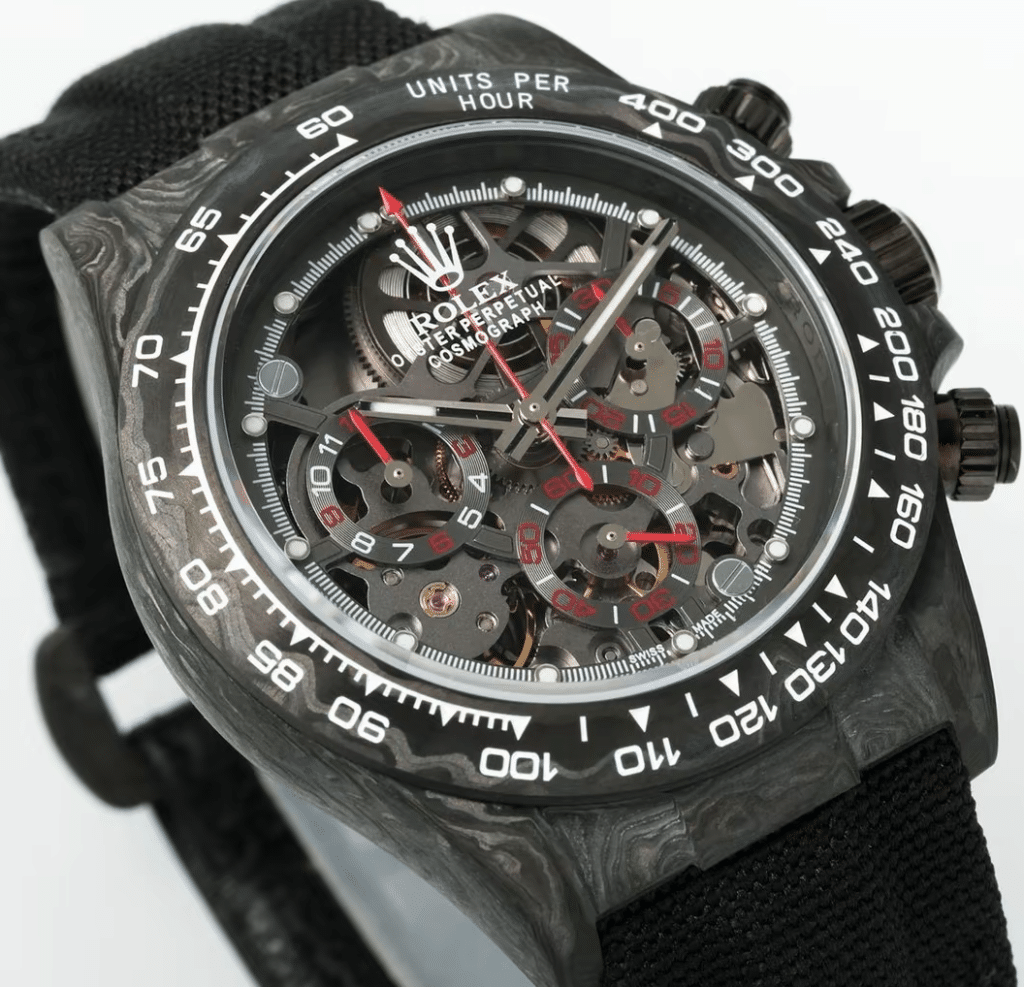
The recent rise of carbon fiber modified Rolex watches is not driven by price or trend chasing. It comes from something more practical and experiential: weight, comfort, and the desire to break away from the uniform look of steel and gold cases. Carbon fiber changes the daily wear feel of a watch in a fundamental way. It sits warmer against the skin, it reduces wrist fatigue during long wear, and it presents a quieter, more personal visual presence. For many owners, the shift from steel to carbon is less about showing off, and more about reshaping the relationship between the watch and the wearer.
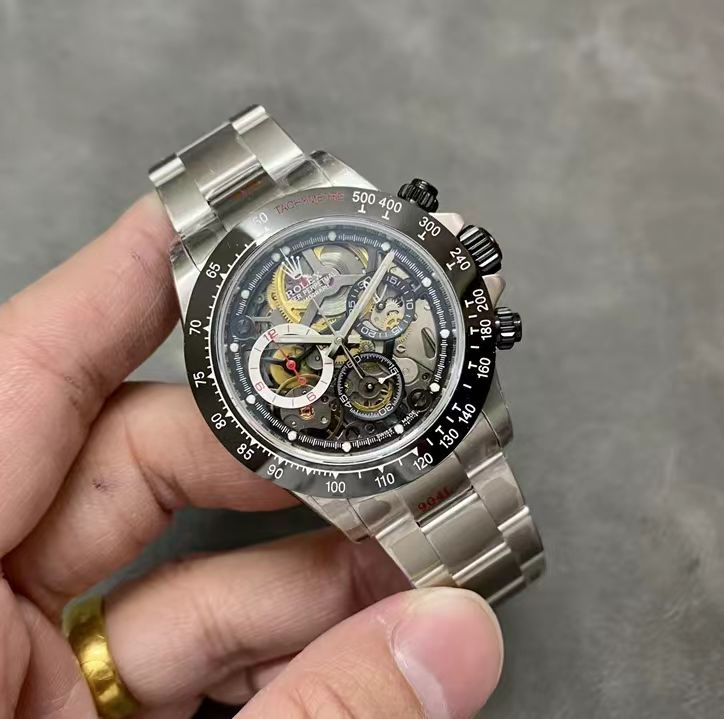
Carbon Fiber Cases Are Not Just “Replacements”; They Are Structural Redesigns
A common misconception is that a carbon fiber Rolex modification means simply removing the original steel case and installing a carbon sleeve or shell. In reality, that approach almost guarantees structural instability. Carbon fiber behaves differently from metal. Steel distributes forces evenly in all directions. Carbon fiber does not. It is directional, meaning the strength of the case depends on how the layers are arranged, compressed, cured, and reinforced. The performance of a carbon case—its durability, impact behavior, and resistance to stress whitening—is determined long before it takes final shape.
This is why a serious carbon mod workshop in China does not “machine a block of carbon until it looks like a Daytona”. Instead, it re-measures the stress pathways of the original Oyster case: the torque from the crown stem, the pressure from the screw-down pushers, the shock points on the lugs when the strap is tightened, and the micro-torsion that occurs during everyday wrist movement. Only after the load map is understood can the carbon fiber layers be arranged in the correct orientation.
This difference is why two watches that both claim to be “carbon Daytona mods” can behave completely differently over time. On poorly executed cases, the lugs begin to whiten and flake after months of wear because the fibers separate under tension. On properly engineered carbon cases, the texture stays intact, the case holds shape, and the watch remains supple yet solid for years.
Material and Processing Philosophy
The material choice itself is a strategic decision: forged carbon blocks for impact diffusion, pre-impregnated carbon fiber sheets where structural direction matters, and reinforced layering at stress points. The processing is equally consequential. Five-axis CNC machining is used not for show, but to preserve fiber continuity across curves. Controlled-temperature curing prevents internal warping. Segmental pressing avoids micro-cracks that only appear after months of use.
When done correctly, a carbon case does not imitate a steel case—it rewrites the physical behavior of the watch.
VS Factory’s Approach to Carbon Daytona Development
In the latest carbon Daytona builds emerging from VS Factory, the development did not start with aesthetics. It began with load mapping and weight distribution. The team re-evaluated how the watch behaves when the chronograph pushers are engaged, how pressure at the strap interface transfers through the lugs, and how the case flexes when exposed to rapid temperature changes.
From there, the case structure was redesigned so that fiber alignment follows stress, not surface shape. This is a fundamentally different philosophy from cutting carbon to look like steel. In practical terms, it means:
- The carbon case remains stable under daily fastening of the strap.
- The lugs do not slowly accumulate whitening or micro-splits.
- The watch feels lighter, but not so light that it loses presence on the wrist.
The carbon Daytona produced in this new workflow is not simply a visually modified Rolex. It is a reinterpreted Daytona engineered for long-term, real-world wear.
Why This Matters to Enthusiasts
Enthusiasts who seek carbon fiber modified Rolex watches are rarely trying to “fake” anything. Most already understand what the original pieces are, and often own them. What they want is variation, tactility, and intimacy—a daily wearing experience that feels more personal and less standard. The lightweight case is not a shortcut. It is an expression of a different relationship with the object: something worn to live with, not to perform for others.
That is why carbon modification has become one of the most compelling directions in the super clone and independent modding scene across China: it is not just a visual experiment. It is material engineering applied to watch culture.
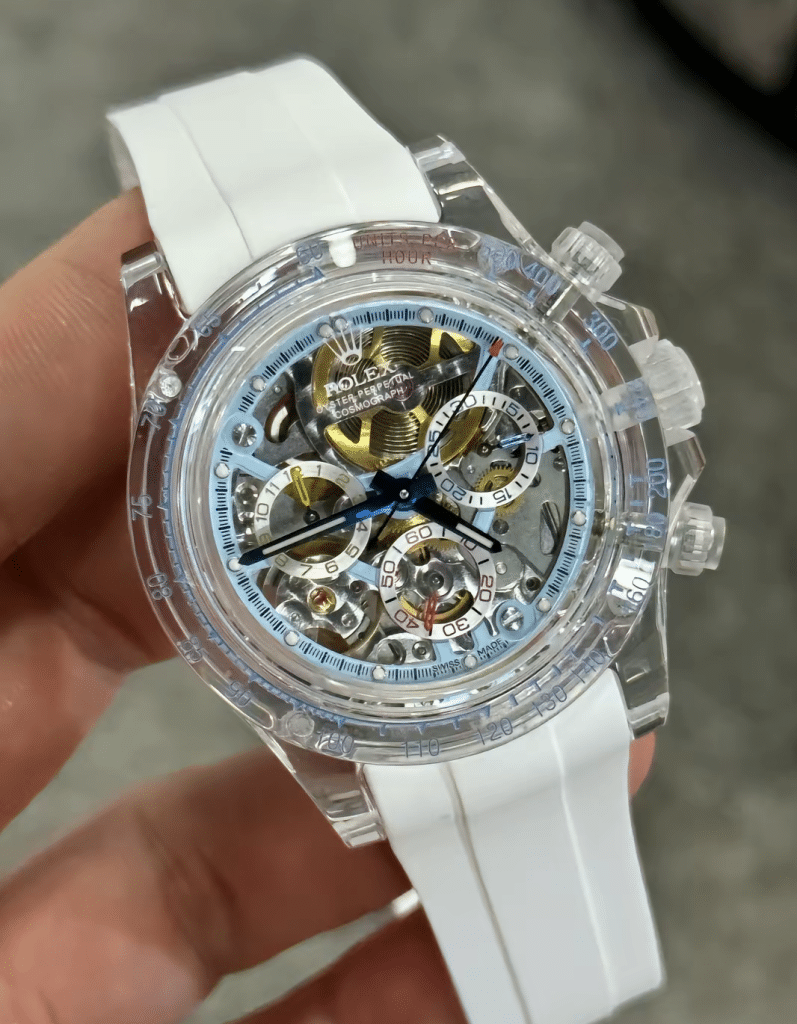
Why Carbon Fiber Rolex Feels Lighter but Never Feels “Cheap”
The first thing most people notice when they put on a carbon Daytona isn’t actually the weight loss itself—it’s the absence of weight memory. If you’ve worn a steel Daytona for years, your wrist subconsciously anticipates that familiar pull, that slight anchor that reminds you the watch is always there. Carbon interrupts that expectation. The watch becomes less of an object on the wrist and more of something that moves with it.
And yet, it never feels hollow or toy-like. This is where the misconception around “light = cheap” dissolves. Cheap watches are light because they are empty. Carbon-modified Rolex models are light because they are structurally intentional. The mass isn’t removed—it’s redistributed. The carbon shell carries rigidity, while the titanium caseback grounds the watch with just enough presence to feel centered. That balance is what prevents the watch from floating or shifting awkwardly during the day.
There’s also a sensory difference that only becomes obvious after wearing carbon for a few weeks: temperature neutrality. Steel records the environment. It’s cold against the skin on winter mornings, warm and metallic under summer sun. Carbon stays quiet. It doesn’t ask for attention. You forget the watch is even touching you—until you look down and realize it’s part of you now.
This quality is why many who switch to a carbon Daytona for daily wear struggle to return to steel. It’s not about weight. It’s about ease. The watch stops demanding space and simply lives with you. Whether you’re typing, steering, playing sports, running daily errands—the watch adapts. It doesn’t remind you to be careful. It encourages you to just move.
There is a word that often comes up among long-term carbon wearers: intimacy.
The watch no longer sits on your wrist—it becomes familiar, personal, almost private. A steel watch sometimes announces itself. A carbon watch whispers.
This is one of the quiet reasons why the carbon Daytona scene, especially the work coming out of certain China super clone and independent mod workshops, has become so compelling. It’s not loud luxury. It’s confident privacy.
Carbon Mods vs. Official Limited Editions — Two Different Philosophies, Not Competitors
This part often gets misunderstood by people who only look at watches from the outside. When someone sees a carbon Daytona built by a China carbon mod workshop or a super clone specialist, they sometimes frame it as a comparison against DiW or Artisans de Genève: “Which one is better?”
But that question misses the point entirely.
Official limited editions tell a story about exclusivity. They are built to be seen, recognized, discussed, displayed. Their identity is woven into the idea that only a few people can have this. The pride is in the distance — in being separate, distinguished, rare.
Carbon mods come from a completely different place. Their story is not about being seen. It’s about being yourself.
A carbon Daytona built in a quiet workshop in Guangzhou or Shenzhen is not trying to imitate DiW. It is answering a different need:
The need to wear a watch that feels honest to your life.
The need to choose comfort and personal connection over public validation.
The need to say, in a subtle way, “I know what I love. I don’t need you to approve it.”
When someone chooses a carbon-modified Rolex, they aren’t trying to be exclusive — they are trying to be true.
They might be the kind of person who drives with the windows down regardless of the weather.
Who doesn’t post their collections online.
Who doesn’t correct people when the watch goes unnoticed.
Someone who wears the watch for themselves — not for the room.
So comparing carbon mods to limited editions is like comparing two forms of handwriting.
Both are real.
Both are meaningful.
But one is written for people to read, and the other is written for the person who writes it.
One seeks audience.
The other seeks intimacy.
And that difference is why the carbon Daytona scene keeps growing quietly, steadily, without hype or marketing noise. Because it speaks to a type of person who doesn’t need applause — just connection.
What to Look For When Choosing a Carbon Daytona
Carbon fiber can be extraordinary when engineered correctly — but it can also fail quietly if the fundamentals are wrong. The difference doesn’t show up on day one. It appears after three months, six months, a year of daily wear. That’s why evaluating a carbon Daytona isn’t about the dial, bezel font, or case color. It starts with structure.
Here’s how to assess a carbon mod watch in a way that actually matters:
1. Check the Lugs — This Is the First Place Stress Shows
Hold the watch under soft, angled light.
Look specifically where the strap meets the case.
If the carbon layers are aligned correctly, the lugs will look:
- Smooth in texture
- Even in tone
- Deep in pattern
If the layers were cut without load orientation, the lugs will show:
- Grayish fading
- Slight whitening at the edges
- Hairline cracks that follow the curve of the strap
Those marks are not wear and tear. They are structural fiber separation.
Once they appear, they do not disappear.
2. Feel the Case Edge Transitions
Run your finger along the inner side of the lugs and the area near the crown guard.
A properly machined carbon case from a serious workshop (including the better super clone carbon Daytona builders in China) will feel:
- Softly contoured
- Even, but not sharp
- Comfortable where skin makes contact
A cheaply cut case will:
- Scratch the inside of your wrist
- Feel “unfinished”
- Have angular edges that catch the skin or strap
If it feels wrong, it is wrong.
3. The Caseback Should Balance the Watch — Not Just Close It
Most good carbon builds pair the case with:
- Titanium backs for warmth and balance, or
- Steel backs if extra grounding weight is needed
If the watch feels like it “floats” or shifts on your wrist when moving,
that means the weight distribution is off —
not necessarily the total weight.
A carbon watch should feel light, but not weightless.
The difference is control.
4. Don’t Judge the Watch in the Display Tray — Judge It on Your Wrist
Wear it.
Tighten the strap.
Roll your wrist.
Type on your phone.
Turn a door handle.
Within 15 seconds, you will know if the watch has coherence.
A good carbon Daytona disappears into your motion.
A bad one constantly reminds you it’s there.
The Emotional Logic of Carbon Daytona — Why Some People Quietly Never Go Back
There is a moment that many carbon Daytona wearers describe, though not always out loud. It happens weeks after the novelty has faded, after the watch has become part of the rhythm of the day. You are reaching for your phone, turning the steering wheel, pushing open a door, making coffee, and you realize you have forgotten the watch was there at all. It is not absence. It is something closer to acceptance. The watch is not performing for you, and you are not performing for it.
Steel demands acknowledgment. It reflects light, it has weight, it carries history. It is beautiful, but it asks to be noticed. Carbon behaves differently. It has warmth that is neither literal nor visual. It holds time quietly. It lets the moment belong to you, not to the watch. That is a subtle shift, but it changes everything about how the object fits into your life.
For some, carbon is the first time a watch feels like it is worn for the self. Not for the room, not for a meeting, not for the idea of being the kind of person who wears a Daytona. Instead, it becomes a companion in a literal sense: present, reliable, physically with you, but not demanding to define you. If steel is identity expressed outward, carbon is identity folded inward.
People who keep wearing carbon do so because it helps them inhabit their own life more comfortably. They stop thinking about scratches. They stop worrying about attention. They stop adjusting the strap every few minutes. The watch becomes a quiet part of the mind’s background, like a favorite pen or a well-used jacket. Something that fits because it belongs.
This is why, when asked to explain the appeal, owners sometimes struggle. The reasons are not loud. They cannot be photographed. They live in the body more than the eye. Carbon Daytona is not about making a statement. It is about removing the need to make one.
And once someone has lived with that kind of ease, returning to steel can feel like stepping back into a conversation that no longer needs to be had.
Carbon Modification as a Form of Personal Expression
Carbon fiber modification does not try to replace the original identity of the Rolex, nor does it compete with official limited projects. It exists to give the watch a different purpose — one that centers on daily wear, private enjoyment, and tactile comfort. For some owners, it becomes a way to keep the watch close while removing the sense of formality or display. For others, it is simply a matter of choosing a material that feels more aligned with how they move through the world.
What matters is that the choice is intentional. A carbon Daytona is not louder, or rarer, or more symbolic. It is simply more personal. And for a certain kind of wearer, that is enough.
The significance of carbon modification is not in its visual impact, but in the quiet practicality and ease it brings into daily life. It reflects the shift from owning a watch to living with one.