
The “Proportion-First” Philosophy of Cartier: Why Specs Lie
For most watch brands, especially those known for robust, round sports watches like Rolex, sizing is a fairly straightforward affair. You measure the diameter, maybe the lug-to-lug, and you have a solid idea of how it will sit on your wrist. But try applying that same logic to a Cartier, and you’ll quickly find yourself in a sizing trap. This also applies when considering a quartz replica choice for the brand, as Cartier doesn’t design watches in the same way; they craft wearable sculptures, pieces of jewelry where visual harmony and proportion are paramount, not just raw millimeters.
This fundamental difference is why replica buyers, particularly those accustomed to brands like Rolex, frequently misjudge Cartier fit. A Cartier’s nominal dimensions are merely a starting point, not a definitive indicator of its true wrist presence. To understand Cartier sizing is to shift your perception from a technical spec sheet to an aesthetic canvas, where every line, curve, and even the negative space contributes to how the watch truly feels and looks on the wrist.
The Cartier Design Language: Symmetry, Flow, and Negative Space
Cartier’s design process is an exercise in visual balance, often across multiple axes. Unlike a purely functional design, Cartier frequently employs negative space and continuous lines to create an illusion of greater or lesser size than its physical dimensions might suggest. This is evident in the seamless integration of cases and straps, or the elongated forms that stretch visual perception, making a watch wear uniquely. The goal is always an elegant, cohesive whole, where hard numbers often fail to capture the subtle interplay of design elements.
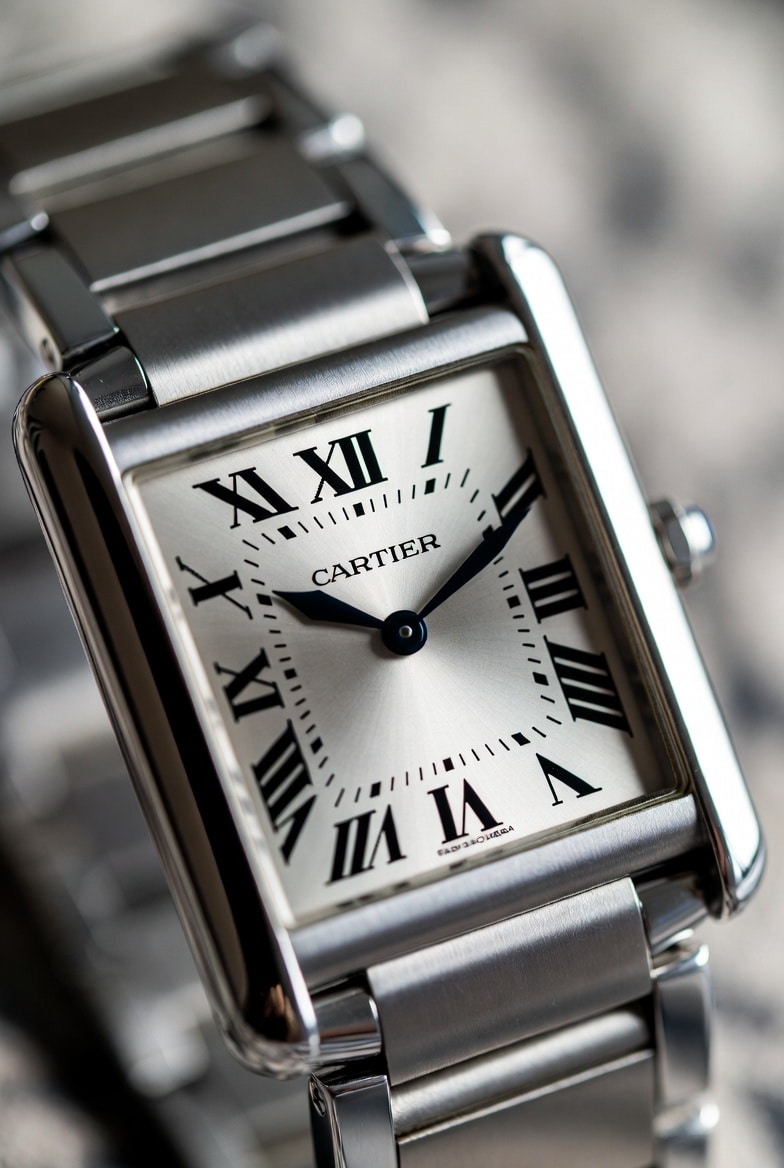
Rolex vs. Cartier: A Mindset Shift from Tool Watch to Jewel
Consider the Rolex Submariner or Oyster Perpetual. Their consistent round cases, prominent lugs, and standardized bracelet integration make sizing relatively predictable. A 40mm Submariner wears like a 40mm Submariner. You know what you’re getting. Cartier, however, operates from a different playbook. With its diverse shapes—rectangles, squares, ovals, and even more abstract forms—and often highly integrated designs, a different approach is required. Here, perceived elegance and how the watch “drapes” on the wrist are paramount. It’s the difference between a meticulously engineered tool and a finely crafted piece of jewelry.
The Illusion of Numbers: Why a 35mm Tank Doesn’t Wear Like a 35mm Oyster Perpetual
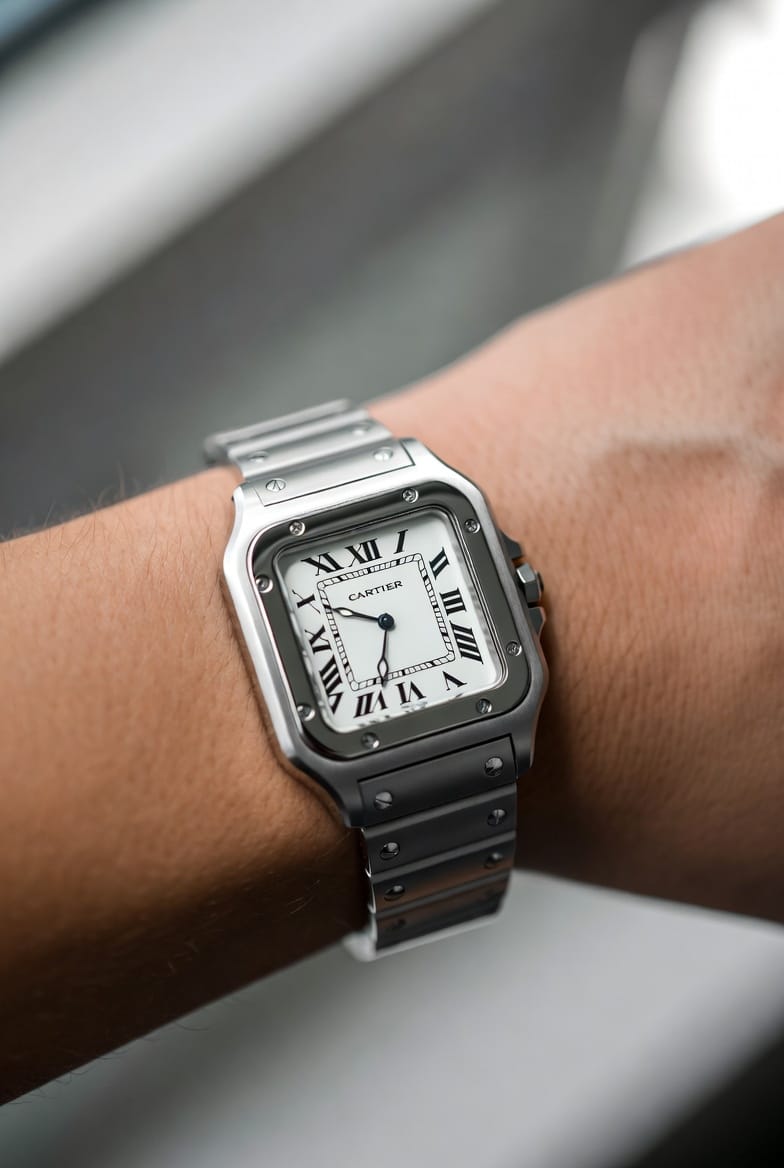
This is where many replica buyers stumble. A rectangular case, say a Tank with a 35mm width, will occupy a vastly different wrist footprint and project a distinct visual mass compared to a 35mm round case like an Oyster Perpetual. The Tank’s longer axis, its vertical reach, extends its perceived wearability far beyond what its width alone suggests. Similarly, the integrated bracelet of a Santos creates a continuous visual line that adds presence, defying direct numerical comparison with a traditional lug-and-strap setup. The numbers, in Cartier’s world, are a suggestion, not a rule.
Expert Authentication Insight
Physical diagnostic: Wrist Interaction Profile: When assessing a Cartier, an expert doesn’t just measure; they observe the “visual footprint.” Place the watch on the wrist and step back. The key is to assess how the case’s entire perimeter interacts with the wrist’s contours. Look for fluid transitions from case to skin, rather than abrupt edges or awkward gaps. A truly well-sized Cartier, whether genuine or a super clone, will exhibit a design-first fit, appearing as a natural extension of the wrist, not an object merely strapped onto it.
Case Geometry: How Shape Dictates Perceived Size
Beyond the raw numbers, the fundamental shape of a Cartier case is the primary determinant of its perceived size and how it interacts with the human wrist. Rectangular, square, oval, or even asymmetrical forms each present unique challenges and create distinct optical illusions. Understanding these geometries is crucial for any replica buyer trying to achieve a genuinely authentic look and feel.
Rectangular Realities: The Tank’s Elongation and Visual Weight
The iconic Tank is a masterclass in rectangular design. Its elongated form factor means that the traditional lug-to-lug measurement, often critical for round watches, takes a backseat to its overall vertical length and the precise proportion of its width to that length. A Tank that measures, for example, 25mm wide might feel much larger on the wrist than a 25mm round watch simply because of its vertical reach. Replica buyers often focus solely on the width, overlooking the profound impact of the Tank’s inherent elongation, which can dominate a wrist if not chosen carefully.
Square Sensibilities: Santos de Cartier’s Broad Stance
The Santos de Cartier, with its distinctive square or cushion-shaped profile and often prominent, screw-adorned bezel, carries a significant visual weight that belies its stated dimensions. Its sharp corners and the seamless integration of its bracelet create a larger perceived footprint than a round watch of similar width. This bold, architectural presence needs to be carefully accounted for, especially on narrower wrists, where a Santos can quickly transition from a statement piece to an overwhelming one. The square form commands attention and appears broader than its circular counterparts.
Oval and Asymmetrical Forms: Baignoire, Tonneau, and Crash’s Unique Demands
Cartier’s more sculptural and unconventional cases, such as the Baignoire (oval), Tonneau (barrel-shaped), or the truly organic Crash, present the greatest challenge to traditional sizing. For these watches, any numerical measurement is largely arbitrary in predicting how they will actually look and feel. Their non-linear forms mean that perceived size is almost entirely a matter of visual harmony with the wrist’s natural curves. Replica buyers must recognize that for these models, the “fit” is an artistic judgment, not a mathematical one, demanding a keen eye for proportion and drape.
Expert Authentication Insight
Physical diagnostic: Case Corner-to-Wrist Edge Alignment Test: To objectively assess the fit of a rectangular or square Cartier, center the watch on the wrist. Then, use a straight edge—a credit card works perfectly—aligned with the outermost points of the case (the corners for Tank or Santos, or the widest points for an oval). Measure the overhang or gap to the wrist’s natural edge. An expert evaluates if the case visually “fits” within the wrist’s boundaries without excessive protrusion that makes it look like a surfboard, or conversely, being completely swallowed by a wrist that’s too large, which would diminish its intended presence.
The Deceptive Role of Lugs and Integrated Bracelets
While case shape is critical, Cartier’s often unique lug structures—or the complete absence thereof—and its approach to bracelet integration profoundly impact a watch’s overall footprint and perceived size. For replica buyers, focusing solely on the case dimensions without considering how the watch connects to the strap or bracelet is a major oversight. These elements often dictate the “visual length” and “visual width” of a Cartier far more than the case itself.
Lug-to-Lug vs. Visual Length: Cartier’s Hidden Lugs and Their Impact
Many Cartier designs, particularly the Tank and Santos, feature lugs that are either highly integrated into the case, exceptionally short, or even cleverly concealed beneath the main body of the watch. This design choice significantly reduces the apparent “lug-to-lug” distance, a metric that is usually a primary concern for round watches. The result is a watch that appears to sit more compactly on the wrist, even if the case itself is quite substantial. Replica makers must meticulously replicate these integrated lug structures, as any deviation can throw off the entire visual balance and make the watch look ungainly.
Bracelet Integration: Santos and Pasha’s Seamless Flow vs. Traditional Lugs
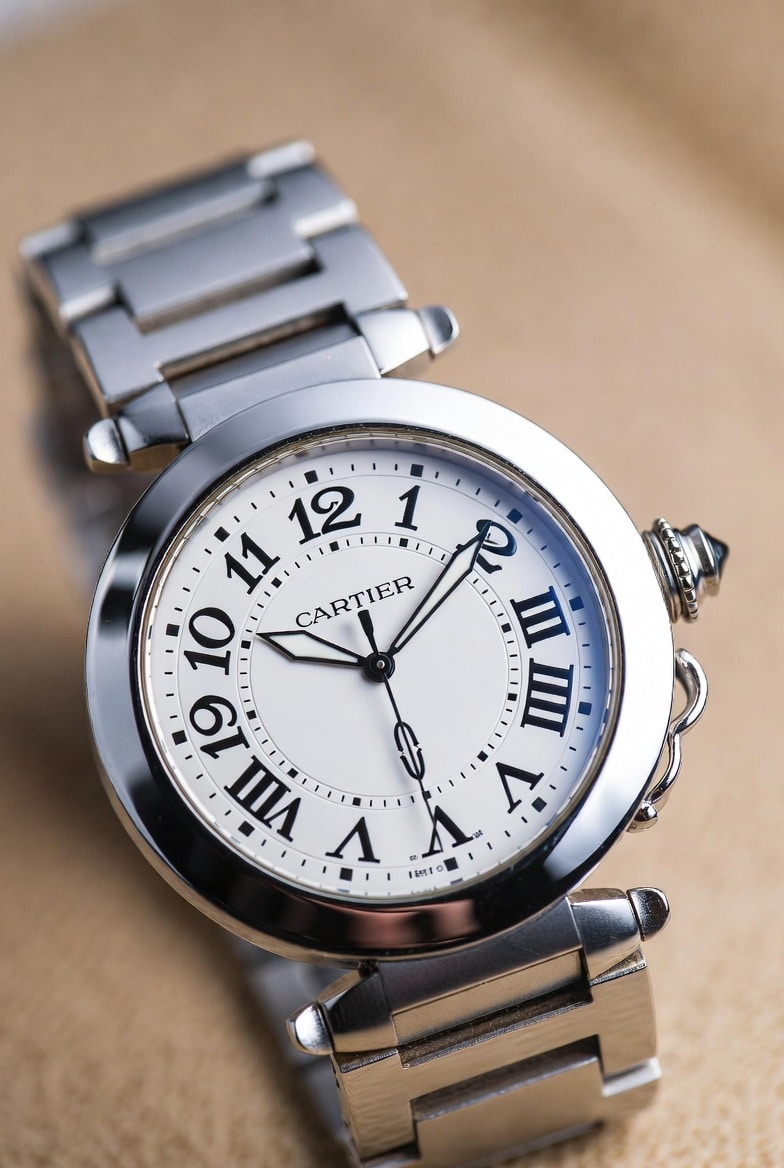
Watches like the Santos de Cartier exemplify seamless bracelet integration. The bracelet flows directly from the case, creating a continuous visual line that merges the watch head and bracelet into a single, larger, and more cohesive form factor. This seamlessness adds a palpable sense of perceived size and presence that traditional lug-and-strap setups simply cannot match. The Pasha de Cartier, with its distinctive crown protector and integrated bracelet, also exhibits this design philosophy. For replica buyers, when considering the suitability of super clone Cartier watches as dress or daily watches, it’s crucial to understand that this integrated design contributes significantly to the watch’s overall wrist presence and cannot be overlooked.
Strap Gap Psychology: How Visible Skin Alters Perceived Scale
The amount of visible skin between the watch case and the strap, particularly with traditional lugs, can dramatically alter how large or small a watch appears on the wrist. A noticeable gap can make a watch look smaller or like it’s floating. Cartier’s designs, however, often minimize this gap through clever lug geometry or integrated systems. This deliberate reduction of the “strap gap” contributes to a more integrated, and thus often larger or more substantial, perceived footprint. A replica that fails to achieve this tight integration will inherently look less refined and potentially less substantial than the genuine article, regardless of its raw dimensions.
Expert Authentication Insight
Physical diagnostic: Lug-to-Wrist Curvature Gap Measurement: To properly assess how a Cartier drapes, observe the gap between the underside of the lugs (or the point where the case would normally transition to lugs) and the wrist at both the 12 and 6 o’clock positions. An expert measures this gap to ensure it follows the natural curve of the wrist. The goal is to see proper “drape,” where the watch hugs the wrist contours, rather than a flat, floating appearance caused by excessive lug-to-lug length that extends beyond the wrist’s edge. This detail is often overlooked but is fundamental to Cartier’s signature elegant fit.
Thickness, Wrist Profile, and Visual Weight
While often overlooked in favor of diameter or length, a watch’s thickness plays an outsized role in its overall visual weight and how comfortably it sits on the wrist. For Cartier, a brand synonymous with elegance and refined proportions, thickness isn’t just about whether it slides under a shirt cuff; it’s a critical component of its three-dimensional presence. A replica that gets the width and length right but misses on thickness will feel fundamentally different, altering the watch’s character from elegant to cumbersome. Understanding your own wrist’s curvature is also key, as it dictates how the watch’s caseback interacts with your anatomy.
Side Profile Story: The Importance of Case Slenderness
Cartier’s iconic dress watches, like the Tank, earned their reputation for understated elegance partly due to their remarkably thin profiles. This slenderness allows them to sit discreetly on the wrist, complementing formal attire without drawing undue attention. A replica of a Tank, for instance, that measures even a millimeter or two thicker than the genuine article can fundamentally alter its visual identity. What should appear delicate and refined can instead feel chunky and less sophisticated. This isn’t just about a number; it’s about the watch’s entire visual character and how it communicates its design intent.
Wrist Curvature and Caseback Fit: Where Comfort Meets Aesthetics
The way a watch’s caseback is shaped—whether it’s flat, gently curved, or significantly domed—is paramount to both comfort and aesthetic fit. A flat caseback on a wrist with a pronounced curve can cause the watch to “float” or create an unsightly gap, making it appear ill-fitted. Conversely, a caseback that’s too curved for a flatter wrist might dig into the skin or feel unstable. Cartier designs often feature casebacks engineered to “drape” gracefully over the wrist’s natural contours, ensuring the watch feels integrated rather than perched. This subtle detail is crucial for both long-term wearability and the overall visual harmony on the wrist.
The Optical Trick of Beveled Edges and Polished Surfaces
Cartier masters the art of visual illusion through meticulous finishing. Highly polished, beveled edges on a watch case are not just decorative; they are functional design elements. By catching and reflecting light in specific ways, these edges can make a case appear significantly thinner and more refined than its actual measurements might suggest. This visual trickery adds a sense of lightness and sophistication. Replicas that cut corners on these subtle finishing details, opting for flatter, less refined edges, can inadvertently make the watch appear bulkier, less elegant, and ultimately, less authentic, even if the primary dimensions are close.
Expert Authentication Insight
“Cuff Clearance” Visual Inspection: The ultimate test for a Cartier’s thickness and wrist profile integration is the “cuff clearance” check. With the watch on your wrist, slide a typical shirt cuff over it. Observe not just if it clears, but how* it clears. A properly proportioned Cartier, especially a dress model, should glide smoothly, tucking under the cuff without snagging, creating an obvious bulge, or rotating awkwardly. This fluid interaction signifies a harmonious thickness and caseback design that works with your wrist profile, rather than fighting against it.
The Bezel Effect: Dial Dominance vs. Metal Presence
The bezel, often seen as a secondary element, profoundly influences a watch’s perceived size and the visual hierarchy of its components. For Cartier, where design is paramount, the bezel’s width, material, and finish are crucial in dictating whether the dial dominates the wrist or if the case itself asserts a bolder presence. This interplay significantly impacts the watch’s overall aesthetic and how it “wears” on the wrist, often more than its nominal diameter.
Open Dials: Tank and Reverso’s Expansive Face Illusion
Watches like many Cartier Tank models or the Jaeger-LeCoultre Reverso (which shares a similar design philosophy in this regard) achieve an illusion of greater size through their minimal bezels and expansive, open dials. With less metal framing the face, the eye is drawn directly to the large dial surface, making the watch appear broader and more commanding than its physical dimensions might suggest. This design choice prioritizes readability and aesthetic simplicity, allowing the dial to become the primary visual element, and thus, making the watch feel larger and more impactful on the wrist.
Robust Bezels: Santos’s Frame and Its Visual Weight
In stark contrast, the Santos de Cartier leverages its distinctive, screw-adorned bezel as a significant design statement. This substantial bezel doesn’t just frame the dial; it adds considerable visual mass to the watch head. The robust, often brushed, metal of the bezel contributes to the Santos’s perceived boldness and utilitarian-chic aesthetic. Even if the dial itself isn’t exceptionally large, the prominent bezel ensures the watch carries substantial wrist presence, making it feel more like a robust tool watch than a delicate dress piece. This design choice is critical to the Santos’s unique character.
Gem-Set Bezels: Adding Visual Mass and Perceived Size
For Cartier models featuring gem-set bezels, the impact on perceived size is even more dramatic. The addition of diamonds or other precious stones not only elevates the watch’s luxury appeal but also significantly increases its visual envelope. The sparkle and physical dimension of the gems create a halo effect, making the entire watch appear larger and more opulent. This isn’t merely about the diameter of the case; it’s about the expanded “visual footprint” created by the bezel’s embellishment, which can make even a moderately sized watch feel substantial and glamorous on the wrist.
Expert Authentication Insight
Dial-to-Bezel Ratio Visual Balance Check: An expert assesses the “bezel effect” by visually evaluating the dial-to-bezel ratio. This involves quickly measuring the visible dial area against the width of the bezel. The goal is to determine if this ratio achieves the intended aesthetic balance. For a Tank, a high dial-to-bezel ratio suggests elegance and an expansive face. For a Santos, a more balanced or even bezel-dominant ratio indicates robustness and a framed dial. A disproportionate ratio in a replica, where the bezel is too thick for a dress watch or too thin for a bold design, indicates a fundamental visual flaw in sizing and design fidelity.
Common Cartier Replica Sizing Traps (and How to Avoid Them)
Cartier’s unique design language often leads replica buyers astray when relying solely on specifications. The brand’s emphasis on proportion and visual harmony means that a watch’s stated dimensions can be highly deceptive in predicting its actual wrist presence. Here, we highlight common sizing pitfalls for some of Cartier’s most iconic models and offer guidance on how to avoid them, shifting your focus from numbers to visual reality.
Tank Louis Cartier: The Peril of Underestimating Elongation
The Tank Louis Cartier is a masterclass in rectangular elegance, but its elongated form is a frequent source of sizing errors for replica buyers. Many buyers focus primarily on the watch’s width, often comparing it to a round watch’s diameter. However, a 25mm wide Tank, for example, will wear vastly larger than a 25mm round watch due to its significant vertical length. This elongation means the watch occupies a much larger visual footprint on the wrist. The trap is in failing to account for this vertical reach. For detailed advice, a comprehensive super clone buying guide suggests considering the watch’s full length, ensuring it doesn’t extend ungracefully past the edges of your wrist bones. A Tank should look integrated, not like a ruler strapped to your arm.
Santos-Dumont: The Thinness Trap and Its Visual Frailty
The Santos-Dumont is celebrated for its extreme thinness, a characteristic that imbues it with a delicate, almost ethereal elegance despite its square shape. Replica buyers, often seeking wrist presence, might be tempted to choose a larger Santos-Dumont size. However, if the replica is even slightly too thick—a common manufacturing challenge for complex thin cases—it fundamentally compromises the watch’s aesthetic. A thick Santos-Dumont loses its refined character, feeling clunky and less authentic. For this model, prioritize accurate thinness over maximizing width or length; a slightly smaller, correctly thin replica will always look more refined and true to the original design than a larger, but overly thick, version.
Pasha de Cartier: The Bulk of the Round Case and Crown Guard
The Pasha de Cartier, while a round watch, defies conventional round watch sizing due to its distinct design elements. Its unique crown guard and often larger dimensions contribute to a substantial visual bulk that buyers frequently underestimate. The prominent crown guard, often featuring a cabochon, adds significant visual weight and extends the watch’s profile. On smaller wrists, this can easily lead to a “dinner plate” effect, where the watch appears disproportionately large and overwhelming. When considering a Pasha replica, remember that its stated diameter doesn’t fully capture its commanding wrist presence; factor in the visual impact of the crown guard and its overall robust aesthetic.
Ballon Bleu: The Dome and Its Unexpected Wrist Dominance
The Ballon Bleu’s most distinctive features—its highly domed crystal and case back—are also its biggest sizing trick. While these elements contribute to its unique, pebble-like aesthetic, they also create a significant perceived height and visual volume that makes the watch wear larger than its diameter suggests. Buyers might focus on the diameter measurement, but the watch’s three-dimensional, almost sculptural form means it occupies more space on the wrist, both visually and physically. A Ballon Bleu replica should be assessed not just for its diameter, but for how its domed profile interacts with your wrist, ensuring it doesn’t appear overly bulky or top-heavy.
Expert Authentication Insight
Model-Specific “Sweet Spot” Wrist Coverage Diagnostic: To avoid these traps, an expert performs a model-specific “sweet spot” diagnostic. For a Tank, this means ensuring the vertical length of the case does not extend past your wrist bones, maintaining a clean visual line. For a Santos, the square case should sit comfortably within the width of your wrist, avoiding excessive overhang at the corners. For a Santos-Dumont, the key is to confirm its thinness is preserved, ensuring it doesn’t look like a chunkier version of the original. For the Pasha or Ballon Bleu, it’s about evaluating the overall visual bulk, including crown guards or domed profiles, to ensure they don’t overwhelm your wrist. This quick visual check against these specific reference points is far more reliable than relying on raw numbers alone.
Developing Your “Cartier Eye”: A Decision Framework for Replica Buyers
After dissecting the intricate dance between Cartier’s design philosophy and the reality of wrist wear, it’s time to synthesize this knowledge into an actionable framework. For replica buyers navigating the nuances of Cartier’s unique sizing, the goal isn’t just to understand the theory, but to confidently apply it. This section provides a step-by-step approach to evaluating replica fit, urging a shift from numerical obsession to a nuanced visual assessment.
Prioritizing Visual Harmony Over Millimeter Obsession
The single most critical takeaway for any Cartier buyer, especially in the replica market, is this: the ultimate goal is a watch that looks aesthetically balanced on the wrist, not one that matches a specific number. This requires buyers to trust their eyes more than a ruler, understanding that “correct” sizing for Cartier is a visual judgment.
Cartier’s design legacy is built on proportion and visual balance. A watch that measures 35mm on paper might feel entirely different from another 35mm watch from a different brand or even a different Cartier collection. The “manufacturing detail” here is profound: Cartier’s design process emphasizes visual balance across multiple axes, often using negative space and continuous lines to create an illusion of greater or lesser size than physical dimensions suggest. This is evident in the seamless integration of cases and straps, or the elongated forms that stretch visual perception. Therefore, chasing an exact millimeter measurement without considering the holistic visual impact is a fool’s errand. You’re buying an aesthetic, not just a measurement.
The “Wrist Shot” Test: How to Objectively Evaluate Fit
To move beyond subjective perception, you need objective data. The best tool for this is the “wrist shot” test. Taking objective wrist shots from multiple angles, and crucially, from a slight distance (not too close-up), is paramount. This provides a more accurate representation of how the watch truly looks, free from the distorted perception of looking directly down at one’s own wrist. When you look directly at your wrist, your perspective naturally distorts the watch’s perceived size, often making it seem larger or smaller than it truly appears to others.
The “manufacturing detail” for this test emphasizes that a true wrist shot, taken from a slight distance, captures the watch’s interaction with the entire wrist and hand, allowing for a more accurate assessment of its overall presence. This perspective helps in identifying issues like lug overhang or a case that appears too bulky or too small relative to the natural proportions of your arm. Don’t rely on mirror selfies or extreme close-ups; get someone else to take the photo or use a timer and a tripod to achieve a consistent, objective view.
Understanding Your Own Wrist’s Geometry (Flat vs. Round)
Your wrist is not a universal canvas; its unique geometry plays a significant role in how any watch, especially a Cartier, will sit and appear. A flat, broad wrist can accommodate different shapes and sizes than a round, narrower one. Understanding your own wrist profile is as important as understanding the watch’s geometry, as it directly influences how a watch will “drape.”
The “manufacturing detail” here lies in the interaction: the specific curvature of your wrist dictates how effectively a watch’s caseback can settle, how its lugs will transition into the strap, and ultimately, how comfortable and aesthetically integrated the watch feels. A watch that fits perfectly on a flat wrist might appear to “float” or have significant lug overhang on a more rounded wrist, even if the measured circumference is identical. Take the time to observe your own wrist’s contours and consider how they might interact with different case shapes and lug structures.
Expert Authentication Insight
Physical diagnostic: The 3-Angle Visual Fit Assessment (Top, Side, 45-Degree): To truly master the “Cartier Eye,” an expert would perform a rapid visual scan from three critical angles. Directly overhead, they’d assess the overall wrist coverage, looking for lug overhang and the proportion of the case to the wrist’s width. From the side, they’d check the watch’s height and how it sits off the wrist, ensuring it doesn’t “float” or dig in. Finally, a 45-degree angle provides a holistic view of the watch’s three-dimensional presence, evaluating the integration of the case, lugs, and strap, and identifying any disproportionate elements or imbalances in its visual footprint.
Cartier sizing is less about reading a spec sheet and more about learning to “see.” It’s a skill developed through understanding design principles, visual psychology, and critical self-evaluation. For the replica buyer, this means that if a watch doesn’t look* right in your objective wrist shot, it’s not the right size, regardless of the numbers. Develop your “Cartier Eye” by prioritizing visual harmony and trusting your aesthetic judgment over chasing specific millimeter figures. That confidence in your own perception is the ultimate key to a successful fit.