
The Cartier Design Ethos: Where Thinness Trumps Mechanical Complexity
For decades, Cartier has carved out a unique space in the world of luxury watches, not through overt mechanical prowess or complicated horological feats, but through an unwavering commitment to design. The brand’s identity is rooted in elegance, proportion, and above all, a distinctive slenderness that allows its watches to sit gracefully on the wrist. This foundational philosophy means that for many iconic Cartier models, the type of movement ticking inside takes a distant second place to the watch’s form factor. When undertaking a Cartier replica gift assessment, understanding this hierarchy is crucial: achieving an authentic aesthetic often means prioritizing the watch’s external dimensions and wearability over the perceived prestige of a mechanical movement.
Iconic Designs Built for Slenderness: Tank, Santos, Ballon Bleu
Consider Cartier’s most celebrated lines: the Tank, the Santos, and the Ballon Bleu. Models like the Tank Must, the Santos-Dumont, and the smaller Ballon Bleu variants were originally conceived with a strong emphasis on a svelte profile and elegant wearability. Many of these historical and contemporary references, particularly the dressier and smaller versions, either housed compact manual-wind movements or, crucially, quartz movements. This design heritage establishes a clear precedent: a thin movement, by its very nature, is a more faithful partner in replicating these iconic designs. For example, the genuine Tank Must often utilizes a quartz movement, and many elegant Santos-Dumont models embrace a slim quartz caliber to maintain their quintessential thinness. This design choice by Cartier itself underscores why a quartz movement, far from being a compromise, can be the most authentic choice for a replica.
The Illusion of Prestige: When Mechanical Adds Bulk, Not Value
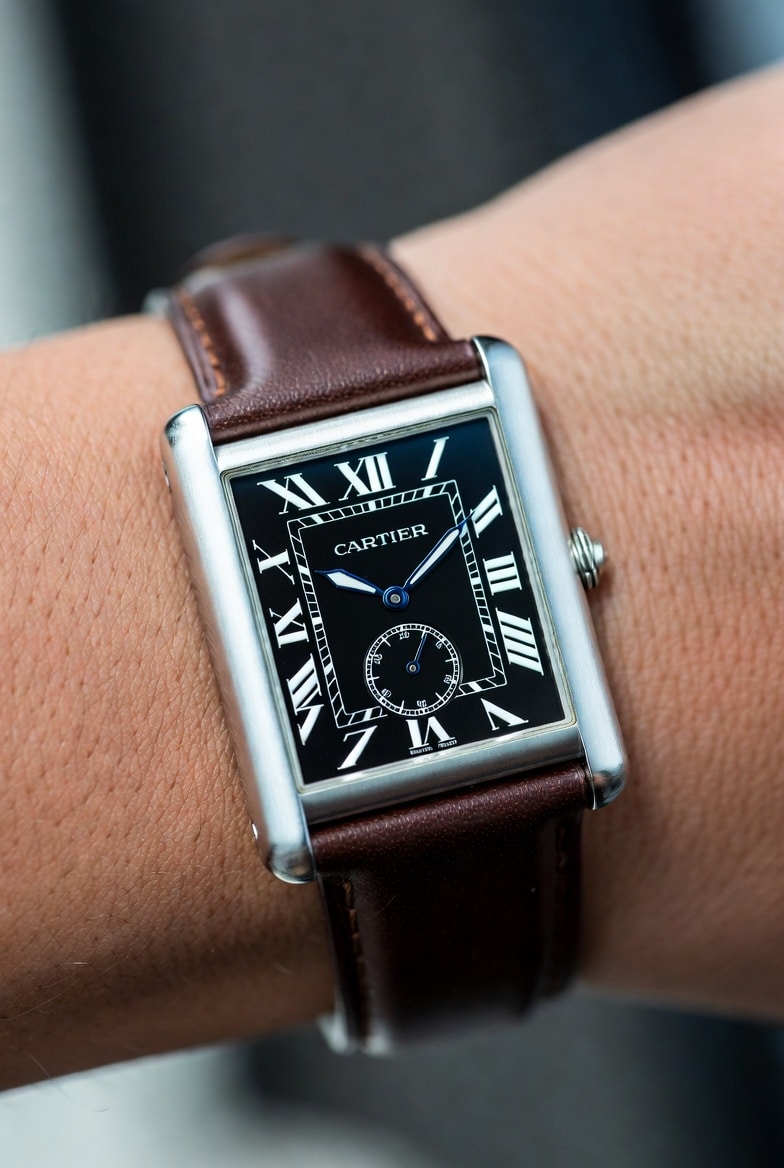
The watch market often fosters a psychology that equates mechanical movements with inherent luxury and superiority. While this holds true for many brands that showcase their intricate calibers through exhibition casebacks, it can be deeply misleading for Cartier. For a significant number of Cartier references, the movement is deliberately hidden behind a solid caseback. In these instances, the true “luxury” of the watch lies in its tactile feel, its visual profile, and how it wears on the wrist. A replica buyer, chasing the perceived prestige of a “super clone” mechanical movement, might inadvertently acquire a watch that fundamentally distorts Cartier’s intended presence. An overly thick mechanical replica, even if its movement is technically sophisticated, sacrifices the very essence of what makes a Cartier watch desirable: its discreet elegance and comfortable, slender fit.
Expert Authentication Insight
When assessing a Cartier replica, especially for models known for their thinness, the most telling diagnostic is a precise measurement of its case thickness. Focus not just on the overall height from caseback to crystal, but also the mid-case and bezel height. Use digital calipers to achieve accuracy. Compare these measurements against the genuine specifications. For many Cartier models, a deviation exceeding 0.5mm from the original thickness, particularly in the mid-case, is a strong indicator that an unsuitable mechanical movement has been forced into a design meant for a much thinner caliber. This often results in a watch that feels and looks noticeably bulkier than the authentic piece, immediately betraying its replica status to an informed eye.
The Mechanical Replica Conundrum: When “Super Clone” Falls Short
The pursuit of a “super clone” often centers on replicating the movement, a logical focus for brands that celebrate their internal mechanics. However, this approach can become a critical misstep when applied indiscriminately to Cartier. For a brand where external design fidelity is paramount, the limitations of generic or slightly oversized mechanical movements can severely compromise the visual and tactile authenticity that Cartier’s designs demand. What might be a “super clone” in terms of movement architecture ends up being a significant downgrade in terms of the watch’s true identity on the wrist.
Generic Mechanicals and Their Impact on Case Proportions
The replica market frequently relies on common mechanical movements such as modified Miyota 9015s, or generic clones of the ETA 2824 or 2892. While these movements are generally reliable, they are often thicker than the proprietary or highly compact movements Cartier uses in its genuine thin models. This thickness discrepancy forces replica factories into difficult compromises. To accommodate the larger movement, they may resort to thicker casebacks, wider mid-cases, or even subtly altered lug angles. For instance, a 42mm Ballon Bleu replica, often using a Sea-Gull 2824 movement, might end up noticeably thicker than the genuine article, which typically houses Cartier’s thinner 1847 MC caliber. These alterations, however slight, fundamentally distort the watch’s intended silhouette, making it appear less refined and often less comfortable than the original design.
Dial-to-Profile Fidelity: The Unseen Compromise
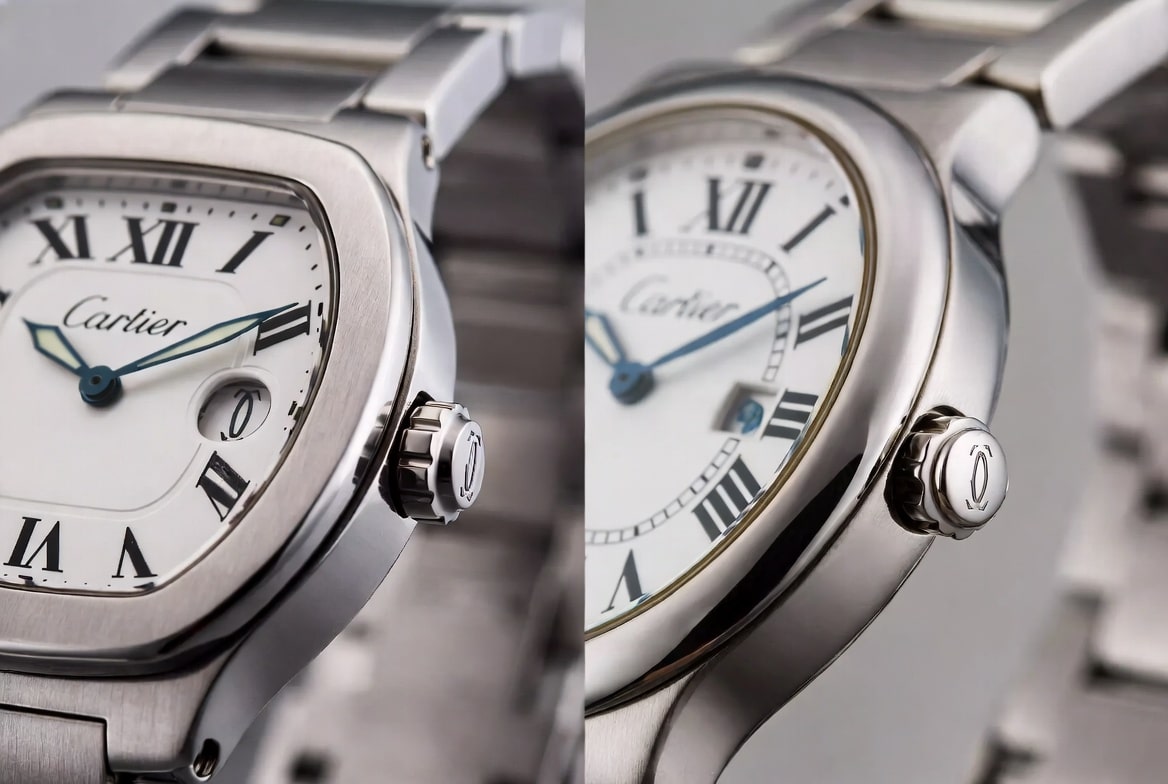
The consequences of increased case thickness extend far beyond just the side profile. This seemingly minor alteration can subtly yet significantly impact the perceived “depth” of the dial, the height and curvature of the crystal, and even the way light interacts with the watch’s surfaces. Cartier’s design language often relies on elegant flatness, subtle curves, or a precise “fish-eye” effect on its crystals (like some Ballon Bleu models). When a mechanical movement forces a thicker case, these subtle design cues are thrown off. The dial might appear recessed, the crystal might sit too high, or its curvature might be exaggerated or flattened incorrectly. These are not just technical deviations; they are aesthetic compromises that detract significantly from the intangible “Cartier feel”—a sense of understated luxury and visual harmony that is difficult to quantify but instantly recognizable.
Expert Authentication Insight
For Cartier replicas, pay close attention to the lug-to-case integration and the curvature of the case sides. Genuine thin Cartier models are characterized by seamless transitions and an elegantly fluid curve from the lugs into the main case body. A mechanical replica struggling with an ill-fitting movement will frequently display what’s known as a “slab-sided” appearance—the case sides look unnaturally flat and thick, lacking the subtle tapering or curvature of the original. You might also observe a disjointed lug profile, where the lugs don’t flow organically from the case, or an unnaturally raised bezel that stands too proud from the mid-case. These imperfections, often visible even to the naked eye with careful scrutiny, are tell-tale signs that the replica’s internal mechanics have dictated its external form, betraying the original design intent.
Quartz Replicas: The Unsung Heroes of Cartier Fidelity
In the often-heated debate between mechanical and quartz movements, quartz is frequently dismissed as inferior. However, for a brand like Cartier, whose design language is so heavily predicated on thinness and elegance, quartz movements emerge as unsung heroes in the replica market. They often provide a superior pathway to replicating many Cartier models, allowing factories to maintain the crucial thinness and precise proportions of the genuine articles, thereby delivering a more authentic and satisfying overall experience.
Achieving True-to-Gen Thinness and Wearability
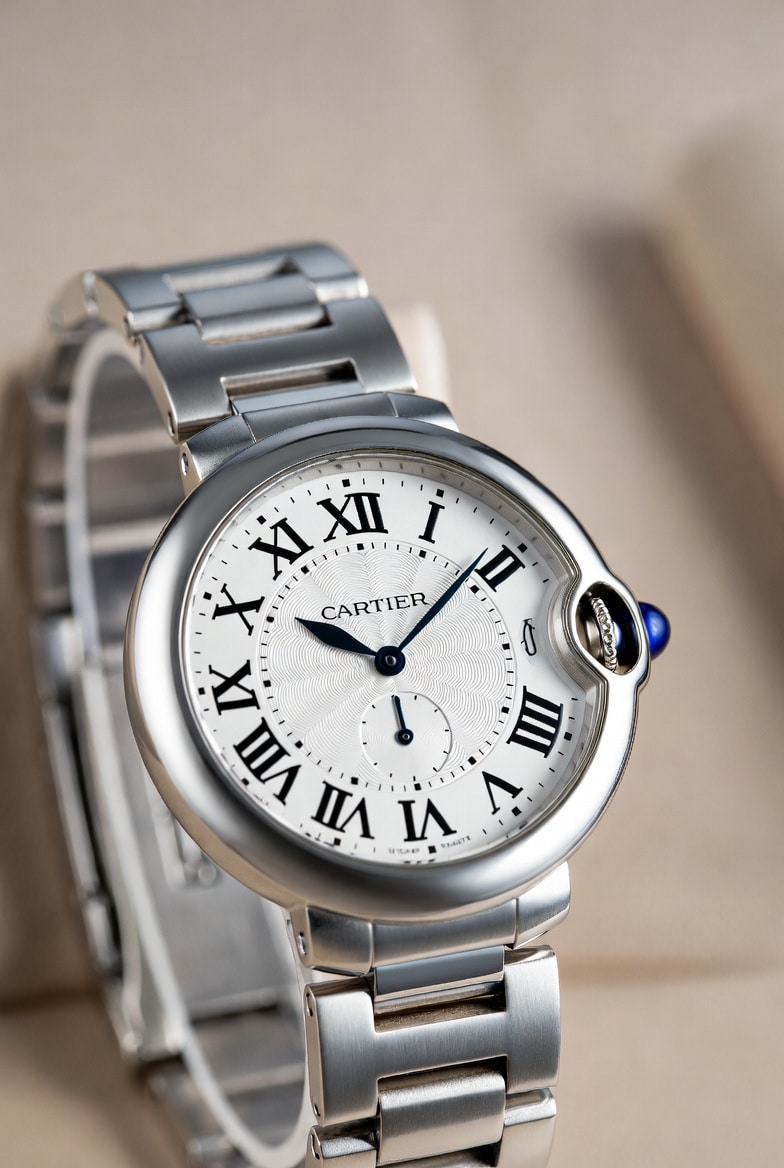
The inherent compactness of quartz movements is their greatest advantage in the context of Cartier replicas. Unlike their mechanical counterparts, quartz calibers require minimal space, enabling replica factories to produce cases that closely match the genuine dimensions, especially in terms of critical thickness. This is vital given the common Cartier replica size mistakes. For example, a well-made quartz replica of a Cartier Tank Must can achieve a profile that is virtually indistinguishable from the genuine model, sitting flush and elegantly on the wrist. This isn’t just about visual accuracy; it has a direct impact on wrist comfort and the overall wearability—factors that are central to Cartier’s appeal. When K3 factory produces a 33mm Ballon Bleu replica with an integrated movement that achieves 9.96mm thickness, it’s directly addressing this critical aspect of fidelity, even if it’s a mechanical movement designed for thinness. But a quartz movement inherently offers this advantage with less complexity.
Cost-Effectiveness and Reliability: Practical Advantages
Beyond design fidelity, quartz replicas offer compelling practical benefits. Their simpler construction translates directly into lower manufacturing costs, which in turn means better value for the buyer. A top-tier quartz Cartier replica might cost around $300-500, offering remarkable accuracy and aesthetic authenticity for a fraction of a mechanical counterpart that might still compromise on thickness. Furthermore, quartz movements are renowned for their superior timekeeping accuracy, often running within seconds per month, compared to mechanical movements that can vary by several seconds per day. They also require significantly less maintenance, with battery changes being the primary service interval, reducing long-term ownership costs and hassle. For a “beater” watch, a daily wear piece, or a fashion-forward replica where the emphasis is on looks and worry-free ownership, these practical advantages enhance the overall experience substantially.
Expert Authentication Insight
The most immediate and obvious tell for a quartz movement is the “dead beat” seconds hand, which ticks once per second rather than sweeping smoothly. However, for authentication focused on replication quality, the real diagnostic lies in the case profile* and *weight*. A quartz replica that perfectly matches the genuine case thickness and feels appropriately light for a thin, non-precious metal watch often provides a stronger indication of faithful replication than a mechanical version that feels too heavy or chunky. While the dead beat seconds is a giveaway of the movement type, the case’s physical attributes are a more profound indicator of how well the replica captures the original Cartier design ethos. If a replica quartz Tank or Santos-Dumont feels right on the wrist—light, thin, and unobtrusive—it’s likely a more successful clone than a mechanical version that adds noticeable bulk.
Specific Cartier Models: Where Quartz Is Clearly Superior
While the allure of a mechanical movement is strong for many watch enthusiasts, there are specific Cartier models where embracing a high-quality quartz replica isn’t just a compromise—it’s often the superior choice for achieving genuine fidelity to the original design. These are watches whose very essence is defined by their svelte profiles, delicate proportions, and elegant wearability, qualities a bulky mechanical movement can easily undermine.
The Cartier Tank: A Case Study in Quartz Dominance
The Cartier Tank, in its many iterations (Tank Must, Tank Française, Tank Louis Cartier), is perhaps the strongest argument for quartz supremacy in the replica world. This collection was born from a philosophy of refined elegance and a low-profile presence on the wrist. Many original Tank models, particularly the Tank Must and older Tank Louis Cartier, were either initially quartz-powered or designed around extremely thin manual-wind movements.
The genuine Tank’s ultra-thin profile is its defining characteristic. A well-executed quartz replica, leveraging the inherent slimness of its movement, can achieve case dimensions that are virtually identical to the original. For instance, the Tank Must, a cornerstone of Cartier’s accessible luxury, often features a quartz movement in its genuine form. A top-tier quartz replica from factories like AF or K11 for the Tank Must or Tank Française can replicate this thinness and wearability almost perfectly. The result is a watch that sits on the wrist with the same understated elegance and seamless integration that defines the authentic piece, a feat that even the thinnest mechanical replica movements often struggle to match without adding noticeable bulk.
Santos-Dumont and Smaller Ballon Bleu: Proportions Over Power
Beyond the Tank, models like the Santos-Dumont and the smaller Ballon Bleu variants (e.g., 28mm, 33mm) also benefit immensely from a quartz movement’s slimness. The Santos-Dumont, a dressier, more refined counterpart to the robust Santos de Cartier, is celebrated for its elegant, almost ethereal presence. Its thin, often precious-metal case is designed to slip effortlessly under a cuff. Similarly, the smaller Ballon Bleu models, with their pebble-smooth cases and delicate proportions, are all about visual harmony and comfort.
For these watches, an exhibition caseback is rarely, if ever, a feature of the genuine article. The internal mechanics are entirely hidden, making the aesthetic and tactile experience paramount. A quartz movement allows replica makers to closely adhere to the genuine dimensions, preserving the critical thinness and delicate curves that define these pieces. A mechanical movement, even a modified one, invariably adds thickness and often weight, disrupting the very balance and wearability that make these models so appealing. In these instances, prioritizing external fidelity over internal mechanical complexity yields a far more authentic replica experience.
Expert Authentication Insight
When evaluating a Cartier Tank replica, pay close attention to the overall case height, particularly from the caseback to the top of the crystal. A common tell for an ill-fitting mechanical movement in a Tank replica is a noticeably thicker profile, especially near the lugs where the case often has to be beefed up to accommodate the movement. Furthermore, inspect the crown: many mechanical Tank replicas feature slightly oversized crowns that protrude more or appear disproportionate to the case, a necessity to accommodate a larger movement stem. This breaks the clean, minimalist lines that are so characteristic of the genuine Tank’s design, instantly signaling an inauthentic build to a discerning eye.
Making the Informed Choice: When to Embrace Quartz
The decision to opt for a quartz Cartier replica, rather than blindly chasing a mechanical “super clone,” represents a shift from ingrained bias to informed practicality. An effective Cartier replica buying guide emphasizes recognizing that for a brand like Cartier, the true essence of authenticity often lies in external fidelity and wearability, not in the unseen intricacies of a ticking movement.
Prioritizing Visual Authenticity and Wearability
When approaching a Cartier replica purchase, the most impactful mental adjustment a buyer can make is to prioritize the external aesthetics, precise case proportions, and the on-wrist feel above all else. For Cartier, these factors are the bedrock of its design identity. The way a Tank slides under a shirt cuff, the elegant curve of a Ballon Bleu, or the svelte profile of a Santos-Dumont are not secondary features; they are the primary experience of owning and wearing a Cartier watch.
A replica that nails these critical external elements—case height, lug profile, dial depth, hand proportions, and overall wrist presence—is often a far more convincing and satisfying “super clone” than one that boasts an impressive mechanical movement but compromises on these visual and tactile fundamentals. When the movement is hidden behind a solid caseback, its type becomes irrelevant to the observer and, arguably, to the wearer’s daily experience, so long as it keeps accurate time.
The “Super Clone” Definition: Redefining for Cartier
The conventional definition of a “super clone” in the replica world often centers almost exclusively on the movement’s accuracy and visual resemblance to a genuine caliber. For Cartier, this definition needs to be expanded. True “super clone” status for many Cartier models should encompass an unwavering commitment to external fidelity: perfectly matched case dimensions, crisp dial details, precisely proportioned hands, and, most critically, the slenderness and elegance of the overall profile.
A quartz replica that achieves these external benchmarks is, in many cases, “more super clone” than a mechanical counterpart that, despite its complex movement, fails to replicate the crucial thinness or subtly alters the case geometry. It’s about recognizing that Cartier’s design language often requires a minimalist approach to internal mechanics to achieve its external perfection. When a quartz movement facilitates that perfection, it becomes the superior choice for authenticity.
Expert Authentication Insight
The ultimate test for any Cartier replica, especially a thin model, is the “wrist test.” A genuine Cartier watch, designed for elegance, sits gracefully and unobtrusively on the wrist, feeling balanced and often vanishing under a shirt cuff. Take a mechanical replica that is too thick, and the difference is immediate and palpable. It will often feel top-heavy, catch awkwardly on clothing, and present a noticeably bulkier, less refined profile from various angles. This tangible difference in wearability and visual presence is an instant tell for an experienced eye, betraying the replica’s true nature far more effectively than any microscopic inspection of a hidden movement.
For many of Cartier’s most iconic designs, the pursuit of an authentic replica experience isn’t about the whirring gears of a mechanical movement. It’s about the subtle curve of a case, the delicate profile on the wrist, and the overall impression of understated elegance. This is where a well-made quartz replica often excels, delivering a level of fidelity that mechanical versions, constrained by their inherent thickness, simply cannot match.
To make the most informed decision, consider this Cartier Replica Decision Filter:
- Is the genuine model known primarily for its thinness, elegance, and refined proportions?
- Is the movement visible through an exhibition caseback on the genuine model?
- Are the external proportions (case height, lug profile, overall silhouette) more critical to the watch’s identity and wearer experience than its internal mechanics?
If your answer to questions 1 and 3 is a resounding “yes,” and to question 2 is a clear “no,” then a high-quality quartz replica is not just a viable option—it is often the superior choice for achieving true authenticity and satisfaction. For Cartier, “super clone” status is less about the movement and more about nailing the external form, a feat that quartz technology frequently enables with greater precision and elegance than an ill-fitting mechanical alternative. Embrace this counter-intuitive truth, and you’ll unlock a more fulfilling and genuinely accurate replica ownership experience.