
Cartier is not Rolex, and this single distinction invalidates most of the advice replica buyers receive about movements.
Applying Rolex movement logic to Cartier is the most common beginner mistake, and it usually leads to the wrong watch.
Rolex is a movement-driven tool watch brand where the caliber is part of the identity. Cartier is not built that way. Cartier was, and still is, a design house first. Its watches are judged by proportion, visual balance, and how the object sits on the wrist long before anyone cares what is beating underneath. The replica market did not invent this hierarchy; it inherited it directly from the genuine brand.
Understanding Cartier replicas starts by abandoning the idea that “better movement” automatically means “better watch.” In many Cartier models, that assumption actively produces worse results.
Why Cartier Is the Most Misunderstood Replica Brand When It Comes to Movements
Cartier replicas are misunderstood because buyers project expectations learned from Rolex, Omega, and Panerai onto a brand that never played the same game. The result is movement obsession where it does not belong, and disappointment that could have been avoided.
Cartier Is a Design Brand First, Not a Movement Brand
Cartier’s value system has always been visual and architectural before mechanical. This order matters, especially in replicas.

First comes case proportion. Cartier cases are unforgiving. A fraction of a millimeter in thickness or lug geometry changes the entire character of the watch. A Tank that is too thick stops being a Tank. A Ballon Bleu that bulges loses its elegance immediately.
Second comes dial printing. Roman numerals, minute tracks, spacing, and ink density define whether a Cartier looks refined or crude. These details age slowly over years of wear, and small errors become more obvious with time, not less.
Third is the crown and cabochon. The shape, depth, and color of the cabochon are visual anchors. When they are wrong, the watch never feels settled on the wrist, even if the movement is technically impressive.
Only after all of this does the movement matter. Cartier itself proved this repeatedly by selling large volumes of quartz Tanks, Pashas, and smaller Ballon Bleu models without apology. The brand never taught customers to judge its watches by calibers. The replica market only started doing that after Rolex-trained thinking took over.
Movement anxiety in Cartier replicas is not organic. It is learned behavior.
Why Movement Obsession Hurts Cartier Replica Buyers
Movement obsession does real damage in Cartier replicas because it forces factories and buyers into compromises that the genuine watches never made.
The most common mistake is insisting on automatic movements where quartz is correct. In small Tanks, ladies’ Pashas, and ultra-thin cases, forcing an automatic movement creates thickness problems that cannot be hidden. The case swells, the mid-case loses definition, and the watch starts to feel top-heavy. Over time, this imbalance affects comfort and durability.
The second mistake is chasing “Swiss movement” labels without understanding context. In Cartier replicas, paying extra for a Swiss automatic often buys nothing but an older, refurbished caliber that adds thickness and service risk. The watch may sound impressive on paper, but it wears worse and ages faster.
These choices also hurt long-term stability. Over-thick cases stress gaskets and crystals. Poorly adapted automatic movements in slim cases increase rotor wear and regulation drift. The irony is that buyers chasing “better movements” often end up with watches that fail sooner and look less accurate after extended use.
In Cartier replicas, the movement should serve the case, not dominate it. When that balance is reversed, everything else suffers.
Quartz vs Automatic – The Core Cartier Replica Debate
This is the point where most Cartier replica discussions go wrong, because quartz has been framed as a downgrade instead of a design tool. In Cartier, that framing is backward.
Is Quartz Cartier Replica Low-End? (Short Answer: No)
Quartz is often more correct for Cartier, not less.
This is not a theoretical argument. It is a direct reflection of how Cartier has built and sold its genuine watches for decades. Large portions of the Tank line are quartz. Many Pasha models are quartz. Small and mid-size Ballon Bleu references are quartz. These are not entry-level concessions; they are deliberate design choices made to preserve proportions.
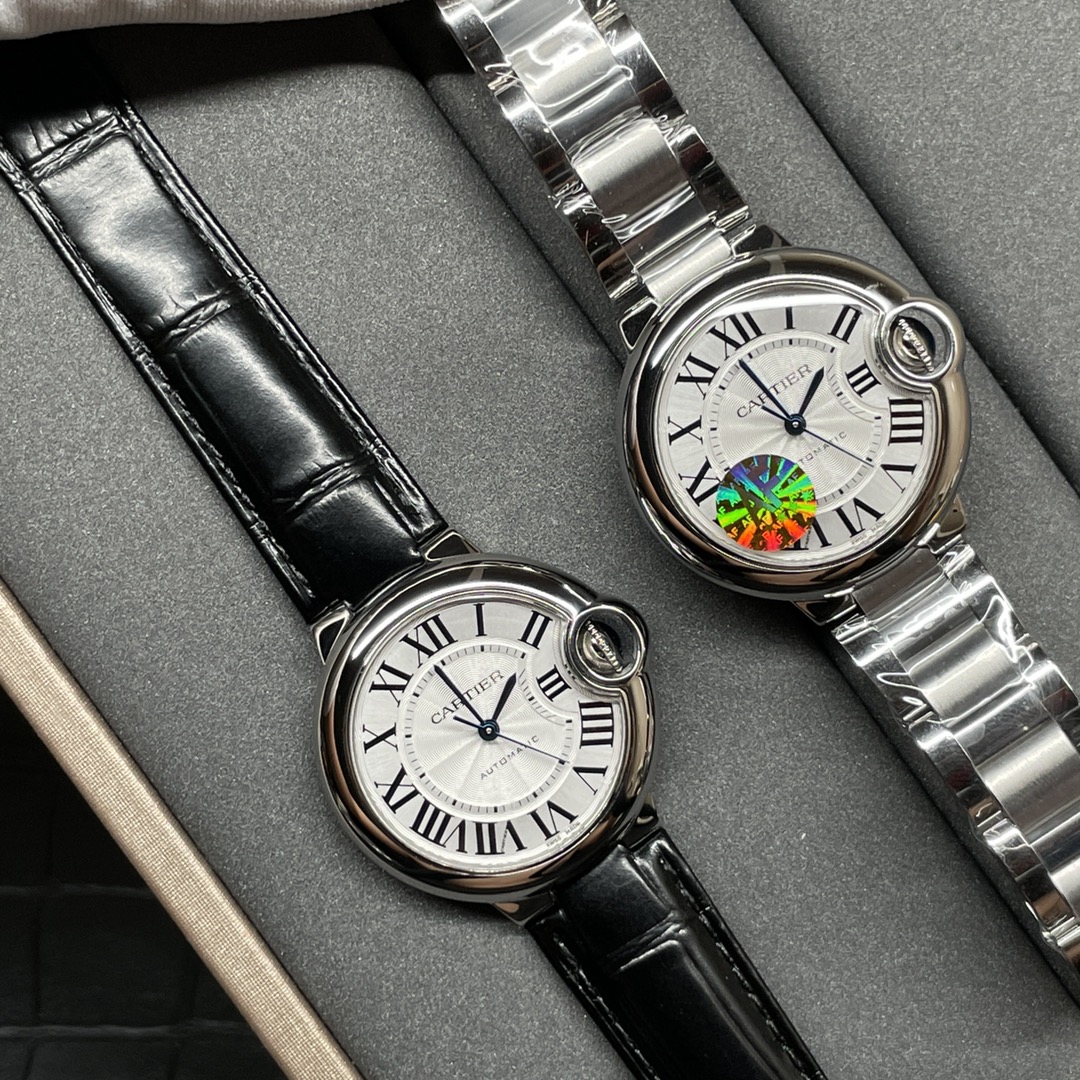
In replicas, quartz performs the same role. It allows the case to stay thin, the mid-case to remain sharp, and the dial to sit at the correct depth relative to the crystal. When you handle a well-made quartz Tank replica from a strong factory, the watch feels immediately “right” in a way that many automatic Tanks never do.
Low-end does not mean quartz. Low-end means distorted proportions.
A poorly executed automatic that adds unnecessary thickness, alters lug geometry, or forces compromises in case construction is objectively worse than a quartz replica that preserves the original design language. After months of wear, the difference becomes clearer, not smaller. The quartz watch keeps its balance. The forced automatic starts to feel clumsy.
Accuracy and reliability are also quietly on quartz’s side. A quality Swiss quartz movement will run for years with minimal drift and no mechanical stress. In a design-driven watch like Cartier, that stability aligns with the brand’s intent far better than constant mechanical adjustment.
When Automatic Cartier Replicas Actually Make Sense
Automatic movements are not wrong for Cartier. They are simply situational.
They make sense when the original watch was designed around an automatic caliber and has enough physical volume to support it without distortion. Large Ballon Bleu models fall into this category. Their rounded cases tolerate extra movement height without looking bloated, and the visual language remains intact when done correctly.
Santos is another legitimate automatic case. Both the Large and Medium Santos models were engineered to house an automatic movement from the start. When paired with a thin, well-matched caliber, the watch keeps its sharp case lines and balanced wrist presence. In these models, automatic movements feel natural rather than forced.
Where automatic movements stop making sense is equally important. Small Tanks do not benefit from them. Ladies’ Pasha models suffer from them. Ultra-thin cases lose their identity when mechanical thickness is introduced. In these watches, an automatic movement solves no real problem and creates several new ones.
The practical rule is simple. If the genuine Cartier relies on thinness, visual restraint, and flat architecture, quartz is usually the correct answer. If the genuine model was designed around mechanical depth and presence, automatic becomes reasonable.
Ignoring this distinction is how buyers end up paying more for watches that look worse, wear worse, and age faster.
Automatic Movements Used in Cartier Super Clones (Real World, Not Marketing)
Automatic movements in Cartier replicas are less about prestige and more about compromise management. Each caliber solves a specific problem, and none of them are perfect. Understanding why factories choose certain movements matters far more than memorizing movement names.
Seagull 2824 – The Most Common Cartier Replica Movement
The Seagull 2824 is everywhere because it works.
It is stable, predictable, and easy to service. Parts are widely available, regulation is straightforward, and long-term performance is well understood. For factories producing large volumes, this matters more than theoretical accuracy. When a watch comes back for service after a year of daily wear, the 2824 rarely surprises anyone.
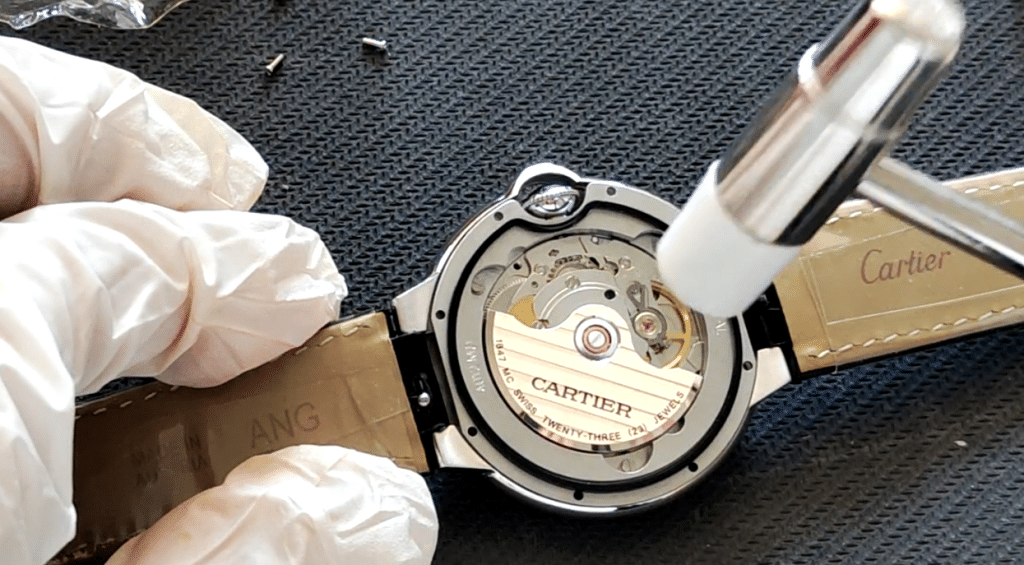
Cost control is the second reason. The 2824 allows factories to invest more resources into case finishing, dial printing, and overall assembly without pushing the watch into an unrealistic price bracket. In many replicas, this trade-off actually improves the final product.
The downside is thickness. The 2824 is not a thin movement, and no amount of marketing changes that. In slim Cartier cases, it forces compromises that cannot be fully hidden. Mid-cases become taller, casebacks protrude slightly, and the overall silhouette drifts away from the genuine watch.
Because of this, the 2824 can never be a fully accurate solution in thin Cartier designs. It is a functional solution, not a perfect one. In larger Ballon Bleu models, this compromise is tolerable. In smaller or flatter cases, it becomes obvious with extended wear.
Miyota 9015 – The Best Balance for Santos and Slim Cartier Cases
For Santos and other relatively slim Cartier cases, the Miyota 9015 is the most balanced automatic option currently available.
Its dimensions are close to Cartier’s in-house 1847 MC movement, which allows factories to preserve correct case thickness and dial depth. Functionally, it matches what matters: time, central seconds, and date where applicable. In daily use, its stability is excellent, with consistent amplitude and reliable long-term accuracy.
This is why serious Santos replicas almost universally rely on the 9015. It solves the physical problem first and avoids the cascading design errors caused by thicker movements. When the case stays right, everything else follows.
There are compromises, and they should be stated plainly. The rotor noise is real. It is not defective, but it is audible, especially in quiet environments. The movement also lacks the refined finishing and decorative identity of Cartier’s genuine calibers. These are not hidden truths; they are accepted trade-offs.
In practice, the 9015 delivers what matters most in a Cartier replica: stability, correct proportions, and predictable ownership over time.
Seagull / ETA 2892 – When Factories Aim for Thinness
The real value of the 2892 family is thinness.
Whether Seagull-produced or Swiss ETA, the 2892 allows factories to build cases that feel closer to genuine Cartier dimensions. This is particularly relevant in models where a few tenths of a millimeter determine whether the watch feels elegant or clumsy.
The difference between Seagull and Swiss ETA versions is less dramatic than marketing suggests. Swiss ETA tends to offer marginally better finishing and consistency, but both share the same architecture and physical advantages. In replicas with closed casebacks, the functional difference in daily wear is minimal.
Fully Swiss 2892-equipped Cartier replicas are rare for a reason. Supply is limited, costs are high, and many so-called “Swiss” claims rely on refurbished or mixed-origin movements. These watches may perform well, but the label itself adds little real value.
What matters is how the movement is integrated. A well-fitted Seagull 2892 in a correctly proportioned case will outperform a poorly adapted Swiss movement every time. Thinness is the advantage here, not nationality.
Quartz Movements in Cartier Replicas – The Hidden Advantage
Quartz movements are the quiet advantage in Cartier replicas because they solve the problems that actually matter. They do not add prestige, but they preserve design integrity, which is the core of the brand.
Swiss Quartz Movements Used by Top Cartier Factories
When high-level factories use quartz, they do not cut corners. They select proven Swiss quartz calibers because reliability and dimensional control matter more than branding.
Ronda movements are common for a reason. They are thin, stable, and tolerant of long service intervals. In daily wear, they drift minimally and rarely fail unless neglected for years. ETA quartz calibers appear in higher-priced replicas where tighter tolerances are required. ISA quartz movements are also used, particularly in slim cases where consistent hand alignment and low torque are critical.
These movements share three advantages that mechanical alternatives cannot match in Cartier replicas.
Thickness control is the most important. Quartz allows the case to remain flat, the bezel to stay proportional, and the crystal to sit at the correct height. This single factor determines whether a Tank or Pasha looks authentic on the wrist.
Accuracy is the second advantage. A quality quartz movement simply keeps time. There is no amplitude drift, no rotor wear, and no regulation cycle. The watch behaves the same on day one and after a year of use.
Long-term reliability is the third. Quartz movements experience less mechanical stress and fewer wear points. For owners who actually wear their watches rather than rotate them weekly, this stability becomes noticeable over time.
Why Quartz Is Often the Closest to Genuine Cartier
Quartz is often the closest match to genuine Cartier because many genuine Cartiers are quartz by design.
Tank and Pasha collections rely heavily on quartz in their authentic lineup. This is not a cost-saving measure; it is a design decision. These watches depend on thinness and visual restraint, and quartz makes that possible without compromise.
In replicas, quartz makes it easier to achieve the correct case architecture. The mid-case stays slim. The lugs retain their geometry. The dial sits where it should, not recessed or crowded. These details define authenticity more than any movement specification.
This is where factories like AF and K11 gain their advantage. Their strongest models are not built around mechanical complexity but around dimensional accuracy. The result is a watch that feels settled, balanced, and visually correct from every angle.
When the goal is to replicate how a Cartier looks and wears, quartz is often not a shortcut. It is the straight path.
Fake “Swiss Movement” Claims in Cartier Replicas (Red Flags)
Movement marketing in the Cartier replica world is full of claims designed to exploit misunderstanding. Recognizing what is impossible is the fastest way to avoid expensive mistakes.
“Swiss 1847 MC” – Why This Is Impossible
The 1847 MC is Cartier’s in-house movement. It is manufactured for Cartier and does not circulate on the open market. There is no surplus, no leakage, and no legitimate external supply.
Any replica advertised with a “Swiss 1847 MC” movement is using the term as decoration, not description. At best, it refers to a different base movement modified to resemble the layout. At worst, it is a complete fabrication.
Factories capable of building accurate Cartier replicas do not rely on this claim. They solve the problem structurally, not linguistically.
When “Swiss Movement” Actually Means Nothing
In Cartier replicas, the phrase “Swiss movement” often carries less meaning than buyers assume.
In quartz watches, Swiss origin does not imply superiority in the way it might for mechanical calibers. Reliability and accuracy are already solved problems. A Ronda quartz that fits correctly will outperform a poorly integrated automatic regardless of nationality.
In mechanical replicas, many so-called Swiss movements are refurbished ETA units with unknown service history. They may run well initially, but long-term stability is inconsistent. Parts availability and future service can also become complications.
Stability matters more than bloodline. A well-integrated movement that preserves case geometry and wears correctly will deliver more value over time than a prestigious name attached to a compromised build.
Movement vs Factory – What Actually Matters More for Cartier
In Cartier replicas, the factory matters more than the movement, and this remains true even when the movement is identical on paper. This is where many buyers misjudge quality by reading specifications instead of understanding execution.
Same Movement, Different Results – Factory Matters More
The same Miyota 9015 can produce very different outcomes depending on who installs it.
AF, GF, and BV have all used the 9015 in Santos models, yet the watches do not wear or age the same. The difference does not come from the movement itself. It comes from assembly discipline, case tolerance control, and quality control standards.
Case tolerances determine whether the movement sits perfectly flat or introduces micro stress into the case. Dial spacing affects hand alignment and visual depth. Crown tube alignment influences winding feel and long-term wear on keyless works. These are not abstract ideas. Over months of wear, they decide whether a watch stays smooth or slowly degrades.
Quality control determines whether the movement is regulated conservatively or pushed for short-term accuracy. Factories that chase aggressive timekeeping numbers often sacrifice amplitude stability, leading to inconsistency later. Better factories accept slightly looser initial accuracy in exchange for longevity.
In practical terms, the movement accounts for perhaps twenty percent of the final result. The factory’s handling of it accounts for the rest. This is why two watches with the same caliber can feel completely different on the wrist after a year of use.
Best Cartier Movement Choice by Collection
Choosing the right movement for a Cartier replica is not about chasing the most complex option. It is about matching the movement to the design logic of the collection.
Movement Recommendations by Model
Ballon Bleu
Large Ballon Bleu models tolerate automatic movements well, and Seagull 2824 remains a practical option when thickness is not critical. For smaller sizes, quartz is often the better choice, preserving the rounded case profile without distortion.
Tank
Quartz only. This is not a limitation; it is the correct configuration. Quartz maintains the flat architecture, thin mid-case, and visual restraint that define the Tank. Automatic versions introduce problems without solving any real need.
Santos
Miyota 9015 is the most balanced solution. It matches the physical requirements of the case, offers stable long-term performance, and avoids the thickness penalties of heavier calibers. This applies to both Large and Medium sizes.
Pasha
Ladies’ Pasha models are best served by quartz, maintaining elegance and comfort. Mid-size Pasha models can justify thin automatic movements such as the 2892 family when executed properly, but thickness control remains the deciding factor.
Across all collections, the guiding principle remains consistent. The best Cartier replica movement is the one that allows the case to remain correct. Everything else is secondary.
Common Beginner Mistakes About Cartier Replica Movements
Most problems with Cartier replicas do not come from defective movements. They come from wrong assumptions made at the buying stage, usually driven by habits learned from other brands.
Choosing Automatic When Quartz Is Correct
This is the most common and most expensive mistake.
Buyers often assume that automatic is an upgrade, even when the genuine Cartier reference is quartz. In practice, this choice frequently damages the watch. The case becomes thicker, the profile changes, and the watch loses the visual restraint that defines Cartier in the first place.
Over time, these watches also tend to feel less comfortable. The weight distribution shifts, the caseback sits higher, and the watch no longer disappears on the wrist the way a Cartier should. The owner ends up with a mechanically “better” watch that feels objectively worse.
Paying Extra for “Swiss” That Adds No Value
Paying more for a Swiss label without understanding context is another trap.
In quartz Cartier replicas, Swiss origin does not meaningfully improve performance. Accuracy and reliability are already solved problems. What matters is fit, hand alignment, and case thickness, not the nationality of the circuit.
In automatic replicas, “Swiss” often means refurbished or mixed-origin ETA movements with unknown service history. These movements can run well, but they do not guarantee better longevity. In some cases, they introduce more variability than modern Japanese or high-grade Chinese alternatives.
Extra cost does not equal extra correctness.
Ignoring Thickness and Case Proportion
Thickness is the silent killer of Cartier replicas.
A watch can have perfect dial printing and a respectable movement, yet still fail because the case proportions are off. This mistake is harder to notice in photos and becomes obvious only after extended wear.
Once the case loses its balance, no movement specification can save it. Cartier watches live and die by proportion. Ignoring this reality leads to disappointment that no future servicing can fix.
How This Movement Guide Works with Our Cartier Factory Rankings
This movement guide is not meant to stand alone. It exists to explain why certain factories consistently produce better Cartier replicas than others, even when they use the same movements.
Factory rankings focus on execution. Movement choice explains feasibility, but factory discipline determines outcome. When you see a factory repeatedly recommended for a specific Cartier model, it is because they understand how to integrate the movement without compromising the case.
Use this guide to understand why those rankings exist, not to override them with isolated specifications.
Final Verdict – The Smart Way to Choose a Cartier Super Clone Movement
For Cartier replicas, the right movement is the one that keeps the case correct.
1️⃣ Movement-Centric Comparison Table (Decision-Oriented)
| Movement | Type | Typical Cartier Models | Core Strength | Real Weakness | Correct Use Case | Avoid When |
|---|---|---|---|---|---|---|
| Swiss Quartz (Ronda / ETA / ISA) | Quartz | Tank (all sizes), Pasha Ladies, Small Ballon Bleu | Absolute thickness control, zero drift, long-term stability | No mechanical appeal | Any thin or design-critical Cartier | Buyers chasing “automatic prestige” |
| Seagull 2824 | Automatic | Large Ballon Bleu | Proven stability, easy service, cost-efficient | Thick, case distortion risk | Large rounded cases that tolerate height | Slim or flat Cartier designs |
| Miyota 9015 | Automatic | Santos Large / Medium | Best size-to-performance balance, reliable | Rotor noise, no brand finishing | Santos and modern Cartier automatics | Ultra-thin cases, silence-obsessed users |
| Seagull 2892 | Automatic | Mid-size Pasha, select slim models | Thin profile, closer proportions | QC dependent, harder to regulate | When case thickness is critical | Poor factory execution |
| Swiss ETA 2892 | Automatic | High-end Pasha / special builds | Thin, consistent architecture | Rare, often refurbished, expensive | Only when factory integration is proven | “Swiss” used as marketing only |