
Most replica watch discussions treat all Richard Mille-style watches as the same category, but the mechanical architecture underneath, as detailed in the RMUL2 movement guide, is what separates a convincing replica from an obvious tell. The difference between a decorative skeleton movement and an integrated movement is not just cosmetic—it changes case thickness, visual depth, balance wheel position, and long-term reliability. This article explains exactly how to tell them apart, why the price gap often makes sense, and which choice fits your priorities before you spend.
| Comparison Point | Decorative Skeleton | Integrated Movement |
|---|---|---|
| Base architecture | Modified round caliber (Miyota, Seagull) with added cosmetic bridges | Purpose-built tonneau-shaped mainplate, bridges serve structural and decorative roles |
| Balance wheel position | Usually at 7:00 (Miyota) or 6:00 (Seagull) | Typically at 11:00–12:00, matching genuine RM layout |
| Case thickness | Thicker due to round base caliber needing extra space inside tonneau case | Thinner and closer to genuine proportions |
| Visual depth | Flatter; gear train appears crowded, bridges may look added-on | Genuine three-dimensional depth; skeletonization feels intentional |
| Reliability & risk | Lower modification risk, easier to repair with standard parts | Better structural stability but harder to service; parts availability uncertain long-term |
| Best for | Budget-conscious buyers or daily-wear use where accuracy matters less | Visual purists and collectors who prioritize dial accuracy and case depth |
Quick Questions Before You Read
Q: Can you tell a decorative skeleton from an integrated movement just by looking at the front dial?
In many cases yes, especially if you check the balance wheel position. A watch with the balance at 7:00 or 6:00 is almost certainly a decorative skeleton based on a round Miyota or Seagull movement.
Q: Is a higher price always a sign of an integrated movement?
No. Some expensive replicas still use decorative skeletons with beautiful finishing. Always verify the bridge layout and gear train position in QC photos rather than relying on price.
Q: Which type is more reliable for daily wear?
Decorative skeletons are generally easier to repair because they use standard base calibers. Integrated movements offer better appearance but may become difficult to service if parts are not available.
Q: Does the weight of the watch indicate integrated architecture?
No. Weight can be faked with denser metals or thicker plates. Weight alone is not a reliable test—check the actual movement layout through a clear case-back or QC photos.
Why “Skeleton Look” and “Integrated Movement” Are Two Different Things
The Richard Mille replica market uses the word “skeleton” loosely—often misleadingly. A watch that looks open-worked through the crystal is not necessarily built around a skeleton movement architecture. This is the single most important distinction a buyer needs to understand before choosing an RM replica.
Many watches described as skeleton are simply standard base movements—Miyota, Seagull, or Shanghai calibers—that have been modified to appear transparent. The factory starts with a solid, round movement designed for generic watches, then adds decorative bridges, CNC-cut openings in the mainplate, or cosmetic plates that mimic the look of a Richard Mille caliber. The result is a movement that looks skeletonized but was never structurally intended to be one. The gear train remains in its original round layout. The bridges sit on top of the movement rather than forming part of its load-bearing structure. We call this a “decorative skeleton” or an “applied skeleton.” It is visual surgery, not structural redesign.
A genuinely integrated Richard Mille-style movement follows a fundamentally different logic. The movement is designed from the start to act as the watch’s structural frame. The mainplate is skeletonized by design, not by later material removal. The bridges serve both decorative and structural roles—they hold the gear train in position, support the balance wheel, and integrate with the case architecture. The movement shape is often tonneau-shaped or asymmetrical to match the RM case, without needing filler plates or spacers. The winding stem, crown height, and pusher positions are determined by the bridge layout, not retrofitted after the fact.
Think of it this way: a decorative skeleton is a bridge painted to look load-bearing. An integrated movement is a bridge designed to hold weight. The visual difference can be subtle in photos, but the engineering difference determines case thickness, visual depth, reliability, and the overall convincing feel of the watch on the wrist.
This distinction is not a niche technical detail. It is the fundamental engineering fork that every RM replica movement takes. Understanding which side a given watch sits on will change how you evaluate its price, its appearance, and its long-term ownership experience. The rest of this article gives you concrete tools to tell them apart.
Factory names in the replica watch market are useful buyer-facing references, but they should not be treated as official luxury-brand affiliations or automatic guarantees of quality across every model. A factory that produces a strong integrated RM055 may still release a decorative skeleton RM030 using a different movement approach. The factory name narrows the search. It does not confirm the architecture.
A Note on Misrepresentation Risk
The purpose of comparing decorative skeleton and integrated movement architecture is to help buyers evaluate what they are purchasing. It is not to provide instructions for representing a replica watch as a genuine Richard Mille. Bridge layout, mainplate construction, gear train positioning, and balance wheel location are all architectural details that affect the appearance and performance of the watch. They should be used for buyer education, quality comparison, and realistic expectation setting—not for authentication fraud or resale misrepresentation. Even the most accurate replica movement remains a replica-market product, not a genuine watch manufactured or certified by Richard Mille. Understanding this boundary is part of being an informed buyer in this category.
How a Decorative Skeleton Movement Works
A decorative skeleton RM movement starts with a standard base caliber that was never intended to look like a Richard Mille. The most common donor movements are the Miyota 8215, Miyota 9015, Seagull ST25, or Shanghai equivalents—all round, solid-mainplate movements designed for generic automatic watches. The factory then modifies them to create the illusion of an open-worked architecture.
The modification process typically involves several steps. First, the factory adds decorative bridges that mimic the shape and positioning of genuine RM bridges. These bridges are often CNC-engraved or laser-cut from brass and then coated, PVD-finished, or painted to match the RM aesthetic. Second, material is cut away from the mainplate in non-structural areas to create the impression of skeletonization. Third, the rotor may be skeletonized or replaced with a custom shape to reduce visual obstruction. Fourth, the plates and bridges are finished with Geneva stripes, perlage, or other decorative patterns to enhance the open-worked look.
Despite these modifications, the fundamental layout of the movement remains unchanged. The gear train still follows the original circular configuration. The center wheel, third wheel, and escape wheel sit in the same positions as they would in any standard Miyota 9015. The balance wheel remains in its original location—often at 7:00, which does not correspond to genuine RM architecture. The winding stem and crown position are dictated by the base movement, not by the RM case design.
The visual tells are consistent across decorative skeleton watches. The bridge layout does not match the genuine RM reference—the bridges cover areas that would be open on a real RM, or they sit in positions that have no corresponding structural role. A common example is a decorative bridge that covers the escape wheel as a purely cosmetic element, doing nothing to hold the gear train in place. The date wheel, if visible, is often positioned where no date display exists on the genuine model, making it an obvious retrofitting. The overall appearance is flatter because the bridges sit on top of a solid mainplate rather than being integrated into a multi-level structure.
This approach has a purpose. Decorative skeleton movements allow factories to offer an RM-style look at a much lower price point. The base movements are inexpensive, widely available, and well-understood by watchmakers. The modification process is labor-intensive but does not require designing a new movement from scratch. For a buyer who wants the visual impression of an open-worked RM without paying for a purpose-built architecture, a well-executed decorative skeleton can be a reasonable option—as long as they understand exactly what they are getting.
Before making a decision, buyers should review real QC photos where available, including dial printing, hand alignment, bezel position, datewheel centering, bracelet fit, clasp engraving, case thickness, and overall finishing. Factory labels and stock photos alone are not enough for a reliable judgment.
The Historical Origins of the “Skeleton Look” in Watches
The technical distinction between decorative and integrated skeletonization is not unique to the RM replica market. It has roots in watchmaking history. Skeleton watches have existed for centuries, but the definition has always required a specific design approach: bridges cut away as part of the original assembly plan, not merely adorned with open-worked covers.[1] Many older skeleton watches used modified standard ebauches with material removed from the plates, but the visual impact was still limited by the round movement architecture. In modern RM-inspired design, the barrel-shaped or tonneau profile makes a round donor movement look particularly misaligned, which is why the gap between decorative and integrated is so visible in this specific category.
In the context of luxury watchmaking, brands like Audemars Piguet and Patek Philippe also produce skeleton movements where the plate is designed from scratch with intentional openings. Richard Mille’s approach takes this further by making the movement itself the principal visible component of the watch, with the case functioning more as a protective shell around the movement rather than a housing that contains a separate module.[2] Understanding this historical layering helps the buyer see that the RM replica market is not simply about “fake vs. genuine,” but about two fundamentally different engineering philosophies that produce different results in the hand.
What Makes an Integrated RM-Style Movement Different
An integrated RM-style movement starts from a fundamentally different premise. Instead of modifying a standard round caliber, the movement is designed from the ground up to function as the watch’s structural skeleton. This is not a modification—it is a reimagining of how the movement relates to the case.
The mainplate itself is skeletonized by design. Rather than starting as a solid brass disc with material cut away afterward, the mainplate is conceived as a framework with intentional openings that define the visual architecture. The remaining material forms the structural spine of the movement, holding the gear train in precise positions while leaving large areas of the mechanism visible through the dial and caseback.
The bridges in an integrated movement serve a dual role. They are decorative in the sense that they define the visual character of the RM design—the distinctive shapes, angles, and screw placements. But they are also structural, meaning they hold the gear train components in place and contribute to the movement’s rigidity. A genuine RM movement uses cantilever bridges, carefully positioned jewels, and a specific gear train layout that is part of the architectural intent. In an integrated replica movement, the bridges follow the same logic: they are not simply added on top of a pre-existing movement; they are part of a layout that was planned from the beginning.
The gear train positioning is a clear indicator. In an integrated movement, the center wheel, third wheel, escape wheel, and balance wheel are arranged to match the RM reference. The balance wheel is typically positioned where the genuine RM places it—often around 11:00 to 12:00 depending on the model—rather than in the 7:00 position common to base movement modifications. This requires a completely different mainplate design and a reconfiguration of the gear train, not just cosmetic bridges.
The movement shape itself is often tonneau-shaped or asymmetrical, matching the RM case profile. A round movement inside a tonneau case requires movement holders, spacers, or false plates to fill the gap. An integrated movement is shaped to fit the case directly, with the winding stem, crown tube, and pusher positions aligned to match the genuine reference. This eliminates the need for adapter rings and allows the movement to sit lower in the case, contributing to a thinner overall profile.
This approach demands significantly more engineering investment. The movement cannot be assembled from off-the-shelf base caliber parts. It requires purpose-designed bridges, a custom mainplate, and often a reconfigured keyless work. The Dandong Peacock RMUL2 clone, used by top-tier factories like APS and ZF in their higher-end releases, is the most well-known example of this approach in the replica market. It was not modified from a standard caliber—it was designed to replicate the visual and structural logic of the genuine RMUL movement series.
The result is a movement that looks open-worked not because material was removed, but because it was always intended to be open. The visual depth is greater. The bridge layout follows the genuine reference. The case can be thinner because the movement does not carry unnecessary layers. For the buyer who values architectural accuracy over a lower price, this is the route that delivers the closer experience.
In super clone watch comparisons, the safer judgment is usually version-specific. A factory may be strong on one model and weaker on another because case shape, dial printing, bracelet construction, bezel action, and movement layout are not equally difficult across every reference.
Movement descriptions in the replica market should be read as configuration references, not as official brand-caliber claims unless there is clear, verifiable evidence. Buyers should distinguish between movement layout, decoration, reliability, and actual serviceability.
The Clarity That Movement Specifications Provide
Movement specifications from official manufacturers can help clarify expectations, but they must be used with care. For instance, the Miyota 9015 is officially rated at 28,800 vibrations per hour (4 Hz) with 24 jewels, a power reserve of approximately 42 hours, and a thickness of 3.9 mm.[3] These are known, measurable specifications. When a seller claims that a decorative skeleton watch contains a Miyota 9015, the buyer can verify the beat rate through a timegrapher and check the balance wheel position at 7:00 as a quick visual confirmation. However, the movement manufacturer’s documentation does not prove that the replica watch has the same finishing, reliability, or service life as any similar movement in a different brand context. Also, a movement that has been skeletonized—material cut from the mainplate—may behave differently from the documented stock configuration because the lubrication paths and structural rigidity are altered.
In contrast, integrated movements such as the Dandong RMUL2 clone do not have public official documentation from the maker. Their specifications are typically discussed in buyer communities and verified through teardown reports or timegrapher readings posted by experienced owners. This means the buyer of an integrated movement must rely more heavily on factory reputation, QC photos, and community verification rather than established manufacturer data sheets. Understanding this asymmetry is important: for decorative skeleton movements, you can often verify base specs through official sources, but for integrated movements, verification is more dependent on second-hand evidence and careful observation.
The Consequences: Thickness, Visual Flow, and Hidden Bridges
The architectural gap between decorative skeleton and integrated RM-style movements is not an abstract engineering discussion. It produces three concrete, observable consequences that directly affect how the watch looks on the wrist and how convincing it feels in daily wear: case thickness, visual depth, and the presence of bridges that serve no structural purpose.
Case Thickness: The Most Obvious Tradeoff
Decorative skeleton movements almost always require a thicker case. The reason is mechanical, not stylistic. A standard base movement like a Miyota 9015 or a Seagull ST25 has a certain height to begin with. When the factory adds decorative bridge plates, engraved covers, or structural spacers on top of that base, the total stack height increases. The movement no longer fits into the slim case profile that the genuine Richard Mille design demands. The factory is left with two bad options: accept a thicker case that looks wrong from the side, or modify the movement more aggressively to regain height. Most choose the first option.
Integrated RM-style movements take a different approach. Because the gear train and bridge layout are designed together from the start, there is no additional layer of decorative material sitting on top of a standard plate. The movement height is controlled from the beginning. The gear train can be placed more compactly, and the bridges themselves serve as structural elements rather than decorative additions. This allows the case to remain closer to the genuine thickness. It is not always thinner—some RM cases are inherently thick—but the thickness comes from the case design, not from a movement that was never meant to be there.
The difference is visible immediately on the wrist, with a decorative skeleton RM replica often looking tall and slightly bulbous from the side, especially near the crown area, impacting replica movement servicing. An integrated movement version typically has a cleaner side profile that matches the genuine proportions more closely.
Visual Flow: Depth vs Flatness
The second consequence is visual layering. A genuine Richard Mille movement is not a flat surface with bridges placed on it. It is a three-dimensional structure where bridges sit at different heights, creating shadows, depth, and mechanical complexity that changes as you tilt the watch.
A decorative skeleton movement struggles to replicate this. Because the base mainplate is solid and the bridges are added on top, the entire movement often looks flat. The bridges may be shaped to suggest depth, but they all sit at roughly the same level, so the visual experience is more like looking at a cutout than looking into a machine. The gear train may be partially visible, but it sits in a single plane, and the overall impression is two-dimensional.
An integrated movement creates genuine visual depth. The mainplate itself is skeletonized with openings at different levels. The bridges are positioned at varying heights, some cantilevered over open spaces. The gear train wheels are visible from multiple angles, and the shadows they cast change as the light moves. This is not a finishing detail that can be added later—it is determined entirely by whether the movement was designed with that depth in mind from the start. From a buyer’s standpoint, this is the single most important visual distinction that separates a convincing RM replica from one that looks like a watch with holes cut into it.
Hidden and Non-Functional Bridges: The Patchwork Problem
The third consequence is the presence of bridges that do not correspond to genuine RM architecture. In a decorative skeleton, the factory needs to cover certain areas of the base movement that would otherwise look wrong. A date disk, for example, might be visible through the dial opening on a model that should not have one. A gear train position might not match the RM layout. To hide these discrepancies, factories add bridges that serve no structural purpose—they are purely cosmetic covers meant to block the viewer from seeing the base movement underneath.
The result is a patchwork appearance. The bridge layout does not match the genuine RM movement. Some bridges are in the right position; others are clearly added to hide something. The edges of these added bridges may not line up with the rest of the architecture. The screws holding them may be in different positions than the genuine watch.
An integrated movement does not need these hidden bridges. The gear train is placed where the RM design places it. The bridges are positioned according to the genuine architecture, not according to what needs to be covered. There is no patchwork because the movement was designed to look correct from every angle, not modified to look passable from one angle.
For a buyer evaluating an RM replica, these three dimensions—thickness, depth, and bridge authenticity—are the most reliable indicators of which movement route was used. They are visible in QC photos, and they are detectable on the wrist. Ignoring them means buying based on overall impression rather than structural reality.
How the Movement Route Affects Ownership Reality
Once the watch arrives, the difference between a decorative skeleton and an integrated RM-style movement stops being a visual comparison and starts being an ownership experience. The architecture you chose affects how the watch feels, sounds, winds, and holds up over time. These factors are rarely discussed in factory marketing, but they determine whether you enjoy wearing the watch or eventually stop using it.
Reliability: The Modification Risk
A decorative skeleton movement starts its life as a standard, mass-produced caliber. It is designed for a standard watch—round, simple, with no open-worked dial to show off the gear train. To turn it into an RM replica, the factory must disassemble it, cut or machine away parts of the plates, add decorative bridges, modify the rotor, and reassemble everything. Each one of these steps carries risk.
The mainplate may be structurally weakened by the skeletonization process. The added bridges may not fit perfectly, creating stress on the gears underneath. The lubricant distribution that the original movement was designed for is now altered because air exposure is different. The rotor, cut down or reshaped for visual effect, may spin differently and affect winding efficiency. Every decorative skeleton movement is a modified movement, and modifications introduce failure points.
Integrated RM-style movements are either purpose-built or heavily reworked at the gear train level. Because the bridges and mainplate are designed together, the assembly is more stable. The gear train does not need to fight against added components. The lubricant path can be designed for an open-worked environment. That does not mean integrated movements are flawless—they are often built in smaller batches with less manufacturing refinement—but the failure mode is different. They tend to fail less from structural weakness and more from QC inconsistency or parts tolerance issues.
The practical difference for the buyer is this: a decorative skeleton movement is more likely to have an immediate or early-in-life problem related to the modification process. An integrated movement is more likely to have a later, use-based problem related to material wear.
Rotor Noise: What You Hear Matters More Than You Think
Rotor noise is one of the most common buyer complaints in RM replicas, and the cause is nearly always the movement architecture. Decorative skeletons typically use the original rotor from the base movement, sometimes with added weight or a cosmetic cover to make it look more like an RM rotor. The result is a rotor that spins freely and loudly. When you move your wrist, you hear a distinct whirring or grinding sound.
Integrated RM-style movements often use custom rotors designed for the specific case and bridge layout. The rotor is better balanced, the bearings are matched to the movement architecture, and the winding efficiency is higher. The noise level is lower, and the winding feel is more solid. The difference is noticeable in daily use. A loud rotor on a decorative skeleton watch does not necessarily indicate a defect—it is a characteristic of the architecture—but it is a characteristic that reduces wearing comfort.
Winding Feel: Generic vs Purpose-Built
The winding feel on a decorative skeleton movement is the winding feel of the donor movement. A Miyota 9015 feels like a Miyota 9015, regardless of how many bridges you put on top of it. The crown action is light, the clutch engagement is standard, and there is no tactile feedback specific to the RM model.
Integrated movements sometimes manage to capture a more solid winding feel because the case and movement are designed as a single unit. The crown is positioned where the RM design places it. The stem length and engagement angle are set up for that specific case, not adapted from a generic round case. The result is a winding experience that feels more intentional and less like an afterthought. It is a smaller detail than thickness or reliability, but it is a detail that owners notice every time they set the watch.
Long-Term Wear: Loosening, Shifting, and Parts Availability
Over time, decorative skeleton movements face a specific risk: the added bridges can loosen or shift. The screws holding the decorative plates may not be designed for the same vibration resistance as the original movement hardware. The bridges may shift slightly, creating visual misalignment that was not present when the watch was new. This does not always lead to a movement failure, but it does degrade the appearance.
Integrated movements are less prone to this issue because the bridges are structural. They are held in place by the movement’s own design, not by added screws. The tradeoff is that integrated movement parts are harder to find if something breaks. A decorative skeleton uses a base movement with millions of units in circulation. Parts are everywhere. An integrated movement may use custom components that only one factory produces, and if that factory stops supporting it, repair becomes difficult.
The buyer should understand this tradeoff clearly. The decorative skeleton route is more likely to need early attention but easier to fix. The integrated route is more stable in construction but carries a longer-term repair risk. Neither is the clear winner. The right choice depends on how long you intend to keep the watch and how much tolerance you have for potential service issues.
In short, the movement architecture does not just change what the watch looks like. It changes how the watch behaves on your wrist every single day. Rotor noise, winding feel, reliability trajectory, and repairability are all determined by the choice between decorative modification and integrated design. A buyer who ignores this choice is buying based on photos alone, and photos do not tell you how a watch wears.
Where the Price Difference Comes From
The price gap between a decorative skeleton RM replica and an integrated RM-style replica is not arbitrary. It is driven by real differences in development cost, manufacturing scale, parts count, and assembly complexity. Understanding these cost drivers helps the buyer decide whether the premium is worth paying—and just as importantly, it helps them avoid assuming that a high price automatically guarantees an integrated architecture.
Development Cost: The Starting Point
A decorative skeleton movement starts with an existing base caliber. The factory does not need to design a new gear train, a new mainplate, or a new bridge layout. They buy a standard movement for tens of dollars, then spend labor on modification. The development cost is low because the engineering is already done.
An integrated RM-style movement requires a fundamentally different approach. The bridge tooling must be designed from scratch. The mainplate may need a custom mold or CNC program to produce the correct cutouts and gear train positions. The gear train itself may be reconfigured to match the RM visual layout. All of this costs significantly more in tooling, prototyping, and testing. The factory is effectively creating a new movement, even if it borrows components from existing calibers. One Chinese reviewer noted that before mass production of the Dandong RMUL2 clone, a single integrated movement could cost thousands of dollars to develop. Those costs are spread across production batches, but they push the final price higher.
Parts Count and Manufacturing Scale
A decorative skeleton uses the same number of main components as the base movement, plus the added decorative bridges. The parts count is slightly higher, but most parts are standard, available in high volume, and cheap. The manufacturing scale is large because the underlying movement is mass-produced for many watch types.
An integrated movement often uses more parts overall, and many of those parts are specific to that movement. The bridges are custom shapes. The mainplate is unique. The gear train wheels may be repositioned, requiring different pinions or arbors. The production run is smaller because fewer RM replicas are sold compared to, say, a Submariner-style watch. Small batch manufacturing drives up per-unit cost. Custom bridge tooling alone can cost thousands of dollars and requires a minimum batch size that may still be relatively small. That cost has to be recovered somewhere.
Assembly Complexity: Skill and Time
Assembly is where the price difference becomes most tangible. A decorative skeleton movement is largely assembled like the original base movement, then the decorative bridges are added as a final step. The process is faster, requires less specialized skill, and produces more consistent results because the core movement is a known quantity.
An integrated movement with multiple bridge levels requires careful alignment. The bridges must be positioned at different heights. The gear train must be placed in a layout that is not standard. The lubricant must be applied in a way that accounts for the open architecture. The assembler needs to understand how the movement behaves when the bridges are both structural and decorative. This takes more time and more skill. In small-batch production, skilled assembly is expensive.
Is the Premium Justified?
The answer depends on what the buyer values. If the priority is a lower case thickness, deeper visual layering, and a bridge layout that matches the RM architectural logic, the premium for an integrated movement is usually justified. Those things cannot be achieved with a decorative skeleton at any price. The buyer is paying for a different level of design intent, not just for better materials.
If the priority is simply an open-worked look at the lowest possible cost, a well-executed decorative skeleton can be sufficient. The watch will look skeletonized from a distance. It will be easier to repair if something goes wrong. The buyer will spend less. They will also accept a thicker case and a flatter visual appearance. That is a valid tradeoff.
A Warning About Price Assumptions
It would be a mistake to assume that a high price always guarantees an integrated architecture. Some decorative skeleton watches are overpriced. The factory may charge a premium for finishing quality, brand reputation, or packaging, even if the movement route is still a modified base caliber. The buyer should evaluate the movement itself, not the price tag. A $900 watch that uses a modified Miyota with added bridges is still a decorative skeleton, regardless of how much it costs. A $700 watch that uses a purpose-designed integrated movement may be the better architectural choice.
The price tells you what the buyer paid. It does not tell you what the movement is. That requires looking at the movement itself, which is exactly what the next section covers.
How Trademark and Customs Realities Frame the Discussion
This entire discussion exists within a specific legal and commercial reality: replica watches are imitation products, not authorized goods from any genuine watch brand. Richard Mille is a registered trademark holder, and its designs, movement architecture, and brand identity are protected under intellectual property law.[4] Replica watches can raise trademark, customs, import, resale, and disclosure issues depending on jurisdiction. The U.S. Customs and Border Protection, for example, regularly seizes shipments containing counterfeit watches, including RM-style items, on the grounds that they violate trademark rights.[5]
This context matters for the buyer because it determines not only the legal landscape but also what information is available. Sellers of replica watches rarely provide detailed movement documentation because the product category itself operates outside official channels. The buyer cannot call a factory to verify whether a particular “integrated” movement contains a custom mainplate or a modified base caliber. The verification process relies on community knowledge, QC photos, and private correspondence with dealers. Understanding the legal framing does not change the technical differences between decorative and integrated movements, but it helps the buyer make a fully informed decision about the nature of the transaction and the risks involved. The movement architecture discussion is best conducted with reciprocal honesty: the buyer should assume the product is an unauthorized replica, and the seller should be as clear as possible about what is inside the case.
What to Look for in QC Photos and Movement Photos
By this point, the conceptual gap between decorative skeleton and integrated architecture should be clear. The next step is translating that understanding into a practical inspection routine. QC photos are not just for checking scratches or alignment—they are your primary tool for Richard Mille replica movements, verifying which movement route a watch actually uses. Without a systematic approach, it is easy to mistake a well-finished decorative skeleton for something more substantial.
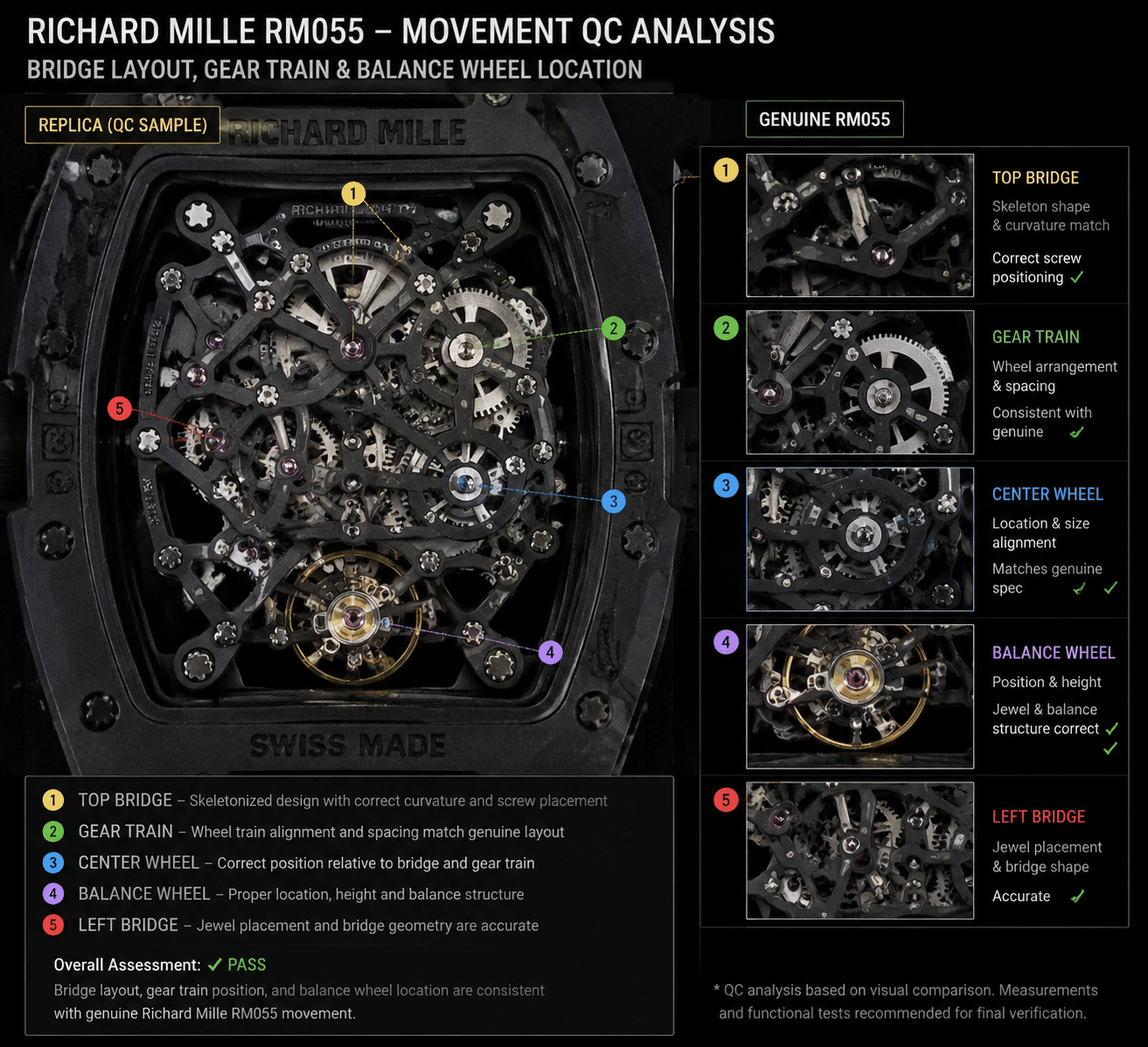
Start with the bridge layout. Open a genuine RM reference photo of the exact model you are considering. Compare the shape, position, and number of bridges. On an integrated movement, the bridges follow the genuine RM architecture closely—specific curves, cutouts, and attachment points. On a decorative skeleton, the bridges often look generic or simplified. They may cover the right areas but with different contours, or they may add extra bridges that do not appear on the genuine model. If the bridge layout looks like it could fit any skeleton watch, that is a warning sign.
Next, check the gear train positioning. On a genuine RM, the center wheel, third wheel, and escape wheel occupy specific positions that are determined by the movement’s dedicated design. On a decorative skeleton based on a Miyota or Seagull movement, the gear train follows the donor movement’s layout. The most obvious tell is the center seconds pinion. If it is dead center, that is typical of a standard base movement. Many genuine RM models use offset or asymmetrical gear train layouts. If the gear train looks conventionally arranged, you are likely looking at a modified stock movement, not an integrated build.
Examine the mainplate. On an integrated movement, the mainplate itself is skeletonized—there are cutouts that expose the gear train from multiple angles, and the plate material is visibly reduced to a structural frame. On a decorative skeleton, the mainplate is usually solid. The bridges sit on top of it, creating the illusion of openness, but the underlying plate remains largely intact. If you can see a continuous metal surface behind the bridges, that is a solid mainplate. If the view through the movement shows layered depth with gears visible at different levels, that suggests a skeletonized mainplate.
The balance wheel position is one of the most reliable checks. Genuine RM movements place the balance wheel at a specific location depending on the caliber—often between 10:00 and 12:00, or at 4:00 on certain models. A decorative skeleton using a Miyota 9015 will have the balance wheel at 7:00. A Seagull-based movement may place it at 6:00. If the balance wheel is in a position that does not match the genuine RM reference, the movement is almost certainly a modified base caliber, regardless of how decorated the bridges look.
Finally, look at the screws and finishing. Integrated movements tend to use screws that match the genuine RM pattern—specific shapes, counts, and positions around the bridge edges. Decorative skeletons often use generic Phillips or flathead screws that are standard on Chinese movements. Also pay attention to the bridge finish. A decorative skeleton can have beautifully anglage and perlage, but that craft alone does not change the underlying architecture. Beautiful finishing on a modified Miyota is still a modified Miyota.
The key is not to be fooled by surface quality. Polished bridges and engraved rotors are cosmetic. The architecture is what matters, and architecture is visible in the layout, the mainplate, and the gear train position.
Requesting the Right Photos
Most trusted dealers provide standard QC photo sets, but those may not include the angles you need to evaluate movement architecture. Be specific with your requests. Ask for a front dial close-up that shows the movement through the dial opening—this is essential for checking the balance wheel position and gear train layout. Many RM replicas have a partially open dial that reveals key components. The dealer should be able to capture this clearly. Also request a full case-back photo showing the entire movement. This allows you to examine the bridge layout, mainplate skeletonization, and screw finishing. If possible, ask for a side profile photo taken through the crystal at an angle. This helps assess the depth of the bridges and whether the movement has genuine layering or a flat, applied appearance.
Low-resolution or poorly lit photos are a red flag. A dealer who cannot or will not provide clear, well-lit movement photos is likely obscuring details that would reveal a decorative skeleton. If the photos look intentionally dark or cropped to hide the gear train, proceed with caution. Good QC photos are not a luxury—they are the only reliable way to verify what you are buying.
Comparing to Genuine RM References
Before you open any QC photos, already have a genuine RM movement image saved for the exact model you are evaluating. Do not rely on memory. The differences between bridge shapes, screw positions, and gear train layouts are subtle, and a side-by-side comparison is the only way to catch them reliably.
Start by aligning the center pinion in both images. This gives you a fixed reference point. Then trace the bridge shapes outward. Do they follow the same curves? Are the attachment screw positions in the same locations? Next, locate the balance wheel. Its position relative to the center pinion should match the genuine reference. If it is off by more than a few millimeters, the movement architecture is different. Finally, check for the presence of any additional components that the genuine movement does not have—extra screws, exposed date wheel components, or bridges that seem to cover areas the genuine leaves open. Conversely, check for missing components that the genuine movement includes. Each discrepancy tells you something about the architecture.
This process takes five minutes. It is the difference between buying a watch based on seller descriptions and buying one based on verified visual evidence.
Visual accuracy should be judged through specific details rather than broad claims. Case thickness, lug shape, dial texture, bezel tone, hand length, date magnification, and bracelet construction can affect how convincing a watch feels in real use.
Understanding the Limits of QC Photo Verification
While QC photos are the most reliable tool a buyer has, they are not a substitute for a professional inspection. QC images are typically taken under controlled lighting, at specific angles, and with the movement in a static state. They can reveal bridge layout, gear train positioning, balance wheel location, and mainplate openness, but they cannot confirm long-term reliability, lubrication quality, or assembly consistency. A movement that looks structurally correct in a photo may still have poorly aligned jewels, insufficient oiling, or tolerance issues that only become apparent after days or weeks of wear. The buyer should treat QC photos as a useful but partial verification tool—they confirm architecture, not craftsmanship.
Common Buyer Mistakes When Evaluating RM Movement Architecture
Even after reading through the technical differences, many buyers still fall for misleading signals. The RM replica market is full of watches that look convincingly skeletonized at first glance but reveal their decorative nature under closer inspection. Here are the most common mistakes and why they lead to the wrong purchase.
Mistake 1: Assuming “micro-rotor” means integrated architecture. A micro-rotor is a smaller winding rotor recessed into the movement plate, and it does sound more sophisticated than a full-sized rotor. But some decorative skeleton movements use a micro-rotor module added to a standard base caliber. The rotor itself is smaller, but the underlying movement remains a modified Miyota or Seagull with a solid mainplate. Micro-rotor is a winding system feature, not an architecture indicator. Do not confuse the two.
Mistake 2: Confusing high beat rate with advanced movement design. A movement beating at 28,800 vph (4 Hz) is common and unremarkable. Both the inexpensive Miyota 9015 and the Dandong RMUL2 clone run at this frequency. Beat rate tells you nothing about whether the movement is a decorative skeleton or an integrated build. Some of the cheapest modified movements in the market run at 28,800 vph. Do not use this as a quality signal.
Mistake 3: Believing that beautiful bridge finishing means integrated design. This is perhaps the most common trap. A decorative skeleton can have bridges that are fully anglage, perlage, black-polished, or laser-engraved with RM-style branding. The finishing can be genuinely impressive. But it is still a cosmetic layer applied to a stock base movement. The bridges may look like they belong to a purpose-built caliber, but their shape and position are dictated by the donor movement’s gear train, not by the genuine RM architecture. Beautiful finishing does not change the underlying layout. Check the positions, not just the polish.
Mistake 4: Thinking that a sapphire case-back proves the movement is good. A sapphire case-back only means the movement is visible. Some of the most clearly decorative skeletons are displayed behind sapphire. The crystal does not change the architecture. In fact, some of the worst RM replicas use sapphire case-backs specifically to create the impression of transparency, while the movement itself is a standard base caliber with added decorative plates. A sapphire case-back is a feature, not a guarantee.
Mistake 5: Assuming that heavier watches are better. Genuine RM movements use grade 5 titanium baseplates and bridges, making them extremely light—often around 4.3 grams for the entire movement. Replica movements using brass or steel plates are significantly heavier. A heavy RM replica is often a sign of a decorative skeleton with a solid brass mainplate. Conversely, integrated movements that use lightweight materials and skeletonized mainplates can be noticeably lighter on the wrist. Do not equate heft with quality in an RM replica. In this context, lighter is usually more accurate.
Mistake 6: Over-relying on factory reputation for movement architecture. A factory that is known for producing excellent Rolex replicas or high-end Audemars Piguet models does not automatically make a good RM movement. Some factories make both decorative skeleton and integrated movements for different models and different price tiers. The same factory name can appear on a modified Miyota watch and a Dandong clone watch. Factory reputation is a starting point, but it is not a substitute for checking the specific movement in the specific watch you are considering. Always verify through QC photos, not through brand loyalty.
Editorial Perspective: At cleanvsfactory.com, we treat the debate between decorative skeleton and integrated RM movements as a model-specific buying question rather than a simple quality ranking. A factory name like APS or ZF may indicate a higher likelihood of integrated architecture, but only for certain models and specific release batches. The same factory that produces an excellent integrated Dandong-based RM055 may also release a decorative skeleton RM030 using a modified Miyota. Relying on the factory name alone is not enough. The buyer’s real tool is the QC photo—specifically the bridge layout, mainplate openness, and balance wheel position. A factory name narrows the search. A photo confirms the architecture. One without the other leaves too much room for assumption. We also caution against assuming that a higher price always reflects an integrated build. Some decorative skeleton watches carry premium pricing due to decorative finishes or seller markup. Price is useful context, but it is not architectural proof. Always verify before committing. This kind of model-specific, photo-verified approach is the only way to avoid buying a watch that looks right in the listing photo but feels wrong on the wrist.
Claims such as “perfect,” “same as genuine,” or “guaranteed to pass inspection” should be treated with caution. A more reliable comparison looks at the actual model version, movement configuration, finishing details, and available QC evidence.
A Note on Movement Terminology in the Replica Market
Movement descriptions in the RM replica market can be misleading even when the seller intends to be helpful. Terms like “skeleton movement,” “tourbillon movement,” “micro-rotor movement,” or “geneva-striped movement” are often used loosely and refer more to the appearance of the caliber than its actual construction. A movement described as “skeleton” may still be a solid-mainplate Miyota with cosmetic bridges. A movement described as “micro-rotor” may use a module that sits on top of a standard base caliber rather than a true integrated micro-rotor architecture. Buyers should not take movement terminology at face value. Instead, they should use the descriptive terms as starting points for verification through QC photos and community discussion, not as final architectural descriptions.
Making the Decision: Which Movement Route Fits Your Priorities
There is no universal answer to the question of which movement architecture is better. The right choice depends entirely on what you value in the watch. The framework below is designed to help you match your priorities to the appropriate movement route. Be honest about what matters most to you, because the tradeoffs are real.
The budget-conscious buyer. You want the open-worked look but you are working with a limited budget. You are willing to accept a slightly thicker case and a less accurate bridge layout in exchange for a lower price. A well-executed decorative skeleton based on a reliable Miyota or Seagull movement can serve you well, provided you understand what you are getting. The watch will look skeletonized at a glance, but under close inspection the architecture will not match the genuine RM. Your tradeoff is visual impression at conversational distance versus structural accuracy up close. For many buyers in this category, that is an acceptable compromise.
The visual purist. You care about the depth, layering, and bridge accuracy of the movement. You want the watch to look convincing not just from a meter away, but also when you examine it closely. You are willing to pay more for a movement that follows the genuine RM architecture. An integrated movement with a skeletonized mainplate, correct gear train positioning, and accurate bridge layout is the right choice for you. Your tradeoff is higher cost and potentially harder serviceability. But if visual authenticity matters most to you, the premium is justified.
The daily-wear buyer. You plan to wear the watch regularly, not just occasionally. Reliability, winding feel, rotor noise, and long-term durability matter more to you than absolute bridge accuracy. In this case, a well-proven decorative skeleton using a common base movement may actually be the smarter choice. The donor movement is widely available, easy to service, and predictable in its behavior. If a problem arises, any competent watchmaker can work on it. An integrated movement, while visually superior, may be harder to repair and more likely to cause headaches if something goes wrong. For daily wear, reliability often wins over visual perfection.
The collector. You want the closest architectural approach to the genuine RM concept. You are not shopping for a daily beater. You appreciate the engineering effort behind a purpose-designed movement, even in replica form. The integrated route is your clear choice. You understand that it may require more careful handling, that service options are limited, and that the price is higher. But for you, the movement is part of the experience. The compromise is acceptable because the architectural intent aligns with what you value.
Regardless of which profile fits you best, a few things remain true across the board. Good QC photos are non-negotiable. Honest communication with your seller about what the movement actually is matters more than any factory name. And realistic expectations about what a replica movement can and cannot do will save you from disappointment. The gap between decorative skeleton and integrated movement is not about one being universally better. It is about knowing which one you are buying and why that choice makes sense for you.
A replica watch should be evaluated with realistic ownership expectations. Even a strong super clone can have limits in water resistance, long-term movement stability, servicing convenience, and close inspection compared with a genuine reference.
[1] “Skeleton Watches: A Brief History,” Monochrome Watches, 2021, accessed via Monochrome Watches.
[2] “Richard Mille: The Movement as the Face of the Watch,” Hodinkee, 2020, accessed via Hodinkee.
[3] “Caliber 9015 Specifications,” Miyota / Citizen Watch Co., official technical datasheet, accessed via Miyota Caliber.
[4] “Trademark Basics,” United States Patent and Trademark Office (USPTO), official government guidance, accessed via USPTO.
[5] “U.S. Customs and Border Protection Seizes Counterfeit Watches Worth Millions,” U.S. Customs and Border Protection, press release, 2023, accessed via CBP.
Disclosure: This article is for general educational and comparison purposes only. Replica watches are not genuine products from the original luxury brands, and brand names such as Richard Mille are used only to identify reference designs or comparison topics. Factory names, movement descriptions, prices, availability, QC details, seller policies, and version information can change, so readers should verify important details with the seller before making a purchase decision. Replica watches should not be represented, resold, or used as genuine watches. The architectural differences discussed here are intended to help buyers evaluate quality and risk, not to facilitate authentication deception or misrepresentation.