
Many buyers focus on dial details when judging an RM super clone, as covered in movement categories, but the real tell is hidden behind the caseback. The movement layout—specifically the position of the barrel, gear train, and balance—determines how convincing the watch looks on the wrist. A dial with excellent finishing cannot fix the visual clutter, high crown, or extra thickness caused by a standard center-layout movement. This article explains why the RMUL2-style architecture, with its offset barrel at 5 o’clock and left-side gear train, is the single most important factor in separating a serious super clone from an ordinary replica. You will learn exactly what to check in QC photos and how to avoid paying a high-tier price for a mid-tier build.
| Movement Type | Visible Tell on Front Dial | What to Check in QC Photos |
|---|---|---|
| Modified standard caliber (e.g., Miyota 8215) | Cluttered, dense center; flat skeletonization with no depth; barrel hidden or centered | Ask for clear front photo; look for dense gear train around the center pinion |
| Dedicated RMUL2-style clone | Open, airy dial layout; barrel visible near 5 o’clock; gear train runs along left side | Verify low barrel position near 5-6 o’clock; check for open bridge structure |
| Standard caliber build (compromised case) | High crown position relative to mid-case; thicker side profile | Compare crown height against the mid-case line—should sit low |
| RMUL2-style clone (correct case geometry) | Crown sits low in the mid-case; overall side profile is slimmer | Review side-angle photo; crown should not protrude high above case edge |
| Standard caliber (lower cost) | Acceptable for casual buyers who prioritize lower price over visual accuracy | Movement photo may not reveal openness—seller may avoid a caseback shot |
| RMUL2-style clone (higher cost) | Better daily-wear feel; quieter rotor; requires specialist servicing | Weight, rotor noise, and crown ergonomics should feel noticeably better on wrist |
Quick Questions Before You Read
Q: Does dial finishing matter more than the movement in an RM super clone?
No. A decorated dial cannot hide the visual clutter, high crown, or thick side profile caused by a standard center-layout movement. The movement architecture determines how convincing the watch looks from every angle.
Q: How can I tell which movement is inside from a QC photo?
Request a clear front movement photo. If the barrel is centered or the gear train looks dense and flat around the middle, it is likely a modified standard caliber. A low barrel near 5 o’clock and an open left-side gear train indicate a dedicated RMUL2-style clone.
Q: Is a standard modified caliber always a bad choice?
Not always. If you prefer a lower price and do not mind the thicker case and higher crown, it can still be a functional watch. But you should pay less for it and not expect the same visual accuracy as a correctly laid-out build.
Q: What if the seller avoids showing a clear movement photo?
That is a red flag. Sellers who do not provide clear front and caseback movement shots are likely hiding a weak layout. If they cannot confirm the architecture, assume it is a standard modified caliber and price it accordingly.
Why Movement Layout Is the Deciding Factor in RM Super Clones
Most RM-style replicas look acceptable in a front-facing dial shot. The skeleton layout appears open, the bridges have some shape, and the rotor carries a recognizable logo. But on the wrist, something feels off. The case looks thicker than expected. The crown sits higher than it should. The side profile does not match the proportions that make Richard Mille watches visually distinctive.
The root cause is not dial printing. It is not rotor decoration. It is not even the quality of the carbon case. The problem is the movement’s physical layout. A genuine Richard Mille movement like the RMUL2 positions its bridges, mainspring barrel, and gear train at specific heights and off-center angles within the case. When a replica uses a standard modified caliber, those components stay in their original positions, and the case must be reshaped around them. The result is a thicker watch, a misplaced crown, or a movement compartment that looks cramped rather than intentionally open.
This is why movement layout, not dial complexity, is the silent benchmark that separates serious RM super clones from ordinary “RM-style” watches. A high-end build with a dedicated RMUL2-style architecture carries its structural credibility from every angle. A decorated modified caliber may look similar in a flat photo, but the moment you turn the watch sideways, the compromise becomes visible. The good news is that most buyers can detect this difference from QC photos without opening the case. The crown height relative to the mid-case, the density of visible bridges, and the position of the barrel are all readable from standard seller images.
The next sections break down exactly what the RMUL2 layout does, and what to look for in photos. But the premise is simple: if the movement architecture is wrong, no amount of dial finishing compensates for it.
Editorial Perspective: The RMUL2 layout conversation tends to oversimplify when reduced to a single factory name or price tier. A buyer may assume that any replica sold under a well-known factory label automatically uses the correct movement architecture, but this is not reliable across all models and versions. At cleanvsfactory.com, the RMUL2 architecture is treated as a model-specific verification point, not a factory-wide guarantee. Even a reputable factory may produce an earlier version using a modified standard caliber with decorative bridges, then release a later version with a dedicated clone movement. The factory name helps narrow the search, but the buyer still needs to confirm the movement generation through visible indicators — barrel position, gear train path, bridge depth — in the specific watch being purchased. A seller who calls a watch “high-tier” without showing these details is asking for trust that the photos should already justify. The movement layout is not something to infer from reputation. It is something to verify from images.
What the RMUL2 Architecture Actually Controls: Bridge Layout, Barrel Position, and Gear Train Path
The RMUL2 layout can be understood as a three-part system. Each part determines whether the movement looks like a purpose-built skeleton architecture or a standard caliber with material cut away.
First, the barrel position. In the RMUL2 architecture, the mainspring barrel sits low in the case, roughly at the 5 o’clock position. This leaves the upper half of the movement visually open. The barrel bridge is visible, but it does not dominate the center of the watch. The effect is a sense of depth: the eye travels from the upper open section down to the barrel, then into the lower movement area. In a replica, if the barrel is not visible in this low position, the movement is almost certainly using a standard center-barrel layout with decorative plates covering it.
Second, the gear train path. In a standard automatic movement, the gear train runs through the center of the watch. In the RMUL2, the gear train runs along the left side of the movement. This is not a cosmetic choice — it is a mechanical decision that changes the entire case architecture. The crown aligns with the left-side gear train, which means the crown sits lower on the case flank. If a replica movement keeps a central gear train, the crown must sit higher to reach the winding stem, and the case must be shaped to accommodate that offset. The left-side gear train is the clearest structural signature of an RMUL2-style movement.
Third, the balance and escapement position. The balance wheel and escapement assembly sit at the lower-right side of the movement, roughly at 6 o’clock or slightly lower. Together with the low barrel at 5 o’clock and the left-side gear train, this creates a distinct visual triangle. The movement is not symmetrical. It is not balanced around a center point. It is deliberately offset, and that offset is what gives RM watches their recognizable skeletonized appearance. The bridges are not simply hollowed out for decoration — they are shaped around a specific mechanical arrangement.
For a replica, replicating this layout correctly means the case, crown height, and side view all align naturally. If the movement uses a standard center-gear-train layout, the bridges must either be fake overlays or the case must be made thicker to hide the mismatch. The difference is not subtle once you know where to look.
Buyers should consider that movement descriptions in the replica market — such as “RMUL2-style” — are references to a design architecture and layout, not to an official Richard Mille- or brand-manufactured caliber. The visual confirmation of that architecture through QC photos and movement details is a more reliable guide than the marketing name alone.
Distinguishing the RMUL2 from Other Movement Families in the Market
Buyers who research RM super clones will encounter several movement families, including the Seagull ST-series, the Miyota 9015, and the Shanghai 7750. Each has its own layout characteristics, power reserve, and winding behavior. Understanding the difference between these platforms and a dedicated RMUL2-style clone is essential for assessing price claims.
Seagull’s ST-series, for example, is a workhorse platform with a center-barrel, center-gear-train layout. The ST2130 offers 28,800 bph and a 42-hour power reserve, but its dimensions and bridge placement are designed for conventional circular cases, not tonneau skeleton formats. Even with heavy decoration, the ST2130 retains its centered architecture, which forces the crown upward and the case outward. A Seagull-based build can be reliable, but it will rarely achieve the open, layered look of a genuine RMUL2 layout.
The Miyota 9015, at 3.9mm thick, is thinner than many Asian alternatives and offers 28,800 bph with hacking and hand-winding. Its slim profile may initially seem like an advantage for tight case volumes. However, the 9015’s gear train still runs through the center, and its barrel is positioned close to the movement center. When placed in an RM-style case, the movement must be offset or topped with decorative plates, and the crown height remains a visual giveaway. Official Miyota specifications indicate that the 9015 uses a center rotor, center second hand, and a four-pinion gear train configuration — all features that run counter to the offset architecture of the RMUL2.
The Shanghai 7750, by contrast, is a thicker chronograph platform with a different mechanical profile entirely. Some RM chronograph replicas use stripped-down 7750 movements with fake bridge overlays, but the base geometry remains centered. The 7750’s 30,000 bph and 12-hour chronograph register can function, but the visual tells — crown height, barrel visibility, bridge depth — remain visible. For a buyer evaluating a skeleton RM with date or power reserve complications, as detailed in decorative skeleton vs integrated movement, the movement family should be confirmed not just by name, but by visual inspection of barrel and gear train placement. A movement family that works well in a conventional sports watch does not necessarily translate to a correct RM super clone.
Movement Transparency Note: Movement references in this article describe the replica-market movement type or configuration, not an official Richard Mille, Swiss-manufactured, or luxury-brand caliber unless explicitly stated with verifiable evidence. The designations “Seagull ST-series,” “Miyota 9015,” and “Shanghai 7750” refer to widely available Asian-sourced movements commonly used in replica watch construction. Their positioning within an RM-style case is a matter of replica-market engineering, not an indication of brand affiliation or officially sanctioned use.
The Problem with Standard Modified Calibers: Why “Decorated” Doesn’t Mean “Correct”
A standard automatic movement — whether a Miyota 8215, an Asian clone 2813, or a Shanghai 7750 — places its barrel at center, its gear train through center, and its balance wheel at 7 to 8 o’clock. This layout is compact, reliable, and designed for conventional round watch cases. It is not designed to sit inside an RM-style tonneau case with an open, asymmetrical skeleton profile.
To make these movements look RM-like, replica manufacturers engrave or attach decorative bridge plates over the center of the movement. The bridges may carry the right shape, the right beveling, and even the right screw placement. But underneath, the barrel is still at center, the gear train still runs through the middle, and the balance is still tucked into the lower-left quadrant where it was always designed to sit. The decoration covers the problem but does not solve it.
This creates three visible problems that matter in daily wear:
First, the movement looks cluttered rather than deeply skeletonized. Because the barrel and gear train are centered, there is no open space in the upper half of the movement. The decorative bridges sit on top of a dense mechanical core, so the eye sees a flat, busy surface rather than a layered structure with gaps between components. The depth that makes RM watches visually striking never materializes.
Second, the crown position shifts upward. A standard movement’s winding stem sits near the middle of the caliber. To reach it, the crown must align with that point. In an RM case designed for a lower crown position, a modified caliber forces the crown upward or outward. The result is a crown that sits noticeably higher on the case flank than the genuine reference. In side-profile photos, this is one of the fastest tells.
Third, the case must be thicker. When a standard movement is fitted into an RM case with decorative bridges above it, the total height increases. The case must expand to contain both the original movement height and the added decorative layer. The genuine RMUL2 movement is a compact, manually wound caliber under 4mm thick. A modified automatic movement with added bridge plates can exceed that by a wide margin. The case thickness becomes the giveaway that no dial decoration can hide.
None of this means modified movements are unreliable. A well-maintained Miyota 8215 can run accurately for years. But reliability and visual correctness are two different questions. A modified caliber can keep good time and still look wrong from every angle that matters in a super clone.
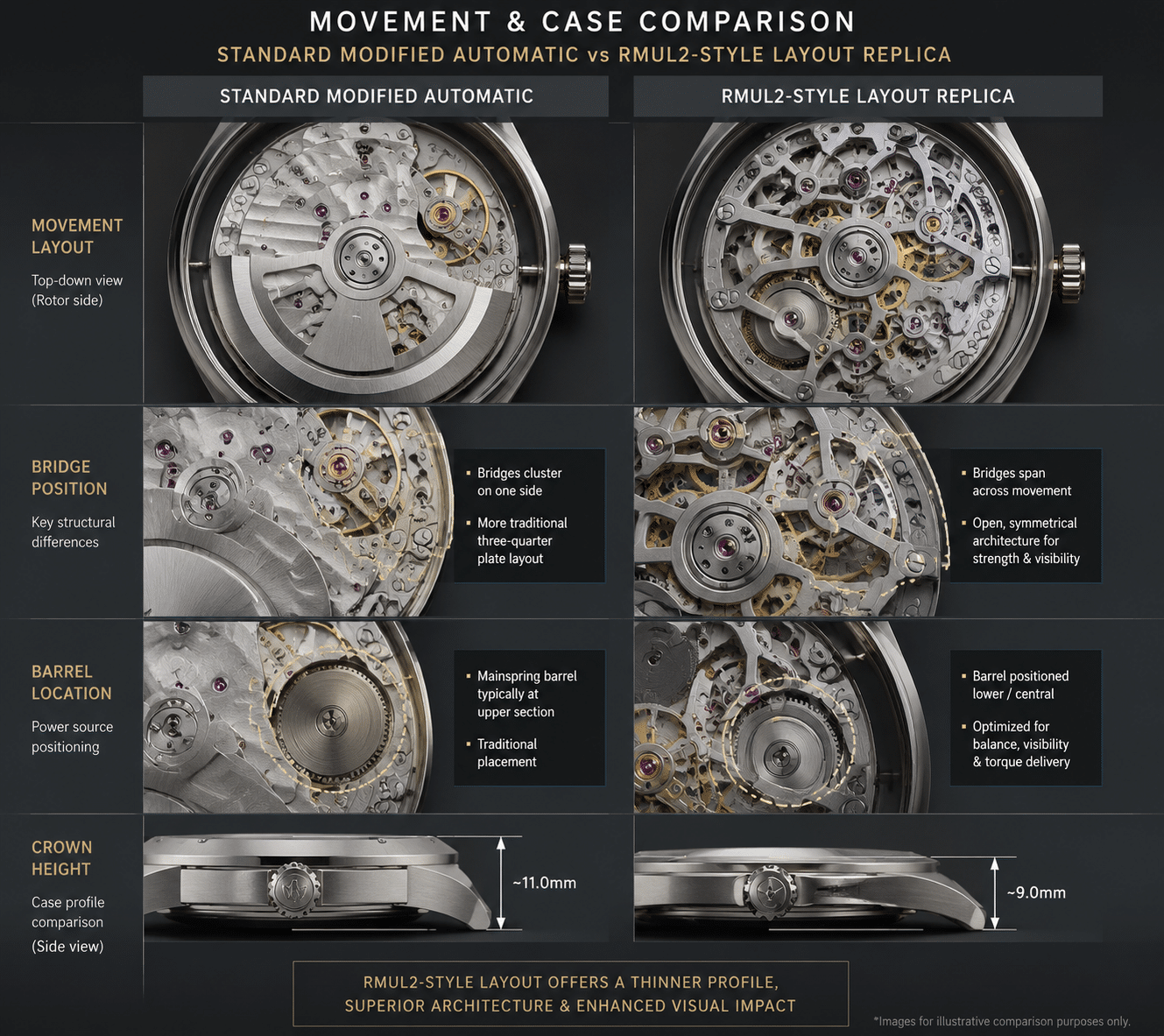
How the RMUL2-Style Layout Improves Case Fit and Side-Profile Correctness
The relationship between movement layout and case dimensions is where most RM replicas break down. A buyer can judge a front dial photo and feel satisfied with the skeleton appearance, but the moment they see a side profile or put the watch on a wrist, the structural compromise becomes obvious. This is not a dial issue. It is a movement-position issue. And it is precisely where the RMUL2-style architecture earns its reputation as a benchmark.
In a genuine RMUL2 design, the mainspring barrel sits low inside the case, positioned near the caseback at roughly the 5 o’clock location. The gear train runs along the left side of the movement rather than through the center. The balance and escapement assembly occupy the lower-right area. This arrangement creates a thin, open upper section inside the movement, which directly allows the case to remain relatively thin — typically in the 12mm to 13mm range for most RM models in this family. The crown aligns naturally with the lower third of the mid-case because the winding stem connects to a movement whose critical components are already positioned low. There is no need to raise the crown or thicken the caseband to accommodate a central barrel or a centered gear train.
When a replica instead uses a standard modified caliber — say, a Miyota 8215 or a similar center-gear-train movement — the barrel and gear train occupy the upper half of the movement volume. To fit this inside an RM-style tonneau case, the builder has three options, none of them ideal. The first is to make the case thicker overall, which is why many budget RM replicas measure 15mm or even 18mm at the mid-case. The second is to top the movement with a decorative plate that fills the upper visual space, but this pushes the caseback outward or forces the crystal higher, distorting the side profile. The third is to mount the movement at an angle or offset, which misaligns the crown height. In all three scenarios, the side profile betrays the watch. The crown sits too high. The mid-case looks bulky. The overall silhouette no longer carries the visual language of a genuine RM.
Consider the RM 055 as a concrete example. The genuine case profile is relatively lean, with a crown that sits low against the caseband. A dedicated RMUL2-style replica movement preserves this geometry because the barrel sits where it should — low and off-center. The gear train runs along the left flank, leaving the upper case volume visibly open. The result is a side profile that looks intentional. The crown lines up. The mid-case does not look overstuffed. The watch wears more naturally because the case dimensions were dictated by the movement layout, not the other way around. This is why side-profile QC photos are the first place to check whether the movement layout is correct.
An important nuance about model-specific fit. The RMUL2 layout is not equally critical for every Richard Mille reference. Models with more complex dial furniture, thicker sapphire stacks, or non-skeletonized dials may partially mask a standard center-layout movement. However, for the core RM silhouettes — the RM 010, RM 035, RM 055, and the RM 67-02 family — where the dial is largely open, the movement architecture is the primary visual anchor. A buyer considering a skeleton RG or carbon case model should weigh whether the dial openness makes the layout visible at a glance. If the barrel can be seen through the front crystal, the layout matters. If the dial is densely layered with multiple subdials or decorative inserts, the movement architecture may be less noticeable, and the buyer may decide a modified caliber is acceptable for their use.
When comparing RM super clones, a movement architecture that is correct for one model reference may not carry over to another. The visual impact of the RMUL2 layout depends on how much of the movement is visible through the dial and caseback. A buyer should verify the layout against the specific reference, not assume it applies universally across an entire factory line or price bracket.
What to Check in QC Photos: Movement Visibility Indicators
You do not need to open the caseback or disassemble the watch to evaluate whether an RM replica uses a dedicated RMUL2-style layout or a modified standard caliber. The evidence is visible in QC photos if you know where to look. Here are five indicators that separate a layout-correct build from a decorated one.
Bridge openness through the front crystal. In a correct RMUL2 layout, the bridges are deeply skeletonized with visible open space between structural components. The movement does not look like a solid plate with cutouts. If the view through the crystal shows a dense, flat surface with engraved patterns rather than real depth and air between bridges, the movement is almost certainly a standard caliber topped with a decorative plate. The bridges should not look like they are sitting on top of a solid base — they should look like they are the base.
Barrel position. The mainspring barrel should be visible in the lower portion of the movement, roughly between the 5 o’clock and 6 o’clock positions. If the barrel sits at or near the center of the movement, the architecture is center-based, not RMUL2-style. This is one of the fastest checks you can make from a straight-on dial photo.
Crown height in a side-profile photo. Request a side-profile shot showing the crown against the mid-case. On a correct layout, the crown aligns with the lower third of the caseband, not the middle or the upper edge. If the crown sits high — near the center of the mid-case or above — the movement’s winding stem position forced the crown upward, which means the architecture is wrong. This indicator does not require magnification or expertise. It is simply a matter of looking at where the crown meets the case.
Caseback view. A caseback photo reveals the gear train path and barrel position more clearly than the front. A correct RMUL2-style layout shows an off-center gear train running along the left side and a barrel positioned low. A modified standard caliber shows a central rotor, a centered gear train, or a dense arrangement of components that do not follow the offset pattern. If the seller cannot provide a clear caseback photo, treat this as a warning sign. It often means the movement layout would reveal telltale modifications.
Fake bridge detection. If the movement looks densely engraved rather than deeply structured, suspect decorative plates. Fake bridges are usually thin, surface-level pieces of metal that are screwed or glued over a standard movement. They lack the functional appearance of real structural bridges. Look for unnatural contours, abrupt changes in surface finish, or screws that seem purely cosmetic. A real RMUL2 layout uses bridges that serve as the actual structural frame of the movement — they are not ornaments.
When reviewing these indicators, it is important to remember that even a well-known factory may produce different versions over time. An earlier batch may use a modified standard caliber with decorative bridges, while a later batch from the same factory may use a dedicated RMUL2-style clone. The factory name alone does not guarantee which generation of movement is inside any particular watch. The QC photos for that specific unit provide the only reliable evidence. Buyers should treat each watch as an individual case and verify the layout from the images provided, rather than assuming consistency across production runs.
What to Ask Your Seller Before Payment
Request these specific photo angles: a straight-on front dial photo with the crown at 3 o’clock, a 45-degree angled shot showing bridge depth, a side profile showing crown height against the mid-case, and a caseback view. If the seller cannot provide a clear caseback photo, this is often a sign that the movement layout would reveal telltale modifications.
Verification Note: When evaluating an RM super clone, stock images and factory labels alone are not sufficient for a reliable judgment. Buyers should review real watch photos showing dial details, bridge depth, caseback structure, crown height relative to the mid-case, and barrel position before making a decision. The specific photo angles, as outlined in the Richard Mille replica movements, — front dial, 45-degree bridge depth, side profile, and caseback — can help reduce uncertainty. A seller who provides clear, well-lit images for each of these angles is more likely to be transparent about the movement architecture. Relying on brand reputation or promotional statements without visual confirmation carries a higher risk of misidentifying the build tier.
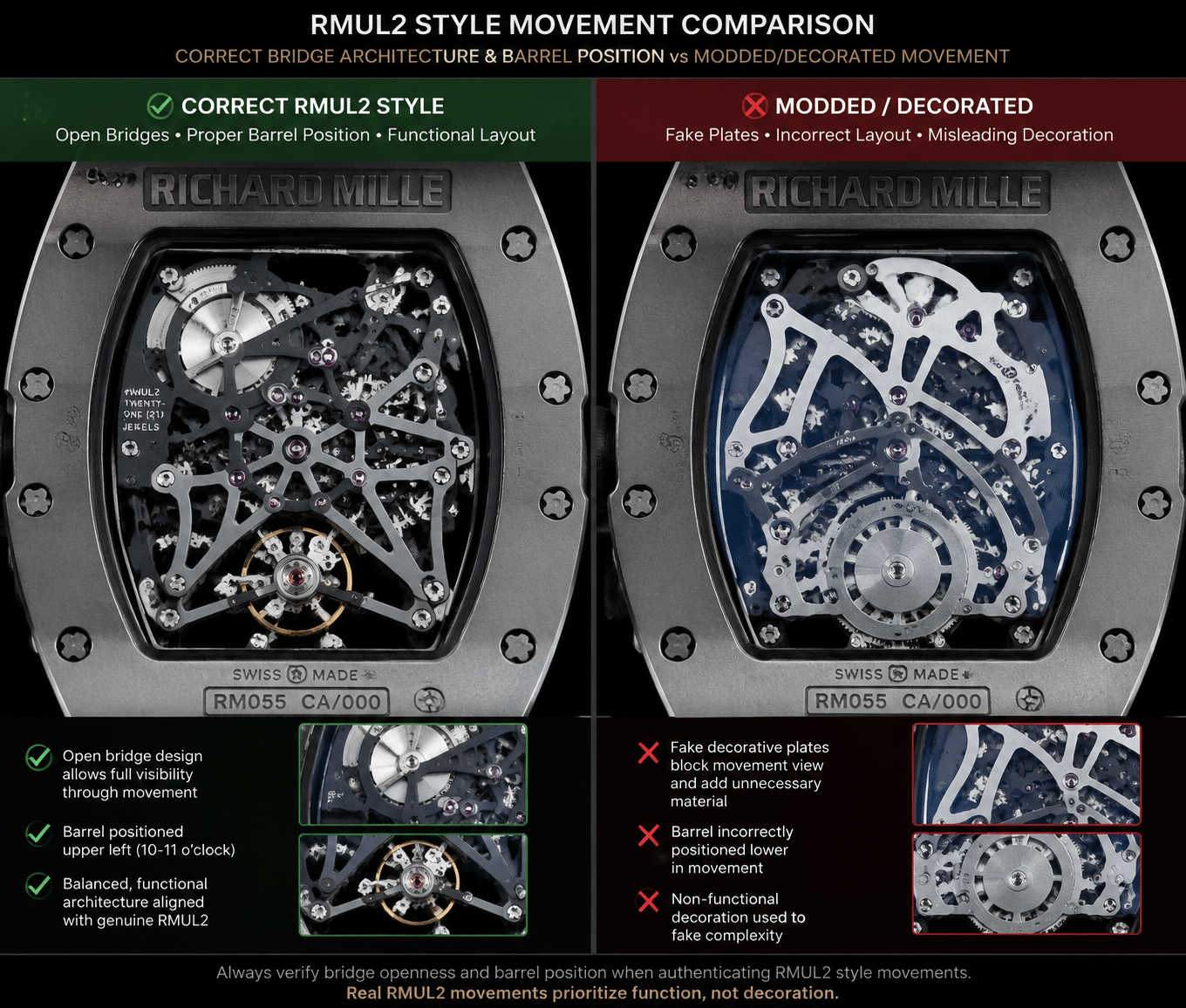
Why Movement Layout Affects Daily Wear and Long-Term Reliability
The movement layout does not only determine how a watch looks from the side. It also affects how the watch feels during daily use and how stable it remains over time. This is where the practical tradeoff between a dedicated RMUL2-style build and a modified standard caliber becomes most tangible for the owner.
A movement designed for an offset architecture — barrel low, gear train along the side — has winding geometry that matches the case shape. The crown turns the winding stem at a natural angle, and the barrel receives torque along its intended axis. By contrast, a standard center-gear-train movement that has been tilted, shifted, or packed into an RM-style case experiences uneven stress. The winding stem may be angled relative to the crown tube. The barrel may be off-axis relative to the gear train. Over time, this creates additional friction in the keyless works and the winding mechanism. The watch may feel stiff when winding, or the crown may have an inconsistent resistance. These symptoms are not signs of poor manufacturing in the general sense — they are direct consequences of a movement being used in a case shape it was never designed for.
Rotor noise is another tell. Modified movements that have been repositioned inside a larger case cavity often develop louder rotor noise because the rotor swings with more clearance or because the movement was not secured at its intended mounting points. A dedicated RMUL2-style build, where the movement was designed for the case volume, usually has quieter rotor operation because the clearances are tighter and the movement sits in its natural orientation. This difference is noticeable in quiet environments or when the watch is on a desk and the rotor spins freely.
On serviceability, the tradeoff is worth stating plainly. Standard modified calibers — Miyota 9015, Seagull ST-series, Shanghai movements — are widely available and relatively easy to service or replace. Parts are cheap and any competent watchmaker can work on them. Dedicated RMUL2-style clone movements, by contrast, are harder to repair. They use custom bridge plates, unique barrel positioning, and non-standard gear train paths. If something breaks, finding a replacement part may take time, and not all watchmakers will want to attempt the repair. The tradeoff is that during daily wear — for months or years before service is needed — the dedicated layout provides a more convincing profile, a more natural winding feel, and a watch that fits the case the way it should. For most buyers, that tradeoff is worth making. But it should be an informed decision, not a surprise after purchase.
Movement Complexity as a Buyer Risk Factor
A separate but related consideration is that not all RM references require the same level of movement complexity. A model with a simple time-only display and a single subdial, like the RM 010, is more forgiving of a standard modified caliber than a model with a split-seconds chronograph, a torque indicator, or a power reserve display. Complicated dial layouts place more mechanical demands on the movement. If the replica uses a modified standard caliber with added modules for subdials, the likelihood of functional issues — sticking chronograph pushers, misaligned subdials, or inconsistent power reserve indication — increases significantly. For these models, a dedicated RMUL2-style clone movement is not just a visual advantage. It is a functional necessity. A buyer considering a skeleton RM with multiple complications should prioritize confirmed movement architecture above almost every other selection factor. A simple time-only RM, by contrast, may still be acceptable with a well-finished modified caliber if the primary goal is keeping a lower budget.
Understanding the Risk of Misrepresentation
An important topic that is rarely discussed openly in RM super clone forums is the risk of a replica watch being misrepresented — either by a seller who exaggerates its tier, by a buyer who hopes it passes as genuine, or by an online listing that uses ambiguous language to blur the line between a replica and an authentic watch. The movement layout discussion in this article is intended to help buyers understand what they are actually purchasing, not to help them present a replica watch as something it is not.
A seller who claims “same as genuine” or “1:1 perfect” for a watch with a modified standard caliber is making an inaccurate statement. A buyer who uses that same language when passing a watch to another person — whether in a private sale, a trade, or a casual showing — is creating a misrepresentation risk that extends beyond the transaction. The RMUL2 layout is a technical differentiator, but it is not a license to suggest that a replica watch carries the same manufacturing origin, material specifications, or service pedigree as a genuine Richard Mille. No amount of bridge openness or correct barrel positioning makes a replica watch an authentic luxury-brand product.
The practical takeaway is straightforward: use the movement layout information in this guide to avoid overpaying for a build that does not match its claimed tier. Use it to compare options realistically. Do not use it to create a false impression of authenticity. A watch with a correct RMUL2-style movement is still a replica-market product. It should not be represented, sold, or traded as a genuine Richard Mille. Understanding the layout is a tool for buyer protection, not for deception.
Factory Name vs. Movement Evidence: A Caution on Labels
In the replica market, factory labels carry significant weight in buyer decision-making. A watch described as coming from a well-known factory often commands a higher price, and buyers may assume the movement architecture is automatically correct. This assumption is worth examining carefully.
A factory name is best understood as a market reference — a label that suggests a particular production source, a range of versions, and a general reputation for quality in certain model categories. It is not a guarantee that every watch bearing that label uses the same movement generation, the same bridge configuration, or the same level of accuracy in case dimensions. Factories update their production. They release version 1, version 2, version 3, and sometimes version 4 of the same model. A factory that initially produced an RM replica using a modified Miyota with decorative bridges may later release an updated version with a dedicated RMUL2-style clone movement. The later version is not the same as the earlier one, and a buyer who relies only on the factory name may receive the earlier generation unless they verify the specific production batch.
This is why movement evidence from QC photos — barrel position, gear train path, bridge depth, crown height — matters more than the factory name or the seller’s claim about the factory. A factory name gives context. The photos give confirmation. When the two do not match — for instance, when a watch described as a high-tier factory build shows a centered barrel and flat decorative bridges — the photos are the more reliable source. The buyer should ask whether the specific unit matches the claimed generation, and if the seller cannot provide a clear answer or avoids showing the movement, the risk of receiving an older or lower-tier version increases.
The safest approach is to treat the factory name as a starting point for research, not as a substitute for visual verification. A factory that is well-regarded for one reference may have inconsistent results on another. A factory that produced a strong version in 2023 may have changed its supply chain in 2024. The only reliable way to know what you are buying is to look at the specific watch, not the label attached to it.
Final Buyer Takeaway: What the RMUL2 Layout Tells You About Build Tier
The single most reliable indicator of an RM replica’s build tier is not the dial, the rotor logo, or the strap. It is the movement layout. A watch that shows correct bridge openness, an offset barrel near 5 o’clock, and a gear train path running along the left side of the movement is almost certainly a higher-tier build. A watch that presents a dense, cluttered center with decorative bridges covering a standard caliber is not — regardless of how convincing the front dial photo looks.
This distinction matters because it saves buyers from overpaying for decoration. A modified Miyota or Asian 2813 movement with engraved bridge plates may look acceptable in a well-lit front shot, but it will never reproduce the structural depth, correct crown height, or side-profile thinness that come from a movement designed for the case. The layout is what makes the case work. If the layout is wrong, the case proportions will always carry a visual compromise.
For the buyer, the verification process is straightforward but requires shifting attention away from what most people check first. Do not decide based on dial complexity or rotor engraving. Instead, look at the movement through the front crystal and the caseback. Ask the seller for clear photos of both. If the bridges look deeply skeletonized with visible space between components, if the barrel sits low and off-center, and if the gear train runs along one side rather than through the middle, the movement architecture is correct. If the movement looks flat, densely engraved, or crowded toward the center, the watch is using a modified standard caliber, and the price should reflect that.
Crown height in a side-profile photo is another fast indicator. A correct RMUL2-style layout places the crown low in the mid-case. A crown that sits near the center or upper edge of the caseband is a reliable sign that the movement geometry forced the stem position higher than it should be. This single detail often separates a $400 RM-style watch from an $800+ build with serious architectural effort behind it.
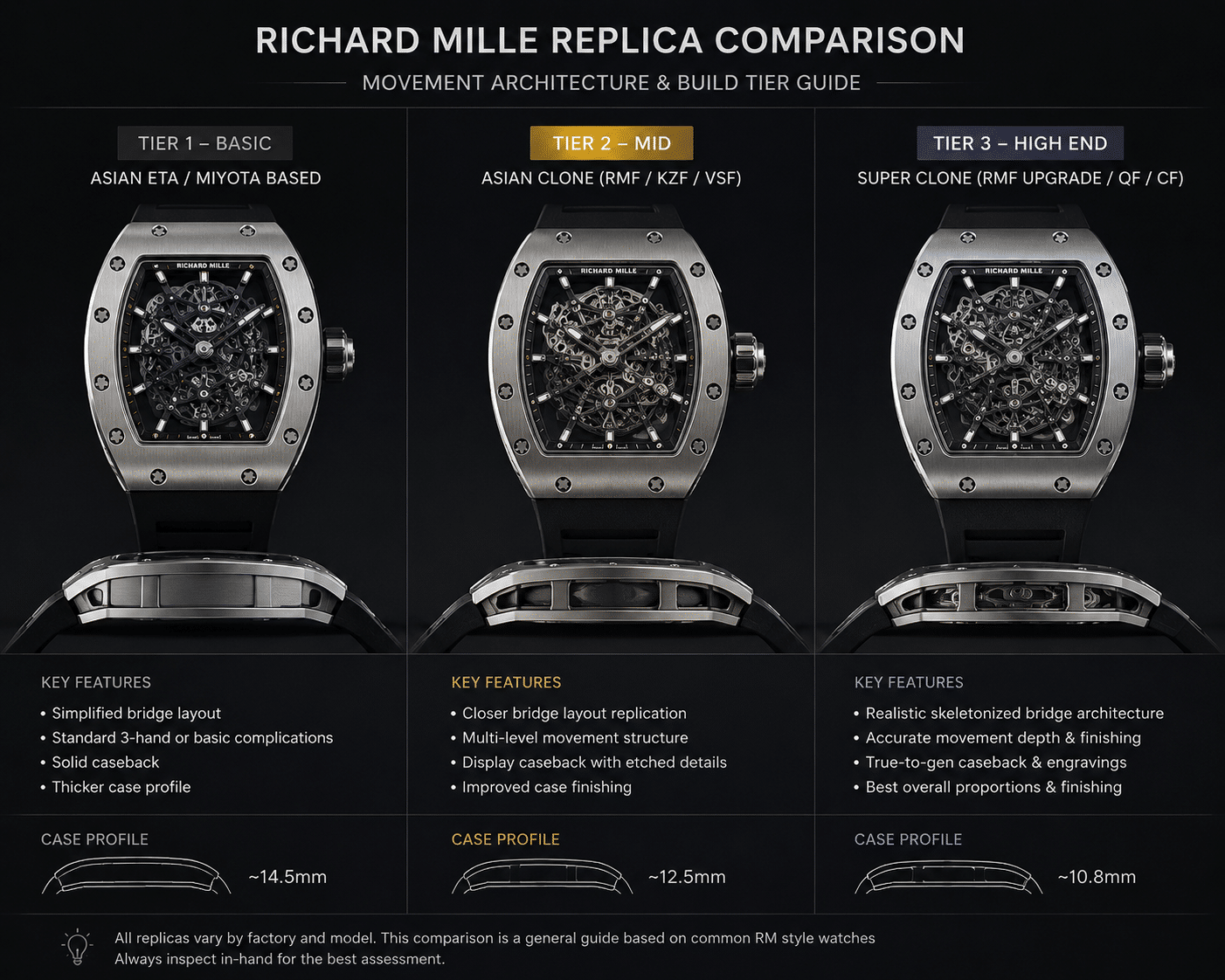
Treat any seller who cannot provide clear movement photos with caution. If the seller sends only dial-facing photos or asks you to rely on brand reputation alone, the movement layout is likely the weak point they are avoiding. The best evidence is visual, not verbal. A well-documented QC set showing bridge layout, barrel position, and crown height tells you more about the watch than any marketing claim.
Prioritize movement architecture evidence in your buying decision. The RMUL2-style layout is the benchmark that separates serious high-end RM super clones from ordinary RM-style watches. Once you know what to look for, the difference becomes visible in seconds — and the wrong choice becomes avoidable.
Buyer Expectation Note: No replica watch should be judged by factory reputation or movement family name alone. A better decision depends on the specific model, movement version, case thickness, dial accuracy, bracelet quality, service risk, and how closely the watch will be inspected in real use. For an RM super clone, the movement architecture should be verified model by model — what works for one reference may not carry over to another. A buyer who confirms barrel position, gear train path, crown height, and bridge depth through real photos is better positioned to match their budget with the appropriate build tier.
[1] Miyota Precision Watch Movement Company (Citizen Group), “Miyota 9015 / 9025 / 9039 Specifications,” technical data sheet, citing center-gear-train layout, 28,800 bph, and center rotor configuration. Accessed via official Miyota documentation at: Miyota Caliber 9015.
[2] Tianjin Seagull Watch Co., “ST2130 Mechanical Movement,” technical specifications, noting center-barrel, center-gear-train architecture with 28,800 bph and 42-hour power reserve. Accessed via manufacturer documentation.
Disclosure: This article is for general educational and comparison purposes only. Replica watches are not genuine products from the original luxury brands, and brand names are used only to identify reference designs or comparison topics. Factory names, movement descriptions, prices, availability, QC details, seller policies, and version information can change, so readers should verify important details with the seller before making a purchase decision. Replica watches should not be represented, resold, or used as genuine watches.