
Most Richard Mille replica buyers judge quality by the dial, but the real difference is hidden behind the movement. Skeleton dials can easily hide a cheap cosmetic plate over a basic quartz or Miyota movement, tricking the eye into thinking the watch is more refined than it is. This article breaks the market into three movement categories—fake skeleton, modified base, and integrated-style build RM011 chronograph movements—and explains exactly what each means for visual accuracy, daily-wear reliability, service cost, and buyer suitability. Instead of guessing by photos, you will learn how to identify each category from case-back details, rotor behavior, thickness, and seller communication, then match the right option to your real priorities.
| Movement Category | Core Construction | Best For |
|---|---|---|
| Fake Skeleton | Cosmetic plate over quartz or Miyota 8215; thick case often matches genuine dimensions; loose, lightweight rotor | Budget-conscious first-time buyers who prioritize lowest cost and basic appearance |
| Modified Base | Genuinely skeletonized Miyota 9015 with custom rotor; thickest case profile; proven mechanical reliability | Daily-wear users who want decent reliability, easy local repair, and visible mechanical depth |
| Integrated-Style Build | Purpose-designed bridge layout and barrel position mimicking genuine RM caliber; thinner but heavier (15–20g vs. 4.3g genuine) | Visual-seeking buyers who prioritize side-profile realism and accept higher failure rates and harder servicing |
Quick Questions Before You Read
Q: Can I tell a fake skeleton movement just from the front dial?
No. Fake skeleton movements look plausible from the front because the cosmetic plate mimics skeleton bridges well. You must check the case-back photo, rotor shape, visible base movement edges, and case thickness to classify it correctly.
Q: Which movement category is most reliable for everyday wear?
The modified base classification using a skeletonized Miyota 9015 offers the best daily-wear balance. The movement is proven, readily repairable, and avoids the higher failure rates and service difficulty of integrated-style builds.
Q: If I want the most visually accurate replica, should I choose an integrated-style build?
Yes, for dial-side and side-profile realism the integrated-style build is closest. But accept that it weighs three to four times more than the genuine, has a higher chance of mechanical issues, and will be harder and more expensive to service.
Q: Is case thickness a reliable way to distinguish these categories?
Yes, but not alone. Fake skeleton movements often match genuine thickness, while modified base builds are typically the thickest. Integrated-style builds vary but are generally thinner. Use thickness as one check among several, not the only test.
Why Dial-Side Photos Do Not Tell You Enough
Here is a scenario that plays out more often than most buyers admit. You find a listing for a Richard Mille replica. The dial photo stops you cold—open skeleton work, visible gears, a complex rotor, the unmistakable tonneau case. The price is inside your budget. You buy it. When the watch arrives, the rotor spins loosely, the winding feel is vague, and the case seems thicker than expected. The movement inside is a cheap Asian quartz with a static decorative plate glued over it. The dial-side photo told you nothing useful.
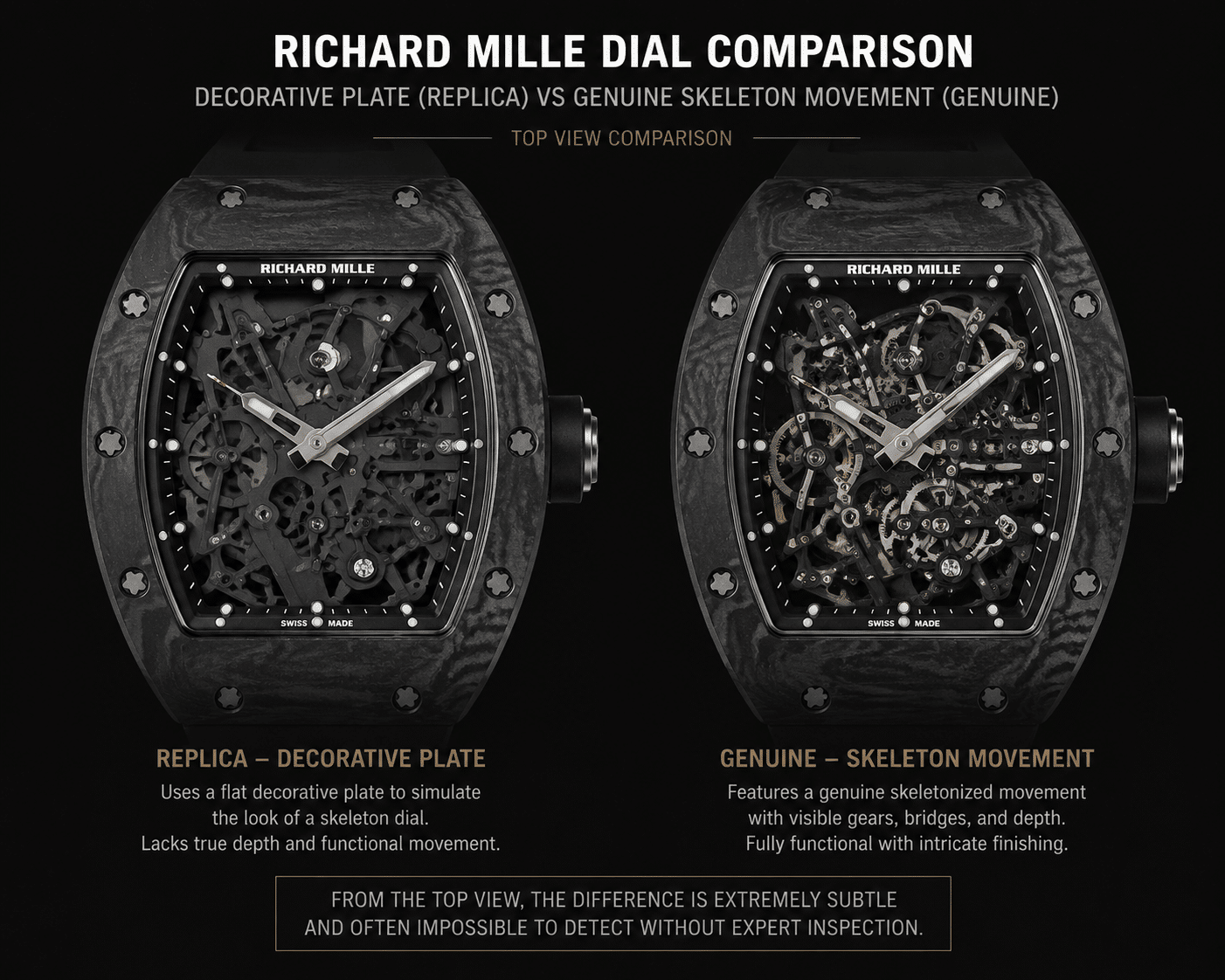
Richard Mille’s skeletonized dial design makes this problem worse than with almost any other brand. Because the dial is open, you see a lot of surface area. Gears, bridges, screws, a balance wheel—it all looks legitimate. But here is the critical point: in an RM replica, what you see from the front is often a staged setup, not a functional movement architecture. A decorative plate can be printed with bridge shapes and screw heads that look convincing in a photo but do nothing mechanically. The rotor may be fixed in place, purely cosmetic. The visible gears may be non-functional or even plastic.
The result is that two RM 055 replicas can appear nearly identical in a dial-side photo yet house completely different movements: one a quartz with a decorative plate, the other a skeletonized automatic. From the top view alone, you cannot reliably tell which is which. This is not a QC issue—it is a fundamental limitation of how RM replicas are marketed. The dial photo is the seller’s strongest selling tool, and it is also the buyer’s weakest evaluation point.
To move past this confusion, you need a framework that categorizes what is actually inside the case, not just what appears through the crystal. The three movement categories that define every RM replica—fake skeleton, modified base, and integrated-style build—give you that framework. They replace guesswork with a clear way to match what you see on the dial to what you can expect in daily wear, thickness, and reliability. Dial photos are the starting point, not the decision point.
Brand name clarification. Richard Mille is a registered trademark of the luxury watch brand Richard Mille. References in this article to “RM,” “Richard Mille models,” or “genuine RM caliber” are used solely to identify the reference design or comparison topic. Replica watches described in this article are not genuine products from Richard Mille and should not be represented as authentic luxury brand watches.
Category One: Fake Skeleton Movements
The fake skeleton movement is the most common category in entry-level Richard Mille replicas, and also the most deceptive. It works like this: a standard movement—often a simple quartz caliber or a basic automatic like a Miyota 8215—is placed inside the case. On top of that movement, a decorative plate is attached. That plate is printed or stamped to look like skeletonized RM bridges, complete with fake screw heads and gear shapes. From the dial side, the watch appears to have a complex, open-worked movement. In reality, the plate is a cosmetic overlay that does nothing except block the view of the actual movement underneath.
Why is this category so common? Because Richard Mille’s skeleton design makes it easy to disguise a base movement with a plate. The open dial area is large, and a well-made decorative plate can cover almost everything the buyer would normally see. The rotor visible through the case back is often a fixed piece that does not move during winding. Some quartz variants even include a stationary rotor that spins freely when the watch is shaken, creating the illusion of an automatic winding system. The watch looks complex, but the mechanical reality is simple—and inexpensive.
For the buyer, the tradeoffs are straightforward. Fake skeleton movements are the cheapest RM replica option, typically priced well below mid-tier alternatives. Reliability depends on the base movement. A quartz fake skeleton will run accurately for years with a simple battery change. A Miyota 8215-based fake skeleton is a proven workhorse. The catch is that you are not paying for skeleton watchmaking. You are paying for a case that resembles an RM model, a dial that looks busy, and a movement that works adequately but does not deliver the visual depth or mechanical complexity of a true skeleton architecture.
Editorial Perspective: Among experienced buyers, the fake skeleton category is often dismissed as a beginner trap. In practice, it serves a legitimate role for the buyer who wants to understand the RM case shape and strap feel before committing to a more expensive build. The mistake is not buying one—it is buying one while expecting the mechanical depth of a skeletonized movement. At cleanvsfactory.com, we treat this category as a valid entry point only when the buyer clearly understands that the decorative plate is not skeletonization. The real test is whether the buyer knows what they are getting: a case that looks the part, not a movement that works the part. If a buyer expects genuine skeleton depth at this price level, the disappointment will come from the gap between what the dial photo implies and what the movement actually is, not from any genuine flaw in the watch itself.
Typical Visual and Tactile Signs
Several clues give away a fake skeleton movement once you know what to look for. The most reliable sign is thickness that does not match genuine specifications. Because the decorative plate sits on top of a standard movement, the overall movement height can be noticeably taller, pushing the case thickness beyond what the genuine model measures. The rotor, if visible, usually spins loosely and feels light. Bridge plates often look stamped rather than machined—edges feel soft, and the surface finish appears uniform in a way that real machining would not produce. If you look closely at the perimeter of the plate, you may see the edge of the base movement peeking out, especially near the winding stem or around the calendar window area. These are not flaws in isolation, but together they point clearly to a decorative overlay.
When This Category Makes Sense
Fake skeleton movements are not automatically a bad choice. They make sense for a specific buyer profile. If your budget is limited and your primary goal is to wear the silhouette and visual style of an RM model—not to impress anyone with mechanical authenticity—a quartz fake skeleton is the most reliable and lowest-risk option. It is also a reasonable entry point for a first-time RM replica buyer who wants to understand whether the case shape and strap comfort work for them before spending more on a higher-tier version. The key is to know what you are buying and not confuse visual busyness with movement quality. Fake skeleton is a budget compromise, and it should be evaluated as one.
Before making a decision on any fake skeleton movement, buyers should review real QC photos where available, particularly the case-back angle, rotor detail, and side profile. A decorative plate can look convincing in a stock image, but a real photo often reveals the flat, stamped appearance of the bridges. Factory labels and dial-side photos alone are not enough for a reliable judgment of what is actually inside the case.
Category Two: Modified Base Movements
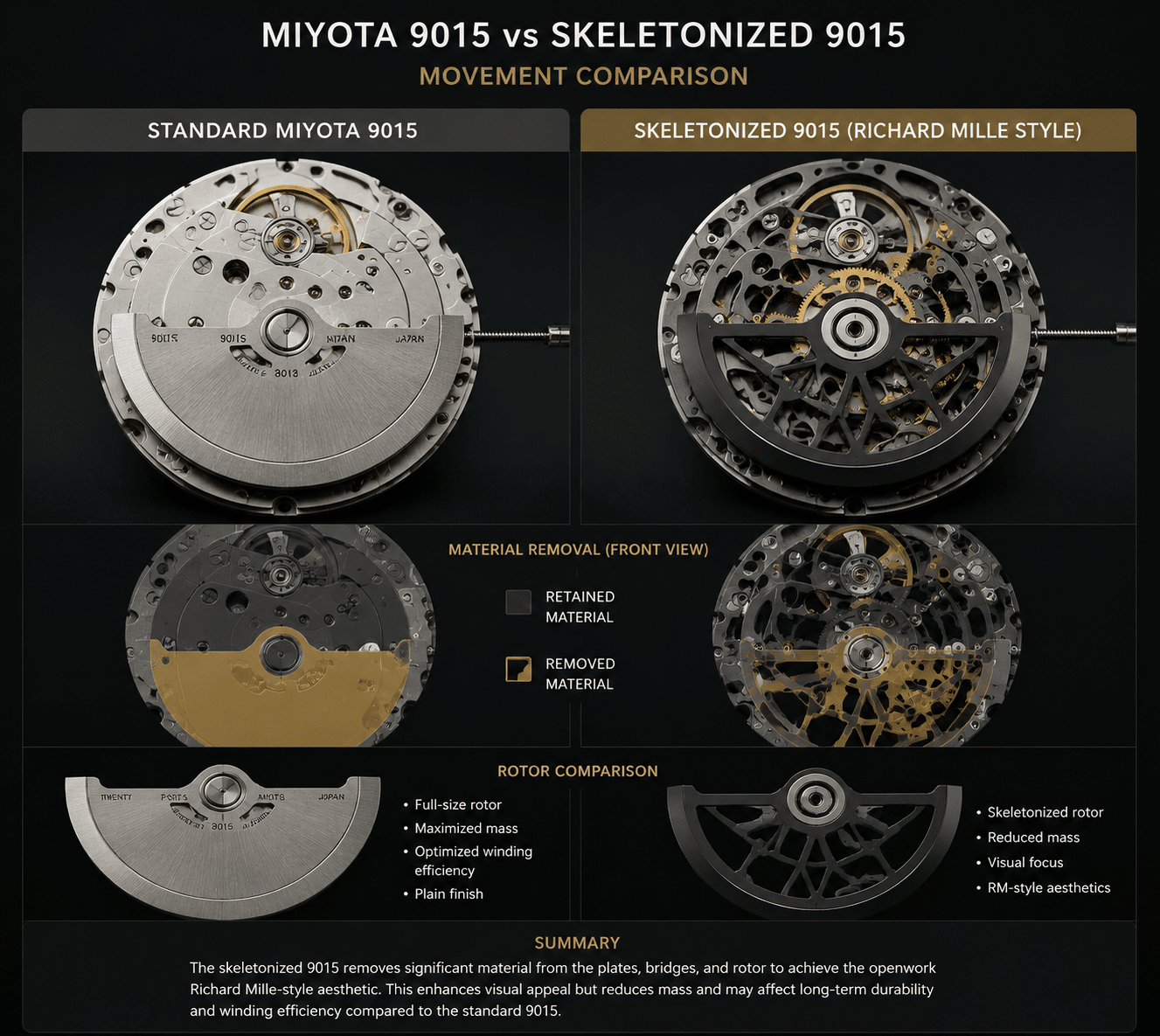
The modified base movement category represents the middle ground where most mid-tier Richard Mille replicas sit, and it is the category most buyers should understand thoroughly before making a purchase. Instead of adding a decorative plate on top of a standard movement, the factory starts with a reliable automatic caliber—most commonly a Miyota 9015—and physically removes material from the bridges and mainplate to create a genuinely skeletonized appearance. The movement is then fitted with a custom rotor shaped to resemble an RM-style skeleton rotor, often with visible cutouts that align with the bridge pattern.
This approach is fundamentally different from the fake skeleton category. The movement is not hidden. What you see from the dial side and the case-back side is the actual movement structure, not a plate. The gear train, balance wheel, and winding mechanism are all exposed and functional. The skeletonization is real: metal has been cut away, the components have been reshaped, and the rotor has been replaced to match the RM aesthetic. That said, this is still a modified Miyota, not a movement designed from the ground up to mimic an RM in-house caliber. The bridge layout follows the Miyota architecture, not the exact RM bridge geometry. The skeleton pattern may not align perfectly with the genuine model’s visual layout. And because the modification process adds some extra clearance, the case thickness often ends up slightly taller than the genuine reference.
For the buyer, the value here is clear. You get a movement that is mechanically honest—no decorative plate hiding anything—and built on a proven, serviceable base. The Miyota 9015 is widely available, reliable when properly maintained, and relatively easy for any competent watchmaker to work on. The skeletonization does not significantly degrade reliability in most cases, though cutting away too much bridge material can theoretically reduce structural rigidity. In practice, most factories leave enough material to keep the movement stable. The visual result is noticeably more convincing than a fake skeleton, especially when viewed from the side or through the case back, because the depth and component positioning are real rather than printed.
It is also worth noting that some sellers advertise “super clone” movements that are, in reality, modified base movements with better finishing. The phrase “super clone” in the RM context often refers to a Miyota 9015 with skeletonized bridges, a custom rotor, and improved decoration rather than an actually in-house-designed caliber. Understanding this helps you avoid overpaying for a movement that is still fundamentally a modified Japanese automatic.
Movement baseline comparison. For context, the Miyota 9015 autowinding movement is a 4.7mm-thick, 24-jewel caliber that operates at a beat rate of 28,800 vibrations per hour (4 Hz) and supports hacking and hand-winding in its stock form.[1] This mechanical profile provides a reliable platform that includes a bidirectional winding rotor and a power reserve of approximately 42 hours in its standard configuration.[1] The stock Miyota 9015 weighs roughly 6–7 grams depending on rotor type. After skeletonization, the movement weight may decrease slightly, but the case and custom rotor will be heavier. Buyers should note that published Miyota specifications describe the stock movement, not the modified version found inside a replica. The skeletonization and custom rotor replacement may alter winding efficiency, stability, and service access, even though the base gear train remains essentially the same.
Common Modification Approaches
Two main modification paths dominate this category. The first and most common is bridge skeletonization. The factory takes the standard Miyota 9015 bridges and uses CNC or hand machining to remove material, creating open areas that mimic the skeleton look of an RM caliber. The remaining bridge material is then shaped to match the visual pattern of the target RM model. The second approach is rotor replacement. The standard Miyota rotor is removed and replaced with a custom rotor that has the distinctive RM shape—often asymmetrical with cutouts that match the bridge pattern. Some factories do both: skeletonize the bridges and fit a custom rotor. Others take a lighter approach, adding a heavily skeletonized decorative rotor while leaving the bridges mostly intact. The most convincing results come from the full treatment, where both the bridges and the rotor are modified to work together visually.
Movement Transparency Note: Movement references in this article describe the replica-market movement type or configuration, not an official Richard Mille or Swiss-manufactured caliber unless explicitly stated with verifiable evidence. A skeletonized Miyota 9015 is a modified Japanese automatic movement, not an RM in-house caliber. The term “super clone” as used by sellers often refers to better decoration of a modified base movement, not an independently engineered clone of the genuine movement architecture.
Category Three: Integrated-Style Builds
The third category is where RM replica movements move from adapted to purpose-designed. Integrated-style builds are not standard calibers hidden behind plates, nor are they existing movements with material cut away. They are movements whose bridge layout, gear train positioning, barrel placement, and screw configuration are engineered from the start to match the visual architecture of a genuine RM caliber.
This is the category that advanced buyers seek, and it is also the most frequently misunderstood.
The architectural distinction of an integrated build lies in its monolithic design philosophy, where the movement’s layout dictates the case’s contours and functional ergonomics. This holistic approach ensures optimal power reserve and chronograph calibration while minimizing case thickness. For specific models like the RMUL2, understanding the intricate placement of bridges, gears, and the rotor is paramount, making the RMUL2 movement layout guide an essential technical reference. Such documentation details the layout’s impact on dial manufacturing, handset proportions, and even service intervals, ultimately defining the clone’s authenticity and long-term reliability.
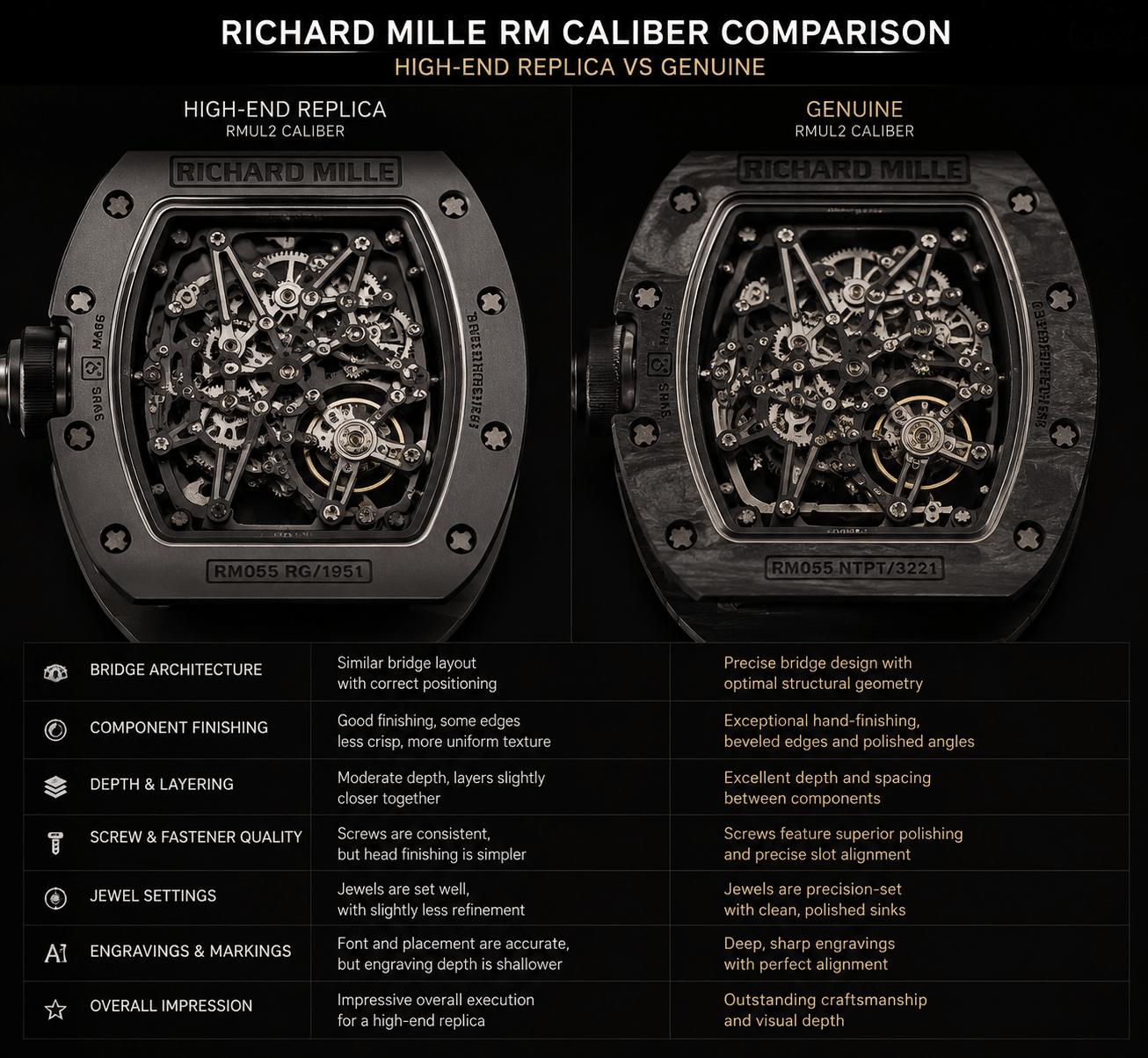
Take a concrete example: a genuine RM caliber like the RMUL2 places the barrel near 12 o’clock, the balance wheel at approximately 7 o’clock, and the gear train in a specific diagonal path between them. An integrated-style replica movement replicates this exact component map. The bridges are shaped to match the gen’s distinctive curves—they are not generic rectangular bridges that happen to sit under a skeleton dial. The screw positions are intentional, not improvised.
In a fake skeleton movement, the decorative plate hides a standard movement layout underneath. In a modified base movement, the skeletonization follows the existing bridge shapes of a Miyota or Seagull caliber. In an integrated build, the layout is rebuilt. The barrel position, balance location, and gear train path are all chosen to match the reference model, not to accommodate an existing movement architecture.
This does not mean the movement is built from custom raw materials. Most integrated-style builds still use off-the-shelf components—gears, jewels, springs, and even whole keyless works—arranged in a layout that mimics the gen. The achievement is in the arrangement, not the raw engineering.
Why the distinction matters for visual accuracy. Richard Mille’s own in-house calibers are designed specifically for the tonneau case shape, with barrel positioning, plate architecture, and bridge curvature all dictated by the RMUL certification requirements and the brand’s emphasis on high-resistance skeletonization.[2] Official brand materials describe RM calibers as being developed around constraints such as shock resistance through the use of a baseplate and bridges made from grade 5 titanium, and a free-sprung balance with variable inertia.[2] An integrated-style replica movement borrows the visual component placement from this architecture—barrel position, balance location, gear train path—but cannot replicate the proprietary titanium construction, the specific surface treatments, or the shock-resistance engineering that define the genuine movement. Understanding what is and is not reproduced helps the buyer calibrate expectations correctly. The integrated build delivers superior visual alignment with the genuine layout, but the materials, finishing, and durability profile remain fundamentally different.
Visual depth and side-profile realism
The most noticeable difference for the buyer is visual depth. Because the bridge and plate layers are designed to match gen spacing, integrated builds often appear more three-dimensional when viewed from an angle. The balance wheel sits at the correct height. The barrel bridge has the correct curvature. The movement does not look flat or stamped.
This depth matters more than most buyers realize in photos. A dial-side shot of an integrated build and a modified base can look similar. But in a side-angle case-back photo, or through the crystal when the watch is tilted, the integrated build reveals layered bridge architecture that the other categories cannot simulate. The movement looks like it belongs inside the case, not like a round movement squeezed into a tonneau shape.
Where this category still falls short
Integrated-style builds are the most visually convincing RM replica movements, but they are not mechanically identical to genuine calibers. The finishing is noticeably different under close inspection. Genuine RM movements use grade 5 titanium bridges with specific surface treatments—sandblasting, PVD, or Titalyt coating. Replica movements use brass or steel bridges with decorative coatings. The color may look correct at a glance, but the texture and warmth are different.
The material weight difference also persists. A genuine RM movement weighs approximately 4.3 grams. A replica integrated build, even a well-executed one, typically weighs 15–20 grams because of the brass and steel components. This affects the total watch weight noticeably.
Version and batch differences matter most in this category. Small changes in bridge shape, screw position, or rotor design between batches can either improve or reduce visual accuracy. The same model from the same factory can look different depending on which production run it came from. Buyers who want an integrated build should always check current batch photos, not rely on reviews from six months ago.
Automatic vs Hand-Wound in This Category
Integrated-style builds appear in both automatic and hand-wound variants, and the choice between them affects visual accuracy, reliability, and daily-wear practicality.
Hand-wound integrated builds are the more common sub-type for skeleton-focused models like the RM 027 or RM 35 family. Because there is no rotor to block the view, the entire movement architecture is visible through the crystal. This creates the most impressive visual experience—the gear train, barrel, and balance wheel are fully exposed, and the skeleton layout can be followed from the crown to the balance. The tradeoff is fragility. Hand-wound movements in this category use delicate gear trains that can be damaged by overwinding. There is usually no slipping clutch or protective mechanism, so the buyer must develop a feel for the winding stop. The power reserve is also shorter than automatic equivalents, typically 40–45 hours versus 50+.
Automatic integrated builds use either a peripheral rotor or a micro-rotor system to preserve skeleton visibility. A full-size central rotor would block too much of the movement, so the winding system must be positioned along the edge or recessed into the plate. This makes the movement architecture more complex and harder to service. The visual tradeoff is that part of the skeleton view is always occupied by the rotor mechanism. The practical advantage is convenience: the watch winds itself during daily wear, reducing wear on the crown and gear train.
For most buyers, the choice comes down to use case. A hand-wound integrated build is better for display purposes and occasional wear where the visual impact matters most. An automatic integrated build is more practical for regular rotation, provided the buyer accepts that the rotor mechanism slightly crowds the skeleton view.
Realistic expectations for integrated builds. Buyers considering an integrated-style build should understand that these movements are not designed to the specifications of genuine RM calibers. They do not use proprietary RM-grade materials, they are not certified to meet shock-resistance or chronometric standards, and they are not supported by the official Richard Mille service network. The visual alignment with the genuine layout can be impressive in controlled lighting and at normal viewing distances, but the movement should not be expected to perform identically to an authentic RM caliber in durability, finishing precision, or service longevity. A well-made integrated build can offer a satisfying visual experience for a buyer who accepts these boundaries, but it should not be treated as a functional equivalent of the genuine movement.
How Movement Category Affects Case Thickness
Case thickness is one of the most immediate real-world differences between RM replica movement categories. It affects how the watch sits on the wrist, whether it fits under a shirt cuff, and how convincing the overall profile looks from the side—an angle buyers often ignore but genuine RM owners notice.
Fake skeleton movements are usually the thinnest category. The decorative plate is thin by design, and the base movement beneath it is a standard automatic or quartz caliber with a normal height. The total case thickness can be surprisingly close to genuine specifications for simple models. This is one of the few advantages of this category: the watch may not look accurate under a case-back view, but from the side profile, it can pass reasonably well.
Modified base movements are generally the thickest category. When a factory starts with a standard automatic movement like a Miyota 9015 and skeletonizes the bridges, the overall height does not decrease. If anything, the skeletonization process can require additional clearance for the rotor or gear train, pushing the case height slightly higher. Add to this the tonneau-shaped case itself—which has less internal vertical space than a round case of the same thickness—and the result is often 1–3 mm thicker than the genuine model. For reference, a genuine RM 055 measures 13.8 mm thick. A modified base replica of the same model often comes in at 15–16 mm. That extra 1–2 mm changes how the watch feels on the wrist and how it fits under clothing.
Integrated-style builds vary the most in thickness. When the movement layout is designed for the specific case, the factory has more control over height. Some integrated builds achieve thickness within 0.5–1 mm of the genuine reference. Others end up thicker because the movement architecture requires more vertical space than a flat decorative plate would. The general rule: if an integrated build is well-executed for that specific model, it will be thinner than a modified base version of the same watch. But it will rarely match genuine thickness exactly.
A simple diagnostic rule for buyers
If an RM replica is noticeably thicker than the genuine model’s published specs, it is almost certainly a modified base movement. If it is close to genuine thickness, it is either a fake skeleton movement or a well-designed integrated build. The buyer can use thickness as a quick filter: request side-profile photos, compare the measurement to the genuine reference, and use the result to narrow down the movement category before investing further.
One caveat: seller-provided thickness specs are not always accurate. Some sellers list the thickest point including the crystal, others list case-only height. Always cross-check with QC photos or community measurements.
How the genuine reference sets expectations. Richard Mille provides official dimensions for most models through brand materials and authorized retailer listings. The RM 055, for example, is listed with a case thickness of 13.8 mm in official brand documentation, while the RM 11-03 measures approximately 14.6 mm thick depending on the specific variant.[3] These published dimensions are useful for the replica buyer as a baseline, but it is important to recognize the limits of this comparison. Official brand measurements describe an authentic watch with a genuine in-house caliber, proprietary materials such as titanium or carbon TPT, and certified assembly standards. A replica case built around a different movement architecture, case material, and assembly baseline will rarely reproduce these dimensions exactly. The comparison helps detect large discrepancies—a replica listed at 16–17 mm for an RM 055 is almost certainly a modified base build—but it cannot confirm that a thinner replica has an integrated-style movement. Quartz-based fake skeletons also achieve thin profiles. Use thickness as one diagnostic indicator among several, not as standalone proof.
Reliability, Serviceability, and Daily-Wear Risk by Category
The most visually impressive RM replica movement is not always the best choice for daily wear. Each category has a different reliability profile, and the tradeoff between visual accuracy and long-term dependability is the most important decision a buyer can make.
Fake skeleton movements: most reliable, least satisfying for enthusiasts
Quartz-based fake skeleton movements are the simplest and most reliable option. There is no mechanical complexity to fail, no rotor to seize, and no delicate gear train to overwind. The watch will run accurately for years with minimal attention. The downside is obvious: a quartz movement in a skeleton watch feels inert. The second hand ticks rather than sweeping, there is no rotor movement, and the decorative plate has no mechanical function. For a buyer who just wants the look without mechanical interaction, this works. For anyone who enjoys watching the movement work, it does not.
Automatic-based fake skeleton movements are also reliable because the base movement underneath the decorative plate is a proven caliber like a Miyota 8215 or 9015. These movements are widely used in replicas and serviceable by any competent watchmaker. The main risk is the decorative plate itself: if it is poorly attached or slightly misaligned, it can rub against the rotor or the case back, causing noise or friction. This is usually a QC issue rather than a design flaw, and it can be corrected.
Modified base movements: the safe middle ground
Modified base movements are the most balanced option for daily wear. The base movement is proven and widely available—typically a Miyota 9015 or a Seagull ST-series caliber. Parts are easy to find, and any watchmaker familiar with Asian movements can service them. The skeletonization process does introduce a small structural risk: removing material from bridges or the mainplate can weaken the movement slightly. In practice, this risk is low for well-executed modifications. The buyer’s greater concern should be the quality of the skeletonization, not the base movement itself.
Modified base movements are also the easiest category to service. If the movement fails, a replacement base movement costs $30–$80 and can be swapped without custom parts. This is the category where a buyer can reasonably expect 3–5 years of daily wear before needing service.
Integrated-style builds: highest visual reward, highest ownership risk
Integrated-style builds are the most complex and the least forgiving. Because the component layout is custom-designed rather than adapted from a standard caliber, the gear train, barrel, and winding system are often unique to that movement. If a part breaks, finding a replacement is difficult. Most watchmakers will not work on these movements because the layout is unfamiliar and parts are not standardized.
The failure rate is noticeably higher than modified base movements. Richard Mille replica movements detail common issues such as gear train binding (caused by slightly misaligned bridges), rotor detachment in automatic versions, and balance staff breakage from shock. Hand-wound integrated builds carry additional risk: the delicate gear train can be damaged by overwinding, and there is usually no clutch mechanism to prevent it.
What this means for the buyer
There is no single correct category for everyone. The decision depends on what the buyer values:
- Maximum reliability, lowest engagement: Fake skeleton quartz. Boring to watch, but it will run.
- Best daily-wear balance: Modified base movement. Visually respectable, proven mechanics, easy to service.
- Maximum visual fidelity, accept higher risk: Integrated-style build. Looks the most convincing, but expect shorter lifespan and harder service.
Modified base movements remain the safest “good value” choice for most buyers. They offer a genuine skeleton architecture without the fragility of fully custom builds, and they can be serviced or replaced at reasonable cost. The integrated build is the enthusiast’s choice—it requires accepting that the movement may not last as long as the watch’s appearance suggests.
Broader serviceability context. For context on the manufacturers producing the base movements used in modified builds, Miyota—owned by Citizen Watch Company—has established a reputation for mass-produced, reliable automatic calibers that power a wide range of watches.[1] Miyota lists the 9015 as a 4.7 mm thick, 24-jewel movement with a 28,800 bph beat rate, hacking, hand-winding, and a 42-hour power reserve in its official specifications.[1] These specifications help the buyer understand the mechanical baseline that a modified base movement starts from. However, it is also important to emphasize that Miyota’s official documentation describes the stock, unmodified movement before any skeletonization or rotor replacement is applied by a replica factory. The factory process of removing bridge material and fitting an aftermarket rotor is not part of the original Miyota design, and Miyota does not approve or test such modifications. The movement’s durability after modification depends entirely on the factory’s execution, not on the original manufacturer’s specifications.
How to Identify the Movement Category Before Buying
Knowing the three categories is useful in theory, but the real challenge is applying that knowledge before you hand over your money. Sellers rarely advertise a watch as “fake skeleton” or “modified base.” They use phrases like “super clone movement,” “1:1 decorated caliber,” or simply “automatic skeleton.” Your job is to translate those claims into actual category identification using the information you can get from a listing, QC photos, or direct questions.
The process is not complicated, but it requires looking at the right details. Most buyers focus on the dial and assume the movement matches. That is the mistake this section is designed to prevent.
Here is a six-step method to identify the movement category before you buy.
Step one: request a case-back or movement photo. If the listing only shows the front dial, that is already a warning sign. A seller who is confident about the movement will show it. Ask for a clear, well-lit shot of the movement through the case back. If they cannot provide one, or if they send a stock photo that looks generic, treat that as a red flag. Fake skeleton movements are harder to spot from the front, so sellers who use them often avoid showing the back.
Step two: examine the bridge shape and layout. Compare the bridge pattern in the photo to the genuine Richard Mille caliber for that specific model. A genuine RM movement has distinct, asymmetrical bridge shapes with specific curves and cutouts. A fake skeleton movement uses a decorative plate that simply stamps a pattern onto a flat surface—the bridges will look two-dimensional and uniform in thickness. A modified base movement will show skeletonized bridges that have variable thickness where material was removed, but the overall layout may not match the gen geometry exactly. An integrated-style build will have bridge shapes that closely follow the genuine layout, with sharper edges and more three-dimensional depth.
Step three: check the rotor type and position. Richard Mille movements use specific rotor designs depending on the caliber. Some are full rotors with a distinct skeletonized pattern; others use peripheral or micro-rotors. If the rotor looks like a standard round automatic rotor from a generic movement (even if decorated), you are likely looking at a fake skeleton or modified base movement. If the rotor is custom-shaped to match the gen model—unusual curves, specific cutouts, correct positioning relative to the bridges—that points toward an integrated-style build. Also check whether the rotor spins freely. In fake skeleton quartz watches, the “rotor” is often a fixed decorative piece that does not move.
Step four: look for visible base movement edges. This is one of the quickest tells. In a fake skeleton movement, the decorative plate sits on top of a standard movement. If you look closely at the perimeter of the visible movement area, you can often see the edge of the base movement peeking out from under the plate. The plate itself may have a consistent, stamped appearance without individual screw placements that match the gen. In a modified base movement, the bridges are the actual movement components, so there is no plate edge visible—but the skeletonization may look rough or uneven. In an integrated-style build, the entire visible area is designed as a cohesive layout, with no hidden base movement edges.
Step five: compare thickness to genuine specifications. Case thickness is one of the most reliable indicators of movement category. Look up the genuine thickness for the specific RM model you are considering. If the listed thickness is significantly higher (2–4mm or more), you are likely looking at a modified base movement, which often adds height due to the skeletonization process. If the thickness is very close to genuine, it could be an integrated-style build or a fake skeleton using a thin quartz movement. At Clean VS Factory, we treat thickness as a primary diagnostic tool—if the number seems wrong on paper, the movement category probably is too.
Step six: ask the seller directly. You can learn a lot from how a seller answers a direct question. Ask: “Is the movement a standard automatic with a decorative plate, or has it been genuinely skeletonized?” Ask: “What is the base movement caliber?” A seller who gives a clear, specific answer—like “Miyota 9015 with skeletonized bridges” or “custom integrated RMUL2-style movement”—is likely being honest. A seller who responds with vague terms like “super clone” or “decorated movement” without specifics is probably describing a fake skeleton. Also ask for the exact case thickness in millimeters. Compare that number to the genuine spec yourself.
Specific Photo Angles to Request
To properly evaluate the movement category, you need more than a single QC photo. Request the following specific angles from the seller:
- Direct case-back shot: A straight-on view of the movement through the case back. This lets you examine bridge shape, plate edges, and rotor type.
- 45-degree movement angle: A slightly angled shot that reveals bridge depth and three-dimensional structure. This helps distinguish a flat decorative plate from a genuine skeletonized bridge.
- Side profile shot: A clear side view of the case to measure thickness. Place the watch next to a ruler or caliper if possible. Do not rely on the seller’s listed thickness alone.
- Rotor detail photo: A close-up of the rotor, preferably with the watch tilted so you can see whether the rotor is free-spinning or fixed. If the rotor does not appear to have clearance to rotate, it may be decorative.
Seller Questions That Reveal the Category
The following questions are designed to force a specific answer. How the seller responds tells you more than the information itself.
- “Is the movement a standard automatic with a decorative plate?” If the seller says yes, or hesitates and says “It has a decorated appearance,” you are looking at a fake skeleton. If the seller says no, ask the follow-up.
- “What is the base movement caliber?” A concrete answer like “Miyota 9015” or “Shanghai 7750” points to a modified base movement. An answer like “custom RMUL2 clone” or “integrated movement” points to an integrated-style build. Vague answers like “high-quality automatic” are a warning.
- “Has the movement been skeletonized, or is it a plate overlay?” This is the most direct question. A seller who is confident in a modified base or integrated build will say “skeletonized.” A seller with a fake skeleton will often avoid a direct answer.
- “What is the exact case thickness in millimeters?” If the seller gives you a number that matches the genuine spec within 0.5–1mm, and the price is in the super-clone range, you may be looking at an integrated build. If the number is 2–4mm thicker, expect a modified base movement. If the number is thin but the price is very low, suspect a quartz fake skeleton.
If a seller cannot or will not answer these questions with specific information, consider that a strong signal that the movement category is the least desirable option. A transparent seller has nothing to hide about what is inside the case.
Verification Note: When possible, buyers should review real watch photos including case-back detail, side profile, and rotor close-ups before making a decision. Stock images and factory labels alone are not enough for a reliable judgment. The six-step identification method described in this section is most effective when applied to actual QC photos or user-submitted images rather than marketing materials.
Which Movement Category Should You Choose?
Now that you understand the three categories and how to identify them, the natural question is which one you should actually buy. The honest answer is that there is no single best category. The right choice depends entirely on your budget, your priorities, and your tolerance for tradeoffs. The most visually impressive movement is not always the smartest choice, and the cheapest option is not always a mistake if you understand what you are getting.
We find it useful to think in terms of buyer profiles. Identify which profile fits you, and the category recommendation becomes clearer.
First-time buyer on a budget. If this is your first Richard Mille replica and you are not ready to spend $600–$1,000, a fake skeleton movement—either quartz or a basic automatic like a Miyota 8215 with a decorative plate—can be an acceptable entry point. The watch will look the part from the front, especially on a wrist at conversational distance. The tradeoff is that the movement will not have genuine skeleton architecture, thickness may be off in unpredictable ways, and the winding feel or rotor behavior will not match a mechanical skeleton. But if your goal is to learn the model shape, understand the case size, and decide whether you actually want to wear an RM before investing more, this category serves that purpose. Just do not expect long-term reliability or convincing depth through the crystal.
Daily-wear buyer who values reliability. Most buyers shopping seriously for an RM replica fall into this category. You want a watch you can wear regularly without worrying about frequent breakdowns or obvious visual tells. The modified base movement—typically a skeletonized Miyota 9015 or similar—is the safest choice here. The base movement is proven, serviceable, and widely understood by watchmakers. The skeletonization gives you genuine mechanical depth through the dial, and the reliability is generally good for a daily-wear piece. The tradeoff is that modified base movements are often thicker than genuine, so you will need to accept that the watch may not sit as flat on the wrist as the real thing. But for the balance of visual honesty, reliability, and cost, this category is the practical winner for most buyers.
Advanced collector prioritizing visual accuracy. If you already own replica watches, understand the risks, and want the closest possible approximation of a genuine Richard Mille caliber, an integrated-style build is the goal. These movements are engineered to replicate the structural layout of the gen—correct bridge placement, proper component positioning, and greater visual depth. The tradeoff is higher cost, often lower reliability than a simple modified base, and more difficult serviceability. This is a category for buyers who accept that the watch may need more attention and who prioritize the visual experience over trouble-free daily wear. If you fall into this group, your buying decision should focus on specific factory versions and batch reviews, not just category labels.
The key takeaway is this: do not let impressive photos push you into a category that does not match your actual needs. A modified base movement may look less exciting in macro shots than an integrated build, but it will probably serve you better if you wear the watch five days a week. Conversely, a fake skeleton movement may disappoint you if you expected genuine skeleton depth. Match the category to your priorities, not the other way around.
It is important to recognize that no Richard Mille replica movement, regardless of category, is an official brand-manufactured caliber. Factory names in the replica market are useful buyer-facing references for identifying construction type and visual approach, but they should not be treated as automatic guarantees of quality across every model or batch. A transparent comparison looks at the specific version, movement configuration, case details, and available QC evidence rather than relying on a factory label alone. For CleanVSFactory, the goal is to make replica watch decisions more traceable by connecting factory claims to visible details, movement behavior, version differences, and practical QC checks.
What to Confirm Before Purchasing
Before you finalize any purchase, run through this short checklist to confirm your decision aligns with your expectations:
- Confirm the movement category with the seller. Use the questions from the previous section. Do not rely on product page descriptions alone.
- Request and review movement photos. Case-back shot, 45-degree angle, side profile, and rotor detail. Compare what you see to the category descriptions in this article.
- Verify case thickness against genuine specs. Do not take the seller’s word. Look up the genuine thickness for your specific model and compare the numbers yourself.
- Ask about service options. If the movement fails, can a local watchmaker work on it? Modified base movements are generally serviceable. Integrated builds and fake skeleton automatics may be harder to find parts for.
- Set realistic expectations. No Richard Mille replica movement is identical to the genuine caliber. Even the best integrated-style builds use different materials, have different finishing, and will not match the feel of a Swiss-made in-house movement. The goal is a satisfying ownership experience within the limits of the category you choose, not perfection.
The movement category framework gives you a way to think clearly about what you are buying. Apply it before you purchase, and you will avoid the most common source of regret: discovering after delivery that the impressive dial hides a movement that does not match your expectations.
[1] Miyota / Citizen Watch Co., “Miyota Caliber 9015 Specifications,” official product documentation. Miyota Caliber 9015. Published specifications describe a 4.7 mm thick, 24-jewel, 28,800 bph automatic movement with hacking, hand-winding, and a 42-hour power reserve in its stock form. These specifications apply to the unmodified movement and do not account for skeletonization or rotor replacement performed by third parties.
[2] Richard Mille, “Calibers,” official brand movement documentation. Richard Mille Calibers. Official information describes RM in-house calibers as using grade 5 titanium baseplates and bridges, free-sprung balance wheels, and variable inertia technology. These details help the buyer understand the architectural differences between genuine RM engineering and replica movement construction.
[3] Richard Mille, “RM 055,” official brand product page. Richard Mille RM 055. Official brand dimensions are listed on the product page. The RM 055 is listed with a case thickness of 13.80 mm in official brand documentation. These dimensions serve as a reference baseline for thickness comparison but do not guarantee that a replica case reproduces these measurements exactly.
Disclosure: This article is for general educational and comparison purposes only. Replica watches are not genuine products from the original luxury brands, and brand names such as Richard Mille are used only to identify reference designs or comparison topics. Factory names, movement descriptions, prices, availability, QC details, seller policies, and version information can change, so readers should verify important details with the seller before making a purchase decision. Replica watches should not be represented, resold, or used as genuine watches.