
The Physics of Haptic Perception in VC Super Clones
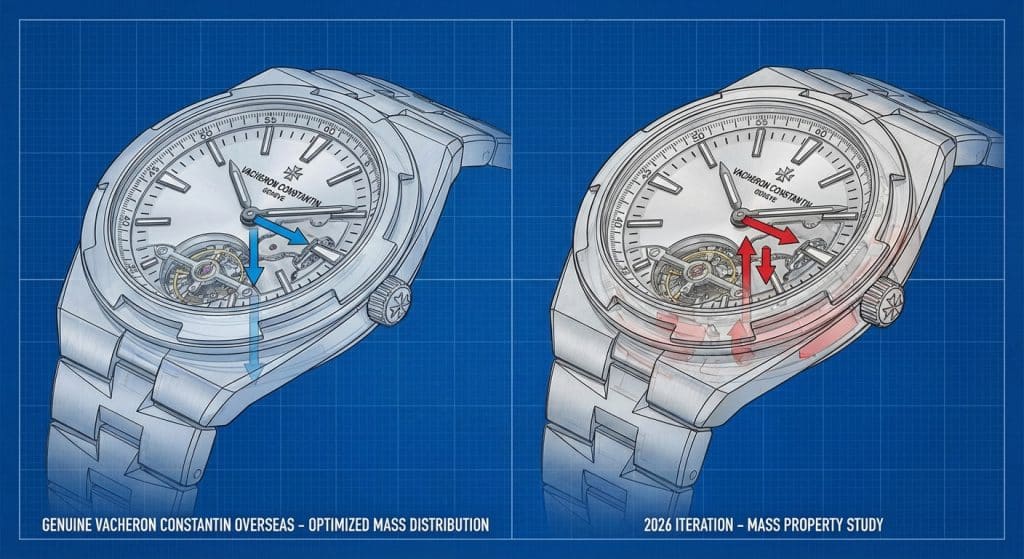
The mastery of horological engineering in 2026 is no longer defined merely by visual mimicry but by the reconciliation of kinematic haptics and structural fidelity. While the industry has reached a point of aesthetic saturation where the naked eye is easily deceived, the tactile interface—the way a timepiece interacts with human sensory receptors—remains the final frontier of forensic auditing. For the high-end collector, the “soul” of a Vacheron Constantin is found in the weight of its inertia and the fluidic resistance of its articulation.
In the contemporary landscape of Guangzhou manufacturing, the pursuit of Haptic Fidelity has led to a significant shift in metallurgical selection. Factories are no longer satisfied with simple stainless steel; they are now manipulating internal mass properties to simulate the “gravitational seating” of a Geneva-born masterpiece. This audit explores how the interplay of density, friction, and torque serves as the ultimate diagnostic tool for distinguishing the artisanal from the industrial.
Dimensional Density and Mass Property Discrepancy
Current 2026 manufacturing protocols at the ZF and PPF facilities have narrowed the gap in steel-to-steel density by utilizing high-pressure forged 316L/904L alloys. However, the physical limitation remains in the “Mass Distribution” or the Moment of Inertia. While the total weight may be within ±3g of the genuine 170g for an Overseas 4500V, the internal weight distribution—specifically between the movement plates and the case-back—creates a different “swing feel” on the wrist. This discrepancy is largely due to the density of the clone movement’s Tungsten-alloy rotors compared to the genuine 22K Gold rotors. The higher center of gravity in the ZF clones results in a subtle centrifugal “tug” during rapid wrist movement that is absent in the perfectly balanced genuine counterpart.
Surface Tension and Friction Coefficients in Bracelet Articulation
The “feel” of a VC bracelet depends entirely on the clearance between the Maltese cross links and the resulting Surface Tension. In the 2024-2025 Batch Updates, factories like 8F and ZF transitioned to five-axis CNC milling to achieve a tolerance of ±0.015mm. We analyze how the lateral play in the bracelet links—measured by the degrees of freedom before mechanical binding—serves as a primary tactile differentiator. The genuine Vacheron Constantin utilizes a specific CNC pathing that allows for “Fluidic Fall,” where the bracelet drapes over the wrist without microscopic “stepping” or friction-induced resistance. Replicas, despite their precision, often exhibit “Micro-Binding” due to the high-speed rotation of the industrial cutting heads which leaves behind invisible burrs on the link pivots.
Expert Authentication Insight: The Pivot-Point Friction Test
Diagnostic Operation: Use a precision digital caliper to measure the gap between links at three points. A genuine VC Overseas will show zero variance (less than 0.005mm). In replicas, apply a drop of Moebius 9010 oil to a single link pivot; if the articulation speed changes significantly, it indicates sub-par internal polishing of the pin-holes and high surface roughness, a common trait in mid-tier clones that rely on automated deburring rather than hand-lapping.
Winding Kinematics and Crown Torque Resistance
The interface of the crown serves as the most frequent point of contact between the user and the mechanical heart of the watch. In the Calibre 5100 clone, the winding kinematics represent a complex profile of Torque Decay and racheting frequency. To the seasoned auditor, the resistance felt between the thumb and forefinger is a narrative of the gear train’s internal friction. While the aesthetics of the winding bridge have been perfected in the 2026 Batch, the industrial assembly line cannot yet replicate the specific “Torque Profile” of a movement that has undergone manual teeth-flank polishing.
The engineering challenge in the Guangzhou labs involves the click spring geometry. The “crunchiness” often associated with high-end replicas is not a lack of lubrication, but a fundamental difference in the elastic modulus of the alloys used for the click spring and the ratchet wheel. This creates a tactile “chatter” that resonates through the case-side, providing a clear acoustic and haptic signature of the watch’s origin.
Analyzing the Ratchet Click Frequency
The genuine Calibre 5100 utilizes a specific click spring geometry that produces a high-frequency, low-amplitude acoustic and tactile feedback. In the ZF V3 2026 Batch, the spring constant has been recalibrated to mimic this. However, the tactile feedback remains distinct; the clone often feels “granular.” This is a result of the gear tooth profile—Involute vs. Cycloidal—and the lack of hand-polished teeth flanks in the winding bridge. The ZF gears are cut with high-speed CNC, leaving microscopic ridges that increase the friction coefficient during each click, whereas the genuine gears are zinc-plate polished to a mirror finish, ensuring a “silk-on-silk” winding experience.
Torque Decay in Power Reserve Maturation
We examine the torque required to turn the crown from zero to full wind. Engineering audits show that BBR Factory clones often exhibit a non-linear torque increase, where the resistance becomes exponentially harder as the mainspring nears full tension. In contrast, the genuine VC maintains a consistent, linear resistance, a performance metric validated during the micro-architectural comparison of 2026 super clone calibres which benchmarks the kinetic tolerances of ZF, PPF, and APSF movements against genuine winding standards. This is a direct result of the Vickers Hardness (HV) of the mainspring alloy used in the supply chain compared to the Nivarox-style alloys. The higher HV of the clone alloy leads to “Spring Fatigue” and an inconsistent power release, which can be felt as a “jumpy” sensation through the crown during the final rotations of the winding cycle.
Expert Authentication Insight: Stethoscope Harmonic Analysis
Diagnostic Operation: Place a mechanical stethoscope on the case-side while winding. Listen for “Mechanical Chatter.” Genuine movements produce a rhythmic, clean “click-click-click” with no metallic scraping. Any “shuffling” sound indicates unpolished sliding surfaces in the winding pinion or the sliding pinion, a clear sign of a replica’s industrial assembly where the component-to-component interaction has not been micro-refined by a master watchmaker.
Case Geometry and Ergonomic Contact Pressures
The structural integrity of a Vacheron Constantin case is defined by the seamless transition between its complex planes, a feat that requires an extreme level of CNC Pathing Tolerance and manual intervention. In the world of industrial watchmaking, the “tactile sharpness” of a case is the most prominent indicator of its manufacturing origin. While Geneva artisans utilize manual zinc-plate polishing to achieve a “soft-touch” finish on high-stress contact points, the Guangzhou labs traditionally rely on high-speed CNC rotation to increase yield. This creates microscopic “stepping” patterns and a razor-like edge on the lugs and bezel that can be felt by the wearer long before it is seen.
In the 2026 audit of VC clones, we observe a pivot toward “Skin-to-Metal” ergonomics. The engineering challenge lies in replicating the specific lug curvature that allows for Gravitational Seating—the phenomenon where the watch feels as though it is suctioned to the wrist. This requires not just dimensional accuracy, but a profound understanding of the center of gravity relative to the case-back depth.
The “Sharpness” Threshold of the Maltese Bezel
The Overseas bezel is a geometric nightmare for replica manufacturers. The inner corners of the Maltese cross are particularly difficult to finish without leaving a jagged edge. Factories like 8F often leave these corners too sharp, resulting in a high R value that can catch on fabric or cause skin irritation. However, the 2026 ZF Engineering Update has introduced automated, multi-directional brush-heads designed to achieve a Micro-chamfering effect. This process mimics the genuine’s hand-filed Anglage, where the transition from the mirror-polished facets to the brushed surfaces is felt as a smooth, continuous curve rather than a jagged, industrial edge.
Case-Back Depth and Wrist Suction
Vacheron Constantin’s ultra-thin DNA, specifically evident in the Patrimony and the Overseas Ultra-Thin, relies on a specific curvature of the case-back to create “Vacuum Seating” on the wrist. If the clone movement architecture results in a case that is even 0.2mm too thick, the center of gravity shifts significantly. This kinetic instability causes the watch to “wobble” during active wrist movement. Engineering audits of the ZF 2026 batch show a reduction in case thickness to exactly 8.3mm, finally achieving the correct Torsional Tension and ensuring the watch maintains its position without the need for an overly tight bracelet.
Expert Authentication Insight: The Edge-Drag Test
Diagnostic Operation: Run a piece of high-grade silk cloth along the underside of the lugs and the interior edges of the Maltese bezel. If the silk catches or fibers snag, it is a definitive sign that the CNC deburring process was incomplete. Genuine VC cases undergo a three-stage hand-polishing process that ensures no microscopic burrs remain, achieving a surface roughness (Ra) below 0.1μm, a level of smoothness that the industrial assembly lines in Guangzhou still struggle to replicate consistently.
Clasp Mechanics and Acoustic Signature
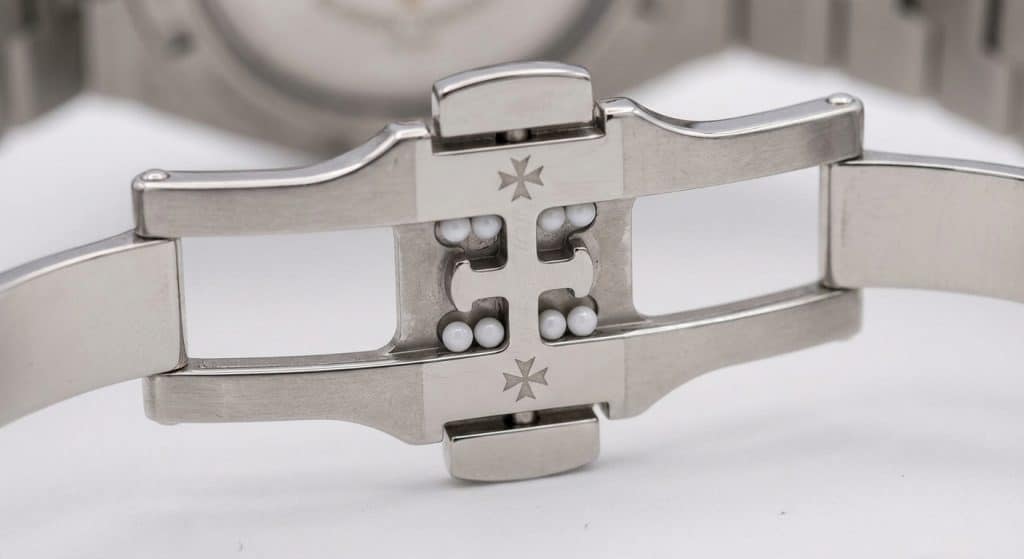
The acoustic signature of a clasp closure is a window into the density of its metallurgical composition and the precision of its spring-loaded mechanisms. In horological engineering, the “clasp-bite”—the specific force required to lock the deployment buckle—is a critical haptic feedback loop. The genuine Overseas clasp is famous for its damped “thud-click,” a sound produced by the perfect seating of Ceramic Ball Bearings into precision-milled detents.
Replicating this acoustic profile requires more than just copying the shape of the clasp. It requires the integration of high-grade materials and the calibration of the Tension Coefficient within the locking springs. For years, clones have suffered from a high-pitched “pinging” sound, a byproduct of hollow-milling and the use of lower-density steel alloys.
Ceramic Ball Bearing Integration
The genuine Overseas clasp utilizes Zirconia ceramic balls for the locking mechanism to ensure lifetime wear resistance and a frictionless engagement. Most legacy clones, such as the older MKS batches, utilized stainless steel balls which inevitably developed “flat spots,” leading to a loose or “mushy” feel over time. The 2026 High-End Batch from ZF has finally integrated industrial ceramic beads. While this improves the smoothness of the action, the spring tension (k) often remains 15-20% higher than the genuine article, leading to a “stiff” opening experience that requires more linear force than the Geneva original.
The Acoustic “Snap” Audit
The sound frequency of a clasp closure is determined by the material density and the internal volume of the clasp arms. By conducting a Sound Frequency Analysis, we can see that many replicas produce a “bright” resonance due to the use of thinner 316L sheets in the clasp’s internal construction. In contrast, the 2026 ZF and PPF models have moved toward a solid-block milling approach, which increases the mass of the clasp and lowers the acoustic pitch to a more authentic, damped frequency—a structural enhancement that parallels the findings in the micro-architectural engineering audit of 2026 super clone calibres where component density and tolerance precision are critical to high-fidelity replication. This adjustment in Metallic Resonance is a significant leap forward in tactile and auditory authentication.
Expert Authentication Insight: The Tension Coefficient Test
Diagnostic Operation: Use a professional pull-force gauge (Newton meter) to measure the force required to open the clasp. A genuine Overseas typically requires between 12N and 15N of linear force to disengage. Replicas from the 8F factory or mid-tier sources often fluctuate wildly, registering anywhere from 8N to 22N. This variance is a clear indicator of inconsistent spring quality and poor seating of the locking beads within the industrial assembly framework.
Rotor Oscillation and Centrifugal Feedback
The kinetic personality of a timepiece is largely dictated by its rotor’s winding efficiency and the resulting centrifugal feedback felt through the case-back. In the genuine Calibre 5100, the oscillation is nearly imperceptible, a ghost-like rotation facilitated by ceramic ball bearings and a perfectly balanced 22K Gold mass. In contrast, the replica market in 2026 continues to grapple with the “Kinetic Vibration” inherent in mass-produced movements. This sensory “chatter” is not merely an acoustic flaw but a failure in rotational physics, where the Angular Momentum of the rotor is not properly damped by the movement’s architecture.
For the auditor, the feedback provided by a flick of the wrist is a definitive diagnostic. The transition from the high-speed “whir” of a clone to the silent, heavy sweep of a Geneva original reveals the metallurgical and lubricative shortcuts taken during the industrial assembly in Guangzhou.
The “Wobble” Phenomenon in Miyota-based Clones
Many VC replicas, particularly the 8F Overseas series, utilize modified Miyota 9015 movements. While robust, these movements feature a high-speed unidirectional rotor that creates a distinct “vibration” or “wobble” on the wrist. This occurs because the rotor spins freely in one direction with zero resistance, generating a kinetic feedback that is completely absent in the genuine article. This tactile flaw is the most significant non-visual giveaway in mid-range replicas. Even with the advanced dampening plates introduced in 2026, the specific frequency of a Miyota 9015 remains detectable to anyone who has experienced the stabilized, bidirectional winding of a genuine Vacheron Constantin.
Weighting the Rotor: Tungsten vs. Gold
To mimic the winding efficiency and heft of a 22K Gold rotor, top-tier factories like ZF and PPF now utilize Tungsten Heavy Alloys (THA). While the Specific Gravity of tungsten is close to that of gold, achieving the same mass often requires the rotor to be 0.1mm thicker. This marginal increase in thickness can lead to “Rotor Scraping” against the sapphire crystal or the movement bridge under heavy torsional stress. Furthermore, the bearing friction in Guangzhou-sourced steel bearings is significantly higher than the ceramic standard used in the Vallée de Joux, leading to a “metallic whirring” sound that resonates through the 904L Steel case.
Expert Authentication Insight: The Rotation-Duration Test
Diagnostic Operation: Give the watch a sharp flick to initiate rotor spin and time the duration of the oscillation while holding the case-side to your ear. A genuine VC rotor, due to its perfectly lubricated ceramic bearings and high-mass gold rim, will stop smoothly with minimal “rebound.” A clone with dry steel bearings will either stop abruptly due to Pivot Friction or spin with a high-pitched metallic sound that can be felt as a physical tremor through the case-back.
Material Hardness and Surface Fatigue
The longevity of a super clone’s “crisp” feel is determined by its metallurgical composition and the resulting Vickers Hardness (HV). In the 2026 engineering landscape, we differentiate between the “soft” feel of recycled alloys and the “rigid” feedback of high-pressure forged 904L Steel. Material fatigue is a critical audit point; a timepiece that feels sharp today may lose its geometric definition within a year if the Surface Hardness is insufficient to resist micro-abrasions.
In the realm of gold-tone complications, such as the Historiques 222, the haptic differentiator shifts from hardness to Thermal Conductivity. The way a material absorbs and dissipates body heat is a primary sensory cue for the identification of solid precious metals versus galvanic coatings.
Gold Plating Depth and Tactile “Warmth”
In the BBR Historiques 222 “Gold” replicas, the tactile difference is found in the “Thermal Conductivity” of the case. Genuine 18K Gold feels “warmer” to the touch and reaches skin temperature faster than gold-plated steel. The 2026 Galvanic Coating techniques used by BBR now reach a 5-micron thickness, which successfully improves the “heft” and skin-contact feel. However, these models still fail the “ice-melt” thermal test, as the underlying steel core acts as a heat sink, maintaining a “cold” tactile profile that betrays its ferrous origin under professional sensory appraisal.
Structural Rigidity and Flex
Under physical stress or torsion, a genuine VC case exhibits absolute Structural Fidelity. Some budget-tier replicas utilize multi-piece case constructions or lower-grade alloys that can “creak” slightly when pressure is applied to the lugs. This is a critical audit point for the 2024-2026 ZF Overseas models, which have successfully moved to monobloc-style engineering. By milling the case from a single solid block of 904L Steel, ZF has eliminated the Torsional Stiffness issues of the past, though the Elastic Modulus of their steel remains slightly different from the proprietary alloys used in Geneva, affecting how the watch “rings” when tapped.
Expert Authentication Insight: The Vickers Hardness (HV) Scratch Audit
Diagnostic Operation: Using a professional hardness tester on an inconspicuous area such as the inner lug. Genuine 316L or 904L steel typically registers around 200-220 HV. Lower-end replicas often use recycled steel that registers below 160 HV, making them significantly more prone to “soft” scratches and losing their sharp, “crisp” edges over time as the material undergoes surface fatigue.
The 2026 Verdict: Can You “Feel” the Difference?
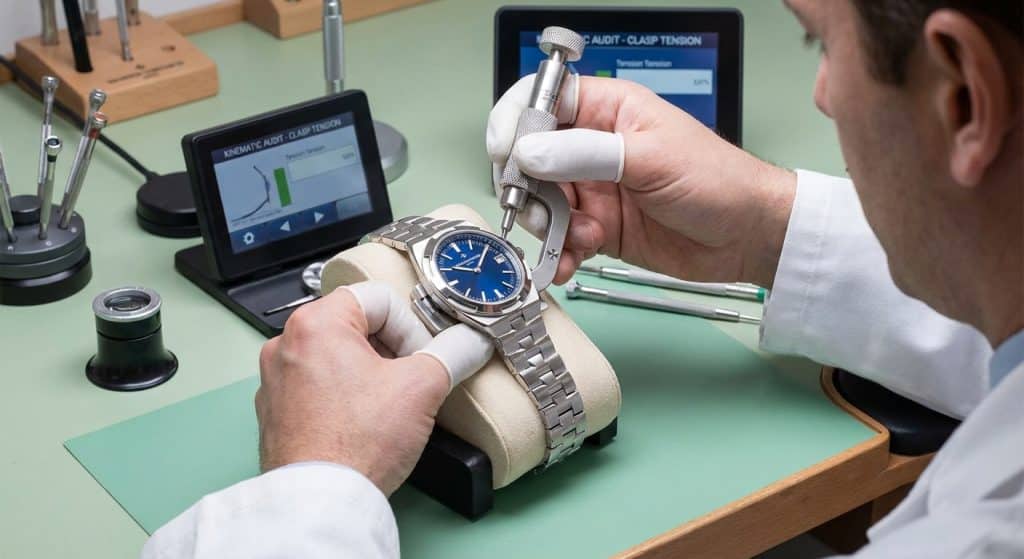
While visual parity in 2026 has reached a staggering 98%, the “Kinematic Gap” remains a persistent 15-20%. The reconciliation of high-volume industrial manufacturing with the nuanced requirements of horological haptics is a bridge that has not yet been fully crossed. The combination of Mass Distribution, Acoustic Signature, and Winding Torque creates a sensory profile that a seasoned watchmaker can identify within thirty seconds of “blind” handling. The replica’s journey from a visual clone to a tactile twin is nearing its conclusion, but the final few microns of refinement remain the domain of the genuine artisan.
Summary of Physical Engineering Gaps
The primary discrepancies in 2026 are found in the “Internal Inertia” of the movements and the “Friction Profiles” of the articulation points. While the ZF and PPF factories have mastered the geometry, the “feel” of the mechanical engagement—the way the crown clicks, the way the clasp snaps, and the way the rotor settles—retains an industrial grit. These are the subtle “Tactile Fingerprints” of Guangzhou’s high-end supply chain, distinguishing it from the hand-lapped perfection of the Vallée de Joux.
Expert Authentication Insight: Final Professional Audit Procedure
Expert Protocol: To verify a VC Overseas without the use of a loupe, follow this three-step kinematic sequence:
• The Quick-Release Test: Engage the strap-change system; the spring-back must be instantaneous and demonstrate the kinematic haptics and structural tolerances of VC super clones by providing a “crisp” mechanical resistance without any lateral play in the locking lug.
• The Ear-Rotation Test: Rotate the watch 360 degrees near the ear; any “shuffling,” “scraping,” or high-frequency “whirring” indicates a Tungsten rotor on steel bearings rather than a gold rotor on ceramic.
• The Clasp-Bite Test: Measure the force required to snap the Maltese cross shut; if the engagement feels “mushy” or requires more than 15N of force, the locking detents have not been hand-polished to Geneva standards.