
GF vs BV Santos: The Core Geometry & Wrist Presence
Most buyers comparing the GF and BV Santos start with the assumption that the case is identical. The specs list the same dimensions, the photos show the same iconic square shape. This is where the first, and arguably most important, misconception lives. The real difference isn’t in the numbers; it’s in the geometry—the three-dimensional architecture of the case that dictates how the watch wears, feels, and presents itself on your wrist.
The Curvature of the Bezel: Flat vs. Domed
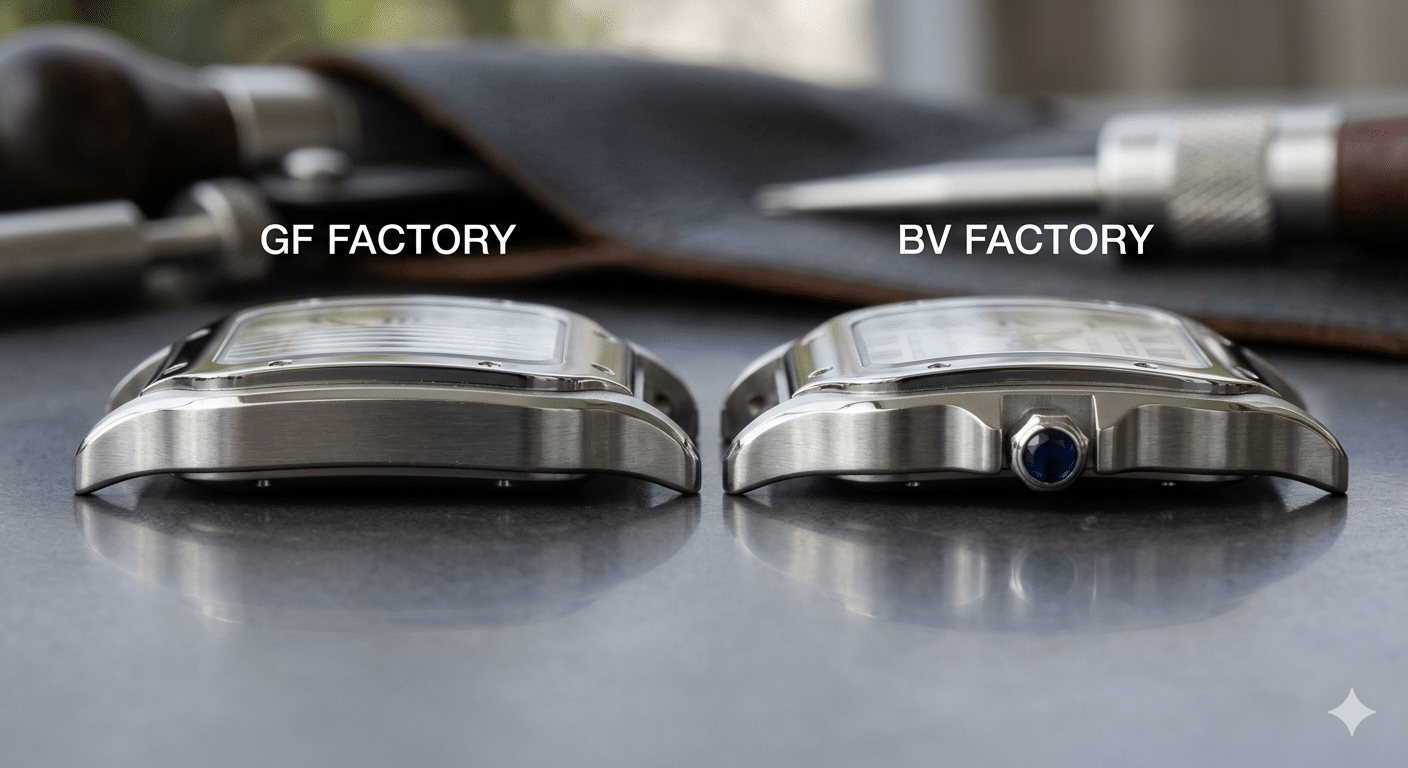
This is the single most defining visual cue. The Santos bezel isn’t just a flat ring; it has a subtle, complex curvature. GF’s interpretation leans toward a flatter profile. The top surface has a minimal dome, creating a sharper, more architectural drop-off to the case side. It reads as crisp and precise. BV, in contrast, employs a slightly more domed or rounded bezel curvature. This isn’t a flaw, but a distinct design choice. The BV’s bezel catches light in a broader, softer wash, which can, to a trained eye, make the watch appear a fraction more rounded or even slightly taller from certain angles. The GF’s flatter bezel reinforces the watch’s industrial, “riveted girders” heritage more starkly.
Case Side Profile and Lug Integration
Look at the watch from the side. The brushed case sides are where the factories’ machining philosophies diverge. GF typically executes a more pronounced, stepped transition from the polished bezel to the brushed mid-case. There’s a clear, defined edge—a shadow line—that emphasizes the watch’s layered construction. BV often opts for a smoother, more blended transition. The angle might be less acute, and the finish change from polished to brushed can be more gradual. This affects the play of light along the case flank: GF’s side profile is more graphic and segmented, while BV’s is more fluid and continuous. It also subtly influences how the lugs appear to flow from the case.
Overall Case Thickness Perception
On paper, both watches measure around 8.9mm thick. On the wrist, they can feel different. This is the “perceived thickness” paradox. GF’s combination of a flatter bezel and a stepped side profile often creates a visual trick of slimness. The sharp transitions break up the mass. BV’s domed bezel and smoother sides can create a more monolithic, slightly chunkier visual presence, even if the calipers disagree. It’s not that one is thicker; it’s that one is designed to look and feel thinner. For a watch prized for its wearability, this perceptual difference matters more than a tenth of a millimeter.
Expert Authentication Insight
The most telling test requires no wear. Place both watches side-by-side on a flat surface. Get down to eye level with the case, viewing them from a perfect 90-degree side angle. Better yet, use a macro lens. What you’re looking for is the silhouette of the bezel-to-case transition. The GF will typically present a distinct, angular “step” or notch. The BV will show a more continuous, rounded curve from the crystal down to the case band. This single line tells you almost everything about the watch’s architectural intent.
Bezel Screws: Decorative vs. Functional Illusion
The bezel screws are the Santos’s fingerprint. Every factory will tell you theirs are “perfectly aligned.” That’s the bare minimum. The real hierarchy is in the minutiae of finish, fit, and the illusion of function they create. This is where a replica announces its tier not from across the room, but in the intimate space of a handshake or a glance across a table.
Screw Head Finish and Sunburst Pattern
The genuine Santos screws have a specific, fine sunburst finish machined into their flat heads. It’s not a simple brushed texture; it’s a precise radial pattern that plays with light. GF consistently nails this detail. The sunburst is sharp, clean, and deeply cut, creating a dynamic sparkle that changes distinctly as the light moves. BV’s screws often have a softer, less defined pattern. It can appear closer to a standard brushed finish, with the radial lines being less pronounced or slightly muddled. Under direct light, the GF screw head will exhibit sharp, star-like reflections; the BV’s will be more diffuse.
Alignment and Flush Fit with the Bezel
Alignment to the bezel’s grid is basic. The true test is planar alignment—how perfectly each screw sits flush within its recess. A screw that is proud (sticking out) or recessed (sitting too deep) breaks the seamless, machine-tooled illusion. GF exhibits exceptional consistency here. The screws sit perfectly flush, creating a smooth, uninterrupted plane across the bezel. BV can show variance. It’s not uncommon to find one or two screws on a BV watch that are a hair proud or slightly sunk. Run your fingernail across the bezel. On the GF, it should glide smoothly. On a BV, you might feel a tiny catch.
The “Black Hole” Effect of the Screw Slots
Look into the slot. On the genuine article, it’s a deep, clean, black abyss, perfectly centered. This “black hole” effect is crucial for the screw’s visual weight and precision. GF’s screw slots are typically laser-sharp, deeply cut, and perfectly centered, maintaining that deep black appearance. BV’s slots can occasionally show faint machining marks inside, may be slightly shallower, or can be minutely off-center. This doesn’t render the watch “fake-looking” from a distance, but under close inspection—the kind you or an observant friend might give—it subtly weakens the convincing illusion of a functional, torqued-down component.
Expert Authentication Insight
Arm yourself with a 10x loupe and a single, strong light source (a phone flashlight works). Isolate one screw. Tilt the watch slowly. Observe how the light travels across the screw head’s surface. A well-defined sunburst (GF) will reflect light in sharp, radial lines that seem to spin. A softer finish (BV) will create a more generalized, blurry reflection. Next, with the loupe, examine the depth and walls of the screw slot. Clean, sharp, parallel walls and a deep, dark base indicate higher precision machining.
The Bracelet & System: Where Ownership is Felt
You look at the dial, but you feel the bracelet. This is the most tactile, daily point of interaction and where the theoretical “quality” of a replica translates into lived experience. The difference between GF and BV here isn’t just about looks; it’s about solidity, sound, and the satisfaction (or frustration) of adjustment.
SmartLink (BV) vs. QuickSwitch (GF) Mechanism Execution
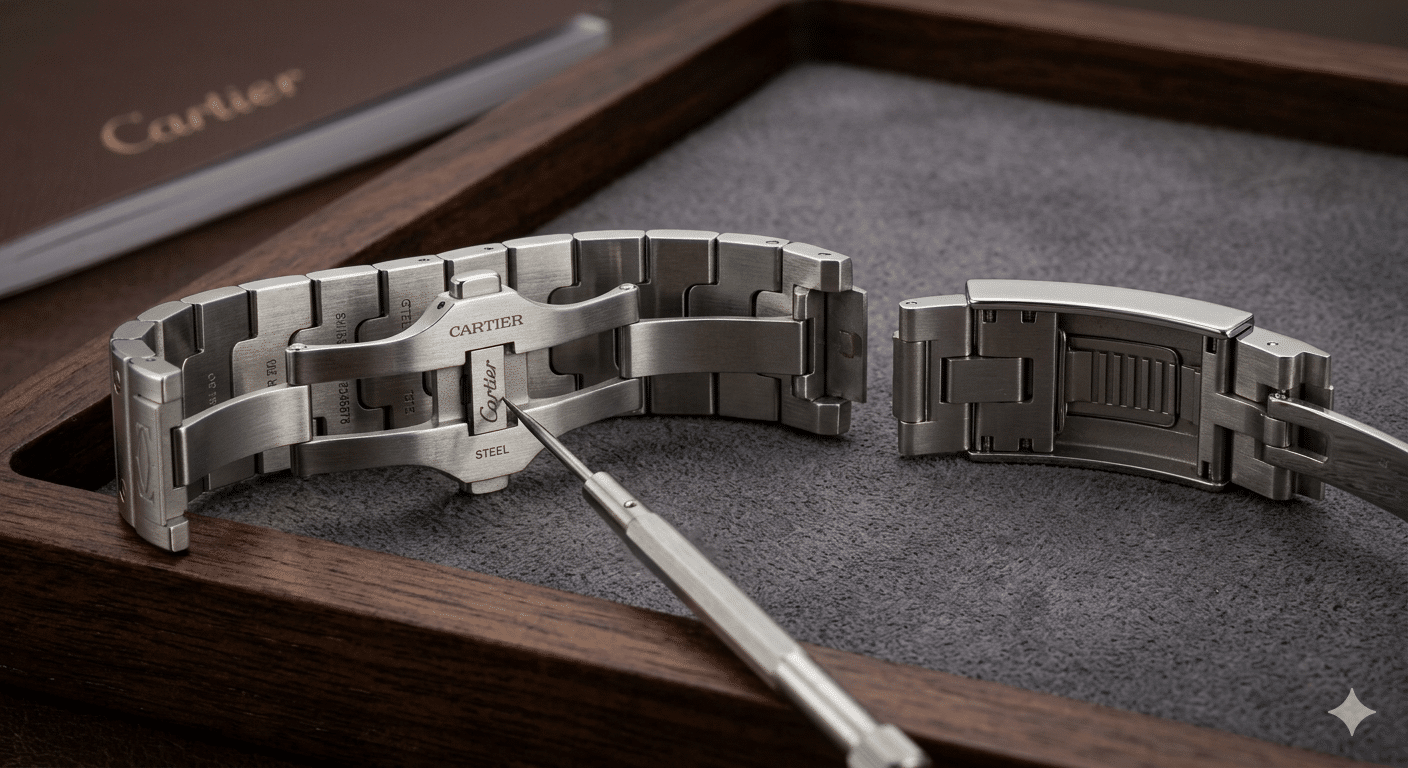
Both factories mimic Cartier’s tool-free link removal system, but their executions feel different. BV’s system (often called “SmartLink”) typically uses a pin-and-collar design with a small button on the underside of the link. Pressing it releases the pin. In practice, the action can feel stiff, gritty, or require significant pressure, and the tiny collars are easy to lose. GF’s “QuickSwitch” system uses a spring-bar-like mechanism activated by pressing a tool into a discreet hole. The action is more positive, direct, and feels more robust. For the end-user, GF’s system often feels more reliable and less finicky for sizing, though it requires the included tool.
Bracelet Link Articulation and “Drape”
How does the bracelet conform to your wrist? GF bracelets have earned a reputation for excellent articulation. The links move with a solid, fluid confidence, with minimal side-to-side wiggle or “play.” They drape around the wrist with a sense of substantial flexibility. BV bracelets are generally good, but consistency can vary. Some feel equally solid, while others may exhibit a slightly more hollow feel or a bit more lateral flex in the links. This isn’t about durability necessarily, but about the perceived quality and comfort during movement.
Clasp Feel: Click, Closure, and Micro-Adjust
The clasp is your primary touchpoint multiple times a day. GF’s deployant clasp is often the benchmark. The closing action delivers a firm, authoritative, and satisfyingly crisp click*. The mechanism feels tight and precise. The interior finishing is also generally cleaner. BV’s clasp is functional but can fall short. The close might be softer, less decisive, or occasionally exhibit a slight grinding sensation. The micro-adjustment, if present, may also feel less refined. This is a small detail that has an outsized impact on the daily wearing experience—the difference between a piece of jewelry that feels secure and one that feels merely closed.
Expert Authentication Insight
Conduct a simple “wiggle test.” Hold the watch head firmly and gently twist the bracelet. Listen and feel. A solid, well-articulated bracelet (common in GF) will have minimal noise and a coherent, unified flex. A bracelet with more play or hollow links might produce faint squeaks or feel less torsionally rigid. Then, open and close the clasp ten times in a row. The action should be consistent. Any hesitation, variance in pressure required, or gritty feedback is a mark against long-term satisfaction and perceived quality.
Dial & Crystal: The Face-Value Assessment
Forget “they’re both good.” When you’re paying for a top-tier replica, the dial and crystal are where the money is supposed to buy you peace of mind—the confidence that you’re not staring at a tell every time you check the time. This is about the subtle, often microscopic, hierarchies that separate a convincing face from a flawed one. It’s not about spotting fakes from a distance; it’s about the quiet, daily irritation of a detail that’s just… off.
Printed Roman Numeral Sharpness and Paint Fill
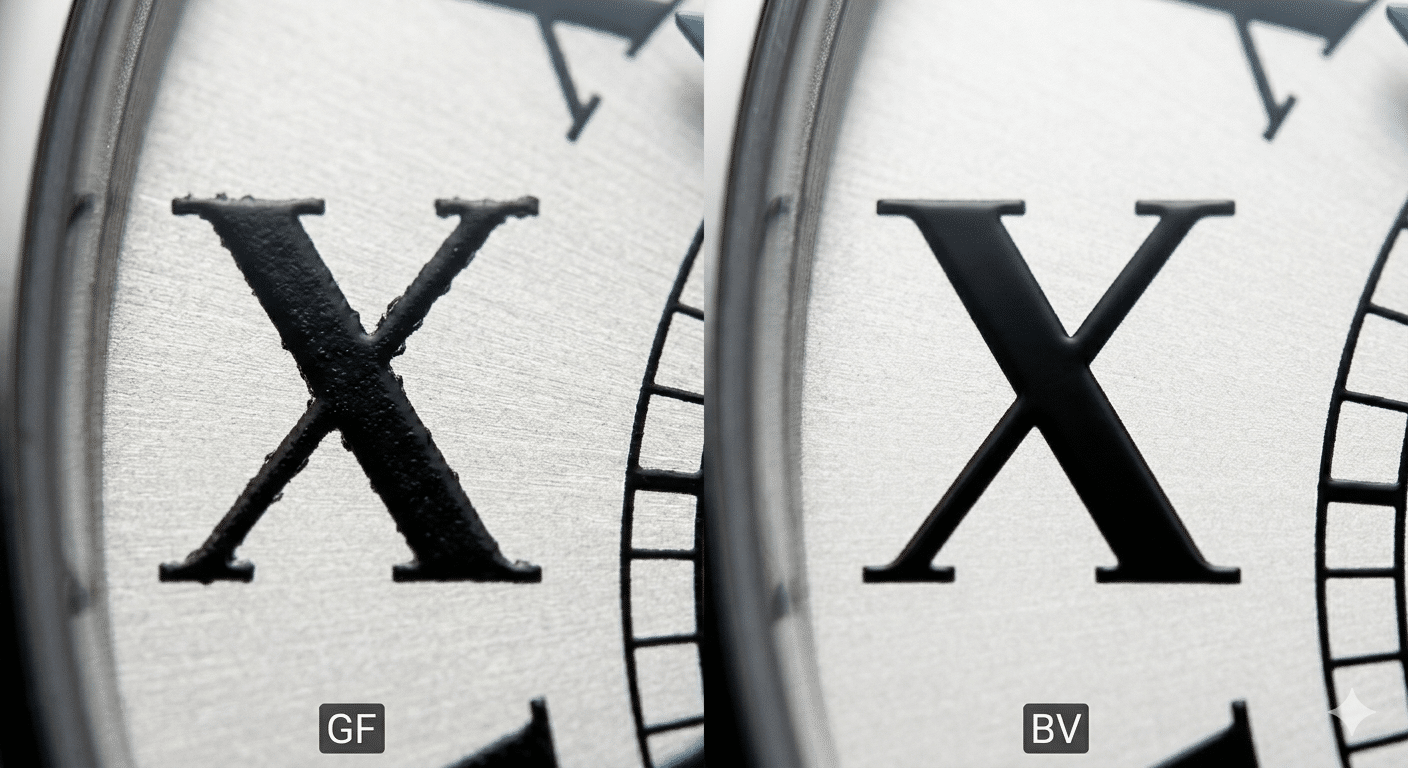
This is the first place your eye goes, and it’s the first place cheap reps fall apart. Under macro scrutiny, the black printed Roman numerals on a Santos dial reveal everything, a key detail in any super clone replica evaluation. GF typically executes this with near-surgical precision. The edges of the numerals are razor-sharp, with no bleeding or feathering into the silver sunburst background. The paint fill is uniformly deep and opaque.
BV, while excellent, can occasionally show its hand here. In some batches, you might find very slight fuzziness at the curves of the ‘V’ or ‘X’, or a minute inconsistency in the paint density. It’s not a flaw you’d see without looking for it, but it’s the difference between perfect and almost perfect. For a watch defined by its clean, graphic dial, this precision matters.
Sunburst Dial Texture and Gradient Effect
The Santos’s silver dial isn’t flat; it’s a fine, silvery guilloché sunburst. The quality of this pattern dictates how the watch plays with light. A superior sunburst will create a smooth, liquid gradient from center to edge, shifting from bright silver to a softer charcoal grey depending on the angle.
GF’s dials consistently exhibit a finer, more refined radial brushing. The transition of light is seamless. BV’s sunburst can sometimes—not always—appear slightly coarser or less consistent. Under oblique lighting, this might manifest as a more segmented or “choppy” reflection, rather than a continuous wave of light. It’s a nuance of refinement, not a glaring error.
Date Wheel Alignment and Font
The date window is a notorious trap. It’s a tiny, focused aperture that magnifies any imperfection. The two critical checks are alignment and font. Is the date perfectly centered within the window, with equal spacing on all sides? A date sitting even slightly high, low, left, or right becomes a persistent eyesore.
Then, the font. The genuine Cartier date font is distinct—elegant, slightly elongated, and of a specific weight. Both factories mimic it well, but GF often nails the weight and spacing with more consistency. A BV date wheel might, in rare cases, use a font that’s a hair too bold or too thin, breaking the visual harmony. A misaligned or font-mismatched date wheel is the kind of flaw that, once seen, cannot be unseen.
Expert Authentication Insight
The test is simple but revealing. Use your smartphone’s macro mode or a cheap macro lens. Zoom in on the point where the tip of a Roman numeral meets the dial. Look for a crisp, clean boundary. Any bleeding or softness is a mark against ultimate refinement. Next, take the watch to a window or under a single light source. Slowly tilt and rotate it. Observe the sunburst. Does the light glide across the surface in a smooth, unified gradient, or does it jump in distinct, concentric rings? The former indicates a higher-quality guilloché process. This isn’t about spotting a fake; it’s about grading the level of execution within the super clone tier.
Movement Choice: Decoration vs. Reliability Reality
This is the heart of the philosophical divide between GF and BV. It’s not about which keeps better time—both are fine. It’s about what you’re buying into: proven, serviceable mechanics, or a visual illusion that complicates ownership. The movement choice defines the long-term relationship with the watch.
The Miyota 9015 (GF) Reality: The Known Quantity
GF equips its Santos with the Japanese Miyota 9015. This is the industry’s workhorse. Its reputation is built on three pillars: it’s reliable, it’s thin (crucial for the Santos’s profile), and it’s universally serviceable. Any competent watchmaker anywhere in the world can open it, service it, and source generic parts for it. The downsides are equally well-known: the rotor is notoriously loud (a high-pitched, metallic whirring), and its industrial, utilitarian finishing is a stark contrast to the elegance of the watch it powers.
For GF, the calculation is pragmatic. The Santos is a closed case back watch. They prioritized a proven, slim movement that guarantees functional performance and easy repair over visual theater no one will see. It’s a tool, not a showpiece.
The “Asia 1847” Clone (BV) Ambition: The Visual Play
BV takes the opposite approach. They use a decorated clone movement that strives to visually replicate the Cartier 1847 MC. Through the exhibition case back, you see faux Geneva stripes (côtes de Genève) on the bridges, perlage (circular graining) on the mainplate, and a rotor engraved with “Cartier” branding. It’s a convincing illusion at arm’s length.
The core question is one of value versus hassle. The decoration is skin-deep; underneath lies a standard Chinese automatic movement of unknown provenance (often a modified Seagull). Its timekeeping is typically on par with the Miyota. However, if it ever needs service, you cannot walk into any watch shop. You need a specialist familiar with replica movements, and replacement parts are not standardized. You’re trading long-term practicality for a momentary visual thrill.
Timekeeping Expectations and Service Scenarios
Set realistic expectations: both watches will likely run within +/- 10-20 seconds per day. That’s not the differentiator. The differentiator is what happens in Year 3 or 4.
For the GF (Miyota 9015): Service is straightforward. A local watchmaker charges a standard fee, uses generic lubricants and parts, and you’re set for another half-decade. Total cost: predictable and moderate.
For the BV (Decorated Clone): Service is a niche operation. You must find a rep-friendly watchmaker. They may need to source donor movements for parts. The labor is more involved, and the risk of “we can’t fix this” is higher. The cost and headache multiply. You are buying a potential future complication.
Expert Authentication Insight
The diagnostic is a sensory one. First, listen. In a quiet room, pick up the GF Santos and rotate your wrist near your ear. You’ll hear the distinctive, high-frequency whirl of the Miyota rotor—it’s a dead giveaway. The BV will be significantly quieter. Second, look (if you have the open case back model). The BV’s movement will have decorative stripes and spotting. The GF’s movement, if visible, is purely industrial—a clear, undecorated mechanism. This isn’t about spotting a fake from the outside; it’s about understanding the mechanical reality inside.
The Price Premium Analysis: Is BV Worth the Extra Cost?
This is where abstract comparisons crystallize into a dollar-and-cents decision. The BV Santos typically commands a $150 to $250 premium over the GF. What are you actually buying with that money? For a comprehensive breakdown of the models and their specifications, this detailed Cartier Santos super clone guide offers essential context. This isn’t about which is “better”; it’s about which provides more value to you, based on your personal priorities and psychology.
Cost-Benefit Breakdown by Category
Let’s audit the premium. For your extra ~$200, BV gives you:
- A Decorated Movement: A visual clone for an exhibition case back (if chosen). Value: High for the detail-obsessed; $0 for the pragmatist who never sees it.
- A Quieter Rotor: The BV movement is notably less noisy. Value: Moderate to high for those sensitive to sound.
- Potentially Slightly Better Screw Alignment/Finish: This is batch-dependent. Value: Low to moderate, as GF screws are often excellent.
- A Different (Smoother?) Bezel Curvature: A subjective aesthetic difference. Value: Subjective.
- Potentially More Service Headaches: A future cost and risk. Value: Negative.
The ledger is stark. You are primarily paying for a visual upgrade (the movement decoration) and a sonic upgrade (quieter rotor). Everything else is marginal or a trade-off.
The “First Santos” Buyer vs. The “Detail-Obsessed” Enthusiast
Your profile dictates the math.
The First Santos Buyer / Value Seeker: You want the iconic Santos experience—the look, the feel, the bracelet—with maximum reliability and minimum fuss. For you, the GF is the unequivocal choice. You get 95% of the wrist presence and 100% of the functional satisfaction for less money, with a far simpler ownership lifecycle. The extra $200 buys you diminishing, almost academic returns.
The Detail-Obsessed Enthusiast / Spec-Sheet Perfectionist: You derive satisfaction from knowing your watch is as visually close to genuine as possible, even in hidden areas. The idea of a noisy Miyota rotor or an undecorated movement bothers you on principle. You are willing to pay a premium and accept future service complexity for that peace of mind. The BV premium is your entry fee to the highest tier of visual replication.
The Diminishing Returns Curve
Understand the curve. The jump from a $300 shoddy replica to a $650 GF is a vertical line—a monumental leap in quality, finishing, and feel. The jump from the $650 GF to the $850 BV is a shallow, flattening curve. You are spending significant extra money for incremental, often invisible, improvements. You must decide if you are at a point on that curve where those increments matter to you. For most rational buyers, the GF represents the peak of the value curve.
Expert Authentication Insight
The final diagnostic requires no loupe or timegrapher. It’s a thought experiment. Ask yourself: “If I covered the solid case back, could I feel or see a $200 difference on my wrist daily?” Be brutally honest. If your answer is “No, I just want a great Santos that works,” buy the GF. If your answer is “Yes, knowing the movement looks right and the rotor is silent is worth that to me,” then the BV justifies its price. The “right” choice is the one that aligns with your psychology, not forum consensus.
Final Verdict & Decision Pathway
After dissecting the geometry, screws, bracelet, and movement, the choice between GF and BV isn’t about which is objectively “best.” It’s about which set of compromises and strengths aligns with your priorities as a buyer. One factory offers a better wearing experience; the other offers a slightly better-looking spec sheet. Your decision should hinge on what you value more in daily ownership, not on forum popularity. Let’s translate the analysis into a clear decision pathway.
The GF Santos: The Recommendation for Most
The GF Santos is the rational, no-regrets default. Its value proposition is brutally straightforward: you get 95% of the genuine Santos experience—superior bracelet articulation, a satisfyingly crisp clasp action, a sharp, architectural case profile, and a dial with excellent print quality—for a lower price. The Miyota 9015 movement inside is the cornerstone of this logic. It’s a known quantity: thin, reliable, and easily serviceable by any competent watchmaker with readily available parts. Its main flaw, the audible rotor spin, is a non-issue once on the wrist for most people.
Choosing GF means you prioritize the tactile, daily interaction with the watch. You’re buying a premium feeling on your wrist and in your hand. You accept that if someone with a loupe examines the case back, they’ll see a generic movement. For the vast majority of buyers, especially those acquiring their first high-tier replica, this is the correct and sensible choice. It delivers outstanding quality where it counts most—on the wrist—and minimizes long-term ownership headaches.
The BV Santos: The Niche Justification
The BV Santos exists for a specific buyer: the detail-obsessed enthusiast for whom visual fidelity is the ultimate prize. The justification for its ~$150-200 premium is narrow but potent. You are paying primarily for the decorated “Asia 1847 MC” clone movement. This buys you a quieter winding rotor and a case back view that, at a glance, more closely mimics the genuine article. It’s a purchase for the collector who derives satisfaction from knowing the spec sheet is more complete, even if that detail is hidden 99% of the time.
This choice comes with acknowledged trade-offs. The bracelet’s SmartLink system may not feel as refined as GF’s QuickSwitch, and consistency in bezel screw finishing can be a step behind. Most critically, you’re opting for a more complex movement ecosystem for servicing. The niche for BV is clear: it’s for the buyer who will lie awake at night thinking about the Miyota rotor noise, or for whom the idea of a “correct” movement decoration provides disproportionate satisfaction. It’s not about value; it’s about pursuing the final 5% of visual accuracy.
Your Personal Selection Filter
Forget the noise. Answer these three questions honestly, and the choice becomes automatic:
- The Movement Priority Test: Is a quiet, visually decorated movement behind a solid case back worth an extra $200+ to me? If your answer is a firm “yes,” and you understand the potential future service implications, lean BV. If you think, “That’s a lot of money for something I’ll never see and barely hear,” lean GF.
- The Detail-Obsession Test: Will minor inconsistencies in bezel screw finish (sunburst sharpness, slot centering, flushness) bother me every time I look at the watch? If you are the type to notice and fixate on such micro-details, the BV’s gamble might not be worth it; GF’s more consistent execution is the safer play. If you barely noticed the difference in the macro photos, it’s a non-issue.
- The Tactile Priority Test: Do I value a flawless, authoritative bracelet clasp action and buttery link articulation above almost all else? If the feel of the bracelet is your primary touchpoint for quality, the answer is unequivocally GF. Its bracelet system is consistently rated as best-in-class.
If questions 2 and 3 point to GF, but question 1 points to BV, you have your core conflict. You must decide if the movement romance outweighs the daily tactile experience.
Expert Authentication Insight
The ultimate diagnostic isn’t done with a loupe; it’s done in your mind weeks after the watch arrives. A successful purchase is one where you stop analyzing the factory and start simply wearing the watch. The “wrong” choice manifests as a persistent, low-grade irritation: the GF owner who can’t un-hear the rotor whir in a quiet room, or the BV owner who constantly fiddles with the slightly less satisfying clasp or notices a screw that isn’t perfectly flush.
The goal is to match the object to your psychology. The GF is for the pragmatist who wants a superb watch. The BV is for the perfectionist who wants a more complete replica. Both are excellent, but they serve different masters. Choose based on which details you can’t live without, and which compromises you can easily accept.