
Size as Deception: When “Small” Means More Than Just Millimeters
The Santos Small isn’t just a smaller watch. In the replica world, it’s a different beast entirely. The assumption that it’s a simple, scaled-down version of the Medium is where most buyers make their first and most expensive mistake. This error often stems from a lack of detailed knowledge about the critical GF vs BV factory comparison, which highlights how the “Small” designation becomes a trap, not a feature. The replica manufacturing process for this specific size doesn’t just miniaturize—it distorts. It amplifies inherent design weaknesses that the larger Medium case can hide, often resulting in a watch that fails at the Santos’s core purpose: projecting an air of confident, architectural strength. This isn’t about preference; it’s about structural integrity on a micro scale.
The Compromised Architecture: Bezel Thickness vs. Dial Real Estate
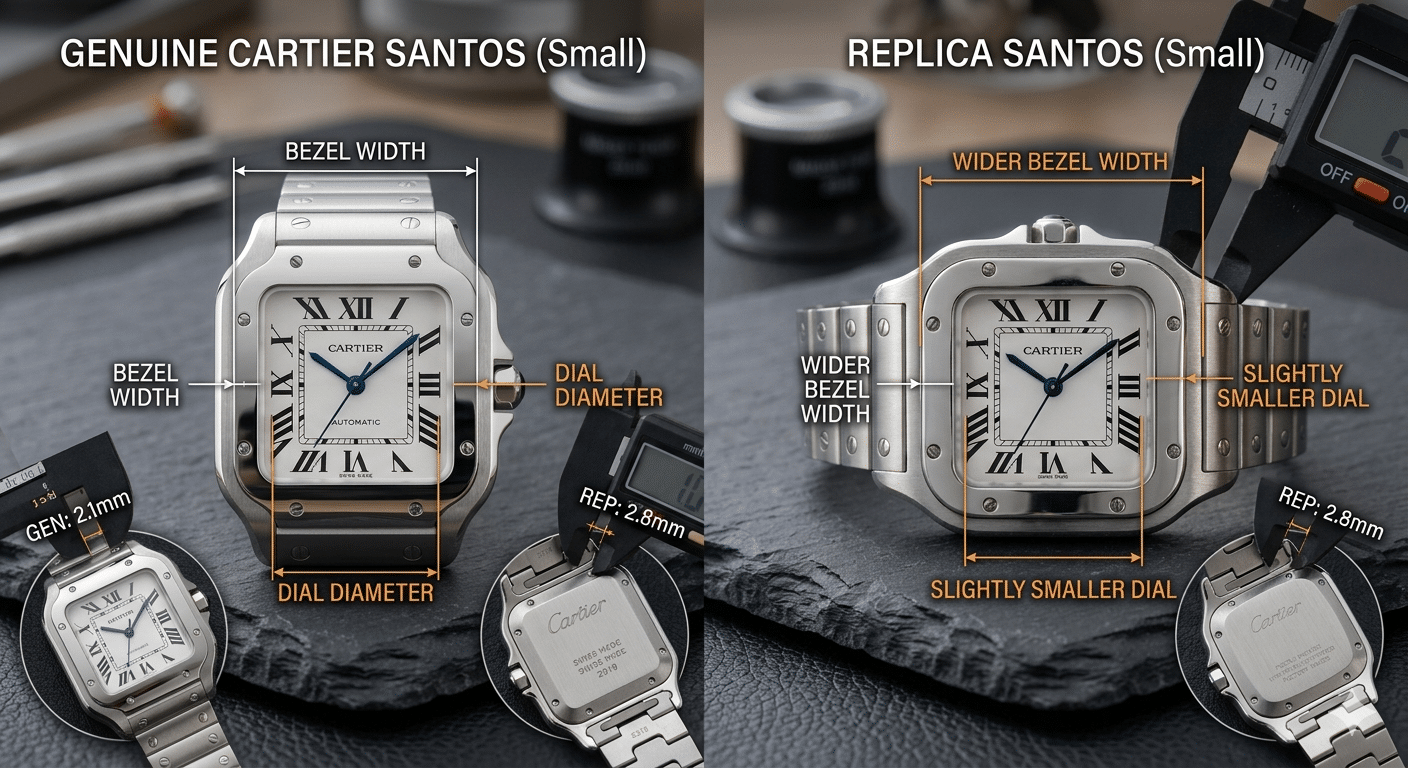
Here’s the mechanical truth most sellers won’t tell you: factories like BVF and V6F/GF don’t create unique tooling for the Santos Small. They use the same bezel casting molds for their Medium models and simply trim down the case diameter. This is a catastrophic shortcut for a design defined by its geometric balance.
The result is a bezel-to-dial ratio that is completely off. Instead of the genuine Small’s elegant, open dial framed by a slender bezel, you get a visually “chunky,” top-heavy look. The bezel occupies too much of the watch’s face, making the dial look pinched and recessive. The iconic screws, a signature element, become a glaring flaw. On a poor replica, they appear disproportionately large, poorly defined, and lack the crisp, chamfered edges of the genuine article. What should be a refined frame becomes a heavy, clumsy border.
The Vanishing Taper: Bracelet Proportion Collapse
If the case is the watch’s face, the bracelet is its spine. The Santos’s “SmartLink” bracelet is a masterpiece of integrated design, its elegance lying in its gradual, seamless taper from the lugs (~20mm) down to the clasp (~16mm). In the Small size, this narrative collapses.
Replica factories struggle to miniaturize this articulation. The links become stiff, losing the fluid, draping quality. More critically, the taper is often botched. You’ll find bracelets that are too narrow overall, feeling insubstantial, or ones that taper too abruptly, creating a jarring, unbalanced silhouette. Instead of a graceful architectural flow from case to clasp, you get a disjointed series of parts. On the wrist, this translates to a bracelet that either feels toy-like or fails to integrate with the case, destroying the watch’s cohesive, singular form.
Expert Authentication Insight
The most telling test requires no loupe, just a flat surface and a phone camera. Place the watch flat and take a picture directly from above. Now, measure. On a flawed replica, the bezel width (from the outermost screw edge to the inner metal frame) will occupy nearly 40% of the watch’s total diameter, swallowing the dial. On a genuine Small Santos—or a superior replica that bothered to get the proportions right—that ratio is a balanced 30-33%. The dial breathes; the watch feels open and intentional. This isn’t a minor detail; it’s the fundamental architecture of the design, and most replicas get it wrong.
The “Male Gaze” Test: Wrist Presence and Silhouette
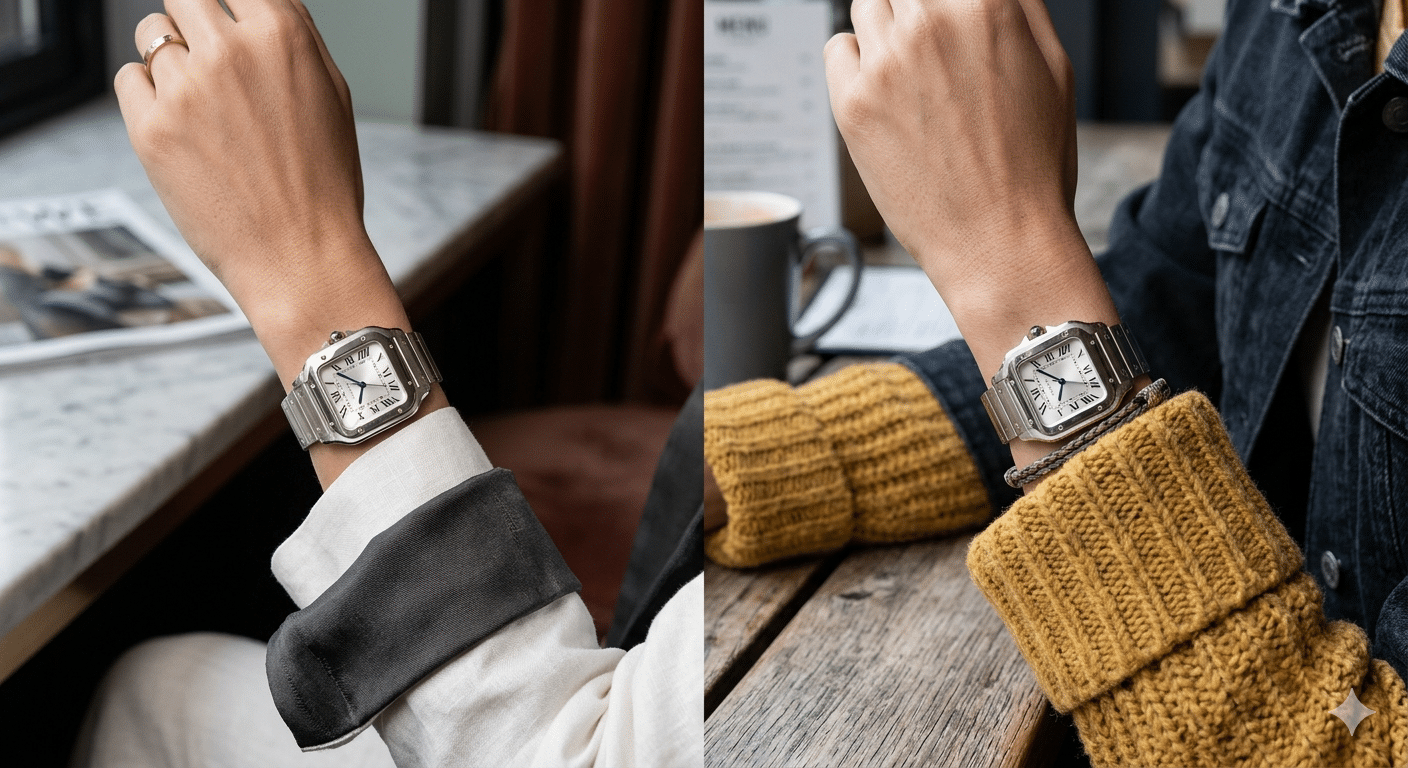
Forget the spec sheet. The real test of a Santos—especially a men’s Santos—is how it performs on the wrist socially and experientially. Its promise is refined masculinity: a square of steel that commands respect through precision, not bulk. The Small replica’s distorted proportions threaten this entire premise, risking a reading that shifts from confident to costume-like.
The Lost “Squaring” Effect on the Wrist
The Santos’s masculine energy comes from the dynamic tension between its rigid, square case and the organic curve of a man’s wrist. It’s a statement of geometry against nature. On a smaller wrist (under 7 inches), a well-executed Small can still achieve this, creating a pleasing, intentional square. But on a larger wrist (7.25 inches and above), the compromised replica proportions fail spectacularly.
The watch doesn’t “square off” the wrist; it sits as a small, isolated plaque. The visual tension disappears. Compounding this is case thickness. Replicas, especially in smaller sizes, often run slightly over the genuine spec. This extra millimeter or so makes the watch sit tall and awkwardly, further breaking its intended low-profile, integrated silhouette. It shouts its presence for all the wrong reasons.
Dial Detail Compression: When Legibility Becomes Delicate
The Santos dial is a study in instrumental clarity: crisp Roman numerals, a precise chemin de fer track, sharp, faceted hands. Scaling this down is a nightmare for replica printers. The result is often a dial where the printed indices suffer from over-inking or blurry application. The Roman numerals can look soft, even smudged. The sword-shaped hands lose their three-dimensional, faceted construction, appearing flat and painted-on.
This erosion of detail is fatal. It transforms the dial from a precise instrument to a fussy, delicate decoration. The watch no longer communicates “tool-watch heritage adapted for elegance”; it communicates “decorative jewelry trying too hard.” The very essence of the Santos’s identity—that blend of form and function—is the first casualty of poor miniaturization.
Expert Authentication Insight
Light is the great revealer. Take the watch into natural, angled daylight. Observe the dial’s surface and the printing. A low-tier Small replica will have a dead, flat, matte black dial with indices that look glossy, thick, and painted on top. A higher-quality rep (or the genuine article) will reveal a subtle, fine-grained texture—like very fine sandpaper—that gives the dial depth. The printing will be crisp, sharp, and look slightly recessed or embedded into the surface, not sitting on top of it. This textural fidelity is what separates a convincing object from a cheap facsimile.
The Refined Choice vs. The Wrong Compromise: Defining the Buyer
Understanding the flaws is only half the battle. The real question is: who should buy this watch despite them, and who is walking into a trap? The Santos Small replica isn’t universally bad; it’s contextually perilous. Your goal determines whether it’s a brilliant choice or a fundamental error.
Profile A: The Intentional Minimalist (The Good Fit)
This buyer has a wrist under 7 inches and a personal style that is inherently refined, understated, and modern. Think tailored minimalism, not bold statements. They are not trying to replicate the wrist-filling “presence” of a Medium Santos. For them, the watch is about finish, proportion, and subtlety on its own terms, a focus that extends to a careful evaluation of details like mid-tier replica authentication methods which can be applied without opening the watch. They are drawn to the Small as a distinct, jewelry-adjacent object of design.
The Path to Success: For this buyer, compromising on factory is not an option. They must target the highest tier, prioritizing BVF for its superior, warm-white dial and sharper printing. The goal is perfection of detail and finish, accepting that they are buying a specific style object, not a substitute for a Medium. The price point for this level of quality starts around $750-$800 USD.
Profile B: The Cost-Conscious Compromiser (The Risk)
This is the most common and most perilous profile. Attracted by the lower price of the Small model across all factories (often $100-$200 less than the Medium), they hope to get “90% of the Santos look for 70% of the price.” This math never works.
The cost savings are immediately consumed by the more obvious proportional and detail flaws outlined above. You end up with a watch that screams “compromise” from every angle. For this buyer, the vastly smarter move is to spend that $500-$600 USD on a mid-tier Medium Santos from a factory like GF. The larger canvas forgives more sins, and the overall design coherence is far superior, delivering a much more convincing and satisfying “Santos experience.”
Profile C: The Gift Buyer (The Wild Card)
Purchasing for a partner with a smaller wrist. Here, success hinges entirely on managing expectations. The replica can succeed as a beautiful, stylish object if the recipient’s reference point is fashion jewelry from brands like Michele or Coach, not the horological precision of Cartier.
The Key Choice: Prioritize wearability over absolute visual fidelity. Choose a factory like V6F known for bracelet comfort and a solid clasp action. A comfortable, well-finished bracelet that feels good will leave a far better impression than a slightly more accurate dial on a jangly, poorly constructed band. Frame it as a piece of fine costume jewelry, not a replica of a precision instrument.
Expert Authentication Insight
The “Clasp Click” test is a brutal and immediate tactile litmus test for intent. Operate the deployant clasp ten times. On a replica destined for the Intentional Minimalist—a watch where refinement is the goal—the action will be firm, precise, and have a solid, muted, mechanical thud-click*. On a replica built for the Cost-Conscious Compromiser, the mechanism will feel loose, gritty, or produce a tinny, high-pitched *snap*. That sound and feel is the immediate, subconscious betrayal of the watch’s intended luxury. It tells you everything about where the factory cut corners.
Factory Showdown: Which Producer Understands “Small”?
Comparing factories on their 42mm Medium Santos is one conversation. Judging them on the Small model is an entirely different, and more revealing, test. Here, general build quality is not enough. The real question is which factory’s engineering and design choices best navigate—or worst exacerbate—the inherent proportional tightrope of the smaller case. This isn’t about who makes the “best” watch in a vacuum, but who makes the most coherent Small Santos. The differences are stark, and they create clear winners and losers for specific buyer intentions.
BVF: The Dial Specialist with Structural Flaws
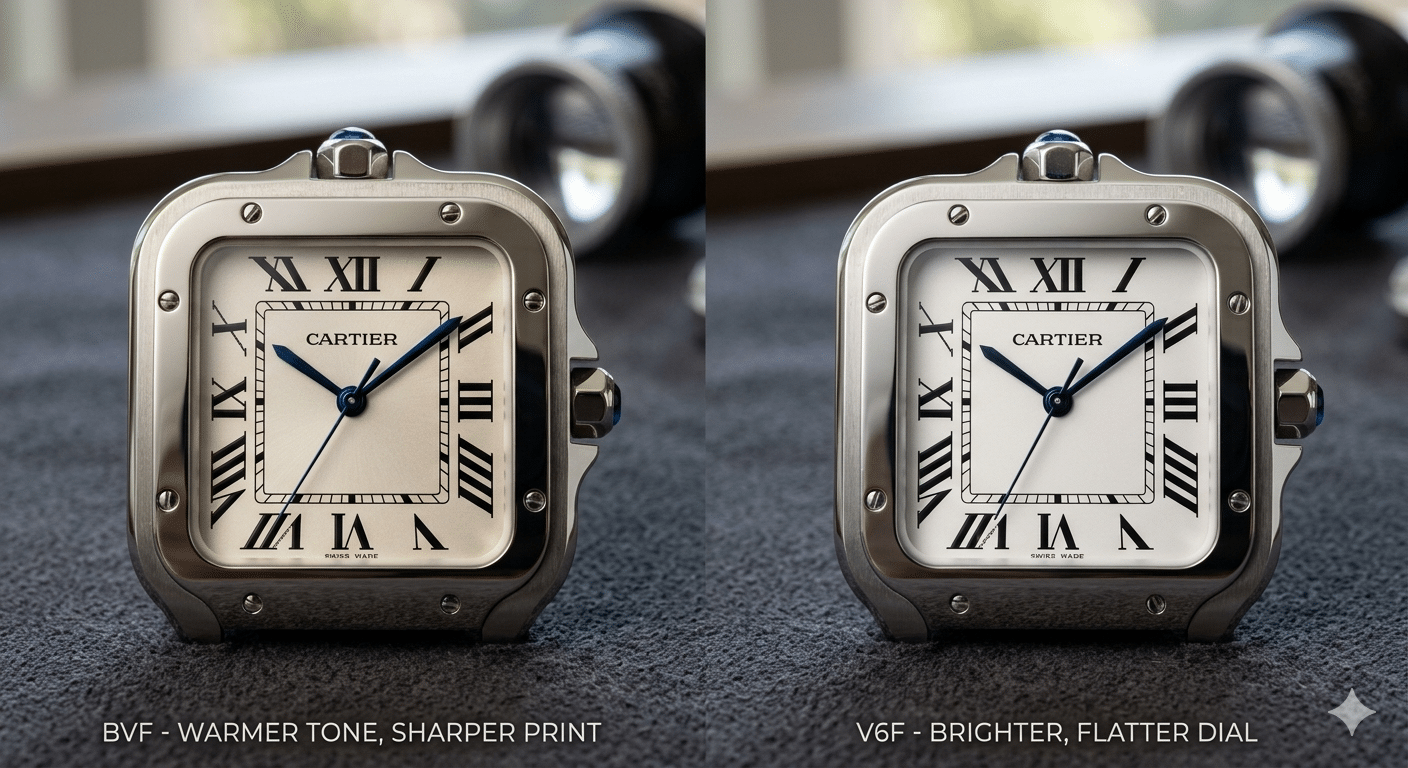
BVF has staked its reputation on dial excellence, and for the Small Santos, that focus is a double-edged sword. Their recent batches deliver what is widely considered the best dial in the replica space: a warm, creamy white that perfectly matches the genuine article, avoiding the cold, sterile white that plagues other factories. The printing of the Roman numerals and the chemin de fer track is sharp, with crisp edges and appropriate depth. For the buyer who will spend most of the time admiring the watch face-up on their wrist or on a desk, BVF is compelling.
However, this dial-centric success comes at a cost to the architecture. To achieve this, BVF often seems to treat the case and bracelet as secondary. The case shape, especially on the bezel, can have slightly softened, overly rounded edges compared to the genuine model’s crisp, defined facets. More critically for the Small, the bracelet taper is frequently suboptimal. While comfortable, it may not achieve the precise, graceful narrowing from 20mm to 16mm that defines the Santos silhouette. The result is a watch that looks fantastic in still photos of the dial but can feel a bit lumpy and ill-proportioned on the wrist. The bezel-to-dial ratio issue discussed earlier is often more pronounced here.
Verdict: BVF is the choice for the Intentional Minimalist who will prioritize dial perfection above all else and whose wrist is under 7 inches. It’s for the person who views the watch primarily as a dial-forward piece of jewelry. Expect to pay a premium for this dial quality, often pushing towards the $750-$800 range for their top-tier Small offering.
V6F/GF: The Balanced Workhorse with a Generic Dial
If BVF wins on the dial, V6F/GF (often operating from shared tooling) wins on the chassis. These factories understand how a Santos should be built and how it should feel. Their Small model inherits the robust, confident case construction of their excellent Medium versions. The edges are sharp, the brushing and polishing are executed with conviction, and the bracelet is where they truly pull ahead. The taper is typically excellent—smooth, consistent, and delivering that essential architectural flow from lug to clasp. The bracelet articulation is also superior, offering a comfort and drape that feels integrated and expensive.
The trade-off is the dial. V6F/GF dials are often their Achilles’ heel. The white can lean too bright and paper-like, lacking the subtle warmth of the genuine and BVF versions. The printing, while clean from a distance, lacks the micro-detail and depth under a loupe. The sword hands can appear flatter, less faceted. It’s a competent dial, but it’s generic. It won’t fool a keen eye up close, and it lacks the visual richness that defines the Cartier aesthetic.
Verdict: V6F/GF is the choice for the buyer who values wrist feel, comfort, and structural integrity over macro-photography-level dial detail. It’s for the person who experiences a watch dynamically, often consulting a comprehensive Cartier Santos super clone guide for detailed factory comparisons and movement analysis. At a price point typically between $650-$750, it offers exceptional mechanical execution where it counts for daily wear.
3KF: The New Challenger with Movement Trade-Offs
3KF enters the fray with a unique proposition: a cloned Cartier 1847 MC movement. For the technically minded buyer obsessed with “correctness,” this is a significant lure. The movement decoration, including the regulator layout, mimics the genuine article far more closely than a standard Miyota 9015. It’s a showcase piece for the enthusiast who values mechanical verisimilitude.
Yet, for the Santos Small, this is often a solution in search of a problem. The genuine Small Santos is a sealed caseback watch; no one sees the movement. 3KF’s focus on the clone movement appears to have come at the expense of the fundamentals. User reports and direct comparisons suggest their case finishing and bracelet quality are a noticeable step behind both BVF and V6F/GF. The edges might not be as crisp, the brushing not as fine, and the bracelet articulation and taper often feel less refined. Furthermore, the super clone movement adds complexity, cost (often placing it in the $800+ bracket), and potential future servicing headaches compared to the ubiquitous and easily serviced Miyota 9015 used by others.
Verdict: 3KF is a niche choice for the movement purist who values internal correctness above external wearability and finish. For the vast majority of Small Santos buyers, the extra cost and complexity do not translate to a better wearing experience or a more visually convincing watch on the wrist.
Expert Authentication Insight
Forget the movement for a moment. The most telling physical diagnostic for a high-quality Small Santos replica is one you can perform with a simple digital caliper: measure the bracelet taper. A superior replica (like V6F/GF) will demonstrate a considered, elegant taper from approximately 20.0mm at the lugs to a refined 16.0mm at the clasp. This is non-negotiable for the silhouette. Inferior versions, including some batches from otherwise reputable factories, will show a lazy or non-existent taper—perhaps 20mm to 19mm, or an inconsistent, awkward narrowing. This single measurement often reveals more about a factory’s understanding of the “Small” design than any dial detail. A poorly tapered bracelet on a small case instantly makes the watch feel cheap, blocky, and architecturally incoherent.
The Verdict: Is It a Smart Replica Choice?
After dissecting the proportions, the psychology, and the factory offerings, the answer to the titular question crystallizes into a stark, conditional ruling. The Santos Small super clone is not a universal proposition; it is a highly specific tool for a highly specific user.
The Conditional “Yes”: Only For This Person
The Santos Small replica is a smart buy only under these strict, non-negotiable conditions:
- Wrist Size ≤ 7 inches (17.8 cm): This is the absolute upper limit. Ideally, your wrist is 6.5 inches or smaller.
- Aesthetic Priority is Refined Minimalism: You are not buying a “smaller Santos.” You are buying a distinct, jewelry-adjacent object where subtlety and precision are the goals.
- Willingness to Pay for the Top Tier: You must invest in the highest-tier factory (prioritizing BVF for dial perfection or V6F/GF for structural integrity) to mitigate the proportional flaws inherent in the replica scaling process. This means a budget of $700-$800.
- Acceptance of Its Nature: You understand you are purchasing a specific style object, not a cost-effective substitute for the Medium Santos’ iconic presence.
For this buyer—the deliberate, style-conscious individual with a slender wrist—a high-end Small replica can be a brilliant, intentional choice. It becomes a piece of personal kit, not an impersonation.
The Definitive “No”: For Everyone Else
For any other profile, the Santos Small super clone is a poor choice and often a waste of money.
- Wrist > 7.25 inches: The watch will look and feel like a misplaced plaque. The compromised proportions become cartoonish.
- Seeking the “Santos Statement”: If you want the bold, architectural, masculine punch of a Santos, the Small replica will disappoint. It trades statement for suggestion.
- The Cost-Conscious Compromiser: Opting for a Small to save $100-$200 over a Medium is the worst possible logic. The value proposition collapses because you are buying into the model where replica flaws are most magnified. You get a less convincing watch, not a cheaper version of the same thing.
For these buyers, the path is clear: save additional funds for a mid-tier Medium Santos replica from GF or V6F, which delivers a far more coherent and satisfying execution of the core design, or re-allocate your budget entirely.
The Alternative Path: If You’re Drawn to “Small”
If the intellectual and aesthetic appeal of a smaller, elegant rectangular watch resonates, but the Santos Small’s replica pitfalls give you pause, consider these superior alternatives that capture a similar vibe on a more forgiving canvas:
- Cartier Tank Must Large Replica: The Tank’s longer, thinner rectangular form is less dependent on wrist-filling presence and a precise bezel-to-dial ratio. Its simpler, flatter design is far easier for replica factories to execute consistently at a high level. It delivers refined elegance without the Santos’s architectural baggage. A top-tier AF or K11 factory Tank Must Large can be had for $500-$650.
- Jaeger-LeCoultre Reverso Classic Medium Thin Replica: For the ultimate in refined, mechanical rectangular dress watches, the Reverso is a masterpiece. The classic Medium Thin model is another object of pure, intentional elegance. High-quality replicas from dedicated factories focus on the case finishing and dial, avoiding the complex bracelet and bezel scaling issues of the Santos. This is a more niche but often more successful pursuit.
These alternatives offer the “small watch” elegance you seek without forcing you to navigate the Santos Small’s particularly treacherous replica landscape.
Expert Authentication Insight
The ultimate, inescapable test is not visual, but psychological and tactile: The Full-Day Wear Test. Put the watch on in the morning and live your day. Does it feel like a confident, integrated piece of architecture on your wrist, or are you constantly aware of it? Do you find yourself adjusting your cuff to check if it “looks right”? Does it feel substantial and intentional, or delicate and costume-like? A genuine Santos—and a truly successful replica—possesses a quiet confidence that allows it to disappear into your persona. A failing replica, however, constantly announces its compromises. It whispers of poor proportions, it pinches with a clumsy bracelet, it draws your eye to its imbalances. The watch should wear you, not the other way around. If you’re thinking about the watch more than you’re simply wearing it, the replica has failed at its most fundamental task.