
The Mindset: You’re Not Authenticating, You’re Filtering
Let’s get one thing straight: you’re not a forensic expert trying to prove a watch is genuine. That’s a fool’s errand. Your goal is far simpler and more urgent: you need to prove that the Cartier Santos replica you’re looking at is not a sloppy, disappointing mid-tier version before you hand over your money, which makes consulting a detailed super clone replica buying guide for authentication methods and movement verification an essential step in your evaluation process.
Think of it like this: you’re not grading an essay; you’re scanning for spelling mistakes so glaring you stop reading. No replica is perfect. Even the best “super clones” from factories like GF or 3K have tells if you look hard enough. But a high-tier replica gets the big picture and the fine details 90% right. A mid-tier factory fails at one, or usually both. They cut corners where they think you won’t look, and those corners are exactly what we’re going to spotlight.
This guide is your five-minute visual triage. It’s a filter, not a scoring system. We’re looking for disqualifying flaws—the lazy, obvious mistakes that scream “mid-tier.” If the watch in front of you stumbles on two or three of these major checks, walk away. Your money is better saved for a piece that passes. The biggest mistake buyers make is “copium”—excusing a glaring flaw on the dial because the bracelet looks okay. Multiple minor flaws are rarely coincidental; they’re the signature of a fundamentally mediocre build.
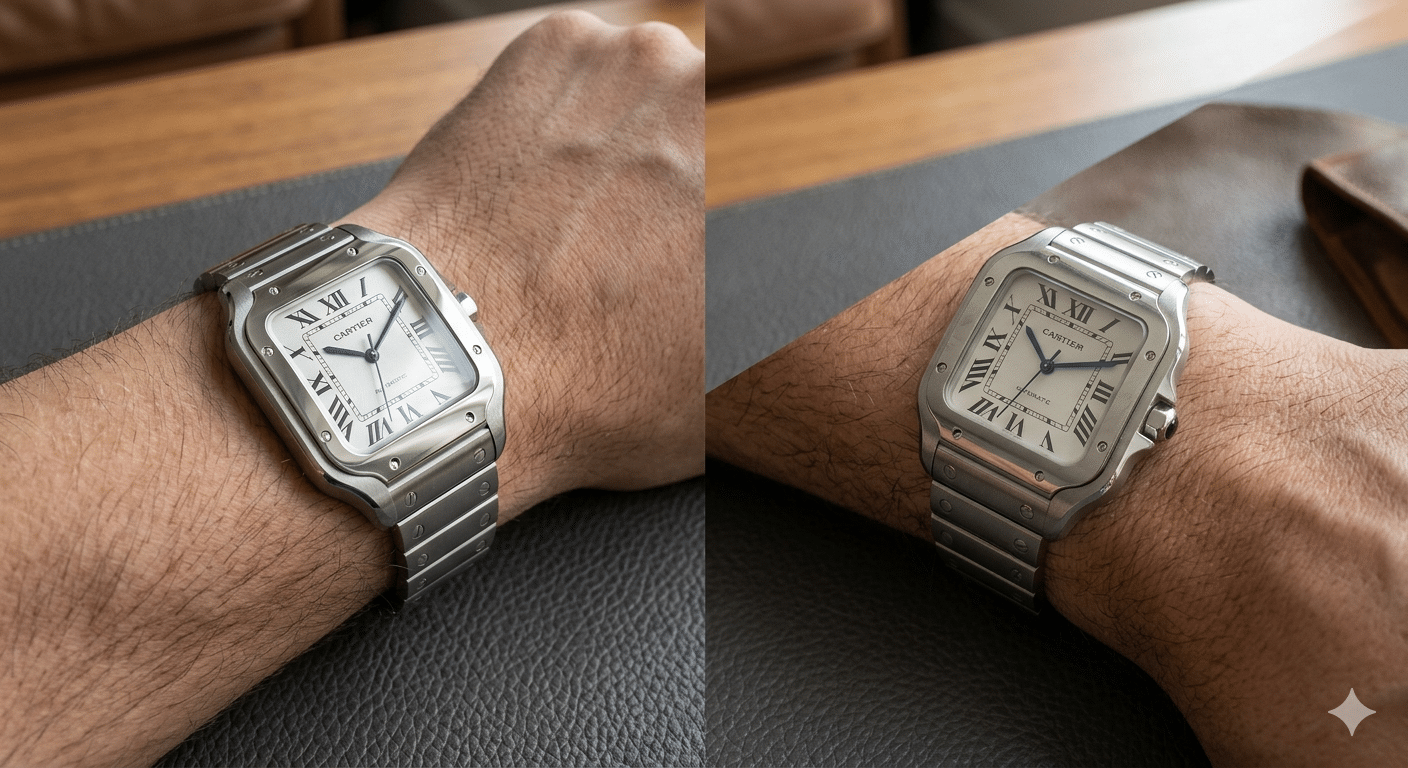
Checkpoint 1: The Dial & Roman Numerals – The Instant Giveaway
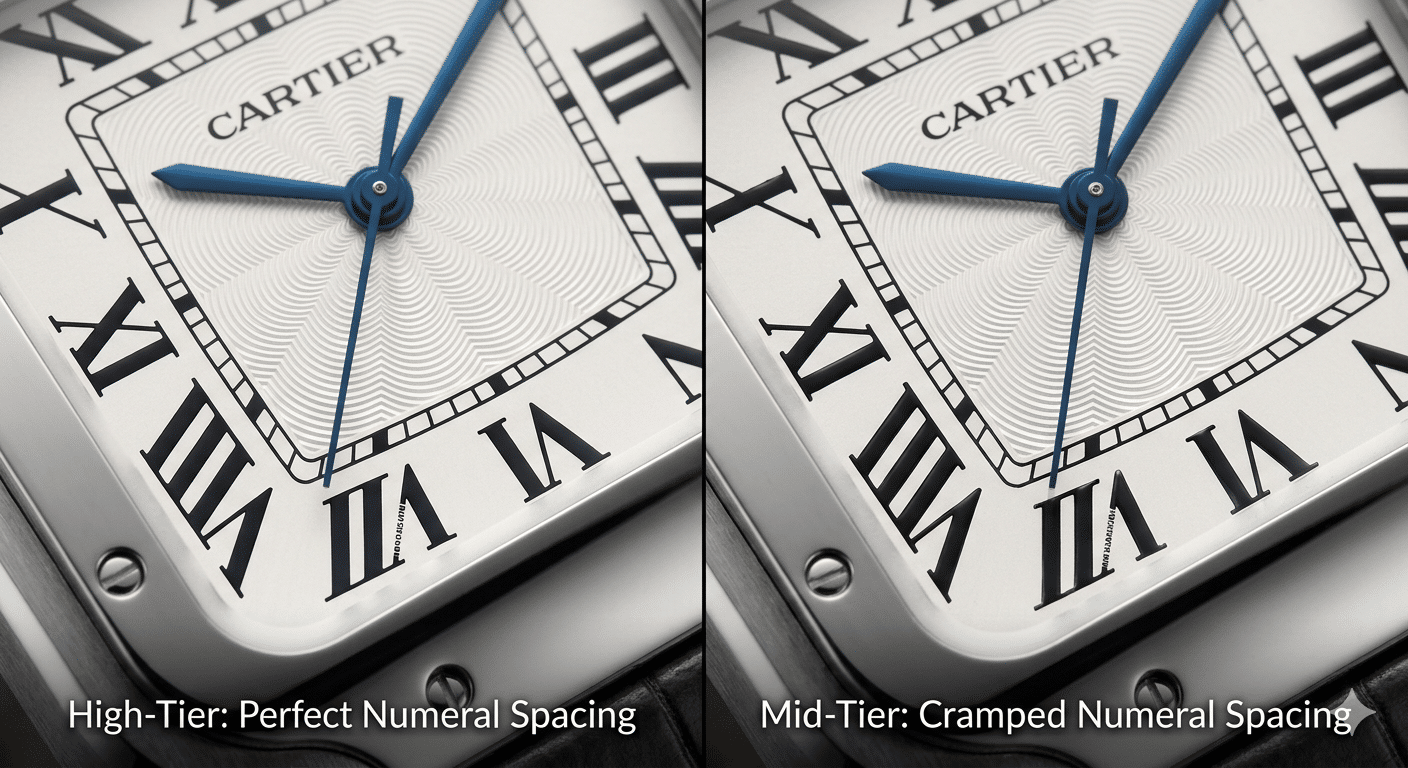
The dial is the watch’s face, and it’s where cost-cutting is most painfully obvious. Flaws here are almost impossible to hide in a decent macro photo. This is your first major go/no-go signal. You need to check two things: the quality of the printing and the sacred geometry of the Roman numerals.
Printing Sharpness and Paint Fill
Don’t just glance; scrutinize. Zoom in on the text. The “Cartier” signature at 12 o’clock, the “Automatic” text, and the “SWISS MADE” at 6 o’clock. On a high-tier rep, this printing is crisp, with sharply defined edges. It often has a slight, clean raised effect, and the paint fill is perfectly opaque—like lacquer. On a mid-tier dial, the edges look fuzzy. You might see slight bleeding where the black paint bleeds into the white dial surface, or a thin, grainy texture that lacks substance. Look at the Roman numerals themselves: the black paint inside them should be deep, even, and flush with the edges. Mid-tier versions often have paint that looks shallow, uneven, or even slightly recessed.
The Roman Numeral “VII” and Spacing Harmony
This is the golden test, the single most reliable visual tell. On a genuine Santos, the “VII” numeral is a masterpiece of typographic balance. The negative space between the “V” and the “II” is precise and elegant. On mid-tier replicas, this harmony is almost always destroyed. The “V” and the “II” are either crammed too close together, making them look like a blocky mess, or spaced too far apart, breaking the visual unity. It’s an instant giveaway of poor dial template engineering.
While you’re there, check the alignment of all the Roman numerals within their square tracks. Each numeral should be perfectly centered. On cheaper reps, they can drift up, down, left, or right.
Expert Authentication Insight
Here’s a pro-level check you can do with a zoomed-in photo or a cheap loupe: examine where the ultra-thin printed minute track intersects the corners of the Roman numerals. On a high-quality dial, these lines meet with razor-sharp, clean precision. On a mid-tier dial, you’ll frequently see a tiny blob of ink at the intersection, or the minute track line itself might waver or look broken. This is a failure of printing registration and tolerance control—a sure sign of a lower-tier factory.
Checkpoint 2: The Bezel & Screws – A Test of Discipline
The screwed-down bezel is the Santos’s defining feature. It’s not just decoration; it’s a statement of engineering. How those screws are treated separates factories with discipline from those with a “close enough” attitude. Misalignment here doesn’t just look bad—it screams mid-tier from across the room.
Screw Slot Alignment (The Cardinal Sin)
This is the single fastest red flag. On a genuine Santos and its high-tier replicas, the slots in the eight bezel screws are not random. They are meticulously aligned according to a specific pattern. The most common pattern is radial alignment, where all screw slots point directly toward the center of the watch. Another accepted pattern is a consistent alternating cardinal direction (e.g., North, South, East, West). A mid-tier watch will have these screw slots pointing in chaotic, random directions. It looks haphazard and immediately betrays a lack of care during assembly. It’s the difference between a tailored suit and one thrown together.
Bezel Fit and Finish
Look at where the bezel meets the case. The seam should be clean, even, and tight all the way around. On a mid-tier Santos, you might see an uneven gap—wider in one spot, tighter in another. In macro shots, this can create subtle but telling shadows. The bezel itself might not sit perfectly flush, appearing slightly proud or sunken in sections. This points to inconsistencies in the case machining or bezel stamping.
Expert Authentication Insight
Use light as your tool. Tilt the watch under a lamp or a bright light source and watch the reflection travel along the polished bevel of the bezel. On a well-made piece, that reflection will glide in a smooth, unbroken line around the entire circumference. On a mid-tier version, you’ll often see the reflection “jump” or distort slightly at the junctions where the separate bezel segments meet. This indicates that the polished surfaces are not perfectly continuous—a sign of less precise machining and finishing.
Checkpoint 3: Case Shape & Proportions – The Silent Architect
You can spot a crooked picture frame from across the room, even if you can’t see the nail. The same principle applies here. A mid-tier Santos replica often gets the small details almost right while completely botching the foundational geometry. The overall silhouette feels “off,” a subtle dissonance that’s hard to pinpoint but impossible to ignore once you see it. This checkpoint is about learning to see the watch as a sculpture, not just a collection of parts.
When the underlying architecture is wrong, no amount of sharp printing or aligned screws can save it. The watch will never look or feel integrated on the wrist.
The Curve of the Lugs
This is the Santos’s handshake. The lugs aren’t just appendages; they’re a graceful, downward-sweeping bridge that connects the square case to the bracelet, creating the iconic integrated look. Mid-tier factories treat this curve as an afterthought.
The failure is usually one of two types: either the lugs are too straight and slab-like, making the watch sit high and awkwardly on the wrist, or they’re too chunky and lack the refined, gentle radius of the genuine article. In photos, compare the lug’s profile to a known-genuine reference, a process detailed in a comprehensive Cartier Santos skeleton replica guide. Does it flow? Or does it look like a block attached to a chain? A poorly executed lug curve is a fundamental architectural flaw that no high-tier factory would let leave the workshop.
Case Thickness and Side Profile
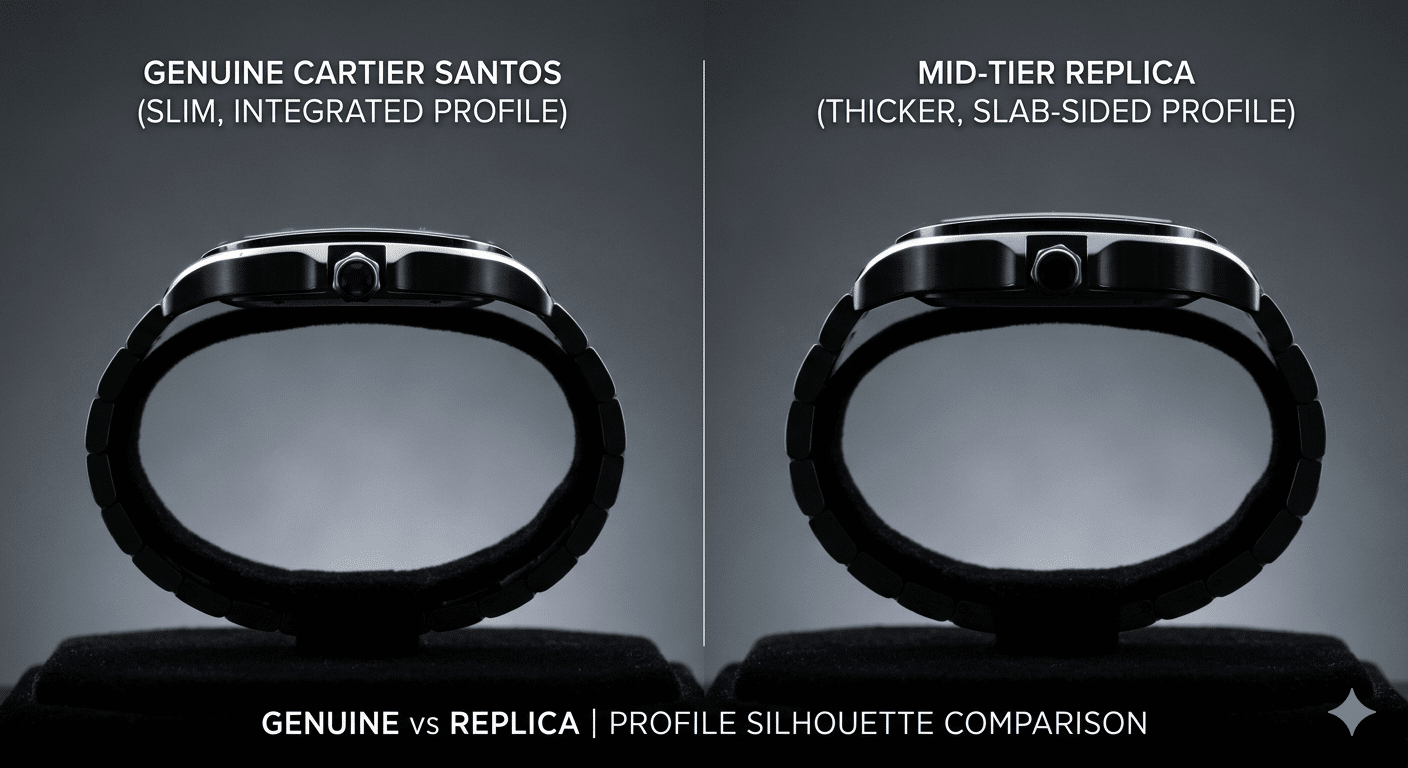
Thickness is the silent killer of replica elegance. The modern Santos de Cartier, especially the large model, is prized for its sleek, wearable profile. A genuine large Santos is about 8.8mm thick. Mid-tier replicas, often built around thicker, generic Asian automatic movements, routinely balloon to 10mm or more.
This doesn’t sound like much on paper, but on the wrist, it’s the difference between a sleek dress watch and a chunky puck. Ask for a direct side-profile shot. The watch should look low, horizontal, and integrated. If the caseback seems to bulge outwards, or if the side profile looks tall and “slab-sided” compared to the thinness of the bracelet links, you’re almost certainly looking at a mid-tier movement stuffed into a poorly proportioned case.
Also, examine the brushed and polished finishes on the case sides. On a high-tier rep, the transition between these surfaces is razor-sharp and linear. On a mid-tier, these edges are often soft, rounded, or inconsistently defined—a clear sign of less precise CNC machining and finishing.
Expert Authentication Insight
Here’s a physical diagnostic trick you can request: ask the seller to place the watch flat on a table and take a photo directly from the side. This eliminates perspective distortion and reveals the true silhouette. A high-tier replica will maintain that elegant, low-slung profile. If the watch looks conspicuously tall from this angle, or if the case doesn’t taper gracefully into the bracelet attachment point, you’ve identified a core construction shortcut typical of mid-tier builds. This thickness isn’t just an aesthetic issue; it often points to the use of a cheaper, bulkier movement that affects the entire case design.
Checkpoint 4: The Bracelet & Clasp – The Kinetic Test
The bracelet is where the watch lives. It’s also where cost-cutting screams the loudest, not just in looks, but in sound and feel. A high-tier Santos bracelet is an engineering marvel—flexible, silent, and substantial. A mid-tier bracelet is a collection of loose parts that rattles and kinks. You don’t need to touch it to know the difference; you just need to know what to look and listen for.
Link Articulation and “Jangle”
This is a video-only test, but it’s devastatingly effective. Ask the seller for a short video where they gently manipulate the bracelet. A high-tier bracelet, like those from top factories, will articulate smoothly. Each link will move in unison with its neighbors, with minimal lateral play. It will drape naturally without kinking at harsh angles.
Now, listen. In the video, give the watch a slight shake. A quality bracelet produces a muted, solid, almost whisper-like sound. A mid-tier bracelet tells a different story. You’ll hear a distinct, hollow, metallic jangle. This is the sound of loose pins, poor tolerances between links, and hollow end links. Visually, you might see gaps between the links even when the bracelet is straight, or watch it kink awkwardly instead of forming a smooth curve. This isn’t just a nitpick; it translates directly to a cheap, uncomfortable wearing experience.
Clasp Action and Engraving
The deployant clasp is your daily point of interaction. Its quality is non-negotiable. In a video, watch the seller open and close it. The action should be firm, positive, and accompanied by a clean, sharp click*. There should be no wobble, no grit, no hesitation.
Then, zoom in. The “Cartier” engraving on the clasp should be deep, crisp, and filled with perfect, opaque paint. The letters should be sharply defined. On a mid-tier clasp, this engraving is often the first place they save money. It will look shallow, fuzzy around the edges, or the paint fill will be uneven or incomplete. Sometimes the engraving isn’t even perfectly centered within the clasp segment. This level of inattention to a high-visibility detail is a hallmark of mid-tier manufacturing.
Expert Authentication Insight
If you want to see the skeleton of the bracelet, ask for a macro shot of the inner link screws. This is a telltale heart. On a high-tier replica, these screws are almost always flat-head screws with clean, deep, precision-machined slots. They are often blued (heat-treated to a dark hue) for corrosion resistance and a touch of class.
On a mid-tier bracelet, you’re likely to find one of two cost-cutting measures: either cheap-looking Phillips-head screws, or flat-head screws with shallow, poorly finished slots that look like they were stamped, not machined. Furthermore, peer at the finishing on the inside surfaces of the links. High-tier factories brush or polish these hidden areas. Mid-tier factories often leave them rough, with visible machining marks. It’s a hidden corner that reveals the factory’s overall philosophy: cutting corners you can’t easily see.
Checkpoint 5: The Crown and Its Guard – The Tactile Finale
The crown and its iconic guard are the Santos’s signature detail, a tiny piece of complex geometry. It’s also a nightmare for factories cutting corners. Getting this right requires precise milling to create the guard’s curves and a perfect fit for the crown itself. Mid-tier versions almost always fail here, and the flaws are both visible and tactile.
Crown Guard Integration
The polished crown guard should hug the octagonal crown like a custom-made sleeve. The gap between the blue cabochon on the crown and the inner edge of the guard should be minimal, even, and symmetrical on all sides. It’s a tight tolerance.
On mid-tier reps, this integration falls apart. The gap is often visibly uneven—wider on one side than the other. Sometimes, the gap is just too large overall, making the crown look like it’s rattling around in a cavern. This misalignment is a direct result of less precise CNC machining and sloppy assembly. It’s a visual red flag that screams “imprecise.”
Crown Action (The “Ask” Test)
This is the tactile check. If you have the watch in hand, winding the crown should feel smooth, with a consistent, slightly textured resistance. Pulling it out to set the time should require a firm, distinct pull with a clean stop, and the setting action should be precise, not mushy or gritty, a standard often detailed in a comprehensive Cartier Santos super clone guide covering movement performance and crown guards design.
Since you’re likely judging from photos or a video, you need to use inference. Ask the seller to demonstrate winding and setting the time in a video. Watch their fingers. Does the crown turn smoothly? Does the hand movement jump precisely, or does it stutter? A seller who hesitates, gives excuses, or provides a video that conveniently cuts away during this action is often telling you everything you need to know: the movement and stem construction are likely poor. A gritty crown action often points to a poorly finished movement and a weak point for future failure.
Expert Authentication Insight
Zoom in ruthlessly on the blue synthetic spinel cabochon itself. This is a surprisingly reliable differentiator. On a high-tier replica, the cabochon is a deep, saturated, inky blue. It’s finely polished to a high gloss and sits perfectly flush with the metal crown, creating a seamless gem-like cap.
On a mid-tier replica, the cabochon is frequently wrong. The color can lean purplish or overly bright, cheap “royal” blue. The surface may look glassy, cloudy, or lack depth. Most damningly, it often isn’t set flush. It might sit slightly proud of the crown (a “pimple”) or be recessed too deep. The quality of this tiny synthetic stone is a direct reflection of the factory’s attention to detail—or lack thereof.
The Synthesis: Putting It All Together for Your Final Decision
You’ve run the checklist. You’ve zoomed in, tilted the watch in the light, and scrutinized every angle. Now comes the hard part: turning a list of observations into a single, clear decision. This isn’t about finding a perfect replica—that doesn’t exist. It’s about identifying a pattern of carelessness that defines the mid-tier. Here’s how to weigh what you’ve seen and make the call.
The Automatic Fails: Disqualifying Flaws
These are the non-negotiable red flags. If you see any one of these, the decision is made for you. Walk away. These flaws represent a fundamental failure in the factory’s discipline or capability, and they guarantee a mediocre wearing experience.
- Chaotic Bezel Screw Alignment: The slots on the eight bezel screws point in random, haphazard directions. This isn’t a minor oversight; it’s a direct indicator of sloppy, rushed assembly. A factory that can’t be bothered to align screws is cutting corners everywhere.
- Grossly Misshapen “VII” Numeral: The “V” and the “II” are noticeably too close together or too far apart, destroying the elegant negative space that defines the Santos dial. This is a printing plate or dial manufacturing error that no amount of rationalization can fix.
- A Bracelet That Screams “Jangly” in a Static Photo: Even in a still image, if the links appear loosely fitted, with visible gaps or a kinked, unnatural drape, it signals poor tolerances. A bracelet is a kinetic component; if it looks bad standing still, it will feel terrible in motion.
Finding one of these is like finding a spelling mistake in the first sentence of a novel. You don’t need to keep reading.
The Weighted Flaws: When to Be Cautious
This is the gray area. These issues are more subtle and subjective. A single, isolated flaw here might be acceptable on an otherwise impeccable piece—a consequence of replica variance. But their presence is cumulative. They signal a lack of refinement.
- Slightly Fuzzy Dial Printing: The “Cartier” signature or “SWISS MADE” isn’t razor-sharp under extreme zoom, but it’s not blatantly bleeding either.
- Minute Track Imperfections: The fine printed track has a tiny blob at the intersection with a Roman numeral, but only in one or two places.
- A Crown Guard Gap That’s Not Quite Even: The space between the blue cabochon and the guard is marginally wider on one side.
- A Case Profile That Looks Slightly* Thicker: In the side-profile photo, the caseback has a faint bulge, or the overall silhouette feels a bit slab-sided compared to reference images.
The Rule: One of these might be a compromise you can live with. Two or more indicate a pattern. You’re no longer looking at a stellar piece with a quirk; you’re looking at a fundamentally mid-tier build where cost-cutting is evident across multiple systems. This is where you need to be brutally honest with yourself.
The Seller Context Clue
Your visual analysis doesn’t exist in a vacuum. The seller’s behavior is a powerful piece of corroborating evidence. A high-tier replica seller is typically confident in their product. A mid-tier seller often operates on hope—hope that you won’t look too closely.
If you ask for a specific macro shot of the “VII” numeral or a video gently shaking the watch to hear the bracelet, and the seller hesitates, gives excuses, or provides a blurry, angled shot that avoids the detail… that’s your answer. They are showing you the watch’s weakness without saying a word. A seller who is transparent and provides clear, well-lit media of the exact details you request is often signaling they have nothing to hide.
Expert Authentication Insight
After all the technical checks, there is one final, invaluable test: your gut feeling. This isn’t mystical; it’s your subconscious synthesizing all the visual data into a holistic impression of quality.
A high-tier replica feels resolved. The details cohere. The watch presents as a single, intentional object. Even if you spot a tiny flaw, the overall impression is one of integrity.
A mid-tier replica feels like a collection of parts. The dial is okay, but the bezel is off. The case shape is close, but the bracelet is wrong. Your brain detects the lack of harmony. If you find yourself mentally negotiating—“Well, the screws are bad, but the dial is pretty good…”—you are trying to rationalize a watch your gut has already rejected.
That unease is your most sophisticated tool. Trust it. It’s the sum of every checkpoint you’ve just learned, telling you this watch isn’t a $800-tier effort. It’s a $400 watch in $800 clothing.
Now you have the filter. The anxiety of not knowing what to look for is gone, replaced by a clear, actionable system. The next time you’re staring at a seller’s gallery or a set of QC photos, you won’t see a confusing jumble of metal and glass. You’ll see a series of checkpoints: the dial, the bezel, the case, the bracelet, the crown. You’ll know which flaws are fatal and which are merely cautionary. You don’t need to be a watchmaker; you just need to recognize the language of carelessness. Use this. Save your money. Hold out for the piece that doesn’t just look like a Santos from afar, but feels like one up close. Your wrist—and your peace of mind—will thank you.