
The Promise and Peril of Pixel Judgement
Your decision to buy a Richard Mille super clone will almost certainly be made from a screen. In 2026, the process is digital by default: you browse a dealer’s website, receive a set of QC photos in a Telegram chat, and watch a 15-second video on a loop. The visual evidence is all you have. This isn’t inherently bad—sharp-eyed analysis of photos and videos, informed by a practical replica buying framework, can absolutely save you from a terrible, obvious fake. It can help you spot a misaligned bezel, a printed-on carbon pattern, or a glaringly wrong font.
But here’s the critical truth you must internalize before you scrutinize a single pixel: the camera is not a documentary tool in this context; it’s a sales tool. Its purpose is not to neutrally record an object, but to create the most compelling digital asset possible. It flattens a three-dimensional, tactile object into a two-dimensional image. It compresses weight, texture, and sound into silence. It uses lighting, angles, and focus to highlight perfection and obscure flaws.
Your goal—assessing a physical artifact you will wear—is fundamentally at odds with the medium you’re forced to use. This article is a toolkit for bridging that gap. We will dissect exactly what you can learn from a seller’s images, providing a forensic methodology for the elements that translate to 2D. More importantly, we will build, piece by piece, a non-negotiable checklist of everything the camera always hides. The goal is not to make you paranoid, but to make you precise—transforming you from a passive viewer into a skeptical, informed analyst who knows both the power and the profound limits of pixel-based judgement.
The Seller’s Lens: Curation Over Documentation
Think of a seller’s photo gallery not as evidence, but as a curated exhibition. Every choice is deliberate. The watch is shot on a clean, neutral background to eliminate visual noise. The lighting is soft, diffuse, and front-facing to minimize harsh shadows that might reveal uneven finishing or shallow engraving. The angles are the “hero” shots: straight-on to showcase symmetry, or a dramatic three-quarter view that emphasizes the sculptural case. You will almost never see a true macro shot of a screw head’s poorly machined slot, or a side-by-side comparison in unforgiving midday sun.
Videos follow the same principle. The smooth, slow pan is designed to show off the light play on the case and the smooth sweep of a seconds hand. It will not deliberately jostle the watch to let you hear the rotor wobble. It will not press the chronograph pushers with enough force to demonstrate a mushy, inconsistent action. The medium is engineered to sell, not to scrutinize. Your first job is to reverse-engineer that intent.
The Buyer’s Need: From Pixels to Physical Reality
You are not buying a JPEG. You are buying a complex mechanical object that must sit on your wrist, operate reliably, and withstand the scrutiny of your own eyes up close. Your checklist extends far beyond what fits in a frame. You need to assess heft, balance, and acoustic signature. You need to judge the tactile feedback of the crown and the security of the clasp. You need to feel if a case edge is razor-sharp or smoothly beveled. None of this data is present in even the most comprehensive set of QC photos.
Therefore, your analysis must be two-pronged. First, extract every possible bit of valid information from the visual medium. Second, and crucially, identify the immutable blind spots. This process turns a binary “GL” (Green Light) or “RL” (Red Light) decision into a nuanced risk assessment. You’re not just asking, “Does this look good?” You’re asking, “Based on what I can see, what are the risks of what I can’t see?”
Expert Authentication Insight
A professional authenticator’s process starkly illustrates the gap between digital and physical assessment. Where you have photos, they have the watch in hand. Their diagnosis relies on senses your screen nullifies.
- The “Knuckle Test” for Rotor Noise: A gentle tap on the caseback can reveal a loose, grinding, or excessively noisy rotor—a common flaw in even high-tier clones. Your video is silent.
- The “Fingertip Graze” for Edges: Running a finger along the case lugs and bezel reveals the quality of finishing. A sharp, unfinished edge catches the skin; a properly polished one feels seamless. A photo shows only a line.
- The “Crown Action” Check: The feel of winding—smooth and consistent, or gritty and uneven—and the crispness of setting the time are immediate tells for movement quality. A video shows a crown turning, but conveys zero tactile information.
The authenticator’s conclusion is based on a symphony of sensory input. Yours, for now, is based on a silent movie. The rest of this guide is about learning to “read” that movie with expert eyes, while never forgetting the entire sensory track is missing.
Forensic Zone 1: The Case and Skeleton Architecture
This is where your photographic analysis can be most effective. The case, bezel, and skeletonized movement plates are the watch’s chassis and exoskeleton—their proportions, finishes, and construction are largely visual traits. A systematic approach here can filter out the majority of low and mid-tier replicas before you ever consider movement performance.
Decoding Carbon: Pattern, Depth, and Light Play
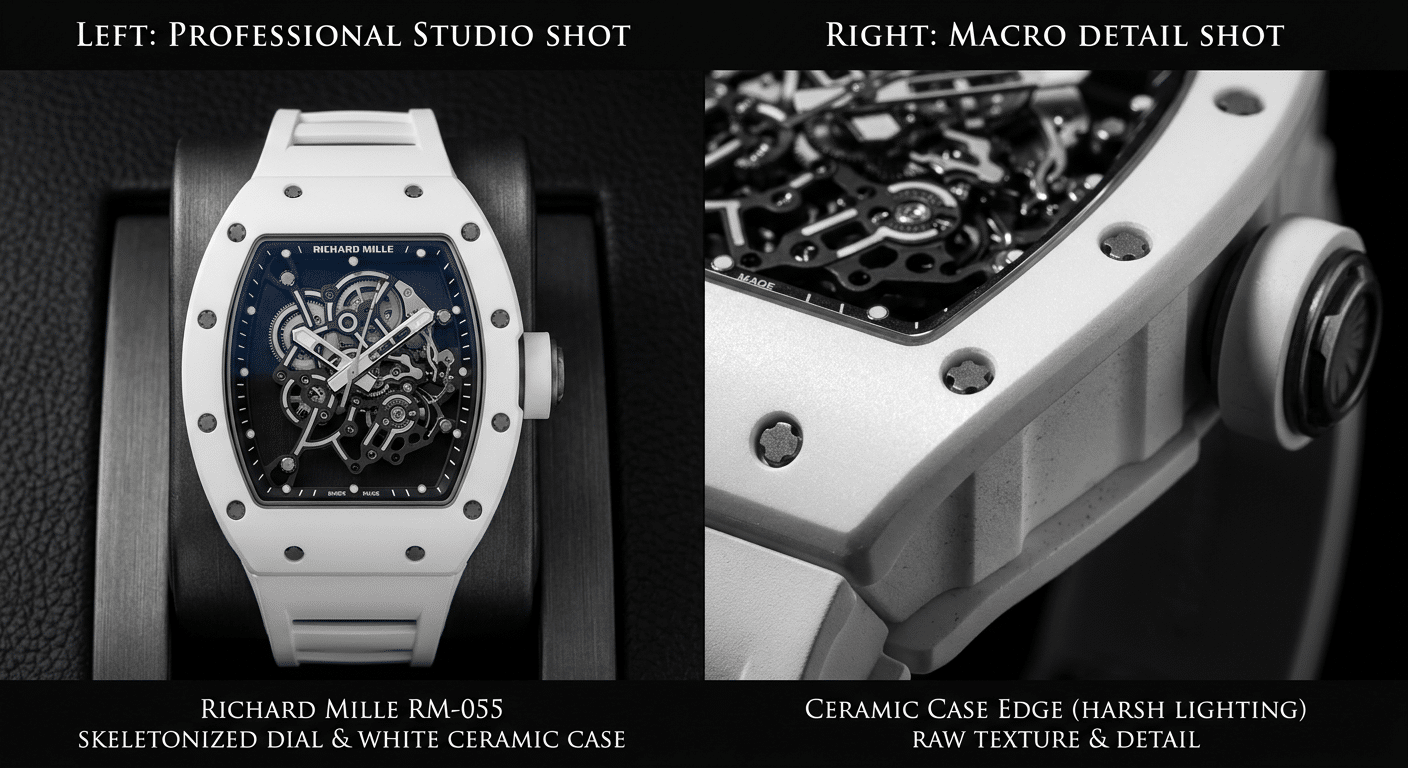
For models like the RM 35-02 or RM 055, the carbon composite case is the first thing you see. Genuine Richard Mille uses exclusive NTPT Carbon TPT, which has a specific, deep, undulating wood-grain pattern created from layers of carbon filament rotated at 45-degree angles. Top-tier replicas from APSF or ZF use high-quality forged carbon that aims to mimic this.
In photos, you’re assessing pattern authenticity and finish quality. Look for organic randomness. The swirls and lines should be deep, three-dimensional, and flow without repeating, predictable patterns. Cheap replicas often have a flat, printed-on look or a pattern that is too uniform and “fuzzy.”
Analyze the sheen under different lights. In the seller’s video, watch as the watch is tilted. Quality forged carbon will have a deep, semi-matte luster with the pattern seeming to shift beneath the surface. Low-quality carbon or plastic will look flat, overly glossy, or have a painted-on shimmer. Request a photo under a single, direct light source (like a phone flashlight off to the side) to see if the pattern has real depth or if it disappears.
Geometry Under Scrutiny: Case Shape and Anglage
The tonneau (barrel) shape of a Richard Mille is deceptively complex. It’s not a simple oval. Pay close attention to the curvature of the caseband—the long, sweeping sides. It should be a continuous, smooth curve. Some lower-quality reps have a slightly flattened or uneven curvature.
The most telling angle is the side profile. You must request a true side-view photo. Here, examine the relationship between the bezel, crystal, and caseback. They should flow together in a cohesive, layered sandwich. A common flaw is a bezel that appears too thick or slab-sided compared to the genuine article. Also, inspect the sharpness of the bevels and angles where different surfaces meet. High-end machining produces crisp, clean lines. Poor finishing results in rounded, soft, or uneven edges.
Compare this side profile directly to a high-resolution image of the genuine watch. Differences of even half a millimeter in thickness or curvature become apparent here. For example, the replica RM 011 is notoriously thicker than the gen due to its movement; this is glaringly obvious in a profile shot.
The Skeleton’s Bones: Bridge Finishing and Screw Alignment
The open-worked “skeleton” is a Richard Mille signature. In photos, you’re judging the quality of the miniature architecture. Don’t just look at the shapes; look at the edges.
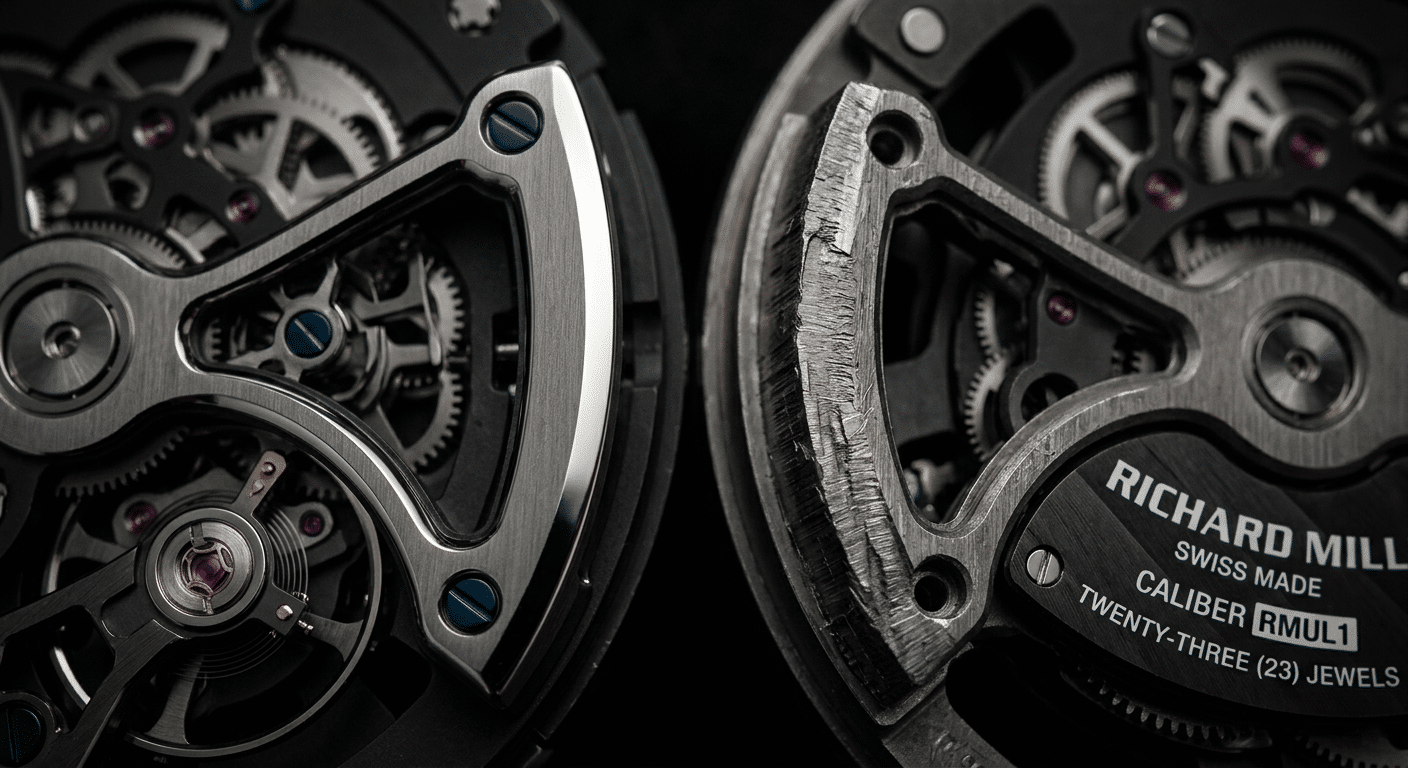
Zoom in on the edges of the movement bridges and plates. On a genuine RM and the best clones (like APSF’s latest), these edges are beautifully beveled and polished—they catch the light with a fine, bright line. On lower-tier reps, the edges are often simply cut and left raw, appearing dark and flat, or have a rough, unfinished look under macro scrutiny.
Next, examine every screw. Richard Mille uses distinctive 5-point spline screws. In photos, check for two things: alignment and finish. Are the slots of the screws oriented in a consistent, purposeful pattern (often alternating or aligned radially), or are they haphazard? More importantly, look at the screw heads themselves. They should be perfectly flat, polished, and sit flush within their countersinks. Rounded, domed, or poorly finished screw heads are a hallmark of cheaper manufacturing.
Expert Authentication Insight
The physical experience of the case and movement architecture reveals what photos conceal. An authenticator doesn’t just look at the anglage; they feel it. A perfectly machined and polished edge has a specific, smooth sharpness—it’s defined but never rough or catching. The “action” of the screws is another tell: on a gen or top-tier clone, they thread in with a precise, buttery feel. On a rep, they can feel gritty or cross-thread with minimal pressure.
Most significantly, weight distribution is completely unfilmable. A genuine RM has its weight meticulously balanced across its unusual shape, with the lightweight titanium movement centrally positioned. A replica, with a heavier brass movement, often feels “head-heavy” or imbalanced on the wrist. This subjective feel of cohesion and quality is the sum of a hundred physical details that no lens can capture.
Forensic Zone 2: The Dial, Hands, and Crystal
This is the watch’s face—the point of direct interaction. Flaws here are immediately visible to you, the wearer. Photo analysis in this zone is highly effective but also highly susceptible to manipulation through lighting and focus. Your goal is to see past the presentation to the craftsmanship.
The Crystal Clue: AR Coating and Distortion
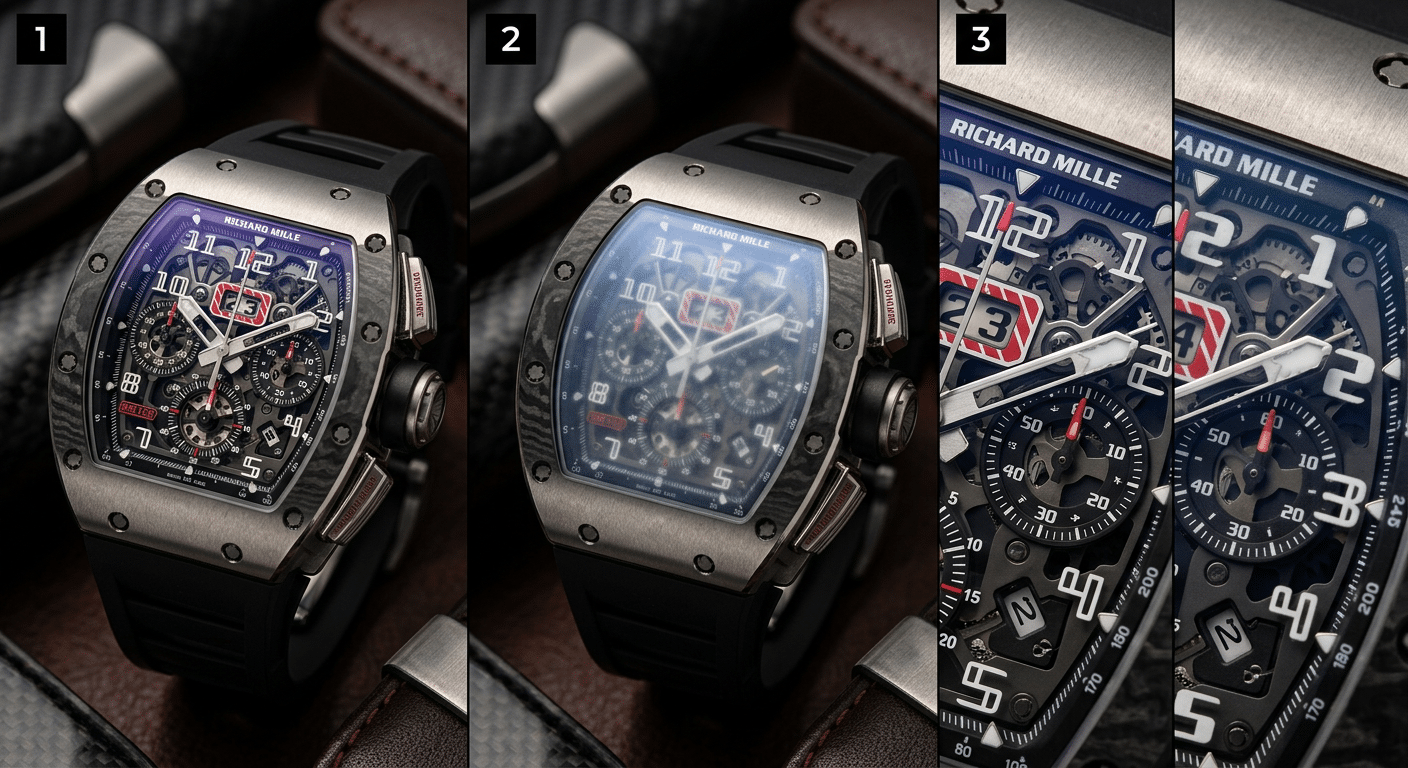
The sapphire crystal is your window to the dial, and its anti-reflective (AR) coating is a major differentiator. Genuine Richard Mille uses a high-quality, multi-layer AR coating on both sides of the crystal, making it virtually disappear under most lighting conditions.
In seller photos and videos, you’re looking for two things: clarity and color. Demand an angled shot. Hold your phone or look at the QC photo at an oblique angle. A good AR coating will show a very faint blue, purple, or green hue. A bad or single-sided coating will show a strong, milky blue or purple haze that significantly obscures the dial. The worst reps have no coating at all, acting like a mirror.
Also, watch for distortion. As the watch is tilted in a video, look at the edges of the dial, especially where they meet the rehaut (the inner ring). High-quality, flat sapphire will have minimal distortion. Lower-quality mineral glass or poorly ground sapphire can create a “fish-eye” effect, bending the lines of the dial.
Dial Depth: Layers, Printing, and Lume
A Richard Mille dial is a multi-level landscape. On skeleton models, this means the relationship between the base plate, sub-dial rings, and applied markers, which can be critically assessed against the **hidden risks of replica watches** concerning noise, fragility, and daily wear. On models with more dial surface, like the RM 67-02, it’s about the finish and printing.
Light is your best tool. Ask for a video where the light source moves slowly across the watch face. You should see distinct shadows and highlights as the light catches different planes. A flat, cheap dial will have little variation. The printing on any sub-dials or numerals should be razor-sharp under magnification. Pixelated, fuzzy, or uneven print is a red flag. For lume, if present, it should be evenly applied within the markers with clean, defined borders. Blobby or misapplied lume is a sign of poor quality control.
Hands in Focus: Shape, Lume, and Alignment
Hands are small but critical. First, examine their shape and proportion against a gen photo. Are the sword hands the correct length and width? Are the counterweights on the skeletonized hands the right shape?
Second, check for alignment. In a video, watch as the seconds hand sweeps around. Does it hit each marker precisely, or does it drift? When the hour and minute hands are set to 12:00, do they align perfectly? A slight misalignment here is a common QC issue you can actually catch.
Finally, look at the lume on the hands (if applicable). It should match the color and intensity of the dial lume perfectly. A mismatch is a telltale sign of a replica.
Expert Authentication Insight
An authenticator uses controlled, oblique lighting and a loupe to see what flat studio lighting hides. They look for the texture of the dial surface—whether it’s a fine-grained matte, a sunburst finish, or a perfectly flat lacquer. This texture is often lost in standard photos. The quality of the AR coating is judged not just by its color, but by its hardness and how it interacts with dust and fingerprints—properties invisible in imagery.
Furthermore, the “click” of the crown engaging the time-setting function and the precise, backlash-free alignment of the hands when setting are purely tactile experiences. A video shows the hands moving, but it cannot convey the smooth, precise feel of a well-adjusted movement versus the sloppy, gritty feel of a poorly assembled one. The action of the chronograph pushers—crisp and distinct, or mushy and inconsistent—is another complete blind spot in any visual media.
The Silent Story of the Strap and Buckle
In the high-stakes game of judging a Richard Mille super clone from photos, the strap and buckle are the ultimate sleeper agents. They’re the components sellers show you just enough of to check a box, but never enough to reveal the truth. This is where the fantasy of a perfect replica meets the daily grind of wearing it. A flawless case and dial mean nothing if the thing is miserable on your wrist.
You can analyze a carbon pattern until your eyes cross, but if you ignore the strap, you’re judging a car by its paint job and forgetting to test the seats. The strap quality and clasp action are where cost-cutting happens first and feels most pronounced later.
Visual Checks: Strap Texture and Buckle Engraving
Start with what you can see. A seller’s gallery should include clear, close shots of the strap and the RM buckle replica.
For the strap, you’re looking at two things: material and execution. A top-tier replica will use a fluoroelastomer or high-grade silicone rubber that tries to mimic Richard Mille’s proprietary blend. In photos, look for a consistent, fine-grained texture. It should look substantial, not plasticky or shiny. The edges should be cleanly finished, not ragged or peeling. If it’s a fabric or leather strap, examine the stitching. Is it straight, tight, and consistent? Sloppy stitching is a dead giveaway of broader assembly carelessness.
The buckle is your best visual tell. Zoom in. The engraving of “RICHARD MILLE” and any other text should be crisp, deep, and evenly filled. The font must match the genuine—this is often where cheap replicas fail, using a standard typeface instead of RM’s distinct, proprietary font. Check the buckle’s proportions against genuine reference photos. Is it the correct shape and size relative to the strap width? A buckle that’s too thick, too thin, or the wrong shape is a common, easily-spotted flaw.
The Hidden Experience: Flexibility, Feel, and Clasp Action
This is where the camera betrays you completely. A strap can look perfect in a still life and feel like a cheap garden hose on your wrist.
Strap flexibility is everything for comfort, especially with Richard Mille’s often large, rigid cases. A good strap needs to articulate freely to wrap your wrist. A stiff strap will create pressure points and make the watch feel like a barnacle. You cannot see this in a photo. You can’t see how the lining feels against your skin—whether it’s soft and breathable or rough and sweaty.
Then there’s the clasp action. This is the single most critical hidden variable. A premium deployant clasp should engage with a firm, precise, and satisfying click. It should feel secure, with no lateral wobble. The mechanism should operate smoothly. A poor clasp will feel gritty, sound tinny, and may even pop open unexpectedly. It might have sharp edges that dig into your wrist. In a seller’s video, the clasp is almost never demonstrated being opened and closed repeatedly under normal pressure. It’s just shown… closed.
The smell of the rubber, the security of the pin, the way the buckle sits flat—these are all tactile, olfactory, and experiential data points that are entirely absent from your digital evaluation. This is why seasoned buyers often factor in the cost of a high-quality aftermarket strap from the outset; they assume the supplied one will be the weak link.
Expert Authentication Insight
A professional authenticator doesn’t just look at a strap; they perform the “fold test.” They take the rubber and flex it sharply, feeling for the right resistance and listening for any telltale creaking or cracking sounds that indicate inferior polymer blends. They then work the deployant clasp dozens of times, assessing the spring tension, the precision of the machining in the hinge, and the definitive, metallic snap of a well-made closure. This entire suite of tests—fundamental to judging quality and longevity—is rendered impossible by photos and silent videos. The strap and buckle remain a black box of potential annoyance until the moment you strap it on.
The Movement: The Greatest Illusion of All
If the strap is a hidden gamble, the movement is the grand, high-stakes magic trick. Sellers understand the theater: they provide glamour shots of the decorated rotor, sweeping videos of the balance wheel in motion. It’s captivating. It’s also largely meaningless for determining what matters most: will this thing keep time, survive a bump, and last more than a year?
Judging a clone movement performance from images is like judging an engine by the shine of its valve cover. You’re being shown the cosmetic shell, not the mechanical heart.
Surface-Level Tells: Finishing and Decoration in Macro
When you get those coveted macro shots, you can perform a limited visual audit of the RM movement decoration. Look at the bridges. On a top-tier clone like those from APS or ZF, the perlage (circular graining) or Geneva stripes should be fine, even, and deep. The engraving on the rotor and bridges should be sharp, not soft or blurry. The color of the plating matters—genuine RM movements use grade 5 titanium, which has a specific, dark grey, almost graphite hue under light. Many replicas use rhodium-plated brass, which appears brighter, whiter, and more reflective.
Check the jewels. Are they set cleanly? Do they have the characteristic “oil sink” appearance? Look at the screws: are the slots clean, or are they burred and messy? These are the best-case things you can hope to see. They tell you the factory invested in surface-level finishing. They do not tell you a single thing about the quality of the gears, the mainspring, the lubrication, or the assembly.
The Unseeable Core: Performance, Noise, and Reliability
Here is the cold, hard list of what a photo or video can never show you:
- Accuracy & Consistency: A smooth-sweeping seconds hand in a 15-second GIF tells you nothing about whether the watch gains 5 seconds or 50 seconds a day. That requires timegrapher readings over multiple positions, which are almost never provided.
- Power Reserve: A beautifully decorated twin-barrel setup might promise 55 hours. The actual movement might deliver 28. You won’t know until you wear it.
- Rotor Noise: This is the #1 complaint with replica automatic movements. A genuine RM rotor spins with a barely perceptible whisper. A replica rotor can sound like a grinding coffee mill, a persistent, grating whirr that you’ll hear with every arm movement. Video is silent.
- Winding Feel: The tactile feedback of winding the crown—is it smooth and buttery, or gritty and notchy? Does the crown screw down securely?
- Shock Resistance: Genuine RM movements are Chronofiable® certified to withstand over 5,000 g’s. Replica movements, even the best Dandong clones, are built to a price. A minor bump that a genuine watch would laugh off could stop a replica dead. The camera can’t show durability.
You are, quite literally, buying the movement blind. A stunningly decorated movement can house a problematic, noisy Seagull base. A plainer-looking movement from a reputable factory like APS might be the more reliable runner.
Expert Authentication Insight
An authenticator’s movement assessment begins where the camera’s capability ends. They listen. They place the watch to their ear, gently shaking it to hear the rotor’s bearing noise—a smooth whisper versus a gritty grind is instantly diagnostic. They feel the crown winding for smoothness and resistance. Then, they place it on a timegrapher to measure amplitude (the health of the mainspring), beat error (the symmetry of the tick-tock), and rate in different positions. These quantifiable metrics of movement performance and health are 100% invisible and inaudible through any seller’s media. The most beautiful macro shot is utterly silent on the question of whether the watch will keep time tomorrow.
What the Camera Always Hides: The Physical Reality
We’ve dissected the visible. Now we must confront the invisible. This is the non-negotiable boundary of online buying. No lens, no lighting setup, no 4K video can transmit the physical essence of an object. For a Richard Mille—a watch defined by its avant-garde materials, radical comfort, and technical sensation—this is the ultimate buyer’s paradox. You are judging an intensely tactile experience through a purely visual medium.
The replica wearing experience is the final, great unknown, a crucial aspect that even a comprehensive Richard Mille super clone guide can only partially illuminate. Here is what you can never assess until the package is in your hands.
The Unfilmable: Weight, Sound, and Feel
Weight and Balance: A genuine Richard Mille has a specific, often counter-intuitive heft. The case might be light from carbon fiber, but the weight distribution can feel unusual. A replica, with its different material densities (brass movement vs. titanium, different carbon composites), will always have a different weight and balance. Does it feel top-heavy? Does it sit flat on your wrist or want to roll over? A photo shows dimensions; it cannot convey mass and center of gravity.
Acoustics: We’ve mentioned the rotor. Add to that the sound of the chronograph pushers (if applicable)—a crisp, precise click versus a mushy thud. The subtle sounds of the watch in motion. A video is a silent movie of your potential purchase.
Haptics: Run your finger along the case edge. Is it razor-sharp or smoothly chamfered? Feel the texture of the bezel screws. Turn the crown. Is the grip secure? Does it engage with precision? These micro-interactions define quality. A seller’s video shows someone else touching the watch. It provides zero tactile data to you.
The On-Wrist Unknown: Fit, Comfort, and Presence
This is the most personal and unpredictable variable. The tonneau case shape is iconic, but how does it conform to your wrist?
- Does the caseback, with its complex curvature, sit flush or dig into your wrist bone?
- Does the watch slide around, or does it grip securely?
- How does it look in proportion to your arm? A 50mm lug-to-lug might look manageable in a product shot but overwhelming on a smaller wrist.
- What is its “presence”? Does it feel like a substantial piece of engineering, or does it feel like a toy?
Furthermore, photos are taken in controlled, ideal conditions. Under the harsh, revealing light of a sunny day or a bright office, hidden flaws can appear: a hair under the crystal, a fleck of dust on the dial, a misalignment of a sub-dial marker that wasn’t visible in the seller’s softbox lighting. These are the gremlins that only appear in real-world wear.
Expert Authentication Insight
Two simple tests illustrate the unbridgeable gap. First, the “wrist roll” test: an authenticator will let the watch slide from the top of the wrist to the side, feeling how the weight shifts and balances. An awkward, top-heavy feel is immediate. Second, the “light graze” test: running a fingertip lightly over every case edge and corner to detect any sharpness or unfinished machining. These are fundamental, physical quality checks that are the absolute antithesis of pixel-based judgment. They confirm the most critical truth about buying a super clone online: you are not buying the watch in the photos. You are buying the watch that arrives in the box, and they are not always the same object.
Building Your Photo & Video QC Protocol
You now know what to look for and what you can never see. This is where that knowledge turns into action. A systematic QC photos guide isn’t about finding a perfect watch; it’s about eliminating a bad one and verifying the factory’s workmanship on the piece you’re about to pay for. Your goal is to transform a seller’s curated gallery into a forensic dossier. Here’s how to do it.
What to Ask For: Essential Angles and Lighting
Don’t accept the default album. A seller providing generic, flattering shots is a red flag in itself. You must request a specific set of images and videos. This is non-negotiable.
Start by gathering your own high-resolution, multi-angle reference photos of the genuine model from Richard Mille’s website or trusted media. This is your baseline. Then, demand the following from the seller:
- The Static Set: Straight-on dial shot (to check hand alignment, dial symmetry). Clear caseback shot (for movement decoration and rotor). Both side profiles (to assess case thickness and bezel curvature). A shot from the crown side. A top-down shot of the buckle/clasp.
- The Angled & Light Play Shots: Multiple shots with the watch tilted at 30-45 degrees under a direct light source. This reveals the quality of the anti-reflective coating on the crystal and the depth of dial printing. A shot with light grazing the case edges shows the sharpness of chamfers and anglage.
- The Mandatory Video: A 15-20 second clip in stable, diffused lighting. It must include: a slow, complete 360-degree rotation of the watch, a deliberate tilting of the watch face under a light to see the crystal AR, and a close-up of the seconds hand sweeping (to check for stutter). If it’s a chronograph, a demonstration of the pushers is essential.
If a seller hesitates or provides blurry, poorly lit images, consider it a major warning sign. A reputable dealer understands this process.
The Analysis Sequence: From Macro to Macro
When the images arrive, don’t just glance. Analyze replica photos with a method. Open your genuine references in one window and the QC set in another. Follow this sequence:
- Macro Details First (The Devil’s in the Details): Zoom in. Look at the edges of the skeletonized bridges—are they cleanly beveled or rough? Examine the screw heads—are they flat and properly aligned, or are they cheese-headed and uneven? Check the engraving on the rotor and caseback for font consistency and depth. Look for any debris, hairs, or fingerprints under the crystal. This is where poor assembly shows up first.
- Proportional Checks (The Big Picture): Pull back. Compare to gen images side-by-side. Does the case shape, particularly the curvature of the lugs and the caseband, match the genuine profile? Is the relationship between the bezel, crystal, and dial correct? For carbon models, does the pattern have a natural, multi-dimensional look, or does it appear flat and printed? Use the video to check these proportions from multiple angles, not just the seller’s chosen “hero shot.”
- Functional & Consistency Checks (The Reality Test): In the video, does the seconds hand sweep smoothly? Do all hands align correctly at 12 o’clock? If there’s a date function, does it change crisply and center in the window? Most importantly, compare each QC photo to the others in the same set. Does the carbon pattern look consistent across all angles, or does it magically change? This internal consistency check is often more revealing than comparing to gen.
Red Flags vs. Acceptable Variance
Not every imperfection is a deal-breaker. You must differentiate between a fatal flaw and an inherent limitation of the replica process.
Red Flags (Likely RL – Reject): Misaligned permanent markers on the dial or chapter ring. A visibly misaligned hand. A screw that is completely cross-threaded or missing. A deep scratch on the crystal or case. A movement rotor that doesn’t move when the watch is shaken (in the video). A carbon pattern that is clearly a cheap sticker or paint. These are signs of poor quality control or damage.
Acceptable Variance (Likely GL – Green Light): A slight variance in the exact shade of lume or platinum plating compared to gen. Minor differences in the carbon fiber weave pattern (this is a natural material, and no two genuine pieces are identical either). A tiny, almost imperceptible speck of dust under the crystal (common even in genuine watches). The presence of a standard regulator arm instead of a free-sprung balance—this is a universal replica limitation, not a QC flaw on your specific piece.
Your job is to catch the former, not to reject a watch for the latter.
Expert Authentication Insight
A professional authenticator looks at QC photos differently. They’re not searching for “perfection against gen.” They’re looking for anomalies that indicate process failure. One misaligned screw might be a fluke. Three misaligned screws in a row suggest the entire bridge was mounted off-axis by a tired assembler. A smudged numeral on the dial points to careless handling in the final packaging stage. A rotor that seems stiff in a video might indicate poor lubrication or a misaligned bearing, foreshadowing early failure.
The pro’s mindset: “This single image is a snapshot of the entire assembly line’s discipline on the day your watch was made.” A clean set of QC photos suggests a higher probability of careful assembly overall. A messy set suggests systemic sloppiness. You’re using pixels to gauge probability, not to guarantee performance.
The Informed Decision: Balancing Pixel Evidence with Inherent Uncertainty
After you’ve scrutinized the last pixel, you face the final, human calculation. You’ve maximized what can be known from a screen. Now you must consciously accept what cannot be. This is the core of buying a super clone online.
The Verdict from Visuals: What You Can Reasonably Conclude
Your forensic photo analysis allows you to draw solid, evidence-based conclusions about several key areas:
- Finishing Quality: You can confirm the level of polish, brushing, anglage, and engraving depth matches the factory’s claimed standard (e.g., APSF vs. a budget maker).
- Assembly Accuracy: You can verify that all components are present, aligned, and free of obvious physical defects like scratches or debris.
- Visual Fidelity: You can assess whether the watch, in static form under specific lighting, achieves the broad visual impression of the genuine article at conversational distance.
In short, you can answer the critical first question: Have I eliminated a visually or structurally defective watch? If your QC checks pass, the answer is likely yes. This is the primary and most valuable function of the process.
Embracing the Unknown: The Non-Negotiable Gambles
No amount of pixel-peeping answers the second, more profound question: Will this be a good watch to own and wear? This is where you must lean on factors beyond the images. You are gambling on:
- The Movement’s Soul: Its long-term accuracy, power reserve consistency, rotor noise, and likelihood of failing in 18 months. A beautiful, decorated plate can hide a gritty, unreliable movement.
- The Tactile Reality: The sharpness of the case edges against your skin, the satisfying “click” of the buckle, the smoothness of the crown winding. A watch that looks flawless in photos can feel cheap and grating on the wrist.
- The Unseen Flaw: The microscopic piece of debris that will migrate onto the dial in two weeks, the water resistance rating that’s a fiction, the strap tube that snaps after 30 wears.
This is the inherent replica purchase risk. You manage it not through more photos, but through supplier selection and tempered expectations.
Expert Authentication Insight
The final, sobering perspective from the bench: “My professional assessment ends where the camera’s field of view does. I can tell you if the screws are aligned to the genuine spec. I cannot tell you if the mainspring will snap in six months. I can judge the depth of perlage. I cannot judge the winding feel. The last 30% of what makes a watch good—the haptics, the acoustics, the longevity—is a leap of faith. Your best indicator for that 30% isn’t in the QC photos; it’s in the factory’s track record and the dealer’s willingness to stand behind the product.”
Your decision, therefore, splits in two. First, use your visual QC protocol to rigorously filter out the bad individual piece. Second, base your acceptance of the unseeable risks on the reputation of the factory (e.g., APSF for movement finish, ZF for case geometry) and the trustworthiness of your dealer to handle post-sale issues.
Buying a Richard Mille super clone is an exercise in managing known unknowns. You’ve now armed yourself with the best possible method to minimize the visual unknowns. The mechanical and experiential unknowns remain. Enter the transaction with your eyes open, your QC checklist complete, and your expectations anchored in reality. Judge the piece you can see, and trust the source for the rest.