
The Richard Mille Replica Mindset Shift: From “Which One?” to “Am I Ready?”
Most replica buying starts with a simple question: “Which factory makes the best Submariner?” For Richard Mille, that’s the wrong first question. Asking it sets you up for disappointment, frustration, and a watch that spends more time in a drawer than on your wrist. This is precisely why a dedicated Richard Mille replica buyer guide is essential, as the correct first question is far more personal: “Am I ready for what buying a replica Richard Mille actually entails?”
This isn’t about picking a color. It’s about entering a market segment defined by extreme technical ambition, inherent mechanical compromise, and a price of admission that filters out the casually curious. If you approach a Richard Mille replica like you would a Rolex or Audemars Piguet replica, you will make expensive mistakes. The entire process requires a mindset shift from passive consumer to active, informed risk manager.
Why RM Replicas Are a Different Beast Entirely
Replicating a Rolex Submariner is an engineering challenge with decades of precedent. The case is a round, three-piece oyster. The movement is a workhorse automatic. The goal is visual fidelity and reliable timekeeping. The replica industry has this down to a science.
Replicating a Richard Mille is a different kind of war. You’re not copying a tool watch; you’re attempting to clone a piece of micro-engineering art built around principles that are antithetical to mass production. The genuine article uses proprietary, aerospace-grade materials like Grade 5 titanium and NTPT carbon, assembled into complex, curved tonneau cases that house ultra-light, skeletonized movements. Every element is a barrier.
The result is a higher inherent flaw rate. A 1mm error in a Submariner’s case thickness is noticeable to an expert. A 1.5mm error in an RM 011’s profile is glaring to anyone who has seen a picture. The movements are not just decorated clones; they are often heavily modified base calibers or integrated clones pushing the limits of Chinese micromechanics. Reliability is a spectrum, not a guarantee. And the price floor for something that even approaches “super clone” status is steeper—you’re not shopping in the $400-$600 range that gets you a near-perfect Submariner. For a credible RM, you start at twice that and go up from there.
The Core Buyer Dilemma: Chasing the Look vs. Accepting the Compromise
You are drawn to Richard Mille for its aesthetic: bold, technical, architectural, and unmistakable. The replica market can deliver perhaps 80-90% of that visual impact from three feet away. That’s the chase. The compromise is everything else.
To get that look, you must accept realities that are far more pronounced than in other replica categories:
- Movement Reliability: The decorated Seagull or Dandong clone inside may look the part, but it lacks the Chronofiable® certification of a genuine RM calibre. It may be noisier, less accurate, and far more sensitive to shocks.
- Water Resistance: Forget it. The complex, multi-part case construction and gasket sealing of a genuine RM are virtually impossible to replicate accurately. Assume any replica has the water resistance of a loose shirt cuff.
- Material Authenticity: That “carbon fiber” case is forged carbon, not the genuine, layered Carbon TPT®. The “titanium” bridges are plated brass. The watch will be grams—sometimes dozens of grams—heavier than the genuine article.
The core dilemma is this: How much of the genuine RM experience are you willing to sacrifice for the look? If your answer is “none,” save your money. If your answer is “a significant amount, but the visual statement is worth it,” you may be ready to proceed. This isn’t about finding perfection; it’s about identifying which imperfections you can live with.
Expert Authentication Insight
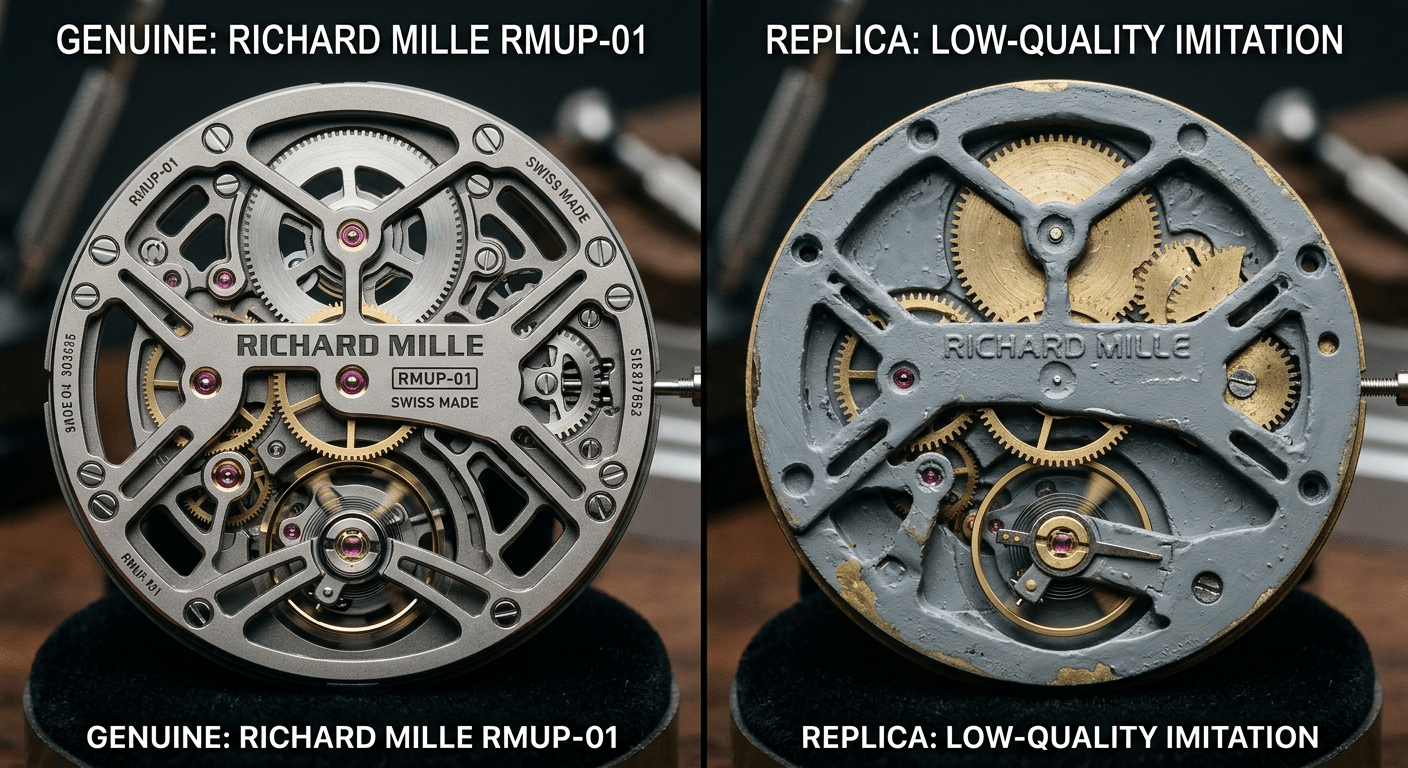
Physical diagnostic: The “Caseback Transparency Test.” This is your first and most sobering reality check. A genuine Richard Mille’s movement is a core part of its design identity, meant to be seen and admired. Before you spend a dollar, find a high-resolution photo of the caseback of the genuine model you desire. Now, find the best available photo of the replica’s caseback. The gap in finishing, architecture, and sheer mechanical artistry is the single most immediate visual tell. Genuine movements feature micro-blasted grade 5 titanium bridges, black-polished screws, and free-sprung balances. Replicas show decorated plates, standard regulator arms, and stamped components. If this disparity bothers you during your research, it will become a persistent, nagging flaw once the watch is on your wrist. This test aligns your expectations with the fundamental mechanical truth upfront.
Stage 1: The Brutal Budget Reality Check
In the RM replica world, your budget doesn’t just determine quality—it determines viability. There is a minimum entry point for a watch that doesn’t scream “fake” from across the room. Wasting time looking at models you cannot afford to replicate properly is the fastest path to a bad purchase. Let’s establish the tiers with unvarnished clarity.
Tier 1: The “Entry-Level” Illusion (Under $500)
For under $500, you are not buying a Richard Mille replica. You are buying a toy that vaguely resembles one. This tier is dominated by DHgate and AliExpress specials. What you get: a case with a poorly proportioned, often plasticky tonneau shape; a mineral glass crystal that will scratch if you look at it too hard; a quartz movement or a bottom-tier automatic like a Miyota 8215; and “carbon fiber” that is either a printed pattern or a cheap, glossy laminate. The colors will be off, the fonts will be wrong, and the watch will feel hollow and light in all the wrong ways.
The advice here is simple: Avoid. If your budget is under $500 and you want an RM, you are better off buying a different brand’s replica altogether or saving up. This tier exists for costume purposes and social media clips, not for anyone seeking a “super clone” experience. It will satisfy no one but the most undiscerning viewer from a distance of 20 feet.
Tier 2: The Main Super Clone Arena ($500 – $1200)
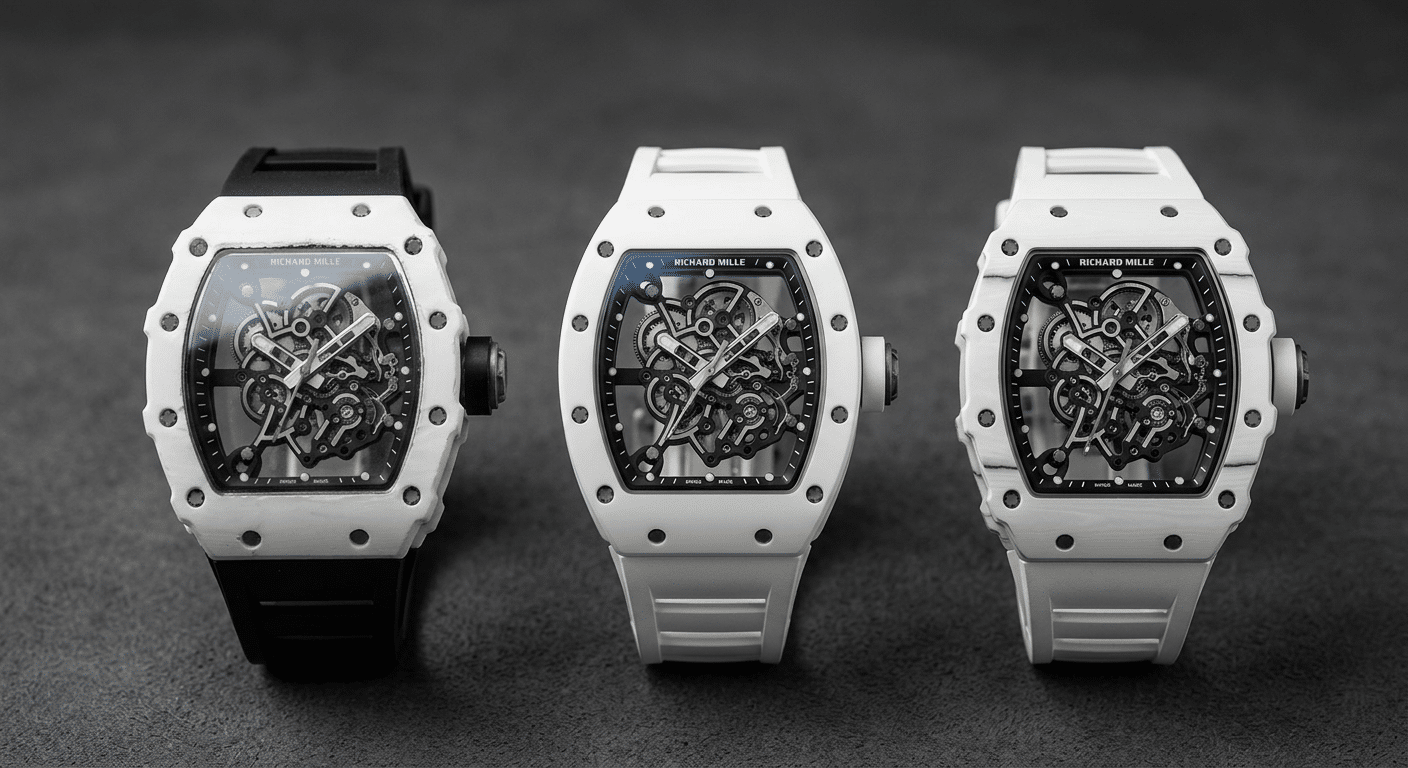
This is the core battleground where the serious game is played. For $500 to $1200, you gain access to models from factories like ZF, APSF, and BBR for popular references like the RM 035-02 or RM 055. This price buys you tangible improvements: vastly better case geometry machined from actual forged carbon or ceramic; a sapphire crystal with anti-reflective coating; and a decorated automatic movement, often based on a Seagull or a Dandong clone, that at least mimics the skeletonized look of the genuine caliber.
However, the compromises are still significant and define this tier. The movement will be thicker than the genuine, affecting case profile. The rotor will likely have a distinct, audible wobble. The “titanium” finishes on the movement are coatings, not the real metal. Functional complications like chronographs are often built on fragile, modified bases. You are paying for the best possible visual approximation from the major factories, but the mechanical and material gaps remain substantial. This tier is for the buyer who accepts that the watch’s primary function is to look convincing, not to perform like a $300,000 mechanical instrument.
Tier 3: The Niche & Complication Premium ($1200+)
Crossing the $1200 threshold enters a frontier of diminishing returns and exponentially higher risk. This tier covers attempts at genuine tourbillons (from factories like EUR), complex case materials, or less commonly repped models that require smaller production runs. Here, “more expensive” does not linearly equal “more reliable.”
A $1000+ tourbillon replica from EUR factory is a marvel of Chinese micromechanics, but it is also a incredibly delicate mechanism without a Swiss service network. A custom-order piece with a “Vaucher clone” movement may offer better finishing, but you are dealing with a single builder, not a factory with QC processes. The risk of a dead-on-arrival movement or a catastrophic failure is higher. This tier is for the seasoned enthusiast, the tinkerer, or the collector who values the novelty of a complex replica above practical daily wear. It is not for the faint of heart or thin of wallet.
Expert Authentication Insight
Physical diagnostic: The “Weight and Sound” Preliminary. Before you even look at the watch, get a small digital gram scale. The weight of a genuine RM is a precise specification, often listed in grams (e.g., the RM 027-03 is ~20g). A replica using steel instead of titanium or denser carbon composites can be 20-40 grams heavier—a difference you can feel in your hand immediately. Next, in a quiet room, listen to the watch. Gently rotate it near your ear. A genuine RM movement, with its ceramic ball bearings and precision engineering, is whisper-quiet. Most replicas have a distinct, gritty rotor sound—a swirling, wobbling noise that is a dead giveaway of a standard, mass-produced automatic base movement inside a exotic case. This simple two-step check cuts through marketing claims about “1:1” builds.
Stage 2: Model Selection Based on Replication Viability, Not Just Desire
You might love the RM 56-01 Sapphire for its audacious transparency. That doesn’t mean you should buy a replica of it. In fact, you almost certainly shouldn’t. The single most important factor in having a satisfying RM replica experience is choosing a model that the replica factories have a fighting chance of replicating well. This means letting replication feasibility, not personal passion alone, guide your choice.
The “Safe Bets”: Well-Repped RM Models and Why
Some models have benefited from intense factory competition and iterative improvement, making them smarter choices. The current “safe bets” are:
- RM 035-02 (Rafael Nadal): The most replicated RM for a reason. Its case shape, while complex, is more standardized. Factories like ZF and APSF have gone through 7+ versions, refining the case, the carbon pattern, and the clone movement. The high volume means better consistency and more available spare parts.
- RM 055 (Bubba Watson): Particularly the NTPT carbon versions from APSF or the ceramic versions from BBR. The relative simplicity of its three-hand function and the popularity of the model have driven factories to solve its specific challenges, like the case profile and dial texture.
- RM 011 Felipe Massa Chronograph: While thicker than genuine due to the Shanghai 7750 movement inside, it’s been in production for years by factories like KV/KU. It’s a known quantity. You know the flaws going in (thickness, rotor noise), and the chronograph complication, while fragile, at least functions.
These are “safe” relatively. They offer the highest probability of receiving a watch that looks coherent and has a known set of documented, acceptable compromises.
The “Red Flag” Models: What to Approach with Extreme Caution
Conversely, some models are minefields. Consider these red flags:
- True Skeleton Dials (e.g., RM 027, RM 052): Aligning multiple skeletonized bridges and gears behind a crystal is a nightmare in mass production. Misalignment is almost guaranteed and is instantly noticeable.
- Extreme Case Profiles (RM 027 “Nadal” series): The curved, ergonomic case of the RM 027 is incredibly difficult to machine accurately. Most replicas are clumsy, thick interpretations.
- Exotic Genuine Materials: Any model with genuine Quartz TPT, Graph TPT, or a full sapphire case (RM 056) is impossible to replicate accurately. Factories use colored carbon or mineral glass substitutes that look cheap in person.
- Functioning Tourbillons at the Replica Level: While factories like EUR make them, a replica tourbillon is the pinnacle of fragility. It’s a $1000+ gamble on a mechanism with no service support.
Loving a “red flag” model is fine. Buying a replica of it is often an exercise in frustration.
Case Shape & Thickness: The Unforgiving Metrics
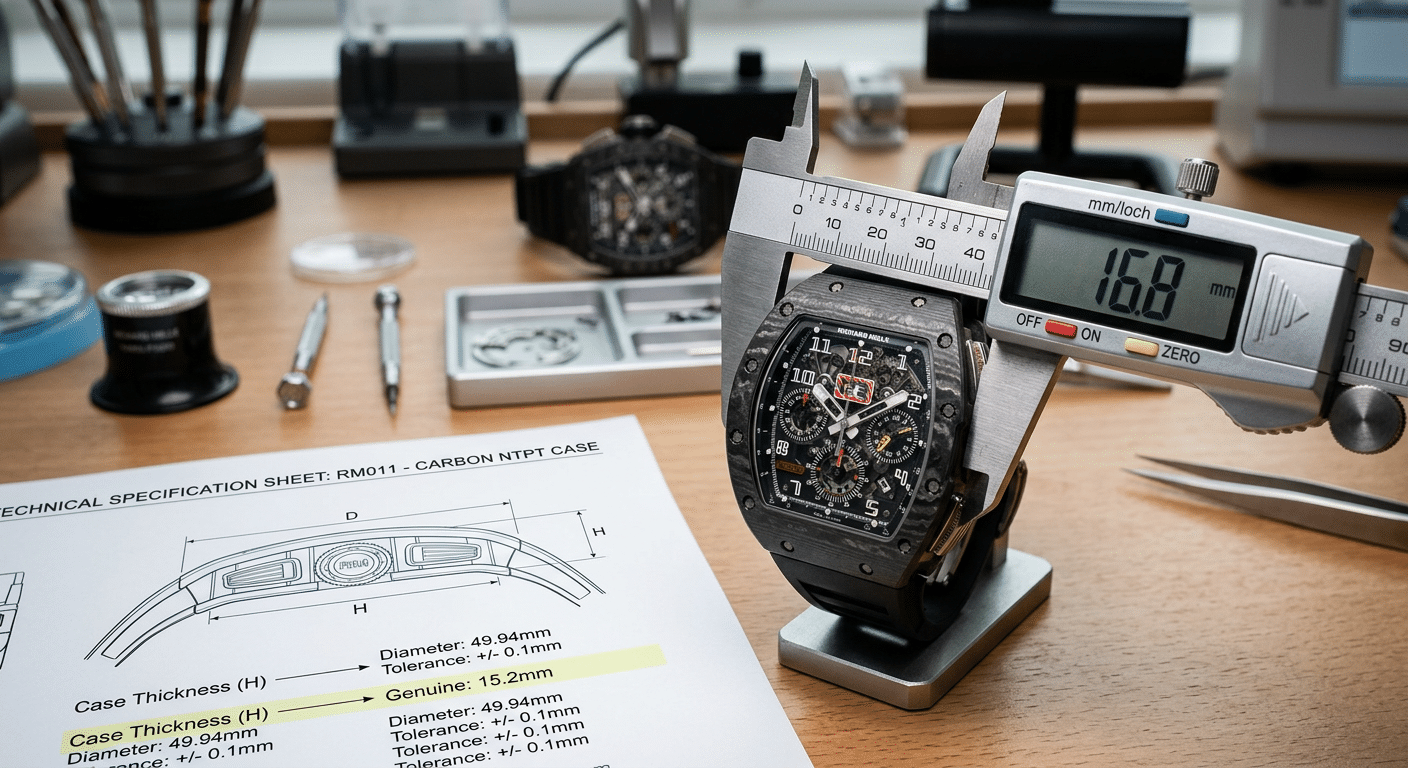
Forget the dial details for a moment. The single biggest visual tell on the wrist is the case silhouette and its thickness. A Rolex Submariner is 12-13mm thick. An RM 011 is 16.15mm thick. A replica RM 011 is often 18-19mm thick. That 2-3mm difference isn’t just a number; it’s a visual chunkiness that transforms the watch from a technical marvel to a clunky toy.
Your first research task for any model is to find and compare official dimensions (width, thickness, lug-to-lug) to the replica factory’s claimed dimensions. Use timezone.com, the Richard Mille website, or reputable dealer catalogs for genuine specs. Then, scour forum QC photos where users have measured with digital calipers. A critical part of this visual verification, especially for spotting deceptive angles or hidden flaws, is understanding how to analyze seller photos and videos. A difference of more than 1.0-1.5mm in thickness, or a noticeable error in the case curvature, is a deal-breaker. This is non-negotiable. A flawed case shape cannot be fixed, and it undermines the entire visual premise of the watch.
Expert Authentication Insight
Physical diagnostic: The “Lateral Profile Caliper Check.” This is where you move from speculation to hard data. When you receive your QC photos, or better yet, the watch itself, use a set of digital calipers. The most critical measurement is the case thickness from the top of the crystal to the bottom of the caseback. Compare this directly to the official specification. Next, measure the case width at its widest point (excluding the crown). Finally, measure the lug-to-lug distance. Replicas frequently fail on one of these three fundamental geometric pillars. The case might be the correct width but 2mm too thick, or the lug-to-lug might be off, making the watch wear larger or smaller than intended. This objective check reveals flaws that are impossible to hide and far more telling than a slightly misaligned marker.
Stage 3: Deconstructing “Functions” – What Actually Works?
In the replica world, especially with Richard Mille, you must translate seller language into reality. Marketing terms like “fully functional” are often a trap. This stage isn’t about features; it’s about managing expectations and identifying the operational weaknesses that will define your ownership experience.
The Date Window: A Litmus Test for Dial Alignment
On a Richard Mille, the date window is rarely just a date window. It’s a tiny aperture cut through multiple layers of a skeletonized dial, often with a cyclops lens. This makes it a nightmare to replicate accurately. Misalignment here—whether it’s crooked, sitting too high or low, or has inconsistent magnification—is rarely an isolated flaw. It’s a symptom of broader dial construction issues, imprecise CNC cutting, or poor assembly tolerances. If the factory couldn’t get this basic, fixed element right, it calls into question the precision of every other component.
When reviewing photos, the date window is your first stop. A perfect one doesn’t guarantee perfection, but a flawed one is a bright red flag for overall quality.
Chronographs & Complications: The Decoration vs. Function Reality
This is where you need brutal honesty. In 95% of RM replicas with subdials, those registers are either completely frozen (decorative plates glued over the movement) or are part of a notoriously fragile modified Chinese chronograph movement.
Take the popular RM 011 replica. It typically uses a modified Shanghai 7750. While it “works,” this movement is thicker, less reliable, and more prone to failure than a simple three-hand caliber. Starting and stopping the chronograph repeatedly is a known stress point. For tourbillon models from factories like EUR, you’re dealing with an even more delicate modified Seagull tourbillon movement. The rule is simple: Assume any advertised complication beyond time and date is either non-functional or a significant liability. You are buying the visual illusion of complexity, not a genuine, serviceable mechanical function.
Water Resistance: Assume Zero
This is non-negotiable. The complex, multi-part tonneau case of a Richard Mille, with its curved crystals and numerous screws, presents a sealing challenge that genuine manufacturers spend immense resources to solve. Replica factories do not. Even if a seller claims “30m water resistance,” treat it as a meaningless specification. Gaskets are often poorly fitted, missing, or made of inferior materials. You should never submerge a replica RM, wear it in heavy rain, or even wash your hands with it on without extreme caution. Consider it a strict “dry conditions only” piece. This isn’t a minor inconvenience; it’s a fundamental wearing limitation.
Expert Authentication Insight
Physical diagnostic: The “function stress test.” Once you have the watch in hand, don’t just admire it—test it. For a chronograph: Operate the start, stop, and reset functions 10-15 times in quick succession. Does the central seconds hand jump or stutter? Does it reset crisply to zero, or does it land slightly off? For the date function: Slowly advance the hands and observe the date change as it approaches midnight. Does it snap over cleanly within a 10-minute window around 12, or does it begin creeping hours in advance? These operational hiccups—hesitation, slack, and imprecision—are the hallmarks of modified base movements that prioritize cosmetics over robust engineering. A healthy, well-adjusted movement performs these functions cleanly. A replica movement often reveals its true nature under this simple stress.
Stage 4: The Pre-Purchase Photo Analysis Protocol
Your most powerful tool before money changes hands is the Quality Control (QC) photo set. Most buyers glance at them; you need to forensically analyze them. This turns a passive step into an active defense against flawed pieces.
Lighting & Angle Demands: How to Request Useful Media
Forget the glamour shots. You need diagnostic imagery. Specifically request from your dealer:
- Macro shots of the dial and date window: To check alignment, printing, and dust.
- A dead-on, perpendicular side profile shot: The only way to honestly assess case thickness against the genuine spec.
- A video of the second hand sweeping: To check for stuttering (a sign of a dirty or poorly adjusted movement).
- A clear, well-lit caseback shot: To inspect movement decoration and engraving.
- Photos under natural, even light—not dramatic shadows or studio lighting: Harsh shadows hide flaws; flat light reveals them.
If a dealer refuses these basic requests, consider it a major red flag.
Focus on the Forgotten Areas: Caseback, Crown, and Case Edges
Flaws hide in the places casual photos ignore. Train your eye here:
- Caseback Engraving: Zoom in. Is the font correct? Is the engraving deep and crisp, or shallow and soft? Poor engraving is a hallmark of lower-tier finishing.
- Crown and Crown Guards: Is the crown shape accurate? Does the rubber insert align properly? Are the crown guards the correct proportion and sharply defined?
- Case Edges and Bezels: The edges should be sharp and well-defined. Rounded, soft edges often indicate a lower-quality casting or lazy finishing. Examine each bezel screw—are the slots clean and uniformly oriented?
These “forgotten” areas often receive the least attention during assembly and reveal the true level of care.
Comparing to Genuine Reference: A Step-by-Step Method
Don’t rely on memory. Use a systematic, side-by-side comparison:
- Open the Reference: Have the official Richard Mille website page for your exact model open on one screen.
- Open the QC Photo: Place the dealer’s photo on another screen or side-by-side.
- Compare Element by Element: Isolate one detail at a time. First, dial color and texture. Then, subdial placement and size. Then, hand length and shape. Then, date wheel color and font. Then, crown profile. Trying to judge the whole watch at once is overwhelming and ineffective.
- Use a Ruler Tool: Most basic photo editing software has a pixel measurement tool. Use the known dimension of one part (e.g., the case is 50mm wide) to measure and verify the proportions of other elements in the photo.
Expert Authentication Insight
Physical diagnostic: The “screw alignment grid.” Richard Mille’s aesthetic is built on technical precision, and nowhere is this more evident than in the bezel screws. On a genuine piece, these screws are not just fasteners; they are geometric elements in perfect alignment. Before approving QC photos, perform this test: Use software to draw straight lines along the axes of the screws. On a genuine RM, these lines will form a perfect, consistent grid, and each screw slot will be aligned to the same angle (often vertical or at a specific uniform offset). On even the best replicas, you will often find slight misalignments—a screw a fraction of a millimeter out of line, or a slot turned a few degrees off. This is one of the most telling, yet often overlooked, signs of machining and assembly tolerance differences.
Stage 5: Quantifying Your Personal Risk Tolerance
Buying a super clone is an exercise in managed compromise. This stage moves you from abstract quality scores to a personal checklist: what flaws will you notice every day, and what are you willing to accept to get 95% of the look for 0.5% of the price?
The Movement Reliability Spectrum: From “Set It and Forget It” to “Tinkerer’s Toy”
Your choice often boils down to a trade-off between robustness and visual fidelity.
- The Reliable Workhorse (e.g., Decorated Miyota 9015): Found in some older or simpler replicas. It’s loud (rotor noise is noticeable), visually incorrect for an RM, but it will likely run for years with minimal issue. You’re choosing durability over accuracy.
- The Visual Specialist (e.g., Dandong RMUL2 Clone): Used in top-tier APSF/ZF models. It looks dramatically closer to the genuine movement, with better finishing and correct layout. However, it’s more complex and may be less robust over a 5-year period than a Miyota. You’re choosing aesthetics over proven, decades-long reliability.
- The Fragile Illusionist (e.g., Modified Seagull Chronograph or Tourbillon): It offers a working complication that looks the part. The trade-off is significantly higher potential for failure, difficulty in servicing, and a shorter expected lifespan. This is a “tinkerer’s toy,” best for those who understand and accept the risk.
You must decide which side of this spectrum you’re on before you choose a model or factory.
The “Tells” You’ll See vs. The “Tells” Others Will See
This psychological filter is crucial for long-term satisfaction. Categorize the flaws:
- “You” Tells (Private Annoyances): A misaligned date window you see every morning. A rotor that whirs loudly in a quiet room. A chronograph pusher that feels mushy. These are the flaws that will grate on you daily.
- “Them” Tells (Social Tells): A case that’s 2mm thicker than genuine. The wrong shade of carbon fiber. These are theoretically noticeable to a trained eye but are almost never called out in real life. No one will put calipers to your wrist.
- “Nobody” Tells (Hidden Flaws): An incorrectly engraved caseback, the wrong balance wheel style, or the grade of titanium used. These are completely invisible during normal wear.
Prioritize avoiding the “You” Tells. Be willing to compromise on the “Them” and “Nobody” Tells. This is how you buy a watch you’ll actually enjoy wearing.
Resale Reality & The “Money Gone” Mentality
You must internalize this: A replica watch is an expense, not an investment. The secondary market for replicas, especially niche ones like Richard Mille, is shallow and illiquid. You will not recoup 70% of your cost like with a popular Rolex replica. Expect to lose 30-50% the moment it leaves the dealer, and more if it shows any wear.
Adopt the “Money Gone” mentality. The funds you allocate should be viewed as payment for the experience of wearing the watch, for the enjoyment it brings you. It is not a store of value. This mindset adjustment is liberating—it removes the pressure of “protecting your investment” and allows you to simply wear and (carefully) enjoy the piece for what it is.
Expert Authentication Insight
Physical diagnostic: The “wrist-roll simulation.” The final, holistic test is about presence, not specifications. Before purchasing, find a high-quality video of the genuine watch being worn and rotated on a wrist. Observe how light dances across the case facets, how the crystal refracts, the sharpness of the edges as they catch the light. Then, request a similar video from your dealer of the replica. Play them side-by-side. The difference is often not in one measurable flaw, but in the overall cohesion, finish, and “jewelry-like” quality. The genuine piece has a luminous, precise presence. The replica, even a very good one, often has a slightly flatter, less dynamic, or less refined light play. This intangible “tell” encompasses a dozen smaller imperfections and is the ultimate test of whether the replica achieves the visual spirit of the genuine article.
Stage 6: The Unvarnished Truth About Replica RM Service & Longevity
Buying the watch is the easy part. Owning it is where the reality of a replica Richard Mille truly sets in. This isn’t a Seiko you can drop off at any mall kiosk. The post-purchase experience is defined by one harsh truth: you are completely outside the ecosystem of genuine parts, factory-trained technicians, and brand support, underscoring the importance of a comprehensive Richard Mille super clone guide before making a decision. What you’re buying is a mechanical island. Your job, before you spend a dollar, is to understand exactly what that means for the next two to five years.
Finding a Watchmaker: The Pre-Purchase Research Task
Consider this your first non-negotiable homework assignment. Do not buy the watch until you have a plausible answer to this question: “Who will fix this when it breaks?”
The answer is not simple. Many reputable watchmakers will refuse to work on replicas on principle. Others will take your money but lack the specific skills or parts for these highly customized movements and cases. Your search isn’t for a generic watch repair shop; it’s for a specialist who understands the Chinese clone movement landscape and isn’t afraid of non-standard parts.
Start by searching replica watch forums for recommended independent watchmakers in your region. Be prepared to ship your watch for service. Factor this logistical cost and risk—both financial and in terms of transit damage or loss—into your total cost of ownership. The availability of a skilled technician is not an afterthought; it is a fundamental pillar of the purchase. If you cannot secure one, you are accepting that the watch may become a very expensive paperweight upon its first malfunction.
Parts Availability: The Myth of “Just Replace the Movement”
This is the most dangerous assumption in the replica space. With a standard watch, a broken ETA or Seiko movement can often be swapped for a new one. With a replica Richard Mille, that is almost never an option.
The movements inside these watches—whether a decorated Miyota 9015, a Shanghai 7750, or a Dandong RMUL2 clone—are heavily modified. They are housed in custom-made movement holders specific to that case. The dial feet are soldered in non-standard positions. The hand sizes are proprietary. The entire assembly is a bespoke puzzle.
If the movement fails, you typically cannot just buy a new one and drop it in. You must find an identical donor movement from the same factory and version, which can be impossible if the factory has moved on or closed. More often, repair means sourcing individual parts (a broken wheel, a worn mainspring) from a donor movement or attempting to fabricate a fix. This turns a simple movement swap into a complex, expensive, and uncertain restoration project. The phrase “just replace the movement” is a fantasy. A broken movement often means a dead watch.
Expert Authentication Insight
Physical diagnostic: The “power reserve and amplitude check.” This is your first and most important health check the moment the watch arrives. Using a timegrapher (a basic model is a wise investment) or even a smartphone app like Watch Accuracy Meter, measure two key metrics:
- Amplitude: This measures the swing of the balance wheel. A healthy, fully wound movement should read between 250 and 310 degrees. A reading consistently below 220 degrees indicates insufficient power transmission—often due to dirt, dried oils, or a weak mainspring—and means the movement needs service immediately, not eventually.
- Beat Error: This measures the symmetry of the balance swing. Keep it under 0.5 ms. A high beat error can cause inconsistent timekeeping and is a sign of poor regulation or a misaligned balance staff.
Finally, manually wind the watch fully, let it run down, and track the actual power reserve. If it claims 45 hours but dies in 28, the mainspring is weak or the gear train has excessive friction. This test gives you a baseline for movement health before you even start wearing it.
Realistic Lifespan Expectations
Forget about heirlooms. Think in terms of functional service intervals. The lifespan of your replica RM is directly tied to its movement complexity and your willingness to invest in maintenance.
- The “Set-and-Forget” Tier (3-5+ years): This applies to simple three-hand models (like some RM 055 versions) using a robust, unmodified base movement like a Miyota 9015 with decorative plates. With a service every 3-4 years—a full disassembly, cleaning, oiling, and reassembly—these can run reliably for a long time. The cost of that service, however, may approach 25-50% of the watch’s original price.
- The “Tinkerer’s Toy” Tier (18-36 months): This encompasses most of the super-clone tier. Watches with the Dandong RMUL2 or modified chronograph movements are more visually accurate but mechanically more fragile. The additional gears, skeletonization, and custom bridges introduce more points of failure. Expect to need a service or encounter a minor issue within the first two years. A major failure (e.g., a broken tooth on a chronograph wheel) within 3 years is not uncommon.
- The “Complication Gamble” Tier (12-24 months): This is for anything with a working tourbillon or a complex module. The Seagull-based tourbillon movements in EUR factory watches, while impressive, are notoriously delicate. They are high-maintenance and prone to stoppage from shock. You are buying a fascinating mechanical display with a potentially very short functional lifespan. Servicing a replica tourbillon is a specialist’s job with a high probability of “we can’t fix this.”
The rule is simple: the more visually genuine the movement tries to be, the more mechanically fragile it often is. Budget for a service as part of the initial purchase price.
The Final Filter: Assembling Your Personal Go/No-Go Checklist
By now, you’re armed with analysis, warnings, and data. This final stage is about synthesis—turning that information into a clear, personal decision. This isn’t about finding the “perfect” replica; it’s about defining what “good enough” means for you, and then systematically vetting against that definition to avoid a costly mistake.
Creating Your Priority Matrix
Grab a piece of paper. Draw two columns: Non-Negotiable and Compromise Acceptable. Now, list your top three priorities from the following, placing each in only one column:
- Case shape & thickness accuracy (within 1mm)
- Movement reliability (low maintenance for 2+ years)
- Specific budget ceiling (e.g., under $800)
- Silent rotor operation
- Specific model desire (e.g., must be an RM 035)
- High-quality carbon pattern (no printed texture)
- Functional chronograph
The hard truth is this: you will not get all three in your Non-Negotiable column. The market does not allow it. If “Budget under $800” and “RM 011 Chronograph” are both non-negotiable, you are guaranteed to fail on “Movement reliability.” The matrix forces you to rank your values. Is visual impact worth mechanical uncertainty? Is saving money worth a glaring thickness flaw? Your completed matrix is your buying constitution—it tells you what to search for and, more importantly, what to immediately walk away from.
The “24-Hour Rule” and Final Vetting Questions
You’ve found a watch that fits your matrix. The dealer has sent QC photos. Your heart says yes. Now, impose a mandatory 24-hour cooling-off period. Do not approve the shipment. Step away.
After a day, return and ask yourself these three questions with brutal honesty:
- Am I buying the model, or the idea of the model? Are you captivated by the image of wearing a Richard Mille, or have you soberly assessed this specific replica’s documented compromises on your wrist?
- Have I budgeted for a full service cost on day one? Is the money for a potential $200-$400 service already set aside? If that extra cost would anger you, you cannot afford the watch.
- Is my chosen watchmaker confirmed? Do you have a name, a contact method, and a rough estimate for a basic service? If the answer is “I’ll figure it out later,” you are not ready to buy.
If you can answer “yes” to all three, you may proceed to the final gate.
When to Walk Away: Clear Red Flags
These are not warnings; they are stop signs. If you encounter any of these, abort the transaction immediately:
- Seller Pressure: Any use of “last one,” “price going up tomorrow,” or reluctance to provide specific additional photos.
- Insufficient Media: No clear, high-resolution macro shots of the dial, caseback, and case profile. No video of the second hand sweep or rotor spin.
- Vague Movement Answers: “Asian clone movement” is not an answer. You need the specific caliber (e.g., “Dandong RMUL2 V2”). Evasiveness here means they’re hiding a lower-grade movement.
- Pricing Anomalies: A “super clone” RM 035 for $300 when the established market price is $750+. This is not a deal; it’s a different, inferior product.
- The “1:1 Perfection” Promise: Any seller claiming absolute perfection is either lying or ignorant. Both are disqualifying.
Expert Authentication Insight
Physical diagnostic: The “pre-acceptance verification list.” Before giving the final GL (Green Light) on your QC photos, methodically work through this list. Do not skip steps.
- Timegrapher Numbers: Are they present? Amplitude > 220? Beat error < 0.5 ms? Rate within +/- 30 sec/day? Missing or poor numbers are a rejection reason.
- Case Thickness Measurement: Use the on-screen ruler tool in the photo app. Have the dealer provide a side-profile shot with a ruler. Measure the case thickness from crystal to caseback. Compare to the genuine spec. A discrepancy over 1.5mm is a critical fail for most models.
- Date Window Autopsy: Zoom in 200%. Is the date wheel perfectly centered in the window? Is the font correct? Is there any visible misalignment with the dial texture beneath it? This is a litmus test for overall dial assembly quality.
- Caseback Engraving Forensic: Compare depth, sharpness, and font to a genuine photo. Are the letters crisp and deep, or soft and shallow? Are the screw slots cleanly machined? Poor finishing here often correlates with poor internal finishing.
Only if every item on this list passes do you approve the shipment. This is your final quality control—your last chance to catch a lemon before it crosses an ocean.
Conclusion: Your Path Forward
This entire framework leads to one final, binary choice. There is no middle ground.
Path A: The Calculated Acceptance. If your priority matrix is dominated by visual impact and wrist presence, and you accept the realities of movement fragility, non-existent water resistance, and the hunt for a willing watchmaker, then your path is clear. Your narrowed search should focus on the most viable models from the most stable factories: the RM 035-02 from APSF or ZF for the best all-around package, or the RM 055 (NTPT) from APSF for its case material execution. Set your budget at $700-$1000, factor in an immediate service, and buy from a trusted dealer with rigorous QC. You are buying a spectacular visual artifact with a mechanical heart that requires managed expectations.
Path B: The Primate Pivot. If the compromises on thickness, the reliability anxiety, the service headache, or the sheer cost of entry give you pause, then this market is not for you—and that is a perfectly rational, financially sound conclusion. Your money and satisfaction will be exponentially better served in a different segment of the replica world. Consider a high-quality replica from a brand with less extreme engineering, where the clones are mature and the gaps are smaller: a Submariner from Clean Factory, a Royal Oak from APS, or a Nautilus from PPF. You will get 95% of the luxury watch experience with about 5% of the ownership friction.
The goal of this guide was never to sell you a replica Richard Mille. It was to give you the tools to decide if you should even be in the market for one. If you choose Path A, you do so with your eyes wide open. If you choose Path B, you’ve saved yourself significant time, money, and frustration. Both are correct decisions. The only wrong decision is leaping before you’ve looked.