
The “Why” of Replica Movement Upgrades: Addressing Core Flaws
The allure of a Panerai replica is often its commanding presence on the wrist, a fraction of the cost of the genuine article. Yet, for many enthusiasts, that initial satisfaction eventually gives way to a nagging “what if.” The core of this dilemma frequently lies beneath the display caseback: the replica movement. When considering Panerai replica movements, it’s important to understand that while advancements in clone movements have been significant, they still present inherent limitations that push owners towards the costly, yet potentially rewarding, path of a Swiss ETA swap.
Common Issues with Clone Movements
Panerai replicas, especially those produced in the last decade, have seen impressive strides in movement cloning. Factories like VS and XF have developed highly decorated P.9000 and P.3000 clones that visually impress. However, beneath the surface, these movements, often based on Asian workhorses like the Seagull ST25, Hangzhou 6300, or heavily modified Asian 7750s, carry a set of common vulnerabilities. I’ve opened dozens of these, and the pattern is consistent: poor lubrication, particularly in critical areas like the escapement and mainspring barrel, is rampant. This leads to premature wear.
Furthermore, issues such as weak mainsprings, which fail to deliver advertised power reserves consistently, and fragile keyless works are frequent culprits for repair. On chronograph models, the decorated A7750 clones are notorious for their finicky nature and propensity for column wheel or hammer spring failures. While a VS P.9000 clone can offer remarkable stability for a replica movement, often holding within +/- 5 seconds per day for a year or two, its long-term durability and ease of service remain a gamble compared to its Swiss counterpart. Expect to pay a watchmaker between $120-$250 for a service on these, and parts can be difficult to source.
Performance Gaps: Accuracy, Power Reserve, and Durability
Quantifying the performance gap between clone and genuine Swiss movements is critical for understanding the “why” of an upgrade. A well-regulated genuine Swiss ETA 2824-2 (Elaboré grade) typically maintains accuracy within +/- 7 seconds per day, and often much better, right out of the box, with a consistent 38-40 hour power reserve. In contrast, while a top-tier VS P.9000 clone might achieve a commendable 70-72 hour power reserve initially, I’ve observed these often drift to 55-60 hours within 12-18 months of daily wear, particularly if the watch isn’t serviced promptly.
Durability is another major differentiator. Clone movements often utilize softer alloys for critical components like pivots, gears, and balance staffs, making them more susceptible to wear and shock damage. For instance, the Incabloc shock protection system found in most genuine ETAs is a robust, proven design, whereas clone movements often use a simpler, less effective system that offers less protection against drops or impacts. This translates to an expected lifespan of 3-5 years for many clone movements before significant issues arise, while a properly maintained ETA can easily last decades.
The Allure of Authenticity and Reliability
Beyond the raw performance metrics, the appeal of a Swiss movement in a Panerai replica is deeply psychological and practical. There’s an undeniable satisfaction in knowing the heart of your watch is a piece of genuine, respected engineering. This translates into a smoother sweep of the seconds hand, a more robust and reassuring feel when winding or setting the time, and the peace of mind that comes with proven reliability. From a practical standpoint, a Swiss ETA movement is far easier to service. Parts are readily available globally, and almost any competent watchmaker can work on them, reducing both the cost and hassle of maintenance compared to the often proprietary and hard-to-find components of clone movements. This ease of serviceability alone can justify a significant portion of the upgrade cost over the long term.
Expert Authentication Insight
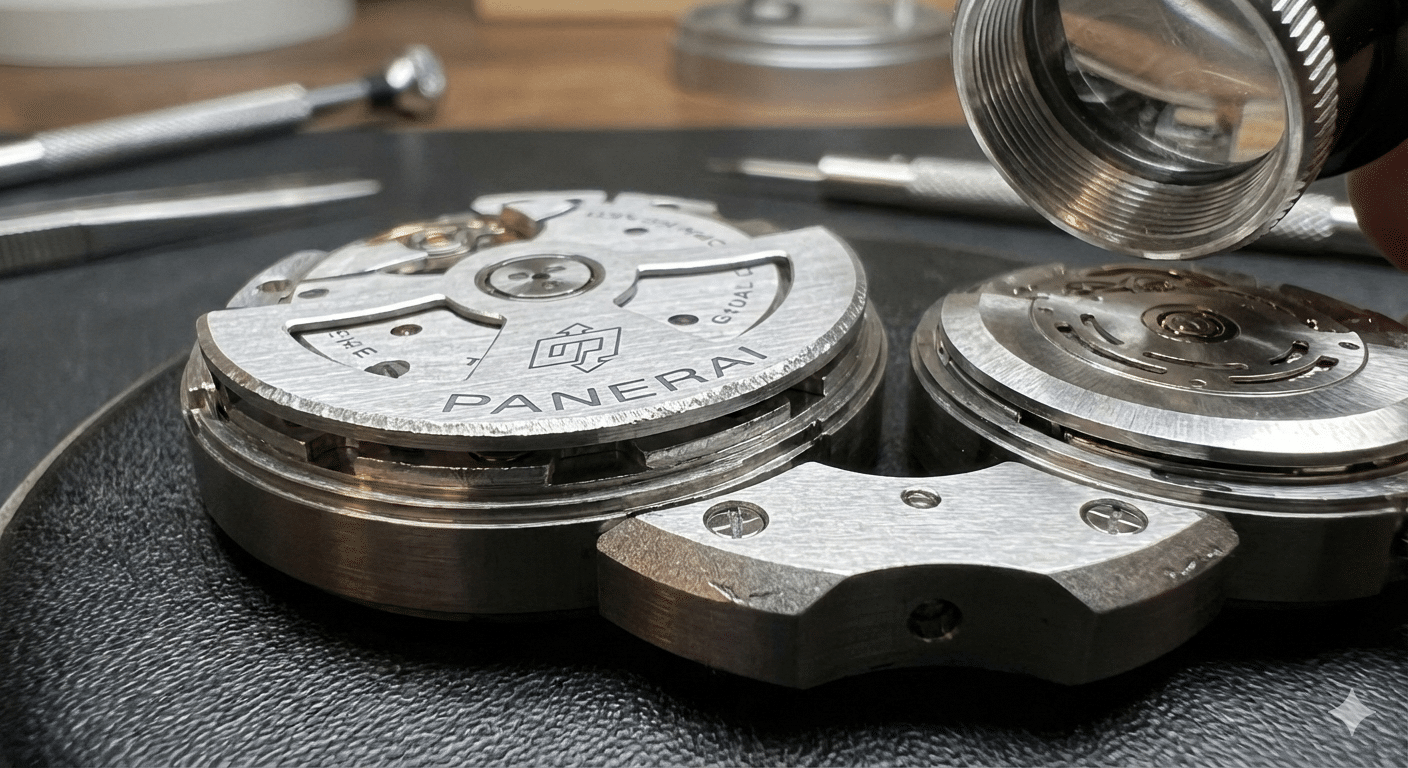
When I’m evaluating a “Swiss-grade” clone movement, the first thing I look for is the finishing and the balance cock. Many clone movements attempt to mimic the bridge layout of a genuine Panerai caliber, but the execution often falls short. For example, a quick visual inspection of the balance cock on many P.9000 clones will reveal less refined beveling and often a simpler, stamped Incabloc-style shock absorber that lacks the precise machining of a genuine Swiss component. The rotor, too, is a tell: while many clones now feature ball-bearing bidirectional winding, the quality of the engraving and the overall finish on the rotor can be noticeably cruder or feature laser-etched markings rather than crisp, stamped details. These subtle cues, visible under 10x magnification, immediately signal a clone, regardless of how well it’s decorated.
Once the decision is made to upgrade, the next critical step is identifying the right Swiss ETA movement. This isn’t a “one-size-fits-all” scenario. Panerai’s diverse catalog, from manual-wind Radiomirs to automatic Luminors and chronographs, necessitates specific ETA calibers, each with its own characteristics and compatibility considerations.
Identifying Compatible ETA Calibers
For Panerai replicas, a few genuine ETA calibers stand out as prime candidates for a swap:
- ETA 6497/6498 (Manual Wind): This is the workhorse for many larger, manual-wind Panerai models, particularly the Luminor and Radiomir lines with small seconds at 9 o’clock (6497) or 6 o’clock (6498). Its large diameter (36.6mm) and thickness make it a natural fit for Panerai’s often substantial cases. The 6497 is robust, reliable, and relatively affordable.
- ETA 2824-2 / 2836-2 (Automatic): These automatic movements are versatile, beating at 28,800 vph, and are suitable for smaller Panerai cases or where an automatic movement is desired. The 2836-2 adds a day-date complication, which can be useful if the replica dial supports it. Their smaller diameter (25.6mm) means they’ll almost always require a custom movement ring to fit securely in larger Panerai cases.
- ETA 7750 (Automatic Chronograph): For chronograph models, the venerable 7750 is the obvious choice. It’s a chunky movement (30.4mm diameter, 7.9mm thick) but perfectly suited for the often-thick chronograph cases. However, integrating a 7750 can be complex due to its pushers and sub-dial layout, which must align with the replica dial.
Understanding their dimensions, stem heights, and functional outputs is paramount before sourcing. Trying to shoehorn the wrong movement into a case will lead to endless frustration and potential damage.
Sourcing Genuine Swiss ETA Movements: Challenges and Pitfalls
Sourcing authentic Swiss ETA movements today is significantly more challenging than it was a decade ago, thanks to Swatch Group’s restrictions on external sales. Legitimate parts suppliers are the safest bet, but their inventory can be limited, and prices are often higher. Donor watches, where a complete watch containing the desired ETA movement is purchased and cannibalized, are a common strategy. This can be cost-effective but requires careful verification of the donor watch’s movement condition and authenticity.
The grey market is fraught with peril. Be extremely wary of “new” ETA movements sold at suspiciously low prices, particularly from unverified online sources. Counterfeit ETAs, often Asian clones re-branded with fake ETA stamps, are prevalent. I’ve seen movements stamped “ETA” that are clearly Asian 2824 copies, identifiable by the incorrect balance wheel, shock protection, and often rougher finishing. Always request high-resolution photos of the movement, focusing on the balance wheel, shock absorber, and specific ETA stampings. Genuine ETAs will have batch IDs and specific markings that a knowledgeable watchmaker can verify. Expect to pay anywhere from $300-$500 for a used but good condition ETA 6497, and $400-$700 for a new old stock (NOS) 2824-2. A genuine 7750 can easily run $700-$1,200 or more.
Understanding ETA Grades and Their Impact on Performance
ETA movements are produced in several grades, each offering different levels of finishing, component quality, and accuracy:
- Standard: Basic finishing, nickel-plated balance, Novodiac shock protection. Accuracy: +/- 12 seconds per day (sd) to +/- 30 sd.
- Elaboré: Improved finishing, often decorated rotor, Glucydur balance, Incabloc shock protection. Accuracy: +/- 7 sd to +/- 20 sd. This is often the sweet spot for upgrades, offering significant performance without the premium cost of higher grades.
- Top: Further enhanced finishing, blued screws, adjusted in 5 positions. Accuracy: +/- 4 sd to +/- 15 sd.
- Chronometer: COSC certified, highest finishing, adjusted in 5 positions. Accuracy: -4 sd to +6 sd.
The choice of grade directly impacts performance, stability, and price. While a Standard grade ETA will still outperform most clone movements, an Elaboré or Top grade will offer superior accuracy, better power reserve stability, and enhanced durability due to better components like the Glucydur balance and Anachron hairspring, which are less susceptible to temperature changes and magnetic fields. This translates to a watch that not only tells time more precisely but also requires less frequent regulation and servicing.
Expert Authentication Insight
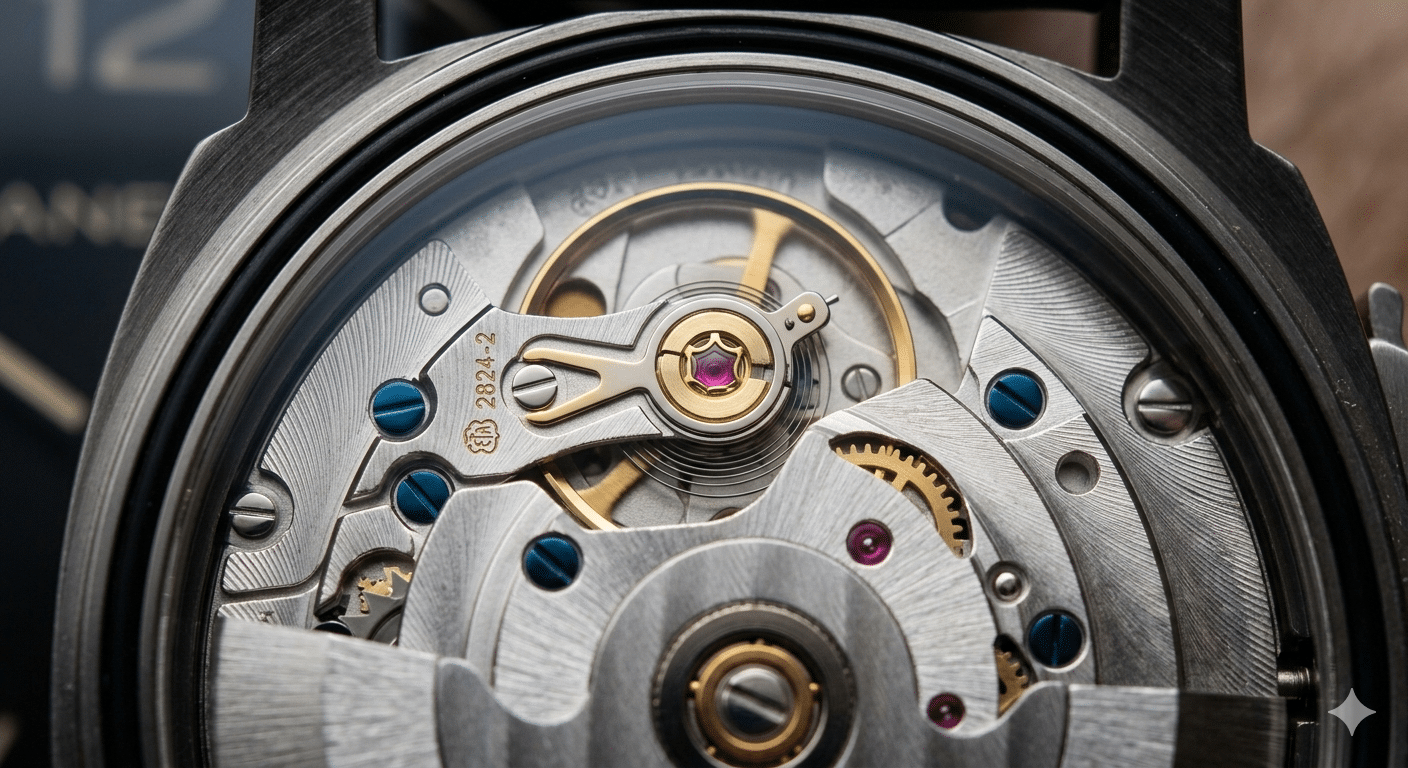
Verifying the authenticity and grade of an ETA movement requires a keen eye and often a loupe. For example, a genuine ETA 2824-2 (Elaboré grade or higher) will feature a Glucydur balance wheel, which has a distinct metallic luster and often appears darker than the nickel-plated balance found in Standard grades or many counterfeits. Crucially, I examine the shock protection system. Genuine Incabloc will have a distinct lyre-shaped spring, while Novodiac uses a simpler, two-pronged spring. Counterfeit ETAs often mimic these, but the finishing on the Incabloc spring holder and the quality of the jewel setting will be noticeably inferior under magnification. Specific ETA stampings, usually found near the balance wheel or under the rotor, are also key. These codes (e.g., “ETA 2824-2” and a specific grade marking) are consistently applied on genuine movements and are often poorly replicated or missing on fakes.
The ETA Swap Procedure: Technical Considerations and Compatibility
Transplanting a genuine Swiss ETA movement into a Panerai replica case is not a simple drop-in operation. It’s a delicate dance of precision and modification, requiring specialized tools and a deep understanding of watchmaking mechanics. The compatibility challenges are numerous, and overlooking any detail can render the entire project a costly failure.
Case, Dial, and Hand Compatibility: Bridge and Stem Height Adjustments
The dimensions of the original clone movement rarely perfectly match those of the chosen ETA. This means differences in movement diameter, thickness, and crucially, stem height. The stem height dictates where the crown stem enters the movement relative to the case opening. If it’s off by even a millimeter, the crown won’t align properly, leading to binding or an unsightly gap.
For Panerai cases designed for larger P.9000 or P.3000 clones, a smaller ETA 2824-2 will require a custom movement ring. This ring, usually made from brass or Delrin, centers the ETA movement within the larger case and provides mounting points. Dial feet relocation is another common hurdle. Clone movements often have dial feet positions that don’t match standard ETA layouts. This means carefully removing the original dial feet and attaching new ones, often with adhesive or by soldering, to align with the ETA movement. Hand clearance is also critical: if the ETA’s cannon pinion or hour wheel is taller or shorter, the hands might rub against each other or the crystal, necessitating modification of these components or sourcing specific hand sets.
Spacer Rings and Movement Holders: Ensuring a Secure Fit
The secure fit of the movement within the case is paramount for reliability and water resistance. Since most replica cases are designed for specific clone movements, a Swiss ETA swap almost invariably requires custom-machined movement spacers or holders. These aren’t just aesthetic pieces; they provide structural integrity, preventing the movement from shifting or rotating within the case.
I’ve seen watchmakers use various materials, but brass or Delrin (a high-strength engineering plastic) are common. The spacer must precisely match the inner diameter of the replica case and the outer diameter of the ETA movement, or other reliable replica movements, while also accommodating any necessary height adjustments. A poorly fitted spacer can lead to the movement rattling, the crown stem misaligning, or even the dial detaching over time. This custom fabrication is a significant part of the labor cost, often running $50-$150 just for the part, plus machining time.
Crown Stem and Keyless Works Integration Challenges
The crown stem and keyless works (the mechanism that allows winding and setting) present one of the most delicate and error-prone aspects of an ETA swap. The length of the crown stem is specific to the movement, the case, and the crown itself. It needs to be cut, filed, and polished to a precise length, allowing the crown to sit flush against the case while engaging the keyless works correctly in all positions (winding, neutral, date set, time set).
Too long, and the crown won’t push all the way in; too short, and it won’t engage properly or will pull out too easily. The keyless works itself is a complex arrangement of tiny springs and levers. Any misstep during stem manipulation can cause parts to pop out, requiring a full disassembly of the dial side to fix. This is not a job for the faint of heart or the inexperienced, as a damaged keyless works can render the movement inoperable.
Expert Authentication Insight
After an ETA swap, I always perform a thorough check of the crown’s operation. Gently pulling and pushing the crown through its various positions (winding, setting, quick-set date if applicable) provides immediate feedback. There should be a distinct, crisp click for each position, and the stem should move smoothly without any grittiness or excessive play. If the crown feels loose, wobbly, or requires undue force, it’s a red flag. This indicates either incorrect stem length, improper keyless works integration, or damage to the keyless works itself. A well-executed stem fit ensures not only proper function but also contributes significantly to the watch’s water resistance by allowing the crown gasket to seat correctly.
Beyond the Swap: Advanced Movement Modification and Regulation
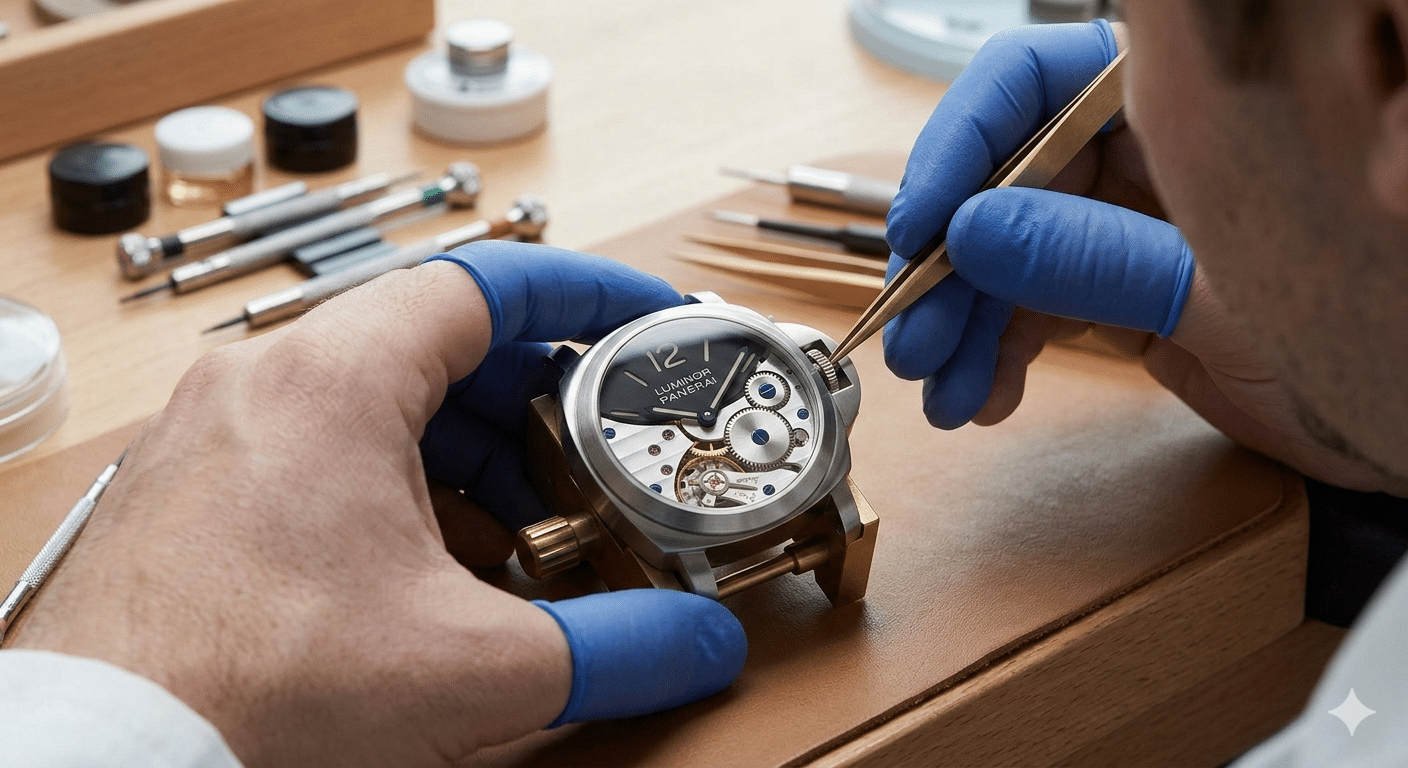
Installing a genuine Swiss ETA movement into a Panerai replica is a significant step, but it’s often just the beginning for true enthusiasts. The raw movement, even a “new old stock” (NOS) ETA, is rarely optimized for peak performance right out of the box. This stage focuses on refining that mechanical heart to unlock its full potential for accuracy, longevity, and robust daily wear.
Full Service and Lubrication: Optimizing for Longevity
Even a brand-new or NOS ETA movement benefits immensely from a comprehensive service. These movements might have sat for years, and their lubricants could be dried, gummy, or simply outdated. A full strip-down involves disassembling every component, cleaning them in specialized solutions, inspecting for wear, and then carefully reassembling with fresh, appropriate lubricants. This isn’t just about making it run; it’s about ensuring it runs well* for years to come.
For instance, a watchmaker will use different viscosities of oil for the escapement (e.g., Moebius 9415 for pallet jewels) versus the gear train pivots (e.g., Moebius 9010 or HP1300) and a heavier grease for barrel walls and mainsprings (e.g., Moebius 8200). This meticulous application reduces friction, prevents premature wear, and ensures consistent power delivery. Neglecting this step often leads to erratic timekeeping, reduced power reserve, and a significantly shortened service interval. I’ve seen movements fresh out of their factory packaging perform poorly simply because they weren’t properly serviced before installation; it’s a critical, non-negotiable step for any serious upgrade.
Hairspring and Balance Wheel Adjustment: Precision Regulation
Once serviced, the movement must be regulated. This is the art of fine-tuning the timekeeping to achieve optimal accuracy across various positions. A skilled watchmaker will use a timegrapher to measure the movement’s rate (how fast or slow it’s running), amplitude (the degree of rotation of the balance wheel), and beat error (the symmetry of the balance wheel’s swing). They will then adjust the hairspring stud carrier to correct the rate and, in higher-grade movements, manipulate balance wheel screws to achieve a consistent rate in multiple positions (dial up, dial down, crown up, crown down, etc.).
The goal isn’t just a perfect score in one position, but a tight spread of rates across all positions. A movement that gains 5 seconds dial up but loses 5 seconds crown up will average out, but its real-world performance will be highly inconsistent depending on how it’s worn. A truly well-regulated movement, even an Elaboré-grade ETA, can achieve performance within COSC chronometer specifications (+/- 4 to 6 seconds per day) across multiple positions, drastically improving daily wearability compared to an unregulated clone that might drift by 20-30 seconds a day.
Component Upgrades: Mainspring, Incabloc, and Jewels
Beyond basic service, certain component upgrades can further enhance an ETA movement’s performance and durability. A common upgrade is replacing the factory mainspring with a higher-grade alternative, which can sometimes eke out an extra few hours of power reserve or provide more consistent torque delivery over the entire power cycle. This is particularly relevant for older NOS movements where the original mainspring might have lost some elasticity.
Another valuable upgrade, especially for lower-grade ETAs, is replacing the standard shock protection (like Novodiac) with genuine Incabloc. Incabloc is renowned for its superior resilience against impacts, protecting the delicate balance staff from breakage. While a genuine ETA already has decent shock protection, ensuring it’s the best available, or upgrading where possible, adds peace of mind. Replacing lower-quality synthetic jewels with genuine ruby jewels is less common but can be done to reduce friction in critical areas, though the practical benefit for daily wear is often marginal compared to a good service and regulation. The real value here is in bolstering the weakest links for maximum robustness.
Expert Authentication Insight
To verify the quality of a serviced and regulated movement, a watchmaker uses a timegrapher. I typically look for a consistent rate across at least three positions (dial up, dial down, crown down) within +/- 5 seconds per day. The amplitude should ideally be between 270-310 degrees in the dial-up position, dropping slightly in vertical positions, and the beat error should be below 0.5ms. If a watchmaker hands you a printout showing these stable readings, you know the movement has been properly tuned. Anything outside these parameters, especially wildly fluctuating rates or low amplitude, indicates a sub-par service or regulation job. This provides concrete, quantifiable evidence of the upgrade’s success.
Dial, Hand, and Case Modifications: Creating a “Frankenwatch”
The term “Frankenwatch” often carries a negative connotation, but in the realm of replica modding, it describes a meticulously assembled timepiece using a combination of genuine, high-quality replica, and custom-made parts. For a Panerai replica, integrating a new movement often requires significant modifications to ensure aesthetic cohesion and structural integrity. This isn’t just a drop-in procedure; it’s a careful dance of precision and adaptation.
Dial Feet Relocation and Crown Tube Alignment
One of the most common challenges in a movement swap is aligning the dial with the new movement. Replica dials are designed for clone movements, which often have different dial foot placements than genuine ETAs. This necessitates carefully removing the original dial feet from the replica dial and attaching new ones in positions compatible with the ETA movement. This can be done using specialized adhesive or, for a more permanent solution, micro-soldering new brass feet. The precision here is paramount; even a fraction of a millimeter off can result in a crooked dial or issues with hand clearance.
Equally critical is the crown tube alignment. The crown stem of the ETA movement must pass perfectly through the replica case’s crown tube to ensure smooth winding and setting. If the movement sits too high, too low, or off-center, the stem will bind or break. This often requires custom-made movement holders or shims to achieve perfect alignment, ensuring the crown pulls out and pushes in with a satisfying click, not a grind.
Hand Set Compatibility and Fitting
Panerai’s distinctive hands are a key aesthetic element, but finding a set that fits an ETA movement and clears the dial and crystal can be a hurdle. ETA movements have specific cannon pinion and hour wheel diameters for their hands. While many aftermarket Panerai-style hands are available, their quality and precise fit can vary. A watchmaker needs to ensure the hand holes are correctly sized, or carefully broach them to fit, without damaging the delicate hand material or the movement’s pivots.
The “stack height” of the hands is also crucial. The hour, minute, and seconds hands must clear each other and the dial without rubbing, and still allow sufficient clearance under the crystal. This often involves careful adjustment of the hand-setting tools and sometimes even minor modification of the hands themselves. A poorly fitted hand set will eventually bind, scratch the dial, or simply fall off, negating the entire upgrade effort.
Case Back Engravings and Water Resistance Considerations
The case back is often where a replica’s true identity is revealed, especially with laser-etched “Panerai” branding or specific model numbers. When performing a movement swap, the decision is whether to retain the replica case back or seek a custom blank one for a cleaner look. For many, the existing engravings are part of the “Frankenwatch” charm, but it’s a personal choice. More importantly, after any modification that involves opening the case and potentially altering its internal structure, water resistance becomes a major concern.
Any reputable watchmaker will re-seal the case with fresh gaskets and conduct a pressure test to ensure it meets a reasonable water resistance rating, typically 5-10 ATM (50-100 meters). Expecting 300m or more from a modified replica is unrealistic, but guaranteeing basic splash resistance is essential for daily wear. Without proper re-sealing and testing, even washing your hands could lead to catastrophic water ingress, turning your expensive upgrade into a paperweight.
Expert Authentication Insight
When evaluating a “Frankenwatch,” I always start with a macro inspection of the dial and hands. Look for perfectly aligned dial feet where they meet the movement ring – there should be no gaps or unevenness. The hands should be parallel, with consistent spacing, and the lume application should be uniform and clean. Any smudges, misaligned hands, or uneven dial printing under magnification are red flags. Finally, insist on proof of a pressure test. A clear “passed” result at 5-10 ATM (50-100 meters) from a proper pressure testing machine is far more reassuring than a verbal assurance. This demonstrates the watchmaker’s attention to both aesthetic detail and critical functionality.
Cost, Risks, and the Search for a Skilled Watchmaker
Undertaking a Panerai replica movement upgrade is a significant project, not a casual endeavor. For those seeking a detailed replica Panerai movements guide, it demands a realistic assessment of financial investment, a clear understanding of the inherent risks, and, most critically, finding a competent and trustworthy watchmaker willing to take on such a specialized task.
Estimating Project Costs: Movement, Parts, and Labor
The financial outlay for an ETA swap can vary widely. A genuine Swiss ETA movement (like a 6497 or 2824) in Elaboré or Top grade can cost anywhere from $450 to $1,000+, depending on its condition (new old stock, refurbished) and grade. Custom parts, such as movement rings, dial feet, and specialized hands, might add another $100-$300. However, the most substantial cost will be labor. A skilled watchmaker’s time is valuable, and this work is intricate and time-consuming.
Expect labor costs for a full service, movement swap, regulation, and case modifications to range from $450 to $1,200+, depending on the complexity and the watchmaker’s reputation. So, a total project cost for a well-executed ETA swap could easily land between $1,000 and $2,500. This is a substantial investment, often exceeding the original cost of the replica itself, and it’s vital to budget for the high end to avoid surprises.
Inherent Risks: Damage, Incompatibility, and Warranty Void
This type of modification is not without significant risks. The replica case, while often high-quality, is not designed for a genuine ETA movement. There’s a risk of irreversible damage during the modification process, such as cracking the crystal while pressing hands, stripping screw threads in the case, or damaging the replica dial during foot relocation. Furthermore, unforeseen compatibility issues can arise, requiring additional custom parts or more extensive modifications, potentially escalating costs and timelines.
Crucially, any modifications will completely void any “warranty” that might have come with the original replica watch. You’re entering a realm where custom work means you rely solely on the skills and guarantees of your chosen watchmaker. There’s also the risk that the final “Frankenwatch” doesn’t meet your expectations, either aesthetically or functionally, leaving you with a significant investment in a timepiece you’re not fully satisfied with.
Finding a Reputable Watchmaker for Replica Modding
This is arguably the most critical step. Most traditional watchmakers, particularly those affiliated with authorized service centers, will outright refuse to work on replicas, let alone modify them. You’ll need to seek out independent watchmakers who specialize in custom builds, vintage restorations, or are known to be “mod-friendly.”
Look for watchmakers who:
- Have a transparent communication style and are willing to discuss the project in detail, explaining potential challenges.
- Can provide examples of previous modification work, ideally on Panerai or similar large-cased watches.
- Are clear about their pricing structure and provide a detailed estimate before beginning work.
- Are comfortable working with both genuine and aftermarket components.
Networking within watch enthusiast forums (like RWI or specific modding communities) can be invaluable for finding recommendations. Do not send your watch to someone based solely on a low quote; the cost of correcting a botched modification far outweighs the savings from a cheap initial service.
Expert Authentication Insight
Before committing to a watchmaker, I always request to see their workspace and, if possible, some of their recent work. I’m looking for a clean, organized bench, appropriate tools (especially a timegrapher, pressure tester, and proper hand-setting presses), and attention to detail in their finished pieces. When you get your watch back, meticulously examine the movement and case for any signs of tool slippage, stripped screw heads, or amateurish modifications. A reputable watchmaker leaves no trace of their work beyond the improved performance. Any visible scratches, fingerprints inside the case, or ill-fitting parts are immediate red flags that indicate poor workmanship and a lack of respect for the timepiece, no matter how good the timekeeping might be.
The Long-Term Value Proposition: Is an Upgraded Replica Worth It?
After navigating the intricate process of sourcing a genuine Swiss ETA movement, finding a capable watchmaker, and funding the significant expense of an upgrade, the critical question remains: does a Panerai replica with a Swiss heart truly deliver long-term value? For many, the answer isn’t purely financial, but a complex interplay of performance, passion, and practicality.
Enhanced Reliability and Daily Wearability
The most immediate and tangible benefit of a genuine Swiss ETA movement swap is the dramatic improvement in reliability and overall daily wearability. Clone movements, while visually impressive, often fall short on the sustained performance that defines a quality timepiece. A genuine ETA, especially an Elaboré or Top grade, offers a foundational robustness that Asian clones struggle to match.
For instance, a well-serviced ETA 6497 or 2824 will typically maintain timekeeping within COSC specifications (+6/-4 seconds per day) across multiple positions, consistently for years, often requiring service only every 5-7 years. In contrast, even the best VS P.9000 clone, while impressive, commonly drifts to +10/-15 seconds per day within 18-24 months of daily wear, and its keyless works are notably more prone to failure. On my own upgraded PAM00111, the ETA 6497 has held a steady +2 seconds/day for over two years, a stark contrast to the +12 seconds/day and occasional crown stickiness I experienced with the original clone Unitas movement within six months.
This translates to fewer trips to the watchmaker, less frustration, and a watch that simply performs as expected, day in and day out. The smoother winding, more precise hand-setting, and robust feel of a genuine ETA elevate the ownership experience significantly beyond what a clone movement can offer.
Resale Value and Niche Market Appeal
When it comes to resale, the “Frankenwatch” occupies a peculiar niche. Unlike genuine watches, which follow established market dynamics, a modified replica does not typically appreciate in value, nor does it reliably recoup the full cost of its modifications. The market for these pieces is small, comprised primarily of other enthusiasts who appreciate the craft and the upgraded mechanical integrity.
While a stock, high-tier VS Factory replica might sell for 70-80% of its purchase price (e.g., a $500 replica selling for $350-$400), a well-documented “Franken-Panerai” with a genuine ETA could potentially fetch 120-150% of the original replica’s cost, but rarely more than 50-60% of the total investment (replica + movement + labor). For example, if a replica cost $550, the ETA movement another $400-$700 (depending on grade and source), and watchmaker labor $300-$500, the total investment could be $1,250-$1,750. You might sell it for $800-$1,000, which is a loss, but still significantly better than the resale value of a stock replica with a failing clone movement.
The key differentiator for resale is meticulous documentation: proof of the genuine ETA movement (batch numbers, photos), details of the work performed, and evidence of consistent performance. Without this, it’s just another modified replica, and its value is largely subjective. A watchmaker in Dallas told me off the record, “I’ve seen Franken-Panerais sell for a premium, but only when the buyer knows exactly what they’re getting and the work is impeccable. It’s a niche for connoisseurs, not an investment strategy.”
The Enthusiast’s Perspective: Pride of Ownership vs. Financial Outlay
For many, the decision to upgrade a replica movement transcends pure economics. It’s a passion project, a journey into watchmaking, and a personal quest for mechanical perfection within a beloved aesthetic. The satisfaction of transforming a mass-produced clone into a unique, robust, and highly accurate timepiece is a powerful motivator.
The “Frankenwatch” becomes a testament to one’s dedication, a conversation piece, and a daily reminder of a personal endeavor. The pride of ownership comes from knowing that while the case and dial might be replica, the heart beating within is genuine Swiss engineering, tuned and cared for. This intrinsic value, though unquantifiable in dollars, often outweighs the financial outlay for the dedicated enthusiast. It’s akin to restoring a classic car: the cost often exceeds the market value, but the joy of the project and the finished product are priceless to the owner.
Expert Authentication Insight
To truly assess the long-term value and success of an upgraded replica, meticulous performance tracking is essential. I advise owners to use a timegrapher to monitor the watch’s rate, amplitude, and beat error not just immediately after the swap, but consistently over several months of daily wear. Track deviation against a reliable reference (like an atomic clock) for at least 3-6 months. Note any changes in power reserve or winding efficiency. A well-executed ETA swap will show stable numbers, with minimal deviation from its initial regulation, even after varying activity levels. If the numbers degrade rapidly, or if issues like crown stiffness or inconsistent winding arise, it indicates either a problem with the movement itself, or more likely, an issue with the quality of the modification work. This long-term, real-world performance is the ultimate arbiter of whether the upgrade delivered on its promise of enhanced reliability and wearability.
The Verdict: Is an Upgrade for You?
Upgrading a Panerai replica movement to a genuine Swiss ETA is not for the faint of heart, nor for those seeking a cheap alternative to a genuine Panerai. It is a significant investment of time, money, and patience. However, for a specific type of enthusiast, it can be profoundly rewarding.
This upgrade is suitable for you if:
- You prioritize mechanical integrity and reliability above all else: You are tired of inconsistent timekeeping, fragile clone movements, and frequent repairs.
- You have a healthy budget beyond the initial replica cost: Expect to spend an additional $700-$1,500+ on top of the replica’s price for a quality movement, parts, and skilled labor.
- You understand and accept the limited financial return: This is a passion project, not an investment. You are doing it for personal satisfaction and enhanced daily wear, not for future resale profit.
- You are willing to seek out and pay for a highly skilled watchmaker: The success of the project hinges on expert craftsmanship.
- You appreciate the craft of watchmaking and the creation of a unique timepiece: The “Frankenwatch” becomes a personal statement.
If your primary motivation is simply to save money, or if you expect a perfect 1:1 clone that will fool any expert, then this path is likely to lead to disappointment. Instead, consider sticking with a top-tier super clone (like those from VS Factory) that has already integrated a highly evolved clone movement. However, if you are drawn to the idea of a mechanically superior timepiece, are prepared for the commitment, and value the journey as much as the destination, then a well-executed Swiss ETA swap can indeed transform your Panerai replica into a truly satisfying and reliable companion that will serve you faithfully for years to come.