
The Allure of Quartz Panerai Replicas: Initial Appeal vs. Practical Reality
The distinctive, robust aesthetic of a Panerai watch commands attention, a design language forged in military utility that has since become an icon of luxury. Yet, the price of a genuine Panerai can easily range from $5,000 to over $20,000, placing it well out of reach for many enthusiasts. This stark reality has paved the way for quartz Panerai replicas, but for those seeking high-fidelity alternatives, understanding the nuances of VS Factory super clone movements offers a more authentic experience, providing a tempting, budget-friendly entry into that coveted “Panerai look.” But is this a shrewd compromise for the budget-conscious enthusiast, or does it ultimately detract from the core Panerai experience? Our investigation digs into how these initial perceptions align with or diverge from the practical ownership experience.
Cost-Effectiveness and Accessibility Advantages
The primary draw of a quartz Panerai replica is undeniably its price. Generic quartz movements, often mass-produced, have significantly lower component costs compared to even the most basic mechanical replica movements. This translates directly to a dramatically reduced retail price. While a genuine Panerai can cost upwards of $8,000, and a high-quality mechanical replica might run $400-$700, a quartz Panerai replica typically sits in the $80-$250 range. This makes the Panerai aesthetic accessible to a much broader audience, essentially offering a visual approximation for the price of a decent dinner out. The simplified assembly process for quartz watches also reduces labor costs, further driving down the final price point.
Perceived Durability and Simplified Maintenance
Quartz movements are inherently simpler in design than their mechanical counterparts, featuring far fewer moving parts. This simplicity often translates into a higher degree of shock resistance, making them less susceptible to damage from drops or impacts that might throw a mechanical movement out of regulation or even break components. From a maintenance perspective, the primary requirement for most quartz watches is a battery change every 2-3 years. This is a relatively inexpensive procedure, typically costing $5-$20 at a local jeweler, and can often be done while you wait. This contrasts sharply with mechanical watches, which often require more frequent and significantly more expensive servicing—ranging from $150 for a basic replica movement to $500+ for a complex one, usually every 2-5 years. The “grab and go” convenience of a quartz watch, always accurate and ready to wear without winding or setting, is a significant practical advantage for many users.
Achieving the “Panerai Look” at a Glance
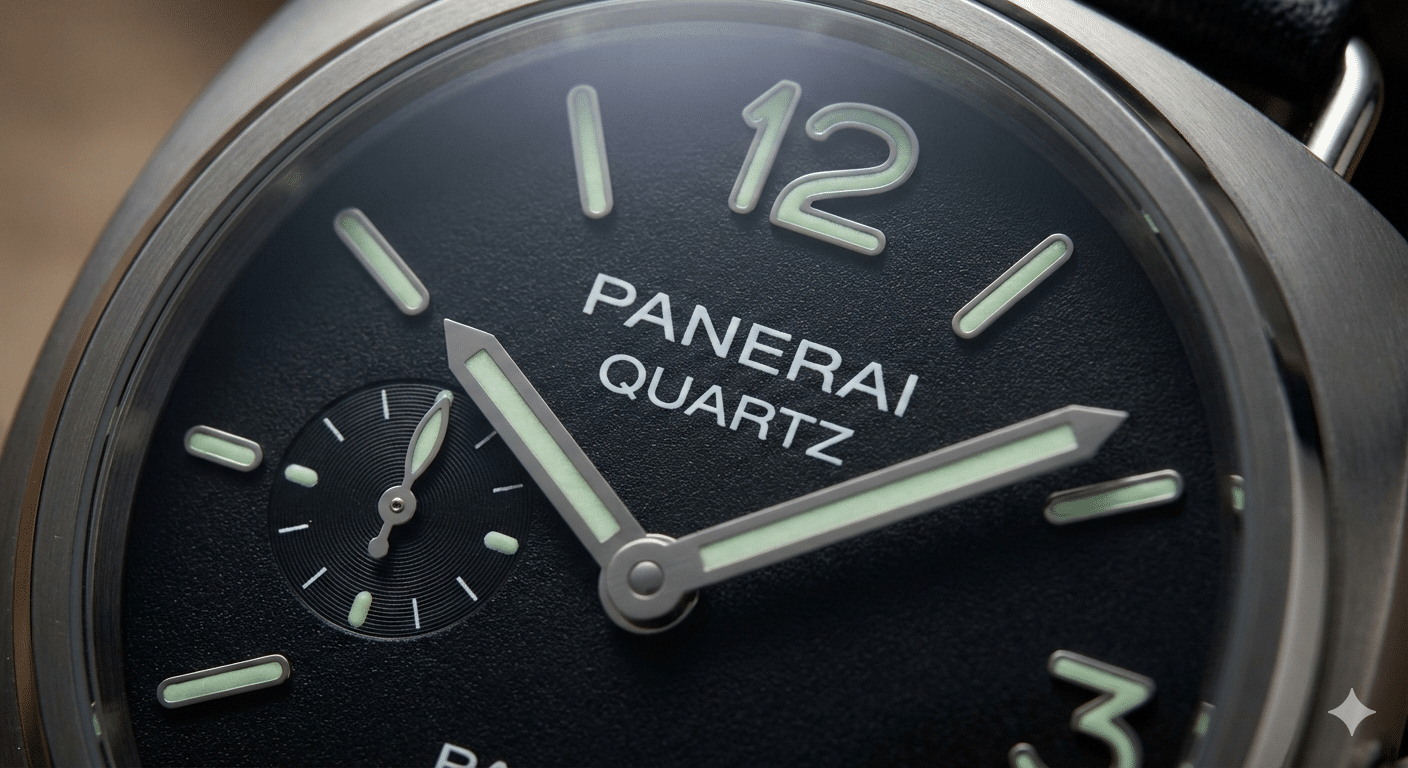
For many considering a replica, the “look” is paramount. Quartz replica manufacturers often excel at reproducing the external aesthetics of Panerai models. This includes the distinctive cushion case dimensions, the iconic crown guard design, the clarity of dial printing, and even the quality and feel of the accompanying strap materials. From a casual glance across a room or even on the wrist, a well-executed quartz replica can achieve a surprisingly high visual fidelity to genuine Panerai models. For buyers whose primary motivation is to sport that unmistakable Panerai wrist presence without the mechanical “soul” or horological prestige, these replicas can be remarkably convincing, especially to the untrained eye.
Expert Authentication Insight
When evaluating a quartz Panerai replica, the retail price point is an immediate and critical indicator of underlying quality. An unusually low price, particularly under $100, almost invariably signals significant compromises that will become apparent upon closer inspection. Watches in this ultra-budget category often utilize extremely basic, non-decorated Chinese quartz movements that offer poor accuracy and short lifespans. More importantly, the low price point usually means severe cutbacks in case finishing, dial printing quality (e.g., poorly applied lume, fuzzy text), and water resistance. These deficiencies are not subtle; they become immediately apparent, even to a novice, with a quick visual examination or a test of the crown action. Don’t expect a $75 replica to feel anything like even a mid-tier mechanical replica, let alone a genuine Panerai.
Unpacking the Movement: Common Quartz Calibers in Panerai Replicas
While the external appearance might capture the Panerai aesthetic, the heart of any watch is its movement. In quartz Panerai replicas, the movement choice dictates everything from accuracy and battery life to overall reliability. This section identifies the specific types of quartz movements typically integrated into these replicas and evaluates their performance characteristics, reliability, and functional limitations.
Prevalent Japanese Quartz Movements (Miyota, Seiko/TMI)
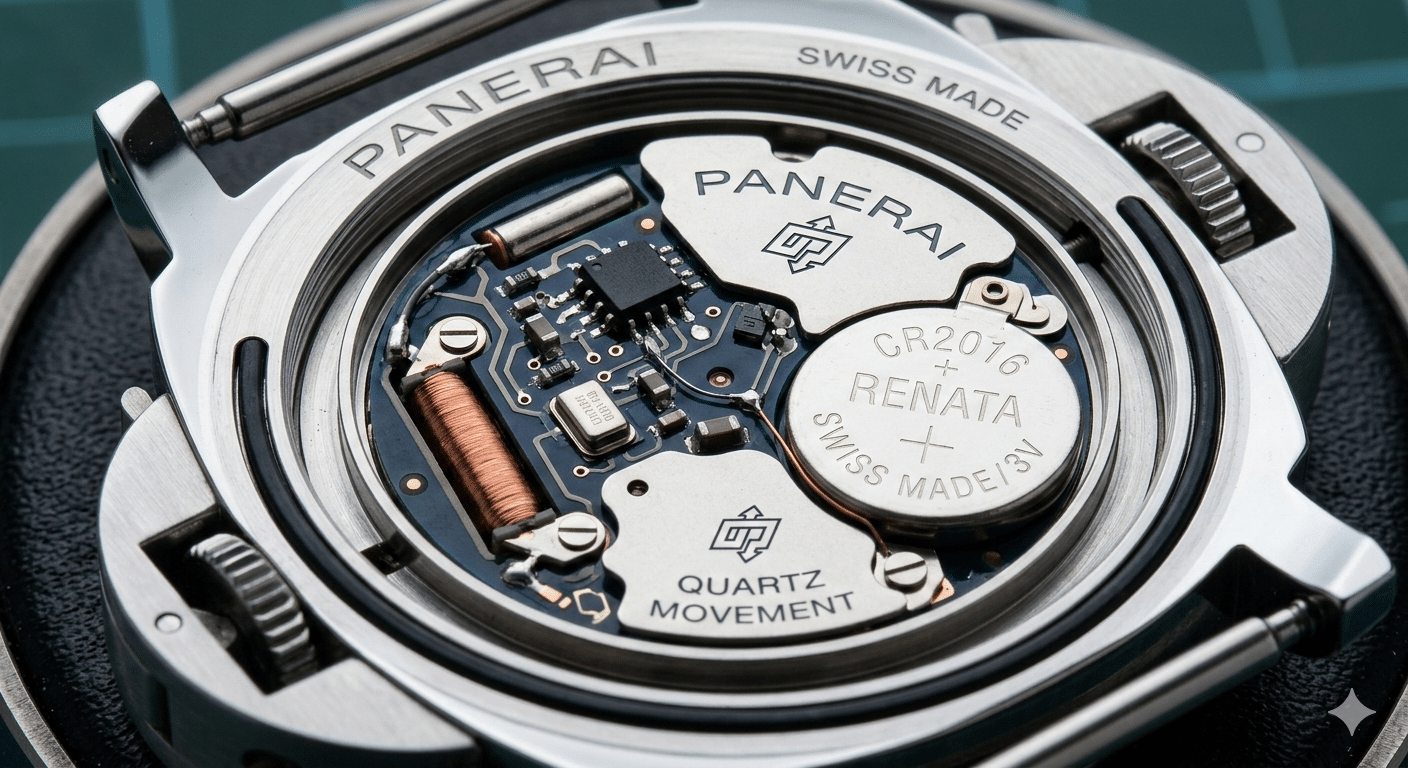
The more reputable quartz Panerai replicas often employ movements from established Japanese manufacturers like Miyota (Citizen Watch Co.) or Seiko/TMI (Time Module Inc.). Common calibers include the Miyota 2035, Miyota 2115 (with date), or the Seiko PC21J. These movements are workhorses known for their cost-efficiency and widespread availability, making them easy to replace if they fail. Typically, they offer a battery life of 2-4 years and maintain accuracy within +/- 15-30 seconds per month, which is perfectly acceptable for daily wear. While generally simple, some variants can include basic complications like a date window or a small seconds sub-dial. Their reliability, while not on par with high-end Swiss quartz, is significantly better than their lower-tier Chinese counterparts, representing a decent balance of cost and performance.
Lower-Tier Chinese Quartz Movements and Homages
At the bottom rung of the quartz replica market are watches fitted with less reputable or generic Chinese-sourced quartz movements. These are often produced with minimal quality control, leading to characteristic inconsistencies in timekeeping, shorter battery life (sometimes less than a year), and a higher incidence of premature failure. These movements are typically found in the lowest-priced replica tiers, often under $100, and are essentially considered disposable. Repairing them is rarely cost-effective; if they fail, the watch is usually discarded. While some may be “homages” to established designs, their execution often leaves much to be desired, impacting the overall ownership experience with frequent battery changes or outright stoppages.
The “Smooth Sweep” Quartz: A Technical Misconception for Panerai?
One of the most common misconceptions among new replica buyers is the idea of a “smooth sweep” quartz movement that mimics a mechanical watch. Standard quartz movements, like the Miyota 2035, tick once per second, resulting in a distinct, jerky motion of the seconds hand. While some high-beat quartz movements, such as certain Seiko VH series calibers, can achieve 2-4 ticks per second, giving a smoother* sweep, this is still visually distinct from the characteristic 6-8 beats per second (3-4Hz) smooth, fluid sweep of genuine Panerai mechanical movements. The difference is immediately noticeable side-by-side. Expecting a quartz Panerai replica to have the same fluid seconds hand motion as its mechanical inspiration is a technical misconception that can lead to disappointment. If a smooth sweep is a non-negotiable for you, a quartz replica is not the answer.
Expert Authentication Insight
To truly understand the quality of a quartz Panerai replica, a direct inspection of the movement is invaluable. If possible, carefully remove the case back (or have a jeweler do so) to reveal the caliber. Look for identifying markings such as “Miyota,” “Japan Movt,” or specific caliber numbers. The general construction quality of the movement can tell you a lot. Higher-tier quartz replicas will often feature a more securely seated movement with minimal visible plastic components, indicating better assembly. Conversely, lower-tier units may show signs of cost-cutting, such as loose battery clamps, excessive plastic components, or a lack of any recognizable branding, all red flags pointing to a less reliable, generic Chinese movement.
Thickness and Form Factor: The Quartz Advantage (and its Limits)
Panerai watches are renowned for their bold, substantial presence on the wrist, a direct legacy of their historical role as instrument watches. This robust form factor is a defining characteristic. We now analyze how the inherent characteristics of quartz movements influence the overall dimensions of Panerai replicas, particularly case thickness, and whether this aligns with the iconic proportions of genuine Panerai watches.
The Potential for Slimmer Profiles with Quartz
One of the theoretical advantages of a quartz movement is its compact and flat design. Unlike mechanical movements, quartz calibers do not require an automatic winding rotor, complex multi-layered gear trains, or bulky mainspring barrels. This inherent simplicity and flatness can* allow for the creation of significantly thinner watch cases. Beyond the design implications for case thickness, enthusiasts often explore options for replica movement modification. For instance, while a mechanical Luminor might be 14-15mm thick, a quartz version could theoretically shave off a few millimeters, making it appear more svelte. This thinner profile could appeal to those who find genuine Panerais too bulky for their wrist or for fitting under shirt cuffs.
Panerai’s Iconic Robustness: A Design Conflict?
However, Panerai’s design philosophy is fundamentally rooted in robustness and substantiality. The brand’s signature cushion cases, often 14mm to 16mm thick, are part of what gives a Panerai its distinctive “wrist presence.” A significantly thinner quartz replica, while potentially more comfortable for some, can compromise this fundamental aesthetic. A Luminor replica measuring 12mm thick, for example, might feel “hollow” or disproportionately light compared to the genuine article, losing some of the satisfying heft and solid feel that define the brand. This creates a design conflict: the technical ability of quartz to be thin versus Panerai’s iconic, thick proportions.
Case Construction Factors Beyond the Movement
While the movement is a key contributor to thickness, it’s not the only factor. Other critical components in a replica’s construction can negate or enhance the thinness advantage offered by a quartz movement. For example, the choice of crystal (domed sapphire adds thickness compared to flat mineral glass), the design of the case back (an exhibition case back with a thicker crystal adds depth), and the requirements for water resistance sealing (which often involves thicker gaskets and case construction) all play a role. A replica manufacturer might opt for a thicker crystal or case back to maintain the visual heft of a Panerai, even with a thin quartz movement, thus negating any potential slimness. Conversely, a cheap replica might use a thin movement and thin case materials, resulting in a watch that feels insubstantial and lacks the characteristic Panerai robust feel.
Expert Authentication Insight
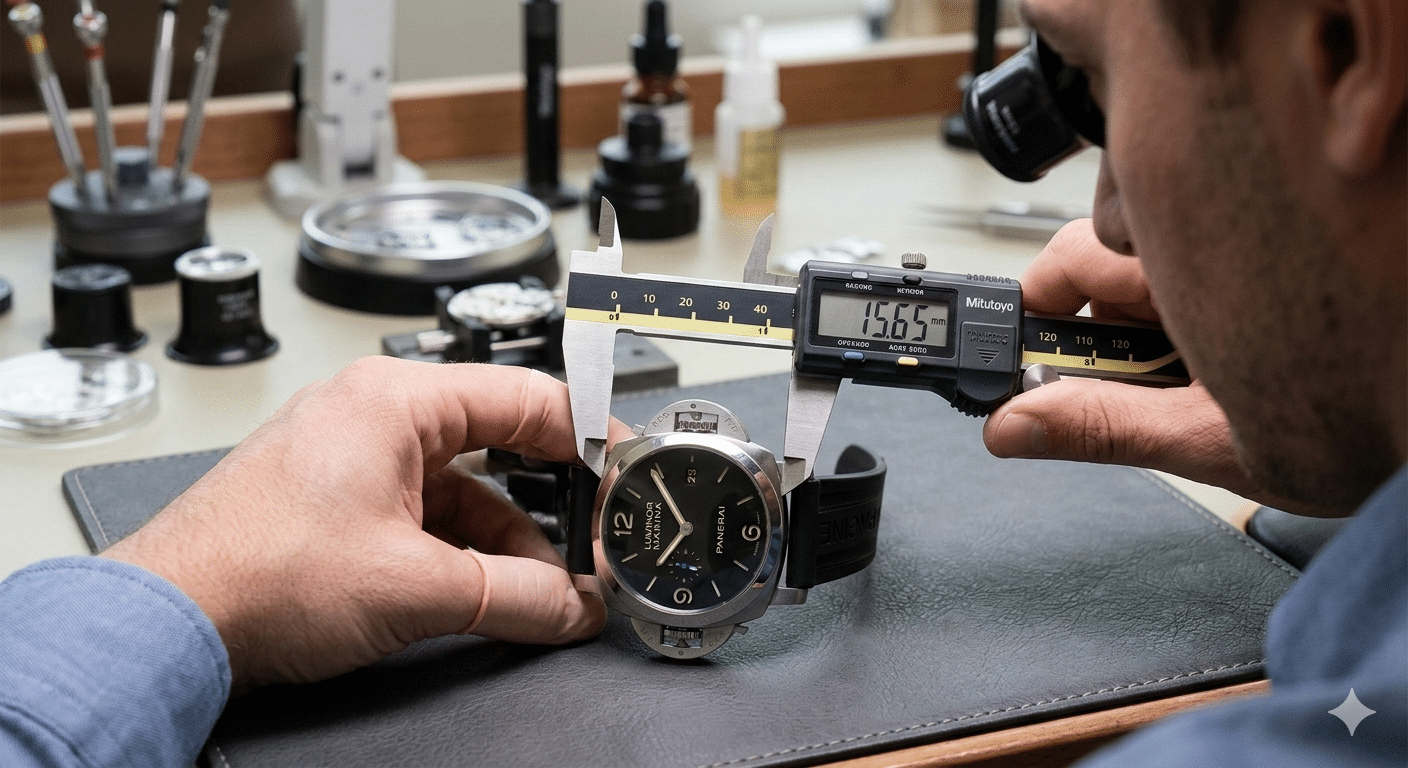
The most reliable way to assess a quartz Panerai replica’s proportional accuracy is through precise measurement. Utilize precision calipers to measure the replica’s case thickness, ensuring you exclude any prominent crystal domes. Then, compare this precise measurement against documented specifications for genuine Panerai models and known dimensions of high-quality mechanical Panerai replicas. For example, if you’re looking at a Luminor replica that measures 12mm in thickness, but genuine Luminors typically range from 14-15mm, that significant deviation is a strong indicator. It suggests either a quartz movement has been used to achieve an unnaturally thin profile for the design, or the case proportions are simply incorrect, leading to a watch that looks and feels off compared to the original.
Ownership Experience: Maintenance, Reliability, and Longevity
Stepping beyond the initial purchase, the true test of any timepiece lies in the ownership experience. For quartz Panerai replicas, this means understanding the practical realities of routine care, potential issues, and what kind of lifespan you can realistically expect from a watch that prioritizes aesthetics and affordability.
Battery Replacement: Costs, Frequency, and Risks
Unlike their mechanical counterparts that require periodic (and often costly) servicing, the primary maintenance for a quartz replica revolves around battery replacement. Most common quartz movements found in these replicas, such as a Miyota 2035 or a generic Chinese caliber, utilize standard watch batteries like the SR626SW or SR920SW, which typically last between 2 to 3 years under normal operation. The good news is that replacing these batteries is generally inexpensive. A professional replacement at a local watch shop or jeweler will usually run you between $5 and $20, significantly less than even a basic service on a mechanical movement.
However, this seemingly simple task carries its own set of risks. An unskilled battery change can easily lead to cosmetic damage, such as scratches on the case back from improper tool use. More critically, if the case back gasket isn’t correctly re-seated or is damaged during the process, the watch’s water resistance can be severely compromised. I’ve personally seen cases where a replica advertised as “waterproof” failed catastrophically after a DIY battery swap, turning a $15 fix into a ruined watch. Given that many Panerai replicas aim for a robust, dive-watch aesthetic, losing water resistance due to a careless battery change is a significant functional setback.
Long-Term Reliability and Repairability Considerations
The inherent simplicity of quartz movements generally translates to good short-to-medium term reliability. With fewer moving parts than a mechanical watch, they are often more shock-resistant and less prone to precise calibration issues. However, the long-term outlook for many generic quartz replica movements leans towards “disposable.” If a low-tier Chinese quartz movement fails after 3-5 years, the cost of diagnosing and repairing it—assuming spare parts are even available—often outweighs the cost of simply replacing the entire movement, or even the watch itself.
Even higher-quality Japanese quartz movements like Miyota can face this reality in a replica context. While parts for a Miyota 2035 are readily available, the labor cost for a watchmaker to troubleshoot and repair a specific issue might still exceed the $20-$40 cost of a brand-new replacement movement. This means that while your quartz Panerai replica might run accurately for years, expect its lifespan to be ultimately determined by the resilience of its movement and the economic viability of replacing it when it eventually gives out.
Water Resistance Integrity and Gasket Longevity
Panerai’s iconic design language is deeply rooted in robust, water-resistant timepieces. Replicas often lean into this, with many sellers touting impressive water resistance ratings. However, the reality for most budget quartz replicas is far less optimistic. Common failure points for water resistance include the case back gasket, the crown gasket, and the crystal gasket. Every time the case back is opened for a battery change, the integrity of that seal is put at risk.
Proper gasket seating, lubrication, and a professional pressure test are crucial to maintaining water resistance. Most replica factories do not perform individual pressure testing, relying instead on generic component quality. This means that even a brand-new quartz replica’s stated water resistance is often unreliable without independent verification. After a battery change, this unreliability compounds. Unless you have a reputable watch technician re-seal and pressure test your watch, assume its water resistance is limited to splash-proof, at best. This is a critical distinction for a watch designed to evoke a diver’s tool.
Expert Authentication Insight
Prior to purchase, inquire about the movement’s specific battery type and its estimated lifespan. To delve deeper into the intricacies of these timepieces, refer to a clone movements guide. This gives you a baseline for future maintenance. Post-purchase, pay close attention to the seconds hand; consistent, precise ticking is normal, but erratic or skipped ticks can indicate a low battery or, worse, a failing movement. When a battery change is due, always ensure it’s performed by a reputable watch technician who can not only replace the battery but also properly re-seal the case and, ideally, perform a pressure test. This small investment can save your watch from water damage, preserving its functional life.
The Target Audience: Who Should Consider a Quartz Panerai Replica?
The allure of a Panerai replica, especially a quartz one, often stems from a desire for a particular aesthetic without the associated luxury price tag. Understanding who this watch truly serves helps potential buyers make an informed decision, aligning their expectations with the product’s capabilities.
The Budget-Conscious Panerai Enthusiast
This is arguably the largest segment for quartz Panerai replicas. These individuals are drawn to the distinctive, oversized cushion case, the bold dial, and the signature crown guard that define Panerai. Their priority is the visual impact and iconic design, not the intricate mechanical engineering or horological prestige. For someone who loves the “Panerai look” but whose budget doesn’t stretch to a $7,000+ genuine model or even a $400-$600 mechanical replica, a quartz version offers an accessible entry point. It allows them to experience the wrist presence and style at a fraction of the cost, making the brand’s aesthetic attainable without significant financial outlay.
The Casual Wearer and Fashion Statement Seeker
For many, a watch is primarily a stylish accessory, not a precision instrument to be constantly wound or meticulously maintained. The casual wearer appreciates the “grab and go” convenience that a quartz movement offers. There’s no need to reset the time after a few days of not wearing it, no manual winding, and no concerns about power reserve. This makes a quartz Panerai replica an ideal choice for someone who rotates watches frequently, views them as part of a broader fashion statement, and values hassle-free ownership. It fits seamlessly into a modern lifestyle where convenience often trumps traditional horological pursuits.
Travelers and “Beater” Watch Seekers
There are situations where wearing an expensive watch is simply not practical or wise. For frequent travelers, adventurers, or those working in environments where a watch might be exposed to bumps, scratches, or even loss, a low-cost “beater” watch is invaluable. A quartz Panerai replica fits this role perfectly. Its affordability significantly reduces the anxiety of potential damage or theft. While not a true rugged instrument like a genuine Panerai, the quartz movement’s inherent shock resistance often outperforms delicate mechanical movements in day-to-day knocks. It allows the wearer to enjoy the Panerai aesthetic without the financial anxiety associated with a high-value item.
Expert Authentication Insight
When evaluating a quartz Panerai replica, pay close attention to the seller’s marketing narrative. If the language heavily emphasizes “affordability,” “style,” “daily wear,” or “no winding needed” over “movement accuracy,” “craftsmanship,” or “authenticity,” it’s a strong indicator that the product is positioned for the casual, budget-conscious buyer. This aligns perfectly with the typical quartz replica market and helps you gauge if the seller’s pitch matches your own priorities. If they’re overselling mechanical fidelity for a quartz, that’s a red flag.
The Verdict: Is a Quartz Panerai Replica Worth Buying?
After dissecting the motivations, movements, and ownership realities, the question remains: is a quartz Panerai replica a worthwhile purchase? The answer, as with many things in the replica world, is nuanced, resting squarely on individual priorities and expectations. It’s a balance of significant advantages against inherent compromises.
Pros: Unmatched Accessibility, Low Initial Cost, and Simplicity
The core appeal of a quartz Panerai replica lies in its ability to deliver the distinctive Panerai aesthetic with unmatched accessibility. For under $200, you can acquire a watch that, at a glance, captures the essence of a brand typically commanding thousands. This low initial cost is a clear advantage for budget-conscious enthusiasts, offering the lowest barrier to entry for the iconic look. Furthermore, the simplicity of a quartz movement translates to convenient, low-maintenance ownership. It’s a “grab and go” timepiece that doesn’t demand winding or setting after a few days of inactivity, and its timekeeping accuracy is generally superior to all but the highest-end mechanical watches, making it a reliable daily timekeeper.
Cons: Mechanical Compromise, Potential for Poor Quality, and Zero Resale Value
However, these benefits come with significant trade-offs. The most prominent is the mechanical compromise: the absence of the “soul” and intricate craftsmanship found in a genuine or even a high-tier mechanical replica. The ticking seconds hand, rather than the smooth sweep of a mechanical movement, is an immediate visual tell and a departure from the authentic Panerai experience. There’s also a considerable risk of receiving a low-quality product. The lowest-priced quartz replicas can suffer from poor case finishing, unreliable movements prone to premature failure, and materials that degrade quickly. Crucially, any replica watch, and particularly a quartz one, holds virtually zero resale value. This isn’t an investment; it’s a transient acquisition for immediate gratification.
Strategic Alternatives to Consider
If the compromises of a quartz replica feel too significant, it’s worth considering alternatives. For those who prioritize mechanical fidelity and the smooth sweep, entry-level mechanical Panerai replicas (often using modified Asian 2824 or simple automatic movements) can be found in the $200-$350 range. While still replicas, they offer a more authentic horological experience, albeit at a higher cost. Another compelling alternative is microbrand homages. These watches offer similar aesthetics, often with better quality control and unique branding, providing a legally distinct and potentially higher-quality product for a comparable price to a good mechanical replica. Weighing these options based on your personal priorities for budget, mechanical authenticity, and long-term satisfaction is key.
Expert Authentication Insight
The “worth” of a quartz Panerai replica is fundamentally subjective, driven by personal desire for the aesthetic. However, its objective value can be assessed by comparing its cost against the verifiable quality of its components. A quartz replica is objectively “worth buying” if its price point corresponds to a known, reliable Japanese quartz movement (like a Miyota), acceptable case finishing, and a reasonable expectation of lifespan. If a seller is asking $150+ for a generic Chinese quartz movement in a poorly finished case, you’re overpaying. Your decision should be based on a clear-eyed assessment of what you’re getting for the money, rather than an inflated perception based solely on the Panerai brand association.
Ultimately, the decision to purchase a quartz Panerai replica boils down to a clear decision matrix: If your absolute priority is to achieve the distinctive Panerai look for under $200, and you are fully prepared to accept a ticking seconds hand, assume limited water resistance, and treat the watch as a finite-life fashion accessory, then a quartz replica is a genuinely viable and satisfying choice. However, if you crave mechanical fidelity, the smooth sweep of a traditional watch, or plan to own and enjoy the timepiece for more than 3-5 years without potential issues or replacement, then it’s essential to increase your budget for a mechanical replica or explore the array of microbrand alternatives. Always, without exception, verify the movement type, accurately measure the case thickness, and scrutinize the seller’s reputation before committing to any purchase.