
Introduction — Why the IWC Pilot’s Series Matters in Replicas
Among modern Swiss tool watches, the IWC Pilot’s line occupies a rare position: instantly recognizable, historically grounded, and mechanically diverse. From clean three-hand field watches to oversized power-reserve icons and full-featured chronographs, few collections cover such a wide functional and visual range while still sharing a coherent identity.
That diversity is exactly why the Pilot’s series behaves unevenly in the replica world. Unlike dress watches, where success hinges on surface finishing, or dive watches, where case and bezel tolerances dominate, Pilot replicas live or die by proportion, legibility, and mechanical honesty. Some models translate into replicas with remarkable consistency. Others expose every shortcut the moment you wear them for a week.
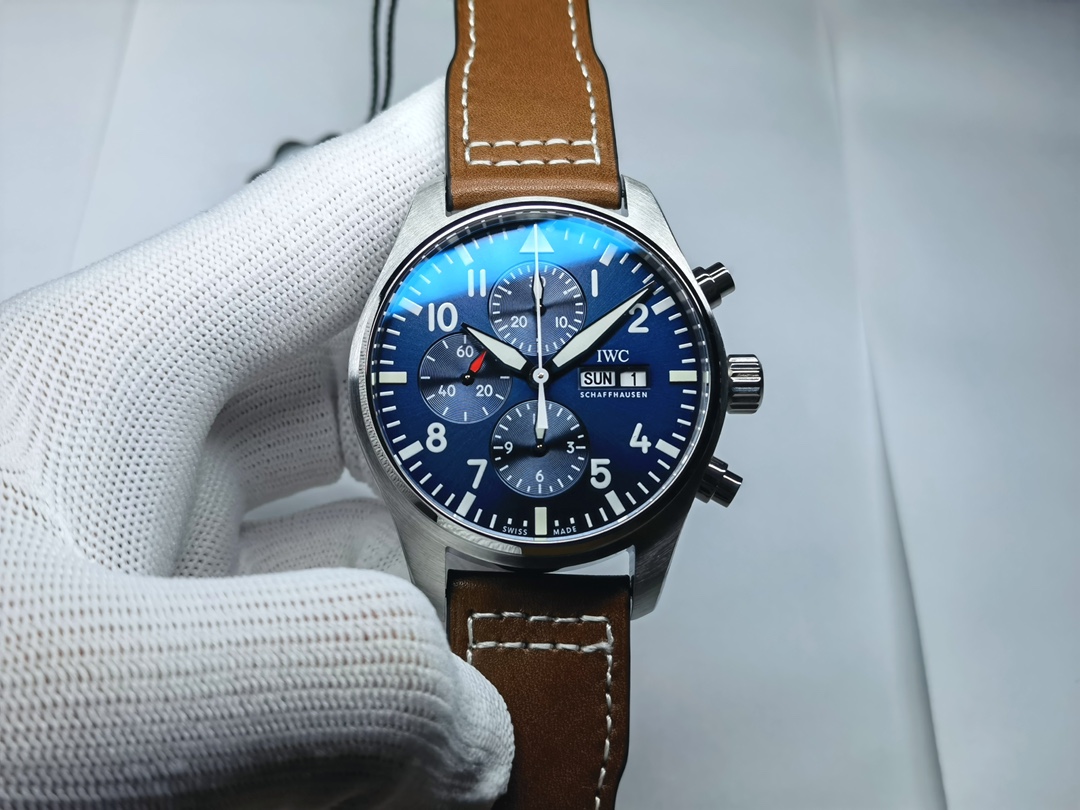
For buyers, especially those new to IWC replicas, the challenge is not spotting the best factory, but choosing the right sub-series. A Mark replica, a Big Pilot replica, and a Pilot Chronograph replica may all carry the same brand name and aviation DNA, yet they deliver radically different ownership experiences once daily wear, comfort, reliability, and visual tolerance are factored in.
This comparison focuses on that reality: how each Pilot sub-family actually performs as a replica, not how impressive it looks in a catalog photo.
What Makes the IWC Pilot Replica Category Unique
Historical Context of IWC Pilot Watches
IWC’s Pilot lineage is rooted in utility rather than luxury. The original Mark 11, developed for military navigation in the mid-20th century, prioritized absolute legibility, magnetic resistance, and mechanical reliability. That philosophy carried forward into modern Mark XVI, XVIII, and XX models: restrained proportions, uncluttered dials, and movements chosen for robustness rather than spectacle.
The Big Pilot evolved from a different wartime need. Designed for cockpit use with gloves, it exaggerated everything—dial size, crown diameter, numeral scale—creating the oversized template that later became an icon. Modern Big Pilots preserve this visual excess while adding features like long power reserve displays, reinforcing their status as statement instruments rather than discreet tools.
Chronographs entered the Pilot family later, combining aviation aesthetics with mechanical complexity. These models retained the bold numerals and high-contrast dials but layered in sub-registers, pushers, and calendar windows, shifting the balance from pure utility to functional display.
These historical differences matter because replicas inherit not only the look, but also the structural demands of each design philosophy.
Replica Market Challenges & Opportunities
Pilot replicas expose a fundamental truth of replication: simplicity forgives, complexity punishes.
The Mark series, with its three-hand layout and restrained dial, is mechanically straightforward. Minor deviations in printing, lume texture, or hand finishing often disappear in daily wear. The movement architecture required is simple, well-proven, and forgiving of mass production tolerances.
Chronographs sit at the opposite end. Subdial spacing, hand alignment, pusher feel, and calendar execution all stack risk. Even when the watch looks correct on the wrist, long-term use reveals whether the movement architecture was a compromise or a proper solution.
Big Pilot replicas occupy an awkward middle ground. The dial is forgiving—large numerals and open space hide small flaws—but the physical scale introduces new problems. Case thickness, weight distribution, and power reserve implementation quickly expose whether a replica was engineered thoughtfully or merely enlarged.
Understanding these structural pressures is more important than memorizing factory names. The same factory can excel in one Pilot sub-series and struggle badly in another.
The Mark Series Replica – Daily Wear Champion
What the Mark Series Is (Mark XVI | Mark XVIII | Mark XX)
The Mark line represents the purest expression of the IWC Pilot concept: time, date, legibility. No rotating bezels, no power reserve theatrics, no chronograph complications. Just a balanced case, a highly readable dial, and proportions designed to disappear on the wrist.
As replicas, Mark XVI, XVIII, and XX models benefit enormously from this restraint. The absence of visual clutter means fewer opportunities for visible failure. Dial layouts are symmetrical, hand lengths are forgiving, and the overall aesthetic tolerates small production variances without drawing attention.
This makes the Mark series the most natural entry point into IWC Pilot replicas, especially for buyers who intend to wear the watch daily rather than rotate it as a novelty piece.
Replica Performance (Design & Movement)
Most high-quality Mark replicas rely on straightforward automatic three-hand movements with date functions. These movements are mechanically mature, widely serviced, and stable over long wear cycles. They do not require decorative bridges, false complications, or stacked modules that compromise reliability.
The clean dial design works in the replica’s favor. Flat printed numerals, minimal text, and simple minute tracks mask slight inconsistencies that would stand out immediately on a more complex watch. Even after months of wear, issues like marginal lume color variation or printing depth rarely register unless directly compared side by side with a genuine example.
In practical terms, Mark replicas tend to hold regulation well, wear comfortably across a wide range of wrist sizes, and avoid the fatigue that comes with oversized or top-heavy cases.
Pros & Cons of Mark Series Replicas
Pros
- Mechanically simple and stable over long-term wear
- Balanced proportions suitable for daily use
- Dial design conceals minor manufacturing imperfections
- Works across casual and professional settings
Cons
- Visually understated compared to other Pilot models
- Lacks the dramatic presence some buyers expect from IWC
- Less satisfying for collectors seeking mechanical complexity
The Mark replica rewards consistency rather than spectacle. For many owners, that trade-off becomes its defining strength.
Recommended Replica Factories for Mark Series
Factory choice matters less here than execution consistency. That said, certain producers have demonstrated long-term reliability with Mark replicas.
MKS versions are widely favored for their balanced cases and dependable movement choices, making them a strong option for everyday wearers who value stability over refinement. V7 variants often refine dial printing and case finishing slightly further, appealing to collectors who focus on detail fidelity. ZF releases occasionally push finishing quality higher still, though the practical difference may only reveal itself under close inspection.
For casual wearers, MKS-level execution already delivers most of what the Mark series promises. For collectors sensitive to small visual cues, V7 or select ZF batches can justify the step up.
The Big Pilot Replica – Statement Piece with Strong Presence
What the Big Pilot Represents
The Big Pilot is not a variation of the Mark series scaled up. It is a different philosophy altogether. Where the Mark is about discretion and balance, the Big Pilot is about dominance—on the wrist, in the lineup, and in IWC’s identity as an aviation watchmaker.
Its oversized case, usually around 46 mm, the exaggerated onion-style crown, and the prominent power reserve indicator were never meant to be subtle. Historically, these elements existed to support gloved pilots and long flight durations. In modern form, they survive because they create one of the most recognizable silhouettes in contemporary watchmaking.
Within IWC’s catalog, the Big Pilot functions as a centerpiece. Even people who cannot name a specific reference often recognize it immediately. That visual authority is exactly why Big Pilot replicas attract buyers looking for impact rather than understatement.
Replica Strengths – What They Do Well
As replicas, Big Pilots benefit from scale. The large dial creates visual forgiveness that smaller watches do not have. Minor inconsistencies in printing, lume texture, or hand finishing are diluted by space and bold typography. The oversized Arabic numerals and wide sword hands are inherently easier to reproduce convincingly than fine dress watch markers.
Better Big Pilot replicas also succeed in delivering a functional power reserve display. While the actual reserve duration may differ from genuine specifications, the visual behavior—gradual movement tied to winding and wear—adds legitimacy to the experience. On the wrist, this complication feels purposeful rather than decorative.
Most importantly, the Big Pilot replica achieves instant recognizability. Even at a distance, its proportions, crown shape, and dial layout communicate exactly what it is. For buyers who want a watch that announces itself without explanation, few replicas perform this role better.
Replica Weaknesses – What to Expect
The same scale that benefits the dial becomes a liability in wearability. Replica Big Pilots are often thicker and heavier than their genuine counterparts due to movement architecture and case construction limits. This extra mass is not theoretical—it becomes noticeable after several hours on the wrist.
Weight distribution is another recurring issue. Some replicas feel top-heavy, especially when paired with stiff factory straps. This can lead to wrist fatigue, particularly for wearers unaccustomed to large tool watches.
Proportion accuracy is also harder to control at this size. Small deviations in case height, bezel thickness, or lug curvature become more noticeable when everything is enlarged. While the watch may look correct at a glance, extended wear sometimes reveals a slightly awkward balance that would not exist on a smaller model.
Owning a Big Pilot replica requires accepting that comfort is a compromise, not an expectation.
Recommended Replica Versions & Factories
In the Big Pilot category, factory choice matters more than in the Mark series. Execution differences are amplified by scale, and weaker versions are easier to spot.
ZF has consistently produced the most balanced Big Pilot replicas, particularly in classic steel and “Le Petit Prince” blue dial variants. Their cases tend to maintain better proportions, and their power reserve layouts align closely with genuine references. VS has also released high-accuracy variants with solid movement behavior, though availability can vary.
When evaluating a Big Pilot replica, focus on three details. The crown should have crisp engraving and correct size relative to the case. The power reserve indicator must sit naturally within the dial, not cramped or misaligned. Case thickness should feel intentional rather than excessive, even if it cannot perfectly match the original.
Top Replica Picks for Big Pilot
Among current options, classic 46 mm Big Pilot references in black or blue dials remain the safest choices. Steel cases tend to age better visually than exotic materials, and their weight feels more appropriate for the design. Ceramic and special-edition variants can look striking but amplify comfort issues.
Most well-executed Big Pilot replicas fall into a mid-to-high price range relative to other Pilot models. This reflects the added complexity of the case and movement rather than decorative upgrades. Cheaper options exist, but they usually reveal their compromises quickly through poor balance or crude finishing.
The Big Pilot replica is best approached as a statement object rather than a daily companion. When chosen with that mindset, its strengths outweigh its limitations.
Pilot Chronograph Replica – High Reward, Higher Risk
What Defines the IWC Pilot Chronograph
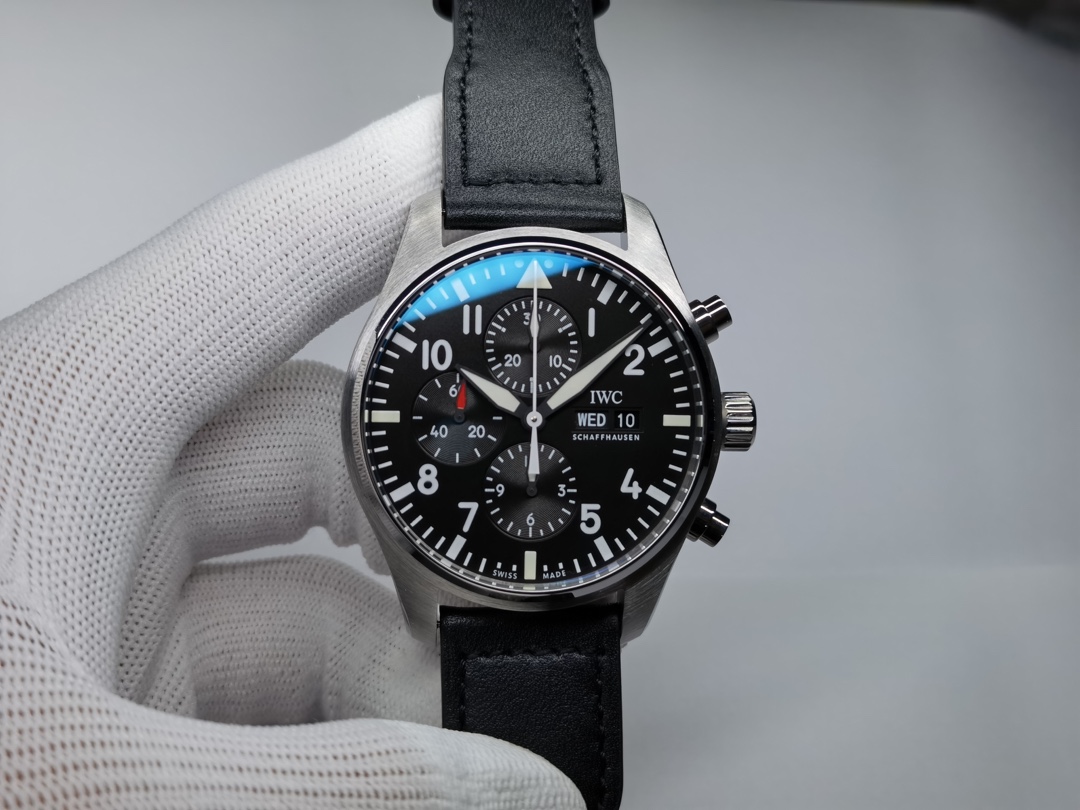
The Pilot Chronograph sits at the most mechanically ambitious end of the IWC Pilot family. It combines the brand’s aviation design language with a full stopwatch function, multiple subdials, calendar displays, and external pushers. On the wrist, it communicates capability and complexity rather than restraint.
Unlike the Mark or Big Pilot, the chronograph is not just about telling time clearly. It invites interaction. Starting, stopping, and resetting the chronograph becomes part of the ownership experience, and the dial is designed to display information in layers rather than simplicity. This makes the Pilot Chronograph visually engaging, but it also places far greater demands on replication.
Every additional hand, window, and pusher increases the chance of something being slightly wrong. In replicas, those small discrepancies tend to accumulate rather than cancel out.
Replica Dial Symmetry & Functional Complexity
Chronograph replicas succeed or fail first on dial geometry. Subdial spacing, hand length, and alignment define whether the watch feels coherent or chaotic. Even small deviations in spacing can disrupt the visual balance, especially on the high-contrast dials typical of IWC Pilot Chronographs.
Pushers add another layer of scrutiny. They must sit at the correct height, respond with appropriate resistance, and reset hands cleanly to zero. Inconsistent pusher feel or imperfect hand alignment after reset is one of the fastest ways a chronograph replica reveals its limitations.
Unlike the Mark series, where the eye focuses on legibility, or the Big Pilot, where scale dominates perception, the chronograph forces the wearer to notice precision. The more you interact with it, the more demanding it becomes.
Movement Limitations in Replica Chronographs
Most Pilot Chronograph replicas rely on modified clone chronograph movements rather than true one-to-one mechanical equivalents. These movements can deliver the appearance of a functioning chronograph, but they often do so through compromise.
Common trade-offs include reduced timing accuracy, less consistent reset behavior, or power drain when the chronograph is left running. Some replicas prioritize dial layout correctness at the expense of mechanical robustness, while others sacrifice perfect subdial spacing to improve reliability.
This creates a fundamental tension. The closer a replica looks to the genuine watch, the more stress it places on a movement architecture that was not originally designed for that configuration. Long-term use tends to expose these compromises, especially for owners who frequently engage the chronograph function.
Pros & Cons of Chronograph Replicas
Pros
- Visually rich, technical appearance
- Strong wrist presence without extreme case size
- Appeals to collectors who enjoy mechanical interaction
Cons
- Greater variability in quality between examples
- Higher risk of alignment or reset imperfections
- Requires more cautious use to maintain reliability
Chronograph replicas reward attention and patience. They are not forgiving tools, and they rarely disappear on the wrist the way a Mark does.
Recommended Pilot Chronograph Replica Factories
Factory selection is critical in this category. Not all producers approach chronographs with the same priorities, and weak execution becomes obvious quickly.
ZF has established itself as the most consistent option for Pilot Chronograph replicas, particularly in classic 43 mm configurations. Their dials tend to maintain better symmetry, and their pusher feel is generally more controlled. Subdial printing and hand finishing also show fewer obvious shortcuts.
When choosing a Pilot Chronograph replica, examine reset behavior, subdial alignment, and pusher engagement rather than focusing solely on case finishing. A chronograph that looks perfect but resets inconsistently will lose its appeal faster than one with minor cosmetic flaws but stable mechanics.
The Pilot Chronograph replica can be deeply satisfying, but only for buyers willing to accept higher risk in exchange for higher engagement.
Related IWC Articles: If you found this helpful, you might also enjoy IWC Complication Replicas: Perpetual Calendar vs Tourbillon vs Repeater (Which Is Worth Playing With?), and IWC Tourbillon Replica Movement Explained: Gimmick, Decoration, or Real Engineering?.