
The 42mm Lie: Deconstructing Paper Specifications vs. Physical Reality
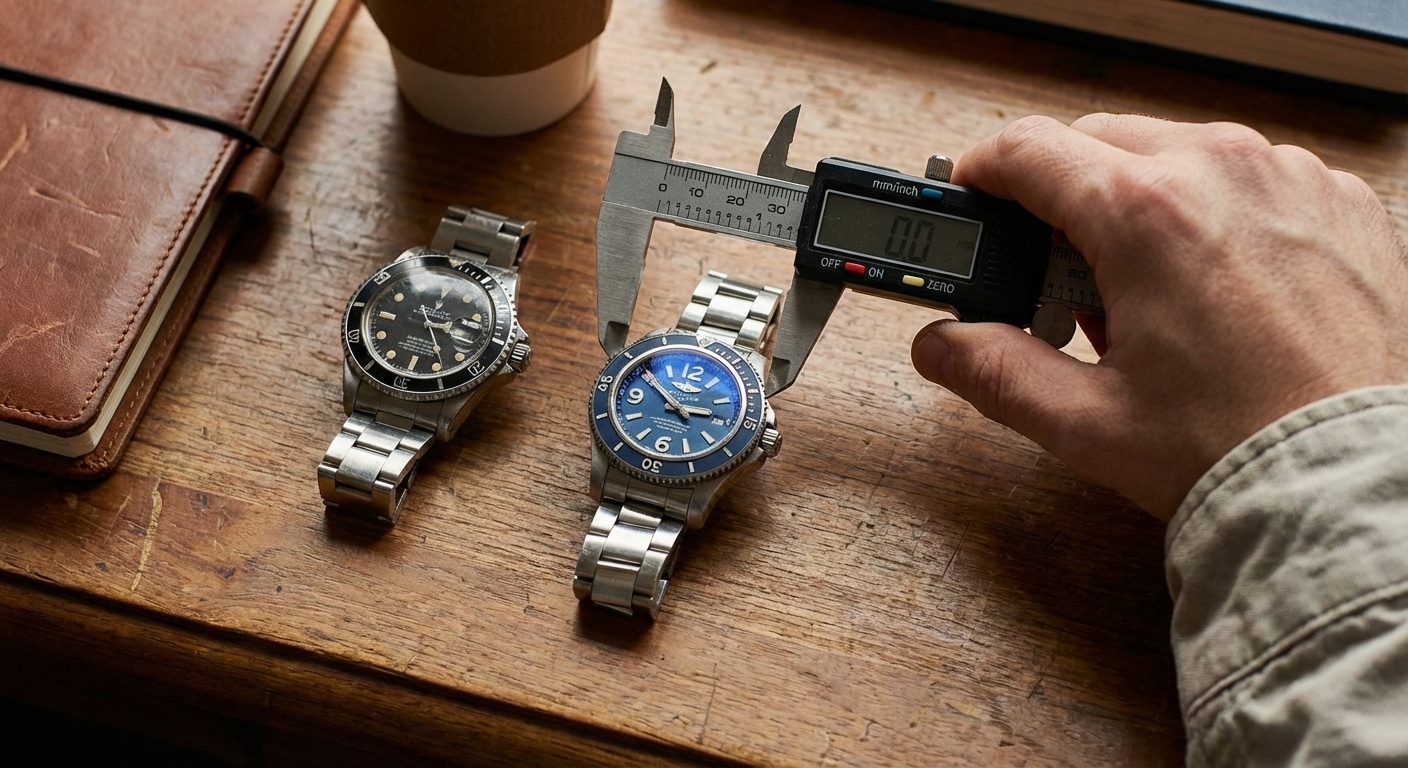
A caliper reading across the bezel is the least useful metric in horology. When you compare the advertised case diameter against the actual wrist footprint dictated by longitudinal span, the math quickly falls apart. Buyers constantly complain of wear fatigue after their first Breitling purchase, failing to account for the titanium vs stainless steel weight factor and remaining entirely unaware that a 42mm watch from Grenchen wears fundamentally differently than a 42mm watch from Geneva. The discrepancy between what the spec sheet claims and what the wrist actually supports is where wearing geometry begins.
The Lug-to-Lug Multiplier Effect
Rolex utilizes a highly standardized Oyster case geometry with a relatively conservative lug-to-lug span. A 41mm Rolex Submariner measures roughly 47.6mm lug-to-lug, keeping the metal well within the boundaries of an average arm. Breitling’s design language, however, heavily favors elongated, sweeping lugs. A 42mm Breitling Superocean stretches to nearly 48mm, while a 43mm Breitling Navitimer pushes past 49mm. This 1.5mm to 2mm difference in longitudinal span pushes the lugs dangerously close to the edge of a standard 16.5cm wrist, creating visible lug overhang and a fundamentally different wearing experience.
The Visual Illusion of Dial-to-Bezel Ratios
The perceived scale of a watch is heavily influenced by dial aperture. Rolex sports models utilize thick ceramic bezels that compress the dial diameter, naturally shrinking the watch’s visual footprint. Conversely, Breitling models like the Navitimer feature expansive dials pushed to the very edge of the case by the internal slide rule bezel. This lack of negative space means a 41mm Navitimer commands the visual presence of a 43mm watch, dominating the wrist visually even if the calipers say otherwise.
Expert Authentication Insight
To authenticate true wearable span, use digital calipers to measure the “effective lug-to-lug”—the distance between the downward pivot points of the bracelet end-links, not just the metal case tips. On many Breitling models, rigid stainless steel end-links extend the effective span by an additional 2mm to 3mm. This is a critical measurement often omitted from brand specifications, yet it strictly determines whether the bracelet will drape cleanly or flare outward.
Center of Gravity and Case Architecture: The Slab vs. The Bowl
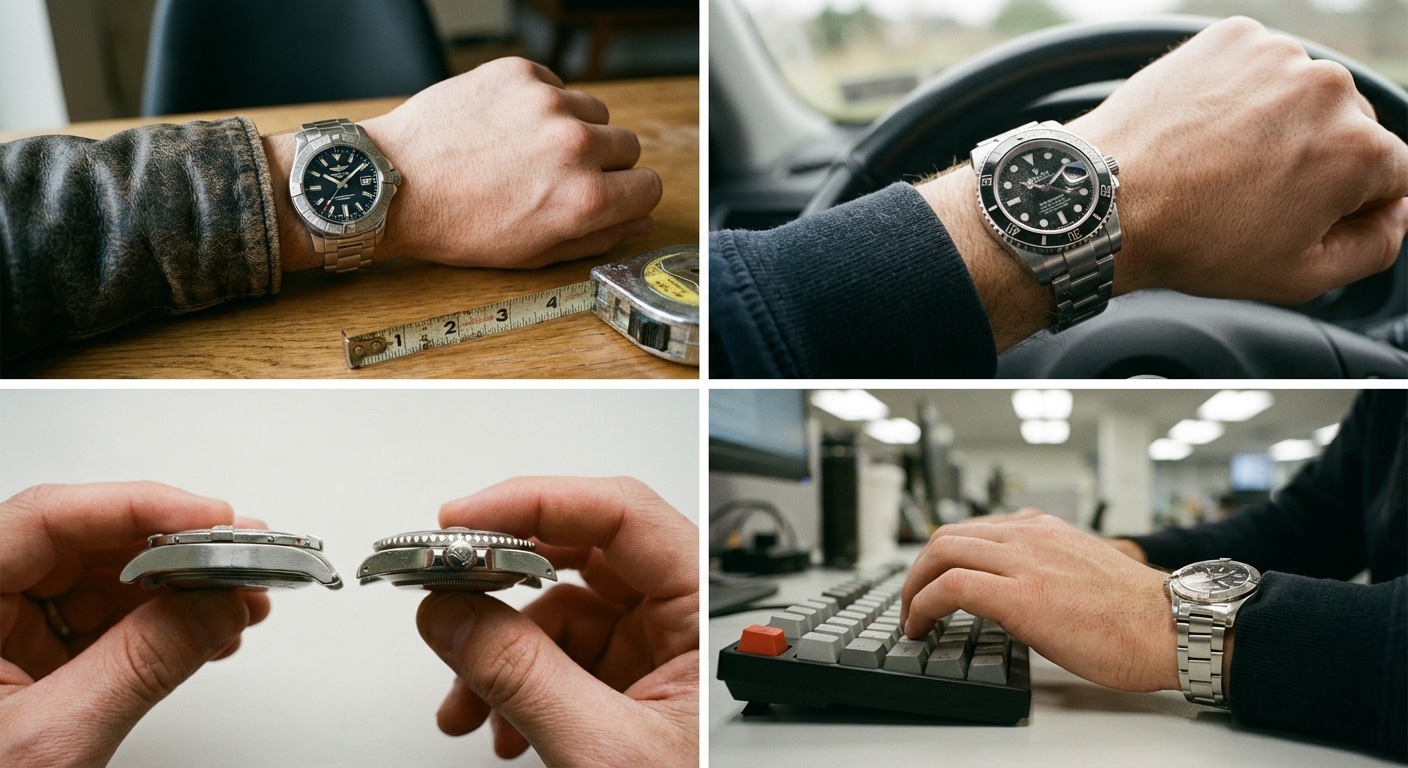
Case back protrusion, mid-case thickness, and weight distribution impact daily wearing comfort far more than dial diameter. A watch that looks perfectly proportioned from a top-down view can become an ergonomic nightmare if its center of gravity sits too high off the wrist plane. Understanding how a brand manages vertical metal is crucial to predicting end-of-day wrist fatigue.
Mid-Case Thickness and Slab-Sided Geometry
Rolex masks case thickness by utilizing a bowl-shaped case back that sinks into the wrist tissue, combined with sloping mid-cases. Breitling frequently employs “slab-sided” mid-cases with vertical walls. A Breitling Avenger at 15.3mm thick presents almost all of that metal vertically. This creates a high center of gravity, causing the watch to become top-heavy and prone to lateral sliding on wrists under 17cm, particularly as body temperature fluctuates and sweat introduces skin slippage throughout the day.
Lug Down-Turn Angles and Wrist Bone Clearance
The trajectory of the lug curvature dictates whether a watch hugs the wrist or floats above it. Rolex Oyster cases feature a distinct downward hook designed to wrap the ulna bone. Breitling’s heritage cases often feature flatter lug trajectories, a structural characteristic that influences the selection of the best straps for Breitling Avenger to ensure proper wrist integration. When worn on a 16cm wrist, this flatter angle leaves a visible air gap between the case back and the skin at the 12 and 6 o’clock positions. This gap significantly increases articulation resistance when the wrist flexes, causing the crown to dig into the back of the hand.
Expert Authentication Insight
Perform a “lateral tilt test” by securing the watch at standard wearing tension and rotating the wrist 45 degrees outward. Measure the gap between the skin and the 9 o’clock case side. A properly seated case should maintain contact. A gap exceeding 2mm indicates a center of gravity mismatch where the case back is elevating the heavy mid-case too far above the wrist plane, guaranteeing wear fatigue by hour eight.
The Breitling vs. Rolex Equivalent Wearable Size Matrix
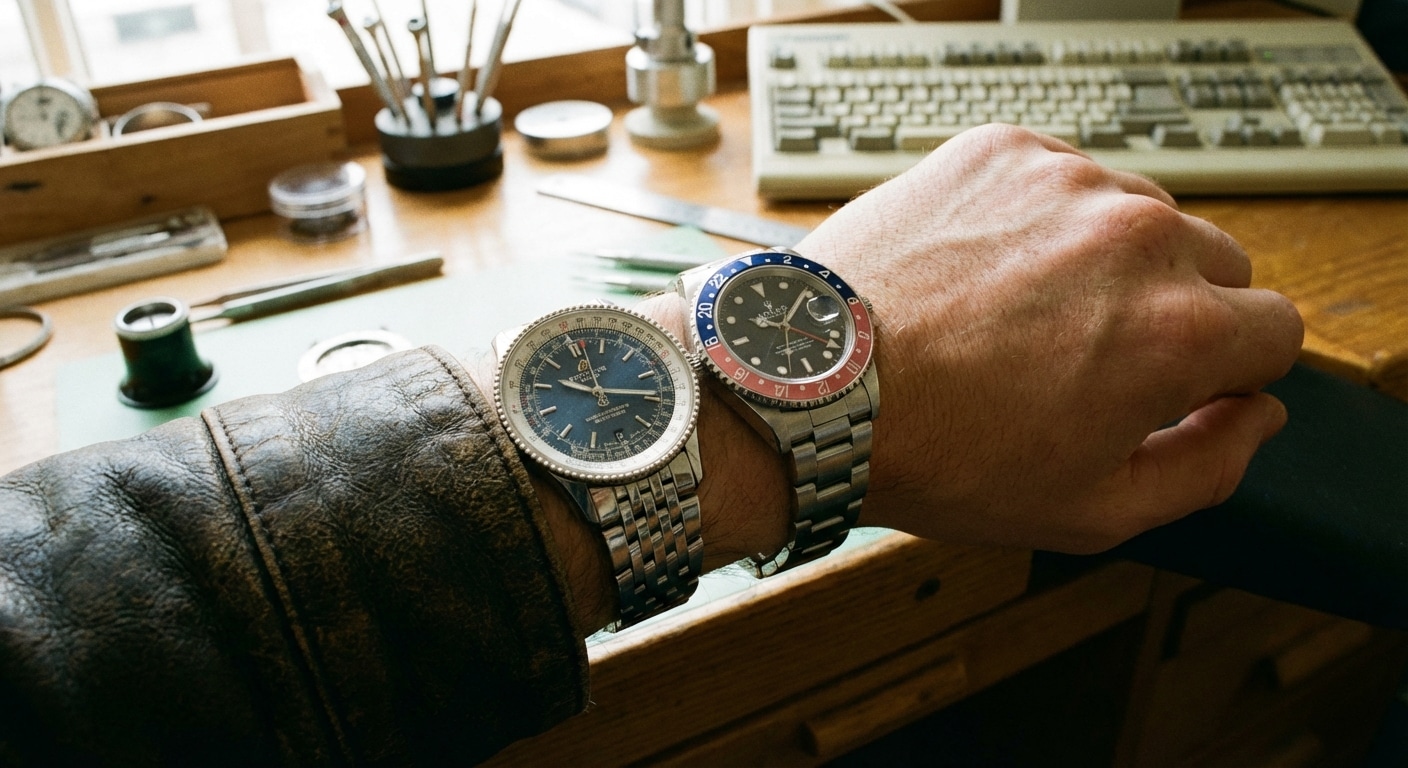
Because paper specifications fail to account for architectural geometry, collectors transitioning between these two brands need a cross-brand conversion baseline. You cannot simply carry your size preferences from Geneva to Grenchen. Establishing a wearable equivalent matrix prevents costly sizing mistakes and ensures proportional balance on the wrist.
Due to the dial aperture and lug extension, a 43mm Breitling Navitimer does not wear like a 43mm Rolex Sea-Dweller. The Navitimer’s expansive crystal and flatter profile mean it commands the visual wrist presence of a 44mm Rolex Deepsea, albeit with a lighter overall gram weight. Buyers accustomed to the compact footprint of a 40mm Rolex GMT-Master II will find the 41mm Navitimer to be the closest geometric equivalent in terms of daily wearability.
Chronomat vs. Datejust Proportions
The Breitling Chronomat features the Rouleaux bracelet, which has highly specific drape characteristics. Because the cylindrical links have limited lateral flexibility compared to a Rolex Jubilee bracelet, the Chronomat demands a flatter wrist surface to seat properly. A 42mm Chronomat feels significantly wider and more rigid on the wrist than a 41mm Rolex Datejust, wearing much closer to the footprint of a 42mm Rolex Sky-Dweller due to the rigid end-link integration.
Expert Authentication Insight
Utilize a mirror test at a 3-foot distance to verify visual scale, rather than looking directly down at the wrist. Direct downward viewing distorts the focal length, artificially inflating the watch’s size and hiding structural fit issues. The mirror test accurately authenticates the proportional balance of the lug overhang in relation to your specific forearm width, revealing how the watch actually presents to the room.
Strategic Downsizing: The 1-2mm Rule for Breitling Buyers
Actionable sizing requires moving past the illusion of dial width and addressing the physical mass of the watch head. To mitigate wear fatigue and achieve proportional balance on standard and smaller wrists, cross-referencing a detailed replica size wearing guide helps buyers adopt a defensive sizing strategy when approaching Breitling’s catalog.
Recalibrating Expectations for the B01 Caliber
Breitling’s flagship B01 in-house chronograph movement is a spectacular mechanical engine, but it requires substantial vertical real estate. Watches housing this caliber rarely sit below 13.6mm in thickness. If your daily wearer is an 11.5mm thick Rolex GMT-Master II, maintaining your standard 42mm diameter preference when moving to Breitling is a geometric error. That extra 2mm of vertical metal fundamentally alters how the watch interacts with your wardrobe and your wrist.
A 42mm B01-equipped case will relentlessly catch on tailored shirt cuffs and feel distinctly unbalanced on a 16cm to 17cm wrist. To compensate for this added volumetric displacement, you must apply a strict 1-2mm reduction rule. If you wear a 42mm Rolex, you should actively target a 40mm or 41mm Breitling. This deliberate downsizing pulls the lug tips inward and drops the center of gravity, neutralizing the top-heavy sensation while maintaining the visual wrist presence you are already accustomed to.
Factoring Thermal Expansion and Strap Degradation
Case architecture dictates how a watch behaves as your body changes throughout the day. A heavy, slab-sided Breitling exerts significantly more shear force on straps and bracelets than a sloped Oyster case. During a typical remote-work day or immediately following a gym session, the human wrist swells by up to 5%.
When this thermal expansion occurs, the top-heavy nature of a larger Breitling acts as a lever, forcing the clasp to dig sharply into the underside of your wrist. By intentionally sizing down, you are reducing not just the diameter, but the overall gram weight of the watch head. This limits the leverage the case has against the clasp pressure point, drastically mitigating wear fatigue as you transition from hour one to hour twelve of wear.
Expert Authentication Insight
To properly evaluate this dynamic, conduct a 3 PM wrist circumference measurement using a flexible tailor’s tape, noting the exact millimeter expansion from your morning baseline. When authenticating the fit of a Breitling deployant clasp, ensure there is exactly 3mm of clearance at the pressure point during this swollen state. Because Breitling utilizes heavier case heads, anything less than this precise clearance will result in visible friction marks on the skin and inevitable late-day discomfort.
Do not let brand-supplied diameters dictate your collection. If you are crossing over from the Rolex ecosystem into Breitling territory, your established size preferences are entirely obsolete. A 42mm measurement generated in Geneva is a fundamentally different geometric proposition than a 42mm measurement calculated in Grenchen. Before you authorize a payment or size a bracelet, demand to measure the actual lug-to-lug span with calipers, execute a lateral tilt test to verify the center of gravity, and apply the 1-2mm downsizing rule. Failing to respect this architectural reality practically guarantees your new watch will spend more time sitting in its display box than sitting comfortably on your wrist.