
The Myth of the “All-Season” Steel Bracelet: Why Metal Demands Climate Control
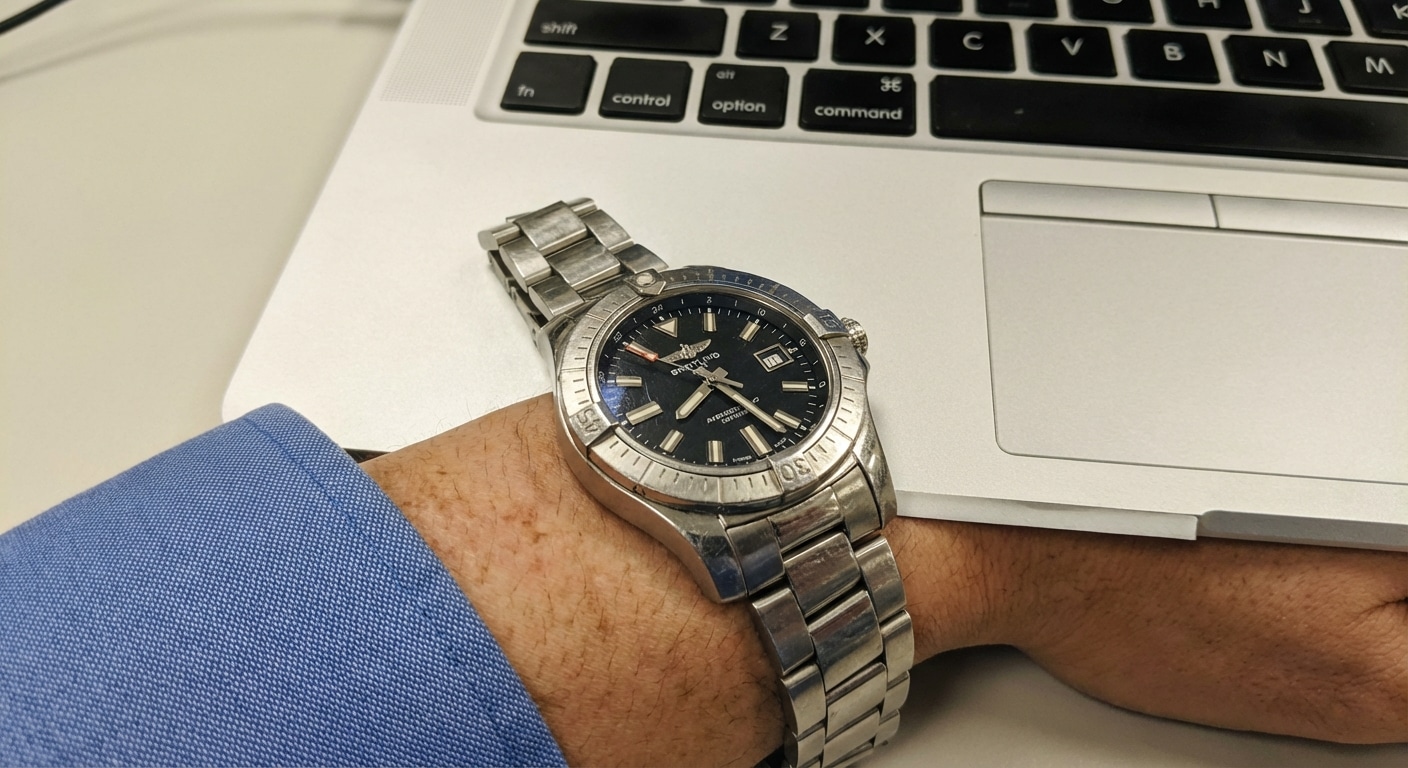
Place a fully linked Breitling Avenger steel bracelet replica on a digital scale, and the readout easily exceeds 180 grams. Strap that mass to a 17cm wrist at 8:00 AM, and it feels substantial; by 3:00 PM in the August heat, it feels like a penal shackle. The prevailing forum consensus that a heavy steel bracelet serves as an ideal, year-round daily driver ignores basic human physiology and complex lug-to-lug wearability factors. A replica watch weight of this magnitude dictates strict wearing parameters. Metal is not versatile; it demands climate control.
Thermal Expansion and the 43mm Case Problem
The Avenger’s dense 43mm 316L stainless steel case acts as a highly efficient heat sink. When paired with a matching steel bracelet, you are wrapping nearly 200 grams of conductive alloy around your arm. In summer months, this entire unit absorbs ambient heat and transfers it directly to the skin, exacerbating natural vasodilation. A bracelet that offered a comfortable pinky-finger gap in an air-conditioned bedroom becomes a tourniquet by mid-afternoon. If the clasp lacks an immediate, tool-free wrist swell adjustment mechanism, the resulting pressure points on the ulnar bone make continuous wear physically fatiguing.
Office vs. Field: The Air-Conditioning Requirement
Steel belongs indoors. Specifically, it excels in environments regulated to a constant 72°F (22°C). In the modern corporate office or remote-work setup, the steel bracelet remains comfortable strictly because your wrist circumference remains static. However, this environment introduces its own mechanical realities. We observe that desk diving scratches accumulate rapidly on the replica’s brushed finish when repeatedly dragged across aluminum laptops and laminate desks. The heavy top-weight of the case constantly pushes the clasp downward, forcing the bottom links to bear the brunt of daily office friction.
Expert Authentication Insight
To diagnose the machining quality of a 2026 replica, test the articulation tolerance of the steel links. Hold the watch head horizontally by the case, allowing the bracelet to extend straight out into the air. A high-tier replica will exhibit no more than 15 to 20 degrees of lateral droop. Excessive sag indicates poor pin-and-collar machining. On the wrist, this loose tolerance translates directly to hair-pulling and an uneven weight distribution that amplifies wearing fatigue.
FKM Rubber: The Summer Performance Imperative
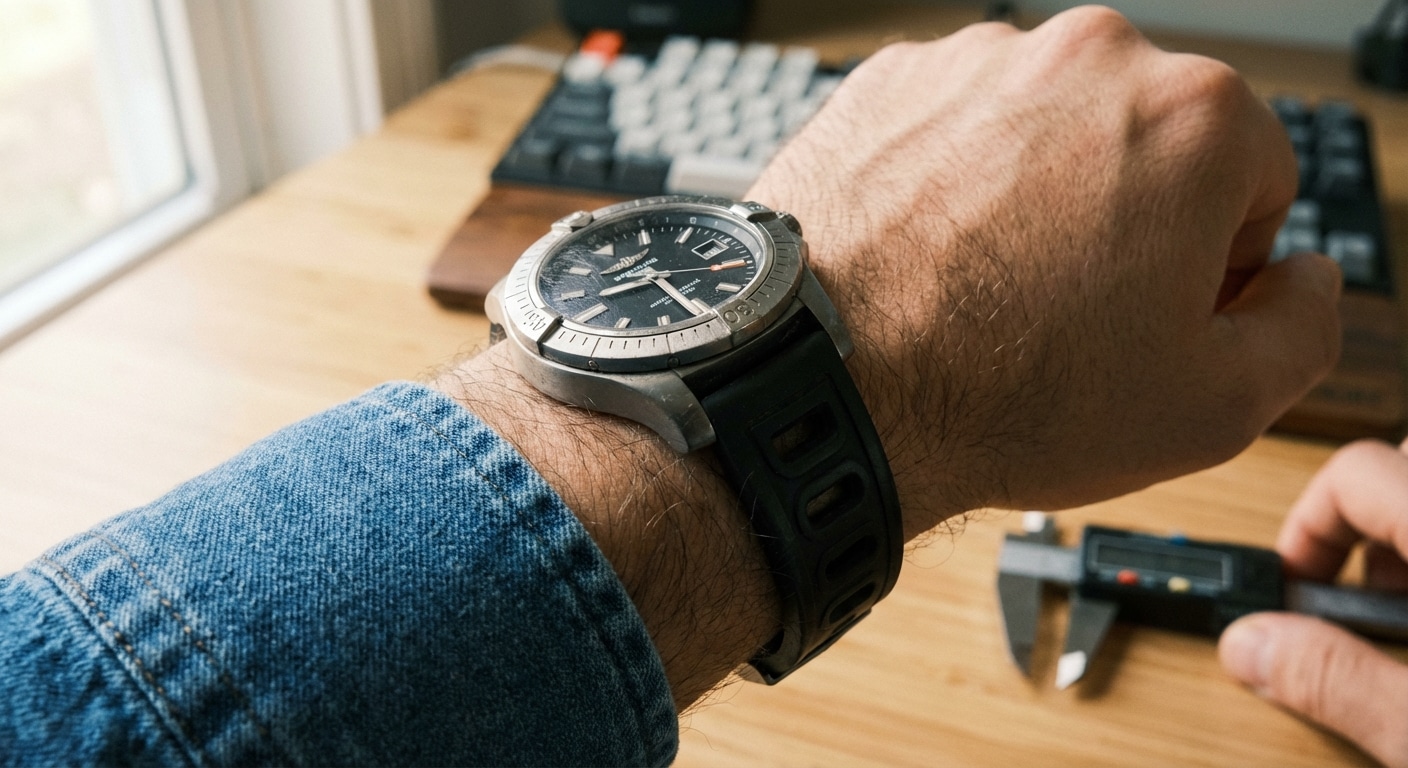
When the humidity spikes and the daily high crosses 80°F, leaving steel in the watch box is not a preference; it is a biomechanical necessity. The Breitling Avenger rubber strap represents the only logical mounting hardware for high-heat scenarios. However, the distinction of FKM vs silicone is critical here. Cheap silicone attracts dust, degrades under UV exposure, and traps body heat. High-grade FKM (Fluoroelastomer) rubber fundamentally alters summer watch wear by resisting chemical breakdown while maintaining the absolute structural rigidity required to anchor a heavy case.
Sweat Evaporation and Internal Channel Design
A truly breathable watch strap relies entirely on its underside geometry. Turning the 2026 replica FKM strap over reveals deeply molded, precise internal channels. These grooves are engineered to route moisture away from the skin. When strapped tightly against a sweating wrist, these channels create a micro-climate of airflow, ensuring sweat evaporation keeps pace with perspiration. This physical design prevents the contact dermatitis and skin maceration commonly associated with flat-backed silicone straps during prolonged outdoor exposure.
Balancing the Top-Heavy Avenger Profile
The Avenger case is notoriously top-heavy. On a flatter 16.5cm wrist, this high center of gravity causes the watch to roll away from the wearer during physical activity. The tensile strength of modern FKM solves this ergonomic flaw. A 22mm lug-width FKM strap provides immense lateral stiffness. It acts as a structural anchor, gripping the wrist firmly enough to counterbalance the heavy case without requiring you to choke the strap down to the last hole, preserving vital blood flow during active use.
Expert Authentication Insight
You can verify the strap material using the lint and rebound test. Drag a dark cotton cloth aggressively across the rubber surface. High-grade FKM will repel the lint entirely, maintaining a clean, matte finish, while low-tier silicone will instantly attract and hold the fibers. Next, pinch the strap firmly between your thumb and forefinger; true FKM will snap back instantly with zero memory deformation, confirming its high-density composition.
Calfskin Leather: Winter Comfort and Cuff Friction
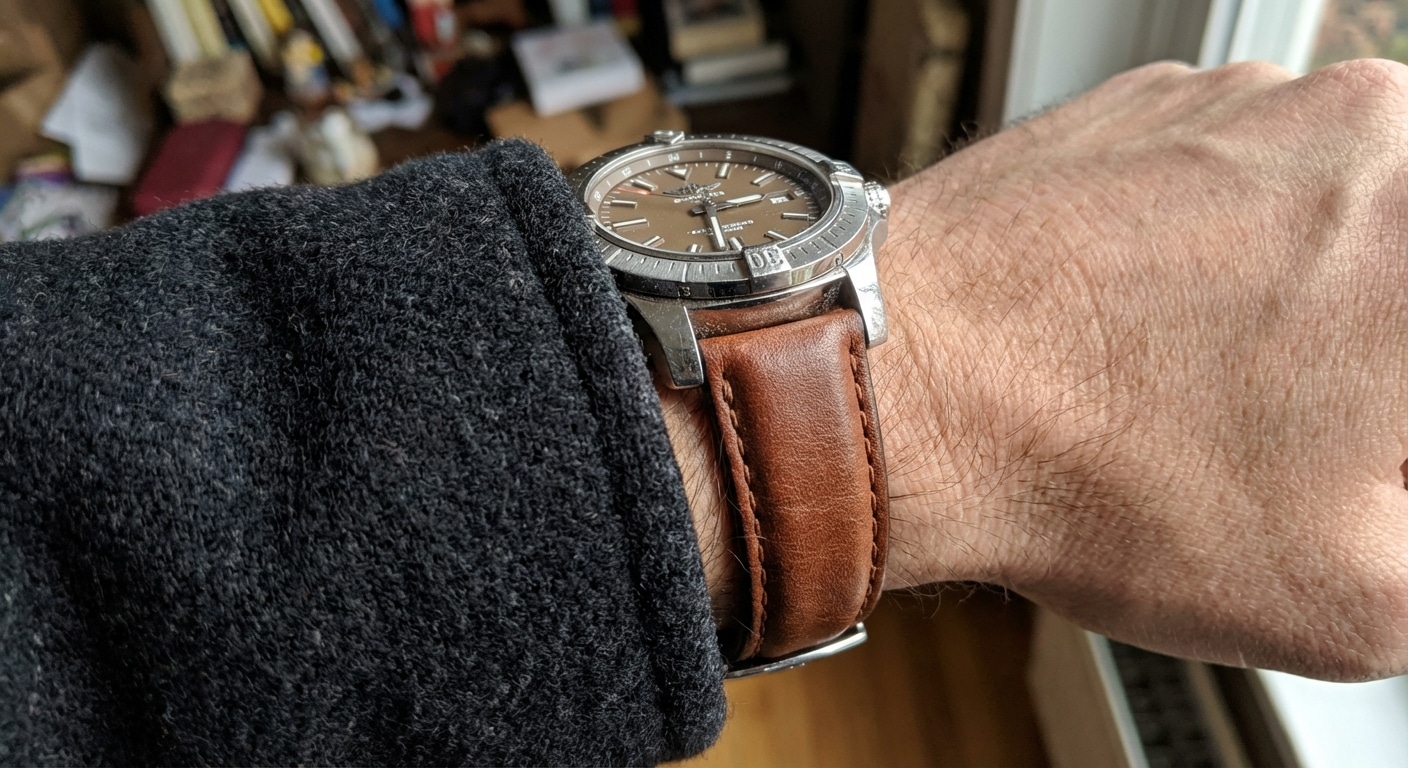
Treating leather as an all-season option inevitably destroys the material. Exposing a Breitling leather strap replica to August heat accelerates the strap aging process, rotting the synthetic core fillers from the inside out via sweat absorption. Leather is strictly a cold-weather, low-humidity tool, prompting many collectors to transition to steel options during summer months. When making this seasonal swap, understanding proper Breitling mesh bracelet adjustment ensures optimal airflow and prevents wrist swelling under high temperatures. In winter, however, leather shifts from being a fragile liability to an ergonomic asset, interacting entirely differently with human skin and heavy clothing layers than conductive metals do.
Thermal Retention on the Wrist
In 40°F (4°C) weather, strapping cold steel to your arm is a physical shock. A winter watch strap must act as an insulator. The organic nature of calfskin, combined with the dense synthetic core fillers utilized in modern replicas, prevents ambient cold from transferring to the skin. After 10 minutes of outdoor winter exposure, the surface temperature of a leather strap remains neutral to the touch, providing immediate thermal comfort and sustained heat retention that metal simply cannot replicate.
Long-Sleeve Clearance and Friction Wear
Winter wardrobes introduce the “sleeve catch” phenomenon. The Avenger features an aggressive lug profile, and when paired with thickly padded leather, it creates a significant friction point against heavy flannel or merino wool cuffs. Over a 48-hour period of constant wear against a heavy winter coat, we documented distinct lug friction. The constant rubbing forces the thick leather to fight the sleeve for real estate, putting distinct mechanical stress on the strap’s edges and accelerating wear at the lug connection points.
Expert Authentication Insight
Inspect the strap’s edge coating and stitch tension under a 10x loupe. Premium 2026 replica leather straps utilize a heated edge-paint process that physically bonds and flexes with the calfskin. Inferior versions use a cheap, hard rubberized coating. If you buckle the strap tightly, these lower-tier coatings will visibly crack at the primary adjustment hole after just three days of wear, exposing the white synthetic core underneath and compromising the strap’s structural integrity.
The 24-Hour Swap Test: Real-World Ergonomic Data
To truly understand watch wearing ergonomics, you have to move beyond static wrist shots and factory weight specifications. I subjected a 43mm Breitling Avenger replica to a strict 24-hour physical wear-test on a flat 17cm wrist, utilizing all three primary strap materials in a single day. The goal of this Breitling strap comfort test was to document the physiological reality of carrying a notoriously top-heavy case through fluctuating temperatures and activity levels. By isolating the physical wearing experience chronologically, we can see exactly when a material succeeds and when it becomes a liability. High strap change frequency is often debated, but as the timeline shows, forcing one material to do three different jobs is an ergonomic failure.
08:00 – 12:00: The Morning Commute and Steel Fatigue
08:00: The day begins at a brisk 65°F (18°C) with the heavy 316L steel bracelet installed. Initially, the cold metal feels crisp, and the dense links provide an excellent counterbalance to the thick Avenger case. The lug to lug fit feels secure, locking the watch onto the center of the wrist during the morning commute.
11:30: As ambient temperatures rise and physical movement increases, natural wrist swelling begins. The once-perfect fit now feels restrictive. The sheer mass of the fully linked replica—weighing in at over 180 grams—shifts from feeling “substantial” to genuinely fatiguing. The lack of elasticity in the steel means every millimeter of wrist expansion translates directly into pressure against the ulna bone, making the watch a physical distraction before noon.
13:00 – 18:00: Peak Swell and The FKM Relief
13:00: With the afternoon temperature hitting 85°F (29°C), the steel is removed in favor of the FKM rubber strap. The immediate drop in perceived weight is a massive relief. Because FKM rubber possesses high tensile strength with slight elasticity, it accommodates the afternoon peak swell without requiring a physical micro-adjustment at the clasp.
16:00: The most notable improvement is the elimination of the clasp pressure point on the volar (underside) side of the wrist. Addressing the common fitment issues detailed in a standard Breitling replica size wearing guide, the deep internal channels molded into the 2026 replica FKM strap actively route sweat away from the skin. Despite the heat and high humidity, the watch remains anchored without the sticky, suffocating sensation associated with cheap silicone bands.
19:00 – 24:00: Evening Cool Down with Leather
19:00: Returning indoors, the FKM is swapped for the padded calfskin leather strap. As the wrist returns to its resting baseline circumference, the leather conforms beautifully to the anatomical curve. It provides a much softer tactile experience against the cuff of a casual evening flannel, eliminating the harsh metal-on-fabric friction of the steel bracelet.
23:00: By the end of the night, the thermal retention of the leather proves its worth in cooler indoor environments. There is no cold shock when putting the watch back on after a shower. The leather simply feels like an extension of the wardrobe, closing out the 24-hour cycle with zero localized wear fatigue.
Expert Authentication Insight
A common hesitation regarding this level of modularity is the fear of damaging the watch case. Frequent strap changes will ruthlessly expose weak machining in replica cases. If you use a 1.8mm digital caliper to check the depth and sharpness of the inner lug holes, you will find that premium 2026 replicas maintain a sharp, deep recess that securely holds the spring bar even after 50+ strap swaps. Cheaper alloy cases will quickly wallow out at the drill points, creating a loose tolerance that risks a dropped watch under tension.
Strategic Rotation Protocol for the 2026 Wearer
The concept of the “all-season watch strap” is a forum myth that ruins good materials and guarantees wrist discomfort. The best strap for Breitling is entirely dependent on your immediate environment. Implementing a strict watch strap rotation based on thermal realities rather than aesthetic whims is the only way to manage a heavy 43mm case. Proper seasonal watch care requires treating the Avenger not as a single static piece of jewelry, but as a modular tool that demands specific mounting hardware for specific conditions. Failing to rotate materials is the primary reason wearers complain about replica strap longevity.
Seasonal Transition Triggers
You need hard environmental rules to dictate your strap choices. When the daily high consistently hits 75°F (24°C) and humidity crests 60%, the calfskin leather must go into the drawer. The synthetic core fillers used in replica leather straps are highly susceptible to sweat-rot; wearing them through August heat will permanently degrade the internal padding and cause the edge-paint to crack. This is your mandatory trigger to shift to FKM rubber. Conversely, when temperatures drop below 50°F (10°C), FKM can feel excessively cold against the skin, signaling the time to reintroduce the thermal insulation of leather.
The Desk-Diver’s Ultimate Setup
If you insist on wearing the steel bracelet, it must be optimized for a strictly climate-controlled environment. The desk-diver’s ultimate setup requires balancing the heavy watch’s center of gravity against minor indoor thermal shifts. Do not rely solely on the clasp for sizing. Utilize half-links on the 6 o’clock side of the bracelet to pull the clasp blade inward, ensuring the heavy Avenger case cannot roll outward on the wrist. When worn in a constant 72°F (22°C) office, this precise static sizing prevents the 180-gram mass from sliding down into the back of your hand while typing.
Expert Authentication Insight
If you are relying on the deployant clasp’s micro-adjustment mechanism to survive the workday, test its mechanical integrity. A true 1:1 replica mechanism will engage with a crisp, audible metallic click and hold firm under 5lbs of lateral pulling force. If you feel a spongy engagement or if the mechanism slips outward under slight wrist flexion, it indicates substandard internal spring tolerances. A failing micro-adjustment renders the steel bracelet virtually useless for managing mid-day wrist swell, forcing you back to rubber or leather.