
The Allure of the Micro-Rotor: Panerai’s P.4000 Design Philosophy
Panerai’s P.4000 movement represents a significant design departure from its more common P.9000 and P.3000 siblings. Introduced as part of Panerai’s push for thinner, more elegant timepieces, especially within its Luminor Due and Radiomir collections, the P.4000 quickly captivated enthusiasts. Its unique appeal lies in its micro-rotor architecture, which offers a blend of mechanical sophistication and aesthetic purity rarely found in other automatic movements. This design choice, however, is precisely what makes it a formidable challenge for replica manufacturers, demanding a deep understanding of Panerai clone movement engineering to accurately replicate such mechanisms with their unique micro-rotor architecture.
Thinness and Aesthetic Integration: A Defining Feature
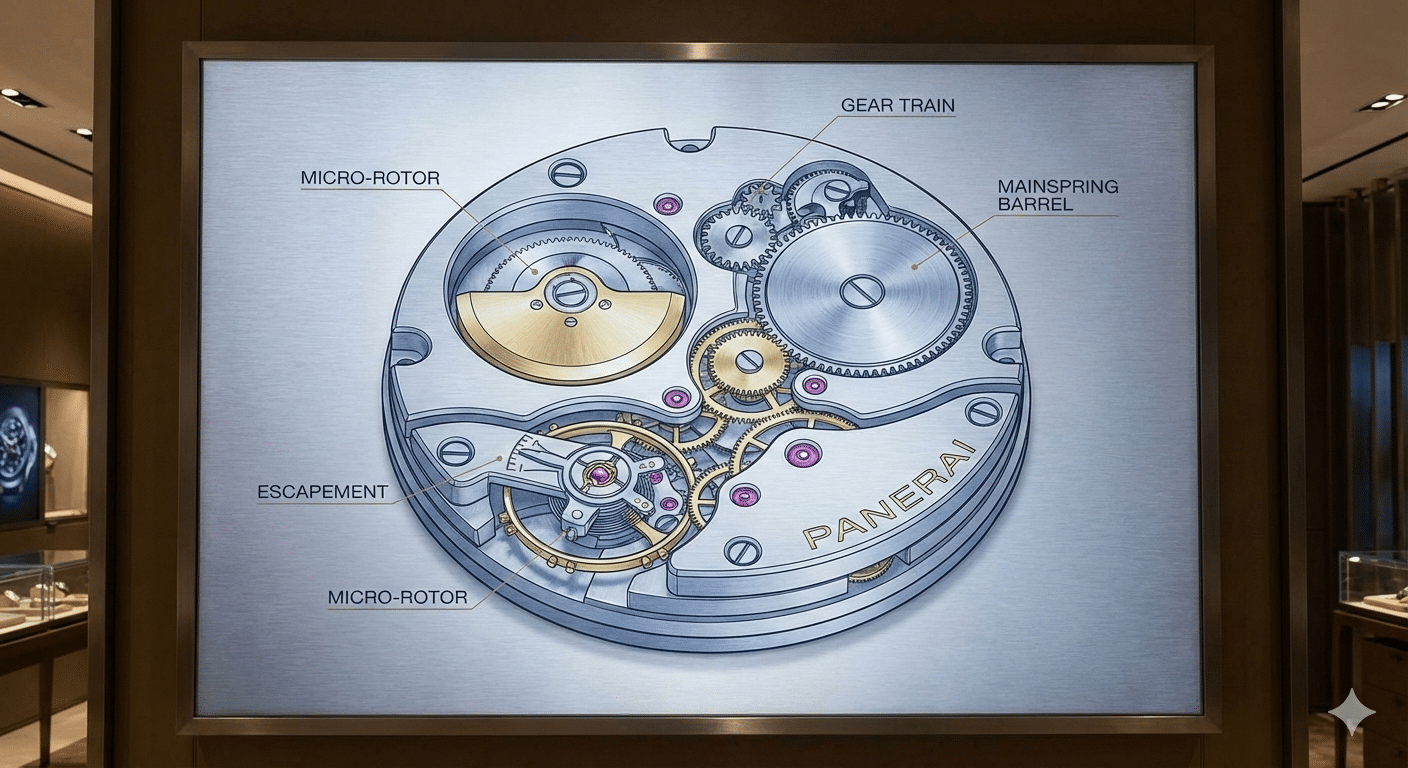
The core innovation of the P.4000 lies in its micro-rotor. Unlike traditional automatic movements where a full-sized oscillating weight sits atop the movement plates, the micro-rotor is integrated within* the movement’s footprint. This design choice dramatically reduces the overall height of the caliber, allowing Panerai to produce watches with significantly slimmer cases. For models like the Luminor Due, which are specifically designed to be more dress-watch friendly, this thinness is paramount. The micro-rotor enables a sleek profile without sacrificing the convenience of automatic winding, a delicate balance that showcases Panerai’s blend of contemporary engineering and classic watchmaking principles.
Functional Advantages: Unobstructed Movement View
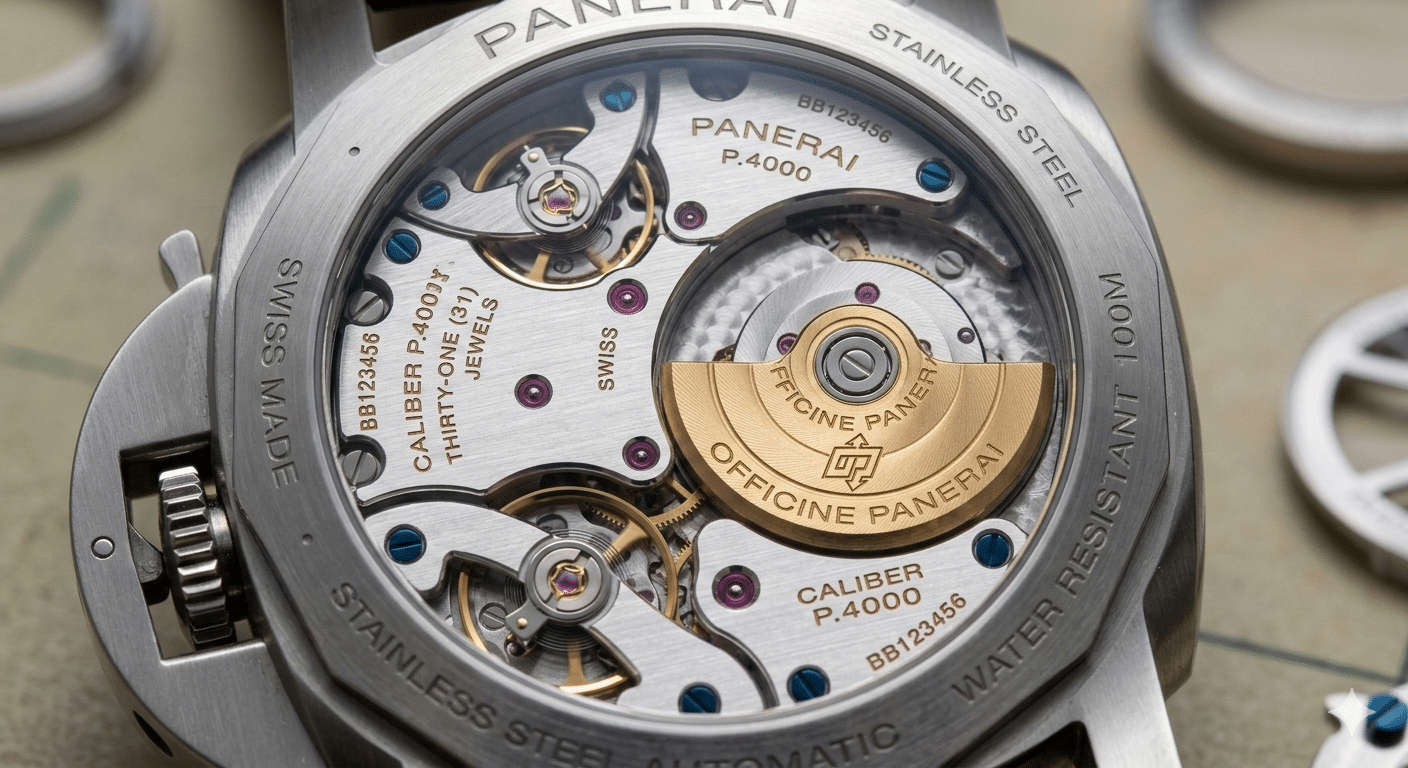
Beyond the benefit of a thinner profile, the micro-rotor design offers a compelling aesthetic advantage: an expansive, unobstructed view of the movement’s intricate mechanics. With the winding mass tucked away, enthusiasts are treated to a full panorama of the bridges, gears, and the oscillating balance wheel through the sapphire caseback. This open architecture enhances the watch’s visual appeal, turning the caseback into a captivating window into the heart of the timepiece. For many collectors, the ability to admire the movement’s finishing and complexity without a large rotor obscuring the view is a significant draw.
Panerai’s P.4000 Family: Caliber Variations and Applications
The P.4000 isn’t a singular movement but rather a family of calibers, each building on the micro-rotor base with additional complications. The base P.4000 offers hours, minutes, and small seconds. The P.4001 adds a GMT function and a power reserve indicator on the movement side, while the P.4002 moves the power reserve indicator to the dial side. These variations are predominantly found in Panerai’s more refined and often thinner collections, such as the Luminor Due and various Radiomir models. Their prevalence in these lines underscores the importance of the micro-rotor’s slimness to Panerai’s modern design language, making its accurate replication crucial for any “super clone” aiming to capture the essence of these watches.
Expert Authentication Insight
When examining a genuine P.4000, pay close attention to the specific bridge layout. Panerai movements often feature large, well-defined bridges that create a distinctive, robust aesthetic. The jewel count and their precise placement within these bridges are critical. Furthermore, the characteristic frosted or striped finishing on the main plate and bridges should be uniform and deep, reflecting high-quality manufacturing. Even the depth and crispness of engravings, such as the caliber number and “Officine Panerai,” offer tell-tale signs. Any deviation in these details—a less refined finish, misaligned jewels, or shallow engraving—immediately raises a red flag about a replica’s authenticity.
Engineering the Micro-Rotor: Inherent Challenges for Replica Manufacturing
The elegance of the micro-rotor design belies the significant engineering and manufacturing complexities involved. For replica factories, these complexities often become insurmountable hurdles, preventing the creation of truly accurate “super clone” versions that match the genuine article in both form and function. The challenges stem from fundamental physics, material science, and the extreme precision required for miniaturized components.
Size and Weight Constraints: Balancing Efficiency and Form Factor
The primary challenge of a micro-rotor is its reduced diameter. To generate sufficient kinetic energy for efficient automatic winding, a smaller rotor must compensate for its size with increased mass. This necessitates the use of high-density materials, such as tungsten or platinum alloys. These materials are significantly heavier than standard brass or steel, allowing the micro-rotor to achieve the necessary inertia despite its compact footprint. For replica factories, sourcing or independently producing and precisely machining such exotic, high-density alloys at scale, and then distributing that weight accurately, represents a substantial manufacturing and cost barrier. Many replicas resort to lighter, less effective metals, immediately compromising winding efficiency.
Precision Machining and Tolerances: Miniaturization Demands
The micro-rotor system operates within extremely tight tolerances. The axle on which the rotor spins, its bearings, and the minute clearances around it within the main plate demand extreme accuracy. We’re talking about deviations measurable in microns. Even minuscule imperfections in machining—a slightly oversized bearing, a fraction of a degree off-axis for the axle, or an uneven surface finish—can lead to excessive friction, binding, or undesirable play. This directly impacts winding efficiency and long-term reliability. Achieving this level of miniaturization and precision consistently across batches is a monumental task, often beyond the capabilities of most replica production lines.
Material Science: The Quest for High-Density Alloys
As noted, high-density alloys are critical for micro-rotor efficiency. Genuine manufacturers invest heavily in research and development to work with materials like tungsten, often with specific proprietary compositions or treatment processes to enhance durability and performance. Replica factories typically lack the advanced metallurgical infrastructure and expertise to independently produce or even reliably source these specialized materials. Instead, they often compromise by using more common, lower-density alloys or less refined manufacturing processes. This compromise inevitably results in a micro-rotor that, while visually similar, is functionally inferior—it simply doesn’t have the necessary mass to wind the mainspring effectively or reliably for the long term.
Expert Authentication Insight
To assess the quality of a micro-rotor, gently oscillate the watch with a slight circular motion. A genuine P.4000 rotor should move smoothly, consistently, and with minimal perceptible play or resistance. It will feel balanced and fluid. In contrast, many replica P.4000s, due to manufacturing inaccuracies or inferior materials, will exhibit noticeable issues. Look for excessive wobble, a gritty or binding sensation as it rotates, or an uneven, jerky movement. This often indicates poor bearing quality, incorrect material density, or imprecise machining of the rotor or its axle, all of which are immediate red flags.
The Achilles’ Heel: Automatic Winding Efficiency in Replicas
Even if a replica P.4000 manages to visually approximate the genuine article, its most glaring functional deficiency almost invariably surfaces in automatic winding efficiency. This is the “Achilles’ heel” of replica micro-rotor movements, where the intricate engineering of the genuine caliber truly shines and where clones consistently fall short. For a watch intended for daily wear, poor winding efficiency translates directly into an unreliable power reserve and a frustrating ownership experience.
Reduced Inertia: Smaller Rotor, Less Kinetic Energy
The fundamental principle of an automatic watch relies on the kinetic energy generated by the oscillating weight. A micro-rotor, by its very nature, is smaller and often lighter than a full-sized rotor. This means it has significantly less inertia to begin with. To compensate, the genuine P.4000 is engineered with superior design, extremely low-friction components, and often high-density materials (as discussed previously). Replica movements frequently fail on one or more of these fronts. Understanding the intricacies of a P.5000 super clone movement helps illustrate why a lighter or less efficient micro-rotor simply cannot generate enough kinetic energy from typical wrist movements to keep the mainspring adequately wound, leading to a drastically reduced power reserve compared to the genuine.
Gear Train Optimization: Minimizing Friction and Losses
The path from the micro-rotor to the mainspring barrel involves a complex and delicate gear train. Each gear, pinion, and pivot point is a potential source of friction and energy loss. In the genuine P.4000, this gear train is meticulously optimized, with highly polished surfaces, precise meshing, and robust jeweled bearings to minimize these losses. Replica manufacturers, often operating with less precise machinery and lower quality control, struggle to replicate this level of refinement. Poorly finished gears, misaligned pivots, or inferior lubricants can introduce significant friction throughout the winding train, effectively “siphoning off” the already limited kinetic energy generated by the micro-rotor. The result is a movement that winds sluggishly, if at all.
Bi-Directional Winding Mechanisms: Complexity in Compact Spaces
Many modern automatic movements, including the P.4000, employ bi-directional winding mechanisms, meaning the rotor winds the mainspring regardless of which direction it rotates. This usually involves a complex system of pawls or reverser wheels. Integrating such an intricate mechanism into the already confined space of a micro-rotor movement adds another layer of complexity. If not executed with extreme precision, these components can become sources of high friction, noise, or even outright failure. Replica versions of these bi-directional systems often suffer from reduced reliability, increased wear, and higher internal friction, further exacerbating the winding efficiency problem and shortening the movement’s lifespan.
Expert Authentication Insight
The most telling diagnostic for P.4000 winding efficiency is a power reserve test. A genuine Panerai P.4000 is rated for a 3-day (72-hour) power reserve. Wind a suspected replica fully, then let it run off the wrist and record how long it lasts. Most replica P.4000s will struggle to achieve even 24-36 hours, let alone the full 72. This significant discrepancy is a clear indicator of inferior winding efficiency, whether due to a lighter rotor, excessive friction in the gear train, or poorly designed winding components. Don’t let a “visually correct” micro-rotor fool you if the watch constantly stops on your nightstand.
Thickness Control: The P.4000’s Defining Feature and Replica Hurdle
The P.4000 movement isn’t just about a micro-rotor; its very existence is predicated on achieving an ultra-slim profile, allowing Panerai to produce watches like the Luminor Due that break from the brand’s historically bulky aesthetic. This pursuit of thinness, however, presents an almost insurmountable barrier for replica manufacturers aiming for a true “super clone.”
Integrated Design: Rotor Within the Movement Plate
The core genius of the P.4000’s slimness lies in its integrated design. Unlike traditional automatic movements where a full-sized rotor sits atop the movement plates, adding significant vertical height, the P.4000’s micro-rotor is embedded within* the movement’s main plate. This requires meticulous layering of components, incredibly slim bridges, and precise placement of every gear and jewel to ensure all elements fit horizontally without adding vertical bulk. It’s a three-dimensional puzzle solved with extreme precision, something far beyond simply miniaturizing parts.
Case Compatibility: Replicating Original Proportions
This integrated thinness directly translates to the overall watch dimensions. For models such as the Luminor Due, the P.4000’s slender profile is the entire point. The genuine Luminor Due PAM00674, for instance, measures a mere 10.3mm thick. If a replica movement cannot match the P.4000’s thinness, the resulting replica watch will inevitably be thicker, often by 1-2mm or more. This seemingly small difference destroys the watch’s intended elegant, wearable aesthetic, transforming a sleek dress watch into a clunky imposter that no longer fits comfortably under a shirt cuff.
Bridge Layout and Component Stacking: Miniaturization at its Best
Panerai engineers achieved the P.4000’s compact form factor through a highly optimized bridge layout and component stacking. Every piece, from the winding mechanism to the balance wheel, is arranged to maximize horizontal space and minimize vertical height. This isn’t just about making parts smaller; it’s about a fundamental re-engineering of the movement’s architecture. Replicating this requires not only access to similar manufacturing precision but also the intellectual property and reverse-engineering capabilities to understand and reproduce these complex, proprietary stacking solutions. Simply put, replica factories lack the R&D budget and the specialized machinery to mimic this level of miniaturization.
Expert Authentication Insight
When evaluating a P.4000 replica, the most immediate and telling physical diagnostic is to measure the overall case thickness. Take a set of digital calipers and compare the replica’s measurement against the genuine Panerai specifications for that specific model. On my workbench, I’ve seen “super clone” P.4000 replicas of the Luminor Due PAM00674 that claim a 1:1 thickness but clock in at 11.5mm or even 12mm. A genuine PAM00674 is 10.3mm. Even a 1mm difference in case thickness immediately indicates that the replica movement inside is not a true 1:1 P.4000 clone, regardless of how convincing its display caseback might look.
Replica Manufacturing Limitations: Why “Super Clones” Fall Short
The term “super clone” implies near-perfect replication, both visually and functionally. For movements as intricate and specialized as the P.4000, achieving this level of cloning runs head-first into significant economic and technical barriers that the replica industry, despite its advancements, simply cannot overcome without fundamentally changing its operational model.
Investment vs. Return: High R&D Costs for Niche Movements
Developing a true P.4000 clone from scratch would require an enormous upfront investment. This isn’t just about buying a genuine movement and copying it; it involves reverse-engineering complex mechanical principles, investing in specialized CNC machines for micro-machining, developing proprietary alloys for the micro-rotor, and employing highly skilled watchmakers and engineers for design, prototyping, and quality control. For a replica industry driven by volume and quick returns, this level of R&D is often deemed uneconomical for a relatively niche movement like the P.4000, which powers a smaller segment of Panerai’s catalog compared to the ubiquitous P.9000 or P.3000.
Material Sourcing and Proprietary Techniques
A critical limitation lies in material science. The micro-rotor, by its very nature, must be small yet heavy to efficiently wind the mainspring. Genuine P.4000 movements often utilize high-density alloys like tungsten or platinum for their micro-rotors. Replica factories typically lack the ability to source, cast, or precisely machine these specialized materials. Instead, they often resort to lighter, more common metals, significantly compromising winding efficiency. Furthermore, Panerai employs proprietary surface treatments, lubricating oils, and finishing techniques that are either secret or require specialized equipment that replica factories simply do not possess, leading to visual and functional compromises evident under magnification.
Quality Control and Consistency: The Micro-Scale Challenge
Producing a complex micro-rotor movement requires incredibly tight tolerances. A slight misalignment in a gear train, microscopic debris in a bearing, or inconsistent polishing can drastically affect performance. The replica industry, while improving, still struggles with maintaining consistent quality control across large batches. This means even if a factory manages to produce a visually convincing P.4000 clone, achieving reliable, long-term performance and consistent power reserve across all units is a significant challenge, as detailed in a comprehensive replica movement guide, often leading to high rates of defects and variability in real-world performance.
Expert Authentication Insight
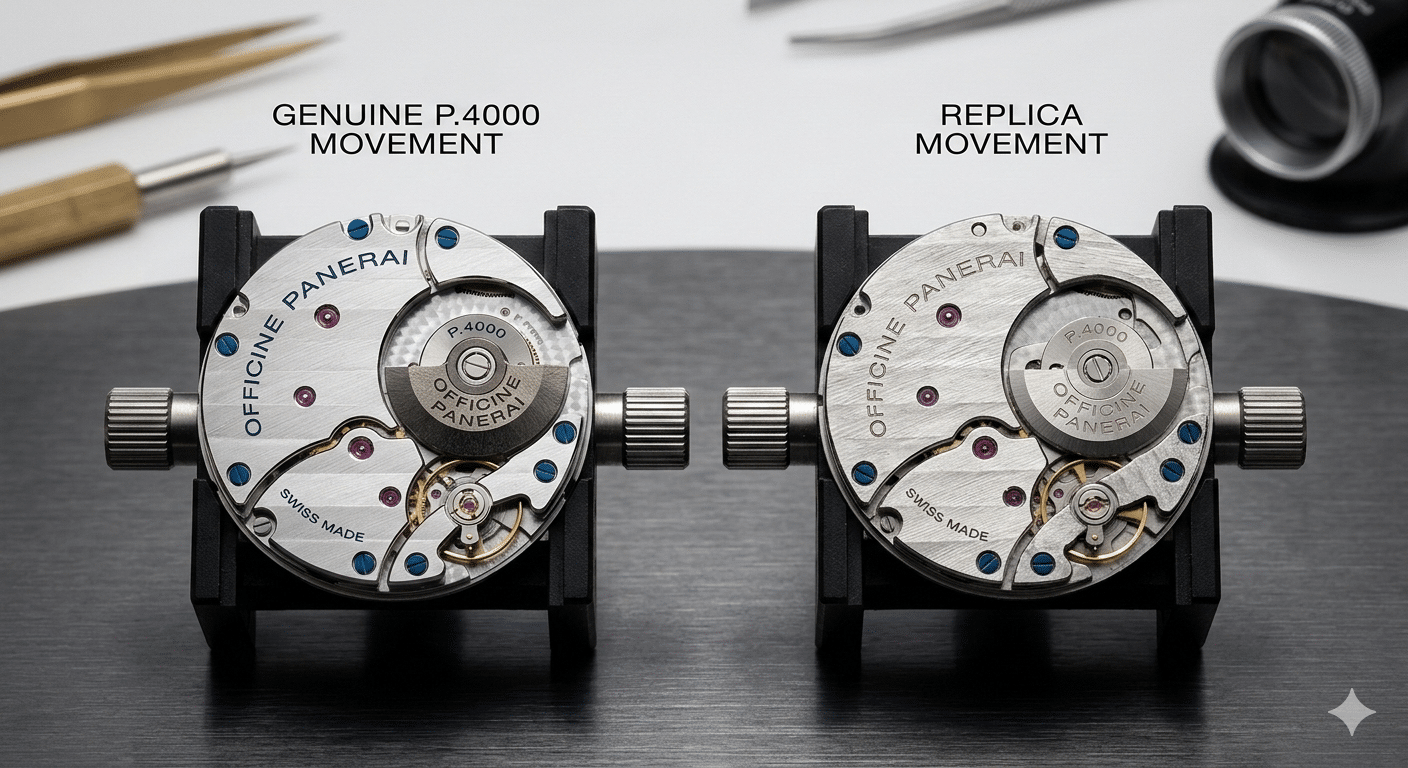
When inspecting multiple P.4000 replica movements, a tell-tale sign of manufacturing limitations is the inconsistency of finishing and engraving. Genuine Panerai movements, even through a display caseback, will show uniform perlage, consistent beveling on bridges, and crisp, deep engravings. Replica P.4000s, by contrast, often display variations: some might have softer, less defined bridge decoration, unevenly blued screws, or text (“P.4000,” “Swiss Made,” jewel count) that lacks the precise depth and clarity of the genuine article. I’ve noted instances where the font on different batches of the same replica P.4000 movement varied slightly, a clear indicator of inconsistent manufacturing processes and quality control. This lack of uniformity is a dead giveaway that you’re not looking at a genuine article.
Common Replica Approaches and Their Compromises for the P.4000
Given the immense difficulty in truly cloning the P.4000, replica manufacturers employ various strategies to mimic* its appearance. However, each approach comes with inherent compromises, often sacrificing functional integrity for visual approximation.
Modified Standard Movements: The “Fake Micro-Rotor” Strategy
The most common and deceptive approach is to take a readily available standard automatic movement, such as an Asian 2824 or 2892 clone, and modify it to appear* like a P.4000. This typically involves removing the original full-sized rotor and attaching a decorative, non-functional, or poorly functional micro-rotor plate. This plate is often merely glued on or superficially attached, serving purely as a visual prop through the display caseback. The underlying movement remains a standard, much thicker caliber, resulting in a watch that is dimensionally incorrect and whose “micro-rotor” contributes little to no actual winding efficiency. It’s a visual trick, nothing more, designed to fool the untrained eye.
Low-Efficiency Dedicated Clones: Performance Sacrifices
Some replica factories have attempted to create dedicated P.4000 clones. While these movements might visually resemble the genuine article more closely and even incorporate a functional micro-rotor, they inevitably suffer from significant performance sacrifices. Due to the aforementioned challenges in material sourcing, precision machining, and quality control, these clones often exhibit dramatically reduced winding efficiency. This translates to a poor power reserve, often struggling to reach even 24-36 hours compared to the genuine 72-hour rating. Furthermore, the movements can be less reliable, prone to increased friction, premature wear, and inconsistent timekeeping due to manufacturing shortcuts and inferior components.
Visual Deception: Hiding Inaccuracies Under Bridges and Plates
Another tactic employed by replica makers is to use clever visual deception. This involves strategically designing decorative bridges or plates that cover up poorly finished components, incorrect gear trains, or other inconsistencies. By obscuring the less accurate parts of the movement, they make visual authentication difficult without full disassembly. While this might satisfy a casual glance through the display caseback, it does nothing to improve the actual mechanical performance or dimensional accuracy of the movement. It’s a facade, designed to pass a quick inspection but failing to deliver on the true engineering prowess of the P.4000.
Expert Authentication Insight
A crucial physical diagnostic for these deceptive P.4000 replicas is to closely examine the micro-rotor’s mounting and function under a strong light. Genuine P.4000 micro-rotors are an integral part of the movement, securely mounted with minimal play. In many “fake micro-rotor” replicas, if you focus a strong light source directly onto the movement and observe the rotor’s axle, you might notice a visibly thicker or less integrated mounting point. In the worst cases, the “micro-rotor” is merely a static decorative plate, completely non-functional. Even with functional clones, excessive wobble or an uneven rotation of the micro-rotor can indicate poor bearing quality or imprecise mounting, a tell-tale sign of a replica’s compromise. I’ve encountered examples where the decorative rotor was so poorly attached it could be gently wiggled with a toothpick, something impossible on a genuine P.4000.
The Verdict: The Elusive P.4000 Super Clone and What to Expect
After dissecting the intricate engineering of Panerai’s P.4000 micro-rotor movement and the inherent challenges it presents, it’s time for a definitive verdict on its replica status. Despite the replica industry’s remarkable advancements, particularly with other Panerai calibers, the P.4000 stands as a stark reminder of where “super clone” claims still fall short of mechanical reality.
Current State of the Art: Managing Expectations for P.4000 Replicas
While factories like VS have made admirable attempts, releasing their P.4000 clone for models like the Luminor Due, it’s crucial for buyers to manage their expectations. The best available P.4000 replicas, often priced around $480-$580, offer a visual approximation of the genuine article, but significant compromises remain in core performance metrics. For instance, the VS P.4000 clone achieves approximately 65-68 hours of power reserve, falling short of the genuine’s 72 hours. While this gap might seem minor, it points to underlying inefficiencies in the winding mechanism or mainspring quality. More critically, the case thickness, a defining characteristic of P.4000-equipped Panerais, often remains slightly off. The VS P.4000 clone, for example, results in a 10.8mm case thickness compared to the genuine Luminor Due’s 10.3mm. This 0.5mm difference, while seemingly small, is immediately noticeable to a discerning eye and defeats the purpose of the micro-rotor’s thin design. These dimensional and functional discrepancies confirm that even the “best” P.4000 replicas are not true 1:1 super clones, but rather highly competent visual fakes with performance caveats.
Unlikely Breakthroughs: Why True 1:1 Clones Remain Distant
The technical hurdles detailed throughout this analysis—from the precision machining of micro-rotors and their delicate axles to the material science required for high-density alloys and the optimized gear trains for efficient winding—collectively form a formidable barrier. Replicating the P.4000 to a true 1:1 standard, matching both its aesthetic and functional performance, would necessitate an investment in R&D, specialized manufacturing equipment, and proprietary material sourcing that currently exceeds the replica industry’s typical operational model. The micro-rotor’s integration within* the movement’s plate, rather than on top, demands an unparalleled level of miniaturization and component stacking that most replica factories simply cannot achieve consistently across batches. Unlike the P.9000, which saw a revolutionary clone from VS Factory with approximately 85% parts compatibility, the P.4000’s complexity means that a similar breakthrough, offering true parts interchangeability and identical performance, is unlikely to emerge under current conditions. The engineering is simply too bespoke, and the tolerances too tight, for mass-produced, reverse-engineered counterfeits to perfectly mimic.
The Cost Factor: When Replication Becomes Uneconomical
Ultimately, the absence of a true P.4000 super clone boils down to economics. The market for Panerai replicas, while robust, is finite. Developing a P.4000 clone that genuinely matches the genuine article in every respect—power reserve, winding efficiency, dimensional accuracy, finishing, and long-term reliability—would require a multi-million dollar investment. This includes not just reverse-engineering but also establishing a supply chain for high-density rotor materials (like tungsten or platinum alloys), refining machining processes to micron-level precision, and implementing rigorous quality control systems. The resulting per-unit cost for such a replica P.4000 movement would inevitably push the replica watch’s price point well beyond the current $400-$600 range. At a certain threshold, perhaps $1,000 or more for a replica, the value proposition diminishes significantly, as buyers might then consider genuine entry-level mechanical watches or alternative Panerai models with more accurately replicated movements. The replica industry operates on a balance of cost-effectiveness and perceived value; for the P.4000, achieving true 1:1 replication simply tips that balance into uneconomical territory.
Expert Authentication Insight
When examining a P.4000 replica, pay meticulous attention to the movement’s engravings. Use a 10x loupe and a strong light source. Genuine Panerai P.4000 movements feature laser-sharp, deeply etched text for details like “P.4000,” “Swiss Made,” and the jewel count. The font will be crisp, uniform in size, and perfectly aligned. Replicas, even the better ones, frequently display softer, less defined, or slightly inconsistent lettering. You might notice edges that appear blurred, uneven depth in the engraving, or minor variations in font size between different text elements. These subtle imperfections, often overlooked by the untrained eye, are clear indicators that you are not looking at a genuine P.4000 caliber.