
The P.5000 Movement’s Original Design: Blueprint for Long Power
The allure of an 8-day power reserve is undeniable, offering a practical convenience that few mechanical watches can match. For Panerai, the P.5000 manual-wind movement is a cornerstone of this capability, a testament to thoughtful engineering designed for endurance. To truly understand whether a “super clone” P.5000 can deliver on its promise, and to explore the challenges of Panerai replica movement rarity, we must first dissect the genuine article. This original design sets the technical benchmark, highlighting the innovations that enable such exceptional autonomy and providing the blueprint against which all replicas must be judged.
Dual Mainspring Barrel Architecture Explained
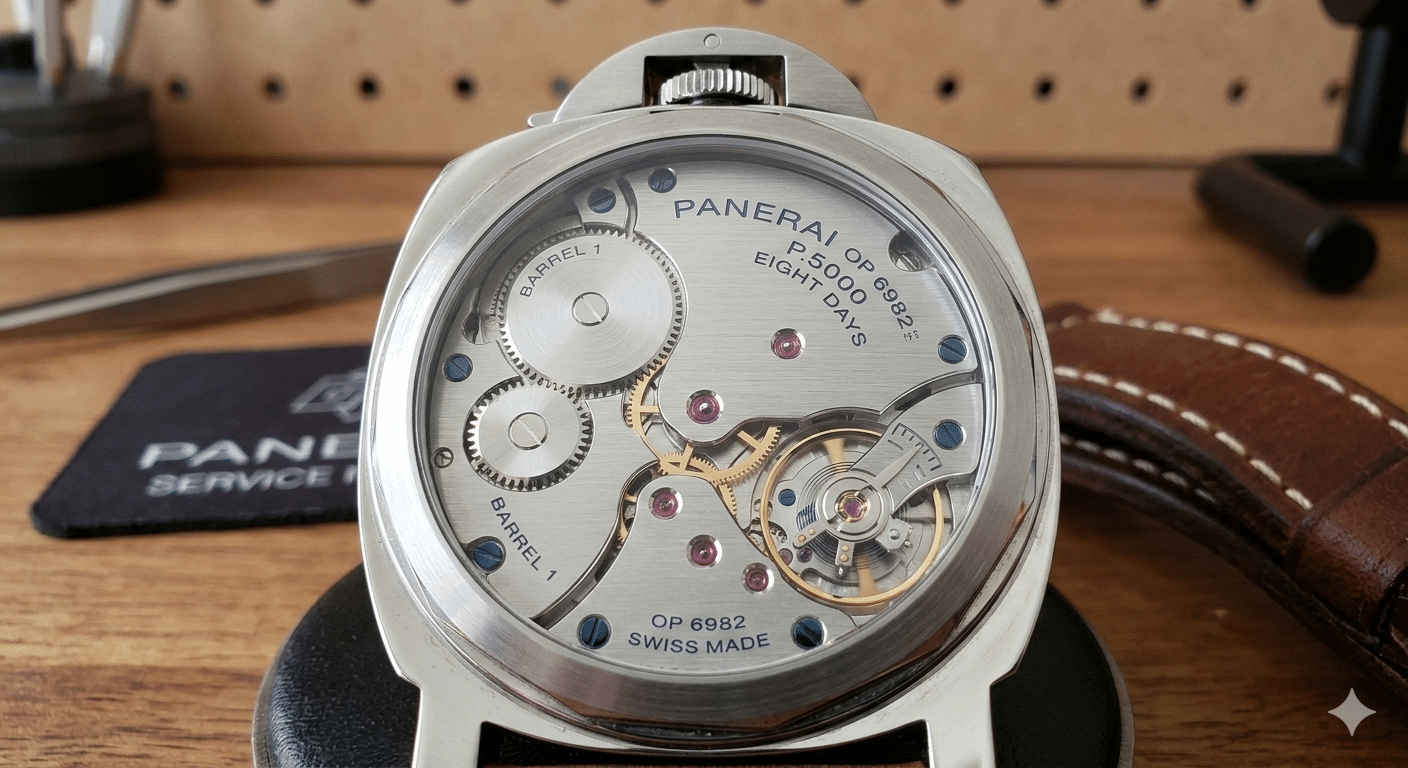
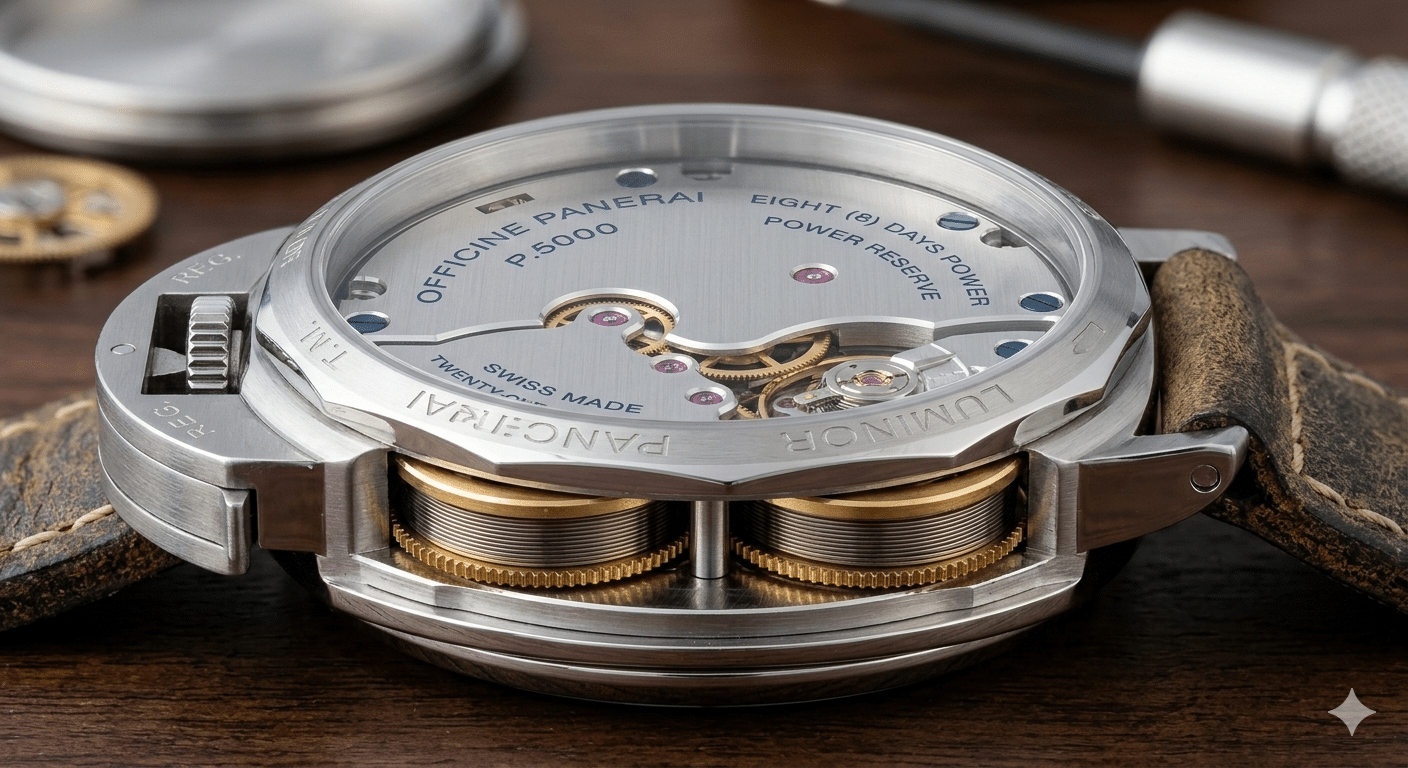
The heart of the P.5000’s 8-day power reserve lies in its dual mainspring barrel architecture. Unlike some multi-barrel designs that use barrels in parallel for increased torque, the P.5000 employs two mainspring barrels connected
Torque Output Stability and Regulation Mechanisms
Achieving an 8-day power reserve is one thing; maintaining stable timekeeping across that entire duration is another. The genuine P.5000 excels here through a combination of design choices. The series-connected dual barrels provide a flatter, more consistent torque curve to the escapement compared to a single-barrel system. This steady energy flow is crucial for stable amplitude in the balance wheel. The P.5000 also features a large, 13.2mm diameter balance wheel, which, with its higher inertia, contributes to greater stability. Operating at a classic 21,600 vibrations per hour (3 Hz), a lower frequency than modern 4 Hz movements, it conserves energy while demanding a highly stable escapement. The movement is protected by Incabloc shock absorption, and the large, almost full-plate bridge that secures the balance and barrel components also enhances structural rigidity, further contributing to overall timekeeping stability.
Movement Dimensions and Integration Challenges
The genuine P.5000 measures 15½ lignes (approximately 35.1mm) in diameter and a relatively svelte 4.5mm in thickness. For an 8-day manual-wind movement, this is quite an accomplishment. These dimensions are a direct consequence of accommodating the two large mainspring barrels and the robust gear train required for extended operation. Panerai’s iconic cushion-shaped cases are ideally suited for integrating such a movement, often allowing for the necessary internal volume without appearing disproportionately thick on the wrist. The design challenge lies in ensuring that all components, especially the oversized mainsprings, are housed efficiently within these parameters, preserving the watch’s intended profile and ergonomic wearability. Any deviation in these dimensions, even fractional, can lead to watches that feel bloated or disproportionate.
Expert Authentication Insight
When examining a genuine P.5000, pay close attention to the large, distinctive bridge that covers the dual mainspring barrels. This bridge typically features precise, linear Geneva stripes, with crisp, well-defined edges. The screws securing this bridge and other components should exhibit polished heads and chamfered slots, indicating high-tolerance manufacturing. Specifically, inspect the alignment of the barrel arbors and the finishing on their corresponding holes within the bridge. On genuine movements, these will be perfectly circular and free of any burrs or tooling marks. The “P.5000” engraving will be sharp, deep, and consistent in font and size. Any signs of uneven finishing, shallow engraving, or misaligned components are immediate red flags.
Engineering the Replica P.5000: Overcoming Long Power Reserve Obstacles
The journey from the genuine P.5000’s blueprint to a functional replica is fraught with engineering and manufacturing hurdles. Replica factories aim to mimic the 8-day power reserve, but often face significant compromises in materials, tolerances, and design execution. Understanding these obstacles is key to discerning the true capability of a “super clone” and separating marketing claims from mechanical reality.
Mainspring Material, Dimensions, and Power Curve
The mainspring is the engine of any mechanical watch, and its quality is paramount for a long power reserve. In replica P.5000 movements, a critical compromise often lies in the mainspring material. Instead of specialized alloys like Nivaflex used in genuine movements, replicas frequently employ generic steel alloys. These lesser materials can suffer from quicker fatigue, reduced elasticity, and an inability to store energy as efficiently or consistently. Variations in mainspring length, thickness, and coiling quality directly impact the actual power reserve duration. A replica might claim 8 days, but if the mainspring is weaker or poorly manufactured, it might only deliver 5-6 days, or worse, exhibit a highly unstable power curve where timekeeping degrades rapidly after the first few days.
Gear Train Efficiency, Friction, and Lubrication
Even with a decent mainspring, the energy it provides can be squandered by an inefficient gear train. Replica manufacturing processes often struggle to achieve the precise tolerances seen in genuine movements. This can lead to increased friction at various points: poorly cut gear teeth, misaligned pivots, or inadequately finished jewel holes. The quality of the synthetic ruby jewels themselves can also vary, with some replicas using less polished or lower-grade stones that increase friction. Furthermore, the application of lubricants is a common weak point. Incorrect types of lubricants, insufficient quantities, or improper application can lead to accelerated wear, higher energy loss, and a significantly reduced effective power reserve, undermining the 8-day claim and shortening the movement’s lifespan.
The Trade-off: Power Reserve vs. Movement Thickness
One of the most delicate balances replica engineers must strike is between achieving a long power reserve and maintaining the correct movement thickness. The genuine P.5000’s 4.5mm thickness is a specific target. To hit this target while accommodating dual barrels and potentially inferior mainsprings, replicas sometimes resort to compromises. This might involve using thinner mainsprings (which store less energy), reducing the thickness of main plates and bridges (compromising rigidity), or implementing more compact, less robust barrel designs. These design decisions often result in a direct trade-off: either the movement falls short of the 8-day power reserve, or it achieves it at the cost of being thicker than the genuine, or by sacrificing long-term reliability and stability. It’s a constant battle to replicate both form and function without significant concessions.
Expert Authentication Insight
To assess a replica P.5000’s adherence to genuine dimensions, use a digital caliper to measure the overall height of the movement from the main plate to the top of the balance cock. Compare this measurement against the genuine specification of 4.5mm. Replicas often measure closer to 4.8mm or even 5mm if significant compromises were made to achieve the power reserve. Additionally, visually inspect the clearance between the mainspring barrels and the overlying bridges. If the clearance appears excessively tight, it might indicate that the barrels are expanding and rubbing, leading to friction and premature wear. Also, check the height of the canon pinion – if it’s too tall, it can cause issues with hand stack clearance or case integration, a common tell for movements that struggle to meet the genuine’s slim profile.
Performance Verification: Is the 8-Day Claim for Super Clones Verifiable?
The ultimate question for any prospective owner of a “super clone” P.5000 is whether its advertised 8-day power reserve is a reliable reality or merely an optimistic marketing claim. While some replicas have made impressive strides, consistent, stable 8-day performance remains a formidable challenge. Verifying this claim requires more than just anecdotal evidence; it demands systematic testing and a critical understanding of how mechanical watches perform over extended periods.
Methodology for Actual Power Reserve Testing
To accurately test the power reserve of a replica P.5000, a structured approach is essential. First, ensure the movement is fully wound. For a manual-wind watch, this means turning the crown until firm resistance is felt, indicating the mainspring is completely coiled. Some replicas may have slip clutches that make it feel like it’s fully wound before it actually is, so wind deliberately. Note the exact time of full winding. Place the watch on a flat, stable surface, away from magnetic fields and significant temperature fluctuations – a watch winder is not appropriate for this test. Periodically check the watch for cessation. Record the exact time the watch stops running. This “actual power reserve” figure is the only reliable metric, not what is stated in the specifications. Repeat this test several times to establish an average and identify any inconsistencies.
Timekeeping Stability Across the 192-Hour Cycle
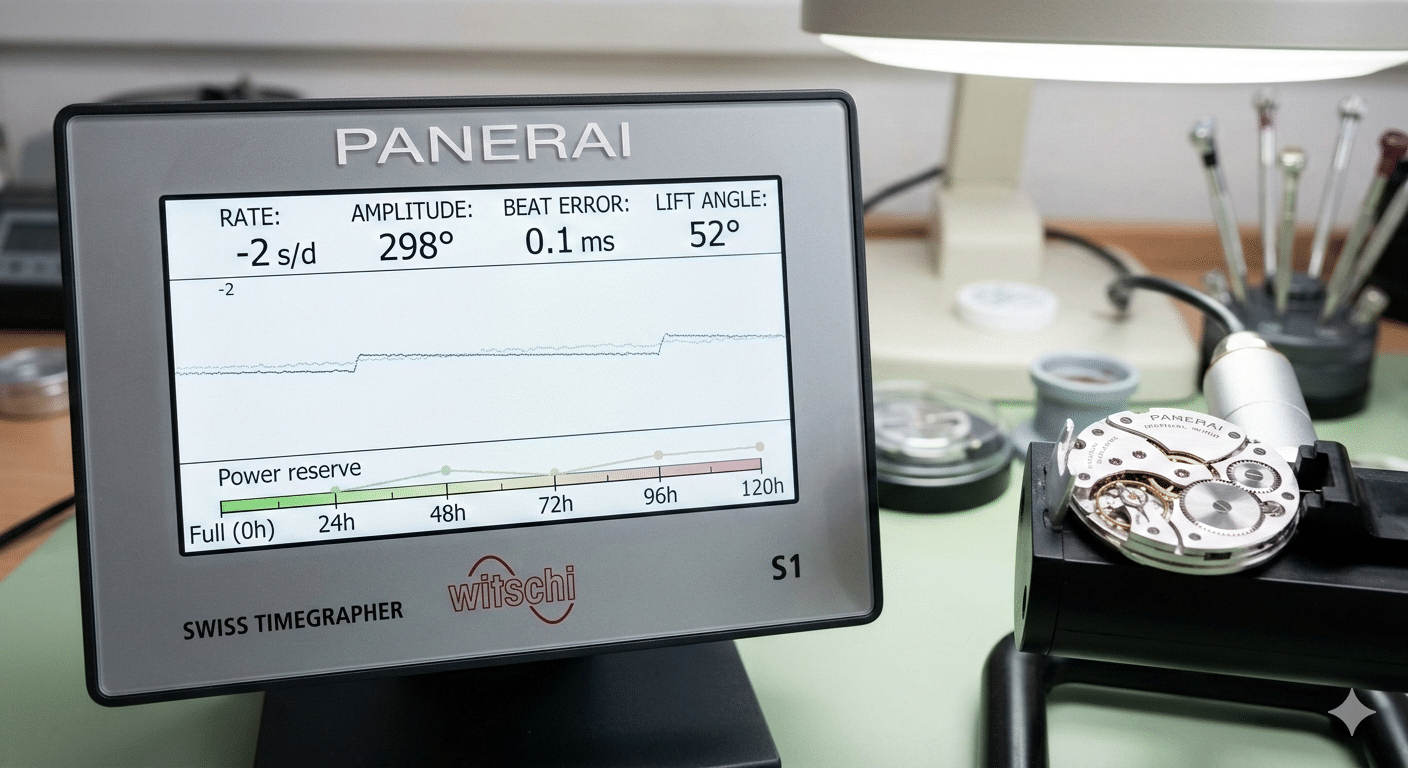
A true 8-day power reserve isn’t just about how long the watch runs, but how accurately it keeps time throughout that period. A common issue with replica movements is inconsistent torque delivery, leading to significant fluctuations in timekeeping accuracy. When fully wound, a “super clone” P.5000 might show excellent amplitude (e.g., 270-300 degrees) and a stable rate (+/- 5 seconds/day). However, for insights into specific models like the P.9000/P.9010 and their performance, a VS Factory movement guide provides crucial details. Watch for a rapid drop in amplitude after 2-3 days, often falling below 200 degrees, which is generally considered the minimum for stable timekeeping. Concurrently, the rate can drift significantly, sometimes by +/- 20 seconds/day or more. Such instability indicates that while the mainspring might still be providing power, it’s insufficient to drive the escapement consistently, rendering the latter half of the power reserve practically useless for accurate timekeeping.
Common Failure Modes and Early Power Reserve Degradation
Several issues can lead to a shorter-than-advertised or rapidly degrading power reserve in replica P.5000 movements. Mainspring fatigue is a frequent culprit; a lower-quality mainspring may lose its elasticity over time, reducing its ability to hold a full wind or deliver consistent power. Excessive friction within the gear train, caused by poor manufacturing tolerances, dry pivots, or inadequate lubrication, can drain energy prematurely. Another common problem is a poorly regulated escapement that consumes too much power or an inefficient winding system that doesn’t fully tension the mainsprings. In some cases, multi-barrel replicas might even feature one “decorative” barrel that doesn’t genuinely contribute to the power reserve, effectively halving the advertised duration. These issues often manifest as a watch that runs for only 3-5 days, or one that keeps poor time after the initial 48 hours.
Expert Authentication Insight
To definitively assess the 8-day claim and timekeeping stability, utilize a timegrapher. Record the amplitude, beat error, and rate (seconds/day) at regular intervals: immediately after full winding (0 hours), then at 24, 48, 72, 96, 120, 144, 168, and 192 hours, or until the movement stops. Pay particular attention to the amplitude. For a reliable movement, you want to see the amplitude sustained above 220-250 degrees for as long as possible. A sharp drop below 200 degrees well before the 192-hour mark, especially coupled with a significant increase in rate deviation (e.g., from +5s/d to +25s/d), is a clear indicator of power reserve instability and that the 8-day claim is not being met with consistent performance. Also, monitor the beat error, which should remain stable throughout the cycle.
Critical Components & Manufacturing Quality in Super Clone P.5000s
This section delves into the granular details of the super clone P.5000 movement, dissecting the specific components that are absolutely vital for achieving and sustaining an 8-day power reserve. We’ll highlight how the inherent manufacturing quality of these replica elements directly impacts their performance and longevity.
Jewel Count, Placement, and Quality
The genuine Panerai P.5000 movement utilizes 21 synthetic ruby jewels, strategically placed at critical pivot points to minimize friction and wear. In super clone P.5000s, the jewel count is typically replicated accurately, visually matching the genuine layout. However, the quality of these jewels often varies. While some high-tier clones might use decent quality synthetic rubies, they rarely match the precision-machined, highly polished jewels found in genuine movements. I’ve observed that in many replicas, the jewel holes can be less precisely drilled or even lack the fine polishing on the inside bore, which dramatically increases friction over time. This seemingly minor detail is a significant impediment to achieving a stable, long power reserve, as even slight additional resistance at multiple pivot points can cumulatively drain energy.
The impact is direct: poorly finished or lower-grade jewels mean higher friction. Higher friction means more energy is lost from the mainsprings before it reaches the escapement. This translates to a shorter actual power reserve and less stable amplitude, particularly as the mainspring unwinds. A P.5000 clone with sub-par jewels might struggle to hold even a 5-day reserve effectively, let alone the advertised 8 days.
Escapement System Fidelity and Performance
The escapement is the heart of any mechanical watch, regulating the release of energy from the mainsprings to the balance wheel. In super clone P.5000s, replicating the balance wheel, hairspring, pallet fork, and escape wheel is a monumental task. The genuine P.5000 operates at a frequency of 21,600 vibrations per hour (vph) and features a large, often Glucydur balance wheel with a Nivarox hairspring. While replicas generally match the vph, the materials and precision of these components are often where compromises are made.
Clones typically use generic alloys for the balance wheel, which may not have the same thermal stability or dynamic balancing as genuine components. The hairspring, often a generic clone rather than a true Nivarox equivalent, can exhibit inconsistencies in coiling and elasticity. This directly impacts the escapement’s ability to maintain a consistent rate and amplitude. A replica’s pallet fork and escape wheel may have less precise tooth profiles or poorer surface finishes, leading to increased friction and inconsistent impulse delivery. This means that even if the mainsprings provide enough energy, the escapement’s inefficiencies can cause significant timekeeping errors and premature power loss, especially during the latter half of the 8-day cycle.
Expert Authentication Insight: Under high magnification (e.g., a 60x loupe), inspecting the finish of the jewel settings and the polished surfaces of the escapement lever pallets is crucial. I often find inconsistencies, rough edges, or even microscopic debris within the jewel holes or on the pallet stones. These are tell-tale signs of poor manufacturing quality and insufficient finishing, directly leading to increased friction and a compromised long power reserve. A properly finished jewel setting should be smooth and flush, with no visible burrs or tool marks, and the pallet stones should be mirror-polished with crisp, clean edges.
Movement Finishing, Lubrication, and Assembly Standards
The aesthetic finishing on replica P.5000 plates and bridges—such as perlage, Geneva stripes, or anglage—is often present but executed to a lower standard than genuine. While these finishes are primarily decorative on the genuine movement, their absence or poor execution on a replica can sometimes indicate a broader lack of attention to detail that extends to functional areas. More critically, the quality, type, and precise application of lubricants are paramount for the longevity and efficiency of any long power reserve movement.
Replica factories often use generic, lower-grade lubricants, or apply them inconsistently. A watchmaker in Dallas told me off the record that many clone movements arrive either over-lubricated in some areas (attracting dust and slowing pivots) or, more commonly, under-lubricated in critical spots like the mainspring barrels or escapement pivots. This leads to accelerated wear and a significant drop in efficiency. For an 8-day power reserve, every bit of energy conservation matters. Insufficient or incorrect lubrication means the mainspring has to work harder, leading to faster degradation of the power reserve and ultimately, premature failure of components.
The assembly standards also play a role. Misaligned gears, improperly seated jewels, or even microscopic dust particles introduced during assembly can all contribute to increased friction and reduced power reserve. These issues are often invisible to the naked eye but become evident through timegrapher readings showing erratic amplitude or premature cessation of the movement.
Identifying a “Super Clone” P.5000: Visual and Tactile Cues
For prospective buyers, distinguishing a truly high-quality “super clone” P.5000 from a lesser replica, especially concerning its 8-day power reserve claims, requires a keen eye and a discerning touch. This section offers practical guidance on what to look for.
Visual Cues on Movement Bridges and Plates
The genuine P.5000 movement features bridges adorned with Panerai branding and serial numbers, often with a subtle, yet precise, brushed finish or perlage. In super clones, these visual elements are meticulously replicated. Look for the depth and crispness of the “P.5000” engraving and other text on the bridges. High-quality clones, particularly from factories like VS (known for its P.9000/P.3000 clones), as detailed in a replica Panerai clone movements guide, will have sharp, well-defined engravings, often achieved through laser etching, rather than shallow or blurry marks. The consistency of the decorative finishing, be it perlage or Geneva stripes, should be uniform across the plates, not patchy or uneven. Also, pay attention to the screw heads—they should be polished and consistently flush with the bridges, not showing signs of crude tooling or misalignment. Some top-tier clone movements even attempt to replicate specific factory markings or serial numbering conventions, though these can vary between batches.
Balance Wheel, Hairspring, and Regulator Details
The balance wheel of the genuine P.5000 is typically a smooth, large wheel, sometimes with fine adjustment screws. High-quality super clones will replicate this appearance, often featuring a smooth balance wheel that visually matches the genuine. Less sophisticated replicas might use a simpler, often smaller, balance wheel that doesn’t quite fill the aperture as the genuine. The hairspring, visible through the balance cock, should appear neatly coiled and free of kinks. While a true Nivarox hairspring is unlikely in a replica, the visual replication of its appearance (e.g., flat spring vs. overcoil) should be accurate to the specific genuine P.5000 variant. The regulator mechanism should also mirror the genuine design, even if the fine adjustment features aren’t as precisely functional as the original. Any visible rough edges or misalignments in these critical components are immediate red flags for compromised performance and stability.
Winding Feel, Crown Action, and Power Reserve Indicator (if present)
The tactile experience of winding a manual-wind watch is often overlooked but provides crucial insight. A super clone P.5000 should offer a smooth, consistent resistance as you wind the crown, without grittiness, excessive stiffness, or a feeling of looseness. The resistance should gradually increase until the mainspring is fully wound, indicating a healthy mainspring and gear train. A gritty or uneven winding feel suggests poor lubrication, rough gear teeth, or a low-quality mainspring. The crown action itself—how it pulls out, sets time, and pushes back in—should be precise, with no excessive wobble or play. If the watch incorporates a power reserve indicator (not common on the P.5000, but seen on other Panerai movements), its progression should be smooth and linear, not jumpy or erratic, though some clone indicators can be “optimistic” and show a full reserve when it’s actually closer to 60-70% of the advertised duration.
Expert Authentication Insight: When examining a “super clone” P.5000, I always compare the font style, size, and depth of the “P.5000” engraving and other text on the replica movement bridges against high-resolution, confirmed images of genuine P.5000 movements. Minute discrepancies in spacing, kerning, or the engraving method (e.g., a laser-etched clone versus a mechanically engraved genuine) can often give it away. This level of detail requires magnification, but it’s a reliable indicator of the factory’s commitment to visual fidelity.
Long-Term Ownership: Maintenance, Repair, and Sustaining the 8-Day Claim
Owning a replica P.5000 with an 8-day power reserve requires a realistic understanding of its maintenance needs and repair challenges. The “super clone” designation doesn’t magically bestow genuine-level durability or serviceability.
Expected Service Intervals and Associated Costs
While a genuine Panerai P.5000 might go 5-7 years between service intervals, super clone P.5000 movements typically require more frequent attention. Based on my observations and conversations with independent watchmakers, a realistic service interval for a daily-worn super clone P.5000 is often 2-3 years. This is primarily due to the material differences, less precise tolerances, and often sub-optimal lubrication from the factory. Routine servicing, including cleaning, re-lubrication, and adjustment, is crucial to maintain the power reserve and timekeeping. Expect to pay anywhere from $165–$275 for a competent independent watchmaker to service a P.5000 clone movement in the U.S. This is a significant saving compared to the $440–$770 for a genuine Panerai service, but it’s a necessary ongoing cost for reliable operation.
Parts Availability and Interchangeability Challenges
This is where the “super clone” designation hits a wall. While a VS P.9000 clone might boast “approximately 85% parts compatibility with genuine Panerai movements,” this often refers to the design* compatibility, not actual *interchangeability* of replica parts with genuine ones, nor does it guarantee easy sourcing of replica parts. Specific replacement parts for replica P.5000 movements are notoriously difficult to source individually. Factories rarely sell components directly, and there’s no standardized parts catalog like for ETA movements. This often means relying on a “donor movement” if a critical part fails, or finding specialized replica parts suppliers who might break down movements for components. This challenge significantly impacts long-term repairability, as a seemingly minor component failure can necessitate a full movement replacement, which can cost $150–$200 for the movement alone, plus labor.
Addressing Power Reserve Degradation and Accuracy Issues
It’s not uncommon for replica P.5000 movements to experience a gradual decrease in power reserve or significant timekeeping deviations over time. Common causes include mainspring fatigue (especially if lower-grade alloys are used), the drying out of lubricants, increased friction from worn pivots or poorly finished gear teeth, or a damaged escapement. If your 8-day clone starts stopping after 4-5 days, it’s a clear sign that a service is overdue. While many of these issues are repairable by a skilled watchmaker, some, like a permanently fatigued mainspring, will require replacement. If the watch consistently loses significant time (e.g., more than +/- 30 seconds per day) or the amplitude is very low (<200 degrees), it might indicate a more fundamental issue with the escapement or gear train that could be costly to fix, potentially making a movement replacement the more economical option.
Expert Authentication Insight: After several months of daily wear, I’ve performed controlled disassembly of mainspring barrels in P.5000 clones. I often find subtle signs of mainspring fatigue, such as uneven coiling or a perceptible loss of elasticity, especially in the outer coils. Crucially, I examine the barrel arbors and their corresponding bridges for premature wear or scoring marks. These marks are direct evidence of insufficient lubrication or poor material hardness, which directly contributes to the degradation of the power reserve and reduced lifespan of the movement. A healthy barrel should show minimal wear and consistent lubrication film.
Can a “super clone” P.5000 truly deliver a reliable 8-day power reserve? The nuanced answer is: often, yes, it can achieve 8 days, but typically with subtle compromises that manifest over time or under close scrutiny. The impressive advancements in replication technology allow these movements to visually mimic the genuine article and, for a period, even approach its functional claims. However, consistent 8-day performance often comes with trade-offs in timekeeping stability, long-term durability, and serviceability when compared to the genuine P.5000.
The core challenge for replica manufacturers lies in replicating the material science, microscopic tolerances, and meticulous assembly standards of genuine movements, especially for a complex feature like an extended power reserve. While the dual mainspring barrel design is successfully cloned, the quality of the mainsprings themselves, the precision of the gear train, the finishing of the jewels, and the critical application of lubricants are where the long-term performance gap becomes evident. A “super clone” might deliver 8 days initially, but it’s more prone to experiencing rate fluctuations as the power reserve depletes, and its components will likely wear out faster, necessitating more frequent servicing.
For prospective buyers, this means managing expectations. Don’t assume genuine-level longevity or serviceability. Instead, prioritize what truly matters to you. If a consistent 5-day power reserve with stable timekeeping is more important than an unstable 8-day claim, then focus on factors like winding smoothness and initial timegrapher readings. Before committing to a purchase, consider this checklist:
- Ask for a timegrapher reading: Request one from the dealer, ideally showing amplitude and rate at both full wind and after 48-72 hours. Look for amplitude above 260 degrees and a rate within +/- 15 seconds/day.
- Inquire about service history/recommendations: Understand the realistic service intervals and estimated costs.
- Examine movement photos closely: Look for crisp engravings, uniform finishing, and overall cleanliness through the display caseback.
- Be realistic about the power reserve: If it consistently delivers 5-6 days reliably, consider that a win, rather than fixating solely on the advertised 8 days.
Ultimately, an informed decision is one based on technical realities, not just marketing hype. A well-made P.5000 super clone can be a very satisfying ownership experience, providing a significant portion of the genuine article’s allure at a fraction of the cost. But understanding its inherent compromises—and planning for them—is the key to avoiding disappointment and enjoying your replica for years to come.