
The Crown Guard (CG) Assembly: Panerai’s Signature Flaw Zone
The crown guard (CG) is arguably Panerai’s most distinctive design element. On a super clone, it’s also one of the most frequently flawed components, demanding rigorous inspection. Beyond the physical watch, navigating the Panerai replica shipping strategy is a critical consideration for collectors. This isn’t just about aesthetics; the CG’s mechanical integrity is crucial for protecting the crown and ensuring water resistance.
CG Lever Tension & Engagement
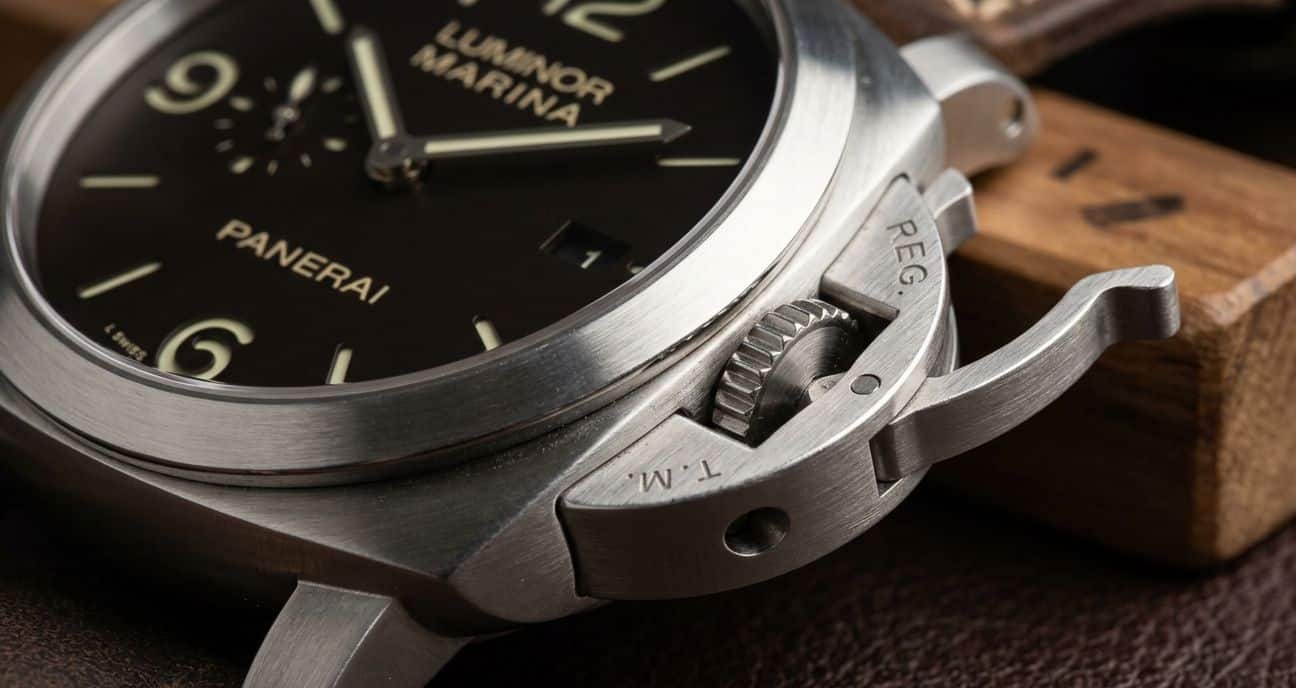
Manufacturing detail: When inspecting your QC photos and videos, pay close attention to the spring-loaded lever mechanism. The lever should snap firmly and audibly into its closed position, securing the crown tightly against the case. There should be no noticeable play, looseness, or wobbling once the lever is closed. Crucially, the pivot pin that allows the lever to articulate should sit flush with the lever and the crown guard itself, showing no protrusion or recession.
Why it matters: A loose or wobbly lever is a clear indicator of manufacturing tolerance issues. This isn’t merely an aesthetic defect; it compromises the watch’s intended water resistance by not providing consistent pressure on the crown gasket. Over time, it can also lead to premature wear on the crown stem or the lever mechanism itself, impacting durability. Genuine Panerai crown guards are engineered for precise, robust engagement.
Evidence & Observation: Compare the action you see in the QC video to the crisp, secure engagement of a genuine Panerai. Look for any visible gaps between the lever and the case when closed, or any side-to-side movement of the lever. A “spongy” or soft engagement, rather than a firm snap, is a red flag.
Judgment: Reject the watch if the CG lever feels flimsy, wobbly, or fails to secure the crown firmly and without play. This is a critical functional and aesthetic flaw.
CG Pin Alignment & Flushness
Manufacturing detail: Examine the two small pins that hold the CG lever in place. These pins must be perfectly flush with the surface of the crown guard, meaning they should not protrude even slightly, nor should they be noticeably recessed. This flushness should be consistent on both sides of the lever.
Why it matters: Protruding pins can snag on clothing or skin, indicating poor assembly or incorrect pin sizing. Recessed pins suggest the opposite problem – pins that are too short or improperly pressed, which can weaken the lever’s securement over time. Both are aesthetic tells that immediately differentiate a replica from a genuine piece, and both hint at a lack of precision in manufacturing or assembly. The reference material notes that VS Factory’s crown guard machining sometimes shows minor asymmetry, which can manifest in these pin alignments.
Evidence & Observation: Request high-resolution close-up photos of the CG from multiple angles. Zoom in to scrutinize the pins. Even a fraction of a millimeter of protrusion or recession is visible under magnification and should be cause for concern. Compare this to images of genuine Panerai CGs, where the pins are seamlessly integrated.
Judgment: Reject if the CG pins are not perfectly flush and even on both sides of the lever. This is a common, yet easily overlooked, sign of inferior quality control.
Crown Stem Operation & Winding Feel
Manufacturing detail: With the CG lever open, observe the crown’s operation. When pulled out to set the time or date (if applicable), it should do so smoothly, without excessive force, grittiness, or sticking. Winding the watch (either manually or by observing the rotor if it’s an automatic) should feel consistent, neither overly stiff nor excessively loose. There should be distinct, positive “clicks” as the crown is pulled to different positions.
Why it matters: A gritty or inconsistent crown operation can point to underlying issues with the movement’s keyless works (the mechanism that allows the crown to engage winding and setting functions) or poorly machined stem components. These are functional problems that can lead to long-term reliability issues and expensive repairs. A smooth, precise crown action is a hallmark of a well-made watch, genuine or replica.
Evidence & Observation: Ask for a video that clearly shows the crown being pulled out, pushed in, and wound. Listen for any unusual sounds or observe any jerky movements. The ideal feel is one of controlled resistance and smooth engagement, with clear tactile feedback at each position.
Judgment: Reject if the crown operation is rough, inconsistent, excessively stiff, or feels “gritty.” These symptoms suggest potential underlying movement or assembly problems that will detract from the ownership experience.
Expert Authentication Insight
Physical diagnostic: If possible, gently depress the CG lever with a finger while observing the pivot pins under 10x magnification. Any lateral play or visible deformation of the pin housing indicates poor machining or assembly that will not hold up to long-term use. For absolute precision, use a micrometer to check the flushness of the pins relative to the CG surface; a tolerance of less than 0.05mm protrusion or recession is generally acceptable, but ideally, they should be perfectly flush.
Dial Details: Precision Printing, Hand Alignment, and Lume Application
The dial is the face of the watch, and any inconsistencies here are immediately noticeable. For Panerai super clones, scrutinizing the dial’s subtle elements—from printing to hand placement and lume—is crucial for spotting tells.
Index & Numeral Printing Precision
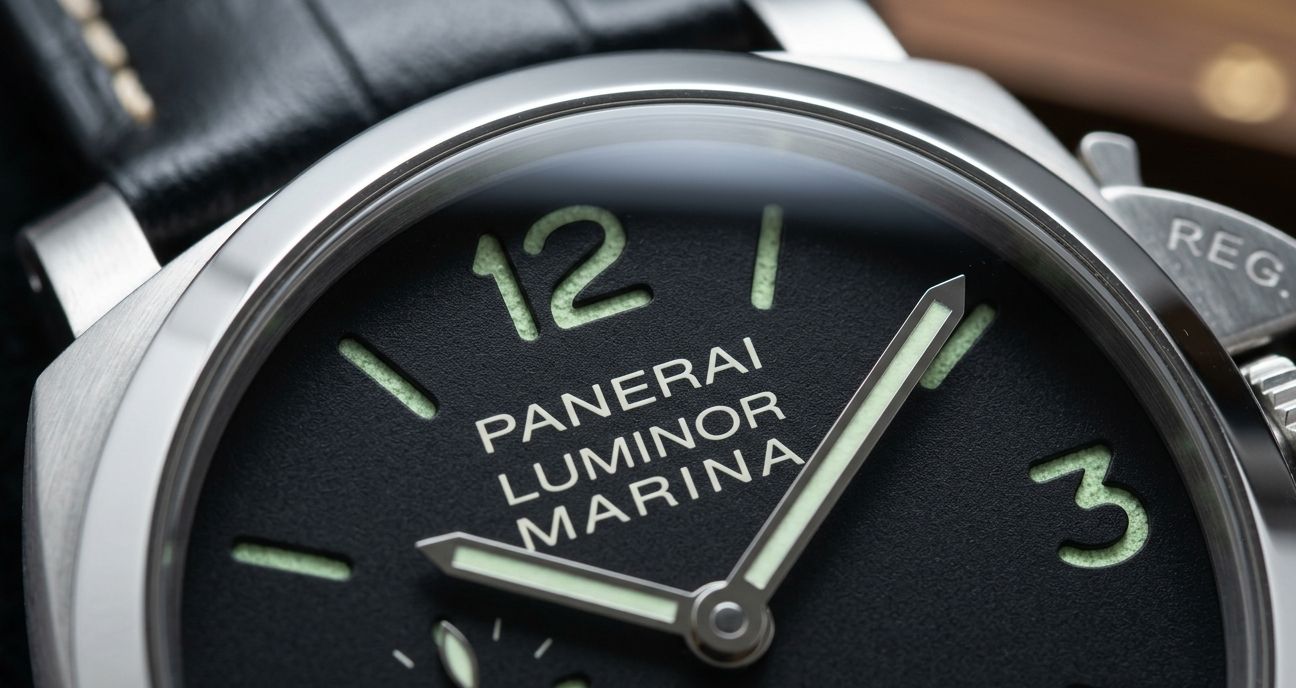
Manufacturing detail: Examine every piece of printed text on the dial, including indices, numerals (e.g., “12”, “3”, “6”, “9”), and branding like “PANERAI” and “LUMINOR MARINA.” The edges of all printed elements should be razor-sharp, without any feathering, bleeding, or fuzziness. The thickness of the lines and characters should be uniform, and the spacing between individual characters and lines of text should be perfectly consistent. Even the tiniest imperfection can give away a replica.
Why it matters: Inconsistent printing quality is a very common tell for replicas. It often indicates poor stencil work, inferior ink application, or rushed production processes. While VS Factory is known for good dial quality, minor flaws can still occur. For example, the reference information notes that VS Factory’s date wheel font can occasionally run slightly bold, which speaks to these printing precision issues.
Evidence & Observation: Request extremely high-resolution, well-lit macro photos of the dial. Zoom in on every numeral and letter. Compare the crispness against genuine dial images. Look for any signs of “ghosting” (faint double images) or uneven ink saturation.
Judgment: Reject if any text or index appears blurry, uneven in thickness, or shows inconsistent spacing. These are fundamental errors that detract significantly from the watch’s authenticity.
Hand Stack & Pinion Alignment
Manufacturing detail: Observe the alignment of the hour, minute, and any other hands (like a small seconds hand or GMT hand) relative to each other and the central pinion. All hands should be perfectly parallel to the dial surface, with no visible bending or unevenness. The central pinion cap, which covers the pivot point of the hands, should be flush with the top of the hands and perfectly centered, not protruding or off-kilter.
Why it matters: Misaligned or bent hands, or a poorly fitted pinion cap, are immediate visual flaws that indicate rushed assembly or poor quality control. This isn’t just an aesthetic issue; hands that aren’t perfectly parallel can rub against each other or the dial, leading to wear, friction, and potentially stopping the watch. A protruding pinion cap can also catch on the crystal or cause issues.
Evidence & Observation: A high-magnification photo taken from the side, or a video slowly rotating the watch, is essential here. Look for any shadows cast by one hand onto another due to misalignment. The central pinion cap should appear as a perfectly circular, flush element.
Judgment: Reject if hands are visibly bent, not parallel to each other or the dial, or if the central pinion cap is off-center, protruding, or visibly uneven.
Lume Application Uniformity & Texture
Manufacturing detail: Inspect all luminous elements on the dial—the hour markers, numerals, and hands—for even and consistent application. The lume material should have a uniform texture and height across all plots, without any visible bubbles, dust particles trapped underneath, or uneven patches. The surface of the lume should appear smooth and consistent, not grainy or pitted.
Why it matters: Poor lume application not only affects the watch’s aesthetic quality but also its functional performance in low light. Inconsistent thickness or texture can lead to uneven glow, and trapped debris is a clear sign of sloppy manufacturing. While the exact color of the lume will be discussed later, this section focuses on the physical application itself.
Evidence & Observation: Request close-up macro photos of the lume plots in normal light. Compare areas with lume to ensure consistency. Look for any “peaks” or “valleys” in the lume application. When considering a purchase, understanding replica watch payment options is also crucial. Genuine Panerai dials feature meticulously applied lume that appears perfectly smooth and uniform.
Judgment: Reject if the lume appears patchy, grainy, has visible bubbles or dust trapped within it, or is unevenly applied across different elements of the dial.
Expert Authentication Insight
Physical diagnostic: Under a macro lens (10x-20x magnification), meticulously inspect the edge definition of all printed elements on the dial. A truly superior replica will show a perfectly sharp edge with no ink bleed whatsoever, mimicking the precision of genuine printing. For hand alignment, measure the gap between the minute hand and the hour hand at various points of rotation (e.g., 12, 3, 6, 9 o’clock) to confirm consistent parallelism and ensure they don’t touch.
Datewheel & Cyclops (If Applicable): Centering, Font Accuracy, and Magnification
For Panerai models that feature a date complication, this often-overlooked area can be a major source of replica tells. Precision in the date window, font, and cyclops (if present) is paramount for a convincing super clone.
Date Window Cut-out & Centering
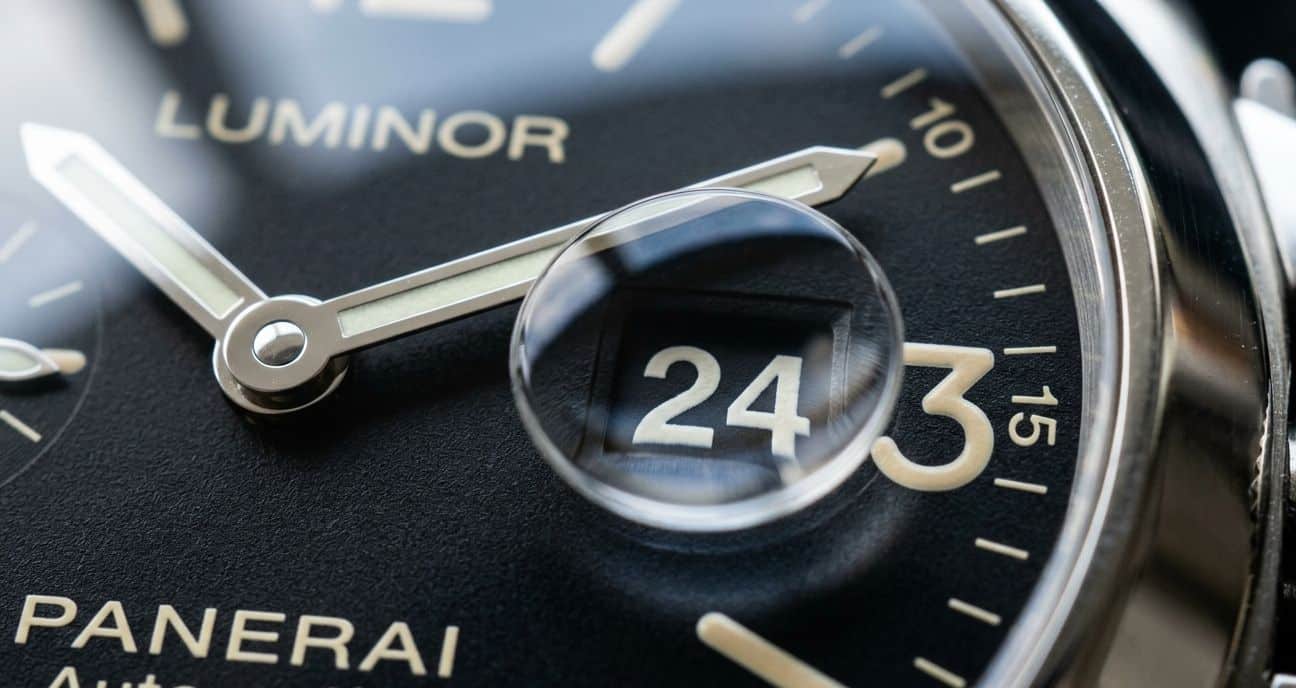
Manufacturing detail: Examine the date window itself. The edges of the cut-out in the dial should be clean, sharp, and free from any rough cuts, burrs, or debris. More importantly, the date numeral, as it appears in the window, must be perfectly centered both horizontally and vertically. This centering should remain consistent as the date changes from 1 through 31. The reference information specifically notes that VS Factory’s date window can occasionally sit 0.2mm too high on some models, which is a subtle but critical flaw to watch for.
Why it matters: A misaligned or poorly cut date window is a glaring flaw that impacts readability and immediately detracts from the overall dial aesthetics. An off-center date numeral is a dead giveaway, indicating imprecise movement assembly or a poorly manufactured datewheel. This is one of the first things many discerning collectors look for.
Evidence & Observation: Request QC photos showing the date at various positions (e.g., 1, 11, 28) to check for consistent centering. Look for symmetry around the numeral within the window. Any visible rough edges around the window’s perimeter are also unacceptable.
Judgment: Reject if the date numeral is consistently off-center within the window for any date, or if the date window itself has rough, uneven edges. Also, be wary if the window appears visibly too high or low relative to the dial’s other elements, as noted for some VS Factory models.
Font Style & Thickness Consistency
Manufacturing detail: Compare the font used on the datewheel to genuine Panerai examples. Pay extremely close attention to the thickness, the presence or absence of serifs (small decorative lines at the ends of strokes), and the overall style of each numeral. Crucially, this font style and thickness must be consistent across all 31 days. The reference material specifically mentions that VS Factory’s date wheel font can occasionally run slightly bold, which is a key detail to verify.
Why it matters: Incorrect date font is a notoriously common replica tell. Factories sometimes use generic fonts or have inconsistent printing processes, leading to numerals that don’t quite match the genuine article. Even a slight variation in boldness or serif style can be a giveaway to an informed eye.
Evidence & Observation: Request multiple QC photos of different dates (e.g., single-digit, double-digit, and dates like “11” or “22” to check for consistency). Side-by-side images comparing the replica date font to genuine Panerai date fonts are invaluable here. Look for any dates that appear thicker, thinner, or just “off” compared to others or to genuine examples.
Judgment: Reject if the date font is clearly incorrect for the specific Panerai model, inconsistent across different dates, or differs significantly in style or thickness from genuine examples, especially noting the common “bold” issue with some VS Factory date wheels.
Cyclops Magnification & Clarity (if present)
Manufacturing detail: For Panerai models equipped with a cyclops lens over the date window, assess its magnification power and clarity. The cyclops should provide a consistent magnification of approximately 2.5x, making the date numeral significantly larger and easier to read. The view through the cyclops should be clear and distortion-free when viewed from various angles, not just straight on.
Why it matters: Incorrect magnification (e.g., 1.5x or 2x instead of 2.5x) or a blurry, distorted cyclops defeats its primary purpose and is an immediate, undeniable indicator of a replica. A poorly manufactured cyclops can also have an incorrect curvature or be improperly installed, leading to visual aberrations that are not present on genuine watches.
Evidence & Observation: Request a video showing the date through the cyclops from various angles, and compare the magnified size to the date numeral size outside the cyclops. Genuine cyclops lenses offer crisp, uniform magnification with minimal edge distortion. Look for any milky appearance, scratches, or uneven magnification.
Judgment: Reject if the cyclops does not provide sufficient magnification (it should appear clearly larger than 2x) or if it introduces significant distortion, haziness, or a noticeable blue/purple tint not present in genuine examples.
Expert Authentication Insight
Physical diagnostic: Request photos of the date display at 09:00, 15:00, and 21:00 positions. Use a digital grid overlay tool on these photos to verify the perfect horizontal and vertical centering of the numeral within the date window. To assess cyclops magnification, compare the physical size of the date numeral as seen through the cyclops against its actual size on the datewheel (or against a non-magnified numeral if visible). A precise 2.5x ratio is key.
Case Construction & Rehaut: Engraving Depth, Finish, and Crystal Fit
This section examines the exterior of the watch, focusing on the quality of the case, the often-overlooked rehaut, and the crystal’s integration.
Rehaut Depth & Engraving Sharpness
When scrutinizing your QC photos, pay close attention to the rehaut—that inner bezel ring between the dial and the crystal. Examine it for consistent depth and the crispness of any engraved text, such as “PANERAI.” These engravings should appear sharp, evenly spaced, and entirely free from burrs, ghosting, or any signs of shallow, imprecise etching. Shallow, uneven, or poorly executed rehaut engravings are a common tell for a replica that falls short of “super clone” standards. While minor variations might exist, a true super clone aims for near-perfection here. To verify, compare macro photos of your watch’s rehaut against high-resolution images of genuine Panerai rehaut engravings. Look for the distinct, clean lines and uniform depth that define authentic pieces. If the engravings appear blurry, faint, inconsistent in depth or spacing, or show any signs of bleeding, it indicates a manufacturing shortcut. Reject the watch if rehaut engravings are shallow, blurry, or inconsistent in appearance.
Case Finish & Lug Alignment
The case is the backbone of any Panerai, and its finish and lug alignment speak volumes about manufacturing quality. Inspect the entire case for uniform brushing or polishing, ensuring there are no stray scratches, dings, or uneven transitions between different finishes (e.g., where a brushed surface meets a polished edge). The lugs—those extensions that hold the strap—must be perfectly symmetrical, evenly shaped, and align flawlessly with the main body of the case. Any unevenness in the finish, such as inconsistent brushing patterns or rough polishing, or any visible asymmetry or misalignment in the lugs, points to poor machining or rushed finishing processes. These flaws significantly detract from the watch’s overall quality and are immediate visual tells. High-resolution photos, especially from multiple angles, are crucial here. They allow you to spot subtle differences between a perfectly executed case and one with minor imperfections like slightly rounded lug edges or inconsistent chamfers. Reject the watch if the case finish is inconsistent, has visible flaws, or if the lugs are asymmetrical or misaligned.
Crystal Fit & AR Coating Quality
The sapphire crystal is not just a protective barrier; its fit and clarity are critical to both aesthetics and water resistance. The crystal should sit perfectly flush with the bezel, exhibiting no discernible gaps, unevenness, or protrusion. A poor fit compromises the watch’s ability to resist water and immediately signals a quality control issue. Furthermore, assess the anti-reflective (AR) coating. On most genuine Panerai models, the AR coating is applied only to the interior surface of the crystal, resulting in a clear view of the dial with minimal reflections, often displaying a very subtle blue tint only at extreme angles. It should be uniform and clear, without a strong, obvious blue or purple hue unless that specific color is characteristic of the genuine model you’re replicating. An incorrect AR coating color or one applied to both sides (which can create a more reflection-free appearance than genuine) is a visual tell. Look for photos that show the crystal from various angles to check for flushness and the nature of the AR coating. Reject the watch if the crystal is not perfectly flush, has visible gaps, or if the AR coating color is incorrect or inconsistent with the genuine model.
Expert Authentication Insight
For a definitive check on the rehaut, if you have access to a depth gauge, measure the engraving depth at multiple points. A consistent depth, typically between 0.1mm and 0.2mm, is expected for a high-quality engraving. For the crystal fit, run a fingernail gently along the edge where the crystal meets the bezel. It should feel perfectly smooth with no discernible lip or unevenness. Any catch or ridge is a red flag.
Lume Performance: Brightness, Longevity, and Color Consistency
Beyond mere application, this section assesses the functional performance and aesthetic accuracy of the watch’s luminous material.
Initial Brightness & Charge Consistency
A critical request for your QC photos is a “lume shot”—a picture taken immediately after the watch has been exposed to a strong light source. In this shot, all luminous elements, including the hour markers, numerals, and hands, should glow with uniform intensity. There should be no noticeable dim spots or areas that appear significantly brighter than others. Uneven initial brightness is a clear indicator of inconsistent lume quality or application, which directly impacts the watch’s low-light legibility and overall aesthetic. Comparing the QC lume shot to known examples of genuine Panerai lume intensity and uniformity will help you gauge its accuracy. If any lume plot or hand shows significantly weaker initial brightness compared to the others, or if the overall glow appears notably dimmer than what’s expected from a genuine Panerai, it’s a reason for concern. Reject the watch if any lume plot or hand shows significantly weaker initial brightness compared to others.
Lume Color & Afterglow Characteristics
The color of the lume, both when fully charged and as it fades, is a crucial detail. Observe the specific color of the charged lume (it might be green for many Luminor models or blue for some Submersibles) and how that color transitions as the glow diminishes. The afterglow should remain consistent across all luminous elements. An incorrect lume color for the specific Panerai model you’ve ordered, or a rapid, inconsistent fading pattern, is a strong indicator that non-genuine or inferior lume material has been used. Genuine Panerai uses high-quality Super-LumiNova, which provides a specific color and a consistent, long-lasting glow. For instance, if your Luminor model should have a green glow but shows a distinctly blue one, or vice-versa, that’s a tell. Similarly, if some markers fade much faster than others, it’s an issue. Reject the watch if the charged lume color is incorrect for the specific Panerai model or if it fades inconsistently across different elements.
Bleeding & Edge Definition Under Lume
Examine the edges of the luminous plots and numerals very closely in the lume shot. The luminous material should be precisely contained within its intended boundaries. There should be absolutely no “bleeding” where the lume extends beyond the printed or cut-out edges, nor should the edges appear fuzzy or undefined. Lume bleeding is a tell-tale sign of sloppy application and significantly detracts from the dial’s precision and overall finish. For a comprehensive Panerai replica buying guide, perfect edge definition is paramount. Given Panerai’s iconic sandwich dials with their sharply cut-out numerals, macro lume shots are invaluable here, as they can reveal even microscopic imperfections. Compare the crispness of the lume edges to macro photographs of genuine Panerai dials. Reject the watch if there is any visible lume bleeding or if the edges of the lume plots appear fuzzy.
Expert Authentication Insight
To properly assess lume longevity, request a timed lume decay video from your dealer. This video should start immediately after charging and ideally run for at least 30 seconds, allowing you to observe the consistency of the afterglow and how quickly it diminishes across all elements. For color accuracy, if a colorimeter isn’t available, ask for comparative photos of the charged lume next to a known genuine example under the same lighting conditions. This helps verify the correct lume color temperature.
VS Factory Movement Validation: P.9000/P.9010 Series Specifics
This section delves into the critical details of the VS Factory’s replica P.9000/P.9010 series movements, focusing on visual accuracy and timekeeping performance.
Decoration Accuracy & Bridge Engravings
For Panerai models with a display caseback, the movement’s visual accuracy is crucial. Examine the movement’s bridges, plates, and rotor for accurate decoration, including Geneva stripes (Côtes de Genève), perlage (circular graining), and the correct engraving of “PANERAI,” “P.9000/P.9010,” and the jewel count. The font style, size, and depth of these engravings must closely match genuine examples. While VS Factory is renowned for its high-quality movement decoration, flaws can still occur. Inaccurate or poorly executed decoration, such as uneven Geneva stripes, faint or misaligned perlage, or blurry/incorrect engravings, is a common tell that can easily betray a replica. High-resolution, side-by-side photos comparing the VS Factory movement to a genuine P.9000/P.9010 will highlight critical decorative elements and any discrepancies. Reject the watch if movement engravings are blurry, incorrect, or if decorative patterns are visibly inconsistent or poorly finished.
Balance Wheel & Regulator Configuration
The balance wheel and its associated bridge are often areas where replica movements, even high-quality ones, can deviate from genuine aesthetics due to different underlying base movements. Observe the balance wheel’s color—it should typically have a Glucydur-like gold tone on genuine P.9000/P.9010 movements—and ensure the regulator mechanism closely mimics the genuine Panerai design. Any significant visual discrepancies in the balance wheel’s appearance, the shape or finish of its bridge, or the overall regulator configuration can be a strong indicator of a less accurate clone. Close-up photos of the movement are essential here, allowing you to compare the VS Factory’s balance wheel assembly against genuine examples and identify key visual identifiers. Reject the watch if the balance wheel or regulator setup visually deviates significantly from the genuine P.9000/P.9010.
Timegrapher Readings: Amplitude, Beat Error, Rate
Perhaps the most objective measure of movement health comes from timegrapher results. Always request these from your dealer. The key metrics to inspect are:
- Rate: This indicates how many seconds the watch gains or loses per day. An acceptable range for a well-regulated super clone movement is typically between -5 to +10 seconds per day.
- Amplitude: This measures the rotational angle of the balance wheel. For a fully wound movement, dial up, an amplitude of 270-310 degrees is generally considered healthy. Lower numbers can indicate friction or a need for service.
- Beat Error: This measures the difference in time between the “tick” and “tock” sounds of the escapement. A healthy range is 0.0-0.3 milliseconds (ms). Higher numbers suggest poor regulation or a bent balance staff.
These metrics are objective indicators of the movement’s health and regulation. Readings consistently outside these ranges suggest a poorly regulated, poorly assembled, or even damaged movement. While a dealer might regulate a movement before shipping, consistently poor numbers often point to underlying issues. Demand clear examples of acceptable versus unacceptable timegrapher readings and understand their implications. Reject the watch if any timegrapher reading falls outside the specified acceptable ranges.
Expert Authentication Insight
Visually confirm the presence and correct placement of all visible jewels on the movement bridges. These should be clearly visible and uniformly seated. Additionally, use a magnifying loupe (if possible, or request a very high-resolution photo) to check for microscopic dust, fibers, or debris trapped within the movement, especially under the balance wheel. Such debris can indicate rushed assembly and lead to future problems.
Caseback & Engravings: Depth, Alignment, and Detail Accuracy
The caseback is often out of sight, out of mind, but it’s a critical area where many replicas fall short. Incorrect engravings, shallow depth, or misalignments can easily expose a replica, especially when the watch is off the wrist or being handled. A genuine Panerai caseback is a testament to precise manufacturing, and any deviation here should be a red flag.
Engraving Depth & Sharpness
Examine all caseback engravings—model number, serial number, “OFFICINE PANERAI” text, and water resistance rating—for consistent depth and sharp, clean edges. Genuine Panerai casebacks feature deeply and precisely engraved markings. They are not merely superficial laser etchings; you should be able to feel the depth with a fingertip. Shallow, faint, or blurry engravings are a common replica flaw, indicating either poor manufacturing processes or an attempt to cut corners. If the engravings appear thin, weak, or have fuzzy edges, it suggests a less-than-super clone.
Reject if caseback engravings appear shallow, faint, or lack crisp, sharp edges.
Alignment of Text & Logos
Beyond depth, the alignment of text and logos on the caseback is crucial. Verify that all elements are perfectly aligned, evenly spaced, and correctly oriented. There should be no crooked text, misplaced elements, or inconsistent spacing between characters or lines. Misaligned engravings are a clear sign of poor manufacturing quality control and a lack of attention to detail during the stamping or engraving process. Even a slight tilt or offset can be an immediate tell to an informed eye.
Reject if any text or logo on the caseback is visibly misaligned or crooked.
Serial Numbers & Reference Markings
Confirm that the serial number and model reference engraved on the caseback match what was ordered and are consistent with known Panerai conventions. While super clones use replica serials, their format should accurately mimic genuine examples. Incorrect serial number formats, inconsistent character spacing, or atypical model references are obvious red flags, even for a replica. Genuine Panerai serials are laser-etched with consistent depth and clarity. Look for dot-matrix etching or inconsistent depth in the replica, which are common tells.
Reject if the serial number or reference markings are clearly incorrect in format or inconsistent with the model.
Expert Authentication Insight
When inspecting the caseback, use a fine-tipped probe or even a fingernail to feel the depth of the engravings. Genuine engravings will have a noticeable tactile depth and resistance. For the serial number, compare its font style and size against known genuine examples under magnification; subtle differences in serif, weight, or spacing are often present in replicas.
Strap, Buckle & Accessories: Often Overlooked Details for a Complete Experience
While not part of the watch head itself, the strap, buckle, and any included accessories contribute significantly to the overall “super clone” experience. These are often areas where factories cut costs, and flaws here can quickly diminish the perceived quality of an otherwise excellent replica.
Strap Material & Stitching Quality
Assess the strap material—whether leather, rubber, or textile—for correct texture, color, and suppleness. A high-quality Panerai replica strap should feel substantial and well-made. Crucially, the stitching should be uniform, straight, and free from loose threads, frayed edges, or uneven tension. Poorly finished or low-quality straps are a common cost-cutting measure and can significantly detract from the overall impression. Furthermore, check the fit of the strap to the case; some replicas show small gaps (0.5-1mm) at the lugs due to imprecise spring bar positioning, which is an immediate visual flaw.
Reject if the strap material feels cheap, looks incorrect, or has visibly poor stitching or fitment.
Buckle Finish & Engravings
The buckle, whether a pin buckle or deployant clasp, is a prominent accessory that gets frequent handling. Examine it for correct shape, finish (e.g., brushed or polished to match the case), and accurate engravings, such as “PANERAI” or the brand logo. These engravings should be sharp, clean, and correctly aligned, mirroring the quality expected from the watch itself. A blurry, misaligned, or incorrect buckle engraving is easily noticeable and diminishes the watch’s overall authenticity.
Reject if the buckle’s shape, finish, or engravings are incorrect, blurry, or misaligned.
Packaging & “Paperwork” (if included/relevant)
If your purchase includes packaging, boxes, or “papers,” inspect them for overall quality, correct logos, fonts, and serial number consistency with the watch. While these are not part of the watch’s core function, incorrect or low-quality accessories can indicate a less reputable source or a lower-tier replica. It’s important to set expectations here: replica packaging is rarely on par with genuine, but it shouldn’t be laughably bad. If a dealer promised high-quality accessories and they arrive looking cheap or with glaring inaccuracies, it’s a point for concern.
Consider rejecting (or negotiating) if included accessories are of exceptionally poor quality or have glaring inaccuracies that were promised otherwise.
Expert Authentication Insight
For straps, measure the width at the lugs and the buckle to confirm the correct taper and size for the specific Panerai model. Inspect the buckle’s spring bar holes for clean drilling and secure fitment, ensuring the spring bar sits flush and doesn’t wiggle excessively.
You’ve now navigated the intricate landscape of Panerai super clone quality control, moving beyond superficial aesthetics to the critical details that define a truly exceptional replica. The goal of this checklist isn’t to demand unattainable perfection, but to define acceptable imperfection*—the standard that aligns with the “super clone” promise. Even top-tier factories like VS Factory will have minor variances, but the critical flaws outlined here are grounds for rejection. Do not be swayed by dealer reassurances if a significant, checklist-defined flaw is present. Trust your judgment, armed with this specific knowledge. Armed with this checklist, you are now the expert. Approve with confidence, or reject without hesitation.