
The Patek Philippe Nautilus 5726 replica sits in a tricky middle ground: it looks more complex and interesting than a simple Nautilus three-hand model, but the extra displays do not automatically mean real annual calendar behavior. That is the core decision in this article, especially when comparing it with a Nautilus 5980 chronograph replica where movement layout, pushbutton feel, and calendar expectations follow a different technical logic: whether you want the richer day, date, month, and moonphase-style layout, or whether you need a watch that actually handles calendar changes with less manual correction. The difference matters because a watch can look convincing at a glance while still requiring frequent resetting behind the scenes.
This guide helps you judge the 5726 the right way: by checking dial alignment, printing, symmetry, case profile, bracelet feel, and what the calendar windows really do. It also shows why some versions are better suited to display-focused buyers, while others can become frustrating if you expect low-maintenance daily wear. If you are choosing between visual complexity and mechanical realism, this article makes the trade-offs easier to see.
| Decision Point | What To Check | Why It Matters |
|---|---|---|
| Calendar behavior | Which windows move and whether correction is manual | Shows if the watch is display-focused or functionally closer to an annual calendar |
| Dial alignment | Window spacing, printing, and symmetry in straight-on QC photos | Small misalignments stand out quickly on a busy 5726 dial |
| Moonphase-style display | Disc placement, artwork, and center alignment | A weak moonphase section can undermine the whole front of the watch |
| Case profile | Thickness and side shape compared with the genuine look | Too much thickness makes the watch feel less balanced on the wrist |
| Bracelet and clasp | Fit, finish, and clasp closure in QC photos | These details affect daily wear more than the calendar display itself |
| Buyer fit | Whether you accept occasional resets and manual correction | The watch suits visual appeal first; low-maintenance buyers may prefer a simpler Nautilus |
Quick Questions Before You Read
Q: Is the 5726 replica a real annual calendar?
Usually not in the full mechanical sense. Many versions only mimic the display and still need manual correction.
Q: What should I check first in QC photos?
Start with dial alignment, window spacing, and the moonphase-style display before worrying about the bracelet.
Q: Who is this model actually for?
It suits buyers who want the richer Nautilus layout and can live with some functional compromise.
Q: Is it better than a simpler Nautilus replica?
Only if you value the added visual complexity more than easy, low-maintenance wear.
Reader Boundary: Brand names are used here to identify the genuine reference design being discussed and to make the comparison understandable. A Nautilus 5726 replica is a replica-market watch, not a genuine Patek Philippe watch, not an authorized product, and not a substitute for a genuine brand-manufactured annual calendar.
The purpose of factory, movement, and QC discussion in this article is buyer education: understanding trade-offs, avoiding exaggerated claims, and making the difference between visual replication and real mechanical behavior clearer. It should not be used to represent a replica watch as genuine or to imply official brand affiliation.
Why the Nautilus 5726 Replica Attracts Buyers Who Want More Than a 5711
The Nautilus 5726 replica draws attention for one simple reason: it looks like a more serious watch than the plain three-hand 5711. The extra calendar information gives the dial more depth, more balance, and more of that complicated Nautilus presence buyers often want when they feel the 5711 has become too familiar.
For many shoppers, that is the real appeal of a Patek Philippe 5726 replica. It does not just copy the Nautilus shape; it adds day, date, month, and moonphase-style visual cues that make the watch feel closer to a mechanical statement piece. That is also why the 5726 often becomes the alternative buyers consider when they want something more interesting than a 5711 but do not want to jump all the way into a 5712 comparison.
The problem is that visual complexity can create unrealistic confidence. A busier dial looks more advanced, but that does not automatically mean the watch delivers genuine calendar behavior or a better ownership experience. In replica watches, complication displays are often where expectation and reality separate the fastest.
Editorial Perspective: On a model like the 5726, factory names and seller photos are only starting points. At cleanvsfactory.com, this kind of watch is better judged by model-specific details: whether the calendar layout is balanced, whether the movement behaves like a true annual calendar or only copies the look, and whether the thickness and bracelet feel still suit the Nautilus profile. A stronger factory label does not automatically solve those issues, and a higher price may simply reflect movement type, batch availability, or seller margin rather than a meaningfully better watch for daily wear.
Evidence Boundary: Official Patek Philippe information can help readers understand what an authorized Nautilus model is and how the brand presents materials, reference identity, and design language; for example, Patek Philippe lists the Nautilus 5811/1G as a white-gold Nautilus with a blue gradated dial.[1] That kind of source is useful for authentic-model context, but it does not prove that any Nautilus 5726 replica has the same case execution, dial quality, movement behavior, water resistance, finishing, or serviceability.
The Appeal of a Busier Nautilus Dial
The 5726 has the kind of dial layout that rewards a second look. Compared with the 5711, it feels less empty and more technical, yet it still keeps the clean Nautilus case language that makes the model recognizable at a glance. That combination is exactly why buyers searching for a moonphase Nautilus or an annual calendar look often land here first.
The visual effect matters more than many beginners expect. On the wrist, a busier dial can make the watch feel more substantial even when the underlying case proportions stay familiar. For some buyers, that extra visual density is enough to justify choosing the 5726 replica over a simpler 5711 alternative.
The Buyer Expectation Problem
This is where the 5726 creates the biggest misunderstanding. Many buyers assume that more information on the dial means the watch behaves like a genuine annual calendar. That is not a safe assumption. A replica can show more calendar indicators without actually understanding them in a mechanical sense.
So the real question is not whether the 5726 looks more interesting than the 5711. It is whether the buyer wants the annual calendar look, or whether they are expecting real calendar intelligence. Those are very different things, and confusing them leads to disappointment.
There is also a source problem in this category. Seller listings may use terms such as “annual calendar,” “moonphase,” “super clone,” or “best version,” but those words should be treated as sales descriptions unless the specific watch is shown clearly and its functions are demonstrated. A buyer should separate three things: the authentic model’s design idea, the replica’s visible dial layout, and the actual mechanical behavior of the individual watch being offered.
Factory names in the replica market are useful buyer-facing references, but they should not be treated as official luxury-brand affiliations or automatic guarantees of quality across every model. A version that looks strong in one batch can still show weaknesses in dial spacing, calendar behavior, or case thickness when compared model by model.
What a Genuine Annual Calendar Is Supposed to Do
A genuine annual calendar is not just a dial with several windows. It is a movement that can recognize how long the month is and adjust the calendar display accordingly. In practical terms, that means it knows the difference between 30-day and 31-day months without the owner resetting it every time the month changes.
The key point is that the watch is calculating, not just displaying. A dial may show day, date, and month, but if the movement does not manage month length on its own, it is not behaving like a true annual calendar. Buyers often miss that distinction because the visual layout can look convincing even when the logic underneath is much simpler.
Display Is Not the Same as Calendar Intelligence
A watch can have all the right calendar windows and still be mechanically basic. That is the core misunderstanding with many annual calendar replica searches. The presence of a day window, date window, and month display only proves that information is being shown, not that the movement understands how calendar transitions work.
Why Month-Length Recognition Matters
Month-length recognition is the feature that separates a true annual calendar from a dressed-up triple-calendar layout. If the watch automatically handles 30-day and 31-day months, it behaves like a genuine annual calendar in the way most buyers actually care about. If it does not, the owner is doing the work the movement should have done.
The Simple Test Buyers Should Understand
The buyer-facing test is straightforward: can the watch move through month transitions intelligently, or does the owner need to correct the displays manually? If manual correction is still required at regular intervals, the watch may look like an annual calendar, but it does not function like one in the way a genuine 5726 is designed to.
A useful way to avoid overclaiming is to describe the watch by verified behavior instead of by complication name alone. “Day and date change,” “month window is manually corrected,” or “moonphase-style disc advances with setting input” are more meaningful descriptions than simply calling a replica a real annual calendar. The more complicated the dial appears, the more important this plain-language function check becomes.
Movement descriptions in the replica market should be read as configuration references, not as official brand-caliber claims unless there is clear, verifiable evidence. Buyers should distinguish between movement layout, decoration, reliability, and actual serviceability.
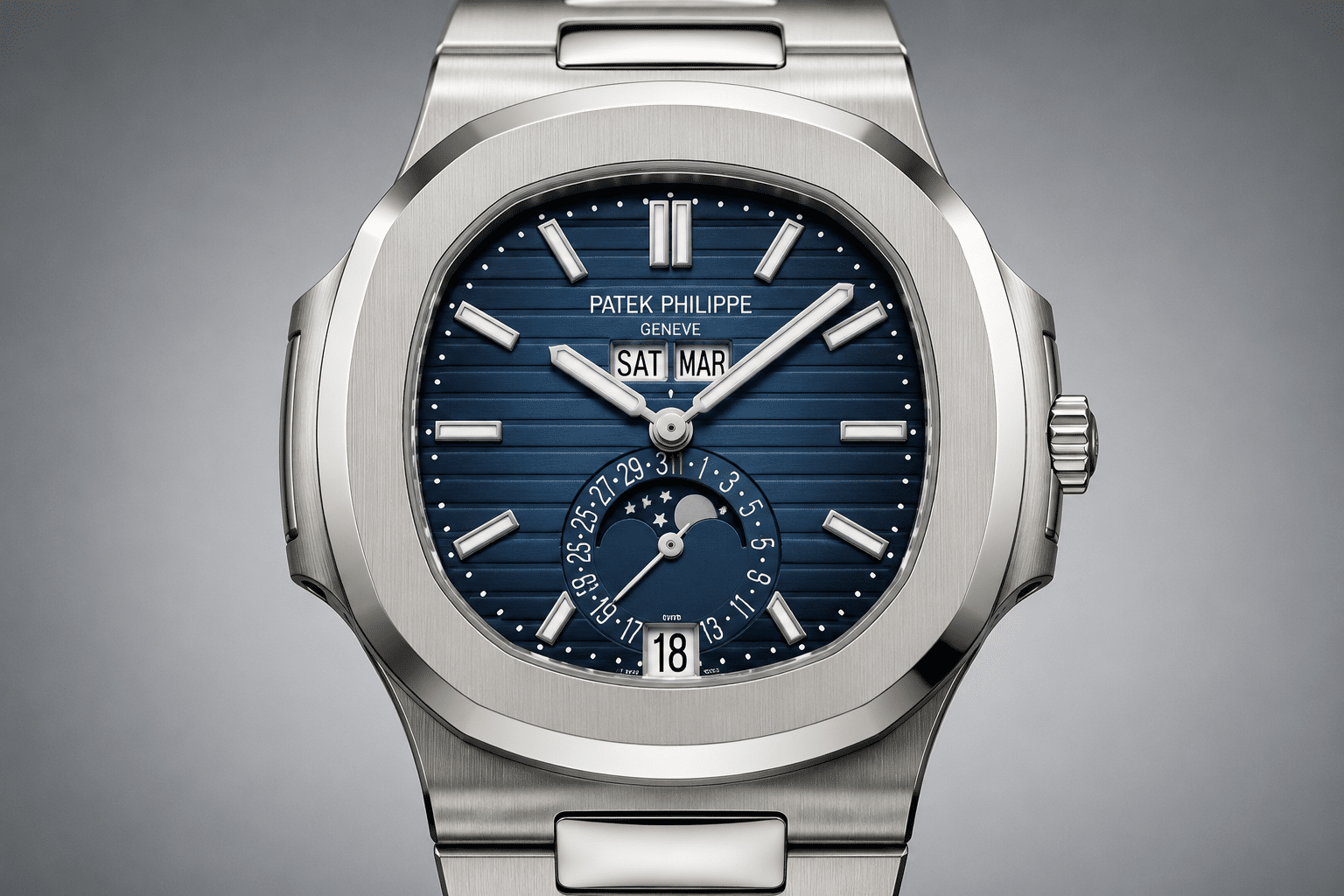
What Nautilus 5726 Replicas Usually Display on the Dial
The 5726 replica usually tries to reproduce the same visual language that makes the genuine watch appealing: multiple calendar indications, a moonphase-style display, and a layout that feels more purposeful than a plain date watch. That is why the model attracts buyers who want a moonphase Nautilus replica rather than just another simple Nautilus clone.
Still, the dial should be read as a map of possible functions, not a guarantee of true function. Depending on version, some indications may move as expected, some may require manual correction, and some may be there mainly to preserve the look of the original reference. The dial tells you what the watch is trying to imitate; it does not prove how intelligently it does so.
Day, Date, and Month Windows
These are the main elements that create the annual calendar impression. When they are placed well, the dial feels more complete and more technical than a standard Nautilus dial. When they are off, even slightly, the whole watch loses balance quickly because the eye notices calendar symmetry very easily.
That is why alignment matters so much on this model. A 5726 can look convincing in a quick photo, but once the calendar windows are slightly uneven or the printing sits wrong, the illusion weakens fast. The complication layout raises the standard for visual accuracy.
The Moonphase-Style Display
The moonphase-style area is one of the biggest reasons buyers choose the 5726 over simpler Nautilus versions. It adds depth and makes the dial feel less static. For a replica, though, that display can be either a strong visual feature or a weak imitation, depending on how the version is built.
Buyers should judge it carefully. A moonphase-style display can look right at a glance while still lacking the refinement or behavior of the genuine watch. In other words, it is a major visual attraction, but not proof of genuine-level calendar mechanics.
Why Dial Symmetry Can Hide Function Limits
A well-balanced dial can create the impression that the movement is more capable than it really is. That is one reason the 5726 replica is such a tricky watch to buy. The layout naturally suggests complexity, so buyers can easily overread the watch’s actual mechanical value.
For that reason, the 5726 should be treated as a visual-complication replica first and a function replica second. If the buyer understands that hierarchy, the model makes sense. If the buyer expects the dial to prove real annual calendar intelligence, the watch will probably disappoint.
Before making a decision, buyers should review real QC photos where available, including dial printing, hand alignment, bezel position, datewheel centering, bracelet fit, clasp engraving, case thickness, and overall finishing. Factory labels and stock photos alone are not enough for a reliable judgment.
Visual, Semi-Functional, and Manually Adjusted Features
The cleanest way to judge a Nautilus 5726 replica is to separate what you are seeing from what the watch is actually doing. A lot of buyers get trapped by the dial layout and assume every calendar indication must be behaving like the genuine annual calendar. That is the wrong test. For this model, the practical question is whether the watch gives you the 5726 look in a convincing way, and whether the functions it offers are honest enough for the price and your tolerance.
In practice, the complication package on a replica 5726 usually falls into three buckets. Some parts are mostly visual, meaning they create the right dial story without much real mechanical meaning. Some are semi-functional, meaning they move and may appear active but still do not manage month length the way the genuine watch does. And some are manually adjusted, which is the part buyers need to understand before they buy. Manual correction is not automatically a deal-breaker if you value appearance over convenience, but it is a real ownership tradeoff.
The wrong expectation is to treat every calendar-looking 5726 as a true annual calendar replica. That expectation will almost always lead to disappointment. The better approach is to ask what the watch actually does, what still has to be set by hand, and whether the dial execution is good enough that the compromise feels acceptable on the wrist.
Visual Features That Create the 5726 Look
The strongest part of a 5726 replica is usually the visual arrangement. The day, date, month, and moonphase-style areas are what give the watch its identity, and those elements matter first as design. Buyers should judge them by placement, print quality, font balance, window cutout shape, and whether the dial feels proportionate rather than crowded. If those elements are off, the watch can look cheap even before anyone asks how the calendar works.
What matters most here is not whether every subdisplay is fully intelligent. It is whether the dial reads cleanly at normal wrist distance, because a Nautilus 5811G super clone depends heavily on spacing, print depth, and balanced visual architecture. A well-done visual complication can make the watch feel much closer to the genuine 5726 than a simpler but mechanically more ambitious version with poor spacing or weak printing. For this reference, visual credibility is not secondary; it is the foundation.
Semi-Functional Displays That May Still Need Correction
Some replica 5726 versions give the impression that the displays are working in a meaningful way, but that does not mean the watch has true annual calendar logic. A hand may move, a window may change, or a moonphase-style indicator may advance, yet the underlying behavior can still be closer to a basic calendar system than a genuine annual calendar mechanism. That distinction matters because the dial can look active while the movement underneath may still lack real month-length awareness.
This is where buyers need to be skeptical of seller wording. “Working” can mean very different things in replica watch language. It may mean the subdial moves, not that the system understands 30-day and 31-day months. It may mean the watch can be set and worn, not that it is internally managing the calendar intelligently. For a 5726 replica, semi-functional is often the most accurate description of what the buyer is actually getting.
Manual Adjustment Is the Real Ownership Difference
Manual adjustment is the part that changes ownership behavior the most. Depending on the version and how you wear it, you may need to correct the day, date, month, or moonphase-style display yourself. That is normal for many replica complication routes, but it is also the thing that separates a pleasant visual watch from a watch that starts to feel annoying after a few resets.
If you wear the watch occasionally, manual correction may be easy to tolerate. If you rotate watches often, let them stop, or expect calendar convenience, the same watch can become tedious. This is the key buyer judgment: a manually adjusted calendar is acceptable only if you are buying the look with your eyes open. It is not acceptable if you are expecting genuine-like behavior without hand-setting.
Function Questions to Confirm Before Choosing
- Which displays actually move on the specific version you are considering?
- Does the day, date, month, or moonphase-style area need to be corrected by hand?
- What happens if the watch stops and has to be reset?
- Is there any true automatic handling of month length, or only a visual calendar layout?
- Are the calendar indications designed for convenience, or only for appearance?
How to Read Seller Wording Without Overreading It
Seller language is often where 5726 buyers get pulled into the wrong expectation. Phrases such as “annual calendar,” “moonphase,” “clone movement,” “top factory,” or “latest version” may describe the look, the market category, or the seller’s positioning rather than verified mechanical behavior. A safer reading is to ask what the wording proves. If it does not show the setting process, month transition behavior, movement layout, or real QC photos of the exact watch, it should not be treated as proof of function.
Price language also needs caution. Replica watch prices can vary by factory label, version, movement configuration, finishing quality, seller channel, availability, and after-sales terms. Without a clear date, currency, source, and version context, exact price comparisons are less useful than like-for-like comparison of the watch itself. A higher quote does not automatically mean a more capable annual-calendar-style movement, and a lower quote does not automatically mean a worse dial.
Guarantee-style wording should be checked directly with the seller before ordering. Return terms, repair options, water-resistance testing, shipping expectations, customs risk, and after-sales support are practical buying issues, but they should not be assumed from a product title or factory label. Water resistance in particular should not be inferred from the Nautilus design; the specific replica watch would need clear testing information and a confirmed seller policy before a buyer treats it as suitable around water.
The same restraint applies to inspection claims. A strong super clone may reduce obvious visual differences in casual wear, but it should not be represented as genuine and may still show differences under close inspection, servicing, or movement review. Any claim that a replica can pass authentication, boutique inspection, resale screening, or official service evaluation should be treated as a warning sign rather than a selling point.
Why No Replica Fully Reproduces Genuine Annual Calendar Intelligence
The main reason is simple: annual calendar behavior is not just a dial design problem. A true annual calendar needs the movement to understand month structure, manage the calendar sequence correctly, and respond reliably when the owner adjusts or resets it. That takes more than copying the face of the watch. It requires a movement route built around the logic of the complication, not just the look of it.
This is why a replica annual calendar movement almost always ends up making compromises. Once a factory tries to keep the case wearable, the price realistic, and the movement serviceable, the easier path is usually to reproduce the visible effect rather than the full mechanical intelligence. That is not a failure of the buyer’s imagination; it is the practical limit of the product category.
A good buyer should think of the 5726 replica as a visual complication watch first. If it happens to offer some movement activity beyond that, fine. But expecting full annual calendar behavior is unrealistic, and treating it as a must-have requirement will lead you toward the wrong purchase.
Calendar Logic Requires More Than Extra Dial Windows
Adding a few windows to a date movement does not create a genuine annual calendar. Real annual calendar logic depends on how the gears interact, how the calendar advances, and how the system distinguishes different month lengths. Without that mechanical structure, the watch may still present calendar information, but it is not truly calculating anything in the way the genuine watch does.
That is why a replica can look convincing in photos and still fail the real test. The dial may suggest sophistication, but the movement underneath may only be simulating the result. Buyers who understand that difference are less likely to overpay for a display that looks smarter than it actually is.
Reliability Usually Matters More Than Mechanical Ambition
For this model, a simpler or manually corrected route is often more sensible than an overcomplicated imitation that tries too hard. A movement that is easy to live with, easier to service, and less likely to create adjustment problems is usually the better ownership choice, even if it is less impressive on paper. That is the uncomfortable truth with complicated replica watches: more ambition does not automatically mean a better daily experience.
If you want a watch that behaves predictably, reliability should outrank mechanical novelty. A partially simulated calendar system that stays stable is more useful than a more ambitious setup that becomes fragile, awkward to set, or difficult to maintain. The buyer should judge the watch by how it will be worn, not by how dramatic the complication sounds in a listing.
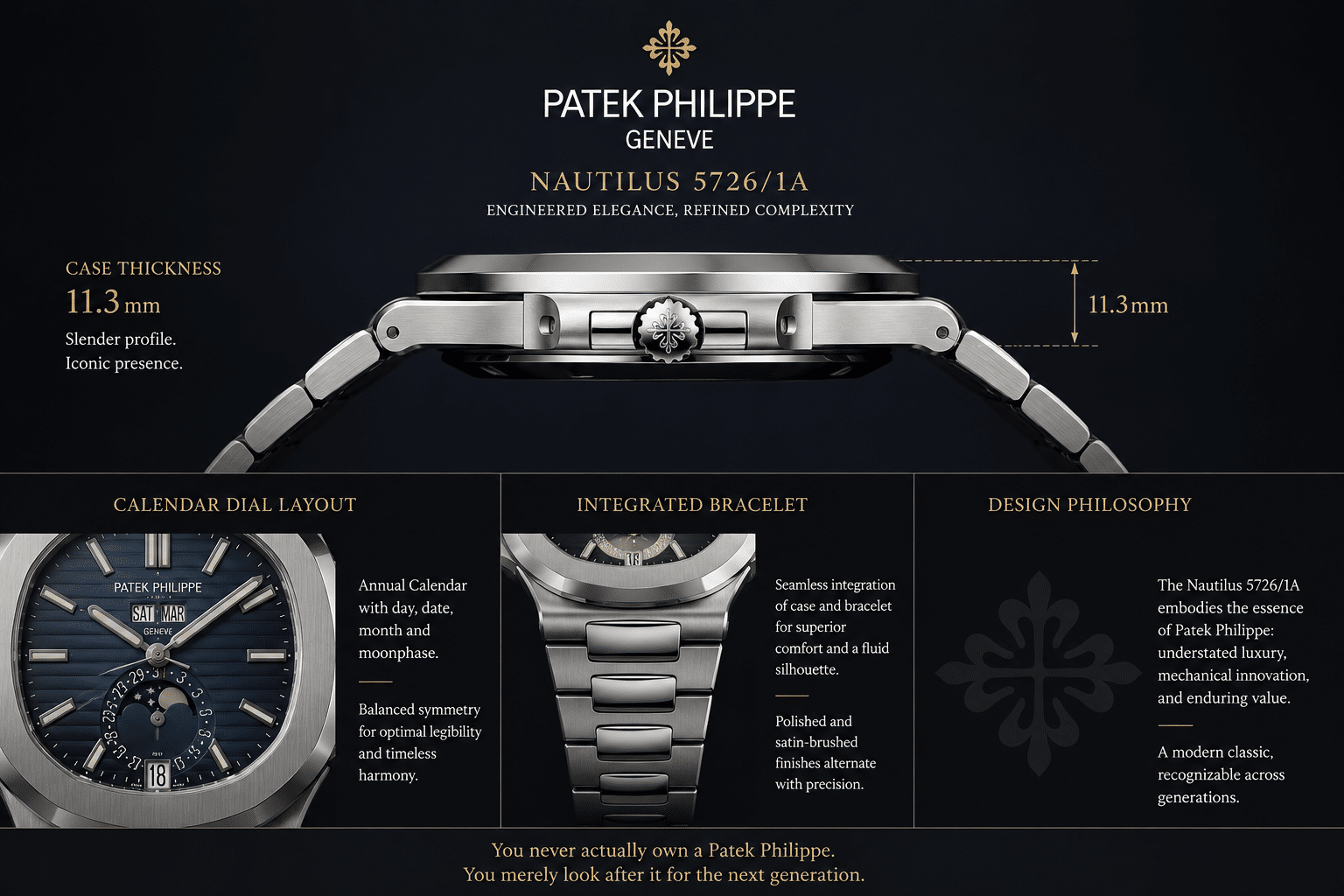
Case Thickness and Layout Constraints
Complication modules affect more than function. They also influence the case profile, dial spacing, and overall wrist feel. Once a replica has to fit extra calendar display logic into the package, the maker may need to compromise on thickness, internal layout, or the visual depth between the dial and hands. Those compromises can show up even when the front of the watch looks acceptable in isolation.
This matters because the 5726 is supposed to wear like a proper Nautilus, not like a bulky calendar watch in a Nautilus shell. If the case feels wrong or the dial spacing looks forced, the whole illusion weakens. Stronger versions are the ones that manage the complication story without breaking the watch’s original proportions.
Movement language should stay conservative here. A decorated rotor, a bridge shape, or a seller’s movement nickname does not by itself prove annual calendar architecture, long-term reliability, or service compatibility. Unless the specific watch is inspected and the setting behavior is demonstrated, the safer assumption is that the visible calendar layout and the actual mechanical logic may not match.
Movement Transparency Note: Movement references in replica and super clone watch discussions should be treated as replica-market movement descriptions unless verifiable evidence shows otherwise. Buyers should check the specific version, setting behavior, service risk, and visible movement configuration rather than assuming that a decorated movement or calendar display reproduces official Patek Philippe annual calendar engineering.
Version-specific judgment matters more than factory reputation here. In super clone watch comparisons, the safer conclusion is usually model and batch dependent: one version may handle the case proportions better but simplify the calendar behavior, while another may improve movement presentation yet still leave dial alignment or bracelet comfort behind.
Factory Choices: PPF, GR, and Mid-Tier 5726 Replica Options
Factory choice on a 5726 should be treated as a version decision, not a branding contest. Buyers often ask which factory is better, but that question is too broad for a complicated Nautilus. The more useful question is which version gives you the strongest balance of dial execution, case shape, bracelet fit, and honest function behavior for the money. On this model, appearance and mechanism have to be judged together.
PPF and GR are names buyers will encounter often, and mid-tier versions may also appear in the market depending on batch and dealer sourcing. None of these names should be treated as a permanent winner. A factory that is respectable on one Patek model may still be less convincing on the 5726 if the window layout, calendar behavior, or case proportion is off. The model matters as much as the factory.
For a buyer, the safest approach is to compare the exact version in front of you rather than assuming the factory label solves the decision. If two watches look similar in photos but differ in calendar behavior, thickness, or dial balance, the better one is the one that feels more honest in daily use, not the one with the louder name.
Why Factory Reputation Is Not Enough
A factory can have a good reputation on a simple Nautilus or another Patek line and still produce a 5726 that leaves something to be desired. Complicated dials expose weak points faster than simpler watches do. Window spacing, subdial balance, and calendar display behavior are harder to fake convincingly when the watch has more going on up front.
That is why factory reputation should be treated as a starting point, not a conclusion. The better factory is the one that handles this specific reference well enough to make the watch believable without creating extra ownership headaches.
What to Compare Between PPF, GR, and Other Versions
The most useful comparison points are straightforward: dial layout, window alignment, case profile, bracelet finishing, clasp feel, and the exact function claims attached to the watch. If a version looks better but behaves worse, that tradeoff may still be fine for a buyer who only cares about appearance. If you want something more practical, the version with the cleaner movement route and more stable behavior may be the smarter choice even if it is slightly less dramatic.
Do not let factory naming distract you from the real issue. Two watches with different labels can still feel similar on the wrist if they share the same general limitations. What separates them is often not some magical leap in quality, but how honestly they manage the 5726’s complication layout.
Batch Differences Can Change the Answer
Batch variation matters more on a model like this because the calendar layout magnifies small flaws. A slightly different dial print, a small change in window placement, or a different adjustment behavior can change the buying decision completely. Old forum opinions are not enough if the current batch has moved on.
This is where current QC photos matter more than reputation history. A strong batch can make a version look much better than its older reputation suggests, while a weaker batch can expose problems that were not part of the earlier discussion. For the 5726 replica, the exact watch matters more than the factory story attached to it.
Factory Name Clarification: Factory names such as PPF, GR, and other replica-market labels are practical buyer-facing references, not official brand affiliations or guarantees of identical quality across every model. For this kind of Nautilus replica, buyers should judge the exact watch by visible QC details, current batch behavior, calendar function claims, and real photos rather than factory name alone.
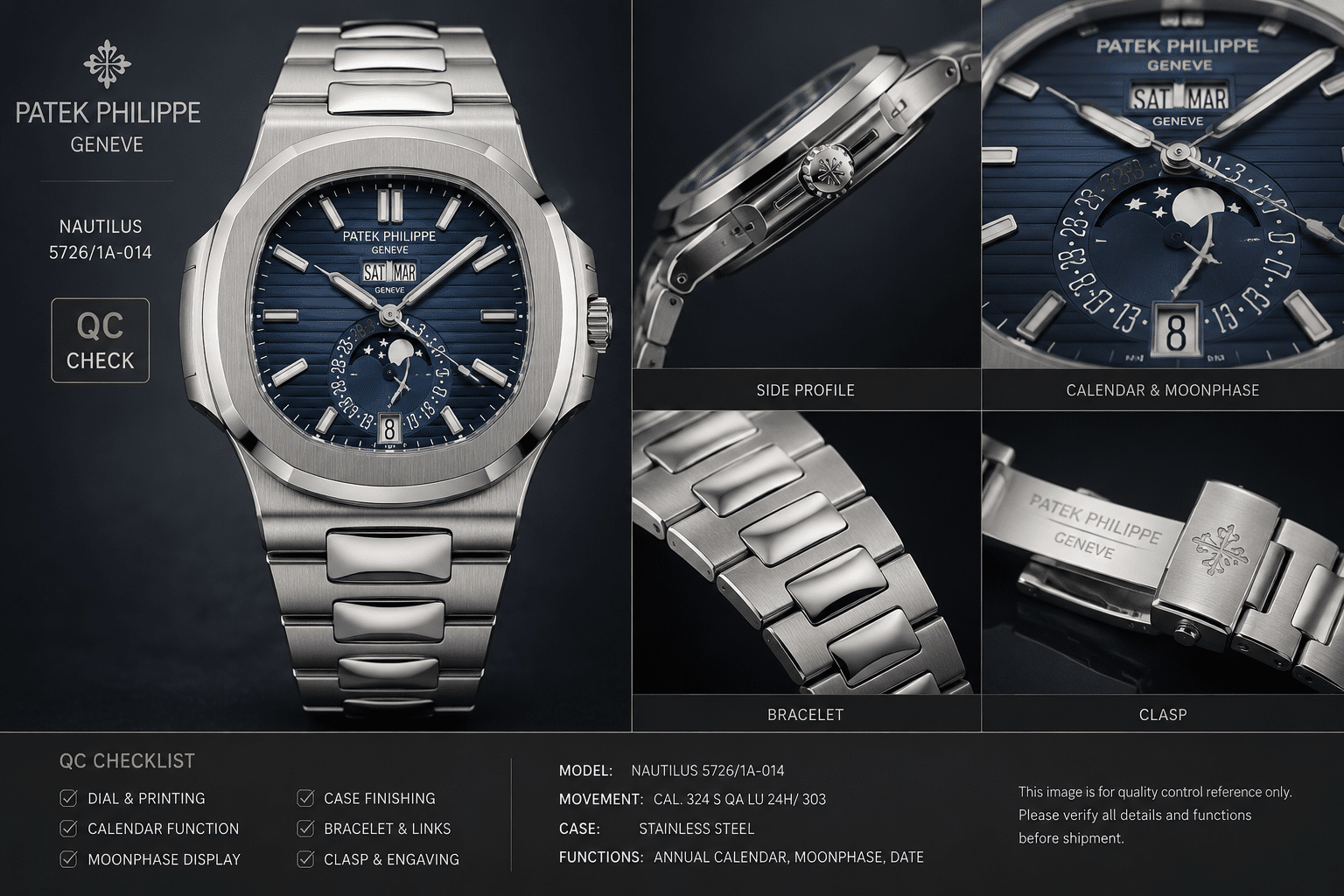
QC Photos Should Focus on Calendar Alignment Before Anything Else
For a Nautilus 5726 replica, QC should start with the calendar display, not the bracelet or even the case. The reason is simple: the dial has enough information packed into it that small layout errors show up fast, and they tend to be more obvious than on a cleaner three-hand Nautilus. A watch can look strong in a single angled photo and still fail the basic test if the day, date, month, or moonphase-style display feels off once you study it straight on.
The first photo you want is a dead-on dial shot. That is where you can judge whether the windows sit where they should, whether the printing reads cleanly, and whether the calendar elements feel balanced across the dial. Straight-on shots matter more than dramatic wrist angles because perspective can hide a shifted window or make one side of the dial look heavier than it really is. A minor camera angle issue is acceptable; a visibly crooked or crowded calendar layout is not.
Calendar Windows and Dial Printing
The day, date, and month displays should be checked as a set, not separately. If one window is slightly off but the others are clean, the dial may still be acceptable. What usually turns into a red flag is a layout that looks strained: a date window that sits too low, a month aperture that feels squeezed, or printing that looks uneven across the dial. On a 5726 replica, the eye notices balance quickly. Even if every function appears to move, poor visual alignment makes the whole watch feel less convincing.
Font consistency matters more than many buyers expect. Calendar text that is too thin, too bold, or unevenly placed can make the watch look cheap even when the case and bracelet are decent. If the dial print is sharp but the spacing is awkward, that is still a problem. For this model, the calendar-heavy design leaves less room to hide sloppy dial work.
Moonphase-Style Display Position
The moonphase-style area should be checked for centering and integration, not just whether it “looks present.” A display can be bright and clean in isolation but still sit awkwardly in the dial architecture. If the moonphase-style element feels crowded, off-axis, or visually separate from the rest of the calendar layout, it weakens the overall Nautilus impression. You are not just checking a decorative feature; you are checking whether it belongs in the composition.
Good QC photos should show whether that display is visually anchored in the dial or floating slightly out of place. The difference may be subtle in photos, but it matters on the wrist because the 5726 relies on symmetry and spacing to sell its complication-heavy look.
Case, Bracelet, and Clasp Checks
After the dial, move to the case profile and bracelet transition. Case thickness is worth checking because a slightly too-thick profile can make the watch lose the slim, integrated Nautilus feel even if the dial looks good. The bezel should have a clean shape, not a bloated top surface. The bracelet should flow out of the case without awkward gaps, and the first link should not look bulky or disconnected.
The clasp deserves its own photo because poor finishing there often signals the same level of care elsewhere. You do not need perfect clasp engraving to accept a watch, but you do want even finishing, a clean closing action, and no obvious misfit between bracelet segments. On a 5726 replica, the bracelet and clasp should support the watch’s elegant shape, not distract from it.
QC Photos to Request
Request a front dial photo first, then a side profile, a crown-side view, a bracelet and clasp shot, and a wrist-angle photo if available. If the seller can provide a short function-setting clip, that is useful because it shows whether the displays behave in a way that matches the claimed version. The goal is not to overanalyze a single frame; it is to confirm that the dial alignment, case shape, and display behavior all point in the same direction.
A buyer should be cautious if the photos hide the calendar windows, if the dial is only shown at steep angles, or if the seller avoids clear straight-on shots, because any serious Patek Philippe Nautilus guide should treat date wheel alignment and dial manufacturing as visible authentication points. Those are the situations where a watch can look acceptable at first glance but reveal alignment problems once it is in hand.
What QC Photos Cannot Prove
QC photos can reduce uncertainty, but they cannot prove that a replica watch is mechanically equivalent to the genuine reference. A clear dial photo may show whether the calendar windows are aligned, but it will not prove annual calendar intelligence, long-term reliability, water resistance, service compatibility, or authenticity. A short setting video can help confirm basic display behavior, but it still does not turn a visual annual-calendar-style replica into a genuine brand-manufactured complication.
Buyers should also avoid treating clean photos as inspection guarantees. Lighting, camera angle, and lens distortion can hide small issues, while stock photos may not show the exact watch being supplied. The practical use of QC is to catch visible problems and confirm that seller claims match observable details, not to certify the watch or make it safe to represent as authentic.
QC photos reduce uncertainty, but they do not remove every risk. They help buyers judge visible execution before shipment, especially when factory names or stock photos do not show the exact watch being supplied.
Daily Ownership: What the 5726 Replica Feels Like After the Novelty Fades
The 5726 replica can be satisfying if you like the look of a complicated Nautilus and you are comfortable treating the calendar display as part of the ownership routine. That is the basic tradeoff. You get a more interesting dial and a more technical presence on the wrist, but you also accept that the watch may not behave like a true annual calendar in the way buyers instinctively imagine. Once the novelty fades, that difference becomes the real ownership story.
For occasional wear, the watch is easier to enjoy because you are less likely to notice the manual side of the complication. Put it on, enjoy the dial, and move on. For daily wear, the equation changes. If the movement stops or the watch sits long enough, the displays may need resetting, and that is where the watch stops feeling like a simple time-only piece. Buyers who rotate several watches should expect more interaction, not less.
Occasional Wear Versus Daily Wear
If you wear the watch only a few times a month, the calendar correction issue may not bother you much. The watch becomes a visual piece first, and the inconvenience is occasional. If you use it as part of a larger rotation, the resetting process can become repetitive. That is especially true for buyers who do not keep one watch running continuously. Once a replica depends on manual correction, every period of inactivity turns into another setting session.
That is why some buyers who initially want a complicated Nautilus later decide they would rather have a simpler model. The watch is still attractive, but the practical rhythm of ownership starts to matter more than the dial layout.
Manual Correction Tolerance
The key question is whether you tolerate manual adjustment as part of the experience or find it annoying. If you are fine checking the displays and correcting them when needed, the 5726 replica can be a reasonable visual-complication watch. If you expect the calendar to behave like a genuine annual calendar and stay correct with little attention, you will likely be disappointed.
That distinction matters because frustration usually comes from expectation mismatch, not from the mere fact that the watch requires adjustment. A manually corrected complication is acceptable only if the buyer already accepts that compromise before purchase.
When the Complication Becomes a Distraction
The complication becomes a distraction when you start watching the watch instead of wearing it. If you are constantly checking whether the date changed correctly, whether the month display is still lined up, or whether the display needs correction after a stop, the model has stopped being enjoyable. At that point, the calendar becomes a maintenance concern instead of a visual feature.
Buyers who value peace of mind usually do better with a simpler Nautilus. The 5726 replica makes sense when the complication layout is the attraction. It makes less sense when low-maintenance ownership is the priority.
5726 Replica Versus 5711 and 5712: Which Nautilus Choice Makes More Sense?
The 5726 sits in an awkward but useful middle ground. It is more interesting than a 5711, but also more demanding in how you judge it. That is why model choice matters more here than factory hype. If you choose the wrong Nautilus for your expectations, the watch can be technically acceptable and still feel wrong in daily use.
The 5711 is the safer choice for most buyers who want the cleanest ownership experience. Fewer complications mean fewer things to inspect, fewer things to reset, and fewer expectations that can be disappointed by a replica movement. The watch also gives factories less room to make the dial look unbalanced. In practice, simpler Nautilus replicas are often easier to live with because the design itself leaves less to go wrong.
The 5726 is for buyers who specifically want the annual calendar look and accept that the function side may be limited or manual. It is the more visually ambitious option, but it comes with more ownership friction. The 5712 sits between the two in spirit, but for a different reason: it appeals to buyers who want a visually busy Nautilus without leaning on the same calendar logic.
Choose the 5711 If You Want the Cleanest Ownership Experience
The 5711 is the practical answer if you want the simplest path. It avoids the extra burden of calendar alignment, and it is easier to judge from QC photos because there is less packed onto the dial. For a first Nautilus replica, that usually makes it the more sensible starting point. Simpler does not mean boring here; it means fewer decision traps.
Choose the 5726 If the Calendar Look Is the Main Attraction
The 5726 makes sense when the complication layout is the reason you want the watch in the first place. If the day, date, month, and moonphase-style arrangement is what you enjoy seeing, then the replica can still be satisfying even if it does not reproduce genuine annual calendar intelligence. In that case, you are buying the appearance and the presence of complexity, not a perfect mechanical substitute.
Consider the 5712 If You Prefer Asymmetry and Power-Reserve Style Visuals
The 5712 is worth considering only if you specifically like a more asymmetrical dial with a different visual rhythm. It is a separate kind of complicated Nautilus, not a better version of the 5726. Buyers who want a cleaner calendar presentation usually still end up preferring the 5726 or stepping down to the 5711.
The cleanest way to think about the three models is this: the 5711 is the easiest to live with, the 5726 is the most calendar-focused, and the 5712 is the most distinctive visually. Once you see them that way, the right choice becomes less about hype and more about how much function compromise you are willing to accept.
Legal, Disclosure, and Source Limits Buyers Should Not Ignore
Replica watches should be understood as imitation products, not authorized Patek Philippe goods. The USPTO describes counterfeit goods in relation to unauthorized use of another party’s trademark, which is why replica-watch language needs clear disclosure rather than wording that implies authenticity or brand approval.[2] In practical buyer terms, that means a 5726 replica should not be presented as genuine, resold as authentic, or described as factory-authorized.
Cross-border purchase and shipping claims also need caution. U.S. Customs and Border Protection identifies intellectual property rights as a trade enforcement priority, including action against goods that infringe protected rights.[3] That does not predict what will happen to any single shipment, but it is enough reason to avoid blanket claims such as “customs safe,” “legal everywhere,” or “risk-free import.”
At the industry level, the OECD treats counterfeit Swiss watches as part of a broader counterfeiting problem affecting Swiss-branded goods.[4] That context does not prove anything about one seller, one factory, or one order, but it supports a careful editorial stance: replica watch articles should separate buyer guidance from legal certainty, and they should avoid presenting imitation products as equivalent to authorized watches.
For CleanVSFactory, the goal is to make replica watch comparison easier to understand by connecting factory names, movement claims, visible QC details, and realistic ownership limits. CleanVSFactory should be read as a buyer education and comparison perspective, not as an official representative of Patek Philippe or any other luxury watch brand.
Final Buyer Judgment on the Nautilus 5726 Replica
The cleanest answer is simple: the Nautilus 5726 replica is worth considering for its appearance, not for true annual calendar function. If your main goal is a complicated-looking Nautilus with day, date, month, and moonphase-style presence on the dial, it can deliver that visual impression for buyers who accept the limits. If your main goal is genuine annual calendar intelligence, it will disappoint you sooner or later.
That distinction matters more here than on a simpler replica watch. The 5726 sells the idea of mechanical sophistication at a glance, but the ownership experience still depends on how much manual correction you are willing to accept. Before judging any example, the better move is to inspect the exact version, study QC photos carefully, and confirm what the displays actually do instead of trusting the dial layout alone.
Visual accuracy should be judged through specific details rather than broad claims. Case thickness, lug shape, dial texture, bezel tone, hand length, date magnification, and bracelet construction can affect how convincing a watch feels in real use.
The Right Buyer for a 5726 Replica
The right buyer wants the visual depth of a calendar Nautilus and is comfortable treating the watch as a visual replica first. This is the person who likes the busier dial, understands that manual adjustment is part of the compromise, and does not need the watch to behave like the genuine annual calendar in everyday use. For that buyer, the 5726 can make sense because the appeal is in the look, the presence, and the complication-style personality on the wrist.
A buyer like this is usually comparing it against simpler models and deciding that extra dial activity is worth the extra expectation management. They know that “more complicated” does not automatically mean “more practical,” but they still prefer the richer layout. That is a realistic way to approach a Patek 5726 replica review.
The Wrong Buyer for a 5726 Replica
The wrong buyer expects the watch to think for itself. If you want genuine-like calendar automation, low-maintenance ownership, or complication behavior that you can ignore for long stretches, this is not the model to anchor your expectations to. The annual calendar look may be convincing, but the underlying function tradeoff remains the point you cannot skip over.
This is also the wrong choice for buyers who get irritated by correction routines or who want a replica that behaves like a simple daily watch. In practice, that frustration usually shows up after the novelty fades. Once that happens, the decorative appeal no longer offsets the manual work for a buyer who expected more intelligence from the movement.
The Cleanest Way to Think About This Watch
Think of the Nautilus 5726 replica as a visual annual calendar Nautilus, not a true annual calendar replacement. That framing keeps the decision honest. It tells you what the watch is good at, what it cannot truly do, and why the best choice depends on whether you care more about appearance or mechanical realism.
For most readers, that is the safest way to avoid disappointment. If you want the complicated look and accept the compromise, the 5726 can be a sensible replica watch choice. If you want real annual calendar behavior, the replica market is still the wrong place to expect it.
References
[1] Patek Philippe, “Patek Philippe Nautilus 5811 official specifications,” official brand reference for the authorized Nautilus 5811/1G model and its listed materials and dial description, available at Patek Philippe Nautilus 5811 官方规格.
[2] United States Patent and Trademark Office, “Counterfeit Goods Basics,” government guidance on counterfeit goods and trademark-related disclosure boundaries, available at USPTO Counterfeit Goods Basics.
[3] U.S. Customs and Border Protection, “Intellectual Property Rights,” official customs guidance on intellectual property rights enforcement in trade, available at U.S. CBP Intellectual Property Rights.
[4] OECD, “Counterfeiting, Piracy and the Swiss Economy 2025: Counterfeiting and Swiss Watches,” institutional report context on counterfeit Swiss watches and affected Swiss-branded goods, available at OECD Counterfeiting and Swiss Watches.
Disclosure: This article is for general educational and comparison purposes only. Replica watches are not genuine products from the original luxury brands, and brand names are used only to identify reference designs or comparison topics. Factory names, movement descriptions, prices, availability, QC details, seller policies, and version information can change, so readers should verify important details with the seller before making a purchase decision. Replica watches should not be represented, resold, or used as genuine watches.