
The main decision with a Nautilus 5811G super clone is not just whether it looks close in a front-facing photo. The genuine Nautilus 5811/1G is listed by Patek Philippe as a white-gold Nautilus with a blue sunburst dial and a 41mm case, so the replica question becomes more demanding when compared with Nautilus 5726 annual calendar expectations: does the watch carry the right case presence, bracelet flow, side profile, and tactile weight for a precious-metal reference, or does it only imitate the surface details?[1]
This guide helps separate attractive photos from details that matter in ownership. It looks at why the 5811G feels less forgiving than a 5711-style steel Nautilus, how case thickness and bezel shape should be judged, why movement behavior matters more than movement labels, and when the larger modern look is worth accepting material and weight compromises.
Brand names are used here to identify the genuine reference design being discussed. A Nautilus 5811G replica or super clone watch is not a genuine Patek Philippe watch, is not made or authorized by Patek Philippe, and should not be represented, resold, or used as an authentic watch. The useful comparison is between the genuine reference as a design target and the specific replica-market version being offered, not between official brand production and an imitation product.
| Decision Point | What To Check | Practical Judgment |
|---|---|---|
| 5811G vs 5711 | 41mm presence, wider case, stronger wrist profile | 5811G suits a modern look; 5711 is usually easier for daily wear |
| Material feel | Weight and density compared with a white-gold reference | Steel-based versions can look convincing but may feel too light |
| Case profile | Side thickness, caseback depth, bezel softness, first-link transition | Profile flaws matter more than a strong front photo |
| Dial judgment | Blue tone under different lighting, texture, printing, markers, date alignment | Do not judge from one attractive dial photo alone |
| Movement choice | Thin case support, smooth winding, clean date change, stable running | Real behavior is more useful than decorative movement claims |
| Bracelet and clasp | Articulation, edge softness, case fit, clasp security | These details strongly affect comfort and daily credibility |
Quick Questions Before You Read
Q: Is the 5811G a safer choice than a 5711 replica?
Not usually. The 5811G is more modern and distinctive, but the white-gold identity makes weight and material feel harder to ignore.
Q: What should be checked first in QC photos?
Start with the side profile, caseback thickness, bezel shape, bracelet flow, and date alignment before focusing on dial color.
Q: Does the movement name matter most?
No. Smooth winding, clean date operation, stable running, thin-case compatibility, and serviceability matter more than labels.
Q: Who should avoid the 5811G replica?
Buyers wanting a low-key, beginner-friendly Nautilus may be better served by a 5711-style steel model.
Editorial Perspective: At cleanvsfactory.com, this comparison is best treated as a model-specific buying decision, not a simple factory ranking. For the Nautilus 5811G, factory name and QC photos are useful signals, but they do not prove the watch will wear like a white-gold Nautilus; the more practical checks are case thickness, bracelet integration, movement behavior, and whether the weight and wrist presence fit the buyer’s actual use. A strong dial can still sit in a case that feels too thick or too light, so the safer shortlist is the one that matches the reference, the movement route, and the buyer’s tolerance for compromise.
Why the Nautilus 5811G Is Not Just a New 5711 Replica
The Patek Philippe Nautilus 5811G super clone attracts attention because it sits directly in the shadow of the discontinued 5711. For many buyers, the logic sounds simple: the 5711 is gone, the 5811G is the modern Nautilus reference, so a Nautilus 5811G replica should be the more current and more desirable choice. That is only half right.
The 5811G is not just a newer reference number with a slightly different dial. It changes the buying problem. A 5711-style replica is usually judged around steel Nautilus proportions, thinness, dial tone, bracelet flow, and movement layout. The 5811G adds another layer: it is a white gold Nautilus, and that means the buyer is no longer evaluating only how the watch looks in photos. Weight expectation, wrist presence, and the credibility of the reference itself become much harder to ignore.
This is where many buyers make the wrong comparison. They ask, “Is the 5811G better than the 5711 replica?” as if newer automatically means safer. In practice, the better question is: does the 5811G’s white-gold identity fit what the replica can realistically deliver? A visually clean dial and a familiar Nautilus case shape may be enough to catch attention online, but they do not solve the material gap that sits at the center of this model.
The 5811G’s Appeal Comes From More Than Being Newer
The 5811G has a strong pull because it represents the post-5711 Nautilus. The discontinued 5711 became overexposed in replica discussions, collector debates, and market speculation. The 5811G feels fresher. Patek Philippe’s official listing identifies the Nautilus 5811/1G as a 41mm white-gold reference with a blue-black gradated dial, which helps explain why buyers read it as a larger and more precious-metal successor rather than just another steel Nautilus-style watch.[1]
That freshness can be useful for a buyer who specifically wants a modern Nautilus reference rather than another 5711-style piece. The 5811G has a slightly more assertive presence and carries the appeal of being the 5711 successor. For someone who already understands the Nautilus family, that distinction matters.
But “newer” is not the same as “easier to buy well.” In replica form, mature models often have an advantage because factories have had more time to correct case profile, dial texture, bracelet fit, and movement packaging. The 5711 replica market has been worked over for years. The 5811G may look familiar, but it brings different expectations that cannot be judged by the same old 5711 checklist.
At Clean VS Factory, we usually separate reference appeal from replica practicality. A watch can be more interesting on paper and still be less forgiving in daily use. The 5811G is a good example: it gives buyers the modern Nautilus story, but it also asks them to accept compromises that are less obvious in seller photos.
The White Gold Reference Changes the Replica Problem
The biggest shift is material identity. The genuine 5811G is a white-gold watch, not a stainless-steel continuation of the 5711. That matters because the Nautilus is not a thick, hidden-case sports watch where material feel disappears under size. It is thin, broad, integrated, and tactile. You feel the case and bracelet as one object.
Many replicas are built primarily around stainless steel construction. Steel can be practical, durable, and comfortable, but it does not naturally reproduce the density of white gold. That means a Nautilus 5811G replica may look convincing enough from the front while still feeling lighter than the reference suggests it should feel. This is not a small technical footnote. For this model, it is one of the central ownership tradeoffs.
Dial printing, blue tone, and case brushing can make the watch look persuasive in isolated photos. They cannot make a steel-based watch feel like a precious-metal Nautilus on the wrist. Buyers who ignore this point often end up surprised, not because the replica looks bad, but because the ownership experience does not match the identity of the watch they thought they were buying.
The sensible way to approach the 5811G is to treat it as its own decision. If you want the modern 41mm Nautilus look and accept that material feel may not fully match the white-gold reference, the 5811G can still make sense. If you want the safest Nautilus-style replica with fewer material-expectation problems, the older 5711 logic may be more forgiving.
A traceable comparison should separate three things that often get mixed together: the genuine reference design, the replica-market factory label, and the specific watch version being offered. The genuine reference explains the target shape and material identity; the factory label helps organize market discussion; the actual version determines the case profile, bracelet construction, dial execution, movement route, and weight compromise. Treating those as separate layers makes the 5811G easier to judge without relying on a broad factory reputation or a single attractive photo.
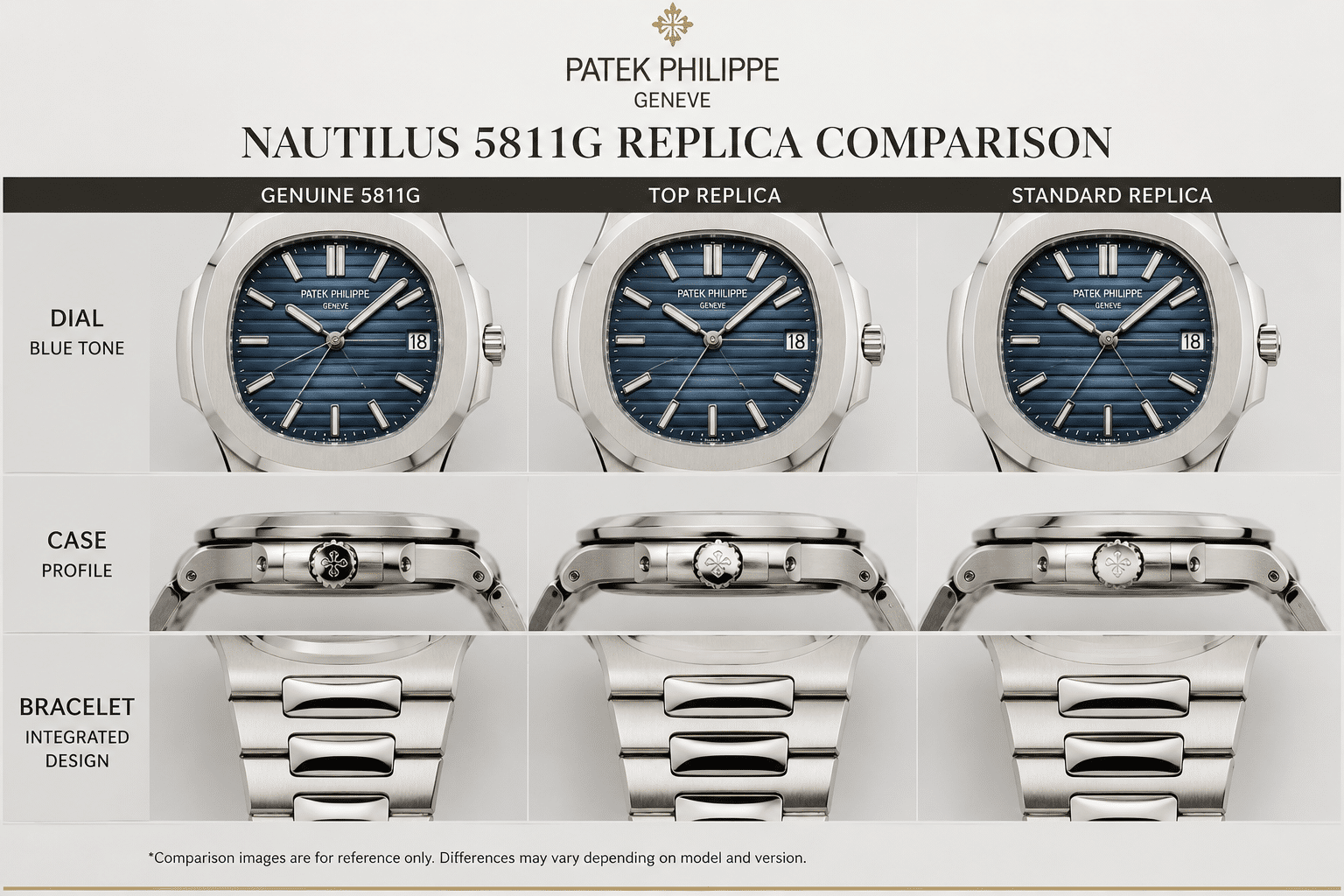
41mm Versus 40mm: How the 5811G Wears Differently From the 5711
The difference between a 41mm Nautilus replica and a 40mm Nautilus sounds minor until you put it into the Nautilus case shape. On a conventional round watch, one millimeter can disappear into bezel thickness, lug design, or case curvature. On a flat integrated-bracelet sports watch, that same millimeter changes the way the watch spreads across the wrist.
The 5811G versus 5711 size question is not only about diameter. It is about visual surface area. The Nautilus has a wide bezel shape, horizontal case ears, and a bracelet that flows directly from the case. Because there are no conventional lugs to visually separate the head of the watch from the bracelet, the whole object reads as one continuous form. A slightly broader case can therefore feel more noticeable than the number suggests.
This does not make the 5811G automatically too large. For many wrists, the 41mm Nautilus feels modern and well-balanced. The issue is buyer expectation. If someone is drawn to the quiet, thin, almost understated feel of the classic 5711 silhouette, the 5811G may feel more present than expected. If the buyer wants a newer Nautilus with a little more visual confidence, the 5811G’s size can be part of the appeal.
Why One Millimeter Matters on a Nautilus Case
The Nautilus wears wide because of its case architecture. The flat case, lateral ears, and integrated bracelet create a broad horizontal footprint. A small increase in case diameter can make the dial opening, bezel mass, and bracelet transition feel more expansive, especially on flatter wrists where the watch sits fully across the top of the wrist.
This is why buyers should not judge the 5811G only by the stated case diameter. Wrist flatness matters. Bracelet sizing matters. The first links matter. A watch that looks balanced on a seven-inch wrist may feel more dominant on a rounded or smaller wrist even if the numerical size seems manageable.
The non-obvious point is that thin watches can still wear large. Buyers often assume slim equals discreet, but a slim integrated watch can cover a lot of wrist visually. The 5811G keeps the Nautilus thin-sports-watch character, yet the broader modern format gives it more presence than the 5711.
The 5711 Feels More Classic, the 5811G Feels More Assertive
The 5711 generally reads as the more classic Nautilus choice. Its proportions are familiar, restrained, and closely tied to the model that made the modern steel Nautilus market explode. For replica buyers, that matters because the 5711’s visual language is already widely understood: slim, steel, blue dial, integrated bracelet, understated from a distance but recognizable to watch people.
The 5811G feels more assertive. It is not loud in the way a large offshore sports watch is loud, but compared with the 5711 it has a more substantial wrist signal. The added size, the white-gold identity, and the newer-reference status make it feel less casual. That is attractive if the buyer wants a modern Nautilus presence, but less ideal if the goal is a low-key daily watch.
Neither feel is universally better. The wrong choice happens when a buyer wants the 5711’s understated wearing character but chooses the 5811G only because it is newer. A newer reference can be more interesting without being the better personal fit.
What This Means for Daily Wear
For smaller wrists, flatter daily style, or buyers who prefer the Nautilus as a quiet sports watch, the 5711-style profile is usually easier to live with. It carries less visual weight and creates fewer questions around why the watch feels more prominent than expected.
The 5811G is better suited to buyers who actively want the more modern 41mm Nautilus presence. It works best when the buyer understands that the watch will likely appear a little broader and more noticeable than a 5711. That does not make it impractical, but it does make it less invisible.
For daily wear, the key judgment is simple: choose the 5711 if you want the classic Nautilus restraint; consider the 5811G if you want the newer reference and are comfortable with a slightly stronger wrist presence. Do not choose the 5811G only because the number is current.
Buyer Expectation Note: No replica watch should be judged by reference number or factory reputation alone. A better decision usually depends on the specific model, movement version, case thickness, dial accuracy, bracelet quality, service risk, and how closely the watch will be inspected in real use.
White Gold Weight Is the Biggest Replica Challenge
The most important issue with a white gold Nautilus super clone is not the dial color, the logo printing, or even the one-millimeter size change. It is weight. The genuine 5811G is a precious-metal Nautilus, and that creates a physical expectation that many steel-based replicas cannot fully match.
The weight discussion should also stay within realistic boundaries. A seller may describe a replica as “white gold color,” “white gold style,” “weighted,” or “heavy version,” but those phrases do not prove precious-metal content or genuine-reference mass. Buyers should ask what material is actually used, whether any weight figure is measured from the specific watch, and whether bracelet sizing affects the stated number. Weight can improve wrist impression, but it does not make a replica watch an authentic white-gold Patek Philippe product.
This is the part buyers often underestimate because weight does not show in photos. A Nautilus 5811G replica may have a convincing blue dial, a reasonable case outline, and clean brushing, but if it is built mainly from stainless steel, the wrist feel may not match the identity of the reference. The watch can look like a white-gold Nautilus while behaving like a steel watch in the hand.
That does not automatically make the replica a bad purchase. Some buyers actually prefer the comfort of a lighter watch. The mistake is believing that visual similarity solves the white gold replica problem. For the 5811G, material feel is part of the model’s character. Ignoring it means judging the watch by the easiest details while missing the hardest one.
Why Steel Construction Changes the Ownership Experience
Steel is practical. It resists daily wear well, feels familiar, and can make the watch easier to wear for long hours. For a replica buyer who values comfort over strict material realism, a steel replica case may even be more pleasant than a heavier build.
But steel does not carry the same density expectation as white gold. A genuine white-gold sports watch has a different physical presence because the case and bracelet mass are part of the experience. On a Nautilus, where the bracelet and case are integrated, that difference is not limited to the watch head. The whole object should feel more substantial.
This is why the 5811G is less forgiving than a steel 5711-style replica. With the 5711, stainless steel construction aligns more naturally with the original reference’s basic material identity. With the 5811G, the replica buyer accepts a built-in material mismatch unless the specific version uses some form of weight compensation or denser construction. Even then, claims should be checked carefully.
Photos Cannot Show the Most Important Difference
Online images tend to flatter the 5811G. The blue dial catches attention, the Nautilus case shape is instantly recognizable, and neutral lighting can make brushing and polished bevels look sharp. None of that tells you whether the watch has the expected mass on the wrist.
This creates a common buyer trap. A front-facing photo can make the 5811G look like an easy upgrade from a 5711 replica. Handling may reveal a different story: the case feels lighter than expected, the bracelet does not carry enough mass, or the watch lacks the physical confidence buyers associate with a precious-metal Nautilus.
The more serious the reference, the more this matters. A small mismatch on an ordinary steel sports watch may be easy to overlook. On a modern white-gold Nautilus, the gap between visual appeal and tactile realism becomes harder to ignore, especially for buyers who already know what they expect from precious-metal watches.
Weight Details to Confirm
Before choosing a 5811G replica, buyers should ask what the case and bracelet are actually made from, especially when using a Patek Philippe Nautilus 5712 review as a material and finishing reference. “White gold style” or “white gold color” does not mean precious-metal construction. In many cases, it only describes the appearance, not the material.
If a seller provides an overall weight figure, treat it as useful but not final. Ask whether the number was measured from the actual watch being offered or copied from a genuine specification sheet. Also confirm whether the weight includes a full bracelet or a resized bracelet, because link count can change the number enough to confuse comparisons.
The most useful weight check is not chasing one exact figure. It is making sure the claim is coherent. A steel-built 5811G that is advertised with genuine white-gold weight without explanation deserves caution. A lighter steel-based version can still be a sensible choice if the buyer understands the tradeoff. The problem is not lightness itself; the problem is buying a white-gold reference while assuming the material experience has been solved when it has not.
Case Construction and Profile: Where the 5811G Needs Careful Inspection
The Nautilus 5811G case is where many replicas either become convincing or start to look like a generic integrated sports watch. A clean front photo can make almost any Nautilus 5811G replica look promising, but the real question is whether the case stays thin, broad, and fluid from the side. The Nautilus design does not tolerate bulk well. If the middle case looks slabby, the caseback drops too far, or the bezel ears look heavy, the watch loses the relaxed tension that makes the 5811G recognizable.
The genuine 5811G also brings updated case construction compared with the older 5711, but buyers should be careful with seller claims around this point. You cannot fully verify hidden two-part case construction from normal QC photos. What you can judge is the visible result: side profile, bezel shape, case thickness, transition lines, caseback depth, and how the case flows into the first bracelet links. For this reference, those visible checkpoints matter more than a factory description that sounds technically impressive but cannot be confirmed from the photos provided.
Version-specific judgment is especially important here. One 5811G replica version may solve the dial color reasonably well but use a thicker caseback; another may have a better side profile but weaker bracelet finishing or a less convincing movement view. A factory comparison is only useful when it is tied to the exact reference, version, movement configuration, case construction, and visible execution details rather than treated as a universal ranking.
Side Profile Matters More Than Front-Facing Photos
A straight-on dial shot is the least useful angle for judging the 5811G replica case profile. From the front, the blue dial, bezel outline, and horizontal case ears dominate the picture. Excess thickness can hide behind the bezel edge, and a bulky caseback can disappear completely. This is why buyers asking what to check on a 5811G case should start with side photos before getting lost in dial color debates.
The side profile should look slim and layered, not like a flat steel block with a Nautilus-shaped bezel placed on top. Look at the relationship between the bezel, mid-case, and caseback. If the caseback protrudes strongly or the lower case drops sharply toward the wrist, the watch may wear thicker than the front image suggests. This is especially important on a thin luxury sports watch because even a small amount of added height changes the wrist presence.
A useful QC set should show the watch from both left and right sides. The polished bevels should run cleanly along the case, and the brushed side surfaces should not look wavy, over-rounded, or unfinished. The best 5811G replica case profile is not the one that looks sharpest in one photo; it is the one that keeps the Nautilus shape balanced from multiple angles.
The Nautilus Bezel Should Look Softly Sculpted, Not Flat and Sharp
The Nautilus bezel is easy to misunderstand. It is not simply an octagonal frame with two ears. The shape should feel softly sculpted, with brushed upper surfaces, polished bevels, and rounded transitions that keep the case elegant rather than aggressive. A replica with a bezel that looks too flat, too wide, or too sharply cut can photograph well but feel wrong once compared with the real design language of the watch.
The bezel ears deserve close attention. On weaker cases, the ears can look thick or squared off, which makes the watch feel heavier than it should. On better executions, the ears blend into the case body with a gentle curve and enough definition to show the porthole shape without turning the watch into a hard-edged copy. This is one of the non-obvious areas where Nautilus case accuracy is judged less by one measurement and more by proportion.
Polished bevel balance is another giveaway. If the bevels are too wide, the case can look flashy and less refined. If they are too narrow or uneven, the case loses the soft luxury finish that separates a Nautilus from a basic brushed sports watch. A buyer should not expect hand-finished genuine-level refinement from a replica, but uneven bevels or harsh transitions are worth rejecting because they affect the whole face of the watch.
Caseback and Thickness Can Reveal Compromise
The caseback is where practical limits often show up. A thicker movement route, spacer construction, or less refined case design can push the watch upward from the wrist. This does not require dramatic thickness to matter. On a Nautilus-style case, a small increase can make the watch look less flat and less integrated, especially when viewed from the side.
Be cautious with any listing that claims the 5811G replica is perfectly matched in thickness without showing a proper side view. Measurement claims are useful only if they are supported by the specific watch being offered, not copied from genuine specifications or repeated from factory marketing. At Clean VS Factory, we tend to treat case thickness as a visible ownership issue, not just a number. If the profile looks wrong, the watch will not become more convincing because the description uses the right terminology.
The right judgment is simple: the 5811G case should look thin, wide, and continuous. If it looks tall, boxed-in, or separated into obvious layers, the replica may still be attractive, but it is not solving the core Nautilus case problem. For this model, a strong dial inside a compromised case is not enough.
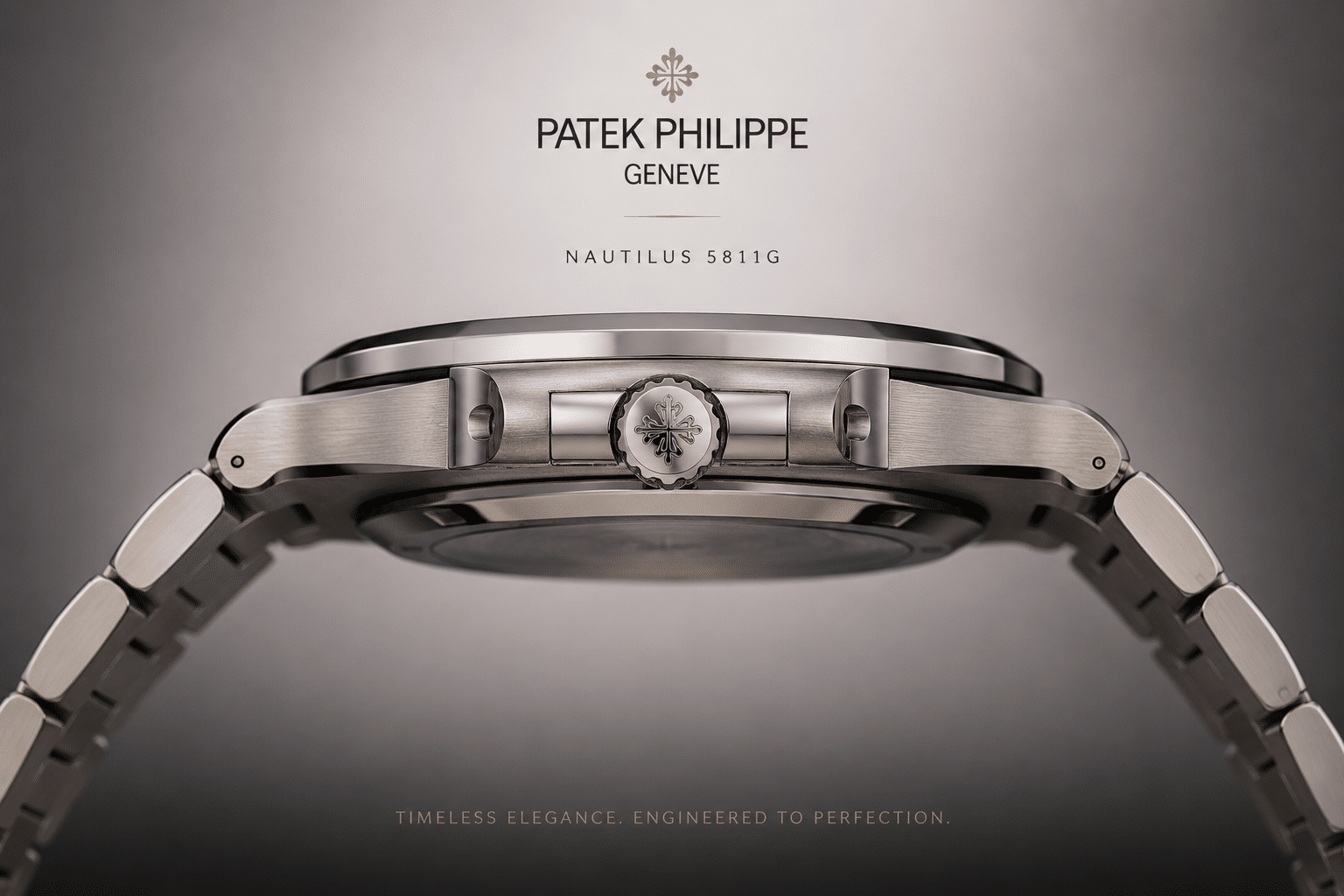
Dial Tone and Blue-Gradient Feel: The Detail Buyers Often Overtrust
The Nautilus 5811G blue dial replica is often judged too quickly from one attractive photo. That is understandable because the dial is the first emotional hook: blue gradient, horizontal texture, applied markers, clean date window, and a familiar Nautilus layout. But dial beauty is not the same as overall 5811G dial accuracy, and it certainly does not solve the larger case, weight, or material expectations of this reference.
The smarter approach is to judge the dial as a group of connected details. Color matters, but so do texture depth, printing sharpness, marker placement, hand finishing, date window alignment, and how the dial sits under the crystal. A dial that looks dramatic under seller lighting may look too flat, too purple, too bright, or too grey in normal indoor light. Buyers who chase one “perfect” blue screenshot often miss more practical issues that remain visible every day.
Blue Dial Color Is Lighting-Sensitive
The 5811G blue dial can shift heavily depending on lighting. A phone camera can brighten the center, darken the edges, or push the tone toward purple or electric blue. Studio lamps can make the gradient look richer than it appears in daily wear, while poor indoor lighting can flatten the dial and make a good example look dull. This is why a single photo rarely settles the question of whether a 5811G dial color is too bright or too dark.
For QC, neutral lighting is more useful than dramatic lighting. Ask for a straight dial photo without heavy reflections, then compare it with an angled shot that shows how the horizontal texture catches light. If the dial only looks good in one carefully controlled angle, that is a warning. A convincing Nautilus dial should not need perfect lighting to show texture, balance, and depth.
Color obsession also creates a common buying mistake. A slightly imperfect blue tone may be acceptable if the print, markers, date, and hands are clean. A more “beautiful” blue dial with poor alignment or sloppy printing is the weaker daily-wear choice. The dial should be judged by coherence, not just shade.
Texture and Printing Should Be Judged Together
The horizontal embossed texture is central to the Nautilus face. It should look controlled and even, not overly deep like a carved groove pattern and not so shallow that the dial becomes flat. The lines need to support the gradient rather than fight it. If the texture is too aggressive, the watch can look cheaper under direct light; if it is too weak, the dial loses the layered feel buyers expect from this reference.
Logo printing and minute markings should be sharp but not heavy. Over-thick printing can make the dial look crude, while faint printing can disappear against the blue background. Applied hour markers should sit evenly with consistent spacing, and the hands should align cleanly with the markers visually. Under magnification, replica hand finishing may show limitations, but in normal use the bigger concern is whether anything looks crooked, mismatched, or poorly seated.
The date window is a small detail with large visual impact. Check whether the date sits centered in the aperture and whether the font weight looks consistent. A slightly off date may seem minor in a zoomed QC image, but on a clean Nautilus dial there are few distractions. Misalignment becomes easier to notice because the rest of the design is so minimal.
Dial QC Photos to Review
For a Nautilus replica dial check, a buyer should review more than one front-facing image. The most useful set includes a neutral-light dial photo, an angled dial photo, a close-up of the date window, and at least one photo with the hands placed away from the logo and date area. This helps reveal marker alignment, print quality, hand finish, and whether reflections are hiding defects.
Do not overreact to one distorted image, especially if the watch is tilted or the crystal is reflecting a bright light source. But do take repeated problems seriously. If the dial looks washed out in every photo, if the date is consistently low, or if the markers appear uneven from multiple angles, the issue is probably not just photography. The dial is important, but for the 5811G it should confirm the watch’s quality rather than distract from structural weaknesses elsewhere.
Bracelet Feel, Clasp Quality, and the Integrated Nautilus Experience
The Nautilus 5811G bracelet replica cannot be evaluated like a strap on a conventional watch. On this design, the bracelet is part of the case architecture. It controls how the watch drapes, how wide it feels, how refined the finishing appears, and whether the whole object feels fluid or stiff. A strong dial and case can still disappoint if the bracelet feels sharp, rigid, uneven, or poorly matched at the case transition.
This is also where photos can be misleading. A bracelet may look clean from above but feel rough along the edges, bind between links, or close with a clasp that feels thin and uncertain. The practical question is not only “does the bracelet look solid?” It is whether the bracelet moves naturally enough to support the Nautilus wearing experience.
The Integrated Bracelet Makes Fit Problems More Obvious
On a watch with conventional lugs, the strap or bracelet has some visual separation from the case. The Nautilus does not give the replica that forgiveness. The first link, end-link fit, and case-to-bracelet transition are immediately part of the silhouette. If the first link looks too thick, sits at the wrong angle, or leaves an obvious gap, the watch loses the continuous flow that makes the design work.
This is why Nautilus bracelet QC should include close photos of the case transition from the top and side. The bracelet should not look like it was attached after the case was designed. It should appear to grow from the case, with a natural taper and enough articulation to follow the wrist. Poor fit here is more serious than a tiny macro flaw on the clasp engraving because it affects the entire wrist presence.
Finishing Should Balance Sportiness and Softness
Nautilus bracelet finishing depends on contrast. Brushed surfaces give the watch its sports-watch character, while polished bevels soften the edges and add refinement. If the brushing is uneven, too coarse, or changes direction awkwardly from link to link, the bracelet can look lower-tier even when the case shape is good. If the polished bevels are too bright or too wide, the bracelet can look flashier than the reference intends.
Sharp link edges are another important warning sign. Some buyers mistake sharpness for precision, but on a Nautilus-style bracelet, harsh edges reduce the luxury feel. The bracelet should feel clean and defined without biting the wrist. A replica does not need to match the genuine bracelet’s finishing standard to be enjoyable, but it should not feel unfinished during normal wear.
Link articulation matters as much as surface finishing. A stiff bracelet can make the 41mm case feel broader and less comfortable than expected. If possible, review photos or short handling clips showing the bracelet flexing. A bracelet that hangs naturally usually wears better than one that stays rigid like a flat band.
Clasp Feel Affects Daily Confidence
The clasp is a small part of the watch, but it controls daily confidence. A weak clasp can make an otherwise attractive 5811G replica feel cheap every time it is opened or closed. Look for clean closure, even alignment, and a secure feel without excessive looseness. The action should not require force, but it also should not feel vague.
Clasp finishing should match the rest of the bracelet. Shallow engraving, uneven brushing, rough internal edges, or a loose folding action are common areas where cost control becomes visible. These details may not ruin a photo, but they affect ownership more than many buyers expect. The clasp is handled every day; a poor one keeps reminding the owner that the watch is compromised.
For this model, bracelet and clasp quality can decide whether the watch feels like a coherent super clone watch or simply a good-looking head on an average bracelet. The stronger choice is usually the version with smoother articulation, cleaner case transition, and more secure clasp feel, even if another example has a slightly more dramatic dial photo.
Movement Expectations: What Matters and What Buyers Should Not Overclaim
The Nautilus 5811G replica movement should be judged by ownership behavior first, not by the most impressive name attached to it. A Patek 5811G super clone movement may look more convincing through a display caseback if it has a decorated rotor and closer bridge layout, but decoration alone does not tell you whether the watch will wind smoothly, keep acceptable time, change date cleanly, or remain serviceable after months of wear.
The practical question is simple: does the movement allow the case to stay thin, does it behave consistently, and can it be handled by a repairer if something goes wrong? For a Nautilus, movement thickness is not an isolated technical detail. A movement that is too tall can force a deeper caseback, and a deeper caseback changes the whole side profile of the watch. That is why a movement route that sounds safer on paper can still create a less convincing 5811G case.
Movement descriptions in the replica market should be read as configuration references, not as official brand-caliber claims unless clear evidence is provided. A buyer should distinguish between movement architecture, visible decoration, rotor layout, hand-setting feel, date behavior, reliability expectation, and serviceability. A bridge layout that looks closer in photos may improve visual realism through the caseback, but it does not automatically prove better long-term stability or easier repair.
A movement label should never be treated as proof that the watch contains an official Patek Philippe caliber, a genuine Swiss movement, or a service-compatible brand-manufactured movement. In the replica market, a movement name may describe a clone-style layout, a decorated movement, a modified Asian movement, or seller terminology. The safest reading is to treat movement language as a claim to verify through current photos, measured case behavior, and realistic service expectations rather than as a certificate of authenticity.
A Display Back Increases the Need for Movement Realism
The 5811G is not a closed-back sports watch where the movement can be ignored. Once the caseback shows the automatic movement, the decorated rotor, bridge layout, screw color, engraving depth, and overall finishing become part of the watch’s visual story. Buyers should still be careful here: a good-looking movement photo is not proof of genuine-level finishing, and it is not proof of long-term replica movement reliability.
The common mistake is treating a decorated movement as an upgrade in every sense. It may be an upgrade visually, especially if the rotor shape and bridge arrangement look closer to the expected Patek layout, but it can still have ordinary machine finishing, louder rotor behavior, or less predictable service support. The more visible the movement is, the more important the appearance becomes, but the ownership risk does not disappear just because the movement looks better in photos.
Reliability Matters More Than Impressive Claims
For daily wear, the safer movement is not always the one with the boldest clone-caliber claim. A practical Nautilus 5811G replica movement should have reasonable winding feel, stable hand setting, clean date change behavior, and rotor noise that does not make the watch feel cheap every time the wrist moves. Rotor sound is especially important on a thin integrated bracelet watch because there is less case mass to hide a rough or free-spinning rotor sensation.
Power reserve claims should also be treated with restraint. Unless a seller provides current, measured information from the actual version being offered, a stated power reserve is often just copied from a movement description or genuine specification. The same applies to decoration claims. Movement photos can show what is visible; they cannot prove amplitude stability, lubrication quality, shock resistance, or future parts availability.
At Clean VS Factory, we usually separate movement appearance from movement ownership. A movement can be visually acceptable through a display back and still be the wrong choice if it makes the case too thick, feels rough at the crown, or becomes difficult to service. For a 5811G, the movement should support the watch’s slim case logic rather than simply sound impressive in a product listing.
Movement Route to Verify
- Movement type: Confirm whether the watch uses a clone-style automatic movement, a decorated common automatic movement, or another route. The name matters less than whether the version is currently known to fit the case properly.
- Rotor style: Ask for a movement photo if the watch has a display back. Look for rotor shape, decoration consistency, engraving depth, and whether the finish looks clean rather than overly shiny or crude.
- Case thickness effect: Do not evaluate the movement separately from the side profile. If the movement forces a thicker caseback, the watch may lose the thin Nautilus feel even if the dial looks strong.
- Date behavior: Confirm that the date changes cleanly and sits centered in the window. A movement that produces an off-center or hesitant date display will be noticed more often than minor bridge decoration errors.
- Serviceability: A more exotic movement route may look better but can be harder to repair. Buyers who want a daily wearer should weigh service access more heavily than cosmetic movement theater.
- Verified claims: Treat power reserve, decoration accuracy, and “latest movement” language as claims to verify, not facts to assume.
What Official Sources Can and Cannot Prove
Official Patek Philippe information is useful for understanding the authentic Nautilus 5811/1G reference: model identity, case material, dial description, case size, bracelet type, and the general configuration of the genuine watch, while a Patek Philippe Nautilus guide can frame replica-specific evaluation around factory comparison, movement checks, and buying considerations. It should not be used as proof that any replica has the same white-gold construction, finishing quality, movement performance, water resistance, or service standard. The source defines the genuine target; it does not authenticate the imitation.
This distinction matters when reading seller descriptions. If a listing copies official language about case material, dial color, caliber naming, or water-resistance style, that wording still needs to be separated from the actual replica being sold. A buyer should ask for current QC photos, a side-profile view, bracelet and clasp images, movement photos when relevant, and a clear statement of what material the replica case and bracelet actually use.
The same restraint applies to factory names. Names such as Clean, 3KF, PPF, ZF, or other replica-factory labels may help buyers organize discussions, but they are not official guarantees of construction, material, movement source, or long-term performance. Factory reputation should be treated as a starting point for inspection, not a substitute for checking the specific watch.
Factory Name Clarification: Factory names in the replica watch market are commonly used buyer-facing labels. They should be treated as practical market references, not as official brand affiliations, audited manufacturer identities, or guarantees of identical quality across every model.
5811G Versus 5711: Which Nautilus Replica Makes More Sense?
The 5811G vs 5711 replica decision is not simply a choice between old and new. The 5711 is the discontinued Nautilus icon, while the 5811G is the modern successor with a 41mm white gold identity. In genuine form, those differences are meaningful. In replica form, they create very different expectations for size, material, weight, and how believable the watch feels as a daily object.
Here is the practical judgment: the 5711 is often the more natural replica choice for buyers who want a low-key Nautilus experience, because its stainless steel identity matches the way most high-end replicas are constructed. The 5811G is more interesting for buyers who specifically want the newer Nautilus reference, but it is less forgiving because a white gold reference creates a weight and status expectation that a steel-based replica may not fully satisfy.
The 5711 Is Often the More Natural Replica Choice
The stainless steel 5711 gives replica buyers a cleaner logic path. If the case is steel, the bracelet is steel, and the genuine reference is also steel, the material expectation is at least aligned. The buyer can focus more on case thickness, dial tone, bracelet flow, date alignment, and movement route without also having to explain away the missing precious-metal density.
This does not mean every 5711 replica is safer or better. Older or lower-tier versions can still be too thick, poorly finished, or weak in dial color. But as a concept, the 5711 is easier to live with because it does not ask the replica to imitate white gold behavior. For many buyers asking which Nautilus replica should I buy, the 5711-style route remains the more rational daily-wear choice.
The 5811G Is More Interesting but Less Forgiving
The 5811G has real appeal because it feels current. It is the Nautilus 5711 successor replica many buyers search for when they want the post-discontinuation reference rather than the older steel icon. The slightly larger 41mm presence also suits buyers who prefer a more modern wrist impression instead of the more restrained 40mm profile.
The tradeoff is that the 5811G attracts more scrutiny from the people who know the reference. It is a white gold reference, not just a newer blue-dial Nautilus. If the watch feels too light, if the case looks too flat or thick, or if the bracelet lacks the expected density and flow, the ownership experience can feel less convincing even when the front-facing dial photo looks excellent. This is the main reason the 5811G is not automatically the better replica just because it is newer.
A Simple Buyer Scenario
A first-time Nautilus buyer who wants a comfortable, understated daily watch will usually be better served by 5711 logic. The stainless steel identity is easier to accept, the wrist presence is more classic, and the watch does not rely as heavily on white gold weight to feel credible. This buyer should prioritize case thinness, bracelet feel, and a stable movement over chasing the newest reference number.
A more experienced buyer may still prefer the 5811G. That buyer understands that the 5811G carries a different status signal, expects a larger and slightly more assertive wrist feel, and accepts that the material-weight compromise is part of the purchase. For this buyer, the 5811G can make sense if the case profile, dial execution, bracelet integration, and movement route are all strong enough to support the reference.
| Buyer Priority | 5711 Replica | 5811G Replica |
|---|---|---|
| Most natural material expectation | Stronger, because stainless steel matches common replica construction | Weaker, because the genuine reference is white gold |
| Modern reference appeal | Lower, because it is the discontinued model | Higher, because it represents the newer Nautilus direction |
| Daily-wear discretion | Usually easier | More noticeable due to size, status, and material expectation |
| Beginner suitability | Often safer if the version is well chosen | Better for buyers who already understand the compromise |
QC Priorities for a Nautilus 5811G Super Clone
5811G replica QC should not start and end with a clean dial photo. The Nautilus is an integrated design, and the 5811G adds the extra problem of white gold expectation. A useful QC review has to show whether the watch stays visually thin, whether the bracelet flows from the case, whether the dial and date are aligned, and whether the seller’s material or movement claims are specific enough to trust.
The biggest QC mistake is approving a Nautilus super clone QC photo set that only shows the watch from the front. A front view can hide an over-deep caseback, awkward side wall, stiff bracelet transition, and weak clasp finishing. For the 5811G, those hidden details matter more than a slightly attractive blue dial under flattering light.
QC photos reduce uncertainty, but they do not remove every risk. Buyers should review real watch photos where available, including dial printing, marker alignment, hand alignment, datewheel centering, side profile, caseback depth, bracelet fit, clasp engraving, and movement photos when relevant. Factory labels and stock photos alone are not enough for a reliable judgment.
QC review should also include seller-policy confirmation, not only visual inspection. Before ordering, buyers should ask about return terms, repair options, water-resistance testing, shipping expectations, and after-sales support directly with the seller, because those details should not be assumed from a factory name, a product title, or a set of attractive photos. Water resistance is especially important: a Nautilus-style case may look like a luxury sports watch, but replica water resistance should not be assumed unless the specific watch has been tested and the seller’s policy is clearly confirmed.
Start With Case Profile, Not Only the Dial
Ask for side profile photos before you get emotionally attached to the dial. The case should look thin, broad, and balanced, not like a flat sports watch sitting on a thick caseback. The bezel should have enough sculpting and softness to avoid a blocky appearance, while the caseback should not visually push the watch too high off the wrist.
A proper 5811G replica inspection should include at least one clear side shot and one caseback view. These angles help reveal whether the movement route has affected thickness and whether the watch still has the low, integrated Nautilus stance. If the side profile looks heavy, the watch will likely feel less convincing no matter how good the dial appears.
Check Dial, Date, and Hands Under Neutral Lighting
The blue dial should be reviewed under neutral lighting, not only bright studio light or a heavily processed phone image. Color will shift, so do not reject a watch based on one slightly dark or bright photo. Instead, look for consistency: horizontal texture, clean logo printing, even marker placement, centered hands, and a date that sits properly in the window.
Date alignment deserves more attention than many buyers give it. On a simple time-and-date Nautilus, the date window is one of the few functional displays on the dial, so an off-center numeral stands out quickly in daily wear. Hand finishing and marker alignment should also be checked from angled shots, because a perfectly straight front photo can hide uneven reflection or small fitting issues.
Bracelet and Clasp Photos Should Not Be Skipped
The Nautilus bracelet is part of the watch’s architecture. QC photos should show the first link at the case, the bracelet taper, the brushing direction, polished bevels, and the clasp both open and closed. A poor case-to-bracelet transition makes the watch feel lower-tier immediately because the Nautilus design depends on a continuous flow from case to bracelet.
Clasp quality is also a daily-use issue, not just a detail for macro photos. If the clasp looks poorly finished, closes unevenly, or feels flimsy, the watch can lose confidence on the wrist. A strong dial cannot fully compensate for a bracelet that feels stiff, sharp, or badly fitted.
Red Flags Before Buying
- Visibly thick side profile: A case that looks tall from the side is one of the fastest ways a Nautilus replica loses its slim sports-watch character.
- Bulky or awkward caseback: A deep caseback may indicate movement or construction compromise that affects wrist presence.
- Poor bracelet transition: Gaps, stiffness, or an oversized first link can make the integrated design look wrong.
- Inconsistent dial printing: Uneven logo text, weak minute markings, or messy horizontal texture should not be ignored.
- Misaligned date: A date numeral sitting too high, low, or off-center will be noticed in normal use.
- Vague material claims: “White gold feel” or “same weight” language should be backed by actual material explanation or measured weight, not just copied wording.
- Unsupported movement claims: A movement name, power reserve claim, or decoration claim should be confirmed with current photos and realistic expectations.
- No clasp or bracelet photos: Missing bracelet and clasp images are a warning sign because those parts strongly affect Nautilus ownership satisfaction.
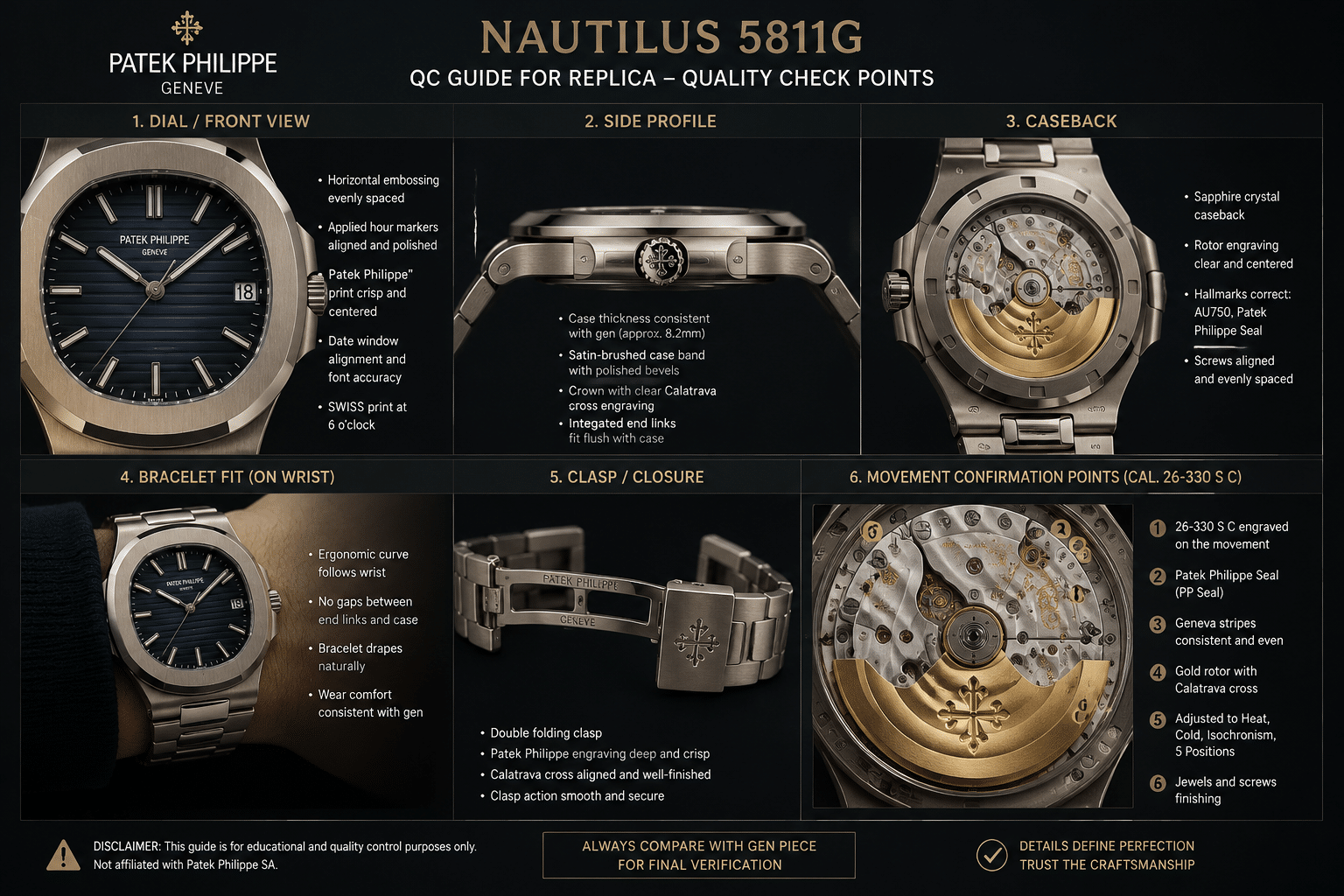
Social Believability and Buyer Psychology Around the 5811G
The Nautilus 5811G replica is not only a technical choice. It is also a context choice. A buyer can accept a slightly imperfect dial, a movement decoration gap, or a bracelet that does not feel quite as fluid as the genuine watch. The harder question is whether the watch feels believable to the person wearing it, because the 5811G is not a casual steel sports watch in the same way the 5711 was. It is a modern white gold Nautilus with a much stronger precious-metal identity.
This is where Nautilus 5811G replica believability becomes different from ordinary visual accuracy. In photos, the 5811G may look like a familiar blue-dial Nautilus with a slightly larger case. In real life, the reference carries a heavier status signal. The genuine model suggests white gold, higher cost, stronger collector visibility, and a more deliberate ownership story. A steel-based replica can still be enjoyable, but the buyer should understand that the biggest mismatch may not be seen across a table. It may be felt on the wrist or noticed in the way the watch fits the buyer’s lifestyle.
The 5811G Carries a Higher Status Signal Than the 5711
The discontinued 5711 already has a strong reputation, but its stainless steel identity makes it more natural as a replica proposition. Most high-end 5711 replicas are also steel, so the basic material expectation is at least aligned. The 5811G changes that equation. It looks related to the 5711, but the genuine reference is positioned as a white gold successor, not simply a larger steel replacement.
That is the core white gold Nautilus replica risk: the model’s meaning has changed. The 5811G is less casual, less anonymous, and harder to explain as a low-key daily sports watch. Buyers often focus on whether the 41mm case looks better or whether the blue dial is more modern, but the more important question is whether they actually want the social weight of this reference. For a buyer who enjoys the Nautilus shape but prefers understated daily wear, the 5811G may feel more self-conscious than expected.
This does not mean the 5811G replica should be avoided by everyone. It means the buyer should not treat “newer than 5711” as an automatic upgrade. The 5811G is more interesting, but it is also less forgiving. A watch can be visually attractive and still feel awkward if the reference’s status signal is much louder than the buyer’s normal style.
Weight Mismatch Can Undermine Confidence
The most important psychological issue is weight. A genuine white gold Nautilus should feel denser than a steel sports watch. Many replicas cannot reproduce that feel if they are built mainly from stainless steel. This does not always make the watch unpleasant; in fact, some buyers may prefer the lighter comfort. But if the buyer expects the tactile impression of a precious-metal Nautilus, the mismatch can become difficult to ignore.
Photos cannot solve this problem. A seller image can show a good dial tone, clean brushing, and a convincing case shape, but it cannot show whether the watch has the wrist presence expected from white gold. This is why buyers asking “is the 5811G too obvious?” are often asking the wrong first question. The better question is whether the watch will feel believable to them after the excitement of the first photos fades.
At Clean VS Factory, we usually encourage buyers to separate appearance accuracy from ownership realism. The 5811G can look persuasive in controlled images while still creating doubt in daily use if the buyer keeps noticing that the weight, context, and reference identity do not line up. That doubt matters because a replica watch is usually worn for personal satisfaction. If the watch makes the buyer feel like they are managing an explanation, it may not be the right choice.
Who Should Consider the 5811G Replica Carefully
The 5811G replica makes the most sense for buyers who specifically want the post-5711 Nautilus identity and understand the compromise. If the appeal is the 41mm case, the newer reference, the white gold model story, and the more assertive wrist presence, then the 5811G can be a satisfying choice as long as expectations are realistic. This buyer is not looking for the safest Nautilus replica; they are choosing the more modern and more complicated ownership proposition.
Beginners should be more cautious. A first-time Nautilus buyer who wants a low-key daily watch may be happier with a 5711-style replica or another steel Nautilus option where the genuine material and replica construction are more naturally aligned. That does not make the 5711 perfect, but it usually creates fewer psychological friction points: steel case, slimmer classic identity, and a more familiar daily-wear profile.
The 5811G is best approached as a deliberate reference choice, not a default upgrade. Choose it if the white gold identity, larger case presence, and modern successor status are the reasons you want the watch. Avoid it if you are mainly chasing the newest Nautilus replica while expecting the easy believability of a steel 5711. The 5811G can be attractive, but it asks more from the buyer: more tolerance for weight mismatch, more comfort with the status signal, and a clearer understanding of why this specific reference fits their wrist and life.
Legal, Import, and Disclosure Boundaries
Replica watches should be discussed and purchased with clear disclosure in mind. The USPTO describes counterfeit goods as products that use another party’s trademark without authorization, which is relevant because replica watches often imitate protected brand names, logos, and design identifiers.[2] This guide discusses imitation watches for buyer education; it does not describe authorized Patek Philippe products and should not be read as implying affiliation, endorsement, or authenticity.
Import and resale claims also need caution. U.S. Customs and Border Protection identifies intellectual property rights enforcement as a priority issue, including action involving counterfeit and pirated goods.[3] That does not predict what will happen to any specific shipment or buyer, but it is enough reason to avoid broad claims such as “customs safe,” “legal everywhere,” or “risk-free to resell.”
The broader counterfeit-goods market is not limited to watches, but OECD reporting identifies counterfeit trade as a continuing global issue and includes Swiss watches within the counterfeiting discussion.[4] For a buyer, the practical takeaway is simple: treat replica watches as imitation goods, avoid misrepresenting them as genuine, and keep expectations separate from official brand ownership, warranty, service, and resale channels.
Final Verdict: Is the Nautilus 5811G Super Clone Worth It?
The Nautilus 5811G super clone is worth considering only if the buyer understands why it is harder than a standard blue-dial steel Nautilus replica. Its appeal is clear: newer reference identity, 41mm case presence, blue-gradient dial, integrated bracelet, and the emotional pull of the post-5711 Nautilus. But the same qualities that make it attractive also make it less forgiving.
The strongest 5811G replica choice is not simply the one with the best dial photo or the most dramatic factory claim. It is the version that keeps the case thin, handles the bracelet transition cleanly, presents the dial and date coherently, uses a movement route that supports the case profile, and makes honest sense around material and weight expectations. If those pieces line up, the 5811G can be a satisfying modern Nautilus-style watch.
If those pieces do not line up, the 5711-style route may be the better decision. The 5711 is not automatically superior, but it creates fewer conflicts between genuine reference identity and replica construction. For buyers who want the newer, larger, white-gold Nautilus story, the 5811G is the more interesting choice. For buyers who want the most natural daily-wear Nautilus replica logic, the 5711 often remains easier to recommend.
Before making a final decision, buyers should build a simple evidence trail: identify the exact version being offered, confirm the case and bracelet material description, review current QC photos instead of only stock images, check the side profile and caseback, compare bracelet and clasp execution, and read movement claims as replica-market configuration language. This does not make the purchase risk-free, but it makes the decision more traceable and helps separate a coherent 5811G replica from one that relies mainly on reference-name appeal.
References
[1] Patek Philippe, “Nautilus 5811/1G official specifications,” official model page for the Nautilus 5811/1G, available at Patek Philippe Nautilus 5811 official specifications.
[2] United States Patent and Trademark Office, “Counterfeit Goods Basics,” trademark and counterfeit-goods guidance, available at USPTO Counterfeit Goods Basics.
[3] U.S. Customs and Border Protection, “Intellectual Property Rights,” official customs enforcement overview, available at U.S. CBP Intellectual Property Rights.
[4] OECD, “Counterfeiting, Piracy and the Swiss Economy 2025,” report section on counterfeiting and Swiss watches, available at OECD Counterfeiting and Swiss Watches.
Disclosure: This article is for general educational and comparison purposes only. Replica watches are not genuine products from the original luxury brands, and brand names are used only to identify reference designs or comparison topics. Factory names, movement descriptions, prices, availability, QC details, seller policies, and version information can change, so readers should verify important details with the seller before making a purchase decision. Replica watches should not be represented, resold, or used as genuine watches.