
The Quartz Question: Why Cartier Replicas Are Different
In the world of replica watches, “quartz” is often whispered with a hint of apology, framed as a budget-friendly compromise for those who can’t afford the “real” mechanical experience. This automatic bias is a pervasive, fundamental error. When it comes to Cartier replicas, especially for its most iconic dress and jewelry watches, this logic is not just flawed—it’s backwards, as a detailed Seagull 2824 movement guide examining reliable super clones versus thick case problems clearly illustrates. Choosing a high-quality quartz movement isn’t settling; it’s often the only path to achieving the single most defining characteristic of a genuine Cartier: its elegant, vanishingly thin profile. To judge a Cartier replica by the same “mechanical-good, quartz-bad” rubric used for a Submariner or Daytona clone is to misunderstand the watch entirely. The correct evaluation criteria for a Cartier are elegance, proportion, and wearability. A quartz movement isn’t the enemy of these goals; it’s their greatest ally.
Beyond the Mechanical Snobbery: Cartier’s Design DNA
Cartier did not become an icon by winning chronometer competitions. It ascended by creating objects of art and refinement for the wrist. The Tank debuted in 1917, the Panthere in the 1980s, the Ballon Bleu in 2007—each was conceived first as a piece of jewelry, a seamless extension of personal style. The design brief was never “showcase the mechanical marvel within.” It was about silhouette, comfort, and a certain effortless chic. The movement was a means to an end, and for much of its history, that end was best served by quartz technology for many models. The brand’s embrace of quartz in genuine models wasn’t a lapse in judgment; it was a commitment to the design’s original intent: thinness, reliability, and convenience. In a replica, using a quartz movement to honor that intent isn’t a shortcut; it’s a philosophically coherent choice. You’re not replicating a complication; you’re replicating a feeling—the feeling of a watch that disappears under a cuff, that sits flush on the wrist, that feels more like a second skin than a machine.
The Thickness Imperative: Where Millimeters Matter Most
This is where theory meets unforgiving physics. Let’s talk numbers. A high-quality Swiss quartz movement, like a Ronda 762, measures about 2.5mm in height. Even the thinnest widely available automatic clone movements, like a modified Seagull or a Miyota 9015, start at around 4.5mm to 5.0mm. That’s a difference of over 2mm before you even account for the dial, crystal, and case back.
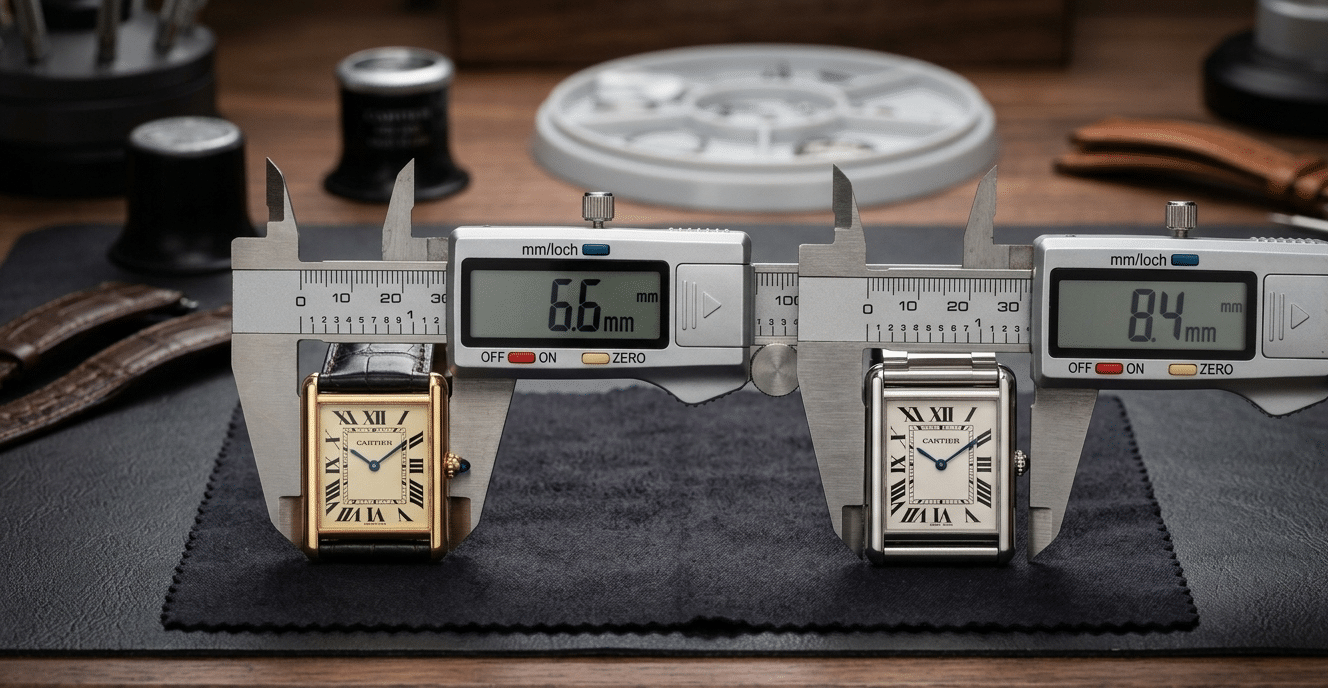
For a watch like the Cartier Tank Must, which gen specs list at around 6.6mm to 7.0mm thick, that extra 2mm from the movement is catastrophic. It doesn’t just make the watch thicker; it destroys its proportions. The elegant, rectangular case becomes a slab. The watch no longer slips under a shirt cuff; it catches on it. It no longer feels like a delicate accessory; it feels like a block on your wrist. This isn’t a minor spec deviation debated by enthusiasts—it’s a fundamental failure of replication. The entire character of the watch, its raison d’être, is lost.
The same is true for the smaller Ballon Bleu (33mm) or the Panthere. These are designs where every fraction of a millimeter is part of the aesthetic language. A thicker automatic movement forces the case to swell, ruining the curved profile of the Ballon Bleu or the integrated, jewel-like drape of the Panthere bracelet. In this context, choosing a quartz movement isn’t about saving money; it’s about saving the design.
Expert Authentication Insight
Physical diagnostic: The single most reliable, immediate tell for a poor-quality Cartier dress watch replica is incorrect case thickness. Arm yourself with a simple set of digital calipers. Measure the watch’s profile from the case back to the top of the crystal. For a Tank Louis Cartier replica, if it measures significantly over 7mm, you are almost certainly holding a watch built around the wrong movement. No amount of good dial printing or a nice strap can compensate for this. On the wrist, the difference is visceral. The genuine article has a featherweight, paper-thin presence. The thick replica feels clumsy and conspicuous. This measurement is the first and most objective filter.
Decoding the Movement Landscape: What’s Actually Inside
Moving from the “why” to the “what,” the landscape of quartz movements in high-end replicas is not a monolith. Top factories don’t use random, generic modules. They select specific, proven calibers that deliver the performance and dimensions required for a believable luxury experience. Understanding what’s actually inside separates a strategic engineering choice from a cheap compromise.
The Swiss & Japanese Workhorses: Ronda and Miyota
The elite factories—think BVF, AF, and 3KF—don’t scavenge from toy watches. They source from the same tier of suppliers that genuine mid-range Swiss brands use. The two dominant players are:
- Swiss Ronda: Calibers like the Ronda 762 (or the similar 705) are the gold standard. These movements are paragons of precision, often rated within ±10 to ±20 seconds per year. They offer multi-year battery life, exceptional reliability, and critically, a height of approximately 2.5mm. This is what allows a factory to build a Tank replica that hits the genuine 6.6mm thickness spec.
- Japanese Miyota: Calibers like the 1L42 (or similar 1Lxx series) are the other pillar. Citizen’s Miyota is renowned for robust, no-nonsense engineering. They are slightly thicker than their Ronda counterparts (often around 3.0mm) but are incredibly durable and accurate. Their use is a deliberate choice for models where a fraction of a millimeter is less critical, or where cost optimization without sacrificing core performance is key.
Contrast these with the generic “Chinese standard quartz” movements found in $100 replicas. Those are often thicker, noisier (audibly and tactilely), less accurate, and have a jarring one-step-per-second tick. The difference isn’t just technical; it’s experiential. A Ronda or Miyota-equipped watch feels solid and refined when you set the time. A cheap quartz feels gritty and imprecise.
The “High-Beat” Illusion: Simulating a Sweep Seconds Hand
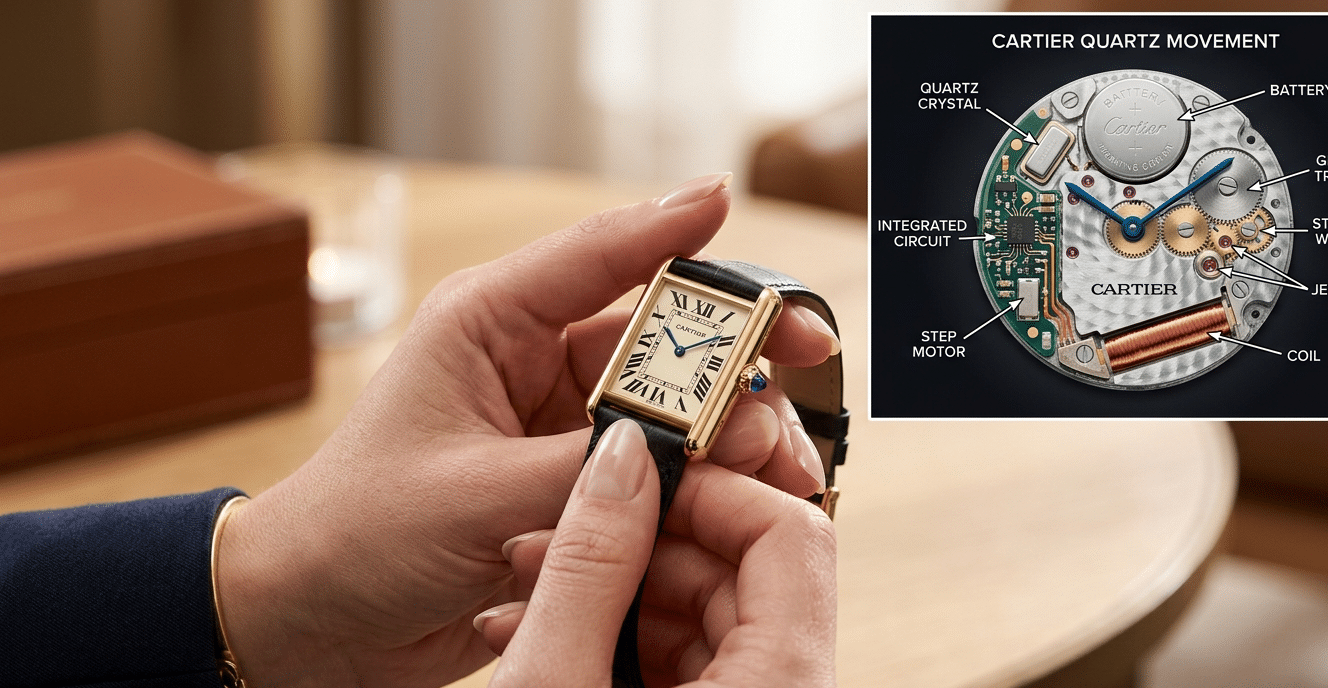
A major point of confusion—and a key differentiator—is the seconds hand motion. Many buyers see a “sweeping” seconds hand and assume it’s automatic, dismissing a quartz watch that “ticks.” This is a misunderstanding of high-end quartz technology. Movements like certain Ronda calibers utilize a stepper motor that pulses at 32,768 times per second (the same frequency as the quartz crystal itself). This allows the seconds hand to advance in much smaller, more frequent steps—typically 8, 16, or 32 steps per second—creating a smooth, glide-like motion that visually mimics a mechanical sweep.
This isn’t a trick or a flaw; it’s a feature of luxury quartz. Genuine Cartier quartz models, like many high-end quartz watches from Patek Philippe or Piaget, often use these “high-beat” quartz movements specifically to provide a more luxurious, continuous sweep. When a top-tier replica factory uses such a movement, they are not trying to “fake” a mechanical watch; they are correctly replicating the genuine article’s behavior, a key insight detailed in the Cartier replica movement guide. The smooth sweep is a sign of a better quartz movement, not an automatic one.
Expert Authentication Insight
Physical diagnostic: Listen closely. In a quiet room, bring the watch close to your ear. A cheap quartz movement emits a loud, metallic, and distinct “TICK-tick-TICK-tick” every second. It’s often audible from a few inches away. A high-quality Ronda or Miyota movement is virtually silent. You might hear a faint, high-pitched hum if you listen intently, but no loud ticking. This sonic signature is a dead giveaway of internal quality. A noisy tick immediately reveals a low-grade movement, betraying the watch’s true nature regardless of how good the dial looks.
The Super Clone Quartz Reality: 3KF, BVF, and AF’s Approach
The proof of quartz’s legitimacy in high-end replicas is in the factories that stake their reputations on it. For these makers, quartz isn’t a fallback option; it’s a core part of their model-specific strategy to achieve maximum authenticity. Their choice is driven by design fidelity, not just cost.
3KF’s Patek-Approach to Cartier: The Tank Must Movement Solution
3KF (or 3K Factory) earned its reputation by producing some of the most meticulous mechanical super clones in the industry, notably for Patek Philippe. When they turned to Cartier, they applied the same obsessive, component-level philosophy. For their Tank Must replicas, evidence suggests they source and potentially even finish Swiss Ronda quartz movements. Why? Because for the Tank, the paramount goal is to hit the exact, wafer-thin case dimensions of the genuine watch. A mechanical movement, even a slim clone, would force compromises. 3KF treats the quartz movement not as a cheap part, but as a critical, precision component that enables the overall replication to succeed. The result is a watch where the thickness, weight, and on-wrist feel are indistinguishable from the genuine article—the highest compliment a super clone can receive.
BVF & AF: Dominating the Ballon Bleu and Panthere
BVF (Blue Vision Factory) and AF (Acronym Factory) are the undisputed specialists for Cartier replicas, particularly the Ballon Bleu and Panthere. Their widespread use of high-end quartz in these models is a masterclass in design-first engineering.
- For the Ballon Bleu: The watch’s signature is its curved case, which arcs to fit the wrist, and the unique crown guard that blends into the case. This architecture demands a specific, minimal movement height. A thicker automatic movement would flatten the case curve, making the watch sit higher and awkwardly on the wrist, destroying the integrated, organic look. BVF and AF’s quartz choice preserves this crucial silhouette.
- For the Panthere: This is a jewelry watch first. Its essence is in the fluid integration of the bracelet links and the delicate, seamless case. Adding the height of an automatic movement would make the case chunkier, disrupting the bracelet’s drape and the watch’s overall lightness. It would feel like a machine attached to a bracelet, not a unified piece of jewelry. The quartz movement is the only way to maintain the Panthere’s essential character.
In both cases, these factories could theoretically install a clone automatic movement. The fact that they don’t—and that their quartz models command prices of $700-$800—proves the point: this is a deliberate, calculated choice for authenticity. They are selling fidelity to the Cartier experience, not just a list of features.
Expert Authentication Insight
Physical diagnostic: Watch the sweep. Use your smartphone’s slow-motion video mode (usually 240 frames per second) to film the seconds hand of a suspected high-end quartz replica. A genuine high-beat quartz movement (and a good replica using one) will show a smooth, continuous glide. You’ll see it advance in tiny, rapid steps—typically 8 per second—making the motion fluid to the naked eye. A cheap quartz movement will show a stark, jarring jump once per second, even in slow motion. This visual test cuts through marketing claims and directly assesses the quality of the quartz movement inside.
The User Experience Verdict: Convenience as a Luxury
In the world of luxury replicas, we often get lost in the technical theater of mechanical movements—the rotor’s swing, the balance wheel’s oscillation, the romantic notion of a tiny machine on your wrist. But for a Cartier, especially the classic dress pieces, this perspective misses the point entirely. The true luxury of a Tank or a Panthere isn’t mechanical complexity; it’s effortless elegance. And nothing delivers that experience more reliably than a high-end quartz movement. This is where the user experience shifts from being about admiring the engineering to simply enjoying the watch. For a piece meant to be an extension of personal style, set-and-forget reliability isn’t a compromise—it’s the ultimate feature.
The Daily Wear Advantage: Accuracy and Readiness
Consider the actual wearing scenario. A Cartier dress watch is not a weekend novelty; it’s a daily companion, an accessory you grab without thought. Here, the quartz advantage is absolute. Pull a quartz Tank from your drawer after three months of neglect. It’s still ticking, still showing the exact time down to the second. The experience is seamless.
Now, contrast that with the best automatic clone movement. Even a well-regulated one will have gained or lost meaningful minutes over that same period. It will have stopped, requiring you to set the time, wind the crown, and sync the date. For a watch whose entire raison d’être is to be a flawless, always-ready accessory, this is a fundamental friction point. The constant need for resetting and adjustment breaks the illusion of effortless luxury. In this context, accuracy isn’t a spec; it’s a core component of the design integrity. A watch that can’t tell time reliably, regardless of its mechanical soul, fails at its most basic function.
Maintenance Myths: The Long-Term Simplicity
A persistent myth in the replica community is that quartz movements are inherently more problematic or “disposable” compared to automatics. This is a fundamental misunderstanding of quality tiers. A cheap, noisy Chinese quartz movement is indeed a liability. But the Swiss Ronda or Japanese Miyota calibers used by factories like BVF and 3KF are a different class entirely.
These movements are engineered for a battery life of 3-5 years, with accuracy measured in seconds per month. Their service interval is literally a 60-second battery swap at any jeweler. Conversely, a thin clone automatic movement—stuffed into a case it wasn’t designed for—is a service liability, a topic explored in depth in this cartier super clone movements guide. It’s more susceptible to positional error, shock damage, and lubrication breakdown. A full service for a clone movement can cost a significant fraction of the watch’s price and requires finding a specialist willing to work on it. Quartz ownership is predictable: long stretches of perfect operation punctuated by a trivial, inexpensive battery change. Automatic ownership, especially in the replica sphere, is a gamble on when, not if, it will need attention.
Expert Authentication Insight
Physical diagnostic: Crown Action and Feel. The crown is your direct interface with the movement, and its quality is a dead giveaway. On a high-quality quartz replica from a top factory, the crown action will be precise and firm. Pulling it out to set the time will have a clean, definite click. Turning it will feel smooth, with no grinding, grittiness, or lateral wobble. On a cheap quartz build, the crown stem and setting mechanism are an afterthought. The action will feel mushy, loose, or imprecise. This isn’t just an annoyance; it indicates poor internal construction, cheap plastics, and a general disregard for the user experience that permeates the entire build.
When Quartz Fails: The Models and Exceptions
To champion quartz in Cartier replicas is not to advocate for it universally. This logic has clear, non-negotiable boundaries. The argument only holds for models where the genuine article was designed with quartz as a legitimate, often primary, option. When you step outside those bounds, a quartz movement immediately signals a low-tier, cost-cutting replica that misunderstands the watch’s very identity.
The Automatic-Only Icons: Santos de Cartier and Calibre Divers
This is the critical exception. For the modern Santos de Cartier, with its exposed bezel screws and integrated bracelet designed to showcase a mechanical heart, a quartz movement is a fundamental contradiction. The genuine Santos is a statement of mechanical watchmaking. A quartz replica of a Santos is always a shortcut, sacrificing the watch’s core identity for marginal cost savings. The same rule applies to any Cartier model built around an in-house calibre, such as the Calibre de Cartier or a Rotonde. These watches are sold as mechanical achievements; a quartz version does not exist in the genuine catalog, so a replica with one is instantly identifiable as a low-effort fake. In these cases, you must seek out factories like GF or 3KF that clone the proper automatic movement, even if it means a thicker case.
Spotting the Cheap Quartz Compromise
Not all quartz is created equal. The goal is to identify the high-end, strategically chosen quartz from a top factory versus the generic, cost-cutting quartz from a low-tier workshop. Here are the key tells:
- Incorrect Hand Stack/Date Position: If the genuine model has a date at 3 o’clock but the replica’s date window is positioned for a different movement layout, it’s a cheap compromise.
- Non-Sweeping Seconds Hand: A loud, jumping one-tick-per-second motion indicates a bottom-tier quartz movement, not the high-beat “sweep” quartz used in genuine luxury watches and good replicas.
- Audible Tick: In a quiet room, a cheap quartz movement is distractingly loud. A quality movement is virtually silent.
- Thick Case Despite Quartz: This is the ultimate failure. If a factory uses a quartz movement but the case is still 1-2mm thicker than the genuine article, it means their engineering is poor. They’re using the wrong movement or have failed to design a proper case to house it.
Expert Authentication Insight
Physical diagnostic: Case Back Examination. The case back is the biography of the watch’s construction. A top factory like BVF or AF, even when using a quartz movement, treats the case back as part of the overall finish. Engravings will be deep, crisp, and correctly aligned. The metal will feel solid, and the fit will be precise. A low-tier factory using a cheap quartz movement will almost always pair it with a flimsy, poorly finished snap-back case. The engravings will be shallow, fuzzy, or misaligned. The metal may feel thin or sharp. The case back tells you everything about the builder’s intent: was this meant to be a coherent replica, or just a front-facing facade?
The Buyer’s Decision Framework: Choosing Your Cartier Replica
Forget the generic “quartz vs. automatic” debate. The correct choice is dictated entirely by the model and the design goals of the genuine watch. Your decision logic should be a clear, model-first flowchart.
Model-First Logic: The Ultimate Flowchart
Ask these questions in order:
- Is it a Tank, Panthere, or classic Ballon Bleu? If YES, your primary mission is to find perfect thickness and proportion. Prioritize factories like BVF, AF, or 3KF that use high-end quartz movements. This is the correct, design-faithful choice. The movement is a means to achieve the genuine article’s silhouette.
- Is it a modern Santos de Cartier or a “Calibre” model (e.g., Calibre de Cartier)? If YES, the genuine watch is a mechanical statement. Only consider factories like GF or 3KF that clone the automatic movement. Avoid any quartz version; it is a guaranteed low-tier compromise.
- Regardless of the model, does the listing show a loudly ticking seconds hand and a case that looks obviously thick? If YES, walk away. This is a low-quality build, full stop.
Factory & Movement Specification Checklist
Use this quick-reference guide to cut through marketing language and target the correct builds:
- Cartier Tank Must (Small/Large): Target 3KF. They are known to use a top-tier Swiss Ronda quartz (or equivalent) to achieve gen-spec thinness. Expect to pay a premium, around $700-$850.
- Cartier Ballon Bleu 33mm/36mm: Target BVF or AF. They use a high-beat quartz (often mimicking a Ronda 762/705) for a smooth seconds sweep and correct case profile. Price range: $650-$800.
- Cartier Panthere (Small/Medium): Target BVF or AF. Again, a high-quality quartz is used to maintain the delicate, jewelry-like proportions. Price range: $600-$750.
- Cartier Santos (Large/Medium): Target GF (for the classic) or 3KF (for newer models). They use a cloned automatic movement (often based on a Miyota 9015). Avoid any quartz Santos. Price range: $750-$900.
This checklist prioritizes the factory-movement combination that best serves the design intent of each specific model.
Expert Authentication Insight
Physical diagnostic: The Final Wrist-Feel Test. All the specs and factory codes lead to this moment. Put the watch on. A super clone Cartier with the correct movement—especially a well-executed quartz in a Tank or Ballon Bleu—will perform a magic trick: it will disappear. It should feel light, slim, and perfectly balanced. It becomes an effortless part of you. A poorly executed replica, whether it’s a thick quartz Tank or a clunky automatic Santos, will constantly announce its presence. It will feel top-heavy, awkward, or conspicuous. The ultimate authentication isn’t done with a loupe; it’s done with your nerves. The genuine article, and its best replicas, are defined by silent, elegant presence.
The Verdict
For the core canon of Cartier’s design—the Tank, the Panthere, the classic Ballon Bleu—seeking out a high-quality replica with a superior quartz movement is not settling for second-best. It is the only rational path to capturing the genuine article’s defining virtue: that sublime, elegant thinness which makes these watches icons. The automatic snobbery common in replica circles is a misapplied dogma. In the context of Cartier, the “super clone” achievement is often measured in millimeters saved, not in a rotor’s swing. The smart buyer’s filter is simple yet powerful: Choose the movement that serves the design. Let the design dictate the watch. Anything else is a compromise of the very thing you set out to own.