
Why the Seagull 2824 Dominates Mid-Tier Cartier Replicas
For a factory producing a Cartier replica, the movement choice isn’t about passion or horological perfection. It’s a cold, hard calculation. The goal is to build a watch that looks like a Cartier, feels automatic, and sells for under $500, while still turning a profit. However, for models like the Santos, a dedicated miyota 9015 super clone movement analysis reveals why a different caliber often becomes the preferred default. In many other replica contexts, the Seagull ST1812—universally known as the Seagull 2824 clone—is the inevitable answer to that equation. It’s not the best movement available; it’s the most logical one.
Cartier’s own entry-level automatic watches, like many in the Ballon Bleu and Santos lines, have historically used variations of the Swiss ETA 2824 or its Sellita SW200 cousin. This creates a perfect blueprint. When a factory in Guangzhou sets out to clone a watch, starting with a cloned version of the movement that was originally designed to fit that specific case is the path of least resistance. The Seagull 2824 is a direct, dimensionally compatible copy. Its parts are dirt cheap, available by the truckload, and every watchmaker from Shenzhen to Switzerland has worked on a 2824. For the factory, it’s a plug-and-play solution that minimizes R&D cost and maximizes reliability—or at least, predictable serviceability.
The Factory Calculus: Cost, Compatibility, and Proven Design
The math is brutally simple. A Seagull 2824 movement costs a factory a fraction of what a Swiss ETA 2824 costs, and significantly less than a Japanese Miyota 9015. This isn’t a small difference; it’s the margin that defines the “mid-tier” replica market. The 2824’s design is over 40 years old, and every potential flaw and fix is documented. This “known quantity” status is priceless for mass production. It allows factories like AF and V6 to focus their budget and effort on the external parts—the case finishing, dial printing, crystal—where visual tells are more immediate. Choosing the 2824 is an industrial decision to allocate resources where they’re most visible to the buyer.
Service Network Reality: Why Watchmakers Prefer the 2824
From a repair perspective, the Seagull 2824 is the closest thing to a universal language in the replica world. Its architecture is identical to the Swiss original. This means any watchmaker with experience on an ETA 2824 can service a Seagull 2824 with minimal friction. Mainsprings, balance staffs, pallet forks—entire generic repair kits exist. For a dealer, this translates to lower after-sales hassle and cost. For a buyer, it theoretically means easier repairs. This serviceability is the primary marketing point used to justify the 2824’s presence over thinner, more modern alternatives. It’s a compelling argument, but one that deliberately ignores the watch’s most critical flaw.
Expert Authentication Insight
The auditory and tactile experience is a quick differentiator. A genuine ETA 2824 has a relatively quiet, refined rotor spin. A well-lubricated Miyota 9015, while sometimes audible, has a distinct, higher-pitched whirl. The Seagull 2824 clone often occupies a middle ground but can exhibit a slightly grainier, more metallic rotor noise. More telling is the winding feel. The crown action on a Seagull can feel less buttery-smooth than a Swiss ETA, with a more noticeable mechanical feedback during manual winding. It’s not a failure; it’s a character trait born of slightly looser tolerances.
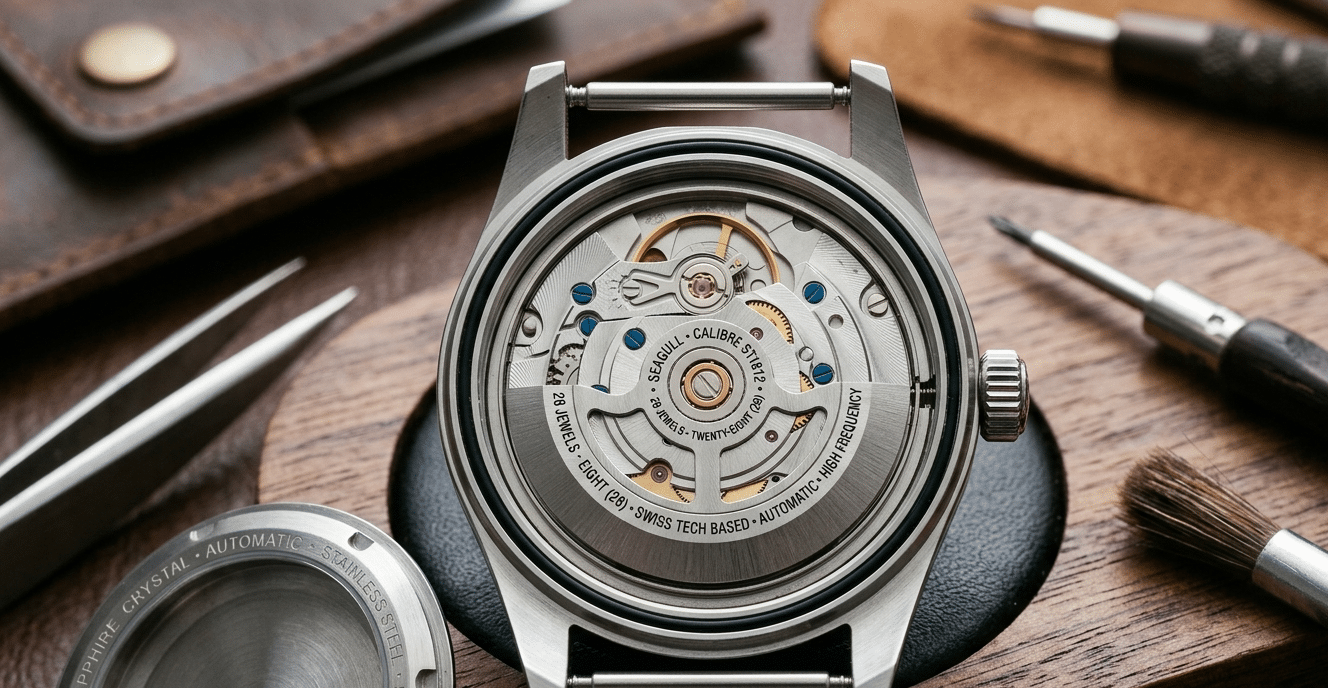
Seagull ST1812 vs. Swiss ETA 2824: The Clone Reality Check
Calling the Seagull ST1812 a “super clone” is both true and profoundly misleading. It is a functionally cloned workhorse, but it exists in a different universe of finishing and long-term resilience. Understanding this gap is key to setting realistic expectations.
Tolerances and Timekeeping: Setting Realistic Expectations
Out of the box, a new Seagull 2824 can keep surprisingly good time, often within +/- 10 to 20 seconds per day. This is where the “super clone” hype gets its fuel. However, this performance is about precision at a single point in time, not consistency. The Swiss ETA 2824 is built to maintain its accuracy across positions and temperatures with greater stability. The Seagull movement is more susceptible to positional error and may see its rate drift more significantly over the first year of wear. The power reserve is nominally the same (around 38-42 hours), but the Seagull’s mainspring and barrel tolerances mean you might experience a more noticeable drop in amplitude as it winds down, leading to less consistent timekeeping in the final hours.
Finishing and Feel: The Visual and Tactile Gap
Open the caseback, and the difference shifts from technical to glaringly visual. The Swiss ETA features perlage on the base plate, polished bevels on the bridges, and blued screws. The Seagull has a matte, industrial gray finish, minimal decorative perlage that often looks stamped rather than machined, and screws that are either plain or poorly thermally blued. The rotor bearing is another tell; the Seagull uses a simpler, noisier ball-bearing system compared to the more refined bidirectional winding mechanism of the modern ETA. This isn’t about snobbery—it’s about the resources invested in friction reduction, wear, and longevity.
Expert Authentication Insight
For a watchmaker, the instant tell is in the details a buyer never sees. The engraving on the rotor is the first clue: the font on a Seagull is often slightly bolder and less sharp than the delicate, laser-precise engraving on a genuine ETA. Look at the gear train: the teeth on the Seagull’s wheels may have slightly less polished edges. Most definitively, examine the balance cock. The adjustment system on a Seagull—the regulator index—often has a different shape and a less refined finish than the Swiss counterpart. These are the fingerprints of a different manufacturing philosophy: functional replication, not qualitative equality.
The Unforgiving Math of Movement Thickness
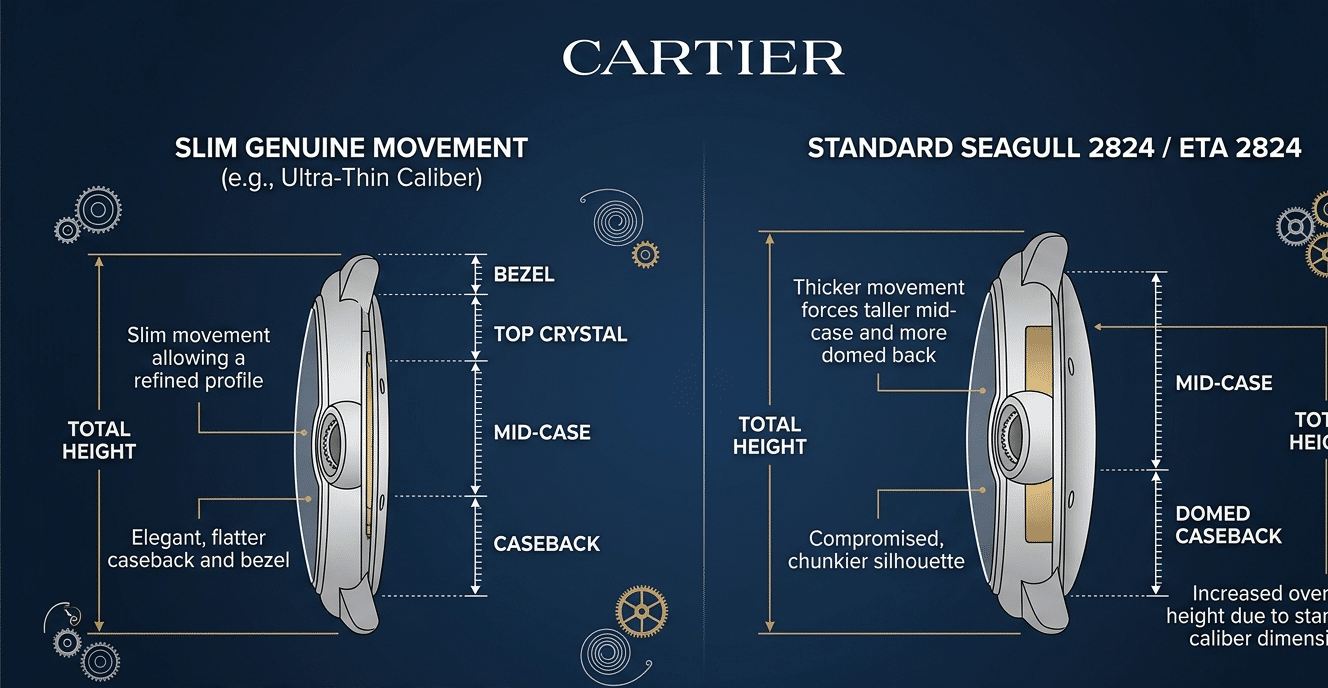
This is where the practical compromise of the Seagull 2824 becomes physically undeniable. The conversation shifts from abstract “reliability” to a tangible, on-wrist flaw. The Seagull ST1812 measures approximately 4.6mm in height. Compare that to the Miyota 9015 at 3.9mm, and the genuine Cartier in-house calibers, like the 1847 MC, which slim down to about 3.6mm. That 0.7mm difference against the Miyota, and over 1.0mm against the genuine movement, isn’t a minor spec sheet footnote.
In watch design, vertical space is the most expensive real estate. Adding even half a millimeter to a movement’s height forces the case designer into a series of compromises. They must either increase the mid-case profile, creating a thicker-looking slab side, or they must create a more pronounced caseback bulge to encapsulate the movement. Often, it’s both. This extra height directly undermines a core tenet of Cartier’s design language: elegant, wearable thinness.
From Millimeters to Silhouette: How Height Becomes Bulk
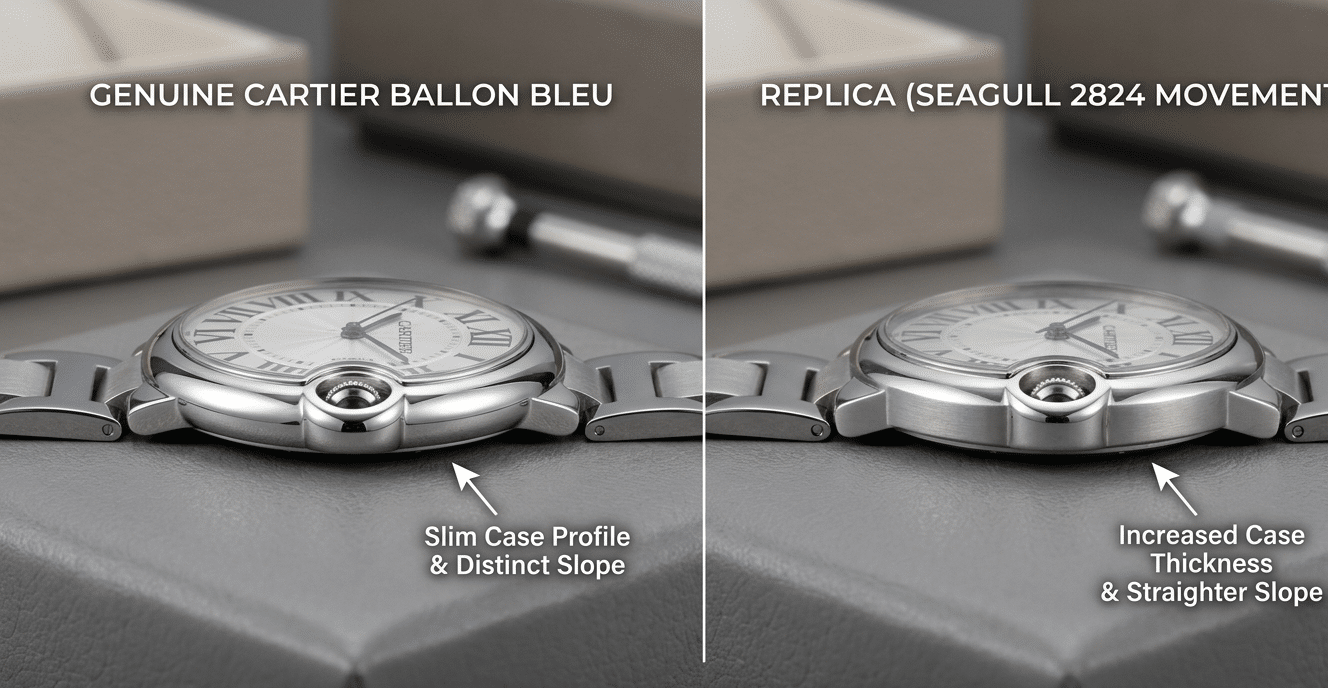
On a design like the Ballon Bleu, which derives its character from a curved, flowing “balloon” profile that seems to float on the wrist, a thicker movement is catastrophic. That elegant, continuous curve from crystal edge to caseback gets interrupted. The side profile becomes taller and straighter, losing the delicate, domed illusion. The watch stops looking like a Ballon Bleu and starts looking like a generic dress watch with a rounded crystal. The aesthetic cost is total.
Caseback Design: The Hidden Culprit of Added Height
Since factories are loath to alter the external dimensions of the bezel and crystal (the most visible parts), the extra millimeter is almost always absorbed by the caseback. A genuine Cartier caseback is often slim and flush. A replica housing a Seagull 2824 will frequently have a noticeably more domed or thicker caseback. This changes how the watch sits on the wrist, pushing it higher off the skin and affecting the center of gravity. It’s a hidden tax on comfort and silhouette.
Expert Authentication Insight
The most straightforward forensic test is a simple measurement. Genuine Cartier publishes official case thickness specifications. For a Ballon Bleu 42mm, it’s approximately 12.0mm. Take a pair of digital calipers and measure the thickness of a Seagull 2824-powered replica from the top of the crystal to the bottom of the caseback. You will consistently find measurements between 12.8mm and 13.5mm. After accounting for standard crystal and caseback thickness, that 0.8-1.5mm of excess is the physical footprint of the Seagull movement. It is the single most measurable, undeniable proof of the compromise.
Model-by-Model Impact: Which Cartier Watches Suffer Most?
The Seagull 2824 isn’t a universal problem; it’s a specific design conflict. Its impact varies wildly depending on the Cartier model it’s stuffed into. For some, it’s a minor compromise. For others, it’s a deal-breaking distortion of the watch’s entire identity, a crucial factor highlighted in analyses of quartz Cartier replica movements explained when comparing factory choices. Here’s where the thickness tax is paid most heavily.
Ballon Bleu: The Silhouette Killer
This is where the Seagull 2824 does its worst work. The Cartier Ballon Bleu’s entire design language is built on a single, ethereal illusion: the domed sapphire crystal appears to melt seamlessly into the curved caseband, creating a “floating” bubble effect. This requires an incredibly shallow, arched mid-case profile. The genuine 42mm Ballon Bleu, powered by Cartier’s thin 1847 MC or 049 caliber, achieves a thickness of around 12mm.
Insert a ~4.6mm Seagull 2824, and that graceful arch is destroyed. The caseback must bulge outwards, and the mid-case walls become taller and straighter to accommodate the movement’s height. The result is a slab-sided, top-heavy profile that loses the delicate, organic curvature of the original. The watch no longer hugs the wrist; it perches on it. The defining “balloon” becomes a blunt cylinder. For this model, the 2824 isn’t a compromise; it’s a fundamental betrayal of the design.
The Verdict: Ruined. The Ballon Bleu is the worst possible candidate for a Seagull 2824. If silhouette matters to you, this movement choice makes the watch fundamentally incorrect.
Santos: Adding Height to a Designed Profile
The Santos de Cartier is a different beast. Its design is more architectural and less reliant on a single, fluid curve. The genuine large model (WSSA0019) measures 39.8mm wide and a svelte 9.08mm thick. The Santos can tolerate a bit more bulk than the Ballon Bleu, but the 2824 still imposes a penalty.
A replica Santos built on a 2824 will typically creep into the 10.5mm to 11mm thickness range. This extra millimeter-plus changes the wearing experience. The watch sits higher off the wrist, losing the integrated, “second skin” feel that defines the modern Santos. The sharp, geometric lines of the bezel start to feel less crisp from the side, as the added height dilutes the design’s intended horizontal emphasis.
The Verdict: Compromised. The Santos can survive a 2824, but it wears demonstrably taller and less refined. The design’s integrity is chipped away, not shattered. For many, this is an acceptable trade-off for the lower price and serviceability, but it is a conscious step away from the genuine article’s sleekness.
Pasha and Others: A Case-by-Case Verdict
For other Cartier models, the calculus depends entirely on the original’s proportions.
- Tank Must/Solo: An automatic Tank with a Seagull 2824 is practically a non-starter. These are meant to be ultra-thin, elegant dress watches. A 2824-based replica would be comically thick, completely defeating the purpose of a Tank.
- Pasha de Cartier: The Pasha’s chunky, sportier case (genuine ~11mm thick) has more internal volume. A 2824 is a more natural fit here, and the thickness increase is less visually disruptive. The compromise shifts from aesthetics to the potential for a more pronounced caseback bulge.
- Ronde, Drive: Similar to the Pasha, these round models with more conventional case shapes can absorb the 2824’s height with less catastrophic effect. The flaw is present but less central to the design’s identity.
Expert Authentication Insight
The most immediate visual tell for a mid-tier Cartier replica is not the dial print or the date wheel—it’s the profile. A trained eye looks for the lug curvature. On a genuine Ballon Bleu or a slim Santos, the lugs curve sharply downward to wrap the wrist. A case thickened by a 2824 often forces a flatter, less pronounced lug curve. The transition from case to crystal also loses its seamless, flowing grade. Before you ever look at the movement, measure the thickness with calipers. A discrepancy of more than 1-1.5mm over the genuine spec, after accounting for crystal and caseback, is almost always the fingerprint of a thicker, cloned workhorse movement like the Seagull 2824.
The Serviceability Argument: How Much Does Easy Repair Really Matter?
This is the hill many dealers and 2824 advocates choose to die on: “It’s easy to service! Any watchmaker can work on it!” This is factually true. The ETA 2824 design is horological bedrock, and the Seagull clone shares its architecture. Parts are cheap and plentiful globally. But for the end buyer of a $300-$500 replica, this argument is often wildly over-weighted and borders on a marketing decoy.
Parts Availability vs. Movement Swap Economics
Let’s run the numbers with cold pragmatism. A full service for a Seagull 2824 from an independent watchmaker in the US might cost $150-$250. A brand new Seagull ST1812 movement can be purchased online for $80-$120. A brand new Miyota 9015 (the thinner alternative) costs $100-$140.
When a movement in a replica watch fails—whether it’s a 2824 or a 9015—the most logical economic decision is almost never a delicate, part-by-part service. It’s a complete movement swap. The labor is simpler, faster, and often cheaper than a full service, and you get a fresh movement with a new warranty period from its manufacturer. The “serviceability” of the 2824 becomes relevant only in niche scenarios: if a single, specific part fails (like a broken click spring) and you find a watchmaker willing to do a micro-repair on a replica for less than the cost of a new movement.
The “Future-Proof” Myth for Disposable Watches
The “future-proof” narrative implies you’re buying a heirloom. You’re not. You’re buying a mass-produced replica with a finite lifespan. The primary point of failure in these watches is rarely the movement first; it’s the water resistance failing, the plating wearing, the crystal scratching, or the buyer simply moving on to another watch. Planning for a costly, detailed service a decade down the line for a sub-$500 watch is an exercise in financial fiction.
This “serviceability” advantage is real, but its primary beneficiary is the dealer or repair shop, not you. It makes their after-sales support and warranty repairs marginally easier and cheaper. For you, the buyer, the tangible, daily impact of the movement choice is not repairability—it’s the thickness on your wrist and the silhouette in the mirror.
Expert Authentication Insight
From a watchmaker’s bench perspective, the serviceability argument is a technical truth but a practical red herring. As one watchmaker who works on replicas noted, “I tell clients with a failed movement in a replica that a swap is almost always smarter than a service. The labor to disassemble, clean, oil, and reassemble a 2824 exceeds the cost of a new unit. The ‘serviceability’ is a convenience for me as the technician, not a long-term value prop for the owner. If they’re that concerned about longevity, they shouldn’t be buying a replica in the first place.”
Direct Alternatives: The Thinner Movements Worth Paying For
If the Seagull 2824’s thickness is a problem, the market does provide solutions. For a deeper analysis of these premium caliber alternatives, you can refer to this detailed guide on Cartier super clone movements, which is key to making an informed choice as they simply cost more.
The Miyota 9015: The Actual Thin-Watch Solution
This is the escape hatch. The Citizen Miyota 9015 is the direct, superior alternative for any replica where case thickness is paramount. Its specification sheet tells the story: at approximately 3.9mm thick, it provides a full 0.7mm of vertical space savings over the Seagull 2824. In the confined universe of a watch case, that’s a monumental difference.
This is why factories like GF (for the Santos) and some higher-tier producers use the 9015. It allows them to closely replicate the genuine watch’s slim profile. The trade-offs? The 9015 is generally a bit noisier (a higher-pitched rotor whirl), can be slightly less robust to shock in some opinions, and adds roughly $80-$150 to the build cost of the watch. For models like the Ballon Bleu or Santos, this is the premium you pay for visual correctness. If you want a slim Cartier replica, you are looking for a Miyota 9015. Full stop.
Beyond Miyota: Niche Clones and Their Premium
The Miyota 9015 isn’t the end of the road. For the ultimate in accuracy, a small subset of replicas use specialized clone movements.
- Seagull 2671 (ST6) / “Clone Cal.076”: Used in some high-end 33mm women’s Ballon Bleu replicas (e.g., from K3 factory), this movement clones the ETA 2671, which itself is the base for the Cartier 076 caliber. Its advantage isn’t just thickness; it’s function. It replicates the genuine movement’s single pull-out position for time-setting, unlike the more common two-position Miyota 8215 clones. This is a detail-for-detail approach, but it commands a significant premium, often pushing the watch toward the $700-$800 range.
- Seiko NH35/NH38: Sometimes presented as an alternative, these movements are actually thicker (~5.3mm) than the Seagull 2824. They are a non-starter for slimming a case and are typically used in replicas where thickness is less critical or where their durability and hacking seconds are prioritized over profile.
These niche options highlight the hierarchy: the Seagull 2824 is the budget, thick workhorse; the Miyota 9015 is the slim, mainstream upgrade; and the specialized clones are the low-volume, high-cost pursuit of total accuracy.
Expert Authentication Insight
Identifying a Miyota 9015 in a closed-caseback watch without opening it is tricky, but the resulting case profile is the giveaway. A genuine-spec thin Santos or Ballon Bleu replica almost certainly contains a 9015 or a specialized clone. The market has standardized this. If a dealer is advertising a “1:1 thickness” or “same as genuine” profile on a modern Cartier model and the price seems too good to be true, they are likely either misrepresenting the specs or using an older, thicker case model as their reference point. Always ask for a caliper measurement of the case thickness before buying.
The Buyer’s Decision Framework: Thickness vs. Total Cost of Ownership
By now, the choice should be painfully clear, but the final decision is rarely made with cold, hard logic. It’s made through the lens of your personal priorities. To cut through the noise, forget features and specs for a moment. Ask yourself one question: what are you actually buying this watch for? The answer will slot you into one of three clear profiles, and from there, the path forward is unambiguous.
Priority Check: What Are You Actually Buying?
This isn’t about good or bad choices; it’s about honest ones. Your priority dictates the correct movement.
Profile A: The Budget-First Purist. Your primary goal is to own the Cartier look for the absolute lowest possible entry cost. You understand that a replica is a compromise by nature, and you are willing to trade off visual perfection for financial accessibility. For you, the extra 0.7mm of case thickness is an acceptable, known flaw for a price that might be $150-$200 less than the Miyota 9015 alternative. You’re buying the design, and the Seagull 2824 delivers that design at the lowest price point with reliable timekeeping. This is a rational choice, provided you go in with eyes wide open to the slab-sided profile.
Profile B: The Proportion-Priority Buyer. You are not just buying a Cartier replica; you are buying the Cartier silhouette. The elegant slimness, the curved caseback that hugs the wrist, the floating illusion of the Ballon Bleu—these are non-negotiable elements of the design. For you, a thicker case isn’t a minor flaw; it’s a fundamental failure that defeats the entire purpose. The “Total Cost of Ownership” for a 2824-powered watch isn’t just its dollar price; it’s the daily compromise of wearing a watch that feels and looks categorically wrong on your wrist. Your only path is to save up for the Miyota 9015 version from a factory like GF (for Santos) or seek out the rare, proper clone movements for the Ballon Bleu. The higher purchase price is the direct cost of correctness.
Profile C: The Tinkerer/Hobbyist. You see the watch as a platform, not just a finished product. The Seagull 2824’s greatest strength—its ubiquitous serviceability and parts availability—is your primary draw. You might plan to regulate it for better accuracy, swap in a custom rotor for silence, or even attempt a case modification. The thickness is a challenge to be understood and potentially worked around, not a deal-breaker. You value the mechanical accessibility over the out-of-the-box perfection. The 2824 is your Lego set; the Miyota 9015 is a sealed unit.
The “Total Cost” Calculation: Purchase Price + Compromise Cost
This is the crucial mental shift. The sticker price is only one part of the equation. You must add the intangible but very real “Compromise Cost.”
- Seagull 2824 Cost: Lower purchase price (+). High reliability for the money (+). Easy, cheap servicing (+).
Compromise Cost: Permanently incorrect, thicker case profile that undermines the Cartier aesthetic (-). Potential for a visually “off” wear every single day (-). - Miyota 9015 Cost: Higher purchase price (-). Potentially higher movement replacement cost if it fails (-).
Compromise Cost: Virtually none for the core aesthetic. You get the correct silhouette (++). The watch looks and feels as intended (++).
The math is simple. If the Compromise Cost of a thick case feels like a daily nuisance, it quickly outweighs the few hundred dollars saved. Your “Total Cost” for the 2824 watch becomes infinite. If you barely notice or don’t care about the thickness, the 2824 offers tremendous value. This isn’t about which watch is “better”; it’s about which cost you are willing to bear.
Expert Authentication Insight
Forget magnifying glasses and dial print for a moment. The single fastest, most reliable visual tell for a mid-tier Cartier replica is its side profile. A genuine Cartier case, especially for models like the Ballon Bleu or Santos, is an exercise in slender, flowing curves. A replica built on a Seagull 2824 often has a mid-case that is too tall and straight, or a caseback that protrudes too much, breaking that sleek line. Before you ever scrutinize the date wheel or the “Swiss Made” print, look at the watch’s thickness and the curve of its caseband. A flat, slab-sided profile is the fingerprint of the 2824 compromise.
The Final Verdict: If you cannot personally inspect the watch’s side profile before buying, and you care about the Cartier aesthetic, avoid the Seagull 2824. Its mechanical reliability is a decoy; the thickness is the permanent, uncorrectable flaw. Your choice is binary and stark: a cheaper, thicker watch that tells time reliably, or a more expensive, proportionally correct watch that actually captures the design soul. There is no magical third option. Choose your priority, and let that choice dictate your movement.