
Understanding the Replica Watch Warranty Landscape
Buying a replica watch, especially a sophisticated Panerai Super Clone from a factory like VS, is often an exciting endeavor. Yet, that excitement can quickly turn to frustration when a movement issue crops up shortly after arrival, or when managing the Panerai replica order timeline proves challenging. Unlike a genuine luxury watch purchase, where a comprehensive warranty from a brand like Panerai is a given, navigating the replica warranty landscape requires a different mindset. This isn’t a complaint session; it’s a clear, actionable roadmap to maximize your chances of a successful warranty claim by understanding the unique challenges and leveraging proactive documentation.
The Realities of TD Warranties: What’s Covered (and What Isn’t)
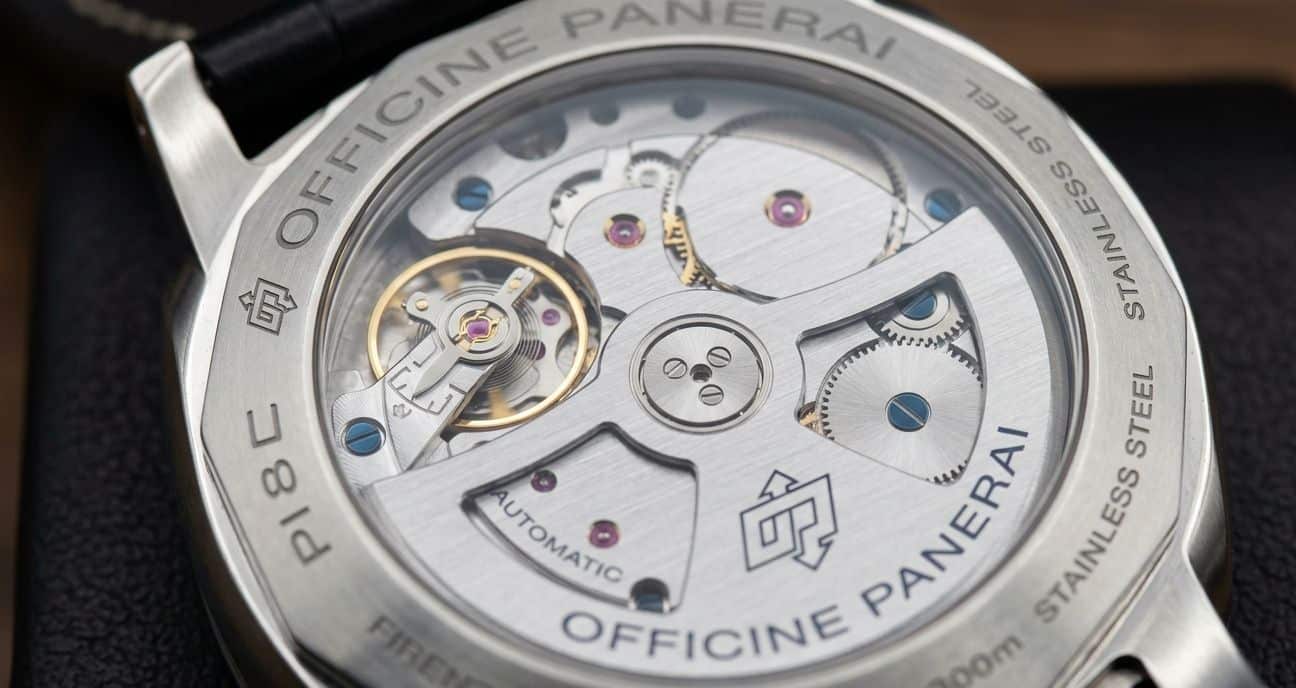
When you purchase a replica watch from a Trusted Dealer (TD), the term “warranty” often carries a very different meaning than what a genuine watch buyer expects. For most high-end replicas, particularly those featuring Super Clone movements like the VS Factory P.9000 or P.9010, the warranty is typically “parts-only.” This means that if a manufacturing defect is proven, the factory will supply replacement components, but the labor cost for installing those parts will fall to the buyer.
TDs structure their warranties this way due to the complex logistics, high shipping costs, and factory policies inherent in the replica market. They act as intermediaries, and while they facilitate communication and shipping, the ultimate responsibility for component quality rests with the factory. Common exclusions from these warranties include user-induced damage (e.g., dropping the watch), water ingress (unless the watch was explicitly tested and guaranteed for a specific water resistance rating by the TD), and any issues arising from unauthorized tampering or modifications. Think of it this way: a TD’s warranty is usually a guarantee that the parts you receive are free from initial manufacturing defects, not a free repair service.
For example, a typical TD warranty clause might state: “Movement issues arising within 30 days of receipt due to factory defect are covered for parts replacement. Shipping costs for replacement parts are covered by the TD. Labor for installation is the responsibility of the buyer.” This stands in stark contrast to a genuine Panerai warranty, which would cover full repair, including parts and labor, for two to eight years depending on the model and service history.
The takeaway here is critical: “warranty” in the replica world often translates to “replacement parts if you can prove a factory defect,” not a complimentary repair service. Plan your budget and expectations accordingly.
The Importance of a Pre-Shipment QC Check & Post-Arrival Inspection
Given the realities of parts-only warranties, your first and most potent line of defense is a thorough Quality Control (QC) check before shipment and an immediate, structured inspection upon receiving your watch. TDs provide QC photos and videos, and scrutinizing these is paramount. Look for:
- Timegrapher Readings: Check for a stable rate (e.g., within +/- 15 seconds per day), a healthy amplitude (typically 260-310 degrees for a new movement), and low beat error (ideally under 0.5ms).
- Cosmetic Flaws: Examine the dial for dust, misaligned markers, or printing errors. Check the hands for proper alignment and any bending. Inspect the case, bezel, and crystal for scratches or imperfections.
- Functional Checks: Ensure the crown winds smoothly, sets the time correctly, and any date or GMT functions operate as expected.
Upon receiving your watch, the inspection process should be just as rigorous. This is your limited window to claim a Dead On Arrival (DOA) issue, which usually has a stricter, shorter timeframe (e.g., 24-48 hours). A recommended post-arrival checklist includes:
- Unboxing Video: Record yourself unboxing the watch from its shipping packaging. This proves the condition upon arrival.
- Initial Timegrapher Check: If you own a timegrapher (or have access to a local watchmaker with one), immediately verify the watch’s performance.
- Winding & Setting Test: Hand-wind the watch fully, then set the time and date. Check for smooth operation and proper engagement of the crown.
- Power Reserve Test: Let the watch run down to verify its stated power reserve (e.g., 70-72 hours for a VS P.9000 clone).
- Visual Inspection: Re-examine all cosmetics, especially for loose hands or dust that might have shifted during transit.
Diligence during the QC review and immediately upon receipt is your absolute first line of defense for any potential warranty claim. It creates a baseline of evidence that can be invaluable.
Expert Authentication Insight
Interpreting basic timegrapher readings from QC videos or initial self-checks is crucial. A healthy VS Factory P.9000 clone movement, for instance, should show a rate within +/- 10-15 seconds per day, an amplitude between 260-310 degrees (in the dial-up position), and a beat error under 0.5ms. If you see an amplitude below 220 degrees, a beat error consistently above 1.0ms, or a rate significantly outside +/- 20 seconds, these are red flags. A “noisy” graph with erratic dots can indicate lubrication issues or debris. Identifying these anomalies before* or *immediately after* receipt allows you to raise concerns proactively, potentially preventing a more complex warranty claim down the line.
Diagnosing Common Super Clone Movement Failures (Panerai & VS Factory)
While Super Clone movements like those from VS Factory are remarkably sophisticated, they are not immune to issues. Understanding the most frequent early failure modes, particularly in Panerai replicas, is key to accurately diagnosing and communicating a problem to your TD. This section provides clear diagnostic criteria for common ailments.
Dead On Arrival (DOA) & Winding Mechanism Issues
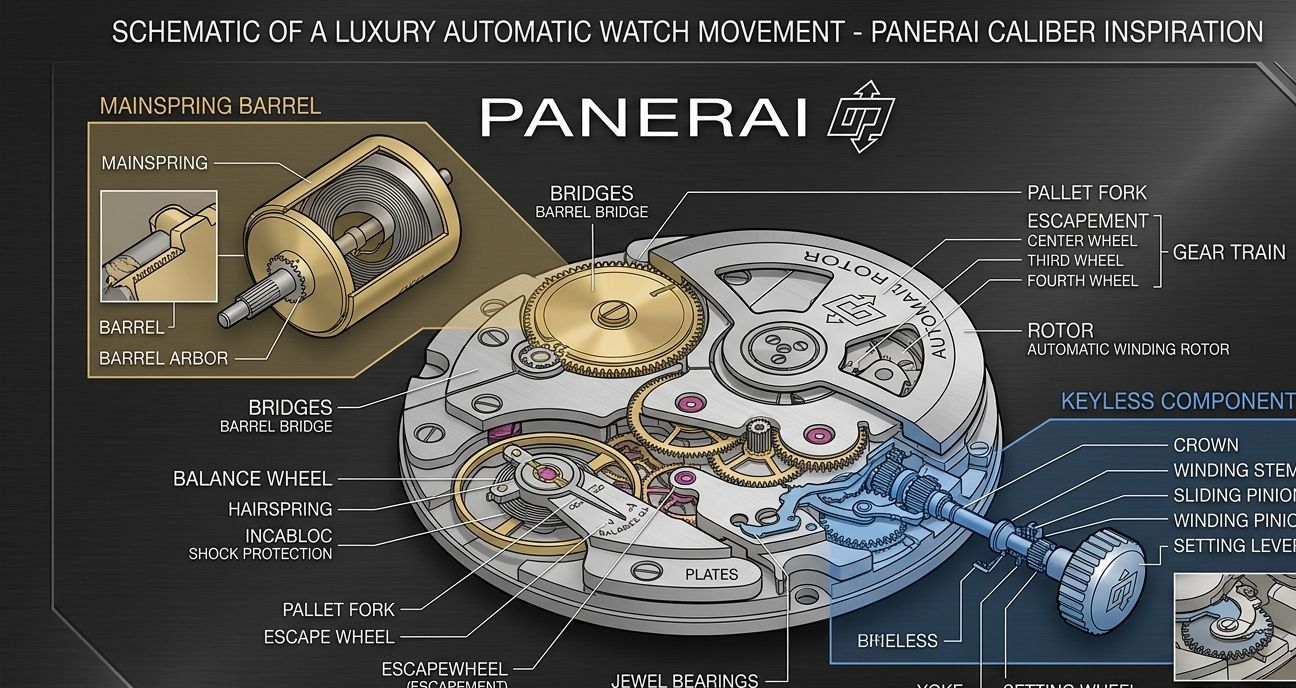
A watch being Dead On Arrival (DOA) is perhaps the most frustrating immediate failure. This can range from a completely immobile movement to one that simply won’t power up or wind correctly. Common causes for a watch being DOA or experiencing winding problems in VS Factory P.9000/P.9010 clones can include:
- Mainspring Issues: The mainspring might be improperly seated, broken, or not engaging with the barrel, preventing power accumulation.
- Winding Stem Disconnection: The stem, which connects the crown to the keyless works, can become disengaged or bent, making winding or setting impossible.
- Rotor Issues: For automatic movements, a jammed or disconnected rotor means the watch won’t self-wind.
- Lubrication Problems: Insufficient or improperly applied lubrication can cause parts to seize or create excessive friction.
To differentiate these issues, try to categorize the symptoms: Is the watch completely dead and won’t start even with hand-winding? Does it hand-wind but the time doesn’t set, or the rotor doesn’t feel like it’s charging the watch? Does the crown feel gritty, unresponsive, or does it refuse to engage in winding or setting positions? A healthy hand-winding action should feel smooth and consistent, with a gentle click as the mainspring tightens. An unresponsive or “dead” crown suggests a problem with the keyless works or stem.
Your ability to accurately describe and categorize these winding-related issues will significantly aid your TD in understanding the problem.
Hands, Dial, and Rotor Noise Anomalies
Beyond the core movement, certain visual and auditory issues can arise, often related to assembly quality or transit shock:
- Loose or Misaligned Hands: Loose hands are a common post-shipping issue, where one or more hands detach from their pinions. Misaligned hands might not point correctly to 12 when the minute hand is at 12, or the hour hand might lag or lead the minute hand. Test for loose hands by gently tapping the crystal; if a hand visibly wobbles or drops, it’s loose.
- Rotor Noise (Grinding, Rattling): A certain amount of rotor sound is normal for an automatic movement, especially with an open caseback. However, a grinding, excessively loud, or rattling sound is abnormal. Grinding can indicate the rotor rubbing against the caseback or movement bridge, while rattling might suggest a loose rotor screw or bearing issue. VS Factory P.9000/P.9010 clones, with their ball-bearing bidirectional winding, should generally operate smoothly with a subtle whir.
- Rotor Drag: If the rotor feels stiff or doesn’t spin freely, it could indicate excessive friction or a lack of lubrication, leading to insufficient self-winding.
- Cosmetic Issues: Dust under the crystal, misaligned dial markers, or imperfections in the lume application can also point to assembly quality concerns.
Documenting these issues often requires audio and video recordings. For rotor noise, record the sound in a quiet environment. For hand alignment, macro photos can clearly show discrepancies. These visual and auditory anomalies are strong indicators of manufacturing or assembly defects.
The capacity to identify and document these visual and auditory anomalies will strengthen your claim significantly.
Crown, Stem, and Keyless Works Malfunctions
The crown and its associated mechanisms are the primary interface with your watch, and problems here can render the watch unusable. These are often linked to improper assembly or material tolerances:
- Wobbly, Stiff, or Pulling Out Completely: A wobbly crown can indicate a loose stem or an issue with the crown tube. A stiff crown might point to debris or a lack of lubrication. If the crown pulls out completely with minimal force, the stem is likely disengaged from the keyless works.
- Stem Issues: The stem can become bent, causing friction, or dislodge from the keyless works, preventing winding or setting.
- Keyless Works Failures: This internal mechanism governs the transition between winding, setting, and (if applicable) quick-set date positions. Symptoms include the crown not engaging in certain positions, feeling “dead” or unresponsive when turned, or inability to switch between functions.
To test these functions, carefully pull the crown into its various positions (winding, time-setting, date-setting for a P.9000 clone). Note the tactile feedback: does it click positively into each position? Does turning the crown in each position have the expected effect? A video demonstrating the crown’s lack of effect or unusual behavior is highly effective evidence. For instance, showing the crown turning freely in the time-setting position without the hands moving.
A clear understanding of how to diagnose and articulate issues related to the crown and time-setting mechanism is paramount for a successful claim.
Expert Authentication Insight
Testing the keyless works requires tactile sensitivity and careful observation. To perform a step-by-step diagnostic: first, gently pull the crown out to the winding position (position 0 or 1, depending on the watch). Wind it and note the feel. Then, pull it further to the time-setting position (position 2). Try to set the time. If the hands don’t move, or if the crown feels “dead” or spins freely, the stem might be disengaged from the setting lever. If the crown pulls out too easily or comes out completely, the detent spring (which holds the stem in place) might be broken. Observe if the crown detent (the small part that holds the crown in position) is visible or if the stem appears bent. These observations, combined with tactile feedback, can help pinpoint whether the stem is disconnected, a spring is faulty, or a lever is malfunctioning.
Crafting Your “Evidence Package”: Speaking the TD’s Language
In the world of replica watch warranty claims, effective communication relies heavily on irrefutable evidence. TDs operate on volume and need clear, concise proof to process claims efficiently. Your “evidence package” is your most powerful tool to ensure a swift and positive resolution for VS Factory movement issues, especially concerning modded replica builds. This section outlines the precise documentation required.
Video Documentation: The Unassailable Proof
For functional issues, video evidence is superior to static photos because it captures motion, sound, and the real-time demonstration of a fault. Your goal is to produce clear, continuous video that leaves no room for doubt or blame-shifting. Detail what specific actions to record:
- Unboxing: Begin with the watch still in its original shipping packaging, showing the shipping label. This establishes the condition upon arrival.
- Full Watch Views: Capture all angles of the watch, front, back, and sides, in good lighting.
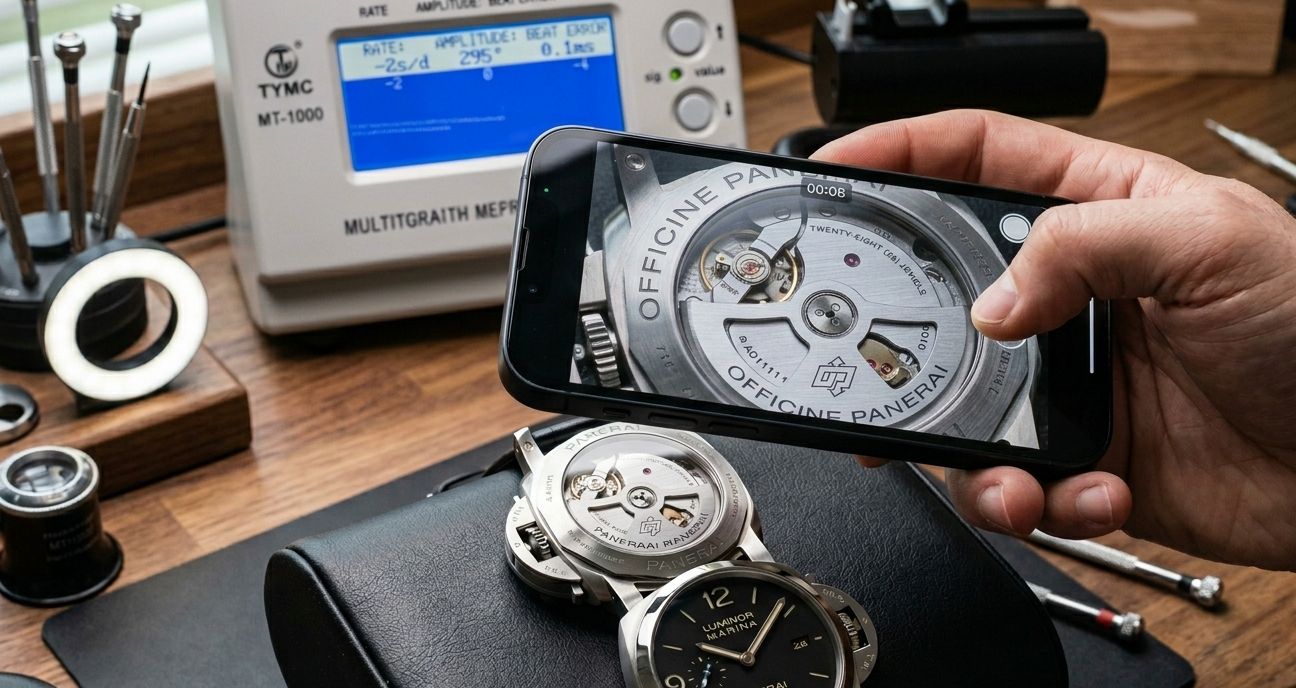
- Timegrapher Readings (if available): If you have access to a timegrapher, record the watch on it, showing the readings for rate, amplitude, and beat error. Hold the phone steady to capture the screen clearly.
- Demonstration of the Specific Fault: This is the most crucial part.
- Winding/Setting: Show yourself attempting to hand-wind, set the time, or change the date. If the crown is unresponsive, show it turning without effect.
- Loose Hands: Gently tap the crystal to show any wobbly or detached hands.
- Rotor Noise: Hold the watch close to the microphone in a quiet environment to capture any grinding or rattling sounds.
- Crown/Stem Issues: Demonstrate the crown pulling out too easily, wobbling excessively, or not engaging in specific positions.
It is paramount that for critical demonstrations (like the fault itself), you aim for a single, unedited take. This prevents accusations of tampering or selective editing. Good lighting and a steady hand (or a tripod) are essential for clear focus. TDs are often dealing with dozens of claims; a blurry, shaky video with unclear audio will only delay your resolution.
Your ability to produce comprehensive and undeniable video evidence will significantly influence the speed and outcome of your claim.
Photographic & Written Documentation: Supporting Details
While video is king for functional issues, high-quality photographs and a concise written description provide crucial supporting detail:
- Overall Watch Condition: Clear photos of the watch from various angles, documenting its general cosmetic state.
- Macro Shots of Specific Flaws: If there are cosmetic issues (e.g., dust under the crystal, misaligned markers, or scratches not visible in QC), take sharp macro photos to highlight them.
- Visible Damage Related to Mechanical Issue: If a bent stem or a detached component is externally visible, photograph it clearly.
The written description should be concise, factual, and chronological. Avoid emotional language or accusations. State clearly when the issue was discovered, what the symptoms are, and what steps you’ve taken to diagnose it. For example: “Watch received on [Date]. Upon unboxing and initial winding, observed hands do not move when crown is in time-setting position. Crown feels loose when pulled to position 2. Video evidence attached.” This objective account complements your visual evidence perfectly.
Understanding how to create a complete and compelling evidence package, combining video, photos, and a factual written account, will leave no stone unturned and significantly bolster your case.
Expert Authentication Insight
To ensure video integrity and prevent accusations of tampering or misrepresentation, follow this protocol: at the beginning of your video, briefly show the current date and time on a separate, trusted device (like your phone or computer screen). Then, proceed with your continuous shot, demonstrating the watch and its fault. Perform the actions clearly and deliberately, showing the problem from multiple angles if necessary, but always within that single, unbroken recording. This establishes an unbroken chain of evidence, proving that the issue was present at the time of recording and hasn’t been fabricated or manipulated.
Once you’ve meticulously gathered your evidence package, the next critical step is communicating effectively with your Trusted Dealer (TD). This isn’t a moment for emotional appeals or accusatory language. TDs handle a high volume of orders and inquiries, and a clear, factual, and non-confrontational approach will significantly increase your chances of a swift and favorable resolution.
Initial Contact: Factual, Concise, and Non-Blaming
Your first message to the TD sets the tone for the entire warranty claim process. It’s crucial to be direct, provide all necessary information upfront, and avoid language that implies blame or demands immediate action. TDs appreciate efficiency and clarity, as it helps them quickly understand the issue and determine the best course of action.
A calm, evidence-based approach is far more effective than an emotional one. Remember, the TD acts as a middleman between you and the factory. Their goal is often to resolve issues without incurring unnecessary costs or administrative burdens. By presenting your case clearly and professionally, you enable them to do their job more effectively. The goal is to make it easy for them to help you.
Always attach your full evidence package—videos, photos, and a concise written description—to this initial email. This prevents delays caused by back-and-forth requests for documentation. A well-structured email outlining the problem, supported by undeniable proof, is difficult for a TD to ignore or dismiss.
Effective Opening Line Example: “Subject: Warranty Claim – Order #XXXXX – Panerai PAMXXX – Movement Issue Upon Arrival”
Ineffective Opening Line Example: “Subject: Your Broken Watch! I Need a Refund Now!”
By initiating your warranty claim professionally and efficiently, you establish a positive tone that can significantly influence the speed and outcome of your resolution.
Follow-Up & Negotiation: Patience and Persistence
After your initial contact, patience is key, but so is persistence. TDs typically operate across different time zones and handle many requests, so immediate responses are rare. Expect a response within 24 to 72 hours. If you don’t hear back, a polite follow-up after 3-4 business days is appropriate.
Common responses from TDs might include suggestions like “try a local repair” or “we can send you replacement parts.” In a parts-only warranty scenario, which is common for VS Factory movements, this is often the standard operating procedure. Your role here is to politely but firmly advocate for a fair resolution. If the issue is minor and can be fixed cheaply by a local watchmaker, the TD might offer to cover a portion of that cost. If it’s a more significant movement failure, they’ll likely offer to ship a replacement movement.
Negotiation points often revolve around who covers shipping costs for parts, or if any labor reimbursement is offered for local repairs. Be prepared to discuss these points calmly, referencing your original evidence package if needed. Avoid making threats or ultimatums, as this can shut down communication entirely. Instead, focus on finding a mutually agreeable solution that aligns with typical replica warranty practices.
The strategic combination of patience and persistent, clear communication is crucial for seeing a warranty claim through to resolution. Understand that the process may take time, but a well-managed dialogue increases your chances of a satisfactory outcome.
Expert Authentication Insight
When a TD proposes a solution, particularly “send parts” or “local repair,” it’s vital to verify the specifics. If they offer to send parts, confirm exactly which components are being sent. For a VS Factory P.9000 movement, for instance, ask if it’s a complete movement assembly, a balance wheel, or a specific gear. Also, inquire about the origin of these parts—are they directly from VS Factory, or aftermarket? This ensures you receive compatible and quality components. If “local repair” is suggested, explicitly clarify if any labor cost reimbursement is implied or offered. Many TDs will send parts but expect you to cover the watchmaker’s fees. Getting this in writing or clear confirmation avoids future disputes.
Resolution Paths: Parts, Local Repair, or Return
Once you’ve successfully communicated with your TD and they’ve acknowledged your warranty claim, several paths can lead to resolution. Understanding the implications of each path—especially for Panerai Super Clone movements—and consulting a comprehensive Panerai replica buying guide is crucial for managing expectations and making informed decisions.
The Parts-Only Solution: What to Expect and Next Steps
For most replica watch warranty claims, especially for Super Clone movements like those from VS Factory, the “parts-only” solution is the most common outcome. This means the TD will ship you the necessary replacement components, such as a new VS Factory P.9000 movement, a set of hands, or a winding stem. The quality control of these replacement parts is generally good, as they typically come directly from the same factories that produce the watches. Shipping times can vary, but expect several weeks for international delivery.
The critical implication of a parts-only warranty is that the buyer is typically responsible for the labor cost of installation. This means finding a competent local watchmaker who is willing to work on replica movements. While many watchmakers are hesitant, some are open to it, especially if you’re transparent about the watch’s origin. Local installation costs can range from $50 for a simple hand re-attachment to $150-$250 for a full movement swap. Ensure you verify the received parts against what was promised and what is needed for the repair.
This section should leave you with a clear action plan for handling a parts-only resolution, including how to find a skilled watchmaker who can complete the installation.
Local Watchmaker Repair: When to Consider and What to Ask
Opting for a local watchmaker repair can be a preferable solution in certain situations. It’s often ideal for minor issues like a loose hand, a simple regulation problem, or a detached winding stem, where the cost and hassle of shipping the watch back internationally outweigh the local repair expense. It also avoids the risks associated with international shipping and customs. However, it’s essential to approach this with caution and find the right professional.
When speaking to a watchmaker, be transparent about the watch being a replica. Frame it as a watch with a sophisticated movement (e.g., “a clone of a Panerai P.9000 movement, similar in architecture to ETA movements”) that requires specific attention. Ask about their experience with non-genuine movements, their rates for common services (e.g., movement swap, hand re-setting), and if they offer a warranty on their work. A simple script could be: “I have a watch with a highly accurate clone movement, and it needs [specific repair]. Are you comfortable working on such movements, and what would be your estimated cost?”
The trade-offs are clear: local repair can be quicker and avoid shipping risks, but you bear the full cost (unless the TD offers partial reimbursement), and finding a willing and competent watchmaker for replicas can be challenging. However, for many buyers, the convenience and speed make it a worthwhile option.
The Rare Full Return/Replacement: Conditions and Logistics
A full return for a refund or a complete replacement watch is an exceedingly rare outcome in the replica watch world. This option is typically reserved for catastrophic damage (e.g., the watch is completely destroyed in transit), repeated failures after multiple repair attempts, or at the sole discretion of a particularly generous TD. Do not expect this to be a standard offering for a warranty claim.
If a full return or replacement is offered, be aware of the significant logistical challenges. You’ll likely be responsible for the cost and risk of international shipping back to the TD or factory. This involves customs declarations, which must be handled carefully (often declared as “watch parts” or “machinery components” with a low value to avoid customs issues for the recipient). There’s always a risk of the watch being seized by customs on either end, in which case you might lose both the watch and the money. Anecdotal evidence suggests successful full returns are uncommon, and often only occur after significant back-and-forth or for truly unfixable issues.
It’s important to maintain a realistic understanding that a full return is an exceptional circumstance, and to thoroughly weigh the risks and costs involved if it is offered.
Expert Authentication Insight
When receiving replacement VS Factory movement parts, especially a full movement, take steps to verify its authenticity and quality. Compare markings, finish, and rotor engravings against known genuine VS Factory components (e.g., from your original QC photos or community resources). Look for the correct balance wheel, regulator, and bridge engravings. While 100% certainty is difficult without specialized tools, a careful visual inspection can help confirm you’ve received a legitimate VS Factory part and not a cheaper, inferior clone movement.
Post-Resolution: Maintaining Your Replica & Preventing Recurrence
Successfully navigating a warranty claim is a relief, but it’s also an opportunity to reflect on long-term ownership. Replica watches, while impressive, benefit greatly from thoughtful care and occasional maintenance. Adopting proactive habits can significantly extend the life of your Panerai Super Clone and prevent recurrence of common movement failures.
Routine Care & Handling for Super Clone Movements
Treat your replica watch with the same respect you would a genuine timepiece. Avoid extreme shocks, such as dropping it or subjecting it to sharp impacts, which can dislodge movement components or damage the balance staff. Keep the watch away from strong magnetic fields (speakers, magnets, certain electronics), as magnetization can severely affect timekeeping accuracy. For Panerai replicas, particularly those from VS Factory, water resistance is often a point of contention. While rated for 50m, 100m, or even 300m, it’s prudent to treat most replicas as splash-proof at best unless you’ve had it professionally pressure tested. Avoid showering, swimming, or diving with your replica unless its water resistance has been independently verified.
Proper winding techniques are also important. Hand-wind your watch gently and smoothly, stopping when you feel resistance—don’t force it. When setting the time or date, pull the crown out to the correct position with care and rotate the hands smoothly. These gentle handling practices, combined with awareness of environmental factors, are the simplest and most effective ways to extend the life of your replica movement and minimize future issues.
Considering Future Servicing & Upgrades
Even the most robust Super Clone movements, like the VS P.9000, are mechanical devices that benefit from periodic servicing. While not explicitly factory-recommended in the same way genuine watches are, a professional service (cleaning, lubrication, and adjustment) every 3-5 years can significantly enhance longevity and performance. This typically costs around $150-$250 for a VS Factory P.9000 clone movement, a worthwhile investment compared to replacing the entire movement or watch.
Beyond routine servicing, some owners consider specific component upgrades. For instance, replacing the mainspring with a higher-quality aftermarket one, or improving the lubrication on specific gears, can sometimes enhance power reserve or winding efficiency. Discuss these options with a trusted watchmaker who is experienced with replica movements. Understanding the value of preventive maintenance and potential upgrades is part of responsible, long-term ownership for a replica watch.
Expert Authentication Insight
After any repair or servicing, perform a quick visual, auditory, and tactile check to confirm proper function. Visually inspect the dial for dust, ensure hands are correctly aligned, and that the crown sits flush. Tactilely, feel for smooth winding and precise crown action when setting the time and date. Audibly, listen for any unusual grinding or rattling from the rotor, which should be smooth and consistent. Finally, if you have access to a timegrapher, verify that the rate is stable, the amplitude is good (ideally 260-300 degrees), and the beat error is low (under 0.5ms). These quick checks can help confirm the repair was successful and the watch is functioning as expected.
The Replica Warranty Claim Decision Matrix
Navigating the replica watch warranty landscape can feel like a minefield, but with the right knowledge, patience, and precise documentation, you can maximize your chances of a successful outcome. The following decision matrix provides a framework to guide your actions, turning uncertainty into a clear, actionable plan:
- Is the watch DOA (Dead On Arrival) or critically damaged within 24 hours of receipt?
- Yes: Immediately contact your TD with clear video evidence of unboxing and the non-functional state. Push for immediate resolution (replacement part or rare full return).
- No: Proceed to next question.
- Is the issue a minor functional problem (e.g., loose hand, slightly noisy rotor, minor regulation issue) or a significant movement failure (e.g., not winding, time setting mechanism broken)?
- Minor: Consider local watchmaker repair first to avoid shipping hassles. Get a quote. If inexpensive (under $100-$150), proceed locally and inform TD. If TD offers to cover part of cost, accept.
- Significant: Proceed to next question.
- Do you have clear, continuous video evidence demonstrating the specific fault without ambiguity (e.g., winding, setting, timegrapher reading showing major issue)?
- Yes: Excellent. This is your strongest tool. Attach it to your initial TD communication.
- No: Stop. Your claim will be difficult to prove. Re-evaluate if you can capture the evidence. If not, be prepared for a difficult negotiation or to pursue local repair at your own cost.
- Is the issue specifically related to a VS Factory movement component (e.g., P.9000 clone)?
- Yes: Clearly state this in your communication. TDs are more likely to have access to specific VS Factory parts. Request a replacement VS Factory part.
- No: The issue might be general assembly or another movement. Still document thoroughly, but be aware that specific factory-branded parts might not be relevant.
- Has your TD offered a “parts-only” solution (e.g., new movement, hands)?
- Yes: This is the most common and often best outcome. Accept the parts. Immediately begin searching for a competent local watchmaker willing to install replica parts. Budget for installation costs ($150-$250 for movement swap).
- No: Politely inquire about this option, especially if you have strong evidence of a factory defect.
- Is the proposed solution (parts or local repair) acceptable, given the cost, time, and risks?
- Yes: Proceed with the agreed-upon resolution.
- No: Politely articulate your concerns and propose an alternative (e.g., “I’m concerned about customs risk for return, can we try local repair with partial reimbursement?”). Be prepared for the TD to stick to their policy.
The “walk away if…” standard: If you cannot provide clear, undeniable evidence of a factory defect, or if the TD’s proposed solution involves unreasonable costs or risks (e.g., full return for a minor issue with high shipping fees and customs risk), it might be more pragmatic to walk away and seek a local, independent repair at your own expense. Sometimes, cutting your losses is the smartest move.
Ultimately, informed buyer behavior is your most potent tool in the replica watch warranty landscape. Knowledge of the process, strategic patience in communication, and precise documentation are the pillars of a successful claim. Equip yourself with these, and you’ll navigate even the most frustrating issues with confidence.