
Structural Credibility Framework: Beyond the Hype, What Makes a Replica “Hold Up”?
Walk into any serious replica forum, and you’ll hear a constant refrain: “Which factory makes the best Richard Mille?” It’s the wrong question. The right question is: “Which Richard Mille model is inherently most replicable?”—RM055 super clone guide—The difference between a watch that fools people and one that falls apart under scrutiny isn’t just factory skill—it’s baked into the original design. A structurally credible replica achieves a 1:1 illusion without requiring manufacturing leaps that don’t exist. To evaluate this, we need to dismantle the vague term “quality” and replace it with a five-pillar diagnostic framework.
Consider two models. The first is the RM 011. In photos, it’s iconic: the massive tonneau case, the complex skeletonized dial, the three-subdial chronograph. It’s the watch every fan wants. The second is the RM 033. It’s a simple, ultra-thin three-hand with a date window. It’s elegant but, frankly, boring next to the 011. Yet in the replica world, the RM 033 is a masterpiece of engineering consistency, while the RM 011 is a perpetual compromise. Why? Because the 033’s simplicity aligns with the replicable; the 011’s complexity battles against fundamental physical and mechanical limits. Structural credibility is the degree to which a model’s design can be duplicated with existing manufacturing capabilities—CNC precision, available movement blanks, material science—without creating fatal tells.
The Case Feasibility Axis: Curves, Angles, and Material Deception
A watch’s case is its first and most constant point of contact. Its replicability hinges on two factors: geometric complexity and material substitution feasibility.
Geometry dictates tooling costs and achievable precision. The RM 011 features a monolithic, deeply curved tonneau with complex, integrated lugs and a multi-part assembly. Machining that curvature from a solid block, then ensuring perfect alignment across the bezel, caseband, and back, requires advanced 5-axis CNC and meticulous hand-finishing. Contrast this with the RM 035 or RM 033. Their tonneau shape is more planar, with gentler curves and fewer integrated components. The tooling is simpler, the tolerance stack-up is smaller, and the chance of a visible gap or misalignment is drastically reduced. A factory can master the 033’s case in months; the 011’s case is a decade-long refinement project.
Material introduces the most common red flags. Richard Mille’s signature is Carbon TPT, but no replica uses genuine NTPT material. Top factories use forged carbon or generic carbon composite with a titanium inner frame. The visual pattern can be convincing at arm’s length, but the material properties differ. More critically, replicas often botch material transitions. A genuine RM might have a ceramic pusher guard seamlessly integrated into a titanium case. A replica attempting this often shows a slight step, a gap, or a color mismatch because bonding dissimilar materials (ceramic to titanium) at a microscopic level is prohibitively expensive. If a listing shows a watch with multiple exotic materials (ceramic, carbon, titanium) all perfectly integrated, it’s a major red flag. The cost/complexity ratio makes that virtually impossible outside genuine manufacture. Simple, single-material cases (all titanium, all ceramic) are always safer bets.
Movement Plausibility: The Heart of the Illusion
The movement is where the illusion either lives or dies. We must separate the visual architecture (what you see through the crystal) from the functional architecture (how the gears actually work).
Replica movements exist on a spectrum of plausibility:
- Simple Three-Hand with Date (~90% plausible): A basic manual-wind or automatic movement. The base ebauche (like a modified Seiko or ETA) can be decorated to resemble the genuine plates. The function is straightforward and reliable. This is the foundation of the RM 033 replica.
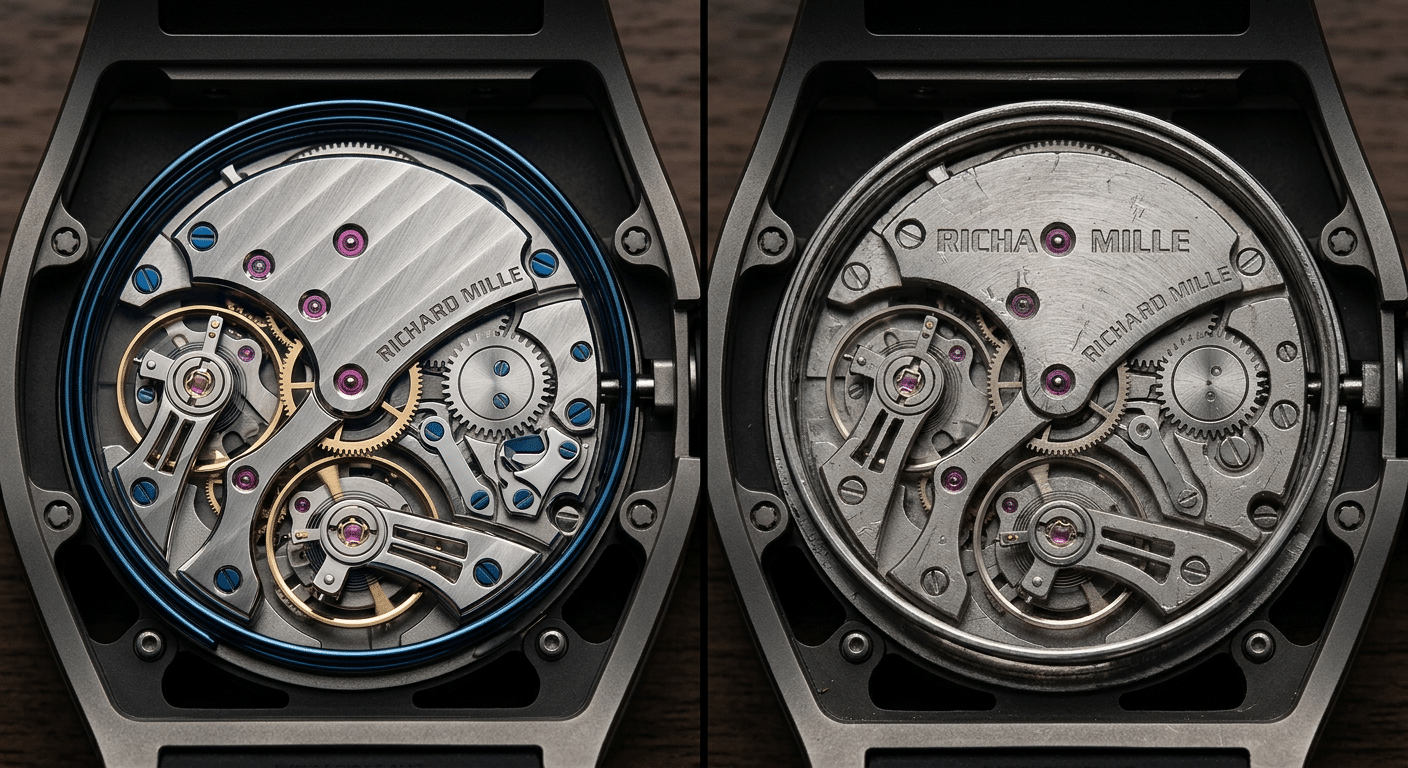
- Skeletonized Manual Wind (~70% plausible): The challenge shifts from function to artistry. The bridges must be shaped, polished, and skeletonized to match the genuine. The gap here is in finishing consistency—a genuine movement has perfect chamfers and mirror polishes on every surface. A replica might get the shape right but show rough edges or inconsistent brushing under magnification. Functionally, it’s simple (just timekeeping), so the risk is purely visual.
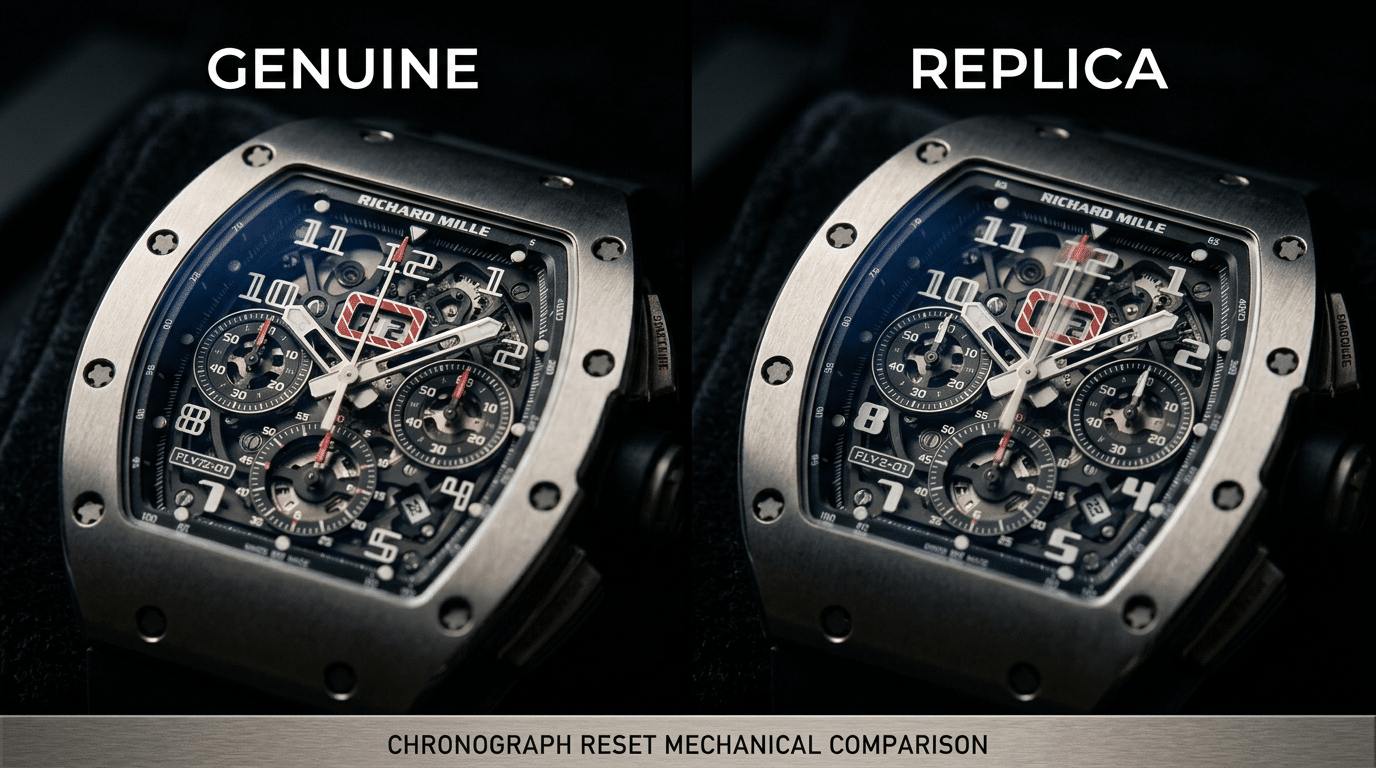
- Complex Chronograph (Flyback, Date, etc.) (~40% plausible): This is the frontier. A base movement like the Shanghai 7750 can be modified to look like an RMAC1 chronograph caliber. The plates can be skeletonized, gears added for visual effect. But the functional core—the coupling and reset mechanism—remains a standard 7750. The genuine flyback mechanism, with its hydraulic precision and instant reset, is engineered from scratch. The replica’s chrono feel will be “lighter,” the reset might have a slight wobble, and the pusher action lacks the definitive click and travel. You are seeing a costume, not the real mechanism.
The most advanced clones, like the Dandong RMUL2 used in the RM 35-02 and RM 055, bridge part of this gap for simple manual winds. But for complications, the functional gap is permanent.
Dial Architecture & Legibility: The Closest-View Test
The dial is under constant, close scrutiny. Its replicability depends on construction technique and optical design.
Application is key. Genuine RMs often use screwed indices (tiny, polished screws holding the hour markers). Replicating this is expensive and finicky; many factories opt for painted or stick-on indices. A dial with perfectly applied, three-dimensional screwed indices is a strong positive sign. Font crispness is another. Richard Mille uses proprietary typefaces; a blurry “Richard Mille” logo or a date window with uneven magnification is an instant fail.
Depth and light-play separate the good from the great. The RM 67-01‘s “floating” dial appears to suspend the movement above a smoked sapphire crystal. The illusion relies on precise spacing and a specific dial color gradient. Replicating this is deceptively simple—if the gradient is wrong or the spacing off by 0.5mm, the dial looks flat and cheap. Conversely, the RM 72-01‘s “côtes de Genève” finished bridges must catch light in a specific, linear way. A replica might have the grooves, but if the polishing isn’t mirror-perfect, the light will scatter instead of gleam, breaking the high horology effect. Some dial designs are brilliantly simple to copy (flat, printed dials); others are deceptively difficult because their magic is in the physics of light on a perfect surface.
Expert Authentication Insight
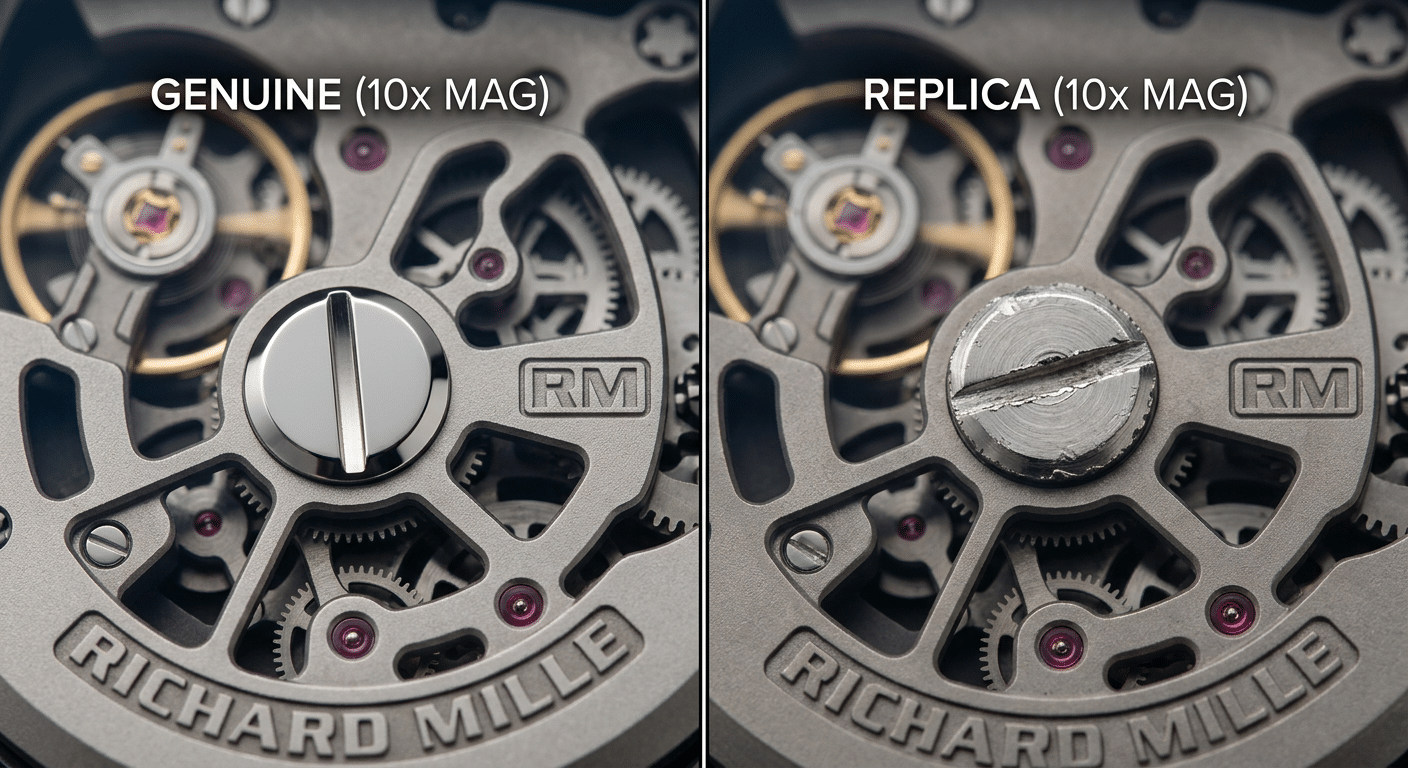
The most critical test for structural credibility is the “10x Loupe + 30cm Distance” test. This isn’t about hunting for flaws; it’s about assessing whether the fundamental construction is sound. Take a 10x loupe and examine the watch from a normal reading distance (30cm). Focus on functional details:
- The machining marks on a screw head: are they crisp and consistent, or rough and uneven?
- The crispness of a logo’s serifs: are they sharp points or blobby?
- The alignment of a date window’s magnification crystal: is it centered, or crooked?
A replica that fails this basic test on a simple element (e.g., a rough, shallow caseback engraving) has no chance of mastering complex areas (e.g., the precise coupling of a chronograph mechanism). The test measures the factory’s baseline capability. If the basics are wrong, the complexities are guaranteed fakes. This test must be applied relative to the model’s own design simplicity. An RM 033 should pass this test effortlessly. An RM 011 might show minor imperfections in a screw slot, but the overall functional architecture (chrono feel, dial depth) must still be evaluated separately.
The “Safe Bets” Category: Models with Naturally High Structural Credibility
These are the “designer-friendly” models. Their inherent design—simple case geometry, proven movement platforms, straightforward dials—aligns perfectly with the upper limits of current replica manufacturing. For these watches, the buyer’s question shifts from “Will this look fake?” to “Which factory’s execution of this proven design is best?” The risk of catastrophic failure is minimal. The primary concern is finish quality and long-term reliability.
Case Study: The RM 035 “Ultra-Thin” – A Triumph of Simplicity
The RM 035’s value lies entirely in its absence of complexity. It is a pure, ultra-thin tonneau with a skeletonized manual-wind movement. There are no complications, no date, no chronograph. The dial is open, but the movement architecture (RMUL1/RMUL2) is the simplest in the lineup.
The challenge is purely in case machining and finishing. Achieving the extreme taper and maintaining consistent bead-blasted surfaces across the curved caseband requires skill, but it’s a solved problem. Top factories like ZF and APS have mastered this. The movement is a modified ultra-thin base—the Dandong RMUL2 clone is exceptionally mature for this caliber. The replica’s illusion is based on correct proportions, weight, and a clean, functional skeleton. There are no hidden functions to fake. This model scores highest because its design doesn’t ask the replica to do the impossible.
Case Study: The RM 033 “Base Three-Hand” – The Gold Standard for Reliability
The RM 033 is the quintessential safe bet. It is the baseline against which all other replicas should be measured. Its case is a classic, gently curving tonneau. The dial is a clean canvas with applied indices and a date window. The movement is a simple, robust three-hand caliber with date.
Every aspect is mature and well-understood:
- Case tolerances are consistent across top factories.
- Dial printing is straightforward—no depth illusions, no multi-layer assemblies.
- Movement cloning is based on decades-old, reliable ebauches (Japanese or Swiss automatics) that have been decorated for years. There are zero functional failure points.
For a buyer, the RM 033 represents the lowest-risk entry. You are not betting on a factory’s ability to simulate a complex function; you are betting on their ability to execute a simple, elegant design perfectly. Any flaw in an RM 033 replica is a clear sign of a low-tier factory or poor quality control, not an inherent design limitation.
Expert Authentication Insight
For “safe bet” models, your authentication focus should be on finish quality, not structural deception. Since the structure is sound, imperfections reveal the maker’s tier. Use a loupe to inspect:
- The consistency of the grain on a brushed surface. Is it uniform, or patchy?
- The sharpness of the bevel on the case back or lugs. Is it a crisp 45-degree angle, or rounded and soft?
- The perfect centering of the brand logo on the dial. Is it dead-center, or slightly off?
These details are where top factories (N, ZF, APS) separate themselves from the rest, directly affecting RM super clone structural risk. On a safe model, a misaligned logo or a rough bevel is an unforgivable QC failure that means you have a subpar unit, not a flawed model concept.
The “Challenge Tier”: High-Desire, Medium-High Credibility Models
This is the core of the ranking—the watches everyone wants. These are the “dream” pieces: complex chronographs, skeletonized movements. They represent the pinnacle of what replica factories can attempt. The tone here must be technical and unforgiving. For these models, “good from 3 feet” is not enough. You must understand the specific, known gaps between genuine and replica. Factory reputation matters immensely, but even the best factory cannot erase the design’s inherent hurdles.
The RM 011 Family: The Chronograph Crucible
The RM 011 and its variants (like the 011-02 with date) are the most replicated complex RMs. The case is achievable—factories like ZF and VS have the tooling down. The dial skeleton is also well-replicated. The battlefield is the chronograph mechanism.
The genuine RMAC1 caliber features a flyback function with hydraulic precision. The pusher action is firm, the coupling is instantaneous, and the reset sweep is a perfect, zero-overshoot return. The replica, typically using a heavily modified Shanghai 7750 or a clone based on it, achieves visual parity but not functional parity. The chrono coupling can feel “light” or “dry.” The reset sweep often has a slight wobble or overshoot before settling. The date complication on the 011-02 adds another potential flaw: the date wheel must change precisely at midnight; replicas can be off by hours or show misaligned fonts.
You are buying a visual representation of a chronograph, not a functionally identical one. The top versions (ZF V-series, VS) have minimized these gaps, but they are still detectable to a trained finger and ear.
The Skeleton Dilemma: RM 67-01 vs. RM 029
Skeletonization is the ultimate test of movement artistry. It’s not just about removing metal; it’s about creating a three-dimensional sculpture where every surface must be perfectly finished.
The RM 67-01 is the harder challenge. Its dial is a “floating” architecture—the movement appears suspended over a smoked sapphire crystal with minimal supporting structures. This illusion is fragile. A replica with a movement that is 0.2mm too thick, or a bridge with a single rough polish line, will catch light and break the “floating” effect. The tolerances are microscopic.
The RM 029 uses a more traditional skeleton with a robust framework. It is slightly more forgiving geometrically. However, it demands perfect black polish on all screws and wheels. Any shine, any tool mark, any imperfection is immediately visible. The 029’s challenge is in consistent, flawless finishing across dozens of small parts, not in achieving a precarious spatial illusion.
The Flyback Frontier: RM 72-01’s Functionality Gap
The RM 72-01’s flyback chronograph is a critical, often unstated, compromise. The visual replication of the caliber is impressive—the bridges, the gears, the layout. But the functional authenticity—the single pusher action that stops, resets, and restarts the chronograph in one fluid, continuous motion—is exceptionally difficult to clone.
Most replicas use a modified standard chronograph mechanism that looks like a flyback but does not function like one. The genuine mechanism involves a complex coupling of levers and a reset cam that allows the seconds hand to snap back to zero without stopping the timing. In a replica, the reset often requires a full stop, the hand may jump slightly past zero, or the pusher feel will be inconsistent. You are getting a watch with a chronograph function, but not the specific, sophisticated flyback function that defines the genuine.
Expert Authentication Insight
For “challenge tier” models, you must test function. Your scrutiny moves beyond the loupe to the stopwatch.
- For Chronographs (RM 011, RM 72-01): Use the chronograph function alongside a second watch with a perfectly sweeping seconds hand (a high-end quartz or a mechanical with a deadbeat seconds). Start both simultaneously. Observe the start: does the replica’s seconds hand jump instantly or lag? Stop them: is the stop instantaneous? Reset: watch the sweep return to zero. A genuine flyback (RM 72-01) will reset instantly and perfectly. A replica will often have a slight oscillation, a wobble, or an overshoot before settling. The pusher action itself: a genuine has a distinct, weighted click with precise travel. A replica can feel “tinny” or have vague, mushy resistance.
- For Skeletons (RM 67-01, RM 029): Use a strong, directional light source (a flashlight or bright desk lamp). Tilt the watch slowly. Watch for any shadow catching on a surface. A genuine movement, with its perfect chamfers and mirror polishes, will have a “glow” as light bounces cleanly. A replica will show dull spots, scratches, or rough edges that catch and darken. This light-play test is the skeleton’s ultimate reveal.
The “High-Risk” Zone: Models with Inherently Low Structural Credibility
For certain Richard Mille models, the pursuit of a credible replica is fundamentally a fool’s errand. These are not watches where the illusion breaks under expert scrutiny; they are designs where the illusion is structurally impossible from the outset. The buyer is not investing in a “super clone” but in a high-fidelity sculpture—a “vibe piece” that captures the silhouette and brand signifiers but fails any test beyond a casual glance. The models in this zone share a common trait: their defining characteristic is an exotic material, an extreme engineering limit, or a complication that sits outside the current technological envelope of the entire replica industry. Paying top-tier replica prices for these is the single greatest source of buyer regret, as the expectation of “holding up” is betrayed by the watch’s own DNA.
Material Impossibility: The Sapphire Crystal Case (RM 56-02)
The RM 56-02 “Sapphire” represents an absolute material barrier. Richard Mille’s sapphire cases are not polished crystal; they are monolithic blocks of lab-grown sapphire, machined over 1,000 hours per case from a single crystal. The result is a case with a specific gravity, thermal conductivity (it feels cool to the touch), and optical clarity (zero distortion, perfect transparency) that is impossible to replicate with any substitute. Every “replica” uses either a mineral crystal or a multi-part assembly (e.g., a sapphire crystal front with a different material caseback), which is immediately identifiable by weight and feel. A genuine sapphire case has a dense, solid heft; a mineral crystal “sapphire” feels light and plasticky. The internal machining of the movement mounts and the lugs is also visible through the transparent case, and here the replica’s finishing is always crude. This is not a failure of factory skill; it is a category error. You cannot clone the material itself.
Complication Overload: Minute Repeaters & Grande Sonnerie
The minute repeater, and by extension the Grande Sonnerie, is the non-clonable complication par excellence. Its value lies in acoustic perfection—the crystalline, harmonized chime of three distinct gongs (hour, quarter, minute) timed to millisecond precision. Replica implementations, even those from EUR Factory with real tourbillon movements, produce a sound akin to a cheap digital alarm clock: dull, mono-tonal, and lacking the layered resonance. The problem is not just the sound; the visible architecture is a giveaway. The gongs, hammers, and their regulator mechanisms inside the caseback are finished with a level of hand-beveling, polishing, and micro-adjustment that does not exist in replica movements. The caseback windows meant to showcase this “music” become a damning exhibit. A buyer expecting a credible acoustic experience will be profoundly disappointed; the sound is a functional fiction.
Ultra-Thin Skeleton Limits: When Less is More (and Impossible)
Richard Mille’s most extreme skeletonized models, like certain iterations of the RM 27-05 and historical limited editions, push movement thickness below 2mm. At this scale, the tolerances for pinions, screws, and jewel settings become microscopic—on the order of microns. The CNC machinery and hand-finishing tools capable of producing parts at this scale with consistent, burr-free edges are proprietary to Richard Mille’s manufacturing partners. A replica attempting this will inevitably compromise in one of two ways: it will be measurably thicker (destroying the watch’s most celebrated attribute), or it will use parts that, while visually similar in photos, reveal coarse machining, rough edges, and inconsistent polishing under a loupe. The delicate balance between structural integrity and visual weightlessness is an equation replicas cannot solve. The attempt results in a movement that looks “busy” or “cluttered” rather than “ethereal.”
Expert Authentication Insight
For “High-Risk” models, your diagnostic shifts from visual subtlety to fundamental physical properties.
- Material & Weight: Use a precise digital scale (0.01g accuracy). A genuine RM 56-02 in sapphire will weigh significantly more than a replica in mineral glass, even if the replica uses a heavier metal for the case. The density difference is that stark. For ultra-thin skeletons, a genuine will feel unnervingly light for its size; a replica will have a suspiciously solid feel due to thicker components.
- Acoustic Signature: Activate the minute repeater in a quiet room. A genuine will produce three distinct, clear, and resonant tones with a slight harmonic decay. A replica’s chime will be a single, flat, metallic “ding” or a poorly timed sequence. Record it on your phone; the difference is obvious on playback.
- Translucency & Edge Thickness: Under a strong light, examine the edges of the skeletonized movement bridges. Genuine titanium bridges, machined to the absolute limit, can appear slightly translucent at the thinnest points when backlit. A replica’s brass or steel bridge will be completely opaque. This is a direct test of material thickness and machining precision.
The Factory Factor: How Execution Varies Within the Credibility Tier
The prevailing myth in the replica community is that asking “Which factory is best?” is the primary question. This is a critical error. The model’s inherent structural credibility is the ceiling; factory execution is the variable within that ceiling. A top-tier factory like ZF can only elevate a structurally difficult model (like the RM 011) to a “very good replica.” A mid-tier factory can produce a structurally simple model (like the RM 033) to a “near-indistinguishable” level. The optimal value proposition is often found at the intersection of a high-credibility model and a competent mid-tier factory, not at the top factory for a low-credibility model. The matrix is simple: Model X-axis (Structural Potential) vs. Factory Y-axis (Execution Tier). Your goal is to maximize the X-axis first.
Execution Tiers Defined: Top, Mid, and Entry-Level Realities
What “Top,” “Mid,” and “Entry” actually mean in tangible, inspectable terms:
- Top Tier (ZF, APS, N for specific models): Multi-axis CNC machines with micron-level tolerance control. Movement blanks (often Dandong RMUL2 V2) with near-genuine skeletonization quality. Dial printing via high-resolution pad printing or laser etching with correct font weight and spacing. Strap material is genuine fluoroelastomer (Richard Mille’s “Rubber”) or accurately sourced NTPT-style composite. Case transitions (where materials meet) are seamless within 0.1mm. Clasp engravings are deep, crisp, and correctly positioned.
- Mid Tier (OK, Clean, AVS for specific models): Standard CNC machines with good but not exceptional tolerance control. Movement is a decorated Chinese or Japanese ebauche (e.g., modified Shanghai) that looks correct from 12 inches. Dial printing is silk-screened, which can be slightly thick or “pasty” under magnification. Strap is high-quality silicone or rubber, but may lack the exact firmness and texture of genuine. Minor gaps or steps may be visible at material junctions.
- Entry Tier (TF, JF, KV/KU): Older CNC equipment with visible chatter marks. Movement is a basic, undecorated Miyota or Shanghai with added fake plates. Dial printing is often coarse, with fuzzy edges and incorrect character spacing. Strap is cheap, hard rubber that quickly cracks. Material transitions are sloppy, with visible gaps or misalignments. Engravings are shallow and blurred.
Case Study: The RM 011 Across Factories
Contrast ZF’s V7 RM 011-02 with a mid-tier factory’s version. Both share the same fundamental blueprint: a carbon case, ceramic pushers, and a modified 7750-based movement. The differences are in the execution fidelity of that blueprint.
- Pusher Guards: ZF’s titanium guards are machined to a perfect 90-degree angle with a consistent, sharp bevel. The mid-tier guard may have a rounded-over edge or inconsistent brushing.
- Ceramic Texture: ZF’s ceramic pushers have a fine, consistent grain that matches the genuine’s “cheese white” or black. The mid-tier ceramic may have a slightly yellowish tint or a visibly coarser grain.
- “Floating” Lug Screws: The RM 011’s lugs appear to float on the caseband. ZF ensures the screw heads are perfectly countersunk and aligned to within 0.2mm. The mid-tier will have screws that sit proud or are unevenly spaced.
- Weight Distribution: Due to more precise internal machining and possibly a slightly thinner movement holder, ZF’s version feels more balanced on the wrist. The mid-tier, with its bulkier movement and less refined internal structure, can feel top-heavy or “clunky.”
The structural reality—a chronograph based on a 7750 platform and detailed in the Richard Mille super clone models guide—is the same but the top factory’s version simply looks and feels more “right” under the 10x loupe test.
Expert Authentication Insight
When comparing two replicas of the same model, ignore the macro design. Your entire focus must be on the micro-transitions. These are the seams where two materials or forms meet, and they are the ultimate test of factory execution.
- The junction where the ceramic chrono pusher inserts into the titanium case should have no visible gap. Run your fingernail across it; it should feel like a single, continuous surface.
- The overmold where the rubber strap meets the titanium lug should be perfectly aligned, with no lip or step. A misalignment of even 0.5mm is a clear mid-tier indicator.
- The bevel on the caseback’s titanium spline screws should be mirror-polished and perfectly symmetrical. A dull or uneven bevel is a cost-saving shortcut.
- The brushing on the caseband should be perfectly straight and uniform, with no crossover marks. A “swirled” pattern indicates a rushed or low-quality finishing process.
These details are where the factory’s investment in tooling and quality control is revealed. A model with high structural credibility but mid-tier execution will still show these flaws. Conversely, a top-tier execution on a high-credibility model will make these transitions disappear.
Ranking & Rationale: The Structural Credibility Leaderboard
The following ranking is the definitive, model-first assessment of inherent replicability. It is not a list of “best watches” but of “most credibly replicated watches.” The score is based on a simple system: +2 for Simple Case/Dial, +2 for Mature Movement Clone, -2 for Complex Function, -2 for Exotic Material, -1 for Ultra-Thin Challenge. A model’s score determines its Credibility Tier.
| Rank | Model | Credibility Tier | Primary Strength / Weakness | Top Recommended Factory |
|---|---|---|---|---|
| 1 | RM 033 | Safe Bet | Strength: Zero functional complications. Ultra-thin, simple dial. Movement cloning is mature and rock-solid. Weakness: None structurally. The benchmark. | N (for finish) / Any major factory |
| 2 | RM 035 | Safe Bet | Strength: Pure tonneau, no date, no skeleton. Challenge is purely case machining—solved. Weakness: Movement is simple manual wind. | APSF (overall) / ZF (NTPT) |
| 3 | RM 037 | Safe Bet | Strength: Ladies’ model with simple three-hand dial. Case geometry is straightforward. Weakness: Smaller size can expose dial printing flaws. | ZF |
| 4 | RM 011-02 | Challenge | Strength: Iconic design. Case tooling is mature. Weakness: Chrono coupling feel is “light.” Date wheel alignment can be imperfect. Thickness penalty (~2mm). | ZF |
| 5 | RM 67-01 | Challenge | Strength: Stunning skeleton dial. Case is thin and achievable. Weakness: Dial’s “floating” illusion requires perfect bridge polishing; any rough edge kills the effect. | N |
| 6 | RM 72-01 | Challenge | Strength: Flyback complication is visually replicated well. Weakness: Functional flyback is not cloned. Chrono action feels “dry.” | ZF / APSF |
| 7 | RM 055 (Ceramic) | Challenge | Strength: Simple case shape. Good movement clone (RMUL2). Weakness: Material color match is off. Balance wheel is not free-sprung (“death point”). | BBR (ceramic) / APSF (NTPT) |
| 8 | RM 052 (Skull) | High-Risk | Strength: Iconic shape. Weakness: EUR’s version is a real tourbillon but is a different caliber. ZF’s version uses moving balance, not a tourbillon. Material/function gap is total. | EUR (for real tourbillon) |
| 9 | RM 56-02 | High-Risk | Strength: Ultimate status symbol. Weakness: Monolithic sapphire case is un-clonable. Weight, feel, clarity are all wrong in replica. | None (avoid) |
| 10 | RM 88 | High-Risk | Strength: Complex complication. Weakness: Minute repeater sound is non-clonable. Caseback finishing is a giveaway. Automatic winding mechanism is simplified. | None (avoid) |
The Logic Behind the Order
The scoring system is brutally reductive but predictive:
- RM 033 (Score: +4): Simple case (+2) + Mature movement (+2) = 4. No penalties. Perfect 10.
- RM 035 (Score: +3): Simple case (+2) + Mature movement (+2) – Ultra-thin challenge (-1) = 3.
- RM 011-02 (Score: 0): Simple case (+2) + Mature movement (+2) – Complex function (-2) – Ultra-thin challenge (-2) = 0. It breaks even because the case is achievable but the function and thickness are both compromised.
- RM 56-02 (Score: -4): Complex function (-2) – Exotic material (-2) = -4. It has no redeeming structural simplicity.
The ranking shows that a model like the RM 72-01 (complex function -2, but case is not ultra-thin or exotic) scores higher than the RM 56-02 (exotic material -2, complex function -2). The former has a plausible case; the latter has none of its defining features replicable.
Expert Authentication Insight
The ranking’s utility is in dictating your level of scrutiny:
- For Safe Bets (Rank 1-3): If the watch fails a basic inspection (misaligned indices, rough caseback engraving, cloudy crystal), you have a bad unit from a bad factory, not a bad model. Reject it and demand a better example. The model’s potential is high; any flaw is a QC failure.
- For Challenge Tier (Rank 4-7): A pass on basic inspection is table stakes. You must then perform the model-specific advanced tests outlined in previous sections (chrono feel for 011, light-play for 67-01, free-sprung balance check for 055). The ranking tells you these advanced tests are mandatory, not optional.
- For High-Risk (Rank 8-10): No amount of testing will create structural credibility. Your inspection is limited to assessing the quality of the visual approximation. Is the carbon pattern convincing? Is the paint on the “sapphire” case even? Does the minute repeater button feel solid? You are grading a costume piece, not a watch. Pay accordingly.
The ranking is your filter. It converts the vague question “Is this replica good?” into the precise question “For this specific model, what level of failure is inherent to the design, and what level is due to factory execution?”
Final Verdict: Your Personal Structural Credibility Filter
The ranking is not a shopping list—it’s a diagnostic tool. Your next question shouldn’t be “What’s the best RM replica?” but “What’s the best RM replica for my specific tolerance of scrutiny and desire?” The structural credibility framework forces you to align your expectations with a model’s inherent replicability. Paying top-tier money for a “Challenge” or “High-Risk” model without understanding its specific, unbridgeable gaps is the single most common source of buyer regret. Use this personal filter to match your intended use with the correct tier of watch.
Your Decision Flowchart in Plain Text:
- Do you want a watch that will pass a casual, 30-second glance from 6 feet away in normal social settings? → Stay in the “Safe Bet” category. These models deliver near-indistinguishable form with minimal functional compromise.
- Do you want a complex, visually striking piece and are you willing to learn and perform 3–5 specific, hands-on checks (like testing chronograph reset or tilting for dial light-play)? → Enter the “Challenge Tier”. You must buy from the single recommended top factory for that model and accept that you are purchasing an “excellent fake,” not a perfect clone.
- Are you buying primarily for the immediate silhouette and brand recognition, accepting that it will be identified as a replica under any serious inspection? → The “High-Risk” path may suffice, but you must pay only a fraction of the top-tier replica price. Treat it as a symbolic “costume piece,” not a horological product.
For the Purist: The 95% Illusion Path
If your goal is long-term satisfaction, zero anxiety, and maximum value-for-money, your purchase should come from the top three “Safe Bet” models identified in the ranking: the RM 033, the RM 035, and early, non-complicated variants of the RM 011. These watches share a critical trait: their design contains no functional complications (chronographs, tourbillons) and no optical-illusion dials. The replica’s job is to match case geometry and finish—a task top factories (N for RM 033, ZF or APS for RM 035) have mastered.
Manufacturing detail: The movement in these models is a simple, ultra-thin manual or automatic base. The cloning technology for these calibers (the Dandong RMUL2 in its standard regulator form) is mature, reliable, and accurate to within ±15–30 seconds per day. There are no hidden gears to synchronize, no flyback mechanisms to fake, and no skeleton bridges that must be polished to a mirror finish in impossible spaces. The buyer’s focus shifts entirely to finish quality: the consistency of the bead-blasted texture, the sharpness of the case back bevel, and the perfect centering of the logo. For 95% of real-world encounters—dinner, the office, a casual get-together—these replicas will be functionally and visually credible. They represent the smartest allocation of your replica budget because they avoid the inherent failure points that plague more complex models.
For the Connoisseur: The 80% Illusion, 100% Desire Path
Your heart is set on the iconic, complex designs—the flyback chronograph of the RM 011 or the floating skeleton dial of the RM 67-01. This is the “Connoisseur” path, and it comes with strict conditions. You must accept that you are buying an 80% illusion: visually stunning and mechanically functional, but with specific, known tells that a knowledgeable observer will eventually spot.
Manufacturing detail: For the RM 011, you must purchase the version from ZF Factory. ZF’s years of iteration on the Shanghai 7750-based chronograph movement have produced the closest visual match, but the functional gap remains. The chronograph coupling will feel subtly “lighter” or “drier” than a genuine hydraulic action, and the reset may have a slight oscillation. The date wheel on the 011-02 variant can also show alignment issues. For the RM 67-01, you must seek the version from N Factory (APS). The “floating” dial architecture is a masterpiece of visual deception, but it is unforgiving. A single bridge with a rough polish or a thickness error of 0.2mm will catch light and break the illusion. The movement’s finishing, while excellent, cannot match the genuine’s grade-5 titanium’s blackish hue under all lighting.
You are not buying perfection. You are buying the best possible execution of a notoriously difficult design. If you are not prepared to learn and repeatedly test the specific 2–3 remaining tells for your chosen model, this path will lead to anxiety, not enjoyment.
For the Status-Seeker: The “Vibe-Only” Path (Proceed with Extreme Caution)
Some buyers are not seeking horological credibility; they want the immediate visual impact and brand association of Richard Mille’s most extreme designs. If this is you, you are operating in the “High-Risk” zone—models like the sapphire-crystal RM 56-02 or the minute-repeater RM 88. These are fundamentally costume pieces. Their value is in the immediate silhouette and the “wow” factor of a $2 million+ design on your wrist, not in surviving a 10x loupe examination or a functional test.
Manufacturing detail: A replica RM 56-02 uses a mineral or sapphire-coated crystal, not a monolithic grown sapphire case. It will be lighter and feel warm, not cool and dense. A minute-repeater replica will chime like a cheap alarm clock, not a crystalline, layered instrument. The intricate caseback gong windows will be crudely finished. These are not “fakes” in the same league as the super-clone chronographs; they are approximations meant for distant viewing.
Critical financial rule: Because these models cannot deliver structural credibility, you should never pay a premium. Their price should reflect their status as vibe-only items. Paying $800–$1,000 for a “replica” RM 56-02 is a profound misallocation of funds. If you must have the shape, seek the lowest-tier version available (often stainless steel with printed carbon patterns) and pay accordingly—$100–$300. The moment you pay top-tier replica prices for a High-Risk model, you are paying for a fantasy that the product cannot fulfill.
Expert Authentication Insight
Your final pre-purchase checklist must be model-specific and non-negotiable. Write it down and perform each check on the QC photos or the physical watch before any money changes hands. If the seller refuses to provide the necessary detail shots or you are not prepared to do this work, walk away and buy a lower-tier model or a different brand entirely.
- For an RM 011 (any variant):
1. Chrono start/stop/reset feel: On a video, watch the seconds hand. A genuine flyback resets instantly to zero. A replica will have a slight wobble or overshoot. The pusher action should feel firm and precise, not mushy or gritty.
2. Pusher guard alignment: The ceramic pusher guards must sit perfectly flush with the titanium case middle. Any gap, step, or misalignment is a factory flaw.
3. Date wheel font and alignment: The date font must match the genuine’s proprietary typeface exactly. The date window magnification (cyclops) must be centered and distortion-free. - For an RM 033 (the “safe bet” benchmark):
1. Dial print clarity: Under magnification, all text (brand name, model, “Swiss Made”) must be razor-sharp with no bleeding or feathering.
2. Caseback engraving depth: The serial number and model engraving should be deep, crisp, and consistent in width. Shallow or rough engraving is a sign of poor CNC control.
3. Hand set perfection: The hour, minute, and second hands must be perfectly centered over their respective indices and apply cleanly without touching the dial. - For an RM 56-02 (sapphire case “vibe-only”):
1. Weight: Weigh it. A genuine sapphire case will be surprisingly heavy for its size. A replica using mineral glass or a composite will feel lighter.
2. Optical clarity: Look through the crystal from the side. Genuine sapphire is perfectly clear with zero distortion. Any waviness, tint, or “fish-eye” effect means it’s not sapphire.
3. Case feel: Sapphire feels cool and hard, like glass. Plastic or coated materials feel warm and slightly “rubbery.” Tap it lightly—sapphire has a high-pitched, sharp sound.
This checklist is your final filter. If a watch fails its tier-appropriate checks, it is a bad unit, not just a bad model. In the “Challenge” and “High-Risk” tiers, passing these checks is the minimum requirement for the watch to be considered a credible replica. If you cannot or will not perform these checks, you are not ready for that tier of purchase.