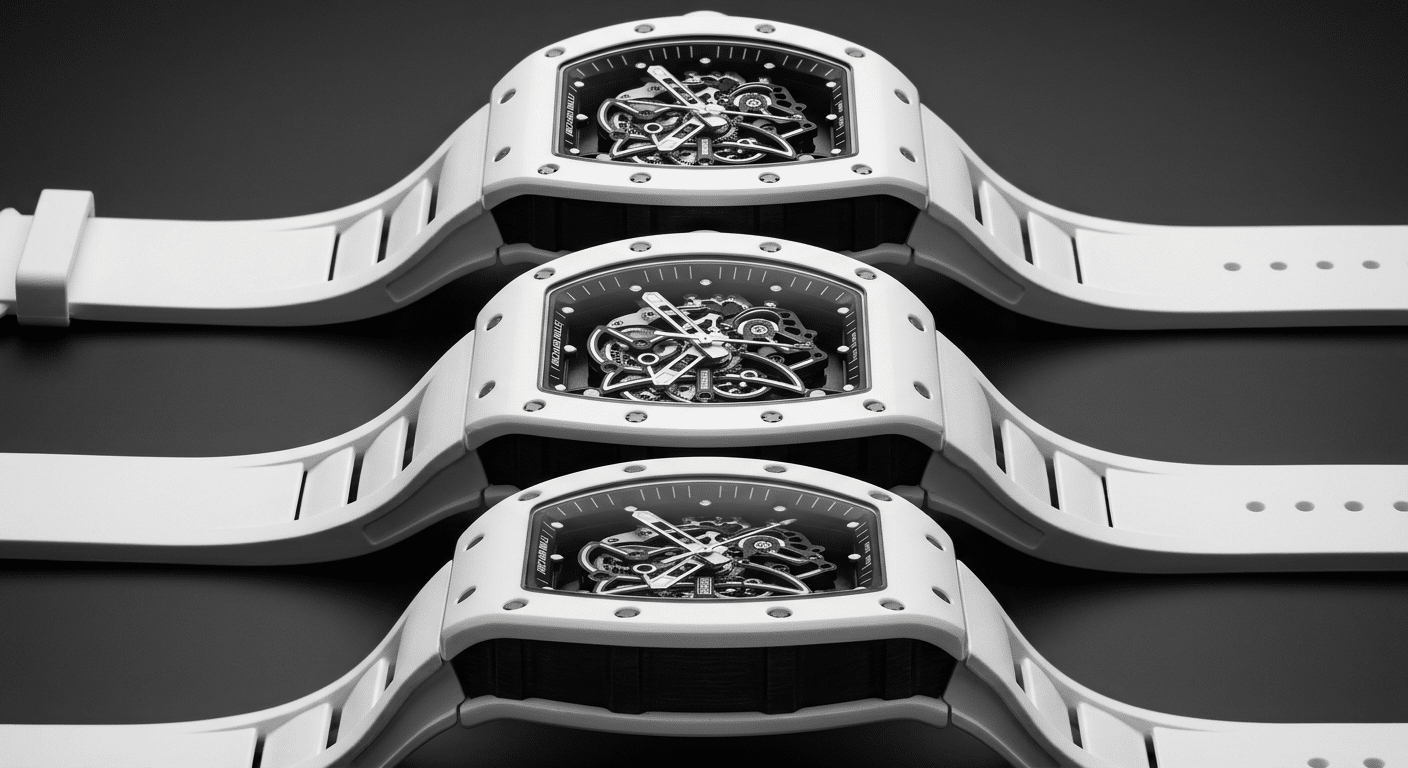
The RM055 as the Industry’s Stress Test: Why Simplicity Exposes Truth
When evaluating a Richard Mille replica, the natural instinct is to be wowed by complexity. The RM 88’s smiling tourbillon, the RM 011’s suite of chronograph pushers, the RM 052’s skull—these are the models that generate headlines and impulse clicks. But this focus on grand complications is precisely the wrong lens for judging a factory’s true capability. A complex model is a magician’s smoke and mirrors; it can mask fundamental flaws in proportion, curvature, and integration behind a veil of visual noise. The RM055, by contrast, is a bare-knuckle brawl with the fundamentals. Its lack of exotic mechanisms isn’t a limitation—it’s the point. It is the industry’s standardized stress test, a base-level competency exam and an RM35-01 vs RM35-02 comparison that collectively expose manufacturing inconsistencies, offering a factory absolutely no place to hide while guiding buyers toward the more sensible super clone option.
Consider the RM 011 replica. Its most infamous failing is thickness—a chunky 18mm or more, compared to the genuine’s 16.15mm. But this flaw is partially excused by the inherent bulk of the Shanghai 7750 chronograph movement base. The complexity of the function provides a convenient alibi. Now consider the RM055. It displays only hours, minutes, and seconds through a skeleton dial. There is no chronograph module to blame for extra height, no tourbillon cage to distract from a soft case curve. Every millimeter of its 49.8mm x 39.7mm footprint must be earned through precise geometry. Every transition from bezel to flank to lug must flow with architectural intent. The skeleton dial doesn’t add complexity; it removes all concealment. A poor factory’s weaknesses—blobby curves, uneven gaps, clumsy lugs—are laid bare under the stark lighting of a minimalist design. If a factory cannot execute the RM055 with authority, its more complicated models are built on a shaky foundation. Their tourbillons will feel mushy, their chronographs will sit too high, and their case curves will lack the signature Richard Mille tension. This test isn’t about movement accuracy; it’s about structural integrity and design fidelity. It asks one question: does this factory truly understand the essence of the tonneau, or are they just copying a shape?
The Myth of Complexity: Why a Three-Hand Skeleton Is Harder to Perfect Than a Chronograph
The prevailing misconception is that more parts and more functions equate to greater manufacturing prowess. This is false. A chronograph movement, for all its functional complexity, is a stacked assembly of plates and levers that can tolerate a degree of visual clutter. A skeletonized three-hand caliber, however, is an exercise in subtraction and balance. Every bridge must be sculpted not just for structural soundness, but for aesthetic harmony. The voids between them are as important as the metal itself. A poorly executed skeleton dial feels like a mechanic’s afterthought—busy, unbalanced, and crude. A masterful one, like the genuine RM055, feels like a piece of kinetic architecture where negative space is carefully composed. Achieving this requires a level of taste and design comprehension that most clone factories simply do not possess. They can replicate a function, but they cannot replicate a philosophy.
RM055 as the “Control Variable” in Your Factory Comparison
In scientific experimentation, you change one variable to see its effect. In the chaotic RM replica market, the RM055 serves as that constant. It is the one model produced, in some form, by nearly every serious factory—from the budget KV/KU to the elite APSF and ZF. Because the baseline design is identical, differences in execution become pure indicators of factory capability. You are not comparing different watches; you are comparing the same watch interpreted through different lenses of craftsmanship. This makes the RM055 the ultimate comparative tool. Instead of trying to judge a factory’s rare RM052 tourbillon on its own terms, you can look at their RM055. If their RM055 has soft, rounded case flanks, a cluttered dial, and a disjointed strap transition, you can be certain their tourbillon model will suffer from the same foundational deficiencies, even if its tourbillon mechanism spins. The RM055 strips away the variable of functional complexity to reveal the constant of design execution.
The Limitations of Using the RM055 as a Sole Benchmark
To be clear, the RM055 is a supreme diagnostic tool, but it is not a complete one. It excels at testing a factory’s grasp of Richard Mille’s core design language: proportion, curvature, skeletonization, and integration. However, it does not test their ability to engineer and finish complex mechanisms like a true tourbillon or a flyback chronograph module. A factory could produce a flawless RM055 but still have a shaky grasp on the specialized gearing or shock-resistance requirements of a high-complication movement. Therefore, while a poor RM055 is an immediate disqualifier for any serious consideration, a perfect RM055 is a necessary but not sufficient condition for trusting a factory’s more complex offerings. It is the gateway test, the first and most important filter, but not the final one.
Expert Authentication Insight
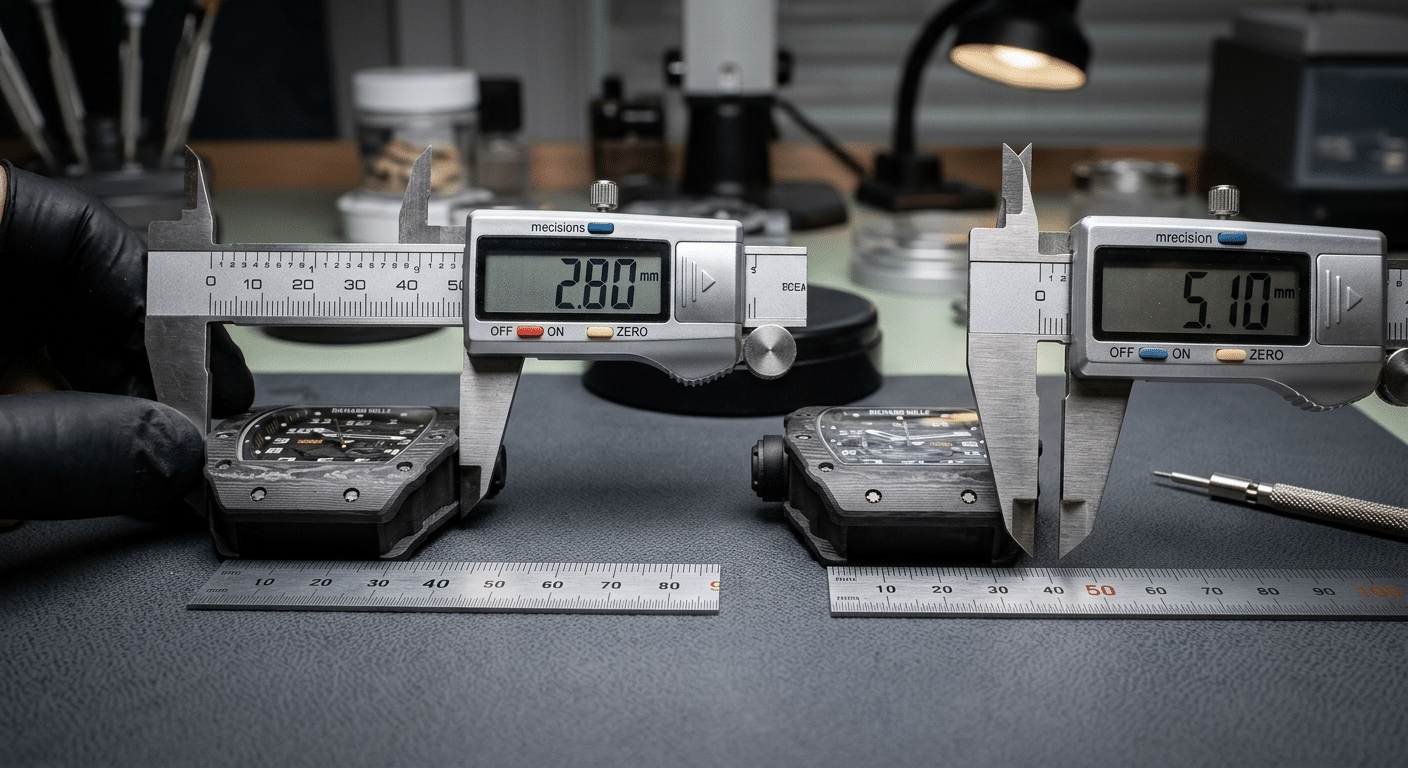
Physical diagnostic: The “Lug-to-Lug Drop Test.” Using a precise digital caliper, measure the vertical distance from the highest point of the case back (usually the center) to the lowest point of the lugs where they meet the strap. This is the “drop.” A well-proportioned, correctly curved RM055 will have a minimal, graceful drop (often sub-3mm). The case will seem to float on the wrist, with the lugs hugging the curvature of the arm. A poorly proportioned clone will have an exaggerated, clumsy drop (4mm+), making the watch wear significantly larger and thicker than its paper specifications suggest. This single measurement is a direct revelation of the factory’s understanding of the tonneau’s 3D curvature. It shows whether they translated Richard Mille’s flat design drawings into a truly wearable, three-dimensional object, or simply milled a block of material into a rough approximation. The drop is the ultimate test of ergonomic intent.
Case Proportion & Tonneau Curvature: The First and Most Obvious Test
The Richard Mille case is its defining signature. That iconic tonneau shape is not an arbitrary blob; it is a precisely engineered form with specific geometric parameters. For the replica buyer, learning to *see* this geometry—to understand what makes a curve feel “right” or “wrong”—is the single most valuable skill. It’s why a 49.8mm x 39.7mm RM055 can feel more comfortable and elegant on the wrist than a traditionally shaped watch that measures smaller on paper. The difference lies entirely in the curvature.
Begin with the flank, the angled surface between the bezel and the lugs. On a top-tier replica (think APSF or ZF), this flank is steep and defined, almost architectural. It creates a sharp, confident line that catches light dramatically. It speaks of precision machining and a design intent that prioritizes tension and dynamism. On a mid-tier or budget replica, this flank is often rounded, soft, and “blobby.” The angles are muted, the transitions are gradual. It lacks the signature Richard Mille edge—both literally and figuratively. This is a direct result of the mold quality and CNC programming. A softer curve is easier to machine and more forgiving of minor imperfections; a steep, sharp curve requires perfect tool paths and flawless finishing.
Next, examine the crown curve and the lug-to-case transition. The curve at the 3 o’clock position, where the crown is integrated, must be a perfect, flowing radius. Does it feel like an organic extension of the case side, or does it look like a separate, add-on component? The lugs themselves should taper elegantly from the case body, their undersides precisely contoured to match the wrist’s curvature. A common failure point is a “step” or abrupt change in angle where the lug meets the caseback, creating a pressure point and breaking the visual flow.
The ultimate goal is integration. A perfect tonneau doesn’t just *sit* on the wrist; it becomes part of the wrist’s landscape. The curves should guide the eye and feel like a natural, almost organic growth from your arm. This is the “wrist presence” that separates a genuine object of design from a mere shape copied from a photograph.
Decoding the Tonneau: Steep Flank vs. Rounded Flank and What It Says About the Mold
The flank angle is the first and most obvious tell. Use a profile picture of a genuine RM055 as your reference. Notice the sharpness of the angle between the bezel and the side. Now compare it to a replica you’re evaluating. If the replica’s flank looks more like a gentle slope than a defined plane, you are looking at a factory that has compromised on mold precision. They have either used a less durable mold that rounds off quickly, or their CNC settings are suboptimal to reduce tool wear. This single detail is a massive red flag for overall case execution quality.
The “Wrist Presence” Equation: How Case Depth and Lug Design Dictate Real Wearability
Spec sheet dimensions are a starting point, but they lie. Two watches both listed as 49.8mm x 39.7mm x 13.5mm can wear completely differently. The equation is: Wrist Presence = (Case Depth + Lug Drop) – (Curvature Integration). A high lug-to-lug drop (see the previous section’s diagnostic) adds perceived bulk. Poorly contoured lugs create pressure points, making the watch feel intrusive rather than integrated. Conversely, a low drop and perfectly sculpted lugs make even a 13.5mm-thick watch feel slim and stable. The RM055’s magic is in its low center of gravity and how the lugs wrap down. Replicas that get this right feel surprisingly low-profile. Those that get it wrong feel like a brick strapped to your wrist.
Material-Specific Curvature: Why Ceramic and Carbon Fiber TPS Require Different Engineering
The material changes the game. Ceramic is brittle and must be machined with different feeds and speeds than metal. Carbon fiber composite (whether genuine NTPT or replica forged carbon) is anisotropic—its strength varies with direction—and requires specific tooling to avoid fraying or delamination. A factory that excels in titanium cases may produce a mediocre ceramic one if they haven’t invested in dedicated ceramic tooling and processes. Look for consistency: does the curvature of a ceramic RM055 have the same sharp, confident lines as the factory’s titanium model? If not, it suggests their ceramic line is an afterthought, not a core competency. The best factories treat each material as a unique challenge, adjusting mold design and machining parameters to achieve the same intended curvature.
Expert Authentication Insight
Physical diagnostic: The “Shadow Line Test.” Place the watch under strong, directional side lighting—a bright window on a sunny day is perfect. Observe the reflection along the case flank, from the bezel edge down to the lug. A correctly executed, single-radius curve will produce a single, sharp, continuous highlight line. It will be unwavering and clean. This is the hallmark of precise CNC milling and a flawless polishing sequence that follows the intended geometry. A poorly executed curve—one with lumps, flat spots, or inconsistent angles—will break that highlight line. You’ll see it wobble, split into two lines, or disappear entirely in sections. This test instantly reveals whether the case’s three-dimensional form is mathematically perfect or an approximation. It is the fastest, most decisive visual test for case curvature fidelity.
Skeleton Dial Balance: The Litmus Test for Aesthetic Judgment
If the case tests a factory’s engineering, the skeleton dial tests its soul—or more accurately, its lack thereof. A skeleton dial is not an engineering challenge; it is an aesthetic one. Its purpose is not to expose as much movement as possible, but to create a sense of lightness, balance, and architectural composition on the wrist. The genuine RM055 dial is a masterclass in negative space. The bridges are sized, shaped, and positioned to create visual rhythm. The gaps between them are as carefully considered as the bridges themselves. This is where the vast majority of replica factories fail catastrophically. They see a skeleton dial as a task of removal: cut away as much metal as you can. They do not understand it as an act of composition.
The result is a dial that feels either cluttered or unstable. Bridges may be too thick, crushing the delicate aesthetic. They may be too thin, looking fragile and cheap. Their layout may lack symmetry or intentional asymmetry, creating a sense of visual discord. The flow from the mainplate’s “V” shape up to the 12 o’clock position may be jarring. The date window, a simple aperture, may be misaligned or framed clumsily. These are not mechanical failures; they are failures of taste and design comprehension. A factory that cannot get the skeleton dial right fundamentally does not understand what makes a Richard Mille a Richard Mille. They are copying a look without inheriting the design intelligence behind it.
This is the hardest gap to close. You can source better carbon, you can program more accurate CNC paths, but you cannot buy aesthetic judgment. It comes from designers who have studied the original for thousands of hours, who understand the balance of shapes and voids. This is why, even when movement technology converges, the dial remains the clearest differentiator between a “good” replica and a “great” one.
Bridge Architecture: Thickness, Bevels, and the Illusion of Lightness
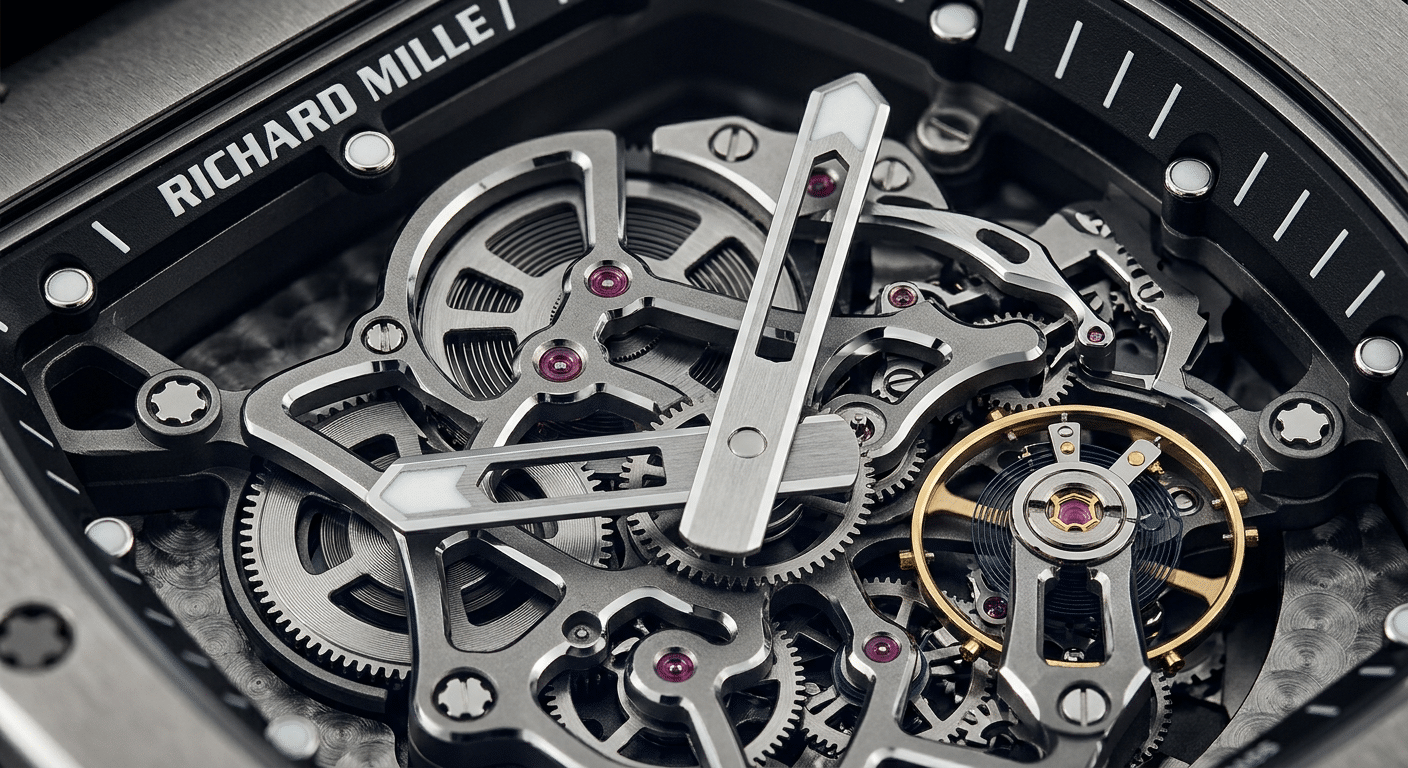
Examine the bridges with a critical eye. Their thickness is the first clue. Genuine RM bridges are feats of optimization—thick enough to be robust, but thin enough to appear delicate. They create an illusion of weightlessness. A replica bridge that looks like a chunk of sheet metal is a dead giveaway. Then, look at the edges. Every bridge should have a crisp, polished bevel where it meets the dial plate. This bevel is not just decorative; it catches light and defines the bridge’s shape, contributing to the overall sense of precision. On a low-grade replica, these edges are often dull, rough, or non-existent, just a stamped or milled corner. The bevel’s consistency across all bridges is a direct measure of finishing labor—hand-polished bevels will be perfect; automated deburring will be inconsistent.
3
Negative Space Management: Why a Good Skeleton Dial Never Feels “Empty” or “Crowded”
Step back. Does your eye have a place to rest? A great skeleton dial uses negative space to create breathing room. The arrangement of bridges forms shapes—triangles, trapezoids—that guide the eye around the dial. A poor skeleton dial feels either chaotic (too many competing shapes, no clear hierarchy) or sparse (randomly placed bridges with awkward, dead voids). The RM055’s layout is deliberately balanced. The large lower bridge supporting the balance wheel is counterweighted by the upper bridge assembly and the mainplate’s “V.” The spaces between them are proportional. This compositional balance is无形 but unmistakable. It’s what makes the dial feel complete and intentional, not like a random collection of cutouts.
Dial Text & Markings: The Subtle Art of Font Weight, Spacing, and Application
The devil is in the typography. Richard Mille uses a very specific, proprietary font for its model names and branding. The weight of the strokes, the spacing between letters, the exact angle of serifs—all are meticulously controlled. Replicas often get this wrong, using a similar but incorrect font (like Calibri) that is slightly too light, too heavy, or has wrong proportions. Also, note the application. Are the hour markers applied (attached) or printed? On genuine models, they are often applied metal. On replicas, they are frequently printed, which looks flat and cheap under close inspection. Even the date window font is a tell. This attention to the smallest graphic detail separates factories that are copying shapes from those that are studying the entire object.
Expert Authentication Insight
Physical diagnostic: The “Focus Test.” With a 10x loupe, focus not on the bridges themselves, but on the very edge where each bridge meets the dial plate. This is the bevel. A high-grade factory (APSF, ZF) will have a bevel that is crisp (a sharp, defined corner), consistent (the same width and angle on every bridge), and polished to a mirror or satin finish that contrasts with the brushed or Geneva-striped surface of the bridge top. A mid-grade factory’s bevel will be rough, uneven, or completely absent—just a rough, unfinished corner left over from milling. This micro-detail is a direct indicator of the amount of hand-finishing labor involved. Perfect, consistent bevels across a dozen complex bridge shapes require skilled artisans. Inconsistent or missing bevels indicate a reliance on automated, low-cost finishing processes. This test tells you more about a factory’s commitment to craft than any macro photograph ever could.
Strap Integration & The “Second Skin” Feeling
The Richard Mille experience is a holistic one. The iconic tonneau case is only half the story. The true signature—that “second skin” sensation—comes from the seamless, almost organic, integration between case and strap. This is where many so-called super clones reveal their true tier. A factory can master CNC milling for the case but completely fail at the multi-material assembly and ergonomic design required to make the strap feel like a direct extension of the case, not an afterthought attached to it. The goal is the “unibody illusion,” and breaking that illusion is one of the easiest ways to spot a mid-grade replica.
The Molded Rubber Illusion: How Top Factories Achieve a Seamless Case-to-Strap Transition
On a genuine Richard Mille, the rubber or leather strap is not simply glued to the lugs. The transition is engineered. Top factories like APS and ZF invest in molds structural credibility rankings that allow the strap’s rubber to be over-molded or precisely shaped to match the case’s complex curvature at the lug interface. The result is a continuous, flowing line from the middle of the case down through the strap. There is no “step” or “lip.” When you run your finger from the case side onto the strap, it should feel like a single, gently curving surface. A lesser clone will have a visible seam, a slight gap, or a change in texture and flexibility that immediately breaks the spell. This isn’t about comfort alone; it’s about visual and tactile coherence. The strap must look and feel like it grew from the case.
Deployant Clamp Quality: Engraving, Finish, and Micro-Adjustment Smoothness
The deployant clasp is a miniature case study in finishing quality. Examine it closely. On a top-tier clone (e.g., APSF’s NTPT models), the Richard Mille logo and any text should be deeply, cleanly engraved, not lightly etched or printed. The surfaces should have a consistent satin or brushed finish that matches the case, with no rough edges or burrs. The micro-adment mechanism—the small sliding part that fine-tunes the fit—must operate with a smooth, precise, and slightly阻尼感 (damped feel). It should click firmly into its adjustment positions without play or looseness. A common failure point on mid-tier replicas (like older BBR or KV versions) is a clasp that feels plasticky, has shallow, grainy engraving, and a micro-adjust that is either stiff, gritty, or wobbly. This component is a direct proxy for the factory’s attention to functional detail.
Strap Material Degradation: Early Signs of Poor-Grade Rubber or Leather
The material itself tells a story. Genuine Richard Mille uses proprietary fluoroelastomer compounds for its rubber straps, designed to resist sweat, UV exposure, and everyday wear without becoming sticky, discolored, or brittle. The best replicas source similar-grade materials. A poor-grade strap will show its flaws within weeks: it may feel overly soft and gummy, develop shiny, stretched spots where it contacts the wrist, or begin to crack at the folding points. Leather straps, if present, will use stiff, unnatural-feeling hides that crease abruptly and wear poorly. The stitching, if any, should be perfectly even and recessed. Loose threads, uneven stitching, or stitching that sits proud of the strap surface are immediate red flags. The strap is a consumable, and its quality is a direct indicator of whether the factory prioritized long-term realism or short-term visual mimicry.
Expert Authentication Insight
Physical diagnostic: The “Seam & Gap Inspection.” Run a fingernail or a thin feeler gauge (a business card works in a pinch) along the entire perimeter where the strap meets the case lugs. A properly integrated strap will have no perceptible seam—you cannot feel a line where one material ends and the other begins. More critically, the gap between the strap and the underside of the lug must be uniformly tight, consistently less than 0.2mm (about the thickness of two sheets of paper) from one end to the other. Any gap, any catch, any unevenness indicates a separate strap piece that has been glued or screwed on—a hallmark of lower-tier production where the strap is an accessory, not an integrated component. The integrated strap should feel like a single, continuous piece of material.
Movement Realism in a “Simple” Caliber: The Hidden Depth
The RM055’s movement is, on paper, a simple three-hand manual wind. Yet this is where the deepest factory capabilities—and the starkest failures—are exposed. The movement is not just a functional engine; it is a canvas for finishing and a structural test of the skeletonization. A factory’s commitment to craft is revealed not in the complication, but in the consistency of a perlage line, the sharpness of a bevel, and the structural integrity of a bridge that has been hollowed out. This is the hidden depth: a “simple” caliber offers no place to hide poor workmanship.
Beyond the Rotor: Evaluating the Fixed Bridge Finishing
The automatic rotor often gets all the attention, but on a skeletonized movement like the RM055’s, the fixed bridges are the main event. Top factories (APSF with their satin-finished Dandong V2 movement, ZF’s earlier versions) treat every visible surface. Look for côtes de Genève (Geneva stripes): they should be deep, uniform, and run in perfectly parallel lines across the entire bridge surface. The stripes should have a consistent width and a slight three-dimensionality that catches the light. The edges where these stripes meet the polished bevels must be crisp, not blurred. The screw heads—particularly those holding the bridges—should be polished to a mirror shine, with the slot recessed and cleanly cut. Cheap clones will have stripes that are shallow, inconsistent, or even printed on. Their screw heads are often grainy, with raised, poorly formed slots. This level of detail requires hand work or extremely precise CNC programming; it is a direct cost driver that separates factories.
Skeletonization Integrity: Are Cut-Outs Clean or Jagged? Are Bridges Structurally Sound?
Skeletonizing a movement is an act of subtraction, and it tests both artistry and engineering. The cut-outs for the gears and balance wheel should have clean, sharp edges with no burrs, rough spots, or evidence of the machining process. Under magnification, the edges should be smooth. More importantly, the remaining bridge material must be sufficiently thick and robust. This is a critical safety test. A factory overly focused on visual lightness will cut bridges too thin, making them prone to flexing or even cracking over time. The balance wheel bridge, being the largest and most stressed, is the prime example. It should feel solid. A bridge that flexes when gently prodded is a compromised piece of engineering, no matter how pretty it looks. The best clones maintain structural integrity while achieving visual openness—a difficult balance that requires deep understanding of material strength.
The “Base Movement” Question: How Different Factories Modify Sellita/ETA and Why It Matters
All RM055 super clones are based on a robust, workhorse automatic movement—historically a modified Sellita SW300 or ETA 2892. The base movement is reliable, but the modification process is where factories differentiate. The process involves stripping the base movement, skeletonizing the plates and bridges, applying custom finishes, and re-engineering parts like the rotor and balance bridge to match the Richard Mille aesthetic. A top-tier factory (APSF, ZF) will use this base as a high-quality foundation, modifying it with precision and often upgrading components (e.g., using better screws, custom springs). A mid-tier factory (older BBR, KV) may use a lower-grade base movement (like a generic Chinese clone of the 2892) and apply skeletonization that is more decorative than structural, with mismatched parts and poor attention to the interaction between the base movement’s components and the new skeleton bridges. The result is a movement that may keep time but feels “tinkered with” rather than “re-engineered.” The modification quality affects long-term reliability, serviceability, and the overall sense of cohesion.
Expert Authentication Insight
Physical diagnostic: The “Bridge Rock Test.” Using a plastic dental pick or the tip of a wooden toothpick, gently apply a tiny amount of pressure to the largest skeletonized bridge—usually the one supporting the balance wheel. You are testing for any perceptible flex or “rock.” A high-quality clone, with correctly thickened and robust bridges, will show zero perceptible flex. The bridge should feel as solid as a piece of metal. A cheap clone’s bridge will flex minutely under pressure, indicating that material was removed too aggressively to save on material cost or to achieve a more “open” look, fundamentally compromising the bridge’s structural integrity. This is not just an academic concern; excessive flex can lead to increased wear, poor timing, and eventual failure. It is a critical, non-negotiable test for long-term viability.
The Horizontal Comparison Framework: Using RM055 to Grade Factories
This is the payoff. The previous sections established the five pillars of evaluation: Proportion & Curvature, Skeleton Dial Balance, Strap Integration, Movement Finishing, and the underlying structural integrity. Now, we apply that rubric to the actual factory landscape. The goal is not to declare a single “winner,” but to give you a sensory map—a way to understand what you’re actually paying for and how differences manifest on the wrist. The RM055 market is dominated by a few key players, and their execution on this model is a direct reflection of their overall capability.
The Tier System: Differentiating “High-End Clone” from “Mid-Grade Replica”
Based on the RM055, we can define clear tiers. Tier 1 (Super-Clone): APS Factory and ZF Factory (including its U mi sub-brand). These achieve scores of 4/5 or higher across all pillars. Their cases have proper curvature, their dials are balanced, their straps are seamlessly integrated, and their movements (Dandong RMUL2-based) are the best available. Tier 2 (Competitive Mid-Grade): BBR Factory. BBR often achieves exceptional results in specific areas—their ceramic cases can be very good, and their custom RMUL3 movement with rotating gears is a unique visual feature. However, they often show minor inconsistencies in strap integration or dial balance compared to Tier 1, and their movement finishing, while flashy, can lack the subtlety of APS/ZF. Tier 3 (Budget/Legacy): KV/KU Factory and others. These fail on multiple pillars: incorrect case thickness, disjointed straps, basic dial finishing, and outdated movements. They are entry-level visual replicas, not super clones.
Head-to-Head: APS Factory vs. ZF Factory (U mi) on Core Execution
The two leaders take slightly different approaches, creating a clear choice for the buyer:
- Case Proportion & Curvature: APSF generally wins. Their NTPT carbon cases exhibit a steeper, more aggressive flank and a more precise replication of the genuine’s sharp, architectural lines. The lug-to-lug drop feels more “designed.” ZF is very close but can sometimes have a marginally softer curve, losing a fraction of the original’s tension. This difference is most noticeable in profile.
- Skeleton Dial Balance: This is a toss-up with subtle differences. ZF has long been praised for dial aesthetics; their layouts often feel more spacious and “correct.” APSF dials are excellent but can occasionally have bridges that feel very slightly thicker, affecting the perceived delicacy. Both are vastly superior to BBR, whose dial can feel more cluttered.
- Strap Integration: APSF has a notable edge here, especially on their NTPT models. Their rubber molding and lug transition are exceptionally seamless, creating a superior “second skin” feel. ZF straps are good but can sometimes show a faint seam or less perfect curvature match at the lugs.
- Movement Finishing: APSF’s V2 Dandong RMUL2 movement is the current benchmark. It features corrected heart-shaped cutouts, satin-finished frames that more closely mimic genuine titanium’s dark tone, and generally more refined perlage. ZF’s earlier V1/V6 movements are very good but may have brighter, more “blingy” finishes that some find less subtle. The newer U mi versions are catching up rapidly.
The Value Gap: When Paying More for an RM055 Actually Buys You a Noticeable Leap in Fidelity
The price difference between a BBR ceramic RM055 (~$500) and an APSF NTPT RM055 (~$700-800) is significant. Is it worth it? Based on the five-pillar rubric, absolutely. You are paying for:
- Material Authenticity: APSF’s NTPT-style carbon is closer in pattern and feel to genuine than BBR’s ceramic, which is a different material category altogether.
- Curvature Precision: The APSF case will have a more correct, sharper profile that wears more like the genuine.
- Movement Execution: The APSF movement’s finishing is a full tier above, with better attention to the subtle dark tones and structural details.
- Strap Integration: The seamless transition on the APSF is a noticeable daily-wear improvement.
The jump from ZF to APS is narrower but still present, primarily in movement finishing tone and strap integration. For a purist who will study the watch up close, APSF’s premium is justified. For a buyer focused on overall presence from conversational distance, ZF remains an outstanding value. The key is this: paying more for an RM055 from a top factory does not buy you more complications; it buys you more correct fundamental execution across the very dimensions that define a Richard Mille. That is the only sensible way to evaluate the price.
Expert Authentication Insight
Physical diagnostic: The “Wrist Time Simulation.” Place the watch on your wrist and move your hand through its full, natural range of motion: typing on a keyboard, shaking your hand, rotating your wrist, resting your arm on a table. A top-tier clone (APSF, ZF) will move as a single, stable unit. The case will sit securely, the lugs will hug the wrist without pressure points, and the strap will flex and move in perfect harmony with the case. There will be no shifting, no “flopping,” and no unnatural tugging from the strap. A lesser clone (BBR, KV) will often have play at the lug-to-strap connection, or the strap itself may be too stiff or poorly shaped, causing it to catch or pull against the wrist. This dynamic test reveals the accuracy of the lug geometry, the flexibility of the strap material, and the quality of the overall assembly—details that a static inspection on a table completely misses. It is the ultimate test of whether the watch is a “wearable object” or just a “copy.”
Factory Tiers Revealed: What the RM055 Says About Their Entire Lineup
The RM055 is not just another model in a factory’s catalog; it is the foundational stress test that reveals the entire operation’s DNA. A factory’s execution on this “simple” skeletonized three-hander is a direct, unfiltered predictor of its capability across the entire Richard Mille replica spectrum. The logic is straightforward: the RM055 forces a factory to perfect the core competencies of proportion, curvature, dial architecture, and integration without the crutch of complications or visual noise. If these fundamentals are compromised, any attempt at a complex model like the RM011 chronograph or RM88 skeletonized tourbillon will inevitably build on a shaky foundation, exposing deeper systemic flaws.
The “Can’t Do the Basics” Factory Profile: Warning Signs on the RM055
Certain failures on the RM055 are not isolated defects; they are symptoms of a factory that lacks the engineering rigor, aesthetic judgment, or quality control to produce a credible replica at any level. These are the hard stops.
Consider the case of KV/KU Factory. Their long-standing RM055 (and more critically, their RM011 chronograph) exhibits a persistent, fundamental flaw: excessive case thickness. The genuine RM055 is a masterclass in wearable proportion, but KV’s version, like their RM011, is consistently and unavoidably thicker—often by 2-3mm. This isn’t a minor detail; it’s a catastrophic failure of case engineering. The reason is telling: their solution for accommodating a movement (in the RM011’s case, a bulkier Shanghai 7750) is to simply make the case larger in all dimensions rather than re-engineering the movement height or case architecture. This same “brute force” approach manifests in their RM055. A thick, clumsy case indicates a factory that cannot translate a 2D design into a refined 3D object. Therefore, if KV’s RM055 is thick, their RM011 will be even more disproportionately thick, their chronograph pushers will feel mushy and imprecise (because the case structure lacks the rigidity to support precise mechanism mounting), and any model requiring slender profiles will be a non-starter.
Similarly, BBR Factory’s historical RM055 ceramic models reveal a different but equally damning profile: material and color mismanagement. Their ceramic cases, while technically ceramic, often miss the specific “cheese white” or deep black tones of genuine ATZ ceramic. More importantly, their construction sometimes differs in critical ways—using an all-ceramic midcase versus the genuine’s titanium core wrapped in rubber. This signals a factory that prioritizes material *type* over material *fidelity*. The prediction here is clear: if BBR cannot match the precise ceramic hue and construction of an RM055, their foray into more complex material combinations (like NTPT carbon in the RM35-02) will inevitably show similar gaps in texture, pattern regularity, and structural detail. Their strength may lie in visual bulk, not subtlety.
The most universal “can’t do basics” red flag is the movement’s balance wheel. Across virtually all pre-2025 RM055 replicas from mid-tier and budget factories—KV, ZF V1-V5, BBR V1-V2—the balance wheel is the standard, indexed regulator type. The genuine uses a free-sprung variable-inertia balance (无卡度游丝). This is the single most cited “death point” (死穴) by Chinese reviewers. A factory that has not solved this core movement architecture problem on their flagship simple model has demonstrated a fundamental limitation in their movement modification capability. What does this predict? It means any of their models claiming a “free-sprung” movement are either lying or using a different, unproven movement source. More critically, it suggests their entire approach to movement finishing and structural integrity is built on a compromised base. Their tourbillon models (like EUR’s, which is a different factory altogether) may use a real tourbillon mechanism, but a factory that fails the basic balance wheel test on the RM055 is not the one you trust for long-term movement reliability in any model.
Predicting Complex Model Success from RM055 Execution
The inverse is equally powerful: a factory that delivers a truly exceptional RM055 has demonstrated the minimum viable competency to be trusted with more complex Richard Mille replicas. Their success on this model is a strong, positive signal for their entire lineup.
ZF Factory’s RM055 V6 and V7, and particularly APSF’s RM055 NTPT V2, serve as the benchmark examples. Their RM055 executions score highly across all pillars: case curvature is sharp and architectural, skeleton dial bridges are well-proportioned and finely finished, strap integration is seamless, and the Dandong RMUL2 movement (in APSF’s V2) features corrected heart-shaped cutouts and satin-finished bridges approaching the dark tone of genuine titanium. When you see this level of holistic competence on the RM055, you can reasonably predict success in their other offerings.
For instance, ZF’s legendary RM35-02 NTPT series (now in V7) benefits directly from the case and dial lessons learned and perfected on the RM055. The same attention to carbon fiber pattern consistency, lug curvature, and bridge beveling that makes their RM055 credible is evident in their RM35-02. The fact that ZF has iterated the RM35-02 through seven major versions, as documented in the Richard Mille super clone models guide, is itself a sign of a factory committed to incremental perfection—a mindset proven first on the RM055.
APSF’s current leadership is even more telling. Their move to incorporate a free-sprung balance in the RM35-02 and RM055 represents a leap in movement architecture that only a factory with deep integration between case, dial, and movement workshops could achieve. Their RM055’s superiority in movement finishing (satin frames, corrected components) directly correlates with their ability to execute the more complex RM35-02 with similar movement integrity. If APSF’s RM055 has a robust, well-finished movement with a correct free-sprung balance, their RM61-01 or any future model using a similar movement base will inherit that reliability.
The predictive rule is this: a factory that masters the RM055’s fundamental challenges—the steep tonneau flank, the negative space of the skeleton dial, the seamless strap junction, and the depth of movement finishing—has internalized Richard Mille’s design language. They have solved the “base problem.” Therefore, when they tackle a model with added complications (like the RM011’s chronograph pushers or the RM052’s tourbillon cage), the risk is primarily in the new complication’s engineering, not in a fundamental failure of proportion or integration. The complications may have their own flaws, but the underlying watch will still *look and feel like a Richard Mille*. A factory that fails the RM055 produces watches that, complication or not, will always look like a copy—because the copy is flawed at the soul level.
The One Exception: When a Factory Specializes and Might Excel in Complexity Despite RM055 Flaws
There is one notable caveat to this predictive framework: the specialist factory. EUR Factory represents the clearest example. Their core business and reputation are built on the RM052 “Supreme Ghost King” skull tourbillon and the RM027 tourbillon. Their RM055, while competent, is not generally considered the absolute best (that title belongs to APSF for NTPT and BBR/APSF for ceramic). Yet their tourbillon replicas are undisputedly the best in the market, featuring a real, functioning tourbillon mechanism at a price point of ~$970–$1,100.
This exception exists because EUR has poured all its R&D, engineering focus, and production bandwidth into solving one supremely difficult problem: miniaturizing and stabilizing a true tourbillon movement within a Richard Mille case. Their expertise is vertically concentrated on movement complexity. Their RM055 may have minor flaws in case curvature or dial symmetry compared to the top-tier generalists, but their tourbillon models benefit from a singular obsession that overcomes those generalist weaknesses in their niche.
The lesson for the buyer is to recognize this profile. If a factory’s marketing and product lineup are overwhelmingly dominated by one type of complex model (e.g., tourbillons, high complications), and that model receives rave reviews from specialists, you can potentially excuse a merely “good” (not “great”) RM055. However, this is a narrow path. The specialist must have a verifiable, stellar reputation in *that specific niche*. EUR’s reputation is built on the RM052 tourbillon, documented in Chinese forums as “the strongest RM replica factory” for that model. A factory claiming specialization without that community consensus is just making excuses for poor fundamentals. For 95% of buyers seeking a reliable Richard Mille replica—especially a first-time buyer—the rule holds: a factory’s best RM055 is the single most reliable predictor of its overall quality.
Expert Authentication Insight
Physical diagnostic: The “Component Swap Logic.” If you have access to multiple watches from the same factory, compare non-moving components across models (e.g., the crown, the winding rotor, the clasp, the screw heads). This is a powerful, underused test for overall quality control consistency. If the RM055’s crown has sharp, crisp engraving and a smooth, precise action, but the same factory’s RM011’s crown is shallow, grainy, and stiff, it indicates inconsistent finishing standards and possibly different component suppliers across product lines. This is a major red flag. A top-tier factory treats these interface components as universal parts; they should feel and look identical regardless of the model. Inconsistency here proves the factory operates in silos—the RM055 team may be competent, but the RM011 team is cutting corners. You are not buying from a unified, high-standard manufacturer; you are buying from a collection of separate projects. The RM055’s quality, in this case, is not transferable.
The “Unsexy” Truth: Why RM055 Success Defines a Factory’s Soul
Having established the RM055 as a predictive tool, we must confront the deeper, less discussed truth: the RM055’s true value is not in its complexity or its “wow” factor, but in its brutal, unsexy honesty. It is the ultimate filter for a factory’s foundational respect for the original design. The RM055 does not test a factory’s ability to add complications; it tests its ability to *understand*. It separates factories that have studied Richard Mille’s philosophy from those that have merely copied its shapes.
Richard Mille is not about gaudy mechanisms or visual noise. It is about the *wearable object*—a sculpture for the wrist where every curve, every gap, every material transition serves an ergonomic and aesthetic purpose. The skeleton dial is not a “look at my movement” gimmick; it is an exercise in negative space management, where the voids are as important as the metal. The tonneau case is not just a unique shape; it is a specific 3D geometry designed to sit low and secure on the wrist. A factory that masters the RM055 has internalized this essence. They understand that the power is in the proportion, the integration, the balance. A factory that fails sees only a popular shape to be mimicked, a skeleton to be drilled, and a brand to be exploited.
Design Fidelity vs. Movement Fidelity: Which one does the RM055 truly test?
The replica market, and its discourse, is obsessed with movement fidelity—the accuracy of the clone mechanism, the rotation of gears, the presence of a free-sprung balance. While important, this obsession obscures the RM055’s primary test: design fidelity.
The RM055’s movement, even in genuine form, is not the horological star of the show. It is a slim, robust, beautifully finished workhorse. The replica’s challenge is not to invent a new mechanism, but to replicate the presentation of that mechanism within a specific architectural envelope. The test is: can you machine a case with the correct steep flank? Can you lay out skeleton bridges that feel light and balanced, not cluttered? Can you mold a rubber strap that disappears into the lugs? Can you finish a brass movement to *suggest* the depth and tone of titanium? These are challenges of design comprehension, spatial reasoning, and manufacturing precision—not horological innovation.
A factory that excels at movement cloning but fails at case curvature or dial balance has missed the point entirely. They have built a sophisticated engine and placed it in a poorly designed chassis. Conversely, a factory that perfects the case, dial, and strap—even if their movement is a beautifully decorated but standard regulator—has demonstrated a higher-order understanding of what makes a Richard Mille feel like a Richard Mille. The RM055, therefore, is a test of a factory’s aesthetic and ergonomic intelligence, which is ultimately more important to the wearer’s experience than the microscopic details of the gear train.
The Long-Term Ownership Signal: A Perfect RM055 Predicts Better Long-Term Satisfaction
The buyer’s journey does not end at the first “wow.” It extends into the months and years of wearing, adjusting, and maintaining the watch. A perfect RM055 is the strongest predictor of long-term satisfaction because it signals a factory that cared about the total object.
Consider the wearing experience. A correctly proportioned tonneau with the right lug curvature distributes weight and pressure, making a 50mm+ watch feel surprisingly comfortable for all-day wear. A poorly proportioned clone, even if lightweight, will feel like a brick on the wrist, catching on sleeves and feeling top-heavy. This is a direct result of case engineering fidelity—tested perfectly on the RM055.
Consider serviceability. A factory that invested in correct bridge thickness and structural integrity on the RM055 (passing the “Bridge Rock Test”) has built a movement that is less likely to flex, crack, or suffer from excessive gear wear over time. Their more complex models, which have even more intricate skeletonization, will inherit this structural prudence. A factory that cut bridges too thin on the RM055 to save material will do the same—or worse—on a complex chronograph movement, leading to higher repair rates.
Consider the psychological arc. The “First Impression vs. Second Look” test (detailed in the Expert Insight) is a powerful predictor of ongoing pride of ownership. A watch that rewards scrutiny—where you discover new details and craftsmanship upon repeated viewing—provides lasting engagement. A watch that impresses from across the room but disappoints under the loupe becomes a source of buyer’s remorse, a constant reminder of compromise. The RM055’s ability to pass the second look is a factory’s certification that they cared about the *craft*, not just the *copy*. That philosophy permeates their entire output.
Final Verdict: The RM055 Is Not a Model, It’s a Report Card
This brings us to the inescapable conclusion. The RM055 is not merely a popular model; it is the industry’s standardized examination. It is the model that, when held up to the light, reveals the complete capability—or fatal flaw—of the factory that made it. It strips away the distractions of complications and forces a direct confrontation with the fundamentals of case making, dial design, material integration, and movement finishing.
Your first and most critical question about *any* Richard Mille replica, from any factory, for any model, must be: “How good is their RM055?” The answer is not a number; it is a comprehensive report card. If their RM055 has a soft, inaccurate curve, you can expect poor proportion on their RM011. If their RM055’s dial bridges are crudely finished, their tourbillon cage will be worse. If their RM055’s strap seam is visible, their entire accessory line is suspect. If their RM055’s movement uses a standard regulator when the genuine has a free-sprung balance, they have failed the most fundamental technical audit.
The RM055 is the Rosetta Stone for decoding the replica market. It translates factory marketing claims into measurable, wearable reality. It separates the studious from the lazy, the integrated from the fragmented, the long-term thinker from the quick-profit copier. In a market saturated with hype and hyperbole, the humble RM055 stands alone as the ultimate, uncompromising benchmark. To master it is to master the language of Richard Mille replicas. To fail it is to fail at the very foundation.
Expert Authentication Insight
Physical diagnostic: The “First Impression vs. Second Look” Test. This is the final, holistic diagnostic. Place the watch on a neutral surface under good, diffused lighting. Step back (first impression). Does it have immediate presence? Does the case shape read as confident and architectural? Does the skeleton dial have a pleasing, balanced composition? Now, lean in (second look). Under 2x magnification or with a loupe, examine the details: the depth and uniformity of the perlage on the movement bridges, the crispness of the bevels on every bridge edge, the consistency of the carbon fiber pattern (if applicable), the seamless transition from case to strap, the sharpness of the font on the dial. A poor clone often impresses from 3 feet away but falls apart under scrutiny—the perlage is shallow and inconsistent, bevels are rough or non-existent, carbon patterns are printed or uneven, strap seams are visible. A great clone does the opposite. From a distance, it may even seem “simple” or “clean.” But upon closer inspection, it reveals increasing layers of craftsmanship. The highlight lines on the case flank become perfectly continuous. The bridge bevels gleam with mirror polish. The skeletonization reveals thoughtful negative space. This emotional and intellectual arc—from good to better to best upon inspection—is the final signal of a factory whose intent is fidelity, not just fakery. It is the mark of a soul that understands Richard Mille.
Prioritization Framework: Your RM055-Based Factory Evaluation Checklist
Use this rubric to score any factory’s RM055 on a 1-5 scale (1 = Poor, 3 = Acceptable, 5 = Excellent). Your total score dictates the next step.
- Case Proportion & Curvature (The Tonneau Test): Is the case shape sharp, architectural, and comfortably low on the wrist? Does the “lug-to-lug drop” feel graceful (<3mm)? Or is it soft, blobby, and disproportionately thick? (Score: 1-5)
- Skeleton Dial Balance (The Negative Space Test): Are the bridges well-proportioned, not too thick or thin? Is the layout balanced and intentional? Under magnification, are bevels crisp and consistent? Or does the dial feel cluttered, with rough edges and uneven finishing? (Score: 1-5)
- Strap Integration (The Second Skin Test): Is the transition from case lugs to strap seamless with no perceptible gap or seam? Does the deployant clasp have smooth micro-adjustment and crisp engraving? Or is there a visible join, a stiff strap, or a clumsy clasp? (Score: 1-5)
- Movement Finishing (The Craft Test): Does the movement, even if a clone, show thoughtful finishing (uniform perlage, polished screw heads, clean skeletonization)? Is the balance wheel type correct (free-sprung vs. standard regulator)? Or is the finishing shallow, inconsistent, and obviously decorative rather than structural? (Score: 1-5)
Decision Protocol:
- Green Light (Total Score 16-20 / Avg. 4.0+): The factory has demonstrated foundational mastery. Their RM055 is a credible, high-fidelity object. You can confidently explore their more complex models (RM011, RM052, RM35-02, etc.), knowing the core execution will be sound. Proceed with standard due diligence on the specific model’s known quirks.
- Yellow Light (Total Score 9-15 / Avg. 2.5-3.9): The factory shows competency in some areas but has significant, identifiable flaws. Their RM055 is a mid-tier replica. You may consider their models only if you are on a strict budget and understand you are accepting compromises in proportion, finish, or integration. Complex models from this factory will almost certainly amplify these flaws. Proceed with extreme caution and low expectations.
- Hard Stop (Total Score 0-8 / Avg. below 2.5): The factory’s RM055 fails the fundamental tests. The case is wrong, the dial is clumsy, the integration is poor, or the movement is a mess. This indicates a lack of core capability. Do not purchase any complex model from this factory. Their RM055 is the best they can do; everything else will be worse. Look elsewhere.
Master the RM055, and you master the language of Richard Mille replicas. Fail here, and nothing else matters.